pull up a chair

where wisdom gathers, poetry unfolds and divine light is sparked…

Category: blessings

an old maple table and the command to build a “little sanctuary”: a holiness story
our mikdash m’at

“over 2,000 years ago,” our rabbi began last night, “our people mourned the destruction of the temple.” the temple, of course, had been the place of worship, of prayer and sacrifice. it was the holy place of the jews. and in the year 70 of the common era, it was sacked by the romans. destroyed to dust and ashes.

but “our people” are resilient people. they are the people of the diaspora. they know what it is to wander, homeless, in the desert. to be strangers in a strange land. they know — deep in the marrow of their bones — the history of exile, the history of holocaust. of nations turning their backs on a holy people.

our rabbi went on: she taught that in the wake of mourning their holy temple’s loss, the rabbis of the time urged the people to build mikdash m’at — little sanctuaries — in their homes, to bring their prayers into where they lived and ate and drank and bathed and slept. and so, all these millennia later, when once again we have been banished — by an invisible virus — from our temples — and our churches, and our mosques, and all our holy shrines — my rabbi was urging us, on the cusp of the holy days of awe, to build mikdash m’at in our circa 2020 houses.

***

mikdash m’at
From the Talmud, Megillah 29a: The verse states: “Yet I have been to them as a little sanctuary in the countries where they have come” (Ezekiel 11:16). Rabbi Yitzḥak said: This is referring to the synagogues and study halls in Babylonia. And Rabbi Elazar said: This is referring to the house of our master, i.e., Rav, in Babylonia, from which Torah issues forth to the entire world.

מְעַט (n-m) heb

  1. littleness, few, a little, fewness
    1. little, small, littleness, fewness, too little, yet a little
    2. like a little, within a little, almost, just, hardly, shortly, little worth

***

i’d signed up for our synagogue’s workshop on creating a sanctuary in our homes for the high holidays because i am always up for carving out a sacred space. and i listened closely to the instruction: pick your prayer space, a place where you might feel elevated, outside the ordinary, at one with the sacred. a sanctuary, our rabbi explained, is a “space that’s holy or set apart.” she went on to define the ways we might fulfill God’s command, “make for me a sanctuary that I can dwell in.”

and so, once i’d sauntered back to the kitchen, as i was chopping eggplant and leaves of basil, dousing grilled peppers in balsamic glaze, i began to babble about this holy assignment. i recounted the instruction to the tall, bespectacled one with whom i share this creaky old house. i told him — in that way an eager student does — that we must pick a holy space. because, of course, the rabbi said so. and then i asked him where that might be. where would be our sanctuary for the holy days of awe? where might be the place where God — and we — could dwell?

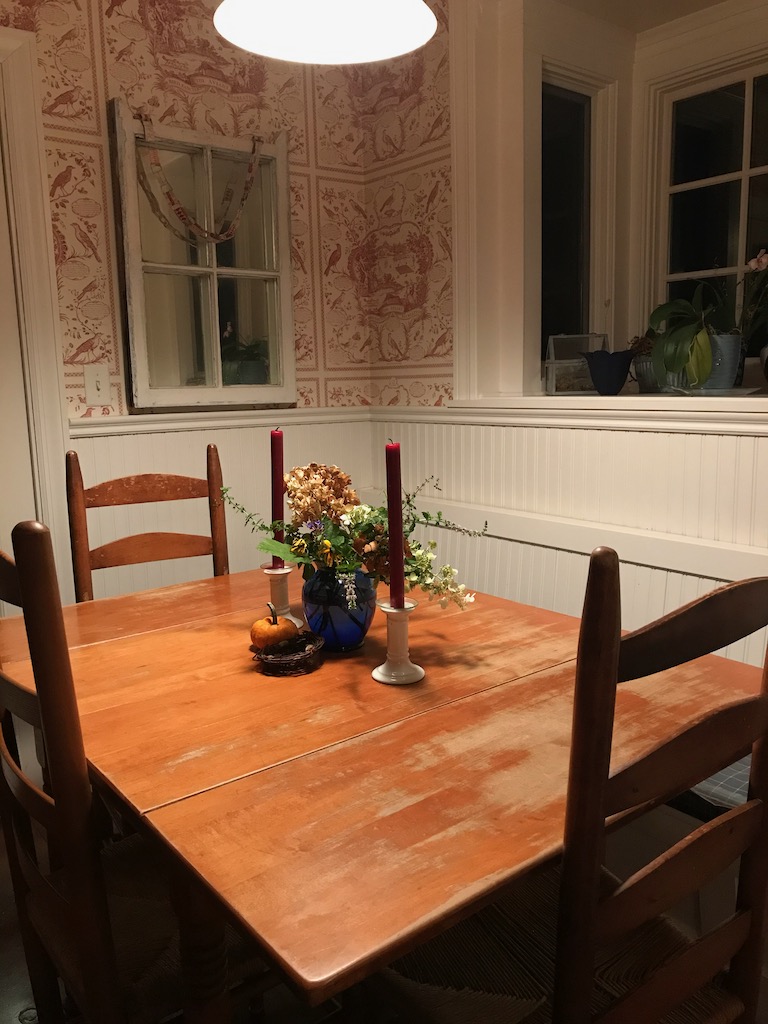
and in that knowing way of his, in that quiet, certain, deeply-rooted-without-a-drop-of-drama-ever way of his, he lifted his finger toward the old maple kitchen table tucked in the corner, and he nodded. case closed.

there was no holier place in our house, of course, than the nearly century-old, hand-me-down maple table, the table etched with imprints of penmanship from ages-ago schoolwork, the table scrubbed bare in patches of whatever stain was long ago applied by some long-ago carpenter. the table where, since moving here almost 18 years ago, umpteen thousand prayers have been unspooled, night after night, morning after morning, midday after midday. countless stories — funny ones, hold-your-breath ones, rip-your-heart-out ones — have let rip here; tears, too. deliberations have been parsed here; life courses, corrected. midnight bowls of cereal have been gobbled down, and blazing birthday cakes presented on pedestals. books have been written here, and law school papers, too. we have mourned and rejoiced here. laughed and sometimes stormed away.

as poet laureate joy harjo so gloriously put it in her kitchen-table poem, “perhaps the world ends here,” “this table has been a house in the rain, an umbrella in the sun.”

and it will be for us, in the unbroken days of awe ahead — the blessed new year, rosh hashanah, and the holiest of holy, the day of atonement, yom kippur — my bespectacled beloved and i will wrap ourselves in our prayer shawls and our prayers, we will lift ourselves out of the ordinary, and reach for the star-stitched heavens, we will hunker down at the years-worn, scruffed-up slab of old maple tree, and we will aim to dwell with the Almighty.

as it is commanded.

where would be your holy place, where would you build your little sanctuary, your mikdash m’at?
a patchwork of thanks amid a long and winding (and sometimes bumpy) summer…

when you’ve been clanging on heaven’s door with the cacophonies i’ve kept up this summer, and suddenly you find yourself ankle-deep into august, when road trips have been clocked without incident (save for the chandelier shangri-la just outside the buffalo (NY) international airport, where a tolerance for prism-ed zirconium was a necessary toll of admission), when planes have taken off and landed without clouds of corona rising up from the itty-bitty pouches on the seatbacks, when bar exams have been re-routed online and virtual graduations did in fact include your own kid’s first and last and two middle names, when federal troops have been called back from the streets, and your tomatoes have grown succulent and drip down your chin…it is high time for a hallelujah of praise and glorious, glorious drop-to-your-knobby-old-knees thank you, Jesus!

and so, i begin…

i begin where i always do: up to my ears in amen, amen, and praise be the heavens that the boys i love are undented, undaunted, and safe in the world. of course, i’ve been chasing after all of ’em with this summer’s 70-percent-alcohol-content elixir of choice, purell by the boatload. i’ve been the purveyor of plastic shields for anyone taking to the clouds, and i’m the queen of counting to 20 (often rounding up to 25 or 30 for good measure) while anyone’s sudsing their hands. and, so far (knock on wood, marble, or cubic zirconium while we’re at it), not a single raised Fahrenheit of fever, thank you patron saint of mercury.

as i type, one of those boys is on the cusp of turning 19 — the miracle of his existence a miracle that will never lose its shine — and slinging away the summer hauling trash, whacking weeds, and otherwise delighting in the fuzzy outlines of his COVID bubble. (the rules they follow are vague, something along the lines of “if you’re outside you won’t get it, keep the windows of cars rolled down, and be sure to have your mask in your pocket if not stretched across your maw.”)

the bespectacled one, still the tallest of the bunch and my beloved for life, would have blown out his own birthday candles yesterday, but the line at portillo’s on a thursday night was 90 miles long, so there was no famed chocolate cake to be had (nor the italian beef that would have preceded it). (he made up for the confectionary dearth with raspberry talenti spooned straight out of the tub.)

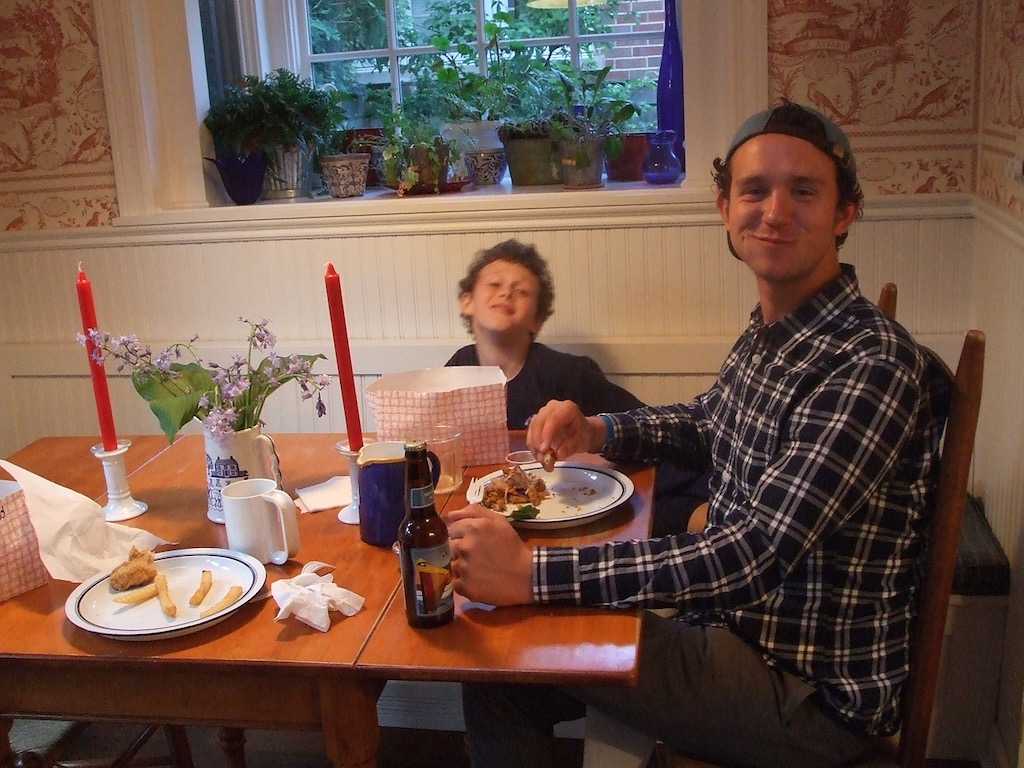
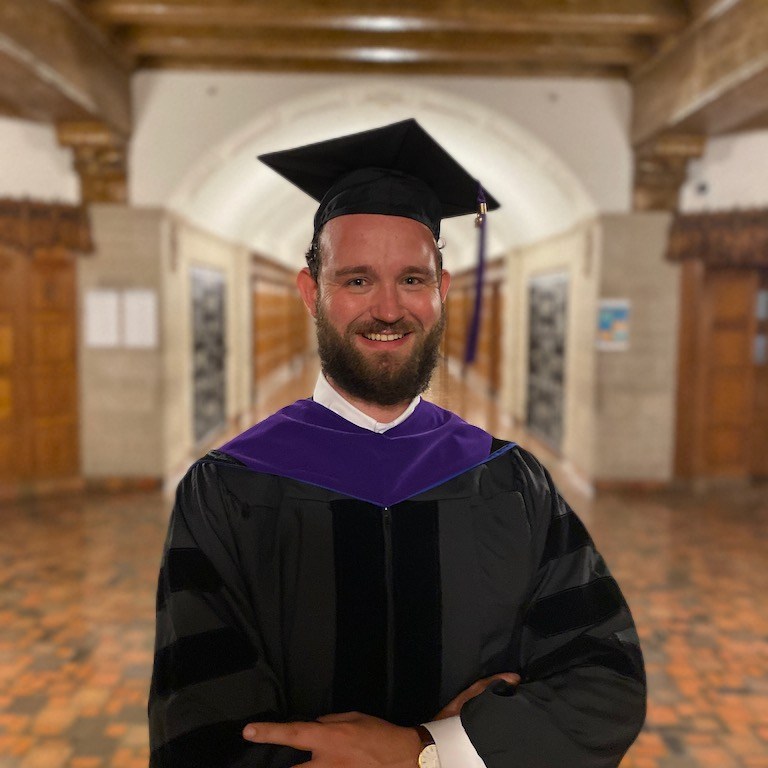
oh, and the first one i birthed (the one under the jaunty cap up above), he’s joyfully — and relievedly — unpacking the boxes that finally, finally found him in his new portland apartment, after the moving van took a circuitous three-week pleasure cruise across the continental U.S.

so, bing, bing, bing, right off the bat, three giant-sized prayers rambunctiously answered.

hovering emphatically there at the top of the thank-you list would be a glory hallelujah for those rare amazing souls more than willing to hold the jittery hand of a mama with worries on the loose (that would be me, and the amazing ones are the ones who never shirk from the cockamamie worries i cook up, more than willing to coo by my side, and promise me all will be well. and if not, they’ll help me sop up the tears and gather the shattered bits). where, oh where, would we be if not for our bravest and kindest of comrades who stiffen our spine and coddle our hearts when the night feels so dark and so long?

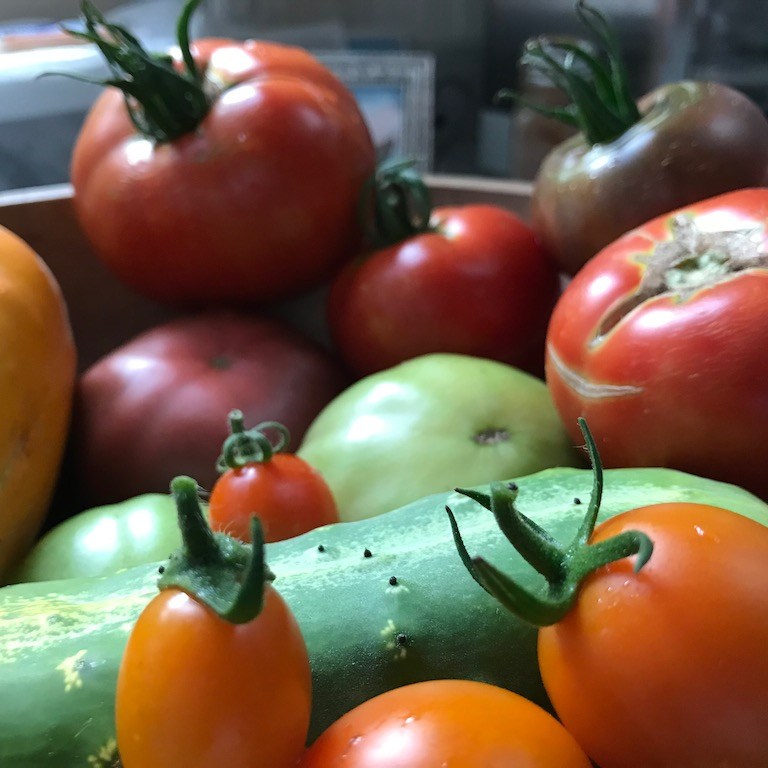
moving from sublime to, well, fruitful…now that drowning-in-tomato season is upon us, and the branches are bending and bowing under the weight of their keep, it’s high time to genuflect at the edge of the so-called “farm,” in praise of the wonders of purple cherokees, san marzano plums, orange zinger cherry tomatoes, and that icon of heartland fertility, the ever-reddening batch of fat, squat big boys. just minutes ago, so it seems, i was the virgin farmer tucking her wee little sprouts into the loamy soils. all summer i’ve watched in wonderment as the earth (and my occasional scattering of tomato-mite root booster) did its thing, sky-rocketing stems and leaves and pert little blossoms and, finally, clumps and orbs that redden by the hour. and have me scrambling for things to do with tomatoes besides salting and peppering and downing like candy.

i take it not for granted any prayer that gets answered, nor the happy ending at the close of any heart-tugging yarn. and that is the point, or at least a crucial part of it anyway. i might be a one-woman smoke stack of worry, sending up fumes and plumes of the wildest imaginable what-ifs, but the flip side — the blessing side — of that tendency toward incessant disquietude is that, on an almost hourly basis, i am awash in the after-rush of relief (disaster once again averted), followed immediately and overwhelmingly by pure and unfiltered gratitude. thank you, thank you, thank you, holy God, the words that most often cross my worry-lined lips.

and so my necessary pause, the blessed interlude that stitches together the worry patches of my days, is the simplest — the most certain — prayer that ever was: thank you, oh thank you, for the grace of this sweet sanctity, for the safe-keeping you’ve brought and the sheer joy of knowing all is well (for now), all is under heaven’s unending gaze, and ever will be.

and that’s the only point that matters here today.

what’s on your list of thank-you prayers, here in the launch of summer’s last full month?

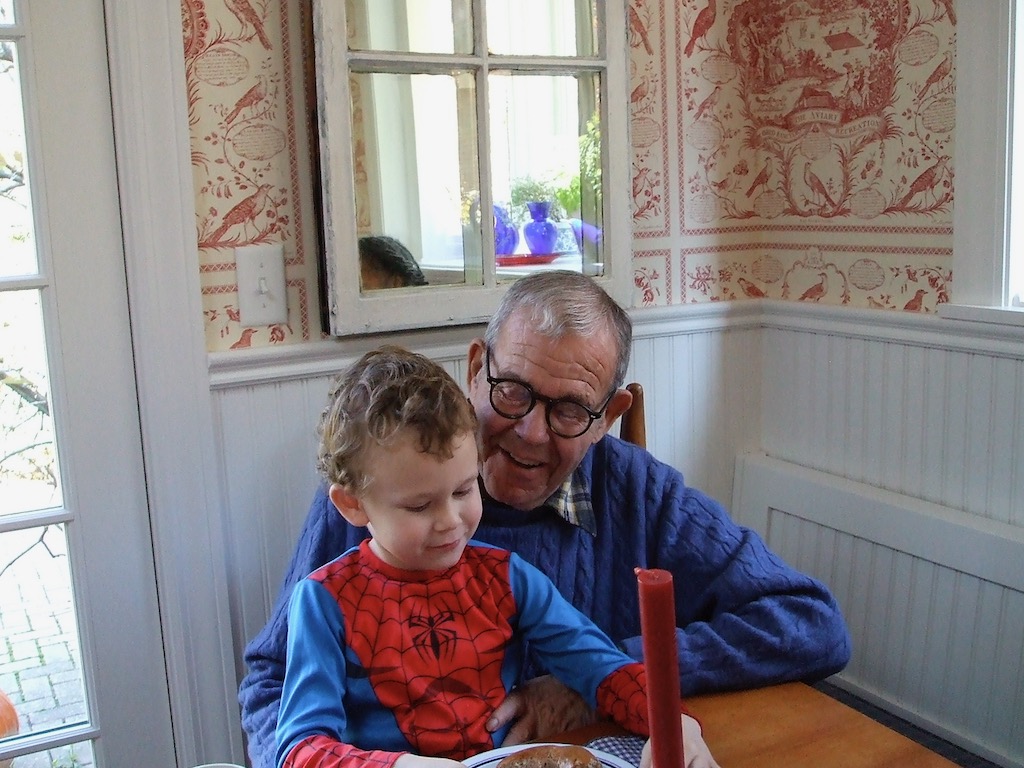
p.s. i just realized that the fourth corner above — yet another reason for thanks — is the front cover of my next little book, one coming into the world on october 6. it’s titled The Stillness of Winter, and my hope is that it will fill your wintry months with quietude and a sense of wonder as you contemplate the blessings of the curling-in months at the cusp of the old and new year….

i was going to cobble a litany of thanks for the glorious reads this summer has brought me, as i while away the days up in my tree-house nook of a windowseat, but the phone rang and someone came to the door, and the morning has unfurled, so the great reads of this 20-20 summer will have to wait till another day……

anointing the hours

except for the centenarians among us, this is our first go-around with pandemics. and so, uncharted as it all is, little should surprise us. i stand somewhat surprised, though, that somehow — in the depths and folds of these blurry hours, where day upon day feels indistinct, where were it not for the winding of clocks on wednesdays, the old-lady shop on thursdays, the watering of plants on saturdays, i might never know what day is unfolding around me  — i seem to have tumbled into an ancient, ancient practice. one rooted in the quiet turning of pages of glorious books. one rooted in prayer, in the sanctification of time, the anointing of hours.

it must be the little old monk in me.

i am utterly transfixed by the notion of the liturgy of the hours, the divine office (opus dei — the work of God), lauds, vespers, compline. morning prayer now begins my every day. morning prayer with candle burning beside me, casting its flickering light on skin-thin pages that turn with a crinkle as i slide the ribbons from section to section: invitatory, psalm, antiphon, collect, confession, thanksgiving.

the lexicon is almost as old as time. the notion of fixed-hour prayer, paying keen attention to the seasons of the day — the shifting of light and shadow — is a practice shared by all the great religions: buddhism, hinduism, islam, judaism, christianity.

the early christians borrowed it, of course, from the jews, who were commanded to pray the holiest prayer, the sh’ma, upon rising and retiring, and who stitched 100 blessings into the arc of the day, lifting the most quotidian of acts — washing hands, hearing thunder, beholding the bloom of the almond tree — into the realm of the holy. the psalms, written by the most brilliant hebrew poets, were read by jews — including jesus and his earliest disciples –as “encounters with God, as stimulating and nourishing a spiritual mystery,” according to william storey, a liturgical historian.

by the fourth century, in the early roman empire, bishops instituted morning and evening prayer in the early cathedrals. in the sixth century, along came st. benedict who wrote down “the rule,” and with it the trellis of prayer that infused the monastery, calling the monks to arise in the darkness, to walk under the cloak of stars to the oratory where the night vigil was sung, and through the day, when the great bell was rung, to drop their work in mid-act — be it the stirring of soup, or the tending of bees — and encounter the angels in the sung prayer of the psalms. (i love that benedict refers to any chiming clock as a “portable monastery,” and instructs that “every chiming hour is a reminder we stand in God’s presence.” i will now consider myself to be “winding the monastery” every wednesday and sunday morning.)

all these centuries later, little old me picked up on the notion about six weeks ago. (no one ever pinned me precocious.)

what i know is this: tiptoeing down the stairs in the dark, hoisting my 2,974-page leather-bound tome, striking a match, kindling a wick, bowing my head, breathing in silence, it grounds me, and infuses my day. even my dreams, some nights.

reciting the words, inscribed millennia ago, whispered by generations before me, from all corners of this wobbling globe, beginning with a daily confession of sins, bends me into a posture of humility that seems so necessary — so countercultural — in this awful, awful age of much too much bombast. i’m enchanted. i’m sometimes disturbed (the god of biblical vengeance is not one i know). i’m always, always quieted. set straight for the day. beginning my day in the recitations launches me into the holy work st. paul instructed: pray ceaselessly. make the work of your day, the quiet of your day, make it all living breathing prayer.

i’m not alone in my preoccupation. rilke and ts eliot, hildegard of bingen and kathleen norris, certainly thomas merton, all were drawn to the undulations of stillness and prayer.

brother david steindl-rast, in his glorious little book, music of silence, writes that monastic prayer is a tradition “that regards each hour of the day and night as having its own distinct message for us.” he implores: “make everything we do prayer.” hour by hour, from night watch’s invitation to “trust in the darkness,” to laud’s morning question — “whom can i make a little happier” in this gift of a new-born day? — brother david draws us into the certain knowing that hour upon hour begs our attention, invites sharper focus on divine intention.

it’s all the sacred practice of paying attention. beholding the beauty, the blessing of each anointed minute and hour. in the same way i’m gobsmacked by the shifting of seasons across the year, i am rapt by the seasons of light and shadow in a day, the invitation to be immersed in each hour’s offering.

i turn to that brilliant radiant rabbi whom i revere, abraham joshua heschl, for one last illumination here, one to carry through this whole blessed day:

he who has realized that the sun and stars and soul do not ramble in a vacuum will keep his heart in readiness for the hour when the world is entranced. 

for things are not mute:

the stillness is full of demands, awaiting a soul to breathe in the mystery that all things exhale in their craving for communion.

out of the world comes the behest to instill into the air a rapturous song for God…

a few of the books i’ve been burrowing into, include these: 

  • a beautiful treasure of a book: Seven Sacred Pauses: Living Mindfully Through the Hours of the Day by Macrina Wiederkehr. (brilliantly recommended by jackie, a dear friend of the chair)
  • Rainer Maria Rilke’s Book of Hours: Love Poems to God
  • Thomas Merton: A Book of Hours…..
  • David Steindl-Rast: Music of Silence

and, if you’d like to poke around online, and hear magnificent gregorian chant (a meditation for another day) try Brother David Steindl-Rast’s Angels of the Hour 

how do you anoint the hours of your day?

holy week, promised land, and the spiritual practice of making do…

“why is this night different from all other nights?”

year after year for all the years we’ve been circling ’round tables when the paschal moon is at its plumpest and pinkest, telling and retelling the story of exodus — of plagues and passover and a promised land just out of reach — that question, the first of the four questions traditionally asked by the youngest, sharpens the focus on the holy act of separating time. setting aside particular hours, according to particular rising and setting of the moon in the heavens, lifting those hours out of the ordinary, sanctifying. making holy. erecting cathedrals of time, in the words of abraham joshua heschel, the late great rabbi and thinker, who wrote:

Judaism is a religion of time aiming at the sanctification of time. Unlike the space-minded man to whom time is unvaried, iterative, homogeneous, to whom all hours are alike, quality-less, empty shells, the Bible senses the diversified character of time. There are no two hours alike. Every hour is unique and the only one given at the moment, exclusive and endlessly precious.

Judaism teaches us to be attached to holiness in time, to be attached to sacred events, to learn how to consecrate sanctuaries that emerge from the magnificent stream of a year. The Sabbaths are our great cathedrals; and our Holy of Holies is a shrine that neither the Romans nor the Germans were able to burn; a shrine that even apostasy cannot easily obliterate.

this year, the question — why this night? — carried particular resonance. and its sister question, why is this week different from all other weeks, begins to burrow into the holiest questions quivering just beneath the surface of all this 20-second hand washing, and bleach-and-water spritzing and tying of masks round our smiles.

in a week woven with tradition — with particular prayers in particular places, particular recipes, particular gatherings year after year after year — it’s all broken open. it’s all in shards and pieces we assemble and reassemble as best we can.

i think here of the japanese art of kintsugi, beholding the beauty in the brokenness, not occluding or hiding the cracks, but filling them in with rivers of shimmering radiant metals, gold or silver or platinum. deeply understanding the infinite wisdom of rumi, the sufi mystic: “the wound is the place where the Light enters you.” or the resounding redemptive truth of hemingway’s glorious line from a farewell to arms“the world breaks everyone and afterward many are strong in the broken places.”

and in this old house where we weave passover and holy week, where the retelling of the parting of the sea, the fleeing from evil pharaoh, the pestilence and boils and locust and darkness, the slaying of the firstborn (the litany of plagues that visited upon egypt) interlaces with the stories of the last supper, the betrayal of judas, the flogging and crowning with thorns, the crucifixion, i found salvation in the spiritual practice of making do.

and there, in the straining of imagination, in the redefining and refocusing on the essence at the root of each strand of tradition, in scouring the pantry, in testing the powers of my own ingenuity, i began to see in sharp focus the extraordinary blessing in reinvention, in improvisation, in the promised land just beyond my reach. in the imperative of bypassing any and all shortcuts. working just a little bit harder. discovering joy at each tiny triumph.

take the chicken marbella.

IMG_1425over the decades since the silver palate cookbook was first published in 1979, and over the decades at the passover seder where i’ve marked the first night of prayer for 36 years, that glorious rendition of chicken and olives and prunes has become synonymous with the jewish rite of spring. add to that the fact that my home-bound freshman in college happens to love it, practically licks the plate of it. (and these days — passover or not — i’ll climb any mountain to bring him one iota of everyday ordinary un-quarantined joy.)

IMG_1432i’d decided a week ago that, come heck or high water (an apt expression in the season of red sea crossing), i was going to muster up a pan full of that vernal succulence. eyeing the few parts of chicken in this old house, i tucked away a package of breasts at the back of the freezer, knowing i might not fetch another till this pandemic is ended. i happened to find just enough dried prunes in the pantry to realize i was halfway there. olive oil, oregano and garlic, i scrounged up with little worry. brown sugar, ditto. white wine i found in the dark and dingy corner of the basement. it was the spanish olives that presented the hurdle. so i made do: i found a few lonely olives, black ones not green, at the back of the fridge. and i stirred it all up like nobody’s business, rejoicing all along the way that i’d found a way — through scrounging + improv — toward chicken marbella.

next up was the seder plate: where in the world does one look for a roasted shank bone in the depths of pandemic? and was i really going to sacrifice one of the six lowly eggs in the fridge for a ceremonial platter of symbols? i was not. so off to the cupboard i trotted, reached for my half-dehydrated markers and scissors. grabbed a sheet of printer paper, and voila, shank bone, egg, and — the hardest procurement of the week — one square of matzo, all kosher for passover. haroset — the apple, walnut, cinnamon and wine meant to remind of the mortar used by the slaves who built pharaoh’s pyramids — that came courtesy of the many-years-old bottle of manischewitz concord grape wine stored in that same dingy corner of the basement, and a stash of walnuts left over from christmas.

but, when we sat down to our laptop, dialed into our zeder (seder by ZOOM, the cyber salvation of the red-ringed siege), we had ourselves a proper seder table, from marbella to matzo, the ingenuity way.

all that making do, all that finding my way — deciding what’s worth the effort, what doesn’t matter — it’s becoming a meditation in mindful distilling. take nothing for granted. turn in to your own toolbox of tricks. never mind the easy way. do away with the unnecessary.

have you noticed that barely-enough makes for extraordinary? have you sensed the keener attention you pay when so little is taken for granted? when i sliced into a ripening pineapple the other morning, and discovered it was perfectly golden and sweet, not hard and pale yellow as it sometimes can be, i felt a sigh of pure joy riveting through me. you would have thought i was an arctic explorer staking my flag in the pole, so triumphant did i feel at suddenly beholding my cache of pineapple perfection. when’s the last time you remembered for days how sweet your pineapple was?

and so it is in the time of corona. when a trip to the grocery store — or a ride on the el, or rubbing elbows with the stranger wedged in beside you at the movies or museum or ballpark — without fear of catching a potentially fatal infection might never again be taken for granted.

we are all, collectively, living and breathing improvisation. expanding the boundaries of what we thought we could do (heck, i’m now very best friends with the sourdough starter bubbling away at the back of my fridge, and i’m zooming into book groups all over the globe, chanting with monks hundreds of miles away). we are looking out for each other in ways we might not have before (sending meals to ER departments, sharing seeds with the neighbor next door).

the brakes have been halted on this mad-paced world. and yes, it’s filled with heartbreak upon heartbreak. jobs are being cut (i lost one of mine). paychecks are being slashed (happened here, too). magnificent glorious souls are breathing their very last breath afraid and alone (dear God, praise the nurses and doctors who step into those holiest of shoes). the obituaries (some of them being written in the room just above) will make you weep (and they do, day after day).

but inside of all the uncharted fear, and the bureaucratic ineptitude that might make you furious, this holiest week is upon us, and it’s teaching us lessons we might never have otherwise learned.

in the nooks and the folds of making-do, i’m paying closest attention to those deepest essentials. and therein lies the holy way home.

what making-do moments have you encountered this week? and what lessons spilled forth?

a housekeeping note: you might have noticed that all week long, in the comments of each week’s post, i’ve been tucking away especially succulent morsels i happen to come across in my cyber adventures. as we’ve long considered this our shared kitchen table, it seems more than apt to leave little bits of deliciousness all week long. so be sure to click back, and scroll through the comments, where i’ve left a bevy of links and snippets of poetry. 

before i go, here’s one i clipped from a letter the great george saunders wrote to all the fledgling writers at kenyon college whose spring quarter was snatched away. he wrote a beautiful long letter, but this one paragraph i saved just for you:

from George Saunders to Kenyon writers:

There’s a beautiful story about the Russian poet Anna Akhmatova. Her husband was shot and her son arrested during the Stalinist purges. One day she was standing outside the prison with hundreds of other women in similar situations. It’s Russian-cold and they have to go there every day, wait for hours in this big open yard, then get the answer that, today and every day, there will be no news. But every day they keep coming back. A woman, recognizing her as the famous poet, says, “Poet, can you write this?” And Akhmatova thinks about it a second and goes: “Yes.”

may we all find poetry, even amid the pandemic….

IMG_1429

and now i enter deep into my holiest hours….the triduum of holy week….

(p.s. that’s our zoom seder screen shot above, same characters year after year after year. beloved mary schmich, the brilliant pulitzer-prize-winning chicago tribune columnist, wrote about it….here.)

maybe we need to open the smoke hole

4-chum-dis

there’s a siberian myth that when you close the smoke hole in a reindeer-hide tent — that orifice opening up to the sky — God can’t see in anymore. when you close the smoke hole, you break the connection to the divine — to the heavens and clouds and stars in the sky.*

when you close the smoke hole, you go mad in the whirl of unending toxic vapors.

maybe the world needs to go quiet to open the smoke hole.

have you heard that dolphins are once again romping in the waters off venice? (the oversized — dare we say obscene — cruise ships are gone.) blue skies and birdsong are back in parts of china that hadn’t seen them or heard them for years. (factories gone silent, cars parked at the curbs; pollution cut off at the knees.)

the earth, amid a pandemic, is healing. you might say it’s the soul that’s pushed its way to the fore.

have you noticed how your inbox is full of invitations from monks and museums and the metropolitan opera? a journal i love — emergence magazine — is, like so many rushing into the abyss, offering “free of charge, online sessions [that] will include: a book club that will meet online once a week, virtual fireside chats with Emergence contributors, a nature journaling course, and facilitated workshops and discussions.”

last night i joined in meditation with a monk and his singbowls at glastonbury abbey on boston’s south shore — along with two dozen soulful others whose faces appeared in squat boxes at the top of the screen, and who were strewn all across the continent. (singbowls originated in the himalayas more than 2,000 years ago, and the sound that rises from the mallet gliding the rim of a metallic bowl is scientifically documented to change our brain waves, and so is thought to be healing and soothing and all of those “ings” we need right now.)

the other morning i sat at my kitchen table, sipping my coffee, watching the birds at the feeder, while the priest at my church spoke of the samaritan woman during the sermon of sunday morning liturgy. last night, my priest popped in again, and mentioned that rather than singing the birthday song twice as she washes her hands, she likes to recite the jewish blessing for the washing of hands (it’s 10 seconds, so repeat twice): “Blessed are you, O Lord, our God, King of the Universe, who has sanctified us through your commandments and has commanded us concerning the washing of hands.”

there are many, many hours to fill in the space between stepping into my haz-mat attire and bravely boldly facing the grocery stores aisles where, more often than not, whole aisles are cleared, picked over as if a cotton field in the wake of the weevil. and so, being human, we itch to find ways to fill those hours.

i say, take this time and seize it: pick up a rake, if you have one idling in the garage or the shed. tenderly pull back the winter’s detritus, marvel at the tender green nubs insistently pushing through the crust of the earth. listen to the birdsong, now that the soundtrack of cars and most trucks (save for the poor amazon delivery squad), have gone silent.

one of my most beloved friends is teaching me, via links to websites and a vat of bubbling goo she’s promised to leave on my stoop, how to befriend that curious alchemical mix of flour and water and floating-by spores (how lovely to think of a wafting microbe as friend and not foe in these red-ringed times) called sourdough starter. there’s something eternally hopeful about the notion of make-your-own yeast, and bake-your-own breakfast.

last night, the college kid among us pulled out a board game, fired up his laptop to connect with his faraway brother, and together — through the wizardry of this wireless age — we all played round after round of word games. when’s the last time we all huddled at the kitchen table to put our collective heads together in game?

i’m making it my most important job to stitch the normal into these days, and to take it up a notch and embroider the moments with whatever delights and high-order embellishments i can muster: i’m tossing lavender packets into the dryer so clean sheets smell like provence herb gardens. i’m cracking open packets of biscuits, cranking the oven, filling the house with buttery inhalations. defrosting stews long tossed to the back of the freezer. the soul when its gasping for air is especially receptive to beauty.

and in between the attempts to make this time something of a break from the madness, i’m paying closest attention to the unbridled kindnesses, to the light that insists on seeping through the cracks.

maybe the smoke hole is opening.

maybe we’re finally noticing how hungry our souls have become. seek vigil not isolation, might be our watch phrase. don’t cut yourself off from the marvelous. from the undeniably beautiful. from the blessed.

open your eyes and your heart, the heavens are beckoning in ways never ever imagined. shabbat is upon us. uninterrupted.

enter in peace.

how are you keeping open the smoke hole?

from time to time across the week, i will bring delicious morsels here to the virtual kitchen table. you’re welcome to do the same….as we join hearts and forge on together. we will emerge and be stronger for seeing the world through new smoke-cleared eyes…..

*credit to martin shaw, mythologist and storyteller from devon, england, (extolled as “a thirteenth-century troubadour dropped into our midst”) for bringing the smoke-hole myth to my attention…..

Screen Shot 2020-03-20 at 8.10.19 AM

1905 Scientific American, documenting Siberian wilderness culture

we all leap…

cosmograph

wrestling time seems to have preoccupied the human species since the dawn of, well, time. time itself ceaselessly flows. the heavens, though, mark it with sun and moon, light and shadow. we, scribblers that we are, we draw lines on pages, make them into little boxes, count them one by one. it’s a russian doll of time boxed. we have boxes in all sizes: millennia, century, year, month, day, and of late (in the scope of human history, that is) we have day-minders that make itty-bitty boxes, one for each hour or quarter hour, depending on your busyness. one box slips inside another. we now know at-a-glance just how booked our tomorrows will be.

hipparchus.

hipparchus

all this time wrestling long ago left the mathematicians and sky gazers with a little bit of a problem. a leftover, in fact. or in second-grade subtraction lingo, a remainder. once wise folk like hipparchus, considered the greatest astronomer of antiquity, started squinting toward the sun, hauling out their rudimentary measuring sticks, they mapped some sense of the heavens. hipparchus, the fellow who gave us trigonometry (something you might or might not celebrate), is the one who first pinned time to the revolutions of the sun, to the dance of planet earth in tango with the biggest star. he’s the one who must have whooped, aha! when he calculated the time it takes for one spin around the sun. and here’s the rub: it takes 365 days and 6 hours to make the round-about. that pesky leftover is what brings us to tomorrow — february 29 (a date pulled from the special-reserve shelf).

if you’re going to put time in a box (or a whole calendar of boxes) what shall you do with that quarter of a day left behind? well, said the wise sky scribes of long ago, let us bundle those quarter days into a single package, one that rolls around every four years. (it gets even trickier for us, and for those ancient numbers dudes, once hipparchus pointed out the pesky little fact that their bundling left yet another remainder: every four years, there’s an extra 44 minutes, or three days every 400 years (as ever, it’s the leftovers that all but foil us). so, geniuses that they were, they once again did their math and this time reached for subtraction, deciding that those years divisible by 100 only get a leap day if they’re also divisible by 400. (meaning 1600, 2000, 2400 are leap years, but 1700, 1800, 1900 got gypped.) (and further proving that you can bend rules to do just about anything you so desire.)

so, basically, we should all bow down to long-ago hipparchus for this construct of the leap day. theoretically, it’s the mathematical solution to the boxing-up of time. but for us seekers of the deeper truths, it begs a russian doll of questions, all pivoting on one essential one: if you were handed a gift box of time, if hours were added to the measure of your life, how might you squeeze the holiest holiness from those ticking seconds, minutes, hours? how might you make it most count?

one of the mystical truths of time is that often we get our clearest vision of the gift when it’s taken away, or so threatened. have you ever held your breath waiting for results of a scan? have you paced the halls outside doors marked “surgery: do not enter,” waiting for word of what was found? have you watched the clock move glacially as you await the phone call that’s not coming? have you begged for one more yesterday, most emphatically with someone loved and lost?

what tumbles through our whole self is the begging sense that if only we could have one more day, a few more hours, we’d do this and this and this. say these words we’ve left unsaid. i heard joe biden, someone who knows volumes about loss, say not so long ago that the truth is that in the end cancer patients aren’t asking for years and years, their pleas boil down to “doc, can i make it till the baby comes?” “can i watch her walk down the aisle?” “maybe make it one more christmas?” it’s chiseled to the precipice of the humblest increments of time, of possibility counted out in minutes.

so what will we do with our so-called extra tomorrow? isn’t this our once-a-quatrain chance to practice sacramental time? to lift up each hour, to hold it to the holy light, infuse it with intentionality (that modern-day queazy term for “paying attention,” as ancient a sacred practice as ever there was).

imagine you are handed a basketful of time. as you unwrap each and every hour, each section of an hour, how will you choose to live it to its most abundant fullness?

that’s the question. contemplate your blessings…and, soon enough, it’ll be time to take the holy leap.

sun

the question above–how will you make the very most of the gift of tomorrow, or today, for that matter–is the question i leave here on this morning’s table….

mapping the sun hipparchus(p.s. the image at the tippy-top here is the cover of william cunningham’s 1559 Cosmographicall Glasse, a compendium of engravings of the known principles (at the time) of cosmography, geography, navigation….among the details is his engraving of hipparchus scoping the sun…)
 

counting: an exercise in loving

DSCF3578

my brother started it. my brother who wasn’t yet 20 the night we all got phone calls, urgent phone calls, to get to highland park hospital. it was dad, we were told in those long-ago calls. and it didn’t look good.

there was a blizzard that night, but we all drove through it–two from milwaukee, two from downtown chicago (one was already there, the youngest; he’d walked in the room steps ahead of my mom, and he saw the team bent over my father’s bed, as they tried to start his heart again). i remember holding my breath as snow flakes fell and blew. i remember thinking the edens expressway, the most direct route from my little apartment to the hospital where we waited, i remember thinking it would never end.

three of my four brothers, especially, were too too young for the news–one, the youngest, had only just turned 13, the other two were in or in and out of college, finding their way–too young for the news that would come when the doctor walked stiffly into the hall, gathered us, and we all leaned in as he looked down at the shiny tiled floor, and said only, “i’m sorry.”

that was not enough for me, the one who needs things spelled out, in more refined detail, so i spurted out, primally, “did he die?”

he did. and so five children and a widow walked back into the snow storm, with a plastic bag of his “effects,” a cold and clinical word for the relics of the one you loved.

all these years later, my brothers especially, try to resurrect the faint outlines of the one we loved and lost. my brother, now the father of a feisty second-grader, he especially reaches into the vapors for the father he never got enough of, none of us got enough of.

this week, on the eve of the 39th february 10 since that snowy awful night, my brother sat down and made a list. a beautiful list. one raw, and unfiltered. he wrote all the way to 39, one moment captured for each year since we’d lost the great gregarious eugene shannon, felled by a heart attack, a massive one, at 52.

my brother’s litany of moments was nothing like mine. so i sat down and wrote my own. and my other brother in arizona, he wrote one too. he wrote his on paper and when he lined up the pages to send us a picture, the pages stretched from one end of his living room clear out into the hall.

in all, we counted out a portrait of the man we loved.

the one, i wrote, who “unwrapped from squares of wax paper his chicken or tuna salad sandwich from the Wesley Pavilion Auxiliary Tea Shop at the side of my hospital bed, almost every day, the entire month or five weeks i was there.” i wrote how, that whole long month in june of 1975, he walked down michigan avenue, from his shimmering big-city ad agency, ducked into the hospital gift shop, bought his sandwich, chips and iced tea (tall with lemon), carried his white paper lunch bag up the elevator to the fourth floor, which everyone knew was the psych floor, and came to my room on the north side of the hall, where he pulled up a chair, and sat beside me. he sat beside me the whole while, as i tried to make my way through whatever was under the metal lid of my hospital tray. we ate side-by-side. i was anorexic, and in 1975, no one knew what to do with a girl who’d all but stopped eating, so they signed me in to a psych unit, and my dad came every day. it remains the tenderest definition of love i know.

i wrote, too, of my dad and his affinity for the backyard hammock strung between two oaks, and his red-plaid christmas pants, and his pride in a closet full of brooks brothers three-piece suits (for a kid who grew up in paris, kentucky, with a train engineer for a father, and a country schoolteacher mama, it had been a long and shining road to brooks brothers’ chalk-striped suits). i wrote of the scar that ran down his bald pate, left there by a german shepherd when my dad was six, and climbed a fence he shouldn’t have.

and i wrote about coming home from the hospital that snowy february night in 1981, “finding dad’s creamy cable-knit tennis sweater, the one with the v-neck rimmed in stripes of blue and red, draped over the kitchen chair (i’d always thought it must have been dropped there when he went off from tennis to the ER that saturday morning, and it still hung there tuesday night).” i wrote of “wrapping myself in the sweater, and literally not wanting to take a breath because I didn’t want to breathe in any air from a world not inhabited by dad.”

we wrote on and on, the three of us. and we all wept reading each others’ litanies. it was, in the week that pauses for love, quite an exercise in bringing back to life the ineffable, the ephemeral, the love that slipped away too soon.

we counted our way into the very depths of love. we brought threads of our father back to life just long enough to wrap ourselves in the thick of it, in the heart of him. love doesn’t die, we proved again, counting the whole way.

i know there is grief gathered round this table, and i wrote this in part because the list-making proved so resuscitating, at least for the short while we were hard at work remembering, conjuring, lifting moments out of the vaults of our heart. we typed through tears. we gathered words as traces of a time now slipped away. the time might be behind us, but the love is living, breathing, even now.

how would you begin to count, your exercise in loving?

and may the swirls of love — lost and present — rise up and swirl around you this day of hearts. 

wild things

IMG_1229

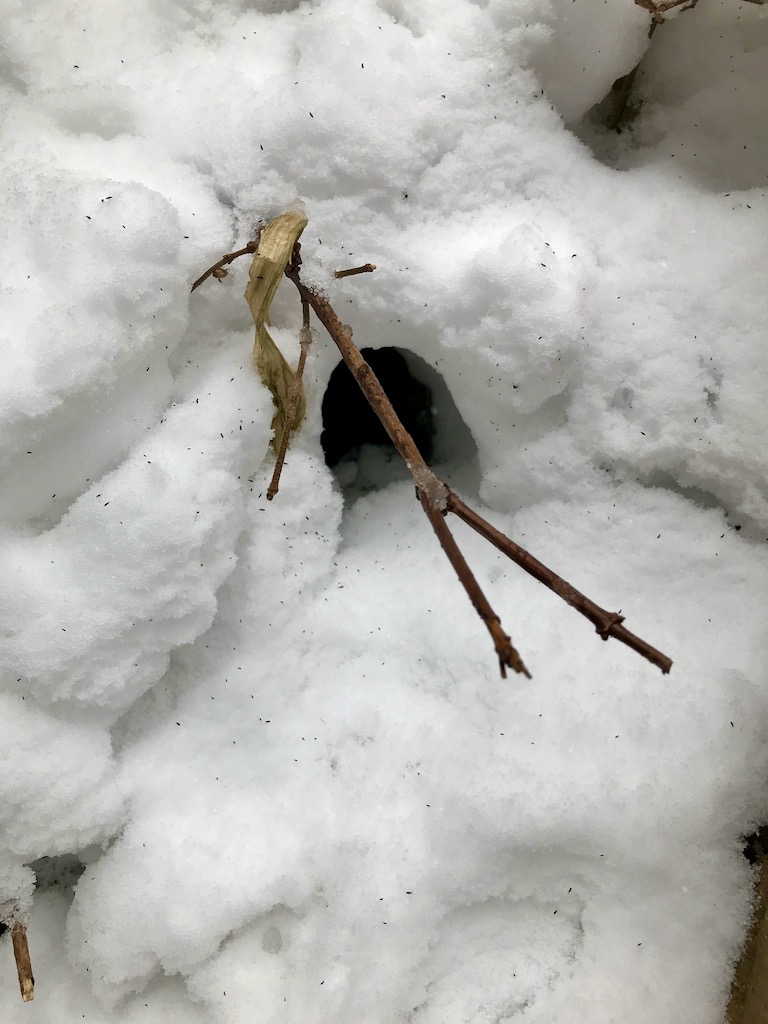
a mouse’s house? with front-porch perch…

it’s the permeability of winter, when the cell wall between the wild and the worldly is punctured, when the precious little things come out into the open, are pushed out into the open, all but tap at the window, beg for a taste of mercy, that’s holiness to me.

IMG_1231against the white tableau of snowy day after snowy day, winter makes evident the tracings of the wild things: a mouse hole here; chantilly-lace tracks of junco and cardinal and jay. even the abominable paw prints of a giant-sized coyote, straight from the woods, up my walk, paused there by the door (did he press his nose to the glass, take a peek under the cookie dome?).
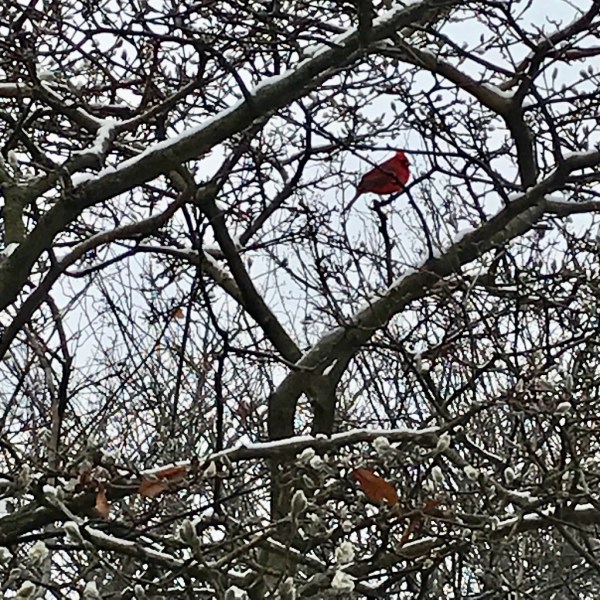
each morning, no matter what the heavens are hurling my way, i don my make-believe farmer-girl boots, i scoop my battered old tin can, fill it with seed, and head out for what you might call matins, morning benediction. i bow to the heavens. scan the trees for any flash of scarlet, or blue-jay blue. i unfurl prayer upon prayer (the moon, if it’s shining, even a crescent or wedge, draws it deep out of me, never more so than in those inky minutes just before the dawn).

what i love about the wild, about this curious equation between us in our warm cozy kitchens and them seeking harbor in ways that mystify now and forever, is the fragile interplay in which we reach beyond what we know, extend an open palm of pure unbridled trust, an offering, no strings attached. it takes stripped-away ego to dare to tiptoe into the world of the wild. it takes a deep and undiluted knowledge of how small a dot we are against the vast canvas of the universe, all but insists we put aside our big ol’ bossy pants, our hurried agendas, our know-it-all nonsense.

it’s the very image of holy veneration: head bowed, palms extended. i come bearing sustenance, in the form of plain seed.

have you ever felt the backdraft of a feathered thing, as it’s flown inches away from your shoulder? have you felt the rush of the wing, heard the soft sound of feather and bone parting the wind?

and then there’s the shock of color, all day long, brush strokes of scarlet, of blue, of smoky charcoal. the boughs are alive, are animated. it’s not all black and white and static gray, not in my patch of the world anyway. all day long it’s a reminder, the wild is just beyond, the wild has wisdoms to teach. mercy is among the urgencies. mercy is what we need to remember; we are lacking in mercies these days.

who ever thought to bring so much wonder to winter? that’s the point at which my wondering leaps from earthly to divine. that’s where unshakeable faith begins to take hold. the wild begs questions that only the heavens can answer for me.

which brings me, round about and once again, to david whyte, whose poem the journey says everything i could ever hope to say with any string of words. have a listen:

The Journey

Above the mountains
the geese turn into
the light again

Painting their
black silhouettes
on an open sky.

Sometimes everything
has to be
inscribed across
the heavens

so you can find
the one line
already written
inside you.

Sometimes it takes
a great sky
to find that

first, bright
and indescribable
wedge of freedom
in your own heart.

Sometimes with
the bones of the black
sticks left when the fire
has gone out

someone has written
something new
in the ashes of your life.

You are not leaving.
Even as the light fades quickly now,
you are arriving.

from House of Belonging  and Essentials by David Whyte

IMG_1240

what wisdoms does the wild whisper to you?

and, while we’re here, the late january table brings a slew of birthdays: kerry down the lane today, beloved beloved pammy jo of the high desert, yesterday. british columbia mary and indiana BB on the 28th. happy blessed whirls around the sun, ladies. and thank you for your radiance….

prayer beads for a new year

sick dolly

tucked under the covers with a thermometer poking out of your spout is no way to start the new year, let alone the new decade. but so it is. and so i type from horizontal perspective. and so this new chunk of time — the dawn of the decade now upon us — has only one direction to go from here: up. 

as i lie and watch out the window, catching a flash of scarlet here, the squawk of blue jays there, i ponder one or two of those lists one we’re supposed to make this time of year. i can’t quite enumerate the things i hope and pray for. after all these years, i’ve boiled it all down to one more or less all-purpose petition: dear God, make me live and breathe your gentle radiant love. let me swallow the urge to be unkind. to rebuff the sharp elbow. to turn the other way when insult’s hurled my way. let me practice the zen of road kindness, refusing to blow the horn, to cut in front, not wait my turn. let me search for and offer the benefit of the doubt. let me try harder not to roll my eyes. (let us institute an apologia for hurling F bombs at the telly when idiots blather on, and on, and on….) let me stop the rumor here and now. not partake of gossip in any way, shape, or form (no matter how juicy). 

these are the sins of the everyday. the little molehills that make for mountains, for a continent-wide topography of pain, of bitterness, the sharp and invisible line dividing “us” from “them,” that makes enemies of those whose stories we never stop to listen to. 

let us traffic in tiny knots of kindness. exercise empathy. imagine how it feels to hurt so much, to be pushed aside, to be left alone on the side of the playground and never find a friend. imagine never letting go of that hurt.

imagine what would happen if one morning you woke up and found yourself inside a life where ego vanished. where someone noticed the glimmer in your eye had dimmed. imagine if someone quietly inquired: are you all right? did someone hurt you? imagine a world where we listened instead of trying to talk over each other. imagine if the ones who take up all the oxygen in the room realized there are others with thoughts to offer. imagine those rare few souls who live to scatter sunshine, who make us laugh till our bellies ache. imagine the miracle of the ones who always think two steps ahead, anticipate our hurt, offer tender loving comfort without folderol or trumpet. 

imagine the quietude of saints who walk among us. 

practice, practice, practice. 

forgive yourself on the days when your brokenness shows. forgive your stumbles. say “i’m sorry.” say it to yourself. 

and just as emphatically, consider a litany of be’s: be curious. be imaginative. be not afraid to dabble in whimsy. be willing to put yourself out there. be humble, so humble. carve out time each and every day to plug into the immense wonder of the heavens and the earth. traipse a meadow, a prairie, sandy dunes. follow a trail into the woods. count the stars. realize how small you are against the infinite canvas of the sky. seek wisdom not from picture shows or airwaves, but in the pages of texts — ancient and otherwise — pulled from bookshelves. deep-dive inside a poem. make a friend in an unlikely place. reach beyond your borders. 

make peace.

these are the prayer beads i carry into this new year; these are the petitions i press against my heart. 

this is how i walk into this new year. once i get up and out from under the blankets and the nyquil. 

what petitions might you bring to this new year? 

counterpain

i am praying extra extra hard for the world this morning. i fell asleep to news alerts, and wake up trembling at the shaky state of global affairs. when we pray for peace, we mean it with every cell of our being. oh, dear God, where is the peace we are meant to bring to this world? let it permeate from each of us. let us double-down our promise to live and breathe it….

something of a christmas-y diary (and a book for the soul)

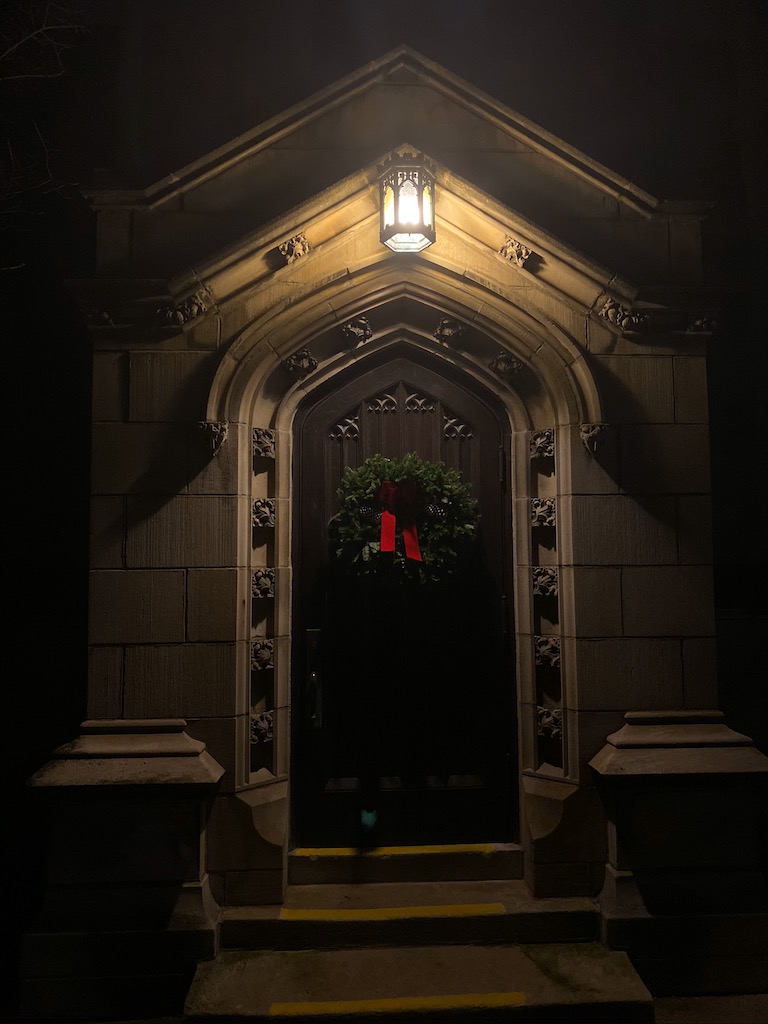
church door

’twas the morn after the morn after the morn that was christmas. not a creature is stirring, ‘cept for me and the first flash of red at the seed trough. the so-called children are nestled all snug in their beds. and so is their papa.

christmas early morn

christmas quiet

i’m up early because, well, i always am. but amid the cacophony that is christmas, it’s the one sure anchor of silence amid the rivers of boys flowing in and out of the house, and the fridge, and the room in the basement they’ve since dubbed “the boy cave.” it’s a room where who-knows-what goes on by night. loud whoops of boy noise bellowed up through the vents last night, so much so that the young legal scholar (a mere four years out of college himself) wondered if perhaps we could do something to stifle the bellows. (i found this more than mildly ironic.) sounded to me like a vociferous round of ping-pong, albeit one that rattled the clanky old pipes in this rattled old house.

yorkshire puddin boys

yorkshire pudding elves

before i turn the page over to the latest in an ongoing and slow-paced series of books for the soul, all courtesy of their original appearance in the chicago tribune, my newspaper home for so many years, i thought i’d share a few entries from the christmas diary: i could tell you about the smoke alarm that bellowed for a good 8.2 minutes on christmas evening, as the young legal scholar “seared” (aka smoked) the long serpentine tenderloin of christmas-y beast. i could tell you how this greatly unnerved the grandmama of said searer, who was certain the beast was being charred to bits right before our wondering smoke-filled eyes (fast forward: it all worked out fine; delicious, in fact).

i could tell you how my heart is wobbling about inside my ribcage. how, on the one hand, it’s bursting with joy at the sweet sounds of falling asleep with the ones i most love all tucked under one roof. and yet, with an eye to the calendar swiftly zipping by, i already know that one of the two is leaving before the last of the leftover beast is snitched from the fridge. so much joy vacuum-packed into a short string of days, and then — poof! — like a flash on the lawn, there’s nothing left but the last blob of toothpaste clung to the sink.

i suppose i’m in the midst of learning to take my motherly joys in oversize gulps, trying hard not to glance forward to the hard edge of the precipice when the house goes quiet, the beds go unrumpled, and i long for a fat load of laundry to wash, fold, and ferry.

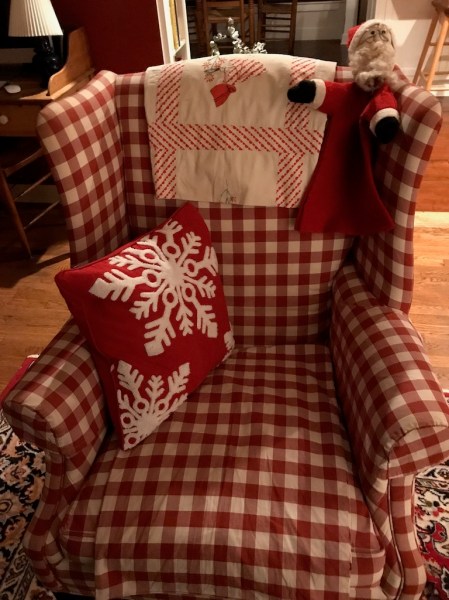
christmas chairthis must be yet another tutorial in the fine art of savoring, of pressing each hour deep against my heart, of tucking the textures deep into the crannies of wherever it is that we store those moments we’ll soon want to pull out, like prayer beads, to run our fingers — and hearts — over and over. and over again.

i know these days — and even these short strings of overabundant joy — are numbered. the more these boys grow up, the more criss-crossed the chance of fetching them home, both at the very same time. it’s now down to once, maybe twice, in a year — at very best.

christmas platesso for now, i’ll merrily dash again and again to the grocery, packing the old red wagon to the brim with cheeses and fruits, and meats by the multiple pounds. i’ll relish the chance to haul bulging sacks of recyclables out to the alley. i’ll marvel at the miracle of mounds of dirty clothes raining down the laundry chute, spilling out of the basket and onto the floor. i won’t even mind trying — over and over and over — to wrench one of the sleepyheads from bed so he gets to work on time these few winter days when he’s flipping burgers, slicing taters into fries, and delighting his boss at five guys (where he’s earning a wee bit of money for college adventures).

i’ll gulp down each of these hours. hold each in the palm of my hand, and press every last one hard against my heart. i’ll savor the joy of the here and the now. and i’ll whisper, amen, a word derived from hebrew, a word that means “certainty, truth, or verily.” amen. yes, amen.

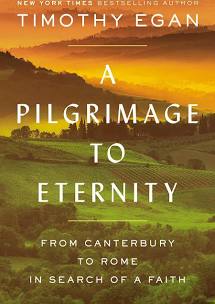
here’s the latest book for the soul, one i truly loved, lugged around with me wherever i traipsed for a few days, because i did not want to put it down, not till the end of timothy egan’s “pilgrimage to eternity,” a trek through ancient monasteries, blister-riddled mountain trails and much of christian history, in search of an elusive certainty.

Timothy Egan’s stirring ‘Pilgrimage to Eternity’ searches for faith

pilgrimage cover

By BARBARA MAHANY

CHICAGO TRIBUNE |DEC 24, 2019 

In “A Pilgrimage to Eternity: From Canterbury to Rome in Search of a Faith,” Pulitzer Prize-winning author Timothy Egan offers a stirring account of his struggles with Catholicism. (Handout)

It’s not hard to imagine dead silence on the other end of the line when Timothy Egan, the Pulitzer Prize-winning reporter and author, dialed up his literary agent and sketched out his proposal for a book-length perambulation through time and the tumultuous terrain of Western Christianity, a months-long trek — by foot in the age of Uber! — from Canterbury to Rome, excavating tales of sinners and saints all along the way. Harder to imagine such a tome would prove impossible to put down.

Aha.

Mission Accomplished: “A Pilgrimage to Eternity” is, in fact, a glorious, laugh-out-loud, wipe-away-tears, blister-riddled, often rain-soaked, sometimes bone-chilled, desolate and desperate, quietly triumphant walk through church history — every last footfall in search of an elusive modern-day spiritual certitude.

Egan, an op-ed columnist for The New York Times, begins as a self-confessed skeptic, an Irish Catholic, who, like many, is “lapsed but listening.” He lays out the stakes of his 1,000-mile quest for any flicker of faith: One member of his family, he writes, “was nearly destroyed by religion,” another “made whole by religion,” after the murder of her teenage son. Rage, he writes, is mixed with redemption.

“Malnutrition of the soul is a plague of modern life,” Egan writes. His is a narrative driven by questions, not iron-clad answers, and one that confronts doubt head-on, never reaching for facile conclusions.

Propelled by truth-seeking, he takes to the Via Francigena, one of the oldest pilgrimage trails in the world that for centuries has led the devout and seekers alike toward Rome, coursing Alpine peaks and medieval monasteries tucked into the folds of storybook hamlets across France, Switzerland and Italy.

A storyteller at heart, Egan populates his trek with a quirky cast of fellow pilgrims, all of whom animate the adventure. He twists and turns from church history — never flinching from the good, the bad or the gruesome — into the deeply personal questions and quandaries that push him onward. His sister-in-law’s terminal cancer, his nephew’s murder, a dear friend’s suicide in the wake of priestly sexual abuse, his mother’s death, and, yes, the 2016 presidential election — all of which ratchet up his need to examine the bare threads of faith.

Egan proves himself to be a prime traveling companion. Someone with whom you’d gladly share your last blister-pak bandage for the sheer delight of his company, intelligence and curiosity.

That he happens to be a beautiful writer — describing Franciscan monks in their “cinnamon-colored robes,” quoting Dom Perignon’s “I am drinking the stars” — is what makes the 33 chapters unspool effortlessly. It’s nothing short of remarkable to find yourself itching to lug around the nearly 400-page book (indispensable appendix and annotated fold-out map included), in hopes of a swatch of time to inhale yet another chapter.

Shortly after telling the story of how his 17-year-old nephew was shot to death by a teenager, Egan sits down with a Benedictine monk in a centuries-old monastery in the Alps. Egan asks the black-robed priest if he believes in miracles, then circles in on a trickier question, one that vexes most anyone who thinks hard about faith: “Do you have doubts?” The priest answers: “About miracles? No. About my faith? Yes. Doubts are allowed by God. Reason can help you come to faith. It’s a bit like training for sports. If you only ride a bicycle with the wind at your back, that’s not going to help you. You need to ride your bike against the wind.”

And so Egan — and any other modern-day pilgrim searching for faith — puts his questions to the wind, walking through ice and snow and rain and brutal heat.

He never gives up. At last standing on a promontory overlooking the city of Rome, Egan beholds the dome of St. Peter’s Basilica. As a thunderclap rattles the sky, the pilgrim with whom we’ve shared the long road recalls Michelangelo’s life motto: “the greatest danger, he said, ‘is not that we aim too high and miss it, but that we aim too low and reach it.’ ”

Egan aimed high, and he reached it.

Barbara Mahany is the author of several books, including, “Slowing Time: Seeing the Sacred Outside Your Kitchen Door.”

‘A Pilgrimage to Eternity’

By Timothy Egan, Viking, 384 pages, $28

what one moment from your christmas is already pressed to your heart?