
pull up a chair

where wisdom gathers, poetry unfolds and divine light is sparked…

Month: May, 2026

etch-a-sketch days

by mid-morning the other day, after a lava flow of bumbling words had frothed from my mouth, after fumbling through apology and course correction that led me to nowhere, abruptly finding myself in a remarkable tizz, spinning wild and wildly into the cattails and weeds, i found myself yearning for an etch-a-sketch day.

that is: utterly drenched in your fallible, flailing, decidedly flappable self, you long to give a shake to the day, clear the screen, dispense with the scratch marks you’ve left in your wake, and start all over again. clean slate.

oh, that it were so doable. that our foibles were so very expungeable.

that we could erase our blunders, reset our starts.

my sins, such as they were, amounted to little more than worries let loose, a storm of what-ifs infusing and infecting an otherwise placid launch of the day. i feared, though, they might be contagious, that the someone to whom i was blathering might soon come down with a similar case of the shakes. and i loathed my frazzled old self for flinging my woes with such reckless abandon.

oh, to take a deep breath, a pure cleansing breath, and aim to be stalwart and steady afresh.

so it is, here in the land of the human. we are but an amalgam of shortfalls and bumbles, with only the occasional triumph to claim for ourselves.

and as much as we might drown in the muck of that unvarnished truth, there might be much more to the story.

consider the utterly human condition, our magnificent fallibility.

yes, magnificent.

lest the abrupt turn here catch you off guard, let me explain: it is against the backdrop of a papal encyclical (for me, who woke early monday to read it, the big news of the week) that i found myself catching a glimmer of something i’d only before seen as a shortfall. and therein is the beauty.

as chicago’s own father bob, aka Il Papa, Leo XIV, so lucidly put it, it is the very fact of our imperfection, our bruises and soft spots, that not only make for our lusciousness but give us our reason for being. we are here to work through the kinks. our majesty is in our not knowing, our awkward pauses in silence whilst the wheels of our brains gurgle and churn, sputter and eventually spew.

it’s this fleshed-out portrait of humanity that leo holds up against the blemishless facade of AI, the newfangled sphere where answers come swiftly (nay, instantaneously) and stripped of question or wonder or doubt. it’s the realm of the certain, the acquisitive grab of all recorded text, that produces, like a slice popped from a toaster, whatever you wanted to know about whatever you might have otherwise pondered and wondered. musing not wanted nor needed here.

and what’s lost?

cue the encyclical, paragraph 99, with special emphasis on the artificial that’s twinned with the intelligence:

“What can be stated, however, is that we must avoid the misconception of equating this type of ‘intelligence’ with that of human beings. These systems merely imitate certain functions of human intelligence. In doing so, they often surpass human intelligence in speed and computational capacity, offering tangible benefits across many fields. Yet this power remains entirely tied to data processing. So-called artificial intelligences do not undergo experiences, do not possess a body, do not feel joy or pain, do not mature through relationships and do not know from within what love, work, friendship or responsibility mean. Nor do they have a moral conscience, since they do not judge good and evil, grasp the ultimate meaning of situations, or bear responsibility for consequences.”

we humans, his holiness goes on to note, are creatures who are “shaped by life and grow over time through choices, mistakes, forgiveness and fidelity.”

choices, mistakes, forgiveness, fidelity.

oh, the litany of all the above that has marked me and molded me, made me into the scarred, the limping, the daffy body and soul that i am. that we all are.

we needn’t erase any or all of that whom we are. we’ve all gotten here the bumpy way. the trial-and-error, the forgive-me-i’m-sorry, the let’s-take-it-from-the-top way.

we are born, all of us, without instruction manual (a fact that becomes alarmingly notable when handed a newborn outside the nursery, and told to figure it out as they point us toward the door). we bumble our way. we try, most days anyway, not to get in the way of ourselves. not to hurt those in our path. and certainly not the ones we love most.

we blow it. squelch opportunity. drop the ball. miss the mark. strike out. chicken out. fritz out.

we all have days we want to start all over again. moments we wish we could play in reverse. lines we’d do well to stuff back into our mouths. looks we wish hadn’t flashed ‘cross our faces.

but then we would be so artificial. so unmistakably automaton. our intelligence, really, would be poured from a jar. diluted with water, and stirred.

an efficient facsimile of some fraction of human.

in the end, upon actual brain-fueled consideration, i’ve come to conclude: i’ll take my days messy, mistake-y, and utterly fallible.

no need, after all, for the etch-a-sketch.

have you considered the ways your soft spots and bumps have made you more beautiful? as you look back across your life, do you see the dead ends and potholes as all part of the wonder?

here’s but one line from the encyclical, Magnifica Humanitas, “magnificent humanity,” worthy of deeply human pondering, musing, meditation:

“Finitude, when truly accepted, does not diminish us but opens us to recognizing the face of God and others. Indeed, precisely because we experience limits—vulnerability, suffering and failure—we can recognize the inviolable dignity of every person, both our own and that of others.” 

and think not that moral complexity is at the heart of humanity. here again, a line from the encyclical worthy of long meditation:

“Even when persons dehumanize themselves and bring about tragedy, a small light continues to shine within humanity, one that can be rekindled, with God’s grace, along paths of conversion and reconciliation. As Viktor Frankl rightly observed, in moments of horror, ‘we have come to know man as he really is. After all, man is that being who invented the gas chambers of Auschwitz; however, he is also that being who entered those gas chambers upright, with the Lord’s Prayer or the Shema Yisrael on his lips.'”
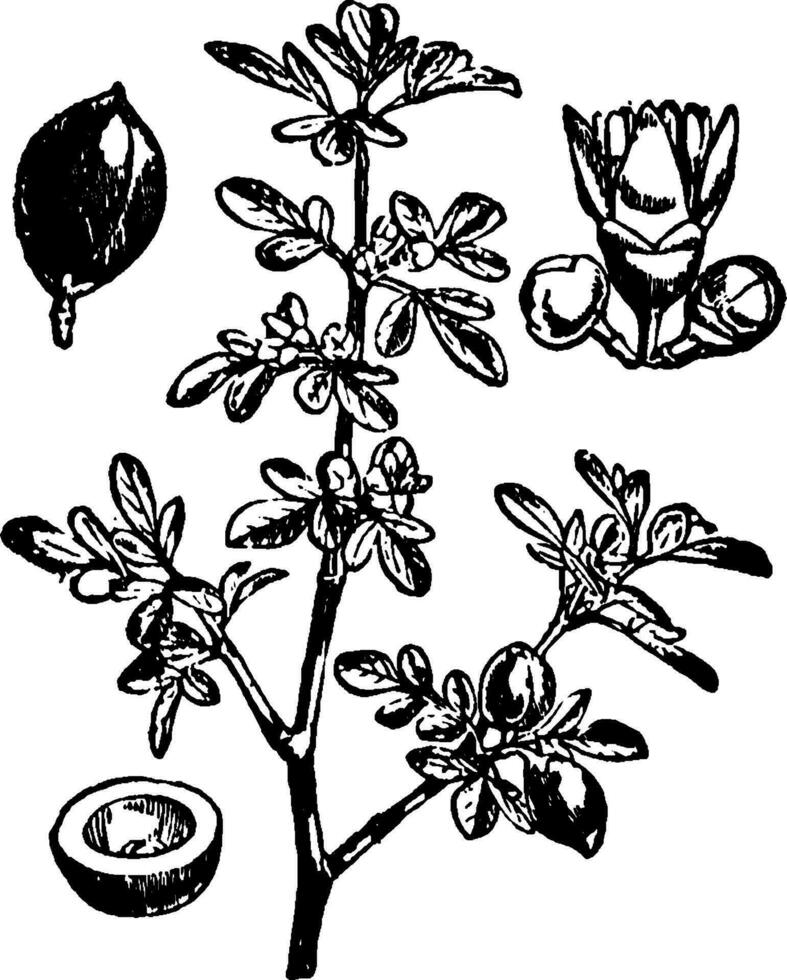
the balm in gilead

the balm of gilead: in ancient, Biblical times, a resin derived from the buds of Pistacia lentiscus, or pistachio trees, found along the Jordan River

gulps of coffee fuel me this morning, groggy as i am from a near-crippling concoction of cough, cold, inhaling too much pollen, and the foolishness of staying up far too late to honor the last gasp of late night’s saving grace these past unfathomable years. i felt downright patriotic and duty-bound to stay awake and bid the nearly-midnight crew adieu. 

after all, that late-night slot has all but saved me. over these long, long, oft-unbearable years, there’ve been so, so many days when the horrors and antics of washington have found me groping for the tonic of someone who might all but croon me a lullaby and tuck me tautly between the sheets—maybe, just maybe, chase away the monsters. someone who could bore into the core of the madness, call it out for what it is, and find a way to soothe our jangled, jagged nerves. or make us laugh before and as we wept about it. 

first, they took away our brian williams, a gentle giant of old-school newscasting who, in the thick of years that straight off hit the skids with doomsday portraits of american carnage, then railroaded right along to ivermectin and bleach-in-our-veins prescriptions from the presidential podium, becalmed me at the 10 p.m. central-time slot. and now, they’ve snatched stephen right out from under us. the man could make me howl with glee at the mere cocking of his wicked eyebrow. and make me feel less a sinner for the dyspepsia the spewed inside me. “thou shalt not hate,” i repeat and repeat, trying oh-so-hard not to cross that God-drawn line. 

so i stayed up. which my raggedy body says was stupid. 

but, heck, i’d hoped my hero of the year—leo the fourteenth, Il Papa—might pop in, at least via vatican-city zoom. or some other heavenly-ordained teleportation.

all of which is to say, i should be curled asleep still. but the chair, the clarion call in my every friday morning for the last 1,018 fridays, stirred me from my slumber. 

and all of which is to back boldly and clunkily into my preoccupation of the week: a book i can’t put down.

which is where we clear our throats, shake the sleep from our eyes, and dive in: this week’s musing . . .

in my backwards, upside-down, and oft off-kilter life’s syllabus, my self-guided and plenty-potholed quest to figure out a thing or two before signing off from this lifetime, my list of texts to absorb is (as you might surmise if you eyeballed the death-defying book stack beside my bed) dangerously, dauntingly, beyond measure. 

pathetically, my ratio of books begun to books read through to the end is woefully skewed—conservatively hovering at roughly 1,000:1. 

avid starter am i. resolutely failed finisher—guilty as charged.

rare is the book that holds me page after page, so enfolded in imagination or intellect i dare not distract myself with some other tome lazing around in one of the many, many stacks that punctuate this old house. thinking back across the last decade, annie dillard’s pilgrim at tinker creek was one. niall williams’ this is happiness, might have been the only other. a third is soon to be added to the triumphant short roster.

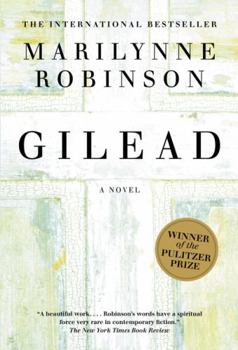
gilead, gosh darn it, has me held captive. 

marilynne robinson’s 2004 pulitzer prize-winning “hymn of praise and lamentation to the God-haunted existence” of a congregationalist minister, the reverend john ames, a late-in-life father who loves the quiet country life “from which he will soon part,” has me running up to my book-reading nook every chance i can snatch, and ferrying the dog-eared paperback hither and yon.

john ames is 76 when we meet him, long rooted in gilead, iowa, dwelling in the very parsonage in which he’s spent most of his many years, having grown up in that drafty, dreary house as his father—and grandfather—had both been ministers there in the “dogged little outpost” that is fictional gilead. straight off, we learn that ames, our protagonist, suffers from a failing heart, and believes his death is imminent. thus, he’s compelled to write a letter to his seven-year-old, late-born son (“the fruit,” as the new york times once put it, of ames’ recent marriage to a much younger woman). 

ames’ first wife and baby daughter have died in childbirth, we learn, and so this son from a wholly unexpected late-in-life redemptive marriage is the singular focus of a father desperate to pack a lifetime of wisdom and lore into jottings and passages that stretch to 247 pages. written in episodic, diary-like entries, nearly stream of consciousness, unspooling generations of wisdoms and family stories, lest the son (whose name we never learn) be left with nothing of his father, it’s a book that leaves me gasping for its sublime beauties—both the literary and the theological. 

it’s not every day i run across a tome of which it’s been said these things: “Robinson has composed a novel as big as a nation, as quiet as thought, and moving as prayer.” (Kirkus Reviews, starred). “One feels touched with grace just to read it.” (Washington Post). Mark O’Connell in The New Yorker wrote: “I have read and loved a lot of literature about religion and religious experience—Tolstoy, Dostoevsky, Flannery O’Connor, the Bible—but it’s only with Robinson that I have actually felt what it must be like to live with a sense of the divine.”

no wonder i’ve slipped right in, and can’t bear to pull away. i too yearn to live that way, with a palpable sense of the divine, a God who brushes up against me—here, there, and anywhere.

in the very same way i’m drawn most deeply to poetry that comes at God not head-on but through the slant, the side window, so too with prose. what takes my breath away most, in just about any writing—fiction or non—is not when i’m klonked on the head but suddenly swept by a wind i feel but cannot see. “God-haunted,” the times put it. “bothered by God,” is how my friend joe the jesuit priest puts it. john ames’ “bothered” is my enlightenment. 

truth is, i finally decided i had to read gilead because father joe (whose theology class, THEO 4300, “the question of God in a secular age,” i recently visited) admits when prodded that he has memorized nearly every word of it, can recite practically any passage from it. quite frankly, i was intrigued. flat-out curious. and i trust joe implicitly.

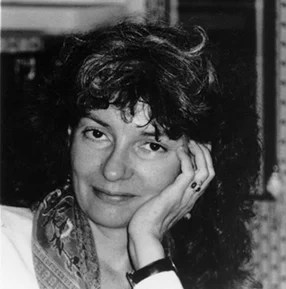
father joe, who wrote his doctoral dissertation at oxford on the theology and literature of robinson and virginia wolff, says robinson’s writing “reveals a deeply sacramental imagination.” in one of many essays he’s written about her, father joe argues that “robinson trains her readers in the discipline of spiritual attention. where is God’s grace operating in nature and in the ordinary ways humans love, disappoint and forgive one other?” father joe goes on to point out that “in her essay ‘Psalm 8,’ she writes, ‘i have spent my life watching not to see beyond the world,’  but ‘merely to see, great mystery, what is plainly before my eyes… with all due respect to heaven, the scene of miracle is here, among us.’ the miracle we await in Advent is not distant, but meets us in the messiness of our human relationships: Emmanu-el, God with us.” 

spiritual attention, i suppose, is my core curriculum. urgently so. especially now, when the godless world works so very hard to pull me—pull us all—under its light-blocking curtain.  (and when i so desperately need my late-night tonic, now pulled off the shelf.)

a deep dive into gilead, into robinson, was the surest balm i could find this week.

here’s just some of what i’ve pulled from my latest excursion into this well-upholstered rabbit hole. . . 

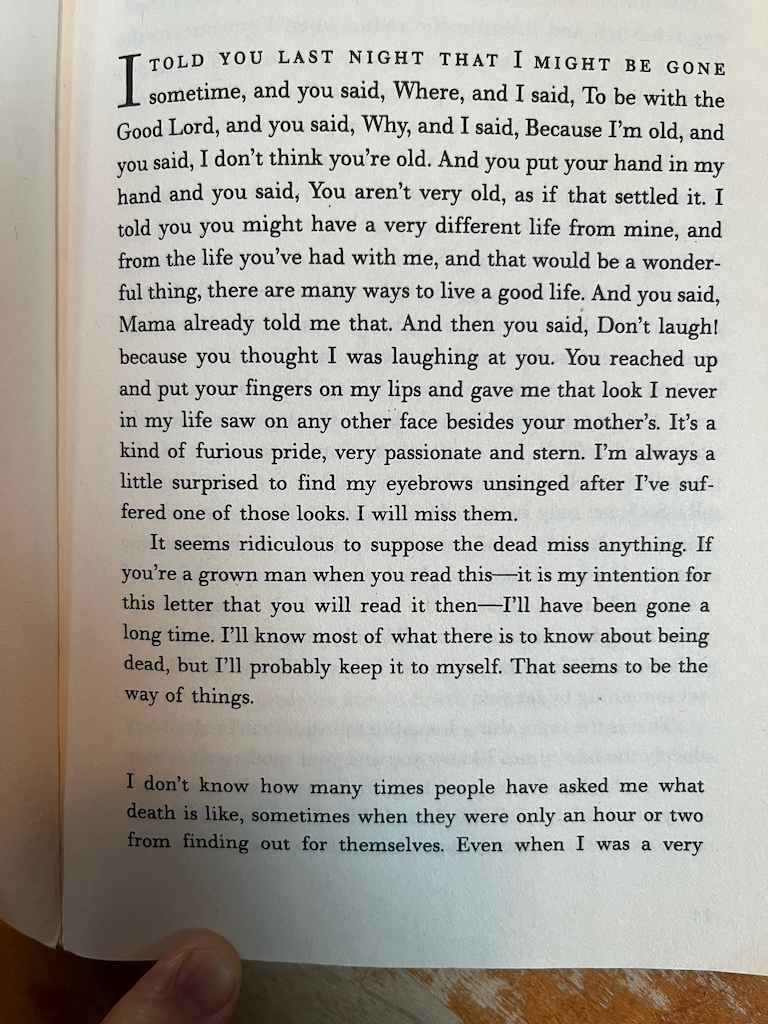
here’s where we begin, the book’s first passage, john ames addresses his sweet little son: 

and while plenty of lines have left me reaching for a vat of highlighter yellow, here’s but one:

describing his love for iowa’s landscape, ames writes: “I have lived my life on the prairie and a line of oak trees can still astonish me.”

or the snippets of poetry posing as passing descriptions…

in one of ames’ passages, he sees his grandfather as “a wild-haired, one-eyed, scrawny old fellow with a crooked beard, like a paintbrush left to dry with lacquer in it.” or, describing him further, the old man seemed “stricken and afflicted, and indeed he was, like a man everlastingly struck by lightning, so that there was an ashiness about his clothes and his hair never settled and his eye had a look of tragic alarm when he wasn’t actually sleeping.” 

when i step back and wonder why i spend so, so many hours of my life with my nose proverbially and literally stuck in a book, it’s to stumble across a line like this next one, one that just might set the mortar of the bricks that herringbone my path

ames recalls that “Augustine says the Lord loves each of us as an only child, and that has to be true. ‘He will wipe the tears from all faces.’ It takes nothing from the loveliness of the verse to say that is exactly what will be required.” 


and there is good company in the gilead fan club:

barack obama, who awarded robinson a 2012 national humanities medal, counts gilead as one of his favorites. in september, 2015, in what’s been noted as “a reversal of journalistic convention,” the 44th president of these united states interviewed robinson on a stage in des moines, for the new york review of books, and told her:

I first picked up Gilead, one of your most wonderful books, here in Iowa. Because I was campaigning at the time, and there’s a lot of downtime when you’re driving between towns and when you get home late from campaigning. … And I’ve told you this—one of my favorite characters in fiction is a pastor in Gilead, Iowa, named John Ames, who is gracious and courtly and a little bit confused about how to reconcile his faith with all the various travails that his family goes through. And I was just—I just fell in love with the character, fell in love with the book …


“This is an interesting planet. It deserves all the attention you can give it.” — Marilynne Robinson, Gilead


an excerpt, john ames (via robinson’s pen) writing of his church at dawn (pages 70-71):

It’s a plain old church and it could use a coat of paint. But in the dark times I used to walk over before sunrise just to sit there and watch the light come into that room. I don’t know how beautiful it might seem to anyone else. I felt much at peace those mornings, praying over very dreadful things sometimes — the Depression, the wars. There was a lot of misery for people around here, decades of it. But prayer brings peace, as I trust you know.

In those days, as I have said, I might spend most of a night reading. Then, if I woke up still in my armchair, and if the clock said four or five, I’d think how pleasant it was to walk through the streets in the dark and let myself into the church and watch dawn come in the sanctuary. I loved the sound of the latch lifting. The building has settled into itself so that when you walk down the aisle, you can hear it yielding to the burden of your weight. It’s a pleasanter sound than an echo would be, an obliging, accommodating sound. You have to be there alone to hear it. Maybe it can’t feel the weight of a child. But if it is still standing when you read this, and if you are not half a world away, sometime you might go there alone, just to see what I mean. After a while I did begin to wonder if I liked the church better with no people in it. . . .

In the old days I could walk down every single street, past every house, in about an hour. I’d try to remember the people who lived in each one, and whatever I knew about them, which was often quite a lot. . . . And I’d pray for them. And I’d imagine peace they didn’t expect and couldn’t account for descending on their illness or their quarreling or their dreams. Then I’d go into the church and pray some more and wait for daylight. I’ve often been sorry to see a night end, even while I have loved seeing the dawn come.

Trees sound different at night, and they smell different too. 


and here, robinson reading robinson… 

where did you find balm this week?

the question of happiness

jane kenyon

jane got me started. jane kenyon, the poet. she’s the one who got me thinking here.

but before i bring jane into this conversation, a conversation sparked by one of her poems, this one titled simply “happiness,” i feel compelled to consider the case of happiness, the subject dragged squarely into our attention.

happiness, i fear, has been shoved to the back of the pursuit shelf (it was a founding pursuit, after all) as it seems to have taken on hallmarkian gauze. it’s blurred at the edges. and if it were a color, it might be some sort of bubblegum pink. it’s joy lite, watered down, saccharine—or so it seems, in this dark historical moment.

it might seem an out-of-reach luxury. what with bombs dropping from skies, drones the latest iteration of lethal birds. who has room for bubble-generator happiness when dread is the common denominator?

i’m going out on a ledge here: i’ll guess i’m not alone in claiming it essential, life-sustaining, worthy of our attention. it’s the active-dry yeast in our days that just might keep us from collapse. rains down out of nowhere, quite oft; dissolves just as quickly.

at simple glance, i’ll concede, it might seem, well, silly.

joy, its elder sister, worthier of pursuit, perhaps. a bit more dignity there. never mind ebullience—a whole other rainbow, happy on steroids, so happy your toes start to wiggle.

we’re talking happiness, pure and simple here.

and that’s where jane comes in. jane, the poet laureate of new hampshire when she died in 1995, at 47 of leukemia, seized that ephemeral quiver, and did the hard work that poets do: she aimed to put words to it. reached for moments that just might capture it. opened her voluminous soul to allow you, too, to peek in. to understand what she was talking about. to grasp, even for a moment, that happiness—especially in the darkest of times—will always be wafting just beyond the margins, out of sight, seemingly out of reach. and then, kaboom! in it will ride on the breeze. tickle us deep down in that joy-registering station. the one where suddenly we realize we are not alone, and not in the dark.

happiness, she makes us think, just might be mightier and more imperative than we imagine. than we’ve cheapened it to seem.

if you’re of the God-believing ilk (and i’ve made it rather clear here that i am), i wonder if that fleeting stirring of the heart or soul, that sense that for a minute there someone cranked the burner and the chemistry inside has suddenly changed, i wonder if it’s a mistake to call it merely happiness. maybe, more aptly, it’s a moment of God. maybe the God we try and try to define, to understand, to see in living color, maybe God comes sometimes in the cloak of a tickling joy, another name for plain old, pedestrian, under-sold happiness.

i wonder if, sometimes, the ineffable, ephemeral, mysterious God drops in, out of the blue, draws us into the swift-running river of radiant light, gives us a dunk, before dropping us back on the sandy bank, uncertain of what’s just happened. and all we know to call it is happiness. but really it’s more. so, so much more.

i’ll let jane take her crack at this; see if you see what she means. maybe she will convince you.

Happiness

There’s just no accounting for happiness,
or the way it turns up like a prodigal
who comes back to the dust at your feet
having squandered a fortune far away.

And how can you not forgive?
You make a feast in honor of what
was lost, and take from its place the finest
garment, which you saved for an occasion
you could not imagine, and you weep night and day
to know that you were not abandoned,
that happiness saved its most extreme form
for you alone.

No, happiness is the uncle you never
knew about, who flies a single-engine plane
onto the grassy landing strip, hitchhikes
into town, and inquires at every door
until he finds you asleep midafternoon,
as you so often are during the unmerciful
hours of your despair.

It comes to the monk in his cell.
It comes to the woman sweeping the street
with a birch broom, to the child
whose mother has passed out from drink.
It comes to the lover, to the dog chewing
a sock, to the pusher, to the basket maker,
and to the clerk stacking cans of carrots
in the night.

It even comes to the boulder
in the perpetual shade of pine barrens,
to rain falling on the open sea,
to the wineglass, weary of holding wine.

+ Jane Kenyon

happiness, she makes clear (rather than argues), is one of life’s glues. it’s on its own clock, plays by its own rules. it might lie in wait: ready to leap out from the geranium pot you found on the bargain shelf; lurk in the email that arrives out of the blue, the long lost college friend you’d thought had forgotten you. happiness, i know, comes in rooms filled with cancer. and just as surely drifts into the grocery store checkout line. it doesn’t seek invitation (and just as blithely ignores our most ardent invites, the times we’re down on our knees begging and pleading). happiness, often, is one short splice from the ever-after reel. extended play is not in its repertoire.

maybe its beauty, its levity comes from its uncharted choreography. it comes and it goes, all of its own accord. and it surely never stays long. but it peeks from just around the corner every once in a while. while enough to make us sense it might be out there; lurking. worthy of pursuit, after all.

happiness—fleeting, sometimes forgotten—is what keep us from crumbling. a pinch of it here, a dab there. its work is beyond proportion. not unlike salt, another life-sustaining grain, happiness, no matter how sparse, just might save us. and, surely, it’s worthy of our keenest attention.

that faint quiver of heart: be on the lookout.

it just might be God, in yet another disguise.

where do you find happiness? can you describe it?

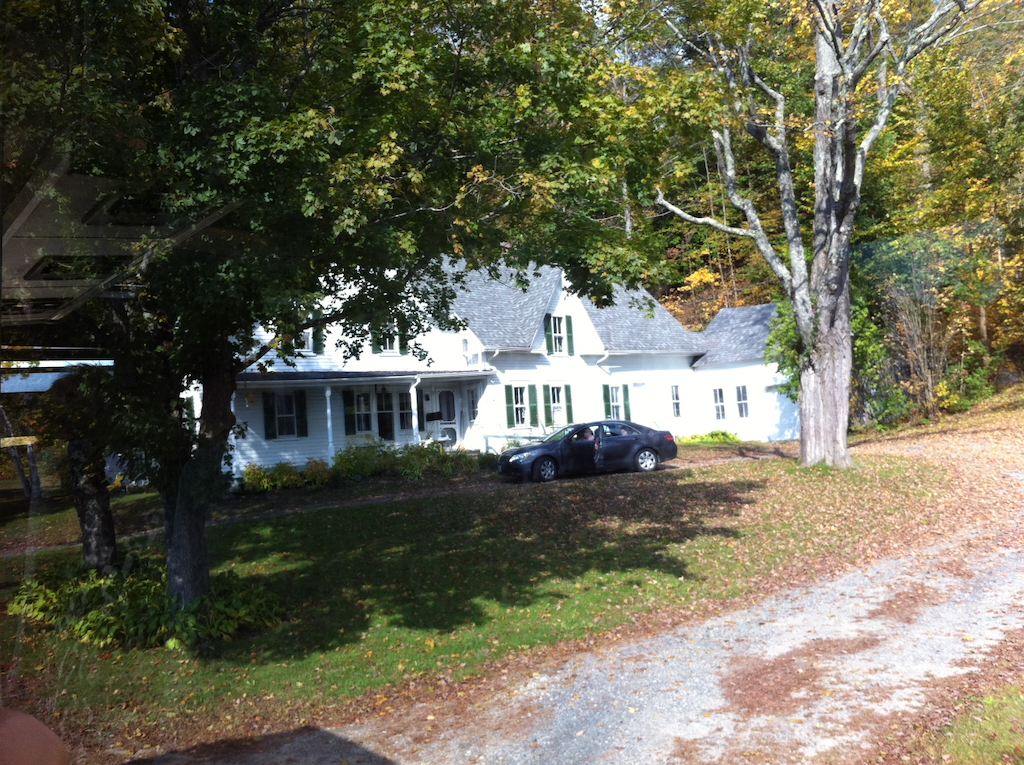
jane kenyon dwells among my innermost circle of poets. i sat in her house once, the white clapboard house at eagle pond farm in new hampshire; swapped letters with her late great husband, the poet donald hall. her poems, pouring from the pen of a daughter of the heartland, rattle me in their stripped-bare simplicities, their unadorned arrows. she takes my breath away with lines so clear they settle forever in my vernacular: “otherwise,” “let evening come”. . .

in case you’re still here, and willing to ride along for a bit of a binge, a few things:

this marvelous short film from friends at the SALT Project, where we hear jane reading her poem, “otherwise” . . .

this link to a short bit of consideration of her most well-known poems.

and this fascinating article from Reformed Journal (self-described as “meaning open, curious, progressive, more interested in building bridges than walls, while still standing in the historical line of Christian orthodoxy”) exploring Jane’s work, where i found these few grafs worth a copy and paste:

Finding God

Jane Kenyon was born (23 May 1947) and raised in rural Ann Arbor, across the road from a working farm, attending a one-room schoolhouse for the elementary grades. She enjoyed the rural upbringing; her imagination flourished in the pastoral setting. Especially, then, her stays at Grandmother Kenyon’s large boarding house in downtown Ann Arbor posed a strange and dangerous world. At Grandmother’s boarding house, young Jane’s imagination took an unexpected turn. One day, after Jane helped Grandmother collect trash from the University of Michigan students’ rooms, they marched down to the basement incinerator. Recollecting the scene in an unfinished essay, “Childhood, When You Are in It,” Kenyon wrote, “As we worked, Grandmother talked about hell, a lake of fire, burning endlessly, or about the Second Coming of Christ, which would put an end to the world as I knew it.” Fearful thoughts for an eight-year-old child.These thoughts didn’t leave her. In her poem “Staying at Grandma’s,” Kenyon wrote:

“You know,” she’d say, turning
her straight and handsome back to me,
“that the body is the temple
of the Holy Ghost.”

The Holy Ghost, the oh, oh. . .the uh
oh
, I thought, studying the toe of my new shoe
and glad she wasn’t looking at me.

Religion at Grandmother’s house was comprised of rooms full of theological horrors and restrictive rules.

Partly rebellious by nature, and partly aware of her own capacity for wrongdoing, young Jane simply went home and announced that she was done with religion forever. Her adamancy persisted while she was a student at the University of Michigan during the 1960s, but since it was a trait of that era to test all things, for good or bad, Kenyon decided to give religion one more try. She attended a Unitarian church one Sunday morning, and left convinced of the correctness of her youthful choice.

Having married poet Donald Hall in 1972, Kenyon moved in 1975 with her husband to his ancestral farm in New Hampshire. The enterprise was not without risk. Hall gave up his position and benefits as a literature professor at the University of Michigan; Kenyon gave up a lifetime tied to Ann Arbor for a new culture. Just how quickly that culture encroached upon them became evident one Sunday morning when Hall suggested they attend South Danbury Christian Church. One might call it a social obligation–friends and family would expect to see them there. Nonetheless, by Kenyon’s recollection, minister Jack Jensen, referred to Rilke, and something stirred in her. She sought advice from Jensen, and he pointed her first to the early mystics–Julian of Norwich, St. Therese, and others–then to the gospels. Soon she and Hall were involved in Bible studies. The “little rebel” as she once called herself, bowed down at the altar of the Christian Trinity.

Faith and Art

Kenyon’s Christian belief, however, would be sorely tried in the remaining years before her death on 22 April 1995 of leukemia. Bouts of acute bipolar depressive disorder that had hounded her since her youth, and then the physical toll of fighting off cancers, first of her salivary gland and then of leukemia, exacted their physical, psychological, and spiritual toll. How can one begin to understand the remarkable interplay of both the joys and trials of her life and also the crisp honesty of her art? Two things help us.

From her earliest lines, Kenyon devoted herself to the lyric poem, searching for what she called “the luminous particular.” The aim of the lyric poem is to take an event or experience of particularly impressive quality upon the poet, but to craft it with such telling detail, crisp language, and physicality of imagery that the reader feels this is his or her poem. The reader enters and owns it, rather than the poet simply declaring. The poem thus requires absolute honesty and exacting care by the poet.

the article goes on, but this is the gist i wanted to leave here, at the ol’ maple table…..

blessings on you this week….

love, bam

the comings-and-goings house: a mother’s prayer come tumbling true

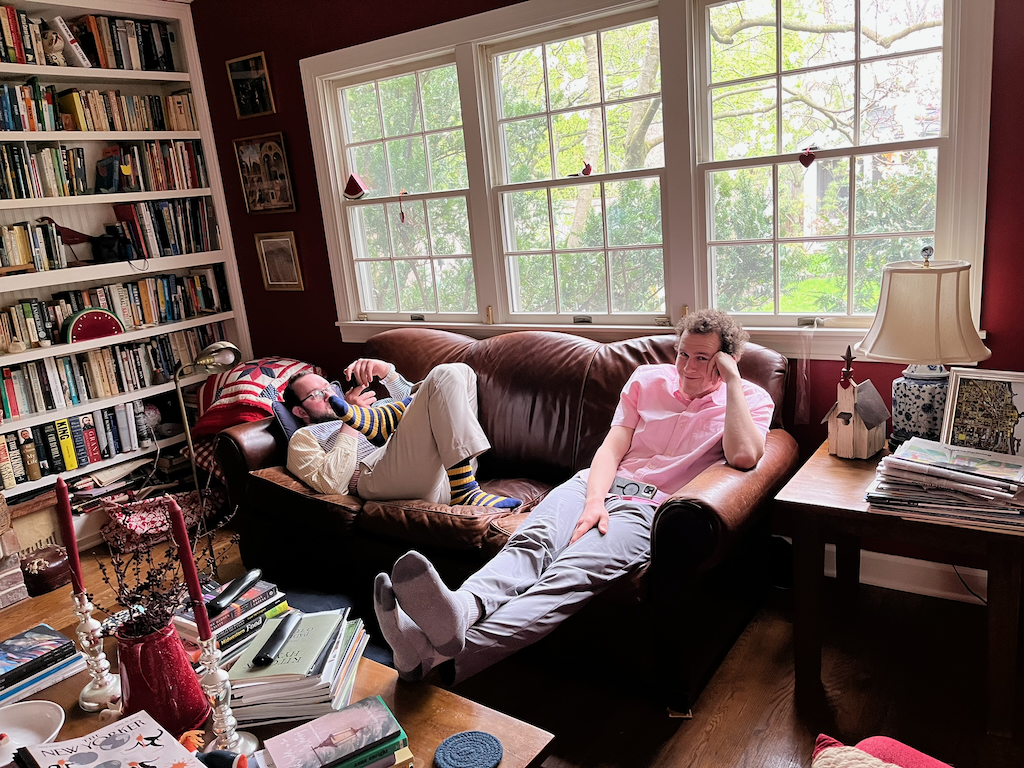
the census at this old house shifts daily of late. a sliding scale of up to four, oft measured in half-drained glasses on the counter, beds unmade and sorta made. pantry shelves are raided in the middle night. and late-night laughter rises, swirls, up the stairs and round the bend, certain as the steam from a pasta pot. that laughter lands, every time, right where it belongs: tap-tapping on the chambers of my heart—no matter how deep i am in my very own dreamland. no dream comes sweeter than the bellow of boys, brotherly boys, from down below.

this old house is playing out its second act in way-station ways. boys come, boys go. one gets a fever and the aches; we scoop him up and bring him here: gingerale and saltines are best doled out by good ol’ mama. the other boy, the professorial one, is in the thick of putting down midwestern roots, back in the heartland after so, so many years away. and this old house is just the place to plop your duffle down whilst you re-acclimate to the city of your birth (and shop for your own places to call home).

in real-time, i hear just how the date unfolded, how the phone call went, and who makes whom laugh aloud. and i am there to wake someone with a kiss instead of a phone call when i’ve been asked to be sure that someone is awake by 9 a.m.

just this week, with my bespectacled fellow off and faraway, i’d thought i just might find myself amid a stretch of days where i alone dwelled here. where i might slather my face with goo, and not feel the urge to hide. or serve a mixing bowl of lettuce leaves and call it “dinner.” or plug in the vacuum at dawn cuz that’s when the spirit stirred me. but then one boy got sick, and the other snared a date. so the arithmetic this week never equalled one, and now is back to three. with four soon on his way.

i couldn’t wish it any other way.

random glasses, messy rooms, be damned!

two januaries ago, when i was feeling especially afraid, and on the brink of highly fragile ice, i prayed with all my heart for one more birthday candle to extinguish with my semi-feeble lungs. and what i really meant, and what i really wished, was the deepest prayer i know: dear God, let me be around to catch a few more episodes of Growing Boys: The Sequels. 

in a rapids-rush the likes of which would make the colorado river run green with envy, that wish (plus one more candle since) has come oh-so-surely true. i get dizzy thinking all that’s come and gone since that cold, cold winter’s day. the fear of losing me, truth be told, prompted boy one (the professor) to pick up the phone and plot his way back chicago way. (think not that it was anything short of soul-testing and against plenty odds to earn a full-time tenure track slot as a law professor at a pretty darn-good law school within a two-hour drive of home sweet home.) and boy two has more or less called on me to join him in the journalism trenches, as he plies his gift for seeing to the pulsing heart of every story but finds himself in need of chief copy editor and fixer of misplaced commas.

not a day, not a phone call, not a late-night dash downtown, passes by without me praising the holy heavens, dumb luck, or pure fat chance for bequeathing me these moments to slip like precious beads on the rosary string i call my life.

if we’re here on earth to learn to love, to love in the holiest, humblest way possible, the way that makes our life just one little tool trying to turn the crank toward a universe of radiance, then for me there’s no tougher school, no steeper curriculum than to be in the very trenches of life with the lives i’ve labored through and birthed. they demand more of me than i ever knew was in me. they look to me to put my hoity-toi teachings into real-life practice. and should i slip up, should i prove to be a preacher of empty aspirations and hypocrisies, they’d be the first to know. and i’d be rightly crumpled.

my boys keep me honest. my boys keep me true. my boys, my boys . . .

i fall to my knees in eternal forever thanks. i know full well the due, the bliss, the wonder—the flat-out miracle—of the two who call me mama. and with all my soul, i know: the gift this mothering day is mine.


my mama, bless her, is very much here. and, truth be told, yearning to go “home.” when i miss her, which is often, i motor over to where she lives (a mere nine minutes away), and—truth again—i often don’t find her there. she is off “at programs,” the curiosities and delights that animate her day. or populate it anyway. she might be listening to a book, or sunning herself in the adirondack chairs out front, or out on one of her circumnavigations around the acreage. if i can’t track her down, i leave her notes. i leave her ice creams in her freezer, and the short litany of things she hungers for: cheese and crackers, clementines, the tall bottle she keeps under the kitchen sink.

but so many i know miss their mamas. and lucille clifton, a poet i hold close to my heart (in keeping with the lines below, i should say i hold her close to my bosom, but i don’t have much of that, so the term is rather lost on me; it’s aspirational at best. and once upon a time i must have wished for a bosom, the sort my grandma had, though those days now are long gone and far away). i love that God here is “antic.” i love that the mama lucille yearns for is the one from half her life ago. i love the whole sensual tableau into which lucille invites us. her song, her scent, the scratch of her wild hair. it’s a moment still in reach. how wild, the human mind, the capacity to reach deep into the long-ago, to bring it near to life. no AI robot will ever ever do that for us. score one for humanity. in all its messy glories.

here is lucille clifton for all of us, but especially for the ones who miss their mama on this mother’s day upon us…..

“oh antic God”

oh antic God
return to me
my mother in her thirties   
leaned across the front porch   
the huge pillow of her breasts   
pressing against the rail
summoning me in for bed.

I am almost the dead woman’s age times two.

I can barely recall her song
the scent of her hands
though her wild hair scratches my dreams   
at night.   return to me, oh Lord of then   
and now, my mother’s calling,
her young voice humming my name.
—Lucille Clifton

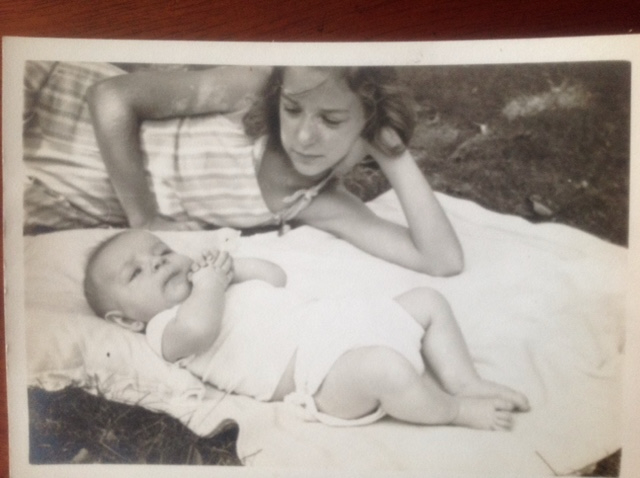
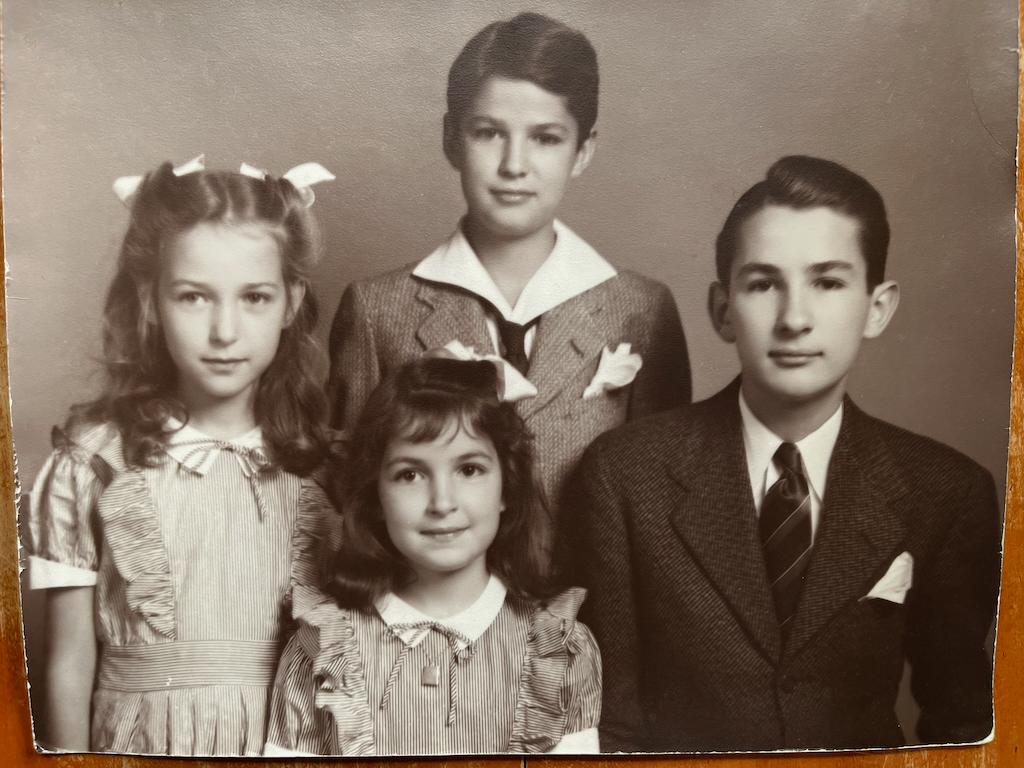
inspired by lucille, here’s my mama from long-ago and not so long-ago. as my mama adds numbers to her years, her strength, her immutable strength is what looms at the fore. i love how deeply deeply present she has always been for me and my boys. my boys who love her so….

love you, mama. xoxo

p.s. i got a peek just yesterday at what will be the cover of my next book, a book whose title is Broken Open. i wish i could show you the two choices, but they’re under wraps till one makes the final cut. it all makes the book very, very real feeling. and i was duly blown away by the two choices. one made me cry. i am guessing that will be the one we pick.

who are the blessed mothers in your life, and what indelible lessons or stories are you remembering this mama day….??

dr. blanche’s blessed-be challah

the dentist’s chair is the last place in the world i’d think to find enlightenment (especially since i’m not of the Whitening School). but then dr. blanche walked in.

dr. blanche is orthodox. and the first such dentist who’s tended to my teeth while fully decked out in tzniut, the traditional, modest garb of orthodox women, clothing that covers collarbone, elbows, knees, and hair, a Talmudic instruction derived from the biblical injunction to “go discreetly with God,” (Micah 6:8) a line itself worthy of deep pondering in this age of bombastic self-amplification.

but back to dr. blanche. we got to talking (not easy when instruments and hands are inside your mouth.) and in that effortless way that often unfolds, our conversation soon swirled from talk of office management (which dentist worked which days) to how she’s out of office every friday, to Shabbat itself. that’s when i asked if she spent the day cooking, getting ready for the most blessed of holy days, the one that comes at sundown every friday. and that’s when she effused.

“i love cooking,” she said, sparks of joy nearly splashing me and my eye-protecting goggles. “and i love baking. i bake all my bread and challah.”

and that’s when we stood at the edge of the enlightenment to come.

she told me how she makes five pounds of challah dough on fridays. and she told me how making challah—the bread to be blessed at the start of the Sabbath meal, along with the lighting of the candles, and the blessings for the light and the cup of wine—is, in her kitchen, and in every orthodox kitchen, a prayer.

prayer upon prayer, actually. a prayer for every step, and every simple foodstuff, in the making of the blessed bread.

the holiness of sustenance; the sustenance of holiness.

she began to explain: for every ingredient, the flour, the sugar, the salt, the yeast, the egg, the oil, the water, there is a blessing. a sacred pause, and an intertwining of earthly and divine.

each ingredient imbued with sacred purpose.

while sifting flour, she prays for her own soul, to sift out the stumbling blocks that distance her from the radiance she is meant to be, and to amplify the positive, the beauties breathed into all of Creation at our beginnings.

as she measures out the sugar, she prays, not surprisingly, for a sweetness to infuse her being. “to always be able to love.”

as she adds two tablespoons of salt, she asks God to help her know how to set limits in her life, to find balance, between her own needs, her work, and the needs of her family. (she has four kidlets—so far. . .)

and so it goes: dry yeast (happiness, protection, joy); oil (strength, grace on all the world); water (faith, unity); eggs (fertility, and blessing in all she does).

the prayers themselves are beautifully unfolded, and by the time she’d recited the prayer for salt i was in tears, and nearly elevating from the cushy dental chair.

in a world that each morning shatters me with its headlines, its vitriol and violence, its toxic spew of hate, of lies, false idols, i lay (mouth wide open) beneath a prayerful soul who found the very stuff of bread and life a sacred ground for prayer.

i couldn’t stop the tears. nor the sense of awe at how the sacred so caught me by surprise, how it’s ever pulsing in the places where we’d least expect it. how it comes just when we think we might have whirled forever away from the penumbra of its light.

in the kosher kitchen of a woman bent in prayer and kneading.

oh, holy God, You astound me.

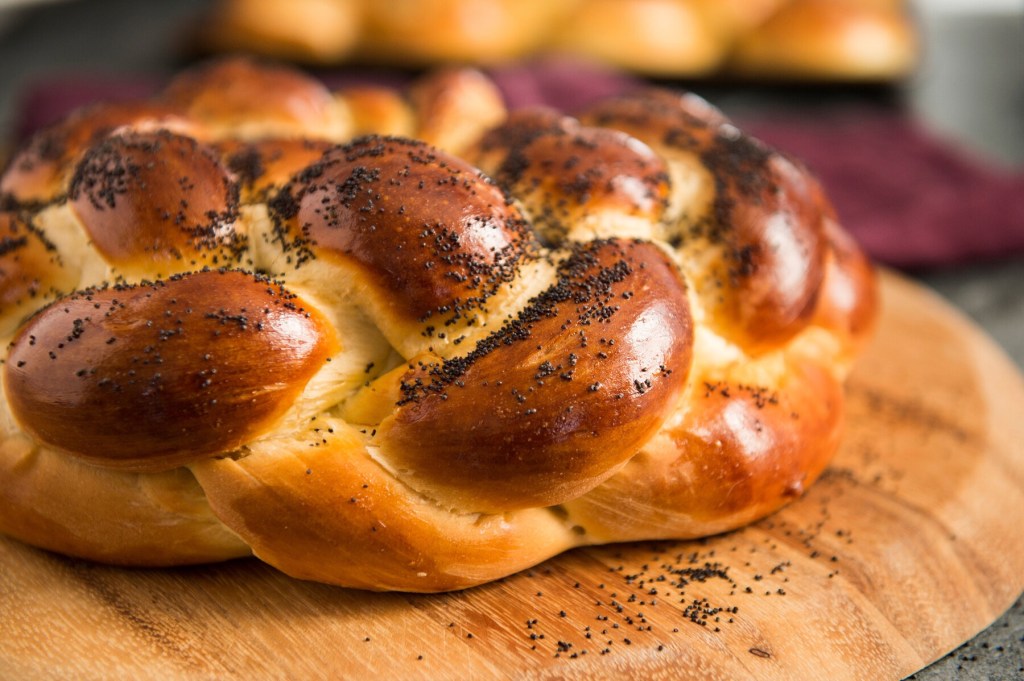
can you imagine what it means to bite into that sweet soften golden braid, one so infused with so much goodness? have you imagined, ever, sifting prayer into that which you knead, allow to rise, and put to the heat of the oven?

it is in the simple kitchen rhythms, a geometry of circles and parabolas, in the chemistry and physics of yeast + sugar + water = rise, that a whole league of women round the globe infuse with simple prayers.

i found it nothing less than stirring, i found it deeply ennobling. and i might borrow those very measures for my own ministrations at the cookstove.

the world we know is all but begging for our prayers in whatever nooks and crannies we might stir them. even in the whole-grain slice i’ll soon be popping in the toaster.

here is dr. blanche’s recipe and prayers:

a note: Hashem is the name for God in more conversational terms; it simply means “The Name,” as utterance of God’s most sacred name is reserved for the most sacred time and prayer.

she begins, per the recipe she printed out for me: When you make Challah you are partners with Hashem!!

Pray:

Thank you Hashem for all the blessings you have given me and my family. Thank-you for always protecting us and doing what is best for us.

Please Hashem help me …..It is an “Et Rratzon” (an opportune time) to connect with Hashem.

5lbs. of lbs. flour:   While sifting the flour, pray;  Please Hashem help me to separate the good from the bad ,help me to get rid of my negative character traits and my Yetzer Hara, help me to focus on the positive and incorporate positive character traits just like I am doing with sifting the flour.

14tbs. of sugar:  As you add the sugar, pray;  Please Hashem, help me to have a sweet din(judgement) help me to have Ayin Tova ( a good eye) help me and my family to have a sweet life, to always be able to love. Help me to help others and to do chesed (acts of loving kindness).

 2 Tbs. of salt:   As you add the salt around the flour, pray; please Hashem help me to know how to set limits in my life, how to balance my own needs, my work and my family life. Just like you made our bodies rely on salt for existence allow me to work for purposes of our existence as well. Yet just as overdoing salt is detrimental to us, so too allow me to know when my work is sufficient and to take proper rest and rejuvenate.

3 or 4 packages of dry yeast:  Create a hole in the center of the flour in the bowl that you have all the above ingredients in. Then in a separate bowl, add the packages of yeast, 2 more tablespoons of sugar and 1 cup of warm water. When it begins to bubble, add the yeast mixture to the larger bowl with the hole in the center of the flour. Pray: help me to have simcha (happiness) in my home, in my life. Grant us your protection (as yeast in Hebrew is called shimarim which translates to protection) now and always. Please Hashem, allow me to feel joy for others as well. Bless me with tranquility, inner peace so I can continue doing mitzvot.

1/2 cup of oil (I prefer olive oil):  Bless us in with good health always. Help us to recognize that everything comes from your hands. All our blessings come from you as well as our hardships. Help us to grow stronger from the hardships and appreciate all that you have blessed us with. Let us be zoche (merit) to see the geula (redemption) and the anointment of Mashiach with oil (shemen hamishcha) speedily in our days amen! 

4 and 1/2 cups of water (add more if you need to for the dough to be elastic): as you add the water and knead by folding the dough over and over, pray: Please Hashem help me to connect to you, strengthen my emunah (faith) in you. Help me to connect to the Torah which you blessed us with. Help me to connect to your children and to everyone around me. Help us to have unity among one another and thereby connect to you as you stand for unity. (water, is a connector, it is a key ingredient to life sustenance).

Making challah, or any bread for that matter allows us the women to make tikun on the sin of Chava. By completing the process of challah (bread) baking, we are in essence allowing our neshamot( souls) to feel complete and whole again.

3 eggs (optional):  if you add the eggs continue to mix it into the bowl and pray: Please Hashem as this egg represents fertility, so too help me and my children to be blessed with fertility. Help everything I do with my hands to have beracha and remain fertile always.

Most importantly thank you for the life you blessed me with. I realize that this egg is a reminder of my humble beginnings, thereby help me to feel this humility always. 

After completing the process of kneading, cover the dough with a large paper towel and a regular towel over that. Allow it to rest for an hour or more to rise.

It is tremendous mitzva for anyone to separate or “take” the challah. Many have the tendency to allow: a woman who is not married yet, to do this mitzvah, so she may find her spouse with ease. You can allow a woman who did not have children yet to separate the challah so she can have children in this merit. Some separate the challah in the merit of certain individual/individuals for refuah shelema (complete healing). Whatever the reason now is a great time to pray for any personal needs you may have as well as anyone else’s needs.

“Taking challah”—pinching off a ball of dough, roughly the size of a ping pong ball, a re-enactment of the temple sacrifice, and a burning in the oven—tells us that whatever we are given is not for our use alone. If we have wisdom, money or good health, our first step is to put them towards a Divine purpose.

Now you are ready to complete the mitzvah of challah. Married women, please cover your hair and make this beracha (blessing):

“May it be Your Will, Eternal, our G-d, that the commandment of separating challah be considered as if I had performed it with all its details and ramifications. May my elevation of the challah be comparable to the sacrifice that was offered on the altar, which was acceptable and pleasing. Just as giving the challah to the Kohein in former times served to atone for sins, so may it atone for mine, and make me like a person reborn without sins. May it enable me to observe the holy Sabbath (or Festival of…) with my husband (and our children) and to become imbued with its holiness. May the spiritual influence of the mitzvah of challah enable our children to be constantly sustained by the hands of the Holy One, blessed is He, with His abundant mercy, loving-kindness, and love. Consider the mitzvah of challah as if I have given the tithe. And just as I am fulfilling this mitzvah with all my heart, so may Your compassion be aroused to keep me from sorrow and pain, always. Amen.”

how do you weave prayer into your everyday?