new york times photo of portland street protest, braced and armed with umbrella shields, this summer’s symbol of resistance
mothers reach for what they need. mothers reach for amulets and gear, paraphernalia and patron saints, to protect their children. it’s an impulse as ancient as time. and will go on till the end of time. of that i am certain.
a mother’s wiring drives me, has driven me now for the better part of 28 years, ever since the doctor told me, incontrovertibly, with the swishing heartsounds of the sonogram echoing wall-to-wall across the darkened tiny room — nine months after the heartache of losing our first — that a life stirred within.
ever since, my first and last impulse, above all, is to keep him safe. to shield life and limb, and cranium too, from incoming assault, be it playground invective, asphalt bike path, high-speed hardball, or any of the fully-pictured atrocities that have played — and replayed — in my too-colorful head.
it is dystopian, at least, that this summer i’ve found myself clicking “buy” on a two-pack of plastic shields, the better to keep the red-ringed virus at bay when a boy i love is flying hither and yon, criss-crossing america at altitudes of 35,000 feet. tuesday night, he dons it for the second time, as he flies from JFK to PDX, that’s new york to portland, oregon, about as long a flight as the american continent offers.
and PDX is where the impenetrable helmet comes in. ever since i started reading reports of unidentified federal forces cruising portland’s downtown streets, driving unmarked vehicles, plucking protestors from sidewalks, stuffing them in vans, without word of miranda rights or where or why on earth they were taking them (leaving some to fear to god they were literally being kidnapped by bands of who knows who), i started thinking about helmets. about what my firstborn might put on his not insignificant head to keep it from getting bashed with the wrong end of a police baton, or any other unidentified thrashing implement.
mind you, it’s not that i worry my firstborn will soon be leaping into the late-night protest. it’s that he’ll be walking to and fro to work. to and from a federal courthouse, as it so happens (though not the one at the epicenter of all the melee; his is the other federal courthouse, two blocks north and west). and in this american summer, in a city besieged by federal forces wielding tear gas canisters and “less-than-lethal” (thank god for modifiers here) weapons, a mother starts considering the selling points and perqs of various impenetrable protective head gear.
which is utterly dystopian, improbable in any other summer than the one that is the america of 2020, a year decidedly not clear-focused. and it makes me think of the litany of mothers who through time have had to send off sons and daughters, who’ve awaited letters, answered the ominous knock at the door, as my own grandmother did, when her son was killed in a midnight ambush on iwo jima. it makes me think of the south side chicago mothers who cannot count on the windows of their minivans to shield the incoming bullets, the ones killing toddlers — even babies; a five-month-old shot just last week in old town — strapped in car seats.
there are mothers weeping across america, across this globe, and the tears seem endless, are endless. will the weeping and the wailing ever, ever end? do we stand a chance to finally stanch the sorrow?
mothers shouldn’t have to plot the surest bullet-free path to school. nor which playlot might prove lethal. children shouldn’t have to spend their summers behind closed curtains, in the corner of a room farthest from the picture window, where crossfire could soar in. mothers shouldn’t have to lay awake nights imagining the phone call, calculating how long it would take to race to the ICU bedside. mothers shouldn’t have to hear the click of the coffin closing.
this is no easy summer in america.
short of searching the internet for plastic shields and bash-proof helmets, we’ve got work to do here in the land of the brave and the free.
america is crying. are we listening? are we doing what we must?
and those my friends are the questions, the imperative questions: are we listening? are we doing what we must?
U.S. Hits Another Record for New Coronavirus Cases: New York Times graphic
we are all — all of us, red states, blue states, striped states, star-dappled states — strapped into this unplotted, unprecedented, unpredictable pandemic roller-coaster ride (*aka “COVIDcoaster,” a term introduced to me by my brilliant friend amy). the season of COVID, long past its toleration date, is gearing up for a wallop. or so it seems as summer cranks up the heat, and what’s ahead grows hazier.
we seem to be lurching upward and off-the-charts at breakneck speed, as if some giant-sized foot is pressing the proverbial pedal to the floorboard.
at this old house, the summer feels a bit like a COVID chess game. us v. the invisible virus that takes our smell and taste away. i need to put on speed dial a beloved ER doc friend of mine, the one who answers every inane puzzle and quandary i conjure. (and, believe me, i conjure.)
just this week, boy No. 2 found out his best friend’s sister — and another dear friend’s cousin — had tested positive — fever + sore throat, the sweet girl’s symptoms. of course, boy 2 had been out hitting golf balls the two previous nights in a row with her brother. and, to double the trouble, one of those nights he’d taken a long sidewalk-straddling walk (without masks), with the COVID girl’s cousin, who’d just gotten back from a week of sharing a summer cottage — and a bedroom — with the newly diagnosed one.
from the minute boy 2 got the news — at the end of a hot sauna of a day mowing grass and chopping trees for the park district — he had his KN95 mask strapped on so tight it musta made it hard to breathe. he insisted on eating his dinner on the far side of the kitchen, a good 12 feet from the rest of us. and he holed up in his room as if protecting me from nuclear fallout. just now, as he loped out the door for another day of tree-chopping, he triumphantly announced his test (taken yesterday afternoon at one of those one-day testing sites) just came back negative, as did his best friend’s and the cousin’s. halle-holy-lujah! i’m thinking it was a close-enough call to maybe add an extra 20 seconds of hand washing to the regime from here on in, though the perceived invincibility of teens prompts me to hedge that bet.
then there’s boy 1: the one who is here, asleep under this very roof, spending his days studying for the bar exam and waiting to move to portland, oregon, where a federal clerkship awaits. you might think — with five scheduled cross-country flights and two separate moving crews, a new job, new apartment, and that bar exam — that we set out to plot the most complicated itinerary imaginable in the age of COVID (though we assure you we did not). as it stands now he is due to fly back to new haven on monday, where the first of the two moving crews will crate every last fork, spoon, and tome in his law school apartment, and ship it all oregon way. the plan had been to come back here for the duration, till it was time to meet the movers in portland, but with the COVID charts skyrocketing in the exact wrong direction, we ditched plan B. and have moved on to plan C in which the poor kid will wait it out for 10 days in a stark empty apartment (save for the old lumpy mattress he is not moving), fly new york to portland, meet the movers, and then — drum roll here for the most mind-bending part of the plot — fly four-and-a-half hours back to chicago to take the bar exam, which in itself is a legal petri dish of COVID waiting to engulf the entire law school class of 2020. the geniuses who plot bar exams are currently planning to stuff 2,000 illinois test takers into a ballroom for two long days at the start of september. some of those test takers, like our very own, will be fresh off airplanes, having flown into chicago for the exam. others, waiting to take the exam before they can start drawing a paycheck, might well be inclined to go ahead and take the test even if, say, they can’t smell a thing, feel a wee bit hotter than usual, and might have started sniffling or coughing. how this is allowed to happen is beyond me, but then it’s the COVIDcoaster, and we are all whipping around the course, bracing ourselves through all its undulations.
so i do what i do best: i worry the night away. i pony up for the higher-cost health insurance, haunted by visions of the kid sick as a dog and turned away from the best hospitals in town if he doesn’t flash the right insurance card. we canceled the plane ticket on the airline that no longer keeps the promise to not fill every seat on the plane, and grabbed a new one for an even-longer ride on a plane that promises a few inches more breathing room. and we are leaving the kid to sleep in an empty apartment for 10 days — all because we’re haunted by the very real fears that COVID is a fire-breathing, smell-stealing dragon that’ll come up and nab you from behind.
meanwhile, we watch germany and south korea mostly trot back to work, no longer so encumbered by this awful terrible invisible virus.
by the hour, awful terrible numbers are flashing before our eyes — cases climbing, death rates certain to follow.
and those of us who swear allegiance to masks and 75-percent isopropyl alcohol hand sanitizer, we begin to wonder when, oh when, will it end? and who of the ones we love will be caught in its vice — snuffed out, or left with lingering scarring for who knows how long?
it’s enough to wear you down, and wring you like a soggy rag. we’re weary of all the lysol-wiping of every last milk carton. and navigating the variations of rule-following among those we love is no summer picnic. (i’m among the self-avowed scaredy cats who takes tony fauci at his every last word; if he tells me to mask up and not share even a fruit bowl among friends, i’m wearing two masks and lysol bleaching like nobody’s business.)
it all makes for strange times. surreal times, really. but, thank God, we are — so far — living to tell about it.
and in the meantime, i’m baking.
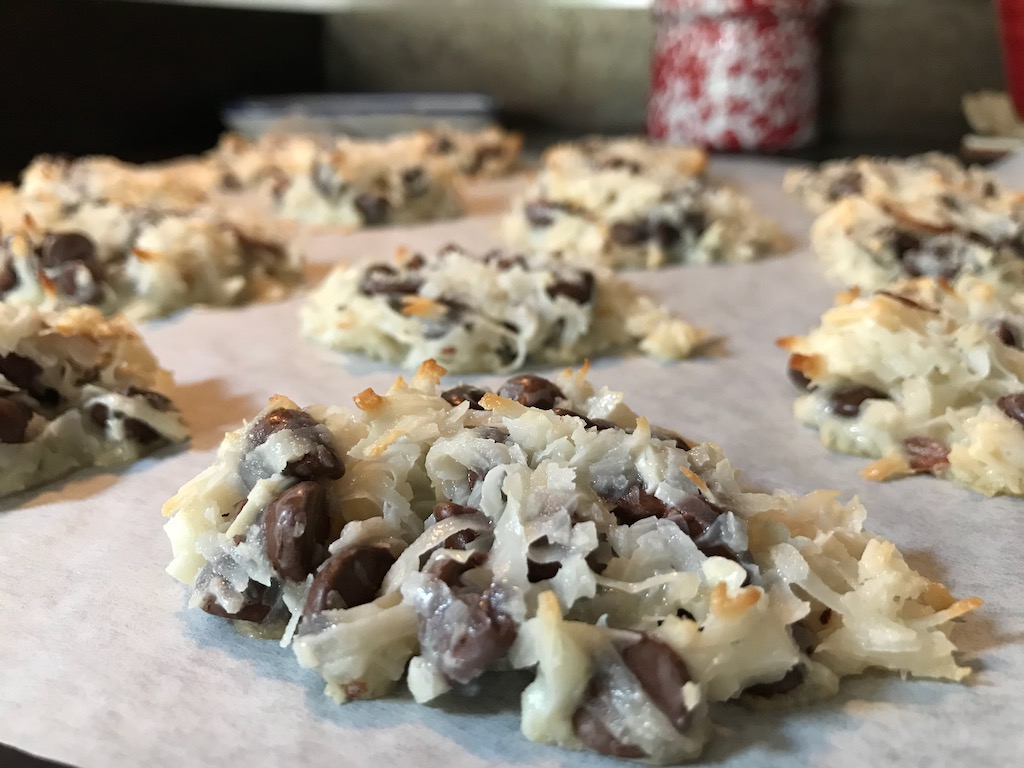
almond joy cookies, hot out of the oven
here’s the latest summer joy from the cookie jar, and they couldn’t be easier. four ingredients, stir, scoop, press flat, await the slightest gilding of the coconut edges. then watch ’em fly.
almond joy cookies
these wicked little coconut cushions, studded with semi-sweet chocolate and bits of sliced almond, are what happens when your favorite grocery store peddles a similar confection at $5.99 for five of ’em. because those pricey little mounds are practically inhaled in this old house, i was determined to make ’em myself. a bit of prowling around the internet, my cookbook without end, led me to these, courtesy of some lovely someone named trish on momontimeout.com
she writes: “These easy Almond Joy Cookies take just four ingredients and don’t even require a mixer! No beating, no chilling, just mix ’em up and throw ’em in the oven EASY! You’re going to love these ooey gooey fabulous cookies!”
Prep Time: 5 mins
Cook Time: 12 mins
Ingredients
1 14-oz bag sweetened coconut flakes
2 cups semi-sweet chocolate chips
2/3 cup chopped lightly salted almonds (trish used Blue Diamond Low Sodium Lightly Salted – light blue bag, but i couldn’t find, so i used sliced almonds and added 1 teaspoon salt)
1 14-oz can sweetened condensed milk regular or fat-free works
Instructions
Preheat the oven to 325F.
Line a large baking sheet with parchment paper and set aside.
In a large bowl combine coconut, chocolate chips, almonds, and sweetened condensed milk.
Stir until combined.
Scoop out dough with a cookie scoop onto prepared baking sheet.
Moisten the tips of your fingers with water and shape into discs. Pat the tops flat.
Bake cookies for 12 to 14 minutes or until tips of coconut are just starting to turn golden brown.
Let cool on baking sheet.
Store cookies in an airtight container.
Notes
Parchment paper is critical for these cookies to turn out right. Silicone mats, waxed paper, etc. will yield a slightly different result.
chime in andspill your COVID-coaster stories. do tell. misery loves company. and by now we are all worn thin from the red-ringed worries.
(p.s. i am not making light of one drop of this, merely recounting with a journalist’s eye the absurdities of what the summer’s bringing….)
this moment in america is one that won’t be bracketed by a solitary summer. this is one of those moments when first the rumbling comes, the thrumming down below our soles. and then the shift begins to come, tectonic shift (or so you pray). wake up, america. it’s been too long now. all of a sudden the rush of history — long overdue, long overspent in costs of brokenness, of cruelty, of gravest injustice — it’s washing over us, washing something from our eyes.
maybe we will see now.
maybe, beneath the din, beneath the shouts and shattering of glass, we will at last hear the whispers and the cries. it’s been too long now. far, far too long.
this summer reminds me of the summer when i was 11. i remember riding in the front seat of our wood-sided station wagon, stopped at a red light, when the news came on. i heard the word assassinate once again. this time, bobby kennedy; last time, only months before, martin luther king, jr. assassinate is an ugly word. a word that scares a kid. a word that makes you freeze inside your bones, a word that makes you afraid to breathe, not sure where or why all these bullets seem to be soaring through the darkness, piercing people’s brains. it’s a word i’d heard too often in the first half of 1968.
in the summer of ’68, america took to the streets. in this, the summer of 20-20, we’re at it once again. we should be. what we’ve seen is wrong, and ugly, and violent. and shattering. imagine — just imagine — what we’ve not seen. that scares me. really scares me. leaves my heart — yours too, i’m guessing — in shards. leaves me — you, too? — gasping.
i’m not so much a take-to-the-streets kind of someone. i’m more turn-the-page and pound-on-heaven’s-door. i inhale words to rouse my soul the way others pound the pavement. i feel a deep-down curdling, a rage, when i read the words of poets who are witness to the unimaginable. i wipe away streams of tears. sit motionless, not breathing, when i get to the end of a line that’s just shot through me like a rock to the side of the head.
the transportive power of poetry — its capacity to draw us into the kitchen where the shouting comes, or the bedroom where the wailing rises up, or the street where blood is spilling — it’s what moves me. its ugly truths can mark me for a lifetime, scenes and moments seared indelibly, ones my eyes and ears have never witnessed but which, nevertheless, i’ll never shake.
maybe that’s why — when i got an email the other day from a most beloved poetry professor of mine, elisa new, creator of Poetry in America, now a public-television series, i read these words so closely, considered them instruction for this long, hot summer ahead. maybe, too, for you.
this is what lisa (who is also a professor of american literature at harvard, and something of a polyglot of poetry and poets) wrote:
Protest is the voice of the people, elevated and offered to society at large. The protests we are hearing fulfill art’s, and especially poetry’s, greatest function—which is to make human beings truly audible to one another, to let them hear one another’s humanity and take in one another’s pain. The opposite of hearing the human voice is denying, muffling, strangling its cry: that is what we saw with deadly and literal explicitness in the murder of George Floyd, and in the appalling murders of Breonna Taylor and Ahmaud Arbery and so many others. Killings committed by deputed servants of the public good implicate the public, and they require us to reckon with the full gravity of what these acts represent. Their stain is on us all, and any institution, large or small, that endeavors to serve the public good must accept its own responsibility, and review its own past failings, in an effort to do better.
The voices we hear on the streets of our cities right now are doing as poets [since before the American founding] have done: decrying injustice, asking for redress, but also: telling the particular stories, naming the particular names, with every city and region and neighborhood now being brought to account by its own residents. On these streets, as on the page and in songs and performances, what we are now hearing is not abstract. It is the sound of people mustering language in its highest forms for the largest civilizational ends.
And so in the work of 20th century poets such as Claude McKay, Robert Hayden, Gwendolyn Brooks, Maya Angelou, Audre Lorde, Lucille Clifton, and June Jordan, and in the work of so many writing today—Rita Dove, Claudia Rankine, Evie Shockley, Terrance Hayes, Jamaal May, Clint Smith, Joshua Bennett, Kendrick Lamar and so many others—Black American poets have continued to carry what Langston Hughes, seventy years ago, called “a heavy load”—of “dream[s] deferred” and plain truths denied.
“…to make human beings truly audible to one another, to let them hear one another’s humanity and take in one another’s pain.”
the power of poetry. of witness.
in the spirit of gathering up a cadre of page-turning protestors, of dialing up our capacities for empathies, i’ve begun to gather something of a 20-20 summer reading list. any of the poets named above would be a place to begin.
but i turn, always, always, to lucille clifton, a poet who doesn’t believe in upper case or think much of punctuation, but whose words might never ever leave you. here are but two that leave me breathless….
and, then, there is claudia rankine, whose words will push you to the edge of your chair. the place to begin would be her 2014 citizen: an american lyric, voted the book — not the poetry book, but the book — most likely to endure in the literary canon of a decade from now by the literati at literary hub, a virtual public square for bibliophiles and word junkies of every stripe. the good folk at LitHub wrote of citizen:
It is a special hybrid of a book, part poetry, part critical essay—the book won the 2014 National Book Critics Circle Award in Poetry, and was a finalist for the same award in Criticism—making use of screenplay form, screengrabs, art, and iconic pop culture images. It is a complex assessment of racism in contemporary America, on both a micro and macro scale, addressing Rankine’s own experiences, as well as stories of Serena Williams, Zinedine Zidane, stop-and-frisk, President Obama, Hurricane Katrina, police violence—the whole heartbreaking, embarrassing litany of examples of American prejudice, or at least as close as we’ve gotten in recent memory. Rankine won a MacArthur in 2016, but most of us have been calling her a genius for years.
The book is also artful, beautiful, sometimes funny, subtle when subtlety is required, razor sharp when that better suits her needs. It investigates memory and identity and the nature of narrative and self-doubt and self-expression. I don’t know anyone who has read it who was not profoundly moved by it. As Dan Chiasson put it in The New Yorker, “The realization at the end of this book sits heavily upon the heart: ‘This is how you are a citizen,’ Rankine writes. ‘Come on. Let it go. Move on.’ As Rankine’s brilliant, disabusing work, always aware of its ironies, reminds us, ‘moving on’ is not synonymous with ‘leaving behind.’”
–Emily Temple, Senior Editor, LitHub
and i will leave you with langston hughes, and his 1927 masterwork.
song for a dark girl
Way Down South in Dixie (Break the heart of me) They hung my black young lover To a cross roads tree.
Way Down South in Dixie (Bruised body high in air) I asked the white Lord Jesus What was the use of prayer.
Way Down South in Dixie (Break the heart of me) Love is a naked shadow On a gnarled and naked tree.
break the heart of me, indeed.
how do you join in the protest, the urgent call of this american moment?
our friends at wordpress have birthed a new way to post, and i am just getting used to its kinks and trick-box. for the life of me, i can’t find where you add images. so i will poke around and see if i can figure this out. for now, these are my words….(figured it out!) and photo above by Gabriela Bhaskar for The New York Times…
early this morning, i opened a package i’d been waiting for all week. it was a great fat book titled, a great cloud of witnesses, and it’s a compendium of saints, so ordained and otherwise. i find myself most drawn to the “otherwise,” the ones whose lives of holiness — a definition worth a lifetime of delving into — the ones whose unheralded kindness, the ones whose courage in the face of attack (be it rubber bullet or tear gas, the lynching tree or one man’s knee), the ones whose words, whose acts of noble defiance, whose everyday living-breathing gospel hold a candle in the darkness.
i’m bringing five of them here to the table this morning, to let their voices be the ones you weave into your day, your soul, your imagination. they are the ones with something wise and beautiful and riveting to say, something worth listening deeply to.
my posture today is one bent low in the sacred prayer of listening.
the ones i’ve gathered here are imani perry, interdisciplinary scholar of race, law, literature, and african-american culture at princeton university; the late great poet and writer james baldwin; michael curry, presiding bishop of the episcopal church; otis moss III, senior pastor of the iconic trinity united church in chicago; and, not least, late-night comedian and cultural critic, trevor noah.
first up, imani perry, with these excerpts from her june 3 essay in the paris review, titled, “a little patch of something,” a meditation that begins with her growing a flat of microgreens on her bedside table, and takes us far far beyond the endosperm of germination. we pick up a couple paragraphs in….(to read the entire essay, click the hyperlink above.)
By any measure of politics and civil order, Black people in the antebellum and Jim Crow South existed in a cruel relationship to land and the agricultural economy. Exploitation happened from birth to death, from the fields all the way to the commissary where people overpaid landowners for minimal goods. Black people gave birth in the cane, died in the cotton, bled into the corn. But out of little patches of something, carefully tended to because beyond survival is love, came reward. The earth gave moments of pleasure: Latching onto a juicy peach—your teeth moving from yellow to red flesh. Digging up a yam, dusting off its dirt, roasting it so long the caramelized sweetness explodes under your tongue. Running your hands across the collard leaves coming up from the ground rippled flowerlike. That green is as pretty as pink.
…But during shelter in place it seems touching and tending to plants has become both more universal and more essential.
Soulful even. I watched my friends and family on screens as they delighted in collards, berries, tomatoes, and chives. Small joys as death rolled by. At first there was a rumor that Black people didn’t get COVID-19, as though by some miracle of our physical constitution. Then we were told it cast us all in the same boat, a virus couldn’t discriminate. Finally, we saw that though a virus doesn’t discriminate the persistent ways a society does had us falling fast. And it seemed we, Black people, all knew someone, or knew someone who knew someone, who died alone in a ward, or a home, or at home. Caresses of loved ones were verboten in the final moments. You had to stay safe from the virus.
This was the context in which the world shifted for the second time in the same season. Police officers killed Breonna Taylor, George Floyd, and more, and more. So many in fact that even if I gave you the whole list I know I would be missing some precious lives that also deserve to be remembered. Being killed by police officers is the same old same old for Black people. Same rage, same sorrow, same politicians’ calls for quiet protest but never remedy. The protests grew like wildfire. People emerged from their homes, hungry to stand with each other, to beat back loneliness and fear, angry, resistant and insistent. From every quarter and dozens of states and nations, people have stepped outside to say:
“Enough!”
The plants are growing too. Their slowly spreading leaves are synchronous with the shattering glass, the rubber bullets, the gouged-out eyes, the tanks and bullhorns. That synchronicity is not new. When the Klan mobs charged into Black homes, ripping out someone who was loved, dragging them in the dirt, dismembering his body bit by bit before stringing him up, the turnips kept growing. When the bombs shook Dynamite Hill in Birmingham, and the hoses knocked over skinny brown children, the pecans fell from branches. Plums hung heavy, purple and sweet as hot rage bubbled from the gut through the vocal passages.
…I’m remembering all that, looking at my little tray of microgreens, sleepless with fear about the devastation just around the corner, yet hopeful too because the dam holding back rage has broken. I want to hold hands with my friends who have been tear-gassed and pepper-sprayed, who I have seen stumbling yet still holding a banner aloft: BLACK LIVES MATTER. The grace of a shared meal seems so remote now. But those days will return sooner than we think. And if this moment of righteous rage turns into a movement that will be sustained, we will need to both fight and nourish each other. We will have to bolster and build more networks to share food and provide care and shelter, not as an alternative to protest but as an essential element of it. It is a lesson we learned over centuries. Freedom dreams are grown and nurtured out of the hardest, barely yielding soul. Our gardens must grow. That is a metaphor and a literal truth. When the bruised and battered seek refuge from the storm, may all of us who believe in freedom remain ready to feed and sustain them.
briefly, we turn to the words of poet-activist james baldwin, spoken back in 1970, when he and anthropologist margaret mead took to a new york city stage for seven and half hours of “brilliance and bravery,” as described by cultural critic maria popova. mead and baldwin’s entire conversation was later published as a book, a rap on race (1971), and is worth pulling from a bookshelf, your own or your library’s.
baldwin’s words, wise to press against our hearts, include this one searing truth: “we’ve got to be as clear-headed about human beings as possible, because we are still each other’s only hope.”
bishop michael curry, the first african-american presiding bishop of the episcopal church, took to the op-ed pages of the washington post last weekend (before the travesty of tear gas and rubber bullets that cleared the way for the president of the united states to walk through lafayette park to the steps of “the presidents’ church,” st. john’s episcopal church, to wield a bible as if a cudgel (by my eyes anyway). bishop curry wrote, in part:
Our nation’s heart breaks right now because we have strayed far from the path of love. Because love does not look like one man’s knee on another man’s neck, crushing the God-given life out of him. This is callous disregard for the life of another human being, shown in the willingness to snuff it out brutally as the unarmed victim pleads for mercy.
Love does not look like the harm being caused by some police or some protesters in our cities. Violence against any person is violence against a child of God, created in God’s image. And that ultimately is violence against God, which is blasphemy — the denial of the God whose love is the root of genuine justice and true human dignity and equality.
Love does not look like the silence and complicity of too many of us, who wish more for tranquility than justice.
next up is otis moss III, senior pastor of trinity united church of christ in chicago. moss is as brilliant a preacher as i’ve heard in a long long while, and i’m thinking some sunday morning i need to hop in the car and drive to 95th street on chicago’s south side. moss, an all-american track star at morehouse college who says he heard a call to the pulpit and switched his major to religious studies then went on to yale divinity school and the chicago theological union, has deep roots in the civil rights movement. his father, otis moss jr., was an affiliate of martin luther king, jr., working together in the southern christian leadership conference, and serving in 1971 as co-pastor with king’s father, martin luther king, sr., at atlanta’s historic ebenezer baptist church.
more than worth your time are either or both of these video sermons posted on the church’s youtube channel:
last weekend, as the nation erupted in a firestorm of protest (and, sadly, pockets of violence), moss preached When Is Someday? , a sermon on the murder of george floyd and its aftermath, framed as a prelude to moss’s unforgettable sermon of the week before, The Cross and The Lynching Tree, in which he addressed the horror of the murder of yet another unarmed black man, this time ahmaud arbery, killed for the crime of taking a jog on a warm spring day in georgia.
and finally, not to be missed is trevor noah‘s powerful 18-minute video posted to his youtube account a week ago friday, reflecting on george floyd and racism in america, in which noah says:
“i don’t know what made that video more painful for people to watch. the fact that that man was having his life taken in front of our eyes, the fact that we were watching someone being murdered by someone whose job is to protect and serve, or the fact that he seemed so calm doing it. there was a black man, on the ground, in handcuffs, and you could take his life, so you did. almost knowing that there would be no ramifications.”
may these voices stir you, revivify you, and bring a speck of light and hope to this dark moment in the american story.
your thoughts always welcome here….
and before i go, happy blessed birthday to two of the chair’s dearest, amy and nan, back-to-back blessings, both blowing out candles on what i hope are sumptuous birthday cakes all across the weekend. xoxoxox
annals of pandemic, part xi…in which surreal spring turns to summer and we set out to build a farm…
you might begin to wonder if the dictionary at my fingertips is one in which the definitions come fast and loose. if, say, there’s hyperbole stitched in on occasion. or, is it simply the byproduct of one storybook imagination?
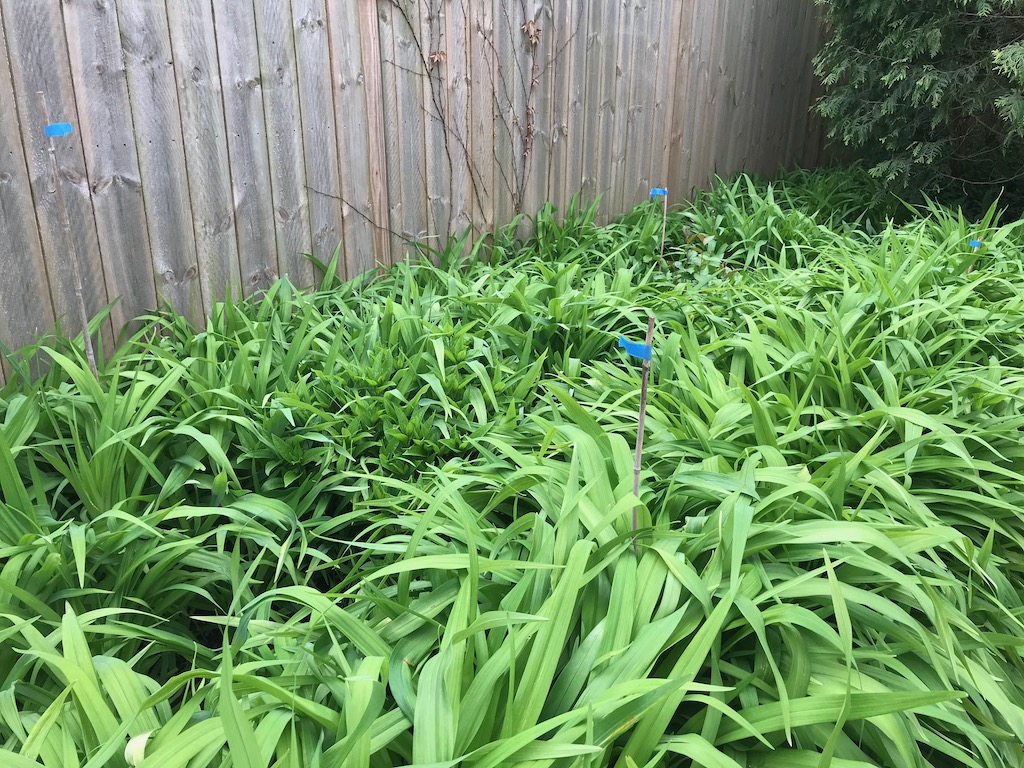
where, for instance, i start waxing on about a farm–so you start imagining endless loam, far as the eye can see, and perhaps a barn and silo, certainly a mooing cow with muzzle pressed against the pasture gate–and then you realize that what i mean, what i’m setting out to carve into the earth, is nothing more expansive, nor more exotic, than a plain old raised bed. a 4×8 plot of decayed leaf and loam (and for good measure a pile of old manure). a mound on which to sprout a vegetable or two. perhaps an herb, for good measure.
in other words, in the world inside my head, the one where my very own picture shows play all day long, what i see might not be exactly what’s before my eyes. (effusive and sometimes far-fetched imagination is requisite number 1 for anyone who dreams of a life of pen to page, i’d argue.)
fact is, for all my daydreaming about white picket fences and tomatoes so fresh from the vine they’re still sunshine-warmed as i unscrew them from the stem, this so-called plot for which i lift my spade and hoe, might well become little more than an exercise in rolling out a romping ground, a banquet hall, for all the critters who nightly prowl along the hardly bucolic back alley.
which brings us to calumet farm.
as is sometimes the case in a writerly family–in other words, a motley crew of folk who relish words with the enthusiasms others reserve for, say, wine or dollar bills–the tangled knot of daylily, weeds, and the occasional errant acorn-on-the-rise has already been named, though i’ve not yet hauled a single shovel to the plot. (that’s this morning’s project, putting blade to earth.)
calumet farm, outside lexington, kentucky
calumet farm, you see, is a magnificent kentucky horse farm, one my uncle danny used to run before he was killed on iwo jima in a brutal midnight raid near the close of world war II. it’s a farm where two triple crown winners–whirlaway and, later, citation–and, in all, eight kentucky derby winners ran the fields. it’s a farm where my very own papa spent his every boyhood summer, curled up reading near the barns, so the story goes.
and my beloved bespectacled mate, the one i hoped would not mind my latest fixation, well, he latched right on–enthusiastically!–once we gave him naming rights. he’s downright tickled to have our very own calumet farm sprouting on the back acreage (even if he is insisting i hoe along the alley, where it won’t disturb his line of sight. p.s. what he’s otherwise looking at is beyond me, all i see is grass and birds nibbling at the feeder…but such are the compromises that make a lasting marriage).
i believe i’ve heard him say he’ll be posting the calumet colors–famously “devil’s red” tracing the sharp edges of the pure-white barns and stables. (calumet was founded by the baking-powder folks, and to this day, that can is trademarked devil’s red.) if naming rights and colors are all i had to trade to get me a summer’s worth of fresh-plucked herbs, and one or two tomatoes, and all these hours of imagining, well that’s a deal i’ll make.
because these distractions of mine can sometimes take up more room in my brain than necessary, because i barely know my way through the tool shed, my faraway brother david, a master gardener, master carpenter, and all-round mensch, took on the role of patron saint of my plot. he’s spelled out in precise detail just the bolts and boards i need. even weighed in late last night on the contents of the 18 bags of loam and compost i’ll be mounding for the farm. when my biggest worry was whacking down the weeds, he scratched that with a simple, “google sheet mulch.” turns out those old moving boxes flattened in the garage will now be resurrected as the “floor” beneath my mounds. all i need do is slice away as much of what’s growing there, yank out roots that might have landed there over the years, and lay down sheets of cardboard. voila. instant start of compost.
once construction is done, and ben-gay amply applied to all my achy parts, i’ll begin the daydreams of what to plant. of course i picture some quaint english herbarium, as well as a bursting-with-a-vengeance vegetable plot, to boot. but truth be told, just one fistful of fresh-born dill or mint or basil, abundant and green and smelling of the earth, that’ll be enough to do me mighty proud.
there is something edifying about going beyond the confines of what you imagine you can do. and building me a farm, even a simple one by arithmetic measure, and doing so when up against an invisible plague that’s turned us upside down, it brings a sustenance you cannot buy at any grocery store.
maybe, too, it’s the turning in, the reliance on little more than our own muscles and our know-how. it’s staking a claim in this old planet, saying i can make my way here. maybe it’s emboldening in the age of pandemic to write your own survival guide. and, once again, to lean on the blessing and benevolence of this holy earth to carry us to safe-keeping.
best of all, my humble plot will always be the farm my brother david believed i could build. and his insistence, his quiet whisper, his certainty, is the bounty upon which all this will grow.
and now i’m dashing to the lumber yard, where a kind and gentle man named mike has all my boards and bolts ready to stash into the old red wagon, the wagon i will now think of as my very own farm truck.
what plots have you devised–amid this pandemic, or otherwise–to reach beyond your comfort zone, to show yourself the self-reliance at the heart of who you are, to prove to yourself you’re more than you imagine?
except for the centenarians among us, this is our first go-around with pandemics. and so, uncharted as it all is, little should surprise us. i stand somewhat surprised, though, that somehow — in the depths and folds of these blurry hours, where day upon day feels indistinct, where were it not for the winding of clocks on wednesdays, the old-lady shop on thursdays, the watering of plants on saturdays, i might never know what day is unfolding around me — i seem to have tumbled into an ancient, ancient practice. one rooted in the quiet turning of pages of glorious books. one rooted in prayer, in the sanctification of time, the anointing of hours.
it must be the little old monk in me.
i am utterly transfixed by the notion of the liturgy of the hours, the divine office (opus dei — the work of God), lauds, vespers, compline. morning prayer now begins my every day. morning prayer with candle burning beside me, casting its flickering light on skin-thin pages that turn with a crinkle as i slide the ribbons from section to section: invitatory, psalm, antiphon, collect, confession, thanksgiving.
the lexicon is almost as old as time. the notion of fixed-hour prayer, paying keen attention to the seasons of the day — the shifting of light and shadow — is a practice shared by all the great religions: buddhism, hinduism, islam, judaism, christianity.
the early christians borrowed it, of course, from the jews, who were commanded to pray the holiest prayer, the sh’ma, upon rising and retiring, and who stitched 100 blessings into the arc of the day, lifting the most quotidian of acts — washing hands, hearing thunder, beholding the bloom of the almond tree — into the realm of the holy. the psalms, written by the most brilliant hebrew poets, were read by jews — including jesus and his earliest disciples –as “encounters with God, as stimulating and nourishing a spiritual mystery,” according to william storey, a liturgical historian.
by the fourth century, in the early roman empire, bishops instituted morning and evening prayer in the early cathedrals. in the sixth century, along came st. benedict who wrote down “the rule,” and with it the trellis of prayer that infused the monastery, calling the monks to arise in the darkness, to walk under the cloak of stars to the oratory where the night vigil was sung, and through the day, when the great bell was rung, to drop their work in mid-act — be it the stirring of soup, or the tending of bees — and encounter the angels in the sung prayer of the psalms. (i love that benedict refers to any chiming clock as a “portable monastery,” and instructs that “every chiming hour is a reminder we stand in God’s presence.” i will now consider myself to be “winding the monastery” every wednesday and sunday morning.)
all these centuries later, little old me picked up on the notion about six weeks ago. (no one ever pinned me precocious.)
what i know is this: tiptoeing down the stairs in the dark, hoisting my 2,974-page leather-bound tome, striking a match, kindling a wick, bowing my head, breathing in silence, it grounds me, and infuses my day. even my dreams, some nights.
reciting the words, inscribed millennia ago, whispered by generations before me, from all corners of this wobbling globe, beginning with a daily confession of sins, bends me into a posture of humility that seems so necessary — so countercultural — in this awful, awful age of much too much bombast. i’m enchanted. i’m sometimes disturbed (the god of biblical vengeance is not one i know). i’m always, always quieted. set straight for the day. beginning my day in the recitations launches me into the holy work st. paul instructed: pray ceaselessly. make the work of your day, the quiet of your day, make it all living breathing prayer.
i’m not alone in my preoccupation. rilke and ts eliot, hildegard of bingen and kathleen norris, certainly thomas merton, all were drawn to the undulations of stillness and prayer.
brother david steindl-rast, in his glorious little book, music of silence, writes that monastic prayer is a tradition “that regards each hour of the day and night as having its own distinct message for us.” he implores: “make everything we do prayer.” hour by hour, from night watch’s invitation to “trust in the darkness,” to laud’s morning question — “whom can i make a little happier” in this gift of a new-born day? — brother david draws us into the certain knowing that hour upon hour begs our attention, invites sharper focus on divine intention.
it’s all the sacred practice of paying attention. beholding the beauty, the blessing of each anointed minute and hour. in the same way i’m gobsmacked by the shifting of seasons across the year, i am rapt by the seasons of light and shadow in a day, the invitation to be immersed in each hour’s offering.
i turn to that brilliant radiant rabbi whom i revere, abraham joshua heschl, for one last illumination here, one to carry through this whole blessed day:
he who has realized that the sun and stars and soul do not ramble in a vacuum will keep his heart in readiness for the hour when the world is entranced.
for things are not mute:
the stillness is full of demands, awaiting a soul to breathe in the mystery that all things exhale in their craving for communion.
out of the world comes the behest to instill into the air a rapturous song for God…
a few of the books i’ve been burrowing into, include these:
a beautiful treasure of a book: Seven Sacred Pauses: Living Mindfully Through the Hours of the Day by Macrina Wiederkehr. (brilliantly recommended by jackie, a dear friend of the chair)
Rainer Maria Rilke’s Book of Hours: Love Poems to God
Thomas Merton: A Book of Hours…..
David Steindl-Rast: Music of Silence
and, if you’d like to poke around online, and hear magnificent gregorian chant (a meditation for another day) try Brother David Steindl-Rast’s Angels of the Hour
it must trace back to the breast. yes, the original suckling breast. (forgive me for shocking so early in the morning, but, yes, this is where we begin.) imagine the soft fullness of the mother’s breast, engorged with milk, tubes and ducts surging with all a little one needs. imagine the heartbeat just beyond the milk. imagine the baby’s cheek pressed against flesh; pillowed, you might say. imagine the countenances, eyes locked in a channel of concentration, mother to babe and back again. imagine the wee little curls of finger, grabbing hold and not letting go; flesh entwined with flesh.
that must be the original comfort food: sustenance. warmth. insistent and unceasing rhythm of heart, the original lullaby, non?
and so, we humans are hard-wired to seek it.
it should not surprise, then, that in a moment of global paralysis, when you can’t get out of the house where you grew up (and your mother and father have nothing more to do than indulge you in their too-lavish attentions), when your college campus is far beyond reach, when the springtime you imagined has gone up in red-ringed vapors, there might come urgency in the department of cooking.
comfort cooking might be the call of the day. comfort cooking might teeter on the sharp edge of survival. comfort cooking might be the handiest cure for the stuck-at-home blues.
which brings us, oddly, circuitously but certainly, to the subject of rice pudding.
what began as almost an afterthought at the grocery store, a last-minute swipe for some plastic-tubbed goo on the shelf, a goo labeled “rice pudding,” took on a bit of a life of its own. it started with an off-handed, “i wonder if you can make that” (for one of us grew up in a house in the space-age food revolution days when true kitchen liberation was found in the form of boxed mixes for everything, and scratch-cooking was so yesteryear; in the house where i grew up, brownies came from betty crocker’s red-spooned box, and not once did i witness rice stirred into pudding).
because one of us is in the business of gobbling down whatever is put before him, and another of us is especially in the business these days of reaching beyond the ho-hum, trying valiantly to infuse a touch of indulgence into the day, it became something of a quest in this old house to stir our way to rice pudding perfection. or, at least, a pudding sans gelatinous lumps, a pudding with just the right kiss of sweetness, a pudding so lick-your-lips-able that it might have you sneaking into the fridge in the wee, wee hours. a pudding with raisins, of course.
despite my protest and preferences, brown rice was immediately ruled out. forbidden, more like it. if this pudding was going to provide one ounce of comfort it was going to be washed out and white through and through. in a pinch, mark bittman (our go-to guy so very often, for he lures with his promise of “how to cook everything“) provided the road map: water; rice; salt; milk; sugar; cinnamon.
what resulted was soft, sweet, and passable. but that only taunted. we somehow locked onto the notion that what was needed was something spectacular. something so comforting it just might fill up every null and void, just might make us forget for one flash of a moment (as long as it takes to swallow a mouthful of pillowy softness) how hungry we were to get on with our once-ago lives….
and so the pudding trials commenced.
we sought out a coterie of experts: nigella lawson (she indulges with double cream, arborio rice, and muscat wine). the pioneer lady (she soaks her raisins in whiskey, for heaven’s sake, adds a splash of cream and — because she’s the pioneer lady — dollops a fat pat of butter). ina garten, aka the barefoot contessa (she takes it over the top with dark rum, basmati rice and — get this — 5 cups of half-and-half). we had ourselves a holy trinity of comfort makers, each with her own derivation.
and then, along came an heirloom from a friend, an unsuspecting formula for rice pudding confection. we knew it might be a winner as soon as we saw that the provenance was simply, “mother.” as in a nursery recipe passed from mother to daughter, one of the kitchen bequests that brings back whole moments in time, conjures up storybook scenes of kitchen comfort. that after-school moment when a pudding is spooned in a bowl, and along with fat grains of rice, afloat in a creamy perfection, there is a mother’s voice, soothing. perhaps even a hand rubbing the back, kneading the knots out of the shoulders clenched from a long day of worry or heartache.
that’s what an heirloom recipe does. that’s what comfort cooking is all about. it’s alchemy in its very best form: the power to heal, to chase away the blues, to restore your faith in the long days ahead.
here is my friend’s unadorned, utterly simple roadmap to rice pudding perfection:
Raisin Rice Custard
(Mother)
3 eggs
2 1/2-3 cups milk
2-3 T. sugar for each cup of milk (make as sweet as you like!)
1 t. vanilla
generous pinch of salt
nutmeg
1 cup or so cooked white rice (day old is best)
1 cup or so raisins
Scald the milk (heat slowly until little bubbles around edge of pan). Beat eggs lightly, add sugar and salt. Slowly add the scalded milk, stirring. Add vanilla and about 1/4 t. nutmeg.
Pour this mixture over the rice and raisins in a buttered 2-quart casserole dish. Sprinkle with nutmeg. Bake custard in a pan of hot water at 350 for 50-60 min. or until knife comes out clean.
and here is nigella’s (note: it’s written for cooking in merry old england; translation necessary):
Nigella Lawson’s Muscat Rice Pudding “I am not suggesting that the basic, plain version of rice pudding is in any way deficient,” says Nigella, “but this muskily ambrosial version is mellow heaven. Perfect dinner-party comfort food.” Ingredients
500ml whole milk
500ml double cream
50g unsalted butter
150g pudding or arborio rice
250ml muscat wine
50g caster sugar
Pinch of salt
Fresh nutmeg to grate
Method
Preheat the oven to 150°C/gas mark 2.
Combine the milk and cream. In a 1.5-litre, hob-proof casserole dish, melt the butter over a medium-low heat, add the rice and stir well to coat, then add the muscat. Stir well and let the syrupy liquid bubble away for a couple of minutes. Then pour in the milk and cream and add the sugar and salt, stirring as you do so. Bring it back to a gentle bubble, stir well again and grate over some fresh nutmeg.
Put in the oven and cook for 2 hours, stirring after the first 30 minutes. Check the dish after 11⁄2 hours – the depth of the dish and the nature of your oven may make a significant difference. The rice should have absorbed the liquid, but still be voluptuously creamy. Remove and cool for at least half an hour before eating.
what’s your roadmap to comfort on those days when you’re ground to the bone?
having now lived 44 days in fear of invisible spiky red-ringed viri that might or might not be lurking on the sides of my milk carton, having grown accustomed to wrapping my face in a variety of shmatas, having mastered the art of bleach spritzing, i think it’s fair to say we all know a thing or two about Life in Pandemic.
the trajectory, i submit, goes something like this: week 1, dizzying nausea at the prospect that we really truly are running low on toilet paper and, for the first time in our lives, we hold little chance of bringing in reinforcements; week 2, full-throttle determination that we will surrender to the new-found wonders of Zoom and the vernal explosions that must be teaching us lessons; week 3, a creeping sense that a calendar can get just as overbooked and exhausting by Zoom as in the Time Before Corona; weeks 4 through 6, a blur. which brings us crashingly to now, the thick of week 7 in which many many of us — for a host of reasons indecipherable and/or clear as the day is long — hit or are soon to hit the proverbial wall.
the signs are these: dinnertime is drowned in tears (note to self: you can omit the salt shaker on the table if the tears are profuse enough). you wake in the night because your left baby toe is throbbing (reason unclear; something to do with knots of nerves wedged between your tootsies, which has something to do with, ahem, aging) and that’s it for the night as a thrashing storm of what-ifs hurl through your noggin, and propel you from bed drenched in a glistening sweat.
all around this week i gathered up evidence to back up this half-baked notion of mine: my best friend in california went to bed the other night worried to death about rising temperatures and the too-real threat of wildfires, awoke to her mattress vibrating under her bum (it was an earthquake, not the latest in west-coast slumber device), and stumbled into the bathroom where she writes that she consoled herself with the somewhat comforting thought that “at least we’ll all die together.” (it might now be obvious why we’ve long been very best friends; we share a disaster-is-looming view of the world.)
she’s not the only one teetering on the pandemic brink. (for quick — and rare, here — current events commentary i might also submit that the present inhabitant of the white house, the one who last night suggested we all guzzle — or inject — lysol as cure for the red-ringed virus, he too might have succumbed to the pressures. but then again…)
even CNN’s media guru, brian stelter, admitted in print that he’d flat out hit the wall, after failing to send out his nightly roundup of all you need to know about news and the news biz.
it can get to be too much: the daily death count, the ever-extending shelter-at-home orders, the shelves that might never again hold toilet paper or lysol (and now that the president is urging ingestion thereof, it might be a public health boon to keep the lysol out of the hands of the american masses).
and, frankly, this is novel to all of us. some days i’m tempted to peek behind the budding leaves of the trees to see if maybe this is a movie set (not too many years ago in this leafy little town they filmed a horror film called “contagion,” and hordes of cute little kids from my then-first grader’s class were cast in roles that had them bleeding to death and being rushed from the schoolhouse on stretchers). maybe if we shake our heads wildly enough, we’ll awake and tumble back into our humdrum life of abundant TP and milk cartons that don’t beg to be run through the lysol bath.
truth is it hit me hard the other day when i found out a beautiful and glorious mom down the block had died, one month after being diagnosed with a cancer. she used to work with me at the tribune. she was one of the brilliant lights on the marketing side of the news biz. she was the mother of three magnificent girls, and she lived and breathed for those girls. they buried her yesterday, after a service held by Zoom.
i can’t shake the sadness of that, can’t stop thinking how the last month of her life — sheltering at home while dying of cancer — must have been unbearably suffocating. or maybe, i pray, there came a clarity — and a calm like my friend in her california bathroom who consoled herself — staring into the razor-sharp truth, holding tight to the few fine things that make it all matter.
some days these are impossible times. some days we can breathe again. some days we weep. and some day, i’m certain, we will once again be able to wash away the tears from the cheeks of the ones we love — from less than six feet away.
i won’t ask if you’ve hit the wall. i will only say that, if so, it’s the truth of the times in the age of pandemic, a subject on which we are now immediate experts.
“why is this night different from all other nights?”
year after year for all the years we’ve been circling ’round tables when the paschal moon is at its plumpest and pinkest, telling and retelling the story of exodus — of plagues and passover and a promised land just out of reach — that question, the first of the four questions traditionally asked by the youngest, sharpens the focus on the holy act of separating time. setting aside particular hours, according to particular rising and setting of the moon in the heavens, lifting those hours out of the ordinary, sanctifying. making holy. erecting cathedrals of time, in the words of abraham joshua heschel, the late great rabbi and thinker, who wrote:
Judaism is a religion of time aiming at the sanctification of time. Unlike the space-minded man to whom time is unvaried, iterative, homogeneous, to whom all hours are alike, quality-less, empty shells, the Bible senses the diversified character of time. There are no two hours alike. Every hour is unique and the only one given at the moment, exclusive and endlessly precious.
Judaism teaches us to be attached to holiness in time, to be attached to sacred events, to learn how to consecrate sanctuaries that emerge from the magnificent stream of a year. The Sabbaths are our great cathedrals; and our Holy of Holies is a shrine that neither the Romans nor the Germans were able to burn; a shrine that even apostasy cannot easily obliterate.
this year, the question — why this night? — carried particular resonance. and its sister question, why is this week different from all other weeks, begins to burrow into the holiest questions quivering just beneath the surface of all this 20-second hand washing, and bleach-and-water spritzing and tying of masks round our smiles.
in a week woven with tradition — with particular prayers in particular places, particular recipes, particular gatherings year after year after year — it’s all broken open. it’s all in shards and pieces we assemble and reassemble as best we can.
i think here of the japanese art of kintsugi, beholding the beauty in the brokenness, not occluding or hiding the cracks, but filling them in with rivers of shimmering radiant metals, gold or silver or platinum. deeply understanding the infinite wisdom of rumi, the sufi mystic: “the wound is the place where the Light enters you.” or the resounding redemptive truth of hemingway’s glorious line from a farewell to arms: “the world breaks everyone and afterward many are strong in the broken places.”
and in this old house where we weave passover and holy week, where the retelling of the parting of the sea, the fleeing from evil pharaoh, the pestilence and boils and locust and darkness, the slaying of the firstborn (the litany of plagues that visited upon egypt) interlaces with the stories of the last supper, the betrayal of judas, the flogging and crowning with thorns, the crucifixion, i found salvation in the spiritual practice of making do.
and there, in the straining of imagination, in the redefining and refocusing on the essence at the root of each strand of tradition, in scouring the pantry, in testing the powers of my own ingenuity, i began to see in sharp focus the extraordinary blessing in reinvention, in improvisation, in the promised land just beyond my reach. in the imperative of bypassing any and all shortcuts. working just a little bit harder. discovering joy at each tiny triumph.
take the chicken marbella.
over the decades since the silver palate cookbook was first published in 1979, and over the decades at the passover seder where i’ve marked the first night of prayer for 36 years, that glorious rendition of chicken and olives and prunes has become synonymous with the jewish rite of spring. add to that the fact that my home-bound freshman in college happens to love it, practically licks the plate of it. (and these days — passover or not — i’ll climb any mountain to bring him one iota of everyday ordinary un-quarantined joy.)
i’d decided a week ago that, come heck or high water (an apt expression in the season of red sea crossing), i was going to muster up a pan full of that vernal succulence. eyeing the few parts of chicken in this old house, i tucked away a package of breasts at the back of the freezer, knowing i might not fetch another till this pandemic is ended. i happened to find just enough dried prunes in the pantry to realize i was halfway there. olive oil, oregano and garlic, i scrounged up with little worry. brown sugar, ditto. white wine i found in the dark and dingy corner of the basement. it was the spanish olives that presented the hurdle. so i made do: i found a few lonely olives, black ones not green, at the back of the fridge. and i stirred it all up like nobody’s business, rejoicing all along the way that i’d found a way — through scrounging + improv — toward chicken marbella.
next up was the seder plate: where in the world does one look for a roasted shank bone in the depths of pandemic? and was i really going to sacrifice one of the six lowly eggs in the fridge for a ceremonial platter of symbols? i was not. so off to the cupboard i trotted, reached for my half-dehydrated markers and scissors. grabbed a sheet of printer paper, and voila, shank bone, egg, and — the hardest procurement of the week — one square of matzo, all kosher for passover. haroset — the apple, walnut, cinnamon and wine meant to remind of the mortar used by the slaves who built pharaoh’s pyramids — that came courtesy of the many-years-old bottle of manischewitz concord grape wine stored in that same dingy corner of the basement, and a stash of walnuts left over from christmas.
but, when we sat down to our laptop, dialed into our zeder (seder by ZOOM, the cyber salvation of the red-ringed siege), we had ourselves a proper seder table, from marbella to matzo, the ingenuity way.
all that making do, all that finding my way — deciding what’s worth the effort, what doesn’t matter — it’s becoming a meditation in mindful distilling. take nothing for granted. turn in to your own toolbox of tricks. never mind the easy way. do away with the unnecessary.
have you noticed that barely-enough makes for extraordinary? have you sensed the keener attention you pay when so little is taken for granted? when i sliced into a ripening pineapple the other morning, and discovered it was perfectly golden and sweet, not hard and pale yellow as it sometimes can be, i felt a sigh of pure joy riveting through me. you would have thought i was an arctic explorer staking my flag in the pole, so triumphant did i feel at suddenly beholding my cache of pineapple perfection. when’s the last time you remembered for days how sweet your pineapple was?
and so it is in the time of corona. when a trip to the grocery store — or a ride on the el, or rubbing elbows with the stranger wedged in beside you at the movies or museum or ballpark — without fear of catching a potentially fatal infection might never again be taken for granted.
we are all, collectively, living and breathing improvisation. expanding the boundaries of what we thought we could do (heck, i’m now very best friends with the sourdough starter bubbling away at the back of my fridge, and i’m zooming into book groups all over the globe, chanting with monks hundreds of miles away). we are looking out for each other in ways we might not have before (sending meals to ER departments, sharing seeds with the neighbor next door).
the brakes have been halted on this mad-paced world. and yes, it’s filled with heartbreak upon heartbreak. jobs are being cut (i lost one of mine). paychecks are being slashed (happened here, too). magnificent glorious souls are breathing their very last breath afraid and alone (dear God, praise the nurses and doctors who step into those holiest of shoes). the obituaries (some of them being written in the room just above) will make you weep (and they do, day after day).
but inside of all the uncharted fear, and the bureaucratic ineptitude that might make you furious, this holiest week is upon us, and it’s teaching us lessons we might never have otherwise learned.
in the nooks and the folds of making-do, i’m paying closest attention to those deepest essentials. and therein lies the holy way home.
what making-do moments have you encountered this week? and what lessons spilled forth?
a housekeeping note: you might have noticed that all week long, in the comments of each week’s post, i’ve been tucking away especially succulent morsels i happen to come across in my cyber adventures. as we’ve long considered this our shared kitchen table, it seems more than apt to leave little bits of deliciousness all week long. so be sure to click back, and scroll through the comments, where i’ve left a bevy of links and snippets of poetry.
before i go, here’s one i clipped from a letter the great george saunders wrote to all the fledgling writers at kenyon college whose spring quarter was snatched away. he wrote a beautiful long letter, but this one paragraph i saved just for you:
from George Saunders to Kenyon writers:
There’s a beautiful story about the Russian poet Anna Akhmatova. Her husband was shot and her son arrested during the Stalinist purges. One day she was standing outside the prison with hundreds of other women in similar situations. It’s Russian-cold and they have to go there every day, wait for hours in this big open yard, then get the answer that, today and every day, there will be no news. But every day they keep coming back. A woman, recognizing her as the famous poet, says, “Poet, can you write this?” And Akhmatova thinks about it a second and goes: “Yes.”
may we all find poetry, even amid the pandemic….
and now i enter deep into my holiest hours….the triduum of holy week….
(p.s. that’s our zoom seder screen shot above, same characters year after year after year. beloved mary schmich, the brilliant pulitzer-prize-winning chicago tribune columnist, wrote about it….here.)
file this under “desperately seeking proof.” or perhaps, “it’s so necessary this time round.”
the subject is the eruption of spring: that moment, year after year, for as many years as there’ve ever been, when the whole chorus of buds, the vocal cords of feathered flocks and the tips at the ends of the trees, all decide at once to clang the cymbals, pound the drums, and explode like nobody’s business.
it’s so necessary this time round. so necessary when the airwaves fill us with cataclysmic reports, when going to the grocery is an exercise in holding your breath, when reading the morning news just might have you heaving before your first spoon of cornflakes.
here in my little corner of the world, about three fingers in from the east coast (if you’re looking at a palm-sized map), a whole thumbprint down from the canadian border, hard against that blue pendicle we know as lake michigan, there is the faintest rumbling of spring. not nearly enough. not enough for a vast swath of humanity staring out the kitchen window on high alert for the invisible virus, not enough for worn-down souls on the lookout for hope.
so i’ve been doing my part: i’ve put serious thought to my latest rube goldbergian plot. my plan to coax the eruption out of the earth. i’ve pictured myself out in the deep ink of the night, knees folded into a crouch, fist wrapped tight around a flashlight, pointing the beam onto stem after stem, branch after branch, seeing if a little light therapy might coax things along.
i’ve got friends in far-off-enough places who are sending me dispatches of itty-bitty finch eggs already laid. cherry trees awash in their seasonal meringue.
here in sweet chicago, here so close to the lake you can hear it lapping the shore: nada, zilch, practically zero. certainly not enough for a soul hungry for spring in the same way some of our bellies growl at the first whiff of oozy cheese in a griddle…
perhaps it would help if i scrawled paint onto a banner, spelled out the plea, “dear mama earth, PLEASE HELP!” we are in serious need of emotional rescue down here. we would do well to fall into the arms of magnolia. might cheer to a bluebird riding along on our shoulder. might fling ourselves face-first and eyes wide open into a bed of tulips and daffodil. fill our lungs with parfum de lilac instead of the fear of the red-ringed demon.
oh, there’ve been the subtlest of cues: goldfinch feathers dropping their wintry drab, taking on the sunshine-gleam of gold that gives them their name; the first lilliputian daffodils putting up their periscopes of promise (see proof above); the birdsong that cannot wait for first light of dawn, birdsong so thick you might think it a recording.
but this is no year for subtlety. this is a year for all the hope we can find. we are holding our breath down here on planet earth, where the whole globe is at a standstill. we need a vernal exclamation like never before.
those faraway friends tell me it’s coming. a friend in cambridge says, except for corona, this would be the most perfect spring she’s seen in a very long while. except for corona…
because my days are a checkerboard of occasional plug-ins — chanting with monks on mondays and thursdays, inhaling celtic spirituality direct from galway nine days in a row, chiming in on a once-a-week book group based in seattle — i’ve plenty of time for prowling my plot. i make the rounds at least twice a day, on the lookout for any sign of eruption. all but wander the walks with measuring stick and string, all in the hopes of seeing some progress.
this is a season for turning our keenest attentions to the rumblings of earth, to this most intoxicating science and faith that never fails, that offers page after page of wisdom and truth.
this unforgettable spring we are learning the art of deep patience. “ride it out,” is the mantra. “stick close to home,” the instruction.
i, like you most likely, have hours when my knees go wobbly. i’ve wiped away the occasional tear or two (or five). i’m trying to be something of a lifeline for a kid i love who’s all alone in a faraway place, where the walls sometimes press in. trying to make life here at home as tranquil and gentle and sometimes delicious as i can possibly muster. (for reasons that don’t quite escape me, i’ve taken keen fondness for a spritz bottle of lavender mist, which i spritz till the sheets and the pillows are soggy. and i figure the more delicious aromas i can stir from the kitchen, the better the chances i can steady the kid in the room up above, the one whose spring semester has — like everyone else’s — gone up in red-ringed vapors.)
it’s a master class in surrender to which we’ve been enlisted. no one asked first if we’d choose it. it was thrust wildly upon us.
the questions are these: how quiet can we go? how calm might we settle our souls? what new and wondrous epiphanies might drop before our eyes, our hearts, our imaginations? what brings you peace? where is your joy? what pulls you out from your darkest hours? who is your lifeline?
and, where oh where, is the promise of spring?
and suddenly, the holiest of weeks is almost upon us: holy week and easter for churchgoers; passover for jews. as i sink deep into the braiding of those two ancient traditions, i leave you with this from our rabbi, a page from the prayers of passover, as we mark the exodus — safe passage — from egypt, in search and hope and belief in the promised land. it’s a theme with particular resonance this year….
In our prayer book,Mishkan T’filah, we read about the crossing of the Red Sea:
Standing on the parted shores of history
we still believe what we were taught
before ever we stood at Sinai’s foot;
that wherever we go, it is eternally Egypt
that there is a better place, a promised land;
that the winding way to that promise
passes through the wilderness.
That there is no way to get from here to there
except by joining hands, marching
together.
join hands, march together; believe in the promised land….
have you stumbled into epiphanies? found yourself a lifeline? what are the saving graces in your days?