pull up a chair

where wisdom gathers, poetry unfolds and divine light is sparked…

Category: angels among us

“by little and by little”: dorothy day, a guide to loving

dispatch from 02139 (in which, at long last, there is time in the day, here on the banks of the river charles, to take a few lessons from one of the 20th century’s modern spiritual pioneers and religious revolutionaries, dorothy day…)

if sabbatical has its roots in sabbath, to rest, to restore, then that is what pulled me, three months ago, to sign up for religion 1004, “modern spiritual pioneers and religious revolutionaries.”

i scanned across the list of saints whose lives we’d be studying — gandhi, martin luther king, thich nhat hahn, abraham joshua heschel — and i was hooked. i saw one more — dorothy day — and i was writing the professor begging to be allowed at the seminar table.

dorothy — for i don’t think she’d want me to call her ms. day; she’s not like that — has been my deep catholic hero for a long, long time. her brand of catholicism, the catholic worker movement founded, in part, on hospitality houses for the poor, the lost, the wholly left-to-the-margins, is the brand i still believe in.

i grew up, spent my holy years, in the 1960s.

stepped into my first dark confession box back in those turbulent days — just post vatican II, when the church was turned on its head, a year after JFK was assassinated, at the height of the escalation of the vietnam war — heard the opaque window slide open, heard the priest’s breathing, heard my own heart pounding as i scoured my soul, got ready to spill all my sins there on the ledge. tasted my first dry, wheat-y communion wafer. wondered what to do when it got stuck on the roof of my mouth.

and then, in seventh grade, it got really deep: we had a nun who’d stripped off her habit, who stood there in sweaters and skirts, strummed a guitar, and turned off the lights so we could watch — over and over — “the red balloon,” sing kumbaya. radical jesus — with his long curly hair and sandals, friend to the thieves and the whores — was a god made for the decade of protest, anti-establishment.

all along, i’d spent hours at bedtime, praying that i could be better come daybreak. be more of a saint. try harder. one lent, when i was in third grade, i think, i got up early, rode my bike to 7 o’clock mass every morning. because i thought it would make my soul shine brighter.

i never stopped trying.

and then, along came the likes of mother theresa and gandhi, and later, dorothy day.

they were my brand of catholic. they scooped souls out of gutters, touched the untouchables, turned away from the gilded altar cloths and the chalices locked away in a safe in the dark of the church.

they were what drew me to appalachia in college, what pulled me into a soup kitchen on the west side of chicago. they and my mother, truth be told.

but my mother has never written out her theology, just told me once, in a few short words (all i needed to hear really) that, after my father died, she figured she’d devote all the days of her life to God, and live a gospel of love. so she does, and i watch.

over the years, i’ve read snippets of the life of dorothy day. knew enough to call her my hero, claim her as my personal saint.

but i hadn’t taken the time to pore over her writings, to absorb the whole of her story — in her words.

and right now, because we’re at that part of the reading list, because for the next two weeks, on mondays at 4, i’ll be sitting at the seminar table in the great gray stone tower that is harvard divinity school, i am reading dorothy. curled up on the couch with her all yesterday afternoon, an afghan under my bare toes, a fat mug of tea and an orange fueling me along the way.

i read paragraphs that could change me forever. so, of course, i’m sharing them here. see if you, too, discover a trail to carry you through the rest of your days, even the days when we’re lost in the deep dark woods. (the italics, for emphasis below, are mine.)

“…she did not expect great things to happen overnight. she knew the slow pace, one foot at a time, by which change and new life comes. it was, in the phrase she repeated often, ‘by little and by little’ that we were saved. to live with the poor, to forgo luxury and privilege, to feed some people, to ‘visit the prisoner’ by going to jail — these were all small things. dorothy’s life was made up of such small things, chosen deliberately and repeated daily. it is interesting to note that her favorite saint was no great martyr or charismatic reformer, but therese of lisieux, a simple carmelite nun who died within the walls of an obscure cloister in normandy at the age of twenty-four. dorothy devoted an entire book to therese and her spirituality of “the little way.” st. therese indicated the path to holiness that lay within all our daily occupations. simply, it consisted of performing, in the presence and love of God, all the little things that make up our everyday life and contact with others. from therese, dorothy learned that any act of love might contribute to the balance of love in the world, any suffering endured in love might ease the burden of others; such was the mysterious bond within the body of Christ. we could only make use of the little things we possessed — the little faith, the little strength, the little courage. these were the loaves and fishes. we could only offer what we had, and pray that God would make the increase. it was all a matter of faith.”

— from “Dorothy Day: Selected Writings,” edited and with an introduction by Robert Ellsberg.

by little and by little.

now there’s a theology i can grasp, clench in my hot little fist.

we could only make use of the little things we possessed — the little faith, the little strength, the little courage.

these were the loaves and fishes.

we could only offer what we had, and pray that God would make the increase.

most days i don’t have much. but by little and by little, i can steady my wobbles, and put one foot forward.

i can try, with all my might, to live a life of love, by little and by little.

there is much this week to pray for, in the heartbreaking wake of hurricane sandy, who has left my beloved in-laws without heat or light or power on the jersey shore, who has turned my sister-in-law’s new york brownstone into a hospitality house for all those with nowhere to go. who spared us, and our sweethearts in maine. for all the heartbreak, up and down the eastern seaboard, i pray for repair and for strength, by little and by little. 

your thoughts on the wisdom of dorothy day? and if she’s not the one who guides your days, who is?

a suspended state of the new

yet another 02139 dispatch…

looking back, some day, all the rest of the days of my life, these seamless hours might seem a blur. but living them, waking up in a room where lace curtains blow, where the view out the window is a shingled roof i’ve not yet memorized, each and every day is in fact a living breathing experiment in the new.

the paths we cut through this enchanted city, wholly unexplored. each and every day we seem to discover a new one, turn a corner we’d not turned before. get lost for a minute. grow still, as we sink down to find our bearings.

for a girl who hums with the familiar, all this new, this suspended state of the new, is rather awakening. like a glistening rainstorm that pounds your every pore. shakes you from your long-held somnolence. shouts, wake up. pay attention. don’t get lost here.

so much newness tumbles across the tableau of a single week, it is hard to gather it all up in  my mind’s short-handled basket. just this week, there was the new school for the little fellow, the new long corridors that seemed to twist and turn on first ambulation, the new classroom, shiny, bright and filled with what might be.

there were new libraries for the big people, shadowy stacks in the bowels of widener library, where the librarian whispered, “you are now standing in one of the world’s greatest research libraries,” (and not a syllable here seems hyperbole), reading rooms the likes of which i’ve only seen in movies, say “love story,” that long-ago ali-mcgraw-gut-wrencher whose scenes sometimes unspool before my eyes as i walk this campus and think, oddly, “i’ve seen this frame before, though i’ve never walked these yards and paths.”

i am learning the vernacular of a place that calls a semester’s course, a “half-course.” i am learning that “to shop classes,” means to go and pile up your academic plate with a smorgasbord of flavors, of professors, of headline names, and stingily and voraciously grab a course to call your own. i am watching those around me make spread sheets of the seven, eight or 12 classes they intend to “shop.” i, though, pulled out a ruler, a felt-tipped pen and a sheet of printer paper, and i made myself a chock-a-block chart of my four academic courses plus writing seminars and master class.

even the simple act of dinnertime is hardly what it was back faraway home, where grammy’s 3-4-5 stew was a culinary highlight of many a week. the other night, for instance, a whole lot of us tumbled into cars and city buses and rode out to somerville, to a mecca i’d return to twice a week if i had spare change. it was ethiopian feasting, and we let our senegalese photojournalist do the ordering, seeing as his roots in western africa made him the one most familiar with the unfamiliar offerings.

three platters arrived, large baskets, draped with soft flat breads, and poetic mounds of chopped salad holding down the north and south poles thereon. the waitress, a lovely charcoal-eyed woman with a smile that caught my pale-gray eye, ferried to the platter bowls of curries (eggplant, and lamb, and spicy chicken), and lentils and potato-cabbage-carrot concoctions i wanted to scoop up with my fingers, they were so delicious. and in fact, that is precisely how we ate that night: thumbs and pincher fingers served as fork and spoon. that, and scoops of flat bread, held like a napkin in one hand, torn and used to envelop more deliciousness than i could ever muster from a fry pan.

and so it goes. new upon new upon new. an adventure from dawn till nearly midnight, when i collapse into bed, and sleep like i haven’t slept since i was maybe 9, and wore myself  out playing in the woods on a long summer’s day.

amid all the new, i step outside myself to keep watch on how i find my way. i am intrigued at how we humans grope for the familiar. how, like magnetic poles, we are pre-set to stitch french knots of the known into the white cloth of unknowns, of foreign, of i-am-paying-attention-to-uncharted-footstep.

we are species in search of mooring.

i stroll the aisles of a shoebox of a market, tucked amid 17th-century cobblestone lanes, and i am lulled by the sight of a pink lady apple, an apple whose taste i know from home. but in the next aisle, i stumble on a raisin-studded bread i’ve never seen before. and i buy it, and bite in, and am filled with brand-new deliciousness. in a single grocery, i am anchored and catapulted.

and so it goes: i find my bearings where i can, i breathe deeply, and then i turn a corner and explore nooks and crannies intended to shake me out of stupor.

some day this will not all be so intensely undiscovered. some day, there will be rhythms again. there will be shores of the known, against which the unknown tumbles, crashes.

but right now, i walk the cambridge streets at full attention.

yet the miracle might be this: even when i turn a wrong corner, i find familiar company in, say, the blue moon that last night drooled illumination on all my footsteps. it is, i imagine, the divine cupping me in holy cradle. it is the whisper of the planets, reminding me, no matter how tangled the hours and the days and the footpaths, i’ll not get lost, truly lost.

so right now, amid these early days in our year of full adventure, i am inhaling deeply, breathing in the electricity, the power surge, that comes with never knowing what’s around the bend.

today’s agenda: a morning’s excursion to the harvard business school, where i’m told the halls smell of money, a perfume that’s certainly unfamiliar to this old nose. after that, a swim in walden pond. yes, walden pond, for cryin’ out loud. who knew you could splash in thoreau’s holy waters? but here we go. crimson-spotted legs now fading to unfamiliar pink, i’ll not be too shy about sliding them deep into that pond. a baptism, indeed, indeed. 

classes begin for all of us on tuesday. the sixth grader, at last, sinks into the classroom he has wondered about for months and months. but at least we now know the teacher’s name. and i will slide myself into the back of harvard classrooms, taking furious notes, plugging in my long-dormant brain cells.

in case you’re playing along at home, i’ve decided on these four classes: religion 1004 — “modern spiritual pioneers and religious revolutionaries,” taught in memorial church; soc-world 25 — the great global health pioneer, dr. paul farmer’s “case studies in global health: biosocial perspectives;” hds 2965, “virginia woolf and religion;” am-civ 200, historian jill lepore’s “major works in the history of american civilization.” 

egad. 

and now a question: how do you seek out the new amid your world of the familiar, and in what ways does it sharpen your senses and your thinking? 

p.s. last night,  for the pure joy of it, i wandered into the big white tent that was harvard divinity school’s 197th convocation. i don’t know that i’ve ever encountered so much godliness under one roof, and certainly the tent top seemed to billow heaven-ward. i was moved to tears during the trumpet voluntary, and during the new dean of the faculty’s remarks on “the fog of religious conflict.” he’s an esteemed scholar who grew up on the streets of belfast, during the long years of “the troubles,” and what he extracted from those bloody days, how he has catapulted tragedy into a worldview of peacemaking was, frankly, breathtaking. i will close with his closing challenge: “be actively engaged in peacemaking in all aspects of your lives.” 

amen. amen to all that. 

the year of magical living

it’s not even started yet, but already serendipity keeps tapping me on the shoulder, and as i turn my head swiftly to see who’s there, i discover a bright and buoyant sprite hovering behind me. it’s as if she’s cooing in my ear, soothing me with the words, “it’ll be all right.”

up and moving does not come easily to nesty girls, girls like me, girls with roots like wild fennel, that twisty-turny underground extension that nearly requires a crowbar to expunge it from the garden.

up and moving is not on my list of things i’d do on any old unscheduled monday.

no, not at all.

but here’s the thing that keeps giving me goosebumps: our adventure to cambridge, massachusetts, seems to be enchanted.

the uncanniest bits of magic keep darting into the cobbled lane, standing in my path, shouting, “look at me, you can’t deny me. who says you’re too old for make-believe and happily ever afters?”

it seems that there are life lessons here, ones worth mining, ones to hold up to the sunlight, to examine from every which way.

long, long ago in the depths of winter, once i’d talked my way through the self-imposed hurdles and barricades, the ones that tried to keep me back, the 101 reasons why staying put made much more sense than up and moving in the middle of my family’s merry life, why it seems the heavens took their cue, opened wide and showered down on me what, so far, seems a fairy-dusted parade.

there’s the third-floor aerie i’ve described in a meandering at the start of summer. and more than that — so much more — there’s the fellow you might technically call my landlord, though i now think of him as something of a life beacon, a spiritual guide, a friend.

why, just last night he sent a final email from his cambridge study, telling me how he’d transformed his college daughter’s bedroom into a room fit for an 11-year-old sports fanatic boy. he called it a “sports den,” went on to note that he’d erected bunk beds, found a bulletin board and hung it over the desk. he cleared shelves for the trophies that are sure to be accumulated (these days, at least in these parts, sports teams dish out trophies for the simple act of showing up….). he even bought and washed a set of twin sheets in a color he chose after careful consideration. he didn’t want my little guy sleeping on girl-colored sheets or store-starched ones straight out of the package; he wanted comfort for the sportster, and he stopped at nothing, bless his bountiful heart.

he’s left me a whole study filled with poetry tomes and texts. the sacred music shelf awaits, arranged in chronological order, no less (i’d best not mix up my medievals and my renaissance chants). and he’s written out directions to the monastery two blocks away, and the one farther down the shore where he tells me i can rent a hermitage for a $60 donation, and expect three meals with all that quiet.

here we pause for that holy exclamation, the one we shout at all our passover seders, “dayenu!” meaning, as if that’s not plenty enough….

ah, but there is more.

and the latest serendipitous installment is pictured up above. that charming house, the one with window frames in blue and red and yellow, the one with at least one parrot perched in a window, well it’s just down the lane from where we’ll be roosting, and i was so enchanted by its paintbox whimsy as i strolled past that first fine sunday morning when we sealed the deal on the aerie, i snapped its picture. i couldn’t help it. it just called out to me, and even if i only tucked it in my pocket in digital pixels, i could not leave it behind.

turns out i just spoke to the lovely woman who lives there, and it’s the very place where we’ll likely be parking our four wheels. we’d been searching high and low for lots or garages — civic, public, paved or unpaved, didn’t matter — and through the most circuitous, serendipitous of circumstances, i found myself just this morning on the phone with the owner of that storybook cottage, and as might be expected her voice is one that might lull you into a soft and feathered state of contentment.

now how could it be — other than pure stardust and moonbeams — that the one house in all of cambridge that i could not pass without clicking a snapshot is the one house where i’ll soon get to pull into the gravel drive, perhaps exchange a morning’s greeting, or a basket of muffins, with the dear dear soul who lives there?

and so, as i continue on with the steady work of packing up our clothes and a little boy’s essentials, as i feel the tug and pull of saying goodbye to friends and a house and a garden and a mother who i’ll miss each and every day, i keep my ear tuned to the whispers that keep coming from the east: i’m convinced that it’s the beckoning of sprites and angels, and they’re drawing me to someplace magical, to a year of deep enchantments and truths to last a whole life long.

all that’s left to do is play along….

dear chair friends, as i type these keystrokes, our beloved HH is being wheeled into surgery. hold her in your prayers. hold her, hold her…..she did not escape the fear that nearly leveled me. it’s her second round with breast cancer, and while the prognosis is great and good, a mastectomy is no woman’s first choice. dear God, hold her and all her hopes and dreams. 

and while we’re at it, please watch over my beloved landlords as they drive from massachusetts to new mexico, for the first chapter of their new adventure. the aerie is emptied out now, for a short spell. we’ll be the next ones who lay our sleepy heads on its pillows, who open wide the doors, fill the bird feeders, listen to the sacred chants. after we pull our shiny car into the slot at the paintbox house of serendipity and charm, and yet another new friend…

what serendipities have leapt upon your cobbled path of late??

the nesty girl’s guide to real estate

when you grow up curled into armchairs, with your nose pressed to the pages of fairy-tale storybooks, absorbed by the drawings of magic cottages tucked in the woods…

when you grow up meandering about the pond across the lane from your growing-up house, poking around in the woods you call your own, making logs into beds, and the seed pods of wildflowers into your make-believe kitchen…

when you grow up with a grandma who lives in an old fine house, with secret stairs and itty-bitty passageways, and an upstairs porch with creaking wicker chairs and fireflies dotting the summer night’s air…

when your idea of a heavenly summer as a 10-year-old girl is to spend it with cardboard boxes and your very best friend, cutting out fabric bits, and gluing and dabbing on paint, building a dollhouse that stretches from june straight into august’s last hours…

when all of those synapses have been connected somewhere along the way, when all of that cozy-cottage DNA courses through your chromosomes, well, you don’t look for a place to lay your head quite like the rest of the world. you don’t get wowed by granite countertops or showers that look as if they might lift off and whirl to outer space.

nope, you tend to poke around in peculiar uncharted ways. you know when you’re home when you hear the ping go off somewhere deep inside your noggin. you wait to feel the pounding there in your chest. matter of fact, you must have a light meter tucked back behind your eyeballs, because you always, always pay attention to the way the sunbeams filter in through the windowpanes.

you become over the years a decidedly undeniably nesty girl.

you turn into a someone who draws oxygen from dappled light dancing on old floor boards, who finds herself charmed by the newel post at the bend in the staircase, who spies clawed feet peeking out from under the victorian bathtub and you can’t wait to climb in.

you, very much so, find places to live by heart.

and you are over the moon when along with all of those lumber and glass particulars, you discover the person who owns the place is clearly a kindred spirit, a brand-new lifelong friend, the soulmate you’ve been searching for, without ever asking.

and so it was that we stumbled upon a charmed treetop aerie the other afternoon, one that will be our home for a year, the holy sacred place we’ll come back to night after night, as soon as we launch our big back-to-college adventure in cambridge, massachusetts, 02139.

as much as, just a few weeks ago, i could barely imagine leaving this old house that owns a piece of my soul, i discovered this week what i’ve always known: four walls and a roof are only the beginning.

what makes a place home are the whispers you hear when you tiptoe in through the doorway. what makes a place home is the way some invisible hand reaches out and cradles the tenderest parts of you.

and as we motored about the twisty winding streets of old cambridge, i knew, soon as we turned around the corner of putnam and franklin, that suddenly something felt familiar, not foreign, even though i’d never been there before. maybe it was the pie bakery & cafe we passed just before taking a left turn at the white picket fence. maybe it was the cobblestone sidewalks. or the victorian laciness of the woodwork out front.

as soon as the front door opened, and a gentle man ushered us in, as soon as we passed the statue of st. jude tucked in one of the bends in the three-story staircase, i found myself sighing deep down inside.

once we walked in, once i saw the way the sunlight fluttered on the old floor boards, dancing through the leaves of the trees that harbored most of the many, many windows, once i noticed the old brick column, a chimney from the downstairs fireplace, once i saw the cherry dining table with room for all of us and a few of our friends, i was starting to cross all my fingers and toes.

then, i tiptoed into the book-lined office of the very kind man who had opened the door, who had shaken our hands and left us alone to look about in quiet.

i spied there on his desk the covers of books with titles that gave me goosebumps, each one some combination of poetry and divinity, the two subjects i’ve long said i was heading east to study. i felt tears welling up in my eyes.

i hadn’t expected any of this. i’d more or less abandoned the hope that my long string of real-estate magic could take yet another miraculous turn. real estate, they tell you, is all about hard cold numbers: dollar signs and square feet. it’s about making the deal, signing the contracts.

except when it’s not. except when you’re a soulful spirit and you don’t work in worldly ways. you wait for the tears to spring in your eyes. you wait to feel that thumping thing there in your chest.

you don’t need dotted lines, on which to scribble your name. you don’t need security deposits to promise you will keep from banging holes in the walls.

you, an A-number-1 nesty girl, you know when you’ve stepped into a hallowed chamber.

you know, right away, when the fellow offering you two kayaks and a canoe, along with passes to all of boston’s museums, and 11 months in this treetop two-bedroom, two-study apartment, complete with bird feeders at two of the windows, you know he’s the saint and the spiritual guide you’ve been secretly waiting for for so many years. (especially when he starts to list for you the monastery in walking distance, should you be inclined toward “smells and bells,” as he joked, meaning the incense and vespers, and then goes on to tell you about the abbey not so far away, along the south boston shore, where you can rent a hermitage for the night, should you care to be holed up with your pen and your prayers in utter silence.)

you didn’t need all the running around to the bank and the notary public. all you needed was to stand there and shake hands, a deal is a deal — when it’s of the heart, that is.

you didn’t need some 10-page typed contract. you simply accepted the invitation of the lovely fellow and his lovely wife to come back that evening for a glass of wine at the candlelit table on the back deck where the mockingbird kept up his night song, and all of you began the unspooling of your life’s story, and the very first threads that would stitch you together for years to come.

and so it is that we now know where we’ll hang our hearts this coming school year, when all of us go back to school in cambridge.

and so it is that once again i am witness to the truth that if you never extinguish the pilot light of faith in undying old-fashioned goodness, it will up and surprise you, surround you, and illuminate your path in pure unfiltered luminescence.

and that’s how nesty girls do real estate.

if i were to write up the real estate ad for the lovely place we’ll call our home, it would go something like this:

2 bdrm, 1 w/ skylight where you can absorb the lullaby of gentle summer’s rain. kitchen w/ bird feeders at 2 windows. windowseat tucked into corner. back deck tucked into the tops of trees, looking out on a flock of gabled roofs where mockingbirds and robins perch for evening song. bookshelves stocked with every cookbook you could dream of. complete, chronologically-catalogued case of sacred music. old quilts on beds. hardwood floors that glow in sunlight. birdsong from 4 a.m. till sunset. church bells, 2 blks. away, chime on the hour. herb garden. climbing roses. lifelong friendship included. floorboards and ceiling beams appear to have absorbed years of poetry.

how would you write the real estate ad for the place you call home?

illustration above is the frontispiece from “the tasha tudor cookbook: recipes and reminiscences from corgi cottage.”

the courage to come back. one last time.

i went back to my old hospital, children’s memorial in chicago, on a sunny sunday afternoon this past weekend, for what was billed as a “closing ceremony” for families who had had a child die there. the old hospital is coming down soon, and before its nine stories are crumbled to a pile of shattered bricks and twisted rebar, the hospital’s biggest hearts and best minds understood that those families needed a chance to say goodbye to a cornerstone of their life story, no matter how dark the chapter.

it was a story and a moment i had to honor. as a nurse i was there for my beloved troupe of kids, the ones who died on my watch: julie joiner, a girl i loved, a girl who had cancer in her spine, and who, lying flat in her hospital bed, once made me a papier-mache pumpkin head and painted it green. she called me her “irish pumpkin queen.” and did i mention i loved her dearly, still think of her, still remember the gift it was to be her nurse? i was there, too, for joe, and for pebbles, and for jeffery, and for denise, and even for the kids i loved whose names i don’t remember. i was there for their mothers and fathers, who allowed me to care for and to love their children, straight through to their dying breaths.

i was there as a writer, too, because over all these years i have learned that words are the finest instruments i can reach for as i carry on my nurse’s promise: to shed light where there is darkness, to hold up the human spirit, and to aim to heal through whatever form love flows. here is the story i wrote. even though it won’t run through printer’s ink in any newspaper, sharing it here is rich enough for me.

By Barbara Mahany

Most of all, it took courage.

Even before they got there, it took courage to scribble the date and the time and the event — Closing Reception for Bereaved Families — onto the calendar.

It took courage to get on the plane in New York or Arizona, or to climb in the car or the pickup truck in Iowa or Highland Park or Tinley Park, and head back to the corner of Lincoln and Fullerton and Halsted streets in Chicago, where for 130 years, Children’s Memorial Hospital has stood, a brick-and-mortar reminder to everyone who walked or drove by that it is not to be taken for granted that children are full-cheeked, and blessed with mops of hair, and can romp in the sunshine.

To go back there, to go back to the place where you heard your child’s last breath, where you held that child in your arms one last time, or kissed him or her on the forehead, or where you crumpled over their lifeless body, is to open a deep dark vault of pain and emptiness that never goes away.

And so, once there at that unforgotten place, you could see the courage it took just to push the “8” button on the elevator of the parking garage, to get to the rooftop on a sun-soaked Sunday afternoon domed by a blue sky pocked with puffy clouds.

You could see it in the faces of the mothers who looked as if they held back a seawall of grief. You could see it in the way a grown son wrapped his arm tight around his mother’s shoulders as they strolled down Lincoln Avenue and turned in at the parking garage, or the way a father clenched the hand of his wife, and leaned hard against the glass. You could see it as the mother in big dark sunglasses squeezed her grown daughter’s hand so tight her knuckles blanched white.

For the 350 or so mothers and fathers and brothers and sisters, grandparents, aunts and uncles, all from families who had had a child — a newborn, a toddler, or a highschooler — die at Children’s, it took a rare brand of courage to come back, one last time, to whisper yet another goodbye.

This time, though, the goodbye was to the building that, for many, had been etched into their darkest memories — the floorplan all but memorized, the steps from the nurses’ station to the door of the room still known by heart, the view out the window frozen in their mind’s eye. Even the nubby fabric of the seats in the chapel, those are the details of a dying and death that are never forgotten.

“One of our first concerns when we started making plans to move to the new hospital was the bereaved families,” explained Kristin James, director of the hospital’s Heartlight bereavement program, which provides support for at least two years to the families of any child who dies at Children’s. (The name of the program, she says, came from a mother who said her heart “went black” when her child died, and not until she met another bereaved mother did she feel the light again.)

“Children’s represents a time, a moment, a chapter. It’s part of their child’s history,” James, a family therapist, continued. “For some of those children, their whole life was spent here. For some, just a few hours. Either way, this becomes a sacred space. So, for some of our families, closing this building felt like a whole other loss.”

She went on: “Children’s is not contained within walls, it’s not limited to a space. Those children who died here, those memories, they are coming with us to the new hospital. It’s very important for the families to know that we carry those children in our hearts.”

And so, some 2,000 invitations were mailed back in March to each family whose child had died there in the last 12 years. Through word of mouth, even the family of a girl who died in 1932 responded. Every day for weeks, James said, dozens of those families have called, just to retell their story, just to make sure all wasn’t lost.

Because until moving day — Saturday, June 9, when the Ann & Robert H. Lurie Children’s Hospital of Chicago officially opens — the Lincoln Park hospital was still treating children on its medical and surgical floors, in its intensive care units and emergency rooms, the “closing ceremony” was held on the rooftop of the parking garage across the street, looking onto the concrete-and-blue-tile tower, just below the helicopter pad where the sickest and most critically injured children have been airlifted over the decades.

Purple tulips and blue hydrangea, tucked into silver cups, teetered on tabletops in the afternoon’s wind. Chimes clanged. And the elevator doors began to open and close, ferrying the somber families.

“It’s 31 years; it’s never left me, you know,” said Charlene Wexler, whose then-12-year-old son, Jeffery, died of leukemia on Sept. 11, 1981, and who pulled from her purse a clutch of snapshots of the full-cheeked boy who once had a shock of jet black hair. She was shaking, and already dabbing at tears as she filled out the name tag, and wrote the name “Jeffery,” after the word, “Remembering…”

“It’s like I can play everything back,” she said, as she began to pull story after story from her memory. She hadn’t been sure she’d be able to make the trip back to Children’s, she said, but her husband urged her, and her sister and brother-in-law met her there.

“Our tears are our trophies,” said the brother-in-law, Jack Segal, as he wiped one off his cheek.

Not far away, another mother, standing in line for a cup of water, didn’t even try to brush away her tears.

“Why come? I had to come. How could you not come?” said Barbara Pinzur, whose son, Brett, was just five days old when he died in the neonatal intensive care unit, back on May 22, 1994. He had been born with three, not four, chambers in his heart, and just the week before the closing ceremony, Pinzur, of Highland Park, said she opened his baby box. She pulled from her purse the card the NICU nurses had sent after Brett died.

“It’s incredible that the hospital remembered all of us,” Pinzur said. “It’s a way of saying, ‘Your child didn’t die for no reason.’ A child dying has to have an impact on somebody — a nurse, or a doctor — to do more, to do better.”

And so, after the reciting of the children’s names, and the tinkling of chimes, and the reading of a poem or two, the mournful bagpipes of the Emerald Society shattered the near silence of the rooftop crowd.

One by one, the mothers and fathers and brothers and sisters and grandparents, aunts and uncles and friends, dipped itty-bitty wands into vials of bubbles, and exhaled. A cloud of iridescent spheres up and wafted across the rooftop, out over Lincoln Avenue, and toward the place where so many children have died.

At last, a smattering of smiles broke across the sea of somber faces. One of the mothers ran to the rooftop’s concrete half-wall, pulled out a camera and tried to capture one last snapshot. And just as the camera clicked, the bubble exploded and was no longer.

-30-

the photo above was taken on the hospital’s parking garage rooftop, and the magnificent city skyline is the backdrop to a red jewel crabtree that will be planted in a park across from the old hospital’s site. families were invited to fill out a tag with a name or a memory, and hang it from the branches. when the tree is planted, the tags will be buried at its roots, so that the families always have someplace, some sacred place, to come back to. 

angels among us…

might as well find feathers falling past your windows, that’s how rare it seems these days to find an angel in your stepping path.

but, oh, when they appear, wings spread wide, head cocked at full attention, offering up the whole of their heart and soul and thoughts, well, it’s enough to take your breath away.

and inspire you to be the same: be the angel in the hard-trod path of someone else’s life.

and so comes the tale this morning of the doctor, the medical doctor with the jam-packed calendar. so hard is it to score an appointment, or even a phone call with this busy bountiful someone, that you will pencil in her name on your calendar after turning page upon page. or you’ll wait days for a call to be returned.

it’s not–not at all–that she doesn’t want to fit you in. it’s that she can’t. she is too darn booked.

so imagine this: in an email dispatch sent across the wires on a sunday, no less, she asked if perhaps a certain boy i love might meet with her for coffee on a thursday evening. it would be a fine time for them to catch up, to see how things are going, to see if perhaps there is any tweaking she can do to his medical plan.

imagine that: a coffee call.

in an age when house calls are all but extinct (try finding the box to check on the insurance forms for that one), a revered and blessed doctor–one who surely trekked off to med school to join in the art of healing–offered up a winter’s evening, to share tea and words with a teenage child.

in my book, that’s an angel all right.

can you imagine the message it sends to a kid? you are important enough, i care about you enough, to give up an evening of my time.

not because you are paying me. not because the insurance company will have a clue what to do with any sort of billing code–as if she’d submit one.

because you are a patient—a human soul and body that needs a tad of tinkering to make things flow as they should flow—and i, as a doctor of medicine, have the knowledge and the life’s practice to steer you on that path.
imagine that.

i, for one, cannot stop thinking about it. i can’t forget the smile spread across my firstborn’s face when he bounded in the door, snowflakes on his shoulders, ice clomped on his boots. he had a deeper understanding of how things worked, and how the medicine might be calibrated to fine-tune the machine that is his lovely self.

it makes me wonder just how many angels are out there, sprinkled on our paths.

it makes me want to start to track them, their meanderings through our days and nights.

for surely, they are here. planted unsuspectingly among us, for the work to be done here, can’t be done by mortals all alone.

i am starting here, a list of angels and their stories. we might all sprout wings, if we begin to understand that the fine line between heaven and earth is bridged by those among us who live with wings spread wide and luminously.

add your angels here:

sometimes we forget the power of a hug

it was last friday night, i am nearly certain, when my little one, who sometimes is a prophet, climbed into our bed. he wanted snuggles, he said.

and then, as he was wrapped from both sides by arms that have held him since the shaft of light in the middle of the night shone that long-ago hot august vigil on his slippery, pink, eight-whopping pounds, he spoke the words that have blanketed me all week:

“i like when you hug me. i feel like the whole world is around me, and i feel like nothing could ever hurt me.”

i know that’s what he said, because as he spoke those words in that pure-hearted voice of a boy who doesn’t censure a syllable, the words–a mere two dozen, swiftly chosen, unfiltered words–pried open my heart, whirled to that place where they will forever live, and i let out a sigh.

it’s not every night you find yourself wrapped around poetry.

“i like when you hug me. i feel like the whole world is around me, and i feel like nothing could ever hurt me.”

i am certain those are the words he spoke because i wasn’t about to leave anything to chance, there in the dark. or to the soft spots in my memory.

i asked for the phone (yes, in the dark). i dialed my number at work. and i recited the words into the phone, knowing i’d etched them into the digital memory that is my work voicemail.

that sweet little boy didn’t know—nor did any one of us–how powerful those words would forever ring, especially as they came just 12 hours before a madman lifted a gun called a glock (a name that sends shivers down my spine, the sound of cold-blooded crime locked in its clipped hard-edged consonants), and sprayed bullets into a crowd, into the heart–yes, the heart–of a 9-year-old child.

“i like when you hug me. i feel like the whole world is around me, and i feel like nothing could hurt me.”

so we hold our breath and pray.

so we wish.

so we fool ourselves every time we wrap our arms around the ones we love.

as if it’s a shield that cannot be shattered. as if impenetrable walls are forever wrapped around the ones we love, the vulnerable ones, the ones who do not–do not–have rhyme or reason to be taken away.

lord have mercy.

my little boy’s words, now a refrain that i tumble round my brain, like some succulent fruit whose juice i cannot get enough of, his words are what we pray for.

his words are what we need to remember.

isn’t that the prayer at the heart of all our comings and goings?

“i like when you hug me. i feel like the whole world is around me, and i feel like nothing could hurt me.”

we are, sadly, old enough and battered enough to understand the limits of those words, a child’s words, to run our fingers along the sharp-edge where our prayers fall off, and pure chance reigns.

but the words are worth remembering: it’s our place in the world, our place by the gift of being grownups, to wrap our arms around our children, around all those we love, the ones whose breath we depend on, the ones whose stirrings matter.

it is all our children ask of us, in the end, to be their shields from the darkness, to chase away the ghosts and goblins, the creaks in the hall in the thick of the night, the ones that scare them to no end.

they lean their little bodies into us, into our soft chests. they ask for so little: wrap me, make me feel safe, shoosh away the monsters.

and while there might always be madmen, and madwomen, who steal the light, who shatter the morning’s hope, our jobs do not cease.

our arms are forever needed, and the hearts that beat in the middle:

“i like when you hug me. i feel like the whole world is around me, and i feel like nothing could hurt me.”

make it your job to hug the ones you love today.

even when they don’t put words to it; the little prophet reminded me the other night in the darkness.

who did you hug this week? how did the heartbreaking news of the week toss and turn in the shards of your heart?

as promised last week, when i feel the rumblings of something to say, i will put fingers to home keys. i will write as long as what’s here doesn’t feel too lean. and bless all of you who took the time to let me know you are out there….i can’t give up on a place where civility and deep thinking and heart have always reigned. bless this place in the world, and my prayer is that we can take it beyond.
i found myself this week making it my personal mission to add extra doses of decency and kindness. i looked more people in the eye, other riders on the el; i said thank you in a deeper way to those who unfolded kindnesses, large or small. i can’t turn around a nation’s civility (or lack thereof) but i can make sure i act with wholehearted dignity and grace. at every turn.
how bout you?

lucy’s story: what you didn’t yet read

there is more. there is always, always more.

sometimes, when i am writing a story for the newspaper, it actually hurts to leave out whole chunks of what i’ve gathered. a hundred thousand times i’ve cut and cried, leaning mightily on the words of one mr. hemingway: “a story’s only as good as what you leave on the cutting room floor.” it’s a line we whisper to ourselves as we wave goodbye to bits and threads we love, but cannot use. only so much you can squeeze onto those blank white pages, before they wrap the next day’s fish. or, in the case of my mother, line her birdcage.

lucy’s story, the one i told on mother’s day, is one of those ones that would have left me aching, feeling unfinished, if not for this holy sacred place where there is always room to finish every story.

my job, as storyteller, is to propel the reader through the piece, to condense, refine, suggest, spell out, depending on the day and space.

my preference, as storyteller, is to meander. to take my time, peek in corners, poke beneath the covers. listen. really, really closely. let whole thoughts unspool, and not just cut and grab.

i understand, of course, that readers mostly want to get to the point, and then move on to tidy up the kitchen table, get the kiddies out the door, pick up the dry cleaning. be done with it.

but this place here, this table with so many chairs, is wholly discretionary. you take it, or you leave it. this is whipped cream and maraschino cherries. you don’t have to pick just one, eenie-meenie-minie-moe.

so curl up, rest your chin on your palms, and your elbows on the table’s edge.

there is more to tell you about blessed lucy, and her mama rosa, the two i introduced you to just yesterday, or if you picked up a chicago tribune, you might have met them back on mother’s day.

for you just joining us, lucy graduated saturday with a degree in bioengineering from the university of illinois at chicago. she’s been in a wheelchair since she was 9. she found out when she was four that she had a rare degenerative disease, spinal muscular atrophy, which has left her arms and legs rag-doll limp, unable even to turn the pages in a heavy book, sometimes too tired to lift a peanut-butter sandwich to her lips.

her mama, rosa, has been the arms and legs that lucy cannot use. for six years. all through college.

she has opened doors, laid out books and papers, cut up lucy’s breakfast, lunch and dinner. at night, she rolls her, side-to-side, three times before the dawn.

i condensed all of this in the story. but what i didn’t get to spell out were some of the everyday obstacles that would have felled a lesser duo.

for instance, lucy and her mama–who is not fluent in english–rode the CTA’s blue line train every day to campus, a one-hour ride if all unfolded as it should have. but, often, it did not.

sometimes, the elevator in the train station near campus wouldn’t work, so lucy and her mama would have to re-board the next incoming train, take it on downtown, where they would transfer to another line, and take that train back out to campus, to a station that didn’t require an elevator.

or, sometimes, when it rained, lucy would worry that the rain would muck up the battery that operates her wheelchair, which would loosen the cable to her joystick, and she’d be stuck–with a 420-pound wheelchair that her mother couldn’t push if she wanted to.

just last week, riding in for her very last exam, a two-hour grueler in her hardest class, lucy spilled a bit of gatorade from the bottle she was sipping during the ride. the sticky liquid got into the battery of her wheelchair, and when they got to campus, to take the exam, the wheelchair wouldn’t work. they had to turn around, go home, get the back-up chair, and start the trip again.

“good thing i hadn’t gotten around to giving away the old chair,” she said matter-of-factly. good thing, too, she added, she’d originally set out for campus four hours before the exam.

earlier in the semester, the only elevator in the building where she took her hardest class was broken for a week. she had to miss a whole week’s lectures, relying on the notes that someone else took for her, never quite totally grasping every concept in a class called Pattern Recognition, which has something to do with understanding how an automated machine–say, an MRI–analyzes data to make a diagnosis.

for a woman who takes half an hour just to write one page of painstakingly-looped letters and words and sentences, she said there was nothing she could do but watch closely as her lab partners precisely measured out chemicals–in fractions of a milliliter, sometimes–with the glass pipettes that are so essential and so taken for granted in every science lab.

same thing, she said, when it came to intricate wiring that had to be tracked and secured for circuit panels in a bio-instrumentation lab. she watched, and absorbed without the tactile learning that comes from fingering each wire, screw and micro-tool.

but what sticks with me as much as the heartache over how hard her road was, and how she not once complained, is what lucy had to say about her unshakable faith, once lost, now found. and a friend whose light still illuminates her way.

“when i was little i was real religious,” said lucy, sitting in a study room in the engineering building at UIC last week. “when i stopped walking, i became an atheist at the age of nine.

“i was depressed from nine to 15. ‘why did i have to be born with a disability?’ i kept thinking.

“but then i thought about how would the world be different if everyone was perfect? would everybody be super vain? they would never think of helping anybody else. what if? when i finally accepted my disability, it felt like a lot of bricks had been lifted off me.”

lucy, who is 24 now, says she wouldn’t change one thing in her life. “i’m not blind, i can hear, i can speak, i can use my mind. i think i finally just got tired of being depressed. i thought, ‘i’m never gonna walk, why be sad about it?’ being sad about it, isn’t going to change it.”

it was a college religion class, one on catholicism, actually, that really opened her heart, she says. the class was assigned to read one of the writings of Pope John Paul II, who suffered from parkinson’s disease. the writing, an encyclical titled, “The Gospel of Life,” she says, revolutionized her thinking about her own disabilities.

“i used to feel like a disability was a punishment. after reading the pope, i realized it’s another beautiful form of life.”

reading the pope’s words, she said, “kind of helped me bring my faith back in God.”

her mother, rosa, never lost it. even though she says her deepest desire is to see lucy stand and walk.

“you know why i think God is very good,” rosa asks. “lucy cannot walk; my other daughter can. what i can’t see in one, i see in the other.” it is the same, she says, with her two sons, one of whom is in a wheelchair (and a freshman at the university of illinois at urbana-champaign), and one of whom is not.

this, from a mother who must speak up for her daughter in the cafeteria line, because lucy’s disease won’t allow her to speak much louder than an amplified whisper. she can’t bark out a request for the baked ziti that is her very favorite lunch.

the one thing that lucy still misses, she says, is her privacy.

“before i’d hide notes all over my room. after i stopped walking, i couldn’t keep anything hidden. everybody always had to know everything.”

lucy says she learned patience from her best friend, giovanna, whom she met when she was eight, and who died when she was 13, from SMA, the same disease that lucy has.

“she taught me to have patience. i didn’t want people to help me, i wanted to do everything for myself. when i first met her i could walk. to all of a sudden be in a wheelchair…”

it was practically unbearable, lucy says. giovanna, she adds, “taught me determination.”

giovanna was full of grace, as lucy tells it. and giovanna, i think, bequeathed her grace to lucy.

and that is most of what i wanted to tell you about two fine souls who rolled into my life last week, and now will never leave.

one of them, a woman who finds justice in the divine equation that has two of her four children in wheelchairs, motoring around college campuses, refusing to rein in their dreams, now inspiring far beyond the boundaries of their colleges.

the other, a woman who sees the wisdom–and the beauty–in a world where our imperfections compel us to reach beyond our limits, to be each others’ arms and legs and hopes and dreams.

those are the lessons i learned at work this week.

it is no wonder why i call this storytelling business not just a job but a holy sacred calling. how blessed i am.

how blessed, lucy and rosa trevino, not trapped at all by a life in a 420-pound chair on wheels. but rather, teaching as they roll, inspiring as we lope behind, trying to catch their holy shining wisdom.

bless you if you stayed to read this story. it was long, i know. but it feels so deeply essential. your thoughts….

the photo above is one i took at lucy’s graduation. months ago, she ordered that certificate of gratitude for her mother, just for graduation day. because the print is small, i’ll spell it out: “thank you for all your love and support. i would not be where i am today if it wasn’t for you. i feel so grateful to have you in my life. today is my day, but i dedicate it to you.”
and then she signed it, lucy trevino. it took minutes to push the pen through those 11 proud but simple letters.
the lilac chiffon you see behind the certificate, and the sturdy hands, those belong to rosa, who was beaming all day saturday, mexican mother’s day.

lucy’s story

i promised, and i always try to keep a promise. i told you i would have something beautiful and wonderful for you to read, to start your week, to tuck in your heart. to give you wings, in the hours and the minutes when you feel empty, out of gas and maybe even hope.

a week ago this morning, i dialed the number to a woman whose name i’d just learned was lucy trevino. a soft, clear voice answered. i told her who i was and why i was calling. she nearly squeaked: “i can’t believe this. i can’t believe you would think of writing my story.”

i thought, all right. thought all week, and can’t stop thinking. every once in a rare while, i get to tell a story that i can’t help but think might change some lives, might plant a holy seed, where one is needed. you never know when you cast a sacred pebble in the waters, just how wide and far that rippled ring will flow.

sometimes, i make a wish, or maybe really it’s a prayer, as i stand at the water’s edge, about to make my toss. whispering, blessing each and every word and sentence, praying that the story finds its way to where it deeply does belong.

i prayed wholly and mightily on this one. lucy trevino and her mama, rosa, are magnificent beyond words. they are humble, shy, but fierce when it comes to not being teetered off the narrow path to their undying dream.

as promised, i share with you a story i believe in with all my heart. it’s a bit longer than we usually meander here, but i want you to always have a place to find it, when you need a little oomph toward your own dreams.

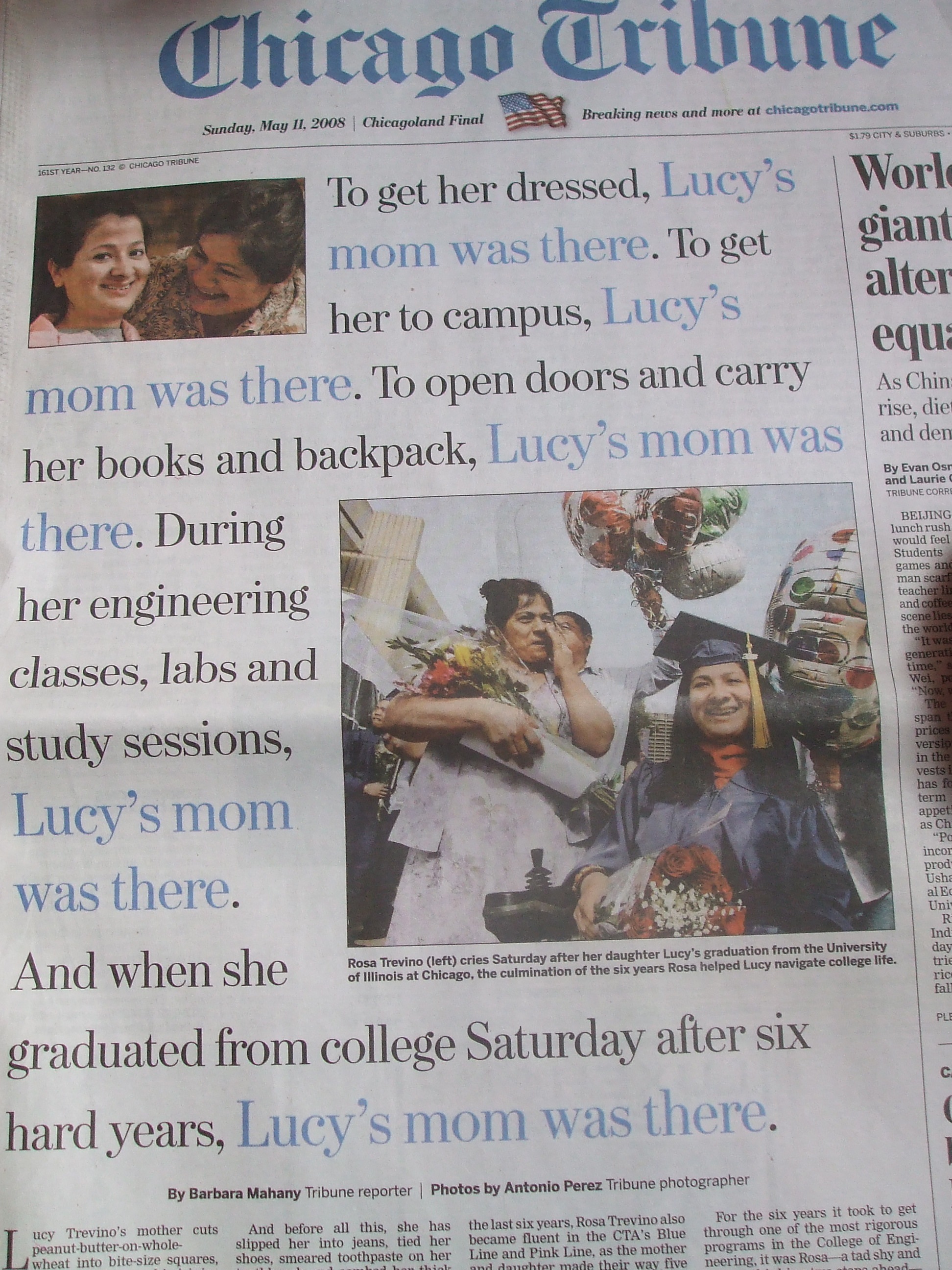
from the chicago tribune….

Lucy’s mom was there

By Barbara Mahany | Tribune reporter
May 11, 2008

Lucy Trevino’s mother cuts peanut-butter-on-whole-wheat into bite-size squares, unscrews a strawberry-kiwi juice and holds the bottle to her daughter’s lips so Lucy can get through lunch and make it back to class.

 She riffles through Lucy’s lavender backpack to find the lab report for BioE 494, bioengineering-based physiology. When the cell phone rings, she holds it to her daughter’s ear. She zips her coat. Unfolds a tissue, puts it to her mouth, trying to be discrete, so Lucy can ditch a wad of gum.

And before all this, she has slipped her into jeans, tied her shoes, smeared toothpaste on her toothbrush and combed her thick black hair into a perfect ponytail.

Lucy Trevino’s mother was right behind her firstborn daughter all through college—sometimes trying to shove through mounds of snow, or maneuver up an icy ramp if her motorized wheelchair balked. When they got stuck, her mother pulled out her cell phone to call maintenance and ask if someone could please come clear the walks.

Over the last six years, Rosa Trevino also became fluent in the CTA’s Blue Line and Pink Line, as the mother and daughter made their way five days a week from home, a red-brick two-flat in Cicero, to the University of Illinois at Chicago.

Lucy Trevino graduated Saturday from UIC with a degree in bioengineering, and the dean stopped the commencement of the Class of 2008 to tell of the Trevinos’ triumph. He barely made it, he said, without breaking into tears.

For the six years it took to get through one of the most rigorous programs in the College of Engineering, it was Rosa—a tad shy and always thinking two steps ahead—who got her daughter to every class, lab and study session. She knew which text and notebook to lay on Lucy’s desk. And she turned the pages when a heavy book tired Lucy’s hands.

For two or three hours, as Lucy absorbed lectures in calculus or thermodynamics or circuit analysis, Rosa sat not far away, just in case Lucy needed a sip of water or began choking.

Lucy, who is 24, was told she had a rare genetic degenerative disease, spinal muscular atrophy, when she was 4. SMA is a progressive disease that withers the muscles that control the arms, legs and lungs, and can make breathing a struggle.

Lucy’s type of SMA usually takes away your ability to walk by the time you’re in your teens—she began using a wheelchair at age 9—but unlike some other types, doesn’t necessarily affect life span.

Lucy, who is the oldest of four, has a younger brother, Hugo, who has the same disease. He, too, uses a wheelchair; he’s a freshman at the University of Illinois at Urbana-Champaign, studying architecture.

Parental dedication

“Lucy’s story is about the sacrifices our mothers make for all of us,” said Pete Nelson, interim dean of UIC’s engineering college. Trevino’s teachers, he said, “were pounding down my door” to ask for some recognition for this mother-daughter feat of unconditional devotion.

At UIC, where nearly a third of the students are the first in a family to go to college, Nelson said it’s not uncommon to hear tales of parents working two or three jobs, sending money from overseas and just plain struggling so their kids can get what parents weren’t afforded.

“But this is sort of the pinnacle in terms of the amount of dedication,” Nelson said. “This is what makes this business worthwhile.”

One of the professors pounding on Nelson’s door was Michael Cho, who teaches mostly graduate courses in cell and tissue engineering, but who has gotten to know—and has been amazed by—the ubiquitous mother-daughter duo, so often spotted wending their way up a ramp, on or off an elevator, or tucked away studying in some secluded corner.

“The first thing that comes to my mind is this can’t be anything else but a mother’s love,” Cho said. “It goes beyond commitment. It is sacrificial love. And I am just overwhelmed. It’s not just one month or one semester. It’s every day for the last four years that I can think of.”

In fact, it’s six years, because Lucy had to take time off when she got really sick her junior year; she suddenly couldn’t lift her arms and was quickly losing memory.

It took months before a sleep test showed she stopped breathing 30 times an hour when she was asleep. She now sleeps with a machine that helps her breathe, and, within a week of using it, she said, she regained her memory, if not her arm strength.

“Ever since I was little, I loved science,” said Lucy, who shares her mother’s deep cocoa-colored eyes and rolls around campus in a purple wheelchair with back wheels that sparkle, like fireworks, with tiny neon bits. “Because I went to doctors a lot and had a lot of medical exams, I would always wonder, ‘How do those devices work?’ ”

In her senior year at Morton West High School in Berwyn, Trevino learned from a counselor about a summer camp in bioengineering at UIC, so she signed up, and found her life’s work.

She once dreamed of working to find a cure for her own disease, but decided “it would be too stressful if I couldn’t find it.”

The first one in her family to ever go to college, Lucy Trevino said she was “too afraid” to venture down to the U. of I. in Urbana-Champaign, where there’s a whole dorm for students with disabilities, and the nation’s oldest college-level disabilities-services program provides trained personal assistants, physical therapy, even wheelchair repairs.

“I didn’t know if I should risk going all the way down there,” she said.

Sticking closer to home seemed like a better plan. But because UIC doesn’t have a personal-assistants program, she was stuck trying to find someone who could help her in a thousand little ways and be there whenever she needed.

“In college, you have such a crazy schedule. You stay after to study with other students. You need to talk to a professor. I was like, ‘Oh, my gosh, how am I going to find someone who’s going to put up with all of that?’

“My mom was like, ‘Well, I guess I’ll just go with you.’

“And then it was getting closer to the start of the first semester, and I still hadn’t found anybody. She said, ‘How would you feel if I went with you?’ I was like, ‘Oh, my gosh, would you?’ ”

Because Rosa Trevino, who is 47 and moved from Mexico when she was 17, had two children with special needs, she had long since become a stay-at-home mom, giving up a series of baby-sitting jobs. Rosa’s husband, Hugo, retired last year after 32 years as a CTA bus driver. Rosa herself had never even been to high school.

On the day back in 1987 when doctors said her little girl would “someday need a wheelchair,” Rosa recalled, crying at the memory, she promised herself she would do “everything I can.”

Mother keeps busy

Even if that meant sitting through more than 2,100 hours of 51 classes, countless study sessions and hourlong train rides, back and forth, each day. Most often, Lucy said with a laugh, her mother spends time cutting recipes and coupons, because she gets bored with all the bioengineering in a language she doesn’t fully understand.

At first, Lucy admitted, going to college with her mother wasn’t exactly without its bumps.

“I had never spent so much time together with my mom. We would sometimes get on each other’s nerves,” she said, chuckling. “But then we got to know each other really well. We’re like best friends. Now I tell her everything. Before I wouldn’t tell her everything that happens when you have a disability. People who aren’t in a wheelchair can’t understand. But now, since we do everything together, she knows.”

Semester after semester, year after year, Lucy and her mother found a way. She passed 400-level exams. She wrote up labs that took her twice the time of everyone else, simply because the pushing of a pen on paper is so hard for her.

Once, a civil engineering professor noticed that because of Lucy’s wheelchair, she couldn’t write on her desk. He challenged her to design a lightweight writing table. Then he went and built it. She got an A.

Mostly, the Trevinos relied on each other, and on unflagging faith.

“One time, I think in the night, almost for an hour, I cried to on high, ‘Why me? Why me?’ ” Rosa said. “I heard a voice, ‘Why not me?’ ”

For those who watched their unswerving perseverance, the simple fact that the Trevinos never stumbled inscribed a lasting honor on Lucy’s college transcript.

“One time last year,” Lucy said, “a student told me she’d felt like ditching class, staying home. But then she looks and says, ‘There’s Lucy, she’s always here. There’s nothing wrong with me. I’m just lazy.’

“Wow, I didn’t even think that anyone noticed me.”

In the very end, on a Mother’s Day weekend in the red-carpeted UIC Pavilion, as Nelson saluted a student and a mother who had taught them all a lasting lesson, a sea of Lucy’s blue-gowned classmates rose and nearly drowned out the dean with a thunderous two-minute ovation. Chances are Lucy and Rosa Trevino finally understood how very much a whole college noticed.

your thoughts, my blessed friends? if you can even muster words…. next meander: lucy’s backstory, what i didn’t get to say in the paper…

i have a dream, too

a year ago, i couldn’t imagine being so bold as to put any words here other than the words of the man to whom this day belongs, martin luther king jr. and so, i excerpted from the speech that moves me to shivers down the spine, and tears down my cheeks. i put a spool of words from the “i have a dream speech” right out on the table, and i let that speak for the day.

well, this year, thinking about this day, i am thinking that we must all be bold–especially when it comes to dreams.
if we don’t reach deep down inside, scout around for that same bold seed, put voice to it, get up and say it out loud, put breath to it, after all, well then, what’s the point in only listening to someone else’s dream.

that dream will not just leap up off the couch, start dancing, doing its thing without some muscle, without us adding to the voices rising, up over the mountaintop, down into the valley on the other side, down to where the shadows fall today. and tomorrow and the morrow after that. if we don’t too dare to be so bold as to raise our hand, say, hmm, i too am dreaming.

a long long time ago now i had a real live, wide-awake dream. a dream i’ve mentioned here, maybe once. but maybe it got lost along the way. today seems a fine day for shaking off the cobwebs of the story of that dream, re-telling it, in case maybe you or you have had a dream, all your own as well.

my dream was in the upstairs chapel of a nunnery, far far away. out where hills rolled and corn reached toward the sky. i was only there for the weekend, for what’s called a silent retreat. which means i ate, i drank, i walked, i prayed in utter, total wordlessness. at least no words that you could hear. there were plenty inside, believe me.

it was a friday night, and i had eaten in silence, tucked my things beneath the hard slab that was serving as my bed. i tiptoed up to the chapel and there i knelt. maybe it was all the silence, or maybe it was something else. but as i knelt and prayed, staring at the crucifix, staring at the long muscled legs of jesus on the cross, fixing on the nail holes in his palms, taking in the beautiful sorrow, and the peacefulness on his handsome jewish face, i saw the start of what turned out to be an endless kodak slide show of faces changing. i saw old faces, white faces, black faces, brown faces, sallow faces, children. i saw a native american, i saw an asian man, an old one. i saw wrinkles, i saw softness. i saw eyes and eyes and eyes. i was, of course, wiping tears from my own eyes, and cheeks, and chin. i can’t imagine seeing such a sight and not being wholly deeply moved. the tears, the transcendence deep inside, is all what comes when you feel, sometimes, as if a hand from heaven has just reached down and tapped you, unwieldingly, on the heart.

i knelt. i squeezed my eyes, then slowly peeked them open, to see if maybe this was all a trick that would just pouf away as fast as it had come. i turned, looked back, and still the faces changed.

i got the message pure and wholly: look for, find, the face of God in every one you meet.

the clincher to this dreamy story is the next afternoon, when i returned, took a seat–near the back, i tell you–in the bigger downstairs chapel. i bravely–through spread fingers–shyly–just a little bit afraid, i tell you–raised my eyes again to the face of jesus on the cross. at first, nothing. phew. safe. that was rather much to ride again. but then, as i softly sank into prayer, i swear to God i saw a smile wash across the face of that there jesus.

now you can hang me up now, press the button and click away. or you can read along, think, like i do, hmm, heaven even comes to ordinary folk. i’m no saint (ask my mother), but i am now among the ones who’ve had a dream. who carry it with us wherever we go from that day forth.

i carried it with me when i criss-crossed this country, once, looking for the faces of those who were poor, were hungry. i carried it, day in and day out, as i poked around the big city where i live and work, where i collected stories of the neediest of needy folk. walked into apartments way up high in dingy highrises and barely made it out alive of one not-so-friendly two-flat where there hadn’t been a speck of heat in weeks, and where someone who huddled there made it abruptly very clear that i was not welcome there.

i carry it, oh boy do i, now, where i live in a place where ironically it’s harder because no one on the surface looks so needy. everyone is cleaned, is polished. children carry ipods. play games on cell phones while they wait for lessons that cost, for half an hour, what some families pay all week for groceries.

the only thing to do if we’ve lived a dream is to wake up every morning and tuck it in our pocket, take it where we go. try every day, to not give up. to not let the phone call go unmade, or the unkind word go uncorrected.

it is the pulse beat really of our every day. it is the undying belief that it is here, at our kitchen tables, that the dream puts on its clothes. leaves behind the wisps of mental images, takes on matter in our every blessed hour.

it is in where we choose to send our children out to play. it is what we cook, and who we choose to feed. it is in the people we invite into our homes, the stories we ask them to tell, so our children can listen, can soak up sparks of wisdom that come from far beyond the walls of our small houses. it is how we look into the eye of the guy behind the gas pump. and where we get our hands dirty. it is in the getting up on sunday morning, and going out to someplace where the lessons come from wiser teachers, instead of staying huddled ‘round the table, sipping cocoa, keeping watch of birds.

it is, day in and day out, saying to yourself: i have a dream. i see a world other than the one before me. i believe it can be changed. it starts, right now, with my next whole breath.

someone else once had a dream. his name was martin. and there is work, still, to be done. he’s no longer here. he needs us to boldly dream in the places where he dreamed.

do you have a dream? how do you make it come to life? some of you, i know, are the very ones who inspire the dreams i set before my children. please, share the outlines of your visions. and bless you all for being filled with dream.