pull up a chair

where wisdom gathers, poetry unfolds and divine light is sparked…

at heart, it’s survival

pickled lime soup.

survival soup: pickled lime, lemon grass, knobs of ginger root, garlic, chili pepper (photo by kalyanee mam)

in this moment of pandemic, amid news reports that make us sometimes want to plug our ears, amid barren calendar pages turned week after week, our everyday tasks are shifted. gone is the dashing here and there (and that’s a very fine thing). gone are the awful tugs and pulls, the guilt strings that tell us we should be doing X,Y, or Z. 

instead, it’s distilled to more of the essence: the few things that really do matter, the ones that matter all the more because all the distraction’s been whittled away. we’re left with essential. and essential is this: exercise your heart, your voluminous, many-chambered heart. use it for its highest purest purpose. use it to love. use it to survive. use it for survival, plain and not so simple. 

or, as my online-college kid put it last night, as he pounded out one of his pile of end-of-semester papers: “corona mom, keep your boys safe. and sane.” (the emphasis on that second sentence, the way he emphatically tacked it onto the first, made it clear that that’s every bit of my job these red-ringed-dodging days. and i couldn’t take it more certainly to heart.)

i’d been thinking a bit about how–in between hours of proofing and re-proofing pages for a new book–my corona days have boiled down to a whole lot of caretaking. how hunting and gathering inform my weekly rhythms (primarily in the form of my hazmat-outfitted grocery-store runs). how feeding is hardly an afterthought. how each night i’m taking time to plot out some serious semblance of dinner, even if, like last night, tearing open bags from the freezer is part of the equation, and it’s hardly all scratch cooking. (though there are days when simmering pots on the stove are as close to incantation as a kitchen might be.) how spritzing pillow cases with lavender water, how scrubbing out the bathtub and sink, how all of it feels essential, verging on straight-up survival. yes, even the scrubbing.

and then, of course, there are the interludes when i’m plopped on the side of someone’s bed, rubbing little circles on someone’s weary forehead. or putting aside those pages of proofs when someone asks, “can you help me with this grilled cheese?”

it is all a part of essential. especially, emphatically, now.

and then i read an essay from a brilliant filmmaker (and lawyer), kalyanee mam, once a cambodian refugee, born during the god-awful khmer rouge regime, one of seven children whose early years were spent in a work camp, before her family escaped through jungle and landmines to a refugee camp on the thai-cambodian border. during the years of the khmer rouge, mam writes that her mother sustained her brood with umami soups, chicken rice, and fried noodles. and that template of nourish-to-survive is the one to which mam has turned in these corona times. she writes:

During these past weeks, I’ve thrown myself into the role of caregiver, as my mother once did. As I soak and sprout beans and rice, chop onions, carrots, and celery, mince and sauté garlic, knead dough, and bake bread, I am finding certainty, meaning, and purpose in preparing and sharing food and conversation with family, friends, and neighbors. In taking care of my loved ones and making sure they are fed, nourished, healthy, and well, I am also being fed. Time has stopped and nothing feels more important.

nothing feels more important.

it’s not every day that we realize that tending to the domesticities of our lives matters at all. most of the time, in the days before corona, that was the almost-disregarded part of what some of us did. those were the chores. the necessities. but maybe, somewhere along the way, we’d come to misunderstand necessity, confused it for meaningless. when, in fact, it’s everything but.

or, as kalyanee mam put it:

care and love are not luxuries: they are necessities, the essence of all life and our survival. in the worst of times and in the face of adversity, care thrives….when our basic human needs are threatened, including our need for certainty, meaning, and purpose, caring emerges to inform us that we are not alone. 

it’s this instinct to care, to take care, to make care, that might make all the difference. that might be the essence of why we’re here at all.

in pondering caring, and what it means to take care, mam writes of the anthropologist margaret mead and her idea of the first sign of civilization. it’s an insight mead long ago revealed in a lecture, and it was retold in a book by the eminent surgeon dr. paul brand, titled, the gift of pain. the revelation, and brand’s take on its meaning, unfolded like this:

“What would you say is the earliest sign of civilization?” Mead asked, naming a few options. A clay pot? Tools made of iron? The first domesticated plants? “These are all early signs,” she continued, “but here is what I believe to be evidence of the earliest true civilization.”

High above her head she held a human femur, the largest bone in the leg, and pointed to a grossly thickened area where the bone had fractured and solidly healed.

“Such signs of healing are never found among the remains of the earliest, fiercest societies. In their skeletons we find violence: a rib pierced by an arrow, a skull crushed by a club. But this healed bone shows that someone must have cared for the injured person—hunted on his behalf, brought him food, served him at personal sacrifice.”

With Margaret Mead, I believe that this quality of shared pain is central to what it means to be a human being.… And the presence of a caring person can have an actual, measurable effect on pain and on healing.

“civilization,” mam concludes, “begins with care.”

and so, we are, all of us, called to care, to share the pain of those we love. to exercise that glorious vessel, the heart. the one anointed and appointed to love and love lavishly. to love as we would be loved. to love as if there’s not a tomorrow. to love with all the urgency of now. as if it might keep us alive. because, truly, it might.

and with that, may your mothering day — a day for all who mother, who care, who love tenderly and fiercely and without end — may it be blessed.

your thoughts on taking care, on the exercise of the heart, and the necessity of love and survival? in any time, but especially now?

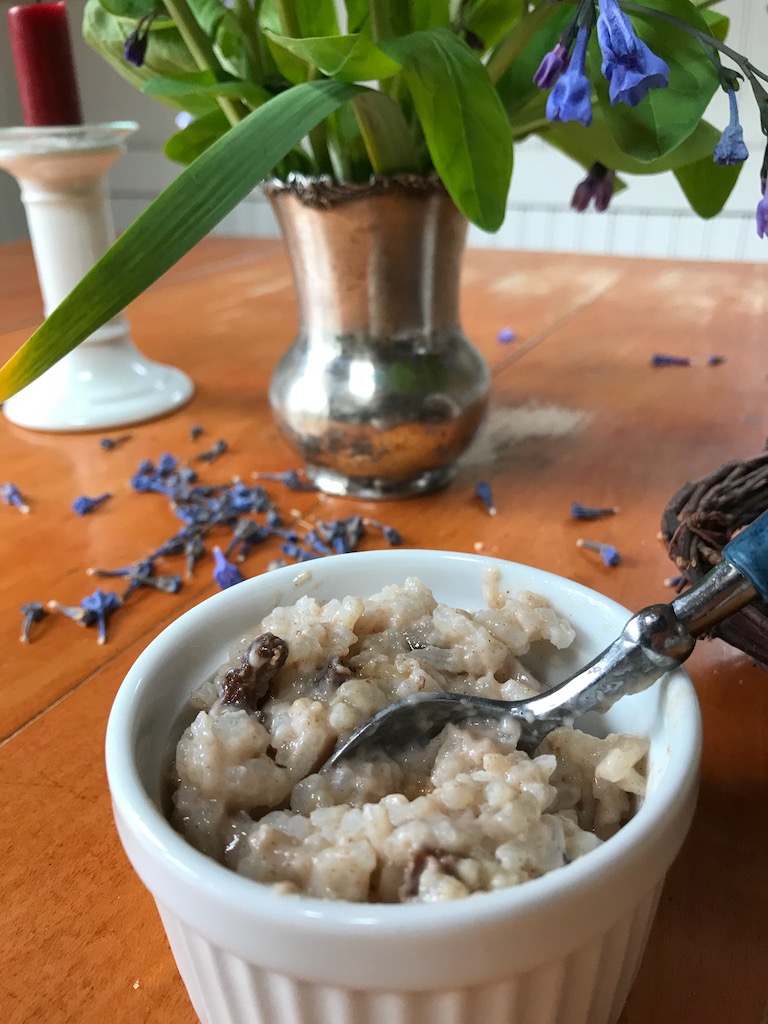
rice pudding trials

rice pudding trials

it must trace back to the breast. yes, the original suckling breast. (forgive me for shocking so early in the morning, but, yes, this is where we begin.) imagine the soft fullness of the mother’s breast, engorged with milk, tubes and ducts surging with all a little one needs. imagine the heartbeat just beyond the milk. imagine the baby’s cheek pressed against flesh; pillowed, you might say. imagine the countenances, eyes locked in a channel of concentration, mother to babe and back again. imagine the wee little curls of finger, grabbing hold and not letting go; flesh entwined with flesh.

that must be the original comfort food: sustenance. warmth. insistent and unceasing rhythm of heart, the original lullaby, non?

and so, we humans are hard-wired to seek it.

it should not surprise, then, that in a moment of global paralysis, when you can’t get out of the house where you grew up (and your mother and father have nothing more to do than indulge you in their too-lavish attentions), when your college campus is far beyond reach, when the springtime you imagined has gone up in red-ringed vapors, there might come urgency in the department of cooking.

comfort cooking might be the call of the day. comfort cooking might teeter on the sharp edge of survival. comfort cooking might be the handiest cure for the stuck-at-home blues.

which brings us, oddly, circuitously but certainly, to the subject of rice pudding.

what began as almost an afterthought at the grocery store, a last-minute swipe for some plastic-tubbed goo on the shelf, a goo labeled “rice pudding,” took on a bit of a life of its own. it started with an off-handed, “i wonder if you can make that” (for one of us grew up in a house in the space-age food revolution days when true kitchen liberation was found in the form of boxed mixes for everything, and scratch-cooking was so yesteryear; in the house where i grew up, brownies came from betty crocker’s red-spooned box, and not once did i witness rice stirred into pudding).

because one of us is in the business of gobbling down whatever is put before him, and another of us is especially in the business these days of reaching beyond the ho-hum, trying valiantly to infuse a touch of indulgence into the day, it became something of a quest in this old house to stir our way to rice pudding perfection. or, at least, a pudding sans gelatinous lumps, a pudding with just the right kiss of sweetness, a pudding so lick-your-lips-able that it might have you sneaking into the fridge in the wee, wee hours. a pudding with raisins, of course.

despite my protest and preferences, brown rice was immediately ruled out. forbidden, more like it. if this pudding was going to provide one ounce of comfort it was going to be washed out and white through and through. in a pinch, mark bittman (our go-to guy so very often, for he lures with his promise of “how to cook everything“) provided the road map: water; rice; salt; milk; sugar; cinnamon.

what resulted was soft, sweet, and passable. but that only taunted. we somehow locked onto the notion that what was needed was something spectacular. something so comforting it just might fill up every null and void, just might make us forget for one flash of a moment (as long as it takes to swallow a mouthful of pillowy softness) how hungry we were to get on with our once-ago lives….

and so the pudding trials commenced.

we sought out a coterie of experts: nigella lawson (she indulges with double cream, arborio rice, and muscat wine). the pioneer lady (she soaks her raisins in whiskey, for heaven’s sake, adds a splash of cream and — because she’s the pioneer lady — dollops a fat pat of butter). ina garten, aka the barefoot contessa (she takes it over the top with dark rum, basmati rice and — get this — 5 cups of half-and-half). we had ourselves a holy trinity of comfort makers, each with her own derivation.

and then, along came an heirloom from a friend, an unsuspecting formula for rice pudding confection. we knew it might be a winner as soon as we saw that the provenance was simply, “mother.” as in a nursery recipe passed from mother to daughter, one of the kitchen bequests that brings back whole moments in time, conjures up storybook scenes of kitchen comfort. that after-school moment when a pudding is spooned in a bowl, and along with fat grains of rice, afloat in a creamy perfection, there is a mother’s voice, soothing. perhaps even a hand rubbing the back, kneading the knots out of the shoulders clenched from a long day of worry or heartache.

that’s what an heirloom recipe does. that’s what comfort cooking is all about. it’s alchemy in its very best form: the power to heal, to chase away the blues, to restore your faith in the long days ahead.

here is my friend’s unadorned, utterly simple roadmap to rice pudding perfection:

Raisin Rice Custard
(Mother)

3 eggs
2 1/2-3 cups milk
2-3 T. sugar for each cup of milk (make as sweet as you like!)
1 t. vanilla
generous pinch of salt
nutmeg
1 cup or so cooked white rice (day old is best)
1 cup or so raisins

Scald the milk (heat slowly until little bubbles around edge of pan). Beat eggs lightly, add sugar and salt. Slowly add the scalded milk, stirring. Add vanilla and about 1/4 t. nutmeg.

Pour this mixture over the rice and raisins in a buttered 2-quart casserole dish. Sprinkle with nutmeg. Bake custard in a pan of hot water at 350 for 50-60 min. or until knife comes out clean.

and here is nigella’s (note: it’s written for cooking in merry old england; translation necessary):

Nigella Lawson’s Muscat Rice Pudding
“I am not suggesting that the basic, plain version of rice pudding is in any way deficient,” says Nigella, “but this muskily ambrosial version is mellow heaven. Perfect dinner-party comfort food.”
Ingredients
500ml whole milk
500ml double cream
50g unsalted butter
150g pudding or arborio rice

250ml muscat wine
50g caster sugar

Pinch of salt
Fresh nutmeg to grate

Method
Preheat the oven to 150°C/gas mark 2.

Combine the milk and cream. In a 1.5-litre, hob-proof casserole dish, melt the butter over a medium-low heat, add the rice and stir well to coat, then add the muscat. Stir well and let the syrupy liquid bubble away for a couple of minutes. Then pour in the milk and cream and add the sugar and salt, stirring as you do so. Bring it back to a gentle bubble, stir well again and grate over some fresh nutmeg.

Put in the oven and cook for 2 hours, stirring after the first 30 minutes. Check the dish after 11⁄2 hours – the depth of the dish and the nature of your oven may make a significant difference. The rice should have absorbed the liquid, but still be voluptuously creamy. Remove and cool for at least half an hour before eating.

what’s your roadmap to comfort on those days when you’re ground to the bone?

this is the part of the story where some of us hit the proverbial wall…

IMG_1492

having now lived 44 days in fear of invisible spiky red-ringed viri that might or might not be lurking on the sides of my milk carton, having grown accustomed to wrapping my face in a variety of shmatas, having mastered the art of bleach spritzing, i think it’s fair to say we all know a thing or two about Life in Pandemic.

the trajectory, i submit, goes something like this: week 1, dizzying nausea at the prospect that we really truly are running low on toilet paper and, for the first time in our lives, we hold little chance of bringing in reinforcements; week 2, full-throttle determination that we will surrender to the new-found wonders of Zoom and the vernal explosions that must be teaching us lessons; week 3, a creeping sense that a calendar can get just as overbooked and exhausting by Zoom as in the Time Before Corona; weeks 4 through 6, a blur. which brings us crashingly to now, the thick of week 7 in which many many of us — for a host of reasons indecipherable and/or clear as the day is long — hit or are soon to hit the proverbial wall.

the signs are these: dinnertime is drowned in tears (note to self: you can omit the salt shaker on the table if the tears are profuse enough). you wake in the night because your left baby toe is throbbing (reason unclear; something to do with knots of nerves wedged between your tootsies, which has something to do with, ahem, aging) and that’s it for the night as a thrashing storm of what-ifs hurl through your noggin, and propel you from bed drenched in a glistening sweat.

all around this week i gathered up evidence to back up this half-baked notion of mine: my best friend in california went to bed the other night worried to death about rising temperatures and the too-real threat of wildfires, awoke to her mattress vibrating under her bum (it was an earthquake, not the latest in west-coast slumber device), and stumbled into the bathroom where she writes that she consoled herself with the somewhat comforting thought that “at least we’ll all die together.” (it might now be obvious why we’ve long been very best friends; we share a disaster-is-looming view of the world.)

she’s not the only one teetering on the pandemic brink. (for quick — and rare, here — current events commentary i might also submit that the present inhabitant of the white house, the one who last night suggested we all guzzle — or inject — lysol as cure for the red-ringed virus, he too might have succumbed to the pressures. but then again…)

even CNN’s media guru, brian stelter, admitted in print that he’d flat out hit the wall, after failing to send out his nightly roundup of all you need to know about news and the news biz.

it can get to be too much: the daily death count, the ever-extending shelter-at-home orders, the shelves that might never again hold toilet paper or lysol (and now that the president is urging ingestion thereof, it might be a public health boon to keep the lysol out of the hands of the american masses).

and, frankly, this is novel to all of us. some days i’m tempted to peek behind the budding leaves of the trees to see if maybe this is a movie set (not too many years ago in this leafy little town they filmed a horror film called “contagion,” and hordes of cute little kids from my then-first grader’s class were cast in roles that had them bleeding to death and being rushed from the schoolhouse on stretchers). maybe if we shake our heads wildly enough, we’ll awake and tumble back into our humdrum life of abundant TP and milk cartons that don’t beg to be run through the lysol bath.

truth is it hit me hard the other day when i found out a beautiful and glorious mom down the block had died, one month after being diagnosed with a cancer. she used to work with me at the tribune. she was one of the brilliant lights on the marketing side of the news biz. she was the mother of three magnificent girls, and she lived and breathed for those girls. they buried her yesterday, after a service held by Zoom.

i can’t shake the sadness of that, can’t stop thinking how the last month of her life — sheltering at home while dying of cancer — must have been unbearably suffocating. or maybe, i pray, there came a clarity — and a calm like my friend in her california bathroom who consoled herself — staring into the razor-sharp truth, holding tight to the few fine things that make it all matter.

some days these are impossible times. some days we can breathe again. some days we weep. and some day, i’m certain, we will once again be able to wash away the tears from the cheeks of the ones we love — from less than six feet away.

i won’t ask if you’ve hit the wall. i will only say that, if so, it’s the truth of the times in the age of pandemic, a subject on which we are now immediate experts. 

on the subject of ephemerality…(and other long-lasting truths)

IMG_1479

in an already cruel april, this seems the cruelest of april’s jokes, this pillow fluff falling from the skies, soft as it is, quick as it is to melt on the tongue (i know; i was just out there with mouth wide open, agasp at the softness, the quiet of this particular snow). this meringue of ice crystals clasping the prayer hands of all the buds just on the verge. the leaden sting of waking up not just to a snow-falling morning, but doing so in the latter weeks of april when the earth has finally, triumphantly, broken through the thawing crust, when the whole globe is aching, is straining, is trying to muster resilience and make it to the other side…

IMG_1476instead, a lesson in ephemerality. the suddenness of slipping away. magnolia? velvety perfumed petals, now on ice. spring beauties, flash-frozen. i dashed out last night, clippers in hand, on a late-night salvation run through the garden. trying to save the soon-to-be stricken.

in any april, a snowfall is crushing. this april, it might knock the last breath of wind out of these tired old lungs. this is the april when we’d already drawn in, drawn quiet. when we were down on our knees, some of us, begging the earth to come to the rescue in the form of easter-egg pastels rising up amid the bursting-forth green synonymous with spring.

when the news pages read apocalyptic — when a zoo in the german town of neumünster is making a sacrifice plan of which animal to feed to another; when krakatoa, the great indonesian volcano, sent “violent puffs” (plumes of smoke and ash and flame) into the skies above the sundra strait, making like some sort of mountainous dragon; when the red-ringed virus crushes our hearts, day after day — we need something akin to a life rope.

the ephemerals of spring carry the whiff of that promise. it’s the evanescence — the now-it’s-here, now-it’s-goneness — that cups the germ of its beauty. the japanese, long wise to this notion in its cherry-blossom iteration, teach this as the truth of the sakura season, in an island nation that maps the bloom from first hint to full blossom.

and, now, it’s all gone. or buried under inches of snow here in the middlelands, here along the lapping shore of lake michigan (where these days it is so very quiet, i could count out the waves by the minute).

so we will need to turn inward again, further and deeper inward. i’ve taken up morning prayer (the serious kind, with flickering candle, the turning of pages, sliding a ribbon from section to section in the book of common prayer). i’ve taken up sourdough baking. and, soon as we can rustle up some plain white rice (the boys protest my usual brown), the homebound college kid and i are honing in on the original nursery confection, from-scratch, stirred-in-a-pot, rice pudding.

braiding sweetgrassamid my red-ringed survival plot, i’ve stumbled into a global book discussion group through my friends at emergence magazine. we’re reading the breathtakingly beautiful robin wall kimmerer’s braiding sweetgrass: indigenous wisdom, scientific knowledge, and the teachings of plants. kimmerer is a mother, scientist, botany professor, and member of the citizen potawatomi nation. each week, these past corona weeks, i find myself in small-group clusters that stretch from bern, switzerland, to tribeca, from the mexican countryside to south portland, maine.

this week we read a chapter titled, “the honorable harvest,” a framework for living centered on the insistent question that arises for kimmerer — and for us, i would argue, as we ache to plot a way forward, out of this corona siege into a recalibrated symbiosis with the world all around — as she pulls fat white bulbs of leek from forest floor:

“if we are fully awake, a moral question arises as we extinguish the other lives around us on behalf of our own. how do we consume in a way that does justice to the lives that we take?” kimmerer asks (italics, for emphasis, are mine). kimmerer, a plant scientist who lives and breathes indigenous wisdom, turns to her ancestral instruction for answers.

“collectively, the indigenous canon of principles and practices that govern the exchange of life for life is known as the Honorable Harvest,” she writes, and goes on to say that the guidelines aren’t in fact written down, but rather reinforced in small acts of daily life (the best such codes anyway). if you were to list them, and i will, she writes that they might look something like this (and, again, i’d add that there is here a particular resonance for mutual reciprocities in the age of corona, when hoarding — and stripping bare grocery store shelves — seems an instinct worth batting down):

know the ways of the ones who take care of you, so that you may take care of them.

introduce yourself. be accountable as the one who comes asking for life.

ask permission before taking. abide by the answer.

never take the first. never take the last.

take only what you need. 

take only that which is given.

never take more than half. leave some for others. 

harvest in a way that minimizes harm.

use it respectfully. never waste what you have taken.

share.

give thanks for what you have been given. 

give a gift in reciprocity for what you have taken. 

sustain the ones who sustain you and the earth will last forever.

brian doyle long riveri’ve one more morsel for the week, and it’s one worthy of its own post, but i’ll tuck it here instead (if i change my mind, you’ll see so in a subsequent post). my wonderful six-year gig plucking and reading and extolling the wonders of books for the soul for the chicago tribune has come to a close (slashed budgets, new owners, no money for freelancers), and the last of my tribune reviews is, fittingly, a book that deserves a trumpet blast. it’s a collection of breathtaking essays from the late, great brian doyle, and it’s titled, one long river of song: notes on wonder. if you are looking to survive this red-ringed siege with your heart and soul intact, read it. if you’re a high-minded soul and hope to emerge more vibrant and alive than ever, read it.

here’s but a bit of what i wrote:

At turns in “One Long River of Song,“ we discover Doyle the psalmist (singing the wonders of raptors and hummingbirds, otters or three-legged elks), Doyle as God’s acolyte (from the prayers to his unborn children to the one starkly titled, “Last Prayer”), Doyle as run-on sentence humorist (antics with his rambunctious brothers, basketball with toddler teammates). Over and over, his musings are canticles of joy, punctuated with occasional double-shots of heartbreak and humility. It’s the textured layering, the leap from shadow to light, that keeps the reader alert, and ever absorbing.

Always, emphatically, there comes wisdom; it’s a signature move, one you can count on. Have your pens aimed and ready.

It’s gospel of the ordinary, the shoved-aside, the otherwise overlooked. And at the heart of it, that ineffable and necessary unction, a holiness you can all but hold in your palms.

and with that, i will tiptoe away, to spend my day turning pages, stirring puddings, and awaiting the melt of the ephemeral snow…

bless you all. be safe. and be blessed….

since this morning is a bit of potpourri, have at it. leap in with any thoughts about anything corona. about the beauty of evanescence in your life and your world. about the honorable harvest and how you intend to live it….

holy week, promised land, and the spiritual practice of making do…

“why is this night different from all other nights?”

year after year for all the years we’ve been circling ’round tables when the paschal moon is at its plumpest and pinkest, telling and retelling the story of exodus — of plagues and passover and a promised land just out of reach — that question, the first of the four questions traditionally asked by the youngest, sharpens the focus on the holy act of separating time. setting aside particular hours, according to particular rising and setting of the moon in the heavens, lifting those hours out of the ordinary, sanctifying. making holy. erecting cathedrals of time, in the words of abraham joshua heschel, the late great rabbi and thinker, who wrote:

Judaism is a religion of time aiming at the sanctification of time. Unlike the space-minded man to whom time is unvaried, iterative, homogeneous, to whom all hours are alike, quality-less, empty shells, the Bible senses the diversified character of time. There are no two hours alike. Every hour is unique and the only one given at the moment, exclusive and endlessly precious.

Judaism teaches us to be attached to holiness in time, to be attached to sacred events, to learn how to consecrate sanctuaries that emerge from the magnificent stream of a year. The Sabbaths are our great cathedrals; and our Holy of Holies is a shrine that neither the Romans nor the Germans were able to burn; a shrine that even apostasy cannot easily obliterate.

this year, the question — why this night? — carried particular resonance. and its sister question, why is this week different from all other weeks, begins to burrow into the holiest questions quivering just beneath the surface of all this 20-second hand washing, and bleach-and-water spritzing and tying of masks round our smiles.

in a week woven with tradition — with particular prayers in particular places, particular recipes, particular gatherings year after year after year — it’s all broken open. it’s all in shards and pieces we assemble and reassemble as best we can.

i think here of the japanese art of kintsugi, beholding the beauty in the brokenness, not occluding or hiding the cracks, but filling them in with rivers of shimmering radiant metals, gold or silver or platinum. deeply understanding the infinite wisdom of rumi, the sufi mystic: “the wound is the place where the Light enters you.” or the resounding redemptive truth of hemingway’s glorious line from a farewell to arms“the world breaks everyone and afterward many are strong in the broken places.”

and in this old house where we weave passover and holy week, where the retelling of the parting of the sea, the fleeing from evil pharaoh, the pestilence and boils and locust and darkness, the slaying of the firstborn (the litany of plagues that visited upon egypt) interlaces with the stories of the last supper, the betrayal of judas, the flogging and crowning with thorns, the crucifixion, i found salvation in the spiritual practice of making do.

and there, in the straining of imagination, in the redefining and refocusing on the essence at the root of each strand of tradition, in scouring the pantry, in testing the powers of my own ingenuity, i began to see in sharp focus the extraordinary blessing in reinvention, in improvisation, in the promised land just beyond my reach. in the imperative of bypassing any and all shortcuts. working just a little bit harder. discovering joy at each tiny triumph.

take the chicken marbella.

IMG_1425over the decades since the silver palate cookbook was first published in 1979, and over the decades at the passover seder where i’ve marked the first night of prayer for 36 years, that glorious rendition of chicken and olives and prunes has become synonymous with the jewish rite of spring. add to that the fact that my home-bound freshman in college happens to love it, practically licks the plate of it. (and these days — passover or not — i’ll climb any mountain to bring him one iota of everyday ordinary un-quarantined joy.)

IMG_1432i’d decided a week ago that, come heck or high water (an apt expression in the season of red sea crossing), i was going to muster up a pan full of that vernal succulence. eyeing the few parts of chicken in this old house, i tucked away a package of breasts at the back of the freezer, knowing i might not fetch another till this pandemic is ended. i happened to find just enough dried prunes in the pantry to realize i was halfway there. olive oil, oregano and garlic, i scrounged up with little worry. brown sugar, ditto. white wine i found in the dark and dingy corner of the basement. it was the spanish olives that presented the hurdle. so i made do: i found a few lonely olives, black ones not green, at the back of the fridge. and i stirred it all up like nobody’s business, rejoicing all along the way that i’d found a way — through scrounging + improv — toward chicken marbella.

next up was the seder plate: where in the world does one look for a roasted shank bone in the depths of pandemic? and was i really going to sacrifice one of the six lowly eggs in the fridge for a ceremonial platter of symbols? i was not. so off to the cupboard i trotted, reached for my half-dehydrated markers and scissors. grabbed a sheet of printer paper, and voila, shank bone, egg, and — the hardest procurement of the week — one square of matzo, all kosher for passover. haroset — the apple, walnut, cinnamon and wine meant to remind of the mortar used by the slaves who built pharaoh’s pyramids — that came courtesy of the many-years-old bottle of manischewitz concord grape wine stored in that same dingy corner of the basement, and a stash of walnuts left over from christmas.

but, when we sat down to our laptop, dialed into our zeder (seder by ZOOM, the cyber salvation of the red-ringed siege), we had ourselves a proper seder table, from marbella to matzo, the ingenuity way.

all that making do, all that finding my way — deciding what’s worth the effort, what doesn’t matter — it’s becoming a meditation in mindful distilling. take nothing for granted. turn in to your own toolbox of tricks. never mind the easy way. do away with the unnecessary.

have you noticed that barely-enough makes for extraordinary? have you sensed the keener attention you pay when so little is taken for granted? when i sliced into a ripening pineapple the other morning, and discovered it was perfectly golden and sweet, not hard and pale yellow as it sometimes can be, i felt a sigh of pure joy riveting through me. you would have thought i was an arctic explorer staking my flag in the pole, so triumphant did i feel at suddenly beholding my cache of pineapple perfection. when’s the last time you remembered for days how sweet your pineapple was?

and so it is in the time of corona. when a trip to the grocery store — or a ride on the el, or rubbing elbows with the stranger wedged in beside you at the movies or museum or ballpark — without fear of catching a potentially fatal infection might never again be taken for granted.

we are all, collectively, living and breathing improvisation. expanding the boundaries of what we thought we could do (heck, i’m now very best friends with the sourdough starter bubbling away at the back of my fridge, and i’m zooming into book groups all over the globe, chanting with monks hundreds of miles away). we are looking out for each other in ways we might not have before (sending meals to ER departments, sharing seeds with the neighbor next door).

the brakes have been halted on this mad-paced world. and yes, it’s filled with heartbreak upon heartbreak. jobs are being cut (i lost one of mine). paychecks are being slashed (happened here, too). magnificent glorious souls are breathing their very last breath afraid and alone (dear God, praise the nurses and doctors who step into those holiest of shoes). the obituaries (some of them being written in the room just above) will make you weep (and they do, day after day).

but inside of all the uncharted fear, and the bureaucratic ineptitude that might make you furious, this holiest week is upon us, and it’s teaching us lessons we might never have otherwise learned.

in the nooks and the folds of making-do, i’m paying closest attention to those deepest essentials. and therein lies the holy way home.

what making-do moments have you encountered this week? and what lessons spilled forth?

a housekeeping note: you might have noticed that all week long, in the comments of each week’s post, i’ve been tucking away especially succulent morsels i happen to come across in my cyber adventures. as we’ve long considered this our shared kitchen table, it seems more than apt to leave little bits of deliciousness all week long. so be sure to click back, and scroll through the comments, where i’ve left a bevy of links and snippets of poetry. 

before i go, here’s one i clipped from a letter the great george saunders wrote to all the fledgling writers at kenyon college whose spring quarter was snatched away. he wrote a beautiful long letter, but this one paragraph i saved just for you:

from George Saunders to Kenyon writers:

There’s a beautiful story about the Russian poet Anna Akhmatova. Her husband was shot and her son arrested during the Stalinist purges. One day she was standing outside the prison with hundreds of other women in similar situations. It’s Russian-cold and they have to go there every day, wait for hours in this big open yard, then get the answer that, today and every day, there will be no news. But every day they keep coming back. A woman, recognizing her as the famous poet, says, “Poet, can you write this?” And Akhmatova thinks about it a second and goes: “Yes.”

may we all find poetry, even amid the pandemic….

IMG_1429

and now i enter deep into my holiest hours….the triduum of holy week….

(p.s. that’s our zoom seder screen shot above, same characters year after year after year. beloved mary schmich, the brilliant pulitzer-prize-winning chicago tribune columnist, wrote about it….here.)

in which we pull spring from out of the earth…

IMG_1406

file this under “desperately seeking proof.” or perhaps, “it’s so necessary this time round.”

the subject is the eruption of spring: that moment, year after year, for as many years as there’ve ever been, when the whole chorus of buds, the vocal cords of feathered flocks and the tips at the ends of the trees, all decide at once to clang the cymbals, pound the drums, and explode like nobody’s business.

it’s so necessary this time round. so necessary when the airwaves fill us with cataclysmic reports, when going to the grocery is an exercise in holding your breath, when reading the morning news just might have you heaving before your first spoon of cornflakes.

Unknownhere in my little corner of the world, about three fingers in from the east coast (if you’re looking at a palm-sized map), a whole thumbprint down from the canadian border, hard against that blue pendicle we know as lake michigan, there is the faintest rumbling of spring. not nearly enough. not enough for a vast swath of humanity staring out the kitchen window on high alert for the invisible virus, not enough for worn-down souls on the lookout for hope.

so i’ve been doing my part: i’ve put serious thought to my latest rube goldbergian plot. my plan to coax the eruption out of the earth. i’ve pictured myself out in the deep ink of the night, knees folded into a crouch, fist wrapped tight around a flashlight, pointing the beam onto stem after stem, branch after branch, seeing if a little light therapy might coax things along.

i’ve got friends in far-off-enough places who are sending me dispatches of itty-bitty finch eggs already laid. cherry trees awash in their seasonal meringue.

here in sweet chicago, here so close to the lake you can hear it lapping the shore: nada, zilch, practically zero. certainly not enough for a soul hungry for spring in the same way some of our bellies growl at the first whiff of oozy cheese in a griddle…

perhaps it would help if i scrawled paint onto a banner, spelled out the plea, “dear mama earth, PLEASE HELP!” we are in serious need of emotional rescue down here. we would do well to fall into the arms of magnolia. might cheer to a bluebird riding along on our shoulder. might fling ourselves face-first and eyes wide open into a bed of tulips and daffodil. fill our lungs with parfum de lilac instead of the fear of the red-ringed demon.

oh, there’ve been the subtlest of cues: goldfinch feathers dropping their wintry drab, taking on the sunshine-gleam of gold that gives them their name; the first lilliputian daffodils putting up their periscopes of promise (see proof above); the birdsong that cannot wait for first light of dawn, birdsong so thick you might think it a recording.

but this is no year for subtlety. this is a year for all the hope we can find. we are holding our breath down here on planet earth, where the whole globe is at a standstill. we need a  vernal exclamation like never before.

those faraway friends tell me it’s coming. a friend in cambridge says, except for corona, this would be the most perfect spring she’s seen in a very long while. except for corona…

because my days are a checkerboard of occasional plug-ins — chanting with monks on mondays and thursdays, inhaling celtic spirituality direct from galway nine days in a row, chiming in on a once-a-week book group based in seattle — i’ve plenty of time for prowling my plot. i make the rounds at least twice a day, on the lookout for any sign of eruption. all but wander the walks with measuring stick and string, all in the hopes of seeing some progress.

this is a season for turning our keenest attentions to the rumblings of earth, to this most intoxicating science and faith that never fails, that offers page after page of wisdom and truth.

this unforgettable spring we are learning the art of deep patience. “ride it out,” is the mantra. “stick close to home,” the instruction.

i, like you most likely, have hours when my knees go wobbly. i’ve wiped away the occasional tear or two (or five). i’m trying to be something of a lifeline for a kid i love who’s all alone in a faraway place, where the walls sometimes press in. trying to make life here at home as tranquil and gentle and sometimes delicious as i can possibly muster. (for reasons that don’t quite escape me, i’ve taken keen fondness for a spritz bottle of lavender mist, which i spritz till the sheets and the pillows are soggy. and i figure the more delicious aromas i can stir from the kitchen, the better the chances i can steady the kid in the room up above, the one whose spring semester has — like everyone else’s — gone up in red-ringed vapors.)

it’s a master class in surrender to which we’ve been enlisted. no one asked first if we’d choose it. it was thrust wildly upon us.

the questions are these: how quiet can we go? how calm might we settle our souls? what new and wondrous epiphanies might drop before our eyes, our hearts, our imaginations? what brings you peace? where is your joy? what pulls you out from your darkest hours? who is your lifeline?

and, where oh where, is the promise of spring?

and suddenly, the holiest of weeks is almost upon us: holy week and easter for churchgoers; passover for jews. as i sink deep into the braiding of those two ancient traditions, i leave you with this from our rabbi, a page from the prayers of passover, as we mark the exodus — safe passage — from egypt, in search and hope and belief in the promised land. it’s a theme with particular resonance this year….

In our prayer book,Mishkan T’filah, we read about the crossing of the Red Sea:

        Standing on the parted shores of history

        we still believe what we were taught

        before ever we stood at Sinai’s foot;

        that wherever we go, it is eternally Egypt

        that there is a better place, a promised land;

        that the winding way to that promise

        passes through the wilderness.

        That there is no way to get from here to there

        except by joining hands, marching

        together.

join hands, march together; believe in the promised land….

have you stumbled into epiphanies? found yourself a lifeline? what are the saving graces in your days?

in which we all begin to live like monks

IMG_1389

because i don’t mess around with red-ringed buggers, i perked my ears at the first mention of this spiky-edged invader. i all but pulled up the draw bridges. all but clambered under the bed covers.

but then i decided that rather than quaking under said covers i might be wise to consider this my short-term spell in monastic living. call me brother babs.

i rise before the sun, step outside as first light seeps across the inky edge of night. drink in the gallons and gallons of birdsong. it’s ambrosial out there (a word i picked up in all my monastic reading this week, a word that aptly describes the velvety notes of interlaced and twining love songs from the trees). i don’t hear a single human-made sound, except for the far-off whoosh of a morning train, and even that is drowned against the clamor rising from the itty-bitty lungs of all the flocks declaring start of reproduction season.

i could stay out there all day, the one sure place where i can breathe. where i don’t imagine the virus chasing after me. (the grocery store i find an exercise in weave and dodge, surrounded by masses wearing masks, imagining with my x-ray vision whole crops of red-ringed dots splattered all across whatever i’m about to pluck from bins or shelves. you now witness how my days in microbiology labs come back to haunt me, how they exercise my far-too-active imagination. how my special powers allow me to see otherwise invisible objects.)

i’ve been down on my knees for good spells this week, but not so much in prayer as in scouring-the-earth mode. i’ve heard reports from parts south that spring is actually rising, breaking forth from slumber. here in the heartland, here not far from the great lake michigan (which i can hear quite clearly these days from my so-called hermitage), there’s barely a hint, though i’ve been raking back the leaves, all but coaxing vernal stirrings. unwilling to dawdle while spring takes its time, i’ve pulled out the clippers. hauled in what looks like armload of spiky sticks. but in fact it’s my annual exercise in forcing, forcing spring, all the more essential this time round, in this the corona siege. (see above.)

i have been known to leave the premises. to take a morning constitutional, to ply the sidewalks. that’s where i ran across this: IMG_1391

praise be the children and their chalk. praise be the ones who spread the gospel of faith and hope and calm.

because i believe in stockpiling but not the toilet-paper kind, i’ve been busy all week tucking away bits and morsels for your consumption here at the virtual kitchen table. i’ve clipped smart paragraphs and poems that packed a punch. here’s some of what i’ve hoarded just for you:

margaret renkl is a writer from outside nashville, now a once-a-week columnist in the new york times. this week she wrote about the balm for jangled nerves, the balm that oozes from the earth:

The natural world’s perfect indifference has always been the best cure for my own anxieties. Every living thing — every bird and mammal and reptile and amphibian, every tree and shrub and flower and moss — is pursuing its own urgent purpose, a purpose that sets my own worries in a larger context.

a few paragraphs later she wrote this: …reminds me of Alice Walker’s words: “I think it pisses God off if you walk by the color purple in a field somewhere and don’t notice it.”

and then there was this: The scent of freshly turned soil works on the human brain the same way antidepressants do.**

that last bit from margaret set me off on a bit of a goose chase to dig into this scientific finding that turning over trowel really does do wonders for the soul. sure enough, i found:

Researchers from Bristol University and University College London discovered using laboratory mice, that a “friendly” bacteria commonly found in soil activated brain cells to produce the brain chemical serotonin and altered the mice’s behaviour in a similar way to antidepressants.

When they treated mice with Mycobacterium vaccae they found that it did indeed activate a particular group of brain neurons that produce serotonin – in the interfascicular part of the dorsal raphe nucleus (DRI) of the mice, to be precise. They established this by measuring the amount of c-Fos in the area, a biochemical marker whose presence indicates that serotonin releasing neurons have fired.

Serotonin, also known as 5-HT (short for 5-hydroxytryptamine), is found in the gut, brain, nerves and blood of humans and other animals. There are 14 different receptors that bind to serotonin each working a different property of this highly multi-functional chemical messenger.

The friendly bacteria in this study appear to be having an antidepressant effect in a third way, by increasing the release of serotonin.

and because poetry will always be sacred text to me, because poetry has a knack for seeping into those unspoken nooks and crannies that make us who we are, i found this from one of my favorites, dorianne laux, who calls herself something of an unschooled poet, a poetess who worked as a sanitarium cook, a gas station manager and a maid before earning a B.A. at 36, and whose poetry is said to be “compassionate witness to the everyday.”

because in some ways we are all carrying the load of grief, because we all teeter on the edge of holding it together or otherwise, this poetic bit of wisdom and truth struck me hard this week. we are all in this together. the kindness of strangers just might be our saving grace. as we move through our so-called monastic days and nights….

For the Sake of Strangers

No matter what the grief, its weight,

we are obliged to carry it.

We rise and gather momentum, the dull strength

that pushes us through crowds.

And then the young boy gives me directions

so avidly.  A woman holds the glass door open,

waiting patiently for my empty body to pass through.

All day it continues, each kindness

reaching toward another–a stranger

singing to no one as I pass on the path, trees

offering their blossoms, a child

who lifts his almond eyes and smiles.

Somehow they always find me, seem even

to be waiting, determined to keep me

from myself, from the thing that calls to me

as it must have once called to them–

this temptation to step off the edge

and fall weightless, away from the world.

–Dorianne Laux

because i imagine we’re a table of survivors and stockpilers of another sort, what saving graces have you stocked up on this week?

and before i go, i am stockpiling all the birthday love in the world for two of my favorite people in the whole wide world who happen to have back-to-back birthdays today and tomorrow. they are both best friends forever, and they both live and breathe the purest most radiant love that ever there was. happy birthday sweet P, and happy almost birthday auntie M. xoxoxoxoxo

may you be safe and strong in this week ahead. look back here for any particularly urgent (and delicious) morsels i find in the days ahead. i tuck them down below in the comments. we are all in this together, each and every gentle kindness our path toward the light on the other side…..

maybe we need to open the smoke hole

4-chum-dis

there’s a siberian myth that when you close the smoke hole in a reindeer-hide tent — that orifice opening up to the sky — God can’t see in anymore. when you close the smoke hole, you break the connection to the divine — to the heavens and clouds and stars in the sky.*

when you close the smoke hole, you go mad in the whirl of unending toxic vapors.

maybe the world needs to go quiet to open the smoke hole.

have you heard that dolphins are once again romping in the waters off venice? (the oversized — dare we say obscene — cruise ships are gone.) blue skies and birdsong are back in parts of china that hadn’t seen them or heard them for years. (factories gone silent, cars parked at the curbs; pollution cut off at the knees.)

the earth, amid a pandemic, is healing. you might say it’s the soul that’s pushed its way to the fore.

have you noticed how your inbox is full of invitations from monks and museums and the metropolitan opera? a journal i love — emergence magazine — is, like so many rushing into the abyss, offering “free of charge, online sessions [that] will include: a book club that will meet online once a week, virtual fireside chats with Emergence contributors, a nature journaling course, and facilitated workshops and discussions.”

last night i joined in meditation with a monk and his singbowls at glastonbury abbey on boston’s south shore — along with two dozen soulful others whose faces appeared in squat boxes at the top of the screen, and who were strewn all across the continent. (singbowls originated in the himalayas more than 2,000 years ago, and the sound that rises from the mallet gliding the rim of a metallic bowl is scientifically documented to change our brain waves, and so is thought to be healing and soothing and all of those “ings” we need right now.)

the other morning i sat at my kitchen table, sipping my coffee, watching the birds at the feeder, while the priest at my church spoke of the samaritan woman during the sermon of sunday morning liturgy. last night, my priest popped in again, and mentioned that rather than singing the birthday song twice as she washes her hands, she likes to recite the jewish blessing for the washing of hands (it’s 10 seconds, so repeat twice): “Blessed are you, O Lord, our God, King of the Universe, who has sanctified us through your commandments and has commanded us concerning the washing of hands.”

there are many, many hours to fill in the space between stepping into my haz-mat attire and bravely boldly facing the grocery stores aisles where, more often than not, whole aisles are cleared, picked over as if a cotton field in the wake of the weevil. and so, being human, we itch to find ways to fill those hours.

i say, take this time and seize it: pick up a rake, if you have one idling in the garage or the shed. tenderly pull back the winter’s detritus, marvel at the tender green nubs insistently pushing through the crust of the earth. listen to the birdsong, now that the soundtrack of cars and most trucks (save for the poor amazon delivery squad), have gone silent.

one of my most beloved friends is teaching me, via links to websites and a vat of bubbling goo she’s promised to leave on my stoop, how to befriend that curious alchemical mix of flour and water and floating-by spores (how lovely to think of a wafting microbe as friend and not foe in these red-ringed times) called sourdough starter. there’s something eternally hopeful about the notion of make-your-own yeast, and bake-your-own breakfast.

last night, the college kid among us pulled out a board game, fired up his laptop to connect with his faraway brother, and together — through the wizardry of this wireless age — we all played round after round of word games. when’s the last time we all huddled at the kitchen table to put our collective heads together in game?

i’m making it my most important job to stitch the normal into these days, and to take it up a notch and embroider the moments with whatever delights and high-order embellishments i can muster: i’m tossing lavender packets into the dryer so clean sheets smell like provence herb gardens. i’m cracking open packets of biscuits, cranking the oven, filling the house with buttery inhalations. defrosting stews long tossed to the back of the freezer. the soul when its gasping for air is especially receptive to beauty.

and in between the attempts to make this time something of a break from the madness, i’m paying closest attention to the unbridled kindnesses, to the light that insists on seeping through the cracks.

maybe the smoke hole is opening.

maybe we’re finally noticing how hungry our souls have become. seek vigil not isolation, might be our watch phrase. don’t cut yourself off from the marvelous. from the undeniably beautiful. from the blessed.

open your eyes and your heart, the heavens are beckoning in ways never ever imagined. shabbat is upon us. uninterrupted.

enter in peace.

how are you keeping open the smoke hole?

from time to time across the week, i will bring delicious morsels here to the virtual kitchen table. you’re welcome to do the same….as we join hearts and forge on together. we will emerge and be stronger for seeing the world through new smoke-cleared eyes…..

*credit to martin shaw, mythologist and storyteller from devon, england, (extolled as “a thirteenth-century troubadour dropped into our midst”) for bringing the smoke-hole myth to my attention…..

Screen Shot 2020-03-20 at 8.10.19 AM

1905 Scientific American, documenting Siberian wilderness culture

those immutable ballasts

super worm mooon

super worm moon 2020, just when we needed a night light

the other night, back in the days when i was still driving to the train most evenings to ferry home the fellow working downtown, back before the red-ringed virus found its way into the glassy tower where he works, back before they–and the rest of the world–sent everyone home, the moon hovered just over the fence line. the moon—big and whole and bright in a way a screen never will be–it stopped me in my tracks.

the moon made me weep the other night.

the moon wasn’t budging. not a kerfuffle in the world could get in the way of the moon doing what it’s done since the beginning of time. and, somehow, that certainty saved me. gave me just enough breath to fill up my soul and my air sacs.

felt like it all but reached out to tap me on the shoulder (or maybe the heart), to save me, to steady me, to give me the something to lean on i needed.

there it was, at the end of a long blurry day, when schools were closing, and produce aisles were beginning to sound a wee bit risky, there it was, taking up more of the sky than i could remember. it was, to my little mind, as if God–or whatever you call the abiding holiness–had pinned it there. just for all of us to see: it wasn’t going anywhere. it had shined before over terrible times. over atomic bombs, and world wars and crusades. it had shined over riots and the night the cities burned down. the moon, and those forces that hold it in place, they weren’t going anywhere. we could count on that one thing.

next morning, just as the sun was peeking over the same horizon–endless cycle, one rising after another–the woodpecker flew to my feeder. as did the cardinals. and the blue jay. their flutterings were not interrupted; they carried on. and so should i, so should we. all of us. maybe more together than we’ve been in a very long time.

maybe, at long last, the glues that bind will come out of hiding. maybe we’ll realize the one true thing is that nucleus of goodness that lives in our hearts. maybe reaching out (elbow-bump style) will be the thing that not only saves us, but carries us onward and upward.

maybe when we’re a little bit rattled, maybe when we’re scared, we can stop all the posturing and pretending we’re not in it together. maybe it’s taking a germ to shake us free from the ugliness, from the us-versus-them, that’s been choking us. truly been making it harder and harder to breathe. maybe this is the germ to wipe out the toxins. or some of them anyway.

in the last few hours, my virtual mailbox, the one i can open without shuffling down the sidewalk, it’s been filling with words from around the world really, words that just might serve to save us, to remind us how much of a difference a kindness will make.

this from a rabbi: rabbi wisdom

this from my priest:

In this time of pandemic, I am reminded of the parts of our scriptures that speak to people who were facing the most frightening thing imaginable in their time–the destruction of Jerusalem or the Temple–apocalyptic scriptures that seem hyperbolic until we too are in a frightening situation and those words of God’s providence and presence amidst crisis are somehow just the thing I was thirsty for but didn’t know it. We couldn’t have predicted that Lent would be a period of unknowing and wilderness in quite this way, but here we are; so we enter in.

right now, when we’re holed inside our houses (or at least that’s where the public health experts hope and pray that we are), when we can’t literally squeeze each other’s hands, words might save us. words are breath put to sinewy cords, words are breath that rises from lungs, from the pit of the soul, really.

words, sometimes, are those intangible tangible ballasts and vessels that break through the barrier, shatter the walls we erect. words put breath to kindness, to empathy, to saying aloud, “i’m just a little bit scared. tell me we’ll all be all right.” words carry joy, carry laughter. words make us laugh out loud–and we can use a good dose of that now. words sometimes make us weep; sometimes in the very best way because they put syllables to the truth of who we are: we’re all alone except for each other, and the one immutable force, the one unconquerable truth is that love wins, love heals, love washes away whatever needs rinsing. love binds. love travels far and wide and without the laws of physics. love is the mightiest breath that ever there was (ask anyone who’s grieving; they’ll tell you the depths of the ache and the anguish, they’ll tell you how sometimes–out of the blue–it’s an updraft that fills them and lifts them again, as if the someone they loved just swept them up by the heart).

so, for the duration of this red-ringed hiatus, let’s put those words to the business of loving. of reaching out. of checking in. of whispering soothing certainties. of making each other laugh out loud. of reminding: the force of our love, collectively, is an immutable, indomitable thing. we might be felled by a fever, but no one, no one can suck the love from our hearts or our souls. together, we rise.

just as the moon and the sun. again and again and again. amen.

if the spirit moves me in these long days ahead, i might post a few extra words here at the chair. maybe down in the comments, maybe in posts that don’t come only on fridays. these are uncharted times, begging uncharted adventures. 

how are you faring, and what are some of the words in days past that have given you hope or joy or a sure sense of belonging to the great and glorious ring of indomitable human family?

public health announcement: the surest equation to “flatten the curve” (that is slow the incline of coronavirus cases) is to minimize contact with those beyond the house where you dwell. this might last for a month; no one can tell us for certain. no need to wipe the grocery shelves clean; no need to hoard (my brother stood in a grocery line behind a woman with a cart filled with new york strip steaks–go figure!). get good sleep. wash your hands. sit in the sun (vitamin D is an immune booster). flush yourself with plain old water; try to keep your mouth from getting dry. the more religiously we can stick to the stay-out-of-crowds plan, the sooner we make it to the days of life after corona….

blessings to my beloved maureen, who sent along the words from the rabbi; to my priest, kat, who is ever wise. blessings to one of our wonderful chair sisters who–egad!–was bitten by a rattlesnake the other day, and is suffering terrible pains (and might be out of the ICU by now). may everyone who wanders by this ol’ table and chairs be safe and well, and surrounded by love. xoxo

my bunker of books

stack o books

it’s dawned on me, as i haul my load of books from nook to nook, that i just might be building myself a bunker of books, a wall of words to crouch down beside, steer clear of bombs and missiles shrieking overhead. all these long and fractured months, the one sure solace, the one oasis is the place i go when i crack a book, haul out a pen (if the book belongs to me and not my kindly library), turn page after page.

i tend to read in stacks, one book begets another. one wise soul points me toward another, and like a sparrow pursuing trail of seed, i follow. hungrily.

the corner of the world into which i’ve staked my flag–of late–is the landscape at the intersection of the sacred and the natural world. it’s a country with permeable borders, ensuring easy entry into neighboring poetry, and down the chute of saints (modern-day sectarian as well as the medieval and monastic kind). the immediate agenda is research for a book i just might write, but really it’s because i could spend all the days of my life catching up on books and minds i missed in my earlier blurrier chapters.

it seems a safe bet, does it not, that the minds that have survived across the ages might be the ones with something wise to say, to remember, to press against my heart. and so i backfill with the classics (john muir and c.s.lewis, and even justice william o. douglas, in the current stack), and move fluidly through the ones hot off the press.

against the backdrop of the daily news, it’s a much quieter terrain. surely, a sacred one. one infused with those rare things, in case of fire, we’d grab and run: shimmering epiphanies, the ones that shimmy open the chambers of our hearts; words so wise we commit them to memory almost as soon as they fall across our lips; poetries that soothe the soul, while simultaneously making us see anew, snapping the whole tableau into finer-grain focus.

it’s the underpinning of my everyday, my subplot to live simply, nearly monastically, amid a world of noise and unceasing distraction. no wonder they call this the age of attention deficit disorder. when’s the last time you sat on a log in the woods, drinking in the symphony of birdsong and silence?

all this to bring me to the latest soulful book i reviewed for my friends in the books section of the chicago tribune. it’s my one excuse for reading that comes with (scant) paycheck. i still pinch myself to think i get to read for work. and every once in a while one of those books takes me to a kingdom i never knew. there seems to be a backlog at the tribune these days, and one of the most glorious books i’ve read in a long while is still sitting on the runway. (here’s a peek into the future: it’s the late great brian doyle’s one long river of song, a collection of take-your-breath-away essays that will leave you gobsmacked at the capacity of the human heart and soul. and if i was allowed to post here before my review runs in the tribune, i surely would. but alas, not allowed…) in the meantime, here’s the review that just posted the other day, a collection of the sermons and speeches of chicago’s very own, rev. jesse l. jackson, sr.

‘Keeping Hope Alive’

By Rev. Jesse L. Jackson Sr, edited by Grace Ji-Sun Kim, Orbis, 256 pages, $25

Jesse Jackson’s sermons, now collected, stir the soul

By BARBARA MAHANY |CHICAGO TRIBUNE

The pages of “Keeping Hope Alive: Sermons and Speeches of Rev. Jesse L. Jackson Sr.” are separated into two sections; one for sermons, delivered in churches, and another for speeches, delivered in arenas most aptly tagged “political.” The thing that leaps out most emphatically, though, is that the separation doesn’t matter at all: For Jackson, one of the great orators of the civil rights movement in America and around the world, religion is political, and politics is religion. One without the other is rootless and decidedly dismissible.

Over the last half century, Jackson — the Chicago-based founder of the Rainbow PUSH Coalition, ordained Baptist minister, and twice Democratic presidential candidate — rightly earned his slot as one of the soul-stirringest preachers on the national stage. He proudly occupies his podium at the intersection of religion and politics: He lives and breathes the Gospel as well as the moral imperative to feed the hungry, clothe the naked, reach out to the oppressed, the stranger, the ones unjustly shoved beyond the margins.

As he beautifully writes in his concluding remarks (perhaps the most powerful piece in the collection), “When I traveled I stayed in people’s homes instead of downtown hotels. Coal miners’ homes. Meat cutters’, housing projects, gang bangers’ in LA. And when I was speaking I saw them. My refrain at the time was, ‘I understand.’ I knew who I was talking to — the woman, the coal miner …. And I wasn’t quoting Scripture, I was scripturing.”

jesse jackson book

Indeed, Jackson’s most profound gift seems to be his capacity for not seeing the line between religion and politics. The Jesus found in these pages — a selective sampling of those rare few sermons (six) or speeches (19) actually written down, compiled for the first time and edited by Grace Ji-Sun Kim, an associate professor of theology at Earlham School of Religion — is a deeply personal Jesus, one Jackson seamlessly translates into one who knows the pain and struggle of whomever Jackson is preaching to. “Jesus was the victim of the most horrific lynching on a tree,” Jackson declared in an Easter sermon at his Rainbow PUSH headquarters in 2003. “The cross was Rome’s electric chair,” he says later in the same sermon, dissolving the line between persecutions ancient and current.

As powerful as each sermon or speech is on its own merit, it’s the sweep of history that most startles and gives weight to nearly every sentence gathered in these pages. Jackson was there, just below the balcony of the Lorraine Motel in Memphis, when the Rev. Martin Luther King Jr. was gunned down in April 1968. Jackson was there, in Cape Town, South Africa, in 1990, when Nelson Mandela walked out of jail on Robben Island after 27 years locked behind its prison gates.

His is a hard-won, authentically lived moral authority, and now, Jackson writes, “I’m old and I have Parkinson’s, but once I was young. I went to jail with my classmates when I was nineteen, trying to use the public library, and now I’m seventy-seven …. After all these years, what remains for me is God is a source of mystery and wonder. Scripture holds up. The righteous are not forsaken. We’ve come a long way since slavery time. But we’re not finished yet. Running for freedom is a long-distance race.”

Reading Jackson, absorbing the clarity of his moral vision, should be required. It’s fuel for the miles yet to be run. “Keeping Hope Alive” is the place to begin.

Barbara Mahany is the author of several books, including, “Slowing Time: Seeing the Sacred Outside Your Kitchen Door.”

Twitter: @BarbaraMahany

what books are in your bunker?