pull up a chair

where wisdom gathers, poetry unfolds and divine light is sparked…

Category: angels among us

catching the elusive slipstream and other hints of holiness

angel

more than once this week, i’ve felt shivers run my spine. more than once this week, i felt myself suspended in some holy sort of hammock. i’ve giggled. and more than once, i’ve wanted to dash to the telephone, to call my blessed friend. and then, stopped cold, i remembered phone lines don’t go to where she is. wherever she is.

my friend died not two weeks ago.

but that didn’t stop me from feeling her as close to me this week as if we were, as we so often were, huddled on the couch, under the buffalo-check blanket that might belong in a horse barn, but kept us warm through many a long winter’s afternoon when, curled up with mugs of tea and bowls of clementines, we coursed across the landscape of our lives, our hearts, our souls.

death when it’s new can be like that. out of the blue you bump into the reality — a cement-block wall, almost — that the someone you want to reach for, the someone you’ve always reached for, isn’t there. it’s as if your mind is playing tricks with you, taunting, teasing, playing hide-and-seek. maybe it’s just me, but i push my imagination as far and deep as it will go, all but see and hear the someone right before my eyes. convince myself one day the phone will ring, and the someone will be there, and at last i’ll hear, “trick’s up. i was only hiding.”

but in moments when i wasn’t playing mind games, when i’ve been going about the business at hand, i’ve suddenly had a certain sense that something, some holy force, had slipped beneath me, inside me, and propelled me or the world around me in inexplicable ways. well, i’ve an explanation, but it defies logic, and laws of physics.

take, for instance, the fact that all summer i’ve been drudgingly tapping keys on my keyboard, slowly uprooting words from deep down underground. i’d type my way to the end of sentences, but really, i was all but lost. form was formless, and all swirled foggily around me. i was trying to find the words, the shape, the essence of some elusive book. i knew what i wanted it to be, but somehow i couldn’t find the path. i’d get distracted, spend long spells away from the keyboard. i started to think nothing would ever come. i thought a bit about my capacities for swirling foam in coffee at the local barista bar. maybe, after all, that was better use of my waking hours.

but then, this week, once again i sat down. opened up a document, one that had no name, and suddenly — slowly at first, but building in speed and force — i’d renamed it “chapter 1.” it’s finished now, and sits waiting on my computer. it’s been followed, swiftly, by chapters 2 and 3, now almost written down to the very last period.

where’d that slipstream come from, i wondered? i didn’t think too hard to pounce upon my answer.

and in another breathtaking moment of serendipity, a fellow i love, a post-college living-in-a-new-city sort of fellow, he was out and about recently, and struck up animated conversation with a lovely lass. they weren’t too deep into conversation before it was revealed that, out of all the souls who inhabit this giant metropolis, they both just happened to share in common a deep love for our beloved friend who had just died. the fellow had known and loved our friend his whole life long, called her his “spiritual godmother”; the lass was one of her devoted students, one of the very few she’d tucked tightly under her wing, imparting the intricacies of her craft even as her cancer spread and spread. the meeting of the two — the fellow and the lass — could not have been more random, impossibly so. and the depth of their first conversation was, apparently, the sort that glimmers on the prairie.

now i can’t claim to be one of those folks who frankly believes that angels have wings and hover over us. but i do believe in souls that never really fade, and i do believe in forces of holiness and miracle. i’ve spent decades trying to figure out just what happens when someone you love dearly dies. what happens after the last breath comes, and stillness fills the room? i promise to let you know when i nail that one. but until then, i’ll side with the folks who believe that holiness is a force of life abundantly present, and animating all the hours of our day. maybe the work to be done is on our side, maybe it’s about opening ourselves through a particular level of prayerfulness, maybe it’s about a soul so porous we’re a filter, a catch basin, for all that’s good and beautiful and buoyant. maybe thinking aloud about all this is the dumbest thing i’ve ever done. or maybe, in putting words to wondering, we might — together — stumble on some truth, some shimmering shard of wonder, of heaven tumbled down to earth.

i can only hope. and pray. and keep watch for the gentle brilliant touch of my beloved slipped-away friend.

as is so often the case, i had no intention to write a word of this. but the words came anyway. so here we are. i’d been thinking that i was so intent on getting back to chapter 3 and 4, i’d just post the latest edition of my chicago tribune roundup of books for the soul. that might have been the safer, wiser bet. or maybe not. a short bit of one of the reviews was cut for space, so i’ll post the link to the latest roundup here, and down below, i’ll include the unedited version of the first review, the glorious, The Grammar of God: A Journey into the Words and Worlds of the Bible, by Aviyah Kushner, which i loved.

soul-roundup-jpg-20151008

The Grammar of God: A Journey into the Words and Worlds of the Bible
By Aviya Kushner, Spiegel & Grau, 272 pages, $27

The highest praise for a book, perhaps, is tucking it into a slot on your bookshelf where you’ll always be able to effortlessly slide it out, lay it across your lap, and soak it up for a minute or a long afternoon’s absorption. The Grammar of God: A Journey into the Words and Worlds of the Bible, Aviyah Kushner’s poetic and powerful plumbing of both the Hebrew and English translations of the Bible, now rests in just such an easy-to-grab spot in my library.

In a word, it’s brilliant. And beautiful.

Kushner, a poet and journalist who grew up in a Hebrew-speaking home where dinner-hour debate often pivoted on the meaning of the Bible’s original Hebrew text, went off to the Iowa Writers’ Workshop back in the summer of 2002, and found herself in novelist Marilynne Robinson’s class, parsing the Old Testament. Kushner barely recognized the text in English translation.

Therein was launched a trek into language and belief that took Kushner around the globe. She draws on grammarians and lexicographers across the millennia to lay out this roadmap into the depths of sacred text. Not lost is her insistence that much is lost in translation, and even if you’ve no interest in religion, the linguistic excursion here is not to be missed.

Most essentially, Kushner lifts the veil for all of us who don’t know ancient Biblical Hebrew. She pulls us deep inside etymology and history and meaning. And as a Kirkus review so aptly put it, Kushner’s first book is, in the end, “a paean, in a way, to the rigors and frustrations — and ultimate joys — of trying to comprehend the unfathomable.”

how have you brushed up against the holiness of someone you’ve loved, no longer right here among us?

the candle burns

shivacandle

our house is blanketed in sadness. layers and layers of sadness. landscapes of uncharted sadness: a son without the father he adored, grandsons without the grandpa who told them knock-knock jokes and reveled in their every triumph. and all of us — since sunday, when news of one death tumbled atop another — without a lifelong friend who, across the decades, animated our dinner table, our hearts, and taught us fearlessness in the face of whatever life hurled our way.

in five short days, we lost two of the dearest souls in our deepest closest orbit.

and so, at our house, sadness ebbs and flows, one minute casting shadow dark and dense; the next, scuttling off, clearing space for light to fill the room. we are wrapped in varied textures of mourning — we mourn a life lived long, and another one snuffed out far too soon. grief catches us by the heart, not letting go. grief leaves us gasping. grief, as it so often does, so especially when it’s just cracked open once again, plays tricks and mind games; we snap our heads and imagine the voice, the someone we love, tumbling through the door, calling on the telephone, springing back to life inside our nighttime’s tossing and turning.

so the candle burns. it burns till the last one of us tiptoes off to bed, and from the moment one of us shuffles into the pre-dawn kitchen.

in its mystical flickering, no matter the shadow cast or beyond the snuffing out of sunbeam at day’s end, it holds me, presses its light against my heart, and reminds me, hour after hour, moment after moment, that souls burn on. that the essence of who we loved still fills the room, is still here to brush up against, to illuminate and magnify the beautiful and the broken.

i’ve never before had a shiva candle burning in my home. and i have found unexpected comfort, caress, in the faint light it casts, hour after hour.

the minute he tumbled in the door from the airport sunday night, my husband pulled from his pocket a small glass jar that held a candle, a yizkor candle, one his mama had handed him as he kissed her and said goodbye in the old white clapboard house by the pond in new jersey, where we had just been joined in a circle of prayer and poetry and remembering.

the candle was a jewish observance of death my husband intended to observe. he didn’t wait before reaching for the kitchen drawer that holds the matches. he struck the match, lit flame to wick, and began the prayer of mourning, the mourner’s kaddish.

the next day, a gray and misty morning, i called the synagogue to ask if they might have another candle, since this short squat one he’d carried home was only meant to burn for 26 hours. and i knew — in that way you know without words spoken — that my husband wanted longer, wanted flame to burn as long as it might light the darkness.

the synagogue had plenty. and so, with rain spitting down on me, i climbed the synagogue steps and stumbled into the embrace of our rabbi, who could not have been kinder, in handing me the candle, the prayer card, the book for the house of mourning. and, that night, when my husband with the heavy heart came home, we lit the seven-day shiva candle, the one that now is burning, that could be burning round-the-clock (except that we’re afraid — despite rabbinic insistence otherwise — of our house going up in shiva flames).

every time i swirl through the kitchen, there it is. flickering. when i’m alone in early morning darkness, there it is, casting golden glow across the maple table, illuminating one small corner of the room. so, too, after nightfall, when i’m the last one up the stairs, when darkness shrouds us once again.

it’s a simple remembrance, yet profound. once again, a quiet nod to the psyche and the soul. a timeless knowing that with death comes darkness, comes a time when one’s whole landscape shifts, and for a time, you cannot find your way. there is no compass out of grief.

not a night has passed in this long last week when our tenderhearted boy, the younger one, the one who’s never known death to brush so close against his heart, not one night that he’s not shed tears upon tears. he has sobbed. and shaken with sadness. so have i. i find myself awash in tears. out of the blue. unstoppable. there is no compass out of grief. no torch to light the way.

and yet, i catch a glimpse of the soft pure incandescence burning from the shiva candle, and i feel as if some tender soul has brushed up beside me. whispered. squeezed me by the hand.

we are cloaked in shades of sadness. we are re-charting the landscape, finding it filled with deep dark holes, ones we tumble down, ones that catch us breathless. we are reaching for the light. we are remembering. we pore over pictures, over words typed and texted just weeks ago. we riffle through our memories, our hearts.

the absence is vast, is limitless.

the soft glow of flame to wick — reminding us that the soul, like the flame, strives heavenward, brings light to darkness — it is constant, and it does not dim.

nor does our love for the ones we lost. may their memory be a blessing. forever and ever. amen.

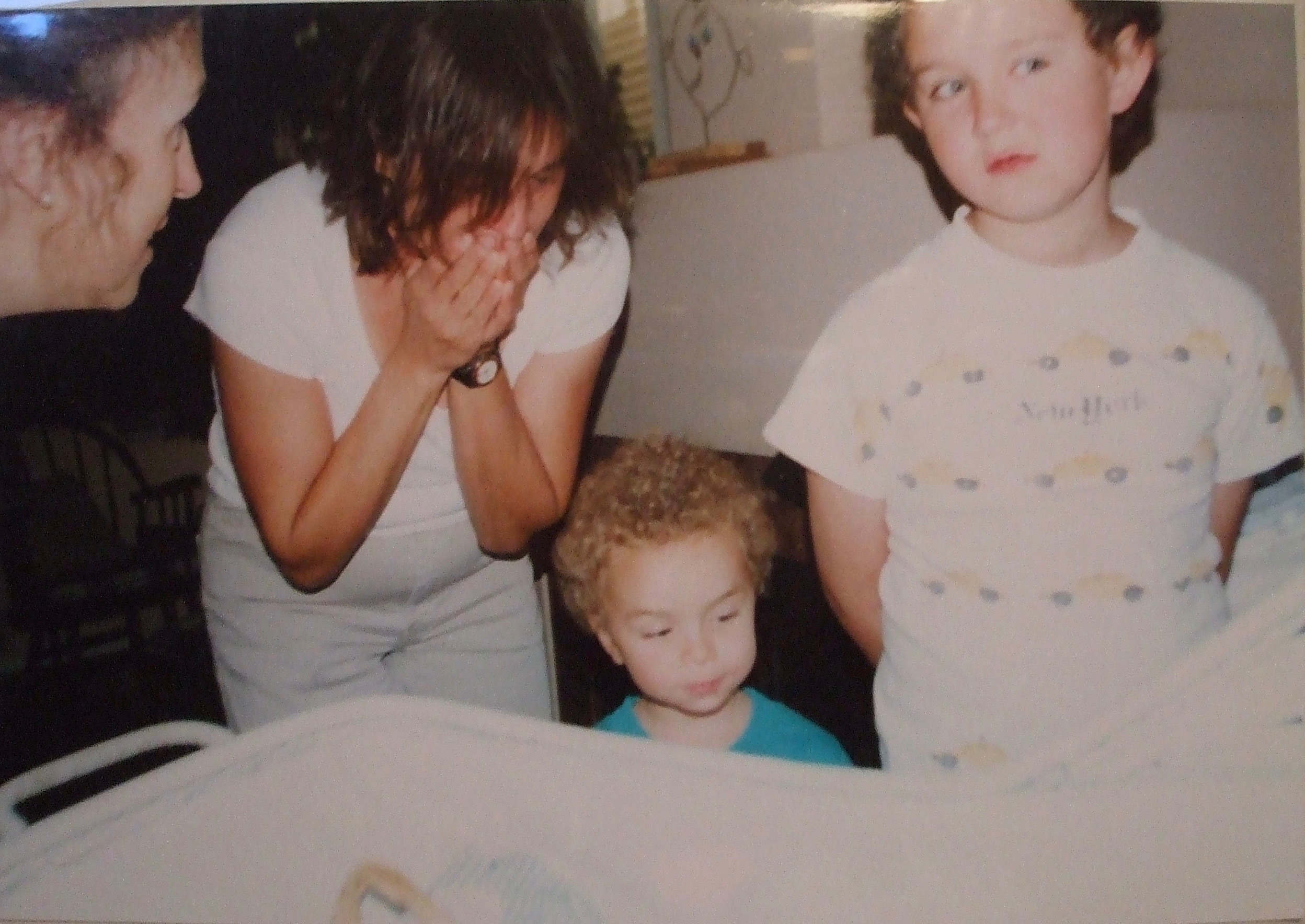
i’d wanted so very deeply to write a love letter to my beloved friend now gone. but privacy was everything to her, and privacy i will preserve for her. i will, though, post a few pictures — ones already seared in my mind and my heart. two from years and years ago, the first time she came to meet little teddy, just newly born, and one she sent me just this past summer, from sunrise at the shore of lake michigan, where she’d gone for sunrise salutation. finally, because it’s out in the world, an audio tribute to my beautiful friend, from her dear friend, the brilliant writer, alex kotlowitz. savor these moments with my friend, and if you’ve a spare, offer up a prayer for her dearest tenderest circle, her beloved husband of 21 years today, and their two beautiful children, one of whom is the curly-haired beauty at the elbow of and cradled in his mama’s arms in the photos below.

cecimeetsteddy

beholding joy….newborn, unexpected joy….

cecijoy

marveling at the itty-bittiness of a newborn.

zenceci

sun salutation. illuminated in everlasting light.

in your hours of grief, what lit your way?

tables turned…

ice puppet

since tuesday, i’ve had a fever. i’ve been achy all over, and moving slow as slow can be and still qualify as movement.

i’ve even taken to my mattress a couple afternoons, which — around here — is unheard of. but the most amazing thing unfolded one of those afternoons, the first one when i was stretched out and aching and hotter than hot. a young lad came to my bedside and insisted he was the fever fixer. he had a plan, he said, and he set out to execute.

from down the stairs and around the bend, i heard the klunk of ice cubes being procured. i heard the linen closet squeaking open. i heard the old metal tray being pulled from where we store those sorts of things. and then i heard the hobbling sound of my sweet boy — the one with one leg in a brace and one arm in a cast — i heard him climbing the stairs.

he appeared at my bedside on that hot july afternoon bearing a tray that held a dripping wet washcloth, a cup of ice chips and an apple tucked pertly in a white souffle cup. before i could say a word, he slipped his cast-less hand into the puppet of a washcloth, one of those terry-towel hand puppets meant to make bath time for little ones a theater of suds.

this particular washcloth, the one that was always his favorite, happens to be a hippo. so my bedside attendant stretched wide the hippo’s mouth, grabbed two cubes of ice, and proceeded to anoint my forehead in this icy, dripping bath. next, he reached for my wrists, and up and down my arms and legs. “you’ll be okay,” were the only words he whispered the whole long while. over and over, he repeated: “you’ll be okay,” as if the words alone were incantations, as if a prayer aloud.

a few minutes into this anointing of the sick, i finally mustered the breath to ask: “who taught you this?”

his answer: “you.”

i felt a tear roll down my cheek. it’s true, yes, that a wet washcloth applied to fevered brow has long been wielded here for curative effect. and ice chips in a cup, often dripped with honey, has long been an apothecary staple in this old house. but never in my life have i been as gentle, as determined, as tender as that boy was to me. the tenderness he learned from his papa. of that i’m certain. i, too, am learning tenderness — all these years later — from my sweet boy’s papa. it’s a lesson without end.

while the icy rinse didn’t make the fever go away, it decidedly worked wonders. for days now, my sweet boy has attended me with his hippo and his ice cubes. i asked him amid one of the icy rubdowns if he’d ever thought of being a doctor or a nurse, because he certainly had the healer’s touch. nope, said he, explaining, “i don’t like blood, and i’m not good at science.”

the marvel here is that we often think the long nights we’ve spent on bathroom floors with a retching or a fevered child, the midnight hours when we’re the ones knocking ice cubes from the freezer, we think of those, sometimes, as invisible hours, times that heed no notice. what we might not realize is that in that transactional moment, when ice practically sizzles on a fevered brow, when a kid who’s so sick he can barely open his droopy lids lets us slip an ice chip to his tongue, what we’re doing is so much more than knocking back a fever. we are quietly, and without folderol, teaching something sacred to the essence of being human. maybe fevers and flus were invented for the simple purpose of one someone being invited to try to heal another.

the marvel here — the reminder that came in dripping ice cubes this week — is that there is a life-and-death curriculum unfurling here in the quiet of our humdrum little lives. our whole life long we are teaching and learning that most magnificent of golden rules: love as you would be loved.

not a minute is wasted. not a lesson lost. little folk and big folk alike are paying attention, our hearts attuned to those gifts, those moments, that lift us, inch by inch, to a higher plane. we love, and so we are loved in kind.

i remembered this week that i am ever teaching, and lessons are ever being learned, even when i don’t think a single soul notices, nor pays attention. so i’d best try to live as tenderly, as full of heart, as my sweet child is teaching me to be.

that kid and his ice cubes, they more than did their job. in fact, they melted me. and my fever, too.

what lessons in kindness and tenderness have molded you, stretched you, carried you to a higher, sweeter plane?

the magic of the tilo tree: the tree that soaks up sunshine and lives and breathes to soothe

tilo tree

for weeks now, through much of spring and into these early days of summer, i’ve been on high alert, awaiting the precise moment when a certain linden tree growing in a convent garden would at last decide it’s time. time to unfurl its yearly offering and erupt in honey-scented blossom.

i’d never been so blessed before, so blessed to be on linden-flower standby, so blessed to have a dear nun dialing my telephone, leaving dispatches from the nunnery, a trail of progress reports from the distal end of one tree’s branches. my tree-spotting sister friend would call every couple weeks, leave messages like this one: “it’s sister rita, calling about the linden tree. as soon as our tree wants to give us its delightful blossoms, i’ll call you.”

and then, a week or so later: “i just want you to know the little buds are finally on the tree. i’ll let you know when they open.”

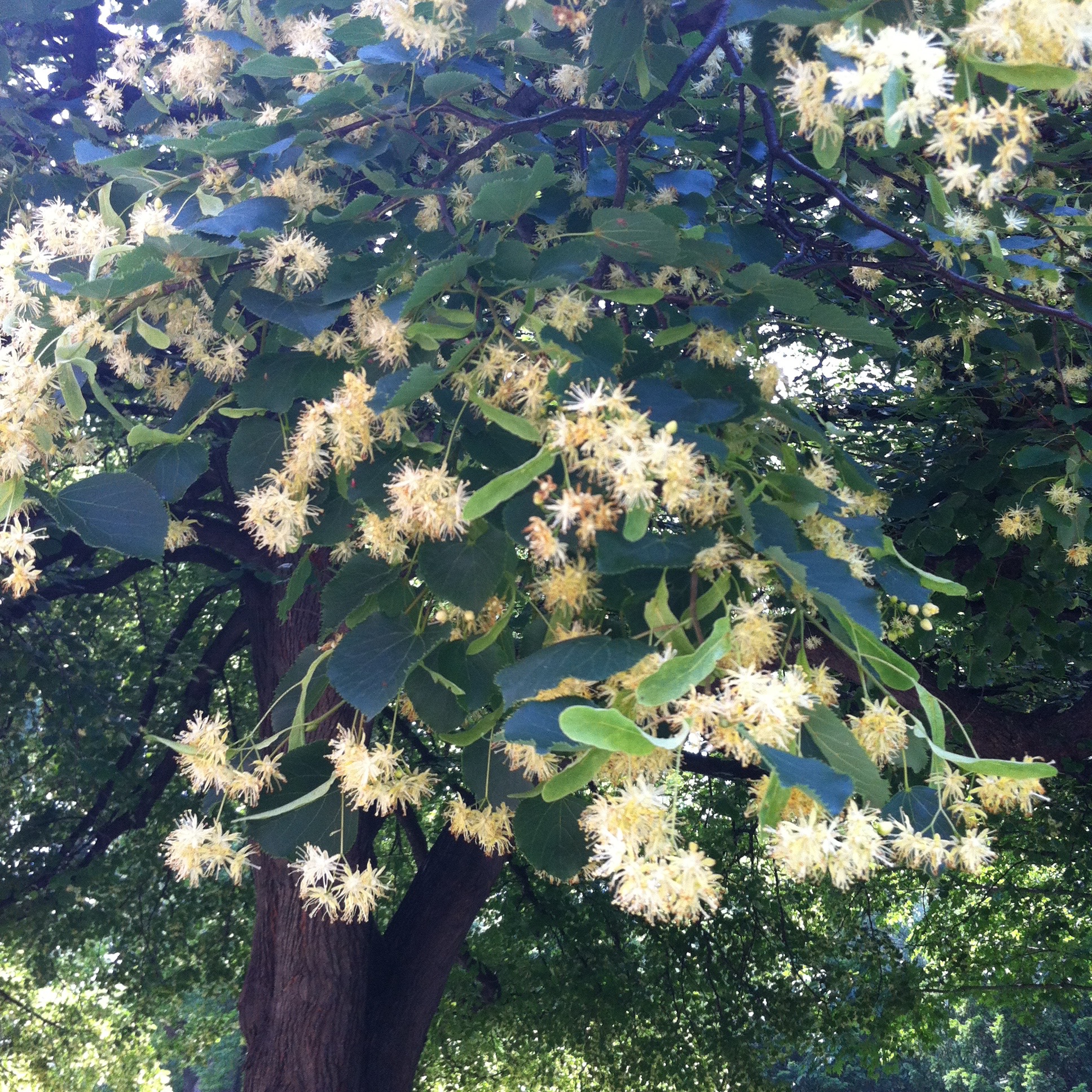
it is a most delightful interlude, i tell you, to find yourself awash in messages about the blooming of a tree, a tree a friend of yours is counting on to heal her hurting ways, a tree that through the ages has long been believed to store the warming rays of sunshine in its star-burst blossoms. a tree that lives and breathes, quite purely, to soothe us through and through.

lindenflower

the linden tree’s honey-scented starbursts

as promised, sister rita wasted not a minute in the spreading of the long-awaited news. she called first thing the other morning. before the clock struck eight. she was on the line bright and early telling me the time had come. the linden tree was at last in bloom, and i needed to come soon, before the sacred blossoms tumbled to the ground, and we’d have to wait another year. the linden tree this year was late, deep into june, nearly july, before it became a froth of honey-dappled sweetness.

i’d be there by two o’clock, i promised. i’d rearrange the day. i’d not let the afternoon’s shadow stretch long across the garden.

the story of the linden tree, and its blessed blossom, traces back to the not-so-long-ago day in april when a dear friend and i ambled through a magic hedge. my friend has cancer, nasty cancer, and we were soaking up the day in the deepest prayerful way. as we ambled through the hedge on that april afternoon and came around a bend, we stumbled into yet another old friend of mine, one who knows his trees. my one friend’s eyes widened as she spied a broad-limbed specimen of tree, one whose branches stretched heavenward and cradled a warbling little bird besides.

upon introduction, both friends began to speak in spanish, words tumbling more and more feverishly. all i could make out was something about a mama, and something called “tilo.” turned out my friend saw the tree and suddenly remembered the one in her backyard when she was a little girl. it was a linden tree, and when she was afraid, or needed calming, her mama gathered up its blossoms and made her little girl a tea. the tea she called “tilo,” linden flower tea, an ancient balm for soothing nerves, and sweating out a fever. my friend these days is sometimes in need of soothing, deep-down soothing, and though her mama’s gone, the branches of the linden tree held out the hope of something she had thought she’d lost.

i’ll not forget her face and how it softened, nearly glowed, as she looked up at that tree, as i saw the pages of her life’s picturebook turn back in time, remembering her mama and the tea that soothed whatever ailed her.

turned out the very next morning — at the very hour my friend was once again submitting to a scan that would peer inside and chart the path of her stubborn cancer — i was visiting an old friend, an icon-painter friend, who flung open the door of her pantry, and asked if i’d like a cup of linden flower tea. now, i tell you, i’d not heard of linden flower tea till just the day before, and suddenly, within the circle of a single day, i’d bumped into it for the second time. i stood there slack-jawed, and stuttered through the story of how my ailing friend had longed for linden flower tea, but had no clue where she might find it, without her mama here to gather up its blooms, and steep the brew just the way she’d always brewed it.

because my icon-painter friend is the sort who knows no end to generosity, the box of linden flower tea was off the shelf and in my hands before i stumbled to the story’s end. i broke out in goosebumps as i glanced at the clock, and realized all this was happening precisely at the moment that the body scan began. i tapped out a message to my friend to say, guess what, i found linden flower tea, and i’m bringing it your way. and then my icon-painter friend told me that, even better than the box of pre-packaged tea, imported from turkey, she knew a convent not too far away where a linden tree spread its branches, and where she knew the nun who each year gathered up its blooms. my icon-painter friend promised me she’d put me and the nun in touch. and so she did (although she placed the call from a 400-year-old silo on a hillside in italy, where she’s gone to spend the summer painting) and that’s how sister rita and i joined in linden-flower watch, keeping vigil on bud to bloom to starburst.

in yet another wrinkle to the story, my friend with cancer hadn’t looked at her phone once she finished the scan that day, the last of april. instead she stopped by the office of a friend, and feeling achy in the belly, told the friend she had to leave to somehow, somewhere in this city, find herself a cup of tilo, the linden-flower tea for which she so suddenly deeply thirsted. it wasn’t too many minutes after that that she finally glanced at her phone and saw the message saying i had a miraculously stumbled upon a box of that very tilo and was driving it to her house.

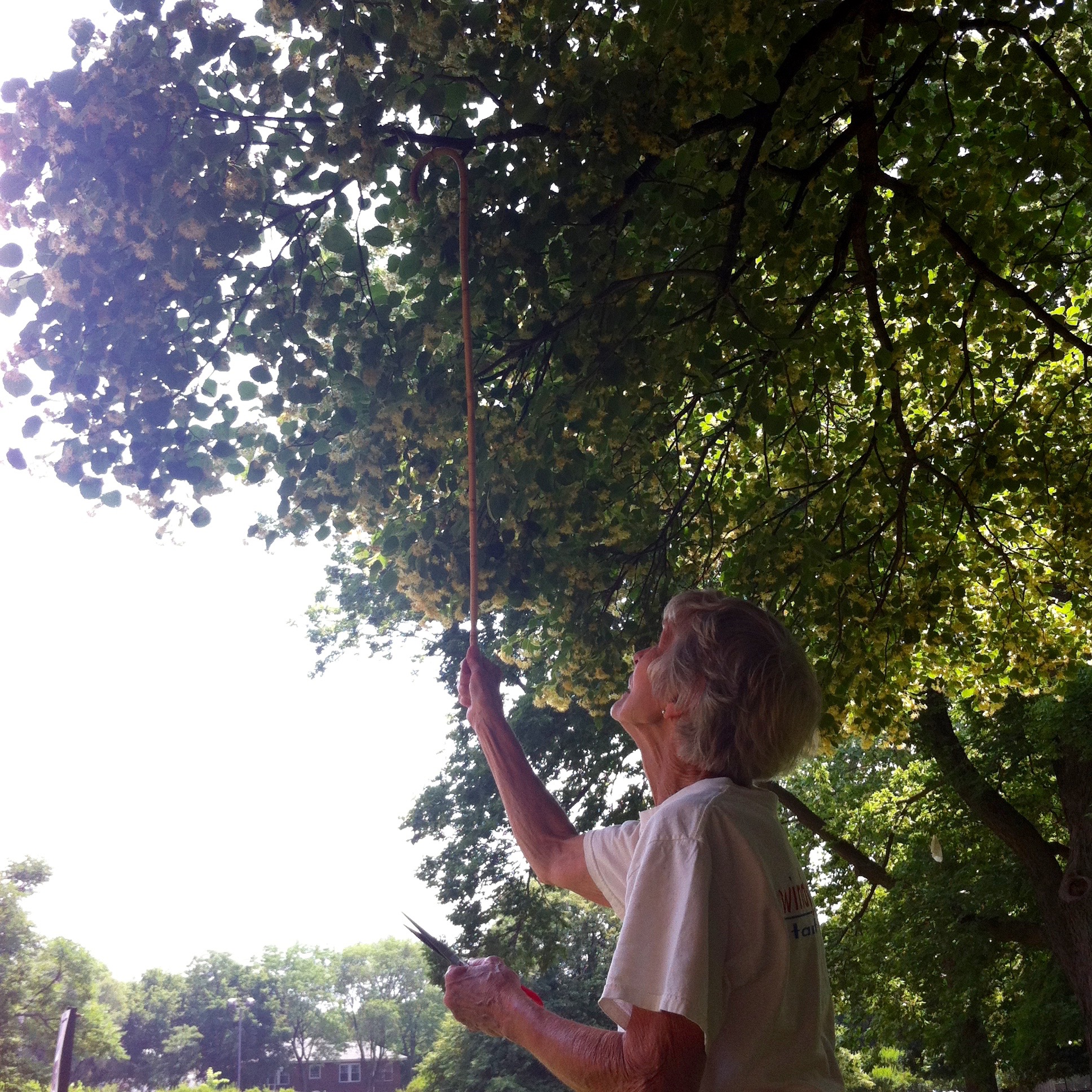
within the hour, as we stumbled into each other’s arms on the sidewalk in front of her house, i told my friend about sister rita and the linden tree. enchanted, my friend and i have spent the last many weeks awaiting the tilo bloom. we’d planned to amble there together to gather up the blossoms, but the day sister rita called was not such a good day for my friend, so i scurried along alone. and there i met the radiant sister rita, who swiftly grabbed a crook-necked cane and thrust it into the branches thick with bloom. coaxed by sister rita’s gentle tug, the starbursts yielded to our reach. she handed me a scissor, and for the better part of half an hour, we snipped and gathered, and filled a grocery bag.

sister rita "canes" the linden tree

sister rita “canes” the linden tree

sister rita

sister rita

i ferried home our cache, and snipped for hours more. my mama joined in the snipping, as we gathered up the blossoms and left behind the branch and leaves. for days now, the linden bursts have been drying in a flat-bottomed basket, drying into tea. it won’t be long till we put the kettle on, boil up a cup or two of water, toss in a teaspoon of the linden flower offerings, and brew my friend the soothing tea that she’s so deeply longed for.

one last thing: when i sent my dear friend a note, with pictures of the harvest day with sister rita, my friend sent back a little note of her own, with just one question: “isn’t saint rita patron of impossible causes?”

she remembered that her mama always prayed to saint rita, always prayed to her when faced with the impossible. i swallowed back a tear or two, and offered up my own petition to saint rita. may impossibility be shattered, and the possible come shining through.

i cannot wait to inhale the vapors of that holy cup of tilo, and to lift it to heavens.

tilo drying

if you’ve a linden tree out your window, here’s how to make your tilo, once you gather up and dry your linden-flower blossoms: simply steep one teaspoon of the dried flowers in boiling water for 15 to 20 minutes. drink up to three times a day. you’ll be soothed. while it’s been known for centuries to be a calming potion, please be cautious if you’ve a weakened heart. if in doubt, check with someone wise to the herbal apothecary.

if you’re not inclined to sip your soothing brew, you can bathe in it. here’s a recipe for a “relaxing evening linden-flower bath” (the name alone sets me to soothing): simply boil two to three handfuls of dried linden flower blossoms in a quart of water. strain your brew, pour it in the tub, and sink yourself in. 

might you have a magic tale to tell? one with holy vapors? one that stars a tree? do tell….

because in the annals of saints, nurses are among the holiest…

julie joyner + pumpkin head

i went back to my old hospital yesterday. my long-ago, very-much-loved hospital. i went because it’s nurses week, and someone asked if i might wander back and whisper love notes to the nurses. i couldn’t have been more tickled.

DSCF7434even though it’s changed its name — from children’s memorial to lurie children’s — and it’s moved — to the glimmering gold-coast streeterville, in the shadow of the john hancock center, from its old spot at the triangle of lincoln, fullerton and halsted, it’s still the place that’s a beacon to some of the sickest kids on the planet. it’s a place, i’m convinced, where the nurses who work there are nothing short of not-yet-canonized saints.

some of the searingest moments of my life were seared in the chambers of old children’s. i still remember my very first day on the floor where i would work for the better part of three years. there was a six-year-old named pebbles. she had cystic fibrosis, so her lips were blue and her lungs rattled and heaved with every in and out breath. the day i started work at children’s was her birthday, so all the nurses swarmed around her hospital bed, and started to sing. i started to cry. stood at the back of the crowd that ringed her bed, and could not stop the stream of tears as i absorbed the whole of all of it. i was new, was raw, and hadn’t yet figured out how my heart would absorb the inevitable, the heartache, that so often comes when you spend your days keeping kids as alive — for as long — as is possible.

i remember, just as vividly, the moment when the first kid who i’d loved died. his name was joe, joe thornton, and he had one of the cancers of blood — not leukemia, but one of the even more awful ones. i’ve now been present at births and at deaths, and i can tell you that both are equally vaulted moments, moments so sacred you feel the distance all but evaporate between heaven and earth; you dwell, at each end of life, in an in-between space so anointed you can practically feel the breathing of angels at the back of your neck. but joe’s was my very first death, and i didn’t know how it would be. when it came, when his last breath never gave way to another, it was as holy a moment as i’ve ever witnessed, the slow, and silent, and soft-petaled ebbing of life, of heartbeat, of breath. i remember feeling blanketed, as if the softest most blessed space — some new dimension of timelessness — had draped around my shoulders. i remember bathing him, bathing away the last bits of the earthly struggle that had been left behind. i remember the sound of the washcloth swirling through the tub of warm water. i remember the sound of his mama’s wail.

i remember, too, julie joiner, the 14-year-old with the spinal tumor that had left her unable to walk, the sweet girl up above in the black-and-white photo. i remember the moment she called me into her room because she’d been hard at work on a top-secret papier-mache pumpkin head. she’d painted it shamrock green, draped it with orange yarn (aka hair), carved out triangular eye holes, and called it “the irish pumpkin queen.” she made it for me, and she very much wanted me to spend the rest of my workday wearing it. i remember the way she laughed when i first slipped it on. she was a kid who didn’t laugh easily — and who would, with a tumor pressing against your spine, and your mama up and gone for reasons you never knew? reasons that left her papa alone to mind over her and her two other siblings — but she melted like butter once i put that hollow green pumpkin over my head.

children’s was like that. is like that. story after story. heartbreak upon heartbreak. only, they tell me it’s even harder these days to work there because kids are sicker, the socio-economic safety net more unraveled, and medicine, far more complex. the nurses at children’s expend every imaginable super power.

so my heart was triple-timing when i walked in there yesterday. when all the nurses started to trickle into the room. when, one after another, i looked into faces i hadn’t seen in 30-some years. because here’s the most amazing thing i discovered yesterday: as tough as children’s can be on your heart — as many times as a nurse’s heart can be shattered and trampled and left gasping for air — nurses don’t walk away. they stay. for the long haul.

it’s as holy a calling as ever could be.

there are nurses i worked with, side by side, back in 1979 till 1982, and they are still there. still making kids laugh. and burying sobs against their chest. still helping parents decipher very bad news. still carrying home heart loads of worry, and plenty of stories that make you spit out loud laughing. because kids are like that. and sick kids are just like everyone else. only a heck of a lot braver. and more likely to make you go weak at the knees.

and sometimes they’ll say things you’ll never forget.

like the kid whose name i can’t remember, but i do remember this: he was a very sick kid whose mama had finally gone home for a night; she lived far away, in indiana, i think. turned out he took a sharp turn for the worse that very night. he was dying. so his nurse was the one who sat close beside him, who took his hand, and just held it, all through the dark of the very long night. as the little boy’s breaths came shallower and shallower, he started to talk to someone the nurse couldn’t see. said something about how he was ready; he’d take his hand now. then, suddenly, the kid who’d been barely catching each breath, he startled, opened his eyes and said with the most animated, radiant face the nurse had ever seen: “you can let go now, i’m taking God’s hand. i’m going to heaven.”

and then he let go of the hand of his nurse, and he died.

and that’s why i looked those nurses straight in the eye — and the heart — yesterday, and i told them this: “you, nurses, do the holiest work: you heal the wounds of the body, but also the heart and the soul. you listen. you troubleshoot. you make the impossible possible.”

and each and every one belongs in the canon of saints.

if you’re a nurse, what drew you to become one? if you’re not, do you have a story of a time when a nurse pretty much ushered you — or someone you love — into the inner sanctum of all that is holy and hushed?

and happy blessed day of mothering, a definition i believe in because the verb, “to mother,” is all inclusive, and counts anyone who’s doled out the great gifts of nurturing and attending, and loving and doting, that define motherhood.

photo credit to my beloved nursing colleague, claire dassy, photographer and archivist extraordinaire. i never knew that picture existed till a few months ago, when dear claire melted me and sent it my way…..

magic day at magic hedge

magic hedge

we cleared the day, i and the friend i love. i and the friend who these days is measuring her life bar by bar. each interlude of each day, each interlude when she can muster the strength to be up and not down. each interlude when the ravages of beating back cancer don’t hold her in their impossible grip.

my friend is one of the ones, blessed ones, who has slipped behind the screen, the opaque screen that so often keeps all of us from seeing the sacred, breathing the sacred, filling our lungs with all that is holy.

she sees everything now.

she’d written me an email that felt almost like haiku, so spare, so distilled to the essence.

she wrote: “blessings, blessings, more blessings. every minute is bonus. sun. birds. now.”

i listened. with those few words as my prompt, i cleared the day of whatever was due, was demanding, because i knew there was no time to waste; there never is. because i read her message, and the three letters — n – o – w — that deserved their own sentence, i stopped trying to find a way to wedge in a visit between appointments and meetings. i beheld the miracle of an ordinary wednesday. i carved out the most precious gift in the world: time. a few quiet hours stitched into the weave of a week.

because of the words she wrote in her haiku, her insistent plea to be awake to the now, because she mentioned birds and sun, i started to scan for a place that was beautiful, one that offered a strong dose of sunlight and shadow, birdsong and silence. the yin and the yang of the springtime, of life — its dualities so deeply essential.

i thought right away of the magic hedge.

we didn’t know when we met there, in the lull of the carved-out hours, just how magic it might be.

the magic hedge, you should know, is a wisp of meadow and brush and groves of old gnarled trees. its paths rise and bend, so do its grasses, the trunks of its trees. it elbows into the lake, lake michigan, as if an offering, an outpost, to the rivers of birds who, come warm springtime winds, catch the updraft, fly thousands of miles, from way south in central america or mexico or the southern united states, to way up north, to the boreal forests of canada, or, just shy of the border, nestled in woods along the great lakes.

the river of birds — songbirds, nearly all of them — flows along the lake’s edge; the tracing between water and shore an avian navigational guide as ancient as any there ever was. one of the great north american flyways, it’s called, and the magic hedge is something of a bed and breakfast for the long-distance flocks. exhausted, their little throats parched, their wings so tired from flapping, from floating on air, they settle into the trees, into the brush. they partake of the vernal banquet that is the hedge in bloom.

one of the miracles of the magic hedge is that it wasn’t always there. God didn’t put it there. it’s landfill. the leftover earth — the dirt, the rubble — from building a city, from raising a metropolis at the edge of the prairie, and all of it dumped into the lake at montrose point in the 1920s and ’30s. blessedly, chicago is a city that makes no small plans. it was alfred caldwell, a noted prairie-style landscape architect, who plotted the hedge’s undulations and meadows, numbered the trees and the shrubs on his planting list. it’s a mere 6.8 miles from the crosshairs of chicago’s cacophonous epicenter at state and madison, the zero-markers of the straight-lined grid that measures the city, border to border.

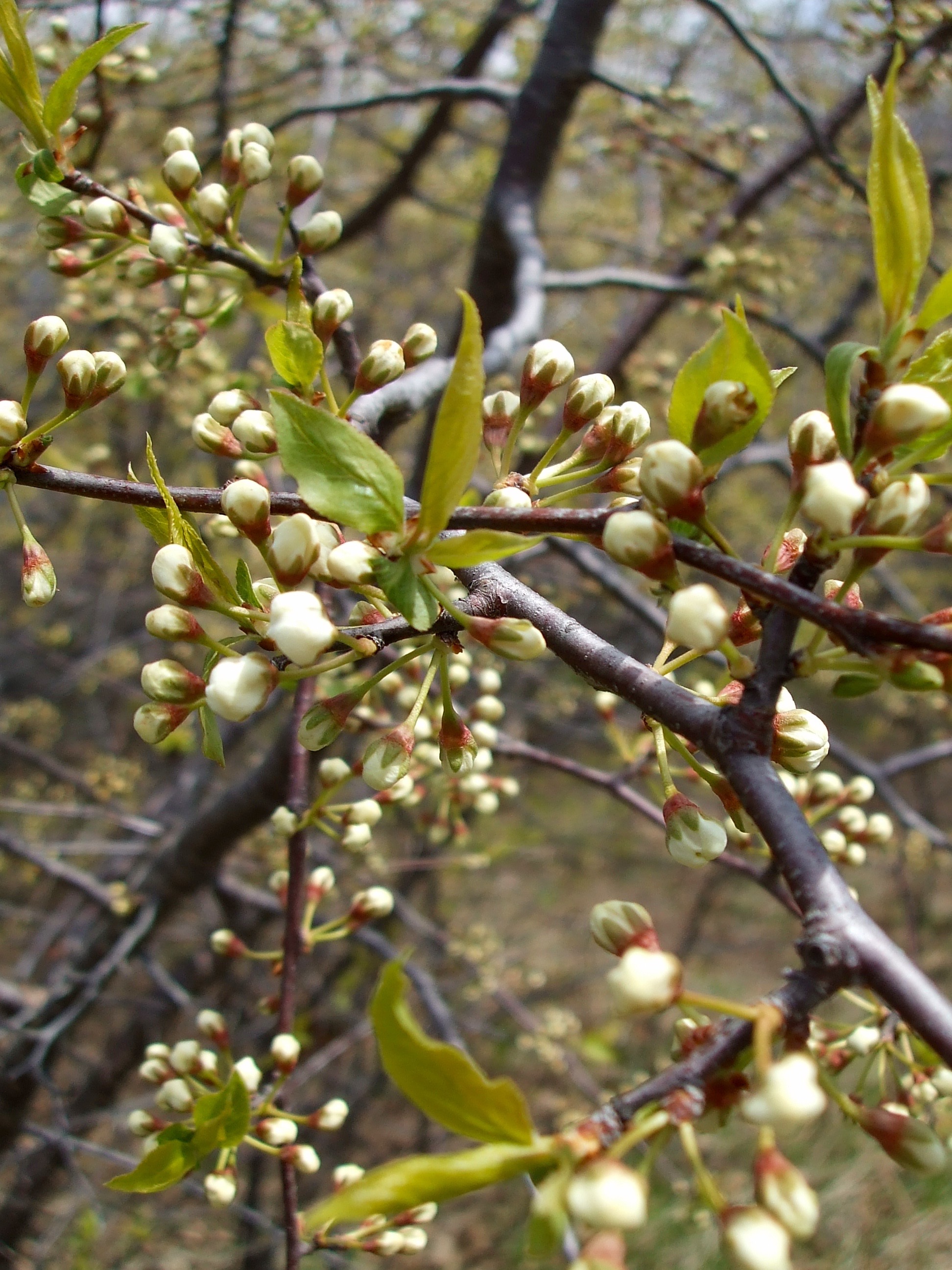
magic hedge blossom

yet, to step into the hedge, not half a mile from the rushing roar of lake shore drive — a flow of exhaust-spewing cars and burping, back-firing motorcycles — not a mile from the urban drama and squalors of uptown, a chicago neighborhood that’s long teetered on margins of every kind, to step into the hedge is to be swept, to be wrapped in the birdsong, the branches in bloom, the tender insistent unfurling of the season, whatever the season.

to step into the hedge is to surrender to the sacred.

we hadn’t guessed how sacred it might be.

it didn’t take long to figure that out.

right away i noticed a flock of the two-legged kind, the human kind. most of the flock were sporting long-nozzled lenses, pressed up to their eyes, pointed toward treetops. i tapped one such fellow gently on the shoulder and asked what the flurry was about.

“came here on a text that there was a hooded warbler, but it hasn’t been seen in 20 minutes,” he kindly told me, not bothered at all that i’d asked.

now, a hooded warbler, you should also know, is a wee little thing, one not often seen, apparently. it flies in saffron-colored robes, and for once i’d say the female is even more luminous than the male (but that’s getting ahead of the story). the hooded warbler is enough of a rarity, enough of a gem upholstered in feathers, that busy birders hard at work at their day jobs, drop everything when a text comes in that one, just one, is flitting through the magic hedge.

i felt a quiver of thrill as i leaned against a fence post, awaiting my friend. and that’s when a scarlet flash appeared before my eyes. right there in a branch i could reach out and touch. mind you, papa cardinals in my backyard do not allow visitors. this one, a proud papa, practically begged me to pat down his feathers.

that’s when i first felt the tap on my very own shoulder: magic was settling in for a visit.

not many minutes later, my beautiful friend arrived. a cap pulled tight over her head. wide-lensed glasses shielding her eyes. the cures for cancer are taking their toll.

we stepped into the birdsong, i and the friend i so love. the woods were achatter, aswoop, as spread wings crisscrossed the sky, as Ws made Xs over our heads. we followed a trail. we talked about those things that matter when you are staring down cancer. we talked of surrender, and healing and prayer in multiple tongues. and that’s when yet another cardinal decided to not be afraid. he hopped onto the grasses that spread between the forks in the trail right before us. he hopped closer and closer. this was a hedge alive with very brave birds, alive with a rare sort of courage.

magichedgecardinal

we did what you do when a cardinal befriends you: we crouched down low. we stayed very still. we barely moved a blade of grass. we whispered his name. he hopped closer and closer. and then his life’s mate, not quite so resplendent in her haus-frau feathers of drab brown and washed-out red, she plopped onto a fence post. she must have beckoned him. he darted away, leaving us slack-jawed at just how close he’d dared to come.

we wound this way and that. we paused at a grove of mayapple, one of the woodland’s underthings caught in the act of spreading its umbrella of wide-berth leaves. we marveled at the ruffled furls of the papery bark on a birch tree. and then we came to the flat slabs of rock, the ones that soak up the sun like a hard-shelled tortoise, the ones just inches away from the lap of the lake.

that’s when a kite-flying fellow appeared out of nowhere. one minute no one was there; the next, there came a man spinning his arms around an invisible spool. we couldn’t see at first what he was doing; it looked like some form of tai-chi, the way he swooped his hands and his wrists through the air at the edge of the lake. but then he called to us: “i made that,” he said, nodding toward high in the sky. we peered into the clouds and the sunbeams and that’s when we spied the red dot.

by then, the man with the kite on the string, he’d wandered close to our rock. without prompting he told us: “i wake up every morning, thank God for another day. you never know. i thank God every night, thank God for another day. you only got one life.”

and then, not long after that, he was gone. poof. vanished. lost in some haze. he’d wafted in long enough to tell the two of us to savor the moment, the minute, the hour. each and every interlude.

which was precisely what we’d been doing, were doing, will do. we promise.

once he was gone, had slipped away into the thin air from which he had come, my friend with the cap pulled over her head, she slipped down her dark-lensed glasses, and, looking straight at me, she said: “i think that was an angel.”

we both did.

we stayed on the rocks. we talked about life. we talked of the hard parts. we talked of the parts we so love. we whispered barely a word about cancer; there wasn’t much need to. we sipped mineral waters, ate clementines, dabbled spoons in two tubs of yogurt.

and then we got up, to meander some more. and there was more magic. the details of which i needn’t spell out (for this is getting to be too long a tale, though some tales are worth it). as we got to the edge of the hedge, though, as we got ready to step back into the day, into the bustle, we spied the last two insistent watchers of birds. they were poised in that way that birders are likely to be: lenses to eyes, pointed to limbs and to sky.

and that’s when we saw it, saw them, without any lenses, without any help (of the man-made kind, anyway): the rare and elusive hooded warbler, a pair of them to be precise. first mama, then papa. we watched, from our post alongside a log, as they darted and played in the trees. the afternoon light shone on the saffron-hued robes of mama warbler. she perched at the end of one very high branch, just sat there, practically glowing, making certain we inhaled the whole of her glory.

and we did.

the friend i so love leaned her head on my shoulder. and we stood in the hedge beholding the magic. beholding the love.

rare hooded warbler. with ceci. on magic day at magic hedge....

and that’s the answer to the prayer that comes when you carve out a holy hour or two or three, when you surrender to magic there at the watery edge. can you see mama hooded warbler, all plump-bellied and saffron there on the edge of the bough?

have you carved out holy time lately? and what magic wafted your way, alighted right before your deeply believing eyes?

once, i had a dream…(or slowing time in real time)

harlene slow time

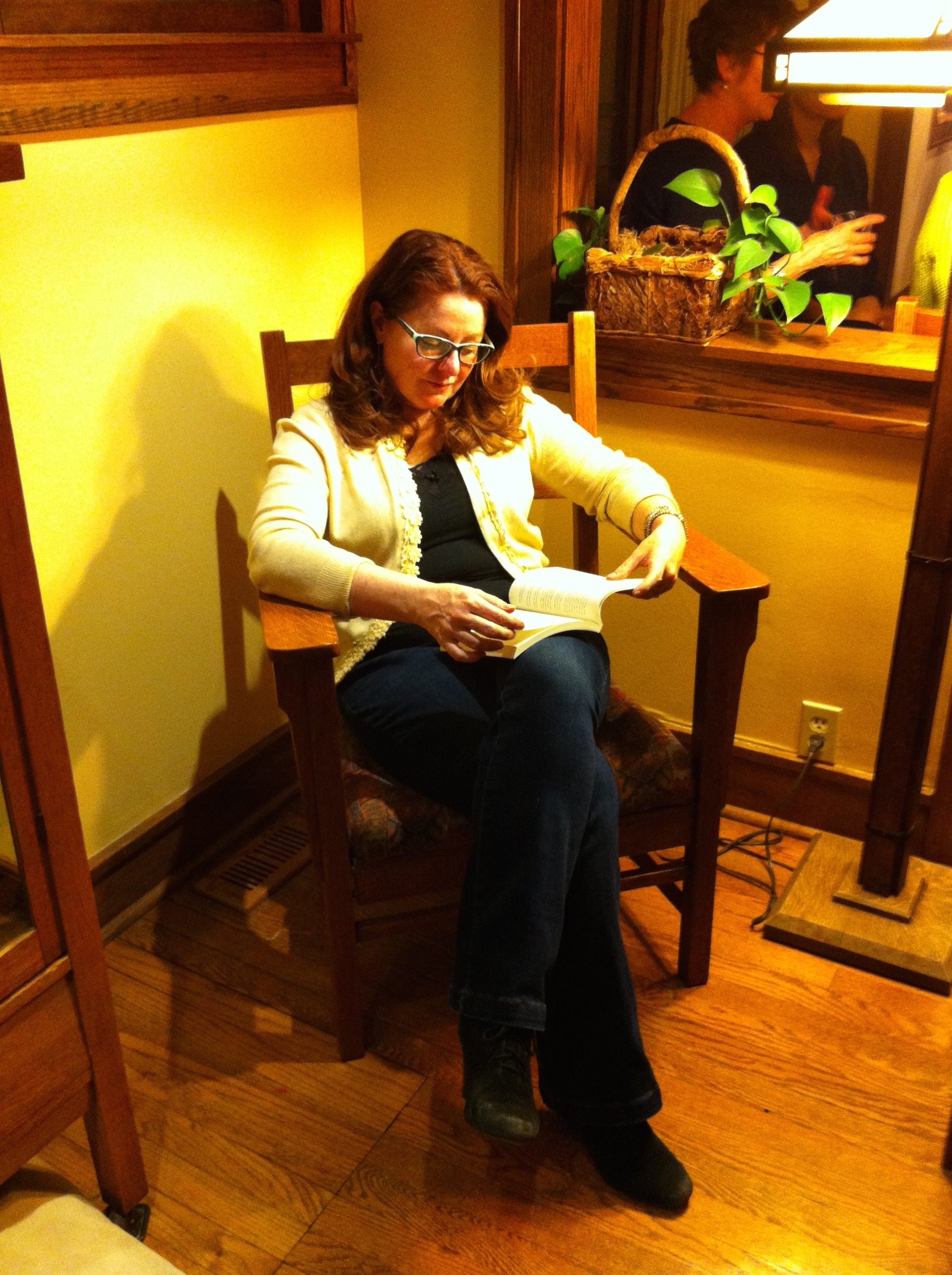
reading cornerslowing time circle

the wintry night couldn’t have made it more daunting. the roads were thick with snow, hadn’t seen a hungry plow. the winds began to whip. the flashing sign on the highway warned that it would take two hours, nine minutes, to snail our way (a mere 11 miles) to the spaghetti bowl of interchanges that only then could shoot us out the next long stretch of byway.

we were, with all our might, trying to get to the little town that once was home to frank lloyd wright and ernest hemingway. a bungalow, candle lit by then, would soon be filled with folk who’d come to taste a wintry eve of slowing time.

we’d be lucky if we got there by 10. and the evening was slotted to unfurl at seven bells. our bellies lurched as we did the math, realized the full throttle of our predicament. and then the car began to shake — convulse, more like it. i thought perhaps it was on the verge of blowing up. or, perhaps, merely screeching off the icy bridge. turned out to be the wheels protesting the ice that stood between the tire treads and traction.

by stroke of side streets, and the zany map in which chicago plows the backroads but not the main roads, we managed to get there at the stroke of half past seven. we’d zigged and zagged and beat the doomsday clock.

once we walked inside the golden-glowing house on grove street, we were soothed. slowed. wrapped in candle light and logs crackling on the fire.

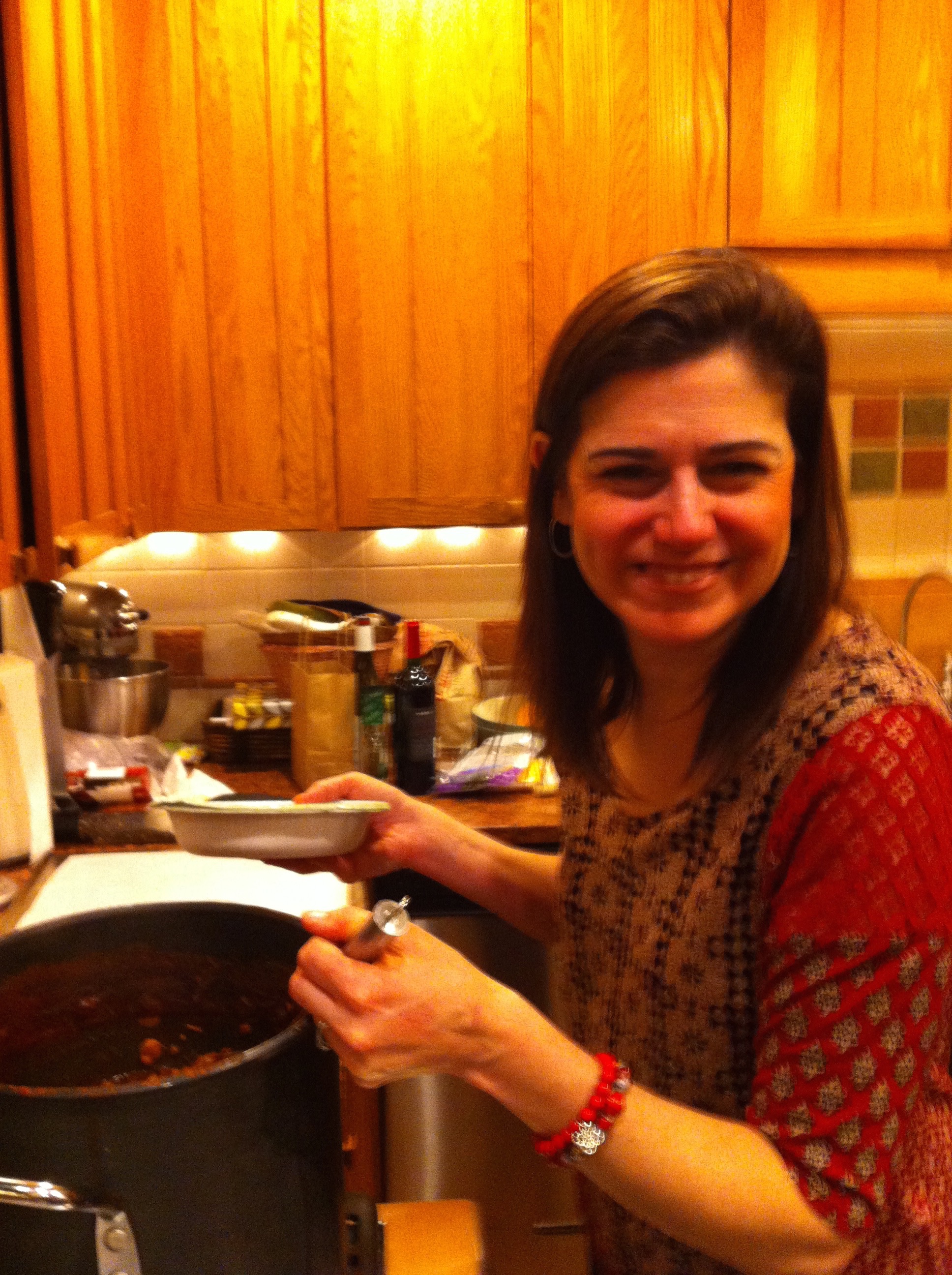
the one who’d done the dreaming up of all of this — a lovely woman named harlene who lives to find the common thread that weaves us all together — she was stirring at the slow time pot, the name she’d pinned to the cauldron of three-bean chili, thick with chicken, zinged with squeeze of lime, the one she’d cooked all sunday.

i got predictably teary-eyed soon after walking in. i only knew four of the 30-some folk who were huddled round the wine, the chips, the hearth. they’d come, i whispered to my flabbergasted self, to hear a bit of slowing time.

oh, it takes a rather packed equation to make a dream come true. but what stirred as i slowly made my way to the stove, to sidle up to the one stirring the chili, was the knowing that i was walking through a dream.

the dream, born long ago, was something like this: what if, in a world that chatters so noisily few can make out any sense, what if we quietly carved out a sacred place, a safe place where words and hearts were shared, and harshness never was invited? what if we could mine the landscape of our simple ordinary lives, our messy stumbling fumbling lives, the one where day after day we try again to get it right? what if we might gather kindred spirits, and hold each other up, on the days when we wobble, yes, but even on the rarer days when we swear we just might glow a little hallelujah glow?

what if, from time to time, the holiness leapt off the screen, or off the page, and took shape in real time, with the flesh of human hands reaching across the table, or real tears slowly mapping their way down a cheek, across a lip, and off the precipice of chin?

what if there were real circles of real chairs in real living rooms? what if stories flowed, and hearts opened, and voices dared to speak beyond the whisper of talking to ourselves?

and there i was: inside the dream. surrounded by smart and soulful women. surrounded by women who’d left behind their day jobs, their kids, their noisy little lives to brave the bitter cold, the whipping snow, and the slip-slidey front steps, to slow time long enough to share a wintry evening’s conversation, to turn a page or three. and, not too much later, to step back into the icy night, behold the glowing arc of moon, and feel a heart a wee bit fuller.

these past few months — the months since slowing time (the book) was birthed — have invigorated and tested, and stretched and stung from time to time. but all of it, every butterfly in my belly, every sleepless hour of the night, even gasping aloud when i was called a “very pagan wiccan,” (yes, ouch), it’s all been the road to last night’s dream come true. and the even-longer potholed path to putting life to hope, to faith, to believing that — whatever it is — it might be done.

so here’s the wondering aloud: might we all not birth a dream? a simple dream, perhaps; maybe just to make it through a morning without the sound of harsh screeching from our throat. or maybe, take it up a notch and declare we’ll paint, we’ll write, we’ll knit till kingdom come — whatever is the shape and form you put to your creative genius (and, oh, yes, it’s genius, all right. every one of us was born with speck of genius, and is it not our job to figure out just how to let that genius out from wherever it’s been hiding all these years?).

what if we envision a world where unlike minds sit in quiet conversation? what if we pray all in one room — jews, muslims, buddhists, christians, wiccans, and, yes, druids, too? whether it’s filling the empty belly of one hungry child, or disrupting the hollow loneliness of the old man next door who sits all by himself, hour after hour. whether it’s tackling tolstoy at long last. or committing to memory every last line of emily dickinson, or maya angelou, or w.s. merwin.

what if we dig down deep and pull out our wildest dream, and then day after day, sometimes after weeks have slipped away unnoticed, what if, little by little, we added flesh to the bones of that dream, and one cold winter’s night, we walked into a bungalow, where bowls of oranges and chocolates waited by the door, where chili bubbled on the cookstove, and women’s words whirled through kitchen and keeping room, dining room and parlor?

what if we all believed that, given time and hope and the great gift of friends who pick us up every time we stumble, skin our knees, or feel our hearts get knocked around far too achingly, even our wildest little dream might come tumbling true?

what’s your dream?

libationslowing time kitchenharlene at the chili pot

and how might you begin to make it come to life?

and here’s an invitation: perhaps you too have a circle of souls you love — or even ones you barely know — and you, like beautiful harlene above, might put a pot of something bubbly on the cookstove, pull chairs into a circle, and softly, quietly, openly, invigorate the night with what you know to be beautiful, and holy, and deeply needed in this aching, sometimes scary world…(p.s. of course i don’t mean a slowing time night, per se, just a night in which you gather with great good souls and carve out time for what deeply matters. in real time. slow time…)

and from the bottom of my heart, harlene, bless you and thank you and thank you…..

maybe i should pretend….

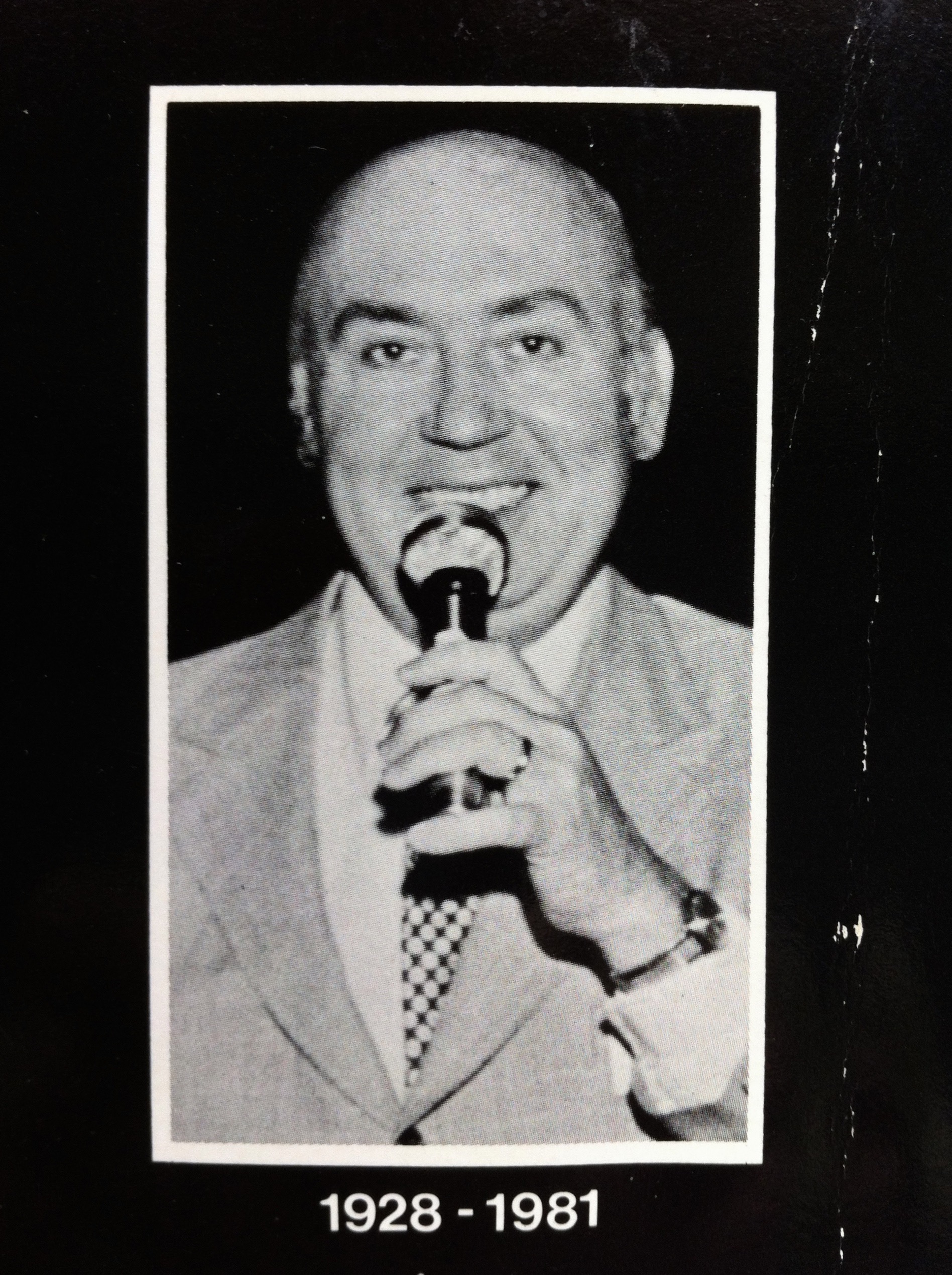
picture of dad, taken from back cover of his book.......

i’m typing this a day before i usually type. because tomorrow, friday, at this lovely hour, i’ll be feeling my heart plunk though my chest. i’ll pretty much be wishing i was anywhere besides where i’ll be: sitting in a grand dining room, with white-jacketed waiters scurrying like flocks of plate-bearing birds. knives and forks will be tinkling. i’ll be wishing that every wine goblet at every place was sloshing and swiftly being drained. i’ll wish for delirium to sweep across the room, and everyone in it to drift into ether-land. i’ll wish, quite frankly, to be knocked out myself.

it might extinguish the angst.

as the clock ticks toward 40 minutes after 12, i’ll be calling on angels and saints to lift me and carry me through the next 35 minutes.

you see, i’m slotted to get up, before a crowded dining room, in an old-guard chicago club, and unspool a few wisdoms.

which — if you know me even a wee little bit, this should come as no surprise — scares the behoozies right out of me. oh, i’ve been practicing a good bit of late. it’s what comes after you spend a few years sitting alone in a room, typing your heart out. all of the sudden, they (those faraway someones in the towers of publishing) glue all that typing together, put a pretty cover on it (in my case, a vase of what my little one calls “the dead flowers”), and then they make you get up and talk about those words. out loud.

which, pretty much, is my definition of living-breathing fear. it’s so far outside my comfort zone, i find myself dreaming of rocks i could hide under. examining closets for the extent of their “hide-ability.” my recurring nightmare, just before i wake up on the dawns of the days when i’m slotted to “book talk”: it’s me being toppled by tidal wave after tidal wave. complete with slimy sea shimmerers.

but then, each and every time i stand up — certain my knees will give out, especially if i’m teetering on the skinny little “kitten heels” my fairy godmother in book touring told me i needed to buy (“everyone looks at your feet while you’re reading; you need something excellent for them to look at,” she instructed, in no-fooling terms) — each and every time (so far), i’ve been overtaken by the intoxicant that swirls through the room. the one called love, pure and simple. i look out into a crowd peopled with faces i love, even faces i’ve never seen before, and suddenly i am soaring. no longer the terrified typer, but suddenly afrolic, to make up a word, one that for these purposes we’ll define as in the midst of frolicking. frolicking in waves and waves of laughter and tears and words tumbling on words.

but here’s the problem: i can tell, by the toxins that build by the hour in the hours and days leading up to every one of these podium moments, that i have clearly not inherited the microphone gene, the one double-dosed in my father, that jolly fellow above, the one who looks as if the mike is a plug that literally fills him with high-voltage current.

my papa never met a podium he didn’t love. heck, he traveled the world seeking out podiums. told us umpteen thousand times his fine little podium trick: just look out and picture everyone in their skivvies (that’s vintage 1920s talk for undies).

frankly, it’s never worked for me. i’m too scared to picture anything, let alone fruits-of-the-loom, and tattered stretchy sports bras (if my undies drawer stands as template for this).

so it came as something of a surprise — perhaps a hand reaching down from the heavens — when, a few hours ago, hard at work rinsing gunk from the kitchen sink, i suddenly was struck with a novel idea. one that in alllllllllll my years of being allergic to podiums and microphones has never before leapt into my braincells.

what if i pretend my papa is sitting there? smack dab in the very front row, all pink cheeks and twinkling gray-blues, drumming his fingers in that way that he did, that way i still can hear in my head.

what if i channel that jolly old soul who lived to tell a great tale, who wrung every drop of guffaw out of a punch line, who couldn’t care less how corny it was, long as it erupted the room in knee-slapping, tear-swiping, catch-your-breath laughter?

my papa lived to make people laugh. my papa lived to delight the ear with the tricks of his tongue and his tale-telling superpowers.

i’m a dialed-down version of my papa. what i’m aiming for, first and foremost, is to make it through alive. or at least not collapse in a heap, my little black dress and kitten heels the only discernible survivors. oh, i love a good laugh. i swell to it, like any living-breathing soul of irish descent.

but when i feel heaven and earth intermingling is when it’s so very quiet you can hear breath flowing in, flowing out. when you look into faces, rapt. maybe a tear, maybe streams of tears, messily making their way down cheek after cheek.

that’s the magic that propels me out of my seat. that’s the one and only reason i’m mustering whatever it takes to stand up and teeter on wobbly knees, wobbly ankles, curled-up toes: i’m aiming for the pulsing heart inside each and every one of us. i want our hearts — for as long as we can stretch it out — to beat in the blessed unison, the deep-down understanding that we all, every one of us, are searching for the sacred stitch that draws us together, that animates the whole of us, and lifts us to a plane of higher purpose.

and, maybe, if i pretend my papa is there, in the very front row, all dapper in his brooks brothers suit, the one with the buttoned-up vest, the one he wore on the most special occasions. maybe if i pretend he walked across chicago’s loop from the glistening tower where he typed for all those years — maybe, just maybe, the god-awful worry will melt away.

and i can pretend, tomorrow, that me and my dad are sitting alone in a very big dining room, and i am looking at him, straight into his heart, telling my very best stories, and unspooling a wee bit of wisdom.

miss you, sweet papa. see you tomorrow….

how do you talk yourself through the things that scare you to jitters?

burrowing begins…

burrowing begins fruit

winds are howling. the chimney is hiccuping (rather rudely), with every passing blast of gale-force updraft. cigar pods from boughs on high are poinking needle-like into the heads of anyone fool enough to tiptoe outside. the last few berries from the american cranberry, the scant few that haven’t been gobbled by blue jays and high-wire squirrels, they’ve been slammed to the ground in a bloody blob this morning.

a few minutes ago, i glanced out the window and thought it was raining itty-bitty locust leaves. then i rubbed my eyes and realized it was a hallowed eve’s snowfall. snow blustering, maybe.

the sky is pewter. the air so cold even the cat is howling in protest.

all in all, it seems surround-sound signal from the seasonal trumpeter: time for burrowing to begin.

autumn as october teeters towards its close, as november waits in the wings, when golden glow gives way to stovepipe gray, when stripped-bare branches scratch at endless sky, autumn is the season to hunker down, to draw in, to turn our attentions toward the essence deep within.

all this dialing down, buttoning up our nubbiest sweaters, slithering on socks for the first time in months, it’s all a call to haul out the soup pots from the back of the cupboard, to reach in the fruit bin for the season’s offerings — the ones that, in keeping with autumn’s ethos, reveal their succulence only after peeling away, digging in, extracting.

if it’s true — as a wise man taught me last week — that God wrote two books, one of which is the Book of Nature, then we’d be fools not to read along, not to inhale the verse of the shifting light, the shadowing that autumn’s depth brings.

if it’s true — and why wouldn’t it be? — that God in God’s Infinite Genius imbued every corpuscle of creation with a map pointing to the interiority of the ones charged with making sense of all this, the ones for whom understanding leads to illumination, which leads to enlightenment, then wouldn’t it follow that one of our holy callings is to heed the wisdom of the bough and the sky and the crunch underfoot?

and so, to steep myself in autumn’s teaching, i step outside into the whirl of this hallowed day’s preamble to winter: i feel the bumper crop of goosebumps on shoulder and thigh and nook of my neck; i inhale the faint whiff of logs burning from somewhere not far away; and, without much dawdling, i scurry back inside and do as instructed.

i pull on another sweater, i plonk on the couch, and survey the stack of pages waiting nearby. i begin to consider pumpkin — and not for carving, for roasting. i press my nose to the glass, set my gaze skyward, watch gray clouds scuttle by.

contemplate the coming depths.

i might be calling it quits on puttering about the garden. might tuck away the hose, the trowel, the watering can. might gather up the bird houses, replenish the bird-seed bins. the deepening is upon us. time to consider those who depend on us to make it through bitter days ahead.

the wisest thing to do, i reckon, is begin the prayerful coiling, the tending to what’s inside and too long left cobwebbed. it’s the season of introspection, and i’m settling in to do as so divinely ordered.

because tomorrow is all saints day, a feast day best honored by honoring the saints who populate our living breathing days, i’m beginning the nominations here with a beloved neighbor named sarah, who moved home a few years ago to care for and feed sumptuous nightly feasts to her aging mama and papa. just yesterday, sarah’s mama could not be awakened. she was breathing, but un-rousable, so an ambulance came and carried her away. she’s now deeply sedated in the ICU, where sarah and her papa kept vigil all day. late last night, sarah finally ferried her papa home, sat him down to feed him, then, in an act of compassion that purely took my breath away, she “rigged up his bed with pillows, so he can feel like he’s bumping into her” all through the night. sarah is saint number one in my book this year. please whisper a prayer for sarah’s mama and papa, and, deeply, for sarah.

who’s on your list of everyday saints? no need to name names. just a story will do…..and question number two: how do you begin your burrowing? what’s on your winter’s reading list? 

coming home to an empty house and other things that matter…

inviting in sacred

i was dripping from the shower, rubbing the fluffy towel around my ears, when i thought i heard the very last sound you want to hear at 6:15 in the morning: “r-r-r-ring, r-r-r-ring!”

the phone at this dark hour is never the nobel committee calling to say, “you won the prize!”

and i, being of celtic root, always suspect disaster. “oh no, this must be awful,” i muttered with certainty, as i leapt down two steps at a time to grab the phone, to take the blow i knew was coming.

“good morning, good morning,” came the first four words. and, then, my mother’s voice went on to tell me this: “i’ve been worrying.” (no news, there; she and i have a special knack in that department.) “i’ve been thinking about tonight, and i don’t want T coming into an empty house after soccer. i think i should skip your book thing. i would love to be there. but he shouldn’t be alone when he comes home. i should be there to give him dinner, keep him company.”

and in those short few words i heard, once again, love defined by my mother.

“don’t want him coming into an empty house…he shouldn’t be alone.”

i added those few words to the lines already etched across my heart.

the ones that include:

“i always felt the most important job i could do was take care of the family so the rest of you could go out and change the world.”

and: “once your father died, i told God i was dedicating the rest of my life to however God needs me.”

in my mother’s book of life, the litany of love reads like this: clothes pulled from the dryer, folded, stacked and delivered to your bedroom chair; hot dinner, complete with cooked frozen vegetables; houseplants given weekly dose of fluids; children driven — without grumble — to where they need to be; soccer matches attended — even if they’re in kingdom come at 7 in the chilly morning.

my mother, who quietly puffs her chest at the fact that she was the only one of her circle of friends deemed worldly enough and smart enough to date my father (this, by virtue of the fact that she subscribed in 1953 to forbes magazine), is not one to knock you over with pythagorean theorems, or deep analysis of the threat of ISIS on the world stage. she will, however, quote you lines from emily dickinson, or robert browning, till you beg her to stop. and she will recount every feather she’s spotted since daybreak in the boughs outside her window and at her 18 backyard feeders (that’s a tad of an exaggeration, the feeder count, but i told you i have irish roots; embellishment is our mother tongue).

and she will quietly, wordlessly, go about the business of taking care of your house — or mine. because to my mama it is in doing that we love.

it is in wiping dry the dishes i’ve left dripping in the rack. it is in ferrying her little blue plastic cooler to our front door every tuesday, always bringing along a zip-lock bag of this or that, the ingredients for dinner pre-measured at her house, in her kitchen to bring to mine. she’s driven 9.62 miles to mix, to stir, to crank the oven, to set the table, and not forget the salt and pepper shakers. she makes a nice hot meal, circa 1970 — the prime of her cooking years when she had six hungry mouths to feed, not counting her own, of course not counting her own.

my mother is not alone in stitching the tapestry of life with petit point, those fine-grained stitches not grand in scale, not at all, but the very threads that hold us all together, that make our lives just a notch more beautiful, more breathable.

talk to anyone who’s dying. listen in on what they tell you matters most: curling up with a child — and a picture book — pressed against each other’s curves. sitting one minute longer on the edge of the bed while tucking someone in at night. spooning one extra dollop of butter in the mound of mashed potatoes. hearing the click of the front door that signals someone’s home. catching the moonlight drool across the bedclothes.

have you ever heard how hard the dying pray, for just one more round of gathering the tiniest glories of a day?

so, last night, my mama was not in the rows of a charmed bookstore, one with paned windows and oriental rugs and books bursting from the walls. she did not listen to her only daughter read from the pages of her just-published dream-come-true. (she’s not yet been to a reading, so it’s not like she took a pass because she’d already sat there drinking it all in.) no, my mama was home to turn the hall light on. to press her hand to the door handle when a tired fist knocked. she was there to warm up the orange chicken she’d made two nights before. to scoop out peas in butter sauce.

and there she sat, with the boy we all love — so he wouldn’t be alone, while his mama was off reading, and his papa was far away gathering notes for a newspaper story.

my mama stayed home at my house because she knew — without words — that it was the purest form of love that she could ladle out for all of us — not least of all for me, always torn when pulled away from where i, too, know i most belong.

my mama, once again, taught us with so few words that there’s no headline-grabbing heroism in a certain brand of loving. but in the end, the very end, those small acts of utter selfless majesty are the surest holy gospel we could ever know.

and it’s why — to this very day — i understand so deeply that i’m most at home, most solidly rooted, when i too partake of the tender acts of stitching a certain kind of attention into the daily cloth of those i love so truly deeply.

dear mama, you are loved. by all of us whom you so ceaselessly love.

what truths did your mama teach you? 

p.s. as of tuesday this week, october 7, Slowing Time: Seeing the Sacred Outside Your Kitchen Door is a living-breathing published book. amen to that.