pull up a chair

where wisdom gathers, poetry unfolds and divine light is sparked…

aretha + eggplant + me

there oughta be a soundtrack here. because there is in my kitchen these days. i might have found a cure for my MSNBC addiction. i spell it R-E-S-P-E-C-T.

the other morning, not long after a raucous ride to the schoolhouse door, i decided there was no better cure for the late-summer blues than cookin’ up a feast for the boys i love, especially the one whose days at my kitchen table are now in official countdown mode (i’m in the slow lane on these matters, so i make sure i get a long head start, and yes, the countdown is roughly in the 350-and-subtracting stage — and, yes, i realize this puts me squarely in the odd zone). but anyway, back to the kitchen. i decided that one more night of grilled chicken might send the kid bawking from the table, so i upped my ante. i decided lasagna — from scratch and in two modes, meatless and otherwise — was the hurdle i’d leap.

and that’s when i turned to two mavens: the barefoot contessa, who nimbly guided me through my cooking instructions, and the goddess of soul, who every time i plug her in takes my heart and turns it up a notch. or three notches.

30 greatest hitstwo minutes after i heard aretha had died, i turned toward motown and bent not my knees but my finger, the one that clicked on the iTunes. the one that bought me two hours of instant therapy. (since i seem to play it on infinite shuffle, 30 greatest hits over and over and over, i figure it cost me — in the first day alone — less than a dollar an hour.)

i rocked and rolled through “baby, i love you,” and “chain of fools,” and, oh yes, “i say a little prayer” (please, aretha, say one for me…). and all the while i read through ina’s instruction. and then, in keeping with the queen of soul, i began to scat. through my roadmap for roasted vegetable lasagna, with a side (a whole other pan) bursting with plenty of beef.

because i tend not to keep eggplant and whole-milk ricotta on hand, my efforts entailed a trip to the grocery. my simple feast wound up costing me a whopping 45 bucks, by the time i plucked top-of-the-line tomatoes and beef off the shelves. (no one said blues-breakers come without cost.)

and then, for the better part of an afternoon, i amazed myself as i roasted and stirred, chopped and dumped, plucked and sautéed. by four bells, i tell you, i was more than humming….i was wailing right along with the queens…

call me “old-fashioned” (you won’t be the first), but by the end of that long afternoon, when the sweet boy bounded through the door, took a big whiff, and exclaimed, “what in the world are you making?” i smiled a little smile deep down inside.

i’d taken a day — an otherwise unremarkable do-little day — and i’d dialed it up a fine notch. i’d used a bevy of produce — eggplant and zucchini, red pepper and mushrooms and spinach and onions and garlic and basil and parsley galore — and great glops of olive oil. i’d sizzled up beef, and stirred marinara. i’d hot-water-soaked whole-grain lasagna ribbons (a trick of ina’s i might not repeat). and then, come dinnertime, i plopped onto the kitchen table, two 8-by-8 squares of oozy, cheesy deliciousness.

there are plenty of days when words alone can’t say what i want to say: i love you like crazy. i miss you already and it’s not even september. and i fully intend to make the most of this one last hurrah of a year.

this week aretha chimed in, she belted it out for the both of us. we served up a feast, me and the queens. and we finished it off with “baby, i love you.”

should you be inclined to play along, here’s where we started. feel free to scat or to vamp or to add your own notes….(and here’s your soundtrack, to boot!)
gettin started

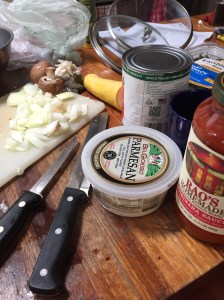
Roasted Vegetable Lasagna 

(from Barefoot Contessa) SERVES 6-8 

1-1⁄2 pounds eggplant, unpeeled, sliced lengthwise 1⁄4 inch thick 

3⁄4 pound zucchini, unpeeled, sliced lengthwise 1⁄4 inch thick
2⁄3 cup good olive oil
1 tablespoon dried oregano 

Kosher salt and freshly ground black pepper
1 tablespoon minced garlic (3 cloves)

10 ounces lasagna noodles, such as De Cecco 

16 ounces fresh whole-milk ricotta 

8 ounces creamy garlic and herb goat cheese, at room temperature 

2 extra-large eggs, lightly beaten
1⁄2 cup chopped fresh basil leaves, lightly packed
1 cup freshly grated Parmesan cheese, divided 

4-1⁄2 cups good bottled marinara sauce, such as Rao’s (40 ounces) 

1 pound lightly salted fresh mozzarella, very thinly sliced 
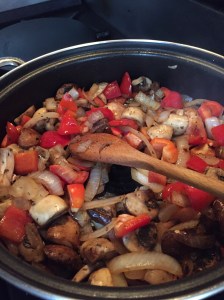
veggies*bam note: besides the eggplant and zucchini, i decided to sauté onions, red pepper, mushrooms (two kinds) and spinach. i made that yet another layer on top of the eggplant and zucch.

** in my meaty version, i ditched the veggies and sautéed one pound of ground chuck, with onions, garlic, oregano, fennel seeds, salt and pepper. then i added a can of whole tomatoes, a few squeezes of tomato paste, and let it all come to a fine pitch. in the instructions below, i  layered my beefy concoction in place of each veggie layer. 

Preheat the oven to 375 degrees. Arrange the eggplant and zucchini in single layers on 3 sheet pans lined with parchment paper. Brush them generously with the olive oil on both sides, using all of the oil. Sprinkle with the oregano (I crush it in my hands), 1 tablespoon salt, and 11⁄2 teaspoons pepper. Roast for 25 minutes, sprinkle the garlic evenly on the vegetables, and roast for another 5 minutes, until the vegetables are cooked through. Remove from the oven and lower the temperature to 350 degrees. 

Meanwhile, fill a very large bowl with the hottest tap water and add enough boiling water to bring the temperature to 140 degrees. One at a time, place the noodles in the water and soak them for 15 -minutes, swirling occasionally so they don’t stick together. Drain and slide the noodles around again.  noodles

Combine the ricotta, goat cheese, eggs, basil, 1⁄2 cup of the Parmesan, 11⁄2 teaspoons salt, and 3⁄4 teaspoon pepper in the bowl of an electric mixer fitted with the paddle attachment and mix on low speed. 

Spread 1 cup of the marinara in a 9 × 13 × 2-inch baking dish. Arrange a third of the vegetables on top, then a layer of the noodles (cut to fit), a third of the mozzarella, and a third of the ricotta mixture in large dollops between the mozzarella. Repeat twice, starting with the marinara. Spread the last 11⁄2 cups of marinara on top and sprinkle with the remaining 1⁄2 cup of Parmesan. Place the dish on a sheet pan lined with parchment paper and bake for 60 to 70 minutes, until the lasagna is browned and bubbly. Allow to rest for 10 minutes and serve hot. 

what’s your sure cure for the late-summer blues? and, more emphatically, what’s your soundtrack?

mangia!!!

p.s. so sorry i was a tad late this morning: i had two boys who needed a few hours of my time, and thus the chair had to wait in line. 

one last whirl: a lesson in savoring

kindergarten-bound

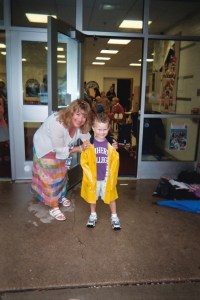
the little guy i love heads off to kindergarten (this was actually his “practice” walk to school): summer, 2006

i should have done this a long time ago. years ago. but, like many, many things in my life, i started late. was behind the average. way behind.

according to the centers for disease control, those fine governmental folk who track these things, the average maternal age for a second birth in the U.S. hovers just above 28. i was 44.7. i remember clearly the saturday afternoon when, knees shaking, i called my obstetrician to tell her the little white stick (aka home-pregnancy-checker gizmo) had just turned happy blue — i was, gulp, miraculously and against all odds and medical prognostications, “with child.” without taking a breath, my dear doctor rattled off the dreary stats: risk of miscarriage, 60 percent; risk of down syndrome, 1 in 32; risk of not surviving till the little bugger’s 18th birthday, 5.5 percent. (i’ve got 349 days to go….)

tell all that to the magnificent 8.0-pound baby boy born on august 8, 2001, at 3:22 in the morning, his big brother, father, and a phalanx of doctors and nurses (who’d rushed in the room when things got dicey) all in attendance. he and i plowed through every statistical obstacle strewn along the way. which is why his names, first and middle, mean “God’s gift,” (in greek), and “gift of God” (in hebrew). he was birthed — and named — in prayer upon prayer.

and now, all these stats-defying years later, said child is beginning his last year of high school this coming monday, which means this old house has entered official countdown mode. every step along the way, from now till the day we pack him up and drop him at some dormitory door, will come with modifier: “the last,” “the last,” “the last”….

what that means for me is that i dial up the savor knob, and even in the middle of a humdrum summer’s afternoon — while he’s ensconced in his little room at the turn in the stairs, and i’m chopping in the kitchen — i might just get a hankering to call up the stairs, and remind him for no reason whatsoever that i love him more than life. (to which he might moan “uh-huh” in humdrum reply.) i even find myself plucking inside-out shorts off the floor, smoothing rumpled sheets on his bed, and not minding one little bit because i know — full-well — that a year from now, i’d do anything to be able to pluck evidence of his presence off the bedroom floor.

i’ve lived — for the last seven years — with one foot in faraway-child mode, and one close as close could be. i know full well just how much that distance makes me ache. just the other morning, in faraway connecticut, i dried the tears as the shuttle pulled away from the curb and hauled me to the airport, my second-year law student disappearing behind the cars and trucks and light poles as the van turned the corner and i could see his broad shoulders no more.

like i said, i’m late to this. so late. plenty of my friends — from high school and from college — have long known grandmotherhood. know what it is to have the little rascals come for sleepovers. watch their firstborns cradle firstborns. not me. i’m still penciling in teacher conferences on my own calendar, making sure my rascal’s up and out of bed on the days the school bell rings.

i don’t know from empty nest. ours has not been empty in a quarter century. and we were married 27 years ago tomorrow. we mostly only know “nest accessorized with child.” come college shove-off next august, it’ll be the first time in 26 years that there won’t be another pair of feet clonking around the floorboards up the stairs. won’t be a soul to listen for as i lie there in the dark, awaiting the click of his key in the front door.

so until we get to that eery silence, that absence that’ll make this house an echo chamber, i’ll savor and savor and savor some more. my hunch is that i’ll be less cranky in this year to come. i’ll even relish smelly socks. and empty pie plates left overnight on the kitchen counter.

i know how absence feels. i know what it is to find myself in tears in the grocery aisle, because i’ve just reached for the something that i’d always thrown in the cart — but suddenly there’s no need anymore; the someone who always loved it is being fed by someone else now, someone in a college cafeteria. i remember full well how hard i tried to re-wire my brain, my being, to wrap my head around the notion that some kid i loved now dwelled hundreds of miles away, called home once on sunday nights in those first few months when he, too, was trying to find his place in this new equation called long-distance.

as always, i’m late to this. and i might be the oldest mama in his senior class. but gosh darn it, that only makes me wise enough to hold this year as if it’s the last. because, well, it is.

TK first day of kindergarten

at the schoolhouse door: first day of kindergarten and a boy i love gets a shoulder squeeze from the very fine school principal.

how do you intend to savor this next whirl around the seasons? 

nowhere i’d rather be

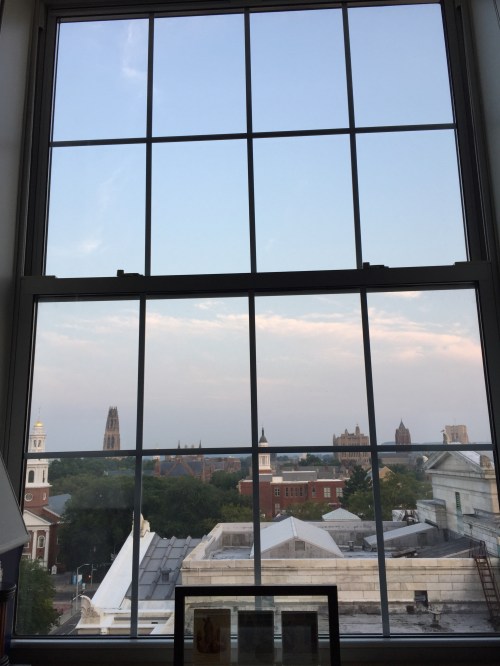
dispatch from 06510…

need i say a word? i’m pretty much at the crosshairs of latitude and longitude that most makes my heart zing — the seventh-floor aerie of the law student i love. made myself a promise that grew into a dream i’d not let go of, that pushed me to click the button that bought the ticket for the plane and the little green van that got me to here, 765 miles from the dot on the map that most often is mine.

“can we have a day?,” he’d long ago asked me, a question that became a code to live by. “can we have a day?” to love and to savor? to dilly and dally and do as we please, no rules, no time clocks, no prescribed agendas?

unless the agenda, of course, is the joy of being side-by-side. unscripted. bound only by unbridled, unscripted love and delight. delight in calling across a room — because you’ve just had a thought. or whispering as you walk down the sidewalk. seeing the same sight at the same time and reveling in that one simple joy — because it’s so very rare, the gift of your footsteps in echo.

so why oh why have i awoken with quite a few spots, not of the bug-bite variety? oh, lordy. can i not take an adventure without heaping on a twist and a turn? can a grownup get measles or pox? might i be allergic to new haven air? my plan is as old as the movies: take two aspirin, and dial the doc. whatever this is, i cannot leave it behind. no remnants allowed in the virus department. maybe it’s nothing other than an invisible mosquito, or a rash that can’t connect its own dots.

for now, while those little white aspirin get to work, i intend to live every ounce of our promise: to live this day and the next and the next and the next as if there’s no holier hour than this one that is fully and finally upon us.

if you could just have a day with whom would it be, and how would you spend it?

breath, suspended…

teddyhanddrawn heart

i prayed so hard these would be the words i got to write, and so i begin with this, the thank you prayer…

the call came just as i was sitting and reading a story i wrote long ago, a story about my mama’s breast cancer. funny, the tricks the universe plays. i thought little of it when the old phone announced on its screen that “northwestern mem” (the hospital) was calling. i’d had a 3-D mammogram the day before and i figured they were calling to give me the official “all’s clear.”

i was wrong.

it must have been mid-sentence in a sentence that suddenly seemed to be taking far too long to get to the point that i realized this might not be the call i’d wanted. i’m pretty sure i felt my heart slow with a thump. the nice lady — they are always nice on these calls — was telling me something about asymmetries, telling me not one but two spots on both sides looked suspicious. (she might have used a more innocuous word than “suspicious,” but once in the call-back landscape, a girl hears what she hears, and i heard trouble).

that’s when the breath-holding began. call backs in the middle of a long hot summer are not for the faint of heart. i’m pretty quick at sizing up danger, and i sized up this one, all right. first words that leapt from synapse to synapse were these: “oh no, too soon. the boys still need me.” for one, there are two years of law school still to go, and i’ve got my seat at graduation on mental reserve. i intend to be right there, and not wafting as some long-gone memory of a mom-turned-casper-the-friendly-ghost. and for two, the so-called little one still has a year left of high school, and right now he’s in the middle of tryouts for varsity soccer, and i was not about to let a single hiccup get in the way of that already-breath-holding adventure in steep climbs. so i sealed my lips and said not a word. (i only whispered to one or two girlfriends, and of course to that blessed fellow who hears most but not all of the daily headlines from my self-published worry gazette.)

long story short: not a minute went by during those long seven days when i wasn’t weighing the odds, hedging my bets, begging the heavens that this whole thing turned into yet another close call.

the hospital that wanted the second look could not fit me in for a week. my doctor insisted i go straight to second-look central, and not dilly around with one of the satellite operations where maybe, just maybe, the scrutinizing wouldn’t be up to her very high standards. of course, that scared me. i was scared, too, because more often than not i’ve sailed through these annual exercises in getting squished in the chest. i’ve had a call-back or two in the past, but it’s been awhile and nowadays the machines they use are so super-duper and soooooo very fine at peeking into every nook and cranny, i figured that if the darn newfangled machine saw something fishy it was a fish meant to be seen.

the weekend was long. so were monday and tuesday.

at long last, on the day that happened to be my second-born’s 17th birthday, and the first full day of his long-awaited, much-fretted soccer tryouts, i had to dart out in the middle of the day for my unexplained five-hour absence. five hours?!?!, you say. yup. that’s how long the darn poking and peeking around ended up going. they’d called me in for so many rounds of pictures, with varying degrees of specificity and technicians muttering, scrutinizing, apologizing, and then trying hard to hold a poker face, that by four in the afternoon when they sent me from pictures to ultrasound, i figured i was cooked. i’d started imagining how i would look with no hair and no eyebrows, how in the world i would break the news to my beautiful boys. i waste no time in the shallow end of the pool, when i can go straight to the deep end. and deep end was me.

i’d seen six rounds of technicians, and a phalanx of high-vision docs before anyone finally muttered the holiest word i’d heard in a very long while. “we’re not seeing anything worrisome,” said the very very nice doctor in charge, letting loose a week’s worth of stored-up breaths from my lungs. and suddenly, after brushing away the tear or two that couldn’t keep from falling, my whole world turned colored again.

but before the colors washed back in, before i could hope in my head for an extraordinary ordinary weekend, i’d tasted the magic — the most blessed blessing — of savoring even the smallest dab of everyday sacred: the gathering with friends over the weekend, the first sip of prosecco, the sound of the birds through the kitchen window, the sound of my firstborn’s voice on the other end of the long-distance line. not a single frame of being alive was passing by me unnoticed. or un-savored.

there’s a sharp edge to living that comes when you’re scared, when you’re thrust unaware into counting the hours, into marking off life in short-term brackets.

it’s a variation on electro-shock therapy (the sort to the soul, not to the brain): you’re jolted awake and at highest attention when flat-out fear comes to roost. i know it’s not altogether healthy, and not the wisest way to fritter away the days. but i make the most of it. i consider it a trial run, a crash course in counting every last decimal of all of my blessings. i use the siege to sift through my life, to weigh the ways i spend my hours. to crank the dial a notch, and make each moment count in duplicate, even triplicate.

and then, when the whistle blows, when the lifeguards tell me the long wait is over and i can breathe once again, i make more than a mental note. i drop to my knees and promise aloud i’ll not take this — not any of this — for granted. i stand at full-throttle attention, drinking in the ones i love with all of my heart, savoring the dew of the dawn, and the stitches of stars in the dome of the night.

the world is bristling with color this morning. and i am blessing each drop.

thank you, dear God, for this day and this hour. i’ll not waste it, i promise…

what keeps you from wasting a day? 

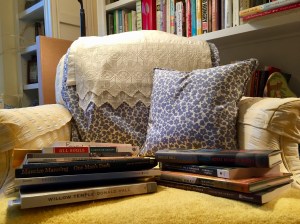
piles and piles of books…

soulbooksstack

books around here are slip-sliding into puddles. books are piled on bedside tables, and teetering at the edge of my old pine writing desk. books shove me out of chairs. and books sometimes line the stairs. books come into this old house all on their own. and sometimes, because i shlep them. my little book-lined writing room is becoming my book-stacked obstacle course. can you hop the pile? can you slither through the gulch, the one between two (or three or four) gravity-defying stacks?

i came home from the smoky mountains with but one genre of souvenir: books, and more books. books that all week have called me to the wicker chairs out back. books whose stories hold me from one reading interlude to the next. and then, of course, there are the books for work. lots and lots of books for work. some, i discard right away (voodoo dolls and crystal balls on covers). some i wade a few chapters in before gently laying aside. but every month, on assignment, i find three who shimmy to the top. they’re the ones i round up and claim satisfying soulful reads.

before we get to the latest round of tribune-anointed books, here are a few that might be among the best i’ve read in years:

donald hall’s a carnival of losses: notes nearing ninety.

hall, once the poet laureate of this fine nation, died a few weeks back, but not before his last — perhaps best — collection of essays was published. every single one of these is a gem, a specimen worth study. as the impeccable ann patchett puts it: “donald hall writes about love and loss and art and home in a manner so essential and direct it’s as if he’s put the full force of his life on the page. there are very few perfect books, and a carnival of losses is one of them.”

once upon a time, i sat in donald hall’s living room, at his farm in new hampshire. those hours grow more and more radiant across the distance.

eveningland: stories, by michael knight.

michael knight, a southern writer whose native and literary landscape is mobile, alabama, and who has been likened to o. henry and called “the anton chekhov of mobile bay,” is a writer i’d not known before i took a seat in the old hall at sewanee. from the first sentence, i was glued. reading an untitled story about a father and his son (one i had reason to think might be autobiographical) he couldn’t make it through without pausing to brush away and apologize for tears. that’s enough to make me love a writer. and when we bumped into him the next afternoon (along a leafy shaded path en route to the bookstore), he apologized again, though we insisted it made his reading all the more beautiful. his eveningland traces a few characters who weave in and out of stories, across the arc of life. each one is achingly wrought. and unforgettable.

and, here, because i forgot to post it a few weeks ago when it ran, is the latest roundup of books for the soul, as published in the chicago tribune.

“Faith” by Jimmy Carter, Simon & Schuster, 192 pages, $25.99

As the early pages of Jimmy Carter’s “Faith: A Journey for All” unspool, it doesn’t take long to get lulled into the front-porch-rocking-chair rhythms and cadences of small-town Southern gentility that is Plains, Ga., circa 1930. It’s easy to forget that you’re not just reading the reflections of a gentleman farmer with his mules and peanut crops, but in fact the remembrances of a Nobel Peace Prize-winning president of the United States.

Carter begins this bedrock retracing of a life of faith by recounting, in down-to-earth vernacular, a boyhood steeped in Sunday school and church suppers, in farm work and field play with the African-American farm kids next door. Yet in the next sentence, the 39th American president is reaching for his mainstay philosopher, Reinhold Niebuhr, then quoting activist, preacher and friend William Sloane Coffin, just as seamlessly as he draws from the writings of theologian and Nazi-resistor Dietrich Bonhoeffer.

But it’s in quoting Carter’s own works — a 1978 speech to his fellow Southern Baptists, for instance — that the former president inspires most unforgettably (and his words, against the backdrop of the summer of 2018, rise up piercingly):

“A country will have authority and influence because of moral factors, not its military strength; because it can be humble and not blatant and arrogant; because our people and our country want to serve others and not dominate others. And a nation without morality will soon lose its influence around the world.”

Carter’s book is necessary tonic — and prescriptive — for these fraught times.

“Letters to My Palestinian Neighbor” by Yossi Klein Halevi, Harper, 224 pages, $24.99

The inside flap of the book jacket states that “Letters to My Palestinian Neighbor” is “lyrical and evocative,” claiming it’s “one Israeli’s powerful attempt to reach beyond the wall that separates Israelis and Palestinians.” It is that, all that; and for that, there is little argument.

The argument of critics, though, is that the series of 10 letters addressed to an imagined Palestinian, all written by Yossi Klein Halevi — a senior fellow of the Shalom Hartman Institute in Jerusalem, where he co-directs the Muslim Leadership Initiative — boils down to a one-sided correspondence.

That’s the pushback from left-leaning rabbis and thinkers who argue that writing to an unknown, unnamed neighbor, with no give and take, no wrestling of ideas and perspectives, is to leave out the essential other voice in a much-needed debate. (Halevi offers the book in Arabic translation for free download and openly invites Palestinian response; he calls this book the sequel to his earlier “At the Entrance to the Garden of Eden,” a search for holiness — and understanding — among Palestinian Muslims and Christians.)

Halevi, an American-born emigre to Israel, writes with a profound and palpable empathy. “We are intruders in each other’s dreams, violators of each other’s sense of home,” he laments. His keen observations — deeply human in scale — ache with a longing to reach across “the wall between us,” to make peace, to find a two-state solution.

This epistolary approach evokes a measure of intimacy and illuminates the undeniable complexities of the Israeli history, across the millennia. With one half of the conversation laid out for all to read, the lingering hope is that there comes from Palestine the voice not heard in these pages.

“On the Brink of Everything” by Parker J. Palmer, Berrett-Koehler, 240 pages, $19.95

Parker J. Palmer — writer, speaker, activist, community organizer, and one who claims “Quakerish tendencies” — has long earned the title of trusted spiritual guide. Now 79, he takes on the mantle of cherished elder.

His newest book, “On the Brink of Everything,” might be called a meditation on aging, but it’s more than that. In his first sentence, Palmer writes, “We grow old and die in the same way we’ve lived.” This is in fact a meditation on living, as we move toward “the brink of everything,” the precipice at the far end of our lives, “a window into heaven,” as he puts it.

Through two dozen essays, a dozen poems and three songs (sung by Parker’s great friend, the soulful folk singer Carrie Newcomer and available for free download at NewcomerPalmer.com), Palmer reminds us not only that aging shouldn’t be feared, but rather that it stands to clarify our vision and deepens our capacity for knowing. Quoting one of Kurt Vonnegut’s characters in “Player Piano,” he reminds, “out on the edge you can see all kinds of things you can’t see from the center.”

Palmer, then, places us squarely on that edge and points us toward all those truths we’d be wise to see — and to make our own.

Barbara Mahany’s latest book,“The Blessings of Motherprayer: Sacred Whispers of Mothering,” was published in April.

Twitter @BarbaraMahany

armchairbooks

what are you reading this summer?

smoky mountain runaway…

smoky mountain stroll

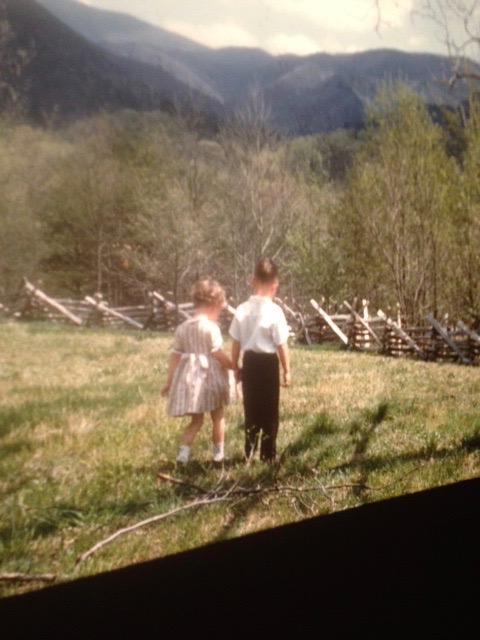
long ago, and far away. strolling in the smoky mountains. my big brother and me, when i was three and he was four, and we called knoxville home….

dispatch from 37383, specifically a roomy porch in the nooks of the smoky mountains, looking out over the undulations of sewanee, tennessee…. 

i’ve run away to the smoky mountains. for a few days. to absorb the rhythms of poetry and southern-steeped prose at the sewanee writers’ conference, where the likes of alice mcDermott, marilyn nelson, and bobbie ann mason bring their writing wares. and where plain folk like me wave our paper fans to stave off the summer’s steamy heat, and drink in undiluted verse.

my dear friend katie (thelma to my louise) picked me up while the stars and moon still blinked, at four bells the other morning, peeling through the city, and down the interstate before too many truckers even roused from their big-rig bunks.

i climbed aboard with visions of a wide front porch, and mountain sounds lulling the night away. i climbed aboard because when nestled alongside an old dear friend, endless conversation melts away the miles. before we’d ticked even halfway through the list of things that must be explored, dissected, analyzed, and plain old pondered, we’d hit the nashville city limits, and not long after, the sign for sewanee, 93 miles, and up, up, up, along the winding mountain road….

the first sound i uttered — upon racing to the promised porch and drinking in the strata-upon-strata of leafy-knotted mountainsides and tops fading in the far-off faraway — was wordless: nothing but the sound of breath rushing in, the sound of drinking what you’ve thirsted for — for so so long you can barely remember a time when you weren’t so parched.

since then, it’s all been as gentle an unspooling as any day — or string of days — can offer.

that porch, equipped with wicker rocking chairs and ceiling fans whose paddles stir air as thick as meringue in the making (at midday, anyway), is Runaway Headquarters, the post from which all stirrings stir.

long stanzas of pure silence — save for birdsong in the morning, and crickets in the thick of night — punctuate the hours. the orb of moon over the mountains, the only speck of light for miles and miles and miles, grows fuller by the night.

dawn begins with softening of inky night. haze settles in the cleaves of mountainside. it’s all soft, slow, seamless, from start to finish, from first fluttering of eyelid to that uncharted moment when at last the sleep surrounds. and there’s no finer first breakfast course than just-brewed coffee and a prayer cast wide across the precipice.

mid-morning, we motor down the winding half-mile gravel drive to the many winding miles of road that deliver us to “the domain,” 13,000 acres of leafy campus, the pride of Sewanee, The University of the South, a literary mountaintop mecca. one that just happens to be the sole beneficiary of Tennessee Williams’ literary estate, and, since his only sister’s death in 1996 (long institutionalized, she was the one on whom williams modeled his character laura in “the glass menagerie”), Sewanee is the holder of the copyright to every play, screenplay, poem, letter, and story the twice-Pulitzer Prize-winning playwright ever penned. curiously, his papers went to harvard and columbia universities, but Sewanee got all the dough and this: his patio furniture, his breakfast plates, a working toaster, and a small bronze nude, tucked away in the archives.

it’s a place dotted with an architecture my favorite critic dubbed “Appalachia Ox-bridge,” modeled after the oh-so-erudite Oxford University (as in the one in England), only here it’s Tennessee limestone in shades of khaki and caramel. oxonian bell towers, complete with parapets, ring out on the quarter hour. rose windows shimmer in the late afternoon light. and nearly every walk leads through or to some medieval surprise — a cloister, a fountained courtyard, a spiral stair to who knows where.

four times a day, all the good folk of the writerly conference plus townies like us gather in a quaint old hall, where oddly dying hydrangea bushes (whole bushes, potted, not stems blithely plunked in a vase) flank the podium. writers, poets, teachers rise and read, recite, preach the holy word of literary craft. i’m not alone in madly scribbling notes, and looking starry-eyed toward the rafters. trying my darnedest to seize a certain turn of phrase, or some truth just lobbed our way, one that begs for at least a moment’s pause.

our collective breath was taken away just yesterday when a southern gentleman in straw hat, seersucker jacket, and French sailor’s striped T, a fellow by the name of allan gurganus (author of “oldest living confederate widow tells all”), rose to read his latest genius in the making, a chapter from a novel he says is titled, “the erotic history of a country baptist church.” while we all rose to a rare (i’m told) standing ovation, i leaned in and whispered to katie, “that alone was worth the 800-mile drive.”

canned-ham camper cafe

you needn’t much else amid such sustenance, but we couldn’t resist the roadside stand, and lunched on perhaps the finest sandwich summer offers: sliced heirloom tomato, piled thick atop oatmeal bread, bare except for shake of salt and a grind or three of pepper. and last night’s porch supper was perhaps the finest tennessee gazpacho ever poured from a roadside canned-ham-camper-turned-cafe.

i’ve never been a natural wanderer; my nesting inclinations, hard to bend. i left a boy back home who filled me up with far more hugs than usual the day before i left; he told me plenty times that day that he’d miss me — words not often spoken by a kid a year away from packing up for college.

but sometimes a mama needs sustenance, needs silence, and poetry and birdsong to fill in all the cracks. i found it here in the mountains, here on the broad front porch from which i count the shining stitches in the night sky.

it’s been a long long time since i was home in the smokies. but, oh, sweet reunion it surely is.

thank you, beloved katie, for plucking me from the summer’s long dry stretch, and quenching me with mountain air and sewanee magic. and for this rare and wondrous chance to pull up a wicker rocking chair this week…xox and, emphatically, to katie’s sister beth, who so generously shares her slice of smoky mountain heaven….

where’s your summer runaway or retreat? and what unfolds once you’re there?

a gift from the mountains….(from maurice manning, Pulitzer-finalist poet, born and bred in Kentucky, and who had me on the edge of my seat at Thursday night’s reading.)

An Orchard at the Bottom of a Hill

by Maurice Manning

Why don’t you try just being quiet?

If you can find some silence, maybe

you can listen to it. How it works

is interesting. I really can’t

explain it, but you know it when

it’s happening. You realize

you’re marveling at apple blossoms

and how they’re clustered on the tree

and you see the bees meticulously

attending every blossom there,

and you think the tree is kind of sighing.

Such careful beauty in the making.

And then you think, it’s really quiet,

but I am not alone in this world.

That’s how you know it’s happening,

there’s something solemn and wonderful

in the quiet, a slow and steady ease.

Whether the tree is actually sighing

is beside the point. It’s better to wonder,

you needn’t be precise with quiet,

it just becomes another thing.

It isn’t a science, it’s an art,

like love, or a dog who’s pretty good,

asleep in the grass beneath the tree.

xox

p.s. i’ll add postcard-worthy pics to this post once home. for the life of me, i can’t add from afar….

sewanee kindness

i’m-not-sure-who-it’s-comforting-more food

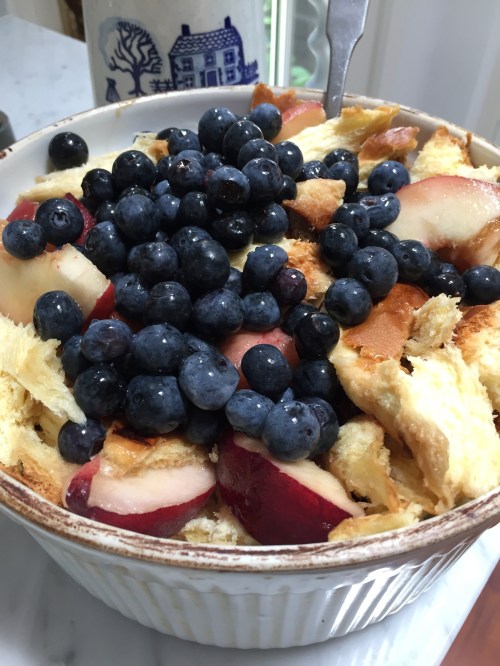
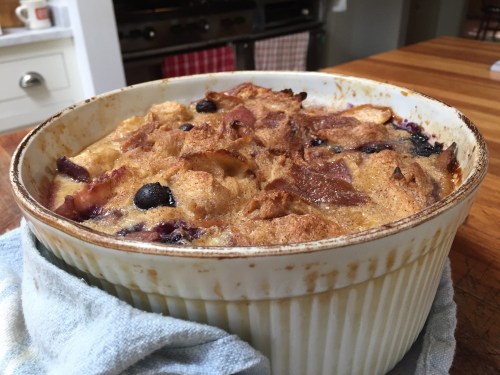
peach-blueberry bread pudding.3

in which we momentarily retreat to the comfort kitchen as the world wears us ragged, and sometimes our sphere of true influence has shrunken to a concentrated radius of one (maybe two on a good day…)…

the leftover challah called to me, as it so often does. every friday the braided loaf of eggy dough finds its way to our shabbat table, and every morning thereafter the mostly untouched loaf (for we tear off only a few shabbat chunks on most friday nights) whispers louder and louder from the basket where it idles in quasi-retirement.

it begs to be rescued from its shoved-aside status, to be transformed in miraculous ways. bread pudding, most often, is the solution.

this week, once i plunked the getting-staler challah onto the cutting board (my tangible reminder to do something with it) my getting-taller-by-the-hour almost-senior in high school chimed in. “oh, mom, could you make it with peaches and blueberries this time? remember you said you would?”

this was not such a radical advance, this seasonal iteration of the bread-egg-and-milk puddingy pablum. but it was a certain departure from the same-old, same-old in which i chop up apples, throw in handfuls of shriveled-up raisins or cranberries, await cloud-like perfection. this called for summery attention to be paid, called for a trip to the produce bin where i found white-fleshed peaches in all their colorless glory, and blueberries by the bushel-load.

wasn’t long till i was sinking into the familiar rhythm of this recipe i know by heart (though for good measure i nearly always pull mark bittman off the shelf — or, specifically, his “how to cook anything” bright-yellow-covered cookery volume).

once i sliced into the peaches, though, my grandma entered the room. there she was, in pure imagined vapors, standing just behind my shoulder, urging me to reach for the brown-sugar canister, where i would partake of one of my grandma’s signature summery moves: douse the sliced, moist peaches in spoonfuls of deep-brown granular sweetness, allow the peachy juices to swirl with the sugar; tuck aside while golden-hued syrup emerges, the taste of summer defined.

and that was precisely the moment i realized that this comfort food for my sweet boy was just as much comfort for me in the making. there i was alone in my kitchen — me and my bread and my cream and my summery peaches — when all of a sudden i was visited by my long-gone grandma, i was swooped back in time and in space to her cincinnati kitchen in the ivy-covered brick house as sturdy and ample as was my grandma.

i was, for one sweet interval, far far from the news of the day, far from the grown-up worries that some days so weigh me down. it was just me and days-old bread, and the alchemy of sugar and peach. who knew such potency lay just beneath the fuzzy-fleshed skin of the fruit?

it’s the one room where this summer i’ve found a joy that might make me hum. that and the porch where i read.

should you want to play along, here’s my roadmap to summery joy — the blueberry-peach bread-pudding rendition thereof….

teddy’s bread pudding, the peachy summer edition*

  • 3 cups milk (or cream)
  • 4 tablespoons (1/2 stick) butter, more for greasing pan
  • 1-1/2 teaspoons ground cinnamon
  • 1/2 cup sugar, plus 1 tablespoon
  • Pinch salt
  • ½ loaf sweet egg bread like challah or brioche, torn into 2-inch cubes (about 5 to 6 cups)
  • 3 eggs, beaten
  • 3 peaches, sliced
  • 3 to 4 tablespoons brown sugar
  • 1 cup blueberries
  1. Heat oven to 350 degrees. Over low heat in a small saucepan, warm milk, butter, 1/2-cup sugar, 1 teaspoon cinnamon, and salt. Continue cooking just until butter melts. Meanwhile, butter a 4-to-6-cup baking dish and tear the bread into bite-sized bits. Place the bread in baking dish.
  2. Slice peaches into separate medium-sized mixing bowl; stir in brown sugar. Set aside (wherein magic ensues, and syrup emerges). Rinse blueberries, and allow to drain.
  3. Once peaches are bathing in their brown-sugary juices (anywhere from five to 10 to even 15 minutes should do it), dump fruits atop bread chunks. Stir gently.
  4. Pour hot milk over bread, peaches, and blueberries. Let it sit for a few minutes, poking down the occasional chunk of bread that rises to the top. Beat the eggs briefly, and stir them into bread and fruit mixture. Mix together remaining cinnamon and sugar, and sprinkle over the top. Set the baking dish in a larger baking pan, and pour hot water into the pan, to within about an inch of the top of the baking dish, effectively making a bath for your bake.
  5. Bake for 45 minutes to 1 hour, or until custard is set but still a little wobbly and edges of bread have browned. Serve warm or at room temperature.

inhale the endless comfort vapors….

*thank you, mark bittman, for your endless guidance and your recipe on much-splattered page 662.

what foods bring you as much comfort in the making as in the consuming?

IMG_0451

the curious pull of family history…

Iwo Jima funeral mass

funeral mass on iwo jima for soldiers who died on its soils, april 1, 1945

amid this summer of deep discontent and dyspepsia, i’ve been visited by an almost mythical faraway sprite — a cousin really, a distant cousin — who has opened for me long locked vaults of family history, and drawn before me the not-so-faint outlines of heartbreak and who came before me.

i signed up for a 14-day free trial of ancestry.com. figured i might learn a thing or three about the irish, german, and eastern european roots of my beloved and me, roots that trace directly to our pair of boys. i had no illusions of finding fine-grain stories, of hearing the voices of long ago come reaching out of the depths. i carefully marked my calendar so i’d remember to un-subscribe on day 13, get in and out without much trace.

and then, after i’d pulled the plug and skittered away, paddy shannon found me. paddy is a cousin plenty removed. we share the same great great grandfather, he told me in his first message. if i was willing to share my email, he told me, he had plenty to share.

within a day i had photos of the old family home, a hodgepodge of sod walls and windows and doors built between two bridges in a wee little place on the map not too far from the eternal tide of the atlantic, in county clare in ireland. i scribbled notes, drew diagrams, to try to trace and re-trace these lines and roots. i followed biographical bits — birth, death, burial — struggled to keep one daniel j., one teddy, one patrick straight from all the others (there are multiples of each, a few fine names used over and over and over, ancestral prize to those so christened).

i read once again of mothers who died in childbirth (on christmas day, no less), and filled in narrative. narratives of heartbreak, of loss, and starting over again.

i was particularly struck this time around (for i’ve gone down these roads before, with far less detail, never before guided by my very own ancestral guide) by the heartbreak that visited my grandma mae — how one of her brothers was struck and killed by lightning when he ran for cover in the tobacco barn on their kentucky farm in a rainstorm described in biblical proportions in the front-page news. how the other brother, the one who lifted his brother’s limp body, tried to revive him, how he died years later of cirrhosis of the liver (i couldn’t help but imagine the heartache that drove him, likely, to drink). i read how my grandma married the widower with four young children, and how four years after they married — he 44, she 35 — she gave birth to her one and only child, my papa (i imagined what a treasure he was, the unlikely and long-awaited firstborn).

and then this week i read the most i’ve ever read about the big brother (my uncle) who was like a papa to my papa, a brother named danny whom i’d always been told was destined for some degree of greatness. i knew he’d run one of the great kentucky racing stables, calumet farm, just outside lexington (he’d left university to learn racing from the ground up, literally starting as a stable boy and rising to business manager of the farm that trained whirlaway, a kentucky derby legend). i knew he’d signed up for the army at the height of world war II. but this week i found out that he’d been plucked for an officer’s college at harvard, had written a regular horse racing column in the lexington herald, and when pearl harbor was attacked in december 1941, he’d been on the california coast at the santa anita track, where he’d remain with the horses for months (racing was shut down in the wake of the attack and no transport of horses allowed), and where — my brother wisely hypothesized — his decision to defend these united states might well have been sparked. my uncle danny wrote a stirring anthem on the obligation to serve, one that ran with a grainy black-and-white photo that couldn’t hide the handsome lines of his bespectacled face, in the pages of the sunday herald-leader of lexington, on january 10, 1943, eight months after he himself had enlisted, and 10 months before he set sail for iwo jima.

and then, because my ancestral guide was himself a marine and stirred to understand how an army air corpsman came to be buried in a marine plot in the national cemetery in nicholsville, kentucky, i read the gruesome details of how my uncle danny and 14 others died in a pre-dawn banzai raid on iwo jima, on march 26, 1945, the very last battle of that awful siege of the japanese island. at 4 in the morning, some 300 japanese soldiers — ordered to stage a final suicide attack — rose up out of miles of caves, surrounded the tent camp not far from the beach on the southeast corner of the island, lobbed grenade after grenade and then, one by one, called out “banzai,” before charging into the tents with bayonets that slashed and beheaded.

my uncle, a first lieutenant at his death, was among the ones buried there on the island, in a military grave with a makeshift funeral mass preceding (see photo above). his father, my grandfather, would later have his remains exhumed and moved to kentucky, where he was laid to final rest beneath one of the white granite gravestones that stretch endlessly across the bluegrass he so loved.

it’s all a narrative that had mostly escaped me. my father — who’d been the one who answered the door when the soldiers came bearing the telegram and the news that danny had died — barely ever spoke a word about it. as my third-cousin paddy put it, “I hope this helps in understanding your Uncle “Danny’s” Service and Death and why your Da never spoke of it. It was to say the least a Horrible Place, and Horrible way to die.”

dear blessed paddy, my patron saint of genealogy, was so moved by danny’s story, he sat down and wrote a doggerel, an irish-intoned ode to the life and death of a little-known american soldier.

my own “da” has been gone now for 37 years. but all week, all summer really, i’ve been swirling in the mists of the past, his past. i’ve ached to hear him fill in the details, to fill my ears and my heart and my soul with the depth of the heartache that stilled him to silence.

there is much to mourn in the stories i’ve turned up this summer. and, just as emphatically, there is much to inspire. it’s a history rife with tragedy, and yet — and yet — it’s a story that goes on and on. triumph over loss. rising up from the unbearable.

and in the summer of 2018, when the world all around shatters me, i am holding onto shards of the past and breathing in the will to not be succumbed.

danny headstone

what family stories do you hold, and learn much from?

coming home.

coming home kitchen

i slipped back in as if gliding my arms through the sleeves of the oldest soft-knit sweater from the back of my closet. the sort of sweater you reach for when it’s the end of the day, and you want the goosebumps to go away, but even more you want woolen threads that breathe against your skin, woolen threads that whisper to your soul, “here we are, home.”

that’s pretty much how it felt to unlock the door after a few days away, to plop the duffel in the front hall, to wander about in that way that one does, to check for what’s happened while you’ve been gone. i saw right away that chipmunks must have upturned a brick or two at the steps that lead down to the garden. and the old house all but hollered to please open the windows, to let the hot dry air back out where it belonged.

wasn’t long till i found the note left on the kitchen counter, the note written by a dear, dear friend — the one who’d stayed at our house while we were away, since she needed a place to sleep and we had one. she wrote:

“in this house, one is always aware of time. the ticks and tocks, the chimes of multiple clocks evoke shared joys, episodes of comfort and sorrow, presences long gone but still close to our hearts. the rhythms of those machines wake me in the mornings, lull me to sleep…and call me to return.”

it’s a fine thing to hear your house through the ears of a friend, a soulful friend, a friend who has always put words to page with more grace than nearly anyone i know. my blessed friend’s words only amplified what i already know. what i know every single hour of every single day i live here.

coming home — even when there’s not a note to remind you — sharpens your ears, and all of your senses. wakes you up once again to this place you’ve spent your life making — making home.

home, for those of us lucky enough to have one, is that place that over time has come to hold the living breathing narrative of perhaps your most essential essence, those threads in your life you hold to be sacred.

my old house is one layered with story upon story. each old clock tells a story. the sounds that ooze in through the windows — the fact that i almost always leave a window open at least a crack — the birdsong, the breeze rustling the leaves, the faraway train whistle, the dog down the block. those are the sounds of home to me. i know its gurgles and burps so intimately that if one is off-kilter i know it’s time to call the plumber or the fellow who stokes the furnace. i am the guardian of my old house, and my old house returns the favor: my old house guards my heart and my soul.

and so coming home to it was coming home to a friend i’d left behind. we’d gone off to see the boy we brought first into the world. we’d packed a two-week visit into four short days — whirled our way through the hottest days DC has seen in a mighty long time (and lived to tell the tale, though for a while there we were gasping for air and long, tall quenchable waters). i’d be lying if i didn’t admit to wiping away a tear (or more) when we said goodbye to the sweet sweet legal-scholar-in-the-making, the one who was working so hard he couldn’t even take in the fourth of july fireworks. and while i wouldn’t trade a single one of those days away for anything, the sweet joy of finding myself back in this place where i most belong made the absence more than worth it.

i’ve come to know my particular custom for coming home: right away i dump the laundry down the chute, i gallop off to the grocery store, tear through the stacks of mostly-junk mail. i’m a madwoman restoring order. and then the puttering comes: i pour drinks down the gullets of my garden. i reach for the clippers and snip here, there, and yon. i stuff the old pitchers again, and tuck a fresh batch of cookies under the shiny glass dome that sits atop the pedestal (my nod to the ’50s diner).

i always take time to listen. to breathe in the ticks and the tocks and the chimes and the rhythms. to be quelled and lulled by all of the quirks of this place i so know by heart.

by the time i plop my creaky bones atop that old familiar mattress, perk my ears to the night sounds seeping in through the screens, whisper my litany of thank-you prayers, i am thoroughly deeply home. and more than grateful to call this old friend by that most blessed of names — home.

thank you, sweet home.

what’s the thing you relish most when you come home? and, just because i’m curious, do you have a quirky way of reacquainting yourself with the place once back from where you’ve roamed?

here’s a little extra morsel, a link to a story about retro and vintage cookbooks i wrote for the chicago tribune. it ran on the fourth of july, a day not too fit for browsing through the news pages. it’s a story whose reporting made me swoon — for the fine cast of characters from the literary kitchen, tamar adler, graham kerr (the famed “galloping gourmet”) and a very fine baker with a yen for updating retro pies, cakes and confections.  

trying to stay sane in the summer of 2018

front page NYT

well, there’s a bold proclamation, trying to stay sane in an unrelenting summer.

sanity, defined: teetering on that knife’s-blade edge between despair and shards of hope, listing away from full-on darkness, into the atmosphere where breath comes in full-enough cycles, where dreams have not lost all their air, where the few fine words you choose to speak are ones that rise up from the holier parts inside.

and how to get there, in a summer that each day brings onslaught of ugly news, the latest being the riddling of a newsroom with bullets, and yet another crop of americans now shattered for the rest of their days? that’s a question that animates so many of the soulful moments, soulful conversations i’ve been having.

what i ache to do is just plain fix it. that’s my auto-pilot. in some corners of my life, when things are broken, i leap into action. stay up all night till i get the glue to set just right, trace my way to the ends of the earth (or the internet) till i track down replacement for whatever object has gone missing.

in this particular instance the things i want to do — lock up the bullies, throw away the keys; turn back time to just before the bullets flew; wrap my arms around the little children, look them in the eye, and promise them i’ll find them their mamas and their papas and the ones who keep them safe — i can’t. my superpowers seem to have expired. they were never more than make-believe anyway.

am i fooling my sorry little self to think the most i can do is keep the circle within which i live a sphere where the light keeps burning, where the words stay gentle, where i check myself and aim to turn the other cheek, not spout the sharp retort, steer away from hornets’ nests of hate, or just plain grumbly folk? where i ought to try even harder to make this old house a respite, a hive of rooms where kids are free to romp, where i don’t nag about the silly things — the clothes in heaps, the stinky soccer bag, the chores undone? where my most important job might be to be the peace-filled center, the one who models “this is how we love”?

as i so often do when things need to get done — and here, the task is hewing toward some measure of sanity — i’m making a list. these few things have brought some semblance of serenity, some anchor in the roiling seas.

  1. i’ve found a little chapel, a sacred space with a carved-wood door at the end of a stone walk that meanders through a shady garden. inside the vaulting rooms, at the foot of the gilded altar, i listen to the words of oxford-educated men and women — yes, women here are priests — and i am emboldened, reminded of what matters, and called to action, holy action. as a lifelong believer in a hundred roads to God, i pay no mind to what the signpost names the church, all i know is what’s inside is stirring me to tears, and, sunday after sunday, taking my whole breath away. better yet, it gives me words so delicious, so must-be-remembered, i’m wont to surreptitiously reach for and scribble in the blank little book i keep tucked in my backpack, and this holy, wholly animating place sends me home with thoughts to percolate all week.
  2. i’ve somehow been pulled into the mists of history, my ancestral history. i can spend hours tracing family roots, poring over news pages from long long ago. i’ve read of a great uncle struck and killed by lightning, when he ran for cover in his tobacco barn during a summer storm of biblical proportion. i’ve read of my grandpa’s first wife (and the mother of their four young children) dying in childbirth on christmas day. and another uncle — the one who tried to resuscitate his lightning-struck brother — dying years later of cirrhosis of the liver. i’ve absorbed the truth that life is hard and, when we’re blessed, we survive — banged up, dented, hobbling along, but somehow we gather up just enough to watch the sun rise and sink again.
  3. i spend a lot of time with my toes in the dirt, out in my garden fully armed with felcro pruners, and trowel, and twine. there is sustenance to be had in nursing limp leaves back to full salute, in chasing down a runaway clematis vine or a tomato plant that’s reaching for the clouds. it’s quiet out there, save for the chatter of the birds, and the occasional butterfly who flutters by me so unassuming he barely moves the breeze.
  4. i read. and read some more. my job for work, as i’ve said here some dozen times, is to read for soulfulness. that’s my assignment: find books that stir the soul. and the occupational by-product is that my soul gets stirred before i pass along the revelation. this week, ol’ jimmy carter, 39th president and peanut farmer, did some stirring. before i go, i’ll leave you with this one passage that reminds me good will come again. it’s our job to seek out those few fine souls whose moral compass never wavers, whose goodness is so good our knees go weak just watching. here’s what our cardigan-wearing, energy-saving president spoke in a 1978 address to his fellow southern baptists:

“A country will have authority and influence because of moral factors, not its military strength; because it can be humble and not blatant and arrogant; because our people and our country want to serve others and not dominate others. And a nation without morality will soon lose its influence around the world.”

how do you strain to stay sane in this soul-testing summer?