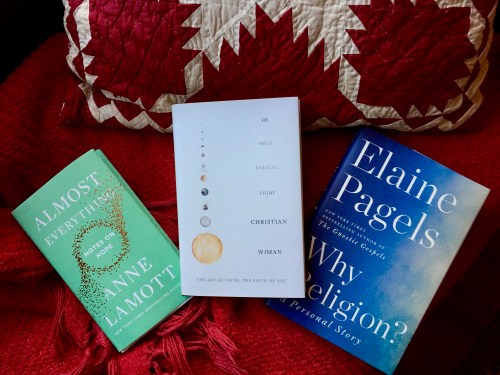
pull up a chair

where wisdom gathers, poetry unfolds and divine light is sparked…

the underground and me: how my papa tried to save me

papa letter

the first draft of history is what journalism’s been called. and so, today, i take a crack at one such draft; i write not knowing quite what epiphany will come, toiling more as an excavator, seeing if there is any shimmering shard buried in the layers of history, my history, a piece of which recently unfolded — in three crisply typed pages — and stirred up the long long ago. turns out, it’s a love story…

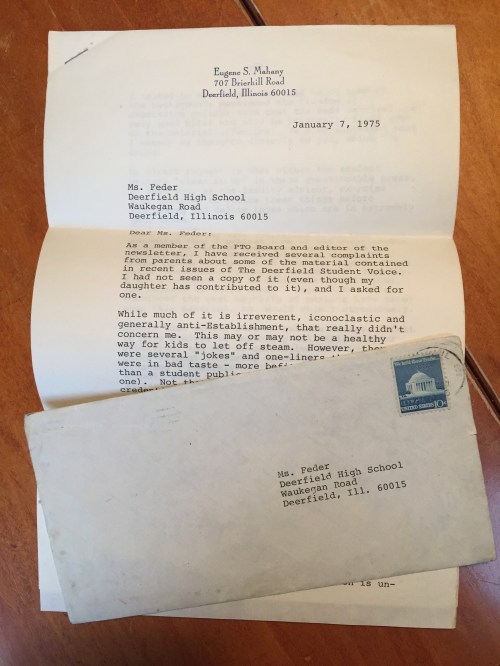
it’s not everyday the artifacts of your past tumble out of the cracks of history. but one of mine came in the mail week before last. it was a letter, dated january 7, 1975, written by my papa, mailed to a beloved high school english teacher, a teacher i remembered most vividly because she was the one who asked a prescient question the monday after homecoming of my senior year, a question that foreshadowed the arc — the heartbreaking arc — of that last year of high school.

what i’d remembered was that she was the teacher, the arch, very cool at the time, teacher who’d assigned kerouac and burroughs and zen and the art of motorcycle maintenance, works with their thumb on the pulse of the thrashing that was 1970s america. what i’d never forgotten was standing outside the library on the monday morning after i’d been crowned the homecoming queen, an unlikely event if ever there was because i was nothing like most homecoming queens. i was not beautiful, not even close. i wasn’t a cheerleader, or one of the pompom girls. all i was was kind. and i remembered the names of just about each and every someone in my 2,400-student high school. and all the janitors, too.

as i was standing there, this teacher we all loved and were afraid of, in equal measure, strode up to me, raised one eyebrow, and volleyed her question: “barb, have you read ‘the demise of the homecoming queen’?” a book apparently with a very bad ending.

consider me unsettled. i answered no, and marched on with my day, the query sufficiently stinging.

but that odd interaction has nothing to do with the letter i got week before last. it only underlines the impact of running into this teacher at synagogue a few weeks back, on rosh hashanah to be exact, when a woman whom i did not recognize, leaned into our pew and exclaimed, “barb!!!!” while my brain gears churned to figure out who in the world this was, she went on, and soon i realized it was ms. feder, the high school english teacher we all feared and loved.

as i climbed over the legs between me and the end of the pew, so i could leap into the aisle to hug her, she went on with a story she was bursting to tell me. (mind you, i’d seen her only one other time in 43 years, when i bumped into her on a train riding downtown and i was carrying a baby, so this encounter was swiftly sweeping me back in time and space and emotion.)

she’d been cleaning her basement, she recounted, barely pausing to breathe, and was rummaging through piles and years of stuff accumulated, when she unearthed the first-ever issue of mother jones magazine, and as she lifted it from cobwebs to give it a look, out from its spine tumbled a 10-cent-stamped envelope addressed plainly to “Ms. Feder, Deerfield High School.”

inside, was a three-page letter from my very own papa, meticulously typed by his secretary of many, many years. in it he explains in thoughtful measured tones that it had come to his attention that the underground newspaper, for which ms. feder was the faculty advisor and to which i was a contributor, had recently raised a few eyebrows. scatalogical jokes, perhaps. he didn’t exactly detail, except to mention that they might be “in bad taste — more befitting bathroom walls than a student publication (even an unofficial one).”

and then toward the end of said letter, my papa takes off his official hat — he’d been writing as a member of the PTO board and editor of its newsletter (of which i have zero, zip, nada recollection) — and mentions that, on a personal note, he has exacted from me a promise that my name would no longer appear on the masthead (my first foray into journalism outside the walls of our basement, where i typed up the neighborhood news complete with comics, was the underground newspaper of our not-so-radical white suburban high school). he went on to write that “I have told her [that would be me, his scribe of a daughter] that I feel that her material has been completely acceptable and in no way of questionable taste.” but — brace yourselves — “Frankly, I am embarrassed to see her (and my) name in even a loose juxtaposition with some of this material.” and he asked that my name be deleted from any future publication.

apparently, that’s when i went even further underground and assumed the pseudonym under which i wrote for the rest of the year, or at least until i was taken out of high school in may, and plunked in a downtown hospital, a skin-and-bones girl who’d whittled down to 85 or 90 pounds (i can’t remember the low point), in the vanguard of that scourge known as anorexia nervosa, a clinical coupling of words that grates at my soul (and my psyche) to this day.

some decades ago, perhaps at a high school reunion, one of my fellow underground rabble-rousers had recounted this incident to me, told me the story of how my papa had forbidden me from writing any longer for the Student Voice, as our anti-establishment rag was called. i remembered not a wisp of it, couldn’t imagine my laser-focused-ad-man of a father paying one bit of attention to my underground toils. i considered it apocryphal, a story someone had conjured up over the years when i became — thanks to my early and strange diagnosis — grist for the small-town rumor mill.

thus, word of this letter’s actual artifactual existence intrigued me completely. to say nothing of the fact that i have astonishingly few (read, almost none) letters or personal writings from my dad who wrote two monthly magazine columns for the ad biz. and the finding of even a page — let alone three — was a find of supreme proportion.

i ran to the mailbox day after day. when two weeks had passed, but no letter had arrived, i began to search for ms. feder. i found what appeared to be a phone number, called, left a message. she called back. she’d made a photocopy, she explained, then put the letter aside. she’d forgotten, but she promised to send.

the day it fell from the pile of mail, i took a deep breath and pulled the three still-stapled pages from the 44-year-old envelope, mailed originally from my papa’s downtown office.

right away, i heard his long-silenced voice, oozing up from the spaces between the typed alphabet letters. i heard his tender protectiveness. his measured level-headedness. in fact, he began by defending our faux-radical shenanigans: “While much of it is irreverent, iconoclastic and generally anti-Establishment, that really didn’t concern me,” he wrote. and then, when i got to the part about my promise to erase my name, i got teary. when i got to the part where he wrote that frankly he was embarrassed, i winced.

this is not the memory of my papa i’ve kept tucked closest to my heart. the scenes that have played, over and over and over, are the ones where i’m in the hospital — a psych ward is where they put me, if you must know, and if i’m completely honest — and it’s lunchtime, and my lunch tray has just been delivered, and the door to my room nudges open, and in walks my papa, face beaming, brooks brothers suit crisp as ever, even after his long walk down michigan avenue, from his high-rise office tower to my hospital. he is clutching a white paper bag, one he’s been handed in the women’s auxiliary cafe just off the hospital lobby, where every day they sold sandwiches and every day for that month he bought one. he sat beside me, pulled a straight metal chair right to the edge of my bed, sometimes taking my hand. he unwrapped from wax paper his choice of the day — chicken or tuna salad on white bread, almost always on white bread. he chewed while i tried to. he never missed a day. not once in the month — the terrible, awful, loneliest month — i was there.

and that’s the love i’ll never forget. that’s the love i lost — or so it felt — when he died.

but now i have another story to tell. the day my papa made me give up my name, and go deeper underground.

i cherish them both. my papa was paying attention, such close attention. and i was blessed to be in his sights.

was there someone in your life who paid close attention to you, closer perhaps than you realized at the time? and what was the difference it made? 

p.s. perhaps the sweetest part of the letter was that i could show it to my beloved blair, who read it the night it arrived as he rode home on the el (i’d taken a picture of each page and sent along to my mom, my four brothers, and blair and will and teddy, wanting everyone to share in this closest encounter of the typed-and-stapled kind). blair’s texts came in two parts: “Loving the letter. Have read first two pages. So, so wise and precise…eager to see conclusion….” and next: “Wow! Loved it. What a good parent. 3 pages of controlled passion. He loved you so much, Fred. I’m thoroughly impressed.”

the love of my life has only gotten to know another love of my life through the dribs and drabs of story, and now the three long-lost typed pages….

not your mother’s pot roast

IMG_0845

back when i was peeking into the kitchen, the room where my mother ruled, what happened to pot roast happened once every couple weeks. and, seeing as my papa was an ad man in the mad men days of american advertising, a three-piece-suited man who came home on the train with a brief case sometimes spilling with mystery boxes, boxes marked X, boxes we were meant to try, i came to count myself on the front line of the post-industrial-space-age kitchen revolution. which means i was among the first to suspiciously nibble hamburger helper, bundt cake in a box, and — our favorite — space food sticks, those tootsie-roll-like batons sheathed in crinkly silvery paper; “breakfast in a bite.”

is it any wonder my culinary quirks got cross-wired?

back to the pot roast. as best i recall, pot roast meant my mama was ripping open packets of dehydrated onion soup (thank you, NASA), spinning off the lids of cans, exercising her dumping skills. (i’d like to imagine that when no one was looking, she poured in a glop of old red wine, but that was likely the kitchen down the street, where my best friend’s mama was likely to pour a little red wine into, well, her first mug of coffee.) the whole pot-roast caboodle was entombed in aluminum foil, and set in the oven till the 6:30 train pulled into the station, my pa motored home, and we all sat down together to hear the highlights of the day downtown where the ad men re-wrote the national narrative, in 60-second pitches with the catchiest tunes.

another thing about the pot roast: i’m pretty sure we never called it pot roast. i think it had a name that ended in “steak.” when you were feeding five kids, and trying to stick to your weekly grocery budget (those were the days when my ma prided herself on a week’s worth of groceries for seven, paid for with $100 bill — and change to tuck back in her pocket, change that became her “funny money,” money to spend as she darn well pleased), you named whatever you could a name that ended in “steak.”

which is how i came to not really know what in the world a pot roast was. all i knew was that it sounded like something donna reed or dick van dyke’s laura petrie would make.

which is all an even longer-winded way to say i was mighty intrigued when i spied a food52 instructional guide for something called “pot roast with 40 cloves of garlic.” if you ever want to grab my attention, toss in any sort of big number. i’ve always liked playing with numbers, and 40 cloves of garlic had me, truth be told, at 10.

as i count down the dinner hours with my sweet senior in high school, i seem to have slid into an ulterior plan of feeding him in ways he’ll never forget. ways that might seep in as he stands in yet another cafeteria line with a dishwasher-splattered cracked plastic tray, awaiting a ladle of whatever swims in the hot metal bins. (it’s sneaky, i know, but we mothers must out-think our offspring, especially when they grow to be big enough that they don’t like to be smothered with our hugs and our kisses and the little red hearts we used to scribble onto their lunch bags.)

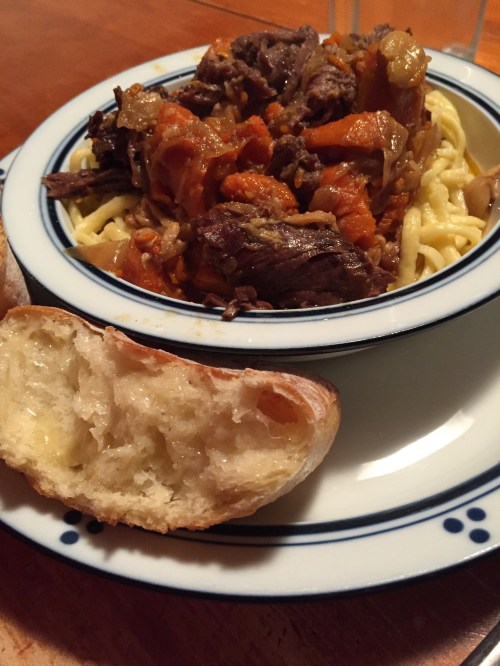
which is where we arrive, at last, and once again, at the pot roast. something about “pot roast” seemed to ping that place in my brain that’s on the prowl for unforgettables. a boy who sits down to dinner on a thursday night, or — back up the clock — a boy who walks into a house where 40 cloves of garlic have been infusing the kitchen, front hall, heck, making their way down the whole dang walk, all backed up with notes of grass-fed beef, and chunks of carrot, onion, and vegetable broth (with a splash of red wine, because i learned watching my best friend’s mama….), well that is a boy who might remember his mama — or at least her pot-roasty roast once in a while.

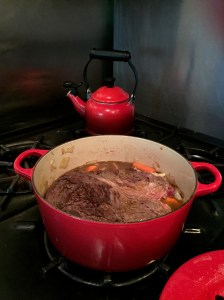
so i set out on my mission. secured me three pounds of grass-fed beast, peeled garlic till my fingers called for time-out, chopped and seared, and cranked up the oven.

because i never want to keep these little miracles to myself, i am herewith sharing my secrets. this comes from my friends at food52, those geniuses of community recipe gathering, where so many cooks have their fingers in the pot, you’re assured that whatever makes it onto the site is vetted up, down, and sideways. and usually delicious.

pot roast with 40 cloves of garlic

Serves: 6 

Prep time: 30 min 

Cook time: 4 hrs 30 min

Ingredients

2 tablespoons canola (or other neutral) oil
3 pounds boneless beef chuck, patted as dry as possible
1 1/2 tablespoons kosher salt, plus more to taste
2 medium onions, peeled and roughly chopped
1 1/2 pounds carrots, peeled and roughly chopped
40 peeled garlic cloves
4 cups vegetable broth

Directions

  1. Heat the oven to 325°F.
  2. Set a large Dutch oven on the stove over high heat. While it’s getting good and hot, season the beef all over with salt. When the pan is hot, add the oil. Sear the beef all over—figure 4 minutes per side—until the outside is deeply browned and crusty. Transfer the beef to a plate.
  3. Add the onions and carrots to the pan. Toss in the rendered beef fat and season with a pinch of salt. Cook for 5 minutes, stirring occasionally. Add the garlic, another pinch of salt, and toss. Cook for another 5 minutes.
  4. Nestle the seared beef on top of the vegetables, then pour the broth around the perimeter. It should rise about halfway up the meat. Bring the liquid to a simmer, then cover the pot and get in the oven.
  5. Roast for 3 1/2 to 4 hours, flipping the meat halfway through. You can start checking the meat at 3 hours—exactly how tender or toothsome you like it is totally personal.
  6. Before serving, remove any butcher’s twine (if it was there, holding the meat together) and use 2 forks to tear and pull the meat into big hunks and shreds. Season with more salt to taste.
  7. Serve with something starchy. This keeps perfectly in the fridge for leftovers all week. I also love freezing portions for pat-on-the-back weeknight dinners down the road.

so there you go. have at it. i can gleefully report that for a minute there last night dinner was silent. silent in that way that the taste of what’s at the end of the fork is so unusually good, the taste buds take over and the vocal cords go mum.

and that’s the story of pot roast. and how i added one notch to the score board, the one marked, “reasons to come home from college. or at least miss my roast-searing mama.”

what’s your secret sure-fire hit to lure those you love back home to your kitchen?

IMG_0838

a compendium of what we ache for…

Video-Justin-Finding-Out-Great-News

some weeks feel like someone’s pulled the plug at the bottom of the bathtub and all the suds — and the baby, too — are shlurping down the drain. this was one of those weeks, when day after day some stumbling block or very steep incline got tossed on my trail through the woods.

i was just about giving up hope. and i realized i wasn’t alone. there was my friend whose kid is in rehab, and she got a middle-of-the-night call that he wanted to quit, was deadset on coming home. even if he had to hitchhike — and bottom out — to get there. from the far left coast. there was another friend whose kid was rushed to surgery with a failing kidney. there was, as always, the national news, which more days than not feels as if someone’s cranked the spigot to full toxic poison and left it to drip, drip, drip.

and there was my own personal trove of worry. packed in that box there’s one prayer in particular that i nearly gave up on. made me start to wonder if anyone was listening. do you ever wonder the same? start to think that maybe your line’s been cut, and the wires to heaven you’ve long depended on, they’ve been snipped and they’re dangling? all you hear is the buzz of a line gone dead?

some weeks i feel i’ve little to say here. think i’ve no right to take up your time or the oxygen in the room. that’s not uncommon among women who grew up like me, taught to be nice or be quiet. i plod on anyway, because i made a promise — to me and to you — that i’d be here on fridays, find something to say. maybe even one glimmering shard of hope to break through the murk.

it’s not often i turn to the world outside to find us all a bit of solace, of something like faith. or even of joy. but in the last 24 hours, the universe seems to be racing to our rescue. shimmering shards are suddenly falling, one after another, onto my path, our path.

turns out, it’s become something of a compendium of what i’ve been aching for: tales of resilience. words of breathtaking wonder.

some weeks, we need to lean on the ones all around us. this is one of those weeks.

here’s this, from the glorious folks at nike. once upon a time i thought nike built shoes. but now i know better. i know they build from the best of the human character. they remind us who we can be. they carry us across finish lines — the ones in our hearts, and the ones in the woods.

take a look. and a listen: witness the moment justin finds out he’s the first signed pro athlete with cerebral palsy.

and now, while you perhaps dry your tears (pass me the carton of kleenex), here’s a poem from one of the patron saints of the chair, our beloved blessed mary oliver:

In the Storm
Some black ducks
were shrugged up
on the shore.
It was snowing
hard, from the east,
and the sea
was in disorder.
Then some sanderlings,
five inches long
with beaks like wire,
flew in,
snowflakes on their backs,
and settled
in a row
behind the ducks —
whose backs were also
covered with snow —
so close
they were all but touching,
they were all but under
the roof of the duck’s tails,
so the wind, pretty much,
blew over them.
They stayed that way, motionless,
for maybe an hour,
then the sanderlings,
each a handful of feathers,
shifted, and were blown away
out over the water
which was still raging.
But, somehow,
they came back
and again the ducks,
like a feathered hedge,
let them
crouch there, and live.
If someone you didn’t know
told you this,
as I am telling you this,
would you believe it?
Belief isn’t always easy.
But this much I have learned —
if not enough else —
to live with my eyes open.
I know what everyone wants
is a miracle.
This wasn’t a miracle.
Unless, of course, kindness —
as now and again
some rare person has suggested —
is a miracle.
As surely it is.
~ Mary Oliver ~
(Thirst)
listen hard to those last few stanzas:
If someone you didn’t know
told you this,
as I am telling you this,
would you believe it?
Belief isn’t always easy.
But this much I have learned —
if not enough else —
to live with my eyes open.
I know what everyone wants
is a miracle.
This wasn’t a miracle.
Unless, of course, kindness —
as now and again
some rare person has suggested —
is a miracle.
As surely it is.
everyone wants a miracle. kindness is a miracle. go make a miracle. it’s the surest lifeline i know.
as if all that doesn’t have you buckling in, buckling down, revving your engines of hope, seeing straighter than you’ve seen in a while, how bout this from a blessing among us, a friend with stage 4 breast cancer, now metastasized to all the wrong places. she’s stopped treatment, she is living with her heart and her arms and her soul wide open. here’s a line from a poem she wrote, her litany of happinesses. she has one beautiful son. she moved to california while he studied at stanford. he is her everything, and she is his. she wrote this:

My dearest, most tender
boy. To describe him … is to
try to name those unnameable colors
and why bother. It’s all love.

Nothing matters here but life.
Nothing is in my thoughts but life.
I sit feet from the ocean and am bathed in this lucky life.*

go out and gather your shimmering shards, your miracles, and joys. and please report back….
what miracles fell on your path this week?
*poem and love from the incomparable robbie k….

home alone — and hearing a cry

it’s just me and the basement crickets here. (i ought to name the whole herd of them since they so noisily, chirpily, send me love songs through the dawn — and the midday — and the late afternoon — and the twilight. deep into the darkness they keep up their chatter.)

the boys i love are faraway. i stayed home because i have a job at the high school, hosting 414 debaters from around the country. feeding each one, breakfast and lunch for the next two days (today we load in provisions). i’d thought i’d write a meditation on being alone. on the luxury of it when you don’t often have it. i know for some it’s a curse; alone bleeds often, bleeds quickly into loneliness. the first syllable — the  a of alone — breaks off, and two new ones cling to the end — loneliness — and suddenly the gift of doing as you please, sleeping with windows open and shades up — because you love the light of night, love even more the dawn’s beginning — all those singular quirks, they can become the humdrum hollowed refrain of a life lived alone not wholly by choice. by grief. by happenstance. by necessity.

but i woke up this morning, and the cavernous cry of this nation — of the countless volumes of women putting breath to the screams they once muffled — it’s echoing inside, rising louder and louder. and i know there’s a vote just hours away. and i know that sitting here listening to the roll, hearing the single syllable rise up, yea or nay, one after another, it’s going to feel something like a gut punch. did you hear her? i will ask, over and over and over.

there will come — for some of us anyway — an unshakeable sense of being kicked aside. of   “ramming this through,” as the senate majority leader himself so unpoetically put it.

there is, though, a gentle breeze of hope this morning. it comes from sweden, from the nobel committee which during our night (their midday) awarded the peace prize to two who’ve dedicated their lives to a fight against sexual violence. one, nadia murad, is a 25-year-old woman, captured, repeatedly raped and tortured by ISIS; she escaped and, ever since, travels the globe speaking out against the atrocities. her inexhaustible journey has left her exhausted, but she refuses to pause, insisting: “i will go back to my life when women in captivity go back to their lives, when my community has a place, when i see people accountable for their crimes.”

time magazine, in their annual centenary of “most influential people,” included nadia in 2016. eve ensler, the playwright and founder of V-Day, a movement to end violence against women, wrote this for the magazine’s roster:

A witness for war’s victims

Nadia Murad stands in a long, invisible history of fierce, indomitable women who rise from the scorched earth of rape during war to break the odious silence and demand justice and freedom for their sisters. At 19 she lost her home, her country, her culture, her mother to murder; witnessed male members of her family murdered in mass killings; and was kidnapped, sold and endlessly raped by members of ISIS. She now travels the world speaking out on the genocide being inflicted on her Yezidi people and demanding release for the more than 3,000 women still held in bondage.

As Europe closes its borders to terrorized refugees in Greece and the U.S. turns its back on the suffering, Nadia is a beacon of light and truth—a reminder that it was the American-led war in Iraq that laid the path for ISIS, that U.S. arms left behind on the battlefield fell into the hands of ISIS and that the U.S. waited too long to intervene in the mass killing and enslavement of the Yezidi people. At 23, Nadia Murad is risking everything to awaken us. I hope we are listening, because we too are responsible.

time-100-2016-nadia-murad

i leave you with nadia, with the faint waft of hope. i know, come time for the vote, we will all be standing shoulder-to-shoulder, heart-to-heart, promising we will do better for our daughters, our sisters, our sons, and our brothers.

(i do not for a minute want to overlook the second nobel peace prize winner,  dr. denis mukwege, 63, a congolese gynecological surgeon, who campaigned relentlessly to shine a spotlight on the plight of congolese women, even after nearly being assassinated a few years ago. working from a bare hospital (often without electricity or enough anesthesia) in the hills of the eastern democratic republic of congo, he has emerged as a champion of the congolese people and a global advocate for gender equality and the elimination of rape in war, traveling to other war-ravaged parts of the world to help create programs for survivors.

“it’s not a women question; it’s a humanity question, and men have to take responsibility to end it,” dr. mukwege once said in an interview. “It’s not an africa problem. in bosnia, syria, liberia, colombia, you have the same thing.”)

may the persistence of justice rise up in all of us today. and tomorrow, and all the tomorrows thereafter. may the fiery determination of nadia and the unrelenting faith of dr. mukwege drive all of us through the fog of despair.

where might you try to carve out space for justice? where might you bring comfort today?

p.s. i’m leaving off a picture up top today, because silence and the sound of a cry are best left unseen….

the call to come together

the invitation was simple: come for coffee. the invite list was the neighbors who surround me, a few of whom have moved in within the year or last couple years, and who i barely or didn’t even know.

all i did was brew a vat or two of coffee. pull out favorite plates. tuck flowers in vases. vacuum cobwebs out of corners. dump clementines and figs into bowls — bowls given to me over the years by some of those very same neighbors. the things we stack in cupboards — many of them, anyway — tell stories all their own. nearly every single thing in my house tells a story. i collect stories, not things.

it all started because the air turned crisp, and light turned amber — or at least that’s the way it always looks to me. there is a light in september that sometimes feels to me as if the heavens open just a crack, and someone tosses down a holy shaft. a shaft that’s almost a stairway back to whence it came.

the date i picked on the calendar was the date that holds a quiet sort of holiness for me: it’s the day my friend ceci died, three years ago, and the birthdate of my friend mary ellen, who died not long after….

it turned out to be the date dr. christine blasey ford took her terrors and her fears and stepped before the senate judiciary committee to tell her awful story, to peel back the layers of the wound she’d tried so very hard to escape.

for a while there, i thought my timing couldn’t have been worse. i’ve long been something of a news junkie and i didn’t want to miss hearing her words, the tremor in her voice, in real time. it felt like we all, as a nation, needed to encircle her, stand behind her, to say emphatically, “we hear you, and we believe you.” and we are here, as literally as possible, reaching through the screen, with our palms pressed against your back, squeezing your hand, touching you softly on the arm, one last time before you take a breath and begin.

i’d decided that i’d leave the tv on — softly — over in the corner, where it’s tucked inside an old armoire. as it happened, one by one, a few of us circled close to listen. we ebbed and flowed from coffee to nibbles to capitol hill testimony. and then, christine blasey ford cleared her throat, pushed back that swatch of hair that insisted on covering her left eye, and a circle of us moved close. as if by instinct. we leaned in. we held our breath. i noticed that we all had wrapped our arms across our own chests, held ourselves tight. anchored ourselves. the looks on our collective faces was a portrait in pain and empathy i’ll not forget. i don’t know, because we didn’t talk about it, how many of us in that circle had our own version of a christine blasey ford story to tell. and that didn’t matter, because we were there — leaning in, listening — for her. to put the power of our hearts, our intellects, our faith, behind the courage it took for her to stand up to power and softly tell her truth.

if i’d been home alone, i would have been glued in front of that screen all day, all by myself. instead i found myself in the company of women, lovely women, women who’d shown up with scones they baked, and pumpkin dip they’d stirred and poured in antique bowls. we told our own stories — how we got here, who we were, what made our children stir. i watched as clusters leaned in and women whispered. or laughed aloud. i watched the company of women weave together those disparate threads that make a whole cloth out of mismatched parts.

instead of going through the day alone, instead of absorbing the nation’s pain all by ourselves, we gathered in a circle, stood — literally — shoulder to shoulder. as i studied the pain-wrought faces of the women watching, absorbing every word of someone else’s nightmare, another woman’s indelible pain and trauma, i saw — without words — how deeply tied we humans are. how much we suffer in the face of suffering.

in the company of strangers, we can find our deeper truer selves.

it made me wonder if we need to climb more often beyond the walls we build around ourselves and our stories. all it takes, sometimes, is vats of coffee. and the invitation: please come….i’ll not spend this day holed up inside my private woes and worries….

what parts of september 27, 2018, will you not forget? which words or images are etched now across your heart? do you find comfort in company? do you need to give yourself a little nudge to get out from behind the comforts of your solitude?

makes me think we might need the occasional occasion of pulling up chairs in real time, say at my house for those who live within chair-pulling distance?

mark this day…

IMG_0545

there is something about the crisp edge of things — of a hem, of a book, of a season — that settles the soul of a sometimes frazzled someone. someone like me. it fills me with a sense of something noble — a job well done, completion. prompts me to bend my knee and bow. it’s gratitude and it’s awe.

take summer, for instance. it ends tomorrow, making today the last full dose of it. and before i chase it out the door, before i usher in the amber hours of the season i love best, before i haul in the wheelbarrows of pumpkins, the tins of cinnamon and clove, before i fling myself upon the forest floor, playing peek-a-boo through golden, crimson, and persimmon-shaded boughs, it’s summer’s due to say goodbye to sand and sun unfiltered. to bees that buzzed and blooms that cheered me with their moppy heads, their delicate tendrils, their sweet perfumes that made me sniff around the garden (a pretty picture — me with nose in air, and mud-stained knees — surely not).

the season of about-to-burst tomatoes, and cicada song at night, the months of curtains flapping in the window’s invisible current, the sweater-less months, they draw to a close tomorrow eve at 8:54 p.m. (central time). that’s the equinox hour, when the sun slides into absolute right angle to blessed planet earth, when its beams fall straight onto the equator, that cinch-waist strap around the middle.

and so this last full blast before the season ends, it begs occasion. begs a moment’s pause. a plea to savor just a swatch of time — time filled with the summeriest wonders you can imagine.

my summery moment might be this: a fat tomato (the last one in my wooden bowl) sliced and salted, laid reverentially on whole-grain bread, and ferried to my summer porch, along with a fat book that begs to be begun. bare toes wriggling in the fading shaft of mid-afternoon sun. a moment’s pause to contemplate the butterfly wafting by. a whispered prayer of thanks — for the somnolence of summer. for the deep warmth and gentle breeze. for all that ripened and spilled with juice. for days that slowed, and hours that nearly burst with sumptuous sweet.

thank you, summer, once again…

***

because i’ve once again stumbled in my duties to bring my soulful literary roundups to this page, here’s the “books for the soul” that ran a month ago. oops. three fine picks. i especially loved the first, “learning to speak God from scratch ,” a linguistic exploration, richly written, and sure to make you think….

may your autumn days be filled with good reads…

How to talk about God, and more, addressed in this week’s spiritual book roundup

By Barbara Mahany

“Learning to Speak God from Scratch” by Jonathan Merritt, Convergent, 256 pages, $15.99

Here’s a subject not often found on the religion bookshelf: linguistics. As in “sacred language” or “Godspeak,” the ways we put words to what’s holy and so often ineffable. It’s a language that’s frankly been hijacked by politicians, blasphemed by holier-than-thou hypocritical preachers, and muted by the masses who dare not utter a word construed to be “church-y.”

And it’s into this battle-scarred landscape that “Learning to Speak God from Scratch” bravely proceeds. A few years back, Jonathan Merritt, a religion and culture contributor to The Atlantic, left behind the Bible Belt for New York City and found himself thunderstruck by the stark disconnect (and discomfort) in God talk there in Gotham.

Something of a spelunker in the realm of sacred linguistics, he robustly constructs his argument — one rife with hard data from the sociocultural realm and rich in personal narrative. It’s one that solidly convinces that sacred words are in crisis, and that any lost language leaves a gaping hole in human understanding. He makes the point that when the language at stake is the one that ties us to all that’s divine, it’s our souls that stand to wither.

He opens his case with this assessment: “The way certain groups of people use sacred words gives the rest of us the holy heebie-jeebies.” From there, Merritt takes off, swashbuckling his way through ironclad analysis, poking into curious linguistic and Biblical corners, making us see in a whole new light why it matters to reimagine and reclaim sacred language.

In the book’s second half, Merritt takes on, one by one, a lexicon of 19 words worth learning all over again, from confession to sin to grace. Because Merritt is an elegant and deeply literate writer, he makes his subject one of which we can’t get enough.

“The Way of Kindness,” edited by Michael Leach, James T. Keane, Doris Goodnough, Orbis, 224 pages, $18

It’s the end of summer, and the reading is supposed to be easy. Never hurts when it’s rich too. “The Way of Kindness” is everything you might want when you stretch out in your recliner, long tall refreshment within quick reach. It’s as if your favorite librarian is sitting beside you, whispering, “Read this. And this. And this, too, while you’re at it.”

The roster here is a greatest hits of American writers, not all of whom are regular travelers in the religious or spiritual domain. And that, perhaps, is what makes this a notch above the usual such gathering. To read Jack Kerouac: “Practice kindness all day to everybody/ and you will realize you’re already/ in heaven now.” Or George Saunders implore, “err in the direction of kindness. Do those things that incline you toward the big questions, and avoid the things that would reduce you and make you trivial.”

Dorothy Day quotes the Carmelite nun who told her, “It is the crushed heart which is the soft heart, the tender heart.” Even Aldous Huxley chimes in, telling us, “(I)t’s a bit embarrassing to have been concerned with human problems all one’s life and find at the end that one has no more to offer by way of advice than ‘try to be a little kinder.’ ”

While this is a book for quick dips or longer dallies, the curators of this collection — three fine souls in the world of spiritual publishing — have put their collective heft into what unfolds here. Your summer’s day will be all the gentler for having spent time among these literary and spiritual masters.

“Love Without Limits” by Jacqueline A. Bussie, Fortress, 195 pages, $24.99

File this one under “Standing By Your Story.”

Jacqueline A. Bussie, theologian, beloved professor of religion at Minnesota’s Concordia College and award-winning author of “Outlaw Christian,” her 2016 exhortation to find authentic faith by breaking a roster of too-rigid rules, sat down to pen “Love Without Limits,” a deeply personal how-to-guide for no-holds-barred loving. Because her stories arose from the depths of her heart, and the truth of how she lives her life — she calls this latest book “my life’s love letter” — she included chapters on both her Muslim and her LGBT friendships. Then, she turned in her manuscript to the Christian publishing house with whom she’d signed a contract, a book whose subject all along had been exploring God’s radical love.

The publishing house balked, deemed the two chapters “offensive” and “theologically out of bounds,” and ordered Bussie to cut them or they’d cancel her contract (and make her pay back every penny of her advance). Bussie refused, dead-set against being censored. Certainly not in a book about how people of faith — all faiths — “are called to love with no exceptions, asterisks, or limits.”

Mighty fine thing that Fortress Press, a Minneapolis-based Christian publisher with a more progressive bent, saw fit to snatch up Bussie’s much-needed message. In a world as balkanized as the one in which we find ourselves, Bussie’s words light the way toward practicing “a love so deep it subverts the social order, so radical it scandalizes the powerful, so vast that it excludes no one.” A love, it turns out, that couldn’t be censored.

Barbara Mahany’s latest book, “The Blessings of Motherprayer: Sacred Whispers of Mothering,” was published in April.

Twitter @BarbaraMahany

how will you mark the last full blast of summer? 

awake to awe

awake to awe

two holy things happened in synagogue this week, on the night and the long day of prayer that marked the new year: one, the boy who now towers over me, he grabbed my thumb with his, and inch by inch enfolded his fingers over mine. he wouldn’t let go. he leaned in, so much so that i yielded my head to his shoulder. felt the rise and fall of his breathing against the tide of my own. we sat like that, entwined, silent, for long stretches of prayer. it was the holiest prayer i’ve prayed in a very long time. over and over — it never gets old — i remember how unlikely it was, how impossible it was, that he came to me, to us. that in the midst of our believing it would never be, the unbelievable happened: he happened.

a mother’s deepest prayers, sometimes, are the ones she whispers only to herself. those were the prayers i prayed on the new year. each breath was emboldened with the knowing that a year from now he will not be by my side. i will not feel him pressing against my shoulders. there will be miles and miles between us. and it will ache. i will ache.

the other holy thing, the thing that’s washed over me all week, and will wash and wash for days still, is the notion that we carve these 10 days of awe out of the whole cloth of the year, and do as commanded. we are commanded to be awake to awe, to make each passing moment be a prayer, the prayer of paying attention, the prayer of drinking in all that surrounds us, that buoys us, that lifts us and carries us on a current unattached to the dreck of the everyday.

the prayer in my prayer book is this, and the title of the prayer (composed for the High Holy Days in the early centuries of the Common Era, according to the footnote) happens to be How Do We Sense God’s Holiness? Through Awe. here are the first lines…

And so, in Your holiness,

give all creation the gift of awe.

Turn our fear to reverence;

let us be witnesses of wonder —

perceiving all nature as a prayer come alive….

the prayer goes on, and the leitmotif of paying attention arises again and again through the hours of prayer that are rosh hashanah. it’s as if the prayer found my soul, found the soul that had been waiting for just those words, just that command: “let us be witnesses of wonder — perceiving all nature as a prayer come alive.”

and so i’ve done as commanded ever since i walked out of that sacred space where the prayers and the limbs of the boy wound around me. i’ve opened my eyes and my ears and my soul to the majesty — the breathtaking, trumpet-blasting, cymbal-crashing beauty — that is this stretch of time and season-turning, the enflaming of the planet as the last-blast palette engulfs the trees and the nodding heads atop the stems that bend in autumn breeze.

it’s not just a ho-hum isn’t-this-lovely that punctuates my days, it’s a notch beyond. it’s a command from God. “perceive all nature as a prayer come alive….”

there is a certain holiness imbued. there is a sure clear knowing that the hand that created all of this, all of this fathomless wonder, is the hand of the Creator, the one who breathed first breath into each of us. the one who has tumbled the unbelievable into my life — more than once.

my watch-keeping this week feels anointed. as if God is right there over my shoulder, delighting each time i spy one of the wonders. delighting when i pause to drink it in — slow the car, plop down on a stone, tiptoe out the door to count the stars.

i felt God the morning i drove along a field shimmering in golden rod, and the glowing slant of sun streaked radiance like lightning bolts, set the dew drops shimmering — jewels of the dawn.

i felt God when i glanced toward the night sky through the heavy boughs of trees last night and caught the crescent moon winking at me. bright. certain. daring me to slow my dash and pay attention. stop and marvel, i almost heard it whisper.

i will feel the certain hand of God when i first hear the faraway cry of the geese, crossing sky, crossing miles, crossing half the globe in search of thermal sanctuary. leaving us behind to shiver in the winter’s cold.

i am living in a census of wonder. i am living awake to awe. i am knowing that all of God’s creation is prayer come alive. and i am praying right along.

what moments of wonder have you counted this week? begin the litany here….

(i am dashing to drive my sweet boy to school, and clicking the publish button before my litany is done. but so be it. we weave the rest together…..)

awe bee nuzzling


improbably, the prayer shawl

will BK AZk bar mitzvah photo

a triptych of prayer shawls: three generations wrapped in sacred thread

it’s as if the voice calls to me from an ancient canyon, a hallowed space carved through time and history. the history of this perpetually-spinning planet and its holy peoples, and, now, the history that is mine, carved across the years.

i yearn to wrap myself in the folds of the prayer shawl. to cloak my shoulders, burrow my arms, to bend my knees and bow down in the way i have long watched my prayerful beloved. a part of me, yes, aches to be enfolded, to feel the soft threads against my bare skin, but more against my heart. to be swept into the incantations of long ago and forever. to confess and call out to the God who is Avinu Malkeinu, “loving parent, Sovereign of our souls,” in the translation of our synagogue’s new prayer book.

i immerse myself in this span of holy time — the days of awe, rosh hashanah, the jewish new year, through to yom kippur, the day of deepest atonement — as if a tide pool that washes over and through me. it’s at once a cleanse and elevation, a surrender to another key, a frequency and melody and language that carries me to another plane. an otherworldly plane.

and yet, it’s one that comes on and through the worldliest of channels: the trip to the butcher shop, the spice jars pulled from the shelves. the chopping and stirring at the kitchen counter. the strolling through the garden, cutting stems to tuck in wide-mouthed jars and pitchers strewn across the table. the gathering of pomegranates, apples, acorns — sweet fruits of the new year, blessed offerings of the season of sacred bounty.

i have always loved the whole-body immersion of judaism, the ancient call to prayerfulness, the stories set in desert and dry land, the image of the sacred quenching that comes through the oasis, the raining down of sustenance from heaven, the voice that calls out, unseen but deeply heard.

these days i seem to be wrapping myself in all sorts of unfamiliar sacred threads, in threads finer-grained in their unfamiliarity, because their language is new to me, the constructions of sentences, the word choice, the tales they choose to tell. i’ve been going all summer to a just-past-dawn service in an episcopal chapel, one presided over and preached by women. wise women. soulful women. women priests.

it is a soul-stirring thing in the landscape of religion to walk into an unfamiliar place, to listen to the unfolding of an unfamiliar script, to feel each word and gesture as if new (because to me it is new). and thus to feel it so deeply fully.

it’s the element of exposure. the eyes-open willingness to surrender. to submit to that which by definition is foreign, uncharted, able to come up and grasp you, unsuspecting. nothing’s dulled; it’s all bristling, and stands at full alert. you never know what might be around the next bend. and thus you enter wide-eyed, scanning. catching every shift and nuance, passing through the sieve of your soul as if the first rinse.

so it’s always been for me in the folds of judaism, the religion i’ve stepped into because my heart and soul pulled me toward this man who is my beloved, my much-tested companion on this long journey called our married life. i feel it wholly because it’s new to me in so many ways, and now, 30 years after i first stepped — quaking — into my then-beau’s synagogue, its refrains come washing over me with decades of resonance. i find my place, i pull familiar threads round my shoulders, taut against my heart. i am cloaked and covered, kept safe, and free to burrow deep inside, to pore over the holy text, to consider prayers and, most of all, the image of the God who puts pause to the mad dash of the everyday. who awaits our urge to surrender. to bow down and pay attention. to hold high the sanctified blessing of the gifts that abound at the cusp of this new and holy year.

in the cry of the shofar, the coiled ram’s horn that calls out the new year. in the minor chords that rise up from our soul’s deepest depths. in the warm notes of spices saved for now. and in the prayers unfurled in each day of the days to come…..

i find my shelter and my refuge, my call to courage, and the certain whisper of the Most Holy. here, in the soft folds and sacred threads, i pull the prayer shawl round my shoulders. improbably, i tumble toward my heart’s deepest resonance.

l’shanah tovah u’metukah — may it be a good and sweet new year…

have you ventured into a sacred landscape that at first was unfamiliar, and did it sharpen all your senses, and draw you deeper into some universal understanding, some fine-grained sense of holy truths? 

p.s. my friday mornings these days include a drive to the far side of this little town to drop my sweet boy off at the faraway high school campus where he is shepherding the new freshmen into their high school adventures. this puts a bit of a pause in my morning writing, and thus delays its arrival in your mailbox, if you’re one who receives this by e-post. apologies for the delay, but this is my last chance, my last year, of dropping my sweet boy at the schoolhouse door, and i am relishing every drop of it. (even the days when we are running late and i am not quite as “chill” as he wishes me to be….)

aretha + eggplant + me

there oughta be a soundtrack here. because there is in my kitchen these days. i might have found a cure for my MSNBC addiction. i spell it R-E-S-P-E-C-T.

the other morning, not long after a raucous ride to the schoolhouse door, i decided there was no better cure for the late-summer blues than cookin’ up a feast for the boys i love, especially the one whose days at my kitchen table are now in official countdown mode (i’m in the slow lane on these matters, so i make sure i get a long head start, and yes, the countdown is roughly in the 350-and-subtracting stage — and, yes, i realize this puts me squarely in the odd zone). but anyway, back to the kitchen. i decided that one more night of grilled chicken might send the kid bawking from the table, so i upped my ante. i decided lasagna — from scratch and in two modes, meatless and otherwise — was the hurdle i’d leap.

and that’s when i turned to two mavens: the barefoot contessa, who nimbly guided me through my cooking instructions, and the goddess of soul, who every time i plug her in takes my heart and turns it up a notch. or three notches.

30 greatest hitstwo minutes after i heard aretha had died, i turned toward motown and bent not my knees but my finger, the one that clicked on the iTunes. the one that bought me two hours of instant therapy. (since i seem to play it on infinite shuffle, 30 greatest hits over and over and over, i figure it cost me — in the first day alone — less than a dollar an hour.)

i rocked and rolled through “baby, i love you,” and “chain of fools,” and, oh yes, “i say a little prayer” (please, aretha, say one for me…). and all the while i read through ina’s instruction. and then, in keeping with the queen of soul, i began to scat. through my roadmap for roasted vegetable lasagna, with a side (a whole other pan) bursting with plenty of beef.

because i tend not to keep eggplant and whole-milk ricotta on hand, my efforts entailed a trip to the grocery. my simple feast wound up costing me a whopping 45 bucks, by the time i plucked top-of-the-line tomatoes and beef off the shelves. (no one said blues-breakers come without cost.)

and then, for the better part of an afternoon, i amazed myself as i roasted and stirred, chopped and dumped, plucked and sautéed. by four bells, i tell you, i was more than humming….i was wailing right along with the queens…

call me “old-fashioned” (you won’t be the first), but by the end of that long afternoon, when the sweet boy bounded through the door, took a big whiff, and exclaimed, “what in the world are you making?” i smiled a little smile deep down inside.

i’d taken a day — an otherwise unremarkable do-little day — and i’d dialed it up a fine notch. i’d used a bevy of produce — eggplant and zucchini, red pepper and mushrooms and spinach and onions and garlic and basil and parsley galore — and great glops of olive oil. i’d sizzled up beef, and stirred marinara. i’d hot-water-soaked whole-grain lasagna ribbons (a trick of ina’s i might not repeat). and then, come dinnertime, i plopped onto the kitchen table, two 8-by-8 squares of oozy, cheesy deliciousness.

there are plenty of days when words alone can’t say what i want to say: i love you like crazy. i miss you already and it’s not even september. and i fully intend to make the most of this one last hurrah of a year.

this week aretha chimed in, she belted it out for the both of us. we served up a feast, me and the queens. and we finished it off with “baby, i love you.”

should you be inclined to play along, here’s where we started. feel free to scat or to vamp or to add your own notes….(and here’s your soundtrack, to boot!)

gettin started

Roasted Vegetable Lasagna 

(from Barefoot Contessa) SERVES 6-8 

1-1⁄2 pounds eggplant, unpeeled, sliced lengthwise 1⁄4 inch thick 

3⁄4 pound zucchini, unpeeled, sliced lengthwise 1⁄4 inch thick
2⁄3 cup good olive oil
1 tablespoon dried oregano 

Kosher salt and freshly ground black pepper
1 tablespoon minced garlic (3 cloves)

10 ounces lasagna noodles, such as De Cecco 

16 ounces fresh whole-milk ricotta 

8 ounces creamy garlic and herb goat cheese, at room temperature 

2 extra-large eggs, lightly beaten
1⁄2 cup chopped fresh basil leaves, lightly packed
1 cup freshly grated Parmesan cheese, divided 

4-1⁄2 cups good bottled marinara sauce, such as Rao’s (40 ounces) 

1 pound lightly salted fresh mozzarella, very thinly sliced 

veggies*bam note: besides the eggplant and zucchini, i decided to sauté onions, red pepper, mushrooms (two kinds) and spinach. i made that yet another layer on top of the eggplant and zucch.

** in my meaty version, i ditched the veggies and sautéed one pound of ground chuck, with onions, garlic, oregano, fennel seeds, salt and pepper. then i added a can of whole tomatoes, a few squeezes of tomato paste, and let it all come to a fine pitch. in the instructions below, i  layered my beefy concoction in place of each veggie layer. 

Preheat the oven to 375 degrees. Arrange the eggplant and zucchini in single layers on 3 sheet pans lined with parchment paper. Brush them generously with the olive oil on both sides, using all of the oil. Sprinkle with the oregano (I crush it in my hands), 1 tablespoon salt, and 11⁄2 teaspoons pepper. Roast for 25 minutes, sprinkle the garlic evenly on the vegetables, and roast for another 5 minutes, until the vegetables are cooked through. Remove from the oven and lower the temperature to 350 degrees. 

Meanwhile, fill a very large bowl with the hottest tap water and add enough boiling water to bring the temperature to 140 degrees. One at a time, place the noodles in the water and soak them for 15 -minutes, swirling occasionally so they don’t stick together. Drain and slide the noodles around again.  noodles

Combine the ricotta, goat cheese, eggs, basil, 1⁄2 cup of the Parmesan, 11⁄2 teaspoons salt, and 3⁄4 teaspoon pepper in the bowl of an electric mixer fitted with the paddle attachment and mix on low speed. 

Spread 1 cup of the marinara in a 9 × 13 × 2-inch baking dish. Arrange a third of the vegetables on top, then a layer of the noodles (cut to fit), a third of the mozzarella, and a third of the ricotta mixture in large dollops between the mozzarella. Repeat twice, starting with the marinara. Spread the last 11⁄2 cups of marinara on top and sprinkle with the remaining 1⁄2 cup of Parmesan. Place the dish on a sheet pan lined with parchment paper and bake for 60 to 70 minutes, until the lasagna is browned and bubbly. Allow to rest for 10 minutes and serve hot. 

what’s your sure cure for the late-summer blues? and, more emphatically, what’s your soundtrack?

mangia!!!

p.s. so sorry i was a tad late this morning: i had two boys who needed a few hours of my time, and thus the chair had to wait in line. 

one last whirl: a lesson in savoring

kindergarten-bound

the little guy i love heads off to kindergarten (this was actually his “practice” walk to school): summer, 2006

i should have done this a long time ago. years ago. but, like many, many things in my life, i started late. was behind the average. way behind.

according to the centers for disease control, those fine governmental folk who track these things, the average maternal age for a second birth in the U.S. hovers just above 28. i was 44.7. i remember clearly the saturday afternoon when, knees shaking, i called my obstetrician to tell her the little white stick (aka home-pregnancy-checker gizmo) had just turned happy blue — i was, gulp, miraculously and against all odds and medical prognostications, “with child.” without taking a breath, my dear doctor rattled off the dreary stats: risk of miscarriage, 60 percent; risk of down syndrome, 1 in 32; risk of not surviving till the little bugger’s 18th birthday, 5.5 percent. (i’ve got 349 days to go….)

tell all that to the magnificent 8.0-pound baby boy born on august 8, 2001, at 3:22 in the morning, his big brother, father, and a phalanx of doctors and nurses (who’d rushed in the room when things got dicey) all in attendance. he and i plowed through every statistical obstacle strewn along the way. which is why his names, first and middle, mean “God’s gift,” (in greek), and “gift of God” (in hebrew). he was birthed — and named — in prayer upon prayer.

and now, all these stats-defying years later, said child is beginning his last year of high school this coming monday, which means this old house has entered official countdown mode. every step along the way, from now till the day we pack him up and drop him at some dormitory door, will come with modifier: “the last,” “the last,” “the last”….

what that means for me is that i dial up the savor knob, and even in the middle of a humdrum summer’s afternoon — while he’s ensconced in his little room at the turn in the stairs, and i’m chopping in the kitchen — i might just get a hankering to call up the stairs, and remind him for no reason whatsoever that i love him more than life. (to which he might moan “uh-huh” in humdrum reply.) i even find myself plucking inside-out shorts off the floor, smoothing rumpled sheets on his bed, and not minding one little bit because i know — full-well — that a year from now, i’d do anything to be able to pluck evidence of his presence off the bedroom floor.

i’ve lived — for the last seven years — with one foot in faraway-child mode, and one close as close could be. i know full well just how much that distance makes me ache. just the other morning, in faraway connecticut, i dried the tears as the shuttle pulled away from the curb and hauled me to the airport, my second-year law student disappearing behind the cars and trucks and light poles as the van turned the corner and i could see his broad shoulders no more.

like i said, i’m late to this. so late. plenty of my friends — from high school and from college — have long known grandmotherhood. know what it is to have the little rascals come for sleepovers. watch their firstborns cradle firstborns. not me. i’m still penciling in teacher conferences on my own calendar, making sure my rascal’s up and out of bed on the days the school bell rings.

i don’t know from empty nest. ours has not been empty in a quarter century. and we were married 27 years ago tomorrow. we mostly only know “nest accessorized with child.” come college shove-off next august, it’ll be the first time in 26 years that there won’t be another pair of feet clonking around the floorboards up the stairs. won’t be a soul to listen for as i lie there in the dark, awaiting the click of his key in the front door.

so until we get to that eery silence, that absence that’ll make this house an echo chamber, i’ll savor and savor and savor some more. my hunch is that i’ll be less cranky in this year to come. i’ll even relish smelly socks. and empty pie plates left overnight on the kitchen counter.

i know how absence feels. i know what it is to find myself in tears in the grocery aisle, because i’ve just reached for the something that i’d always thrown in the cart — but suddenly there’s no need anymore; the someone who always loved it is being fed by someone else now, someone in a college cafeteria. i remember full well how hard i tried to re-wire my brain, my being, to wrap my head around the notion that some kid i loved now dwelled hundreds of miles away, called home once on sunday nights in those first few months when he, too, was trying to find his place in this new equation called long-distance.

as always, i’m late to this. and i might be the oldest mama in his senior class. but gosh darn it, that only makes me wise enough to hold this year as if it’s the last. because, well, it is.

TK first day of kindergarten

at the schoolhouse door: first day of kindergarten and a boy i love gets a shoulder squeeze from the very fine school principal.

how do you intend to savor this next whirl around the seasons?