pull up a chair

where wisdom gathers, poetry unfolds and divine light is sparked…

enwrapped, still, with mary O

winter-woods-1418741454w4l

it’s a tundra out there. i’ve just crunched across the hard crust of snow, coffee can of fat black seed in tow. if ever the birds depend on me, the pewter-haired one who clangs around as if the keeper of the flocks, it’s on a dawn like this. even the wind is shivering.

inside this toasty-warm old house, we’re dwelling in the rarest of quiet pauses. the soon-to-be college kid has turned in his last exam, and might sleep till dusk. it’s the first day in eons that there’s not a single essay or snatch of homework for me to pester him about. he has literally zippo, zilch in the to-do pile, which means i, too, am off whatever hook we mothers impale ourselves.

i’m going nowhere on a day as cold as this. and, till nightfall, have every intention of plunking myself right here, at the old maple table, where i keep watch on flash of scarlet at the feeder, in the boughs. i’ve got all i need within reach: a mug that’s warm and filled with morning brew, a stack of books so tall it sometimes teeters.

img_1249all week, i’ve been deep in the pages of mary oliver. one by one, i’ve pulled her books off my shelves, and pored over line after line. i’ve been drawn especially to her prose, the long sentences as stitched with poetry as any of her verse. i inhaled upstream: selected essays, and a poetry handbook, her 1994 master class in the making of a poem.

reminded me — as i scribbled notes on sound (did you know our alphabet is divided into families of sound? and that besides good old vowels and consonants, there are semivowels and mutes? a mute, it seems is most important in the realm of poetry; a mute, mary tells us, “is a consonant that cannot be sounded at all without a vowel, and” — here’s the interesting part, where the little bitty alphabet letter seems to take on menacing character — “suddenly stops the breath.” the mutes are k, p, t, as in ak, ap, at.) — and as i was saying before i interrupted myself, being inside the pages of mary oliver’s masterclass reminded me of the glorious semester i spent studying poetry with helen vendler, the great literary critic and mastermind of poetry, who every monday and wednesday at 1 o’clock on the dot, marched into harvard’s emerson hall, plonked her satchel on the desk and dove in. with nary a hello. we had 60 minutes to squeeze in all there was to know about lyric poetry — from ancient to modern — and she would shave off not a second for distractions such as long-winded greetings. helen vendler was one of those treasures, a lioness of american poetry, whose every poetic utterance you knew was met with full-stop attention far beyond the cambridge city limits, and had she not been such a gentle-souled professor in her sensible shoes, dabbing tissues at her nose in between recitations of pound and eliot and coleridge, you might have shuddered in her presence. but in fact we all sat hushed, even the snotty little harvard first years who hush for almost no one. (i was already pewter-haired, as this was amid our nieman year, our year of living sumptuously, when we all went off to college at the ripe old age of 55.)

and, yes, it’s something of a magic trick, a measure of her writerly powers, that mary oliver could make the pages of a book feel as alive as a living, breathing, whole-semester class.

it was in the fresh wake of her death — just a week ago — that this reading felt almost sacramental. it was a reverential rite, absorbing her wisdoms with a measure of urgency, a sense of hurry-before-she-slips-too-far-away. read against the sharp edge of the final bracket of her life, her words and wisdom felt infused with the prophet’s cry. and, certainly, in her returning over and over to themes of the eternal cycle, life to death to life in newly configured form, there was a peace that rose from the pages, from the knowing. if anyone who’d walked among us was welcoming that last great surrender, it was mary O who all along had seen the glistening beauties in the mystery of death, who lived and breathed the truth of life’s brevity, who asked again and again, how will you live this one wild and precious life?

because i’m reading mary O with an eye toward a talk on thomas merton and the Book of Nature, i took notes, lots and lots of notes.

here are just a few that insisted they make their way into my notebooks — and now, perhaps, yours too:

“Beauty has its purposes, which, all our lives and at every season, it is our opportunity, and our joy, to divine.” So writes Mary O in Upstream, and then she goes on to witness the dawn of day across a 20-acre field in winter: “The sun has not yet risen but is sending its first showers over the mountains, a kind of rehearsal, a slant light with even a golden cast. I do not exaggerate. The light touches every blade of frozen grass….The still-upright weeds have become wands, encased in a temporary shirt of ice and light….It is the performance of this hour only, the dawning of the day, fresh and ever new. This is to say nothing against afternoons, evenings, or even midnight. Each has its portion of the spectacular.” (“Poe claimed he could hear the night darkness as it poured, in the evening, into the world….I will hear some sound of the morning as it settles upward.”)

Later, she writes: “For me it was important to be alone; solitude was a prerequisite to being openly and joyfully susceptible and responsive to the world of leaves, light, birdsong, flowers, flowing water….To the young these materials are still celestial; for every child the garden is re-created. Then the occlusions begin.”

A bird, she writes, “was, of course, a piece of the sky.” “…This is not fact; this is the other part of knowing, when there is no proof, but neither is there any way toward disbelief.”

Of a great-horned owl, swooping through the forest, she writes: “When I hear it resounding through the woods, and then the five black pellets of its song dropping like stones into the air, I know I am standing at the edge of mystery….”

Knowledge, she writes, entertained her, shaped her, and ultimately failed her. “Something in me still starves. In what is probably the most serious inquiry of my life, I have begun to look past reason, past the provable, in other directions. Now I think there is only one subject worthy of my attention and that is the precognition of the spiritual side of the world and, within this recognition, the condition of my spiritual state.”

“I would say that there exist a thousand unbreakable links between us and everything else, and that our dignity and our chances are one. The farthest star and the mud at our feet are a family….we are at risk together. We are each other’s destiny.

“For me the door to the woods is the door to the temple.”

and this, the closing lines of poetry handbook, is the one i’ll leave with you to ponder for the day:

 “For poems are not words, after all, but fires for the cold, ropes let down to the lost, something as necessary as bread in the pockets of the hungry. Yes, indeed.” 

—Mary Oliver, “A Poetry Handbook” 

may our own occlusions be swept away by wonder and the telltale tingle of the spine that reminds us we’re in the presence of the holy, the infinite, the ever….

which line above from mary O most stirs you? or which did you unearth this week?
polestar now illuminates the heavens: mary oliver (1935-2019)

Mary Oliver cover closeup

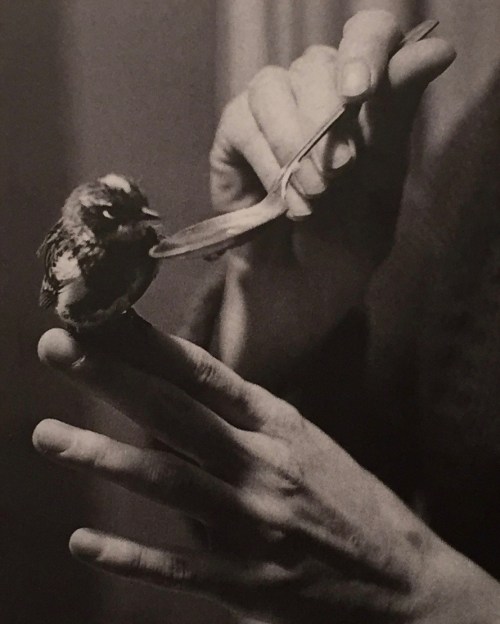
Mary Oliver spoon-feeding tiny feathered friend, close-up from the cover of Oliver’s 2017 “Devotions,” a collection of poems spanning five decades. photo by Molly Malone Cook, Mary’s life partner

Mary Oliver, a Pulitzer Prize-winning poet whose work, with its plain language and minute attention to the natural world, drew a wide following while dividing critics, died on Thursday at her home in Hobe Sound, Fla. She was 83.

so begins the New York Times obituary for Mary O, polestar of poetry as prayer for some of us, for many of us. for me, most certainly.

as with most every death that shakes you at the marrow, my first response was cloudy, was confused. why, out of the blue yesterday, was a dear friend sending me lines from Mary O poems in the middle of an ordinary afternoon? then i looked again, closely, at the subject line and saw the dates spanned by hyphen, 1935 – 2019, our vernacular shorthand for “death has come.” it sank in slowly, as if my brain cells refused to register.

it’s not everyday that a death in the news so dizzies me, jerks me into momentary disbelief before settling with a thud, one that opens into sorrow. but mary O had long ago burrowed deep inside my soul; i’d made a whole room for her in wherever is that place that holds our heaven-sent synapses and soarings.

mary O had the gift of belonging to each and every one of us who read her, who memorized her lines, who traced our fingertips across the page, all but absorbing the unspoken, the shimmering sacred, she infused between the words, the images. to read a mary oliver poem is, often, to feel “the telltale tingle of the spine,” as nabokov so unforgettably put it. it’s as much what mary oliver doesn’t say, the unspoken, that catapults off the page, that reverberates, that catches in your chest, your throat, your mind, and lies there pulsing while you absorb the holy inference, the Truth.

mary oliver takes us by the hand, and down the trodden path into the woods, along the marsh, the tide pool, the ocean’s noisy shore. we sit beside her on the sodden log. keep watch with her as she keeps watch on the box turtle slithering into the pond. we hear the cry of the owl, the heron, the kingfisher, the red bird, the stirring in the trees. we are right beside her, footsteps behind her, always, when we enter into her poetry.

she was for me — and maybe for you, too — my polestar of prayerful poetry, the poetry of astonishment, the poetry of the Book of Nature. she was my doorway into all those poets — w.s. merwin, david whyte, wendell berry, terry tempest williams (i’ll think of more) — whose critical attention teaches us to see the divine — feel the divine, know the divine — in the stirrings of the earth and sky, those poets who remind us that the holy is all around, and it’s ours to enter any time. all it asks is that we open — even just a crack — the doorways of our soul.

mary O opened those doorways every time.

i met her once. sat in the same room, breathed the same air. shared words, shared silence. listened. laughed. it was heavenly, but i’d dreamed of more. had hoped to trek to cape cod when she was there, and i was in cambridge. hoped to comb the beach with her. walk the woods. then, when she up and moved to florida, i rearranged my dreams. imagined sending her a letter, asking if perhaps she’d meet with one of her disciples. i fully imagined sitting beside her on that log, listening, absorbing. learning.

she was, though, famously, intensely private. and it’s that thin-shelled soul, the porous, almost fragile cell wall of self that i recognize. that i honor with my distance. i’d not dare disturb.

i did though send her a letter. i had to once. i wanted to begin my first book, slowing time, with a mary oliver epigraph, her poem “praying;” these lines especially…

just
pay attention, then patch

a few words together and don’t try
to make them elaborate, this isn’t
a contest but the doorway

into thanks, and a silence in which
another voice may speak.

so i wrote her, asked if i could please have permission. her assistant wrote me back. but the letter came from mary O’s writing place, and that was close enough for me. (that and a letter from wendell berry are among the two treasures in the narrow drawer of my writing table.)

i never met her. but she knew me — or so it felt as her words slipped over me, put voice to my heart’s beat, my breath, my prayer, my hope, my faith. and that’s what made her my patron saint of poetry. delicate as the little bird she spoon feeds up above, a close-up from the cover of her last collection, her life’s work, bound. 455 pages.

img_1224devotions, indeed.

Her poems, which are built of unadorned language and accessible imagery, have a pedagogical, almost homiletic quality. 

so says the new york times, which goes on to say:

For her abiding communion with nature, Ms. Oliver was often compared to Walt Whitman and Robert Frost. For her quiet, measured observations, and for her fiercely private personal mien (she gave many readings but few interviews, saying she wanted her work to speak for itself), she was likened to Emily Dickinson.

Ms. Oliver often described her vocation as the observation of life, and it is clear from her texts that she considered the vocation a quasi-religious one. Her poems — those about nature as well as those on other subjects — are suffused with a pulsating, almost mystical spirituality, as in the work of the American Transcendentalists or English poets like William Blake and Gerard Manley Hopkins.

i say, simply, thank you, mary O. thank you, thank you, thank you.

When it’s over, I want to say: all my life

I was a bride married to amazement.

I was the bridegroom, taking the world into my arms.

When it’s over, I don’t want to wonder

if I have made of my life something particular, and real.

I don’t want to find myself sighing and frightened,

or full of argument.

I don’t want to end up simply having visited this world.

bless you, mary O. may astonishment be yours eternally.

what’s your holiest line or poem from mary oliver?


taking up the challah challenge

img_1213

years and years ago, when my kitchen confidence was far wobblier than it is now, i tried my hand at friday challah baking. i wound up with paddles of braided bread that appeared amphibian and reptilian. there were a couple weeks of challah masquerading as crocodile. challah as lobster, with vengeful claws reaching across the table. my challahs looked anything but edible. my challahs begged for names. and cages.

so i surrendered, bought my weekly challah at the grocery store. but, because it comes only in sizes fit for half a synagogue, we almost always have leftover loaves hardening in the corner. i have a slew of ways to use it: i’ve frozen so many picked-over loaves a peek in our freezer might make you think we eat one and only one foodstuff — challah in varying stages of ice age; i’ve mastered bread pudding and french toast (can do both with my eyes closed); we’ve sliced it for a million saturday PB&Js; and of course our squirrels get a steady diet (i wouldn’t be surprised if our squirrels know the hamotzi, the challah blessing, by now).

and every friday night i’ve sat across the table from that oversized soul-less loaf, and dared myself to take up the challah challenge: “take a deep breath, and a humble packet of baker’s yeast, and see if you can once again find it in yourself to pull two golden braids from the oven, adorn your friday night shabbat table with bread you’ve kneaded and blessed with silent incantations all on your own, start to finish.”

yesterday, in full trial mode, i dove in. i am here to tell you that instant yeast is nothing to be afraid of. (this declaration is nothing short of revolutionary for a girl who grew up in a house where yeast was spoken of in hushed tones, as if a living-breathing creature that might wreak uncharted havoc if not treated kindly and gently enough. and, yes, my mother baked bread often in those radical suburban ’70s, so the misappropriation of fear and loathing is all my own. she is hereby declared innocent of that particular quirk of mine. now pie crust, that’s another story….)

i turned once again to the step-by-step instructions of my challah-baking friend and long-ago ally, henry, who with his family had escaped nazi germany, and who regaled me with tales of his mama’s friday baking and her magnificent golden braided loaves back in the old country, before all was shattered. though the pages now have yellowed, i found henry’s instruction clear and encouraging as ever, as i pulled his three stapled sheets from my cookery file, and followed along, triumphant at each and every stage. because i was baking challah on a thursday, there was something of an experimental air to the whole shebang. didn’t matter if i flubbed it. didn’t matter if it never rose (though i would have felt my heart deflate right along with the lack of yeasty rise).

and i was all but jubilant when, at quarter to three, i pulled from my wobbly old oven (it gets as hot or warm as it’s inclined on any given day, paying no mind to the faded numbers on the oven dial), two sturdy loaves. two loaves studded with sesame and poppy, onion bits and garlic, too (i had bagel topping in the pantry and figured it wouldn’t hurt to sprinkle with abandon — i was later informed to ditch the bagel topping, “this isn’t a bagel, mom,” and go the purist route: sesame or poppy, not both, not ever again).

i’m hardly exaggerating to declare my two loaves adorable. (see photo above!) after admiring abundantly, the taste-testers dove in. besides the plea to ditch the bagel-y topping, there came a request to please make it “eggier.” i’ve already consulted “the bread baker’s apprentice,” written by the master of bread, peter reinhart, aka brother juniper. he’s got a roadmap riddled with eggs — two whole + two yolks, and a host of other instructions besides.

so next week it’s challah 2.0, and i’ll keep at it till i’ve mastered these doughy batons. not long ago i met a woman who bakes like a fiend and, come friday afternoons, she piles her back seat with challahs galore, and drives and delivers to a circle of loved ones numbering into the 20s. i’d like that. imagine myself, pewter hair flapping out the driver’s side window, as i steer my station wagon — aka the challah mobile — hither and yon, flinging loaves as i go.

it’s all part of a scheme to infuse more intentionality into my days. to conquer those wee quirky fears, the ones that stand in the way of the bigger more daunting ones. slay a little dragon, and perhaps you muster the muscle to take on the giants. and in the meantime it quiets my fridays, ushers in the holiness of shabbat in the hours when i’m alone. i know enough of the meditative calm that comes with kneading and waiting, waiting and punching down dough, waiting some more. to bring to the table a loaf, blessedly braided, a loaf into which i’ve infused my prayers, a loaf just the right size for the two of us who, henceforth, will be the two main players at our shabbat table, once the youngin shoves off for college. it’s holy, all right. and triumphant besides.

and it sates a hunger of the most soulful kind.


a few fun challah facts from my friend brother juniper: garnishing the loaves with seeds, either sesame or poppy, symbolizes the falling of manna from heaven, and the covering of the challah with a cloth as it’s served on shabbat represents the heavenly dew that protects the manna. how lovely is that? so lovely.

what little dragon might you already have slain, or determined to slay, in this blessed new year, a chance to rise again?

wonder year

img_1182

sometimes we walk in circles before we find our way. or at least i do. maybe the last few months have been circle-walking. maybe the way forward is threaded by wonder. maybe what i’ve been looking for, a way into that deep-down still place inside, the place that’s a wellspring of the divine, maybe we get there by opening our eyes, putting our pulse up against the heartbeat of creation. maybe the quieter we go, the stiller we become, the more certain the sacred pulses inside and through and around and beyond.

maybe the place to begin — and this is the season for new beginnings — is right here where we are. maybe the way to begin is to be as still as we can possibly be, and plunge ourselves into those places where wonder can’t help but rub up against us.

this is hardly new revelation. i’ve been deep in the writings of thoreau these past couple weeks, poring over, underlining, making stars in the margins of a collection of passages and essays keenly observing the trees in and around walden pond and the woods of concord, mass. it’s a glorious collection of words and black-and-white photographs, gathered by the photographer and writer richard higgins from the two-million-word journal of the great transcendentalist and poet laureate of nature, henry david thoreau (1817-1862). it’s titled “thoreau and the language of trees,” and in it the instruction begins (for this is as much a guide to living as it is a historical recounting) with these guidepost paragraphs:thoreauandthelangaugeoftrees

“old trees connected thoreau to a realm of time not counted on the town clock, an endless moment of fable and possibility….

“and they were his teachers. although he called the shedding of leaves each fall a tragedy, he knew that the leaves that fell to the ground would enrich the soil and, in time, ‘stoop to rise’ in new trees. by falling so airily, so contentedly, he said, they teach us how to die.

“thoreau wrote prolifically about trees for a quarter century, from 1836 to 1861. he observed them closely, knew them well, and described them in detail, but he did not presume to fully explain them. he respected a mysterious quality about trees, a way in which they point beyond themselves. for thoreau, trees bore witness to the holy and emerged in his writings as special emblems and images of the divine.”

more and more of late, i am being drawn to a deeper understanding of the Book of Nature, a belief both catholic and jewish, a belief of many many faiths, that God first wrote the Book of Nature in creation, and then, in words, gave us the Torah, the Bible.

the pages of the Book of Nature are before us always — if we open the valves, the channels — the eyes, the ears, the soul — that detect and absorb the holy all around. the wisdom, the lessons, it’s all there to be extracted. it’s the wonder that catches our attention, that draws us in, holds us in its grasp. and then comes the pondering, the meditation, the sifting and filtering, the sieving and panning for glimmering gold.

but to notice, to pay attention, we need to go quiet. to still the noise. quell the cacophony. go to the woods or the edge of the shore. go to where the waters rush or trickle or flow in and flow out. stand under the stars of a cold winter’s night. we’re wrapped in the holiest text, the calligraphy of the great Book of Nature. God’s book. the book that beckons. the ancient and timeless antidote to the madness of civilization.

“the winter woods, especially, were a spirit land to thoreau, a place for contemplation. he walked in them alert to the mystical, more as supplicant than naturalist….

“thoreau also detected the divine in the woods. ‘nature is full of genius, full of divinity.’ all its motions — ‘the flowing sail, the running stream, the waving tree, the roving wind’ — must be the ‘circulations of God.’ ‘if by watching all day and all night i detect some trace of the Ineffable, then will it not be worth the while to watch,’ he asked, alluding to the recurring motif in the psalms of the watchman who calls out in the morning. ‘to watch for, describe, all the divine features which i detect in Nature. my profession is to be always on the alert to find God in nature.”‘

and so, at the cusp of this blessed new year, this moment when beyond the woods the cacophony rises, i am following the trail in and through, in search of the wonder that makes clear what might otherwise escape me.

where do you find wonder? 

happy blessed newborn year to each and every one, as we all pack away the holidays, the glitter and shiny paper, and shuffle back to the extraordinary quotidian….i’m finding myself a wee bit heavy-hearted this morning as my firstborn, home for the first time in a year these past two weeks, flies off tomorrow, into what promises to be another steep climb up the next mountainside….thank goodness the so-called little one will stick around till he too shoves off when college calls early next autumn…..

p.s. ice crystals above, clinging to the roots of a fallen tree, discovered yesterday along lake michigan’s shore when my beloved and i went out for a late afternoon’s winter walk, but one of the wonders marking my annual return to the day i was birthed….

prayer for the new year just round the bend

new year sky

it’s almost upon us, here in the hush of the in-between days. new year’s coming. new hopes, new dreams, new promises.

new beginning. old habits. can we shed even one? break one chain that binds us? worry less? hope more? trade in gentle for harsh? can we be kinder, beginning with our sweet old selves? can we sketch out, at last, a plan for moving us closer to the ways we want to be, to live?

i’ve no idea who invented the notion of starting over, but it’s a notion to which i’m deeply indebted. the whole year gets to start all over again. one after another. slate gets wiped — or so we pretend, so we make ourselves believe under the noise of the new year’s whistles and horns.

as i settle in for a quiet turning over of the page, i think of the ones who aren’t with me. the ones who’ve lived their lives large, with abundance. who filled every crevice with courage, with joy, with conviction. i think of the look in their eyes as their hours drew to a close. how they implored: don’t waste this. it’s not lasting forever.

i’m drawing all of them close. each and every one who didn’t live to see 2019. i’m thinking of one magnificent friend who at any hour might breathe her last. i’m poring over the lessons she’s been teaching ever since her cancer came back, ever since she’s been bravely, transparently, hold-nothing-back “nearing the edge.”

i’ve been digging around my old notes, and found a prayer i prayed once upon a new year. if i boiled it all into one single whisper it would be this, i believe: give me the grace, please, to make this as holy a world, as gentle a world, as the one you, God, first imagined when you breathed it all into being.

dear God, help me take it up a notch. and be ready with the band-aids when i fall and skin my knees.*

amen. love, meDSCF0322

*i decided the longer version of my new-year prayer was simply taking up oxygen, so i boiled it down and left only one line standing. the one about band-aids, for the hours and days when we fall from our deepest-held hopes…..

what’s your new year prayer?

out of darkness, the first radiant light

prayer for new year

imagine, long before telescopes and science tomes, what must have rumbled through the minds of those keeping watch on the heavens. how a time came when each day was darker and darker. when the hours of midnight-blue-toward-black blanketed farther and wider across the landscape. imagine the terror it might have stirred. are we edging toward endless seamless darkness?

and then, one day, at the darkest hour, a stirring happened, a stillness barely noticed. the waxing darkness ceased, the light broke through, and day by day, minute by minute, there was more of it. ebb and flow. wax and wane. addition and subtraction. the arithmetic of heaven, earth, and all creation.

and into that cosmos of push and pull, the ones who felt the spirit, the ones who believed the heavens were stirred by the hand of the Creator, they infused the darkness with the Christmas story. they made this the time of year when the Great Scripture opened in Nativity. a babe was born. in quietest, cast-aside manger. it’s a narrative whose shining light begins on the margins, celebrates the marginal. it is in every way the antithesis of splendor. it’s a straw bed where the moans and cries of labor are punctuated with the mews and bellows of the barnyard flock. where sheep and ox kept time.

it is a story that turns everything — darkness, splendor — on its head. the holiest one is born in a barn. there’s no room at the inn, not even for the one who brings the light. it’s a tale whose tropes never ever fade. year after year, they permeate hope. year after year, the dark hours before the solstice serve to quiet us. draw us in. invite us to explore the unlocked chambers of our hearts, the ones we sometimes never notice.

i’ve come to wrap myself in the little-noticed threads of Christmas, the quiet threads. the ones lost in the folderol and rump-a-pum-pum. the Christmas i love is all but invisible. you can’t unwrap it. it unfolds all on its own, deep in the stillest places in my heart. i do everything i can to amplify the quiet. i tiptoe down the stairs earlier and earlier. i make a point of opening the back door and stepping into the dawn. i shlep my tin can of birdseed across the frozen grass, under star-stitched dome, and thrill to the spilling song of all that sunflower and safflower funneling into the feeder. i simmer orange peel and cinnamon stick, clove and bay leaf, star anise too; my kitchen’s incense, calling me to quiet prayer.

on mornings like this one, i listen for the muffled thud of three distinct footfalls. it’s a sound that now comes but once a year. it’s a sound that means three beds — not two — are filled in this old house. i want nothing more than the sound of those footsteps, and the long day’s cacophony that follows. i want the whispered conversations at the kitchen table. and the hilarious ones that might punctuate hours round the Christmas tree. i want the sleepy-eyed listening in on the words weaving back and forth between two boys who call themselves brothers, and live and breathe that alliance as if it’s forged in titanium. i want to feed them, and make them laugh. i want to reach across wherever it is we are sitting and squeeze the flesh of their now-grown hands. i want to catch the glimmer in their eye when we pull to a stoplight in the night, and the street lamps catch the animation i can’t see across the long-distance-telephone miles.

if Christmas is the time when radiant light breaks through winter’s darkest night, i want to wrap myself in all its threads. if Christmas is love born anew, if it’s quiet — as quiet as the first one truly was — then all i want for Christmas is what burns bright and still inside me. and my prayer then would be to hold that light, to carry it long beyond the Christmastide. to animate my every day, to hold the stillness, the quiet, the kindled inextinguishable flame, and let its lumens fall across my winding path, illuminating my every hour.

for that, i beg the heavens. amen.

may your Christmas be blessed, and as quiet or as rambunctious as you wish. may your solstice hour carry you across the threshold from dark to first inkling of light. 

how do you make Christmas in the quiet of your blessed heart?

IMG_1081

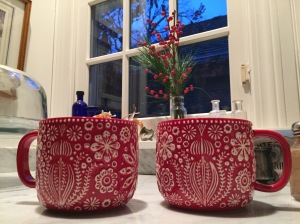
my christmas captured: two mugs, not one, awaiting morning’s coffee. my sweet boy’s home…and these mugs are invitation to a long morning’s reverie….

twelve: a dozen years of chairs

PUAC 12 tree

can you imagine the early morning inferno if i’d decided to light those birthday candles tucked in the fir boughs?

twelve years ago, this old house awoke to the sound of someone clack-clack-clacking in the old one-car garage-turned-maid’s chamber-turned-writing room. i was clacking in the dark, while upstairs a kindergartener slept, and three steps below him, at the hard bend in the stairs, an eighth-grader dreamt. i tried not to make noise, didn’t really want anyone to know what i was up to, so uncertain was i of whatever this was, wherever i was typing toward in this uncharted landscape.

DSCF0291

“the little one” when he was five, and the chair was being born…

i birthed the chair that cold december morning of 2006. and now, as i type this, the eighth-grader is off in law school, almost halfway through i keep reminding him as he grinds toward the end of first-semester-second-year finals. and the kindergartener, he’s holding his breath, waiting to hear from colleges! any hour now.

where, oh where, did the years go?

they unfolded here, is where they went. i’ve sat down 892 times to try to snare some passing-by moment in my writer’s net. some of the moments caught are among the most precious of my life, of my boys’ lives. some got away.

over all these years and all these posts, we’ve — all of us — woven together sacred threads — thoughts and comments, stories, prayers, snippets of poetry, a recipe or three — into a cloth that wraps us, gives us pause and comfort from the melee and the cold just beyond.

it was december 12, 2006, a tuesday, when i sat down to begin. i began with these words, this promise, this vow i lived to keep:

…like all births, i have no idea what’s coming. no idea how all this might unfold. only, i have hope and an idea. i hope that this place becomes a touchstone for a whole circle of us, that we will drop in, pull up a chair, share some thinks, as my beloved friend and doula of this site, sandra sweetpea, so perfectly always puts it.

as every conversation worth diving into is one that wends and winds, turning this way and that, this too will be a stew. we might marvel at a new children’s book. we might have to swap recipes for that pumpkin bread on my table. i might share a prayer, or a snippet of poetry. i might tell you the very cool thing i just read about pouring a good stiff drink for your paperwhite bulbs so they won’t grow so floppy, and bang against the glass, up there on the sill. if i stumble into a magical shop where handmade or one-of-a-kind things will delight you, you can bet i’ll let you know where and how to get there.

the mighty mississippi of all these tributaries, the force flowing ever onward, will be this: we are looking for everyday grace. i believe that in quietly choosing a way of being, a way of consciously stitching grace and Beauty into the whole cloth of our days, we can sew love where before there was only one moment passing into another. making the moment count, that’s what it’s about here. inhaling, and filling your lungs and your soul with possibility. learning to breathe again. learning to listen to the quiet, blessed tick and the tock of your heart. filling your soul with great light so that, together, we can shoosh away the darkness that tries always to seep in through the cracks, wherever they might be. please, pull up a chair….

and pull up a chair you did. and i did. and we became the collective we set out to be.

along the way, we’ve held up those monumental moments — birth and marriage, death and dying and brokenness of so many kinds — and we’ve marveled at the barely-noticed ones (monster fighters, the crooked way home, snow when it’s still white). we’ve considered hope and faith and crushing blows. we’ve felt the brushstrokes of God across our brow, and goose-bumping down the crook in our neck as well.

i’ve learned to live — as mary oliver, our patron saint, instructs — wide-eyed for astonishments, as she reminds us that “attentiveness is the beginning of devotion.” or, as the 15th-century philosopher and theologian nicolas malebranche put it: “attentiveness is the natural prayer of the Soul.”

keep watch, the saints and mystics insist. the holiest hour is the one upon you now. make it count, make it count. practice kindness. love as you would be loved, the essence of it all. be still, so still, to drink in all the wonders all around: the stars and moon above, the light and shadow splashed upon the earth, the stirrings of the blessed creatures and the tender growing things, and most of all the unspoken prayer and longing of the ones who populate your every day. those are the few small truths we’ve made into our creed, here at this old table.

more than anything in the warms-my-soul department is the fact that not once at this table — not once in 12 whole years — has a harsh word been laid down here. it’s an unbreakable rule here: we trade in gentle kindness. you can be kind and honest at once, if your heart’s in the right place. and hearts here have always, always been just right — wide-open and all-enveloping, pulsing in purest empathy.

twelve years ago i never imagined i’d still be typing here where we pull up chairs. never imagined three books would flow from this old table. nor that i’d make some of my dearest friends, deepened other older friendships. i’ve bared my heart here, and my soul. i’ve laid out plenty of my quirks (there are volumes to be written there). i’ve trusted all of you. trusted you with my truest truths, ones i’d not before put to breath and form.

while i’ve never missed a friday, and know there are plenty more fridays in me, i might tweak things ever so slightly and, if there’s nothing deeply stirring, i might simply offer silence, or a line of poetry that’s caught me in its hold across the week. i know i’ll write across the months till T — my once-upon-a-time “little one” — packs up and plants himself in some far-off college dorm. but chapters have come and closed. and i think it wise to not take up oxygen unless i truly have a thought or two worth carving into words.

it’s a wicked world out there some days. and this will always be a refuge, and a holy respite, too. that, i promise you. if you click “follow” down below, you’ll always know if there’s been a stirring over here. especially if you click the follow format that sends an email to your mailbox.

before i tie this in a bow, i must bend knee and bow down low in deepest gratitude. you’ve wrapped me in something sacred all these years. your kindness is unmatched. you’ve become the dearest of soulmates, even if we’ve not spoken a word. the mere fact that you visit here tells me you understand. we’re an odd lot those of us who huddle here — we won’t give up on those rare few radiant lights that illuminate the way.

with all my heart, for all these years, and all these rambling un-refined thoughts, thank you, thank you. may you be deeply richly blessed and wrapped in all that’s holiest.

love,

b., the chair lady

PUAC 12 cookie dome

where were you 12 years ago? and how’s your story deepened?

a special special thank you to those few who have been here, faithfully, from the very very beginning.

TK _ WK hug

the ones who infuse it all…

extra special edition: glorious books for the soul

IMG_1042

this is the second of two posts today because, silly me, when i posted season of stillness earlier this morning i didn’t realize the latest edition of my chicago tribune roundup of books for the soul — really fine books for the soul — was already posted online. egad. 

so here tis, a double dose for this friday snuggled in the depths of hanukkah and advent and  however you mark the deepening of winter to come….

if you put just one book on your wish list, or your giving list, i’m thinking i’d pick one of these. see if you can guess which would be my number one? 

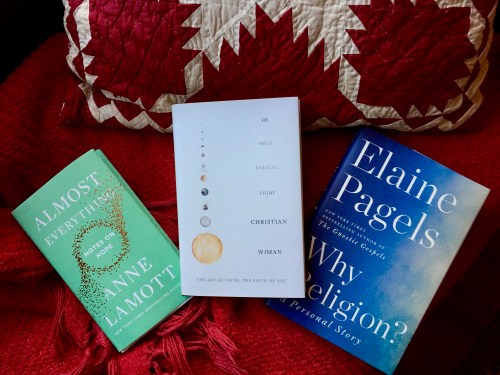
Christian Wiman’s memoir reflects on years as editor of Chicago-based Poetry magazine, plus Anne Lamott, Elaine Pagels

Barbara Mahany

“He Held Radical Light” by Christian Wiman, Farrar, Straus and Giroux, 128 pages, $23

The epigraph, perhaps, whispers the secret of what’s to come in the pages of poet Christian Wiman’s latest soul-searing memoir, “He Held Radical Light.” The epigraph, from Juan Ramon Jimenez, reads: “The world does not need to come from a god. For better or worse, the world is here. But it does need to go to one (where is he?), and that is why the poet exists.”

So begins Wiman’s wrestling with art and faith, faith and art, driven by the question, “What is it we want when we can’t stop wanting?”

The book follows Wiman’s earlier, brilliant memoir, “My Bright Abyss,” composed in the wake of his 2011 bone marrow transplant. In this latest work, Wiman — who teaches religion and literature at the Yale Institute of Sacred Music and Yale Divinity School — offers a volume that is part memoir (his years as the Chicago-based editor of Poetry magazine), part anthology (a compendium of poems lucidly critiqued), and, delightfully, a recounting of close encounters of the most curious kind with a Who’s Who of Poetry. He recalls Mary Oliver stuffing half a dead pigeon in her pocket, Seamus Heaney leaning in at a crowded dinner table and beginning an intimate conversation about faith, and A.R. Ammons refusing to read in front of an audience.

Early on in this book that reads like an unfiltered tete-a-tete, Wiman writes that when he left college, he set out to be a poet who would write “a poem that would live forever.” He has done that with this magnificent, radiant memoir.

“Almost Everything” by Anne Lamott, Riverhead, 208 pages, $20

Before you’ve turned even two pages in Anne Lamott’s newest, “Almost Everything,” you might hear yourself thinking aloud that, surely, she’s been peeking in through our windows, diagnosing the terrible straits of our souls. And, thus, she’s dive-bombed this balm straight down the chimney, just in the nick of sweet time. How’d she know how hopeless it’s felt? How bottomless? How’d she know these were the words we so needed?

Over the decades, through her 10 earlier nonfiction books, plenty of us have grown to trust Lamott’s spiritual compass. We settle in quickly here, knowing just around the next sentence she might pry open our heart, and pack in truths we will mull long after we’ve put down her pages.

“It is hard here,” she writes, with bracing honesty, and by “here,” she means this moment on planet Earth. Her subject is hope; she offers it in lines like this: “our beauty is being destroyed, crushed by greed and cruel stupidity. And we also see love and tender hearts carry the day.” Again and again, Lamott steers us in and out of the canyons and potholes of despair.

“We have all we need to come through,” she assures. “Against all odds, no matter what we’ve lost, no matter how many messes we’ve made over time, no matter how dark the night, we offer and are offered kindness, soul, light, and food, which create breath and spaciousness, which create hope, sufficient unto the day.”

“Why Religion?” by Elaine Pagels, Ecco, 256 pages, $27.99

Elaine Pagels, one of the great voices in American theology, plunges her reader into an abyss of grief before even the midpoint of her latest work, “Why Religion? A Personal Story.” But fear not.

As Pagels masterfully interweaves her personal story with her profound insight honed through by a career in academia, she offers her reader a lifeline toward hope, toward light after darkness. Along the way, she answers her titular question — Why religion? — by illuminating an ancient truth of human experience: religion, a construct of cultural beliefs and traditions, holds at its core the power to “heal the heart.”

In “Why Religion,” Pagels, the Harrington Spear Paine Foundation Professor of Religion at Princeton University, departs from the scholarly writing that propelled her earlier works, “The Gnostic Gospels” and “Beyond Belief,” to critical and popular acclaim. Here, in a memoir that wrenchingly recounts the slow death of her 6-year-old son, Mark, and a year later the mountain-hiking accident that killed her physicist husband, Heinz, she bares her incomprehensible, nearly unbearable grief.

Pagels’ fluency and nimble excavation of the wisdom found in the Gnostic Christian texts is what gives her — and her readers — a certain glimpse of a redemptive truth, and an exit route from the griefs that are sure to come to us all.

Barbara Mahany’s latest book,“The Blessings of Motherprayer: Sacred Whispers of Mothering,” was published last spring.

Twitter @BarbaraMahany

season of stillness

IMG_1033

not so many years ago, my writing room at this time of year took on north-pole proportions: spools of ribbon, bags of this and that to slip inside other bags or boxes, layers and layers of tissue papers, itty-bitty cards. lists abounded. i was a walking-talking maker and checker of lists.

not so much these days. and not because i’m scrooge.

simply because the sanctity of stillness is what i’m after in this season of deepening darkness. i punctate the night — the shroud of black that grows with every passing whirl around the sun — with my litany of sacramental simplicities.

the dawn is longer, blessedly, giving me more time to stitch those hours with the fine few invitations to bring in what’s hushed, what’s holy. i scoop my old tin coffee can with fat black seed, slide my toes into clunky boots, my arms in puffy sleeves. as the shock of morning cold splashes up against me, i fill my lungs with one quick gulp. then i march across the frozen stiff blades of grass, the mud that’s now succumbed into icy form, and perk my ears to hear the flutter of a wing, the rustling of a bough. i pause to scan the heavens, count the stars, spy the fraction of the moon. i’ve written a thousand times of how i make like i’m a farmer filling my trough, as i pour the seed in the feeder high above my head, stretching my arm far as it will stretch, raising up on tippy-toes, too. i’ve come to realize that the rush of pouring seed must be a call to all the birds, akin to “coffee’s on, come and get it!”

on the stillest mornings, the holiest ones, a cardinal or a junco might flutter in before i’ve stepped away. as if the gentle creature knows we’re in communion here.

perhaps i’ve learned, in my years — now three decades — of braiding jewish threads with catholic ones, to sanctify time, even more than place. abraham joshua heschel, whom i count among my constellation of north stars, writes: “judaism teaches us to be attached to holiness in time, to be attached to sacred events, to learn how to consecrate sanctuaries that emerge from the magnificent stream of a year.” he goes on to draw out that point: “the Sabbaths are our great cathedrals; and our Holy of Holies is a shrine that neither the romans nor the germans were able to burn; a shrine that even apostasy cannot easily obliterate…”

point, well taken. point, deeply taken.

i consecrate the holy hours — the ones of dawn and dusk and deepest night.

and so, this season is no longer a mad dash, but a countercultural adventure in stitching in stillness. in simply kindling light, one by one, an arithmetic of brightening, night after night, as both menorah and advent wreath burn against the darkness. our house is not filled with shiny boxes. santa’s list is not an annual exercise in accumulation. hanukkah at our house is brisket + latkes + jelly-filled donuts on the first night, candles and dreidels each night after that.

year by year, i dial down the noise, and amplify the hush that ushers in the stillness.

how do you consecrate your holy hours?

when the writing tide rises around you…(so of course you think of cookies)

IMG_1007

gulp. that’s the sound of me deep against a deadline. i’m a wee bit underwater here, with a 2,500-word story in the works. and a clock ticking loudly, telling me to crank it up, crank it up.

whatever leisurely tale i might have told you here this morning, it’s being scuttled by the overdrive that writing brings. when sleep becomes a playground for sentences that romp around your head, and you rise to gurgle coffee and down it by the mugful.

tis advent time, the season of quietest anticipation, a season i love and will enter deeply, once the clacking on the keyboard quells.

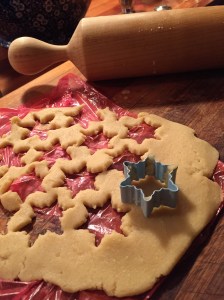
because i wouldn’t want to leave you high and dry, while i pull verbs and nouns and nifty transitions out of a hat, i thought i’d leave you something rather earth-shattering: we’ve a  new cutout cookie recipe over here, and after decades making my grandma lucille’s rolled cutout cookies, the ones she blanketed in wax paper sheets, tucked inside her cookie tins, her cutouts swapped for seasonal appropriateness, she’s been one-upped. there’s a new cookie in town, and my cookie-scarfing 17-year-old (a kid who knows) has deemed them better than the best.

this fine road to buttery perfection came to me — why, of course — at a hanukkah baking workshop on a recent rainy saturday afternoon at our synagogue. i was enticed to sign up because i’d thought i might learn the secrets to old jewish cookie treasures, some hanukkah morsel to bring to the table when we light the menorah on the first night of the festival of ever-burning light. instead, i got an ultra-upgraded butter cookie, one whose magic might rest in the milk (or cream) or vanilla my grandma never used, or perhaps it’s the baking powder, one of those cooking alchemies whose magic i don’t quite grasp. because i’m a girl who likes to get to the bottom of things, and maybe you do too, i’ll leave both recipes here on the table for you to peek at, pore over, and perhaps dive into.

but i’ll let you in on a secret that might amount to family treason: the new one, the one from marlene, my best new baking buddy, who all week checked in on me to make sure i’d not run into any lumps, is — shhhhhhh — the one i’ll reach for from now on. i baked these in the middle of the week, shortly after turning in my first draft of that darn story i’m still writing — or rewriting, to be precise. and i tell you, pulling out the cookie-cutter basket, remembering the tale of how each cutter came to me — a double bass for my longtime bass player, a teddy bear for, well, my very own TB — it was sweeter to me than the three and three-quarters cups of sugar i dumped into the mixing bowl. but those are stories for another day.

(a recipe note: i’m particularly charmed by the little asides in marlene’s instructions. you can almost hear her peeking over your shoulder, gently pointing out a better way, a shortcut, a trick she learned from years and years behind the rolling pin. i hope you’re as charmed as i am, and ever will be…)

Sugar Cookies from Marlene Carl (Directions 2018*)

*p.s. i love that marlene dates her directional revisions, as this cookie baking science is not to be taken nonchalantly…

3 and ¾ cups of regular flour a bit more if using egg beaters instead of regular egg

1 and ½ cups of regular sugar

2 teaspoons of real vanilla

1 and ½ teaspoons of baking powder

1 stick of unsalted butter and 1 stick of Can’t Believe It’s Butter margarine.  You can use all butter but the batter seems to roll better with the combination of half of each.  However, I do use all butter as I love the more delicate taste.

1 large egg or I use ¼ cup of egg beaters   (when baking with children who like to taste the raw batter, egg beaters are a safer option than real egg.)

2 and ½ Tablespoons of milk, (there are 3 teaspoons in one tablespoon)

Cream the butter until soft and blended, add the sugar and blend well. Then add the egg or egg beater, followed by the vanilla.

Mix the flour and baking powder together in a bowl, then add some of the flour, then some of the milk blending on low speed, continuing adding and blending until thoroughly  blended and mixed. The dough will begin to form a ball and pull away from the sides of the bowl.  Add a bit more flour if the dough seems very sticky.

Form three balls with the dough and press flat.  Wrap in plastic wrap and put into fridge until ready to use.  36 hours is the longest I have done so and it was perfect. You can also freeze the dough until ready to use.  Be sure it is double wrap and use within a month.

Bring the dough to room temp when ready to make the cookies.  Flatten one ball of dough between two pieces of wax paper the size of your cookie sheets and roll to about 1/8 to ¼ inch thick.

Using cookie cutters form into shapes, then remove as much of the extra dough around the cookies as possible. When you have done so, place in freezer or fridge (freezer about 10 minutes, fridge maybe a little longer amount of time).  When the cookies are cold it will be easy to pick them up and then place the cookies on a different cookie sheet and repeat the process.   Smaller cookies can often be removed without chilling them.

Leave about ½ inch between cookies.  I usually wait until I have used all the dough and made all the cookie forms before baking two trays at a time in a preheated 400 degree oven.  I use convention mode and they bake in about 6 to 7 minutes the edges turn a nice golden brown color.  Regular bake mode will take longer maybe 8 to 10 minutes.

Take the cookies off the tray immediately and place on cooling rake.  I usually only bake two trays at a time as the cookies are hard to get off the tray if they cool too much. If that occurs, place the tray back in the oven for about 30 seconds and the butter will soften the cookies and they will become easy to remove again.

When you roll the dough between the two pieces of wax paper, (if the dough seems to be sticking to the top piece of paper), you need to add one heaping tablespoon of flour.  Then knead the flour into the circle of dough.  It should not leave any particles of dough on the wax paper.

IMG_1008

and because i promised, here’s my grandma lucille’s. like my grandma, it is clipped and to the point, no frilly asides in this one. my german grandma meant business, and business we got. even in her recipe tin.

Lucille’s Famous Rolled Cut-Out Cookies

1 cup shortening

½C. brown sugar

½C. white sugar

1 egg

2 Tbsp. lemon juice and grated rind

2 C. flour

¼tsp. baking soda

¼tsp salt

Cream shortening. Add sugar. Cream well, egg, flour, soda, salt, lemon juice and rind.

Chill about 3 hours (or overnight).

Roll ¼-inch. Use cookie cutters {Editor’s note: most notably turkeys, bunnies, Santa on sleighs, at appropriate seasons of course. Put raisin in turkey’s eye; same for bunny’s nose.}

Bake at 350 for 10-12 minutes.

cookie baking wintery blessings

do you have a stand-out family cookie recipe in your tin, one that comes out at least once a year, or perhaps every other week? how does your family favorite stand up to the one dear marlene just bequeathed me?