“it’s like we’re the great kaleidoscope, all little pieces, but every time you turn it, it’s different. so you and i are made up of exactly the same stuff, but every one of us is unique. there’s only one in all the world. and the same with every petal of a pansy….i’m the star thistle, and the grass, and the dirt. i am you; you are me.”
i tumbled into this most breathtaking old soul, majestic soul, and i shall let her do the talking today. i quickly grew so enchanted by her voice, her deep and gravely voice, a voice that must have traveled rocky roads, that i began to take notes, and i am leaving those notes here: part transcript, part poem. i’m not catching every word but the words i’m catching are those i do not want to lose. it’s as if a great elder has come today to impart something. to share a light, the light she came to know was her one thing to share. to leave with the world.
may we all be so.
may we all by illuminated by this nearly 96-year-old, who is a veritable masterpiece of all that matters.
and here are notes, in prayer form, in poetry…
that i can still breathe easy i don’t want to have just visited this world i want to be a child of wonder and astonishment
i’m having my second childhood now, my happy childhood i was always the outsider, i was always pointed at, i always felt terribly self-conscious so i have fun now
i’m just learning about play because i didn’t know what play was when i was a child i think play means exploring, experimenting, being curious, looking, seeing, being in the body not being afraid
it’s about the miracle and mystery of being alive
“we shall not cease from exploration
and the end of all our exploring
will be to arrive where we started
and to know the place for the first time”
that’s t.s. eliot.
i had cancer once and . . . and afterwards i had surgery and i felt like i had to give myself a reaon that i was spared. that i got my life back and then, over many years, i saw that i had something to give, my light
something ineffable that i don’t know that light of harmlessness and harmony and singing and being joyful and rejoicing and being grateful
we’re here to experience the wonder of being in a body. . . to know that we are each other that we’re the same we’re made of all the same stuff . . . we’re little bits of stars, we’re dust
it’s like we’re the great kaleidoscope all little pieces but every time you turn it, it’s different so you and i are made up of exactly the same stuff, but every one of us is unique. there’s only one in all the world. and the same with every petal of a pansy….
i’m the star thistle, and the grass, and the dirt. i am you; you are me.
. . . my prayer is to go gently and as much aware of myself leaving with gratitude and joy and the satisfaction, “i’m done, i’m outa here. and it’s ok” it’s all such a mystery
thanks, i wanna say thank you not try to figure anything out, or understand it
but just be in awe
what’s the secret? it’s go slow for me . . .
[breaks into song. . .]
this beautiful film was made by two south african filmmakers who go by first names only as far as i can tell, justine and michael. their mission: to explore our shared humanity. their enterprise is known as reflections of life, formerly green renaissance. i do believe there is a trove worth plumbing…..i do not know the name of this blessedly beautiful nonagenarian so i shall name her simply Wisdom.
as we enter into supremely holy time, in both the jewish and the christian spheres, (are we not always in supremely holy time?), our friend here prompts the question how will you choose to live in awe?
in which we take a hard look at the crumbling discourse in this country, and consider a solution or two….
i’ll be honest. these are hard times. i pick up the news and feel pummeled by each new blow. i see pillars of democracy crumbling one after another. jeff bezos and the washington post, only the latest. i read of law firms—white shoe ones, meaning old-guard firms who take on some of the highest-profile clients, the most complex cases, aka “the elite”—being stripped of security clearance, being considered for criminal investigation only because they represented a client the current administration has inked onto the enemies list.
i see revenge as the rule of the day.
i’m sickened.
i’ve never prayed to a God of revenge.
but i read, too, that there are stirrings of hope. faint, yet beginning to stir.
you might call it an occupational hazard, but i happen to pay attention to the ways we get news and i worry desperately that we all cower in distant silos. (getting more distant by the day.) i get my news and you get yours and, often, ne’er the twain shall meet.
so how do we have a shared conversation? how do we sit down to the same old table and begin to listen? how do we reach across the table, and in a quiet, unquivering voice, utter the words, “i hear your point”? or the certain conversational lubricant, “say more”? or the nervier, and necessary, “that’s not actually true”?
i hold onto my hunch that most of us want what we think is fair, is just. and i’m not giving up on my fervent belief that if you saw me bleeding on a sidewalk, you would not ask first how i voted and then decide whether or not to lift me off the ground.
i’m fairly certain that in the nearly two decades we’ve been pulling up chairs here, some of us do get our news from different silos. i try to tread lightly. i respect divergence of thought. but the problem, as i see it, is that we are all being fed news in the flavors most to our liking. and that’s not the way the news is supposed to work. it’s not the way it worked for the time i was one of the ones writing what counted as news. and not in the newsroom i knew.
so here’s the jam: if the news you’re being fed is slanted, if some of it’s filtered out, and some of it’s twisted, if both sides aren’t fairly presented, it’s not any sort of surprise that conclusions are drawn, and wedges are wedged.
“…without fear or favor…”
these days, the ones helming the news––the owners, the billionaires who thought it a romp to claim a slot on the masthead––they seem to be in it for hard, cold cash. the one with the most wins. cozying up to power seems a game to which we’re not invited. to get there, you need to fly in your private jet, hopefully not one of the ones making a mess on the runways.
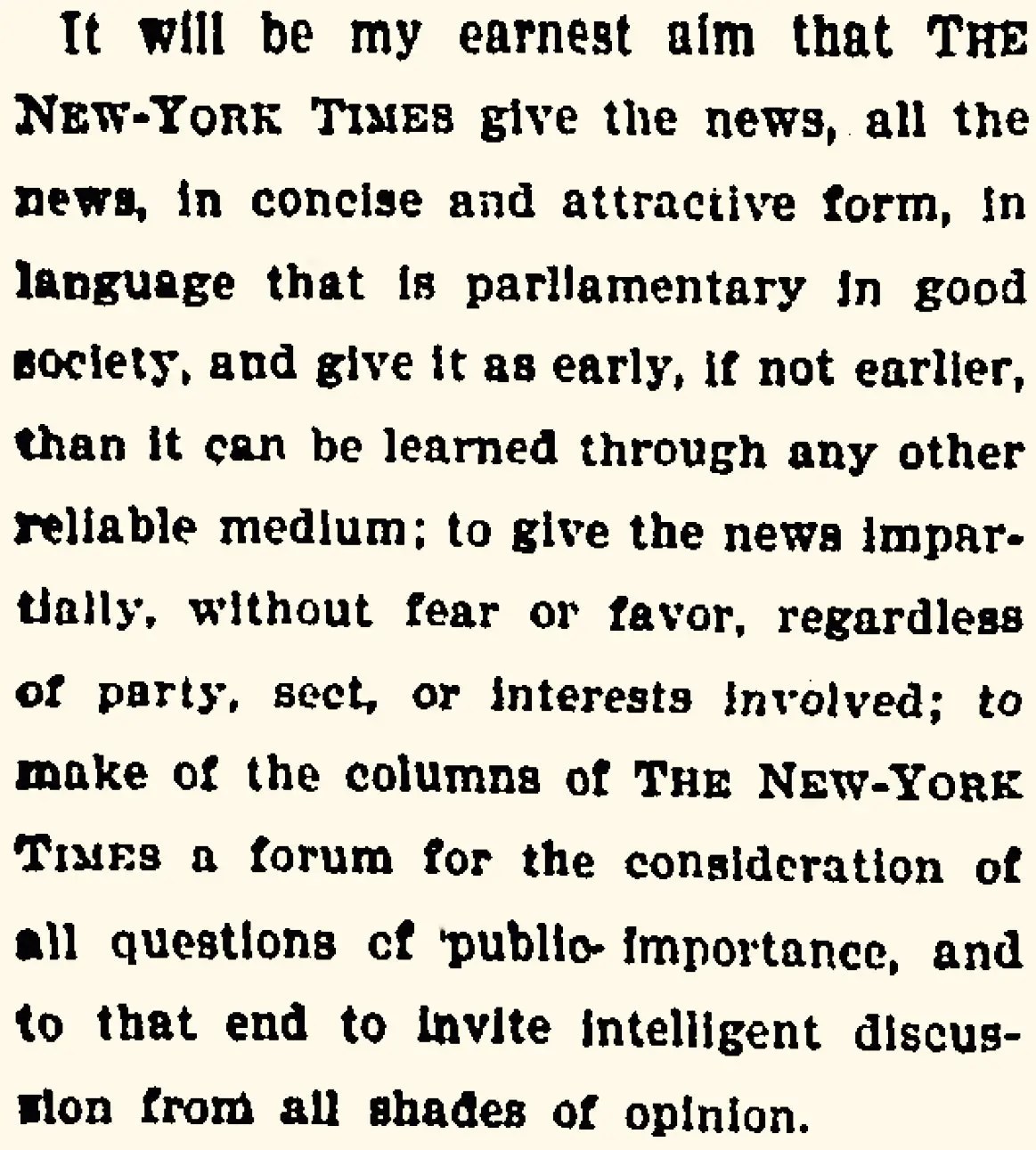
so much for democracy dying in darkness. or that now quaint-seeming declaration of adolph s. ochs in april of 1896, that his newspaper, the venerable new york times, would “give the news impartially, without fear or favor.”
good journalists hold firm to those words. good journalists have died defending those words.
you don’t get into the news biz––chasing after crooks and pols, climbing rickety stairs in darkened hallways, knocking on doors knowing full well you might find a muzzle pointed at the bridge of your nose––because it’s a sure way to raise your heart rate. or just cuz you’re nosey.
you get into the news biz cuz you’re a mad dog for the truth. and the fair telling of stories. you dig and you dig till you find that shimmering shard that, to your best knowledge, and according to more than one reliable source, is unassailably true. i sat beside folks in the newsroom who thought nothing of holing themselves in the dungeons of city hall or the bowels of bureaucrat mazes, riffling through file after file to track down the name and the dollar amount on contracts that might or might not have been legal. that might have unearthed wrongful convictions. or identified bodies dumped on the roadside. and those subterranean scribes had the pallor to prove it, after months and months under the glow of flimsy fluorescent lights. and cups of stale coffee. (we’ll leave the bottles of whiskey for another day.)
these days, the ones coursing the landscape with their reporter pads and pens, their itty-bitty microphones and their smartphone recorders, are plenty besmirched. discounted as little more than rousers of rabble. there’s a strong scent of disdain souring the air.
that’s an unfair and erroneous swipe at all those who abide by the time-tested codes. you might have heard that, um, democracy dies in darkness. and the reporters i know refuse to turn off their flashlights.
my little screed here won’t make a dent. but i cannot give up. none of us can. my faintest hope is that even one someone who reads this might take up the dare: fight fallacy and fiction with verifiable fact. there was an old maxim in the newsroom, one that we more or less lived by: if your mother tells you she loves you, check it out.
check your sources for news. read beyond your usual silo. sit down at a table and listen. exercise your ears more than your tongue.
at least for now, it’s a place to begin….
p.s. i know there is a good handful of journalistic heroes who pull up a chair, so if any of you wander by today or tomorrow or anytime soon, feel free to pen your prolific and profound views on the state of news consumption in america, and how it might be at least part of the root of what’s tearing us apart….
only one poem this week, and it’s a wonder from a poet who is a chicago legend, a hero in Black arts…..it’s an ode to books, which is a great place to begin a grounding in knowledge, and finding common language…..be sure to get to the last line, where i’m guessing you’ll let out a sigh. as i did. so much in common….
So Many Books, So Little Time by Haki R. Madhubuti
My sanctuaries are liberated lighthouses of shelved books, featuring forgotten poets, unread anthropologists of tenure- seeking assistant professors, self-published geniuses, remaindered first novelists, highlighting speed-written bestsellers, wise historians & theologians, nobel, pulitzer prize, and american book award winners, poets & fiction writers, overcertain political commentators, small press wunderkinds & learned academics. All are vitamins for my slow brain & sidetracked spirit in this winter of creating.
I do not believe in smiling politicians, AMA doctors, zebra-faced bankers, red-jacketed real estate or automobile salespeople, or singing preachers.
I believe in books. It can be conveniently argued that knowledge, not that which is condensed or computer packaged, but pages of hard-fought words, dancing language meticulously & contemplatively written by the likes of me & others, shelved imperfectly at the level of open hearts & minds, is preventive medicine strengthening me for the return to my clear pages of incomplete ideas to be reworked, revised & written as new worlds and words in all of their subjective configurations to eventually be processed into books that will hopefully be placed on the shelves of libraries, bookstores, homes, & other sanctuaries of learning to be found & browsed over by receptive booklovers, readers & writers looking for a retreat, looking for departure & yes spaces, looking for open heart surgery without the knife.
—Haki R. Madhubuti, who turned 83 this week, is a poet, writer, and educator, who in 1967 founded Chicago’s Third World Press, the largest independent Black-owned press. He’s regarded as an architect of the Black Arts Movement. Born Donald Luther Lee, he changed his name in 1973 after traveling to Africa: “Haki” means “justice” or “rights,” while “Madhubuti” means “precise, accurate, and dependable.” Both names are derived from Swahili. Of his renaming, Madhubuti explained at the time that he wanted to arrive at a new definition of self.
have you had any hard conversations of late? were you afraid to go there? what peaceable tools did you use to navigate? how did it go? will you try again?
these are dark times. chaotic times. times so upside down and alarming, i’m groping for what i can do. sometimes i think the solutions are way, way above my paygrade.
what i know i can’t do is whistle in the dark. blather on about incidental ponderings, pretend that all this will soon go away. it feels as if we’re witnessing wide-eyed the wielding of sledge hammers to bedrock pillars of democracy. who are these 19-year-olds re-writing code in the department of treasury? why in the world would anyone waste a minute of breath renaming a mountain, a gulf, except for extreme case of hubris? and what of claiming gaza, the land of a people who have sustained unthinkable horrors to simply exist on the land of their ancestors, a land now so deeply bloodied i fear it seeps to the core of the planet? to say nothing of erasing the existence of aid to the poor, the hungry, the marginalized around the globe. to strike language and data from federal websites, all but telling vast swaths of humanity they’ve been expunged. to imagine the labs where cures for disease are suddenly stalled, where lives––like mine––depend on those cures.
i have aimed from the beginning not to bleed into politics here. and i still hold firm to that core. what i address here, what i disdain here, is something far more foundational, a vengeance fueled by a mindset that it’s always always us v. them. a philosophy of division, of payback in the cruelest of iterations. a credo of greed. let the weak be weakened, and the few take the pot. and let it all be built on a mound of mistruths, fictions of wild proportion.
we’ve an unspoken bond here at this table that once a week i will leave some platter of words that might open a window. even a crack. let light in to our collective souls. so maybe in these dark times my place is shifting. maybe i’m meant to listen in silence, to keep close watch, to defend the tenets of the God of justice and love. a God whose wisdom is not twisted, turned on its head, shoved to the side for malevolent purpose.
maybe the chair, in these dark and cruel times, is simply a place to swing by, to listen for voices wiser and keener than mine. maybe the chair is a place to come catch your breath. to embolden your spirit. to find brief reprieve.
until the darkness lifts––and wise and faithful souls believe that it will, that We the People in our undeniable goodness and courage shall overcome––i’ll do what i quietly can. my platter today comes with two poems and a slather of chocolate. yes, chocolate. though in this case, it’s the priceless morsel of the story behind katie hepburn’s very own chocolatey brownies that might best the brownies themselves. you decide.
a beauty of a new poem found on diana butler bass’s straight-talking, life-sustaining, deeply soulful the cottage….
Love relentlessly, she said, and I want to slip these two words into every cell in my body, not the sound of the words, but the truth of them, the vital, essential need for them, until relentless love becomes a cytoplasmic imperative, the basic building block for every action. Because anger makes a body clench. Because fear invokes cowering, shrinking, shock. I know the impulse to run, to turn fist, to hurt back. I know, too, the warmth of cell-deep love— how it spreads through the body like ocean wave, how it doesn’t erase anger and fear, rather seeds itself somehow inside it, so even as I contract love bids me to open wide as a leaf that unfurls in spring until fear is not all I feel. Love relentlessly. Even saying the words aloud invites both softness and ferocity into the chest, makes the heart throb with simultaneous urgency and willingness. A radical pulsing of love, pounding love, thumping love, a rebellion of generous love, tenacious love, a love so foundational every step of what’s next begins and continues as an uprising, upwelling, ongoing, infusion of love, tide of love, honest love.
an ode to kindness….aptly titled…
Small Kindnesses
I’ve been thinking about the way, when you walk down a crowded aisle, people pull in their legs to let you by. Or how strangers still say “bless you” when someone sneezes, a leftover from the Bubonic plague. “Don’t die,” we are saying. And sometimes, when you spill lemons from your grocery bag, someone else will help you pick them up. Mostly, we don’t want to harm each other. We want to be handed our cup of coffee hot, and to say thank you to the person handing it. To smile at them and for them to smile back. For the waitress to call us honey when she sets down the bowl of clam chowder, and for the driver in the red pick-up truck to let us pass. We have so little of each other, now. So far from tribe and fire. Only these brief moments of exchange. What if they are the true dwelling of the holy, these fleeting temples we make together when we say, “Here, have my seat,” “Go ahead—you first,” “I like your hat.” —Danusha Laméris
and now, for katie’s brownies, the story of which first appeared in the letters to the editor of the new york times….
July 6, 2003
To the Editor:
Re the death of Katharine Hepburn last Sunday: For many decades, my father used to walk across town to do his food shopping on Second Avenue. He often shopped at a Gristede’s around the corner from Miss Hepburn’s town house on East 49th Street.
One day he suddenly came face to face with Miss Hepburn, who was also picking up groceries. He acknowledged her with a nod, and she responded in kind. He began thinking of her as a neighbor.
In 1983, my senior year at Bryn Mawr, Miss Hepburn’s alma mater, I was frustrated and was doing poorly, and at Christmas break, I decided to quit. I had the romantic notion of running away to Scotland to write screenplays. My father was frantic. My mother had died two years before, leaving him with all the responsibility for his headstrong daughter.
He knew that Miss Hepburn had gone through her own struggles at Bryn Mawr, so he wrote her a letter asking her to intervene. ”She’s a great admirer of yours, and perhaps she’ll listen to you,” he wrote. On the way to the grocery store, he dropped the letter in her mail slot.
At 7:30 the next morning, the phone woke me up. I answered it and heard that famous voice, crackling with command. ”Is this the young woman who wants to quit Bryn Mawr?” I said it was. ”What a damn stupid thing to do!” she snapped. She went on to give me a lively lecture, the gist of which was that I had to finish my studies and get my degree, and after that I could do what I wanted to do. There was no arguing with her imperiousness. Then she said she wanted to meet us for tea.
The day of our appointment was gray and wintry. Walking the long blocks to Turtle Bay, my father and I didn’t speak much. It felt as if we were about to meet the Queen.
Miss Hepburn greeted us warmly. With casual hauteur, she provided us with tea and some of her famous brownies. Though she was in her 70’s, she had a youthful look, enhanced by her girlish clothes: a turtleneck, a black cardigan and shabby khaki-green pants.
We talked about many things, including Bryn Mawr. She said that she was miserable there and still had nightmares about it, but she was glad she went. At the end of the afternoon she told me, in a rather grim tone, ”You’re smart.” It was a compliment, but also an admonition not to be foolish in the future.
My father was invited to visit her a few times after that. Once, he had heard that she was recovering from a serious car accident, and he stopped by to drop off a package of homemade brownies and a get-well note. To his surprise, he was ushered in and invited into her boudoir, where she greeted him in her nightgown. She sampled his brownies.
”Too much flour!” she declared. She then rattled off her own recipe, which he hastily wrote down. ”And don’t overbake them! They should be moist, not cakey!”
I’ll always be grateful to Miss Hepburn for making me stick it out at Bryn Mawr and for giving me these rules to live by: 1. Never quit. 2. Be yourself. 3. Don’t put too much flour in your brownies.
KATHARINE HEPBURN’S BROWNIES
1/2 cup cocoa 1 stick butter 2 eggs 1 cup sugar 1/4 cup flour 1 cup broken-up walnuts or pecans 1 teaspoon vanilla pinch of salt
Preheat oven to 325 degrees. Melt butter in saucepan with cocoa and stir until smooth. Remove from heat and allow to cool for a few minutes. Mix in eggs, one at a time. Add sugar, flour, nuts, vanilla and salt. Pour into a greased 8×8 square pan. Bake 40 minutes. ”Don’t overbake!” They should be gooey. Let cool (an essential step) and cut into bars.
Heather Henderson St. Paul, Minn.
how, pray tell, are you finding your way? chocolatey or otherwise…
this blessed string of days we’ve called “a year,” is drawing now its last deep breaths. it’s almost time to begin again, or so we imagine in the geometry of the mind, a flatter-planed sphere that sees the year going round and round like vinyl spinning on a phonograph. ascension is not in the equation.
in the geometry of the soul, though, each new turn––we hope, we pray––is not mere spin, but spiral, ascension its sure distinction. it’s the ever-incremental accumulation of loft we’re after. loft attained, most often, the hard way. we stumble, skin our knees, hold our nose and hold our breath while the doctor jabs the needle. from year to year, there is, we hope, at least the humblest modicum of lessons learned. year by year, we aim for wiser.
and so in this year now waning to its close, its hardest lessons came in scans and calls not returned, in snubs and deaths that came too, too soon. but it brought too the sorts of hallelujahs that remind us that good patience, in time, brings resolution, brings peace, brings love come home. the long lost friend we found again. the one hard heart that finally softened, seemed to learn a whole new lexicon, the language of delight at last unfiltered.
i am letting all the lessons settle in, knowing they’re the elements of accumulating wisdom. one year to the next, wiser, gentler, quieter, deeper.
or so we pray.
and in this quiet space––this most delicious time of yuletide, the time beyond the noise, the shopping, the dishes scrubbed and put away––i am inviting the past year to wash over me, to sift through the sediment, to save the gems, rinse away the detritus.
i’m adopting my deep-breathing posture, the one that has me curled under blankets in my red-checked armchair, the fire crackling, the tree twinkling, my boys all ringed around me.
and i’m leaving here at the table two shimmering gems: one, something of a wish upon a star and the discovery that the star is us; and the other a truth of which i cannot be reminded too many times….
here’s the first…
azita ardakani, an iranian-born social activist and communications guru, wrote this “once upon a time” for maria popova’s the marginalian. it’s part poem, part lullaby, and part creation myth with a dash of astronomical science. it reads a bit like a children’s book, and, like all the best and deepest pages penned to a child, it ends in revelation: the true wonder that the star upon which we wish is, in fact, a little bit of us. we are our own wish come true. or, we can be, especially if we aim for spiral and not spin…
Once upon a time, In a place far far away, The darkness drifted. The darkness knew no time. Reaching for infinity, only knowing beyond. One day in the web of inky forever, it asked itself, can I see you? It waited, and waited, and then, answered, a star. And then another, and another, and, another. Another was where it began, and as the star beings asked to be born to meet the darkness from which they came, one particular planet created water so it too could reflect the stars back to themselves. The stars seeing their reflection were filled with joy and delight. Curiosity was born in their light millions of years away. One by one they made their way down, to touch the ocean, to see themselves. The soil darkness watched with awe as the stars arrived, A heart’s desire asked: Can I see you closer? The water stars stretched onto the soil, and mixed into the clay, and became, everything. Yes you too, coyote who hears this, wise owl, mouse and rabbit, you too sleeping fawn, you too tree and root and seed, you too nested flight, and you too, sitting two legged. Mixed from clay and star, flesh and life, a hollow canal opened so breath too could reach back to the darkness. Missing the beginning, it exhaled a bridge, home. The star water became everything we know, and you? The story of us? Well, to experience the closest thing to the very beginning of star meeting water, we learned to create a small ocean inside of us, where it could all be felt, all over again. Once upon a time, in a place far far away, the darkness drifted, and you drifted inside it. You were the wish you once wished for.
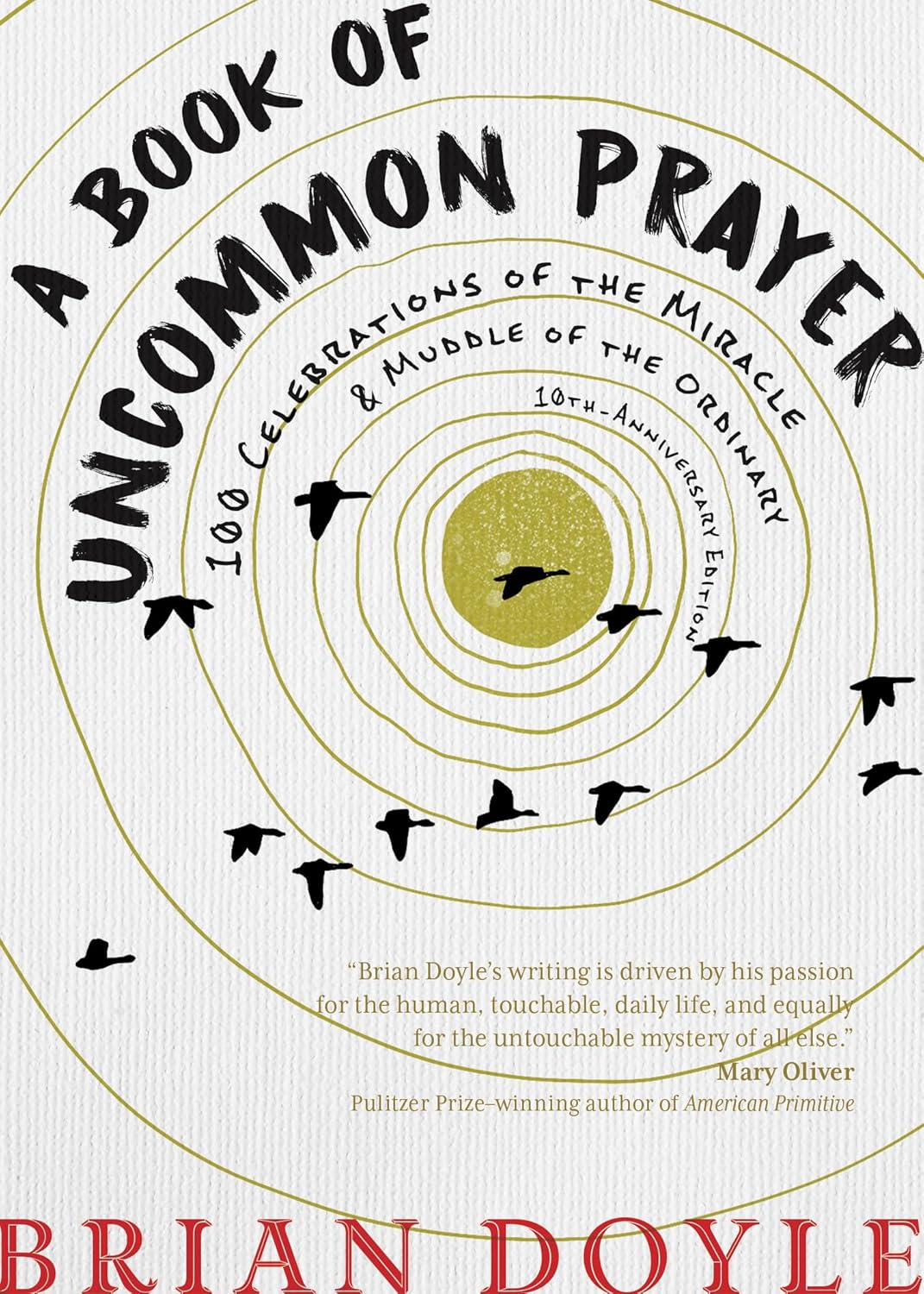
i count the late, great (astonishing) brian doyle among the favorite soul seers i have ever read. he finds words that burrow deep into the places in my soul that might never before have been struck or stirred. in his too-short time on earth, he saw wonder, plumbed wisdom in the unlikeliest of places. from prayers for cashiers and checkout counter folks, to prayers for robert louis stevenson on his birthday, and prayers for the greatest invention ever, the wicked hot shower, all found in his marvelous, marvelous, A Book of Uncommon Prayer: 100 Celebrations of the Miracle & Muddle of the Ordinary. these are the first lines of one with the magnificently brilliant title, “Furious Prayer for the Church I Love and Have Always Loved but Which Drives Me Insane with Its Fussy Fidgety Prim Tin-Eared Thirst for Control and Rules and Power and Money Rather Than the One Simple Thing the Founder Insisted On.” and it’s a fine fine note on which to both end and begin a year….
Granted, it’s a tough assignment, the original assignment. I get that. Love — Lord help us, could we not have been assigned something easier, like astrophysics or quantum mechanics? But no — love those you cannot love. Love those who are poor and broken and fouled and dirty and sick with sores. Love those who wish to strike you on both cheeks. Love the blowhard, the pompous ass, the arrogant liar. Find the Christ in each heart, even those. Preach the Gospel and only if necessary talk about it. Be the Word. It is easy to advise and pronounce and counsel and suggest and lecture; it is not so easy to do what must be done without sometimes shrieking. Bring love like a bright weapon against the dark… And so: amen.
bless us all. and may your new year bring you loft and leaven.
any wisdoms you acquired this year, with a story to share?
i’ve raised a blog, it seems, from birth to the verge of being grown-up. eighteen years: 12.12.06 it all began. 1,200 posts before today, so this––wondrously (to me, anyway)––is 1,201. at first i tended it, this conversation, this wondering aloud, this occasional epiphany, every weekday for a year, then chiseled it down to thrice a week. and then, yet again, i distilled it: once weekly––religiously every friday morn. here and there i’ve taken rare short breaks. a bit of summer breather once or twice.
and yet, kept on. and on and on. (sometimes wondering if maybe i should just be quiet.)
cycled through waves who’ve pulled up chairs in ebb and flow as of the tides. friends who’ve come to stay awhile, then shuffled off for one reason or another. at least a few i’ve deeply loved have died; angels still among us. some who’ve pulled up a chair have never ever strayed. here from the beginning, faithful as the day is long. bless them. bless and bless and bless them.
i too have ebbed and flowed. waded into deep and deeper waters. shed old fears, grew courage. been puzzled. pondered. hatched new fears. wobbled. stumbled. inhaled courage again, again, and again. i’ve wondered and worried aloud. weathered aching heart, and phone calls and headlines that left me breathless. i’ve loved and loved some more. i intend to never stop.
my school at first was all that unfolded under this old roof, where creaky twisting stairs and a nearly antique Garland stove––six burners, flattop, quasi-oven, a behemoth you’d find at any all-night diner––came to animate so many stories. it was my boys from whom i mostly learned and learned the most. and learned and learned again. and of course the holy earth and heavens high above: the gardens, the birds, the trees, the stars and moon, the dawn and dusk and nighttime’s inky darkness that never fail to draw me in. the book of nature, i’ve come to read, where lessons rise and fall season after season after season. i found a holy peace in this old house and the ramshackle plots where i kneel with trowel and soul wide open. i’d been chasing that peace for years.
i seem to have stumbled into a new teacher these days, one i’d never thought could bring such knowing: it comes with darkness, yes, though i’m reminded that darkness is the embryonic space where stirrings first begin. and it’s nighttime’s darkest hour when stars most brightly shine. stripped of distraction, of the nettlesome sorts of things that blur our everyday, it denudes us to our barest essence. it’s cancer (even when i do not name it here it’s ever present in my rumblings, and has catapulted me to highest most-reverent attention). mine is an especially wily iteration, one that doesn’t follow rules. and brings me squarely into the land of uncertainty. where i, a girl who likes to know things, am finding out how not knowing whittles the knowing to one or two immutables: love is the force that triumphs over all; its alpha and omega, the God who dwells within. within me, and you. and even all the ones who make us want to scream and run for cover.
here’s what i know 18 years in: there is nothing that love––true, deep love in all its iterations––cannot infuse. and in the infusing, molecules are stirred, shifted, and forms reshaped, dissolved, emboldened, made new. i’ve felt mountains move. i’ve felt fear melt away, like butter on hot biscuits. i’ve felt surrender––holy, holy “thy will be done.”
and a life well lived is one in which we love as unstintingly, as capaciously, as we might never have known possible. to live a life of loving is to scatter the few seeds that might blossom in our wake, that might rise in the seasons beyond us. it is the deepest mark i hope and pray to leave: to know my heart, my soul, has found a way in, forever in, to those whose lives i might have touched.
it all becomes so spare, so simple, in the end. when you realize your days––for as long as they stretch––are your one rare turn to hone the art of loving, as it is meant to be. as it is meant to make the holy difference. to trace the path from here to heaven.
that’s some of what i’m thinking eighteen sweet years in.
and now, because the older i get the more i glean from the wisdom of those who’ve left their trace, here’s my birthday bouquet to ponder for the day, the week, the hour…an indelible quote, a poem to make you laugh, and one to maybe melt you….
first, a quote from the french philosopher and playwright gabriel marcel, from the mystery of being:
“You know you have loved someone when you have glimpsed in them that which is too beautiful to die.”
a poem that might make you laugh, and certainly leave you with a smile:
Emily Dickinson at the Poetry Slam BY DAN VERA
I will tell you why she rarely ventured from her house. It happened like this:
One day she took the train to Boston, made her way to the darkened room, put her name down in cursive script and waited her turn.
When they read her name aloud she made her way to the stage straightened the papers in her hands — pages and envelopes, the backs of grocery bills, she closed her eyes for a minute, took a breath, and began.
From her mouth perfect words exploded, intact formulas of light and darkness. She dared to rhyme with words like cochineal and described the skies like diadem. Obscurely worded incantations filled the room with an alchemy that made the very molecules quake.
The solitary words she handled in her upstairs room with keen precision came rumbling out to make the electric lights flicker.
40 members of the audience were treated for hypertension. 20 year old dark haired beauties found their heads had turned a Moses White.
Her second poem erased the memory of every cellphone in the nightclub, and by the fourth line of the sixth verse the grandmother in the upstairs apartment had been cured of her rheumatism.
The papers reported the power outages. The area hospitals taxed their emergency generators and sirens were heard to wail through the night.
Quietly she made her way to the exit, walked to the terminal and rode back to Amherst.
She never left her room again and never read such syllables aloud.
and finally, a christmas poem that just might melt you, as it melted me. . .
Kenosis by Luci Shaw
In sleep his infant mouth works in and out. He is so new, his silk skin has not yet been roughed by plane and wooden beam nor, so far, has he had to deal with human doubt. He is in a dream of nipple found, of blue-white milk, of curving skin and, pulsing in his ear, the inner throb of a warm heart’s repeated sound. His only memories float from fluid space. So new he has not pounded nails, hung a door broken bread, felt rebuff, bent to the lash, wept for the sad heart of the human race.
thank you, with all my heart, for pulling up a chair, be it only for awhile, or for some or all these years. i am holding especially close against my heart this morning ginny, my once closest reader (my beloved mother in law who was quick to call if she liked what she’d read, and deafeningly silent if she did not!), mary ellen, and ceci, who waft over my shoulder, angels to my every day….and especially to my boys, who animate each and every pulse of my heart and every breath i breathe….(and certainly to will, who got this whole thing started, when he insisted i could do it, and built the website to make it happen….) xoxo love, bam
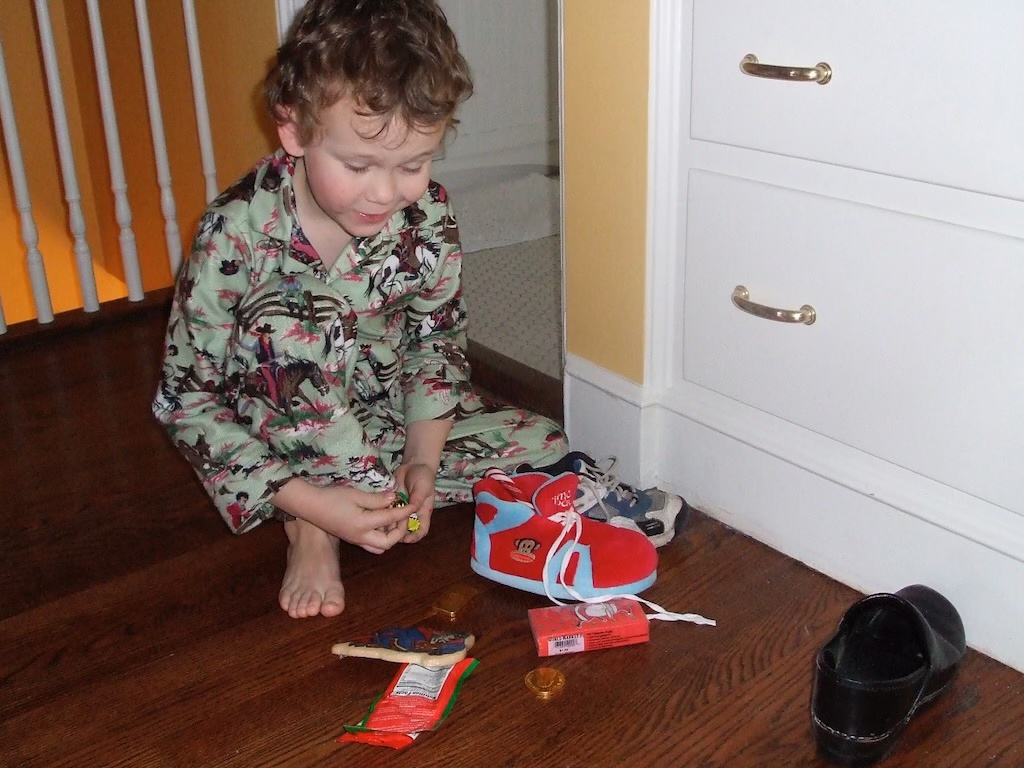
not so very long ago, within the reach of my old brain folders, this was the morn i had my boys set out shoes (sometimes admittedly smelly sneakers), which i filled with clementines and tinfoil-wrapped chocolates. the feast of st. nick, the jolly soul who in long-ago times filled the shoes of girls and boys with trinkets from his pouch. the original arbiter of good v. not-so-good; a lump of coal you did not want to find tucked in the toe of your wooden clog.
december, it seems, is a month punctuated with tradition. we embroider advent’s waiting, the dim day-by-day darkening with the kindled flickering of myth and lore and wonder gathered round the globe. every land, it seems, is looking for a bit of light amid the darkness.
i learned only this week of december fourth’s “barbara branch,” when the german tradition is to give the branch of a flowering tree to a barbara and await its blossoming by christmas. the story goes that barbara, who would become a saint and then later (at my tender and impressionable age of 9 or 10) be stripped of her sainthood (for reasons i never quite grasped but the good ol’ Church did it anyway), dear barbara back in medieval times was such a beauty that her wretched father locked her in a tower whenever he went away. and when she refused to marry some princely fellow, because she preferred to marry Jesus Christ (plenty of saints chose that path) he sent her off to prison, awaiting beheading. on the way to prison, so the story goes, a cherry branch snagged against her skirt, so wise and wily barbara clutched the branch and carried it along to her cell, whereupon every few days she watered it with drops from her scantly-filled drinking glass. and don’t you know that on the day she was burned at the stake and then beheaded, the branch blossomed. and so we barbaras carry on the blossoming, with branches awaiting bloom. my mother is a barbara, and she now has a dear friend where she lives who also happens to be a barbara. so this barbara brought those barbaras branches awaiting bloom.
and so december goes.
but really what i find myself thinking here this morning is how the sages i have come to know and love find themselves in conversation across space and time. how their wisdoms interlace and amplify, and to my mind underscore the eternal in their simple truths.
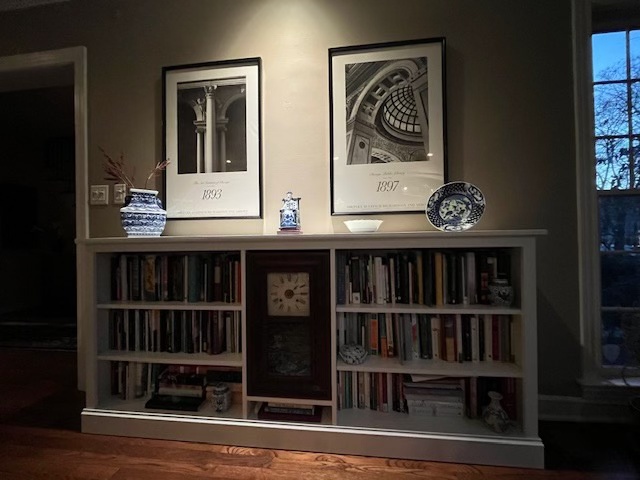
the sages shelf: poets, left; mystics and sages to the right
the two i’ve drawn from my shelf this week are brian doyle, the beyond-brilliant late great essayist and longtime editor of portland magazine, who died of a brain tumor not too many years ago. his wisdoms cannily or not line up with those of dorothy day, the radical pacifist and co-founder of the Catholic Worker movement, devoted to the poor, the hungry, the broken, and now on the road to sainthood, though she famously protested that labelling when she once snapped: “don’t call me a saint. i don’t want to be dismissed so easily.” (a sassy saint she’ll be, patron saint of sassiness among her zillion virtues.)
i found myself pulling dear brian off my sages shelf this week, and zeroed in on this passage in particular from his magnificent one long river of song: notes on wonder (a book whose praises i once sang in the pages of the chicago tribune, back when i wrote a column called “books for the soul”):
This is what I know: that the small is huge, that the tiny is vast, that pain is part and parcel of the gift of joy, and that this is love, and then there is everything else. You either walk toward love or away from it with every breath you draw. Humility is the road to love. Humility, maybe, is love.
he echoes the essence of dorothy’s wisdom, an epiphany of hers long etched on my heart. this simple, simple code: “by little and by little.”
her biographer, robert ellsberg in dorothy day: selected writings, elucidates: “simply, it consisted of performing, in the presence and love of God, all the little things that make up our everyday life and contact with others. from therese [of lisieux, yet another saint, the one who inspired dorothy], dorothy learned that any act of love might contribute to the balance of love in the world, any suffering endured in love might ease the burden of others. . . we could only make use of the little things we possessed—the little faith, the little strength, the little courage. these were the loaves and fishes. we could only offer what we had, and pray that God would make the increase. it was all a matter of faith.”
what i’ve come to know, through the alchemies of age and maybe cancer, is that my one holy task here is to live by love, little by little, day by day, for as many days as i have. if i can be a little flame, if i can choose love, choose joy, choose kindness at each and every turn and each and every choice, then my swift life here will have left some mark and measure. if each one of us might tip the balance, bend the arc toward justice, then our existence holds holy purpose. the choice becomes so clear, so finely-grained focused: i aim to walk closer and closer to the holiness i was––we were all––meant to be. and to find unending bliss within.
so help me God.
one more brian doyle: in a brilliant, brilliant essay (found in One Long River, p. 12) about two strangers holding hands as they leapt from the south tower on sept. 11, doyle wrote: “their hands reaching and joining are the most powerful prayer i can imagine, the most eloquent, the most graceful. it is everything we are capable of against horror and loss and death. it is what makes me believe we are not craven fools and charlatans to believe in God, to believe that human beings have greatness and holiness within them like seeds that open only under great fires, to believe that some unimaginable essence of who we are persists past the dissolution of what we were, to believe against such evil hourly evidence that love is why we are here.”
i don’t know why i even try to say what has been so magnificently, unforgettably uttered already. brian doyle’s truth i feel unfolding in me every blessed day. i feel those seeds breaking open in the roaring furnace that is a cancer in your lungs.
because, why not, two Advent poems from emily d. or at least two poems worth contemplating in this season of anticipation, of heightened awaiting, of soul on the lookout for wonder coming….(Advent reflection on the poems, from my friends at the Salt Project, down below, but first, emily, the belle of amherst:)
“The Infinite a sudden Guest” (1309)
The Infinite a sudden Guest Has been assumed to be — But how can that stupendous come Which never went away?
“Tell all the truth but tell it slant — “ (1263)
Tell all the truth but tell it slant — Success in Circuit lies Too bright for our infirm Delight The Truth’s superb surprise As Lightning to the Children eased With explanation kind The Truth must dazzle gradually Or every man be blind —
+ Emily Dickinson
and here’s what my friends at Salt Project say about both…
These two Dickinson poems are perfect meditations for Advent:
The first as a provocative play on one of the season’s mysteries (How can we “wait” for someone who is also present to us, and in us, even as we wait?); and the second as a window into the many ways the Advent and Christmas stories testify to a God who comes in ways that are somewhat softened, accessible, “slant,” camouflaged, even hidden.
An ordinary baby in an ordinary backwater town, signaled by a star so faint that only Magi can spot it (Herod’s assassins can’t!), and announced not to the powerful in Jerusalem but to nameless shepherds on a forgotten hillside, watching their flocks by night.
It’s as the old carol has it: “Veiled in flesh the Godhead see, Hail th’ incarnate Deity!” (that’s from “Hark the Herald Angels Sing”). Veiled, hidden, not so God disappears but precisely so God may appear — or rather, so we may see. The Truth must dazzle gradually…
what simple sages’ truths have you found echoing of late?
blessings to teresa p for teaching me all about BBs, barbara branches!
in which these uncharted times have me leaning on the wisdoms of great minds and expansive souls who’ve navigated their own immensely dark and tough times…
more and more i find history is my balm. i think back to the eras of darkness across the arc of time and the indomitable human spirit that has never yet been extinguished, no matter the force of the counterwinds.
albert camus
curiously, albert camus––whom i’d never thought of as any sort of balm––has served well in that role. though considering the era in which he was writing, it’s no wonder it was darkness he saw through, shone a fierce beam of light on the way through the horrors of europe during the holocaust.
so often it’s the artists and writers, the makers of films and penners of poems, the ones endowed with an eye to see beyond the occlusions, the ones who imagine what others can’t conceive, who cast the lifeline beyond the capacities of strategists and political operators, power brokers and thieves.
in his 1940 essay titled “the almond trees” (a species that brilliantly blooms in winter), found in his Lyrical and Critical Essays, camus weighs in on happiness, despair, and how to amplify our love of life.
only twenty-seven when he wrote this, here is the french-algerian philosopher who gave us the plague, the fall, the stranger,and the myth of sisyphus:
We have not overcome our condition, and yet we know it better. We know that we live in contradiction, but we also know that we must refuse this contradiction and do what is needed to reduce it. Our task as [humans] is to find the few principles that will calm the infinite anguish of free souls. We must mend what has been torn apart, make justice imaginable again in a world so obviously unjust, give happiness a meaning once more to peoples poisoned by the misery of the century. Naturally, it is a superhuman task. But superhuman is the term for tasks [we] take a long time to accomplish, that’s all.
Let us know our aims then, holding fast to the mind, even if force puts on a thoughtful or a comfortable face in order to seduce us. The first thing is not to despair. Let us not listen too much to those who proclaim that the world is at an end. Civilizations do not die so easily, and even if our world were to collapse, it would not have been the first. It is indeed true that we live in tragic times. But too many people confuse tragedy with despair. “Tragedy,” [D.H.] Lawrence said, “ought to be a great kick at misery.” This is a healthy and immediately applicable thought. There are many things today deserving such a kick.
echoing the sentiments of an earlier manifesto written in the immediate wake of the first world war, the 1919 “declaration of the independence of the mind,” again by a french philosopher, this time romain rolland––and signed by such luminaries as bertrand russell, albert einstein, bengali poet and nobel laureate rabindranath tagore (a favorite of mary oliver), social worker and activist jane addams (chicago’s own), upton sinclair, and hermann hesse––camus argues that this “kick” is to be “delivered by the deliberate cultivation of the mind’s highest virtues”:
If we are to save the mind we must ignore its gloomy virtues and celebrate its strength and wonder. Our world is poisoned by its misery, and seems to wallow in it. It has utterly surrendered to that evil which Nietzsche called the spirit of heaviness. Let us not add to this. It is futile to weep over the mind, it is enough to labor for it.
But where are the conquering virtues of the mind? The same Nietzsche listed them as mortal enemies to heaviness of the spirit. For him, they are strength of character, taste, the “world,” classical happiness, severe pride, the cold frugality of the wise. More than ever, these virtues are necessary today, and each of us can choose the one that suits him best. Before the vastness of the undertaking, let no one forget strength of character. I don’t mean the theatrical kind on political platforms, complete with frowns and threatening gestures. But the kind that through the virtue of its purity and its sap, stands up to all the winds that blow in from the sea. Such is the strength of character that in the winter of the world will prepare the fruit.
elsewhere in lyrical and critical essays, we find the line that practically serves as camus’s epigraph: “in the depths of winter, i finally learned that within me there lay an invincible summer.”
toni morrison
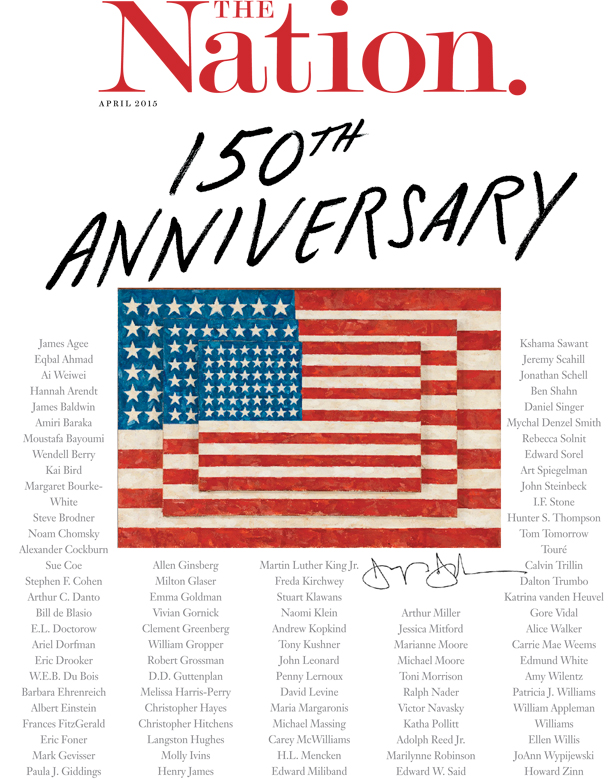
no less than toni morrison takes the baton, elaborating that the task of the artist is as a grounding and elevating force in turbulent times, in her essay titled “no place for self-pity, no room for fear,” included in the 150th anniversary issue of the nation, the monthly founded by abolitionists in 1865, not long after the adoption of the thirteenth amendment abolishing slavery.
morrison writes:
This is precisely the time when artists go to work. There is no time for despair, no place for self-pity, no need for silence, no room for fear. We speak, we write, we do language. That is how civilizations heal.
I know the world is bruised and bleeding, and though it is important not to ignore its pain, it is also critical to refuse to succumb to its malevolence. Like failure, chaos contains information that can lead to knowledge — even wisdom. Like art.
marcus aurelius
and finally let us turn way back the clock to ancient wisdoms, in this case those of good ol’ marcus aurelius, the roman emperor whose meditations were suggested to me the other day by one of my more astute and heavenly comrades. the meditations, written in the late second century of the Common Era during the emperor’s military campaigns against germanic tribes along the danube, are thought to be a window into his inner life, uncannily recognizable to our own deep-down whisperings. i borrowed the stoics from the library, but have already decided i need a paper copy all my own, the better for underscoring and stars in the margins. here’s but one of marcus’s wonders, from book II of his meditations, thought to be written in about the year 170 C.E. (uncanny how true wisdom is timeless, as this fits the november of 2024 as fulsomely as it fit nearly two millennia ago):
Begin the morning by saying to thyself, I shall meet with the busybody, the ungrateful, arrogant, deceitful, envious, unsocial. All these things happen to them by reason of their ignorance of what is good and evil. But I who have seen the nature of the good that it is beautiful, and of the bad that it is ugly, and the nature of him who does wrong, that it is akin to me, not [only] of the same blood or seed, but that it participates in [the same] intelligence and [the same] portion of the divinity, I can neither be injured by any of them, for no one can fix on me what is ugly, nor can I be angry with my kinsman, nor hate him. For we are made for co-operation, like feet, like hands, like eyelids, like the rows of the upper and lower teeth. To act against one another then is contrary to nature; and it is acting against one another to be vexed and to turn away.
what timeless wisdoms do you find anchoring, or elevating? and where might lie your invincible summer; how might you summon it?
here’s a challenge: imagine what’s possible. work toward it. begin with a baby step.
only when it is dark enough can you see the stars…
Undaunted is the word that came to me. Once the shock began to dull. Once I quelled the queasing in my belly. Once I decided I won’t surrender this blessed world, won’t shift the course of the project I call my most urgent life’s work.
I am undaunted.
My life’s work is accelerated these days. Its urgency is upon me, upon us all.
My life’s work aligns with that of every sage and mystic that ever has been: I am devoted to molding myself closer and closer to the holiness I was made to be, we were all made to be. Because this world is a sacred work in progress, and we are its players. We are the ones with the hearts and minds and hands to bend the arc of justice, to kindle more and more brightly the flame of the sacred. To reach toward the holiness infused through our every breath, every utterance, every inkling. The whole of it. At every turn. To be gentle, and kind. To tenderize the fibers of our heart. Especially the ones that have been torn and shorn over the years.
This is a path beyond the politics and power seekers of the world. I answer to a call from deep within, the eternal flame of the Divine breathed into us all in the beginning. In our beginnings. And the very beginning.
We’re called to play out our work in the milieu of the everyday, on a plane peopled with those who might test us, or just as certainly––often, more certainly––those who reach out a hand, and carry us along. Shimmy us onto their shoulders, if need be. And we in turn will do the same when we’re the ones whose knees aren’t buckling.
It’s contagious more often than not, this reaching toward kindness, toward peeling open the heart, digging deep, living for joy.
I’ve come to know that it’s a work best played out in incremental barely-noticed exchanges: the heart-melting smile shared in a crowded hallway; the hospital scheduler who takes the time to squeeze your hand, knowing you’re afraid; the grocery-store clerk who wipes away the tear that has crept down your cheek.
I once dreamed of solving world problems, curing life-crippling ills. Now, all I ask of each day is that I find moments to be bigger than I’ve been before, to reach deeper into the well of ordinary kindness, to bow my head and heart in deep thanks for every drop of beauty, wonder, decency.
That work is unaffected by whatever plays out on the world stage. The powers that be hold no power over our souls, and we needn’t succumb. Needn’t employ the crude or the cruel we witness too, too often these days; in fact, we need amplify the opposing forces. Be radical in our generosity. Our empathies. Our magnanimity. Our humility. And our righteous indignation when called for.
It so happens that this week found me being schooled in some of these very practices, and through the doorways of two great world religions. On Monday, a magnificent soul who happens to be a Hindu yogi, sat me down, lit a candle, and taught me the ways of deep meditation, turning my focus inward to the eternal flame of the Divine within; I am practicing every day. On Wednesday, I walked into the first of a series of classes at our synagogue on an ancient Jewish spiritual practice called the Mussar, centered on the verse in the Torah that tells us, “You shall be holy.” By drawing on seventeen soul attributes, and spending an arc of time––a season, a month, a week––keenly attuned to each, we exercise the muscles of our deepest being to become holy, to work toward our “primary mission in this world…to purify and elevate the soul.” The practice begins with humility.
In simplest terms, as the great Chasidic teacher known as the Kotzker, once put it: “Fine, be holy. But remember first one has to be a mensch.”
No one can stop us. Mensches will be we.
I’ve spent the week gathering around me a wagon train of wisdoms, a line from the Talmud, a prayer from Judy Chicago, a profoundly wise passage from EM Forster, another from Hannah Arendt, a post from Rebecca Solnit, and finally a paragraph or two from Kamala Harris’ gracious concession speech…..
from the wisdom of the Talmud, found in what’s known as the Pirkei Avot, which translates to Chapters of the [Fore]Fathers, a compilation of ethical teachings and maxims from Rabbinic Jewish tradition. It is a part of the Mishnah, a code of Jewish law compiled in the early third century of the Common Era.
“Do not be daunted by the enormity of the world’s grief. Do justly now, love mercy now, walk humbly now. You are not obligated to complete the work, but neither are you free to abandon it.”
A Prayer for Our Nation by Judy Chicago
And then all that has divided us will merge And then compassion will be wedded to power And then softness will come to a world that is harsh and unkind And then both men and women will be gentle And then both women and men will be strong And then no person will be subject to another’s will And then all will be rich and free and varied And then the greed of some will give way to the needs of many And then all will share equally in the Earth’s abundance And then all will care for the sick and the weak and the old And then all will nourish the young And then all will cherish life’s creatures And then all will live in harmony with each other and the Earth And then everywhere will be called Eden once again.
The English novelist, essayist, and broadcaster E.M. Forster (January 1, 1879–June 7, 1970) took up questions of societal empathies in an essay titled “What I Believe,” originally written just before the outbreak of WWII and later included in the out-of-print Two Cheers for Democracy, his 1951 collection of essays based on his wartime anti-Nazi broadcasts. Here’s Forster:
I distrust Great Men. They produce a desert of uniformity around them and often a pool of blood too… I believe in aristocracy, though… Not an aristocracy of power, based upon rank and influence, but an aristocracy of the sensitive, the considerate and the plucky. Its members are to be found in all nations and classes, and all through the ages, and there is a secret understanding between them when they meet. They represent the true human tradition, the one permanent victory of our queer race over cruelty and chaos. Thousands of them perish in obscurity, a few are great names. They are sensitive for others as well as for themselves, they are considerate without being fussy, their pluck is not swankiness but the power to endure, and they can take a joke… Their temple… is the holiness of the Heart’s affections, and their kingdom, though they never possess it, is the wide-open world.
With this type of person knocking about, and constantly crossing one’s path if one has eyes to see or hands to feel, the experiment of earthly life cannot be dismissed as a failure.
Politcial theorist and philosopher Hannah Arendt reminds us our reach for change needn’t be in the boldest strokes in The Human Condition, her 1958 study of the state of modern humanity, thought to be more striking now than at the time of its first publishing. Here’s but one sentence underscoring that claim:
“The smallest act in the most limited circumstances, bears the seed of… boundlessness, because one deed, and sometimes one word, suffices to change every constellation.”
Rebecca Solnit’s message the morning after the election:
You are not giving up, and neither am I. The fact that we cannot save everything does not mean we cannot save anything and everything we can save is worth saving. You may need to grieve or scream or take time off, but you have a role no matter what, and right now good friends and good principles are worth gathering in. Remember what you love. Remember what loves you. Remember …what love is. The pain you feel is because of what you love.
and finally, these two passages from Kamala’s gracious concession speech:
Fight in the voting booth, in the courts and in the public square. And … in quieter ways: in how we live our lives by treating one another with kindness and respect, by looking in the face of a stranger and seeing a neighbor, by always using our strength to lift people up, to fight for the dignity that all people deserve. The fight for our freedom will take hard work. … The important thing is don’t ever give up. Don’t ever give up. Don’t ever stop trying to make the world a better place. … This is not a time to throw up our hands. This is a time to roll up our sleeves. This is a time to organize, to mobilize, and to stay engaged for the sake of freedom and justice and the future that we all know we can build together.
and she closed with this…
You have the capacity to do extraordinary good in the world. And so to everyone who is watching, do not despair. This is not a time to throw up our hands. This is a time to roll up our sleeves. This is a time to organize, to mobilize, and to stay engaged for the sake of freedom and justice and the future that we all know we can build together. Look, many of you know I started out as a prosecutor and throughout my career I saw people at some of the worst times in their lives. People who had suffered great harm and great pain, and yet found within themselves the strength and the courage and the resolve to take the stand, to take a stand, to fight for justice, to fight for themselves, to fight for others. So let their courage be our inspiration. Let their determination be our charge. And I’ll close with this. There’s an adage a historian once called a law of history, true of every society across the ages. The adage is, only when it is dark enough can you see the stars. I know many people feel like we are entering a dark time, but for the benefit of us all, I hope that is not the case. But here’s the thing, America, if it is, let us fill the sky with the light of a brilliant, brilliant billion of stars.
what bright stars did you see this week? and how do you intend to carry on?
to those who note the rare use of caps this week, indeed sometimes you need to stand tall and say it loud and with proper capitalization, and so it is this fine morning. i mean what i say, and i say it undaunted.
you start to wonder. which is another name for worry. for most of the last five months, i’ve worked at pushing it off to the edge of the frame. to keep it out of my focus. but october is coming. and with it, the next scan. the next clear-eyed peek into my insides, into my lungs, to see if anything’s lurking that oughtn’t be.
i’ve mused about the saintly side of scan time. how it’s akin to memento mori, the ancient and holy practice of remembering our death so that we maximally live our one swift shot at this astonishing life.
but the other side of scan time is the deeply human side. the wake-me-up-in-the-night, the try-not-to-worry-that-the-pain-in-my-ribs-is-anything-scary side.
i feel it rumbling around the edges. the what-ifs i bat down as if a pesky mosquito that won’t leave me alone. i try not to tumble down the shadowy mole hole of imagining a call to my boys, letting them know i need another round of surgery. i try to quash the dialogue that runs through my head, my doctor’s voice telling me there’s something in the scan that looks worrisome, that needs more poking around. i try not to let cancer be the ice to my spine.
i try not to cry.
but sometimes i get scared.
i am, always, bumpily, raggedly, very much human.
i’m still new to the tidal ebb and flow of scan time. and the scan now rising on the horizon’s edge is only my third since surgery, since they took out a chunk of my lung, since they found an uncommon cancer that sometimes decides to shuffle around in the lungs, settle in where it wasn’t before. what i’m finding here in the precinct of scan time is that when i near the one-month-to-go mark, the palpable fear comes.
maybe each round i’ll get a little bit less wobbly (though, having lived with myself and my keen imagination for all of these years now, i tend to doubt that). maybe i won’t be tempted to imagine the worst.
but the flip side, the smarter side, even now, even at the less-than-three-weeks-to-go mark, is that the hovering worry makes me sink deeper and deeper into the now. “today is a day when i don’t know anything’s wrong yet,” i sometimes hear myself saying. i suppose there are healthier ways to frame the day (for instance, omitting the “yet”), but once the doctor stamps the C word onto your chart, once it follows you pretty much wherever you go, it gets decidedly hard to unshackle yourself from being afraid.
remember, i’m bumpily, raggedly, very much human.
which is why a necessary ingredient on this bumpy, pock-riddled road is to enlist a battalion of comrades. some are fellow travelers i know up close and personal. a few are glorious souls i only know through their words, words they beam to me as if telepathic lifelines to put oomph where i’m lacking.
whether they’re friends whose numbers i could find in my phone, or soulmates by circumstance, they’re all someones who know by heart how it is to live in the penumbra of cancer. what i find utterly indispensible about each and every one of them is that they put words to the rumblings i’d otherwise keep under lock and key.
and when you hear the worst of your worries, the very words you’ve not yet dared to utter aloud, come out of a mouth that’s not yours, there comes an incomparable sigh, a sheer and certain relief to find you are hardly alone. and deep in communion, even if it’s a union to which you wish you didn’t belong.
one of my incomparable comrades is suleika jaouad, the best-selling author of between two kingdoms: a memoir of a life interrupted, the new york times writer of the “life interrupted” column, and every week in my inbox, the author of “the isolation journals,” her unfolding and intimate chronicle of her rare leukemia and relapse and bone marrow transplant. she’s one of the ones whose wisdom and courage i lean on. she infuses me. and, often, she steadies me.
just the other day, after a weeks-long silence that signaled something amiss, suleika, who indeed has suffered yet another relapse and is back to chemotherapy, mused about radical acceptance.
she wrote:
That’s not to say I don’t feel fear—of course, I do. But strangely, the anticipation of pain can be far scarier than just being in it, actually confronting it. After my first transplant, in the years when I was cancer-free, I felt hijacked by the prospect of a recurrence and afraid that I wouldn’t be able to handle it. When it actually happened, I faced it. Knowing that, I have been trying to practice a kind of radical acceptance of whatever comes up, responding with whatever the situation calls for.
Take last weekend, for example. On Saturday, I had to go in for my last infusion of my second round of chemo. The side effects compound day-to-day, and afterward I felt awful, and I knew I’d be spending the day in bed. It had been a rainy morning, but on my way home, the sky began to clear, and I beheld a spectacular rainbow. For a moment, I glimpsed a sense of wonder. When I got to my room, I said to myself, “If I have to be in bed all day, so be it. What can I do to make this a little less miserable?” I took some anti-nausea meds and got a big glass of water. I put on my favorite face oil, wrapped myself a heating pad, gathered my pups around me, and queued up some favorite old movies to watch. Did I still feel awful? Yes. But instead of fighting it, or lamenting all of the things I wouldn’t be able to accomplish that day, I accepted it. And it turned out that staying in bed all day felt almost luxurious.
she speaks such truth. and then she somehow wraps it in what feels like a velvet blanket, somehow makes even a day in the sickbed sound a bit like a day at the spa. no wonder suleika is someone whose hand i would reach for on the darkest and scariest of days.
even though she wouldn’t know me if i bumped into her in the revolving door of sloan-kettering (a hospital entrance both of us have spun through) i wrote her right away to thank her for planting seeds of courage that some day might be my ballast. and i seized on her phrase, “radical acceptance,” to try to put it to practice. to not let my fears escape from the barnyard. to not be hijacked by fear, but to stare it square on, and to remind myself that time and again in my fair little life, i’ve steadied my knees and my spine in the fulcrum of whatever would have been my worst fear. i’ve always been braver than i’d ever imagined. i think we all are.
another one of my unparalleled big-hearted compatriot warriors who speaks to my deepest-down soul is the spoken-word poet and queer activist andrea gibson, diagnosed with ovarian cancer in 2021 and a recurrence last spring. i can’t count the times she’s sprung me to tears. tears of recognition. of stripped-naked truths. of beauty so rare and so fine i sometimes imagine she dwells with celestial beings.
here’s a line from one of her poems that stiffened my spine and reminded me to steady my ways:
My worst fear come true. But stay with me y’all- because my story is one about happiness being easier to find once we finally realize we do not have forever to find it.
we do not have forever to find it…
i play their words over and over, as if a broken record, hoping and hoping that with each spin of needle to groove, i might finally inscribe their wisdom, their wonder, their truth, onto my heart. or at least find a strong steady hand to hold while i aim there….
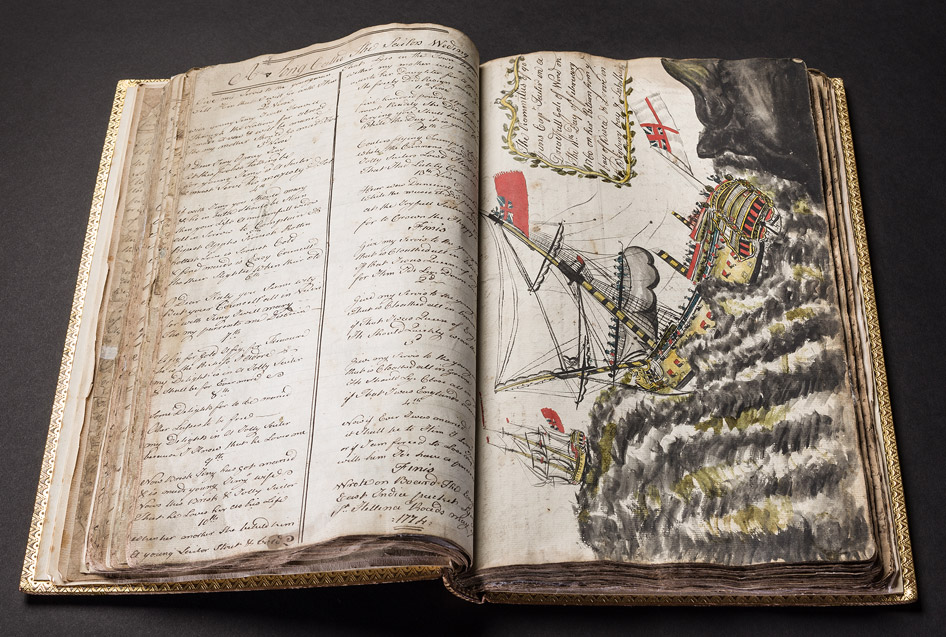
a page from british sailor henry tiffin’s commonplace book, 1760
more and more, the literary form into which i ease is one that traces roots to the ancients. to pliny, the great naturalist, whose mind must have been a beehive of sorts back in first-century rome. it’s an enthusiasm for accumulation that courses its path on through the renaissance when humanists, especially, were anxious to lock down their thoughts, keenly aware of the tragic loss of ancient learning, as libraries were so often, too often, the sites of military revenge. it’s a form that wends its way on and on through the centuries, straight through the twentieth, when mark twain, thomas hardy, ralph waldo emerson, and henry david thoreau, to name but a few, all partook of the habit. and here we are now, with plenty of us keen practitioners of the urge to gather up bits of literary esoterica and assorted ephemera before they skitter away. i think of myself, more often than you might imagine, as a rag picker of ideas in any which size, from the itty-bitty and poetic to the mindbogglingly big.
humans, it seems, like to scribble things down.
may our scribbling never cease.
the fancy name for this scribbling is commonplacing, the literary form the italians once named zibaldone, “a salad of many herbs,” in culinary terms, or a “hodgepodge” more broadly. we’re contemplating here the hodgepodge.
it’s the mosquito netting of the mind, of wonders and thoughts before they escape. or, as the 13th-century dominican monk, vincent of beauvais, once explained, it was “the multitude of books, the shortness of time, and the slipperiness of memory” that compels one to scribble.
count me in on the slippery mind.
vincent’s not-so-slippery solution: a ginormous tome, totaling 4.5 million words (someone counted!), an exhaustive compendium of all medieval knowledge, which he titled speculum maius (literally “great mirror”), speculum a word he chose because it contained “whatever is worthy of contemplation (speculatio), that is, admiration or imitation.” and thus he set out, over the course of his monastic lifetime to gather all the “flowers” (his word), or best bits of all the books he was able to read, in a selfless quest to save others the strains (time, money, trips to the library) of doing so themselves.
over the last many months, as the population of this old house has dwindled to two, and the stories to tell are fewer and fewer, my efforts here seem to have morphed into a looser, yet more concentrated consideration of the bountiful ideas and thunderbolts i bump into across the arc of a week.
there is something so natural about the human instinct to share what we’re thinking. of course there are those who might protest, who might consider me rude for shoving a book or a page or a picture in your face. but, when you think of it, isn’t that the instinct that drives so much of social media? (i often think we’ve gone overboard there, but that might be because too often it’s the magnification of any or every passing brain burp and not necessarily ones that might leave us enlightened. and too often amount to plain old overgazing at navels, or hair-raising nastiness and gut-wrenching vulgarity. but i digress…)
i’ve been keeping what amounts to my salad of many herbs for years and years now, and that urge seems to have spilled over to here, where week after week sometimes i seem to be assaulting you with the few morsels i’ve found most delicious in recent days. it’s a way, i suppose, of collectively swelling our brains. and our souls, most certainly.
in the spirit in which i bring my rag picking here, i like to think of us sitting side-by-side, cozy against the pillowy confines of an armchair broad enough for two. and in the gentlest, yet conspiratorial whisper, i offer you a page or a passage, my eyes widened and sparkling with glee, as if to say, wait’ll you see this one. what wonderments or deep thoughts spring to your mind?
any one of these next morsels is worthy of long and deep consideration. here are the ones that struck me this week:
these first two come from maria popova, whom i’ve referred to in the past as the high priestess of cultural commentary, and one of the most voracious gatherers of ideas i’ve encountered in recent years. her online literary journal, now known as The Marginalian, has been described as a compendium of hundreds of thousands of entries “that search for meaning, cross-linking ideas and connecting metaphysical dots.” here’s where she thunderbolted me this week:
“joy is a stubborn courage we must not surrender.”
“. . . love — whether we call it friendship or family or romance — is the work of mirroring and magnifying each other’s light. Gentle work. Steadfast work. Life-saving work in those moments when life and shame and sorrow occlude our own light from our view, but there is still a clear-eyed loving person to beam it back. In our best moments, we are that person for another.”
another place i often turn for soulful sustenance is Emergence magazine, a wellspring that explores the timeless connections between ecology, culture and spirituality. in a recent talk, titled “memory, praise, and spirit,” the filmmaker, composer, sufi teacher, and driving force behind Emergence, emmanuel vaughan-lee, opened with these words:
“The mystics say that we are like a seed; that we hold the blueprint for our highest potential within us, and that much of spiritual practice, regardless of what tradition, is unlocking that potential.”
and i close with this one from the great james baldwin, a passage from his 1964 collection of intimate but somewhat little-known essays, titled nothing personal. this passage is from the fourth of the four essays collected there:
“One discovers the light in darkness, that is what darkness is for; but everything in our lives depends on how we bear the light. It is necessary, while in darkness, to know that there is a light somewhere, to know that in oneself, waiting to be found, there is a light.”
i could write an essay on any one of the above, but instead i invite you to chew on each or any one. each one, a morsel worthy of your time, your mind, your soul.
which one spurs you and stirs you the most, and what deep thoughts spring to your mind?
i’ve written before of commonplacing. here at the chair, and in my latest book, The Book of Nature, on pages 87 and 88. it’s a habit i can’t get enough of, an urge i can’t quench.
pages from the commonplace book of charles dodgson, aka lewis carroll













 pull up a chair