
mrs. parks’ feet were not particularly weary
by bam
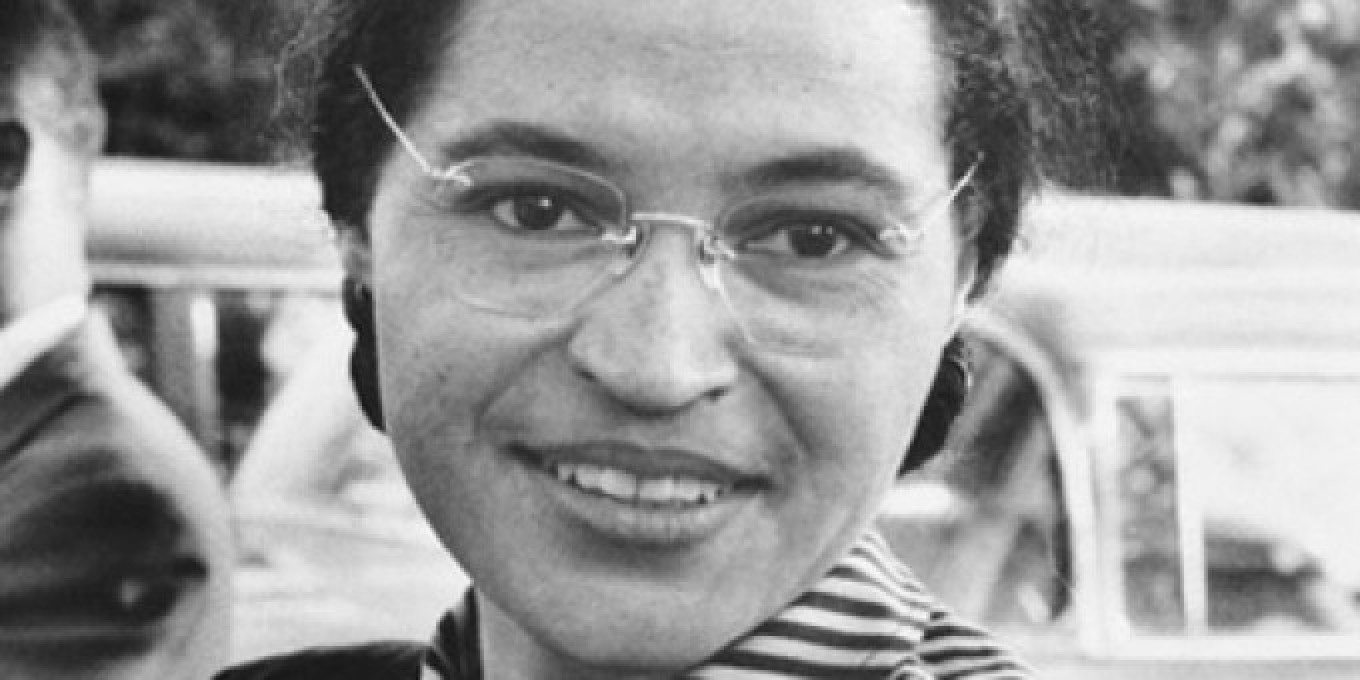
because we are not giving up on the america we believe in, the one that bears a very big heart, the one that can shoulder the world’s heavy load, the one whose muscles have always been fibered with heroes of human scale, the ones who wouldn’t get up, the ones who wouldn’t sit down, the ones who marched and meant it. the ones who died.
and because we need a day to declare the glory of emancipation, an act of defiance, of faith, as ancient as there’s ever been. for we the species of greed seem to have long had a knack for stealing the liberties of those who might serve us, who might lighten our load. their own load, be damned.
and because today, the nineteenth of june, juneteenth, is one such day, let us turn our attention to one for the ages: ms. rosa parks, a woman whose simple act—refusing to give up her seat on a bus to a white man, even on pain of arrest—invigorated a movement that fundamentally changed american life. and whose story, over the years, has been diluted, made to be one with keynotes of pity, where truth be told she was all about grit.
the story so often told of ms parks is that she was one tired soul, a seamstress who’d put in a long day’s work, when she boarded that bus in montgomery, alabama, in december of 1955. and that if not for her weary feet she might not have refused to get up from her seat where the white man wanted to sit.
some have called that the Standard Rosa Parks Story, one that skimps on nuance and short shrifts the structural underpinnings of the civil rights movement, specifically the longstanding work of the NAACP, the national association for the advancement of colored people—the nation’s oldest such grassroots organization, founded in 1909, by a diverse, interracial corps of activists including W.E.B. Du Bois and Ida B. Wells. critics of the oft-told version of rosa parks’ story would like us all to consider a Revised Standard Edition, which sets the story in more accurate context and illumination. (that edition, which i’m not outlining here, corrects a mistake and fills in an omission. you can read of it here.)
rosa parks herself rebutted the standard telling of her bus-seat story in her 1992 memoir: “people always say that i didn’t give up my seat because i was tired, but that isn’t true. i was not tired physically, or no more tired than i usually was at the end of a working day. i was not old, although some people have an image of me as being old then. i was 42. no, the only tired i was, was tired of giving in.”
what’s not argued is that ms. parks’ arrest that december day triggered a meticulously organized boycott of the entire montgomery bus system that lasted for 381 days. and that led to a supreme court ruling that, in 1956, expanded the Fourteenth Amendment’s protections, affirming that “separate but equal” had no place in public transportation—an evolution that culminated a decade later in the Civil Rights Act of 1964, dismantling state-sponsored segregation across all public spaces.
the great nikki giovanni, a poet i have long loved, picked up on that course correction—specifically on the status of mrs. parks’ feet—in this poem i have always loved. she, too, ditches the notion that the seamstress was but a “tired old woman” and plants her squarely as a deliberate activist in a larger, justice-seeking movement.
it’s a poem that begs to be read today, aloud or otherwise (i am always a sucker for a poem unfurled in a way that takes my breath away).
there are many things to love about this poem; placing the pullman porters front and center, chief among the reasons. the whole sweep of Black history here makes for an aching, aching read.
aches, i’ll argue though, are good for the soul. they’re what bulk up our empathies—and without empathy, what’s the point of taking up oxygen here on this rarest of planets? i love, too, how ms. giovanni winds us toward a waltz between the porters and mrs. parks. i love how they stand, arms linked, fending off cruelty and injustice.
i am all in for rosa parks today. and the pullman porters. and the poets who bring them whirling to life on this nineteenth of june.
Rosa Parks
BY NIKKI GIOVANNI
This is for the Pullman Porters who organized when people said
they couldn’t. And carried the Pittsburgh Courier and the Chicago
Defender to the Black Americans in the South so they would
know they were not alone. This is for the Pullman Porters who
helped Thurgood Marshall go south and come back north to fight
the fight that resulted in Brown v. Board of Education because
even though Kansas is west and even though Topeka is the birth-
place of Gwendolyn Brooks, who wrote the powerful “The
Chicago Defender Sends a Man to Little Rock,” it was the
Pullman Porters who whispered to the traveling men both
the Blues Men and the “Race” Men so that they both would
know what was going on. This is for the Pullman Porters who
smiled as if they were happy and laughed like they were tickled
when some folks were around and who silently rejoiced in 1954
when the Supreme Court announced its 9—0 decision that “sepa-
rate is inherently unequal.” This is for the Pullman Porters who
smiled and welcomed a fourteen-year-old boy onto their train in
1955. They noticed his slight limp that he tried to disguise with a
doo-wop walk; they noticed his stutter and probably understood
why his mother wanted him out of Chicago during the summer
when school was out. Fourteen-year-old Black boys with limps
and stutters are apt to try to prove themselves in dangerous ways
when mothers aren’t around to look after them. So this is for the
Pullman Porters who looked over that fourteen-year-old while
the train rolled the reverse of the Blues Highway from Chicago to
St. Louis to Memphis to Mississippi. This is for the men who kept
him safe; and if Emmett Till had been able to stay on a train all
summer he would have maybe grown a bit of a paunch, certainly
lost his hair, probably have worn bifocals and bounced his grand-
children on his knee telling them about his summer riding the
rails. But he had to get off the train. And ended up in Money,
Mississippi. And was horribly, brutally, inexcusably, and unac-
ceptably murdered. This is for the Pullman Porters who, when the
sheriff was trying to get the body secretly buried, got Emmett’s
body on the northbound train, got his body home to Chicago,
where his mother said: I want the world to see what they did
to my boy. And this is for all the mothers who cried. And this is
for all the people who said Never Again. And this is about Rosa
Parks whose feet were not so tired, it had been, after all, an ordi-
nary day, until the bus driver gave her the opportunity to make
history. This is about Mrs. Rosa Parks from Tuskegee, Alabama,
who was also the field secretary of the NAACP. This is about the
moment Rosa Parks shouldered her cross, put her worldly goods
aside, was willing to sacrifice her life, so that that young man in
Money, Mississippi, who had been so well protected by the
Pullman Porters, would not have died in vain. When Mrs. Parks
said “NO” a passionate movement was begun. No longer would
there be a reliance on the law; there was a higher law. When Mrs.
Parks brought that light of hers to expose the evil of the system,
the sun came and rested on her shoulders bringing the heat and
the light of truth. Others would follow Mrs. Parks. Four young
men in Greensboro, North Carolina, would also say No. Great
voices would be raised singing the praises of God and exhorting
us “to forgive those who trespass against us.” But it was the
Pullman Porters who safely got Emmett to his granduncle and it
was Mrs. Rosa Parks who could not stand that death. And in not
being able to stand it. She sat back down.
—Nikki Giovanni, “Rosa Parks” from Quilting the Black-Eyed Pea.
how will you sit back down or stand up and be counted, or not stay quiet, or refuse to acquiesce today?
 pull up a chair