pull up a chair

where wisdom gathers, poetry unfolds and divine light is sparked…

Category: rites and ritual

tefillah (תפילה) for a sweet new year in the season of awe

it is the soft dawn of a new year here, the jewish new year, an ancient calendar i’ve been drawn into, enfolded by, graced by, for all the decades since i met my beloved. he was the one who caught my eye back in the long ago, leaving the newsroom before sundown on friday nights to go to synagogue. i was moved by that devotion. leaving the newsroom on a friday night, back in the days when the big fat sunday newspaper was being “put to bed,” all the sections laid out, the stories edited, photos cropped and captioned, leaving the newsroom before deadline on a friday night meant you were breaking a mold. and you’d better have had a very good reason.

he broke my mold, all right, that tall bespectacled fellow loping toward the door. broke open a love of sacred creation, broke open an ancient text, the poetries and prayers that rose from the rocky, dusty, sometimes fertile terrain of a land indeed holy.

it would be a couple years before i found out the reason the bespectacled fellow was heading out to synagogue early on those friday nights: that was the hour of the singles’ shabbat service. he was looking to meet a nice jewish girl, and theirs was the six o’clock service. oh, well. that didn’t quite work the way he’d intended.

nor did i ever expect to be so deeply entwined with the religion of ancient ancient times. though there were hints. way back in high school, i asked a jewish friend of mine if i could come to her family’s seder, the passover meal at which the story of the exodus is told and retold. she answered that her family didn’t really mark the occasion, but maybe that year they’d make an exception. so there i was at their table, turning the pages of the exodus story, searching for the hidden matzah at the end of the meal. i came back year after year.

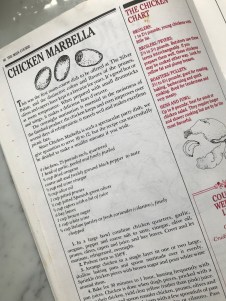
and all these years later, i’m the one who opens the jewish cookbook as the holidays near. over the arc of time, we’ve inscribed customs into the trace of the year: rosh hashanah, the new year, is when lamb stew (a middle-eastern iteration with chickpeas, and raisins, and apples and rice) is on the stove, though this year, just the two of us, we opted for the modern-day jewish classic, chicken marbella from the silver palate cookbook.

i crack open the prayer book too. crack it open weeks and weeks ahead of time, for the prayers are what draw me deep into the currents of the great river of judaism. awaken me to the mysteries and sumptuous beauties all around. remind me to see the miraculous in the most ordinary: the dust mote wafting by, the shadow of a tree, the call to pray “in the moments when light and darkness touch.” sometimes it’s the language, a simple line chiseled over time, that breaks me wide open, like this one: “prayer is our attachment to the utmost.”

let that one filter in…

sometimes i think my blessing is that i am still new to all this, so the way the words are unspooled is still fresh enough to catch my attention, my breath. i am often the one quietly gasping in the pews. or here at my kitchen table.

one last thing before i unfurl my prayer, my tefillah, for the new year: the other night at synagogue, just before the prayer for healing, the rabbi told of a midrash taught over time. she began by pointing to the eternal light that hangs above the arc where the Torah scrolls are kept. she noted that in the ancient temples the light that burned was from a wick floating in oil, specifically olive oil, the only oil allowed to burn in the eternal light. and then she went on to talk about the olive, the abundant small but ubiquitous fruit of the hillsides of the holy land. she noted that the oil from an olive is released only when it’s pressed, and crushed. and then, in that majestic humble way of hers, she taught us a lesson i’ll never forget: “when the olive is crushed it’s brightest light comes forth.”

ponder that the next time you feel the world pressing in from all sides, when you feel crushed. your brightest light might soon be burning.

here is my prayer for the new year. . .

tefillah for a sweet new year in the season of awe

O One who robes this world in threads of crimson and bronze, who reaches in the paint pot for persimmon, goldenrod, and concord grape, the palette of autumn ablaze,

under newborn moon, under deep black dome of night, i bend my knees and pray…

i ask for blessing abundant. i ask stingily, you might think. 

but then, you look around the world, see the tally from which i draw, and realize i’m barely beginning.

i pray first for forgiveness, for the sins of this selfish, self-obsessed culture of course, but more immediately and closer to the bone, for the sins of my own failings: my unwillingness to stray too far beyond the comfortable, to not muster the radical courage to cut a bold swath, to heal what’s deeply broken; for my inability to see my own blind spots; for the flippant dismissals i sometimes make too quickly; for being afraid, to the point that it occludes my seeing and breathing, my being. 

i pray for peace, peace of nations and peace of each unsettled heart.

i pray for wisdom to discern that which lasts and that which crumbles over time. 

i pray for grace which i define as radiance that will not fade in the face of shadow, will not step aside when life inflicts sharp elbow.

i pray for the hand that reaches out to dry the tears of the one whose cheeks are splotted, streaked, and sodden. even when, especially when, those cheeks belong to a someone we do not know. yet the simple presence of those tears signals how deep, how stinging, the hurt must be, the pain. i pray for the woman who sat beside me at synagogue and could not stanch her tears.  

i pray for those who go through life fists clenched, driven by a fury that won’t allow unfurling. won’t release the tendons taut, won’t uncoil the hands God gave so we could do the work of loving, of reaching, and cradling in times of turbulence and tumult.

i pray for the echo of laughter’s peals rising from the kitchen tables, the diner counters, the park benches, those flat plains where good souls congregate to dig down deep and tell their stories.

i pray for morning light to rush in before eyelids flutter open so that when they do all is golden, nearly blinding, in its insistence to start the day awash in luminescence.

i pray for mothers who buried their children this week. i pray for the papas whose hearts were hollowed by deaths too soon, too impossibly inexplicable. i pray for memory to fill in the cracks, to begin to piece together the jagged edges of the shattered vessel that is the grieving heart. 

i pray and i pray for the children––afraid, broken, scared out of their wits, looking into a night sky not for stars but for rockets’ red glare.

i pray for silence from the bombs and the hell screech of rockets. 

i pray for those pummeled by rain — be it the rain of those rockets or the deluge of storm and hurricane winds.

i pray we see You in the sparks that animate the woods, the streams, the darkened skies. i pray that all the cosmos becomes as if a light-catching prism of holy wonder and wild astonishment that points to the One Creator God.

i pray we see You, too, in the gentle murmur of kindness, of tenderness, of heavenly mercy that is certain trace of Holy Presence.

i pray, dear holy, holy God, for these days of awe to fuel us for the long winter to come. let us stock the larder, fill the shelves that line the walls of heart and soul. let us go forth, each and every blessed day, fully awake to the miracle of those we love, and those we don’t yet know whose lives, like ours, contain untold tragedy as well as untrumpeted triumph, and whose wholeness any day just might depend on the goodness of those who do not pass them by unnoticed. 

amen. and thank you.

what lines would you add to our prayer, communally or privately?

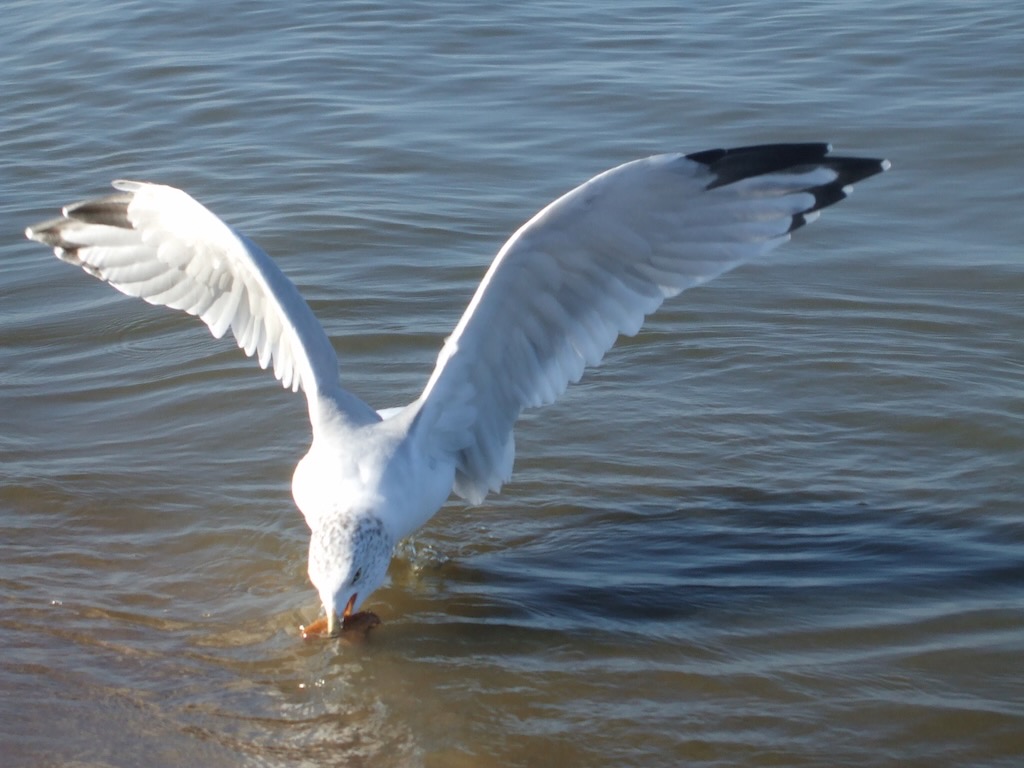
the gull above is diving into lake michigan to gather up a chunk of bread one of us has tossed into the water, a symbolic casting of our sins into the lake in an act of absolution.

the line, “prayer is our attachment to the utmost,” is from rabbi abraham joshua heschel, and the full line is: “unless we aspire to the utmost, we shrink to inferiority. prayer is our attachment to the utmost.”

the roots are stirring. . .

sometimes, especially when staring into a tableau best described as blkkh, a monochrome of melted soot + oozy mud, we little people need reminding that there is stirring afoot. underground, that is. deep in this holy earth, particles expand. and multiply. and do those “rooty” things. they set down shoots. reach into the hollows to construct the nutrient highways that, come spring, will rise in daffodil and snowdrop. will punctuate the earthscape in royal-purple crocus and knock-your-socks off cobalt blue.

since ancient times, spurred by the collected wisdoms of those who’ve found themselves at this point in the revolution of the year, at the very midpoint between winter’s darkest longest night — the solstice — and springtime’s resuscitating equinox, the moment when the shadow and the sunlight fall in equal measure, this moment has been marked in ways that promised hope. ancient peoples, too, must have known the dregs of winter trodding on too long, or at least the ancients of the north.

those ancient peoples dubbed this a cross-quarter day, the precise mid-score between the changing of the seasons. and those ancient peoples, ones whose livings came not from sitting in front of keyboard pounding keys, but rather who picked up staff or rod, and herded flocks or fished the seas or tilled the earth, they turned to what they knew best to look for hopeful signs: earth and sea and sky. therein was the stirring from which they drew their wisdoms and their post-it notes from God.

in the case of this cross-quarter day, the one that falls as winter wanes, when springtime hasn’t yet picked up its paces, there might well have been some undercurrent of we-are-running-out-of-steam-here. and so perhaps one wintry day, one wise (and desperate) someone dropped to her knees, pawed the crusty earth just down deep enough to catch a glimpse of tangled rootlets reaching down, down, down. she might have whooped in exclamation, let her fellow desperados know that, lo and behold, all was not lost. the earth had not gone thoroughly to sleep. deep down where earth keeps all its secrets, there was promise stirring.

and so, the peoples celebrated. the peoples, being wise long before we were specks of anyone’s imagination, might have extracted their own wisdoms from this botanic wonder. they might have realized that if the wondrous underbellies of the bulbs were hard at work in ways unseen, we too might seek analogous metaphor in the vicinity of our psyche and our souls. we too might figure out that now, as winter’s grip begins to loosen, our own deep-down growing stirs. even when we think it not. (and we’d be wise, methinks, to bolster that stirring with at least a dab of concentrated meditations, sifting through the questions that might propel our year ahead, steering our own soulful energies to those one or two roots we decide most warrant our attention.)

the ancient israelites (and jews today) called it tu b’shevat, the new year of the trees, so marked by the first blossoming of the almond trees. the celts called it imbolc, a word that means “in the belly,” when the earth’s belly begins its thaw and the seeds below begin their stirring. (the word imbolc comes from Old Irish, and was reference to the ewes beginning to lactate as birthing season comes and the field grasses start to grow.)

indeed, the earth is quickening, the obstetric name for that first sacred stirring from within, when that tiny tiny human limb first garners enough muscular oomph to kick the wall of mama’s womb. i remember sensing it, unsure if it was just a tummy rumble, or the first fetal morse code that someone in there was really in there. in due time, the kicks make clear that it’s no hiccup of the fetal variety.

jews gather for the tu b’shevat seder, a feast of seven fruits and four glasses of wine, beginning with one of deepest red (winter at its fullest) and each successive glass a paler pink till springtime’s wine, all white. the celts, being earthly people, turned to fire and water: the women of the home slept beside the hearth on imbolc’s eve (jan. 31), and checked in the morning for any markings in the ash signifying that saint brigid (a fiery spirit) had wafted by in the night, spreading her imbolc blessings. they headed for the hills, too, and lit bonfires atop the crests, then spent the night leaping over the flames. more docile celts might have settled for kindling a few wicks around the house. but every peoples has its wild ones. and if fire wasn’t your thing, you might wander to the nearest sacred well, and take a dip for purification purposes.

i might let the candles burn today, or perhaps i’ll take a sudsy bath, as i think deep and hard of how i intend to bring my little flickering of light into this world that grows dark and darker by the day….

and on that note i bring you this emboldenment that my blessed firstborn sent along the other day, quoting from his favorite of thomas merton’s writings, raids on the unspeakable.

Be human in this most inhuman of ages; guard the image of man for it is the image of God. You agree? Good. Then go with my blessing. But I warn you, do not expect to make many friends…

Thomas Merton

what might you do today to mark the incoming of light, minute by minute, day by day, till the full birthing comes?

an old maple table and the command to build a “little sanctuary”: a holiness story

our mikdash m’at

“over 2,000 years ago,” our rabbi began last night, “our people mourned the destruction of the temple.” the temple, of course, had been the place of worship, of prayer and sacrifice. it was the holy place of the jews. and in the year 70 of the common era, it was sacked by the romans. destroyed to dust and ashes.

but “our people” are resilient people. they are the people of the diaspora. they know what it is to wander, homeless, in the desert. to be strangers in a strange land. they know — deep in the marrow of their bones — the history of exile, the history of holocaust. of nations turning their backs on a holy people.

our rabbi went on: she taught that in the wake of mourning their holy temple’s loss, the rabbis of the time urged the people to build mikdash m’at — little sanctuaries — in their homes, to bring their prayers into where they lived and ate and drank and bathed and slept. and so, all these millennia later, when once again we have been banished — by an invisible virus — from our temples — and our churches, and our mosques, and all our holy shrines — my rabbi was urging us, on the cusp of the holy days of awe, to build mikdash m’at in our circa 2020 houses.

***

mikdash m’at
From the Talmud, Megillah 29a: The verse states: “Yet I have been to them as a little sanctuary in the countries where they have come” (Ezekiel 11:16). Rabbi Yitzḥak said: This is referring to the synagogues and study halls in Babylonia. And Rabbi Elazar said: This is referring to the house of our master, i.e., Rav, in Babylonia, from which Torah issues forth to the entire world.

מְעַט (n-m) heb

  1. littleness, few, a little, fewness
    1. little, small, littleness, fewness, too little, yet a little
    2. like a little, within a little, almost, just, hardly, shortly, little worth

***

i’d signed up for our synagogue’s workshop on creating a sanctuary in our homes for the high holidays because i am always up for carving out a sacred space. and i listened closely to the instruction: pick your prayer space, a place where you might feel elevated, outside the ordinary, at one with the sacred. a sanctuary, our rabbi explained, is a “space that’s holy or set apart.” she went on to define the ways we might fulfill God’s command, “make for me a sanctuary that I can dwell in.”

and so, once i’d sauntered back to the kitchen, as i was chopping eggplant and leaves of basil, dousing grilled peppers in balsamic glaze, i began to babble about this holy assignment. i recounted the instruction to the tall, bespectacled one with whom i share this creaky old house. i told him — in that way an eager student does — that we must pick a holy space. because, of course, the rabbi said so. and then i asked him where that might be. where would be our sanctuary for the holy days of awe? where might be the place where God — and we — could dwell?

and in that knowing way of his, in that quiet, certain, deeply-rooted-without-a-drop-of-drama-ever way of his, he lifted his finger toward the old maple kitchen table tucked in the corner, and he nodded. case closed.

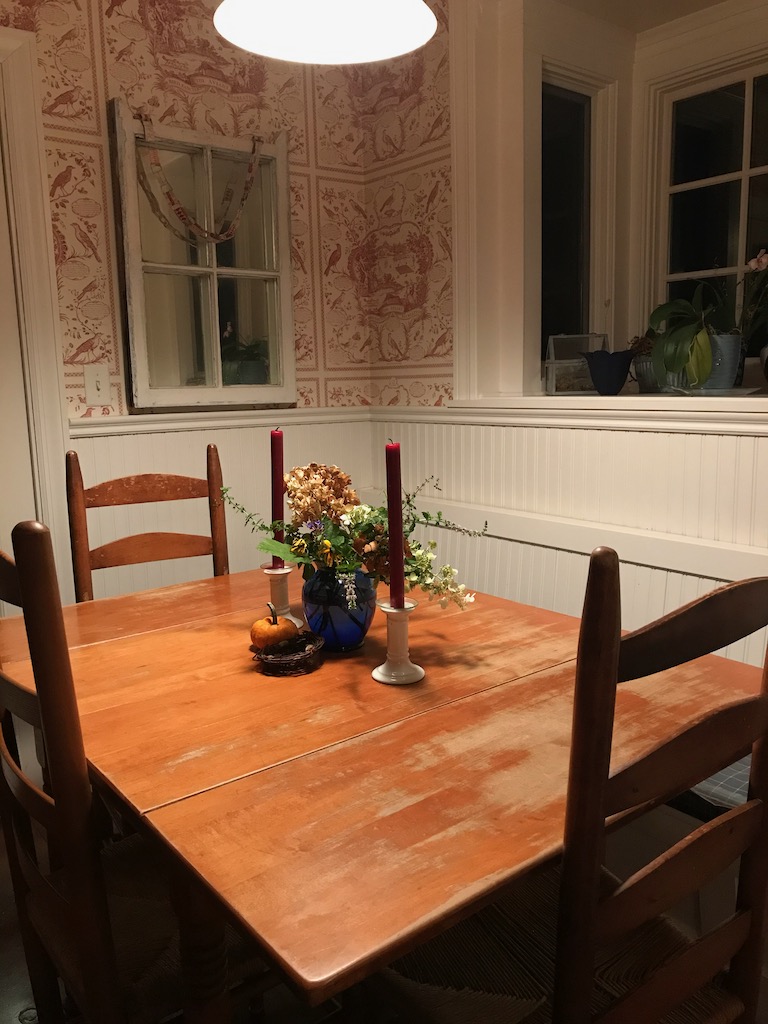
there was no holier place in our house, of course, than the nearly century-old, hand-me-down maple table, the table etched with imprints of penmanship from ages-ago schoolwork, the table scrubbed bare in patches of whatever stain was long ago applied by some long-ago carpenter. the table where, since moving here almost 18 years ago, umpteen thousand prayers have been unspooled, night after night, morning after morning, midday after midday. countless stories — funny ones, hold-your-breath ones, rip-your-heart-out ones — have let rip here; tears, too. deliberations have been parsed here; life courses, corrected. midnight bowls of cereal have been gobbled down, and blazing birthday cakes presented on pedestals. books have been written here, and law school papers, too. we have mourned and rejoiced here. laughed and sometimes stormed away.

as poet laureate joy harjo so gloriously put it in her kitchen-table poem, “perhaps the world ends here,” “this table has been a house in the rain, an umbrella in the sun.”

and it will be for us, in the unbroken days of awe ahead — the blessed new year, rosh hashanah, and the holiest of holy, the day of atonement, yom kippur — my bespectacled beloved and i will wrap ourselves in our prayer shawls and our prayers, we will lift ourselves out of the ordinary, and reach for the star-stitched heavens, we will hunker down at the years-worn, scruffed-up slab of old maple tree, and we will aim to dwell with the Almighty.

as it is commanded.

where would be your holy place, where would you build your little sanctuary, your mikdash m’at?

anointing the hours

except for the centenarians among us, this is our first go-around with pandemics. and so, uncharted as it all is, little should surprise us. i stand somewhat surprised, though, that somehow — in the depths and folds of these blurry hours, where day upon day feels indistinct, where were it not for the winding of clocks on wednesdays, the old-lady shop on thursdays, the watering of plants on saturdays, i might never know what day is unfolding around me  — i seem to have tumbled into an ancient, ancient practice. one rooted in the quiet turning of pages of glorious books. one rooted in prayer, in the sanctification of time, the anointing of hours.

it must be the little old monk in me.

i am utterly transfixed by the notion of the liturgy of the hours, the divine office (opus dei — the work of God), lauds, vespers, compline. morning prayer now begins my every day. morning prayer with candle burning beside me, casting its flickering light on skin-thin pages that turn with a crinkle as i slide the ribbons from section to section: invitatory, psalm, antiphon, collect, confession, thanksgiving.

the lexicon is almost as old as time. the notion of fixed-hour prayer, paying keen attention to the seasons of the day — the shifting of light and shadow — is a practice shared by all the great religions: buddhism, hinduism, islam, judaism, christianity.

the early christians borrowed it, of course, from the jews, who were commanded to pray the holiest prayer, the sh’ma, upon rising and retiring, and who stitched 100 blessings into the arc of the day, lifting the most quotidian of acts — washing hands, hearing thunder, beholding the bloom of the almond tree — into the realm of the holy. the psalms, written by the most brilliant hebrew poets, were read by jews — including jesus and his earliest disciples –as “encounters with God, as stimulating and nourishing a spiritual mystery,” according to william storey, a liturgical historian.

by the fourth century, in the early roman empire, bishops instituted morning and evening prayer in the early cathedrals. in the sixth century, along came st. benedict who wrote down “the rule,” and with it the trellis of prayer that infused the monastery, calling the monks to arise in the darkness, to walk under the cloak of stars to the oratory where the night vigil was sung, and through the day, when the great bell was rung, to drop their work in mid-act — be it the stirring of soup, or the tending of bees — and encounter the angels in the sung prayer of the psalms. (i love that benedict refers to any chiming clock as a “portable monastery,” and instructs that “every chiming hour is a reminder we stand in God’s presence.” i will now consider myself to be “winding the monastery” every wednesday and sunday morning.)

all these centuries later, little old me picked up on the notion about six weeks ago. (no one ever pinned me precocious.)

what i know is this: tiptoeing down the stairs in the dark, hoisting my 2,974-page leather-bound tome, striking a match, kindling a wick, bowing my head, breathing in silence, it grounds me, and infuses my day. even my dreams, some nights.

reciting the words, inscribed millennia ago, whispered by generations before me, from all corners of this wobbling globe, beginning with a daily confession of sins, bends me into a posture of humility that seems so necessary — so countercultural — in this awful, awful age of much too much bombast. i’m enchanted. i’m sometimes disturbed (the god of biblical vengeance is not one i know). i’m always, always quieted. set straight for the day. beginning my day in the recitations launches me into the holy work st. paul instructed: pray ceaselessly. make the work of your day, the quiet of your day, make it all living breathing prayer.

i’m not alone in my preoccupation. rilke and ts eliot, hildegard of bingen and kathleen norris, certainly thomas merton, all were drawn to the undulations of stillness and prayer.

brother david steindl-rast, in his glorious little book, music of silence, writes that monastic prayer is a tradition “that regards each hour of the day and night as having its own distinct message for us.” he implores: “make everything we do prayer.” hour by hour, from night watch’s invitation to “trust in the darkness,” to laud’s morning question — “whom can i make a little happier” in this gift of a new-born day? — brother david draws us into the certain knowing that hour upon hour begs our attention, invites sharper focus on divine intention.

it’s all the sacred practice of paying attention. beholding the beauty, the blessing of each anointed minute and hour. in the same way i’m gobsmacked by the shifting of seasons across the year, i am rapt by the seasons of light and shadow in a day, the invitation to be immersed in each hour’s offering.

i turn to that brilliant radiant rabbi whom i revere, abraham joshua heschl, for one last illumination here, one to carry through this whole blessed day:

he who has realized that the sun and stars and soul do not ramble in a vacuum will keep his heart in readiness for the hour when the world is entranced. 

for things are not mute:

the stillness is full of demands, awaiting a soul to breathe in the mystery that all things exhale in their craving for communion.

out of the world comes the behest to instill into the air a rapturous song for God…

a few of the books i’ve been burrowing into, include these: 

  • a beautiful treasure of a book: Seven Sacred Pauses: Living Mindfully Through the Hours of the Day by Macrina Wiederkehr. (brilliantly recommended by jackie, a dear friend of the chair)
  • Rainer Maria Rilke’s Book of Hours: Love Poems to God
  • Thomas Merton: A Book of Hours…..
  • David Steindl-Rast: Music of Silence

and, if you’d like to poke around online, and hear magnificent gregorian chant (a meditation for another day) try Brother David Steindl-Rast’s Angels of the Hour 

how do you anoint the hours of your day?

holy week, promised land, and the spiritual practice of making do…

“why is this night different from all other nights?”

year after year for all the years we’ve been circling ’round tables when the paschal moon is at its plumpest and pinkest, telling and retelling the story of exodus — of plagues and passover and a promised land just out of reach — that question, the first of the four questions traditionally asked by the youngest, sharpens the focus on the holy act of separating time. setting aside particular hours, according to particular rising and setting of the moon in the heavens, lifting those hours out of the ordinary, sanctifying. making holy. erecting cathedrals of time, in the words of abraham joshua heschel, the late great rabbi and thinker, who wrote:

Judaism is a religion of time aiming at the sanctification of time. Unlike the space-minded man to whom time is unvaried, iterative, homogeneous, to whom all hours are alike, quality-less, empty shells, the Bible senses the diversified character of time. There are no two hours alike. Every hour is unique and the only one given at the moment, exclusive and endlessly precious.

Judaism teaches us to be attached to holiness in time, to be attached to sacred events, to learn how to consecrate sanctuaries that emerge from the magnificent stream of a year. The Sabbaths are our great cathedrals; and our Holy of Holies is a shrine that neither the Romans nor the Germans were able to burn; a shrine that even apostasy cannot easily obliterate.

this year, the question — why this night? — carried particular resonance. and its sister question, why is this week different from all other weeks, begins to burrow into the holiest questions quivering just beneath the surface of all this 20-second hand washing, and bleach-and-water spritzing and tying of masks round our smiles.

in a week woven with tradition — with particular prayers in particular places, particular recipes, particular gatherings year after year after year — it’s all broken open. it’s all in shards and pieces we assemble and reassemble as best we can.

i think here of the japanese art of kintsugi, beholding the beauty in the brokenness, not occluding or hiding the cracks, but filling them in with rivers of shimmering radiant metals, gold or silver or platinum. deeply understanding the infinite wisdom of rumi, the sufi mystic: “the wound is the place where the Light enters you.” or the resounding redemptive truth of hemingway’s glorious line from a farewell to arms“the world breaks everyone and afterward many are strong in the broken places.”

and in this old house where we weave passover and holy week, where the retelling of the parting of the sea, the fleeing from evil pharaoh, the pestilence and boils and locust and darkness, the slaying of the firstborn (the litany of plagues that visited upon egypt) interlaces with the stories of the last supper, the betrayal of judas, the flogging and crowning with thorns, the crucifixion, i found salvation in the spiritual practice of making do.

and there, in the straining of imagination, in the redefining and refocusing on the essence at the root of each strand of tradition, in scouring the pantry, in testing the powers of my own ingenuity, i began to see in sharp focus the extraordinary blessing in reinvention, in improvisation, in the promised land just beyond my reach. in the imperative of bypassing any and all shortcuts. working just a little bit harder. discovering joy at each tiny triumph.

take the chicken marbella.

IMG_1425over the decades since the silver palate cookbook was first published in 1979, and over the decades at the passover seder where i’ve marked the first night of prayer for 36 years, that glorious rendition of chicken and olives and prunes has become synonymous with the jewish rite of spring. add to that the fact that my home-bound freshman in college happens to love it, practically licks the plate of it. (and these days — passover or not — i’ll climb any mountain to bring him one iota of everyday ordinary un-quarantined joy.)

IMG_1432i’d decided a week ago that, come heck or high water (an apt expression in the season of red sea crossing), i was going to muster up a pan full of that vernal succulence. eyeing the few parts of chicken in this old house, i tucked away a package of breasts at the back of the freezer, knowing i might not fetch another till this pandemic is ended. i happened to find just enough dried prunes in the pantry to realize i was halfway there. olive oil, oregano and garlic, i scrounged up with little worry. brown sugar, ditto. white wine i found in the dark and dingy corner of the basement. it was the spanish olives that presented the hurdle. so i made do: i found a few lonely olives, black ones not green, at the back of the fridge. and i stirred it all up like nobody’s business, rejoicing all along the way that i’d found a way — through scrounging + improv — toward chicken marbella.
next up was the seder plate: where in the world does one look for a roasted shank bone in the depths of pandemic? and was i really going to sacrifice one of the six lowly eggs in the fridge for a ceremonial platter of symbols? i was not. so off to the cupboard i trotted, reached for my half-dehydrated markers and scissors. grabbed a sheet of printer paper, and voila, shank bone, egg, and — the hardest procurement of the week — one square of matzo, all kosher for passover. haroset — the apple, walnut, cinnamon and wine meant to remind of the mortar used by the slaves who built pharaoh’s pyramids — that came courtesy of the many-years-old bottle of manischewitz concord grape wine stored in that same dingy corner of the basement, and a stash of walnuts left over from christmas.

but, when we sat down to our laptop, dialed into our zeder (seder by ZOOM, the cyber salvation of the red-ringed siege), we had ourselves a proper seder table, from marbella to matzo, the ingenuity way.

all that making do, all that finding my way — deciding what’s worth the effort, what doesn’t matter — it’s becoming a meditation in mindful distilling. take nothing for granted. turn in to your own toolbox of tricks. never mind the easy way. do away with the unnecessary.

have you noticed that barely-enough makes for extraordinary? have you sensed the keener attention you pay when so little is taken for granted? when i sliced into a ripening pineapple the other morning, and discovered it was perfectly golden and sweet, not hard and pale yellow as it sometimes can be, i felt a sigh of pure joy riveting through me. you would have thought i was an arctic explorer staking my flag in the pole, so triumphant did i feel at suddenly beholding my cache of pineapple perfection. when’s the last time you remembered for days how sweet your pineapple was?

and so it is in the time of corona. when a trip to the grocery store — or a ride on the el, or rubbing elbows with the stranger wedged in beside you at the movies or museum or ballpark — without fear of catching a potentially fatal infection might never again be taken for granted.

we are all, collectively, living and breathing improvisation. expanding the boundaries of what we thought we could do (heck, i’m now very best friends with the sourdough starter bubbling away at the back of my fridge, and i’m zooming into book groups all over the globe, chanting with monks hundreds of miles away). we are looking out for each other in ways we might not have before (sending meals to ER departments, sharing seeds with the neighbor next door).

the brakes have been halted on this mad-paced world. and yes, it’s filled with heartbreak upon heartbreak. jobs are being cut (i lost one of mine). paychecks are being slashed (happened here, too). magnificent glorious souls are breathing their very last breath afraid and alone (dear God, praise the nurses and doctors who step into those holiest of shoes). the obituaries (some of them being written in the room just above) will make you weep (and they do, day after day).

but inside of all the uncharted fear, and the bureaucratic ineptitude that might make you furious, this holiest week is upon us, and it’s teaching us lessons we might never have otherwise learned.

in the nooks and the folds of making-do, i’m paying closest attention to those deepest essentials. and therein lies the holy way home.

what making-do moments have you encountered this week? and what lessons spilled forth?

a housekeeping note: you might have noticed that all week long, in the comments of each week’s post, i’ve been tucking away especially succulent morsels i happen to come across in my cyber adventures. as we’ve long considered this our shared kitchen table, it seems more than apt to leave little bits of deliciousness all week long. so be sure to click back, and scroll through the comments, where i’ve left a bevy of links and snippets of poetry. 

before i go, here’s one i clipped from a letter the great george saunders wrote to all the fledgling writers at kenyon college whose spring quarter was snatched away. he wrote a beautiful long letter, but this one paragraph i saved just for you:

from George Saunders to Kenyon writers:

There’s a beautiful story about the Russian poet Anna Akhmatova. Her husband was shot and her son arrested during the Stalinist purges. One day she was standing outside the prison with hundreds of other women in similar situations. It’s Russian-cold and they have to go there every day, wait for hours in this big open yard, then get the answer that, today and every day, there will be no news. But every day they keep coming back. A woman, recognizing her as the famous poet, says, “Poet, can you write this?” And Akhmatova thinks about it a second and goes: “Yes.”

may we all find poetry, even amid the pandemic….

IMG_1429

and now i enter deep into my holiest hours….the triduum of holy week….

(p.s. that’s our zoom seder screen shot above, same characters year after year after year. beloved mary schmich, the brilliant pulitzer-prize-winning chicago tribune columnist, wrote about it….here.)

insert (relief) here

IMG_1280

amid a long stretch of blur, amid headlines of “bloodbaths” at the newspaper that basically birthed the whole of this family, amid a washington moment that left me wanting for a lysol bath (in the infamous line my mother once uttered upon a trip home from a las vegas convention, the woes of the ad exec’s dutiful wife), amid deadlines that have me typing from darkness to darkness, the tall bespectacled fellow with whom i reside (aka my lawful wedded husband) casually glanced out at the snows as i motored him off to yesterday’s train. “it’s my half-birthday today,” he informed, as if that alone might be enough to save the day.

and it was, and it did, in its infinitesimal way.

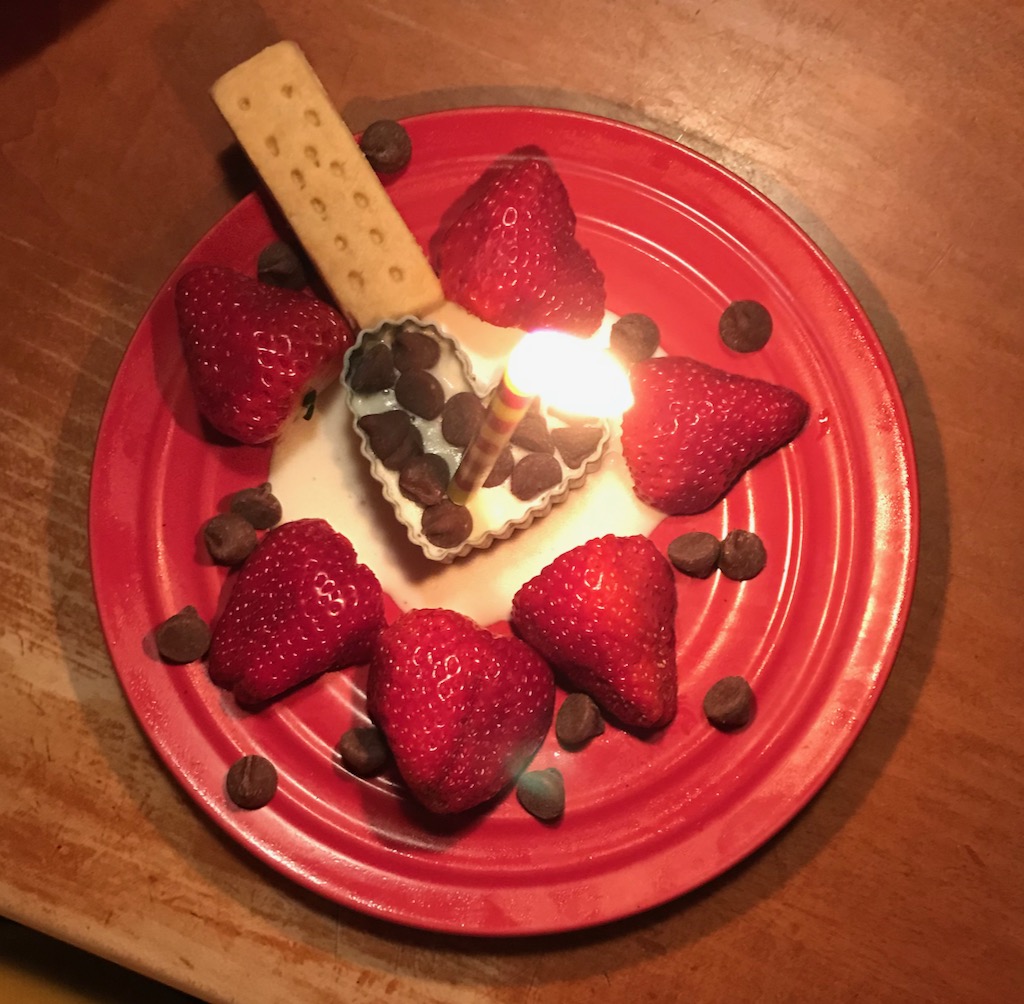
the moment, which i latched onto, which i considered as i went about the eventual business of melting ice cream, hauling out a heart-shaped cookie cutter, as i sprinkled ghirardelli chocolatey chips–plonk, plonk, plonk on the plate–sliced strawberries in quarters and halves, was not unlike a wisp of a comma in a long, long paragraph of words: easily missed, but emphatically necessary (ask any third-grade teacher of grammar).

the sense indecipherable without it.

necessary, because in the seasons of life, some feel impossibly uphill; others, more feet-off-the-pedals-whiz-down-the-lane hardly an effort at all. necessary, because the human species is hard-wired for a break in the weather, a break in the onslaught. (i often wonder if that’s why God invented seasons, and the turnings therein.) and sometimes we have to decidedly, determinedly, do that–engineer the breaks–all by ourselves. it’s our job. we have to insert (joy) here. insert (relief) there. insert (closest thing to whimsy) precisely here.

my first wave of response, loosely holding the wheel, craning my neck to get a look at the half-birthday boy’s face, was to utterly melt. to be charmed that the long-standing practice in this old house of making a fuss over fractional birthdays (as recently as noting someone’s 26-1/2) had rubbed off on the tall one. he’d never before in all these years mentioned his half birthday, though it comes a mere two days before the one we’ve been noting for the last 18 years. (don’t think i didn’t try to mail half a birthday cake to faraway college…)

my second wave of response, the one that’s stuck with me all day and over the night, is the not-so-big thought that sometimes it’s up to us to take the reins of our joys, and our whimsies, and push away the worries, the angst, the unrelenting questions, for enough of a pause to let in a dribble of light.

otherwise, we go dark. endlessly dark.

IMG_1275and there’s something particularly joyful about making your joys all by yourself. home-spun joy. joy barely noticed. joy that comes from scrounging the pantry (too many deadlines to rush to the grocery). from reaching into the freezer and thinking ahead to melt the tahitian-vanilla-bean ice cream (okay, so i had to take two passes at that part when i forgot i was in the middle of melting and found myself with a pint of oozy liquid vanilla). from reaching into the basket of heart-shaped cookie cutters, pulling out just the right one. from turning the lights out, striking a match, ferrying a heart + berries + chocolatey chips and flickering candle over to the half-birthday boy.


it was the tiniest wisp of a moment–surely a comma in a long string of words (try reading without that ink swirl on the page we know as the comma). but it ushered in an exclamation mark of momentary joy. and that, at the midpoint of a year in the life of someone you love, is perfectly, positively necessary. and good.

IMG_1283

how might you insert (joy/relief/wonder) here, today or any tomorrow?

stockpiling

IMG_0369

it felt almost like instinct. as the weeks narrowed to days narrowed to hours, i couldn’t keep from stockpiling. soon as the boy — now sleeping just overhead, in the bed by the bend in the stairs — soon as the boy told me he’d found a ride after all, was coming home for a three-day break — fall break, officially — my fill-the-larder instincts kicked in.

lavish him in all the tastes and smells and textures and offerings he could possibly wish for. that seemed to be the propelling mission.

so i stockpiled. stockpiled pumpkin pie from the farmer’s market, grabbed a loaf of banana bread while i was at it. stockpiled cider and raspberry rugelah. ordered up a chicken pot pie from a mama who makes it delicious.

the sheets on his bed hadn’t been touched since the day after he left the room empty as empty could be, the day i scrubbed every last inch of that room, as if preserving something ineffable. the room, more relic than place to hang out these days, barely needed a flick of my wrist. but i vacuumed anyway.

the prodigal papa back in the bible, he wasn’t the only one who knows of the fatted calf. i too might have tossed a beast onto a pyre if chicken pot pie hadn’t been to his liking, the kid who rode six swift hours in the back of a minivan, the kid who all but tumbled onto the street once the four wheels pulled to a stop there at the curb.

we squeezed so tight it’s a miracle all my ribs are still in one piece. i wiped away tears (of course) and then we loped in the house, past the welcome home sign that only made him laugh, because it’s a truth in this house that you can hardly take a trip to the grocery store without finding a welcome home sign upon your return.

inside, once he kicked off his shoes, he too seemed to kick into some instinctual and ancient reflex: he walked room to room to room to see if anything had changed, to make sure all was as he’d left it. then, and only then, did he settle into his most native rite of settling in (be he gone for merely an hour or long weeks on end) as he began to circle the kitchen island in the way he (and his brother; it must be genetic) forever have done, ambulation propelling cognition it seems. story spilling upon story, each one told to the beat of his footfall.

he punctuated his stories with poking around the pantry, inspecting the fridge, and, after all the wind-up, picking a plain old box of make-your-own mac-n-cheese, the kind he’s loved since he was three. and so his first feast at home after seven and a half weeks wasn’t the hoosier mama chicken pot pie, wasn’t the homemade cranberry-studded applesauce, wasn’t the farmer-baked banana bread or the kosher-deli raspberry rugelah. it was the starchy pile of pasta shells swirled with powdery cheese turned into goop. he nearly licked the pot, my boy who’s grown three-quarters of an inch since last he was home (we pulled out the tape measure and measured).

all that spooning into his mouth must have left him exhausted, for the next stop on the homecoming tour was a flop backward onto his bed, and a sigh of pure joy like nothing i’ve heard in a very long while. he mumbled something about how glorious it was to sleep on a mattress that cared for a spine and all its spiky little vertebrae. but then he was off in dreamland, not to be heard from for hours and hours.

it didn’t take me long to realize there’s something (very much something) of the human heart involved in all the stockpiling. it’s almost as if in shopping and shlepping and stocking the shelves (and the fridge and the countertop and the blue willow plate under the cookie dome) we’re giving the blood-pumping muscle a boost. almost as if all the comestibles are edible poetry, are the extensions of our vocabulary. as if they pick up where words cannot go. as if they’ll reach deep into nooks and crannies, as if they’ll saturate every last cell that just might need to be bathed in the notion that someone loves you through and through and through. as if we can’t go the distance all on our own.

it’s almost as if the stockpiling is squeezing every last drop of that thing we call love out of the tired old muscle — the magnificent vessel — that is the human heart. that storehouse deep inside our ribs where all the love is churned, is harbored, is pumped into the ether. almost like it’s a little bitty factory, a production line of loving, that never ever dies. not even when we do, i’m utterly certain.

it all made me wonder if this might be the rhythm from here on in, in these days when the boys i love most dearly are far far from home, and their visits grow less and less frequent: will i learn to stockpile, to fill the larder with all the love i used to lavish day upon day, hour after hour, the barely-noticeable ministrations of the heart — the kiss on the forehead while they’re sleeping, the whiff of their hair while setting a plate at their place at the old maple table, even the occasional deep inhale and sigh when tossing piles of muddy sweaty clothes into the wash? will i store it all up, every last drop of it, and save it for when they come home, when it will all but ooze out of me, when i all but plant myself at the door of his sleeping room, just to watch the rise and fall of his breathing? will i ever not miss the days when i used to wear them, literally strapped into bundles across my chest? the days when their itty-bitty plump-dimpled hands were always reaching up for a lift or a hug or a squeeze round the neck? all our life long, the gestures of love shift and evolve. and while the deep caverns of the mind grow more and more nuanced and brilliant, sometimes it’s the old ways, the skin-to-skin entanglements of mother and child that i miss, that can’t be replaced, can’t be once again, all over again. IMG_0365

so we stockpile. we store it all up, and we ooze it all out for those short few hours and days when they’re close enough that we can hear their breathing, bury our nose in their necks. one deep inhale, one that’s going to need to last for weeks or months on end.

***

it’s been a busy week around here: my first book review for Orion Magazine is online. twas of a beautiful, beautiful memoir, The Salt Path, about an epic journey propelled by unlikely homelessness and a dire diagnosis, one that leads to epiphany, and you can find the review here.

but the bigger news of the week is that the book i’ve been working on for months (years, actually) is officially published and stocked on the amazon bookshelves. it’s my friend mary ellen’s book, “On the Wings of the Hummingbird: A Chronicle of Joy, Grief, and Gratitude,” a collection of her beautiful breathtaking essays. here’s what i wrote when i posted something of a birthing announcement on facebook yesterday:

When Mary Ellen started her blog, “On the Wings of the Hummingbird,” on March 2, 2012, she harbored a flickering hope that someday it might lead to a book. She never dreamed she would die just four years and 11 days after “Hummingbird” first took flight. Yet her dream of a book never died. And so, after a few years of culling and sorting and weaving her essays into a whole (a labor of love that became mine when I found out a month after her death that in her will she’d appointed me “custodian of her creative work”), it is with pure joy that Mary Ellen’s family and I announce the birth of her book, “On the Wings of the Hummingbird: A Chronicle of Joy, Grief, and Gratitude.” It’s a distillation of Mary Ellen’s profound wisdom, her unending gratitude, and her unrelenting search for and discovery of joys even amid the shadow of grief and fear as she traversed the uncharted landscape she’d never imagined. It’s slim and it’s elegant and it shimmers with a beauty that was hers alone. Her words, her urgent pleadings, are sure to etch deeply into your heart. It’s available in paperback and e-book, and you’ll find it on Amazon.

two versions of covers, one for the e-book, left, and one for the paperback, right. i was constrained by the strictures of the platform, but tried to make the whole of the book as beautiful as mary ellen’s indelible words…..

how do you stockpile — and lavish — the love in your life?

prayer for comings and goings

gyroscope

gy·ro·scope  /’jira-skop/  n. a device used to provide stability or maintain a fixed direction, consisting of a wheel or disk spinning rapidly about an axis that is free to alter in direction. a device for measuring or maintaining orientation and angular velocity. it is a spinning wheel or disc in which the axis of rotation is free to assume any orientation by itself.

“device for maintaining orientation.”

sometimes i think my job is to be the human gyroscope. to keep it all straight. to keep all afloat. at speeds all their own. above all: to maintain orientation.

sometimes, even my own.

today is one of those days when the gyroscope in me is working overtime. before i was even awake i was tracing the map in my head of where people i love — children i love — are scattering today. one is climbing into a van with a van full of friends and a summer’s worth of clothes and rolling from new haven, to new york, to washington, to the rolling hills of virginia, then back to d.c. for a long, hard summer playing like a tv lawyer.

yet another of my kids (there are only two, lest i make it sound as if there are dozens and dozens) is marching into his last friday of high school. then he and the little flock i’ve come to love (as if my own), they are scattering like pool balls all across the country: wisconsin, new york, indiana, michigan, ohio, and, yes, illinois. (how apt that the heartland is draped in these particular boys, a heart-filled flock if ever there was.)

years back, when my firstborn headed off to massachusetts, and i stayed behind in sweet chicago, i got my first taste of this re-mapping that mamas do. i imprinted the hills of western massachusetts, pioneer valley, into my imagination. i knew the streets and inclines he loped day after day. and as i’d talk to him, the pictures in my head traveled along. on days when i wasn’t talking to him, i imagined where he trekked. you learn, when you’re someone who loves faraway, how to plunk yourself far far from where you dwell. the size of the space inside your head, it reaches as far as it needs to stretch. adds a live pulsing dot onto the map of the globe. you find yourself scanning the news for hot spots near any one of your very own dots. but mostly, you unreel a whole new reel of picture shows, one for each faraway someone you love.

i woke up this morning wanting more than anything to do like i’d always done when they were little, and we were about to go on a road trip. we’d pile into the wagon, check all the seatbelts, shuffle the water jug away from their feet, be sure the snack bag was reachable. then, before i shifted the car into reverse, we all paused, bowed our heads and muttered the mixed-up prayer that was our own: “holy garden angels protect us.” (one of us once dropped a syllable in guardian and it’s stuck ever since.)

this morning my prayer would be a bit more complex. it’s been nuanced over the years, textured with shadow, with depth and, yes, patches of darkness. the pleadings are at once as unfettered as ever — please let us land safe and whole wherever it is we’ve set out to go — and far more intricate, taking into account the particular inclines and tight mountain passages that come when the journeys are of the real-world, unchaperoned, higher-altitude ilk.

my instinct — no matter how far from home the journey begins — is always to reach toward the ones i so love, spread my arms and my safe-keeping prayers across and around them. i picture the prayer shawl, the one we draped over their shoulders the day they first chanted the Torah, the one we’ve pulled off the shelf for each of their blessings. all these years and journeys later, it’s the sacred cloth i yearn to lay on their shoulders, to wrap round their backs, as they bow their sweet heads, and my job — my holiest job — is to anoint them with my prayers. and my love.

dear holy God, God of adventure and challenge, God of steep inclines and precipitous drops, dear God, steady their footfall. soften the blows. dial up the everyday triumphs and occasional joys. most of all, bring them home, safe and sound and whole. and, yes, steady me, as i try my hardest to maintain orientation. no matter what comes.

amen. and with love.

what’s your prayer for comings and goings? 

taking up the challah challenge

img_1213

years and years ago, when my kitchen confidence was far wobblier than it is now, i tried my hand at friday challah baking. i wound up with paddles of braided bread that appeared amphibian and reptilian. there were a couple weeks of challah masquerading as crocodile. challah as lobster, with vengeful claws reaching across the table. my challahs looked anything but edible. my challahs begged for names. and cages.

so i surrendered, bought my weekly challah at the grocery store. but, because it comes only in sizes fit for half a synagogue, we almost always have leftover loaves hardening in the corner. i have a slew of ways to use it: i’ve frozen so many picked-over loaves a peek in our freezer might make you think we eat one and only one foodstuff — challah in varying stages of ice age; i’ve mastered bread pudding and french toast (can do both with my eyes closed); we’ve sliced it for a million saturday PB&Js; and of course our squirrels get a steady diet (i wouldn’t be surprised if our squirrels know the hamotzi, the challah blessing, by now).

and every friday night i’ve sat across the table from that oversized soul-less loaf, and dared myself to take up the challah challenge: “take a deep breath, and a humble packet of baker’s yeast, and see if you can once again find it in yourself to pull two golden braids from the oven, adorn your friday night shabbat table with bread you’ve kneaded and blessed with silent incantations all on your own, start to finish.”

yesterday, in full trial mode, i dove in. i am here to tell you that instant yeast is nothing to be afraid of. (this declaration is nothing short of revolutionary for a girl who grew up in a house where yeast was spoken of in hushed tones, as if a living-breathing creature that might wreak uncharted havoc if not treated kindly and gently enough. and, yes, my mother baked bread often in those radical suburban ’70s, so the misappropriation of fear and loathing is all my own. she is hereby declared innocent of that particular quirk of mine. now pie crust, that’s another story….)

i turned once again to the step-by-step instructions of my challah-baking friend and long-ago ally, henry, who with his family had escaped nazi germany, and who regaled me with tales of his mama’s friday baking and her magnificent golden braided loaves back in the old country, before all was shattered. though the pages now have yellowed, i found henry’s instruction clear and encouraging as ever, as i pulled his three stapled sheets from my cookery file, and followed along, triumphant at each and every stage. because i was baking challah on a thursday, there was something of an experimental air to the whole shebang. didn’t matter if i flubbed it. didn’t matter if it never rose (though i would have felt my heart deflate right along with the lack of yeasty rise).

and i was all but jubilant when, at quarter to three, i pulled from my wobbly old oven (it gets as hot or warm as it’s inclined on any given day, paying no mind to the faded numbers on the oven dial), two sturdy loaves. two loaves studded with sesame and poppy, onion bits and garlic, too (i had bagel topping in the pantry and figured it wouldn’t hurt to sprinkle with abandon — i was later informed to ditch the bagel topping, “this isn’t a bagel, mom,” and go the purist route: sesame or poppy, not both, not ever again).

i’m hardly exaggerating to declare my two loaves adorable. (see photo above!) after admiring abundantly, the taste-testers dove in. besides the plea to ditch the bagel-y topping, there came a request to please make it “eggier.” i’ve already consulted “the bread baker’s apprentice,” written by the master of bread, peter reinhart, aka brother juniper. he’s got a roadmap riddled with eggs — two whole + two yolks, and a host of other instructions besides.

so next week it’s challah 2.0, and i’ll keep at it till i’ve mastered these doughy batons. not long ago i met a woman who bakes like a fiend and, come friday afternoons, she piles her back seat with challahs galore, and drives and delivers to a circle of loved ones numbering into the 20s. i’d like that. imagine myself, pewter hair flapping out the driver’s side window, as i steer my station wagon — aka the challah mobile — hither and yon, flinging loaves as i go.

it’s all part of a scheme to infuse more intentionality into my days. to conquer those wee quirky fears, the ones that stand in the way of the bigger more daunting ones. slay a little dragon, and perhaps you muster the muscle to take on the giants. and in the meantime it quiets my fridays, ushers in the holiness of shabbat in the hours when i’m alone. i know enough of the meditative calm that comes with kneading and waiting, waiting and punching down dough, waiting some more. to bring to the table a loaf, blessedly braided, a loaf into which i’ve infused my prayers, a loaf just the right size for the two of us who, henceforth, will be the two main players at our shabbat table, once the youngin shoves off for college. it’s holy, all right. and triumphant besides.

and it sates a hunger of the most soulful kind.


a few fun challah facts from my friend brother juniper: garnishing the loaves with seeds, either sesame or poppy, symbolizes the falling of manna from heaven, and the covering of the challah with a cloth as it’s served on shabbat represents the heavenly dew that protects the manna. how lovely is that? so lovely.

what little dragon might you already have slain, or determined to slay, in this blessed new year, a chance to rise again?

hearts opened wide…

cranberry pear

aunt brooke’s cranberry-pear relish in the making. because, why not?

it seems to come more flowingly with every passing year. that’s how it feels anyway.

this year it comes amid news that one friend i love, a friend who’s been the rock of life for countless legions for countless years, as she alone found ways to eke out hilarity despite the rules, (dressing up in yellow rubber boots and raincoats, stringing orange construction-paper duck bills across our mouths, marching clear across campus and into the college president’s office, straight past the military-grade secretary, to trick-or-treat and commandeer his afternoon, among the early antics i recall), she had a heart attack the other day. i sat here wiping away tears when i got the news. heart attacks have always held a certain fear for me, the daughter of a man felled by one at 52. my friend is 61; her heart, a prize that should not ever be attacked. (she’s home now, thank God, but feeling like she was “hit by a truck.”)

it comes as another friend sends breathtakingly beautiful spools of poetry from the brink of death — her own. which she is facing with more grace and majesty and transparency than i have ever witnessed.

it comes amid a world that convulses my heart and soul on what sometimes seems like a quarter-hourly basis. (my mother last night counseled that i should just turn off the damn TV and say a rosary with my spare time. i appreciate her instincts here, but i’m too far gone, i fear, to trade in MSNBC for a string of glory-be’s.)

when i feel the quivers coming on, when the longview across the landscape gets to be too much, i leap into something akin to being my own cinematographer, and i pull back the camera from wide lens to up close and stitch-by-stitch. it’s a lesson learned from the pantheon of saints who populate my brain cells — dorothy day, anne lamott, therese of lisieux. and a host of other holy folk who remind us that there is no more certain route to faith (just another name for knowing the Divine has brushed up beside you, swooped in and tapped you on the noggin, shown you in vivid detail that heaven’s just the other side of the filagree, in holy whisper, in flap of feathered wing, in the way the sunlight pools on crimson maple leaf).

that’s when my litany of gratitudes comes spilling out. when, in tiniest, most obscure details, i can fill up my heart with little joy upon little joy (another name for blessing).

for 12 years now, we’ve huddled here at the table, on the morning after the great day of giving thanks, and cobbled our own litanies of gratitude. we’ve counted to 100, the centenary of thanks. and dialed back to a modest couple dozen. the count, of course, is not the thing. it’s the exercise of scouring the landscape, and plucking the otherwise unnoticed, uncounted, and tallying, one by one, the plus signs that propel us through the day. there is no too-small a joy to lift us breath by breath.

it’s barely eight o’clock, and already i count these:

the twin bed and rumpled quilt mounded around the kid who yesterday morning announced, “mom, this is my last thanksgiving,” delighting in the wince that must wash across my face every time i’m caught in countdown. i am so grateful that come monday morning that bed will still be rumpled, and its primary inhabitant will be running late for the ride to school that i so willingly — if occasionally grumpily — provide, complete with hot breakfast on a plate.

the golden-filtered light streaming in the windows, washing across the treetops, because i got up an hour later than usual, and the color shifts by the minute at the dawn, luminescence seeping into daybreak’s early acts.

the fridge that’s filled so full we practically needed a bungie cord to keep the doors from bulging open. and nothing short of strategic puzzle-solving skills wedged each last leftover safely in its shelter.

the utter lack of shopping on my mind, as we buck the national over-consumptive rite of greedily gobbling up whatever is on the sales-rack shelves.

the friends i love who hold their breath for a child deep in pain. their over-capacity hearts are a marvel to behold. i watch them ride the turbulence, keep the faith, climb on airplanes and into cars, to cross the miles to be by their children’s sides, and i witness motherlove in its most defiant, magnificent, dare-to-stop-me forms. if God loves half as fiercely as these mothers love, we are all saved already. that, i promise you. if you some days despair that there’s a God who’s listening, just scan the crowd for a mother — or a father — keeping vigil in the ICU, at the rehab center, parked outside the county jail (i know all three, and the cumulative power of their love could not be measured on a richter scale); that’s what love beyond our wildest imaginations looks like. i’d posit that’s a fraction of how God loves. and how certainly God is scrunched elbow-to-elbow by our sides, even when we can’t see to the other side of the waiting room door and feel stranded all alone.

some mornings my blessing is no fancier than the feel of my old familiar coffee mug cradled in my palms. somehow the choosing of the morning’s mug has become a rite that sets the joy of the day. for at least that fleeting instant.

scanning back across the year, i think of all the what-ifs that swooped away: the mammogram that turned out clean; the kid i feared had driven in a ditch, gotten mugged, blown the deadline, missed the plane — all worries dissipated.

on and on the blessings come. if i slow down long enough, allow the quiet to seep in, and pay close attention to the fine grain of the holiest of hours: this one we’re living now.

you catch the drift, now add your own to our litany of blessings….

pear-double cranberry-apple lattice

pear-double cranberry-apple lattice pie: my first.