pull up a chair

where wisdom gathers, poetry unfolds and divine light is sparked…

Category: angels among us

the courage to come back. one last time.

i went back to my old hospital, children’s memorial in chicago, on a sunny sunday afternoon this past weekend, for what was billed as a “closing ceremony” for families who had had a child die there. the old hospital is coming down soon, and before its nine stories are crumbled to a pile of shattered bricks and twisted rebar, the hospital’s biggest hearts and best minds understood that those families needed a chance to say goodbye to a cornerstone of their life story, no matter how dark the chapter.

it was a story and a moment i had to honor. as a nurse i was there for my beloved troupe of kids, the ones who died on my watch: julie joiner, a girl i loved, a girl who had cancer in her spine, and who, lying flat in her hospital bed, once made me a papier-mache pumpkin head and painted it green. she called me her “irish pumpkin queen.” and did i mention i loved her dearly, still think of her, still remember the gift it was to be her nurse? i was there, too, for joe, and for pebbles, and for jeffery, and for denise, and even for the kids i loved whose names i don’t remember. i was there for their mothers and fathers, who allowed me to care for and to love their children, straight through to their dying breaths.

i was there as a writer, too, because over all these years i have learned that words are the finest instruments i can reach for as i carry on my nurse’s promise: to shed light where there is darkness, to hold up the human spirit, and to aim to heal through whatever form love flows. here is the story i wrote. even though it won’t run through printer’s ink in any newspaper, sharing it here is rich enough for me.

By Barbara Mahany

Most of all, it took courage.

Even before they got there, it took courage to scribble the date and the time and the event — Closing Reception for Bereaved Families — onto the calendar.

It took courage to get on the plane in New York or Arizona, or to climb in the car or the pickup truck in Iowa or Highland Park or Tinley Park, and head back to the corner of Lincoln and Fullerton and Halsted streets in Chicago, where for 130 years, Children’s Memorial Hospital has stood, a brick-and-mortar reminder to everyone who walked or drove by that it is not to be taken for granted that children are full-cheeked, and blessed with mops of hair, and can romp in the sunshine.

To go back there, to go back to the place where you heard your child’s last breath, where you held that child in your arms one last time, or kissed him or her on the forehead, or where you crumpled over their lifeless body, is to open a deep dark vault of pain and emptiness that never goes away.

And so, once there at that unforgotten place, you could see the courage it took just to push the “8” button on the elevator of the parking garage, to get to the rooftop on a sun-soaked Sunday afternoon domed by a blue sky pocked with puffy clouds.

You could see it in the faces of the mothers who looked as if they held back a seawall of grief. You could see it in the way a grown son wrapped his arm tight around his mother’s shoulders as they strolled down Lincoln Avenue and turned in at the parking garage, or the way a father clenched the hand of his wife, and leaned hard against the glass. You could see it as the mother in big dark sunglasses squeezed her grown daughter’s hand so tight her knuckles blanched white.

For the 350 or so mothers and fathers and brothers and sisters, grandparents, aunts and uncles, all from families who had had a child — a newborn, a toddler, or a highschooler — die at Children’s, it took a rare brand of courage to come back, one last time, to whisper yet another goodbye.

This time, though, the goodbye was to the building that, for many, had been etched into their darkest memories — the floorplan all but memorized, the steps from the nurses’ station to the door of the room still known by heart, the view out the window frozen in their mind’s eye. Even the nubby fabric of the seats in the chapel, those are the details of a dying and death that are never forgotten.

“One of our first concerns when we started making plans to move to the new hospital was the bereaved families,” explained Kristin James, director of the hospital’s Heartlight bereavement program, which provides support for at least two years to the families of any child who dies at Children’s. (The name of the program, she says, came from a mother who said her heart “went black” when her child died, and not until she met another bereaved mother did she feel the light again.)

“Children’s represents a time, a moment, a chapter. It’s part of their child’s history,” James, a family therapist, continued. “For some of those children, their whole life was spent here. For some, just a few hours. Either way, this becomes a sacred space. So, for some of our families, closing this building felt like a whole other loss.”

She went on: “Children’s is not contained within walls, it’s not limited to a space. Those children who died here, those memories, they are coming with us to the new hospital. It’s very important for the families to know that we carry those children in our hearts.”

And so, some 2,000 invitations were mailed back in March to each family whose child had died there in the last 12 years. Through word of mouth, even the family of a girl who died in 1932 responded. Every day for weeks, James said, dozens of those families have called, just to retell their story, just to make sure all wasn’t lost.

Because until moving day — Saturday, June 9, when the Ann & Robert H. Lurie Children’s Hospital of Chicago officially opens — the Lincoln Park hospital was still treating children on its medical and surgical floors, in its intensive care units and emergency rooms, the “closing ceremony” was held on the rooftop of the parking garage across the street, looking onto the concrete-and-blue-tile tower, just below the helicopter pad where the sickest and most critically injured children have been airlifted over the decades.

Purple tulips and blue hydrangea, tucked into silver cups, teetered on tabletops in the afternoon’s wind. Chimes clanged. And the elevator doors began to open and close, ferrying the somber families.

“It’s 31 years; it’s never left me, you know,” said Charlene Wexler, whose then-12-year-old son, Jeffery, died of leukemia on Sept. 11, 1981, and who pulled from her purse a clutch of snapshots of the full-cheeked boy who once had a shock of jet black hair. She was shaking, and already dabbing at tears as she filled out the name tag, and wrote the name “Jeffery,” after the word, “Remembering…”

“It’s like I can play everything back,” she said, as she began to pull story after story from her memory. She hadn’t been sure she’d be able to make the trip back to Children’s, she said, but her husband urged her, and her sister and brother-in-law met her there.

“Our tears are our trophies,” said the brother-in-law, Jack Segal, as he wiped one off his cheek.

Not far away, another mother, standing in line for a cup of water, didn’t even try to brush away her tears.

“Why come? I had to come. How could you not come?” said Barbara Pinzur, whose son, Brett, was just five days old when he died in the neonatal intensive care unit, back on May 22, 1994. He had been born with three, not four, chambers in his heart, and just the week before the closing ceremony, Pinzur, of Highland Park, said she opened his baby box. She pulled from her purse the card the NICU nurses had sent after Brett died.

“It’s incredible that the hospital remembered all of us,” Pinzur said. “It’s a way of saying, ‘Your child didn’t die for no reason.’ A child dying has to have an impact on somebody — a nurse, or a doctor — to do more, to do better.”

And so, after the reciting of the children’s names, and the tinkling of chimes, and the reading of a poem or two, the mournful bagpipes of the Emerald Society shattered the near silence of the rooftop crowd.

One by one, the mothers and fathers and brothers and sisters and grandparents, aunts and uncles and friends, dipped itty-bitty wands into vials of bubbles, and exhaled. A cloud of iridescent spheres up and wafted across the rooftop, out over Lincoln Avenue, and toward the place where so many children have died.

At last, a smattering of smiles broke across the sea of somber faces. One of the mothers ran to the rooftop’s concrete half-wall, pulled out a camera and tried to capture one last snapshot. And just as the camera clicked, the bubble exploded and was no longer.

-30-

the photo above was taken on the hospital’s parking garage rooftop, and the magnificent city skyline is the backdrop to a red jewel crabtree that will be planted in a park across from the old hospital’s site. families were invited to fill out a tag with a name or a memory, and hang it from the branches. when the tree is planted, the tags will be buried at its roots, so that the families always have someplace, some sacred place, to come back to. 

angels among us…

might as well find feathers falling past your windows, that’s how rare it seems these days to find an angel in your stepping path.

but, oh, when they appear, wings spread wide, head cocked at full attention, offering up the whole of their heart and soul and thoughts, well, it’s enough to take your breath away.

and inspire you to be the same: be the angel in the hard-trod path of someone else’s life.

and so comes the tale this morning of the doctor, the medical doctor with the jam-packed calendar. so hard is it to score an appointment, or even a phone call with this busy bountiful someone, that you will pencil in her name on your calendar after turning page upon page. or you’ll wait days for a call to be returned.

it’s not–not at all–that she doesn’t want to fit you in. it’s that she can’t. she is too darn booked.

so imagine this: in an email dispatch sent across the wires on a sunday, no less, she asked if perhaps a certain boy i love might meet with her for coffee on a thursday evening. it would be a fine time for them to catch up, to see how things are going, to see if perhaps there is any tweaking she can do to his medical plan.

imagine that: a coffee call.

in an age when house calls are all but extinct (try finding the box to check on the insurance forms for that one), a revered and blessed doctor–one who surely trekked off to med school to join in the art of healing–offered up a winter’s evening, to share tea and words with a teenage child.

in my book, that’s an angel all right.

can you imagine the message it sends to a kid? you are important enough, i care about you enough, to give up an evening of my time.

not because you are paying me. not because the insurance company will have a clue what to do with any sort of billing code–as if she’d submit one.

because you are a patient—a human soul and body that needs a tad of tinkering to make things flow as they should flow—and i, as a doctor of medicine, have the knowledge and the life’s practice to steer you on that path.
imagine that.

i, for one, cannot stop thinking about it. i can’t forget the smile spread across my firstborn’s face when he bounded in the door, snowflakes on his shoulders, ice clomped on his boots. he had a deeper understanding of how things worked, and how the medicine might be calibrated to fine-tune the machine that is his lovely self.

it makes me wonder just how many angels are out there, sprinkled on our paths.

it makes me want to start to track them, their meanderings through our days and nights.

for surely, they are here. planted unsuspectingly among us, for the work to be done here, can’t be done by mortals all alone.

i am starting here, a list of angels and their stories. we might all sprout wings, if we begin to understand that the fine line between heaven and earth is bridged by those among us who live with wings spread wide and luminously.

add your angels here:

sometimes we forget the power of a hug

it was last friday night, i am nearly certain, when my little one, who sometimes is a prophet, climbed into our bed. he wanted snuggles, he said.

and then, as he was wrapped from both sides by arms that have held him since the shaft of light in the middle of the night shone that long-ago hot august vigil on his slippery, pink, eight-whopping pounds, he spoke the words that have blanketed me all week:

“i like when you hug me. i feel like the whole world is around me, and i feel like nothing could ever hurt me.”

i know that’s what he said, because as he spoke those words in that pure-hearted voice of a boy who doesn’t censure a syllable, the words–a mere two dozen, swiftly chosen, unfiltered words–pried open my heart, whirled to that place where they will forever live, and i let out a sigh.

it’s not every night you find yourself wrapped around poetry.

“i like when you hug me. i feel like the whole world is around me, and i feel like nothing could ever hurt me.”

i am certain those are the words he spoke because i wasn’t about to leave anything to chance, there in the dark. or to the soft spots in my memory.

i asked for the phone (yes, in the dark). i dialed my number at work. and i recited the words into the phone, knowing i’d etched them into the digital memory that is my work voicemail.

that sweet little boy didn’t know—nor did any one of us–how powerful those words would forever ring, especially as they came just 12 hours before a madman lifted a gun called a glock (a name that sends shivers down my spine, the sound of cold-blooded crime locked in its clipped hard-edged consonants), and sprayed bullets into a crowd, into the heart–yes, the heart–of a 9-year-old child.

“i like when you hug me. i feel like the whole world is around me, and i feel like nothing could hurt me.”

so we hold our breath and pray.

so we wish.

so we fool ourselves every time we wrap our arms around the ones we love.

as if it’s a shield that cannot be shattered. as if impenetrable walls are forever wrapped around the ones we love, the vulnerable ones, the ones who do not–do not–have rhyme or reason to be taken away.

lord have mercy.

my little boy’s words, now a refrain that i tumble round my brain, like some succulent fruit whose juice i cannot get enough of, his words are what we pray for.

his words are what we need to remember.

isn’t that the prayer at the heart of all our comings and goings?

“i like when you hug me. i feel like the whole world is around me, and i feel like nothing could hurt me.”

we are, sadly, old enough and battered enough to understand the limits of those words, a child’s words, to run our fingers along the sharp-edge where our prayers fall off, and pure chance reigns.

but the words are worth remembering: it’s our place in the world, our place by the gift of being grownups, to wrap our arms around our children, around all those we love, the ones whose breath we depend on, the ones whose stirrings matter.

it is all our children ask of us, in the end, to be their shields from the darkness, to chase away the ghosts and goblins, the creaks in the hall in the thick of the night, the ones that scare them to no end.

they lean their little bodies into us, into our soft chests. they ask for so little: wrap me, make me feel safe, shoosh away the monsters.

and while there might always be madmen, and madwomen, who steal the light, who shatter the morning’s hope, our jobs do not cease.

our arms are forever needed, and the hearts that beat in the middle:

“i like when you hug me. i feel like the whole world is around me, and i feel like nothing could hurt me.”

make it your job to hug the ones you love today.

even when they don’t put words to it; the little prophet reminded me the other night in the darkness.

who did you hug this week? how did the heartbreaking news of the week toss and turn in the shards of your heart?

as promised last week, when i feel the rumblings of something to say, i will put fingers to home keys. i will write as long as what’s here doesn’t feel too lean. and bless all of you who took the time to let me know you are out there….i can’t give up on a place where civility and deep thinking and heart have always reigned. bless this place in the world, and my prayer is that we can take it beyond.
i found myself this week making it my personal mission to add extra doses of decency and kindness. i looked more people in the eye, other riders on the el; i said thank you in a deeper way to those who unfolded kindnesses, large or small. i can’t turn around a nation’s civility (or lack thereof) but i can make sure i act with wholehearted dignity and grace. at every turn.
how bout you?

lucy’s story: what you didn’t yet read

there is more. there is always, always more.

sometimes, when i am writing a story for the newspaper, it actually hurts to leave out whole chunks of what i’ve gathered. a hundred thousand times i’ve cut and cried, leaning mightily on the words of one mr. hemingway: “a story’s only as good as what you leave on the cutting room floor.” it’s a line we whisper to ourselves as we wave goodbye to bits and threads we love, but cannot use. only so much you can squeeze onto those blank white pages, before they wrap the next day’s fish. or, in the case of my mother, line her birdcage.

lucy’s story, the one i told on mother’s day, is one of those ones that would have left me aching, feeling unfinished, if not for this holy sacred place where there is always room to finish every story.

my job, as storyteller, is to propel the reader through the piece, to condense, refine, suggest, spell out, depending on the day and space.

my preference, as storyteller, is to meander. to take my time, peek in corners, poke beneath the covers. listen. really, really closely. let whole thoughts unspool, and not just cut and grab.

i understand, of course, that readers mostly want to get to the point, and then move on to tidy up the kitchen table, get the kiddies out the door, pick up the dry cleaning. be done with it.

but this place here, this table with so many chairs, is wholly discretionary. you take it, or you leave it. this is whipped cream and maraschino cherries. you don’t have to pick just one, eenie-meenie-minie-moe.

so curl up, rest your chin on your palms, and your elbows on the table’s edge.

there is more to tell you about blessed lucy, and her mama rosa, the two i introduced you to just yesterday, or if you picked up a chicago tribune, you might have met them back on mother’s day.

for you just joining us, lucy graduated saturday with a degree in bioengineering from the university of illinois at chicago. she’s been in a wheelchair since she was 9. she found out when she was four that she had a rare degenerative disease, spinal muscular atrophy, which has left her arms and legs rag-doll limp, unable even to turn the pages in a heavy book, sometimes too tired to lift a peanut-butter sandwich to her lips.

her mama, rosa, has been the arms and legs that lucy cannot use. for six years. all through college.

she has opened doors, laid out books and papers, cut up lucy’s breakfast, lunch and dinner. at night, she rolls her, side-to-side, three times before the dawn.

i condensed all of this in the story. but what i didn’t get to spell out were some of the everyday obstacles that would have felled a lesser duo.

for instance, lucy and her mama–who is not fluent in english–rode the CTA’s blue line train every day to campus, a one-hour ride if all unfolded as it should have. but, often, it did not.

sometimes, the elevator in the train station near campus wouldn’t work, so lucy and her mama would have to re-board the next incoming train, take it on downtown, where they would transfer to another line, and take that train back out to campus, to a station that didn’t require an elevator.

or, sometimes, when it rained, lucy would worry that the rain would muck up the battery that operates her wheelchair, which would loosen the cable to her joystick, and she’d be stuck–with a 420-pound wheelchair that her mother couldn’t push if she wanted to.

just last week, riding in for her very last exam, a two-hour grueler in her hardest class, lucy spilled a bit of gatorade from the bottle she was sipping during the ride. the sticky liquid got into the battery of her wheelchair, and when they got to campus, to take the exam, the wheelchair wouldn’t work. they had to turn around, go home, get the back-up chair, and start the trip again.

“good thing i hadn’t gotten around to giving away the old chair,” she said matter-of-factly. good thing, too, she added, she’d originally set out for campus four hours before the exam.

earlier in the semester, the only elevator in the building where she took her hardest class was broken for a week. she had to miss a whole week’s lectures, relying on the notes that someone else took for her, never quite totally grasping every concept in a class called Pattern Recognition, which has something to do with understanding how an automated machine–say, an MRI–analyzes data to make a diagnosis.

for a woman who takes half an hour just to write one page of painstakingly-looped letters and words and sentences, she said there was nothing she could do but watch closely as her lab partners precisely measured out chemicals–in fractions of a milliliter, sometimes–with the glass pipettes that are so essential and so taken for granted in every science lab.

same thing, she said, when it came to intricate wiring that had to be tracked and secured for circuit panels in a bio-instrumentation lab. she watched, and absorbed without the tactile learning that comes from fingering each wire, screw and micro-tool.

but what sticks with me as much as the heartache over how hard her road was, and how she not once complained, is what lucy had to say about her unshakable faith, once lost, now found. and a friend whose light still illuminates her way.

“when i was little i was real religious,” said lucy, sitting in a study room in the engineering building at UIC last week. “when i stopped walking, i became an atheist at the age of nine.

“i was depressed from nine to 15. ‘why did i have to be born with a disability?’ i kept thinking.

“but then i thought about how would the world be different if everyone was perfect? would everybody be super vain? they would never think of helping anybody else. what if? when i finally accepted my disability, it felt like a lot of bricks had been lifted off me.”

lucy, who is 24 now, says she wouldn’t change one thing in her life. “i’m not blind, i can hear, i can speak, i can use my mind. i think i finally just got tired of being depressed. i thought, ‘i’m never gonna walk, why be sad about it?’ being sad about it, isn’t going to change it.”

it was a college religion class, one on catholicism, actually, that really opened her heart, she says. the class was assigned to read one of the writings of Pope John Paul II, who suffered from parkinson’s disease. the writing, an encyclical titled, “The Gospel of Life,” she says, revolutionized her thinking about her own disabilities.

“i used to feel like a disability was a punishment. after reading the pope, i realized it’s another beautiful form of life.”

reading the pope’s words, she said, “kind of helped me bring my faith back in God.”

her mother, rosa, never lost it. even though she says her deepest desire is to see lucy stand and walk.

“you know why i think God is very good,” rosa asks. “lucy cannot walk; my other daughter can. what i can’t see in one, i see in the other.” it is the same, she says, with her two sons, one of whom is in a wheelchair (and a freshman at the university of illinois at urbana-champaign), and one of whom is not.

this, from a mother who must speak up for her daughter in the cafeteria line, because lucy’s disease won’t allow her to speak much louder than an amplified whisper. she can’t bark out a request for the baked ziti that is her very favorite lunch.

the one thing that lucy still misses, she says, is her privacy.

“before i’d hide notes all over my room. after i stopped walking, i couldn’t keep anything hidden. everybody always had to know everything.”

lucy says she learned patience from her best friend, giovanna, whom she met when she was eight, and who died when she was 13, from SMA, the same disease that lucy has.

“she taught me to have patience. i didn’t want people to help me, i wanted to do everything for myself. when i first met her i could walk. to all of a sudden be in a wheelchair…”

it was practically unbearable, lucy says. giovanna, she adds, “taught me determination.”

giovanna was full of grace, as lucy tells it. and giovanna, i think, bequeathed her grace to lucy.

and that is most of what i wanted to tell you about two fine souls who rolled into my life last week, and now will never leave.

one of them, a woman who finds justice in the divine equation that has two of her four children in wheelchairs, motoring around college campuses, refusing to rein in their dreams, now inspiring far beyond the boundaries of their colleges.

the other, a woman who sees the wisdom–and the beauty–in a world where our imperfections compel us to reach beyond our limits, to be each others’ arms and legs and hopes and dreams.

those are the lessons i learned at work this week.

it is no wonder why i call this storytelling business not just a job but a holy sacred calling. how blessed i am.

how blessed, lucy and rosa trevino, not trapped at all by a life in a 420-pound chair on wheels. but rather, teaching as they roll, inspiring as we lope behind, trying to catch their holy shining wisdom.

bless you if you stayed to read this story. it was long, i know. but it feels so deeply essential. your thoughts….

the photo above is one i took at lucy’s graduation. months ago, she ordered that certificate of gratitude for her mother, just for graduation day. because the print is small, i’ll spell it out: “thank you for all your love and support. i would not be where i am today if it wasn’t for you. i feel so grateful to have you in my life. today is my day, but i dedicate it to you.”
and then she signed it, lucy trevino. it took minutes to push the pen through those 11 proud but simple letters.
the lilac chiffon you see behind the certificate, and the sturdy hands, those belong to rosa, who was beaming all day saturday, mexican mother’s day.

lucy’s story

i promised, and i always try to keep a promise. i told you i would have something beautiful and wonderful for you to read, to start your week, to tuck in your heart. to give you wings, in the hours and the minutes when you feel empty, out of gas and maybe even hope.

a week ago this morning, i dialed the number to a woman whose name i’d just learned was lucy trevino. a soft, clear voice answered. i told her who i was and why i was calling. she nearly squeaked: “i can’t believe this. i can’t believe you would think of writing my story.”

i thought, all right. thought all week, and can’t stop thinking. every once in a rare while, i get to tell a story that i can’t help but think might change some lives, might plant a holy seed, where one is needed. you never know when you cast a sacred pebble in the waters, just how wide and far that rippled ring will flow.

sometimes, i make a wish, or maybe really it’s a prayer, as i stand at the water’s edge, about to make my toss. whispering, blessing each and every word and sentence, praying that the story finds its way to where it deeply does belong.

i prayed wholly and mightily on this one. lucy trevino and her mama, rosa, are magnificent beyond words. they are humble, shy, but fierce when it comes to not being teetered off the narrow path to their undying dream.

as promised, i share with you a story i believe in with all my heart. it’s a bit longer than we usually meander here, but i want you to always have a place to find it, when you need a little oomph toward your own dreams.

from the chicago tribune….

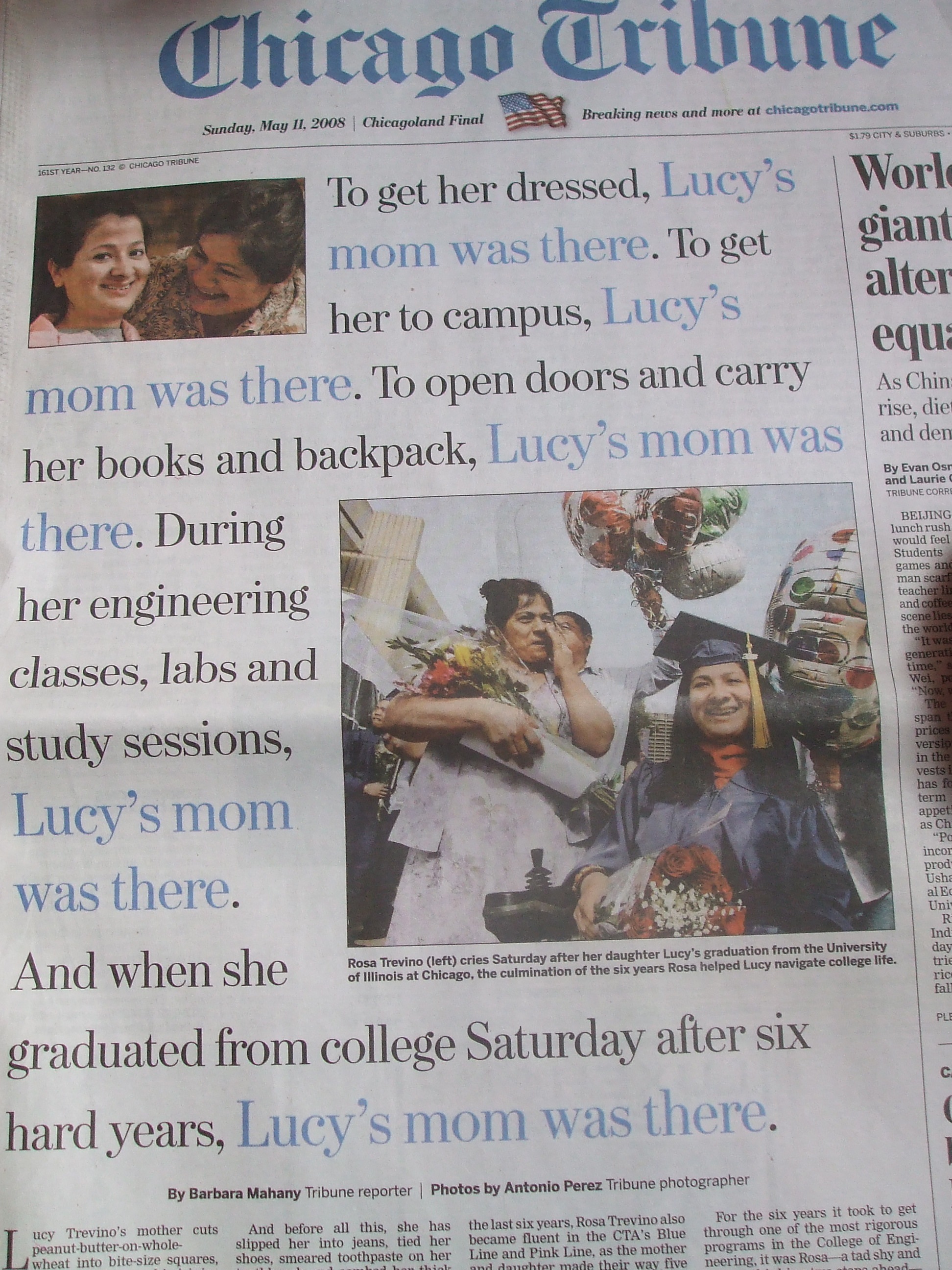
Lucy’s mom was there

By Barbara Mahany | Tribune reporter
May 11, 2008

Lucy Trevino’s mother cuts peanut-butter-on-whole-wheat into bite-size squares, unscrews a strawberry-kiwi juice and holds the bottle to her daughter’s lips so Lucy can get through lunch and make it back to class.

 She riffles through Lucy’s lavender backpack to find the lab report for BioE 494, bioengineering-based physiology. When the cell phone rings, she holds it to her daughter’s ear. She zips her coat. Unfolds a tissue, puts it to her mouth, trying to be discrete, so Lucy can ditch a wad of gum.

And before all this, she has slipped her into jeans, tied her shoes, smeared toothpaste on her toothbrush and combed her thick black hair into a perfect ponytail.

Lucy Trevino’s mother was right behind her firstborn daughter all through college—sometimes trying to shove through mounds of snow, or maneuver up an icy ramp if her motorized wheelchair balked. When they got stuck, her mother pulled out her cell phone to call maintenance and ask if someone could please come clear the walks.

Over the last six years, Rosa Trevino also became fluent in the CTA’s Blue Line and Pink Line, as the mother and daughter made their way five days a week from home, a red-brick two-flat in Cicero, to the University of Illinois at Chicago.

Lucy Trevino graduated Saturday from UIC with a degree in bioengineering, and the dean stopped the commencement of the Class of 2008 to tell of the Trevinos’ triumph. He barely made it, he said, without breaking into tears.

For the six years it took to get through one of the most rigorous programs in the College of Engineering, it was Rosa—a tad shy and always thinking two steps ahead—who got her daughter to every class, lab and study session. She knew which text and notebook to lay on Lucy’s desk. And she turned the pages when a heavy book tired Lucy’s hands.

For two or three hours, as Lucy absorbed lectures in calculus or thermodynamics or circuit analysis, Rosa sat not far away, just in case Lucy needed a sip of water or began choking.

Lucy, who is 24, was told she had a rare genetic degenerative disease, spinal muscular atrophy, when she was 4. SMA is a progressive disease that withers the muscles that control the arms, legs and lungs, and can make breathing a struggle.

Lucy’s type of SMA usually takes away your ability to walk by the time you’re in your teens—she began using a wheelchair at age 9—but unlike some other types, doesn’t necessarily affect life span.

Lucy, who is the oldest of four, has a younger brother, Hugo, who has the same disease. He, too, uses a wheelchair; he’s a freshman at the University of Illinois at Urbana-Champaign, studying architecture.

Parental dedication

“Lucy’s story is about the sacrifices our mothers make for all of us,” said Pete Nelson, interim dean of UIC’s engineering college. Trevino’s teachers, he said, “were pounding down my door” to ask for some recognition for this mother-daughter feat of unconditional devotion.

At UIC, where nearly a third of the students are the first in a family to go to college, Nelson said it’s not uncommon to hear tales of parents working two or three jobs, sending money from overseas and just plain struggling so their kids can get what parents weren’t afforded.

“But this is sort of the pinnacle in terms of the amount of dedication,” Nelson said. “This is what makes this business worthwhile.”

One of the professors pounding on Nelson’s door was Michael Cho, who teaches mostly graduate courses in cell and tissue engineering, but who has gotten to know—and has been amazed by—the ubiquitous mother-daughter duo, so often spotted wending their way up a ramp, on or off an elevator, or tucked away studying in some secluded corner.

“The first thing that comes to my mind is this can’t be anything else but a mother’s love,” Cho said. “It goes beyond commitment. It is sacrificial love. And I am just overwhelmed. It’s not just one month or one semester. It’s every day for the last four years that I can think of.”

In fact, it’s six years, because Lucy had to take time off when she got really sick her junior year; she suddenly couldn’t lift her arms and was quickly losing memory.

It took months before a sleep test showed she stopped breathing 30 times an hour when she was asleep. She now sleeps with a machine that helps her breathe, and, within a week of using it, she said, she regained her memory, if not her arm strength.

“Ever since I was little, I loved science,” said Lucy, who shares her mother’s deep cocoa-colored eyes and rolls around campus in a purple wheelchair with back wheels that sparkle, like fireworks, with tiny neon bits. “Because I went to doctors a lot and had a lot of medical exams, I would always wonder, ‘How do those devices work?’ ”

In her senior year at Morton West High School in Berwyn, Trevino learned from a counselor about a summer camp in bioengineering at UIC, so she signed up, and found her life’s work.

She once dreamed of working to find a cure for her own disease, but decided “it would be too stressful if I couldn’t find it.”

The first one in her family to ever go to college, Lucy Trevino said she was “too afraid” to venture down to the U. of I. in Urbana-Champaign, where there’s a whole dorm for students with disabilities, and the nation’s oldest college-level disabilities-services program provides trained personal assistants, physical therapy, even wheelchair repairs.

“I didn’t know if I should risk going all the way down there,” she said.

Sticking closer to home seemed like a better plan. But because UIC doesn’t have a personal-assistants program, she was stuck trying to find someone who could help her in a thousand little ways and be there whenever she needed.

“In college, you have such a crazy schedule. You stay after to study with other students. You need to talk to a professor. I was like, ‘Oh, my gosh, how am I going to find someone who’s going to put up with all of that?’

“My mom was like, ‘Well, I guess I’ll just go with you.’

“And then it was getting closer to the start of the first semester, and I still hadn’t found anybody. She said, ‘How would you feel if I went with you?’ I was like, ‘Oh, my gosh, would you?’ ”

Because Rosa Trevino, who is 47 and moved from Mexico when she was 17, had two children with special needs, she had long since become a stay-at-home mom, giving up a series of baby-sitting jobs. Rosa’s husband, Hugo, retired last year after 32 years as a CTA bus driver. Rosa herself had never even been to high school.

On the day back in 1987 when doctors said her little girl would “someday need a wheelchair,” Rosa recalled, crying at the memory, she promised herself she would do “everything I can.”

Mother keeps busy

Even if that meant sitting through more than 2,100 hours of 51 classes, countless study sessions and hourlong train rides, back and forth, each day. Most often, Lucy said with a laugh, her mother spends time cutting recipes and coupons, because she gets bored with all the bioengineering in a language she doesn’t fully understand.

At first, Lucy admitted, going to college with her mother wasn’t exactly without its bumps.

“I had never spent so much time together with my mom. We would sometimes get on each other’s nerves,” she said, chuckling. “But then we got to know each other really well. We’re like best friends. Now I tell her everything. Before I wouldn’t tell her everything that happens when you have a disability. People who aren’t in a wheelchair can’t understand. But now, since we do everything together, she knows.”

Semester after semester, year after year, Lucy and her mother found a way. She passed 400-level exams. She wrote up labs that took her twice the time of everyone else, simply because the pushing of a pen on paper is so hard for her.

Once, a civil engineering professor noticed that because of Lucy’s wheelchair, she couldn’t write on her desk. He challenged her to design a lightweight writing table. Then he went and built it. She got an A.

Mostly, the Trevinos relied on each other, and on unflagging faith.

“One time, I think in the night, almost for an hour, I cried to on high, ‘Why me? Why me?’ ” Rosa said. “I heard a voice, ‘Why not me?’ ”

For those who watched their unswerving perseverance, the simple fact that the Trevinos never stumbled inscribed a lasting honor on Lucy’s college transcript.

“One time last year,” Lucy said, “a student told me she’d felt like ditching class, staying home. But then she looks and says, ‘There’s Lucy, she’s always here. There’s nothing wrong with me. I’m just lazy.’

“Wow, I didn’t even think that anyone noticed me.”

In the very end, on a Mother’s Day weekend in the red-carpeted UIC Pavilion, as Nelson saluted a student and a mother who had taught them all a lasting lesson, a sea of Lucy’s blue-gowned classmates rose and nearly drowned out the dean with a thunderous two-minute ovation. Chances are Lucy and Rosa Trevino finally understood how very much a whole college noticed.

your thoughts, my blessed friends? if you can even muster words…. next meander: lucy’s backstory, what i didn’t get to say in the paper…

i have a dream, too

a year ago, i couldn’t imagine being so bold as to put any words here other than the words of the man to whom this day belongs, martin luther king jr. and so, i excerpted from the speech that moves me to shivers down the spine, and tears down my cheeks. i put a spool of words from the “i have a dream speech” right out on the table, and i let that speak for the day.

well, this year, thinking about this day, i am thinking that we must all be bold–especially when it comes to dreams.
if we don’t reach deep down inside, scout around for that same bold seed, put voice to it, get up and say it out loud, put breath to it, after all, well then, what’s the point in only listening to someone else’s dream.

that dream will not just leap up off the couch, start dancing, doing its thing without some muscle, without us adding to the voices rising, up over the mountaintop, down into the valley on the other side, down to where the shadows fall today. and tomorrow and the morrow after that. if we don’t too dare to be so bold as to raise our hand, say, hmm, i too am dreaming.

a long long time ago now i had a real live, wide-awake dream. a dream i’ve mentioned here, maybe once. but maybe it got lost along the way. today seems a fine day for shaking off the cobwebs of the story of that dream, re-telling it, in case maybe you or you have had a dream, all your own as well.

my dream was in the upstairs chapel of a nunnery, far far away. out where hills rolled and corn reached toward the sky. i was only there for the weekend, for what’s called a silent retreat. which means i ate, i drank, i walked, i prayed in utter, total wordlessness. at least no words that you could hear. there were plenty inside, believe me.

it was a friday night, and i had eaten in silence, tucked my things beneath the hard slab that was serving as my bed. i tiptoed up to the chapel and there i knelt. maybe it was all the silence, or maybe it was something else. but as i knelt and prayed, staring at the crucifix, staring at the long muscled legs of jesus on the cross, fixing on the nail holes in his palms, taking in the beautiful sorrow, and the peacefulness on his handsome jewish face, i saw the start of what turned out to be an endless kodak slide show of faces changing. i saw old faces, white faces, black faces, brown faces, sallow faces, children. i saw a native american, i saw an asian man, an old one. i saw wrinkles, i saw softness. i saw eyes and eyes and eyes. i was, of course, wiping tears from my own eyes, and cheeks, and chin. i can’t imagine seeing such a sight and not being wholly deeply moved. the tears, the transcendence deep inside, is all what comes when you feel, sometimes, as if a hand from heaven has just reached down and tapped you, unwieldingly, on the heart.

i knelt. i squeezed my eyes, then slowly peeked them open, to see if maybe this was all a trick that would just pouf away as fast as it had come. i turned, looked back, and still the faces changed.

i got the message pure and wholly: look for, find, the face of God in every one you meet.

the clincher to this dreamy story is the next afternoon, when i returned, took a seat–near the back, i tell you–in the bigger downstairs chapel. i bravely–through spread fingers–shyly–just a little bit afraid, i tell you–raised my eyes again to the face of jesus on the cross. at first, nothing. phew. safe. that was rather much to ride again. but then, as i softly sank into prayer, i swear to God i saw a smile wash across the face of that there jesus.

now you can hang me up now, press the button and click away. or you can read along, think, like i do, hmm, heaven even comes to ordinary folk. i’m no saint (ask my mother), but i am now among the ones who’ve had a dream. who carry it with us wherever we go from that day forth.

i carried it with me when i criss-crossed this country, once, looking for the faces of those who were poor, were hungry. i carried it, day in and day out, as i poked around the big city where i live and work, where i collected stories of the neediest of needy folk. walked into apartments way up high in dingy highrises and barely made it out alive of one not-so-friendly two-flat where there hadn’t been a speck of heat in weeks, and where someone who huddled there made it abruptly very clear that i was not welcome there.

i carry it, oh boy do i, now, where i live in a place where ironically it’s harder because no one on the surface looks so needy. everyone is cleaned, is polished. children carry ipods. play games on cell phones while they wait for lessons that cost, for half an hour, what some families pay all week for groceries.

the only thing to do if we’ve lived a dream is to wake up every morning and tuck it in our pocket, take it where we go. try every day, to not give up. to not let the phone call go unmade, or the unkind word go uncorrected.

it is the pulse beat really of our every day. it is the undying belief that it is here, at our kitchen tables, that the dream puts on its clothes. leaves behind the wisps of mental images, takes on matter in our every blessed hour.

it is in where we choose to send our children out to play. it is what we cook, and who we choose to feed. it is in the people we invite into our homes, the stories we ask them to tell, so our children can listen, can soak up sparks of wisdom that come from far beyond the walls of our small houses. it is how we look into the eye of the guy behind the gas pump. and where we get our hands dirty. it is in the getting up on sunday morning, and going out to someplace where the lessons come from wiser teachers, instead of staying huddled ‘round the table, sipping cocoa, keeping watch of birds.

it is, day in and day out, saying to yourself: i have a dream. i see a world other than the one before me. i believe it can be changed. it starts, right now, with my next whole breath.

someone else once had a dream. his name was martin. and there is work, still, to be done. he’s no longer here. he needs us to boldly dream in the places where he dreamed.

do you have a dream? how do you make it come to life? some of you, i know, are the very ones who inspire the dreams i set before my children. please, share the outlines of your visions. and bless you all for being filled with dream.

you never know the lessons you teach

bear with me. it might be worth it.

i had no intention of returning here to the pigeon man, but then i walked to my mail box the other day.

it’s not so common anymore for that little box down at the newspaper where i work to be filled with not just junk, but real live letters. oh, there are always a few, often rather sweet. but not like the one i got the other day, not really an epistle, a letter i keep coming back to, a letter i read and re-read because, on so many levels, it calls out to me.

it was written by a man who grew up not far from where the pigeon man–his real name is joe zeman, by the way–had his first newspaper stand. a little wooden shack, basically, at a busy downtown corner. that corner just happened to be near cabrini-green, the infamous public-housing project in chicago, where life could be, well, hellish.

gunshot was a sound that every child knew, knew to duck for cover when it came. elevators had long stopped working in the 15- to 18-story towers, so you ran for your life up stairwells that reeked of urine, or worse, and prayed you didn’t run into someone out looking for trouble.

the man who wrote the letter–his name is dwight taylor–was a kid there, lived there till he was 17, charged with armed robbery and murder, and went to jail. he sat in jail 11 months, he told me, till they finally let him out, not guilty after all.

here’s his letter, dated december 20, 2007:

hello barbara,

my name is dwight taylor. i am a product of the infamous cabrini green housing projects. in the mid 60’s, my friends and i used to walk east on division street to rush street to shine shoes. there was a shack on the northeast corner of the intersection of division & lasalle. a man would always stand outside of that shack and feed the pigeons. there were times we would make fun of that man.

as time progressed, we would walk past that shack and just speak and keep on walking. as i grew older, i began to realize the significance of the man on that corner. i began to think about what he was doing on that corner.

i recall him being swamped with pigeons on just about every part of his body. i then came to the realization that he was not only doing a service for God, he was doing something from his heart. i came to realize his heart was not the size of the average person.

considering the minimal love and affection i was receiving at home, he was a blessing in disguise. mr. zeman will never know what impact he had on my life. as you are probably aware, life in the projects is no joke.

the many times we walked past mr. zeman’s shack, he will never know i grew to really appreciate the presence of him. i began to appreciate the presence of him because of a deficit of love and understanding i never received at home. when i witnessed true love, compassion and generosity being exchanged between mr. zeman and his pigeons, i realized i was truly blessed that God directed me on that path on division street.

my sister called me thursday afternoon to inform me of his demise. when i logged onto your website [the tribune’s], i saw a man i hadn’t seen in many years. nevertheless, it was the same saint i remember many years ago on division & lasalle street.

he will be no stranger to the many wings where he is going. especially considering the many wings he had down here.

dwight taylor

gary, indiana

i called dwight the other day, told him i was deeply touched by his letter. asked if i could share it here, and with the letters to the editor at the tribune. i asked, too, a bit about his life today.

dwight is 52. he has four daughters, the oldest graduated from purdue university, the youngest is a sophomore at the university of notre dame. the middle two are in collge, too; one at indiana university, and the other at southern indiana university.

dwight says he’s had some financial troubles of late, so his email wasn’t working. said he’d graduated from technical school, worked at motorola, in the cellular division. but then, he said, he’d broken his neck in a freak accident–reaching for something up high on a shelf–and had to learn to walk again.

i asked if he was some kind of minister, or pastor, or whether he did some kind of preaching, because his letter sure read like that of someone who could pack a punch before the folks in the pews got one bit wiggly.

he laughed. said he gets asked that all the time. he’s not any kind of pastor, he said, just a man who says what he sees.

dwight’s story is sticking to me. like the best sort of shadow, it’s clinging all throughout the day, even through the weekend.

i couldn’t wait to let you read it too.

gives me goosebumps to think an old man cloaked in feathers could be a beacon of loving kindness to a kid growing up where love was scarce.

and that kid was smart enough to figure out just what the lesson was, and use it, a shaft of light on his murky trail, to escape what might have been.

but he didn’t stop there: he went on to live a life, and spew a brand of wisdom, that made me think he must have been a preacher, for the lesson he was teaching me.

you never know, sometimes, that you bumped into a teacher, until you realize, you just can’t shake the lesson.

dear mr. taylor, thank you oh so deeply. and mr. zeman, too. you’re quite a pair of wise ones, and you’ve shined a mighty light here on my ever-winding trail.

forgive me for a third take on the pigeon man. but i couldn’t not share the letter. i left it out all weekend for my boys to read. maybe in light of the few sad souls (on the tribune’s website last week) who found the pigeon stories worthy of the smallest thoughts, i found dwight’s letter so extraordinary. i am endlessly amazed by everyday saints, mr. taylor among them. your thoughts, friends.

fire-hydrant funeral

fire-hydrant funeral

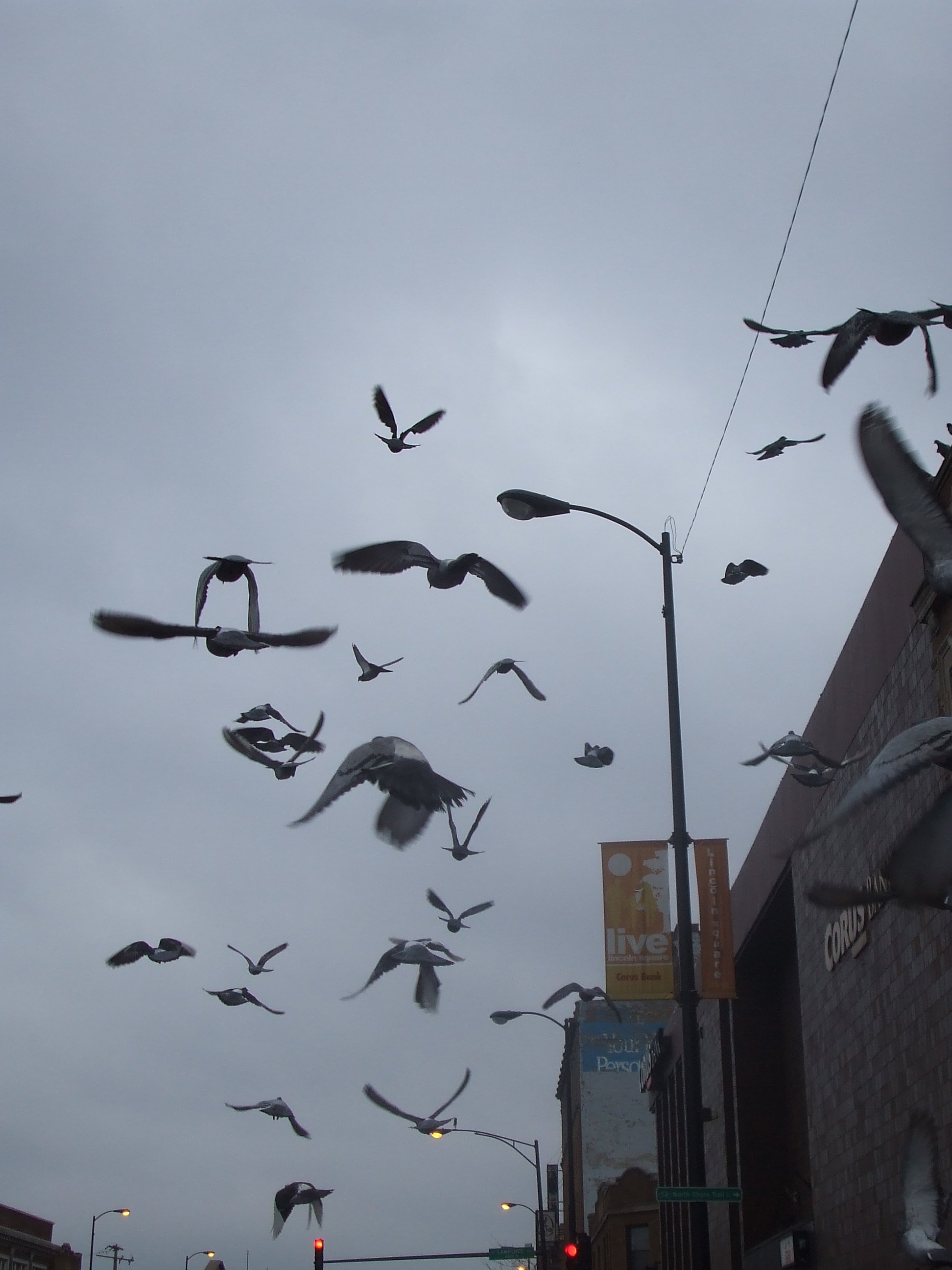
they came on foot and on wings. one hobbled on a three-pronged cane. one pedaled her pink-and-white old-timer bicycle. a whole flock finally came down from the soupy gray sky.

they all were drawn to the fire hydrant, now empty, now nothing but a bulging spout where firetrucks would hook up their hoses should a fire ever come to the dingy gray block of western avenue, across the way from lincoln’s statue, on chicago’s north side.

but for nearly 10 years that hydrant more or less belonged to joe zeman, the stooped old man best-known as the pigeon man of lincoln square.

nearly three weeks ago, joe died. was killed when a van pulled out of a bank parking lot, and the elderly driver didn’t see the man who so often–when not covered in pigeons–faded into the shadows.

the hydrant belonged, too, to the pigeons, joe’s pigeons, the dozens and dozens who fluttered down, found peace on the sturdy limbs of the man who made like st. francis of a city.

the pigeons roost–then and now–up on the terra-cotta brow of an old boarded-up bank, or down by the corner where the street lights blink all night and day. but they don’t circle down to the hydrant anymore.

some say the pigeons are crying. some say that in the days right after joe died, the pigeons circled, cooed in a way that sounded like wailing, then dropped their heads, flew away. kept watch, but wouldn’t come down to the hydrant.

the sadness that swelled their hearts–people and pigeons, alike–could no longer be contained. nor the yearning for a proper goodbye.

so, on a balmy january sunday, just yesterday, friends and strangers–even the pigeons–came back to the hydrant.

there was no clergy at this fire-hydrant funeral of sorts. and no coffin; joe had been cremated at his family’s request, and they promise to hold a memorial in a few months. communion came in the form of squishy white bread, on sale at the aldi, passed out in single slices to the dozens who wandered by for the better part of an hour.

a city bus pulled to the curb, so the driver–who told me he whispers a prayer every time he rolls by the now-empty hydrant–could pay his respects. another one honked, from across three lanes of traffic.

even a city cop, in her squad car, pulled up to add her blessing. she was the beat cop who’s worked the precinct for the last seven years, and she used to stop by each day to visit with joe. not once, she said, did she respond to one of the callers, the complainers, who wanted joe hassled for feeding the pigeons.

before she drove off, she told me joe died with a copy of a newspaper story clutched in his hand, not tucked in his jewel bag as i’d first imagined when told by the cops he’d died with my story right there.

this whole sidewalk benediction for joe, for joe and all that he stood for, was the idea of tara theobald, a woman who sports a faux-hawk–that is a semi-mohawk, close-cropped on the sides, curly and longer in a stripe on the top–a woman who never once met or even saw zeman, but read of him, and mourned for the hole now in the weave of the city.

“he was an icon,” she told me. “he was someone taking care of the community, the animals, the corner. he showed the neighborhood what it means to care.”

hers was a simple idea. on facebook, no less, she put up a post, asking hundreds of folk to come pay their respects.

“bring bread and/or grain, and any kind words,” she wrote, “to commemorate zeman’s philosophy of charity and consideration he long evoked in the lincoln square neighborhood.”

and so, under a gray sky that seemed to be dripping fine mist, a small knot gathered. the pigeons, nearly a hundred, and the people, no more than seven or eight.

in all, there were nine loaves of bread, a bag of cracked corn, and 200 black-and-white cards that theobald had designed, printed and photocopied. each one showed a photo of joe, covered in pigeons, with the word compassion, defined: “deep awareness of others’ suffering, accompanied by the desire to alleviate it.”

beneath those words, she wrote simply: “joe zeman. 1930-2007. be the change.”

she had no solid plans for the simple sidewalk remembrance. just a loose notion to pass out a single slice of the bread, and a compassion card, to each passerby. hoping to stir up the spirit of joe, there at his hydrant.

for nearly an hour, a stream of folks flowed by. out on a warm gray sunday for a stroll, running an errand, chasing a bus, some stopped, some paused, others kept right on walking.

the sidewalk was slick from the mist. the curb was clogged with charcoal gray slush, the last bits of snow, melting.

crumbs of bread and the scattering of corn soon soaked up the spill from the mist and the snow. the pigeons returned, gobbled up bits, then roosted again.

stories were told. a refugee worker remembered how she passed by joe every morning, how his soft gentle ways infused her, reminded her how she ought to be. a young mother out walking her four-year-old stopped to say how many conversations joe and his birds had inspired. how she used him to teach her little ones how to be in the world they were just learning.

one old lady cried. a grad student, one whose teacher had penned a beautiful poem, a poem entitled, “endangered species,” a poem about joe, cleared her throat, turned toward the pigeons and began to read.

the last line of the poem is the one i can’t forget: “who is to say you cannot collect love?”

it was the city at its slushiest, grittiest, there where the pigeons do and mind all their business.

and it was there that a woman who teaches synagogue sunday school dreamed up this holy sidewalk communion, for the birds and the un-winged friends, all so very much missing an old hunched-over man who tried to teach only this:

“i’m really advertising to the public how easy it is to be good without an attitude,” he once told me. “it’s just as easy to show decency as it is to hate today.”

don’t forget joe. be the change.

blessed monday, blessed back-to-the-real-world monday. i needed to take you all to the sidewalk to see what i saw, to hear what i heard. i have a similar story in the tribune today, but i couldn’t say there all that i can say here at the table. so this one’s for you.

long as we’re here, i just wanted to say happy blessed day to mbw, another urban saint among us. she’s my kind of hero, used to leave her car unlocked every night so some homeless folk could find shelter and a soft place to sleep. she was my first best boss at children’s. i picked her to be my firstborn’s godmother, cuz hers is a soul and a wisdom any child would be so blessed to absorb.

at our house it was a rocky beginning to the week. hope yours was smoother. and here’s a prayer that all of us find what it takes to return to the real world, but still hold onto the magic of unwrapping mornings, and twinkling nights. the test is now, to find peace in the long list of to-do’s. hope the story of joe, and the hydrant, brings you a bit of what you might need this january monday.

the pigeon man of lincoln square

the police called me last night. a few times.

they were calling because an old man, an old bent-over man, one with a black canvas satchel slung over his shoulders, too-big janitor’s pants held up by suspenders, was shuffling along on a sidewalk, beside a busy city street, on a cold december tuesday, yesterday, at 2:15 in the afternoon.

probably, he was headed off to the fire hydrant, the red one, just by the bank at lawrence and western, where the pigeons, for years now, have counted him one of their flock.

the old man was walking, past a bank parking lot, when another old man, one driving a chevy van, pulled out of the lot. must not have seen him. the man in the van hit the one with the satchel.

the old man died.

the old man was joe zeman. but most everyone called him the pigeon man of lincoln square. cops couldn’t tell who it was. except for a newspaper story, one laminated, tucked in the satchel, one with a little rectangular label up in the corner, scribbled with the words, “for who ever.”

except for that story, one that showed him, in color, feathered with pigeons, one that told his story, the cops and the doctors who pronounced him dead at the hospital had no clue who he was.

the pigeon man’s life was like that. barely a soul had a clue who he was. mostly, only the pigeons.

that’s why the cops called me. they knew i knew a bit of his story. i wrote the one they found in his satchel. two years and three months later, almost to the day, and he still carried it–maybe half a dozen laminated copies of it–wherever he went.

the cops needed someone to call. needed to know if there was a soul in the world who might care to know what happened to joe.

there was no one, save for the pigeons. and me.

here’s just a bit of the pigeon man’s story, the one he carried till he fell down and died:

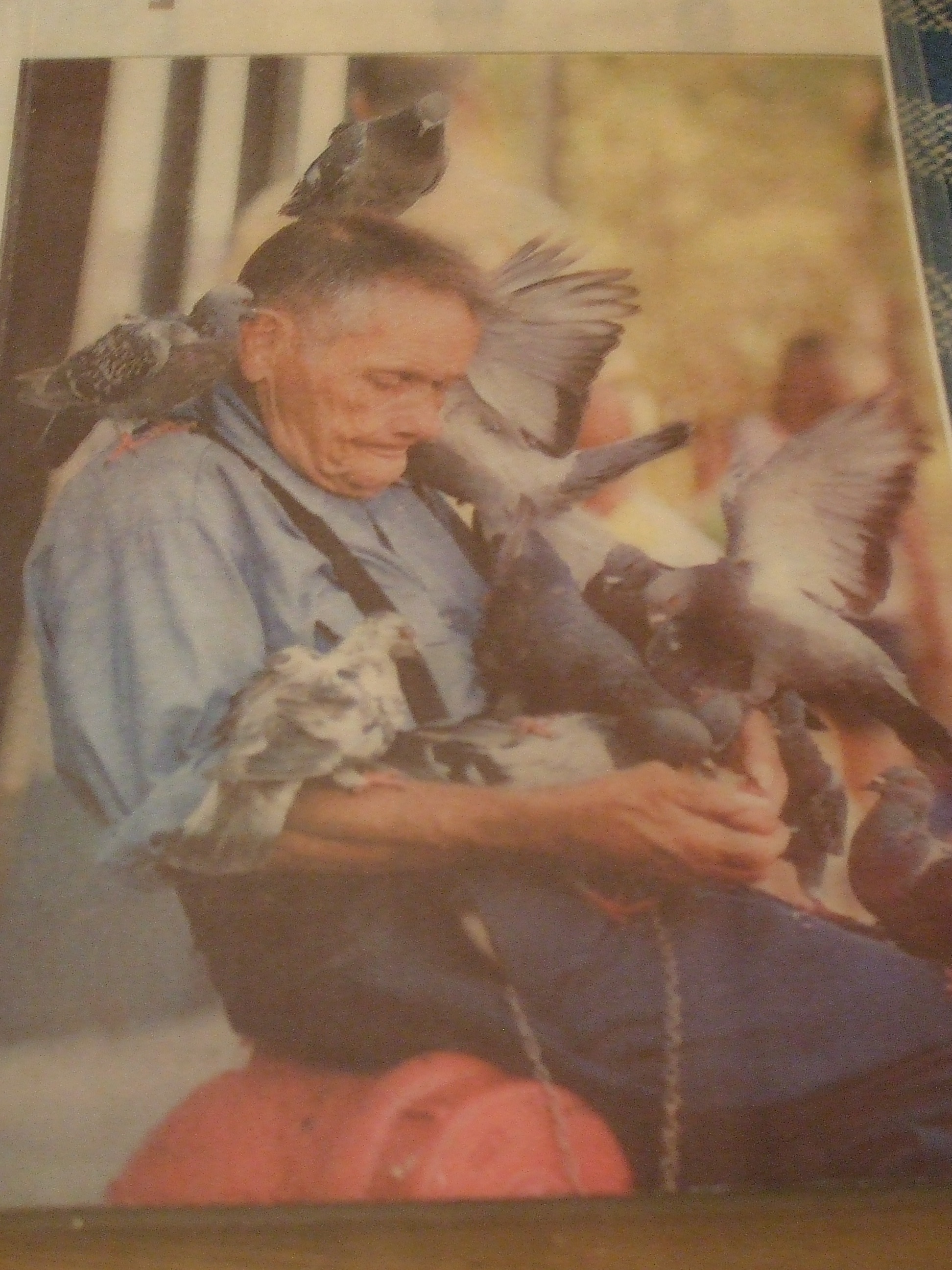
“except for the lips, you would think he was made out of stone, the man who sits, hours on end, on the red fire hydrant on western avenue, just north of lawrence, pigeons by the dozens perched on him.

“pigeons on his head. pigeons on his shoulders and right down his arms. pigeons poised on each palm. pigeons clinging to his chest. pigeons on his lap. pigeons on his thighs. pigeons, of course, perched on each foot.

“the pigeons peck and coo, occasionally flutter their wings. sometimes even scatter. but not the man, the man is motionless. you might mistake him for a statue.

“joseph zeman,” 77 when he died, “can sit for hours, barely flinching a muscle,” i wrote. “except for those lips.”

i wrote how he cooed right back to the birds. how he kissed them, right on their iridescent necks, flat on the point of their sharp little beaks. how he nuzzled them, rubbed his nose in their wings, the herringbone of feathers all black and charcoal and pewter and white. how he called them by name, his favorites. how he worried when one was missing in action.

i wrote how up in the attic where he lived a few blocks from the hydrant he kept track, in a neat little ledger, of whatever dollar bills might have been slipped in his hand, dropped by the side of his hydrant.

how he used the money for his pigeon supplies, the unpopped popcorn kernels, the bags of white rice, the loaves of deerfield farms enriched white bread, the maurice lenell oatmeal cookies, the plain old birdseed that comes in 50-pound sacks, which he broke down, each night, into zip-top plastic bags.

i wrote too, because he took me up to his attic, because he was proud to show off his deeply-thought method, of the old baby food jars he filled, each morning and night, with rice or popcorn, seven jars in all, and tucked in his satchel, each time he shuffled off to the hydrant.

twice a day, at least, once in the morning, once in the late afternoon, the pigeon man returned to his roost.

but the part of the story that’s stayed with me all these years was the part where he explained why he was drawn to the pigeons.

“all my life i had so much backstabbing at home, real problems there. i got to love the animals more, so trustworthy. fifty years, all i heard was ‘shut up, shut up.’ i needed help at home ‘cause i was handicapped. they took advantage of me. epileptic fits since the day i was born.

“because i had so much trouble at home, i learned not to say nothing, keep to myself. so they came up to me [the pigeons]; i appreciated the friendship out of a bird more than a person. they’re wordless. they come up with pure appreciation.”

zeman, who for 47 years ran a newsstand downtown, said that he considered sitting on the hydrant the most important work he had ever done.

“i’m really advertising to the public how easy it is to be good without an attitude; it’s just as easy to show decency as it is to hate today.”

zeman, a man without much schooling, understood how when he took to the hydrant, raised both his arms, palms upward–the veneration pose, really–as thousands of cars and trucks and smoke-spewing city buses rumbled by, drivers craning their necks to take in the sight of the stooped little man covered in pigeons, he really did resemble a modern-day st. francis of a city.

matter of fact, up in his little attic, he had boxes and boxes of st. francis postcards, each one printed with the peacemaker’s prayer: “lord, make me an instrument of your peace. where there is hatred, let me sow love…”

matter of fact, zeman once grabbed a stack of the postcards, maybe a hundred or so, and gave them to me. i tucked them all in the drawer of my desk, here where i do all my typing. i keep them, right there, to remind me of the wisdom of the lost soul who found his peace with the pigeons.

just yesterday afternoon, before the phone rang, before any cops called to ask what i knew, i had reached in my drawer for a calculator, and my hand ran into the stack, spilled and scattered, making a mess in the old pine rectangular drawer.

i started to shove the cards back into a stack, but then, for some reason, i picked up the top one, and i read it through to the very last line, which just happens to be, “and it is in dying that we are born to eternal life.”

thinking back on the day, i know that the clock ticking beside me had to have been just after two in the afternoon.

that was the hour when the pigeon man of lincoln square breathed his last breath.

that was the hour the great gray raincloud of pigeons, the ones who for nearly 10 years had kept watch on the hydrant, had fluttered down as soon as a little stooped man slid off his satchel, settled onto his cold metal roost, raised both his arms, palms upward–the pose of st. francis–that was the hour the birds must have let out a most mournful coo.

this morning, for almost the first time in a decade, the hydrant is empty. the pigeons are perched. but the little man with the gentlest heart is not coming.

not ever again, amen.

oh, goodness. i’m back from my respite. and thank heaven there’s a place where i could tell joe zeman’s story. carry it close to your heart, maybe. scatter some seed for the birds today. think of the man who found solace only in the birds of the city, birds often shooed and thought to be pests. the picture above is my desk drawer. i too had a laminated copy of the newspaper story, one the pigeon man gave me. i keep it off in another drawer. but last night, i nestled it next to the prayers of st. francis. seemed the right thing to do, as i remembered the man who taught me so much.

i’m thinking i’ll pull up a chair, meander, at least every wednesday, smack dab in the thick of the workweek. but as happened today, what i thought i would write got nudged to the side so i could tell the pigeon man’s story. that means i’ll be back friday to tell the one i intended to tell today. we’ll find a flow here, as we settle into a rhythm that’s new. till then, just wander back when you can, you might find something waiting.

oh, and one other thing, thank you so much for the beautiful thoughts you spilled as the chair wrapped up its whole long first year. i am touched. deeply.

every year, a cast of characters


every year. count on it. there will be characters. they will be many. they will be deeply, richly, crazily creviced, shadowed, colored.

it is as much the order of the seder as the haggadah itself. the table will spill with character. ooze with it. rumble, tumble, jumble, full of characters.

wafting just above, that’s character no. 1. the tall one, that is.

that’s ted. rebbe ted. the one wrapped in japanese prayer robe, tied with obi. the one raising the first of four glasses of vintage manishewitz. the one we drive miles to be with every pesach.

ted, a rabbi and cantor without a congregation these days, is a therapist; spends his working hours trying to screw on people’s heads, or at least screw them on a little less wobbly than when they first wandered in.

but mostly, always, ted is a character. ted’s eyes, i think, must gleam even when he’s sleeping.

at ted’s seder, things are, um, unorthodox. ted reaches in a bag and pulls out yarmulkes from around the world. sometimes he wears his tibetan temple headdress. he always wears his japanese robe.

at ted’s, you do some chanting. you close your eyes and chant the vowels. you do not close your lips when chanting vowels, he tells you, and thus you assume a posture of openness that ted thinks the world truly deeply needs. you chant deeply, ahhhhhhhhh.

at ted’s, you eat sumptuous french hors d‘oeuvres. (and then you find out, oops, they are not kosher for passover; maybe that’s why they tasted so good.)

i tell you the story of ted because in bringing my children to ted each year i bring them to one of the most essential gifts a parent can give a child: the gift of the one who’d never paint by numbers, the iconoclast, the eccentric, the character. the deep and rich and soul-expanding knowledge that life is splashed with vibrant colors.

one of those colors is the color ted.

it brings unending joy to me to bring my children to tables where i know they will hear voices they do not hear at home. home is where the grounding happens. home is where you learn that the parachute has a safety cord, and you can pull it any time.

other people’s launch pads are where you learn to lift your foot off the ledge, set it in mid-air, and feel the fall, but then the updraft, carrying you, lifting you to places you’d never see from the safety of that concrete ledge.

last night we soared with ted. heard his salty brand of politics. took in his dash of new-age mysticism. felt the gestalt of letting go of that by which we’d been enslaved. watched him raise a yale sweatshirt, oy, to teach a lesson on hebrew light and perfection. (right there, spelled out on yale’s emblem, in hebrew letters, who knew? found out that centuries ago, at the founding of yale, patrician of patrician schools, hebrew was required study. ted, by the way, went to yale.)

tonight we congregate again. at another table of eccentrics. they will be the ones with whom we’ve worked for decades. the ones with whom i’ve “sedered” for 25 years, before husband, before children, and every variation since. a cast of newspaper kooks. my boys, all eyes and ears, will learn much that i won’t teach them.

besides the wine glasses filled with jelly beans (the kinder version of fruit of the vine), the flogging each other with scallions, yes, scallions, the pulling out of little plastic plagues, there is the annual putting of passover lyrics to broadway tunes.

we drive home each year, from nights one and two, with bellies aching. not from all the passover matzo kugel. no, no. from laughing ’til our sides feel split in two.

we are blessed. so very blessed.

all my life, far back as i can remember, i have loved the odd ball. the duck who waddled to his or her own drum beat. at my mid-century mark, i survey the landscape of my life and see i’ve assembled quite some cast of characters.

my almost-man-child told me recently that one of the most lasting lessons he learned from his uncle david was when david spoke of a brilliant friend of his, a friend with phD in sanskrit, a friend who studies global drumming and, for a long while, drove a cab in new york city. david, it seems, told my almost-man-child: “he really is a kook.” and my almost-man-child told me that the way he said it, he knew that uncle david meant that to be a kook is a very noble thing. “that’s how i learned i should never march to other people’s drummers,” said my boy who decidedly does not.

my prayer this pesach, my prayer that already has been heard on high, is that all the children, not just my boys, hear a world of many drummers. and come, as often as they can, to a table that spills with kooks and characters and bold eccentrics, a table, every first-night seder, led by rabbi ted.

who, by the way, i love with all my heart. even if he makes me close my eyes and chant the vowels.

do you collect characters? do you see the beauty in those who color outside the lines? do you, if you have children, or love children, or are a child at heart, seek out tables where you know they–and you–will hear voices unlike the ones they–and you–hear at home?