
the balm in gilead

gulps of coffee fuel me this morning, groggy as i am from a near-crippling concoction of cough, cold, inhaling too much pollen, and the foolishness of staying up far too late to honor the last gasp of late night’s saving grace these past unfathomable years. i felt downright patriotic and duty-bound to stay awake and bid the nearly-midnight crew adieu.
after all, that late-night slot has all but saved me. over these long, long, oft-unbearable years, there’ve been so, so many days when the horrors and antics of washington have found me groping for the tonic of someone who might all but croon me a lullaby and tuck me tautly between the sheets—maybe, just maybe, chase away the monsters. someone who could bore into the core of the madness, call it out for what it is, and find a way to soothe our jangled, jagged nerves. or make us laugh before and as we wept about it.
first, they took away our brian williams, a gentle giant of old-school newscasting who, in the thick of years that straight off hit the skids with doomsday portraits of american carnage, then railroaded right along to ivermectin and bleach-in-our-veins prescriptions from the presidential podium, becalmed me at the 10 p.m. central-time slot. and now, they’ve snatched stephen right out from under us. the man could make me howl with glee at the mere cocking of his wicked eyebrow. and make me feel less a sinner for the dyspepsia the spewed inside me. “thou shalt not hate,” i repeat and repeat, trying oh-so-hard not to cross that God-drawn line.
so i stayed up. which my raggedy body says was stupid.
but, heck, i’d hoped my hero of the year—leo the fourteenth, Il Papa—might pop in, at least via vatican-city zoom. or some other heavenly-ordained teleportation.
all of which is to say, i should be curled asleep still. but the chair, the clarion call in my every friday morning for the last 1,018 fridays, stirred me from my slumber.
and all of which is to back boldly and clunkily into my preoccupation of the week: a book i can’t put down.
which is where we clear our throats, shake the sleep from our eyes, and dive in: this week’s musing . . .
in my backwards, upside-down, and oft off-kilter life’s syllabus, my self-guided and plenty-potholed quest to figure out a thing or two before signing off from this lifetime, my list of texts to absorb is (as you might surmise if you eyeballed the death-defying book stack beside my bed) dangerously, dauntingly, beyond measure.
pathetically, my ratio of books begun to books read through to the end is woefully skewed—conservatively hovering at roughly 1,000:1.
avid starter am i. resolutely failed finisher—guilty as charged.
rare is the book that holds me page after page, so enfolded in imagination or intellect i dare not distract myself with some other tome lazing around in one of the many, many stacks that punctuate this old house. thinking back across the last decade, annie dillard’s pilgrim at tinker creek was one. niall williams’ this is happiness, might have been the only other. a third is soon to be added to the triumphant short roster.
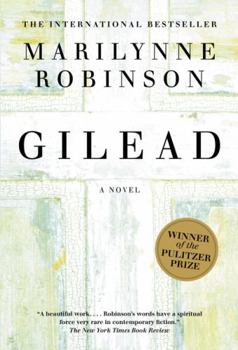
gilead, gosh darn it, has me held captive.
marilynne robinson’s 2004 pulitzer prize-winning “hymn of praise and lamentation to the God-haunted existence” of a congregationalist minister, the reverend john ames, a late-in-life father who loves the quiet country life “from which he will soon part,” has me running up to my book-reading nook every chance i can snatch, and ferrying the dog-eared paperback hither and yon.
john ames is 76 when we meet him, long rooted in gilead, iowa, dwelling in the very parsonage in which he’s spent most of his many years, having grown up in that drafty, dreary house as his father—and grandfather—had both been ministers there in the “dogged little outpost” that is fictional gilead. straight off, we learn that ames, our protagonist, suffers from a failing heart, and believes his death is imminent. thus, he’s compelled to write a letter to his seven-year-old, late-born son (“the fruit,” as the new york times once put it, of ames’ recent marriage to a much younger woman).
ames’ first wife and baby daughter have died in childbirth, we learn, and so this son from a wholly unexpected late-in-life redemptive marriage is the singular focus of a father desperate to pack a lifetime of wisdom and lore into jottings and passages that stretch to 247 pages. written in episodic, diary-like entries, nearly stream of consciousness, unspooling generations of wisdoms and family stories, lest the son (whose name we never learn) be left with nothing of his father, it’s a book that leaves me gasping for its sublime beauties—both the literary and the theological.
it’s not every day i run across a tome of which it’s been said these things: “Robinson has composed a novel as big as a nation, as quiet as thought, and moving as prayer.” (Kirkus Reviews, starred). “One feels touched with grace just to read it.” (Washington Post). Mark O’Connell in The New Yorker wrote: “I have read and loved a lot of literature about religion and religious experience—Tolstoy, Dostoevsky, Flannery O’Connor, the Bible—but it’s only with Robinson that I have actually felt what it must be like to live with a sense of the divine.”
no wonder i’ve slipped right in, and can’t bear to pull away. i too yearn to live that way, with a palpable sense of the divine, a God who brushes up against me—here, there, and anywhere.
in the very same way i’m drawn most deeply to poetry that comes at God not head-on but through the slant, the side window, so too with prose. what takes my breath away most, in just about any writing—fiction or non—is not when i’m klonked on the head but suddenly swept by a wind i feel but cannot see. “God-haunted,” the times put it. “bothered by God,” is how my friend joe the jesuit priest puts it. john ames’ “bothered” is my enlightenment.
truth is, i finally decided i had to read gilead because father joe (whose theology class, THEO 4300, “the question of God in a secular age,” i recently visited) admits when prodded that he has memorized nearly every word of it, can recite practically any passage from it. quite frankly, i was intrigued. flat-out curious. and i trust joe implicitly.
father joe, who wrote his doctoral dissertation at oxford on the theology and literature of robinson and virginia wolff, says robinson’s writing “reveals a deeply sacramental imagination.” in one of many essays he’s written about her, father joe argues that “robinson trains her readers in the discipline of spiritual attention. where is God’s grace operating in nature and in the ordinary ways humans love, disappoint and forgive one other?” father joe goes on to point out that “in her essay ‘Psalm 8,’ she writes, ‘i have spent my life watching not to see beyond the world,’ but ‘merely to see, great mystery, what is plainly before my eyes… with all due respect to heaven, the scene of miracle is here, among us.’ the miracle we await in Advent is not distant, but meets us in the messiness of our human relationships: Emmanu-el, God with us.”
spiritual attention, i suppose, is my core curriculum. urgently so. especially now, when the godless world works so very hard to pull me—pull us all—under its light-blocking curtain. (and when i so desperately need my late-night tonic, now pulled off the shelf.)
a deep dive into gilead, into robinson, was the surest balm i could find this week.
here’s just some of what i’ve pulled from my latest excursion into this well-upholstered rabbit hole. . .
here’s where we begin, the book’s first passage, john ames addresses his sweet little son:
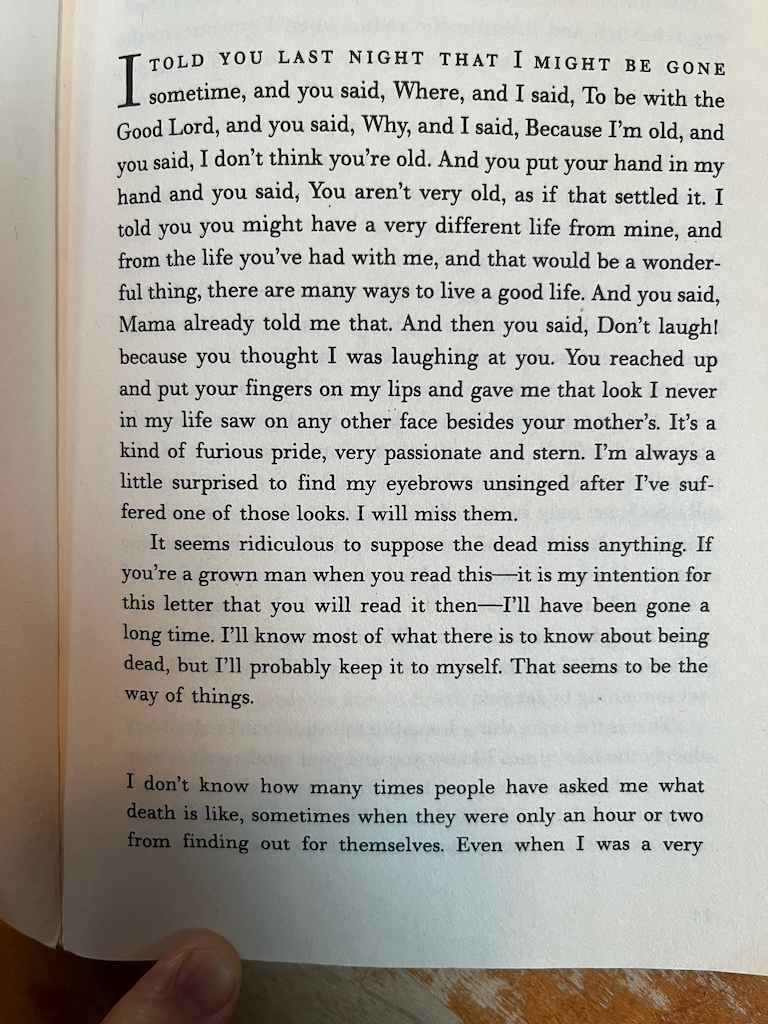
and while plenty of lines have left me reaching for a vat of highlighter yellow, here’s but one:
describing his love for iowa’s landscape, ames writes: “I have lived my life on the prairie and a line of oak trees can still astonish me.”
or the snippets of poetry posing as passing descriptions…
in one of ames’ passages, he sees his grandfather as “a wild-haired, one-eyed, scrawny old fellow with a crooked beard, like a paintbrush left to dry with lacquer in it.” or, describing him further, the old man seemed “stricken and afflicted, and indeed he was, like a man everlastingly struck by lightning, so that there was an ashiness about his clothes and his hair never settled and his eye had a look of tragic alarm when he wasn’t actually sleeping.”
when i step back and wonder why i spend so, so many hours of my life with my nose proverbially and literally stuck in a book, it’s to stumble across a line like this next one, one that just might set the mortar of the bricks that herringbone my path
ames recalls that “Augustine says the Lord loves each of us as an only child, and that has to be true. ‘He will wipe the tears from all faces.’ It takes nothing from the loveliness of the verse to say that is exactly what will be required.”
and there is good company in the gilead fan club:
barack obama, who awarded robinson a 2012 national humanities medal, counts gilead as one of his favorites. in september, 2015, in what’s been noted as “a reversal of journalistic convention,” the 44th president of these united states interviewed robinson on a stage in des moines, for the new york review of books, and told her:
I first picked up Gilead, one of your most wonderful books, here in Iowa. Because I was campaigning at the time, and there’s a lot of downtime when you’re driving between towns and when you get home late from campaigning. … And I’ve told you this—one of my favorite characters in fiction is a pastor in Gilead, Iowa, named John Ames, who is gracious and courtly and a little bit confused about how to reconcile his faith with all the various travails that his family goes through. And I was just—I just fell in love with the character, fell in love with the book …
“This is an interesting planet. It deserves all the attention you can give it.” — Marilynne Robinson, Gilead
an excerpt, john ames (via robinson’s pen) writing of his church at dawn (pages 70-71):
It’s a plain old church and it could use a coat of paint. But in the dark times I used to walk over before sunrise just to sit there and watch the light come into that room. I don’t know how beautiful it might seem to anyone else. I felt much at peace those mornings, praying over very dreadful things sometimes — the Depression, the wars. There was a lot of misery for people around here, decades of it. But prayer brings peace, as I trust you know.
In those days, as I have said, I might spend most of a night reading. Then, if I woke up still in my armchair, and if the clock said four or five, I’d think how pleasant it was to walk through the streets in the dark and let myself into the church and watch dawn come in the sanctuary. I loved the sound of the latch lifting. The building has settled into itself so that when you walk down the aisle, you can hear it yielding to the burden of your weight. It’s a pleasanter sound than an echo would be, an obliging, accommodating sound. You have to be there alone to hear it. Maybe it can’t feel the weight of a child. But if it is still standing when you read this, and if you are not half a world away, sometime you might go there alone, just to see what I mean. After a while I did begin to wonder if I liked the church better with no people in it. . . .
In the old days I could walk down every single street, past every house, in about an hour. I’d try to remember the people who lived in each one, and whatever I knew about them, which was often quite a lot. . . . And I’d pray for them. And I’d imagine peace they didn’t expect and couldn’t account for descending on their illness or their quarreling or their dreams. Then I’d go into the church and pray some more and wait for daylight. I’ve often been sorry to see a night end, even while I have loved seeing the dawn come.
Trees sound different at night, and they smell different too.
and here, robinson reading robinson…
where did you find balm this week?
 pull up a chair