pull up a chair

where wisdom gathers, poetry unfolds and divine light is sparked…

Tag: Emerson

paean to the poets, and to those who planted poetry’s seeds in us
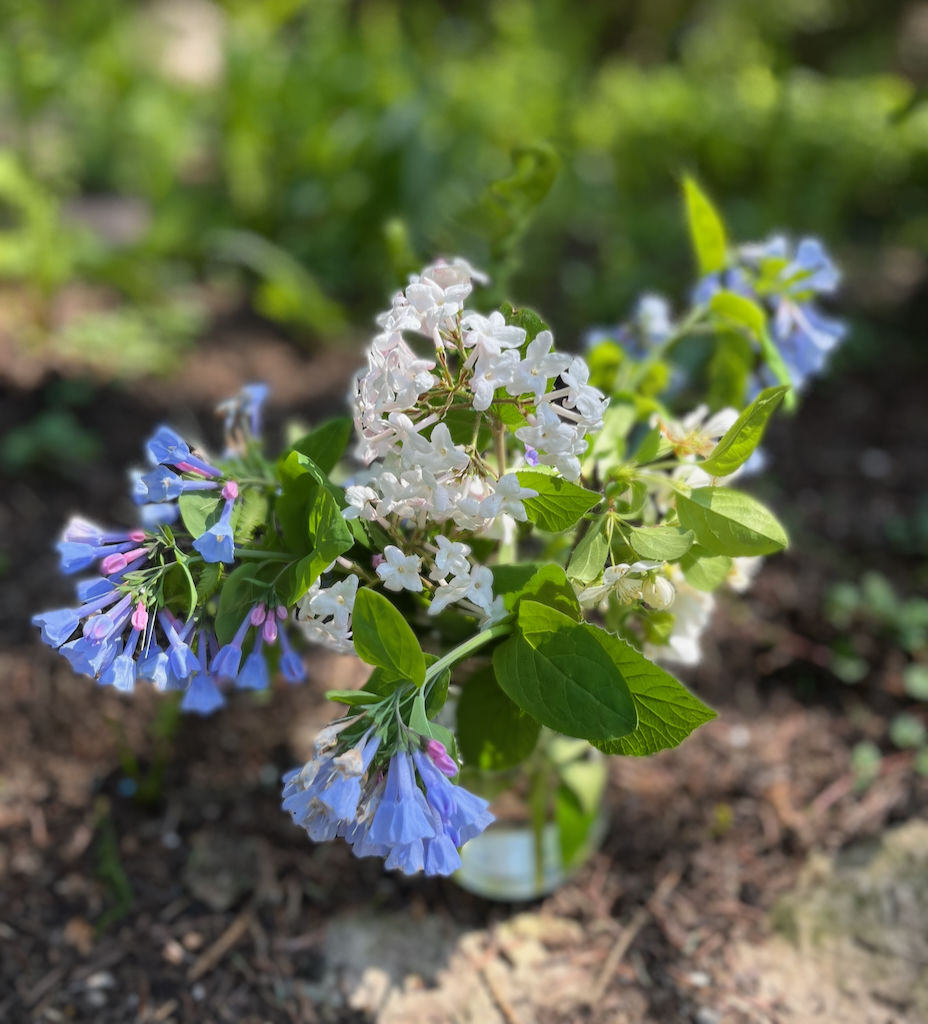
woodland bouquet: bluebell, viburnum, brunnera, flowering crab

in the house where i grew up, poetry was never far away. poetry was my mother’s native language. she awoke us with it. and recited it when we were sick in bed. she spoke of emily and hopkins as if both were neighbors down the lane who’d saunter by for tea and verse. amid especially harried afternoons, when the quintet of us were driving her mad, she’d tuck herself away in the living room and declare it off limits as she lit her rare cigarette, and cracked open a tome of poem after poem. indeterminate time later, she emerged resuscitated—by rhyme scheme or distance away from us, we never did discern (nor did it matter to us dare-not-trespass peepers who kept close and curious watch through the crack of the kitchen door).

most memorable of all perhaps (at least to my wee mind), was the occasional sunday morning recitation of lines i’ve long since etched into my heart’s smooth fibers. while missing sunday mass was never an option, the renegade in my mother was known to let loose sotto voce emily D’s rebellious defense of liturgical absence: “Some keep the Sabbath going to Church – / I keep it, staying at Home – / With a Bobolink for a Chorister – / And an Orchard, for a Dome —” 

so much of who my mother is is captured in those twenty-five words. therein lies the supernatural capacity of any poem that echoes across the landscape of our lives.

and yet, never did i imagine that grown-up me would so embrace my mother’s poetic passion. in a house where words and wit were play things, and my father’s witticisms kept us on our toes, it seems my mother’s way with words is the one that snuck in sideways. and stuck firmly to my ribs. to this day, it shakes me to my rafters.

i am drawn to the ineffable, the liminal, the say-it-slant; i am drawn to the knowing that fills in the silence, the epiphany barely glimpsed in passing. i ache to grasp the depths and heights that crowd the wordless void.

or, as my muse maria popova once wrote: “language is not the content of thought but the vessel into which we pour the ambivalences and contradictions of our thinking, afloat on the current of feeling and time. when the vessel becomes too small to hold what we pour into it, language spills into poetry. in this respect, poetry serves the same function as prayer: to give shape and voice to our unspoken and often unspeakable hopes, fears, and inner tremblings — the tenderest substance of our lives, to be held between the palms and passed from hand to compassionate hand.”

as the hallmarkian labeling of april as poetry month* (see below) is all but wrapped for the year, i thought i’d plop a few poetic musings here on the make-believe maple table, all snipped from my commonplace source, as a way of holding poets, poetry, and poetics up to the flickering light. 

this, then, is my ode to the awe and wonder that propels each and every line of poetry, and its power to catapult us into that which cannot be contained in any string of prose. herewith, a litany of poets (and a rare scholar) on the great work and mystery of poetry: 

jane hirshfield: “Poetry's work
 is the clarification 
and magnification 
of being.”
 

billy collins: “all babies are born with knowledge of poetry, because the lub-dub of the mother’s heart is in iambic meter. then, life slowly starts to choke the poetry out of us.” 

robert ultimo, a classics scholar who has taught the art and science of writing for the last quarter century, and now twice weekly sends brilliant missives via his Writing Smartly blog, put it pithily: “Prose wants to describe the husk, but poetry wants the seed.”

ralph waldo emerson: “For poetry was all written before time was, and whenever we are so finely organized that we can penetrate into that region where the air is music, we hear those primal warblings and attempt to write them down, but we lose ever and anon a word or a verse and substitute something of our own, and thus miswrite the poem.”

marie howe: “poetry holds . . . what can’t be said. It can’t be paraphrased. It can’t be translated. The great poetry I love holds the mystery of on being alive. It holds it in a kind of basket of words that feels inevitable. There’s great, great, great prose, gorgeous prose. You and I could probably quote some right now. Poetry has a kind of trancelike quality still. It has the quality of a spell still.

“I mean, maybe the first poem was a lullaby a woman sang to her child, the incantatory, “Everything is OK, everything is OK, everything is OK. I’m here, go to sleep.” Or we prayed for rain, or we thanked the Gods for the corn, or we sang to the deer we were going to catch. But it’s interrelational. It’s incantatory. It feels as if its roots can never wholly be pulled out from sacred ground.”

 t.s. eliot: “the great poet . . . should perceive vibrations beyond the range of ordinary men [and women], and be able to make [them] see and hear more at each end than they could ever see without [the poet’s] help. … It is therefore a constant reminder to the poet, of the obligation to explore, to find words for the inarticulate, to capture those feelings which people can hardly even feel, because they have no words for them; and at the same time, a reminder that the explorer beyond the frontiers of ordinary consciousness will only be able to return and report to his fellow-citizens, if he has all the time a firm grasp upon the realities with which they are already acquainted…

“The task of the poet, in making people comprehend the incomprehensible, demands immense resources of language; and in developing the language, enriching the meaning of words and showing how much words can do, he is making possible a range of emotion and perception for other men, because he gives them the speech in which more can be expressed.”

eavan boland, the great Irish poet, once said: “Poetry begins where certitude leaves off.”

and let us close with christian wiman, who gets the last but not final word: “Let us remember … that in the end we go to poetry for one reason, so that we might more fully inhabit our lives and the world in which we live them, and that if we more fully inhabit these things, we might be less apt to destroy both.”
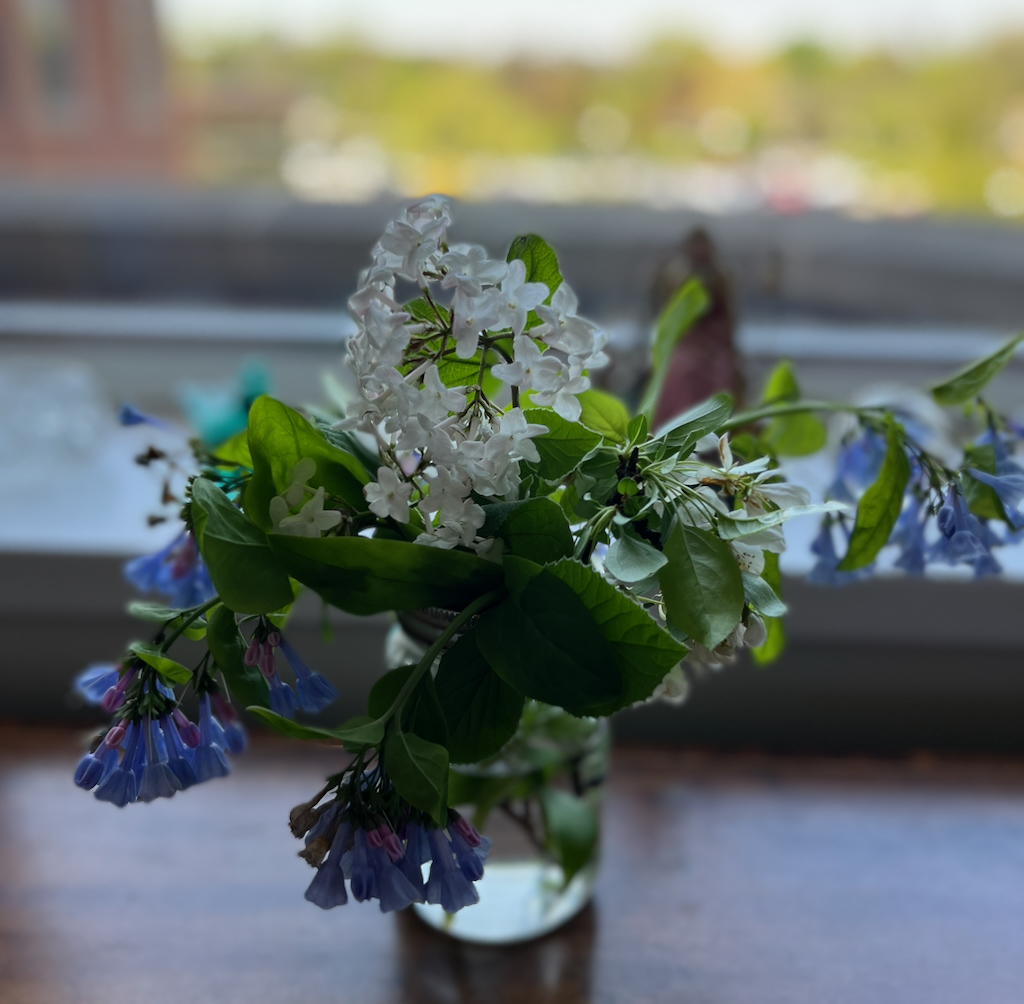
i brought the woodland to my mama, who over the decades has brought so, so much to me….not least, poetry. . .

are you inclined to poetry, or are you more cozy inside prose? either way, who sparked the earliest such seeds in you, and when do you first remember them sprouting?

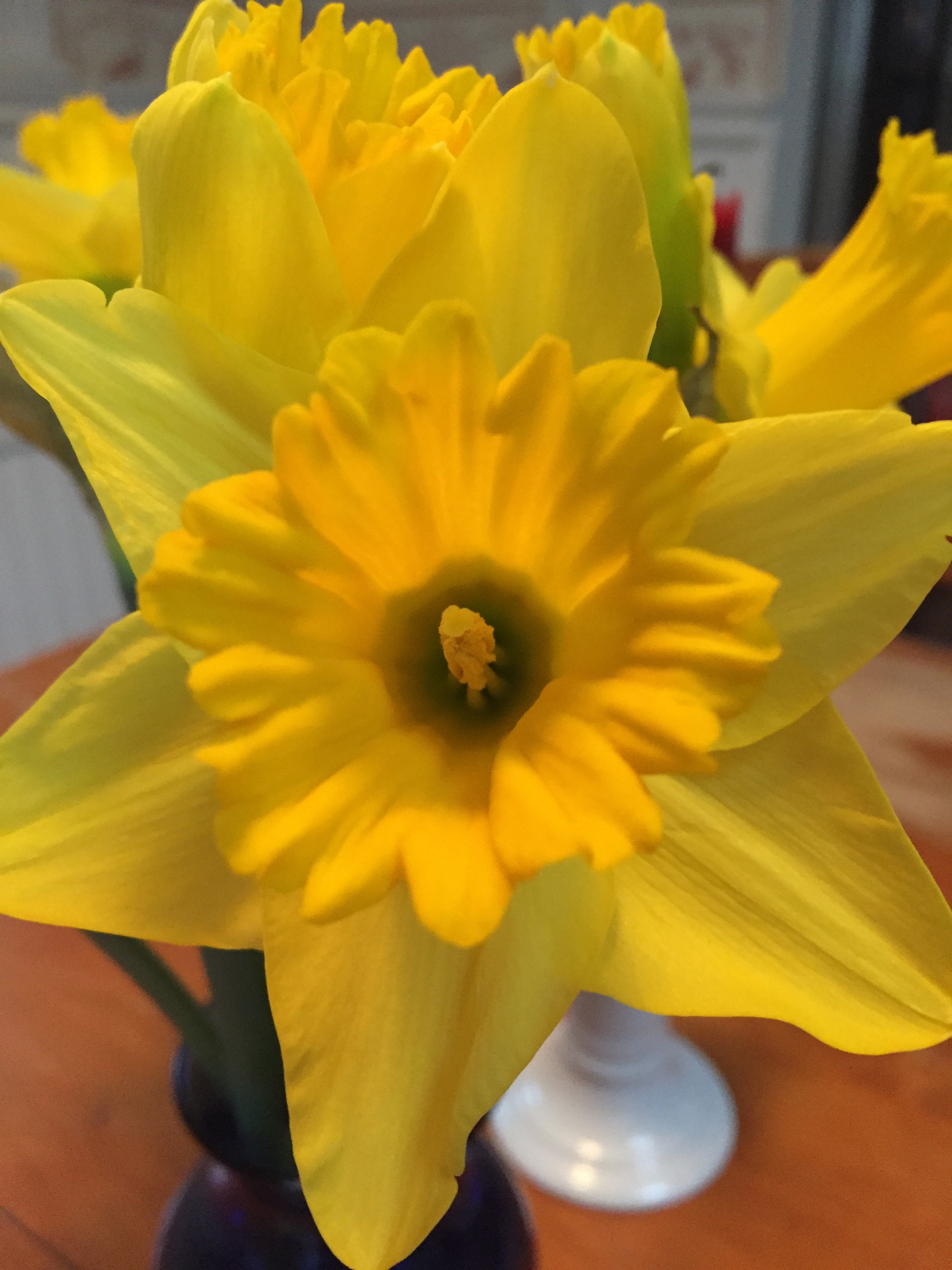
*about that poetic designation: should you be even a tad curious about how it is that the fourth month of the gregorian calendar found itself with the appellation national poetry month, the chair comes lurching to the rescue: twas the decision in 1996 of the academy of american poets who chose it for a host of reasons, not least being a poetic bit of playful towel-snapping contra to t.s. eliot’s claim that “april is the cruellest month.” pragmatically, the pedagogues among the poets decided the penultimate month of the school year was the perfect period to pack in piles and piles of poems. and should you be even remotely curious about which poem snares the title as most-read (at least in modern times), it’s claimed to be the ode to daffodils from ol’ will wordsworth, who, out wandering “lonely as a cloud” with his little sister dorothy in april of 1802, came upon a belt of yellow-bellied bloomers. exclaimed, he did:

“I wandered lonely as a cloud That floats on high o’er vales and hills, When all at once I saw a crowd, A host, of golden daffodils.”

perhaps you have another that you’d consider your very own personal most-read poem . . . (all contenders welcome!)
keeping company with waldo & friends

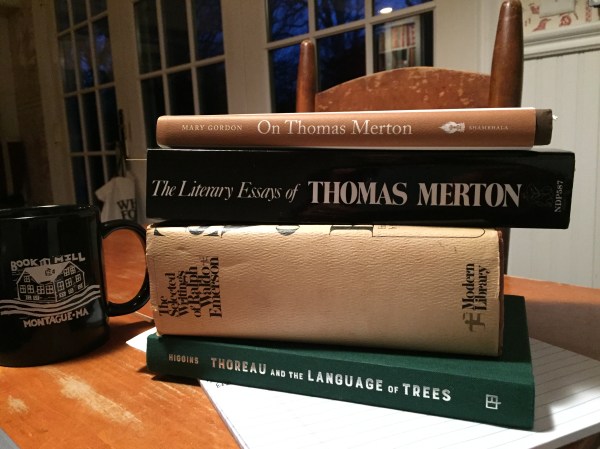
by the hour, i sit behind my wall of books, reaching from merton to thoreau to emerson, deeper and deeper into the folds of wisdom. it all started because of merton, aka brother louis. or maybe it all started because of mary O. or maybe it all started because of my mother.

my mama, who goes to mass every day of her life (a week ago, during the depth of the polar vortex, i called, and she was in her armchair at 8 o’clock sharp, watching mass on the telly. i shouldn’t have been surprised, and i wasn’t; but i melted a bit at her devotion), she must have been my first rabbi (rabbi in hebrew translates to “master,” or “teacher”).

she’s the one who woke me each morning, flinging the blinds, warbling lines from browning or dickinson — “God’s in his heaven, all’s right with the world” (browning, song from “pippa passes”); “some keep the sabbath going to church — / i keep it, staying at home — / with a bobolink for a chorister — ” (dickinson, 236).

she’s the one whose home movies always drifted away from the faces of her five cherubic children to the iridescent-blue indigo bunting, or the neon-red scarlet tanager darting in the boughs over our heads. some 60 years ago, when in a single day a realtor toured her through half a dozen lovely houses along chicago’s north shore, she bought the one with the most trees. and the creek gurgling in the woods across the street, and the green pond where the frogs croaked and the turtles sunbathed on logs, and the country club directly across the way, with its wide-open vista, promising her a lifetime of sunsets.

she must have been the one who first planted the seed. the seed that has grown and grown. the seed that now is a towering, undeniable, inescapable force, the one that draws me into the woods, under the star-stitched dome of midnight or dawn, the seed that draws me to windows where i can keep watch — on the birds, on the wind, on whatever is falling from heaven.

turns out i am hardly alone in this congregation of woods-goers. i’ve been hot on the trail of something called the Book of Nature, a text i’d never known by name, though i’ve been reading it since before i learned to assemble alphabet letters into words that came with particular sounds and meanings. i’d first learned of it — by name — when a rabbi i was talking to on the radio a few years back said of my first book, slowing time, “it’s midrash to the Book of Nature.” (midrash is defined as ancient commentary, often rabbinic, on Hebrew Scripture; it makes connection between text and lived reality, so says my all-things-jewish dictionary.)

hmm. i’d never known that a girl with a confirmation name, and a patron saint besides, could put a pen to midrash. but my main intrigue centered on this Book of Nature, a title i certainly wanted to get my hot little hands on.

over time, and through the years since, i’ve burrowed deeper and deeper into this ancient wisdom. there’s a whole theology that centers on the notion that the Book of Nature, unfurled at Creation, is God’s first holy text. (called the Two Book Theology, it’s the belief that God is revealed through a pair of complementary sources: the Books of Scripture and Nature; Genesis followed by Word.) this first text even has a latin name, librum naturae, and it traces through the millennia, an idea explored by the ancient “church fathers,” among them augustine of hippo, origen of alexandria, galileo, on through martin luther, emily dickinson, clear to merton’s gethsemani doorstep and mary oliver’s walks through the cape cod woods.

a fellow by the name of sir thomas browne, clear back in the 17th-century, aptly wrote: “there are two books from whence i collect my divinity: besides that written one of God, another of his servant, Nature, that universal and public manuscript that lies expansed unto the eyes of all.”

just a few years ago, pope francis wrote: “God has written a precious book, ‘whose letters are the multitude of created things present in the universe.'” and before him, pope john paul declared: “the visible world is like a map pointing to heaven… we learn to see the Creator by contemplating the beauty of his creatures.

all i knew was that i love nothing more than to stand, stone still, under the night sky, drinking in the moon and the glowing orbs of heaven. or to sit burrowed in sand and stiletto-sharp dune grasses along the shore, counting out the undulations of the lake’s watery pulses. or to marvel at the mama bird dutifully and vigilantly building her nest, one shriveled stick or grass or ribbon at a time.

i knew and know that i feel the hand of God there. feel the telltale tingle up my spine. i know God’s nearby when i catch the goosebumps breaking out along my arms and my thighs.

so, acolyte to Wisdom, i follow the trail deep into the pages where wisdom is recorded, where it’s spelled out in words that hold me like a vice, or would it be as a spelunker? this week found me in the Transcendentalists: first thoreau, then the master, r.w. emerson, who i learned preferred to go by his middle name, waldo. (henceforth, waldo it is.)

i’ll begin though with a few notes drawn from thoreau, first from richard higgins’ thoreau and the language of trees:

…The winter woods, especially, were a spirit land to Thoreau, a place for contemplation. He walked them alert to the mystical, more as supplicant than naturalist….All its motions… must be “circulations of God.”

and from thoreau himself: “if by watching all day and all night i may detect some trace of the Ineffable, then will it not be worth the while to watch?”

or: “my profession is to be always on the alert to find God in nature.”

maple trees, thoreau called “cheap preachers,” whose “century-and-a-half sermons” minister to generations. 

at his funeral, thoreau’s friend and teacher emerson said that despite thoreau’s “petulance” toward churches, he was “a person of a rare, tender, and absolute religion.” 

which drew me straight to emerson, absorbed for days in his signature essay, Nature. and these are but some of the notes i scribbled into my notebook:

Chapter IV Language:

Every natural fact is a symbol of some spiritual fact. Who looks upon a river in a meditative hour, and is not reminded of the flux of all things? Throw a stone into the stream, and the circles that propagate themselves are the beautiful type of all influence.

A life in harmony with nature, the love of truth and of virtue, will purge the eyes to understand her text. By degrees we may come to know the primitive sense of the permanent objects of nature, so that the world shall be to us an open book, and every form significant of its hidden life and final cause.

Chapter VII Spirit: 

[Nature] always speaks of Spirit. It suggests the absolute. It is a perpetual effect. It is a great shadow pointing always to the sun behind us. The aspect of nature is devout. Like the figure of Jesus, she stands with bended head, and hands folded upon the breast. The happiest man is he who learns from nature the lesson of worship. 

…the noblest ministry of nature is to stand as the apparition of God. It is the organ through which the universal spirit speaks to the individual, and strives to lead back the individual to it.

…Is not the landscape, every glimpse of which hath a grandeur, a face of him?

Chapter VIII: Prospects

The invariable mark of wisdom is to see the miraculous in the common.

no wonder mary oliver called herself a student, first and most, of emerson, who taught her — and us — that “the heart’s spiritual awakening” is “the true work of our lives.”

and with that i leave you to your own musings on the true work of our lives, the Book of Nature, and its most brilliant disciples and diviners….

who are your wisdom teachers, from the pages of the Book of Nature, or otherwise?

IMG_1276

one stack among many