pull up a chair

where wisdom gathers, poetry unfolds and divine light is sparked…

the cry of the october garden

october garden

the garden’s been hushed for months now. or maybe i’ve been too distracted to notice.

this week though, with honey-dappled light oozing across its fading, bent, and desiccating boughs and stems, with fronds of fern collapsed, splayed every which way, and nodding heads of hydrangea weighing down the branch, with my own soul ragged, in need of long slow immersion, i heard october’s garden call my name.

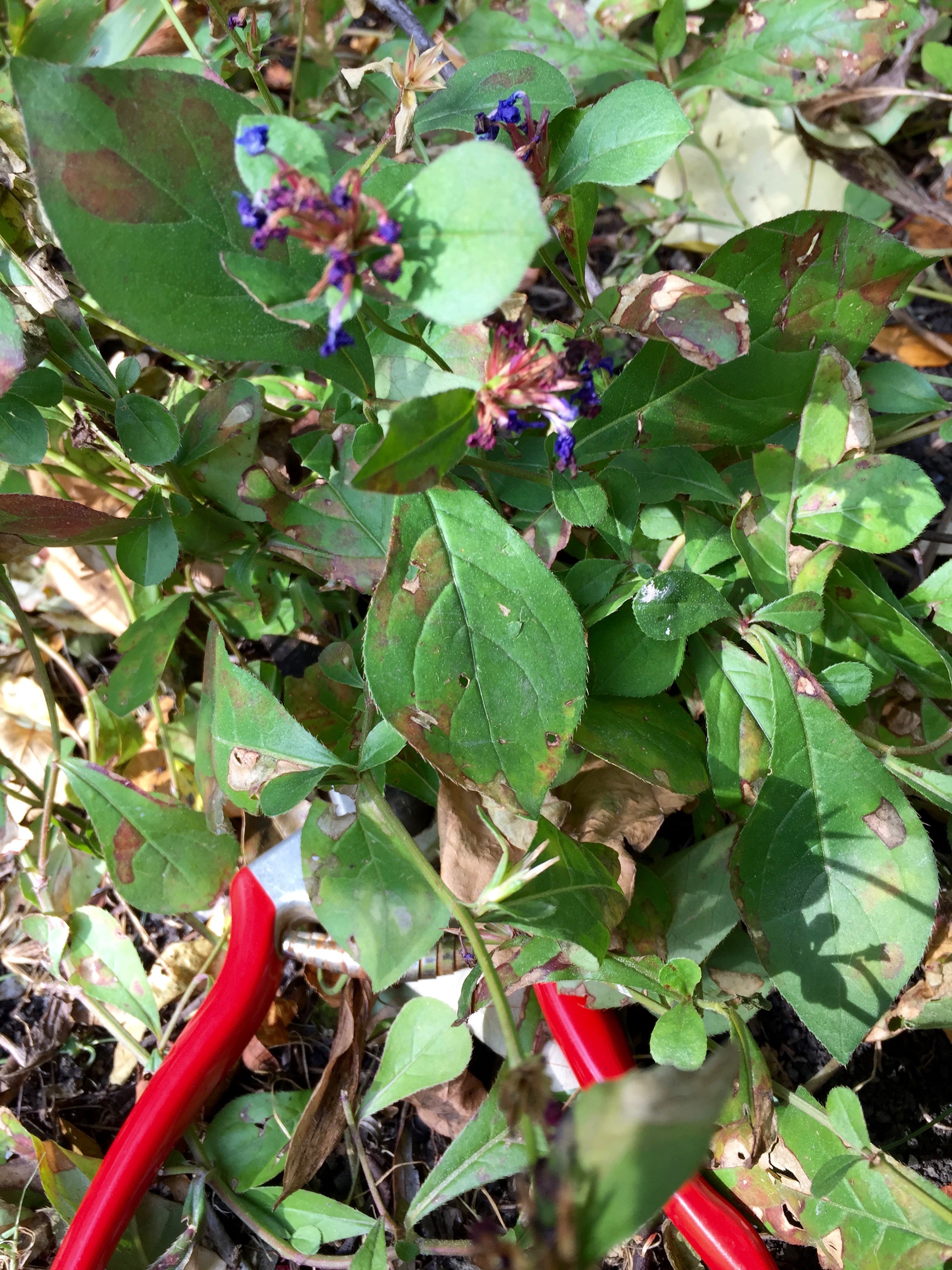
i’d been typing — or trying to anyway — when suddenly some drop of golden light, nectar from the heavens, caught my eye. i looked up, pushed out my chair, threw on my muck-about boots and grabbed the clippers on the way.

for a good long soak of an afternoon, i snipped and yanked and piled high the proof. my growing things, most of them at least, were forgiving; i apologized anyway. i’d left them all abandoned through summer’s height and frenzied weeks. they’d waited, as all good gardens do. they knew that, someday, i’d return. i always do.

and, apothecary on slender sturdy stem, the whole plot applied its balm. gentian blue dots, a sure cure for any faded heart, still winked at me. mopheads of hydrangea kept on their color show, turning lime to rose to tinged in plum, all but begging me to snip them at the neck and bring them in for winter. the black-eyed susan, once a perky swath of whimsy, now lay dark, nothing but the black-eyed button, landing pad for hungry songbirds, who peck and fill their bellies.

to be amid a garden in october is to catch up to the end of the story, to pay notice to what happens when the glory fades away, and yet another topography of beautiful is bared.

this is, after all, the wabi-sabi season, so defined by a farmer friend of mine as the season that pulses with the beauty of sadness and the sadness of beauty, the season that pulses with the poetry of imperfection and impermanence. nothing beautiful lasts forever, my garden whispers, so savor all of it, every drop of it, while you have the chance to reach out and rub your nose, your hands, your heart, in the whole of it.

essential wisdom, far beyond the garden.

i’m fairly certain it was the earthy, tactile element, the dirt under my nails, the pin scratches up and down my arms (october’s thorny roses are no less forgiving than the sturdy stems of june), that soothed me. the being out in golden afternoon, feeling the faintest ray of sun bathe across my sweatered back. there was healing in the garden stain splotting my knees, and surely in the armloads of autumnal offerings i hauled in the house, tucked in old vases.

once my shoulders ached, and my clipper hand throbbed, i kicked off my garden boots, and clambered back inside, content to watch the sunlight fade as i assumed my steady post just beside my chopping board and cookstove. in yet another iteration of surrendering to hands in lieu of cerebration, i turned this week to slicing, stirring, cracking eggs, and cranking up the oven. there was, there is, in the alchemy of the kitchen a sure cure for ails of the deepest-down ilk. stew and soup and pumpkin bars, i made them all this week.

i was drawn by battered heart, and sodden soul, to find my solace where the growing things live and breathe and surrender to the season’s close, and when the air grew chill, i warmed the rest of me — and those i love — by tending to the cookstove.

not a bad prescription, after all. welcome mat

where and how do you practice healing acts or arts?

when all else fails…turn to page 200

mac n cheese

for two decades now, ever since may of 1995 when i was plotting my firstborn’s second birthday fete, and i flipped open the pages of my monthly infusion of delicious, gourmet magazine — before it was ruth reichl’s gourmet magazine, before it was defunct, folded into the crypt of long-gone magazines, magazines that shaped our culture and then withered and died, the sad fate of so much of what’s printed in ink on the page — page 200, the page where the binding is coming unglued, the page crusted with splatters of roux, it’s been my no-fail, last-ditch, best-hope-of-filling-a-hole-in-a-heart-by-way-of-the-belly cookery map.

so it was yesterday, a crisp october day, when the sun poured in as if from a flask of molasses, so it was on a day when the boy who’d loped from the car at the school house curb was a boy with a leaden heart. he had so much homework, was so worried about homework, that he’d decided to skip the end-of-the-season soccer gorge on pasta and pizza. instead of hanging with friends, he’d decided he should come home straight after practice.

to make matters a tad bit worse, i wouldn’t be home when he got there. i try hard to keep my nights away to a serious minimum, but last night was a night i’d promised to be elsewhere, in a dim-lit watering hole and song hall, actually, reading words from a page for a very fine purpose, all to raise funds for a most noble cause.

i’m always torn when tugged away from my boys. and at the end of this week, this week when the lights in the kitchen never went out before midnight, because a young soccer player was trying hard to finish all of his homework, often accompanied by the sadness that lingers in our house, it was especially hard to be away.

so i reached for my holy salvation: the plainly-named “Baked Macaroni and Cheese,” ala page 200. it’s a cheesy-buttery bath stirred round and through tubes of wide-mouthed pasta, each tube filling with ooze as much as being wrapped in it. it vies, in our house, with bread pudding, as the neck-and-neck nos. 1 and 2 comforts on a spoon.

over the years, the making it — for me, anyway — is as soothing as it must be for my boys to polish it off in one sitting. assembling its components — the butter, the cheddar, the flour, the milk, the salt, paprika, bread crumbs, and parmesan shavings to finish it off — i slip into priestess mode. my old black cookstove — an industrial-grade contraption that somehow slipped into this old house in the 1970s, never to be removed — is my altar.

i begin my incantations and prestidigitations right there, where the flame is cranked, and the concoctions in my pots begin to bubble, not unlike vats of heavenly potions. with the oven cranked to 375, the kitchen begins to warm. everything about this kitchen ritual is warming. soon, my old sweater is off, and as i stir i imagine my sweet boy coming home to find the big white ceramic souffle dish perched atop the stove, my hand-scribbled note just to the side.

is there a more certain way to say i love you than to have cooked all afternoon? to have reached for the cookery shelf and pulled out the one thing a kid asks for on those nights when his sleepy head hits the pillow but the worries won’t be extinguished?

because a big old vat of mac n’ cheese wasn’t enough, not on this particular day, in the thick of this particular passage, i pulled out the produce bin and piled a mound of apples atop the cutting board. i chopped honeycrisp and granny smith, i didn’t peel — why bother? — and i tumbled the slices into the pot, added a splash of honeycrisp cider, a shake or two of cinnamon, and once again, applied flame to the equation. wasn’t long till the whole house was swimming in eau de apple and buttery-cheese. even the cat ambled back in from the garden.

then i set the table. is there anything that says i was thinking of you quite so quietly, certainly, as coming home to a kitchen table that awaits you, that has your very own napkin and napkin ring at the place where you always sit?

it’s the rhythms we carve into the grain of the day, of the months and the years — simple rhythms, unadorned rhythms, nothing so fancy as a napkin and fork at a place that is yours, set by someone who thought about how it might be to come home harried, and worried, and tired to the bone — that makes coming home feel as if someone just handed you your oldest, comfiest slippers. and a fuzzy sweater to boot.

i’d left the stove light on, and the mac-and-cheese under a foil dome, as i slipped out the door and turned the key. then, not a block from home, i got a message: the soccer player had decided, after all, to skip coming home. he’d hang out with the soccer team, inhale store-bought pasta and delivery pizza.

such is a mama’s existence.

so much for stirring and chopping, in hot pursuit of healing a tattered heart.

but here’s the holy truth: i was the one whose heart was soothed in the long hours of love at the cookstove.

and, besides, mac-n-cheese cold makes for excellent bedtime snack. when the lights go out at midnight.

what’s your when-all-else-fails cookstove concoction?

catching the elusive slipstream and other hints of holiness

angel

more than once this week, i’ve felt shivers run my spine. more than once this week, i felt myself suspended in some holy sort of hammock. i’ve giggled. and more than once, i’ve wanted to dash to the telephone, to call my blessed friend. and then, stopped cold, i remembered phone lines don’t go to where she is. wherever she is.

my friend died not two weeks ago.

but that didn’t stop me from feeling her as close to me this week as if we were, as we so often were, huddled on the couch, under the buffalo-check blanket that might belong in a horse barn, but kept us warm through many a long winter’s afternoon when, curled up with mugs of tea and bowls of clementines, we coursed across the landscape of our lives, our hearts, our souls.

death when it’s new can be like that. out of the blue you bump into the reality — a cement-block wall, almost — that the someone you want to reach for, the someone you’ve always reached for, isn’t there. it’s as if your mind is playing tricks with you, taunting, teasing, playing hide-and-seek. maybe it’s just me, but i push my imagination as far and deep as it will go, all but see and hear the someone right before my eyes. convince myself one day the phone will ring, and the someone will be there, and at last i’ll hear, “trick’s up. i was only hiding.”

but in moments when i wasn’t playing mind games, when i’ve been going about the business at hand, i’ve suddenly had a certain sense that something, some holy force, had slipped beneath me, inside me, and propelled me or the world around me in inexplicable ways. well, i’ve an explanation, but it defies logic, and laws of physics.

take, for instance, the fact that all summer i’ve been drudgingly tapping keys on my keyboard, slowly uprooting words from deep down underground. i’d type my way to the end of sentences, but really, i was all but lost. form was formless, and all swirled foggily around me. i was trying to find the words, the shape, the essence of some elusive book. i knew what i wanted it to be, but somehow i couldn’t find the path. i’d get distracted, spend long spells away from the keyboard. i started to think nothing would ever come. i thought a bit about my capacities for swirling foam in coffee at the local barista bar. maybe, after all, that was better use of my waking hours.

but then, this week, once again i sat down. opened up a document, one that had no name, and suddenly — slowly at first, but building in speed and force — i’d renamed it “chapter 1.” it’s finished now, and sits waiting on my computer. it’s been followed, swiftly, by chapters 2 and 3, now almost written down to the very last period.

where’d that slipstream come from, i wondered? i didn’t think too hard to pounce upon my answer.

and in another breathtaking moment of serendipity, a fellow i love, a post-college living-in-a-new-city sort of fellow, he was out and about recently, and struck up animated conversation with a lovely lass. they weren’t too deep into conversation before it was revealed that, out of all the souls who inhabit this giant metropolis, they both just happened to share in common a deep love for our beloved friend who had just died. the fellow had known and loved our friend his whole life long, called her his “spiritual godmother”; the lass was one of her devoted students, one of the very few she’d tucked tightly under her wing, imparting the intricacies of her craft even as her cancer spread and spread. the meeting of the two — the fellow and the lass — could not have been more random, impossibly so. and the depth of their first conversation was, apparently, the sort that glimmers on the prairie.

now i can’t claim to be one of those folks who frankly believes that angels have wings and hover over us. but i do believe in souls that never really fade, and i do believe in forces of holiness and miracle. i’ve spent decades trying to figure out just what happens when someone you love dearly dies. what happens after the last breath comes, and stillness fills the room? i promise to let you know when i nail that one. but until then, i’ll side with the folks who believe that holiness is a force of life abundantly present, and animating all the hours of our day. maybe the work to be done is on our side, maybe it’s about opening ourselves through a particular level of prayerfulness, maybe it’s about a soul so porous we’re a filter, a catch basin, for all that’s good and beautiful and buoyant. maybe thinking aloud about all this is the dumbest thing i’ve ever done. or maybe, in putting words to wondering, we might — together — stumble on some truth, some shimmering shard of wonder, of heaven tumbled down to earth.

i can only hope. and pray. and keep watch for the gentle brilliant touch of my beloved slipped-away friend.

as is so often the case, i had no intention to write a word of this. but the words came anyway. so here we are. i’d been thinking that i was so intent on getting back to chapter 3 and 4, i’d just post the latest edition of my chicago tribune roundup of books for the soul. that might have been the safer, wiser bet. or maybe not. a short bit of one of the reviews was cut for space, so i’ll post the link to the latest roundup here, and down below, i’ll include the unedited version of the first review, the glorious, The Grammar of God: A Journey into the Words and Worlds of the Bible, by Aviyah Kushner, which i loved.

soul-roundup-jpg-20151008

The Grammar of God: A Journey into the Words and Worlds of the Bible
By Aviya Kushner, Spiegel & Grau, 272 pages, $27

The highest praise for a book, perhaps, is tucking it into a slot on your bookshelf where you’ll always be able to effortlessly slide it out, lay it across your lap, and soak it up for a minute or a long afternoon’s absorption. The Grammar of God: A Journey into the Words and Worlds of the Bible, Aviyah Kushner’s poetic and powerful plumbing of both the Hebrew and English translations of the Bible, now rests in just such an easy-to-grab spot in my library.

In a word, it’s brilliant. And beautiful.

Kushner, a poet and journalist who grew up in a Hebrew-speaking home where dinner-hour debate often pivoted on the meaning of the Bible’s original Hebrew text, went off to the Iowa Writers’ Workshop back in the summer of 2002, and found herself in novelist Marilynne Robinson’s class, parsing the Old Testament. Kushner barely recognized the text in English translation.

Therein was launched a trek into language and belief that took Kushner around the globe. She draws on grammarians and lexicographers across the millennia to lay out this roadmap into the depths of sacred text. Not lost is her insistence that much is lost in translation, and even if you’ve no interest in religion, the linguistic excursion here is not to be missed.

Most essentially, Kushner lifts the veil for all of us who don’t know ancient Biblical Hebrew. She pulls us deep inside etymology and history and meaning. And as a Kirkus review so aptly put it, Kushner’s first book is, in the end, “a paean, in a way, to the rigors and frustrations — and ultimate joys — of trying to comprehend the unfathomable.”

how have you brushed up against the holiness of someone you’ve loved, no longer right here among us?

the candle burns

shivacandle

our house is blanketed in sadness. layers and layers of sadness. landscapes of uncharted sadness: a son without the father he adored, grandsons without the grandpa who told them knock-knock jokes and reveled in their every triumph. and all of us — since sunday, when news of one death tumbled atop another — without a lifelong friend who, across the decades, animated our dinner table, our hearts, and taught us fearlessness in the face of whatever life hurled our way.

in five short days, we lost two of the dearest souls in our deepest closest orbit.

and so, at our house, sadness ebbs and flows, one minute casting shadow dark and dense; the next, scuttling off, clearing space for light to fill the room. we are wrapped in varied textures of mourning — we mourn a life lived long, and another one snuffed out far too soon. grief catches us by the heart, not letting go. grief leaves us gasping. grief, as it so often does, so especially when it’s just cracked open once again, plays tricks and mind games; we snap our heads and imagine the voice, the someone we love, tumbling through the door, calling on the telephone, springing back to life inside our nighttime’s tossing and turning.

so the candle burns. it burns till the last one of us tiptoes off to bed, and from the moment one of us shuffles into the pre-dawn kitchen.

in its mystical flickering, no matter the shadow cast or beyond the snuffing out of sunbeam at day’s end, it holds me, presses its light against my heart, and reminds me, hour after hour, moment after moment, that souls burn on. that the essence of who we loved still fills the room, is still here to brush up against, to illuminate and magnify the beautiful and the broken.

i’ve never before had a shiva candle burning in my home. and i have found unexpected comfort, caress, in the faint light it casts, hour after hour.

the minute he tumbled in the door from the airport sunday night, my husband pulled from his pocket a small glass jar that held a candle, a yizkor candle, one his mama had handed him as he kissed her and said goodbye in the old white clapboard house by the pond in new jersey, where we had just been joined in a circle of prayer and poetry and remembering.

the candle was a jewish observance of death my husband intended to observe. he didn’t wait before reaching for the kitchen drawer that holds the matches. he struck the match, lit flame to wick, and began the prayer of mourning, the mourner’s kaddish.

the next day, a gray and misty morning, i called the synagogue to ask if they might have another candle, since this short squat one he’d carried home was only meant to burn for 26 hours. and i knew — in that way you know without words spoken — that my husband wanted longer, wanted flame to burn as long as it might light the darkness.

the synagogue had plenty. and so, with rain spitting down on me, i climbed the synagogue steps and stumbled into the embrace of our rabbi, who could not have been kinder, in handing me the candle, the prayer card, the book for the house of mourning. and, that night, when my husband with the heavy heart came home, we lit the seven-day shiva candle, the one that now is burning, that could be burning round-the-clock (except that we’re afraid — despite rabbinic insistence otherwise — of our house going up in shiva flames).

every time i swirl through the kitchen, there it is. flickering. when i’m alone in early morning darkness, there it is, casting golden glow across the maple table, illuminating one small corner of the room. so, too, after nightfall, when i’m the last one up the stairs, when darkness shrouds us once again.

it’s a simple remembrance, yet profound. once again, a quiet nod to the psyche and the soul. a timeless knowing that with death comes darkness, comes a time when one’s whole landscape shifts, and for a time, you cannot find your way. there is no compass out of grief.

not a night has passed in this long last week when our tenderhearted boy, the younger one, the one who’s never known death to brush so close against his heart, not one night that he’s not shed tears upon tears. he has sobbed. and shaken with sadness. so have i. i find myself awash in tears. out of the blue. unstoppable. there is no compass out of grief. no torch to light the way.

and yet, i catch a glimpse of the soft pure incandescence burning from the shiva candle, and i feel as if some tender soul has brushed up beside me. whispered. squeezed me by the hand.

we are cloaked in shades of sadness. we are re-charting the landscape, finding it filled with deep dark holes, ones we tumble down, ones that catch us breathless. we are reaching for the light. we are remembering. we pore over pictures, over words typed and texted just weeks ago. we riffle through our memories, our hearts.

the absence is vast, is limitless.

the soft glow of flame to wick — reminding us that the soul, like the flame, strives heavenward, brings light to darkness — it is constant, and it does not dim.

nor does our love for the ones we lost. may their memory be a blessing. forever and ever. amen.

i’d wanted so very deeply to write a love letter to my beloved friend now gone. but privacy was everything to her, and privacy i will preserve for her. i will, though, post a few pictures — ones already seared in my mind and my heart. two from years and years ago, the first time she came to meet little teddy, just newly born, and one she sent me just this past summer, from sunrise at the shore of lake michigan, where she’d gone for sunrise salutation. finally, because it’s out in the world, an audio tribute to my beautiful friend, from her dear friend, the brilliant writer, alex kotlowitz. savor these moments with my friend, and if you’ve a spare, offer up a prayer for her dearest tenderest circle, her beloved husband of 21 years today, and their two beautiful children, one of whom is the curly-haired beauty at the elbow of and cradled in his mama’s arms in the photos below.

cecimeetsteddy

beholding joy….newborn, unexpected joy….

cecijoy

marveling at the itty-bittiness of a newborn.

zenceci

sun salutation. illuminated in everlasting light.

in your hours of grief, what lit your way?

we remember them….

AZK

a beloved, bespectacled man died this week. my husband’s father. the original mensch. a man i most remember with his face crinkled by the folds of a smile that enveloped from chin to forehead, and, best of all, with a single tear trickling down his cheek from behind his tortoise-rimmed glasses. i see him at the dining room table, holding up a short glass of wine, as we sit down to bless shabbat — the sabbath — and i hear him reciting the Shehecheyanu, the jewish blessing for those rare anointed moments in time, when, as the prayer says, we thank God for enabling us to reach this sacred occasion.

my father-in-law — a man so tender to me you might never have guessed how hard it was for him, early on, that his only son was in love with and marrying a catholic, even an irish catholic — died on the eve of Yom Kippur, the holiest of holy days, the day of atonement, of fasting, the day of judgement. a day when jews (and those who love jews) wrap themselves in their deepest prayers, and the prayers are laced with unflinching references to death, to dying, to lives well lived — or not. who shall live and who shall die? who shall perish by water and who by fire? who by sword and who by wild beast? on and on the prayer pulses through the litany of life’s endings, not a one of them softened for easier going down.

the prayers, some of them this year, made the raw ache of this brand-new death even harder. they stung, some of the words, so i squeezed my husband’s hand as tightly as i could, and i kept watch. i watched his face, in profile, through the hours of prayer; kept watch for tears in his eyes, for that faraway look, for the moments when he swallowed hard. i kept watch on the visage of grief, and imagined the landscape inside.

but there came a moment in the day of atonement prayers, toward the end of the day, when the sun was setting, and the shafts of light streamed in from the west, turning the sanctuary from blinding gold to rosy. it’s a part of the day of prayer called the memorial service, and tradition has it that children are kept outside — too sorrowful. the words and the prayers are tinged with mourning, with longing for lives lost. but amid the sadness, there is a prayer i have always loved, a prayer that wraps its words around me like the softest afghan, a prayer that makes me feel the brushstroke of God, quite honestly. it is pure embrace of a prayer. and it has never held me more tightly, nor more tenderly.

it doesn’t seem to have a name, but the refrain is “we remember them,” so you might call it the “remember-them prayer.”

what i love most is that, like so many jewish prayers, it pulses with a deep interiority. it rustles through the soul. it captures the quiet of the human heart. it breathes into the crevices of our consciousness. it understands perfectly how it is to be alone with your grief, with your longing, and to feel your heart swell and spill, as that rising up of love and loss, intermingled, so defines grief. and it grasps for breathtaking pauses in the beauty of the passing year, in the turning of the seasons, and it anoints those moments, those unfoldings, as vessels for remembering, for loving, for stepping bravely into a world without the ones who have defined us from the beginning of our time, or for as long as we have loved them.

i offer here, the “remember them” prayer:

In the rising of the sun and in its going down, we remember them.

In the blowing of the wind and in the chill of winter, we remember them.

In the opening buds and in the rebirth of spring, we remember them.

In the blueness of the sky and in the warmth of summer, we remember them.

In the rustling of leaves and in the beauty of autumn, we remember them.

In the beginning of the year and when it ends, we remember them.

When we are weary and in need of strength, we remember them.

When we are lost and sick at heart, we remember them.

When we have joys that we yearn to share, we remember them.

So long as we live, they too shall live, for they are now a part of us, as we remember them.

—Text by Rabbis Sylvan Kamens and Jack Riemer from Gates of Prayer, R.B. Gittelsohn

grandpa art with first two of five grandsons

grandpa art with first two of five grandsons

the truth of today is that i am holding tight to prayer for one other someone i love tenderly and dearly. someone with whom i have shared deeply sacred moments, and hours of animated conversation over the decades. hours curled up on a couch, afghan covering our feet. hours in the kitchen. hours at the dinner table. hours walking in the woods. hours cradling our newborns. hours adoring our growing and nearly-grown children. hours marveling at her energy, her spark, her heart that knows no bounds. she is still here, but already i am remembering. and loving till the end of time. 

AZK at the Reagan White House, pen poised, question ready to pounce

AZK at the Reagan White House, pen poised, question ready to pounce

and this just in, my beloved father-in-law, the son of an immigrant baker who rose to become editor and president of a new jersey newspaper, the one that covered the news of the jersey shore, read the forward, the legendary jewish newspaper every day for years and years (it was originally written in yiddish). so my husband, who wrote a beautiful obituary for his father, rewrote one with a yiddish twist for the forward. and it runs there, as of minutes ago. the headline: Arthur Z. Kamin, Trailblazing New Jersey Journalist, Dies at 84. for my tenderhearted newsman of a father-in-law, this is the much deserved trumpet blast at the close of his most beautiful life.

this day, i send deepest love first to my beautiful beautiful mother in law, and to my blessed sister in law who i will soon be with. their loss is vast and without borders. hold them, and my sweet blair, and will, and especially little teddy whose tears will not be stanched, in your whispered prayerful hearts. 

and here’s the question of the week: what words bring you comfort when you are aching in sorrow?

she asked for a poem

mary oliver poem

she asked for a poem, my beautiful friend did. she asked for words. she asked for my voice.

she asked so that “at certain times,” in the dark dark hours that come when you are lying in your bed, or curled on your couch, when the knife-to-the-gut of cancer won’t stop, when you tremble deep down inside, when all you want is to wail but you can’t, she asked “to be soothed” by the sound of the human voice rising and falling and wrapping around letters and lines and syllables and silence and words, each word a vessel of hope, a finger to grasp, the next best thing to morphine. or, maybe, better.

she asked me to pick out a poem, to read it, to record the sound of my voice. “not STAGE PERFORMANCE,” she wrote, just “ntural,”she typed, her fingers fumbling for keys, “poems red by my friends.”

it was a blanket of sound she was stitching together, my friend whose world has always been about sound. she’s gathered sound all around the globe, on nearly every continent. she’s woven sound into story, story that shattered hearts, peeled back truths, shone beacons of light. sound that reached out through the squat little box that sits on the kitchen counter, or the flat rectangular one that blinks red numbers just beside my bed. sound that could draw me to the ends of the earth, or into the depth of someone’s long lonely walk through a mountain pass, or down a dusty country road. it might be the sound of a katydid. or a jackhammer. or maybe the cry of a mother who’s just buried her child. it might be the whistle of wind she records. or the story in spanish of someone who’s been lost for too long.

her life has been a tapestry of sound, one that my friend has pieced together with fierce intelligence, unparalleled heart, and a light in her eyes that will never go out.

so, in her darkest hours, in the hours when the walls seem to be squeezing in from all sides, she asked for more sound. for the sound of the human voice, doing what it most sacredly does: putting breath to the balm that is love, that is tender and dripping with mercy, that heals, always heals, and that just might be the last earthly tie, one heart to another.

it’s no mystery why mamas sing lullabies to their babies. why mamas turn pages of storybooks. why mamas make “mmm” sounds and sigh to their wee little newborns. the human voice is breath + vibration + heart, is sound put to flight. the instrument of that flight might be a screech, or a whisper. it might be vicious and crack in half the heart of the one who hears it. or, in the case of my friend, it might be the best shot for soothing, for wrapping a blanket, a compress, of undying love.

and, yes, it might be a poem. the healing power of the hard-chosen word, words plucked from the star-stitched heavens, beauty and heartbreak distilled. that’s poetry. and, no, it won’t cure cancer, certainly not. but there are ails along the way that poetry — a poem read aloud by someone you love — will always be able to heal.

it will break through the canyon of fear and of emptiness. it will cradle the tired. and, as best as is possible, it just might dull the ragged edge of the pain, and, maybe just maybe, soften the suffering for as long as it takes for the poem to be read and maybe to linger.

i knew right away the poem and the poet to which i would put my breath and my heart: mary oliver. “praying.” it’s the poem i tucked on the very front page of my very first book. it’s a poem about paying attention, about patching together a few simple words, nothing elaborate. it’s about prayer not being a contest, but a doorway into thanks, and “a silence in which another voice may speak.” it’s about stitching together prayer, and it’s something my friend and i have talked about — many times, once while wandering about a wooded magic hedge.

i knew, too, right away, just where i wanted to read it, the poem about prayer — amid my late-summer garden, so the words of mary oliver would be enfolded, would be punctuated, with the sounds of this summer drawing to a close: the few cicada still buzz-sawing, the blue jay who squawks, even the wind rustling through the boughs of the willow.

i whispered a prayer, took a breath, and pushed the little red “record” button.

my friend asked for a poem. i sent her the pulse of my heart, and a sound-swatch of the late summer garden.

here’s how it sounded:

i wanted to quietly lay this on the table because i know that among the chairs circled here, there are hearts intent on finding ways to bring healing to the world, and i thought it the most beautiful quiet creation, the notion of my friend to weave together a patchwork of poems, all in the voices of friends, all for the purpose of soothing. it’s a simple gift, a pattern we can all trace and retrace, should the need arise. it might even be a baby gift, a gift at the launch of life, when you wrap not just a favorite picture book, but the sound of your very own voice reading it, turning the pages. the gift of your voice is one no one else could ever give. and it comes from the depth of your heart. priceless.

because i happen to know that mary oliver doesn’t want anyone printing her poems anywhere without permission (i asked for and received full permission for the epigraph of slowing time), i am honoring mary’s heart and will not print it here, although it is in the photo above. and you can read it yourself if you open the book to just past the dedication page. and, miracle of miracles, i figured out how to drop a line of poetry reading onto this latest meander. wonders never cease. 

so here’s the question: if someone you love asked you to read a passage or a poem, what one would you choose?

and now we pause for awe…

DSCF1354

the lamb has been ordered. the prayer books, slipped from the shelf. soon, i will slice the pomegranate and begin to count the seeds. are there really precisely 613, the same as the number of mitzvot, or commandments, as the sages taught, as i was told in whispers in a kosher kitchen once upon a time?

i have been curious, asking questions, burrowing into the holiness of the new year, the jewish new year, rosh hashanah, ever since i stumbled on that fine bespectacled fellow in the newsroom so long ago, decades ago now. and because i come to this beginning — this pause to behold the wonder of creation, original creation — with inquisitive heart, because question upon question tumbles before me, because one leads to another and another, i can’t help but be drawn deep into what these days offer: these days offer awe.

they are called, quite precisely, the Days of Awe.

awe, my dictionary tells me, is “a feeling of reverential respect mixed with fear or wonder.”

awe, my etymologists* tell me, has deep roots in fear, and traces back to circa 1300, aue, “fear, terror, great reverence,” earlier aghe, circa 1200, from a Scandinavian source, such as Old Norse agi “fright;” from Proto-Germanic *agiz- (cognates: Old English ege “fear,” Old High German agiso “fright, terror,” Gothic agis “fear, anguish”), from PIE *agh-es- (cognates: Greek akhos “pain, grief”), from root *agh- “to be depressed, be afraid” (see ail). the current sense of “dread mixed with admiration or veneration” is due to biblical use with reference to the Supreme Being. To stand in awe (early 15c.) originally was simply to stand awe. Awe-inspiring is recorded from 1814.

in my own dwelling inside these days of awe, i don’t think too much about fear. i tend toward wonder. the God i know and sidle next to is not one who makes me tremble. truth is, i’m most myself when i draw deep into the hollows of God. when i feel myself wrapped in the arms of the one who gave me breath, and question, and proclivities for awe.

because this pause for holiness is at once still new to me, and now familiar, because in many ways it’s always felt as if i’d been waiting for reason to hold up these days, to hold up these autumn’s-coming hours, i walk through them with all pores open. i love the pungent notes that will rise up from the pot on the stove, the one where lamb simmers alongside onion and celery and garlic, before the apples and raisins and cinnamon settle in. i love the way the molasses morning light pours across the page. i love each sentence i find on the page, especially the ones that startle me, give me pause, give me much to think about during the long hours in synagogue, during the long walks that will punctuate the pause, the anointing that makes the days of awe unlike ordinary time.

because i am always, always drawn to the sage of all sages, abraham joshua heschel, i pulled him, too, from the shelf this morning. i’ve been filling the shelves with heschel for a long long time. even before i knew i’d be the one to share my husband’s bookshelves.

this morning i found this from heschel, along with the pages of prayer that we will tuck under our arms and carry to the pews where the prayers will come. because it speaks to all of us who are inclined to turn in, to refuel in the depths of quietude, i share these fine heschel thoughts as something of a blessing for these days when we pause for awe.

here’s heschel, from “On Prayer,” found in the collection, Moral Grandeur and Spiritual Audacity: Essays, by Abraham Joshua Heschel, edited by Susannah Heschel (Farrar, Straus and Giroux, 1996):

Prayer is not a stratagem for occasional use, a refuge to resort to now and then. It is rather like an established residence for the innermost self. All things have a home: the bird has a nest, the fox has a hole, the bee has a hive. A soul without prayer is a soul without a home. Weary, sobbing, the soul, after wandering through a world festered with aimlessness, falsehoods, and absurdities, seeks a moment in which to gather up its scattered life, in which to divest itself of enforced pretensions and camouflage, in which to simplify complexities, in which to call for help without being a coward. Such a home is prayer. Continuity, permanence, intimacy, authenticity, earnestness are its attributes. For the soul, home is where prayer is.

may you find your way home in this sacred span of time, the one that unfolds across the coming hours, the ones i’ve come to know and love as the holy Days of Awe, when i bow my head, my heart, my soul, and pulse with the wonder of creation, and my one small moment to revel in all its glories.

how do you pause for awe? who is your trail guide across the landscape of prayer?

*my etymologists: online etymology dictionary

never again, we promised

little boy heartbreak

i don’t often bring world news to the table. not because i don’t pay attention to it each and every day. mostly because most of the time the holiest way i know how to live is to saturate the moment, the space before me, with all the heart and soul i can muster.

but there are moments and images that shatter. that land on my kitchen table with the plop of the morning’s newsprint. that stop me cold in my tracks. that propel me to drop to my knees, or tumble me out the door, where i stand beneath heaven’s dome, and i open my heart and my prayers, and i beg for an answer: what can i do? what can we do? how can we gather up this suffering, how can we put balm to the wounds of the world, how can we heal the broken children, broken dreams, broken hearts?

dear God, how can we make a drop of a difference?

so it was when i saw the photo of the turkish policeman lifting the little syrian boy who had drowned in a moonlit sea. drowned when a boat built for 10 had been loaded — overloaded — with 17, too many of them little children. not long after setting out across the aegean sea, escaping from the war-torn hell that is syria, hoping to make it to kos, the island off greece, the little boat capsized, and 12 children, aged nine months to 11 years old, were lost, drowned in the dark, dark waters.

i’d seen the photo the day before of the limp little boy, face pressed against the sand, bare little legs, sensible shoes buckled, still buckled, after he’d washed to shore.

1548

and then the next morning’s news — on the front page of the wall street journal, a paper held in the hands of decision makers around the U.S., around much of the world — showed the next frame in the story: the turkish policeman lifting, cradling, the little boy. the legs limp, bent at the knee, a little hand folded across the little boy’s tummy.

little boy heartbreak

dead and alone at the edge of the sea, chased away by a war that won’t stop.

little boy, being lifted too late.

and so we need to pay attention, all of us.

amid the first light of dawn, i offered a prayer for the little boy, and all of the others.

truth is, i don’t know what to do, and my prayers feel too hollow. not that they’re not prayed with fiercest urgency. but what i want is to airlift myself to the syrian shore, where throngs of terrified mothers and the children who cling to them are emptying their pockets and purses of whatever currency they can manage to scrounge, climbing into rickety boats, and setting sail under the light of the moon that glistens across the water, and falls, too, across my backyard, falls across my collapsed black-eyed susans and the anemone that nod through the night. (is there not some mystical unifying force — lunar pull — as the beams of the same gibbous moon shine down on all of us, syrian refugees adrift on the sea, and, halfway across the very same globe, our own ramshackle gardens?) i want to walk through the train station of budapest, where babies are cradled against mamas’ chests, tucked under arms, made to sleep on the hard station floor, or out in the city square, where one family — a syrian refugee father, his wife, and their baby — threw themselves across the train tracks in protest, and would not be moved. i want to reach out a hand, offer my home as a place to sleep and eat and be safe, find their bearings in this terrible world that’s chased them from their home, their life, the world as they knew it and loved it.

i’m certain i sound naive, my too-simple solution, my impulse for healing the wounds of the world. but how can we believe in the power of love, the gospel of love, and not believe in trying?

so what will we do, those of us captured by the image of the drowned little boy, haunted all day by the shrieks followed by silence?

there is a river of humanity — women and children and the men who love them — pushed from their homes; rickety boats succumb to roiling seas, and trains refuse to budge, won’t carry the war-torn to safety. the world is watching. we have promised and promised again: we won’t stand back and watch horrors unfold.

horrors are unfolding. voices are crying.

never again, we promised. so how are we keeping our promise?

the question is literal as much as rhetorical, what can we do? what wise response might we muster?

the book bench at summer’s close

book bench august

as this summer draws to its quiet close, there tiptoes in this latest roundup of books for the soul — from the pages of the chicago tribune, where i cull through a stack of offerings every month. this lands in my mailbox at a moment when i too am feeling quiet. in this old house, we’re sinking back into the sacred rhythm of whispered dawn followed by momentary rustle as that new-to-high-school boy is shuffled out the door. then it’s quiet again. for too-short a spell.

before the pace picks up — or maybe to keep it at bay — i’m headed out to my book bench to soak in the succulence of summer’s end. here’s hoping you, too, have a quiet place to curl into human comma, turning the pages perhaps of a book that fills your soul. here, a few titles you might want to slip into your book bag. or ferry to your favorite reading nook. no matter your choosing, may you be blessed abundantly as we reach the summer’s closing chapter…

from the pages of Printers Row Journal, the Chicago Tribune’s literary supplement…

soul roundup august

Spiritual roundup: ‘Encyclical on Climate Change and Inequality’ by Pope Francis, more
By Barbara Mahany

Encyclical on Climate Change & Inequality by Pope Francis, Melville House, 167 pages, $14.95

Naomi Oreskes, professor of the history of science at Harvard University, begins her introduction to this particular printing of Pope Francis’ latest encyclical by reminding us “(h)istorians looking back often recognize turning points, but ordinary people living through them rarely do. Sometimes, however, a book catalyzes thought into action.” She goes on to count “Uncle Tom’s Cabin” and “Silent Spring” as two such masterworks. And then she deftly tucks “Encyclical on Climate Change & Inequality: On Care for Our Common Home” onto that same rare call-to-action bookshelf.

As it should be.

This breathtaking amalgam of urgency and poetry mines the spirit and appeals to the moral core. Billed as the pope’s pontifications on the environment, it is in fact a sweeping letter addressing a spectrum of global sins, not the least of which is summed up in Francis’ declaration that “(t)he earth, our home, is beginning to look more and more like an immense pile of filth.”

That a secular publisher, Melville House, chose to print in its entirety the papal document — termed by The Guardian “the most astonishing and perhaps the most ambitious papal document of the past 100 years” — bespeaks its relevance beyond the walls of the Roman Catholic Church. Where it stirs the soul, though, is in its majestically crafted sentences that wholly illuminate the understanding that nature is “a magnificent book in which God speaks to us and grants us a glimpse of his infinite beauty and goodness.”

Coupled with the pope’s insistence that pillaging the planet exacts too costly a toll on the world’s poor, this work drills home the plea that we “hear both the cry of the earth and the cry of the poor.”

Map: Collected and Last Poems by Wislawa Szymborska, translated from the Polish by Clare Cavanagh and Stanislaw Baranczak, edited by Clare Cavanagh, Houghton Mifflin Harcourt, 447 pages, $32

 
When awarding Wislawa Szymborska the Nobel Prize in Literature in 1996, the Nobel commission called her “the Mozart of poetry.” But they didn’t stop the invocation there, adding that her elegant, precise works held “something of the fury of Beethoven.”

All of which is to underline the supreme sadness that one of Europe’s greatest recent poets is not better known this side of the Atlantic. “Map: Collected and Last Poems” could right that.

Here, for the first time, is the English translation of all of the poems of Szymborska’s last Polish collection, including previously unpublished works. In all, “Map” gathers some 250 poems written between 1944 and 2011.

While Szymborska, who died in 2012, focuses her attention on quotidian subjects — an onion, a cat — she plumbs them to probe life’s big questions — love, death, and passing time. And while she might not be as widely read in America as poets Mary Oliver and Mark Strand, her words bore deep into a shared soulful landscape. She is poet serving as spiritual guide.

Consider, for instance, this one stanza from the poem “Nothing Twice”:

“Why do we treat the fleeting day/ with so much needless fear and sorrow?/ It’s in its nature not to stay:/ today is always gone tomorrow.”

Is that not a call to savor the one holy hour that is upon us? To not fritter away a single day?

We can only hope that hers becomes a household name, in any house that believes poetry is direct line to the depths of the human spirit. This tome is the place to begin.

Letters from the Farm by Becca Stevens, Morehouse, 160 pages, $18

“Letters from the Farm: A Simple Path for a Deeper Spiritual Life” is one of those quiet books that slips across the transom. You couldn’t predict from its cover — nor from the measure of its page count — just how much it holds inside. You needn’t read too far to realize its heft.

Stevens is an Episcopal priest and the founder of Thistle Farms, a community of women who have survived sex trafficking and addiction. Rooted outside Nashville since 2001, it is in fact a farm, one where herbs and teas and thistle are grown and made into bath and body care products distributed nationally. And it is from this plot that Stevens reaps much wisdom.

Her redemptive truth: “Love heals.” She writes: “I’m not called to change the world. I am called to love it.”

It’s the take-your-breath-away simplicity of Stevens’ letters that makes you take sharp notice. Count her emphatically in the Anne Lamott tradition of unexpectedly walloping you over the head, or in the heart, with a sentence so profoundly wise, so steeped in substance, you could pause and spend a few days burrowing into the truth of it.

Her stories from the farm — and from her travels to Africa and around the United States — are raw and rugged. When she writes of a woman locked in a lightless closet for four months, or mentions another woman who slept in a bathtub, night after night, to avoid “being raped before sunrise,” she stirs a knowing grittiness into what she calls her stack of “love letters to God.” Her prose unsettles in the most profound ways. And that is a very good thing.

Barbara Mahany is the author of “Slowing Time: Seeing the Sacred Outside Your Kitchen Door.” Twitter: @BarbaraMahany
Copyright © 2015, Chicago Tribune

praise be to youyet another lovely edition of the pope’s encyclical arrived post-deadline, but it’s one worth considering. footnotes unspool across the bottom of each page, and, as with the melville house edition, (above), it’s an exact reprinting of the original, pressed between hard-bound covers.

“Praise Be To You: Laudato Si’ On Care for Our Common Home,” by Pope Francis (Ignatius Press, $14.95)

and what might you carry to your book bench?

all’s quiet…sigh.

allsquiet

the last footsteps have trailed out the door, down the walk, and into the alley. it’s barely half past eight. and i am blanketed, as i’ve been the last two days, in a sumptuous, seep-deep-into-my-pores afghan of quiet. it’s not silence, for there’s a clock ticking just inches away, and there’s a pesky mower off in the distance. but not even the wind is whirring. and the hum of the fridge fades into not much notice.

quiet to me is essential, is holy. is where the whispers and dreams slip in, unannounced. where they sift and drift and catch in the eddies of my soul. where they chase away the emptiness that comes from too much too much. quiet is the elemental contemplative bedrock from which my chalice is filled.

and i’ve been waiting for this, waiting for the curative tincture of being home alone, with hours unclaimed, hours unfurled in the timelessness of morning, followed by afternoon — quiet tumbled softly on quiet.

it’s the glorious gift of back-to-school, that cold shock at the end of summer when alarm clocks start clanging before 6 a.m. and the kitchen counter becomes a short-order diner, with PB&J slapped up on one end, and waffles and berries dumped on the other. more often than not, there are exhortations to hurry, and the minute-by-minute bellowing as one of us — that would be me, but of course — broadcasts the unflagging advance of the minute hand, slowing for no one.

i sometimes forget, in that deep down sort of way, how very much i need quiet. depend on it. how it’s neck and neck with oxygen in the shortlist of things that keep me alive.

yet, all of a sudden the other morning, not long after the last shoe walked out the door at 24 minutes past seven, i felt as if i’d just been submerged in a velvety bath, maybe even one spilling with lavender-scented bubbles, and for the first time in months, i felt my deep-down hollows filling in, filling up. you know the hollows, the ones etched and stretched over time, the ones that come without notice, worn down by weeks of helter-skelter not knowing what in the world to expect of a day — who would wake up at noon, who would want breakfast at 2 in the afternoon, and who suddenly needed a ride to the far end of kingdom come. those sorts of upside-down days are the bread-and-butter of mama-hood. it’s all topsy-turvy, all the time. you hang on by a cord, a frayed cord, a cord that just might snap without notice.

you weather the whirl. you look down and see that one foot is galloping (barely) behind the other, trying hard to keep up. you fall in bed at night and wonder why your bones let out a sigh. but since it’s all punctuated with those drippy peaches, and the sand between your toes, and black-eyed susans ad infinitum — the sweet parts of summer — you pay little mind.

and then the quiet comes. it slithers in through the screens still in the windows, it taps you on the shoulder, or more aptly, the heart. and suddenly, for the first time in weeks, you perk up your ears and you hear only the sounds of an old house breathing.

maybe it’s something to do with the light, the molasses-tinged light that drips across the kitchen table this time of year. this holy blessed born-again time of year.

i am, this hushed late-august morning, breathing again. breathing deep. i am savoring, relishing, the rare and blessed gift of soft, slow, deeply quiet time.

and i am whispering — quietly, quietly whispering — my most certain and soulful thanks to the heavens from which all this comes.

i’d thought i might write light of heart this morning; i’d felt that way the past couple days. but then last night something bumpy happened, and my heart doesn’t feel quite so light anymore. time — and quiet — will heal, no worries.

my sweet boy, the one now teaching in a classroom on the fourth floor of an old brick school on the west side of chicago, talks about “catching the slipstream.” it’s a wonderful phrase, a phrase that captures the magic of brainwaves and timing and that ephemeral pulse beat that syncopates writing. i feel like the slipstream slipped past me this morning, which always saddens me, leadens my heart. but there’s a beautiful late-summer morning, just outside my kitchen door. and there’s a garden where bumblebees buzz, and berries ripen on the vines. the pit-pat of my bare toes on the wide planks of this old kitchen floor, as i putter and put things in order, it is all part of the alchemy of healing that i always find here amid the blessing of quiet. may your day, too, restore you, and quench the thirst of your parched parts.

do you, too, need daily doses of quietude?

p.s. as i typed that very last sentence, i heard the cry of the canadian geese, so i walked to the door, and looked to the heavens. sure enough, the chevron of southbound geese, winging their way to where they belong for the winter…