pull up a chair

where wisdom gathers, poetry unfolds and divine light is sparked…

thinking in circles

last night, while i scrubbed the onion burn off the bottom of a pan, i dove in deep in conversation with a mind i have known since delivery, which i think was just the other year.

heck, i can close my eyes and see that brain unborn, an ultrasonic skull, white-on-black on screen, the fuzzy outlines of cerebrum, the big black space i once mistook for lack of brain. until the radiologist talked me off the ceiling. i’ve had my eye on that gray matter since way back, in the beginning.

only last night, suddenly flashed forward, we parsed evil versus harmful. evil, he pointed out, is big picture; harmful is far less sinister in scope. next, he told me why he worries about organized religion; he worries that too many are too judgmental. who do people think they are, he asked, judging other people? it simply makes no sense. the God he knows forgives.

then he tossed out this: “people say you’ve gotta be good because you’ll go to heaven. it’s not about heaven,” he said as if that’s plain as day. “it’s about how you’ll impact other people.
“oy!”

not a heartbeat later, he’d moved onto deep forgiveness and i’d moved onto the pan that steamed asparagus.

he circled the sink and me, the boy who’s walked in circles as he thinks ever since he started thinking, which might have been the original day he lifted foot from ground and placed it back again. nearly 13 years, he’s walked circles ’round me; now, i realized as i grabbed for towel to dab at dripping pan, he thinks circles ’round me too.

when all the pots were clean enough, he and i indulged in sweet dessert—even deeper conversation. we retired to the maple table, we pulled up chairs, an after-dishes tete-a-tete all too rare in the world of over-busy, overburdened children. a tete-a-tete that might be required should anyone ever think to license those who sign certificates of birth.

while he ticked through list of one to twelve, a ranking of degrees of evil, each culled from news reports of recent years, i couldn’t help but note how on the days the news had happened, i’d so fiercely blocked him, little thinker, from this very litany of horrors—columbine, timothy mcveigh, the east texas worse-than-lynching death of james byrd, jr., the black man tied behind a pickup truck and dragged down a country road (my thinker’s pick for evil no. 1), and of course 9-11, which unfolded just minutes after i’d put him, then third grader, on a 12-seat van, newborn in my arms, his first solo ride to school on the far side of the city, a ride that, torturously that september day, coursed him through the shadows of chicago’s tallest towers.

back then, not long ago, i’d not wanted him to know the world could hold such hell.

and now, just minutes later, he was almost-man equipped with mind that studied every shade and shadow of every real-life horror story, probed for what it meant well beyond the news. a mind, i couldn’t help but notice, i could drink like desert water for the rest of all my days.

i shook my head, although he didn’t see me shaking. how, i wondered, did we get to here so fast? how is it that all those bedtime prayers, and all those late-into-the-night conversations, the ones where tears were wiped, the ones where stories told and questions asked sometimes felt like brill-o to my heart, how is it that while i was keeping watch, i swear i was, he had unfolded from little thinker of big thoughts into this mind, this soul, who, as i watch, is sharpening that tool, the way a carver sharpens knives, so he can use it to try to rid the world of what he sees as evil and injustice.

there are not, it seems, too many moments when you freeze the frame, see what’s taking shape before your very eyes. not on-stage moments. not graduations. not holding up a torah, or taking first communion. but right there, at the kitchen sink and just beyond, at the same maple table where you once set your elbows and launched a life of asking big fat questions.

there are a million moments along the road to that maple table and the parsing of degrees of evil that are, simply put, not a lot of fun.

there were fevers when the mercury shot to 105. and back at the beginning, weeks of rocking him beside the tub with the water running hard, something about the rushing sound that soothed (hmm, wonder if that’s why he now takes showers that could go on for hours).

there were schooldays when i heard all about how he’d stood alone on the playground, or perched on the roof of the climbing house, keeping watch on all the other children playing games without him.

and then we up and moved in the middle of fourth grade, and he endured a whole semester as the new kid from the city, the kid who in a town where baseball truly mattered, barely ever got on base, and swung at nearly every ball.

but sitting at that table, watching how he thinks, realizing that i was talking to a soul i couldn’t have designed to be more nourishing to my own soul, i couldn’t stop the warming down my spine: i’d do it all, all over again. in a blink, please sign me up.

it is perhaps the sweetest after-dinner morsel i’ve tasted in a long, long time: half an hour being circled by my firstborn child.

might i mention that it is exceedingly hard to write about how you love your growing-up child. i groped my way through the dark just now. i do it not to say how wonderful he is–that’s not the point at all. i do it to hold up the fact that here we are, some of us, in the very blessed front-row seat, watching the spectacle of true creation. it is almost unspoken, shared perhaps in pillow talk, the truth that what we’re watching takes our breath away. this is, i hope and pray, a place where we can whisper out loud the things not spoken often elsewhere. it is majesty, in rawest form. and though it’s hard as heck to put words to God’s most divine creation, i thought it worth a take. this, after all, is life in roughest draft. as always, i pull in close, i would love to hear your thoughts…

and while you’re at it, please, keep my blessed friend susan and her mama in your prayers. they could use a few today.
requiem for the spring that will not be


i cannot let this heartbreak pass without taking time to sing a song of sorrow.

the petaled promise of spring, everywhere, it seems, is bent, is broken, downed by something silent that came under cloak of night, but also in the klieg light glare of high morning, when the sun, at full slant, could not make its way through molecules of cold.

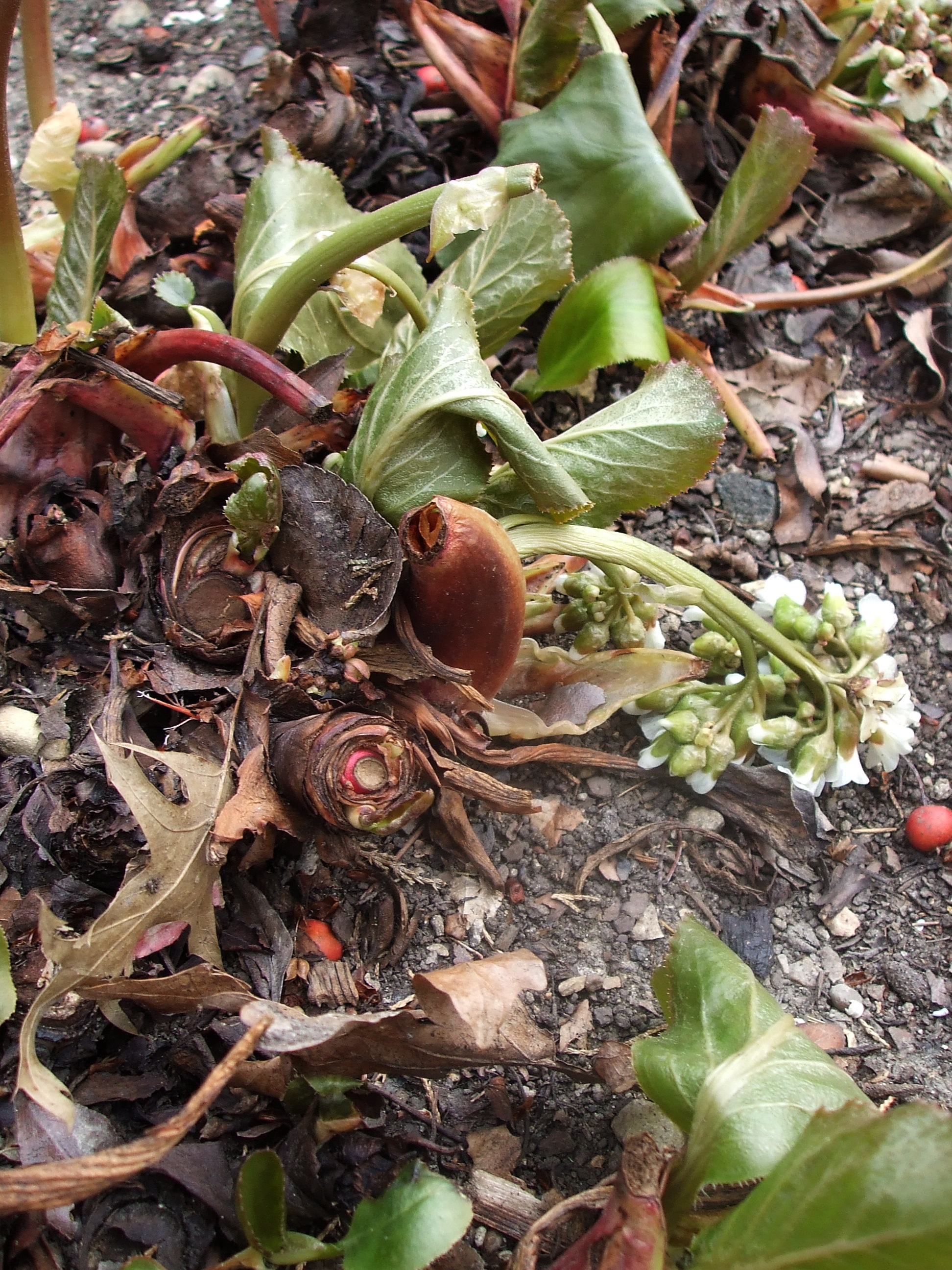
i have walked for miles, i have taken toll. i know now the litany of the dead, the blooms that will not be. star magnolia, petals browned like egg whites under too much butter, too much flame. only this is brown from freezing. daffodils, whole hosts, bowed in cold defeat, heads down, limp in dirt that might as well be burial mounds. bergenia, a woodland beauty sometimes known as pigsqueak, has lost its squeal. exhibit a, up above; the barnyard must be weeping.

i know i am.

barely a week ago, when winds were filling lungs, getting ready to let loose, when the air was balmy 70, we heard the rather mild-mannered news, the short-burst alarm: temperatures might dip. take precaution.

precaution, we presumed, was tossing blankets helter skelter overnight. and lifting in the morning. the danger past, the sun back up, all caution scattered with the noonday wind.

but then, the cold, it stayed. the daffodils, days later, still haven’t raised their heads from deepest dying bow. the magnolia never had a chance. one day, its velvet fingers, gloved in alabaster. but then, the next, all froze, and kept on freezing. there will be no bloom this year. there will only be brown buds falling to the ground, botanic bullets shot through with frozen death.

promise lost before it even had a chance.

which sounds, to the children’s cancer nurse in me, too much like life sometimes. this narrative we know, not only from the garden.

all around, i walk through springtime frozen on the stem; i ask myself just what it means. what lesson is this teaching?

i called a man who knows many things about the garden. he said it’s death on case-by-case basis. depends, he said, on micro-climate. vigor of the plant before the cold winds came. says he’s never seen anything like it, not this much cold, this long, preceded by solar-heated days that coaxed the blooms, coaxed spring, right from the earth, from winter.

way he sees it, he says, it’s just a blip for planet earth. a mere blink of the eye for the globe that’s spun for zillions of millions of revolutions.

buck up, he pretty much says. these growing things grow here because, through the millennia, they’ve done the darwin thing. they’ve got little tricks up their long green sleeves. but there will be no blooms. toast, he boomed, time after time, no matter what i mentioned, full of hope, some growing thing, perhaps, merely suspended in freeze-frame animation.

toast, he cried. toast, toast. i could hear him shake his head; pity the poor lady with skull so thick she’s dense.

at best, the wise man offered, the growing things dig deep inside their little souls, extract a blast of carbohydrate, give it everything they’ve got to unfurl their leaves, take a chance at air and light and a good stiff drink of rain.

it’ll be an iffy proposition from here on out, this season. too little rain, too many pests–oh no, here comes his favorite word–“toast!” he crowed again.

scooching out to the edge of this most precarious limb, i asked the hard-baked gardener if he saw any metaphysics in all this burned botanic bread. “this is nature,” he said, shooing me away to take another call.

well, half the reason i come to class is i’m convinced there is much to learn in the not-so-tidy rows of my struggling garden.

as i tiptoed through the swath where my daffodils once tossed their pretty heads, scissors at the ready, at last surrendered to the notion that there would be no resurrection, i mused long and hard on all this would-not-be.

walking miles, shuffling past the dead and fallen, i rumbled thoughts through head. why death? why so much frozen death?

the singular thing that struck me was how this scourge rolled in without a sound, without a whimper even. this was not destruction with a drum roll, no whipping winds and thunder claps, nor streaks of light that tore the sky in jagged halves.

this was, like so much of life’s unwanted news, completely unannounced.

one minute you’re talking to your papa on the phone; the next you’ve got an operator on the line, interrupting some other silly call, telling you to clear the line, someone must get through, someone needs to tell you it’s very, very bad, you need to get there fast.

one minute you think your firstborn son is out riding his bike on a golden autumn day filled with light and promise; the next, the doctor is leaning against the hard cold wall, telling you it’s a fractured vertebrae in his neck and the spinal cord itself looks to be in trouble.

you think of all the friends you’ve loved, whose news came in fractured syllables: a dark spot on a lung, a blob they couldn’t see through, ’bout the size of a cotton ball, on an unsuspecting breast.

they never knew it was coming. you never knew it was coming. it was suddenly just here. it was the sub-freezing dawn in the middle of your spring.

you too, drooped your head into the dirt. you too forgot to breathe. case-by-case basis, the plant man said. some will make it. others won’t.

you, not willing to go with door no. 2, you dig down deep inside your carbohydrate stores. you give it everything you’ve got.

some will make it.

you swallow deep your sorrow, and plow on into spring. you pray to God warm winds are on their way.

just there, beyond the window, in the hoary morning’s frost, you set your gaze on daffodils, a humbled host, stilled, not breathing at half mast.

you, though, you take a breath. you brace against the chill. you carry on, intrepid, into spring. no one says it doesn’t sting. no one…

anyone care to offer up a line, or stanza, in this song of frozen springtime sorrow? or some sign of resurrection in the field?

into the woods

leave it to the italians. they have a name for today. they call it “pasquetta,” or little easter.

why, they wonder, after all the deprivation and darkness of lent, the shadow that burst, finally, into light, into the unbridled exuberance of easter, why, they wonder, why pack it up like so many leftover baskets, and tuck it on the shelf ’til next year?

mais non, they would say if they were french. but, of course, they say it in italian. dag nab it, is what they mean, though, again, they don’t say it quite that way.

those smart italians, they do a very smart thing: they grab one of those baskets, they pack it with leftover yummy things from easter, and they take to the woods. specifically, they set out in search of a watery place.

water, on pasquetta, is key. there is, depending on your level of gusto for this little easter, some splashing involved.

in fact, all over europe today, there are folks splashing. they are not being mean to each other. as a matter of fact, they are partaking of the little easter blessing.

in hungary, apparently, boys knock on doors. girls answer. boys splash girls. girls invite them inside. they feast. they send boys home with wildly painted easter eggs.

on easter tuesday, the girls return the favor. they knock and splash.

it must be riotous, all this knocking and splashing and heading to the woods with your leftover pink and green eggs.

but, besides the fact that it’s quaint, there is, it seems, something rich about the european approach to little easter. to all of life, perhaps, but certainly to little easter.

it is about taking linear measure of time, peeling back the ordinary, extracting mystery and sacred, raising simple hours into the realm of the extraordinary. it is about pushing away the rock of workday expectation, exploring the cavern of the deep unknown, the unexpected. reveling on a monday.

because a friend i love has been telling me for months i need to, have to, must not sleep until i read, “to dance with God,” (paulist press, $14.95) a poetic, eye-opening 245 pages on family ritual and community celebration written by gertrud mueller nelson, i finally cracked the cover over the weekend.

she is very wise, this deeply jungian, deeply spiritual woman, who in 1986 wrote this book while living in california. she says this of what she calls “holy time out”:

“holes are created in time through the creation of holidays–or, indeed, holy days–where the ordinary and everyday stops and time is set apart and not used. every seventh day (sabbatical) since the story of creation is a day of being, a ‘day of rest.’ that is what a feast is. the feast has its origin and its justification in its dedication to celebrating and worship. it belongs to the gods.”

she goes on to tell us that plato, of all thinkers, put it this way: “the gods, taking pity on mankind, born to work, laid down a succession of recurring feasts to restore them from fatigue and gave them the muses and apollo, their leader, and dionysis, as companions in their feasts–so that, nourishing themselves in festive companionship with the gods, they should stand again upright and erect.”

the feast–or holy day–then, is, “the very act which makes the transition from crawling beasts to the upright and conscious human,” nelson writes, “a transformation which makes what is human equal to and a companion (comrade) of the gods.”

i don’t know about you but we don’t spend a whole lot of time around here even noticing feast days, let alone packing our baskets and heading to the woods.

apparently, gertrud does. she says that on easter monday she always let her children stay home from school. they went off to church early in the morning, but then they took off to the woods, often to a marshy place. through binoculars, they watched the water birds, the mating birds, doing their springlike thing. they inhaled the woods, the little tips of tender green budding on all the branches, turning the gray of winter woods into the lacy green of early spring.

getting wet, she says, was always part of the picnic. back to the baptismal waters, and the holy sprinklings, that are so very much a part of easter.

immediately, i found all of this a notion i could warm to: an excuse for picnic. tromping through the woods. stopping time for one more day. stealing children from the classroom, for the sake of exuberating spring (i know, i know, it’s not a word, but i just made it one, so now it is).

so last night, well past sleeping time, i tiptoed in the dark to the bedside of my almost-man-child, the one who loves the woods and who also had just flicked out the light when he heard me coming up the stairs. i told him my little easter idea. at first, he broke out in a grin (he turned the light back on, that’s how i know that), but then he thought about the school day, and thought, not even for a lunch hour picnic could he leave the load at hand.

oh, well, i sighed. fact is, we might have done our little easter backwards. we had taken to the woods already, on big easter. taken kosher-for-passover-for-easter picnic to the woods, in our glorious mixing of religions. it seemed the place to be, the woods that is. for all the reasons up above.

but still, i think, i might take the little one on a pasquetta picnic. or maybe in the twilight, i’ll take my boys by the hand, and take them off to where the gods urge us to recline. just one more day, a holy day.

a holy day for splashing in the woods. i think i like this little easter.

all right, all you wise people, do some of you already know and do this little easter? have you been splashing away for years without me? and what of the notion of not confining the holiday to one day, but extending exuberance? might we do well to weave more holiness and more exuberance into our ordinary time? are the italians, and all the europeans, not onto something? something much larger than little easter?

photo credit: my sweet will. taken on big easter. we both spotted the moss island amid the marsh; my camera said it was busy reclining and couldn’t be bothered, so will came to my rescue, once again.

p.s. it’s monday, the lazy susan spins afresh…

silence on a day that darkens

today is the day it gets dark. it does, i swear it does. it almost always does. i watched, when i was little, for the darkness to roll in.

God was broken, broken-hearted, on Good Friday. and i, grade-school believer with all my heart, i kept an eye, all afternoon, on the sky. sometimes i’d take to a rock. a thinking rock. i’d sit and watch the sky. i would know, come three o’clock, when the story says that Jesus closed his eyes, sighed his final sigh, and we all drop to our knees, that black clouds would roll in, eclipse the light.

early on, i told my jewish not-yet husband that story. i’ve told my children. i will watch the sky today.

and while i watch, i will be silent. three hours, noon to three. the hours that, by his hands and feet, Jesus hung on that heavy wooden cross. it is, my mother taught me, the least that we can do.

last night i went to church. my very favorite day of the whole church year is holy thursday. the last supper. the washing of the feet. for two hours, the stream of people, humbled, on their knees, feet naked, washed. i was washed, and i washed. a beautiful mother from kenya, her baby on her hip, washed me. i held her baby on my lap so she could wash, yes, between my toes. i washed her toes too.

it is not hard, when you see an old priest walking barefoot, ferrying pitchers and basins of water and clean white towels, to the blind, the wheelchair-bound, the teenage boy with down’s syndrome, the black, the brown, the pink, to picture Jesus doing the same.

while all the washing was going on, while the long lines of people filled with prayer, stood waiting, waiting to be seated in the chair, to lift their naked feet above the bowl, to have the stream of water poured, then lathered, then poured again, then dried and blessed–no half-baked, symbolic washing here, this was real and hygienic as well as full of spirit–while all the washers waited, i thought about the sins of this sorry world.

there is much to be silent for this good, dark, friday. as i sat ticking through a litany of sins, once again, i found myself informed and borrowing from jewish prayer, from yom kippur, the day of atonement, the holiest of holy days when you’re a jew. and if you listen, if you pray along, it is a deeply holy day even if you’re not.

i find myself, every year, filled with awe at the breath-taking jewish admission of the brokenness of the human condition. they do not tick through mamby-pamby sins. no. they get astonishingly real, and very close to the bone, to home. where my mother, again, always taught me charity begins. i think forgiveness might do well to start there, too.

so, in the spirit of atoning on this day in which it feels so right to be considering our sins, especially the sins of the homefront, that place we spend so much time considering here, i borrow from that same frank baring of the soul, i tap into the confessional vein i have found, and been held by, in the jewish prayers of the mahzor, the prayer book for the days of awe.

on this most christian day of awe, i beat fist to breast, i wrap myself in cloak of silence. i look deep within.

there is much, yes, to be silent for…

the sin of being afraid to speak up–even when it is among neighbors, and you hear or see exclusion.

the sin of shouting, singeing tender hearts of children.

the sin of not opening the door–or closing it in too much of a hurry.

the sin of breaking down the beauty of this world, and not repairing that that you’ve left broken behind you.

the sin of not noticing the hurt right in front of your face.

the sin of asking too much of your children.

the sin of wanting too much.

the sin of believing but not taking action.

the sin of standing back, watching injustice eclipse the truth, and doing not enough.

the sin of saying you’re too busy, but you’re not.

the sin of holding back, not fulfilling all that you can be, for being afraid to manifest the seed of genius that, surely, has long been buried deep inside you.

the sin of leaving someone else to reach out a hand to lift up the poor, clothe the naked, give the extra toys in the basement corner to children without any.

the sin of going along with the crowd.

the sin of thinking you needn’t be the one to feed the forgotten on your block.

the sin of going to sleep another night taking for granted there will be a tomorrow morning.

the sin of sending children off to bed without saying, “i love you.”

the sin of not saying i’m sorry–or not being so.

the sin of not feeding yourself–body or soul.

this might be just the beginning. but for each of these, i am so heartily sorry. Father, forgive me, for i know not what i am doing.

i leave you now in prayerful silence. i leave you to this day that just might darken. i’ll be watching. trust me.

feel free, should it mean something, to cast a sin….

being e. bunn

when i signed up for this being-a-mama thing, there are many points i failed to adequately ponder.

(we’ll not dive, not today anyway, into some of those matters that i might wisely have run through the almighty thinker, that mass of cells between my ears, that might better have equipped me for this madre job. we’ll leave that for a less auspicious day. this, after all, is countdown week for judy garland belting song of easter bonnet and said parade.)

certainly, in days b.c. (before child, that would be), i never grasped the charm, the pure delight, of packing joy, delivering it, complete with jelly beans, in a straw-braided basket. the easter basket, of course.

the santa thing, i might have given thought. you know, some winter’s afternoon, as a pouty post-believing child, flung (with requisite drama) upon my bed, legs cocked at the knees and crossed, kicking foot up in the air. thinking: when i grow, i’m going to be one heck of a santa. i’ll not forget the china teaset, the one with tiny painted flowers.

but easter? who spent much time considering the occupational upside of mr. e. bunn, esq.?

the basket, while i do recall a spectacular sponge paint set when i was 5, was, in the house where i grew up, more pure sugar rush, ten grubby little hands racing to the pink-and-purple plastic baskets, inhaling beans, then dashing off to rest of resurrected morning.

i failed to grasp the paschal possibility.

i would say i rather stumbled into the rabbit hole, into the unexpected magic of tiptoeing through the night, leaving trail of cut-out bunny feets, and hiding the basket of just-hatched tenderness in a place that, come morning, little feets would have to find.

there is something, something far beyond charming, about slipping inside these make-believe, oversized, dispatchers of joy, be it the one with wiggly tail or the chap with jiggly belly.

there is something that almost takes your breath away when you realize, poof, you’re all grown up, and you now are the one who, with your brush of many hues, shades and colors the someday stories, the memories, of what it was to grow up in the house where you preside.

it’s up to you, you realize, you who tucks tenderness in a basket, to tenderize the hearts of those who traipse through the land where children romp. at least in your house.

but, indeed, i have discovered, and now, myself, i practically jiggle with the wonder that it brings, that nowadays i get to pack the baskets for those little sparkling eyes, the ones that, certainly, will be up and out from under covers, rubbing, shouting some early-morning merriment, as they stumble down the stairs and round the bend, ultra-sonic easter radar leading them without wrong turn straight to where the sugar, in several forms, awaits.

before we get too far on that sugar thought, let me toss this sad disclaimer, admit this thing that might make you sigh a sigh; say, phew, thank heaven i wasn’t born to that ol’ mama. here’s the sorry truth: i don’t do unending sugar at easter. it’s not about sugar in this house.

it’s about something far, far sweeter.

and that, i think, is why i love it so.

i have a someone, a sandra sweetpea, who taught me how to do easter. instructed me in easter basket 101. like many things she taught me, she hasn’t a clue, really, how deep the lessons she imparted. there was no hand-out. no quiz, or chapter review.

instead there was a little shop, a shop called sweetpea, a shop of natural toys and classic books, a shop where imagination unlocked the door and set the stories spinning. sandra was the shopkeeper. and if you studied the way she gathered things, the tender, earth-spun beauty she gathered in her shop, in baskets, on antique bookshelves, tucked in woodland scenes that you swore the fairies might have visited, then you learned a thing or ten about quietly offering a whole other sort of being a child.

being a child–or a mama or a papa or a someone with child heart–who listens to the rhythms of the season, who understands the gift in playing richly with simple child’s toys, who breathes in the magic of a beautifully spun storybook.

it was like a refuge and a respite from the worldly, that little shop on southport in chicago. i’d pull back the door, a bell would tinkle, and then, surely, sandra would appear from behind a curtain, all sparkling eye and wisdom. quietly, without words sometimes, she’d lead me by the hand to something full of beauty. she would laugh her marvelous grown-up-little-girl laugh, and i would see the magic. then she might spend a minute telling me about the marvelous soul who tromped the woods, carved the elfin house, spun the wool, dyed the cloth from flower petals or vegetable scrapings. i would stand there, spell-bound.

my children’s toy chests were never stuffed. but they were rich in things–an elf’s tree house, rows of books, simple blocks–that will last forever.

and so it was sandra who taught me easter baskets, too. to go to sweetpea for easter, my pilgrimage each holy week, was to come home with a finger-sized bunny so sweet i’d want to carry him to bed with me (or feed him itsy-bitsy carrots). a book or two, the pages splashed with springtime colors. some little pack of seeds, forget-me-not, or carrot. just enough to whisper, the earth is waking up from winter’s slumber. all life is new, rejoice.

and so it was the other day that i wandered back to where sandra now presides. the sweden shop, it’s called, but i like to think of it as the swede pea. for it seems she’s transplanted plenty of her magic there. (her sweetpea, sadly, closed.)

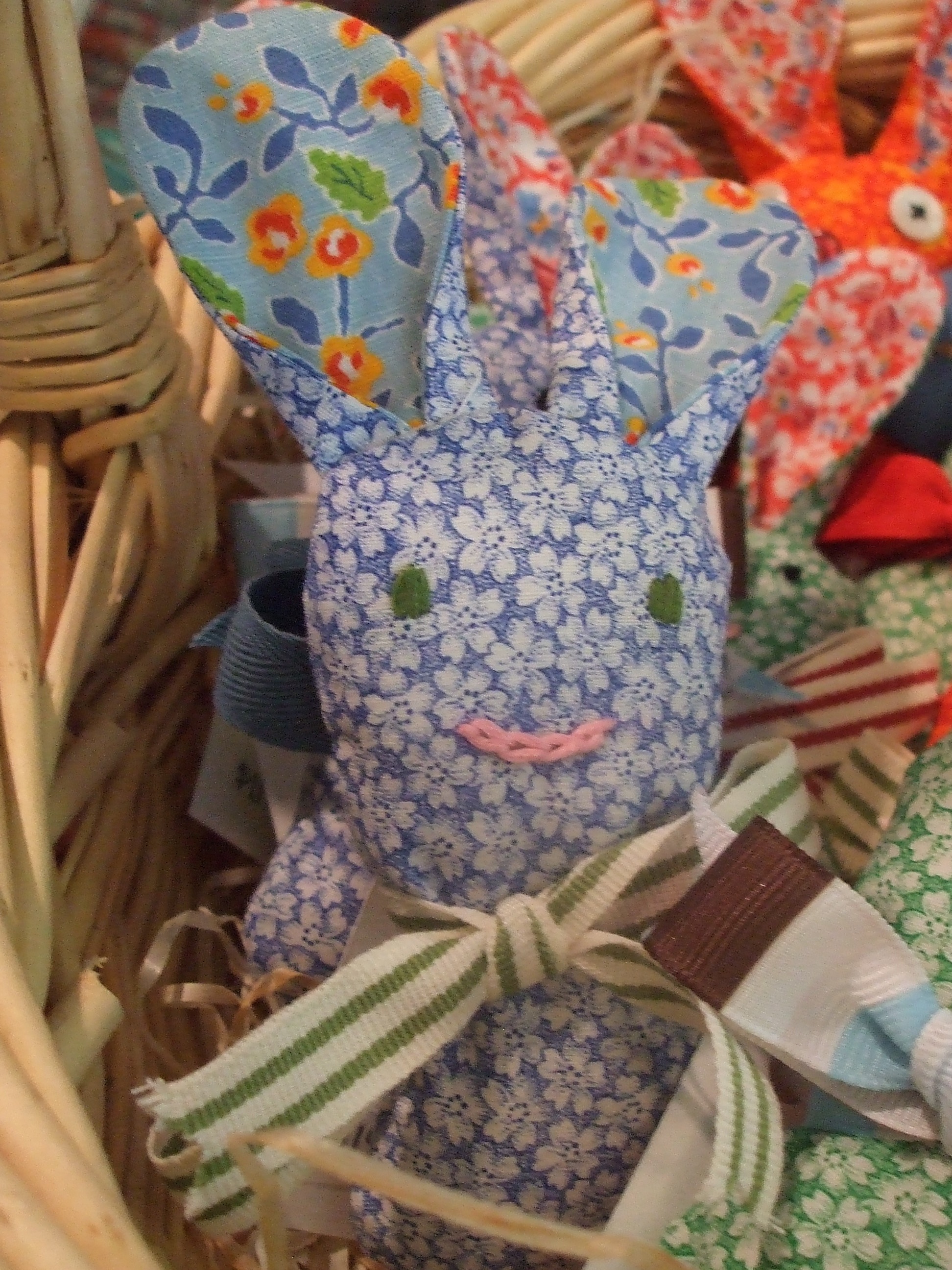
the little bunny smiling from above–sandra, who is quite something with thread and needle, made him. stuffed him first with lavender, real lavender, from someone’s garden. then she stitched him up. when you rub his belly, lightly, with just the press of your finger, the lavender wafts. i bought two. one has little button eyes and nose. of course, i bought a book. a book from green tiger press (collectors of breathtaking, knee-buckling illustrations from days past), a book called, “the truth about easter rabbits.” of course, i bought a pack of carrot seeds. and a big fat orange carrot stuffed with all orange jelly beans.

come saturday night, when all is clear (i can’t promise quiet, since my littlest rabbit has made quite a habit of hopping out of bed in recent weeks), i will make like e. bunny himself, and gather my new-life wares. i will tuck simple magic in a basket. i will smile all the while. it is hard not to melt when tucking easter in a basket.

i will make one basket for each boy in this house, and then i will tiptoe to a hiding place. when all is finally still, i will sprinkle pink construction-paper rabbit feet and baby carrots from edge of beds through the hall, down the stairs where the trail will then diverge, one branch south and one southwest. each boy is on his own to find what easter brings.

and i’ll stand off in a corner, softly soaking in the joy. no one told me how sweet it is to play the easter bunny. and that, perhaps, is the sweetest secret ever. one i’ll not stop, ever, believing wholly in.

oh, if only i could, i’d make a lovely basket for every one of you. the house would be so filled, there’d be lavender wafting everywhere. and plenty of old-fashioned carrot bunches, complete with carrot tops, those leafy greens that are, perhaps, the crowning glory of every bam-made easter basket.
do you, or you, or you, find joy in being a big invisible bunny? and do you have any secret things you always search for in a basket of your own making?

batten the hatches, blanket the garden

no, no, this is not about how to dry your laundry on the line, sans the line. this is not about casting your underthings and old rags upon the garden for the sake of saving turning on the dryer.

no, darn it, this is about fickle spring.

there you are merrily thinking the thaw is underway. all around the place, little things are pushing up, pushing through the crust. not so tentatively, but maybe a little shy, they peek their soft green tips. tenacious tips. they gaze around, they check to see if they’ve got goosebumps, or whether it’s safe to keep on coming.

they come. a tulip sprout here. virginia bluebells there. the poppies, even, send up their fountainhead of leaves that look as if they’ve been cut by giant pinking shears, all ziggy-zaggy around the edge.

and my april prize, my heirloom hyacinths. the antiques of my garden with roots dating back to 1870, the one they call, “the queen of the blues.” she is a soft, soft silvery blue, according to my friends at old house gardens, the ones who rescued her in the first place, and then, for a small price, bequeathed her to me. she’s been in my care and custody for years now. if heaven sold perfume, this might be the no. 2 seller (after the aphrodisiac, korean spice viburnum, which sends me to the moon, and which, if sold at neiman marcus would elbow ol’ dowdy chanel V right off the counter.)

but back to the laundry scattered in the beds.

it seems that just as all the pretty things were hours or maybe days from showing their true colors, someone somewhere decided to pull the switch, hit reverse, and suddenly out there it feels like winter.

the mercury on my truth-telling thermometer is silently sliding south, right now at 32, which, unless i’m losing marbles, i am certain i learned in first-grade science is the point at which fluid water turns to solid ice, a substance nowhere in the primer, “how to grow a flower.”

the weatherperson who lives in my computer tells me it’s getting colder still; and, as is, all living things outside feel as if it’s deep down in the early 20s.

that means, my growing things need coats.

sleeves for tulips can be a little difficult to construct. so i go for the loose look, the draped look. old sheets flung. terry towels as fabric domes to hold in what little heat there is.

did i mention that the winds were whipping through the night? great howling winds. winds that made you think you must have holes right through your floorboards and the winds were whistling west to east, taking shortcuts through the room where you were sleeping. or trying to sleep, at least.

yes, yes, it was a night, it remains a day, for ragtag april garden. i’ve had to do this right up through may: the annual tucking of the beds under bedclothes.

in the city, i lived next door to an equally towel-tossed gardener. our side-to-side gardens on these frosty mornings looked like christo, the fabric artist who has shrouded museums and mountains and even central park, had slipped through the ’hood and done his wrapper thing. on our tulip heads under towels.

these days i dwell in the land where one does not fling mismatched rags on the lawn. once again, i stand in danger of at least a phone call from the appearance review police.

excuse me, madame chair, they would begin, we do not support your nasty habit of littering the leafy shore with those babushkas in your beds. please remove them, or we will revoke your passport and send you shuffling back to the nitty-gritty city.

which is why i do my dirty work, my mission work, really, in the back, where, save for this blaring announcement, no one should notice that i am deep into doing what it takes to get my garden through the cold snap.

if it means secreting out the back door, in dark of night, bundle of slightly tattered sheets in arms, then i will risk my residence here on this north shore. i will, as i unfurl my cotton armaments on my shivering spring shoots, not be stopped.

do not, i tell you, get between a madwoman and the precious beds she must protect, come lawn police or subzero temps that would do in a lesser warrior.

anyone else lie awake fearing for their tender sprouts, as wicked winds whistle taunts all through the night? anyone else cast a quilt of tattered cloths upon the april beds, in hope that may the month will bring a riotous show of life triumphant over freezing cold? anyone else have any other warming tricks up their shivering gardener’s sleeves?

every year, a cast of characters


every year. count on it. there will be characters. they will be many. they will be deeply, richly, crazily creviced, shadowed, colored.

it is as much the order of the seder as the haggadah itself. the table will spill with character. ooze with it. rumble, tumble, jumble, full of characters.

wafting just above, that’s character no. 1. the tall one, that is.

that’s ted. rebbe ted. the one wrapped in japanese prayer robe, tied with obi. the one raising the first of four glasses of vintage manishewitz. the one we drive miles to be with every pesach.

ted, a rabbi and cantor without a congregation these days, is a therapist; spends his working hours trying to screw on people’s heads, or at least screw them on a little less wobbly than when they first wandered in.

but mostly, always, ted is a character. ted’s eyes, i think, must gleam even when he’s sleeping.

at ted’s seder, things are, um, unorthodox. ted reaches in a bag and pulls out yarmulkes from around the world. sometimes he wears his tibetan temple headdress. he always wears his japanese robe.

at ted’s, you do some chanting. you close your eyes and chant the vowels. you do not close your lips when chanting vowels, he tells you, and thus you assume a posture of openness that ted thinks the world truly deeply needs. you chant deeply, ahhhhhhhhh.

at ted’s, you eat sumptuous french hors d‘oeuvres. (and then you find out, oops, they are not kosher for passover; maybe that’s why they tasted so good.)

i tell you the story of ted because in bringing my children to ted each year i bring them to one of the most essential gifts a parent can give a child: the gift of the one who’d never paint by numbers, the iconoclast, the eccentric, the character. the deep and rich and soul-expanding knowledge that life is splashed with vibrant colors.

one of those colors is the color ted.

it brings unending joy to me to bring my children to tables where i know they will hear voices they do not hear at home. home is where the grounding happens. home is where you learn that the parachute has a safety cord, and you can pull it any time.

other people’s launch pads are where you learn to lift your foot off the ledge, set it in mid-air, and feel the fall, but then the updraft, carrying you, lifting you to places you’d never see from the safety of that concrete ledge.

last night we soared with ted. heard his salty brand of politics. took in his dash of new-age mysticism. felt the gestalt of letting go of that by which we’d been enslaved. watched him raise a yale sweatshirt, oy, to teach a lesson on hebrew light and perfection. (right there, spelled out on yale’s emblem, in hebrew letters, who knew? found out that centuries ago, at the founding of yale, patrician of patrician schools, hebrew was required study. ted, by the way, went to yale.)

tonight we congregate again. at another table of eccentrics. they will be the ones with whom we’ve worked for decades. the ones with whom i’ve “sedered” for 25 years, before husband, before children, and every variation since. a cast of newspaper kooks. my boys, all eyes and ears, will learn much that i won’t teach them.

besides the wine glasses filled with jelly beans (the kinder version of fruit of the vine), the flogging each other with scallions, yes, scallions, the pulling out of little plastic plagues, there is the annual putting of passover lyrics to broadway tunes.

we drive home each year, from nights one and two, with bellies aching. not from all the passover matzo kugel. no, no. from laughing ’til our sides feel split in two.

we are blessed. so very blessed.

all my life, far back as i can remember, i have loved the odd ball. the duck who waddled to his or her own drum beat. at my mid-century mark, i survey the landscape of my life and see i’ve assembled quite some cast of characters.

my almost-man-child told me recently that one of the most lasting lessons he learned from his uncle david was when david spoke of a brilliant friend of his, a friend with phD in sanskrit, a friend who studies global drumming and, for a long while, drove a cab in new york city. david, it seems, told my almost-man-child: “he really is a kook.” and my almost-man-child told me that the way he said it, he knew that uncle david meant that to be a kook is a very noble thing. “that’s how i learned i should never march to other people’s drummers,” said my boy who decidedly does not.

my prayer this pesach, my prayer that already has been heard on high, is that all the children, not just my boys, hear a world of many drummers. and come, as often as they can, to a table that spills with kooks and characters and bold eccentrics, a table, every first-night seder, led by rabbi ted.

who, by the way, i love with all my heart. even if he makes me close my eyes and chant the vowels.

do you collect characters? do you see the beauty in those who color outside the lines? do you, if you have children, or love children, or are a child at heart, seek out tables where you know they–and you–will hear voices unlike the ones they–and you–hear at home?

holy, holy week

in our house, it is the gospel according to matthew, and the seder infused by elie. and this, by the blessing of the calendar, is one of those wham-bam weeks.

we’ve got it all, and weave and flow from exodus to last supper, from parting of red sea to rending of blackened sunless sky. we dash the house of bread, but then bring on the easter baskets.

long long ago, we set our own pesach dispensation for easter sunday. even when it’s in the midst of the eight days of no leavened grains, we part the matzo for a sprinkling of chocolate, for jelly beans, in the easter basket.

i was musing that wednesday is the only day of this whole week not rich in something jewish or catholic, and thus i would need to consult the koran to divine my depth for the day.

it is, very much, a fact that the interlacing of the passion of jesus, a passion set in history at the cusp of passover, and the jewish remembrance of the exile from egypt, is, for me, a rich one.

after 25 years of living them on top of and through each other, i have come to see shadows, understand subtleties that would have escaped me were it not for my being drawn, in love and faith, to a man who is, himself, a son of the tribe of israel.

and so it was that we all, the four of us, two jews, one catholic and one just learning both, walked into a church courtyard yesterday where palms were swaying in the air, the priest’s red robe was billowing–nay, blowing–up and nearly over his head from behind, the winds were whipping so unrelentingly, a red bird’s plumage in flight. the red cloth punctuating the otherwise gray day.

the priest, one i’d known long ago, one who’d grown older and even wiser, and though he’d grown bent, never bent from his focus on that core of what i call dorothy day catholicism that sees peace and justice as the central burning flame of a religion he won’t let go down in flames.

he was in the midst of reading the passion of jesus when he looked up, looked out at the sea of waving palms, and implored the multi-colored crowd: “consider and tend the wounds of the world as if they were your own—-for they are.”

that then, i gulped, is the mission of this week.

i came home, sat down to consider elie wiesel, the nobel-prize winning poet and seer who survived the holocaust and will not, bless him, let us forget.

“i love passover,” he wrote, “because for me it is a cry against indifference, a cry for compassion.”

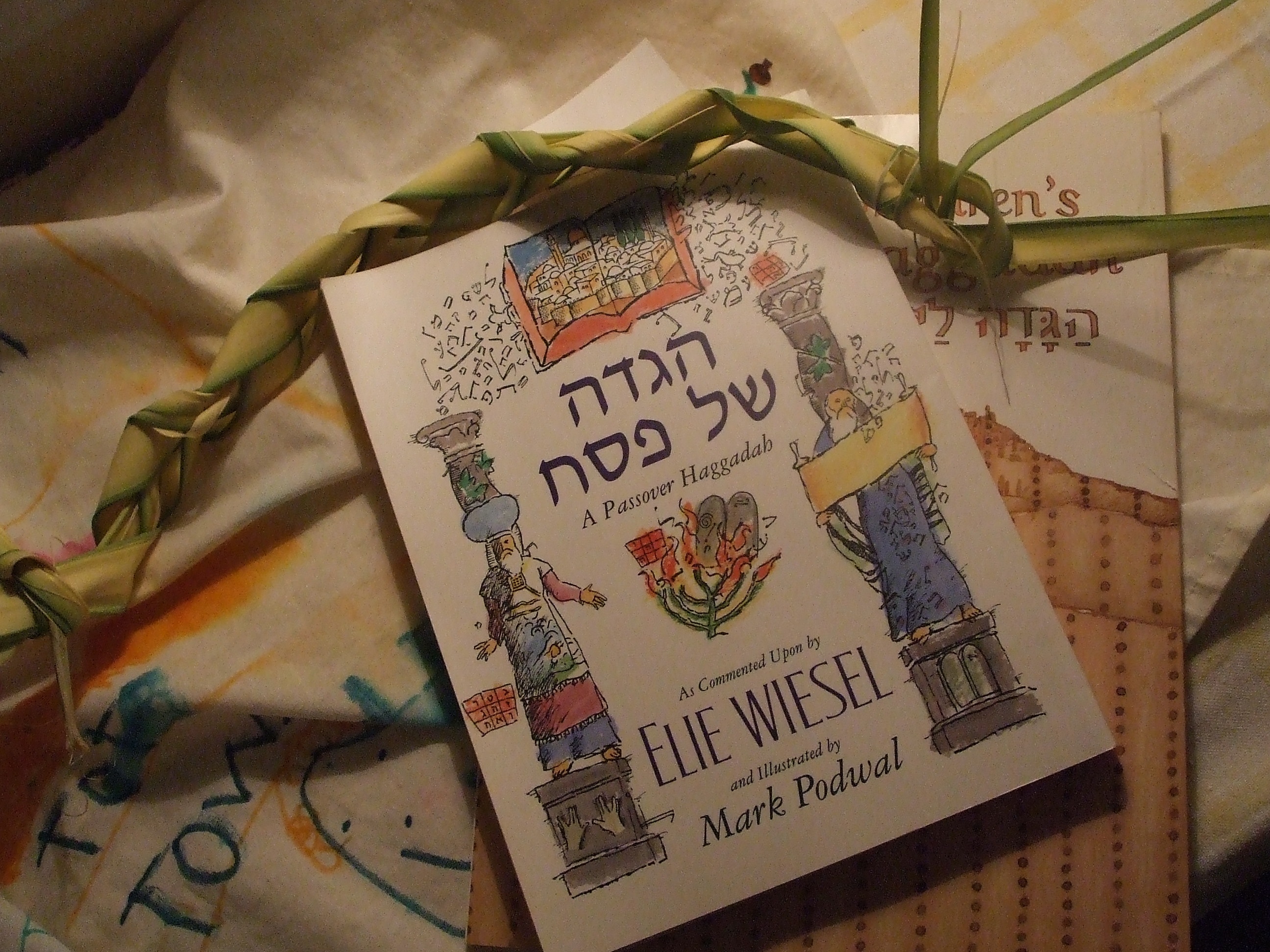
wiesel wrote those words in perhaps the only autographed book (certainly the only autograph that fills me with awe) on my shelves, “a passover haggadah,” (simon & schuster) his 1993 commentary and guide through the seder, or meal of remembrance, the retelling of the exodus story, that is the centerpiece of passover.

“sometimes the sheer speed of events makes us reel,” wiesel also wrote in the haggadah. “history advances at a dizzying pace. man has conquered space, but not his own heart. have we learned nothing? it seems so. witness the wars that rage all over the globe, the acts of terror that strike down the innocent, the children who are dying of hunger and disease in africa and asia every day. why is there so much hatred in the world? why is there so much indifference to hatred, to suffering, to the anguish of others?”

wiesel asks. the old priest implores.

because i am catholic, because i spent many years on my knees studying the 10-foot-high crucifix that hung before me in the church where i grew up, i don’t even have to close my eyes to see the wounds that i’ve been asked to dab with cool and healing waters.

and so i walk, i stumble, through this most holy week.

what questions do you carry into this blessed string of holy days? what thoughts do you put to those questions? those callings?


p.s. some really fine thoughts–really fine–have been tacked onto meanders in recent days, thanks to the brilliant souls who keep pulling up chairs. bless them! don’t forget to take a look back and keep the conversation flowing. just because we move on to a new meander does not ever mean the case is closed on a meander past. in fact, we might have drummed up a real-live beekeeper to tell us a thing or three about the
heartbreak in the hives….
p.s.s. welcome back from break, all of you who flew away…we held down the fort just fine….

the essential shelf

once upon a time, it seemed the end of the week might be a fine time to pull up a chair and ponder the almighty word. relax. get comfy. kick off your workday shoes, plunk your naked toes on table’s edge.

consider the word.

in any form. alone. strung together into something akin to thinking aloud. broken, roughly, into stanza. pressed between the covers of a blessed book. a book you’d grab first thing, should you ever need to dial 9-1-1.

by now, whether you are a regular or a once-in-a-while puller-up of chair, it might have rumbled through your head that, save for clicking on a button, the only real price of admission here is a simple, unadulterated passion for what the linguists call the morpheme. again, standing all alone, a single uttered sound; or strung together, syllable on syllable, root on one of the –fix fraternal twins, pre-fix or suf-fix; or bearing apostrophe or hyphen, the cement of linguists’ possessive and compounding tools.

a word, no matter how you cut it, slice it, tape it back together.

here at the table, words are pretty much our salt and pepper, the very spice, the essence of who we are.

words, it would be safe to say, are the surgeon’s tools with which we poke around deep beneath the skin, pulling back, retracting, examining the places often hidden from ordinary view. words, too, as we’ve suggested in the past, are jungle gym and slide and, yes, the swing set upon which we pump our little legs and point tootsies toward the sky.

i come by love of words quite naturally. words, as much as irish eyes and soulful soul, come to me genetically. from both sides, my papa who typed them for a living, my mama who as often as i can recall was holed away in secluded places, barricaded behind pages of a book that made her laugh out loud, or, sometimes, cry. she claims, though none of us has ever seen, to have a lifelong stash of poetry. free verse. so free it’s captive, under lock and key.

not sated, i married into words. the man to whom i wed my life—son of newspaper editor who, to this day, reads six or seven papers, front page to obituaries, stacks so high i fear the house might soon cave in, and teacher mother who, for 52 years and counting, has championed children struggling to decode long parades of alphabet, turning squiggles into sense, triumphantly ingesting every written line—word by word, we fell in love.

in olden days, before the days of email, we sent surreptitious blurbs of words back and forth across a newsroom. he took my breath away through certain verbs (and, no, not racy ones), left me heart-thumped at the way he furled a sentence. he went on, my wordmate for life, to take home what our 5-year-old at the time called the polish surprise, for the way he cobbled words into thought. thought that at times has left me in tears, the power of its message, the pure poetry of his rock-solid prose.

my life, it seems, is strung together by the syllable.

and some times, oops, i get carried away on winds of words, and ramble on and on, dizzied by the pure delight of watching strings of letters turn to words turn to joy, or, sometimes, crumble into sorrow, right here upon my screen.

my wordly destination today, the place i intended to meander to this morning, is really rather risky. before i even mention where, i must issue a disclaimer: this is fairly off the cuff. you cannot hold me unshakingly to my claims. not forever anyway.

i am proposing that as a gaggle at the table we put forth what we consider the most essential bookshelf. ten authors, ten books, your choice. mix it up. if you only care to offer one or two, that’s fine. we will all set forth with list in hand, and check out the nearest library. we might read and then concur. or we might strongly shout in protest.

i’ll go first. sort of like being the one dared, and dreading, leaping off the dock, into icy waters of the spring-fed lake just before the dawn.

in utterly no order—all right, let’s go with alphabetical—i would stack my shelf with these: dillard, annie; fisher, m.f.k.; heschel, abraham joshua; lamott, annie; maclachlan, patricia; merton, thomas; thoreau, henry david; webster, daniel; and certainly not least, the whites, e.b. and katharine.

dillard for “pilgrim at tinker creek,” and a sentence such as this: “a schedule defends from chaos and whim. it is a net for catching days. it is a scaffolding on which a worker can stand and labor with both hands at sections of time.”

fisher, for making food writing the most essential recipe for life.

heschel for being my guide into the deep rich soul of judaism, and expanding the envelope of what it means to be filled with spirit in any religion.

lamott for making me laugh out loud, laugh ’til my side hurts, and then taking away my breath with a profound irreverent sense of god alive in the darkest hours of our struggling, nearly-broken soul.

maclachlan for “what you know first,” the purest child’s poem–a “grapes of wrath” for tender hearts–that i have ever known.

merton for taking me to the mountaintop, for laying out the poetry of what a catholic soul can sound like, even and especially from inside the silent confines of a monastery named gethsemani.

thoreau, for taking me into the woods like no one else, and for all i’ve yet to learn at the foot of this great teacher.

webster, for being my dearest comrade in the aim to get it right, and for the pure delight of traipsing through his lingual play yard.

the whites, he for charlotte and stuart and just about any canvas to which he brought his richly colored pens; katharine for her views of the garden, for her new england (and new yorker) wit and wisdom, and for being the one who stole the heart of elwyn brooks.

your turn, who’s jumping next?

heartbreak in the hives

it’s not every day we interrupt our homefront meditations to bring you the news, but it’s not every day the honeybee lands on the front page of the newspaper that’s dropped on your front stoop.

sadly, today is that day.

the honeybee, Apis mellifera, is, as you know, or might easily imagine, one of God’s creations that we love best. (see “illumination: bees’ no lesser labor,” 01.24.07)
and the honeybee, it seems, is in distress. serious distress.

suddenly, starting last fall, beekeepers all over the country were opening their hives and finding nothing–no bees, no dead bodies, no obvious culprits, either. “apian ghost towns,” the chicago tribune called it.

hundreds of thousands of colonies–millions and millions of honeybees–dying off, across the map.

at first, the keepers of bees were calling this strange occurrence “fall dwindle,” or “disappearing disease.” but then, underlying and amplifying the alarm, just last month a swarm of bee brains put their heads together in a task force and realized this was not some seasonal decline; they renamed the mysterious and vast wiping out of bees from coast to coast, Colony Collapse Disorder. egad, capital letters.

no one has a clue what’s wreaking all the havoc; the beekeepers, it seems, are truly baffled. it might be pest, or the modern ways some have come to manage hives. it might be, worst of all, some environmental scourge.

to date, 24 states across the country count themselves among the seriously afflicted; illinois has yet to raise its tattered flag. but, beekeepers say, it’s never a good idea to open your hive before the daffodils are in bloom, so in many states they just don’t know what they’ll find when they finally lift the lid.

what’s at stake, according to the bee people and the newspaper that landed on my stoop, is, of course, the $150-million-a-year honey industry, but worse, the honeybees’ pollination of crops across the U.S., valued at $14 billion annually. (what they do, when all is well, is truck in billions of bees in boxes, and let them do their thing among the would-be fruited plains; problem is, all is not now well, and there’s no buzzing in the fields.)

that would mean, my friends, your produce bin, severely done in. and grab your almonds while you can, because almond growers in california haven’t a clue what they’ll do without their bees.

about three decades ago, an apiculturist, that’s someone who studies bees, estimated that one third of what humans eat is a direct result of honeybees’ pollinating labors, the way they nuzzle their nose in the fuzz of every blossom that must be passed from pistil to stamen if bearing fruit is to occur.

the national research council figures three-fourths of all flowering plants require pollination to bear fruit.

far as i’m concerned, though, all this number pinning only begins to lay out the breadth of the disaster.

here’s a dabble into the depth: no economist will put numbers to the loss of wildflowers, but already in the u.k. and the netherlands, scientists have correlated the decline in honeybees and flowers. it’s a vicious cycle: bees rely on certain plants, plants rely on certain bees. what’s lost is the ephemeral wild flower, beacon of fragile beauty, bursting through the earth with reckless and random abandon.

but what else of the noble bee might we stand to lose? the wax, illumination in its early stage; a wonder healer called propolis, believed to cure or stave off everything from the common cold to asthma to festering wound; the colony itself, model of cooperation and getting the job done, even if an autocratic civilization, what with madame queen bee ruling over all her winged minions.

when i am distressed about the bee, or just plain curious about the buzzing creatures, i turn to sue hubbell, who has been described as “a latter-day henry thoreau with a sense of the absurd.” once a beekeeper in the ozarks, she wrote, “a book of bees,” (houghton mifflin, $12) back in 1988, bits of which originally ran in the new yorker. she puts together words that drip like honey from the hive.

i wish i could have called her to get her read on this disaster, but, alas, i could only turn her pages, remind myself of why it is i am so gaga for the bees.

on page 53 she tells us, “beekeeping is farming for intellectuals.” already, i am more than hooked. not that i consider myself any sort of intellectual. but i know that all sentences that follow will send me to the moon. and they did.

she goes on to tell that “the greeks spun tales about the god of beekeeping, aristaeus. pliny wrote about bees. aristotle observed them, puzzled over them and reported his findings. virgil made bees the subject of his fourth georgic, a part of the series of poems with agricultural themes.” classicists, she tells us, insist that virgil’s purposes were political, that he used bees as a vehicle for his clearly political leanings, to prove his civic points, pointing all the while to the workings of the hive.

but isn’t that the very thing that makes us drool at the thought of bees (and not simply their golden honey), the very fact that bees might be a model for whole civilizations?

and then we come back to the wildflowers. there is nothing left but sadness, when considering that the tender and the robust, both and all, would be helpless in the wind if it weren’t for the busy flapping bee, ferrying most essential pollen from one sweet throat to another.

and what would be a world without strawberry? or berry of any sort? or the apple or the peach? would it be a world in which i would want to dwell?

the honeybee it seems is hardly afterthought, although most of the world, save for all those beekeepers and honey lovers, think little of the bee in the course of any day.

it’s curious to note that back in ancient times, there grew a great myth, the myth of aristaeus, that had as its crisis point the wiping out of all the hives.

it makes me wonder if there’s a lesson to be learned, if only we will listen to what’s unfolded in the millennia of long ago.

here’s the story: aristaeus, it’s told, was the son of cyrene, who despised spinning, weaving, “and similar housewifely tasks.” she preferred to hunt wild beasts. apollo, you might remember, once watched her wrestle a lion to the ground and fell so in love with her, he carried her off to africa and built a palace there for her.

after their love child, let’s call him ari for short, was born, apollo ditched cyrene, and cyrene, longing for the wild, in turn ditched poor ari, leaving him to be raised by nymphs who, among other tasks, taught him to raise bees in terra cotta pots.

when grown, aristaeus wandered out of libya, and amid his wanderings stumbled upon eurydice, a wood nymph, who happened to already be taken, the beloved, it seems, of orpheus. (and you thought modern soap operas were twisted? well, hold on, it gets better here…)

not-smart ari, according to the story, tried to rape eurydice, but she ran, through the woods. in her hurry, she did not see a big fat snake right there on the path. don’t you know, this being a greek legend, she tripped right then and there over a tree root. the snake, of course, bit her and she died from the poison. orpheus, heartbroken, grabbed his lyre and started to pluck. hades, god of the underworld, was so moved by the beautiful music, he was going to let eurydice out, but only if orpheus promised not to look at her until she was safely in the sunlight. alas, ol’ orph couldn’t help himself, looked back, and lost her forever.

the other gods, so furious at ari, punished him by killing all his bees. he had no clue–sound familiar?–why all the bees had died, so he went off in search of his mother, mistress of wild things. he found her living under a stream, a fine place for a wild mama. she knew nothing about the bees, but sent him off to proteus, the god of many shapes, who might have a clue. ari ends up having to wrestle proteus to the ground, insisting he hold one shape until he tells what happened to the bees.

to make a too-long-already story a mere tad shorter, suffice it to say that much sacrifice was involved, but at last, the gods relented and a swarm of bees appeared to ari, who promptly stuffed them back in terra cotta pots.

grateful for the forgiveness of the gods, ari and his pots of bees settle down and live a relatively uneventful life, except for when his son gets turned into a stag, then torn to bits by a pack of 50 hounds.

all this is to say that, perhaps, just maybe, the gods are buzzing mad at something that we’ve done. and we, like ari, must do something rather drastic, something sacrificial, should we ever have a hope of once again seeing swarms of honeybees in our terracotta pots.

it’s either that, or a life that might be hades-ruled, a life spelled h-e-double l. i can’t imagine. no strawberries. no beeswax candles. no wildflower tossing in the wind. it makes me shudder.

whither the honeybees?

record your heartbreak here…..