
pull up a chair

where wisdom gathers, poetry unfolds and divine light is sparked…

Category: religion

holy, holy week

in our house, it is the gospel according to matthew, and the seder infused by elie. and this, by the blessing of the calendar, is one of those wham-bam weeks.

we’ve got it all, and weave and flow from exodus to last supper, from parting of red sea to rending of blackened sunless sky. we dash the house of bread, but then bring on the easter baskets.

long long ago, we set our own pesach dispensation for easter sunday. even when it’s in the midst of the eight days of no leavened grains, we part the matzo for a sprinkling of chocolate, for jelly beans, in the easter basket.

i was musing that wednesday is the only day of this whole week not rich in something jewish or catholic, and thus i would need to consult the koran to divine my depth for the day.

it is, very much, a fact that the interlacing of the passion of jesus, a passion set in history at the cusp of passover, and the jewish remembrance of the exile from egypt, is, for me, a rich one.

after 25 years of living them on top of and through each other, i have come to see shadows, understand subtleties that would have escaped me were it not for my being drawn, in love and faith, to a man who is, himself, a son of the tribe of israel.

and so it was that we all, the four of us, two jews, one catholic and one just learning both, walked into a church courtyard yesterday where palms were swaying in the air, the priest’s red robe was billowing–nay, blowing–up and nearly over his head from behind, the winds were whipping so unrelentingly, a red bird’s plumage in flight. the red cloth punctuating the otherwise gray day.

the priest, one i’d known long ago, one who’d grown older and even wiser, and though he’d grown bent, never bent from his focus on that core of what i call dorothy day catholicism that sees peace and justice as the central burning flame of a religion he won’t let go down in flames.

he was in the midst of reading the passion of jesus when he looked up, looked out at the sea of waving palms, and implored the multi-colored crowd: “consider and tend the wounds of the world as if they were your own—-for they are.”

that then, i gulped, is the mission of this week.

i came home, sat down to consider elie wiesel, the nobel-prize winning poet and seer who survived the holocaust and will not, bless him, let us forget.

“i love passover,” he wrote, “because for me it is a cry against indifference, a cry for compassion.”

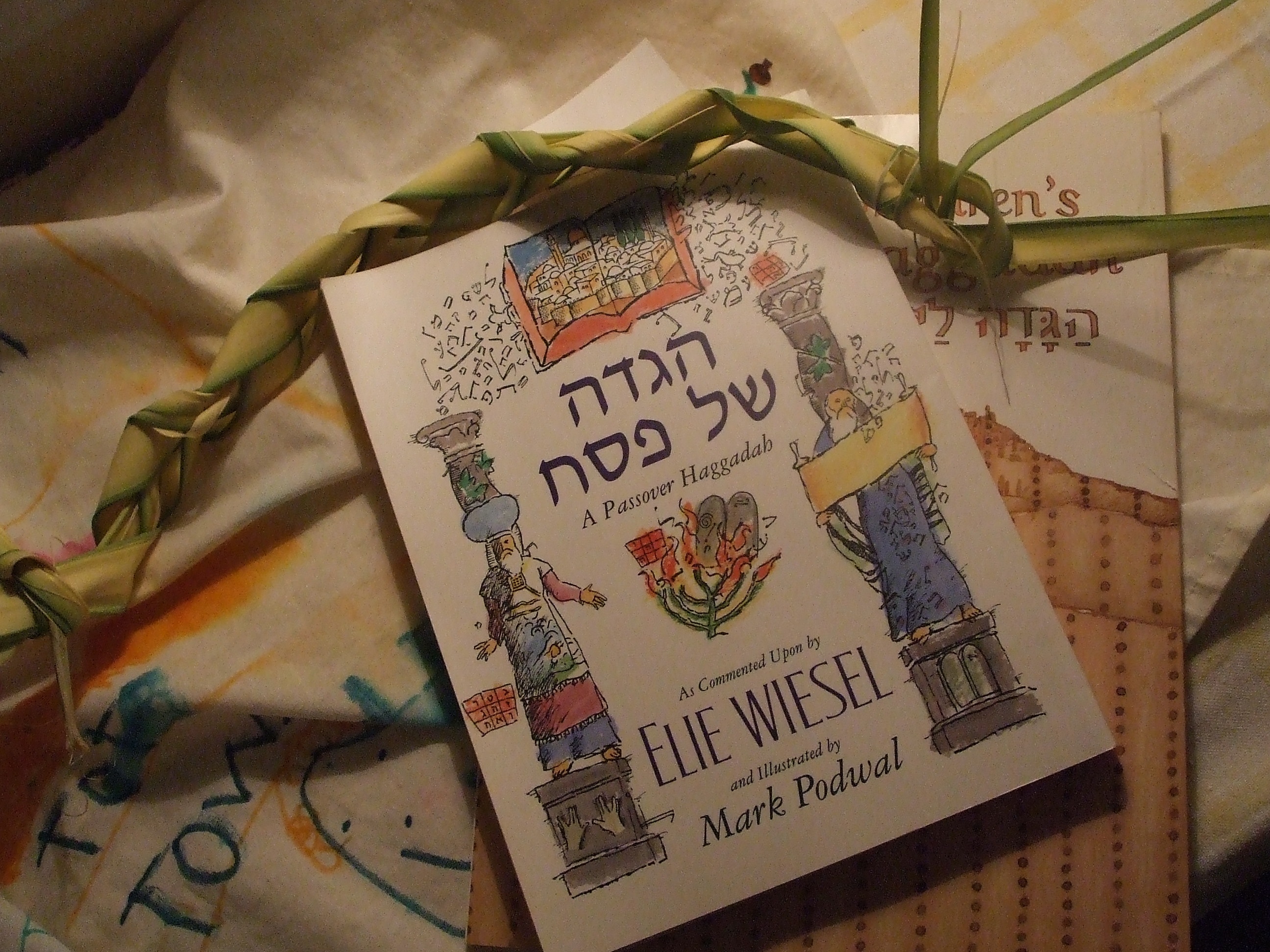
wiesel wrote those words in perhaps the only autographed book (certainly the only autograph that fills me with awe) on my shelves, “a passover haggadah,” (simon & schuster) his 1993 commentary and guide through the seder, or meal of remembrance, the retelling of the exodus story, that is the centerpiece of passover.

“sometimes the sheer speed of events makes us reel,” wiesel also wrote in the haggadah. “history advances at a dizzying pace. man has conquered space, but not his own heart. have we learned nothing? it seems so. witness the wars that rage all over the globe, the acts of terror that strike down the innocent, the children who are dying of hunger and disease in africa and asia every day. why is there so much hatred in the world? why is there so much indifference to hatred, to suffering, to the anguish of others?”

wiesel asks. the old priest implores.

because i am catholic, because i spent many years on my knees studying the 10-foot-high crucifix that hung before me in the church where i grew up, i don’t even have to close my eyes to see the wounds that i’ve been asked to dab with cool and healing waters.

and so i walk, i stumble, through this most holy week.

what questions do you carry into this blessed string of holy days? what thoughts do you put to those questions? those callings?


p.s. some really fine thoughts–really fine–have been tacked onto meanders in recent days, thanks to the brilliant souls who keep pulling up chairs. bless them! don’t forget to take a look back and keep the conversation flowing. just because we move on to a new meander does not ever mean the case is closed on a meander past. in fact, we might have drummed up a real-live beekeeper to tell us a thing or three about the
heartbreak in the hives….
p.s.s. welcome back from break, all of you who flew away…we held down the fort just fine….
vernal whisperings

if you listen, you can hear the first stirrings of winter loosening its grip. yes, the snow moon, that great white orb that cast its full light on the cold cruel landscape of last night, made it hard to see anything that was not white, or bluish white, a color even colder.

but in fact, and despite the wind chill, this is the day when myth and legend begin their vernal whisperings. there’s the old folktale about the ground hog and his shadow. but that doesn’t much catch my fancy.

what does catch it, locks it in its grip, is something i knew little about. until now. it is the jewish festival of tu b’shevat, the new year of the trees.

it is, it seems, all about vernal whisperings, the first hint of promise that all this, the harsh and the cold and the barren, will soon melt away.

as a woman married to a jew, as a woman who embraces spirit and rite and story and all things of the earth, this little holiday seems made for souls like me.

i had had an inkling that the holiday i had a hard time pronouncing (tu-bish-vat, more or less) had something to do with trees or planting trees. in fact, it is said that this is the day when God decides how bountiful the fruit of each tree will be in the coming year.

in israel, this is when the almond tree awakes from its winter sleep, erupting in clouds of tissue-white flowers, the first blossom of spring.

in ancient times, tu b’shevat marked the day of tithing. it clanged the final bell on the fiscal year. all fruits borne before this day, belonged to the harvest of the last year, and must be divided accordingly, a portion to the poor, a portion to the temple in jerusalem.

all of that was lovely enough.

but then i heard something about a special seder of seven fruits.

and that’s when i knew i needed to dig a little deeper. that’s when i discovered the thinking of the 16th-century jewish mystics.

known as the kabbalists, these deeply spiritual thinkers believed that we elevate ourselves by the eating of certain fruits on tu b’shevat. if done with holy intention, they taught, sparks of light hidden in the fruit could be broken open from their shells, freed to float up to heaven, to the great divine, completing the circle of the renewal of life.

oh my.

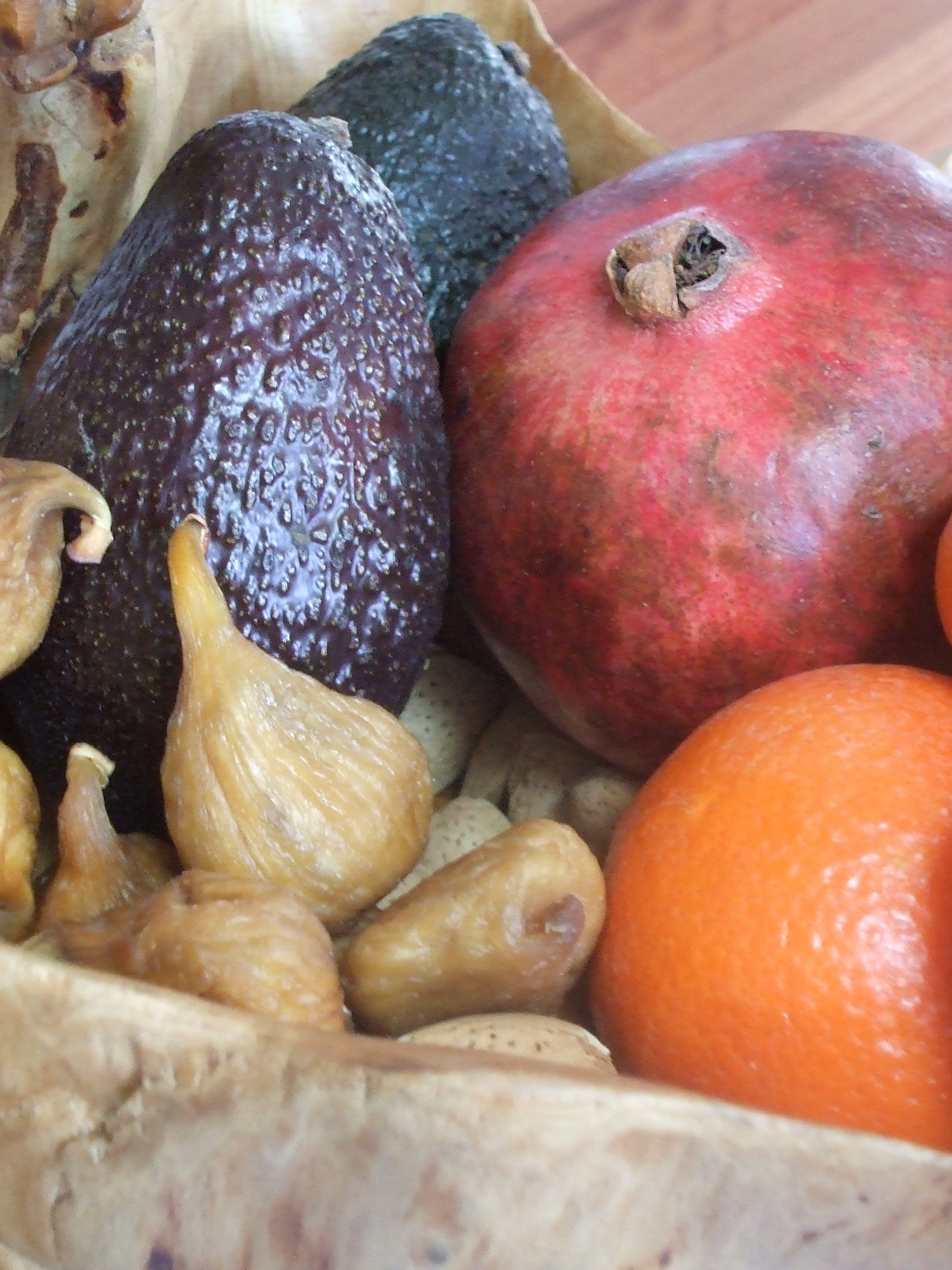
they go on, these marvelous mystics. they talk not about seven fruits, but ten. they break them into categories corresponding to four levels of creation. there are the fruits that need no protection, and can be wholly eaten; grapes and figs, among them. there are fruits that require protection but only at the heart; olives, dates and persimmons would be among these. then there are the fruits that need full protection, the pomegranate and avocado, both of which hide inside a leathery shell. the fourth realm, purely spiritual, by definition has no fruits: it’s just pure spirit.

the holiness of each fruit or nut is, according to the kabbalists, the soft edible part, the part you can bite into. the pits or inedible parts were thought to be impure. and the shells were the protection of the holiness. (makes you feel kindly toward that ol’ banana peel, eh?)

reciting blessings–there is a particular line from the torah for each fruit or nut, believe it or not–helps to release the holy spark of life flow trapped within them, the kabbalists believed.

ah, but the act of chewing, they tell us, kicks it all into some sort of spiritual overdrive.

get this: chewing is more powerful than reciting blessings, they believed, because humans have 32 teeth, and that is the precise number of times the word “elohim,” or God, appears in the story of creation.

goodness. it is morsels like that that make it so delicious to dig deep into something of which you once knew so little, but deep in your soul feel so drawn to. it’s the marvelous adventure, open to all of us, of cracking deep into the book of religions other than the one we knew first. it’s the weaving and steeping, the absorbing and unfolding, that i swear enriches the broth.

but back to the fruits, and the part that i think is the absolute swooningest.

along with the fruits of the seder, the kabbalists said there must be four glasses of wine at the meal. you begin, they taught, with a white wine. each glass after that adds more and more red wine, so that each glass deepens in color. the first glass represents the cold whiteness of winter, the next, the pale buds of spring, onto the deep rose of the height of summer, and finally the crimson of the autumn leaves before they fall from the trees.

you needn’t be jewish to want to drop to your knees on that one, the breathtaking progression, the resonance of the fruit of the vine with the rhythms of earth, the unfolding. a whole sensory reminding that the changing of season is a blessing beyond blessing.

and this is a day when we pause, when we listen, for the first stirrings of the deep underground.

abraham joshua heschel, the great 20th-century jewish scholar, writes magnificently of the sanctification of time in judaism. here is one thought to ponder:

“judaism teaches us to be attached to the holiness of time, to be attached to sacred events, to learn how to consecrate sanctuaries that emerge from the magnificent stream of the year.”

and so tonight, as i light the shabbat candles, usher in tu b’shevat, a sanctuary i never really knew until now, i will sit down to a feast of the earth’s promise, to fruits and nuts and wine. i will behold the shifting of the seasons, the absolute truth of the returning of life.

yes, now winter is making itself abundantly present. but from the heart of the fruits, will break open great sparks of holiness, wafting toward heaven. from each sip of my ever-blushing wine, the taste of the turning of time.

i will know as i eat and drink that beneath the cold hard snow, the fruits of spring are stirring. are whispering sacred incantations. vernal incantations.