pull up a chair

where wisdom gathers, poetry unfolds and divine light is sparked…

Category: religion

hallowing the hollows

“the garden of eden with the fall of man” (ca. 1615):
Peter Paul Rubens
Jan Brueghel the Elder

i emerge here from a day of prayer, a day of poring over the sins of my soul, and the sins of us all collectively. it is a day that’s not easy to leave behind. certainly not this year.

Yom Kippur, the day of atonement, opened with the rabbi once again sharing shattering news. a horror in manchester, england, he told us, without details, had left more than one dead.

morning light streamed in.

i felt us all move in closer, a natural deeply human instinct to harbor each other. it’s those natural instincts that tend to get drowned out on ordinary days, days when it’s noisy, days when we’re so distracted we don’t pay attention to the sound of our breath, the warmth of our skin, the deeply human instinct to run toward, not away, from someone who’s hurting.

we live in a world so distant now from the original vision. from an edenic world where boughs were bent from the heaviness of their fruits, where the silence allowed for the chorus of chirring and chirping to rise from the underbrush, from the branches. in the beginning, in the genesis, after the cascade of wonders—light, darkness, seas and sky, dry land and waters, seed-bearing plants and fruits with seeds buried inside, two great lights in heaven’s vault, the demarcation of day and night, teeming waters and birds filling the air, wild beasts and slithering, down-on-the-ground ones—the one who’d imagined it all, the one we name God, God looked down and saw still a void. how would the garden be tilled? how would it be kept?

and so God made beings in God’s own image, so genesis tells us. and for a short flash of time, man and woman lived in peaceful accord. but temptation arose. and it all shattered and changed. eden was no longer. the man and the woman were banned.

and all these millennia later, we are a people plagued by temptation. temptation of power, of greed, of malice and evil, of hurtful whisper, and weapons of war.

we have fallen so far from the garden of peace and tranquility.

and so, on Yom Kippur, we atone. all world religions, as far as i know, hold confession at the core, are built on the knowing that we will go wrong, exercise evil, traffic in hate.

and so, through the day, over and over and over again, we confess. we confess in short form and long form. we confess and confess, each go at it grating closer and closer to the core.

against the backdrop of the world in which we are living, these are a few of the confessions we prayed:

“The ways we have wronged you by hardening our hearts; and the harm we have caused in Your world through careless speech.”

“The ways we have wronged You by giving in to our hostile impulses; and the harm we have caused in Your world through inflexibility and stubbornness.”

or this, one of the pleas to the Almighty and Merciful, Avinu Malkeinu:

Avinu Malkeinu, halt the reign of those who cause pain and terror.”

so ardently we confess and we pray.

to enter the sanctuary, be it the one of a synagogue or the one under the heavens in my own backyard, is to submit to a paradigm other than the distortions of a world ruled by greed, and power, and envy, and lust.

in these past godawful years, when i can almost hear the walls of decency and democracy crumbling, i retreat more and more into the sanctuary. the voice to whom i answer is that of the Merciful, Benevolent God, a God who is gentle, and tender, a God who seeps into the deepest parts of me, the parts where i surrender, where i know my place is so, so small, and yet, whatever light i can bring to this world, whatever infinitesimal flickering flame, it matters. because we are not the only flame. we inch closer together when word comes, once again, of horror and chaos and evil upon evil. we are many, many flames. or we can be. if we so choose.

it is a mighty thing to stand and sit through a day when over and over we confess our sins, our evils, our hurt-making acts. we are a nation that could do with a day of atoning.

and i am blessed that i, a lifelong believer in God’s tender mercy, was asked to atone for the sins of my own and the sins of us all.

i enter quietly back into this shattered, and shattering world.

i will not extinguish my faint little flame.

what will be your flame this holy day?


i leave you with words of john lewis, the late great hero of civil rights and warrior for justice:

Every human personality is something sacred, something special. We don’t have a right, as another person or as a nation, to destroy that spark of divinity, that spark of humanity, that is made and created in the image of God. 
—John Lewis 


and should you care to be moved by one of the gentlest, fiercest spirits ever to walk among us, this beautiful interview, recorded just last week, of jane goodall, the great primatologist and anthropologist who died at 91 on wednesday. bless her, she was deep in her last book tour when her blessed heart beat its last.

i remember how, when there was a jane goodall special on national geographic, my mother would huddle us around the TV, for she was someone worthy, and i always found her a brilliant source of hope, kindness, an uncanny attunement with nature and nature’s creatures. i have prayed all my life to live to be a wise grace-filled woman like her…..wrinkles worn with dignity, hair whitened by the sun, wrapped in her shawl, at once wise and funny, of the moment and yet timeless. . . .

the nautilus of sacred time

last night, from my wooden pew in the great stone nave that is the church where i pray, i listened to the words spoken from the pulpit, and i imagined back in time to the night in a garden when the man and God wept. i imagined his betrayal. i imagined how he was tried on charges trumped, convicted by the roar of a deafened and deafening crowd, then stripped, and flogged, and soon told to carry the cross upon which he would breathe his last and die.

i thought of who this man-God was: how he’d upturned the tax-collectors’ tables, and the moneychangers’ too. i thought of how profoundly he lived and breathed the words of Torah, how he prayed the sh’ma; the v’ahavta, too. (“you shall love Adonai your God with all your heart, with all your soul, and with all your might.”) and i listened to the priest who, in his sermon, said that the man, named Jesus, had on this holy night gathered his disciples, the ones who’d turned over their lives to him and his teachings, and how just before the grueling hours in the garden, he’d shared the Seder, the Passover meal, and one last time taught his truest, lasting lessons.

before he did, though, he broke rank, broke tradition, this soul who lived not by worldly rule. he rose amid the telling of the exodus from egypt, took off his outer robe, poured water in a basin, tied a towel around his waist, and began to wash the dusty feet of those who’d gathered one last time. this man soon to be accused of claiming to be king took on the servant’s role: he bent, pressed his knees to the floor, and one by one, he washed away the grime.

and then he spoke his one last teaching:

“I give you a new commandment,” he began in the hours before betrayal, “that you love one another. Just as I have loved you, you also should love one another. By this everyone will know that you are my disciples, if you have love for one another.”

as i wrapped myself in the whole of those words, spoken by the Jesus who would soon be crowned with thorns, the priest called us to come forward, to bare our bumpy calloused feet, the ones with toes oddly angled, and nails often yellowed or purpled or however one’s toes age. and then we knelt. and washed each other’s feet, a posture of utter and bottomless humility. “thou shalt love as you are loved.” we poured warm water from a pitcher, and we grabbed a freshly folded towel, and wiped each toe and heel and sole. we washed each other’s feet, an act of reverence in which we’re at once stripped of all pretense, exposed—and yet and yet, we’re met with tender loving kindness, our naked flesh bathed and dried, wiped of earthly dust.

against all of this, a newsreel spooled through my mind. in particular, a single prisoner held behind merciless bars. i was stunned in the contrast: how sacred time, year after year, returns us to the ancient, timeless themes, the ones my parents learned and lived, and their parents too. and theirs, and theirs.

i thought of how starkly this year the sacred story stands against the backdrop of the worldly news. how trumped up charges are once again in play. how there are those who’ve been stripped and shorn. made to sit in ungodly postures, crammed like urchins in a tin can. locked behind bars. held by merciless guards.

that newsreel cracked open in my mind a way of seeing the night of betrayal, the trial and the dusty road to golgotha in dimension i’d not seen quite so viscerally before.

as we knelt and washed each other’s feet, i would later read, a senator who would not be refused, who would not leave the prison gate, had persisted. had finally sat beside the man who’d all but disappeared. gave him but a simple glass of water. “love as you would be loved.”

this year, as the world stands gasping, as cruelties beyond our imaginations play out, i found myself wrapped in the timelessness of sacred time. how its truths have not been quashed. how all the cruelties of humankind have still not stilled, nor silenced, the one command of every sacred text: “love as you would be loved.” stand up to evil. kneel and wash the feet of the stranger just beside you. gnarly toes and crusty heels and all.

sacred time is dauntless. worldly time will crumble in our hands.

the rhythms of the church, of sacred time, again and again, point our attention to the timeless. this year, more than ever, i am on my knees and crying out for mercy.

i am cradled in the nautilus of sacred, sacred time where the cruelties of humankind crumble in the face of Holy Breath.

as the altar last night was stripped of every cloth, as every candle snuffed, and we filed out in silence, so too i leave this table unadorned today. and i ask no question. i leave you in silence, in whatever prayers you pray.

may you be blessed in this holy time.

a p.s.: this good friday is especially deep for me this year, as two years ago today i was wheeled into surgery, and came out minus half a lung, and with a worldview forever changed. i see through a clearer lens now, the lens that cancer brings. and i embrace each holy hour like never before. i am, for the first time in at least a decade, home with all my boys this weekend: the law professor, the line cook, the critic, all gathered for the easter-pesach weekend. it gets no holier than this. dear God, for this blessing, i am eternally, eternally grateful.

ashes to ashes under the specter of scan time

remember that thou art dust and unto dust thou shalt return. 

sobering words, as the grainy smudge is pressed upon my brow. it’s the season of shadow in the liturgical calendar, the season for recognizing our mortality, our fleeting time here to attend to the task of our being. 

dust to dust, ashes to ashes. 

the point of religion, at its wisest, is to strip us to our unfettered incidentality. to put us squarely in our place. we are star dust by chance. but a speck in the great river of time. a mere dot ordained with a task that we trust, we believe, might tip the scales toward goodness, toward light. i believe we’re here to be blessed, to become holiness in flesh form. 

six weeks of lent makes it the longest season of the church year outside of ordinary time. i’m no theologian so i’ve not read deeply on that equation, but i have to think it’s telling us something of import if more days are devoted to repenting, to remembering how mortal we are than to filling our heads with the usual noise. 

i’ve found myself in recent weeks deep in the writing of a book plumbing the spiritual epiphanies of cancer, which at its heart is a meditation on paying attention, remembering that we will die, and seizing the imperative to live profoundly in the now. 

i’ve called it scan time, an abbreviation of time into three- or six-month allotments that serve to focus my seeing. in knowing my time is on the clock, i dive into the work. holy work.

it’s basically living in some iteration of lent from here on in: ashes to ashes. knowing full well that i am dust and to dust i shall return. 

it’s a practice of every religion; humility among the highest virtues. recognizing how tiny a dot we are. and admitting how often we falter. putting voice to confession.

judaism distills it on a single day: the day of atonement, as somber a day as there is. a day in which we fast from all things, and scour our soul, confessing our sins from A to Z acrostically. abused, betrayed, been cruel, destroyed, embittered other’s lives. . .

before the naming of each and every one of those sins, both communal and individual, these words from the Yom Kippur prayer book are recited, directed to the almighty and merciful God:

You know the secrets of the universe and the secrets of the human heart. You know and understand us, for You examine our inner lives. Nothing is concealed from You, nothing hidden from Your sight. Eternal One, our God and God of our ancestors, we pray that this be Your will: forgive all our wrongs, pardon us for every act of injustice, help us atone for all our moral failures.

the act of contrition i learned in second grade says it like this: 

O my God, I am heartily sorry for having offended Thee, and I detest all my sins because of thy just punishments, but most of all because they offend Thee, my God, who art all good and deserving of all my love.

I firmly resolve with the help of Thy grace to sin no more and to avoid the near occasion of sin. Amen.

and the confession in the anglican book of common prayer is not dissimilar: 

Most merciful God,
we confess that we have sinned against you
in thought, word, and deed,
by what we have done, and by what we have left undone.
We have not loved you with our whole heart;
we have not loved our neighbors as ourselves.
We are truly sorry and we humbly repent. . .

sins and ashes aren’t things we like to think about. but, oh, they serve their purpose. and in a world where madness is reigning, where blame is cast but rarely admitted, and hubris has inverted the divine equation, i find myself seeking an alternative paradigm, one that answers not to power and vengeance but to mercy and justice and light.


and for a consideration of not our failings but our goodness, meister eckhart weighs in with this wisdom: 

The inner person is the soil in which God has sown the divine likeness and image and in which God sows the good seed, the roots of all wisdom, all skills, all virtues, all goodness—the seed of the divine nature. 
—Meister Eckhart 


a few years back, i dove a bit deeper into musings on the day of atonement, a post found here: 

you needn’t have been daubed with ashes, nor live with a scary diagnosis, nor recite an alphabet of sins, to recognize the wisdom of silently examining the state of your soul. and stepping forward to make right where you’ve wronged. it’s becoming countercultural in a world taking shape as it is. the ancient ways, though, have lasted. here we are millennia later, and confession still stirs in the human spirit. it takes nerve and true might to live it. needn’t answer here, but what are the profound memories you hold of learning to say, i am sorry? or any other thoughts on ashes and dust, and the sobering truth of our mortality. . .

p.s. i suppose my publisher would reallllly want me to mention (she sent me a little nudge in the social media department, a department where i’m quite often lacking) that The Book of Nature came out in paperback this week, so you can slip a copy more easily into a backpack or pocket. and it’s cheaper!! looks just like its big sister, only a flimsier–er, more pliable––cover.

musings on sainthood . . .

soon-to-be-beheaded st. babs

i’m actually in amherst, massachusetts, this morning, about to traipse over to the homestead, the butter-yelllow brick house where emily dickinson was born and penned her nearly 1,800 poems, and i’m even hoping for a peek into the upstairs room where it all flowed from her inkwell, a room not normally on the itinerary of those who tiptoe in hushed tones through the hallways of emily’s house on the hill. but with an eye toward next week’s all saints day (a day that’s always captured my imagination), i spent a bit of this week musing on sainthood, just another name for what this world needs abundantly, urgently, in the form of plain old honest-to-goodness holiness, empathy, unheralded kindness, and megadoses of humility.


saint (n.)

early 12c. as an adjective, seinte, “holy, divinely inspired, worthy of worship,” used before proper names (Sainte Marian Magdalene, etc.), from Old French saint, seinte “holy, pious, devout,” from Latin sanctus “holy, consecrated,” past participle of sancire “consecrate.” It displaced or altered Old English sanct, which is directly from Latin sanctus.


i’ve had my eye on the saints since i was a wee thing. in the catholic imagination of my first and second grade, i thought hard about the haloed ones held up in the pages of my religion books. we were schooled to be demure, kind (endlessly kind), and enamored with Jesus (always dashingly handsome with his ambered skintones and long flowing locks in the full-color catechism primers, which wisely omitted most of the stories of tortures to which the anointed had had to submit). 

every night, i prayed to be saintly and attempted what i thought might be a postural shortcut: i began by smoothing my patchwork covers, then i’d lie as still as the mummies that scared me in the darkened chambers of chicago’s labyrinthine field museum of natural history, and then––the clincher––i clasped my hands in my best saintly imitation and hoped to move not even a squiggle during the night, to awake still clasped in prayerful pose. it seemed the first in a series of requisite feats on the dusty pilgrimage to sainthood.

by day, i practiced my fledgling aspirations on a lady bug, my fumbled attempt at assisian communing with all of creation. i built her a village––complete with steepled church––and ordained her high priestess of the cardboard hamlet. i checked on her last thing at night, and first thing in the morning, making sure her wings still opened and closed, and that she hadn’t succumbed to inside air. then i let her go. opened the window and unfurled the chant: “go little lady, go free!” and off into the orchard behind our house she flew, the happiest well-loved ladybug that ever there was. 

since i’ve long been an ecumenicist at heart, and don’t subscribe to any of the ecclesial hoops and tangles that dictate who’s in and who’s out in the saintly department, i go about my saint-watching by intuition and impulse. i know a saint when i see one or sense one. a saint to me is just another name for someone whose deep-down goodness is pure as pure can be. while catholics insist on a step-ladder to sainthood, other world religions seem just as intent on holiness but without the boxes to check. according to page 8033 of the thomson gale encyclopedia of religion (2nd edition):

“Historians of religion have liberated the category of sainthood from its narrower Christian associations and have employed the term in a more general way to refer to the state of special holiness that many religions attribute to certain people. The Jewish hasid or tsaddiq, the Muslim waliy, the Zoroastrian fravashi, the Hindu rsi or guru, the Buddhist arahant or bodhisattva, the Daoist shengren, the Shinto kami and others have all been referred to as saints.”

the best of the saints (hasids, waliys, fravashis, gurus, bodhisattvas, shengrens, kamis), in my book, are the quotidian ones. the ones whose everyday garb keeps them from being noticed. except for their kindness, the certain radiance they leave in their wake, the sense that something holy has just brushed by, you might not notice the saintly among us. 

but they leave behind a mark, a certain mark, a change of heart, a new expanse of seeing. we become better, bigger of heart and soul, kinder, gentler, maybe quieter, certainly softer, because of them. that’s saintly to me. 

among the saints i’ve known in my life, there was the old wrinkled man who perched on a fire hydrant befriending the pigeons. “i’m really advertising to the public how easy it is to be good without an attitude; it’s just as easy to show decency as it is to hate today,” joe zeman, the pigeon man of lincoln square once told me. 

and there was the foster mother who’d taken in nearly 100 newborns, and who was sitting by a hospital crib when she looked up and told me: “i’m no mother teresa,” she insisted, wrapping her fingers around a metal rung of the crib, as her littlest toddler was being infused with drip after drip of cancer-fighting chemo. “i always think of something i saw in the New World (a catholic newspaper) in which a columnist was saying, `i’d hate to be in line at heaven’s gate behind mother teresa when God looks down and says, `you could have done more.’”

even now, when it’s no longer my job to scour the landscape in search of those sorts of souls whose goodness leaps off the newspaper page, i find saints in the unlikeliest places: behind the cash register at the grocery store; in the catering office of my college kid’s dining hall; at a check-in gate at america’s busiest airport; in the lady down the alley who never dresses in anything fancier than her mud-stained sweats but who routinely writes checks for thousands of dollars for families in trouble, be it escape from afghanistan or domestic abuse. (a secret i discovered only by listening closely, and connecting a dot or two.)

so what makes a saint a saint, or a hasid a hasid, or a bodhisattva a bodhisattva

is it answering to an otherworldly call, the whisper of the holy divine? is it believing that the glimmering lights of the public square are simply distractions; turning instead to a quieter code, one infused with boundless empathy more than anything: love as you would be loved? is it the courage to call out injustice, to muster the chutzpah to say, “this isn’t right. you’re treating her poorly. your words are scarring her, leaving welts where they’ve hit her.” is it emanating a peacefulness, a serenity, that comes from knowing yours is a timeless eternal, a blessing for ever and all time?

what makes a saint a saint, what makes holiness holy? 

it’s a question worth asking, but mostly it’s a question to put to work. what are the scant few things you might include in, say, a manual for the would-be saint, the very title of a poem i left here on the old maple table a few years ago, after coming upon them in a book i was reviewing for the tribune. i’ll leave the first lines here again, as a place to begin your own musings on sainthood. 

Manual for the Would-Be Saint
by Susan L. Miller

The first principle: Do no harm.
The second: The air calls us home.
Third, we must fill the bowls of others
before we drain our own wells dry.
The fourth is the dark night; the fifth
a subtle scent of smoke and pine.
The sixth is awareness of our duties,
the burnt offering of our own pride.
Seventh, we learn to pray without ceasing.
Eighth, we learn to sense while praying.
The ninth takes time: it is to discover
what inside the seed makes the seed increase.

(the poem goes on for 14 more lines…but you might be inclined to pen your own…)

because i’m so worried about the world, and the evils and horrors that seem to be steamrolling goodness, i’m thinking we might put forth a collective effort here, outline a framework for how we might bring a bolus of holiness into this world. have at it. i’ll chime in too…

what do you see or sense when you encounter someone you’re sure is steeped in a certain holiness, another name for the sainted?

emily d., the belle of amherst

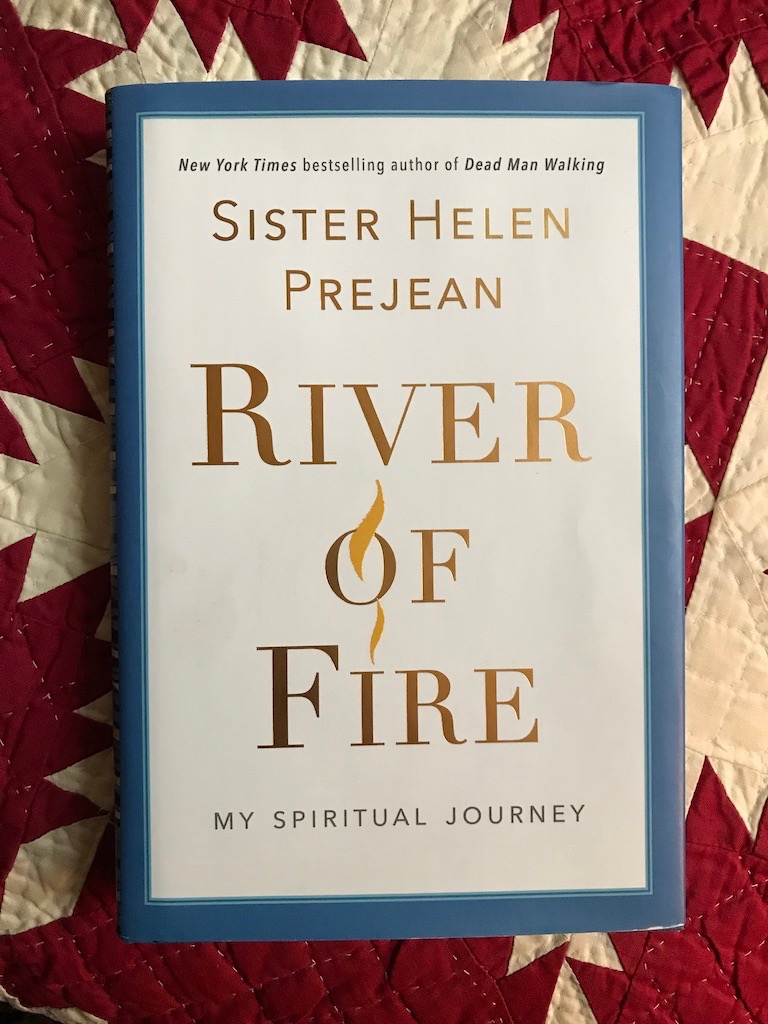
book for the soul: sister helen prejean’s “river of fire”

IMG_0353

i’ve been waiting to tell you about this one, one that pulled me in from the very first pages.

here’s how it begins:

“They killed a man with fire one night. 

Strapped him in an oaken chair and pumped electricity into his body until he was dead.

His killing was a legal act.

No religious leaders protested his killing that night. 

But I was there. I saw it with my own eyes. 

And what I saw set my soul on fire–

a fire that burns in me still.”

that’s the very beginning of Sister Helen Prejean’s fiery baptism into her role as the Dead Man Walking nun who, ever since that night in the killing chamber, has devoted her days to fighting mightily and gutsily against the death penalty. and as she writes a few paragraphs later in the preface to her latest book, River of Fire, a memoir at once hilarious, soulful, and intimately detailed, recounting the spiritual journey that drew her to the executioner’s cell that night: “Once when I was inside the Louisiana death house awaiting an execution, Captain John Rabelais, a guard, asked, ‘What’s a nun doing in a place like this?'”

River of Fire is her answer to that question. and it’s as soulful a book as i’ve read in a rather long while, and a glorious read to boot! as i didn’t write in my review for the Chicago Tribune, i wound up hauling that book wherever i went for a few days, carving out hours and space in which to sidle up beside Sister Helen, who came to feel like the nun i didn’t have in fourth grade. oh, i loved sister leonora mary, but she wielded a sharp-tipped pointer, kept every hair on her head in hiding, and sure never told me the tales of the loves in her life, nor referred to herself as “a sort of free-range chicken version of a nun.”

sister helen is, by her own admission, highly free-range. and that’s how i best like my chicken — and, apparently, my nuns.

oh, lordy, to sit down beside her in real time…who knows the tales that she’d tell in the confessional of kitchen-table tête-à-tête?!

turns out, two fine friends here at this very table know her well (one is and one was a sister of the congregation of st. joseph, the very order of nuns to which Sister Helen belongs, and one is spelled out in the shortlist of acknowledgements at the end of River of Fire). both can — and animatedly do — unspool a skein of Sister Helen stories: how she shows up at sundown on the front stoop fully equipped and raring to go for a long night of story-swapping; how she holds any audience anywhere utterly spell-bound and never brings so much as a note to the podium; how in real life she’s the real deal — every bit the iconoclast and rabble-rouser she seems on the pages of her books.

before i plop down my tribune review, i’ll add this one community service announcement: sister helen will be at The Well Spirituality Center in lagrange on wednesday, october 30 at 7 p.m. (click the link above, and secure your $25 seat in the room). without notes, of course, she’ll be telling tales from the pages of her life and her books. and, as she does in her book, she’ll leave you laughing one instant, and covered in goosebumps the next, so utterly stirring is her brand of free-range wisdom and soulful epiphany.

here’s the review, as it ran in the tribune:

‘River of Fire,’ Sister Helen Prejean’s new memoir, is as irreverent as it is wise

By BARBARA MAHANY

CHICAGO TRIBUNE | OCT 02, 2019

‘River of Fire’

By Helen Prejean, Random House, 289 pages, $27

Sister Helen Prejean is known as the nun from New Orleans who wrote prayerfully and piercingly about witnessing death-row electrocutions in a Louisiana prison. That her book about her experience, “Dead Man Walking,” rocket-blasted to best-seller status, spawned a movie, an Academy Award-winning performance, a play, and an opera that’s been produced on five continents, says something undeniable about her storytelling powers.

Prejean has done it again in her new memoir, “River of Fire.” While the subject here — her own spiritual evolution — might not be as harrowing as what she terms “government killings,” Prejean’s capacity for truth-telling, for holding little back, makes for can’t-put-it-down page-turning.

A truer title might have been “Inside the Nunnery: 1,001 Things You Were Afraid To Ask.” And Prejean tells plenty. We start innocently enough, reading about life beneath a nun’s habit of so much black serge she felt “mummy-wrapped.” She recounts the story of a nun friend once mistaken in a fabric store for a “bolt of black material,” so voluminous was the to-the-floor flesh-masking swirl of standard-issue black wool. Prejean holds back little in detailing a seven-year relationship with a hard-drinking priest, a celibate bond, to be sure, but one charged with more than some of us might ever have imagined vis-a-vis our fourth-grade nuns.

But Prejean isn’t practically a household name in social justice circles and beyond because of her knack for titillation. She oozes hard-won wisdom, soulful epiphanies, and wraps it all in breathtaking humility that shrinks any distance between author and reader. The whole way through, “River of Fire” reads as if a tête-à-tête on the schoolhouse steps, where one sits beside a beloved, much-wiser soulmate and sops up a lifetime’s worth of lessons learned, often the hard and roundabout way.

Most of all, Prejean cuts through church-preach. Time and again, she zeroes in unswervingly on the essence of radical non-conformist Jesus, the one who preached love, the one who reached out to those on the ragged margins of society.

And she’s laugh-out-loud funny. And irreverent. Sometimes, both at once. Writing about the saints — Joan of Arc in particular, the saint who was “burned at the stake on charges of heresy and the unpardonable sin of cross-dressing” — Prejean writes matter-of-factly: “I just know I’d never be a good martyr. I burned my hand once making brownies and I nursed my wound and talked about my wound and held up my poor burned hand for all to see and sympathize with. Burn at the stake? For something as trivial as holding beliefs considered to be a little unorthodox? Be burned alive for that?”

Don’t mistake her narrative hijinks or her yarn-spinning capacities as sideshows to dilute an otherwise indelible confessional and testament to the power of a life devoted to God and godliness. Rather, it’s the pure joy of reading Prejean — her gift for knocking herself off any saintly pedestal, making the reader believe that we might all leap into her river of holy fire — that makes this a spiritual work of high and radiant order.

“I have a hunch I’m going to be waking up till the moment I die,” she writes. And in so writing, the good sister opens up for all of us the doorway into our own humble stumblings toward what can only be termed the lifelong walk toward holiness.

Her parting words, almost as if she’s leaning in, there on the schoolhouse step, where you’ve now been sitting side-by-side for 286 pages, as if imploring one last life-or-death time: “I urge you to get in the conversation on human rights and stay in it. It’s the only way the arc of the universe bends toward justice.”

Barbara Mahany is the author of several books, including, “Slowing Time: Seeing the Sacred Outside Your Kitchen Door.”

Twitter @BarbaraMahany

and what fine reads have you read of late?

sometimes when you fly, you land in heavenly places

IMG_7150

sources tell me it’s no secret that i’m a homebody. one of the original give-me-my-old-lumpy-mattress homegirls. so it was with no smidge of trepidation and wishing-it-was-over that i sped off to the airport the other morning, encountered a TSA line sure to make me miss my plane, and nixing all hopes of a hot paper vat of airport coffee.

i flew to music city (aka nashville) where i sang not a note, but i did meet some very very very fine folk. i was there to make a video — five brilliant women + me. i was there in the role of (take your pick) oprah or, my preference, krista tippett. all i had to do was ask questions. the brilliant ones did the stuff that mesmerized me. two of the women are professors, biblical scholars of the old and the new testament, four are preachers. one (the professor/preacher from princeton and yale divinity school) preaches at the oldest black baptist church north of richmond, virginia, a church in alexandria founded in 1806 by the black baptist society whose number swelled when slaves from mount vernon plantation joined in 1815.

that professor-preacher, rev. dr. judy fentress-williams, mentioned to me that she served as senior assistant pastor to rev. dr. howard-john wesley, considered “one of the great orators of this generation” (so claimed by the NAACP, in awarding him one of their most prestigious honors earlier this month). wesley’s sermon, “when the verdict hurts,” preached just 12 hours after the 2013 verdict in the trayvon martin murder trial, was pegged by no less than time magazine as “the best” on the subject of george zimmerman’s not-guilty verdict, in their cover story, “after trayvon,” with the prompt, “if you hear one sermon about america’s trayvon martin moment, let it be this one.”

judy, beyond brilliant in her own right, mentioned to me that i really ought to take a listen. so, of course, i did.

it might have been the holiest thing i heard this week, so rather than prattle on about trivialities, let me turn this week’s table over to the man who left med school to become a preacher, was named a martin luther king, jr., scholar at MLK’s alma mater, boston university, and in whose pews i pray i some day find myself.

pull up a chair, and take a listen: “when the verdict hurts,” july 14, 2013. rev. dr. howard-john wesley, pastor, alfred street baptist church.

what i’d give to be able to go someplace once a week where i was stirred to goosebumps, stirred to action.

made me remember, once again, that when i pull myself away from where i’m most at home, i never fail to be amazed by the wonders always just beyond my doorstep.

who stirs you to goosebumps?

the eloquence of silence

silence on day that darkens

the sky is gray. as it should be. as my mama long ago told me it would be. had to be. this was the day that jesus hung on the cross. this was the day they call good friday, though i never have, never will, understand that. it’s a friday i nestle into, to be sure. it’s a friday when i will carve out a hollow of silence. i will wrap myself in silence and gray, gray sky.

it’s my practice, because we don’t usually shake off the ways of our earliest days, to contemplate deep and hard these hours when the one who healed the sick, threw out the tax collectors, the one who preached “love your neighbor as yourself,” the one who wept in the garden of gethsemane, he was stripped, and crowned with thorns. he carried the cross of his own dying along the dusty road to golgotha. he fell down. three times. and then, when he came to the place where he was to die, his arms and legs were nailed to limbs of tree, to wooden timbers, and he slowly breathed his last. and before he dropped his head, he called out: “father, forgive them, for they know not what they’re doing.”

and if no other story of the christian narrative compels you, this might be one to contemplate deep and hard all life long.

i never get to the bottom of it. but every year, come this gray, gray friday, i try. i sink deep into what might have been coursing through a holy man on his way to die. i contemplate how it might be to live a life of trying to right the ways of a world that’s side-stepped what matters, that’s lost sight of how to love, of what it means to make peace with enemies, to embrace the cast-aside, the forgotten, the scorned. and then, at the end of that short life, to be condemned to die. to carry the weight of that cross knowing it’s the instrument of your own death.

and all of that i contemplate in silence. it’s one rule from long ago that i try mightily to abide by. my mama made us all be silent. not a word from noon to three, the hours when jesus hung on that cross, the hour when he died. long ago, for all those gray gray fridays, i tiptoed to my bedroom, my one sanctuary in a house of brothers. i sat on my bed, stared out the window at the sky. turned the pages of some evocative telling of those final hours. and waited for the sky to darken, maybe rumble, maybe cleave, at the stroke of three, the hour when jesus died.

and so it is here and now, the silence that will infuse the afternoon, when i will retreat to my room, stare out the window, turn the page of some evocative retelling of this gray gray friday. though i don’t, and haven’t, set that rule in my house, have not made my boys abide (though i do offer it as suggestion, nearly every year). i follow all alone the rule of silence.

there is such eloquence in silence, particularly amid this noisy, cacophonous world. there is wisdom in allowing thoughts to flow, to follow their course deep down to where the inklings come. or the knowing. it’s as if the rivulets of thawing spring find their way to rushing creek, where the bubbling up begins.

it’s rare and it’s a gift, this setting aside an afternoon for silence. for holy thought. for deepening.

and this gray gray friday, there is much to contemplate. to breathe deep and fill my soul.

the wonder of this particular good friday is that as i pull away from the afternoon’s silence, i will turn to passover’s story of exodus. and there i will be gathered at a table and that story will be told and retold. two compelling narratives in one day at our house. so it is, the blessing of being both. last night, at the mass of the last supper, i listened as one reading told the escape-from-egypt story, and the next told how jesus sat down to the seder, the passover feast, the one that we’ll sit down to tonight and tomorrow night. the intermingling of narratives, the points of intersection, they’re not missed by me. and it’s all part, i think, of what makes the good friday story even more compelling. the contemplation of the depths from which it flowed.  

this morning i thought i was going to burrow deep on the subject of silence, but, as so often happens, the sentences took me elsewhere. took me this time into jesus and the hours of this deepening afternoon. i don’t often write overtly about the tenets of my religion, or tell its stories here, but indeed they resonate and deeply draw my attention.

minutes after writing the words above, i sat down with my most beloved haggadah (the book that holds the story of the exodus, and outlines the prescriptions for the seder, the passover retelling and feasting); it’s the new american haggadah, edited by jonathan safran foer, published in 2012, and it’s brilliant. i read these words:

“we are not merely telling a story here. we are being called to a radical act of empathy.

oh, i wish i’d read those words before i started writing this morning. they grabbed me by the throat, and hold me in their grasp. we are being called to a radical act of empathy. jewish or christian, the stories of this holy blessed weekend are calling us to radical acts of empathy. and therein lies the miracle. that we have the capacity to enter.

contemplate the radical act of empathy in how, in our lives, we are called to feel from inside those beyond ourselves.

and my original first question of the morning:

do you, amid your busy days, ever declare interludes of silence, to follow the rivulets of thawing spring to the rushing creek where bubbling comes?

hours of sorrows

silence on day that darkens

amid this breathless week of passover seders and holiest hours, amid trying to pack lunches kosher for passover, and waking up early to stir and bake passover coffee cakes (in which it’s the egg white that’s relied upon for alchemy, to lift the leaden matzoh into something that falls on the tongue with delicate bite), amid wondering what to serve our muslim houseguest when she’s here for easter brunch while we’re keeping kosher for passover, today is the day i deep breathe.

today, good friday, holy friday, friday of sorrows at the nadir of the week, this is the day when the noon hour comes, and the sky darkens (at least in my searching imagination it does), and i retreat to my quietude. and my sorrows.

sorrows not my own, but sorrows for the world. sorrows of which there are too, too many. the more you read the newspapers, the more you turn the pages of memoir, the more and more you realize the world is shrouded in darkness. darkness that demands whatever energies we have to battle it back. to insist we’re not letting it win. we’re not standing by in abeyance. we’re not washing our hands, turning and dropping the ball, leaving the dirty work to anyone else.

on this day, in these hours of sorrows, i turn to that ancient and ever-birthing instrument of petition and promise: i pray. i pray on my knees (till my old bones tell me to stop, anyway). i pray curled by my window, my eyes deep in the words on the page. i pray all alone, just me and the God who is listening. listening, i’m certain.

this year, i’m bringing along a wisp of a book, a book originally published in 1955, before i was born, a book i searched for and found this year because its words had so stirred me, sitting in the pews at a church not far away in miles, but legions away in raw earthy truths. it’s a church filled with a few dozen languages and skin from pitch-black to blotchy from tears. it’s a church where i go to feel naked, to feel in communion with the messy stuff of humanity. i’ve seen old women, bent and bowed, rocking with tears, and mumbling half out loud. i’ve seen fat brown-skinned babies dunked in the holy waters. i’ve seen walkers and wheelchairs and crutches and canes. the whole lot of God’s sorrows streaming up to communion.

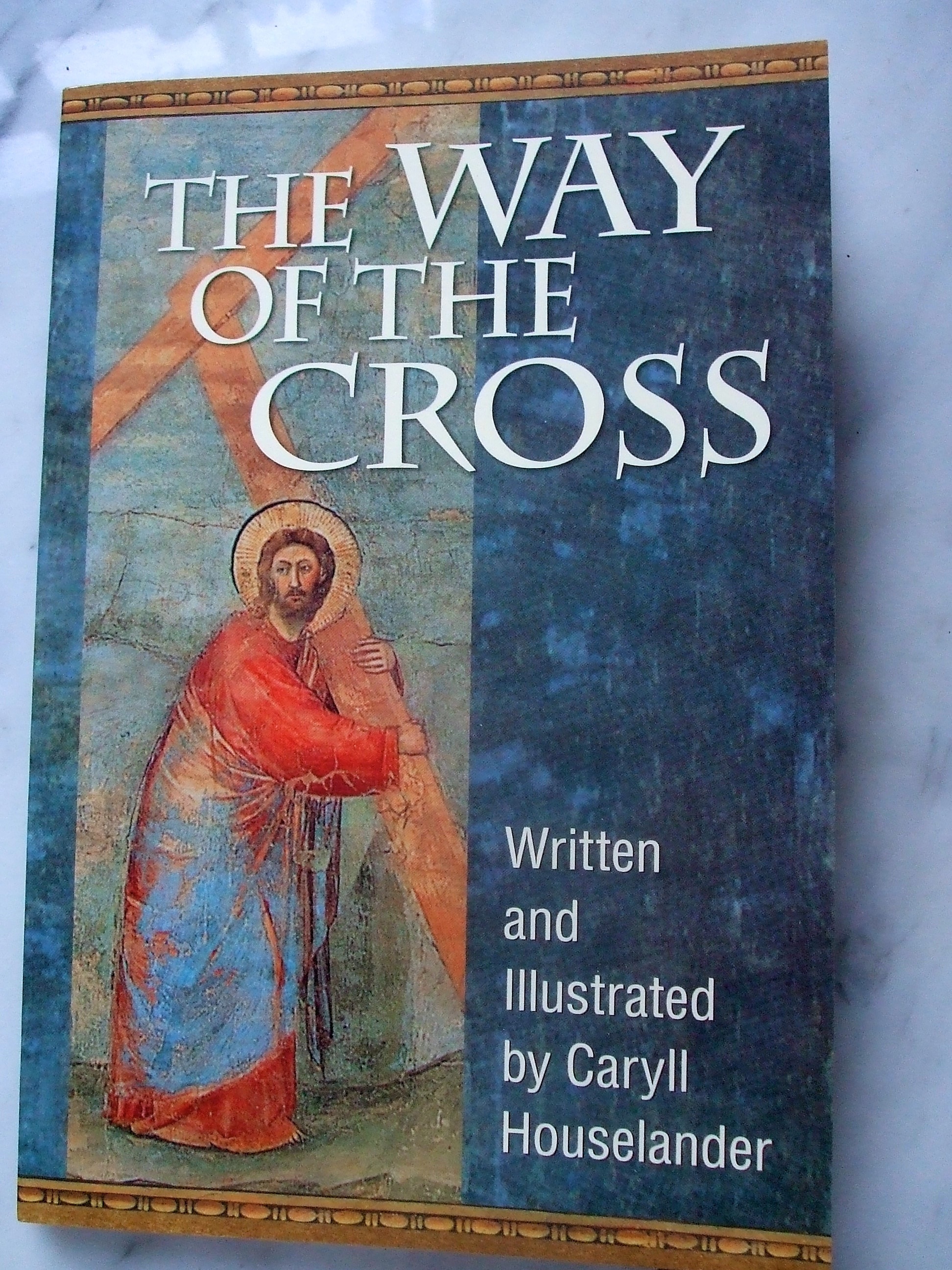
the book, this book that speaks to me, speaks to all who gather at st. nick’s and beyond, it’s “the way of the cross,” written and illustrated back in 1955 by caryll houselander, and you can find it from liguori publications, down missouri way.

way of the cross

now this caryll houselander, she was a bit of a rabble-rouser (a chain-smoking, profanity-spewing 20th-century british catholic mystic, artist, woodcarver, prolific author, teacher of disturbed children, counselor of the war-traumatized, widely known as “the divine eccentric”).

she liked her religion messy, she liked it to speak from the hollows of the human heart. and she lifted it out of long-ago millennia and into the moment, for me anyway. she puts me there in the dust at the side of the via dolorosa, the quarter-mile road in old jerusalem where jesus carried the cross, falling not once or twice but three times under the weight of those shoulder-crushing timbers. up the hill to calvary, where, upon that cross, he cried out, “father forgive them, for they know not what they are doing.” and then, with his mother weeping at the foot of the cross, he let out the gurgly rattle of death, and he died.

we all have words in our lives with magical mystical powers, words that unlock some soulful place in us. caryll houselander’s “way of the cross” does it for me.

here she is on veronica, the compassionate woman who burst through the rabble to come face to face with the tormented jesus. here she is, caryll houselander, with the pleading to God inspired by veronica wiping the face of jesus, a soulful act of compassion if ever there was:

give me Your eyes

to discern the beauty of your face,

hidden under the world’s sorrow.

give me the grace

to be a Veronica;

to wipe away

the ugliness of sin

from the human face,

and to see

Your smile on the mouth of pain,

Your majesty on the face of dereliction,

and in the bound and helpless,

the power of Your infinite love.


Lord take my heart

And give me Yours.

quietly, i leave you to enter your own pleadings and sorrows.

may this be a day steeped in the Holy. may your hours of sorrows draw you into a depth of compassion that lifts you beyond your own full deck of worries.

another road into compassion:  a few months back, i mentioned here that i was working on a story about a 20-year-old former star swimmer and water polo player who suffered a brain aneurysm in the fall of his senior year of high school and now lives in the hell called “locked-in syndrome.” the story just came out in marquette magazine, and web wizards masterfully interlaced film clips throughout the words of the story. if you are hungry for a bit of humbling today, you might want to click on patrick stein’s story here, as published in the magazine. 

how will you spend the hours of sorrows? 

“by little and by little”: dorothy day, a guide to loving

dispatch from 02139 (in which, at long last, there is time in the day, here on the banks of the river charles, to take a few lessons from one of the 20th century’s modern spiritual pioneers and religious revolutionaries, dorothy day…)

if sabbatical has its roots in sabbath, to rest, to restore, then that is what pulled me, three months ago, to sign up for religion 1004, “modern spiritual pioneers and religious revolutionaries.”

i scanned across the list of saints whose lives we’d be studying — gandhi, martin luther king, thich nhat hahn, abraham joshua heschel — and i was hooked. i saw one more — dorothy day — and i was writing the professor begging to be allowed at the seminar table.

dorothy — for i don’t think she’d want me to call her ms. day; she’s not like that — has been my deep catholic hero for a long, long time. her brand of catholicism, the catholic worker movement founded, in part, on hospitality houses for the poor, the lost, the wholly left-to-the-margins, is the brand i still believe in.

i grew up, spent my holy years, in the 1960s.

stepped into my first dark confession box back in those turbulent days — just post vatican II, when the church was turned on its head, a year after JFK was assassinated, at the height of the escalation of the vietnam war — heard the opaque window slide open, heard the priest’s breathing, heard my own heart pounding as i scoured my soul, got ready to spill all my sins there on the ledge. tasted my first dry, wheat-y communion wafer. wondered what to do when it got stuck on the roof of my mouth.

and then, in seventh grade, it got really deep: we had a nun who’d stripped off her habit, who stood there in sweaters and skirts, strummed a guitar, and turned off the lights so we could watch — over and over — “the red balloon,” sing kumbaya. radical jesus — with his long curly hair and sandals, friend to the thieves and the whores — was a god made for the decade of protest, anti-establishment.

all along, i’d spent hours at bedtime, praying that i could be better come daybreak. be more of a saint. try harder. one lent, when i was in third grade, i think, i got up early, rode my bike to 7 o’clock mass every morning. because i thought it would make my soul shine brighter.

i never stopped trying.

and then, along came the likes of mother theresa and gandhi, and later, dorothy day.

they were my brand of catholic. they scooped souls out of gutters, touched the untouchables, turned away from the gilded altar cloths and the chalices locked away in a safe in the dark of the church.

they were what drew me to appalachia in college, what pulled me into a soup kitchen on the west side of chicago. they and my mother, truth be told.

but my mother has never written out her theology, just told me once, in a few short words (all i needed to hear really) that, after my father died, she figured she’d devote all the days of her life to God, and live a gospel of love. so she does, and i watch.

over the years, i’ve read snippets of the life of dorothy day. knew enough to call her my hero, claim her as my personal saint.

but i hadn’t taken the time to pore over her writings, to absorb the whole of her story — in her words.

and right now, because we’re at that part of the reading list, because for the next two weeks, on mondays at 4, i’ll be sitting at the seminar table in the great gray stone tower that is harvard divinity school, i am reading dorothy. curled up on the couch with her all yesterday afternoon, an afghan under my bare toes, a fat mug of tea and an orange fueling me along the way.

i read paragraphs that could change me forever. so, of course, i’m sharing them here. see if you, too, discover a trail to carry you through the rest of your days, even the days when we’re lost in the deep dark woods. (the italics, for emphasis below, are mine.)

“…she did not expect great things to happen overnight. she knew the slow pace, one foot at a time, by which change and new life comes. it was, in the phrase she repeated often, ‘by little and by little’ that we were saved. to live with the poor, to forgo luxury and privilege, to feed some people, to ‘visit the prisoner’ by going to jail — these were all small things. dorothy’s life was made up of such small things, chosen deliberately and repeated daily. it is interesting to note that her favorite saint was no great martyr or charismatic reformer, but therese of lisieux, a simple carmelite nun who died within the walls of an obscure cloister in normandy at the age of twenty-four. dorothy devoted an entire book to therese and her spirituality of “the little way.” st. therese indicated the path to holiness that lay within all our daily occupations. simply, it consisted of performing, in the presence and love of God, all the little things that make up our everyday life and contact with others. from therese, dorothy learned that any act of love might contribute to the balance of love in the world, any suffering endured in love might ease the burden of others; such was the mysterious bond within the body of Christ. we could only make use of the little things we possessed — the little faith, the little strength, the little courage. these were the loaves and fishes. we could only offer what we had, and pray that God would make the increase. it was all a matter of faith.”

— from “Dorothy Day: Selected Writings,” edited and with an introduction by Robert Ellsberg.

by little and by little.

now there’s a theology i can grasp, clench in my hot little fist.

we could only make use of the little things we possessed — the little faith, the little strength, the little courage.

these were the loaves and fishes.

we could only offer what we had, and pray that God would make the increase.

most days i don’t have much. but by little and by little, i can steady my wobbles, and put one foot forward.

i can try, with all my might, to live a life of love, by little and by little.

there is much this week to pray for, in the heartbreaking wake of hurricane sandy, who has left my beloved in-laws without heat or light or power on the jersey shore, who has turned my sister-in-law’s new york brownstone into a hospitality house for all those with nowhere to go. who spared us, and our sweethearts in maine. for all the heartbreak, up and down the eastern seaboard, i pray for repair and for strength, by little and by little. 

your thoughts on the wisdom of dorothy day? and if she’s not the one who guides your days, who is?

seeds cast to the winds…

our house this week has been aswirl with all that comes in that holiest of weeks, the week at our house when, so often, passover and easter glide in and intermingle.

i’ve been in the kitchen, digging out the pint-sized processor my beloved jewish grandma (the one i’d felt was mine, from heart, if not from birth) shipped to us back when our firstborn was just born, and she decided, upon his birth, that it was the one thing i needed, so she boxed it up in florida to send our way, lest i choose to someday whir the baby’s veggies to a pea-green paste.

i made charoset for the first time in years, the apple-wine-and-walnut mortar, the one set upon the seder table, a table we’ve not set here in years and years, but did this year because the rabbi who usually leads us all in chants and jewish mysticism, he’s had a bumpy year and couldn’t manage yet another room of crowded tables.

i pulled the “silver palate” cookbook off the shelf, decided after much debating with myself, that the only feast that symbolizes passover for me is the chicken marbella, page 86, the one we’ve feasted on for 20-some years at a dear friend’s second-night seder. and so it is; it’s now our first-night feast, now that i too know how to grind the head of garlic, stir with spanish olives, prunes and capers, an aromatic cloud that filled the fridge for one whole night and next day long.

i roasted egg and shank bone. i boiled up matzah ball soup. ordered gefilte fish from the fishman. watched my boys sink in their forks, and smile from deep-down places.

and now, with the pantry stocked and freezer too, with foods that have no leavened grain, no grain at all, save for ground-up matzah, we carry on the catholic end of the week, the holy week, the days of awe for me.

and while i sometimes find myself in lonely place, alone at church on palm sunday, for instance, i have found in this end of the week, quiet joy, unexpected joy.

last night my little one sat beside me at holy thursday mass, the mass that remembers the last supper–a seder, after all. he curled into my side, entwined his slender getting-longer fingers in mine. he asked me questions throughout, and i whispered answers, so quietly moved that for once i was not alone at church.

and today, good friday, a day i’ve long marked in silence from noon to 3, in remembrance of jesus on the cross, jesus suffering, my 6-foot-3 rower told me he was skipping practice. why, i asked? because it’s slotted for noon to 2, he said, matter-of-factly, and it’s good friday.

i quietly felt a glow.

i have not been one to try to wedge my boys into the practice of my religion. i’ve not tried to wedge anything at all. i have offered up all i have. i have made the seders, left out holy books, asked plenty of questions, tried to answer questions without easy answers.

we have, every night since each boy was born, whispered a litany of prayers, a head-to-toe veneration and then some, before sweet child slipped into slumber.

i have put out shabbat candles every friday. made fish for most shabbats, a subtle catholic-jewish intertwining.

i have walked to the lakefront with my boys, tossed bread upon the waves, cast sins at the jewish new year. savored the ritual, felt deep-down blessing at the many roads to the holiest of holies.

i have honored the sacred in all its forms. but i have not demanded, not sulked. oh, i’ve shed tears, though, but not when anyone was watching. i’ve felt the price of living in a home where two religions were offered. i’ve felt the sting of their pointed questions, of not knowing if they believed at all.

it’s a far lonelier road than most anyone will tell. i have tried hard to make peace with carrying on my quiet flame, believing all alone, of being without my boys on holy thursday night when the time came to take off my shoes and have my naked feet washed by strangers, and to return the blessing all alone.

and this year, i am quietly and deeply moved that i was not alone last night, and will not be alone this afternoon in my silent vigil.

it is dicey business, this growing up with deep cords of faith, in a world where the secular is drowning out the sacred. it is double hard to try to teach two religions, when there seems barely room for one.

it is not wise, i figured out, to demand belief. there is no such demanding.

in the end, we can only light the candles, set the seder table, cook fish for each shabbat, revel in the glories of the good times, and pray to God that in the darkest hours, our children will find the seeds that we once planted. and those seeds somehow will swell and burst with the tender beginnings of a vine that someday will carry them to the heaven that surrounds us.

that’s my prayer this holiest of fridays.

and how do you pass the seeds of faith to your children, or to the ones you so love?