pull up a chair

where wisdom gathers, poetry unfolds and divine light is sparked…

Category: quiet

gravitational pull

i can’t stay away. 

etched on a map, you might not notice; its tucked-away nature is but the flint of its charm: a treasure in almost plain sight. i might have zipped by a thousand times. it only took once for curiosity’s lure to draw me into its fold. and now it won’t let me go.

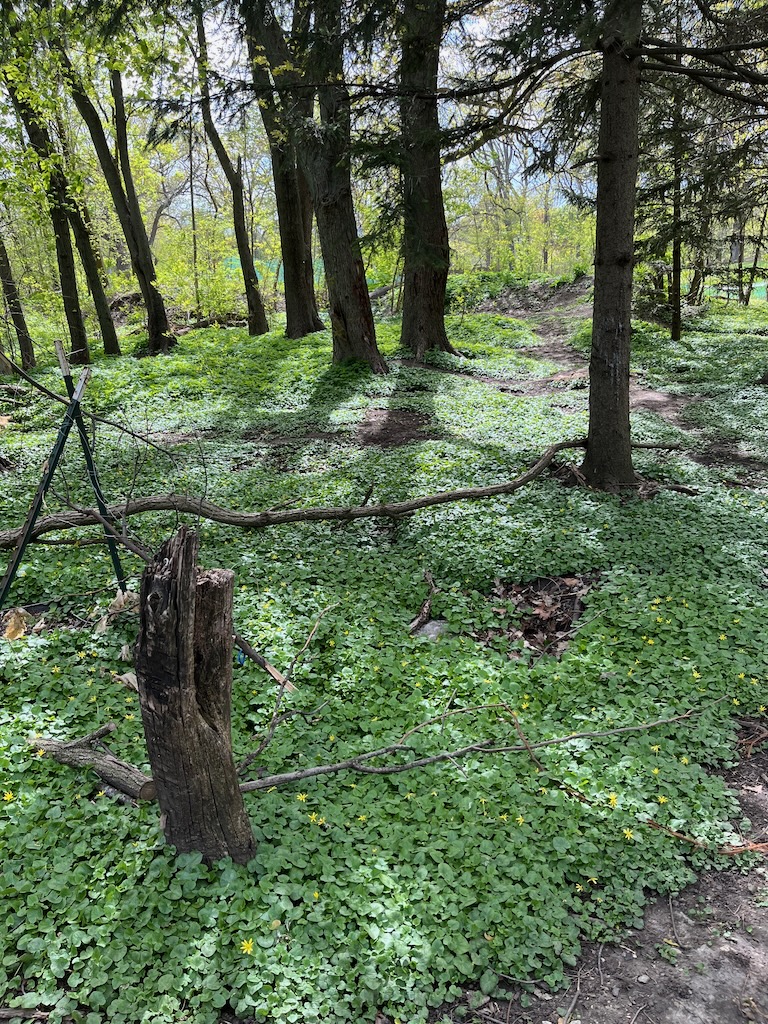
i’m coming to think of it as my footpath to the wellspring where the sacred stirs me, a nowhere-else-like-it sanctuary under the arbors, carved into the banks of a slow-flowing channel, a serpentine zig and a zag, through patches of woodland and birdsong. 

as far back as i can remember, the woods behold wonder to me. my biography would be laced with a trail through woodlands and ponds and gurgling creeks. the never-ending acres of lily of the valley where my papa once drove me as a wee girl of three. the woods across from the house where i grew up, a copse that came to life in my imagination, one day a pioneer’s outpost, the next day a place to pretend i’m laura ingalls wilder in the big woods. 

trailheads beckon. the barely-noticed aperture into the brush, where suddenly suburbia is leagues and leagues away. maybe it’s my imaginative overdrive, or my storybook tendencies. but give me a path, and a parting of trees leaning this way and that, and my feet cannot but go forward.

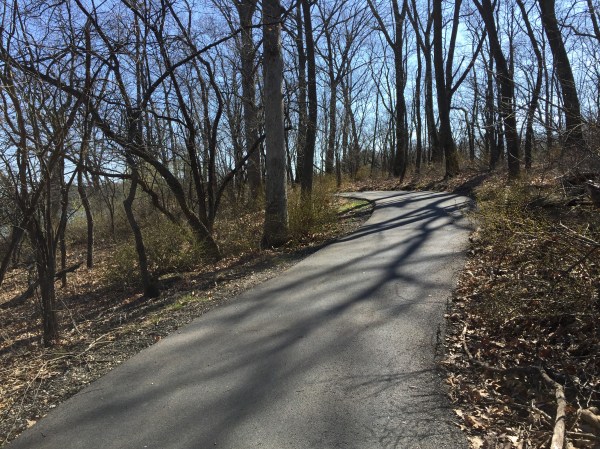
so it was on mother’s day morn when at last i found myself at the trailhead i’d vaguely noticed in the making. trees had been felled, and buckthorn burned by the wheelbarrow full. logs were yanked from where they’d fallen, and laid in a line, woodchips carpeted the paths in between. a woodland trail that meanders along and through a woods both ancient and newly imagined. 

enchanted at first footfall, the only way to describe it. the ups and the downs, the dappling of light, and the peek-a-boo shadow. i walked with my eyes and my mouth wide open. over and over i marveled. 

it’s a woods best described as delicate, at least in the moment—a petit point of vernal ephemerals stitched into the hillsides. springtime at its tenderest, springtime in may when it’s no longer tenuous. 

it’s a place that suddenly holds inexplicable pull on me. enough to lurch me out of my wintry posture, curled over a book or an alphabet keyboard, snug in the nook by the wall-to-wall windows. it’s a place that lured the prayer right out of me. a place to dwell in my quietest stillness. 

it’s my axis mundi, you see. 
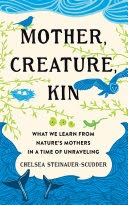
my friend chelsea steinauer-scudder, a breathtaking writer and author of the new book, mother, creature, kin: what we learn from nature’s mothers in a time of unraveling (broadleaf), explains: “i’ve heard countless stories of what i’ve come to think of as axis mundi experiences: encounters that have pulled someone into a deep experience of felt belonging upon the tiny bit of Earth that they find themselves upon. 

“…within the study of religion, an axis mundi is a sacred pole, literal or figurative, which is fixed in a particular place, connecting Earth to the realms of heaven, underworld, and divine. “

these holy places might be a mountain (the Mauna Kea on Hawaii’s Big Island, known by the Indigenous peoples to be the umbilical cord, “the place from which the world emerged”), a cosmic tree (Norse mythology), the Ka’aba in Mecca (which pilgrims encircle seven times, as within it is the stone believed to have been handed to Adam as he was banished from Eden, so his sins would thus be forgiven). 

or, in my case, an undulating woodland path along what in fact is a sanitation canal, though i pretend for the life of me that it’s an idyllic stream or a creek. one that just happens to shimmer an odd shade of aqua, a phosphoresence that might signal toxins astir. 

my friend chelsea goes on to write that “we are a species in need of centers,” and within us there is encoded “an inherent capacity for place-based awe.”

those are the places with gravitational pull. a pull from the deepest well. the sacred well. 

or, as chelsea distinguishes between the capital-A Axes Mundi (the most sacred of places so recognized by cultures or religions), and the small-a axes mundi (the ones you and i might call our own), the ones i know best are the quotidian, intimate ones, defined as “small, daily irruptions of majesty, those any-place encounters with the sacred.”

no surprise then that i can’t stay away. it’s an itch that can’t be scratched till i double-knot my sneakers, and try to remember sunscreen (i never do). 

and it’s walking through a poem, quite literally. the soundscape a montage of birdsong and trill, punctuated with quarter notes and a screech that scares off the feeble.

these are the verses i walked among on just one of my mornings traipsing along the trail: common yellowthroat; red-bellied woodpecker; swainson’s thrush; red-winged blackbird; northern cardinal; blue jay; goldfinch; baltimore oriole; rose-breasted grosbeak; gray catbird; and a hairy woodpecker to boot. it’s as if the crayola crayon box was suddenly feathered in flight. 

and in the flora department, a whole other poem: bloodroot, bluebells, celandine poppy, and columbine. lily of the valley, trout lily, spring beauty, wood anemone, and blue cohosh. jack-in-the-pulpit, shooting star, mayapples, and dutchman’s breeches. 

all these names, which whirl in me thanks to the Original Mother Nature who schooled me, got me to wondering who in the world gave the names to the winged flocks and the leafy ones too. the stories behind names are their own wonders. the ones from folklore and legend are the ones that charm me most: jack-in-the-pulpit is said, of course, to resemble a preacher spreading the Good Word; the trout lilies’ mottled leaves resemble the markings of the freshwater fish; and dutchman’s breeches clearly resemble the pantaloons of one who’d also wear wooden shoes.

those, though, are merely the preamble curiosities, the ones that loosen my soul, open me up to the prayer that burbles up whilst sauntering deeper and deeper, per God’s gravitational pull, unwilling to pause till i get there. to the place where i go to feel as saturated with the sacred as i do of the sun when at last i plop onto the stump of a log, and consecrate the most blessed moment of being.

where is your axis mundi?


wislawa szymborska

and before we part, a poem worth pondering, from the late, great polish poet and nobel prize-winner, wislawa szymborska

Life While-You-Wait

Life While-You-Wait.
Performance without rehearsal.
Body without alterations.
Head without premeditation.

I know nothing of the role I play.
I only know it’s mine. I can’t exchange it.

I have to guess on the spot
just what this play’s all about.
|Ill-prepared for the privilege of living,
I can barely keep up with the pace that the action demands.
I improvise, although I loathe improvisation.
I trip at every step over my own ignorance.
I can’t conceal my hayseed manners.
My instincts are for happy histrionics.
Stage fright makes excuses for me, which humiliate me more.
Extenuating circumstances strike me as cruel.

Words and impulses you can’t take back,
stars you’ll never get counted,
your character like a raincoat you button on the run?
the pitiful results of all this unexpectedness.

If only I could just rehearse one Wednesday in advance,
or repeat a single Thursday that has passed!
But here comes Friday with a script I haven’t seen.
Is it fair, I ask
(my voice a little hoarse,
since I couldn’t even clear my throat offstage).

You’d be wrong to think that it’s just a slapdash quiz
taken in makeshift accommodations. Oh no.
I’m standing on the set and I see how strong it is.
The props are surprisingly precise.
The machine rotating the stage has been around even longer.
The farthest galaxies have been turned on.
Oh no, there’s no question, this must be the premiere.
And whatever I do
will become forever what I’ve done.
~ Wislawa Szymborska ~

(Poems New and Collected 1957-1997, trans. S. Baranczak and C. Cavanagh)

not all gravitational pulls are without hazard

of pickled onions and a particular fondness for kentucky’s homegrown farmer bard

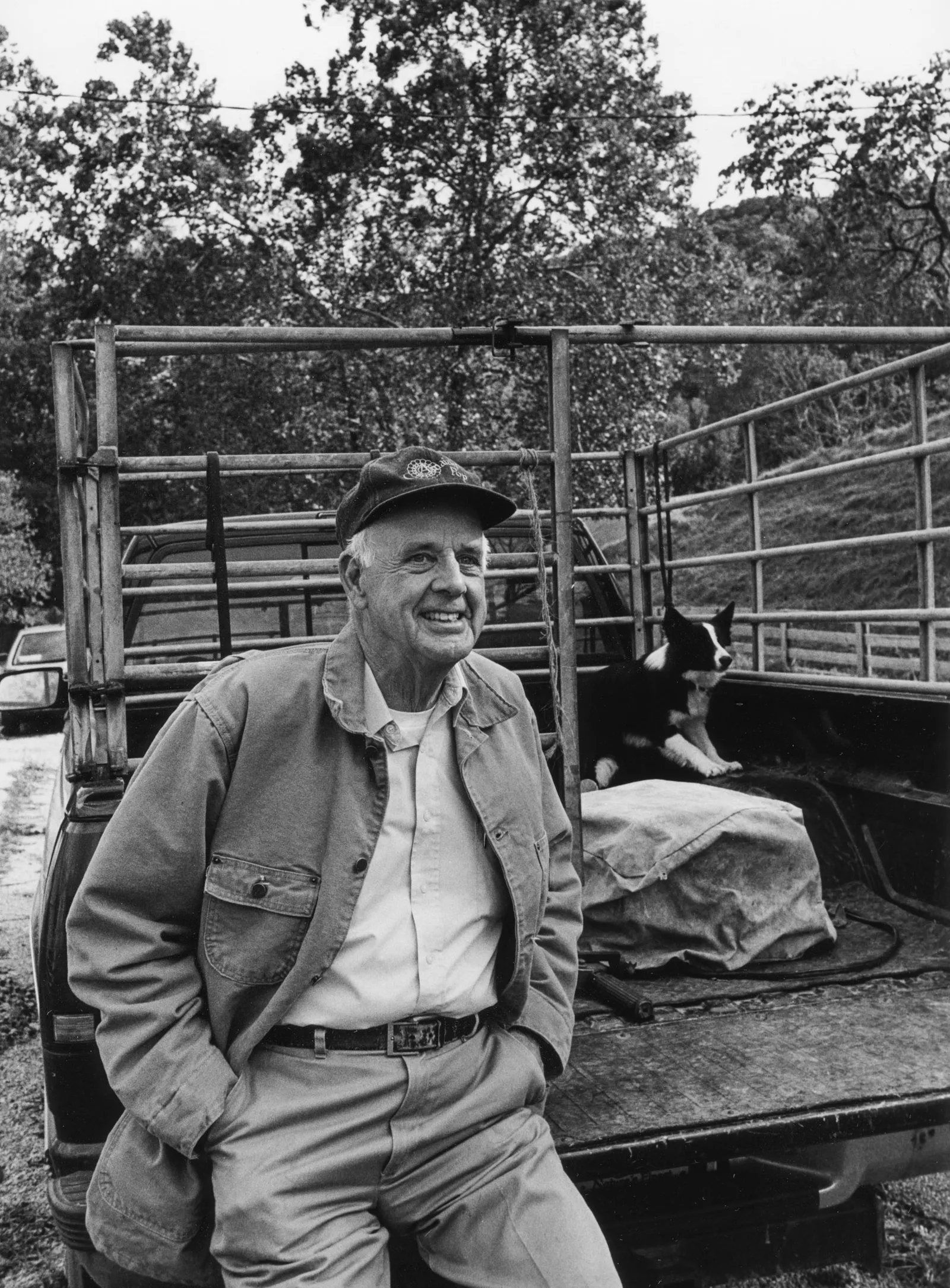
wendell berry

in which the somnolence of summer has settled into its seasonal adagio so much so that pickling a red onion or two, and slow-reading the poetries and musings of one wendell berry is as fever-pitched as it gets around here. welcome to my slo-mo world of the week.

it started when i stumbled on the poem below, a poem that captures the quietude of a couplet of humans who’ve breathed in unison for so long they can fill the silence richly. so it is here in this old house of late, where only two of us now reside. where we know the choreography of most days by heart. and come and go as in a wordless waltz. there’s an ease now, one i never imagined, as i balked mightily long ago about the idea of two lives squeezed under one roof and in a labyrinth of too-tight rooms. but over time, across all these years (near 33), the respirations of our souls have aligned, at least enough to feel our echo in the lines below. those lines, by wendell berry, the poet, novelist, and conservation farmer whom i count as one of my heroes, were just enough to take me down the rabbit hole that is the life and work of kentucky’s homegrown literary treasure. and, besides, mr. berry’s birthday was this week, the fifth of august, wedged, it so happens, between the birthdays of two of the three humans whom i count as pillars holding up my world and whose arrivals to the planet are marked across the week in that steady beat of 4-6-8.

here’s the poem that got me started:

They Sit Together on the Porch
By Wendell Berry

They sit together on the porch, the dark
Almost fallen, the house behind them dark.
Their supper done with, they have washed and dried
The dishes–only two plates now, two glasses,
Two knives, two forks, two spoons–small work for two.
She sits with her hands folded in her lap,
At rest. He smokes his pipe. They do not speak,
And when they speak at last it is to say
What each one knows the other knows. They have
One mind between them, now, that finally
For all its knowing will not exactly know
Which one goes first through the dark doorway, bidding
Goodnight, and which sits on a while alone.

i shared the verse with the one with whom i share these walls, and he wrote back that he found it “haunting,” which made me see the lines anew. and was just enough to prompt a bit more poking around, again reminded how much i love the poetries that come with accumulated lifelong wisdoms. and that’s where i then re-bumped into this 2019 dispatch from the new yorker, a days-long interview between bard and scribe, one distilled and put to paper. it’s worth a read in whole (link below will take you straight to it), but i’ll pluck a few parts should your summer’s day demand a snappier pace than mine (or should a paywall keep you out):

the dispatch, titled Going Home with Wendell Berry, is by amanda petrusich, a new yorker staff writer and writer-in-residence at the gallatin school of individualized study at NYU. a 2016 guggenheim fellow, she writes often about music, and blessedly for us she takes the occasional road trip down kentucky way. in this case, she wound her way to where berry’s farmed for more than four decades, a little town that goes by the name port royal. sixty-three miles from the dot in the blue-grass map my papa called home (paris, KY), and one mile from the meandering kentucky river, it’s a town you might think ol’ garrison keillor pulled from his imagination. (in 2010, its population, according to the U.S. Census, was all of 64 humans.) it’s a town one writer (sandra mcCracken, a singer-songwriter) described thusly (and not too surprisingly given the threadworn quilt that is rural america these days): “Port Royal is a patchwork strip of storefronts, a blink-and-you’ll-miss-it sort of spot made up of a local bank, a post office, a general store with a built-in diner (with little printed signs about their town’s famous author, Wendell Berry), and an old Baptist church. I am sad to report that, like most small towns in our country, Port Royal looks as though it is dying.” 

here’s how the new yorker‘s chronicling of that luscious conversation between journalist (petrusich) and poet (berry) begins:

Two and a half years ago, feeling existentially adrift about the future of the planet, I sent a letter to Wendell Berry, hoping he might have answers. Berry has published more than eighty books of poetry, fiction, essays, and criticism, but he’s perhaps best known for “The Unsettling of America,” a book-length polemic, from 1977, which argues that responsible, small-scale agriculture is essential to the preservation of the land and the culture. The book felt radical in its day; to a contemporary reader, it is almost absurdly prescient. Berry, who is now eighty-four, does not own a computer or a cell phone, and his landline is not connected to an answering machine. We corresponded by mail for a year, and in November, 2018, he invited me to visit him at his farmhouse, in Port Royal, a small community in Henry County, Kentucky, with a population of less than a hundred.

Berry and his wife, Tanya, received me with exceptional kindness, and fed me well. Berry takes conversation seriously, and our talks in his book-lined parlor were extensive and occasionally vulnerable. One afternoon, he offered to drive me around Port Royal in his pickup truck to show me a few sights: the encroachment of cash crops like soybeans and corn on nearby farms, the small cemetery where his parents are buried, his writing studio, on the Kentucky River. Berry’s connection to his home is profound—several of his novels and short stories are set in “Port William,” a semi-fictionalized version of Port Royal—and his children now run the Berry Center, a nonprofit dedicated to educating local communities about sustainable agriculture. Our correspondence would continue, but, before I left, Berry gave me a broadside letterpress of his poem “A Vision.” I think often of some of its final lines, which clarify, for me, what it means to truly know a place:

Memory,
native to this valley, will spread over it
like a grove, and memory will grow
into legend, legend into song, song
into sacrament.

here’s but one of the questions captured from their conversation (with a few lines in bold for emphasis):

Q: Have you always farmed here?

A: Right away, we had a large garden, and we kept two milk cows. We fattened two hogs to slaughter, for our own meat. We had a flock of chickens. And we had some fruit that we produced ourselves, and some that was wild. We were sitting down during that time to a lot of meals that came entirely from under our own feet by our own effort. And our children came up in that way of living. The integration of the various animals and crops into a relatively small acreage becomes a formal problem that is just as interesting and just as demanding as the arrangement of the parts of a novel. You’ve got to decide what comes first, and then you work your way to the revelation of what comes last. But the parts also have to be ordered. And if they’re ordered properly on a farm, something even more miraculous than most art happens: you have sustainability. Each thing supports the whole thing.

and here’s another exchange:

Q: It’s funny, clarity is often undervalued in art. One of the things I admire about your writing, especially the essays, which feel like polemics, is that you’re very clear in your arguments. They’re beautifully supported. In the new book, you talk about how you often read seeking instruction. I’m curious how you balance that idea with reading for beauty, savoring the visceral pleasure of words.

A: You’re being fed in an essential way by the beauty of things you read and hear and look at. A well-made sentence, I think, is a thing of beauty. But then, a well-farmed farm also can feed a need for beauty. In my short story “The Art of Loading Brush,” when Andy Catlett and his brother go to a neighbor’s farm, there’s a wagonload of junk, and it’s beautifully loaded. Andy’s brother says, “He couldn’t make an ugly job of work to save his life.” In the epigraph I use from Aldo Leopold he questions if there’s any real distinction between esthetics and economics.


and here, in case you’re even a little bit hooked, is a poem worth reading in whole. it’s from a 1965 volume of Poetry magazine, and it’s excerpts from an early Berry wonder, titled, “The Handing Down,” a poem about a grandfather and grandson sitting on a porch and the quiet conversation that unspools between them. read those excerpts here.


oh, and about those onions. . . my kid, the one who turned 23 yesterday, finds himself a line cook these days at a chicago eatery of some notoriety; girl and the goat, it’s called, and stephanie izard, who dreamed up the joint seems to have a particular fondness for things pickled. she pickles everything from kumquats to mushrooms to beets. i decided pickled red onions might be a summery thing to do, and besides i like a little crunch amid the strata of my sandwich. and, as with many a task in my kitchen, i pickle the easy way. no cauldrons steaming for me. no sterilizing jars and lids. i dumped a little of this, stirred in some of that, and by next morning, i had a jar of garnet rings shimmering in my fridge. i’m not fond of sugar these days (i never was, and then a dear friend told me cancer is fond of sugar, making it something of a foe of mine, thus i’ve perma-sealed my lips to sugar’s sweetness), so i searched for pickling roadmap that steered clear of the sugar bin. here’s what i found: (and ps i have no real clue what whole30 compliant means, so feel free to disregard.)

what captured your fancy this week, quick-clipped or slow?

new year upon us: proceed with all the grace you can muster


Now is the season to know
That everything you do
Is sacred. 

~ Hafiz ~

and so we begin. wrapped in the whisper of unknowing. all is vast, and formless. we etch out possibilities, promises, in our mind’s eye. we put shape to what we hope will come, what we worry might come, in the allotment of time we call “the new year.”

as long as humans have been harnessing time, putting order to the rhythms of darkness to light, warming to cooling to warming again, we have imagined our dominion over the hours unspooling. some of us live by clocks. and calendars. and pings and beeps and the showtunes we set to awake us, to remind us to sleep.

i’m especially attuned to the timekeeper beyond the clouds: the solar star. the one around which we turn and spin and revolve in our somewhat elliptical geometries.

what if we returned to a time without second hands, and minutes parsed into fractions, what if we surrendered to shadow and light, allowed the cosmos to do our timekeeping? what if we understood the passage of time by the wrinkles on the backs of our hands, or the ebbing of wisdom that comes with a life lived at attention?

but that is not the world we live in, the moment we live in. we’ve been conditioned, all of us, to count time in blocks, and the newest addition to our arithmetic table is the one we’ve named 2024. and so it shimmers before us: new, unmarked, not yet broken.

not a half day in to this newly-bordered chunk of time, the year threw me a challenge. decided to let me know that my well-laid plans for my first birthday since losing half a lung would not be quite the occasion i’d (for once) carefully plotted (a dinner i’d cook for beloved old friends on the eve thereof, followed by a dinner for three at a charming cafe on the day itself). indeed, they’d be altogether scrapped. our old friend covid decided to drop in unannounced, in the form of a grand exposure (my mate sat for four hours on new year’s eve beside a woman who awoke to a positive test the next morn). and so we did what any respectable citizen would do: we donned our masks for five straight days, steered clear of any and all, and tested accordingly along the way. (so far, so clear.)

i admit to meeting the news with a mighty harumph. and a stinging tear in my eye. in my heart i was crooning something along the lines of “can’t i please catch a fresh start here?” but, alas, covid is covid and there’s no getting around it. so, i cobbled the best that i could: roaring fire all day, long walk under gray cloudy skies; i seized what i could, and turned the page anyway.

and here we are, in what hafiz reminds us is best thought of as “the season to know that everything you do is sacred.”

the new year, i sense, is going to ask plenty of us. i, for one, am strapping on my seat belt. for, as a dear friend reminded me last night, “you may just want, as bette davis said, to ‘tighten your seatbelts. it’s going to be a bumpy night.'”

indeed, it might be. and for such a bumpy spell ahead we shall need to equip ourselves. my plan is to take it slow, and with all the grace i can muster. i’ll bite my tongue when wisest to do so. and speak up with actions not words when that is most warranted. i’ll aim to dollop out goodness all along my way, not unlike hansel and gretel in the woods, leaving behind their breadcrumbs. i’ll imagine droplets of sunlight scattered like shards. and hope to enter and leave each encounter with a soft unspokenness, a sense that something like an angel wing has just wafted by. it’s a big ask, but it’s the litany for which i pray. for i’ve an inkling, like bette, that we’re in for one bumpy night.

what are you seeking to equip you for this year?

quiet is the way . . .

a meditation on the quiet way…

i begin with a poem that took my breath away. 

Nativity
by Kenneth Steven 

When the miracle happened it was not
with bright light or fire—
but a farm door with the thick smell of sheep
and a wind tugging at the shutters.

There was no sign the world had changed for ever
or that God had taken place;
just a child crying softly in a corner,
and the door open, for those who came to find.

and i couple that with this line from TS Eliot’s “East Coker”:

The only wisdom we can hope to acquire
Is the wisdom of humility: humility is endless.

the message is so countercultural: be humble; in quiet, come. “a farm door with the thick smell of sheep / and a wind tugging at the shutters / … just a child crying softly in a corner / and the door open …” a more earthly, rough-sawn tableau it might be hard to conjure. it is a tableau that aims only to find its place in the quiet folds of the depths of a pitch-black night. it begs not for attention. but its aim is a fiery transformation, a redefinition of love, love made flesh, love lived through every breath.

the sufi mystics take it even further. purity of heart, they teach us, is when the I pronoun dissipates in the sun in the way of early morning fog: not disappearing but becoming translucent; it melts away. 

the highest level of holiness in Islam is Iḥsān, defined as “spiritual excellence,” and Omid Safi, the Islamic scholar who mesmerized me this week, teaches that without gentleness, without kindness, there is no loveliness. and loveliness is the divine attribute that defines and permeates Iḥsān. to live in loveliness, in selfless purity of heart, is to summit the holy mountain.   

according to Islamic teaching, when the angel Gabriel asked The Prophet to define Iḥsān, or spiritual excellence, The Prophet answered: “Excellence is to worship Allah as if you see Him, for though you do not see Him, He surely sees you.” (translation from Muslim Ibn al-Ḥajjāj al-Qushayrī)

and what do i, a simple soul of 66 whose spiritual life was put to the fire in the wake of a springtime diagnosis, what do i take all this to mean? to live a quiet life, aspiring to be pure of heart, meaning to exercise my every breath toward tender, gentle loving. learning to allow my I to dissipate into the morning fog. to turn the other cheek, yes. always. to exorcise the hurtful impulse. to love through my last breath. 


** you might want to know more about kenneth steven. and wasn’t i surprised/not surprised to discover he’s a poet with the celtic flowing richly through his veins. this morsel from his website might find you curling up with him on an otherwise chilly winter’s afternoon, one in which the ashen sky stirs you to tuck yourself beneath the contours of a fuzzy afghan that tickles your nose:

“Kenneth Steven is first and always a poet. To survive as a literary author he’s had to become many other things as a writer – he translated the Norwegian novel The Half Brother, he’s a children’s picture book and story writer, he’s an essayist and a feature writer – but it’s poetry and the love of poetry that lies at the heart of it all. His volume of selected poems Iona appeared from Paraclete Press in the States a couple of years ago. His numerous collections have sold many thousands of copies, and he has a strong name as a poet thanks to the poetry-related features he’s written and presented over long years: his programme ‘A Requiem for St Kilda’ having won a Sony Gold for Radio 4.

“His poetry has been inspired primarily by place. He grew up on the edge of the Scottish Highlands with a profound awareness of that world: his mother’s people were Gaelic speakers from Wester and Easter Ross. It’s the wildscape of Highland Scotland that pours through his pen.”


where did you find quiet this week?

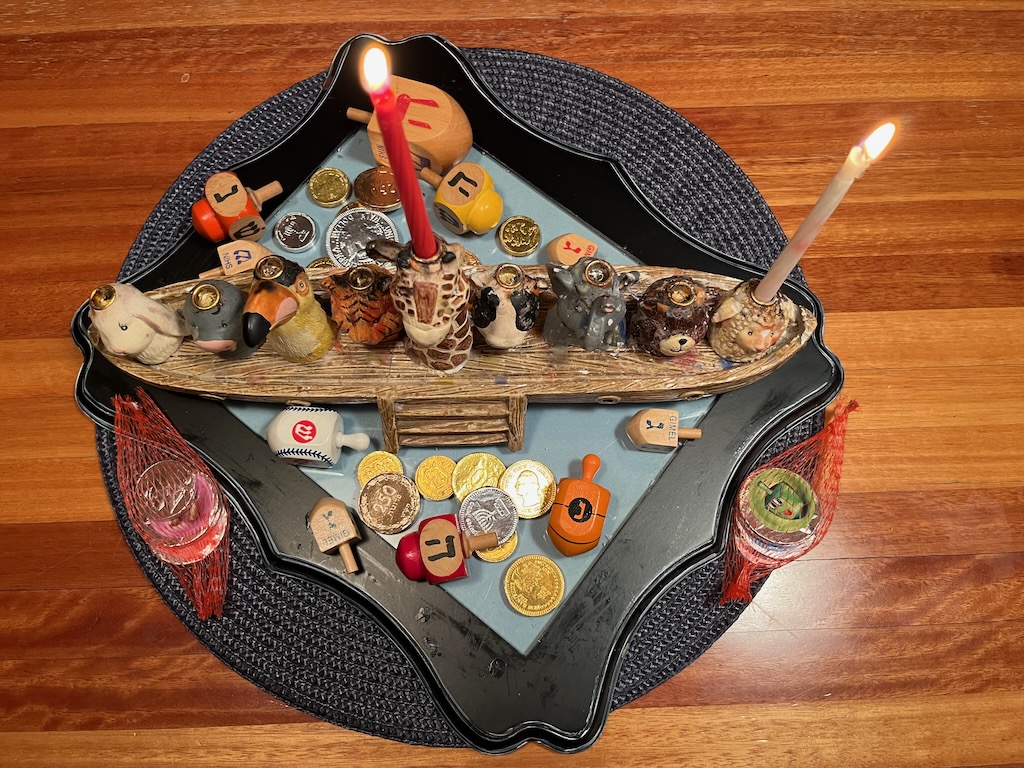
hanukkah began last night, and at our house our skinny candles were shimmied into and kindled in the noah’s ark menorah first unwrapped when our firstborn was but a few months old. all these years––thirty now––giraffe and bear and walrus have done their part in carrying our thoughts to the miracles of light that flickers even in the darkest darkness. even in a year such as this when bombs rock the holy land. 

summer’s sabbatical. . .somewhat. . .

it’s time for me to slip into a deep well of quiet. one where a pebble tossed into a pond or a puddle makes barely a ripple. 

i’ll still be gathering bitlets and wonders that send heart or soul or imagination soaring, and i’ll quietly slip them here onto the “table” on friday mornings, but i am going to practice stillness with magnified focus — at least for the next few whiles. 

my body and soul have been turned on their sides in these last few months. and they’re calling for the blessing of a sabbath’s rest. thus, sabbatical; the ancient invention of a God who toiled six days (creating sky and sea, landmass and creature, blooming thing and someone to till it) and deemed that the seventh be made holy, and blessed, and that rest be the call for the day. 

this summer sabbatical is my summer’s seventh day.

i’m gentling it with the “somewhat” because i can’t quell my commonplacing, and i do delight in passing along the treasures and trinkets i find. so expect offerings week by week till i rev up my engines again. and, who knows, there might come a week when i’ve something fulsome to say. but i feel a bit thin right now. thin in the voice, and thin all around.

and as any airline passenger knows, we’re instructed to slip on our own oxygen mask before tending to those in our care. and i suppose i need the oxygen that comes with quiet. the rare gift of time to wander, to let thoughts unspool as they will. 

i can’t catch my breath. and quiet might help.

from deep down in my quiet, i promise to send forth edification in the forms i find most fitting for a summer’s gambol. but mostly i’m craving the summer relish of bare toes in the grass or the sand. and the cognitive equivalent thereof. 

and the sigh that comes on their heels.

shhhh….


i came upon this morsel this week, a definition of happiness that i knew would have launched me down intricate paths. i shall leave the launching to you. but here’s the line that first stirred me…

willa cather defined happiness as the feeling of being “dissolved into something complete and great.”

(she inscribed it on her gravestone…”that is happiness; to be dissolved into something complete and great. the keyword, it seems to be, is “dissolved,” to be dissipated into atoms and ions that meld into the atmosphere. that truly, biochemically become one with the beyond. to lose a sense of one’s boundaries, to float on an innertube of utter vast blessing…)


and while we’re on the subject of happiness, here’s a poem to go with it…(think not that what’s coming is frothy confection…)

THE WORK OF HAPPINESS
by May Sarton

I thought of happiness, how it is woven
Out of the silence in the empty house each day
And how it is not sudden and it is not given
But is creation itself like the growth of a tree.
No one has seen it happen, but inside the bark
Another circle is growing in the expanding ring.
No one has heard the root go deeper in the dark,
But the tree is lifted by this inward work
And its plumes shine, and its leaves are glittering.

So happiness is woven out of the peace of hours
And strikes its roots deep in the house alone:
The old chest in the corner, cool waxed floors,
White curtains softly and continually blown
As the free air moves quietly about the room;
A shelf of books, a table, and the white-washed wall —
These are the dear familiar gods of home,
And here the work of faith can best be done,
The growing tree is green and musical.

For what is happiness but growth in peace,
The timeless sense of time when furniture
Has stood a life’s span in a single place,
And as the air moves, so the old dreams stir
The shining leaves of present happiness?
No one has heard thought or listened to a mind,
But where people have lived in inwardness
The air is charged with blessing and does bless;
 Windows look out on mountains and the walls are kind.


here’s a breathtaking definition/description of love (can anyone define love? i think not):

the poet Robert Graves defined love as “a recognition of another person’s integrity and truth in a way that…makes both of you light up when you recognize the quality in the other.”

so beautiful…


and because joy harjo deserves the last best word….here she is…

We heard it.
The racket in every corner of the world. As
the hunger for war rose up in those who would steal to be president
to be king or emperor, to own the trees, stones, and everything
else that moved about the earth, inside the earth
and above it.

We knew it was coming, tasted the winds who gathered intelligence
from each leaf and flower, from every mountain, sea
and desert, from every prayer and song all over this tiny universe
floating in the skies of infinite
being.

And then it was over, this world we had grown to love
for its sweet grasses, for the many-colored horses
and fishes, for the shimmering possibilities
while dreaming.

But then there were the seeds to plant and the babies
who needed milk and comforting, and someone
picked up a guitar or ukulele from the rubble
and began to sing about the light flutter
the kick beneath the skin of the earth
we felt there, beneath us.

—excerpt from When the World as We Knew It Ended
by Joy Harjo


consider this a summer’s potluck, and feel free to bring by your own morsels and delicacies. the cupboard is open…

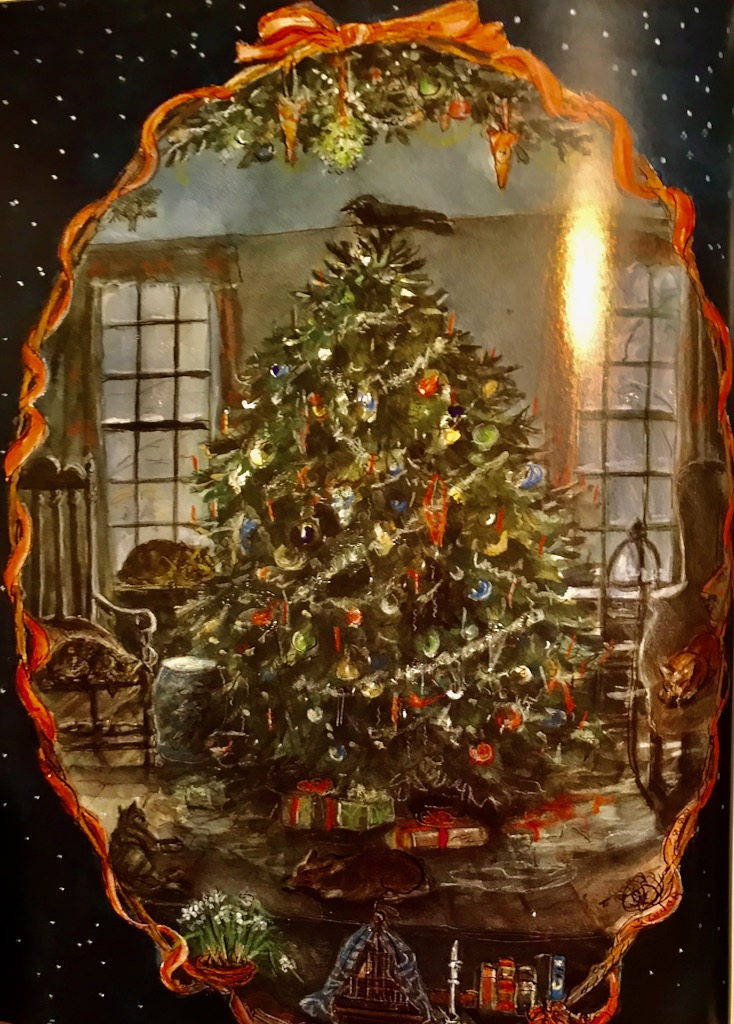
quiet christmas, red-ringed edition

tasha tudor illustration from The Night Before Christmas

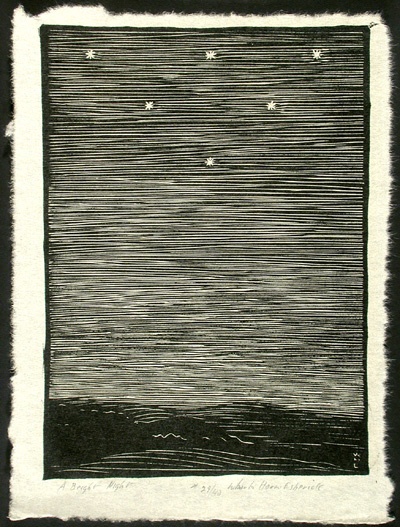
more than anything, i yearn for the quiet of christmas, the early morning silence when it’s just me puttering about the kitchen, cranking the oven, simmering spices on the stove. i take my morning prayer by flickering candle flame. or beneath the morning stars. or beside the woodsy fir, now strung with lights and berries, standing proud beside the ticking clock that chimes the hours.

i love listening for the first of the footsteps thumping onto the floorboards overhead, and the creaking of the old oak that follows. but long before that longed-for stirring breaks the silence, it’s into the depths of quiet that i surrender, that i’ve been waiting for all these weeks. the old house before its stirring. when it’s just barely breathing. and christmas is finally at the door.

it’s in that silence that i most absorbingly slip into the dusky hours of that ancient, ancient night, when amid the vastly-vaulted holy land, beneath the rough-hewn rafters of a barn, down low where the straw was matted, where the creatures intoned their moans and mews and cooing, a newborn babe let out a human cry. i like to imagine i’m peeking out from behind a post. i sometimes imagine the laboring mother reaching out her hand, reaching out for strength in the form of someone else’s flesh and delicate bone, reaching for another hand—my hand—to hold onto hers, to wipe her brow, her tears, to kneel down beside her and whisper certainties. “you got this,” i imagine saying, as these three words have so often scaffolded me in my own hours of trembling fears. 

but this christmas is not going to be like any other christmas. it’s not even like last year’s most unfamiliar christmas, when we all but hunkered down, when we awaited the vaccine just peeking over the horizon, when hope felt not too far off. 

no, this christmas, we’re all upside down again. it’s all changed and changing fast. as fast as that red-ringed variant omicron is mutating, is doubling in numbers inside some of us, our hopes and plans for christmas are changing too. 

there is abundant heartbreak this christmas. and here, on the very eve of christmas day, i don’t yet know what tomorrow will bring. but i’m willing to bed i won’t be leaving my bed.

given the headlines––the wildfire that is omicron––there’s a mighty fair chance your christmas is as tumbled up as ours. 

we’ve an uninvited visitor here, one who snuck in through the back door and turned everything inside out and slanted. yes, covid came, and in very short order canceled someone’s surgery, and canceled someone else’s flight from california. covid came and sent one of us all but seeing stars, she was so gulpingly alarmed. after all, i’ve lived the last nearly two years doing everything i could to lope at least two steps ahead: for months i was among the ones who washed every single grocery bag or box or pint hauled into this old house; i steered clear of crowds, wore not one but two masks unless alone in the woods, or tracing the lakeshore’s edge. met ones i love harbored on the front stoop a good twelve feet away. washed my hands to happy birthday thrice. (if twice was recommended, i opted always for the extra round of public health insurance.)

but covid caught up to us. my firstborn—home for the first christmas in two years—is quarantined in the room at the top of the stairs. i was quarantined in my little writing room until my PCR came back negative early yesterday morn. for two long days, i was calling the book-stacked chamber my covid cottage, my covid christmas cottage.

and now, after a long night with thermometer under tongue, i’m all but sure the red-ringed virus dodged the swab but has me in its clutches, since i feel more awful by the hour. i’m thinking omicron is wily, and mighty good at playing hide-and-seek. i’ll test again this morning. (bless the neighbors who drove home from ohio, where supply is far more abundant, with a wee stash of impossible-to-find DIY covid tests.)

most of all, i’ve worried about my mama, who does not want to be alone on christmas day, but whom we don’t want felled by this nasty, nasty scourge. dear God, don’t let her get it.

all the last minute upside-down-ness has clearly pointed to one simple single certain truth: if we can be gathered with the ones we love, under the same roof, by zoom or phone or mental telepathy, well then we’re blessed as blessed could be. 

this is not the way i imagined it, whispering christmas wishes through a crack beneath the door, leaving packages on the tray that ferries food and dishes in and out of the sickroom. too contagious to wander down the stairs and daydream by the light-strung tree. but here’s what matters: we are emphatically and undeniably all under one single roof. 

which, after all, is the answer to a hundred prayers. it’s what we lacked last year. and some iteration of what i wished for this year. 

while we untangle uncertainties here on the homefront, i still stand ready to unfurl a christmas morning’s benediction. 

a prayer for quiet christmas

dear God of starlit dawn, dear God of Light now coming, as we gather up this year, gather up the sorrows and the sweetness, hear our deepest cries. let us love even when our hearts get bumped and bruised. let us be gentle in the harshest hours. let us keep upright even when we’re wobbling. let us hold onto hope. let us seize the blessings as they unfold within our reach. lift up our tender memories, the ones we’ve loved and lost this year. let us carry forward their inextinguishable flame, and keep their incandescence blazing. dear God, as we bow down and bend our knees, let us behold the newborn wonder, and do all we can to absorb the holy light of this most silent silent night.

merry blessed christmas to each and every someone who wanders by the chair. may you be well, and hold tight to all your blessings.

days of deepening…(awaiting that which is decidedly fertile)

this fine dragonfly landed — and stayed — just outside our front door this week. the dragonfly*: “symbol of change, transformation, self-realization; it teaches us to love life.”

sabbatical (adj.)

1640s, “of or suitable for the Sabbath,” from Latin sabbaticus, from Greek sabbatikos “of the Sabbath” (see Sabbath). Noun meaning “a year’s absence granted to researchers” (originally one year in seven, to university professors) is from 1934, short for sabbatical year, etc., first recorded 1886 (the thing itself is attested from 1880, at Harvard), related to sabbatical year (1590s) in Mosaic law, the seventh year, in which land was to remain untilled and debtors and slaves released.

Sabbath (n.)

Old English sabat “Saturday as a day of rest,” as observed by the Jews, from Latin sabbatum, from Greek sabbaton, from Hebrew shabbath, properly “day of rest,” from shabath “he rested.” Spelling with -th attested from late 14c., not widespread until 16c.

The Babylonians regarded seventh days as unlucky, and avoided certain activities then; the Jewish observance might have begun as a similar custom. Among European Christians, from the seventh day of the week it began to be applied early 15c. to the first day (Sunday), “though no definite law, either divine or ecclesiastical, directed the change,” but elaborate justifications have been made. The change was driven by Christians’ celebration of the Lord’s resurrection on the first day of the week, a change completed during the Reformation.

The original meaning is preserved in Spanish Sabado, Italian Sabato, and other languages’ names for “Saturday.” Hungarian szombat, Rumanian simbata, French samedi, German Samstag “Saturday” are from Vulgar Latin *sambatum, from Greek *sambaton, a vulgar nasalized variant of sabbaton. Sabbath-breaking attested from 1650s.


sabbatical. the word bathed over me like cool water to a banged-up knee, aloe to a sunburn, a waft of lavender to the nose. my eyes swept across its four short syllables; they draped me like a balm.

sabbatical, the word itself soothes. each sound jumble tumbling softly into the next, a somersault of sound rolling off the tongue. it’s a word that seized me, and instantly made perfect sense. as if it had been calling out, awaiting my attention.

i believe in sabbath, by my definition “anointed time,” time to dwell in the sacred, to burrow into the nautilus of our deepest stirrings. 

time to be quiet. time to ponder. time to be alone with one’s thoughts, to see where they course, to discover the rivulets and the river stones under which they seek shadow.

for too long now i’ve felt i was uttering sound when silence might have been the wiser course. we are a noisy nation. too noisy. the sound of silence might be the wisest one for recalibrating so much of what’s amiss on this cacophonous planet.

especially now, after a homegrown tornado of a year here in this old house — of illness, death, distress, and mountainloads of worries — i hear a deep-down shushing, the call to be quiet. say little more. offer silence, the most generous of invitations in which each one of us is untethered, unconstrained, our thoughts our own to trace as far or near as we so choose. 

so many friday mornings i’ve sat down to write with a dyspeptic sense that i might be barging in, the noisy guest who doesn’t know her exit was welcomed hours ago. sometimes, though, i sat down unsure of where i’d go, and suddenly i’d find myself plumbing some eddy i’d not realized was still water awaiting stirring. 

and now, after so many hollowings (the cavernousness that comes in the wake of heartache), and with a thick batch of editing about to drop onto my laptop lap, it seems a fine time to tiptoe quietly off to the riverbank, where i’ll keep close watch but watch in silence.

i’ve been at it, straight, for 1,027 posts, and i would have paused at 1,025 but then dear ginny neared her end, and i was drawn to leave her mark here, at the table where she so dutifully pulled up a chair week after week after week for all these almost 15 years, always hoping for a few threads that might have unspooled with the doings of her grandsons or her son. (not long before she died she asked me to print out any of the chairs she might have missed, but she only wanted ones about the family, she specified, “none of that religion or nature.”)

to be on sabbatical is not to curl up in a ball and doze for a van winkle-style snooze. it is to read, to learn, to exercise curiosities and follow trickles to their source. sabbatical, in agricultural terms, is to leave a field unsown, to give it air and time to grow fertile again. consider me in fallows. seeking the fertile will be my task. 

i’ll be back once i feel a stirring again, once i think there might be a thought, an observation, a story worth leaving here at the table that’s become so sacred over time, sanctified by our gentle kindnesses, our willingness to listen, our back-bent humilities. 

in the meantime, there’s a trove here to peek around. but mostly, there is life to be lived at full attention, and from the bottom of my heart, bless you, and thank you, for stopping by whenever you feel so stirred. 

xoxox

bam

one last summery salad to send you on your plein air picnics….

homegrown cucumber, fennel, corn, red pepper, and basil leaf salad

serves 1 to 4, depending how hungry you find yourself

salad:

chop to your heart’s content: 

1 or 2 cucumbers (preferably, plucked from the vine)

1 fennel bulb (plus a few fronds)

1 ear fresh corn

1 red pepper

fennel fronds, to taste

basil leaves, a good handful

can be chopped, covered tightly, and chilled ahead. 

dressing*:

1 Tbsp. dijon mustard

1 fat garlic clove

1 teaspoon kosher salt (or to taste)

3 Tbsp. white wine vinegar

4 to 6 Tbsp. olive oil

basil leaves chopped

fresh ground pepper

*really, i wing it with measurements here, but i am adding rough approximates for those who like a little precision at their chopping block….

mix dressing ahead of time, let steep all day. 

shortly before serving, add dressing to chopped salad, mix with freshly chopped basil leaves and fennel fronds; toss.

savor summer on a fork.

***

*the dragonfly, according to hindu teaching, is a “symbol of change, transformation and self-realization. it teaches us to love life, to rejoice and have faith even amidst difficulties.” be on the lookout for your dragonflies…..

a question to ponder: how will you rejuvenate your soul in these deepening days of summer?

p.s.s. don’t be surprised and please don’t roll your eyes if i come back sooner rather than later. soon as i think i’ve nothing to say, i might think of something to scribble before it escapes me….

another friend who landed here last friday morning and hovered through the weekend…

anointing the hours

except for the centenarians among us, this is our first go-around with pandemics. and so, uncharted as it all is, little should surprise us. i stand somewhat surprised, though, that somehow — in the depths and folds of these blurry hours, where day upon day feels indistinct, where were it not for the winding of clocks on wednesdays, the old-lady shop on thursdays, the watering of plants on saturdays, i might never know what day is unfolding around me  — i seem to have tumbled into an ancient, ancient practice. one rooted in the quiet turning of pages of glorious books. one rooted in prayer, in the sanctification of time, the anointing of hours.

it must be the little old monk in me.

i am utterly transfixed by the notion of the liturgy of the hours, the divine office (opus dei — the work of God), lauds, vespers, compline. morning prayer now begins my every day. morning prayer with candle burning beside me, casting its flickering light on skin-thin pages that turn with a crinkle as i slide the ribbons from section to section: invitatory, psalm, antiphon, collect, confession, thanksgiving.

the lexicon is almost as old as time. the notion of fixed-hour prayer, paying keen attention to the seasons of the day — the shifting of light and shadow — is a practice shared by all the great religions: buddhism, hinduism, islam, judaism, christianity.

the early christians borrowed it, of course, from the jews, who were commanded to pray the holiest prayer, the sh’ma, upon rising and retiring, and who stitched 100 blessings into the arc of the day, lifting the most quotidian of acts — washing hands, hearing thunder, beholding the bloom of the almond tree — into the realm of the holy. the psalms, written by the most brilliant hebrew poets, were read by jews — including jesus and his earliest disciples –as “encounters with God, as stimulating and nourishing a spiritual mystery,” according to william storey, a liturgical historian.

by the fourth century, in the early roman empire, bishops instituted morning and evening prayer in the early cathedrals. in the sixth century, along came st. benedict who wrote down “the rule,” and with it the trellis of prayer that infused the monastery, calling the monks to arise in the darkness, to walk under the cloak of stars to the oratory where the night vigil was sung, and through the day, when the great bell was rung, to drop their work in mid-act — be it the stirring of soup, or the tending of bees — and encounter the angels in the sung prayer of the psalms. (i love that benedict refers to any chiming clock as a “portable monastery,” and instructs that “every chiming hour is a reminder we stand in God’s presence.” i will now consider myself to be “winding the monastery” every wednesday and sunday morning.)

all these centuries later, little old me picked up on the notion about six weeks ago. (no one ever pinned me precocious.)

what i know is this: tiptoeing down the stairs in the dark, hoisting my 2,974-page leather-bound tome, striking a match, kindling a wick, bowing my head, breathing in silence, it grounds me, and infuses my day. even my dreams, some nights.

reciting the words, inscribed millennia ago, whispered by generations before me, from all corners of this wobbling globe, beginning with a daily confession of sins, bends me into a posture of humility that seems so necessary — so countercultural — in this awful, awful age of much too much bombast. i’m enchanted. i’m sometimes disturbed (the god of biblical vengeance is not one i know). i’m always, always quieted. set straight for the day. beginning my day in the recitations launches me into the holy work st. paul instructed: pray ceaselessly. make the work of your day, the quiet of your day, make it all living breathing prayer.

i’m not alone in my preoccupation. rilke and ts eliot, hildegard of bingen and kathleen norris, certainly thomas merton, all were drawn to the undulations of stillness and prayer.

brother david steindl-rast, in his glorious little book, music of silence, writes that monastic prayer is a tradition “that regards each hour of the day and night as having its own distinct message for us.” he implores: “make everything we do prayer.” hour by hour, from night watch’s invitation to “trust in the darkness,” to laud’s morning question — “whom can i make a little happier” in this gift of a new-born day? — brother david draws us into the certain knowing that hour upon hour begs our attention, invites sharper focus on divine intention.

it’s all the sacred practice of paying attention. beholding the beauty, the blessing of each anointed minute and hour. in the same way i’m gobsmacked by the shifting of seasons across the year, i am rapt by the seasons of light and shadow in a day, the invitation to be immersed in each hour’s offering.

i turn to that brilliant radiant rabbi whom i revere, abraham joshua heschl, for one last illumination here, one to carry through this whole blessed day:

he who has realized that the sun and stars and soul do not ramble in a vacuum will keep his heart in readiness for the hour when the world is entranced. 

for things are not mute:

the stillness is full of demands, awaiting a soul to breathe in the mystery that all things exhale in their craving for communion.

out of the world comes the behest to instill into the air a rapturous song for God…

a few of the books i’ve been burrowing into, include these: 

  • a beautiful treasure of a book: Seven Sacred Pauses: Living Mindfully Through the Hours of the Day by Macrina Wiederkehr. (brilliantly recommended by jackie, a dear friend of the chair)
  • Rainer Maria Rilke’s Book of Hours: Love Poems to God
  • Thomas Merton: A Book of Hours…..
  • David Steindl-Rast: Music of Silence

and, if you’d like to poke around online, and hear magnificent gregorian chant (a meditation for another day) try Brother David Steindl-Rast’s Angels of the Hour 

how do you anoint the hours of your day?

off to the woods

st. mary lake

i’m off to the woods, soon as i pack the wagon, stash the little library next to the umbrella, make sure i don’t leave behind the binder with the pages and pages of notes and thoughts and scribbles.

i’m doing something i’ve not done before, not for this many days and nights anyway. and i’m doing it in a sacred splotch of woods, a place so quiet you can hear the cardinal talking to the blue jay, and you can hear the bullfrog leaping off a log so wrapped in odd-planed fungi it looks extraterrestrial. i’ve walked these woods before, and the miles and miles of trails that snake around the lake, st. mary lake. it’s all on the grounds of an old seminary, and if you listen closely you can hear the murmurs of years and years — whole decades, a century and three quarters, actually — of prayers unreeled in all these woods.

last time i was there, i was one of the ones who’d gone to be quiet. it was a two-day mostly silent retreat. this time, i’m the one who needs to talk. who needs to weave and wend the soulful into morning, noon, and night. or try, anyway.

i don’t know anyone who will be there. not yet anyway. i’m told 16 soulful women have signed up, packed their bags, and will be looking to me for sustenance of the spiritual kind. oh, lordy. help me. (it’s why i’ve spent weeks reading, thinking, writing, scribbling all those notes.)

i keep wishing it was a chair sisters’ retreat. that all of us were finding our way to the woods, gathering in the kitchen to cook ourselves a feast, kindling logs in the fireplace, taking moon walks under heaven’s star-stitched dome. i wish we were all bringing pages we found soulful. or worthy of deeper study, thoughtful consideration.

maybe this is just the first step. a trial run. to see how i fare across three days, two nights.

i imagine there will be moments of blessing. once i chase away the butterflies. i worry i won’t be “churchy” enough. hope my turning to mary oliver, and celtic poets, to ralph waldo emerson and good ol’ thoreau — my pantheon of poets and shimmering souls — is enough to sate the thirsty.

the idea here — or at least the thread that weaves this all together — is rooted in that old Book of Nature i’m so intent on reading closely. the eruptions and raptures of springtime, this season that explodes right before our eyes (while typing here i spied my first goldfinch of the season, and this morning the redbud that reaches across my backyard is twice as swollen and pink as when the sun set last night) it’s a season rife with lessons and wisdoms and wonder, and we’ll be walking the woods in search of all of it. (snow is in the forecast for tomorrow, but i’m going to pretend i didn’t see that.)

we’ll weave in thoughts about the spiritual practice of paying attention, and carving out hours of stillness. and really, truth be told, these are all ideas i could spend a lifetime considering. my deepest attentions are drawn toward the liminal, the thin places and craggy edges where secular and sacred intersect. shimmer radiantly. come unexpected. i like it slant, as dear emily (dickinson) might prescribe.

so i bring my slanted theology to the woods today. and i pray my heart meets each and every one who finds me there. in between the five titled talks, simple shared conversation — over meals, during walks, curled in armchairs in the library — will be where souls are sparked.

and as always, the bookshelf offers hope. here, in the spirit of soulful edification, is the litany of books i’ve gathered and packed and will soon be tossing in the old red wagon.

BOOKS:

Carmen Acevedo Butcher:
Hildegard of Bingen, Doctor of the Church: A Spiritual Reader
The Cloud of Unknowing

Ralph Waldo Emerson:
The Selected Writings of Ralph Waldo Emerson (Modern Library); edited by Brooks Atkinson

James Finley:
The Contemplative Heart

Richard Higgins:
Thoreau and the Language of Trees

Pico Iyer:
The Art of Stillness: Adventures in Going Nowhere

Gina Marie Mammano:
Camino Divina: Walking the Divine Way

Thomas Merton:
Literary Essays of Thomas Merton

Mary Oliver:
Devotions
Upstream
Long Life

Christine Valters Paintner:
The Soul’s Slow Ripening: 12 Celtic Practices for Seeking the Sacred
Dreaming of Stones: Poems

Jan Richardson:
Sacred Journeys: A Woman’s Book of Daily Prayer
Circle of Grace: A Book of Blessings for the Seasons
In Wisdom’s Path: Discovering the Sacred in Every Season

Joan Sauro, CSJ:
Whole Earth Meditation: Ecology for the Spirit

David Steindl-Rast and Sharon Lebell, introduction by Kathleen Norris:
Music of Silence: A Sacred Journey through the Hours of the Day
gratefulness.org

Simone Weil:
Waiting for God (essays: “Reflections on the Right Use of School Studies with View to the Love of God;” “The Love of God and Affliction”)

may your weekend, wherever it is, and however you spend it, be something of a soulful retreat.

what books might you pack for a string of days and nights of soul stirring?

off to the woods

wonder year

img_1182

sometimes we walk in circles before we find our way. or at least i do. maybe the last few months have been circle-walking. maybe the way forward is threaded by wonder. maybe what i’ve been looking for, a way into that deep-down still place inside, the place that’s a wellspring of the divine, maybe we get there by opening our eyes, putting our pulse up against the heartbeat of creation. maybe the quieter we go, the stiller we become, the more certain the sacred pulses inside and through and around and beyond.

maybe the place to begin — and this is the season for new beginnings — is right here where we are. maybe the way to begin is to be as still as we can possibly be, and plunge ourselves into those places where wonder can’t help but rub up against us.

this is hardly new revelation. i’ve been deep in the writings of thoreau these past couple weeks, poring over, underlining, making stars in the margins of a collection of passages and essays keenly observing the trees in and around walden pond and the woods of concord, mass. it’s a glorious collection of words and black-and-white photographs, gathered by the photographer and writer richard higgins from the two-million-word journal of the great transcendentalist and poet laureate of nature, henry david thoreau (1817-1862). it’s titled “thoreau and the language of trees,” and in it the instruction begins (for this is as much a guide to living as it is a historical recounting) with these guidepost paragraphs:thoreauandthelangaugeoftrees

“old trees connected thoreau to a realm of time not counted on the town clock, an endless moment of fable and possibility….

“and they were his teachers. although he called the shedding of leaves each fall a tragedy, he knew that the leaves that fell to the ground would enrich the soil and, in time, ‘stoop to rise’ in new trees. by falling so airily, so contentedly, he said, they teach us how to die.

“thoreau wrote prolifically about trees for a quarter century, from 1836 to 1861. he observed them closely, knew them well, and described them in detail, but he did not presume to fully explain them. he respected a mysterious quality about trees, a way in which they point beyond themselves. for thoreau, trees bore witness to the holy and emerged in his writings as special emblems and images of the divine.”

more and more of late, i am being drawn to a deeper understanding of the Book of Nature, a belief both catholic and jewish, a belief of many many faiths, that God first wrote the Book of Nature in creation, and then, in words, gave us the Torah, the Bible.

the pages of the Book of Nature are before us always — if we open the valves, the channels — the eyes, the ears, the soul — that detect and absorb the holy all around. the wisdom, the lessons, it’s all there to be extracted. it’s the wonder that catches our attention, that draws us in, holds us in its grasp. and then comes the pondering, the meditation, the sifting and filtering, the sieving and panning for glimmering gold.

but to notice, to pay attention, we need to go quiet. to still the noise. quell the cacophony. go to the woods or the edge of the shore. go to where the waters rush or trickle or flow in and flow out. stand under the stars of a cold winter’s night. we’re wrapped in the holiest text, the calligraphy of the great Book of Nature. God’s book. the book that beckons. the ancient and timeless antidote to the madness of civilization.

“the winter woods, especially, were a spirit land to thoreau, a place for contemplation. he walked in them alert to the mystical, more as supplicant than naturalist….

“thoreau also detected the divine in the woods. ‘nature is full of genius, full of divinity.’ all its motions — ‘the flowing sail, the running stream, the waving tree, the roving wind’ — must be the ‘circulations of God.’ ‘if by watching all day and all night i detect some trace of the Ineffable, then will it not be worth the while to watch,’ he asked, alluding to the recurring motif in the psalms of the watchman who calls out in the morning. ‘to watch for, describe, all the divine features which i detect in Nature. my profession is to be always on the alert to find God in nature.”‘

and so, at the cusp of this blessed new year, this moment when beyond the woods the cacophony rises, i am following the trail in and through, in search of the wonder that makes clear what might otherwise escape me.

where do you find wonder? 

happy blessed newborn year to each and every one, as we all pack away the holidays, the glitter and shiny paper, and shuffle back to the extraordinary quotidian….i’m finding myself a wee bit heavy-hearted this morning as my firstborn, home for the first time in a year these past two weeks, flies off tomorrow, into what promises to be another steep climb up the next mountainside….thank goodness the so-called little one will stick around till he too shoves off when college calls early next autumn…..

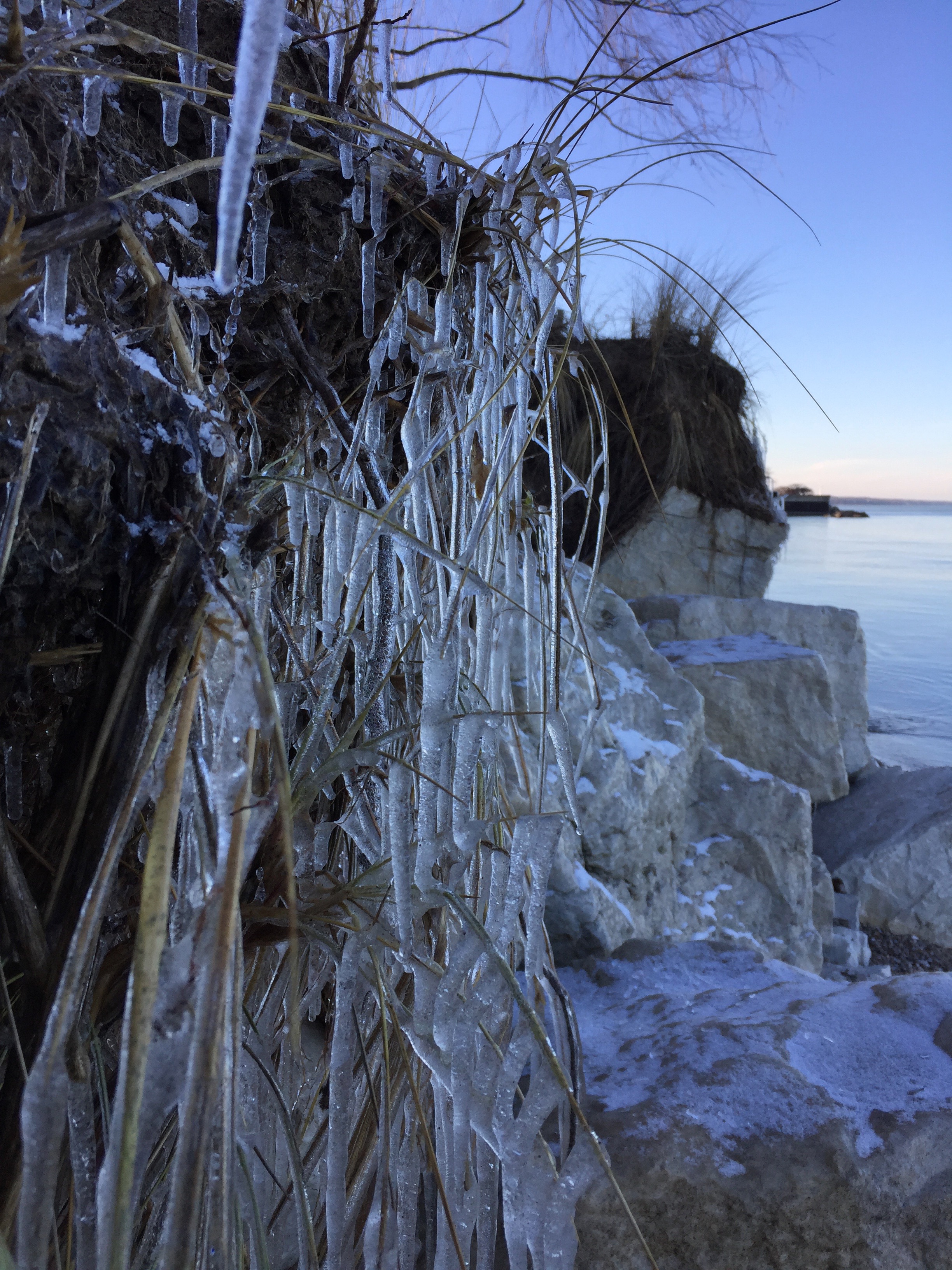
p.s. ice crystals above, clinging to the roots of a fallen tree, discovered yesterday along lake michigan’s shore when my beloved and i went out for a late afternoon’s winter walk, but one of the wonders marking my annual return to the day i was birthed….