pull up a chair

where wisdom gathers, poetry unfolds and divine light is sparked…

Category: motherhood

saved by the dust bunnies

dear reader, fear not. at last writing, as i bemoaned the absence of progeny in this old house, and awoke to the relative quietude of life as empty nester, i might have seeded worry. what will she do, that poor blithering mama, you might have wondered. will she clock her time staring out the window, awaiting the return of said progeny galloping in from distant plains, in need of laundry, grilled cheese, or any other assorted task for which a mother is distinctly schooled?

worry not: purpose has arrived.

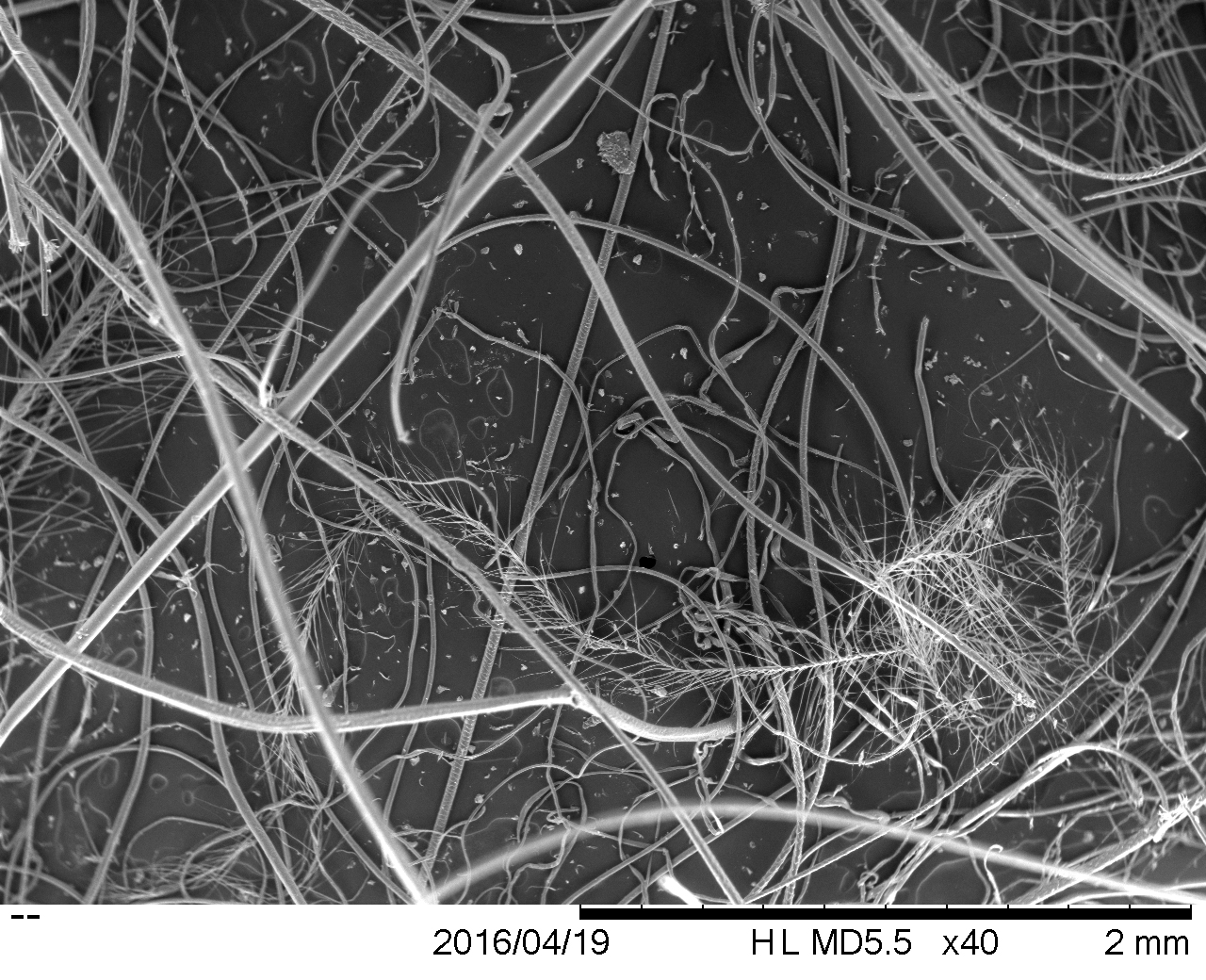
yes, indeedy. in the form of unknown possibly invisible creatures lurking in the chamber where the recently departed (from this house, that is) now attempts to sleep. these invisible and invincible forces seem intent on making the boy rub his nose and eyes and sneeze. all night long. and well into the daylight.

and so, the call has come. i am (somewhat) needed. or, at least my vacuum is. and i, taking no such task lightly, i’ve equipped myself with a whole battery of dust-bunny-battling weaponry. just last night my friends at amazon delivered the air purifier deemed best in class by the folks at wirecutter, that band of trusty testers at the new york times. and i’ve a gallon jug of vinegar, a mop, and microfiber dust cloths, enough to wipe out legions of pesky mites.

dust buster am i.

dust bunny under microscope: what we’re up against in the dust bunny challenge

all of which points to the foregone conclusion that ol’ mothers never ever pass their expiration dates. we are not sent off to distant pastures. our aprons and our mops, never really set out to dry. we do not wither on the vine. we are, if not invincible, indelibly anchored in the domestic equation.

why, just this week the kid who mostly dashed in and out of the house whilst he was living here, has seen fit to call me for instructions on: a.) how to work a wet mop; b.) what to take for allergies; c.) what else to take for allergies; and d.) all of the above.

it’s a reassuring thing to know the worry chambers of my mama brain need not turn off. i can still muster up a storm in there, scheming up the options, imagining the worst. and, then, as i’ve done since the first note of first pregnancy, i leap into action. if i can slay one dragon––be it lost mitten in the long ago, or dust mites under the bed today––i sidle one inch nearer to indispensability. or so i pretend.

the truth, as i’ve long known, is that love––in any form––does not subscribe to geographical or chronological bounds. i can love as fiercely and devotedly whether you’re under my roof or far far from here. ours is a world in which distance is a given. we are no longer a people of the shtetl or the lane. i only wish those i love lived nearby enough to rap at the door and sidle in for tea. or late night storytelling.

be it by the powers of imagination or a polished knack for empathy, the human heart is the inexplicable muscle with unbound capacity to stretch from here to eternity. and in so doing, we can fiercely and fine-grainedly love the ones too far away or the ones who are no longer, for their essence burns on and on as long as we are breathing. and, sometimes, in the uncanniest of ways: in reaching for my mother-in-law’s signature-red coffee mug on any morning, i can suddenly hear her singsong way of telling me her faith in me has never dulled. and she’s been gone now for nearly three years.

the resurrective powers of love are without rhyme or reason. and, indeed, they save us.

i’ve thought plenty in recent months about the muscularity of love. how it has propelled me up steep inclines, ones i might not have found the nerve to climb had i not felt some forcefield behind me. i’ve a never-ending fascination with this ineffability we know as love, not as valentine ephemera, but love as true physical force, love as divinely inspired. with the power to heal. the power to quell. and, sometimes, the power to slay a bunny made of dust.

your thoughts on the mystical powers of love welcome here:

time travel

the other morning, when the clouds were especially bumpy, i boarded a plane, paid no mind to the bumps, and flew 612 miles to turn back the clock to “before time,” and seize a few of the most important days of my life. 

what might those days be, you wonder? those days are nothing so fancy as plain old ordinary quotidian days side-by-side with a law professor who happens to be my firstborn. and whose life all those hundreds of miles away from where i usually lay my head on my pillow feels too far for a mama trying to seize every blessing from every old day. 

i count myself among the blessed, having birthed a human who happens to be one of my favorite of the whole species. he is 30 and i am double that-plus. and all these decades in, i still purr like a happy cat when he and i are curled like bookends on either side of the same couch. or side-by-side in the front seat of a car, him at the wheel, motoring hither and yon as together we trace some curiosity. or attend to a plain old errand. 

a year ago at exactly this time i was here slicing open boxes, stacking sheets on shelves, and filling a fridge, moving him in at the start of his professorial life. it was just weeks before i had surgery, and before i had any idea what the surgeon would tell me as i lay there coming out of an ethereal fog. in fact, it was during my week here in DC that i tried to casually mention that i was going to be having a little surgery. and so, this week in time and place holds some sort of magical power for me: it allows me to suspend time, to return to “before,” and to savor the simple insatiable union of mother and manchild. 

only, truth is, there’s a twist this time round. and that twist takes it up a notch. or many a notch. 

i know now, in a way i didn’t know then, how very precious even one day is. and how, if you told me i had only a certain number of days, and then asked me how i would want to seize the most of those days, i would tell you the one thing i wanted most emphatically was to be as close as i could be to the people whose lives have left the deepest mark on me. 

this year, i know a bit more about the arithmetic of life. and how, no matter how many days there are, there are a precious few categories for which there are never enough. and how, simply hearing the sounds––even the humdrum ones, maybe especially so––of someone you love shaking off the bedsheets in the other room, awaking to another day, watching that someone in real time, in the flesh, go about the unspoken routines that make for a day––grabbing the keys from the bowl, looping back for one last chug of coffee, turning down a particular street to get to work, all those incidentals that make a life a life––those are the things i want to take in in real time. to press them to my knowing. to be entwined with.

and so, as the calendar rolls back to that seminal season when everything changed, i wanted to slip in between time and enter a netherworld in which i could plant one foot in “before time,” when i wasn’t someone who’d been told she had cancer, and “after time,” another name for now, when i do know that the blessing of cancer, or any leaden-weighted diagnosis, is that nothing means more than time. unfettered, ordinary, spectacular, magnificent hour-upon-hour doing the things that make a life a life. 

because these are the hours i will never ever regret or forget. and i don’t ever want to wish i’d made more time for time. 


while i marinate in the hours and days before me, before i board the homebound plane, here are a few things worth pondering. all of which make for this most beautiful mosaic we call our sweet fine lives. . .

this sweet gem is an excerpt from the very lovely susan cain’s Bittersweet

Franz Kafka was one of the great European novelists of the twentieth century. But there’s another story, this one written not by Kafka but about him, by the Spanish writer Jordi Sierra i Fabra. This story is based on the memoirs of a woman named Dora Diamant, who lived with Kafka in Berlin, just before his death.

In this story, Kafka takes a walk in the park, where he meets a tearful little girl who just lost her favorite doll. He tries and fails to help find the doll, then tells the girl that the doll must have taken a trip, and he, a doll postman, would send word from her. The next day, he brings the girl a letter, which he’d composed the night before. Don’t be sad, says the doll in the letter. “I have gone on a trip to see the world. I will write you of my adventures.” After that, Kafka gives the girl many such letters. The doll is going to school, meeting exciting new people. Her new life prevents her from returning, but she loves the girl, and always will.

At their final meeting, Kafka gives the girl a doll, with an attached letter. He knows that this doll looks different from the lost one, so the letter says: “My travels have changed me.”

The girl cherishes the gift for the rest of her life. And many decades later, she finds another letter stuffed into an overlooked cranny in the substitute doll. This one says: “Everything that you love, you will eventually lose. But in the end, love will return in a different form.”


and, lastly, this: wisdom from The Dhammapada, a collection of sayings of the Buddha in verse form and one of the most widely read and best known Buddhist scriptures.

With gentleness overcome anger – with generosity overcome meanness – with truth overcome deceit – Beware of the anger of the mind – master your thoughts – Let them serve truth – the wise have mastered body, word and mind – the wise harm no one. 

The Dhammapada*

“the wise harm no one…” let us be wise, be gentle, be generous.


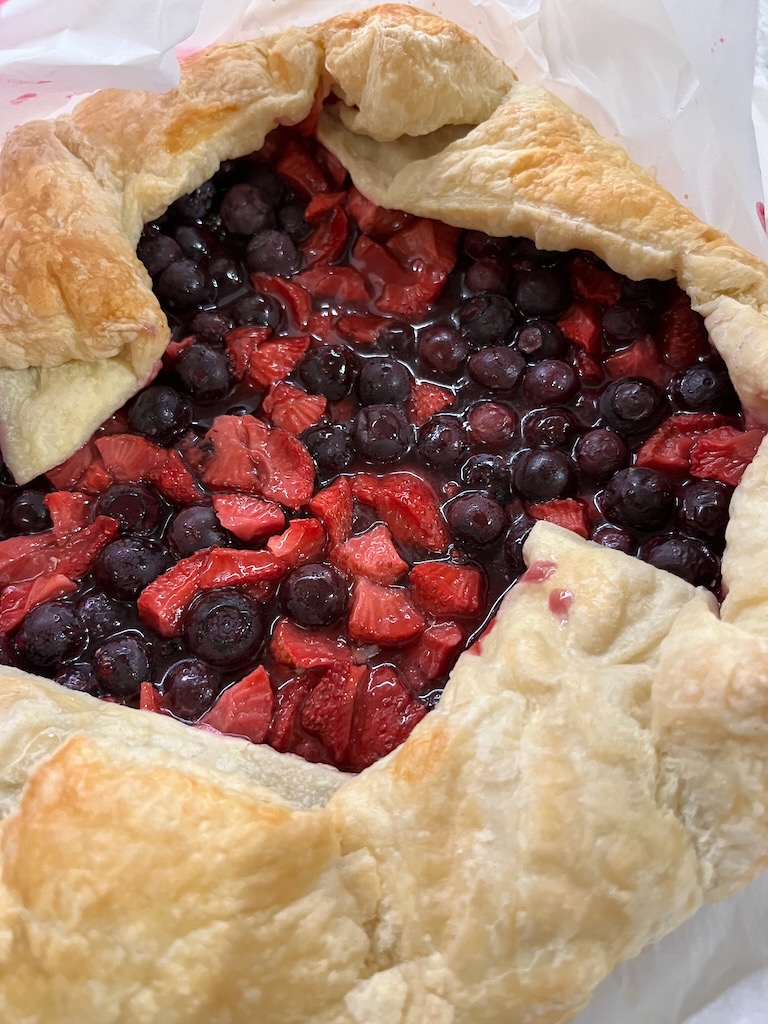
and speaking of generosity one of our beloved beloved chairs who lives not far from where i sit typing here in DC motored over yesterday to spend a good chunk of the day traipsing through a franciscan monastery that took our breath away (and not only because of the paths up and down hills) and who delivered this glorious berry-filled galette to me and my sweet professor, whom she knew when he was a mere wee lad of kindergarten age…generosity abounds at the chair, and i love you all for it.

pjt’s very magnificent very-berry galette

and how might you choose to seize a day, any old day, in the magnificent story of your sweet and blessed life?

the prayer after the fall. . .

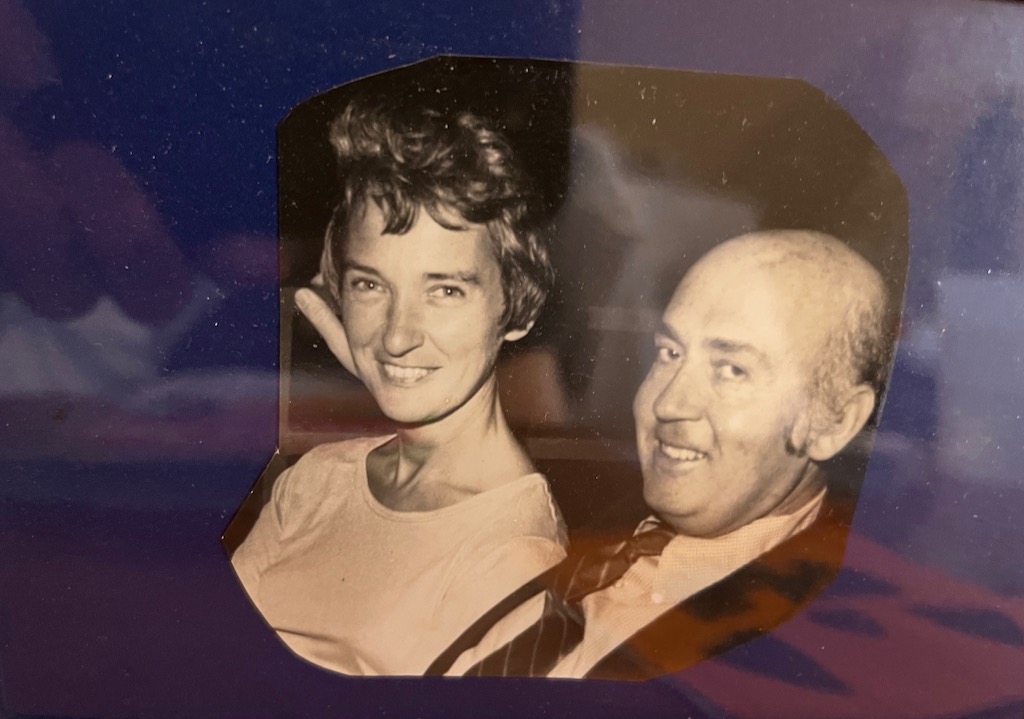
my mama and papa, a long long time ago…

it was the call you pray you never, ever get: early morning. “police and paramedics are already there.” little else known.

except that it was my mom. and she’d taken a terrible fall, a nightmare of a fall. police had broken in the front door when they saw her lying, crumpled, unresponsive, at the bottom of the stairs. a spotted trail of blood had followed her down the last eight of 14 stairs, around the landing, and onto the slate floor of the front hall, where it had pooled. 

as the pieces started to fall into place, one theory was replaced by another, and what we knew was that it was a fall from the top of the steep hardwood stairs to the hall down below. she’d been lying there almost 12 hours. 

and i was some 200 miles away, driving 70 miles per hour, suddenly fielding phone calls to and from brothers scattered across the country, detroit, california, maine, and the brother whose car was following the ambulance to the emergency room where so much of our family’s life has unfolded: death, birth, broken arms and legs and umpteen stitches, hours-long surgeries and outpatient, too, along with a few godawful diagnoses.

my mother’s most fervent prayer since a car accident two aprils ago has been “to go home.” and home to my mother is heaven. she desperately doesn’t want to be alive anymore. finds little joy in the everyday. except for the birds. and irish whiskey on the rocks, with plenty of water, at 5 p.m. sharp (or 4 if nobody’s looking). and as she said to me in a whisper from her ICU bedside the other day, “to be honest, i wish i’d gone” (meaning not waken up after the fall). “but not that way, i guess” (meaning not alone, in the dark, at the bottom of the stairs, when she thought she’d been headed into the shower, to climb into bed, for another restless night of not much sleeping). 

my mother, who is as pragmatic and plainspoken as the day is long, wasted little time in realizing “i might never be allowed to live alone again.” a dawning followed quickly by “can you take me right now to westmoreland,” which is not quite the name of the place where she’s been on a waiting list for independent living since two aprils ago, and at least four times has told them “i’m not ready” when they’ve called her with an available apartment.

she’s still not ready. not really. 

but my mother’s face and scalp and arms and legs are the color of eggplant right now. the bruising so intense it’s long past purple and deep into inky indigo. somewhere between aubergine and midnight. and that’s only what’s broken on the outside. ribs, and vertebrae, and a bone on her face, they’re broken too. 

i was lying in bed the other night, the night before we moved my mother to rehab, tallying the things my mother will miss after 60 years in the house where we all grew up, the house she would not leave because of its tall oaks, and its sunsets out the kitchen window, and the birds and the deer and the pair of ducks who waddled under the fence each and every spring. 

after all these years of knowing ours was the house at the first bend on the winding dead-end street, across from the green pond and the woods where i grew up, across from the country club where my mother for years would strap on skis after any snowfall and glide for miles across snowy greens and tees and sand traps, i am bumping into brain hiccups any time i try to wrap my head around the brand-new notion that 707 will no longer be. or no longer be ours anyway, no longer the polestar to our family chronicles. 

for now, my mother is miles away from that old house. and she’s never going back. says she doesn’t think she could bear to say one last goodbye. so we will shutter it, the five of us who know that house inside and out, who know which upstairs window was the one a brother climbed in one night too late past curfew, the sliding door where another brother was showing off his brand new BB gun and PING! the glass was shattered, the arbor of oaks under which i and my beloved were married. 

this is not the way my mama––or any of us––wanted her story to end. 

but we’ve soldiered on before. she has always taught us how. she’s not one to buckle under. 

she’s been widowed 42 years; buried a husband, and a tiny baby granddaughter atop her husband’s grave; mothered five children, each of whom has had twists and turns and upside downs. she’s had cancers of her own. 

and till now, she has not crumpled. 

even now, her faith has barely flagged. but she looks up at me, through her swollen ink-black eyes, and asks, “barbie, why won’t God take me?” 

and how can i answer that, other than to say, “mama, we don’t know. we just don’t know.”

and so i rub her back where the terrible aching is, and we find her favorite cowboy channel, and i pray and i pray. don’t think me wrong to echo my mama’s prayer. i pray too, dear God, please take her home. she wants so very, very deeply to be there…

i’m transfixed by that photo above. i stare into my mama’s long-ago glimmer. i miss them both, so deeply.

today my only questions are ones without answers…

of night sounds and saints and summer poems. . .

i wasn’t too deep into a jet-lagged slumber when the sound i’d waited to hear rose from the kitchen last night, wended its way up the stairs and into the room where my head lay on the pillow. it was the sound i’d hoped to hear in faraway paris, the sound of two brothers bouncing off each other’s humors and wits and midnight banter. it was a sound that oozed into the cracks in my heart, and the tender spots too. it was a soundtrack so sweet it lulled me back to my dreams.

we finally caught up with the boy who couldn’t get to france when we met him in the international terminal day before last, shortly after he’d flown into chicago from DC, where he’d waited all week for our return. he happens to have a dear friend getting married in town tomorrow, and he’d long planned to fly home with us, to be here for the weekend. so the reunion in the airport was sweet as it could be. long-awaited. much pined for. and i’ve been indulging in every drop of it ever since.

theirs is the soundtrack that makes me more whole than anything else. the soundtrack i’d dreamt of in the days after surgery when i knew more vibrantly than ever before in my life what i lived for. and long, long ago, the soundtrack i’d dreamt of in the very long years before there was ever even a brother, when it seemed “one and only” would be our equation forever. and it’s the soundtrack i pray will go on long into the forever, long after i’m gone and they have each other.

though they’re eight years apart they both share particularly nuanced humors. they tango with words, and glances that only they understand. it’s shorthand for brothers. and it’s the holiest balm i know. i’d longed for it, as if a summer’s hammock tied between trees, one that would rock me into the semi-fugue state of a lazy afternoon’s nap. i’d imagined it unfurling in parisian cafes; threading through crowded sidewalks along the boulevard st. germaine; or taking off into the night as the intrepid pair ventured into the city of lights.

but that wasn’t to be. and the waiting––the hole in my heart that never went away––might have made its midnight appearance last night all the sweeter.

it’s the unexpected twist in the story, the script that didn’t play out as i’d imagined. life is like that. life likes to remind me of its stubborn insistence that i’m not the screenwriter here. and just because it doesn’t turn out the way i’d plotted it, doesn’t mean the happy ending won’t come. sometimes you have to stick it out through the hard parts to get to the part where sweetness comes in.

i’m thinking a lot about hard parts and scripts that don’t seek my opinion, scripts that play out in ways i’d never suggest. i admit to finding myself in a role that’s foreign to me, one that doesn’t make sense: i run out of breath and i run out of steam, and i can get scared by runaway worries. i’ve a long quiet summer ahead to figure some of this out, and i intend to do it the slow way. with the brotherly sound track propelling me onward whenever i get to the hard parts.


side chapel at Chartres, devoted to therese of lisieux

a little bit about a saint: i was one of those catholic school girls, the ones who wore plaid jumpers and were told to pick a saint upon which to model our ways, especially when it came time for our confirmation, and we got to wear white lacy dresses and the bishop would splotch our foreheads with oil. i picked therese of lisieux, the little flower of jesus, partly because i liked little flowers, and i always saw pictures of her surrounded by wee purple violets. i loved that in her quiet little way, she never abandoned love. and i too believed that in my quiet little ways i could make my way through the world, infusing little drops of love all along my route. i didn’t know until last week, when i stepped into a side chapel at the cathedral of chartres honoring the 150th anniversary of her birth, that therese was born the day before me. 84 years earlier. over the years i’ve discovered that dorothy day, one of my heroes, loved her too, for her teaching of “the little way”–by little acts of kindness, little acts of courage, little acts animated by love, we can shift the balance of love in the world. and it turns out that just this week, pope francis (yet another hero of mine, and yet another someone who loves saint therese) devoted his remarks in st. peter’s square to the little flower of jesus, imploring us to imitate her ways, by doing even the littlest things with great love. because she was sickly most of her life, and died at 24, pope francis went on to say that though her body was sickly, “her heart was vibrant and missionary.” i find particular resonance these days in a saint who saw herself as “a small grain of sand,” and who never let her bodily frailties impede her heart’s zeal.

st therese of lisieux

three poems: two summer poems, and a stanza from audre lord that took my breath away…

from mary oliver’s “Six Recognitions of the Lord”

My heart
sings but the apparatus of singing doesn’t convey
half what it feels and means. In spring, there’s hope,
in fall the exquisite, necessary diminishing, in
winter I am as sleepy as any beast in its
leafy cave, but in summer there is
everywhere the luminous sprawl of gifts,
the hospitality of the Lord and my
inadequate answers.

— Mary Oliver


a stanza from audre lord’s, “A Litany for Survival”

For those of us
who were imprinted with fear
like a faint line in the center of our foreheads
learning to be afraid with our mother’s milk
for by this weapon
this illusion of some safety to be found
the heavy-footed hoped to silence us
For all of us
this instant and this triumph
We were never meant to survive.


In Passing

 How swiftly the strained honey
of afternoon light
flows into darkness

 and the closed bud shrugs off
its special mystery
in order to break into blossom:

 as if what exists, exists
so that it can be lost
and become precious

~ Lisel Mueller ~

a curious hodgepodge here, fueled by jet lag perhaps, but nonetheless: what are the summer sounds (or poems) that soothe you most?

jubilance and the boy who made impossible possible

My baby boy, the one they told me I’d never ever have, is graduating from a college he never thought he’d know as his own. And we are celebrating. We are jubilant. We are celebrating deep down inside both of us all those things that people say you will never ever do; but you forge right ahead and you do them anyway. 

We have long thought of the kid as “the egg that wouldn’t take no for an answer.” That little egg did not care that I was 43, halfway to 45 by the time he was born. Did not care that so many other eggs had not followed instructions. That egg — his egg — refused to take no for an answer. And that egg grew and grew into the magnificent human with the very very big heart. The tenderest heart I’ve ever known. A heart that says best what it says in unpunctuated text messages, in hilarious pictures he sends of himself dressed in alligator suit, complete with spiky tail he swishes hither and yon as he stalks his native habitat.

That kid is my champion. That kid makes me believe in the impossible. That kid is living, breathing, impossible made possible. 

That kid told me a few weeks ago that when he was trying to do the impossible — to reach for something well out of reach — he tapped his shoulder as if to beckon me, to give him the strength and the will and the courage he needed. Turns out, he reached what he was reaching for. And he let me in on his secret the morning after it happened. Ever since, I’ve follow his lead: when I need to reach for something beyond my reach — be it courage, or breath, or not flinching a muscle when the doctor comes at me with needles the size of a drain pipe — I now tap my shoulder too. 

That kid and I might spend the rest of our lives tapping our shoulders, beckoning courage, beckoning the possible, beckoning reaching far, far beyond what we think we can do. 

So I am madly wildly celebrating that kid, and the chance to be by his side when he doesn’t exactly walk across the graduation stage this weekend. Because his most recent impossible something was winning a championship along with his mates, the ones who fling frisbees into the air, and shout out in joy as they run for the discs that spin through the air, impossibly. He’s taking to frisbee fields, in the national championship, instead of seizing diploma, and I will be right there on the sideline. Jubilant. Celebrant. Waiting to see if he taps at his shoulder. 

My once-impossible impossibly soaring and diving, seizing the impossible. My blue-ribbon boy. My joy and jubilance ever after…


i could sit and read jane kenyon all day any day. and this one is new to me, so i’m sharing it…

jane kenyon, a poet of the quotidian, was long and adoringly married to donald hall, the late great poet and essayist. both now gone; forever heroes to me, their poetries worthy of a lifetime’s attention. some years ago, in the blessing of one such lifetime, i sat beside hall –– on the floor tucked against his armchair –– in the living room of their white frame farmhouse on eagle pond, in new hampshire. it was during our “year of thinking sumptuously,” when we up and moved to cambridge, mass., and drank from the firehose that is the nieman fellowship for journalists. poetry was where i took my deepest dive that year. and, after that field trip to new hampshire, hall and i became something of pen pals, posting letters back and forth, letters i now save tucked between the pages of his poems. on the day we had spent at eagle pond farm, kenyon, who had been the poet laureate of new hampshire, had already died (she died at 47 in 1995), but her poetries for me are now animated by knowing the kitchen where she cooked, the desk where she wrote, and the barn where she sometimes went to weep.

here is kenyon’s “happiness”…

There’s just no accounting for happiness,
or the way it turns up like a prodigal
who comes back to the dust at your feet
having squandered a fortune far away.

And how can you not forgive?
You make a feast in honor of what
was lost, and take from its place the finest
garment, which you saved for an occasion
you could not imagine, and you weep night and day
to know that you were not abandoned,
that happiness saved its most extreme form
for you alone.

No, happiness is the uncle you never
knew about, who flies a single-engine plane
onto the grassy landing strip, hitchhikes
into town, and inquires at every door
until he finds you asleep midafternoon,
as you so often are during the unmerciful
hours of your despair.

It comes to the monk in his cell.
It comes to the woman sweeping the street
with a birch broom, to the child
whose mother has passed out from drink.
It comes to the lover, to the dog chewing
a sock, to the pusher, to the basket maker,
and to the clerk stacking cans of carrots
in the night.

It even comes to the boulder
in the perpetual shade of pine barrens,
to rain falling on the open sea,
to the wineglass, weary of holding wine.

+ Jane Kenyon

my jubilance: apparently, he’s been dressing up as zoo animals his whole life long. here he is, my tiger.

this is what mothering looks like. . .

a few years ago, maybe many years ago, i wrote something of a proclamation on mothering, the verb. in my feisty little voice, i argued — as vehemently as a girl taught to be polite could argue –– that, gosh darn it, mothering was not an art that belonged exclusively to those who happen to have pushed a wee squawker from her womb, nor only to those who’ve clutched babies to her bosom, anatomically-aligned attachments. i argued that we should be honoring not simply the noun — those who are mothers — but the verb — those who mother. 

it’s an all-inclusive distinction, one i tried to describe thusly:

yes, every last someone who has stroked a brow, wiped a tear, dabbed chocolate off a little cheek, fluffed a pillow, tucked in the covers, whispered bedtime prayers, set an extra place at the table, stretched a meatloaf, picked the peas out of the pasta salad, kissed a bloody knee, kept a retching belly from falling in the toilet bowl.

yes, every pair of arms that’s lifted a dead-weight child in the pool, played red rover till the cows came home, bent half-over to push a kid on training wheels around and round the block, turned the pages of good night moon so many times you find yourself chanting good night to the mittens when no one’s in the room.

you get the point.

i believe it as firmly as i believe anything. and in fact, in the many hours i’ve spent curled in my window seat in recent days, i found myself with nose in a book that argues — again, vehemently yet politely — that we are missing out on a whole lot of God if we think of God only as a white-bearded fellow perched on a throne with a sword and a scepter, a God as king, imperial ruler and judge, as wielder of power, and slayer of sinners. (for the record, that has never been my image of God, and i admit to images, being of the simple kind who need pictures to go along with my favorite passages. and the picture i saw is a tender God, one with arms that reach, and a palm that cradles, or presses against the small of my back. and as i’ve grown and deepened into the mystery, i now sense God without image at all. i sense God in the shiver that runs up my spine when i encounter the beautiful or the unbearably tender, and i find God in the interplay — the ineffable force — that animates hearts and draws us — any of us, all of us — into each other.)

the book i’ve been reading — She Who Is: The Mystery of God in Feminist Theological Discourse, by Elizabeth A. Johnson , a brave and brilliant theologian who happens to be a roman catholic nun –– says this: 

“God is that on which you lean your heart, that on which your heart depends, ‘that to which your heart clings and entrusts itself,’ in Martin Luther’s memorable phrase.”

the truth is, it’s all mystery, and we reach for metaphor so our little minds can find something to seize. how do you put words to the inexplicable, the unknowable? you simply know what you know. 

but in considering a God imbued with the feminine, a God more mother-like, a God, as johnson writes, of “gentleness and compassion, unconditional love, reverence and care for the weak, sensitivity, a desire not to dominate but to be an intimate companion and friend,” i scan the landscape of my recent days, and i spell out this litany of what mothering — the verb that belongs to all who employ tender loving empathies and unending expression of gentle kindness — looks like:

mothering is the knock at the door on a rainy morning, not long after dawn, and the friend who is standing there with a handful of field-plucked flowers and a soggy brown bag of parsley and spinach and ramps, foods she grabbed from the farmer’s market, knowing from her own daughter’s deadly cancer that these are the foods that should fuel me. and she knew without asking how very much i wished i could get to the market, though i couldn’t quite yet.

mothering is my beloved husband who, every morning, makes certain the feeder is filled with seed and the bird bath fully watered, for he knows the joy i absorb watching the birds flit hither and yon. mothering is the pizza he drove into the city to fetch because it oozes the things i love — spinach and mushrooms and cheese and a heavenly red sauce –– and he is intent on fattening me my way. mothering is the rod stewart and kim carnes tapes he played all morning long to try to convince me the rasp in my so-called voice (paralyzed vocal cord caused by the surgery) was a sexy addition to life here on the homefront.

mothering is the friends who don’t back down, who don’t shy away, who know without asking just when to barge in, and when to stay quiet. and who keep coming back, week after week, willing to walk at a snail’s pace, or pick up a vacuum and suck up the kitchen-floor crumbs that are driving me batty. 

mothering is my aunt who tucked a tiny enamel cross in an envelope and scribbled these words on a note card: “hope i’m helping you carry your cross!” and then wrote that as soon as her daughter could drive her up here from cincinnati, she wanted to sit side-by-side under an apple tree “to make your ‘hurts’ hurt less.”

mothering is the courage to go the distance, even when the distance is wholly uncharted and fraught with shadows and plenty of bumps. and what you need more than anything is a friend who won’t cower and run for the hills. 

mothering is the way some listen for the fears tucked in an otherwise straightforward sentence, and who don’t shush those hauntings away, but make room for it all, the light, the darkness, the liminal. 

mothering is the text message that comes out of nowhere and makes you laugh till the slits in your side tell you to stop. because laughter is always, always, a curative. and it can carry you for hours, the echo of its joy refusing to fade.

mothering is this holy earth unfurling its tight buds and its blossoms into frothy meringues of cumulus white and lavender blue. mothering is the dawn that reminds me again and again that the light will shatter the night. mothering is the papa bird who tucks the seed into mama’s beak, an iteration of kissing i’ll not soon forget.

mothering is without gender, independent of obstetrical status. mothering, quite frankly, is simply another name for “love as you would be loved.”

mothering, quite simply, is what God does. 

blessed mothering to all of you who mother and mother and mother –– even if you don’t realize…

birthday blessings to one of the wise women among us, our beloved lamcal, who fetched me from the darkness last night, and plunked me into a circle of pure and undeniable love, even when i wasn’t sure i was up for an outing. she’d sensed it might do my soul wonders, despite my bodily wobbles and squeaks, and she was oh so very very right on the money. i sat last night in a circle of holy holy pilgrims, who poured out their hearts and their blessings. and sent me forth. happy birthday, wise one….

lest you miss it, here’s the week’s query: tell a story of a time you were so deeply mothered — perhaps by an unlikely motherer — you’ve never forgotten.


and i’m leaving you this. because it’s glorious:

Go Deeper than Love

Go deeper than love, for the soul has greater depths,
love is like the grass, but the heart is deep wild rock
molten, yet dense and permanent.
Go down to your deep old heart, and lose sight of yourself.
And lose sight of me, the me whom you turbulently loved.
Let us lose sight of ourselves, and break the mirrors.
For the fierce curve of our lives is moving again to the depths
out of sight, in the deep living heart.

~ D.H. Lawrence ~

p.s. even though the picture above is overt mothering with a literal mother cradling her literal baby (moi and my firstborn, the law professor) i had to reach for it today, because that tenderness, that love, is the very thing fueling me right now, as i reach out of these past upturned weeks and set my sights fervently, fiercely, on doing everything i can to keep on loving my boys –– and all of this life –– with every ounce of tender lovingness i can squeeze out of me…..so help me, MotherGod….

equal time for equal mothering: this is saying goodbye one college drop off and that’s the kid who graduates next week. my miracle baby. . .

a mother’s heart finds its place in a canyon of moving boxes

dispatch from 20009: in which canyons of boxes in every room are ours to conquer, moi and the one i birthed first. . .

i write to you this dawn from the singular place on the planet i wanted to be this week, a point on the map now highlighted in illuminating shades of radiant. a kid i love is a professor now, and i am here where, in my book, a mother belongs: by his side, tearing open his boxes, tallying the lost and found, turning a blueprint of rooms into a place called home. 

i’ve planted the kid in five points on the map since the day he left home for college, and each one for its season became a place i peered in on, checking the weather, counting the miles, watching police reports. his dot became mine by extension. 

i’ve spent years now considering places called amherst and new haven, portland, manhattan, and now the nation’s capital, specifically adams morgan, a neighborhood where RBG graces the banners that waft from the light poles, with the words “live your truth.”

the kid has decidedly hopscotched across the country over the course of the last decade. but his itinerant days might be over, as a tenure-track post prompts me to think i’d better get used to the latest in zip codes. and, anyway, unpacking boxes, finding places on shelves, has become my sub-specialty. it’s a task i take on with all the love in the world. i don’t think i’ll ever extinguish the place in my heart that tells me my number one job on the planet is to soften the blows, trod the circuitous path, keep stretching my arms clear across the landscape, and always, always find space and time for side-splitting giggles and tears when they spill from both of our eyes. 

the kid is 29 but nowhere in the manual i was handed in the delivery room can i find a line telling me there’s a time when the mothering stops. mothering over the decades is a three-dimensional wonder: it deepens and widens, is layered with strata of life’s most wrenching and glorious moments. just last night as we were giggling and whispering our way to sleep––me on un-sheeted bed (we’re working our way from kitchen to bedroom), him on inflatable mattress––i told him how even though i see the professorial glasses he wears these days and feel the heft of his six-foot-three pillar of flesh and bone when he wraps his arms around me, i also see plenty often a flashing picture show of his life at various points along his continuum: i see––clear as clear could be––the wet and squirmy little thing placed in my outstretched arms the very first time; i see the six-month-old who let out a belly laugh for the very first time; i see the toddler who looked up from the kitchen table one breakfast and asked, as if it was the most ordinary of questions for a three- or four-year-old, “mommy, what is facetious?” meaning what does it mean, this very long word not normally found in preschool vocabulary. and, yes, i see the kindergartener who set up a lecture hall in our living room, with a circle of stuffed-animal pupils, a chalkboard and easel, and 26 spongy alphabet letters. the professor wore suspenders and tie and bare feet, and instructed his class on the fine points of D, O, and Q.

it’s a curious thing, this mothering the grown human being. there are those, i’ve been told, who believe a mother’s role is to step into the distant background, loosen the grip on the ups and the downs of those you’ve loved every day of their lives. i’m not among them, though i can go––and i have––whole weeks without more than a short burst of texting. i find it only gets richer and richer, the closest i know to “love as you would be loved.” mothering to me is a spectacular testing ground: day after day, i re-define and refine the extraordinary intricacies of loving, of where to position myself in the tableau of his life, how much of the weight to bear, and when to stand silent and when to come running. 

what i know, after a lifetime of fumbles, of occasional hits and plenty of misses, is this: the width of my brain has only grown wider over the years, as each of my boys carry me into realms i’d otherwise never explore. and my heart and my soul, they’ve at once defied the laws of physics, both deepening and rising to depths and heights i’d never ever imagined. and so, as long as i’m needed and able, i shall tear away the endless strips of packing tape till my fingers are raw and my boy has a place to call home, his very own faraway home. six hundred miles from mine.


since i’ve been busy unpacking this week, i’ve not had much chance to gather up a commonplace-y bouquet. but i did find this, from the late great bard, leonard cohen, on sainthood:

“What is a saint? A saint is someone who has achieved a remote human possibility. It is impossible to say what that possibility is. I think it has something to do with the energy of love. Contact with this energy results in the exercise of a kind of balance in the chaos of existence. A saint does not dissolve the chaos; if he did the world would have changed long ago. I do not think that a saint dissolves the chaos even for himself, for there is something arrogant and warlike in the notion of a man setting the universe in order. It is a kind of balance that is his glory. He rides the drifts like an escaped ski. His course is the caress of the hill. His track is a drawing of the snow in a moment of its particular arrangement with wind and rock. Something in him so loves the world that he gives himself to the laws of gravity and chance. Far from flying with the angels, he traces with the fidelity of a seismograph needle the state of the solid bloody landscape. His house is dangerous and finite, but he is at home in the world. He can love the shape of human beings, the fine and twisted shapes of the heart. It is good to have among us such men*, such balancing monsters of love.”

Leonard Cohen

“achieved a remote human possibility. . . ” contemplate that for a while….


in book news: it seems hard copies of The Book of Nature have been plopping onto front stoops all over these united states, and heavenly folk, especially friends of the chair, have been sending along snaps, each of which makes my heart do a little bit of a gallop. it’s still a couple weeks till the official pub date––the vernal equinox, march 21; bring on the springtime, bring on the book!––so these early sneak-peek arrivals are both surprise and delight. and i am hoping to set that book soaring with a grand circle of chairs, as night falls on that first day of spring. see here for more details, should you be so inclined. (we’re gathering on march 21 at 7 p.m. central time, via zoom, one of the rare silver linings to emerge from our years in pandemic––or at least i count it as a silver lining, bringing me poets and thinkers from all across the globe.)

before i get back to uprooting books from their boxes, here’s the question (to ponder or drop us your thoughts): of all the mothers you’ve known or watched from some distance or close proximity, what are/were the defining qualities that allowed you to see and see clearly just what it means to love in the deepest mothering way? (and, remember, mothering for me is a verb not tied to any particular gender or state of procreativity, but rather to any and all who love with a tender loving attention and care, and the undying prayer that in some way they might both lighten another’s load and magnify the wonder of being alive…)

packin’ it in. . .

at one point yesterday afternoon, five of six burners were occupied on the carrier ship of a cookstove that occupies this kitchen: one boiled a vat of water for soon-to-be-roiling pastas; one simmered the beginnings of roux; one held a pot of tomatoes and basil and a chunk of parmesan cheese; one simmered chunks of apple and pear and cranberry into a compote; and one awaited the tea kettle’s whistlings.

even the cutting boards had taken assigned seats: one for the stinky onions and garlic; another for apples and pears.

we were packin’ it in.

stuffing as many favorites onto the stove, into one afternoon, into one ultra-condensed week of days jam-packed together. four of us––aka, all of us––are home this week. bedsheets are tossed in two of the rooms, the floors seem to be serving as closets and drawers. why unpack when you’ll soon be packing again, heading back out the door, into the air, and home to those faraway places?

packing it in seems as apt a way to live a life as any i can imagine. squeeze in as much as you can. (as long as those super-thick times are bracketed with spells of the monastic quiet that seems my most natural habitat.)

when it comes to loving, i’ll attach lavish every time. i don’t think an hour’s gone by this week––or maybe in my whole motherly lifetime––when i didn’t deep-down marvel at the miracle that two human beings were born to me. born from me, as a matter of fact. a feat i somehow never ever thought my wobbly old body would be able to do. i’d never put quite enough faith in my physical capacities. finish lines felt far beyond my reach; i wasn’t one to get where i needed to go by sinew and bone. and, besides, i’d mucked it up plenty along the way.

and so, the sound of their newborn cries in two dimly-lit delivery rooms is a sound that lifted me out of my body. it’s never faded.

in birthing both of them, volumes and volumes were birthed in me. i began to redefine love. and loving. i was filling in blanks, inserting my own particulars, and reaching toward the surest truth i’d ever been told: love as you would be loved. it was sacred instruction made flesh.

and all these years now––decades now––i’ve been stumbling, and bumping into walls, and trying and trying to do just that. my boys have become my paradigm for loving. my living-breathing exercise in empathy. i might try too hard sometimes. but i’d rather err in that direction than in not quite enough. not enough can feel achingly empty.

and so, here at the brink of a newborn year, another chance at trying again, it’s not a bad time to consider the ways we choose to live our days: will we pack it in? lavish a little bit of love? or as much as we can muster? will we put up with the jumble, and the noise, because it means we might squeeze in a few bits of truth, the truth that rises up from the deepest residue of the heart and the soul? will we pay close attention? will we savor our one more chance to live the love we all pray for? to be the love we imagine, we believe in?

my prayer for the new year is ancient and infinite: dear Holy Breath, that i may love as i would be loved. again and again and again. in ways never noticed, and in ways certain and strong. amen.

how will you live your days?

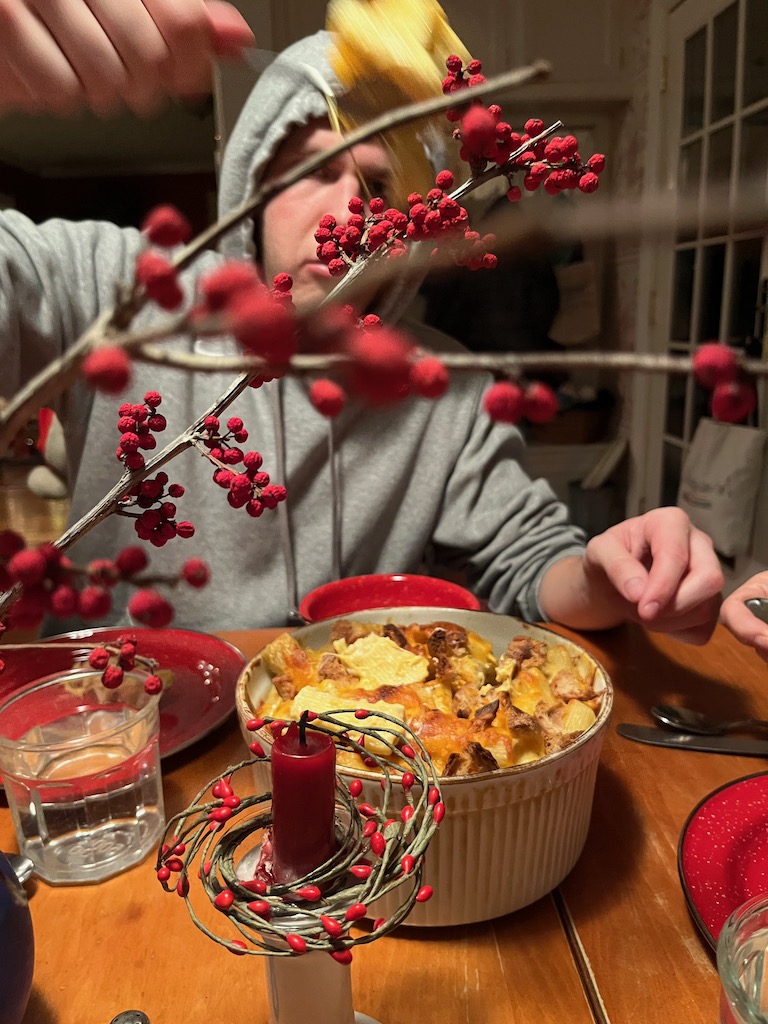
(the sweet boy above had promised he’d send along a photo of the jam-packed cookstove, with all its burblings and gurglings, since i was far too busy stirring to snap one, but as of friday morning press time, said photo hadn’t yet appeared, so we’re running with the one frame i managed to snap, in all its blurry glories. tis the famed mac ‘n’ cheese i’ve been making for 28 years.

p.s. long as i’m here, might as well pass along the mac ‘n’ cheese that has my boys crowding the cookstove….

mama mac ‘n’ cheese

Provenance: Gourmet magazine, May 1995, pages 200 -201; the issue that just happened to be lying on my kitchen table the day I sat down to plot the festivities for my firstborn’s second birthday.

Yield: Serves 8 children.

3 Tbsp. unsalted butter

3 ½ Tbsp. all-purpose flour

½ tsp. paprika

3 C. milk

1 tsp. salt 

¾ pound wagon-wheel pasta (rotelle)

10 ounces sharp cheddar cheese, shredded coarse (about 2 ¾ C.)

1 C. coarse fresh bread crumbs

* Preheat oven to 375-degrees Fahrenheit and butter a 2-quart shallow baking dish (the broader the crust, the better).

* In a 6-quart kettle bring 5 quarts salted water to a boil for cooking pasta.

* In a heavy saucepan melt butter over moderately low heat and stir in flour and paprika. Cook roux, whisking, 3 minutes and whisk in milk and salt. Bring sauce to a boil, whisking, and simmer, whisking occasionally, 3 minutes. Remove pan from heat.

* Stir pasta into kettle of boiling water and boil, stirring occasionally, until al dente. Drain pasta in a colander and in a large bowl stir together pasta, sauce and 2 cups Cheddar cheese. Transfer mixture to prepared dish. Macaroni and cheese may be prepared up to this point 1 day ahead and chilled, covered tightly (an indispensable trick, when confronting a serious to-do list for a day of birthday jollity). 

* In a small bowl, toss remaining ¾ cup Cheddar with bread crumbs and sprinkle over pasta mixture {Note: My boys insist you go heavy on the extra cheese here, it makes it better, and my boys are ones who like their cheese to supersede their bread crumbs}. 

* Bake macaroni and cheese in middle of oven 25 to 30 minutes, or until golden and bubbling. Let stand 10 minutes before serving. At last: Dig in.

may all of our 2023s be blessed. . .

turning the page with a tug and a pull

we are definitely turning the page here at this old shingled house. the bespectacled architecture critic no longer calls me from the office at 8 at night, saying he’ll be stuck writing for a few more hours. there are no carpools to coordinate, no getting up at 5 in the morning for soccer matches in kingdom come. i’ve gotten used to the new geographies in my head, the ones that have me simultaneously keeping track of news, weather, and covid in new york city and the middlelands of ohio, the current turfs of both of our birthlings. 

somehow, without notice, without even a sign posting the warning, we’ve moved into the loveliest calmest quietest chapter of our married life that ever there was. (do not think of even uttering a syllable of the R word, the one synonymous with hanging up one’s professional hat; one of us has no intention of putting away the keyboard and the other seems to have taken up full-time swimming, biking, and running across finish lines). underscoring the shift, this year we’ll be racking up plenty of lasts in the kid department: the last college drop off. last parents weekend. last winter and spring breaks. last graduation. last packing up the dorm room. last whopping tuition bill. 

we are, very much so, on the final verge of true empty nesting.

it’s a mix tinged with poignancy, and a good measure of disbelief. time passes so swiftly, you suddenly realize. after years and years of thinking the routines will never be broken. poof, and they’re gone! 

we’re late to this party, only because i found myself in a delivery room when others i knew were there awaiting their grandbabies, but i was there because of what felt and always will feel like i somehow squeaked through the maternity ward as the very last egg was being cleared from the deck. and, as with so much in my life, i’ve been soaking it in from every which angle, taking none of it lightly, extracting as much as i possibly could at every twist, turn, and trial along the way. 

ours, these days, is a quiet life by choice. my favorite hours are nestled in books and on my knees in the garden, over coffees with people i love, and the dinners at the end of the day when we weave together the threads we’ve both followed all through the day. i know full well that every drop of it is pure blessing, a benevolence no one deserves, for life is not doled out in rewards and punishments. we just get what we get, and it’s ours to savor or squander. i’ve had more than enough hours staring into the shadowed abyss, imagining sudden endings, to perk up my relishing gears. (the bright side of being a doomsayer is that any and every happy ending is reason for rousing hallelujah. don’t mind my scrambled up wiring. seven decades in, it works for me just as it is.) 

anyway, this weekend’s the last-ever parents weekend, that glorious mix of scintillating speakers and professorial panels, long strolls across a campus straight out of the picture books, and delivering a pile of groceries and pies and blankets and boots only a college kid’s idiosyncratic tastes would relish or request (who else would send a middle-of-the-night text asking for portwine spread cheese, rubber-soled boots, and someplace good to go out for dinner?). i plan to savor every sweet drop, knowing not long from now i’ll pine for the chance to make-believe i’m a kid savoring college. (as long as i don’t peek in the mirror, and wonder who in the world is the one with the locks now the color of silvery moon.)

i know, because life has taught me over and over, whole new adventures await, and none of this will ever get dull. but i’ve loved this part where you hover fairly closely over the shoulder of the kids you’ve brought into the world, and feel your heart grow by the week and the month and the year. i know, because life is already teaching me, each of their new adventures becomes vicariously mine, and therein lies a whole nother joy. but now, here i am at the precipice looking both ways. and mostly i’m grateful for this heart that finds it hard to let go….


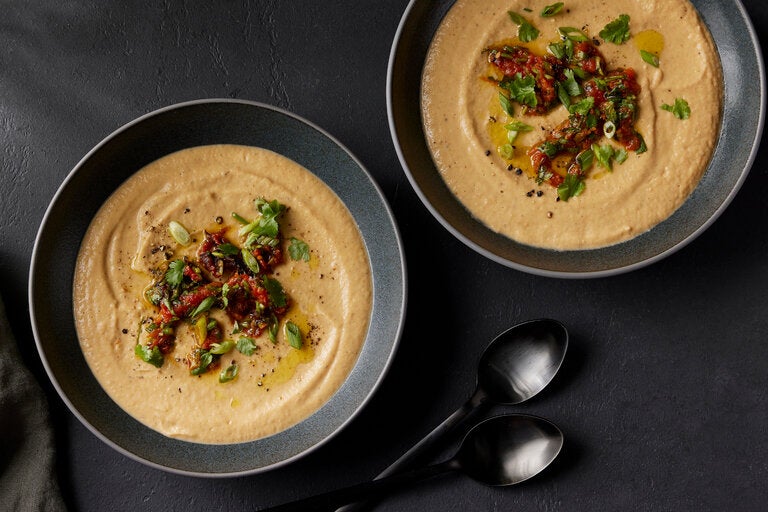
because we’re motoring back and forth in three short days (the weekend cut short by a work trip to houston for the one more apt to be running or riding these days), i’m keeping this short, and will leave you instead with two little morsels: a peek inside the little book that landed on my stoop the other night, and a soup i plan to make on one of the autumnal days next week when the critic is chowing down on texas barbecue. slow cooking is in sync with my slow, savoring ways. 

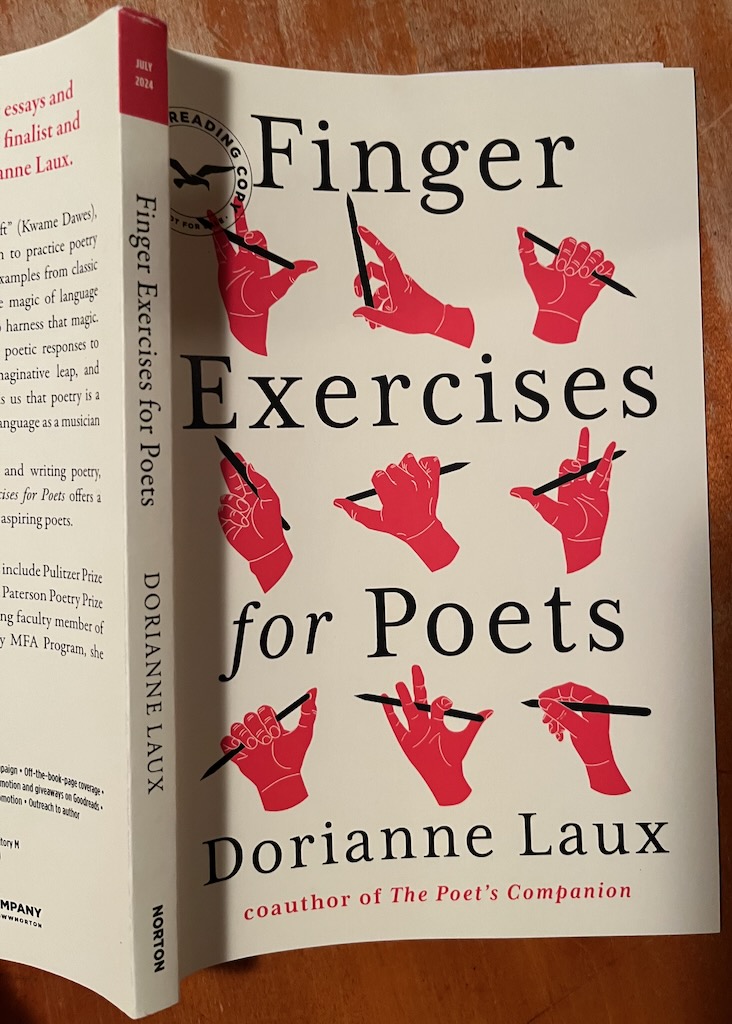
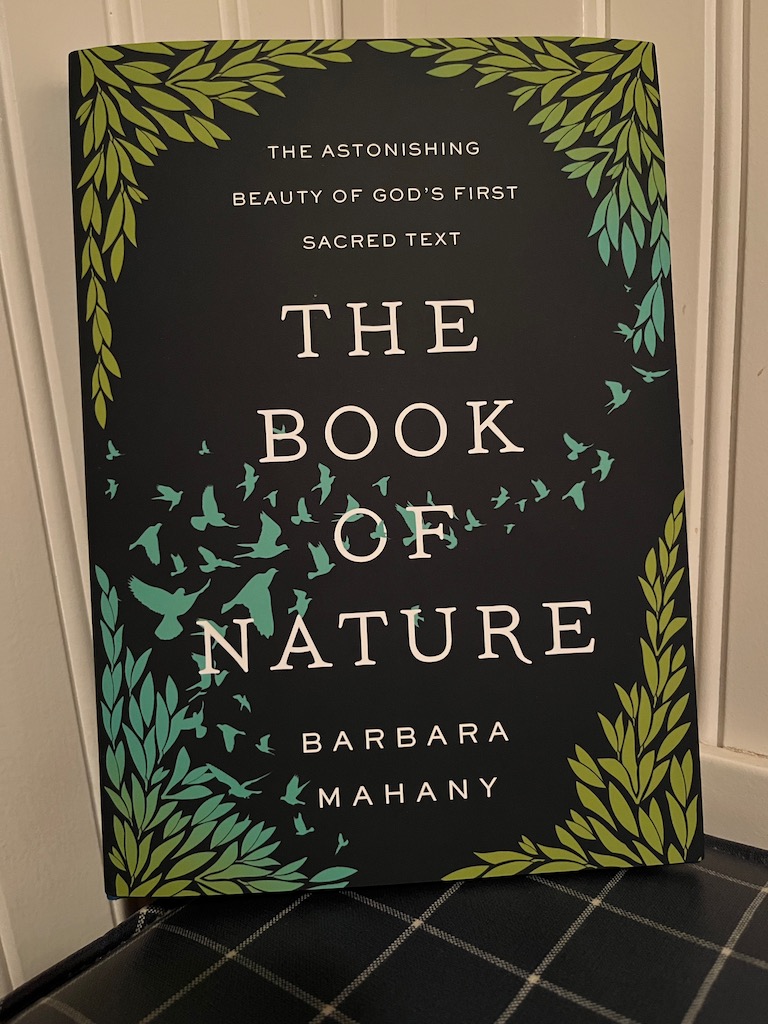
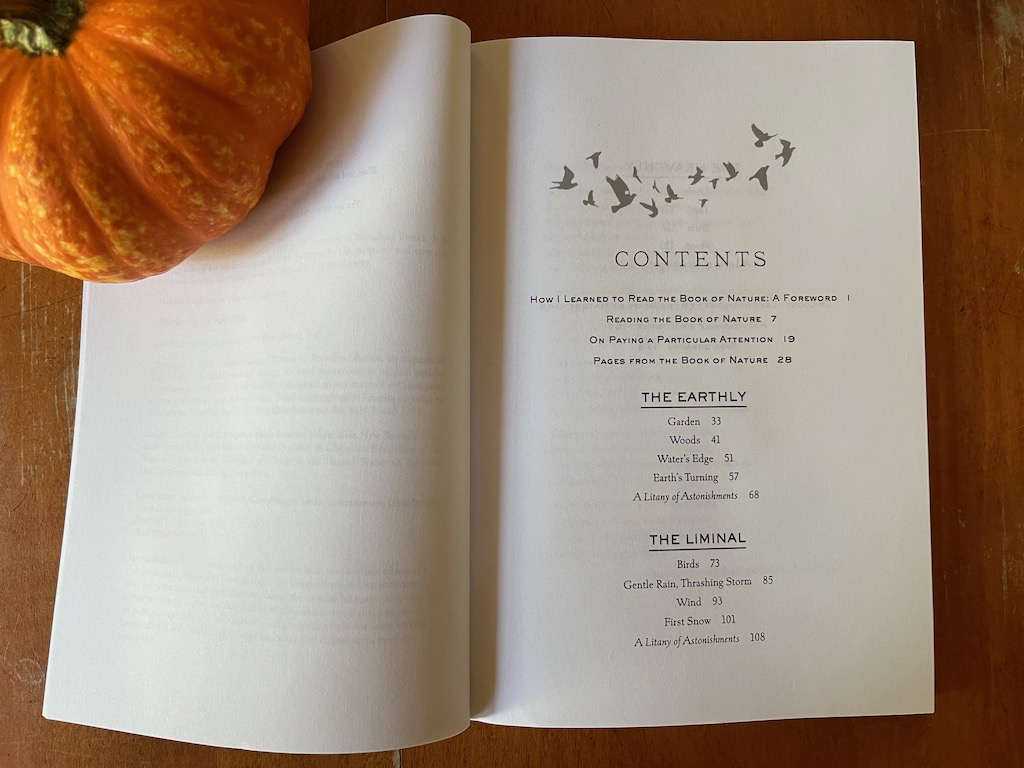
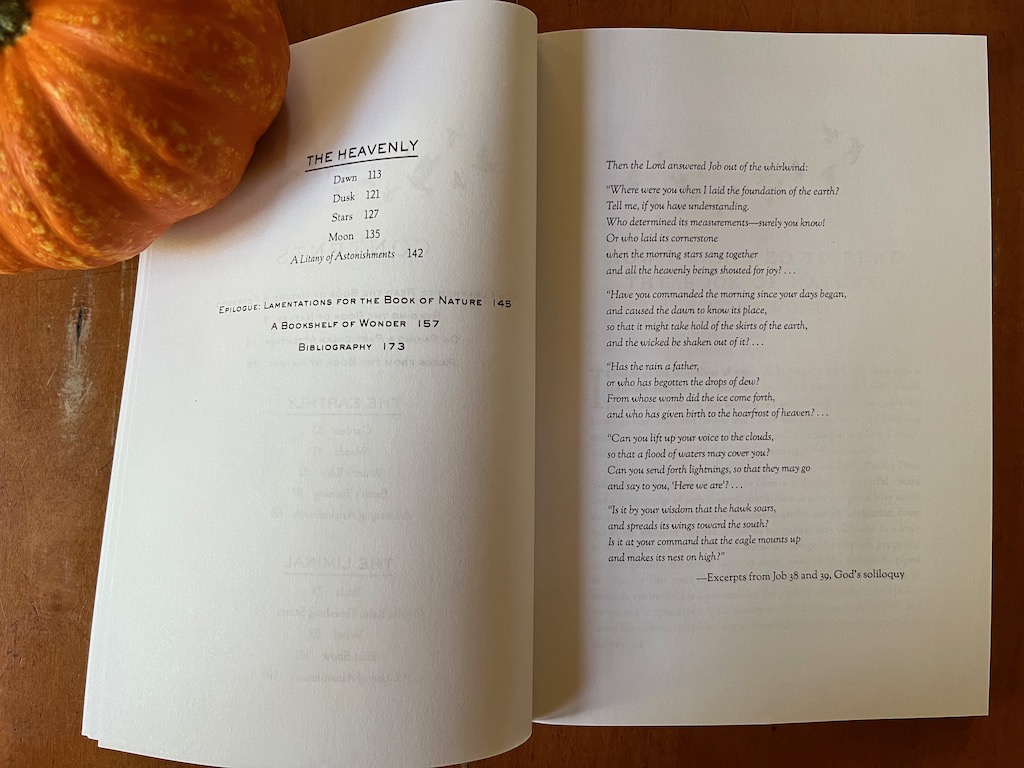
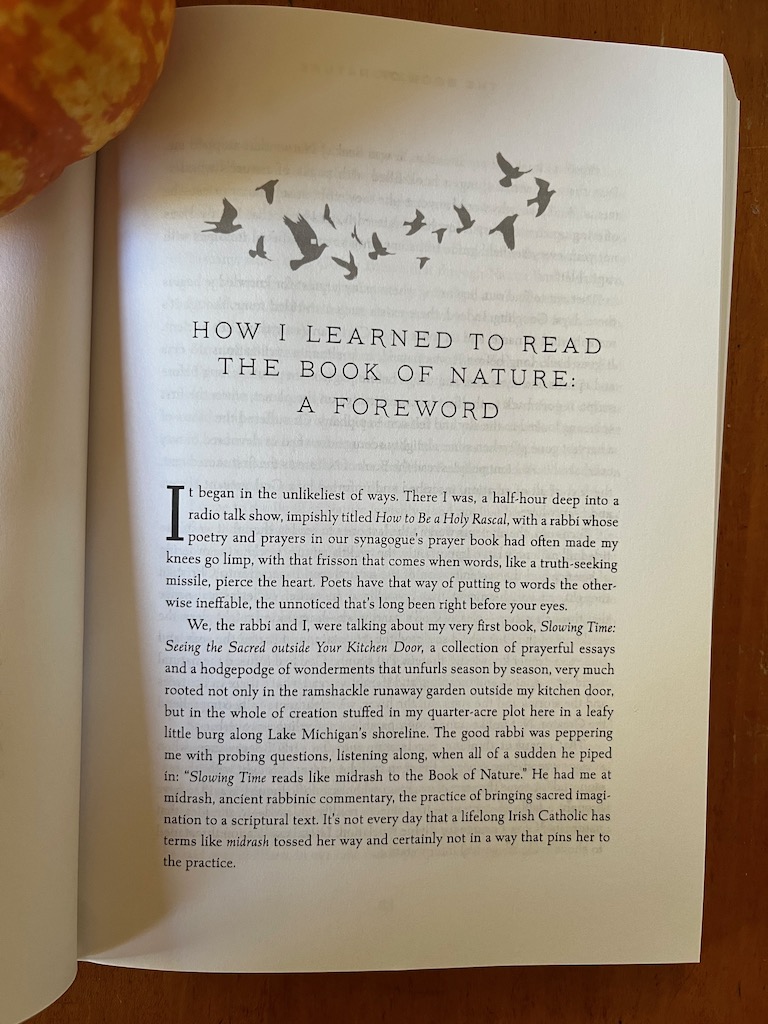
first, a peek at the Advanced Reading Copy of The Book of Nature, with a look at the cover, the table of contents, and the first page of the foreword.


photo by Bobbi Lin, NYT

Creamy Cauliflower Soup With Harissa Tomatoes
By Melissa Clark, The New York Times
Yield: 6 servings

INGREDIENTS
1 large head cauliflower (about 3 pounds), trimmed and cut into 1-inch florets (about 12 cups)
Kosher salt (such as Diamond Crystal) and freshly ground black pepper
1-1⁄4 teaspoons ground coriander
7 tablespoons extra-virgin olive oil, plus more for serving
1 small bunch thyme (about 10 sprigs)
1 pound plum tomatoes, halved, seeds scooped out
2 to 4 tablespoons harissa paste
3 large bunches scallions, whites and greens thinly sliced (about 21⁄2 cups)
1 jalapeño, seeded (if desired) and coarsely chopped
4 large garlic cloves, finely chopped
1-1⁄2 teaspoons ground cumin
1 tablespoon tomato paste
6 cups vegetable stock
3⁄4 cup chopped cilantro leaves and tender stems, plus more for optional garnish
1 lemon

PREPARATION
Step 1
Heat oven to 425 degrees and line 2 sheet pans with parchment paper.
Step 2
In a large bowl, combine cauliflower, 1 teaspoon salt, a large pinch of black pepper, 3⁄4 teaspoon ground coriander, 3 tablespoons oil and half the thyme sprigs, tossing everything until well coated. Spread the cauliflower evenly across one of the prepared pans.
Step 3
Using the same bowl (no need to wash it first), combine halved tomatoes, 1 to 2 tablespoons of harissa (depending on how spicy your harissa is; taste it first), 2 tablespoons olive oil, a large pinch of salt and the remaining thyme sprigs, and toss gently until the tomatoes are well coated. Spread tomatoes on the other baking sheet, cut-side up.
Step 4
Place both sheet pans in the oven and roast for 20 minutes, then stir the cauliflower but not the tomatoes. Continue to roast until cauliflower is golden brown and tender, 15 to 20 minutes longer (35 to 40 minutes total roasting time). Transfer cauliflower pan to a rack, and discard thyme sprigs.
Step 5
Using tongs, gently flip tomatoes over so their cut sides are down. Using the tongs, pinch off the tomato skins – they should slip right off – and discard. Brush 1 to 2 more tablespoons of harissa onto tomatoes and continue to roast until shriveled and condensed, about 15 to 25 minutes (35 to 45 minutes total roasting time).
Step 6
While tomatoes are roasting, make the soup: In a large pot, heat the remaining 2 tablespoons oil over medium. Add scallions (saving 1⁄4 cup scallions for serving) and jalapeño, and cook, stirring occasionally, until soft and lightly colored, 5 to 7 minutes. Stir in garlic and cook for 1 minute. Add another 1 1⁄2 teaspoons salt, black pepper to taste, cumin and tomato paste, and cook until tomato paste darkens and caramelizes, 2 to 3 minutes.
Step 7
Stir in roasted cauliflower and stock, and bring to a simmer. Cook, partly covered, over medium-low heat until all vegetables are very tender, 15 to 20 minutes. Turn off the heat. Using an immersion blender, purée the soup until smooth. (Alternatively, you can purée it in batches in a food processor or blender.)
Step 8
Transfer the roasted tomatoes into a mixing bowl and add cilantro. Using a Microplane or other fine grater, grate zest from about half the lemon into the bowl, then stir in 1⁄2 teaspoon coriander and reserved scallions.
Step 9
Using a fork or spoon, break up some of the tomatoes as you combine everything. Cut the lemon in half and squeeze a little into the tomatoes, then taste and add more salt and lemon juice as needed. It should taste well seasoned and a little tangy.
Step 10
To serve, squeeze in the juice from half the lemon. Taste and add salt, pepper and lemon if needed. Ladle soup into individual bowls and dollop harissa tomatoes on top; top with olive oil and more cilantro, if you like.

how do you savor the most succulent parts of your life? and do you, like me, find turning the page a bit of a tug and a pull?

the sodden state of summer’s back-to-school days . . .

it’s been getting heavier and heavier all week. my heart, that is. the boy i love—or one of ‘em anyway—is heading off again. one last time. to school, that is. we’ll be playing follow-the-leader, interstate-style, this weekend, when he pushes off with a trunk filled to the gills, and i follow not far behind with a wagon equally jammed. i’m enlisted only for my skill at hospital corners (a nurse’s way of tucking in bedsheets), and my knack for stuffing things in the teeny spaces that qualify as dorm-room closets. 

all week, amid a blur of other complications, i’ve felt my heart grow heavy with tears not yet spilled. the country roads the whole way home––just me and some fine book on tape––will make for a bucolic sponge for salt-water spillage. 

that boy is the best of company, that boy of the very big heart and the disposition best described as super chill, and ever animated. the boy fills this old house, and every heart in it.

so, once he’s left behind, back here at the homestead it’ll feel hollow once again till we get used to the long pauses of silence, till we get used to a room where the door isn’t sealed shut to hide the disarray inside. 

a wise someone once told me that if i thought high school blurred by in a blink, i’d find college blurred in half a blink. and so it is. eight years after dropping off his big brother one last time, it’s time for the caboose to part as well. this is it: the end of tuition checks and dorm vernacular, the end of considering time in back-to-school and semester allotments.

there’s perhaps a better chance that this one will find his way back home, to call sweet chicago the place where he belongs. but till then, nine months will trickle by. 

it’s the leave-taking that always bumps me up. the saying goodbye is not my strong suit. my trouble in that department dates back to when i was five and my papa got a big new job in a city far away, and every sunday night for the rest of a school year, he slid behind the wheel of his turquoise ford falcon and headed down the drive while i sat slumped on the concrete stoop there in the garage. i remember crying till my cheeks hurt. and going to bed with tummy aches. till he came home on friday nights.

nowadays i cry while spritzing the bathroom mirror, and when luring dust bunnies out from under the college kid’s bed, once he’s emptied it, once he’s faded into the faraway. then i try to find my way again, to find the joy in silence, in the slower pace with which the fridge and pantry empty, in the fewer loads of laundry. in that bathroom mirror that never splatters.

it’s come and go, all life long. and we’re wise to make the most of those blessed hyphens in between.

in the weeks ahead, i’ll be busy plotting my new cloister garden as a six-foot wall is being erected (straight through a chunk of what had been my garden, and hard up against our once-breezy screened-in summer porch) even as i type. i’m thinking of it as my monastery wall––the cedar barricade shutting out all the troubles of the world. but the thing i’ll miss most is the slant of sunlight at the twilight hour, as the great orb sinks low and the shafts of light get long and longer. it’s a golden glow that makes my summer porch seem gilded with celestial stardust. 

and because the last round of page proofs got delayed till next week, i’ll fill my quiet hours with the intense concentration those pages demand. and then it’s off to the printer as i await the day the box of books lands plop on my doorstoop. 


cook’s corner: here’s a truly nifty thing i bumped into this week (if meat lovers thrill to find a way to use every bit of the beast, from tongue to tail, then we who love the produce patch thrill just as mightily to find there’s more to the vine than just the fruits!). as one with a plethora of tangled vines, and one who sniffs deeply of my finger tips after plucking my daily tomato harvest, this enlightenment brings double the delight from those vines. and it’s all about the leaves…

How to Cook with Tomato Leaves

Tomato leaves contain 2-isobutlythiazole, a compound responsible for the plant’s distinctive aroma. Commercial tomato products, like ketchup, often include an isolated form of that compound to boost fresh tomato flavor.

If you have a garden full of tomatoes, though, you’ve got a great source of 2-isobutlythiazole right in your backyard. Here’s how to use tomato leaves to boost your sauce’s flavor.

1. When you harvest your tomatoes, pluck a handful of leaves from the plant.

2. Toss the leaves into the sauce and steep them for 10 minutes.

3. Remove and discard the leaves. 

Taste your sauce, and you’ll find that the tomato flavor has been both heightened and made more complex and earthy.


commonplacing:

from poet and pacifist William Stafford, found in his son Kim Stafford’s intimate portrait, Early Morning: Remembering My Father:
every day Stafford would write a page in his journal, his response to what he called “the emergency of being alive.” 

we are all of us deep in the emergency of our being alive…


a little bit of Buechner, in memory of the blessed man who died at 96 on monday. 

Frederick Buechner

a few years back, in 2016 to be precise, i counted a new collection of writings from theologian frederick buechner, with introduction by anne lamott, as one of the best books for the soul that year. his death this week made me pull that review from the shelf, and perhaps it’ll prompt you to pull a bit of buechner from your own bookshelf or that of your nearest library. 

Buechner 101: Essays and Sermons by Frederick Buechner

By Carl Frederick Buechner, Introduction by Anne Lamott, Frederick Buechner Center, 170 pages, $15.99

Maybe once a generation, once every few generations, someone is born with gifts literary and sacred, in equal brilliant measure. A translator, perhaps, of the highest calling. One who can at once lift our souls and our sights, by virtue of the rare alchemy of the poetic plus the profound. Therein lies the prophet. Therein lies Frederick Buechner, at 90, one of the greatest living American theologians and writers.

In these collected works, Buechner 101: Essays and Sermons by Frederick Buechner — a table of contents that includes excerpts from his Harvard Divinity School lectures, The Alphabet of Grace; a searing essay on his daughter’s anorexia; a seminary commencement address on the hard truths of pastoring a flock of believers, doubters and everyday sinners — we are introduced to, or immersed in, the depth and breadth of this rare thinker’s literary and soulful gifts. 

Anne Lamott, in her introduction, admits to being blown away by Buechner’s capacity “to be both plain and majestic” at once. She ranks him side-by-side C.S. Lewis, then declares, “No one has brought me closer to God than these two men.”

That alone might make you rush to pore over these pages. What I know is that this world sorely needs a prophet who reminds us to not give up our search for holiness amid the noise and hate and madness all around. Buechner, though, says it in words that work as poetry, shimmying through the cracks, burrowing deep within us, reverberating long after the page is turned. He writes: “We must learn to listen to the cock-crows and hammering and tick-tock of our lives for the holy and elusive word that is spoken to us out of their depths. It is the function of all great preaching, I think, and all great art, to sharpen our hearing precisely to that end.”

And it is that very sharpening that we find, paragraph upon paragraph, page after page, in Buechner 101


poet’s corner:

two poems worth pressing against your heart…

Field Guide

Once, in the cool blue middle of a lake,
up to my neck in that most precious element of all,

I found a pale-gray, curled-upwards pigeon feather
floating on the tension of the water

at the very instant when a dragonfly,
like a blue-green iridescent bobby pin,

hovered over it, then lit, and rested.
That’s all.

I mention this in the same way
that I fold the corner of a page

in certain library books,
so that the next reader will know

where to look for the good parts.

––Tony Hoagland

Moon

The moon is full tonight
an illustration for sheet music,
an image in Matthew Arnold
glimmering on the English Channel,
or a ghost over a smoldering battlefield
in one of the history plays.

 It’s as full as it was
in that poem by Coleridge
where he carries his year-old son
into the orchard behind the cottage
and turns the baby’s face to the sky
to see for the first time
the earth’s bright companion,
something amazing to make his crying seem small.

 And if you wanted to follow this example,
tonight would be the night
to carry some tiny creature outside
and introduce him to the moon.

And if your house has no child,
you can always gather into your arms
the sleeping infant of yourself,
as I have done tonight,
and carry him outdoors,
all limp in his tattered blanket,
making sure to steady his lolling head
with the palm of your hand.

And while the wind ruffles the pear trees
in the corner of the orchard
and dark roses wave against a stone wall,
you can turn him on your shoulder
and walk in circles on the lawn
drunk with the light.
You can lift him up into the sky,
your eyes nearly as wide as his,
as the moon climbs high into the night.

––Billy Collins


listening nook: because i’ll be coursing through the countryside in my red wagon this weekend, i’m bringing my reading nook on little discs. here’s the stack assembled from the library shelves:

A River Runs Through It, Norman Maclean: i once was graced to work alongside Norman’s son John, a fine fine bespectacled gent with a much quieter, more studious demeanor than many of the newsroom characters. his father’s masterwork  stands as one of the great “evocations of nature’s miracles…and a probing of human mysteries.”

The Abundance, Annie Dillard: a landmark collection from the writer i consider my north star.

Five by Fitzgerald, F. Scott Fitzgerald: i’m ever trying to expand and deepen my knowledge of the American canon and F. Scott deserves more of my attention. 

Dear Ann, Bobbie Ann Mason: mason, like me, is a kentucky native, so i feel it my native obligation to inhale her prose and her poetic ways of unspooling a story. i read my first bobbie ann mason so long ago, and it’s been ages since, so where better to reacquaint ourselves than the rolling countryside of the heartland we both call home?

Wallflower at the Orgy, Nora Ephron: ephron makes me laugh so hard i’d best keep an eye out for rest stops along the way. en route to one parents’ weekend, we listened to Heart Burn, her tale of woe from her years married to and divorcing from none other than journalistic legend Carl Bernstein. we loved listening so much we were sort of bummed we had to stop the car in ohio, where our kid was a freshman in college, and couldn’t roll along till, say, the atlantic seaboard, where we could have gotten a few more hours of ephron under our belts….


a bit more buechner, because there’s never enough:

“What we hunger for perhaps more than anything else 
is to be known in our full humanness, and yet that 
is often just what we also fear more than anything else. 
It is important to tell at least from time to time the secret of who we truly and fully are . . . because otherwise we run the risk of losing track of who we truly and fully are and little by little come to accept instead the highly edited version which we put forth in hope that the world will find it more acceptable than the real thing. It is important to tell our secrets too because it makes it easier . . . for other people to tell us a secret or two of their own . ”

Frederick Buechner

and with that, this week’s edition of the chair gazette is a wrap. question of the week: how will suck the succulence out of summer’s august sweetness?

college kid this week, on the brink of one last back-to-school.