pull up a chair

where wisdom gathers, poetry unfolds and divine light is sparked…

Category: life lessons

as one year sighs its last, and another stirs anew, wish upon a star and then some…

this blessed string of days we’ve called “a year,” is drawing now its last deep breaths. it’s almost time to begin again, or so we imagine in the geometry of the mind, a flatter-planed sphere that sees the year going round and round like vinyl spinning on a phonograph. ascension is not in the equation.

in the geometry of the soul, though, each new turn––we hope, we pray––is not mere spin, but spiral, ascension its sure distinction. it’s the ever-incremental accumulation of loft we’re after. loft attained, most often, the hard way. we stumble, skin our knees, hold our nose and hold our breath while the doctor jabs the needle. from year to year, there is, we hope, at least the humblest modicum of lessons learned. year by year, we aim for wiser.

and so in this year now waning to its close, its hardest lessons came in scans and calls not returned, in snubs and deaths that came too, too soon. but it brought too the sorts of hallelujahs that remind us that good patience, in time, brings resolution, brings peace, brings love come home. the long lost friend we found again. the one hard heart that finally softened, seemed to learn a whole new lexicon, the language of delight at last unfiltered.

i am letting all the lessons settle in, knowing they’re the elements of accumulating wisdom. one year to the next, wiser, gentler, quieter, deeper.

or so we pray.

and in this quiet space––this most delicious time of yuletide, the time beyond the noise, the shopping, the dishes scrubbed and put away––i am inviting the past year to wash over me, to sift through the sediment, to save the gems, rinse away the detritus.

i’m adopting my deep-breathing posture, the one that has me curled under blankets in my red-checked armchair, the fire crackling, the tree twinkling, my boys all ringed around me.

and i’m leaving here at the table two shimmering gems: one, something of a wish upon a star and the discovery that the star is us; and the other a truth of which i cannot be reminded too many times….

here’s the first…

azita ardakani, an iranian-born social activist and communications guru, wrote this “once upon a time” for maria popova’s the marginalian. it’s part poem, part lullaby, and part creation myth with a dash of astronomical science. it reads a bit like a children’s book, and, like all the best and deepest pages penned to a child, it ends in revelation: the true wonder that the star upon which we wish is, in fact, a little bit of us. we are our own wish come true. or, we can be, especially if we aim for spiral and not spin…

Once upon a time,
In a place far far away,
The darkness drifted.
The darkness knew no time.
Reaching for infinity, only knowing beyond.
One day in the web of inky forever, it asked itself, can I see you?
It waited, and waited, and then, answered, a star.
And then another, and another, and, another.
Another was where it began,
and as the star beings asked to be born to meet the darkness from which they came, one particular planet created water so it too could reflect the stars back to themselves.
The stars seeing their reflection were filled with joy and delight.
Curiosity was born in their light millions of years away.
One by one they made their way down, to touch the ocean, to see themselves.
The soil darkness watched with awe as the stars arrived,
A heart’s desire asked: Can I see you closer?
The water stars stretched onto the soil, and mixed into the clay, and became,
everything.
Yes you too, coyote who hears this, wise owl, mouse and rabbit, you too sleeping fawn, you too tree and root and seed, you too nested flight, and you too, sitting two legged.
Mixed from clay and star, flesh and life, a hollow canal opened so breath too could reach back to the darkness.
Missing the beginning, it exhaled a bridge, home.
The star water became everything we know, and you? The story of us?
Well, to experience the closest thing to the very beginning of star meeting water, we learned to create a small ocean inside of us, where it could all be felt, all over again.
Once upon a time, in a place far far away, the darkness drifted, and you drifted inside it.
You were the wish you once wished for.
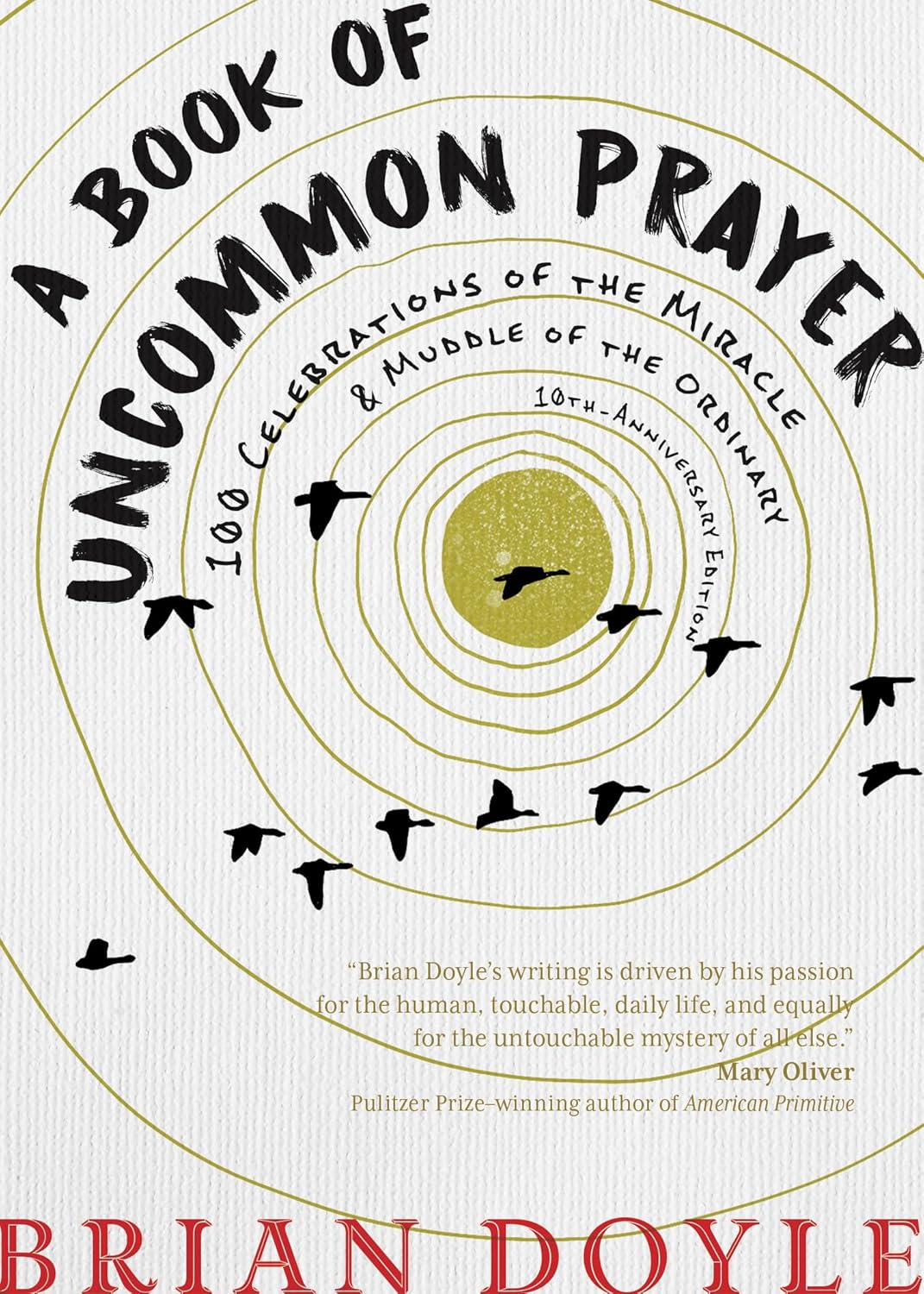

i count the late, great (astonishing) brian doyle among the favorite soul seers i have ever read. he finds words that burrow deep into the places in my soul that might never before have been struck or stirred. in his too-short time on earth, he saw wonder, plumbed wisdom in the unlikeliest of places. from prayers for cashiers and checkout counter folks, to prayers for robert louis stevenson on his birthday, and prayers for the greatest invention ever, the wicked hot shower, all found in his marvelous, marvelous, A Book of Uncommon Prayer: 100 Celebrations of the Miracle & Muddle of the Ordinary. these are the first lines of one with the magnificently brilliant title, “Furious Prayer for the Church I Love and Have Always Loved but Which Drives Me Insane with Its Fussy Fidgety Prim Tin-Eared Thirst for Control and Rules and Power and Money Rather Than the One Simple Thing the Founder Insisted On.” and it’s a fine fine note on which to both end and begin a year….

Granted, it’s a tough assignment, the original assignment. I get that. Love — Lord help us, could we not have been assigned something easier, like astrophysics or quantum mechanics? But no — love those you cannot love. Love those who are poor and broken and fouled and dirty and sick with sores. Love those who wish to strike you on both cheeks. Love the blowhard, the pompous ass, the arrogant liar. Find the Christ in each heart, even those. Preach the Gospel and only if necessary talk about it. Be the Word. It is easy to advise and pronounce and counsel and suggest and lecture; it is not so easy to do what must be done without sometimes shrieking. Bring love like a bright weapon against the dark… And so: amen.

bless us all. and may your new year bring you loft and leaven.

any wisdoms you acquired this year, with a story to share?

the chair is old enough to vote. . .

i’ve raised a blog, it seems, from birth to the verge of being grown-up. eighteen years: 12.12.06 it all began. 1,200 posts before today, so this––wondrously (to me, anyway)––is 1,201. at first i tended it, this conversation, this wondering aloud, this occasional epiphany, every weekday for a year, then chiseled it down to thrice a week. and then, yet again, i distilled it: once weekly––religiously every friday morn. here and there i’ve taken rare short breaks. a bit of summer breather once or twice.

and yet, kept on. and on and on. (sometimes wondering if maybe i should just be quiet.)

cycled through waves who’ve pulled up chairs in ebb and flow as of the tides. friends who’ve come to stay awhile, then shuffled off for one reason or another. at least a few i’ve deeply loved have died; angels still among us. some who’ve pulled up a chair have never ever strayed. here from the beginning, faithful as the day is long. bless them. bless and bless and bless them. 

i too have ebbed and flowed. waded into deep and deeper waters. shed old fears, grew courage. been puzzled. pondered. hatched new fears. wobbled. stumbled. inhaled courage again, again, and again. i’ve wondered and worried aloud. weathered aching heart, and phone calls and headlines that left me breathless. i’ve loved and loved some more. i intend to never stop. 

my school at first was all that unfolded under this old roof, where creaky twisting stairs and a nearly antique Garland stove––six burners, flattop, quasi-oven, a behemoth you’d find at any all-night diner––came to animate so many stories. it was my boys from whom i mostly learned and learned the most. and learned and learned again. and of course the holy earth and heavens high above: the gardens, the birds, the trees, the stars and moon, the dawn and dusk and nighttime’s inky darkness that never fail to draw me in. the book of nature, i’ve come to read, where lessons rise and fall season after season after season. i found a holy peace in this old house and the ramshackle plots where i kneel with trowel and soul wide open. i’d been chasing that peace for years. 

i seem to have stumbled into a new teacher these days, one i’d never thought could bring such knowing: it comes with darkness, yes, though i’m reminded that darkness is the embryonic space where stirrings first begin. and it’s nighttime’s darkest hour when stars most brightly shine. stripped of distraction, of the nettlesome sorts of things that blur our everyday, it denudes us to our barest essence. it’s cancer (even when i do not name it here it’s ever present in my rumblings, and has catapulted me to highest most-reverent attention). mine is an especially wily iteration, one that doesn’t follow rules. and brings me squarely into the land of uncertainty. where i, a girl who likes to know things, am finding out how not knowing whittles the knowing to one or two immutables: love is the force that triumphs over all; its alpha and omega, the God who dwells within. within me, and you. and even all the ones who make us want to scream and run for cover. 

here’s what i know 18 years in: there is nothing that love––true, deep love in all its iterations––cannot infuse. and in the infusing, molecules are stirred, shifted, and forms reshaped, dissolved, emboldened, made new. i’ve felt mountains move. i’ve felt fear melt away, like butter on hot biscuits. i’ve felt surrender––holy, holy “thy will be done.”

and a life well lived is one in which we love as unstintingly, as capaciously, as we might never have known possible. to live a life of loving is to scatter the few seeds that might blossom in our wake, that might rise in the seasons beyond us. it is the deepest mark i hope and pray to leave: to know my heart, my soul, has found a way in, forever in, to those whose lives i might have touched. 

it all becomes so spare, so simple, in the end. when you realize your days––for as long as they stretch––are your one rare turn to hone the art of loving, as it is meant to be. as it is meant to make the holy difference. to trace the path from here to heaven. 

that’s some of what i’m thinking eighteen sweet years in.

and now, because the older i get the more i glean from the wisdom of those who’ve left their trace, here’s my birthday bouquet to ponder for the day, the week, the hour…an indelible quote, a poem to make you laugh, and one to maybe melt you….

first, a quote from the french philosopher and playwright gabriel marcel, from the mystery of being:

“You know you have loved someone when you have glimpsed in them that which is too beautiful to die.”


a poem that might make you laugh, and certainly leave you with a smile:

Emily Dickinson at the Poetry Slam
BY DAN VERA

I will tell you why she rarely ventured from her house. 
It happened like this:

One day she took the train to Boston,
made her way to the darkened room,
put her name down in cursive script
and waited her turn. 

When they read her name aloud
she made her way to the stage
straightened the papers in her hands —
pages and envelopes, the backs of grocery bills,
she closed her eyes for a minute,
took a breath, 
and began. 

From her mouth perfect words exploded,
intact formulas of light and darkness.
She dared to rhyme with words like cochineal
and described the skies like diadem. 
Obscurely worded incantations filled the room
with an alchemy that made the very molecules quake.

The solitary words she handled
in her upstairs room with keen precision
came rumbling out to make the electric lights flicker.

40 members of the audience 
were treated for hypertension.
20 year old dark haired beauties found their heads
had turned a Moses White.

Her second poem erased the memory of every cellphone
in the nightclub,
and by the fourth line of the sixth verse
the grandmother in the upstairs apartment 
had been cured of her rheumatism. 

The papers reported the power outages. 
The area hospitals taxed their emergency generators
and sirens were heard to wail through the night.

Quietly she made her way to the exit,
walked to the terminal and rode back to Amherst. 

She never left her room again
and never read such syllables aloud. 


and finally, a christmas poem that just might melt you, as it melted me. . . 

Kenosis
by Luci Shaw

In sleep his infant mouth works in and out.
He is so new, his silk skin has not yet
been roughed by plane and wooden beam
nor, so far, has he had to deal with human doubt.
He is in a dream of nipple found,
of blue-white milk, of curving skin
and, pulsing in his ear, the inner throb
of a warm heart’s repeated sound.
His only memories float from fluid space.
So new he has not pounded nails, hung a door
broken bread, felt rebuff, bent to the lash,
wept for the sad heart of the human race.

thank you, with all my heart, for pulling up a chair, be it only for awhile, or for some or all these years. i am holding especially close against my heart this morning ginny, my once closest reader (my beloved mother in law who was quick to call if she liked what she’d read, and deafeningly silent if she did not!), mary ellen, and ceci, who waft over my shoulder, angels to my every day….and especially to my boys, who animate each and every pulse of my heart and every breath i breathe….(and certainly to will, who got this whole thing started, when he insisted i could do it, and built the website to make it happen….)  xoxo love, bam

how did you find the chair?

the equinox of scan time: equal parts shadow and light

you start to wonder. which is another name for worry. for most of the last five months, i’ve worked at pushing it off to the edge of the frame. to keep it out of my focus. but october is coming. and with it, the next scan. the next clear-eyed peek into my insides, into my lungs, to see if anything’s lurking that oughtn’t be. 

i’ve mused about the saintly side of scan time. how it’s akin to memento mori, the ancient and holy practice of remembering our death so that we maximally live our one swift shot at this astonishing life. 

but the other side of scan time is the deeply human side. the wake-me-up-in-the-night, the try-not-to-worry-that-the-pain-in-my-ribs-is-anything-scary side. 

i feel it rumbling around the edges. the what-ifs i bat down as if a pesky mosquito that won’t leave me alone. i try not to tumble down the shadowy mole hole of imagining a call to my boys, letting them know i need another round of surgery. i try to quash the dialogue that runs through my head, my doctor’s voice telling me there’s something in the scan that looks worrisome, that needs more poking around. i try not to let cancer be the ice to my spine. 

i try not to cry.

but sometimes i get scared.

i am, always, bumpily, raggedly, very much human.

i’m still new to the tidal ebb and flow of scan time. and the scan now rising on the horizon’s edge is only my third since surgery, since they took out a chunk of my lung, since they found an uncommon cancer that sometimes decides to shuffle around in the lungs, settle in where it wasn’t before. what i’m finding here in the precinct of scan time is that when i near the one-month-to-go mark, the palpable fear comes. 

maybe each round i’ll get a little bit less wobbly (though, having lived with myself and my keen imagination for all of these years now, i tend to doubt that). maybe i won’t be tempted to imagine the worst. 

but the flip side, the smarter side, even now, even at the less-than-three-weeks-to-go mark, is that the hovering worry makes me sink deeper and deeper into the now. “today is a day when i don’t know anything’s wrong yet,” i sometimes hear myself saying. i suppose there are healthier ways to frame the day (for instance, omitting the “yet”), but once the doctor stamps the C word onto your chart, once it follows you pretty much wherever you go, it gets decidedly hard to unshackle yourself from being afraid.

remember, i’m bumpily, raggedly, very much human.

which is why a necessary ingredient on this bumpy, pock-riddled road is to enlist a battalion of comrades. some are fellow travelers i know up close and personal. a few are glorious souls i only know through their words, words they beam to me as if telepathic lifelines to put oomph where i’m lacking. 

whether they’re friends whose numbers i could find in my phone, or soulmates by circumstance, they’re all someones who know by heart how it is to live in the penumbra of cancer. what i find utterly indispensible about each and every one of them is that they put words to the rumblings i’d otherwise keep under lock and key. 

and when you hear the worst of your worries, the very words you’ve not yet dared to utter aloud, come out of a mouth that’s not yours, there comes an incomparable sigh, a sheer and certain relief to find you are hardly alone. and deep in communion, even if it’s a union to which you wish you didn’t belong.

one of my incomparable comrades is suleika jaouad, the best-selling author of between two kingdoms: a memoir of a life interrupted, the new york times writer of the “life interrupted” column, and every week in my inbox, the author of “the isolation journals,” her unfolding and intimate chronicle of her rare leukemia and relapse and bone marrow transplant. she’s one of the ones whose wisdom and courage i lean on. she infuses me. and, often, she steadies me. 

just the other day, after a weeks-long silence that signaled something amiss, suleika, who indeed has suffered yet another relapse and is back to chemotherapy, mused about radical acceptance.

she wrote:

That’s not to say I don’t feel fear—of course, I do. But strangely, the anticipation of pain can be far scarier than just being in it, actually confronting it. After my first transplant, in the years when I was cancer-free, I felt hijacked by the prospect of a recurrence and afraid that I wouldn’t be able to handle it. When it actually happened, I faced it. Knowing that, I have been trying to practice a kind of radical acceptance of whatever comes up, responding with whatever the situation calls for.

Take last weekend, for example. On Saturday, I had to go in for my last infusion of my second round of chemo. The side effects compound day-to-day, and afterward I felt awful, and I knew I’d be spending the day in bed. It had been a rainy morning, but on my way home, the sky began to clear, and I beheld a spectacular rainbow. For a moment, I glimpsed a sense of wonder. When I got to my room, I said to myself, “If I have to be in bed all day, so be it. What can I do to make this a little less miserable?” I took some anti-nausea meds and got a big glass of water. I put on my favorite face oil, wrapped myself a heating pad, gathered my pups around me, and queued up some favorite old movies to watch. Did I still feel awful? Yes. But instead of fighting it, or lamenting all of the things I wouldn’t be able to accomplish that day, I accepted it. And it turned out that staying in bed all day felt almost luxurious.

she speaks such truth. and then she somehow wraps it in what feels like a velvet blanket, somehow makes even a day in the sickbed sound a bit like a day at the spa. no wonder suleika is someone whose hand i would reach for on the darkest and scariest of days.

even though she wouldn’t know me if i bumped into her in the revolving door of sloan-kettering (a hospital entrance both of us have spun through) i wrote her right away to thank her for planting seeds of courage that some day might be my ballast. and i seized on her phrase, “radical acceptance,” to try to put it to practice. to not let my fears escape from the barnyard. to not be hijacked by fear, but to stare it square on, and to remind myself that time and again in my fair little life, i’ve steadied my knees and my spine in the fulcrum of whatever would have been my worst fear. i’ve always been braver than i’d ever imagined. i think we all are.

another one of my unparalleled big-hearted compatriot warriors who speaks to my deepest-down soul is the spoken-word poet and queer activist andrea gibson, diagnosed with ovarian cancer in 2021 and a recurrence last spring. i can’t count the times she’s sprung me to tears. tears of recognition. of stripped-naked truths. of beauty so rare and so fine i sometimes imagine she dwells with celestial beings. 

here’s a line from one of her poems that stiffened my spine and reminded me to steady my ways:

My worst fear come true. But stay with me y’all-
because my story is one about happiness
being easier to find once we finally realize
we do not have forever to find it. 

we do not have forever to find it…

i play their words over and over, as if a broken record, hoping and hoping that with each spin of needle to groove, i might finally inscribe their wisdom, their wonder, their truth, onto my heart. or at least find a strong steady hand to hold while i aim there….

what steadies you when you’re afraid?

summer idyll: another name for “idle”

summertime is for slow. and slow i am this summer. i watch bunnies make breakfast buffet of my flowerpots. i keep vigil for a redbud tree that might be on its death march. i cut corn off the cob and dump it into confetti-like salads, delicious salads of tomato, armenian cucumber, and fists full of basil. i swim, slowly and gasping for air at the end of the lanes, in a pool where i am the youngest by a few decades.

and of course i read, an exercise that requires little other than the moving of one’s pupils, the occasional blink, and the turning of pages should one resort to that quaint document, the page.

and so it was in reading this week that those pupils of mine––and the braincells behind them––paused for deep consideration when i came across a commencement address by the late great russian poet and essayist joseph brodsky.

joseph brodsky

in the summer of 1989, two years after he won the nobel prize in literature and two decades after he fled the soviet dictatorship with the help of w.h. auden, brodsky stepped to the podium at dartmouth college to give the commencement address, later published in a posthumous collection titled, “on grief and reason: essays” (farrar, straus and giroux, 1997).

the topic he chose, curiously, was boredom. but brodsky being brodsky, he soared with it. and because i found it altogether mesmerizing, and because his closing passage stuck with me in what amounts to the cerebral iteration of gum to the bottom of your sneakers, i’m bringing it here to the old make-believe maple table.

what’s true, in these months of living fully awake to the ephemerality of time, is that i soak in especially the wisdoms of those who understand that fleetingness to be central to the sanctifying of time’s each and every parcel. to understand that time is not endless, but rather bracketed and with certain end, is for me anyway the gravitational force that drives my attention out of malaise and into full-on savor.

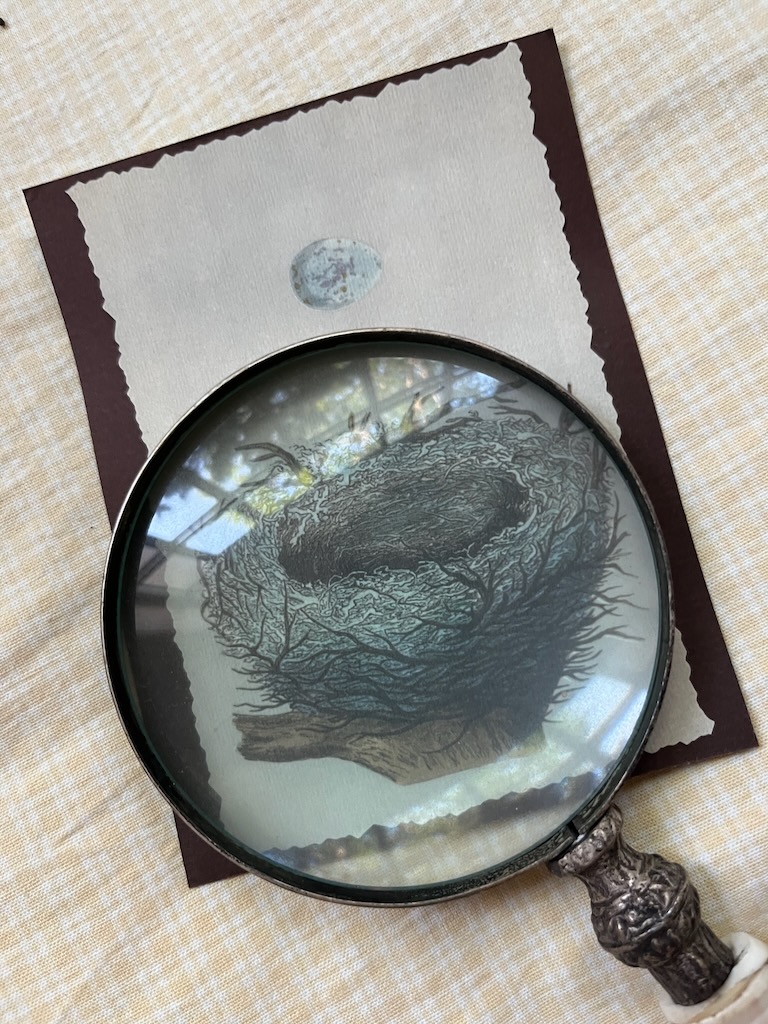
i hold each grain of time, as often as i pause and catch myself, up to the incandescent luminescence that reveals and magnifies its wonder. in other words, i aim to live with one of these in my back pocket, gliding time beneath my ever-ready looking glass:

here then is where brodsky begins his deep-dive into boredom, as he looked out upon a sea of soon-to-be-graduates at that ivy-covered college in new hampshire’s piney countryside (i’d endorse reading clear through these next few grafs, but if you’re pressed for time, leap down to the bottom of read to see if you, too, are struck by brodsky’s likening our time here to a ride on a runaway train, and his admonition to seize each blessed frame as it’s passing by):

Known under several aliases – anguish, ennui, tedium, doldrums, humdrum, the blahs, apathy, listlessness, stolidity, lethargy, languor, acedia, etc. – boredom is a complex phenomenon and by large a product of repetition. It would seem, then, that the best remedy against it would be constant inventiveness and originality. That is what you, young and newfangled, would hope for. Alas, life won’t supply you with that option, for life’s main medium is precisely repetition.

[…]

In a manner of speaking, boredom is your window on time, on those properties of it one tends to ignore to the likely peril of one’s mental equilibrium. In short, it is your window on time’s infinity, which is to say, on your insignificance in it. That’s what accounts, perhaps, for one’s dread of lonely, torpid evenings, for the fascination with which one watches sometimes a fleck of dust swirls in a sunbeam, and somewhere a clock tick-tocks, the day is hot, and your willpower is at zero.

Once this window opens, don’t try to shut it; on the contrary, throw it wide open. For boredom speakes the language of time, and it is to teach you the most valuable lesson in your life – the one you didn’t get here, on these green lawns – the lesson of your utter insignificance. It is valuable to you, as well as to those you are to rub shoulders with. “You are finite,” time tells you in a voice of boredom, “and whatever you do is, from my point of view, futile.” As music to your ears, this, of course, may not count; yet the sense of futility, of limited significance even of your best, most ardent actions is better than the illusion of their consequences and the attendant self-aggrandizement.

For boredom is an invasion of time into your set of values. It puts your existence into its perspective, the net result of which is precision and humility. The former, it must be noted, breeds the latter. The more you learn about your own size, the more humble and the more compassionate you become to your likes, to that dust swirls in a sunbeam or already immobile atop your table. Ah, how much life went into those fleck! Not from your point of view but from theirs. You are to them what time is to you; that’s why they look so small. And do you know what the dust says when it’s being wiped off the table?

“Remember me,”
whispers the dust.

Nothing could be farther away from the mental agenda of any of you, young and newfangled, than the sentiment expressed in this two-liner of the German poet Peter Huchel, now dead.

brodsky closes his address with the words that first caught my eye this week, and that i––once again––will aim to not forget:

[…]

What lies ahead is a remarkable but wearisome journey [on a] runaway train. No one can tell you what lies ahead, least of all those who remain behind. One thing, however, they can assure you of is that it’s not a round trip. Try, therefore, to derive some comfort form the notion that no matter how unpalatable this or that station may turn out to be, the train doesn’t stop there for good. Therefore, you are never stuck — not even when you feel you are; for this place today becomes your past… receding for you, for that train is in constant motion. It will be receding for you even when you feel that you are stuck. So… look at it with all the tenderness you can muster, for you are looking at your past.

i reached for that confetti salad glamour shot above because it was a bit more visual than trying to find an image of boredom. it was perhaps the most delicious thing i made this week (the grilled salmon that arrived with the salad was mighty good, but i did nothing other than introduce it to the heat of the grill), and if you’re now hungry, here’s the recipe, courtesy of david lebovitz, a former pastry chef from chez panisse now a cookbook writer living in paris. lucky david.

fresh corn, tomato, cucumber, avocado, basil summer salad

2-3 ears of fresh corn
2 cups (350g) cherry tomatoes , (or 2 cups fresh tomatoes, diced)
1 ripe avocado
1/2 cucumber, peeled and seeded
1 cup (75g) loosely packed chopped fresh basil, (reserve any small leaves for garnish) Freshly ground black pepper
Vinaigrette
2 tablespoons red wine vinegar
4 teaspoons Dijon mustard
1-2 small shallots, peeled and minced (1-2 tablespoons)
1 teaspoon sea or kosher salt
6 tablespoons (90ml) extra-virgin olive oil

  1. Shuck the corn and remove it from the cob.
  2. Remove any stems and slice the cherry tomatoes in half.
  3. Peel the avocado, remove the pit, and dice the flesh. Cut the cucumber into similar sized cubes.
  4. Put the corn kernels, tomatoes, avocado, cucumber, and basil into a serving bowl and season with freshly ground black pepper.
  5. In a small bowl, whisk together the vinegar, mustard, shallots, salt, and olive oil. Pour the vinaigrette dressing over the salad and gently mix together. Taste, and add more salt and pepper if necessary.

Serving and storage: The dressed salad can be served right away or in a few hours. (It can be stored in the refrigerator or at room temperature, but should be served room temperature.) It’s best the same day it’s made.

your thoughts on the runaway train (above) welcome here, with the related question, what are the ways you remind yourself to live each day mindful of the preciousness and miracle that it holds?

a narrative twist and the wisdoms that come in its wake

when last we pulled up a chair, we were a gladsome foursome giddily gadding about the eternal city. unbeknownst to us, a fifth was among us. a red-ringed hanger-on who might have climbed aboard on the plane that flew through the night. or perhaps in the crowds in one art-ringed room or another.

but by nightfall one friday ago, a mere four days into our roman romp, one among us was lying flat on his back when he plaintively asked, “could you feel my head?” and suddenly the tiniest of sniffles i’d been hearing for the past two days, and the uncharacteristic naps that were beckoned mid-morning and again mid-afternoon snapped into sense, and a not-so-subtle hypothesis bolted into my brain: “this couldn’t be covid, could it?!?”

and with that, lickety split, i leapt out the door and wiggled my way through ancient streets and crowds thick with myriad tongues. i found myself a farmacia and in the clearest italian i knew, asked, “covid test?” the farmacista knew too. it seems the red-ringed word is universally understood. she handed me the prova covid, i handed her euros, and off i flew.

didn’t take more than a minute for that dreaded double line to flash into sight. bright purple it was, as my pictures of rome in quartet whirled down the drain. we had among us a covid-plagued fellow, the very one who had spent weeks and weeks planning and plotting. signing us up for this tour and that. and now, the poor chap was confined to a room at the back of the Airbnb, and i was moved to the couch.

i felt my heart crack.

i pictured a big pink eraser descend from above, dashing our roman holiday and turning our fine little appartamento into a quarantined clinica covid. i feared, right away, that the dastardly viral intruder would tear us asunder. that i, too, would be felled. and then boy 1 and boy 2.

i reached for my phone and dashed off a text to my beloved american doctor. as the sun set in rome, it was just reaching its midday peak in the states, so, lo and behold, she swiftly wrote back. told us they’re basically treating covid as a head cold these days, and that 24 hours after the fever broke or symptoms abated, our chief travel guide would enter the five-day mask-and-distance phase. and the rest of us should hope for the best.

without delay, the ailing one and i both reached for our phones to alert the dear friends with whom we’d shared the previous evening of rooftop aperitifs and a long and lovely roman dinner. and, belly flip-flopping all the while, i texted the sorry update to our boys, who’d gone out with a professorly friend for pastas and spritzes and whatever else might unfold on a friday night in glorious rome when you’re young and with nary a care.

i couldn’t sleep. so i lay there on my couch till the wee hours, listening for the boys’ signature voices and the clomp of their feet on the stone-cobbled street down below. when in they wandered, i confirmed that they’d seen the bum news spelled out on their phones. and we figured the weekend engagements — a guided tour of the colosseum and forum, as well as a lazy sunday lunch on our friends’ rooftop terrace (which had been the imagined highlight of the trip to little old me) — had gone up in vatican smoke.

but here’s where the story once again takes a turn, rises into the allegorical, and makes of one player a hero: assuming the boys would never in a million years awake for an early-morning architectural tour of ancient roman ruins, i’d already scratched the colosseum and forum off the list. so wasn’t i proven to be the fool when, with an hour to spare before the already-paid-for tour, the bedroom door cracked open and out strolled a towel-clad gent on his way to the shower. as he sauntered sleepily past me, he uttered only three words that soon set the tone for the day and all those that followed: “when in rome. . .”

and so we were off. if he, a boy who’d slept a mere few hours, could pull himself off the pillow to make good on his papa’s pre-ordained plot for the day, certainly boy No. 1 could follow, and i — who had originally declined a tour of what i referred to as “the ancient blood bath” and imagined instead a leisurely morning alone — could step into gear. turned out we missed the guided part of the tour, but we managed to get into the old ruin and carried on the self-guided way. all that walking and gawking made us hungry, so kid No. 2 called time-out and guided us through the meandering streets to an osteria that he’d been told had the very best food in all of roma (and it certainly did)*. and then, bellies full and sunscreen slathered, we climbed to the tippy top of the palatine gardens, and all of rome lay majestically, magnificently sprawled out before us.

the boy’s simple instructive “when in rome. . .” is the essence of carpe diem, the code by which he not only lives but inspires. he’s a mere 22, a kid born just before 9/11, a kid whose years have been punctuated by the horrors of parkland and sandy hook, a kid who cowered inside our cambridge apartment the terrible week of the boston marathon bombing when we could watch the police helicopters whirring in the sky just out our windows, a kid who went to college during covid and got sent home for half a semester to watch pre-recorded lectures on the laptop perched on the covers of his boyhood bed.

he’s emerged with an unshakeable knowing that life comes around but once, and you’d better seize it while you can. because there’s no cinch on tomorrow. which pretty much is the truth it’s taken me decades — and a medical scare of whopping proportion — to figure out.

we talked plenty (be it discoursing eternal verities or swapping silly serendipities) as we wound through the ancient streets of rome (his hand always reaching for mine, to make sure i didn’t wobble or fall), as he insisted we mosey down the block to the corner watering hole for spritzes at dusk, as he and his brother led us hither and yon to the best eats in the city. and his ironclad creed is that life is to be lived to the fullest.

my number one teacher in rome was the kid who grew in my womb long after the doctors insisted there’d never be another; an odds-breaker ever since, a kid who dwells in the joy of exclamation. and his lesson is one i’ll not tuck away on a shelf now that we’re home. nor ever.

it’s a beautiful and glorious thing when the teacher appears in the form of a kid who serves up his lessons with spritzes and leads you through rome on a quest for flavors you’ll never forget.

bless you, and thank you, dear T.


post script: our covid-afflicted fellow made it through mostly unscathed, and is now back among the unmasked. once his fever broke, and 24 hours had passed, he made the most of his unfettered hours to stand and absorb the architectural wonders of rome for as long as his big ol’ heart desired. none of the rest of us ever tested positive. though we missed the rooftop lazy sunday lunch of our dreams, we now have reason and incentive to return. i brought a good chunk of rome home in my heart.

me and my boys, ala sunset spritz

what wisdoms have come your way in the wake of a narrative twist?

*in case you find yourself in the eternal city any time soon, the best food we inhaled in rome was at the little osteria il bocconcino, just up the hill and around a few bends from the colosseum. if you ask the boys, there are multiple other contenders as well. every bite, in a word, was sublime.

solitary vigil

hospital breakfast tray: one year ago

there are days we mark in silence, days best kept in solitude, in the quiet deep down places where only we can trace the contours of the shadow, the weight of how they’ve changed us, cleared the lens through which we see.

they’re the days that have left their mark on us, indelibly. the days in our lifetime that will forever inscribe the demarcation, time divided starkly––before and ever after. 

one by one, or one alone, they’re the days, the dates, the hours that constitute our subterrain, the strata by which our soul is shaped and stretched and textured. it’s the timeline that draws us into depths, to keener understanding of what it means to be alive. or our life, anyway.

it might be a death or disfigurement. it might be birth, or betrothal. a beginning or an end. most often, both at once. to close one chapter is, by definition, to open the next. and while some of those days are duly announced, and bracketed with anything from helium balloons to holding our breath, it might be the weightier ones––the ones whose mark is most unexpungable––best kept in solitary vigil.

it is in the profound spaciousness of unspoken thoughts that we find the room to grope for consequence, that we fumble toward those few faint stirrings that draw us closer and closer to what becomes our truth. we can’t really find our way without the grace of our aloneness, the room where knowing comes. in the beginning and the end, we tread the thin-bare thread of life with but our God to take us by the hand. or so i believe.

and here’s a truth: by the time we’ve hobbled through a few decades (or less or more, depending on our lot), we all accumulate those days. the days whose dates we don’t forget. the day we met our one true love. the long night of our first miscarriage. the house fire that chased us out. the last look into someone’s eyes. the first time the doctor put breath to the word cancer, and quickly added how surprised he was they’d found it deep inside us. 

we keep those days in cloak of silence because we are sifting still through all the ways they’ve reconfigured who we know ourselves to be, and how we move through time. 

yesterday was one such day for me. one year since i awoke on a gurney, my surgeon by my side. i shudder  now to remember it, though at the time i didn’t shudder at all. i was brave that day. it hadn’t sunk in so deeply yet. ever since, and all year long, i’ve had glimpses both of bravery and brokenness. i’ve cried buckets and, then, i’ve set my shoulders firm; i’ve faced the worst of my fears with unflinching questions, endless hours reading, and airplane rides to doctors i wish i’d never needed to know. i’ve slowly, slowly, tried to imagine adding numbers to my years. 

april 18 is a date i’ve uttered umpteen times in the last year. date of surgery: date of diagnosis. date of new beginning. date of counting time with deeper intention and attention. 

maybe the date will dim, as i move on from it. as 2024 fades to 2025 and . . . (and hallelujah for the 4 that now sits firmly where the 3 began.) a year ago today was the first time i saw my life measured in the span best known as five-year-survival rate, the chance you’ll be around five years hence. believe you me, it’s a bracing thing to count forward and hope and pray you cross the line to––bing! bing! bing! your magic number is….––04.18.28. the date now yours with odds attached. 

i’m going for broke here, and placing bets. but that’s only because at this very moment what swells in me is hope. quick as the clouds scuttle across an april sky, i might flinch, get scared, and pull my money from the table. 

my point is simply to say that there are days that define who we are, and we keep those days in silent vigil, wrap those days in certain grace. and we pray to God we come out the other side, with lessons learned and underscored, as we reach and reach toward that one repeating prayer: dear Holy Gracious God, let me make of this one most sacred day every iota of blessing that is mine––and yours––to give. 

some mornings are so much clumsier than others; this is a clumsy one, but my vow to try–even when i mostly miss–is one i take to heart. to write raw is its own peculiar dare. but here’s the why: because every fleeting while you just might catch a dust mote of life as you know it. and thus i will keep swatting at the passing motes, in hopes of putting words to those ineffable pieces of the puzzle. because we are all bumbling along together here, and in good company we find light and air.

as you look back across the plane of your life, are there days you’ve not forgotten, days you note alone and without mention, because you know how lastingly they’ve marked you? and that’s a questions whose answer you needn’t give voice to here. but just a prompt.

the quarryings of time

my hair is gray. my left shoulder is frozen. my right middle finger locks most mornings. and half of one of my lungs is no longer. 

there’s more (darn that paralyzed vocal cord), but the dirge needn’t drone on. the point is i’ve been quarried by time. which is close to the way annie dillard, my polestar and patron saint of seeing, put it in a passage i read –– and couldn’t forget –– this week. 

on page 238 of pilgrim at tinker creek, my bible of the woods, annie D. turns her otherworldly attentions to living creatures in various states of disarray: spiders with only six or seven of eight species-imperative legs; grasshoppers missing antennae; butterflies whose wings are torn; a swallowtailed sparrow minus its tail. and, yet, and yet, they creep and leap and flutter and glide on anyway. nature is not daunted by its disassembling. 

nor should we be. 

when it comes to us humans –– the species with the power to wonder, to question, to connect the occasional dots –– each quarrying carries its own volume, its own mysteries and humilities and sometimes epiphanies. each nick or chink in the armament of flesh and sinew and bone both takes us down a notch, and, if we’re paying soulful attention, points us closer to our soul, to that essence that bellows our being.

dillard writes thusly:

I am a frayed and nibbled survivor in a fallen world, and I am getting along. I am aging and eaten and have done my share of eating too. I am not washed and beautiful, in control of a shining world in which everything fits, but instead am wandering awed about on a splintered wreck I’ve come to care for, whose gnawed trees breathe a delicate air, whose bloodied and scarred creatures are my dearest companions, and whose beauty beats and shines not in its imperfections but overwhelmingly in spite of them, under the wind-rent clouds, upstream and down.

she got me to thinking about the beauty in brokenness. in disrepair. in all the parts of me that no longer follow instructions. 

and then four pages in, annie lands on the phrase that’s entranced me all week. she wonders aloud if, rather than somehow thinking it our birthright to come into existence “with the spangling marks of a grace like beauty rained down from eternity,” we might be wiser to realize we’re most whole “with the botched assaults and quarryings of time?”

“we are all of us clocks,” she goes on, quoting british astrophysicist arthur stanley eddington, who described us as clocks “whose faces tell the passing years.”

there, in those time-etched crowsfeet and the lines that furrow our brow, lie some of our deepest wisdoms. and most hard-earned beauties. that is, if you, like me, consider it a dazzling thing to have tucked into your brain files those rare few ideas whose staying power drives your every step thereafter. 

i’ve been in hospitals more times than i can count, have sat with eyes squeezed shut as someone drew needle and thread through my torn flesh, have felt the warm ooze of plaster cast being swaddled round my broken wrist. and each and every time, the wounds have left me more awake to life’s unscripted, oft-unspoken ponderings. (except maybe not the time when i made like peter pan, and flew off a garage roof when a rope swing escaped my grasp.) each and every time, we emerge keener to the pains –– and wonders –– of the world.

the most lasting empathies are forged in ERs and aftermaths.

and think about this: might you tally the innumerable times you’ve broken into smile, or squinched your eyes in irrepressible delight, to earn yourselves those hieroglyphs that now stand testament to your life’s-long accumulation of joy, or the hours you bent in deep concentration. or worried for the someones you love.

such are the quarryings of time. they inch us toward our holiest core.

it’s an excavation i’d not surrender.

now in my seventh decade (egad, that sounds sooooo old), i’ve been reminded time and again that none of this is a given. and we are breakable vessels nearly every time. and yet, without the botched assaults and the quarryings, from whence would come our vast acquired wisdoms? 

how would i know how precious each birthday candle is if i’d not wondered “will there ever be another?” how would i know the utterly-taken-for-granted gift of seamlessly sliding an arm down a sleeve if i’d not done so yelping the whole while?

doesn’t our brokenness bring us the pricelessness of knowing how deeply perishable we are? and how we’d best get on with what we know to be those few defining pursuits: whatever is the thumbprint we aim to leave behind on the life and lives we’ve loved? 

aren’t our depths — even the impossible-to-ask-aloud parts –– the prize that comes via our frayed and nibbled selves? 

none of us asked for nor expected the choreography of our lives. but with each and every quarrying there’s come an unintended plus. even if it took awhile to make itself apparent. 

all of which brings me roundabout to this prayer for beauty in the mundane. beauty in the brokenness is another prayer for which i pray. but first, this from writer and poet Cole Arthur Riley*’s breathtaking book Black Liturgies, in which she prays for our capacity to hold together the extraordinary and the ordinary:

God of every beautiful thing,

Make us people of wonder. Show us how to hold on to nuance and vision when our souls become addicted to pain, to the unlovely. It is far easier to see the gloom and decay; so often it sings a louder song. Attune our hearts to the good still stirring in our midst, not that we would give ourselves to toxic positivity or neglect the pain of the world, but that we would be people capable of existing in the tension. Grant us habits of sacred pause. Let us marvel not just at the grand or majestic, but beauty’s name etched into every ordinary moment. Let the mundane swell with a mystery that makes us breathe deeper still. And by this, may we be sustained and kept from despair. Amen.

cole arthur riley

*i am reading cole, stockpiling her wisdoms, as i begin to stock my larder for the lean months to come, when i sense the discord of the world beyond my quarter acre might otherwise knock me asunder. i intend to find a path toward the light. and i will, of course, bring it here.

how has time quarried you? what treasures did you find down deep beneath the dug-out parts?

any time i can bring a nurse to these pages it’s a good day. here, a fine acolyte of healing in action….can you imagine the shenanigans that landed this crew in her sublimely fine care? and, yes, i once wore a cap as pert as hers. and shoes not too dissimilar….

incandescence

There must be always remaining in every one’s life some place for the singing of angels, some place for that which in itself is breathlessly beautiful and, by an inherent prerogative, throws all the rest of life into a new and creative relatedness, something that gathers up in itself all the freshest of experience from drab to commonplace areas of living and glows in on bright white light of penetrating beauty and meaning — then passes.

— Howard Thurman

my relationship with time shifted this year. living does that. somewhere along the line, a rock is thrown. it shatters what it hits. and as you stumble to pick up the pieces, you start to see that you won’t get it back to what it was. the picture window is no longer. instead, the shards are what you hold. 

i’m beginning to practice gathering the shards, holding each to the light. being careful not to get cut on the sharp edges, the piercing edges. knowing the shards are what’s left, i find it easier to lift each one, position it in front of the flame, turn it this way and that, and watch for the incandescence. 

it’s called seizing the day. 

it’s why we watch babies, stare at them mesmerized. they are our sages, the ones whose every dandelion, every dust mote floating by, is a new encounter. can you imagine emerging from the dark wet womb and suddenly feeling fleshy arms cradling you, soft lips kissing you? can you imagine finally putting form to the face from which that one murmuring voice has been coming? 

babies seize everything because it’s all new. the rest of us learn to seize things when we start to realize they won’t last forever. 

if only we all realized how fragile a life this all is. we would be kinder to it. we would be kinder to ourselves maybe. we’d let go of the hurts that poison us. we’d shake off the fears that strangle us. we’d dig down deeper maybe, and let all the beauties out. and, critically, we’d let more in. 

and so, with my understanding of time now deepened, my frame of time shifted, i am more determined than ever, and finding it far less arduous, to step out of my old, afraid ways and into the incandescence of each and every shard. each and every blessing called “this day.” this holy day.

i am, as thurman writes above, keeping an ear out for the singing of angels, and allowing the bright white light of this most blessed life to enfold me, to behold the breathlessly beautiful. before it passes. 

where are you seeing the incandescent? are you letting it in?

and happy blessed blessed new year. while my seat belt is buckled for the year ahead, let us hold hands, and bump our way along, scaffolded by those few fine things we know to be immutable and imperative.

note to true wonder: the bottom photo i took driving home from your farm all those blessed years ago. yes, i drove and clicked. and how it happened, i still wonder. but that heartland panorama i do love. and the heartland farmer.

of walls and bridges…

before: when sunlight had a place to play

been thinking a lot about walls and bridges this week, because it seems the only thing to do about a wall is to try to build a bridge. something of a wall––a six-foot-three-inch, solid-cedar wall––was dropped into our little world this week. it’s a wall i’d known was coming. a wall i’d been warned was on the wishlist all of three years ago. that’s a lot of breath-holding, spring to fall to summer, again and again and again. but held it i did. savored every drop of sunlight shafting in. counted my blessings in dapplings and plashes of sunshine’s incandescence, delighted in the way the light danced upon the wicker and the shingled walls of the little room we call “the summer house.” stood there just soaking in the breeze.

after…

it’s gone now.

and once i cried (the day i heard it’d been ordered, paid for, and soon to be arriving), once i dried those tears, i did what mightier folk than me have shown me what to do, and how to do it: how to build a bridge. starts with chin up, and turn the better cheek. if a wall was coming and i couldn’t stop it, i pretty much shrugged my shoulders and decided i’d take it like a grownup, take it with as open a heart as i could muster. and i’ve been mustering. all summer we’ve been gardening side by side, my next-door-neighbor friend and i. i dug up all the plants that wouldn’t grow in the dark at my house, and now they’re growing in the light at hers. on her side of the six-foot-three-inch fence.

since i’ve been at this digging thing for a few decades now, i’ve told her the few secrets and wise things i’ve learned the hard way. fact is, she’s smart as a whip and a whip-crack study, figures things out in a flash. and best of all she’s not afraid to get her hands muddy, or to spend a whole darn day on her hands and knees scrubbing. i’d say there’s grown genuine affection in our weeks of garden talk. we’ve sprouted something even a wall can’t eclipse.

and then this week the fence was no longer something i needed to picture in my head; it’s right outside, the whole long stretch of it. i wish it was a picket. i wish it let even a little dab of light through, but it doesn’t.

once the sun slides low, it gets dark out there. the light no longer plays.

so i got to work digging. dug myself a garden plot where before there’d been an isthmus of grassy lawn that stretched without end, it seemed. my old garden––along the western edge, a patch of peonies, an oak leaf hydrangea, some happy happy ferns––it’s pinched and stunted in mid-sentence it seems. things will need to be moved, and the few i moved already, to escape the metal posts being banged into the ground, they seem to have died in protest.

but i’ve a new garden now. one that will catch the morning sun. one i’ll delight in, once it starts to bloom. once the butterflies come in, and the birds nibble at the seed, and the bumblebees imbibe the succulence. and three years ago i bought myself a fantabulous bird house that will rise up on a bird-house post from somewhere in that garden, and it will be the pretty thing my eye is drawn to, the birds are drawn to. and i intend to come to love what i’ll pretend is my cloister garth. my place to soak in the sacred that animates this holy earth.

it’s not the only bridge i had to build this week, which got me to thinking hard about the ways i want to live my life. i will always always try to be the one to turn the other cheek. to search for the glowing heart of humanity –– or do i mean the sacred? the divinity? –– buried deep down inside, in the shadow of whatever hurts and scars have made it hard to see. i turned to thinking about the long line of blessed radicals, even the one whose name has been so deeply abused by so-called christians. i thought about the good samaritan. i thought about gandhi and martin luther king, jr. i thought about how, in the face of hurling hatreds, they listened only to the sound of love. how they always, always chose the bridge, and broke the walls.

what it really means to practice love is to do it when it’s hard. when things you dearly love are being taken away. when ones you love are sometimes even the ones doing the hurting. whatever are the million things that make it hard to muster, to offer, to model, to practice love.

we all need practice. it’s try and try and try again. stumble, skin your knees, and try again. the question is: will we try, or will we walk away, and leave a trail of hurt and hearts that only serve to harden?

and while i was thinking of all that, i stumbled on these words that fell right in line with all my thinking of walls and bridges…

SOMETIMES

we need a bridge and sometimes we are the
bridge. No one I know has escaped
troubled waters, rough seas and challenging,
scary days. There are times in our lives
when we could use a little help, and other
times when we are given the chance to be
that help for someone else. It really doesn’t
matter where you are right now. What
matters is that you remember we are
stronger together, and taking a hand is
just as important as offering one.

paul boynton

what bridges are begging to be built in your world this week? (a question for quiet contemplation….no self-disclosure needed…)

so far i’ve built a path of limestone stepping stones in what’s now a skinny gangway between garage and fence, but it’ll some day have a picket gate, and i plan to line that stretch of fence with avian residences (aka bird houses) and i need to find wee plants that don’t mind growing in the dark. and today, since my page proofs still aren’t here, i’m headed to the nursery to pluck myself some bushes that will bloom in spring and blossom into berries when the autumn comes. and there’s a long list of perennials i’ve always wished i had a place for, and now i do. so my bridge promises delight even in its earliest iterations.

year upon year, truth upon truth…

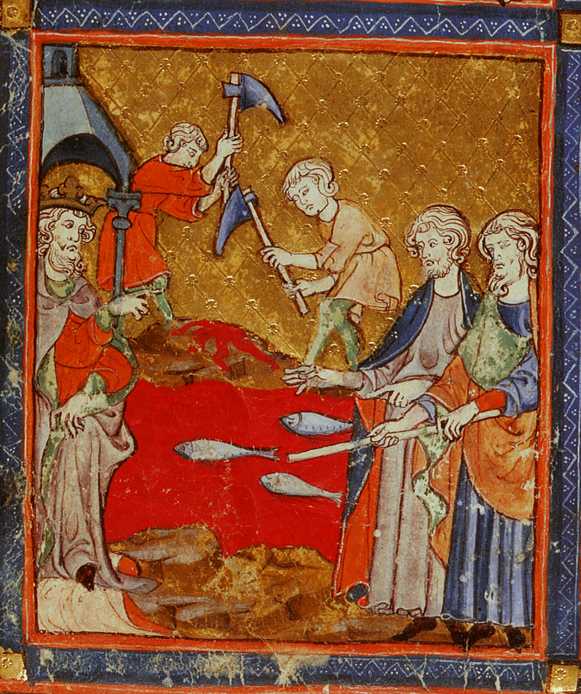
14th-century rendering of the plagues of egypt

we are tellers and re-tellers of story, a people long bound by the unspooling of truths told in text or in verse, around table or hearth, under moon and star or plaster and beam.

in the geometry of time, there lies both wisdom and instruction in the unfurling of the year, an unfurling that might feel like a circle but that i see as a spiral. year after year, we return to texts––familiar texts––that draw us in more and more deeply, the more closely we pay attention. 

so it is––as i fill my house with matzo and shred it of breadcrumbs, as i shop for both lamb and shank bone, as i steam mounds and mounds of asparagus––that once again we come to this holy stretch of time endowed with foundational story, ancient stories both christian and jewish. the story of a savior who wept in a garden, and soon was betrayed, then flogged and stripped and pierced with a crown of thorns. a humiliation as severe as any i’ve ever read. certainly more than any i’ve ever known. and at the same time in this house, we read and retell the story of the enslaved jews finding their way out of bondage, crossing an isthmus, a sand bar in a sea of reeds, but not before witnessing the scourge of ten plagues. 

the beauty of these texts, and any text meant for endless curiosity––these texts, as if prisms we hold to the light, turning and turning for the making of new rainbows––is that each year some new fragment may catch our attention. new rainbows might scatter against the walls of our soul. 

so it is that this year i am thinking anew of the plagues: water turning to blood, frogs, lice, flies, livestock pestilence, boils, hail, locusts, darkness, and the killing of firstborn children.

i remember how at the long seder table where my boys grew up, the table would be scattered with wee plastic frogs and broad-winged bugs; ping pong balls would serve as hail. and red food dye would be splattered on plates. the detail was never lost. 

and only this year––a year when both those boys who once squirmed at the bugs and squealed at the blood will be hundred of miles away––only this year have i come to pay closer attention to what the plagues might have meant to the story we’re commanded to tell. 

according to a wise, wise rabbi whose wisdom i found myself reading the other day, the plagues are “commonly read as punishments levied against the egyptian people for the terrible suffering they forced upon the israelites,” writes sharon brous, the senior rabbi and founder of IKAR, a jewish congregation in los angeles, a rabbi who calls it her life’s work to re-animate religion. oh, that we animate it, this vein in our lives that seems to either be bent to fit particular agendas, or shoved to the side altogether. 

but, writes rabbi brous, there is another way to interpret the plagues, and God’s intent therein (and here’s where i buckle my seatbelt, and begin my own homegrown rocket ride): what if the plagues, the sufferings, are meant not to punish but rather to tender the heart. to grow compassion. to breathe and breed empathies. 

we need turn to the 16th and 17th centuries, to the wisdom of a venetian scholar and rabbi named obadiah ben jacob sforno, to find the seeds of this thinking: sforno argued in his commentary on the text of exodus that the plagues were actually brought to awaken the conscience of the oppressor, “to increase the chances that pharaoh would finally see the light and become a genuine penitent.” 

“in other words,” writes brous, “what God desired was a true change of heart. God wanted pharaoh and his people to take responsibility for the injustices they committed. tell the truth. make amends. offer reparations. chart a new course, together with the israelites.”

in a world as plagued as ours currently is––war and pillage, pandemic and pestilence, fire and flood and drought––in a world where it’s too too easy to turn our backs on the sacred, to point to the suffering and insist there’s no God so hard-hearted to look the other way so therefore there must be no God, in a world as replete with reasons not to believe, what if the radical notion, the one that’s hardest to come by, is the dawning idea that with each and every suffering we grow more and more tender. 

there’s the crux, the hard part: to allow the suffering to tender us, not to harden. not to let horrors metastasize, not to let hurt spread like a cancer, nor turn us into walking, talking cess pools of resentment, to leave us every morning, noon, and night with the afterburn of bitterness there on our tongues. 

imagine ten of your own plagues: the time you were double-crossed; the time you discovered a terrible truth, a truth that was crushing; the dying and death of someone you loved. the remembering and never forgetting of a time you caused the suffering. the lie you let grow. the cruel innuendo that crossed your own lips. count your own ten.

now, consider the pain that you felt. how it awoke you in the night. how it haunted you by the day. how it felt like a nest of hornets let loose in your soul. 

now imagine that the pain didn’t harden. imagine it worked to loosen the loam of your soul. allowed room for new seeds to be planted there. tender sproutlings of purer compassion. how, ever after, you knew what it meant to grieve in a bottomless way. how, ever after, you knew how tempting it was to turn away and never turn back. how, ever after, you knew the muscularity demanded to rise up and out from the darkness. 

consider how those plagues pushed you––not without ache, not without wishing you could wish it away––toward a deeper, broader understanding of and connection with the suffering all around.

imagine if the resonance of your own hours of suffering allowed you to look upon the sins and the suffering all around and find common ground, feel your heart open not close.

imagine if the world’s suffering was meant to do the same. imagine if all this is an exercise in tendering our holiest vessel: the one heart made as a chamber for the sacred to dwell. 

what if, instead of growing bitter and hard over time, we grow softer and sweeter? what if we return to the text––the suffering and crucifixion of the one born to teach and live love, the freeing of an oppressed people made to witness hardship upon hardship, ten plagues in all––what if we return to the text and find, for the very first time, a wisdom to carry us on? into a world that never seems to pause in its inflicting of pain.

what if, in feeling the pain, we are moved to be the agent of balm, of healing, of lifting the other out of a pain we know all too well? tikkun olam. “repair the world.” mend the tatters. reimagine the whole.

there must be wisdom, must be reason we circle again and again to the same lines of text, as if we’re meant to meet it again with whomever we are one year to the next. this year the lines that most drew me in were the ones that ask why in the world would ours be a God who not only allows but inflicts plague upon plague, hurt upon hurt.

my knowing next year might differ. but this year i’ve come to dwell on the thought that no one escapes a life stitched with sufferings. and if the sufferings come, how might they make of us souls that pulse with compassion. communion, after all, is the holiness we seek. oneness. with God, with ourselves, and the whole of humanity circling this earth in this long, dark hour.

what plagues move you to compassion? (a question to answer deep in your soul in these entwined holy hours ahead….)

i cannot let this day pass without remembering my beautiful mother-in-law whom i last saw on this day, her birthday, a year ago. we keep her flame alive, very much alive, in the telling and re-telling of her stories. may they never end…..

*the question of the israelites and the plagues––whether they witnessed them or endured them––was a question that prompted much discussion at dinner last night. one of those rabbit holes into which we fall at our house because one of us––either the jew or the catholic––is always fairly new (or newer) to a story, and wonders about it in ways that have never quite struck the one to whom it is more familiar. i’d assumed––wrongly, it turns out––that to be in egypt at the time of the plagues meant to endure them but a closer read of the story made clear that, according to Exodus, for at least some of the plagues, the israelites were protected. certainly, i knew that the whole point of the “passover” was that Jews were to mark the doorways to their home with the blood of a sacrificed lamb, and the angel of death would know to pass over, sparing the firstborn son. i hadn’t realized––nor had my tablemate––that plagues one through three seem to have been endured by all, and four through ten were endured only by the egyptians, except for those who were penitent and thus spared the wrath.