pull up a chair

where wisdom gathers, poetry unfolds and divine light is sparked…

Category: joy of writing

love letters lost

love letters lost hands

sifting through the cyber-ashes, gathering up a flake or two of text, pausing long enough to read, to remember, to let the tears fill and fall. feeling the full-throttle pang of if-that’s-what’s-left-how-very-much-was-lost?

i’ve found the snippet dated april 10, 2009, on the eve of a baby’s birth, in which i wrote to the expectant mama and papa: “i am certain that we have entered into holy time….” a beautiful baby girl was born deep in the middle-night four days later. the email marked the beginning of the hardening rhythms of that labor and delivery.

i’ve been scribbling life’s every twist and turn, long as i can remember. i mark time with typed-out missives. short or long or in-between, doesn’t matter. all that matters is that, for me, it’s putting life to paper, etching time with written record.

i’ve found the one i sent hours after delivering our firstborn to his leafy college, in which i wrote: “poor teddy sobbed silently, melted in tears.” august 29, 2011. i’d sent that one off to my mama, who wanted to know how the parting went.

and there’s the one, three months later, when that firstborn came home for the very first time, and at the dawn of that first morning while he slept, back in the bed above where i was typing, i wrote to my brother: “i suddenly feel whole for the first time in three months….”

i even found the email, carefully tucked away in my meticulously organized treasury of emails — a virtual apothecary chest of drawers within drawers, each one labeled and stuffed with cyber-snippets — from november 4, 2008, when one newly-elected barack obama sent out a note letting me (and a few million other cyber-pals) know that we’d just made history and, by the way, he was heading over soon to grant park, a moment in history — a moment in my email trove — that won’t soon be forgotten.

i have been sifting through all week, discovering what was lost and what was saved. i find notes from the mother of a dying child who wrote, “as they say at NASA, failure is not an option.” another to a friend whose husband had just died, and who i tried to fill with comfort in the best way i know — words dispatched from the pulsing place deep inside my heart. yet another to a friend whose unborn baby girl had just died. and another, a note from the intensive care unit where our firstborn lay with a fractured neck bone. and one my little one (nine at the time) wrote to his uncle, “i will love max all my life,” after his uncle’s beloved golden retriever up and died.

it’s birth and death, and all the touch points in between. it’s loss and hearts filled up. it’s history and how i breathe.

i write because words for me are the vessels in which i pour my unharness-able heart. i pay acute attention to nuance and particulars. i make up words to try to stretch the periphery of that place that holds so much. i want the people in my world to know they’re not alone, they’re loved, their murky shadow is pierced by shard of light. there is a hand to squeeze in the darkness, and i offer it in words.

i render communion in banged-out letters on a keyboard.

and when your hard drive fails, and the trusted back-up drive does too, when you fall in the unheard-of 0.5 percent, you lose crucial threads, you lose what matters, you ache and you weep, the tears spilling to the keyboard.

and so it’s been all week, as i sift and sort and flag bits and snippets that piece the long-winding narrative — the story of a love that’s flowed without end for all the years i’ve been typing.

among the many chapters lost: the one of a boy with a broken neck and his triumphant bar mitzvah three weeks later; the story of that boy wending his way through high school and — finally, achingly (for his mother anyway) — heading off to college. i’ve lost all the emails that i sent, at every turn in those early far-from-home days that turned to weeks and months of learning how to be a long-distance mama. i’ve lost the emails i sent to beloved teachers, kindergarten through college. and, to pinpoint yet another now-missing chapter, the emails bandied back and forth between my sweet life mate and moi, as we decided whether to up and leave our house, our life, our humdrum everyday, to move for one short year to cambridge, mass., to go back to college, to dwell beyond our comfort zone.

in the life story of a family, much unfolds over the course of eight years. back when i first started typing on this particular apparatus, one boy had just turned 13, the other was barely five. i was working at a newspaper, longing to work from home. george bush was president. my brother’s first wife had just died. neither my beloved niece nor nephew had yet been imagined. my mother hadn’t been told that she had a tumor growing in her belly.

i recorded it all in the little blasts i type and send nearly every single morning, and through the whole day long.

the nice and very smart geniuses who live in apple-land, they did the best they could. for days and days and hours without end (or so it seemed when our phone calls ticked into sixth straight hour, three days in a row). but the sent emails could not be saved. nor the photo albums, all carefully edited and curated. i got back raw images, some 20,000, and i will sift and sort and delete the blurry ones, as i’d done before, in all those hours now lost. the books i’d made from those images — pictures and text, page after page — all gone.

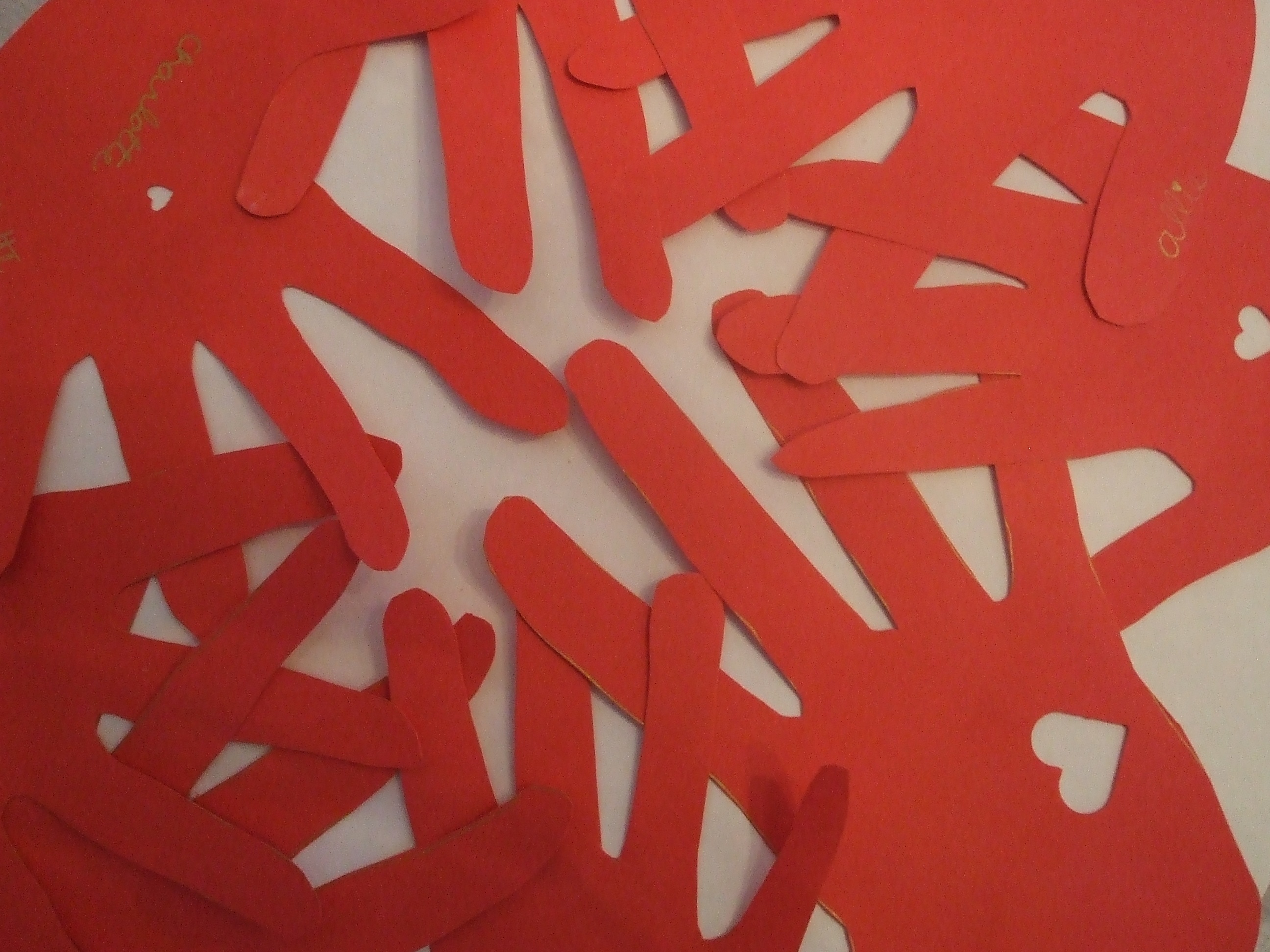
and so, on this day of hearts and cut-out valentines, when words are scribbled in silly rhymes and riddles, i am left to consider love letters lost. and to hope and pray that the echo of what they meant, and what they tried to hold up to the light, i am left hoping that it lives on where it was birthed — deep inside me, deep inside the soul of a girl who’s been holding tight a pencil all her life, trying again and again to get it on paper, to get it right, this immeasurable, unfathomable force of life, of love, of understanding.

the one that sometimes is spelled out in quiet little emails. ones that arrive with nothing but the ping of a flat black box telling you something from the heart has just landed. please read, and know that you are loved.

forgive me for dwelling one more week on this nasty mess of a cyber-crash. it’s been just awful, the slow dawning realization of chunk after chunk that’s simply gone, vanished, kaput, kerpluey. like so many other losses in life, we console ourselves with the deep down truth that in the end the only thing that can’t be stolen, can’t be crushed, or lost, is the imperceptible and vast catalog of memory, of what’s held in our hearts and souls and minds. 

what love letters do you hold closest to your heart?

poetry school

poetry school

when the school bell rings, i shuffle over to class in my holey-est slippers. and, dating my pedagogical style, i haul out my spiral notebook, my pen, and settle in. click a couple buttons, and poof! poetry school’s in session.

so it goes when you go to college from the comfy confines of your kitchen table. when you’re hauled out on field trips to the lower east side, and south street seaport, without so much as buttoning a sweater.

over the wintry weeks, i’ve grown fond of my professor — she tells us to call her lisa, even though she’s listed as elisa in the course book. (she lets on, in a cozy email, that only strangers call her by her full name, first syllable vowel-prefix attached; she seems to be inferring that we are now admitted to her inner circle — how kind of her, how generous. see why i like her already?)

she tells that to the thousands and thousands of us who click into class from wherever we sit on the globe, and learn a thing or two about poetry in america, and walt whitman, specifically.

thousands and thousands, you ask? yup, if they packed us all in a lecture hall it’d need to be about as big as beijing’s bird’s nest, that iconic steel-strung stadium built for the 2008 summer olympics.

back on the days when we were settling into class, when virtual papers were being passed out, and we were going around the room to introduce ourselves, i tried to scribble down all the countries we come from. i started with ukraine, scribbled india, UK, bangladesh, serbia, south korea, nigeria, netherlands, lebanon, swaziland, kosovo, even togo. i practically ran out of room after packing in itty-bitty letters clear to the bottom of the notebook page, and sideways up the margins. i just counted 49, and i’m sure i missed a few.

we are all huddled round our laptops, our iPads, our clunky desktops for a class called “poetry in america: whitman.”

think not that this is mamby-pamby read-along at home. this is sit-back-while-the-brilliant-professor — from the comfy confines of her book-lined office in the red-brick barker center just off harvard square — waxes-eloquently (and without notes) about the quintessentially american 19th-century poet. and when she wants to show us an original manuscript, she just hauls her video crew over to the rare books vault in harvard’s houghton library and pans the lens up and down the page. and when she wants us to know the streets whitman walked in new york city, she pops up yet another video and walks us up and down the sidewalks, pointing out the print shop where he set type, showing us his newspaper’s proximity to new york’s city hall, and even the back alley where whitman got to know the prostitutes and actresses of mid-19th-century manhattan.

this is hardly a hands-off matter. why, this fine professor insists on “two well-crafted paragraphs,” in open response to questions about the poems. she and her technical wizards have provided a nifty annotation tool, so we — the thousands of students, all of whom speak a thousand different mother tongues — can identify anaphora (repeating the same word at the start of successive lines) and parallelism (repetition of certain structures throughout the poem) and the latest poet-trick of the week, apostrophe (an address or salutation, as in O sun!). and we have to post these things in public manner. so anyone who’s in the class can scroll along and peek over our shoulder and figure out whether we are complete dunces or might be onto something.

in fact, this global classroom comes complete with office hours and TAs. and those brilliant almost-PhD’s actually scroll through the online postings, those “two well-crafted paragraphs,” and comment on our postings.

now, for a timid soul like me, one whose hand might be quaking in an early round of hand-raising in a lecture hall the size of kingdom come, it is scary enough to hit the submit button, and watch your thoughts on walt whitman’s “crossing brooklyn ferry,” or “song of myself” get all but nailed to the village crier’s blackboard. but even i can suffer the possible indignities and disgraces from the loneliness of my kitchen, so imagine how the soul doth swell, when hours later you circle back and find the nice TA has scribbled “you’re really onto something,” there beneath your humble words.

this whole exercise, in fact, might be far more than what i signed up for. i thought it was a vigorous way to dig deeper into the world of poetry that so captivates my imagination. but, slowly and certainly, i am discovering it might just be a brilliant bathtowel-rub of confidence and faith.

we all have a million reasons why we never think we’re good enough. the joke at harvard, we learned last year, is that nearly every freshman shuffling across the yard is peeking over his or her shoulder, wondering who in the admissions office made the mistake and let her or him in. “they must have mixed me up with the brainiac whose name was after mine in the applicant pile,” you can’t help but think — unless, that is, your mother gave you cans of ego-builder for breakfast with your eggs. (mine did not.)

so, i bumbled into this class in the ways i often do. first i wasn’t sure if i was allowed to sign up. (i was; it’s free and open to the public.) then i thought i wouldn’t take it for the nifty certificate that says i passed (i figured i didn’t need any more papers in my rat’s hole of an office, and besides, what if i couldn’t cut it?). and i sure didn’t think i’d ever muster the courage to say a single thing out loud (you could film a video introduction of yourself, or cobble a few penned sentences; i opted for the pen — aka keyboard).

but then, somewhere along the way, i started reading and thinking, and melting under the warmth of this professor with her deep love of poetry and her proclivity for messed-up hair and quirky field trips. and then i wrote what i thought, dug down not too deep — because what i thought had already bubbled up and wanted to be typed — and found myself deeply engaged in conversation with mr. TA and a few other students of poetry, who, for all i know, might be typing from a drafty hovel in azerbaijian or a dim-lit flat in kosovo.

it’s what happens when you go fling yourself into any one of life’s classrooms, the ones that don’t come with comfort guaranteed. you find a two-track curriculum — the one where you absorb the lesson plan, as penned by the professor, and the one that’s more of an independent study, and you find yourself quietly, wholly, learning who you are and who you might become.

walt whitman, i’ve learned, was the son of a carpenter who came of age during america’s building boom. he schooled himself in new york city, first as a newspaperman and, always, a flaneur, a fellow who strolled the city inhaling its street theater and its lessons.

but i’ve learned too that the wobbly-legged just-born thoughts that spill from deep inside, might “really be onto something.” and that’s a gold star i’ll carry closest to my heart.

word of the week, thanks to poetry school: amative — sexually potent. (i learned that whitman might be described as such. you decide for yourself how you choose to apply to your very own self or someone you admire.)

any hour now, i am sliding into my snow boots and riding the clackety el downtown to meet my dear professor in the flesh. yes, indeed, she is coming to the poetry foundation on chicago’s north side — that transparent cube of glass on aptly named west superior street. she is coming for conversation about whitman and gwendolyn brooks, chicago’s own poet wonder. i can’t wait to look into her sparkly eyes — the professor’s, i mean.

learn more about MOOCs (massive open online course) and EdX, in particular, by clicking on those hyperlinks. 

do you have a favorite whitman poem, or better yet, have you flung yourself into any discomfort zone this week, and did you find that you somehow stayed afloat? 

hummingbird birthday

hummingbird cake

with this day of birth tucked amid snow drifts, and clearly beyond the holiday statute of limitations, i long ago taught myself to upholster the day with wee delights, delights all my own, partaken of in modest degrees of solitude.

this birthday, the one my little one tells me is stellar because i am turning the number of the year i was born — that’s ’57 for those keeping track — has been bursting out of its seams and it’s only just a wee bit after dawn as i sit here at the table tapping on keys. keys to my heart, indeed.

there was a hummingbird cake last night, served up with a B of blueberries, all festive and lit, poised upon a one-footed pedestal. there was a fireplace crackling just over my shoulder, and i was nestled on a velvety couch with people i love.

hummingbird wish

and this morning, once i’d trudged through the snow with my old banged-up coffee can of seed for the birds, once i’d read the love notes left on the old maple table by my moppy-topped night-owls (boy 1 and boy 2), once i’d clicked on the christmas tree lights and poured my best blue willow mug with cinnamon-spiked coffee, i discovered this poem of perfection, written by my beloved mary oliver. it’s as if she peeked in my hearts and put words to my fumbles. and it is all we need here for all of us to launch into this holy new year. (but, since birthdays, especially ones that are stellar birthdays, are best done without that level-headed note of restraint, i am going to dig up the receipt (tasha tudor word for recipe) for that hummingbird cake i’ll never forget.)

so, first, mary oliver. followed by a fat slice of hummingbird cake. could there be a more perfect beginning to a year that had me on my knees last night, praying mightily for all good and heavenly blessings?

one last thing: thank you, always, for keeping me company here at the table. you are loved simply for listening. isn’t that all anyone of us wish for, deep down inside? to be heard….

and now…

Mindful
by Mary Oliver

Everyday
I see or hear
something
that more or less

kills me
with delight,
that leaves me
like a needle

in the haystack
of light.
It was what I was born for —
to look, to listen,

to lose myself
inside this soft world —
to instruct myself
over and over

in joy,
and acclamation.
Nor am I talking
about the exceptional,

the fearful, the dreadful,
the very extravagant —
but of the ordinary,
the common, the very drab,

the daily presentations.
Oh, good scholar,
I say to myself,
how can you help

but grow wise
with such teachings
as these —
the untrimmable light

of the world,
the ocean’s shine,
the prayers that are made
out of grass?

“Mindful” by Mary Oliver from Why I Wake Early. © Beacon Press, 2005.

and now, for that hummingbird cake…

it’s a southern cake, one whose name might come from the whimsy that it makes you hum, it’s so heavenly. it’s known to be something of a symbol of sweetness, and it’s so rich it’s best sliced in thin and elegant fractions of the whole. my hummingbird cake baker said she used orange in place of some of the pineapple. and the toasted pecans gave it a hint of southern groves on a cold chicago’s night. here is art smith’s rendition of that south-of-dixie cake….

hummingbird cake, ala one unforgettable and stellar birthday

the recipe notes this: This cake is one of the most requested desserts at Art Smith’s Chicago restaurant, Table Fifty-Two.

Serves 12
Ingredients
3 cups all-purpose flour
2 cups granulated sugar
1 teaspoon baking soda
1 teaspoon ground cinnamon
1/2 teaspoon salt
2 cups chopped ripe bananas
1 cup drained crushed pineapple
1 cup vegetable oil
2 large eggs , beaten
1 1/2 teaspoons vanilla extract
1 cup (4 ounces) finely chopped pecans
8 ounces cream cheese , at room temperature
1/2 cup (1 stick) butter , at room temperature
1 pound confectioners’ sugar (about 4 1/2 cups sifted)
1 teaspoon vanilla extract

Directions
To make the cake, position racks in the center and bottom third of the oven and preheat to 350°. Lightly butter two 9″ round cake pans, sprinkle evenly with flour and tap out the excess. (If you wish, butter the pans, line the bottoms with rounds of parchment paper, then flour the pans and tap out the excess.)

Sift the flour, sugar, baking soda, cinnamon and salt into a bowl. In another bowl, stir or whisk the bananas, pineapple, oil, eggs and vanilla until combined. Do not use an electric mixer. Pour into the dry mixture and fold together with a large spatula just until smooth. Do not beat. Fold in the pecans. Spread evenly into the pans.

Bake until the cake springs back when pressed in the center, 30 to 35 minutes. Transfer the cakes to wire racks and cool for 10 minutes. Invert the cakes onto the racks (remove the parchment paper now if using). Turn right side up and cool completely.

To make the icing: Using an electric mixer on high speed, beat the cream cheese and butter in a large bowl until combined. On low speed, gradually beat in the sugar, then the vanilla, to make a smooth icing.

Place 1 cake layer, upside down on a serving platter. Spread with about 2/3 cup of the icing. Top with the second layer, right side up. Spread the reaming icing over the top and sides of the cake. The cake can be prepared up to 1 day ahead and stored, uncovered in the refrigerator. Let stand at room temperature 1 hour before serving.

that’s it for today. what’s your birthday cake of choice? or your poem for the new year, or your stellar birthday?

well that was going to be it, but then i popped up from the couch to pour more coffee into my mug, and there before my wondering eyes appeared a kitchen table decked out for the broccoli girl’s birthday, with a load of brussels sprouts to boot. do my boys know me, or what? i nearly melted. the biggest boy of all, the one to whom i wed my life, he was puttering about while i sat here typing, not realizing what in the world he was up to, just beyond the cookbook shelves and the old ticking clock. hilarious. and more than worthy of this morning’s frame of glory…..brussels

hummingbird birthday

the holiness of work

holiness of work this

the dry spell had been long. the dust, collecting in my throat. the days of wondering where i was meant to be. aching for a path, a sense of how to find the clearing, through the thicket, up the side of the mountain.

some days i swore i’d lost my soul. found myself pounding out tales of how to clear a plugged drain (talk about ironic). oh, sure, i liked the plumbers all right. didn’t mind learning a thing or two about the ways of my sink. but really? i’d left the bedsides of dying children, picked up pen and notebook, to find myself 30 years later, making sure the world knew how to un-plug that drain.

clearly, that was not my steady diet. i spiced it up with the occasional soulful musing. saying goodbye to kids headed off to college. saying goodbye to my own. but it was, more days than i wanted it to be, an exercise in driving me to madness.

i could barely remember those days this week as i sat, morning after morning, in the shifting light. heard the chatter from just beyond the screen, as the sparrows had it out with the cardinals. and no one appreciated the stalking ways of my fat striped cat.

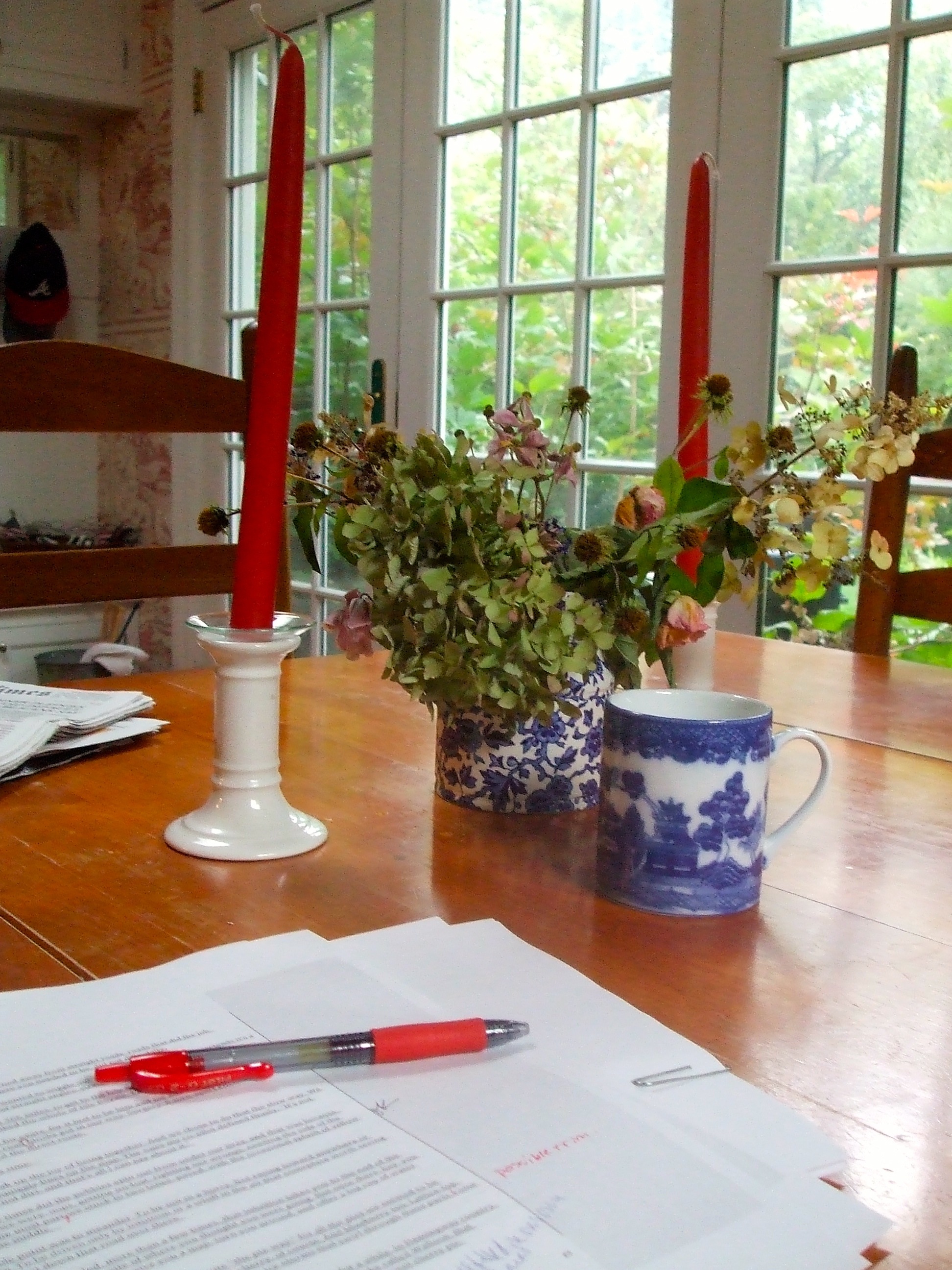
but there i was, red pen in hand, poring over pages that are typed-out vessels from my heart. more like prayer cards, each and every one. it’s called editing, but really it’s distilling. distilling to the essence, paring away excess. cutting to the bone.

it happens to be essential to the craft of writing, but really it’s essential in this odyssey called life.

we are each of us, processing machines. we wander through the day, absorbing this and that, taking in that long tale, and this winding one. if we’re thinking, paying attention, we are always on the lookout for the essence, the gospel take-away, the distillation of heart and mind and soul.

one by one, we take the offerings of the day, hold them to the light, sift and sort. decide which ones serve up sustenance, which ones merely upholstered the day in wit and whimsy.

so that’s the task i’m attending to right now. whittling down page after page, sentence after sentence, to its essence. its holy spark, if there is one. others will be the judge.

and as i slowly turned the pages, as the red pen traced progress in the margins, i found myself bathed in an undiluted sense of the holy. maybe, just maybe, it’s baptism, all over again. a new beginning. maybe after all the years, i’ve stumbled on the deep pure vein that connects me, that i’ve been trying to find for what feels like forever.

holiness. it’s why i set out on my journey long ago. it’s the wind beneath my wings.

and it came up and tapped me on the heart this week. seeped in through the holes in the screen door. filled the kitchen.

there’s work to be done, from now till tuesday, when the next deep round of edits are due. this whole month is pretty much a blur of tight deadlines, one cascading atop another. thank God i live with someone who understands the urgency, and the long long dry spell that preceded it.  he seems to know that it’s a prayer i am offering to the heavens. because really that’s what this is.

and it’s the holiest work i’ve ever done.

thank God it found me. i’ve been searching for so long.

so that’s the update from here at the news desk. whirling madly toward the deadline. a dear friend visiting for the weekend, the joy of trying to sustain calm amid deep-down palpitations. so i’ll simply pay closer attention to whatever it is i’m doing in the moment. extract more essence. 

and the question: what’s your holy work? and how did it find you?

99 psalms: prayer-poems that “refuse to leave us unattended”

99 psalms

it was nearly 17 months ago, on a hot saturday’s afternoon, with little sleep the night before, that i climbed the stairs of a gray triple-decker (boston vernacular for what chicagoans call the “three-flat”), just down the lane and around the corner from harvard square. there i met a bearded gentle man, a man who presided over an aerie where birds came to the windows, where sunrise poured into the living room, and sunset washed the kitchen in a rose-tinted rinse. cabinets were stacked with pottery, cobalt rough-hewn plates, heavy to the hand; mugs whose handles met the flesh of your palm with solid tenderness. and books, books lined the walls, floor to ceiling, in half the rooms.

the bearded bespectacled man was mark burrows. he was, for 11 months, our landlord. and he will be, for life, my lighthouse keeper and my teacher.

mark (for in this moment i address him as a friend) is a professor of poetry and divinity, a scholar of mysticism, and a historian of medieval christianity. in that first walk-through of the two-bedroom-two-office apartment for rent, as i spied the titles on his desk, i knew i needed to live there. i needed to inhale the essential texts, and the poetry and prayer that breathed there.

almost a year ago, mark, who is now teaching theology and literature at the university of applied sciences in bochum, germany, published the luminous “prayers of a young poet” (paraclete press, 2013), a collection of 67 poems of rainer maria rilke, the great german poet. that book, the first english translation of rilke’s prayers in their original form, evoked for poet jane hirshfield, “leonardo da vinci’s notebooks — it shows the same mix of surety, roughness, genius, and the sense of a precipitous creative speed.”

rilke explores “the poetry of search,” or as burrows writes, “poetry that ponders darkness.”

just weeks ago, my teacher, professor burrows, published another translation of a poet whose work dares to explore the often unexplored landscape — the soul in exile. this time, burrows put his considerable intellect to the work of a poet i’d not ever known, one who goes by the pen name of SAID.

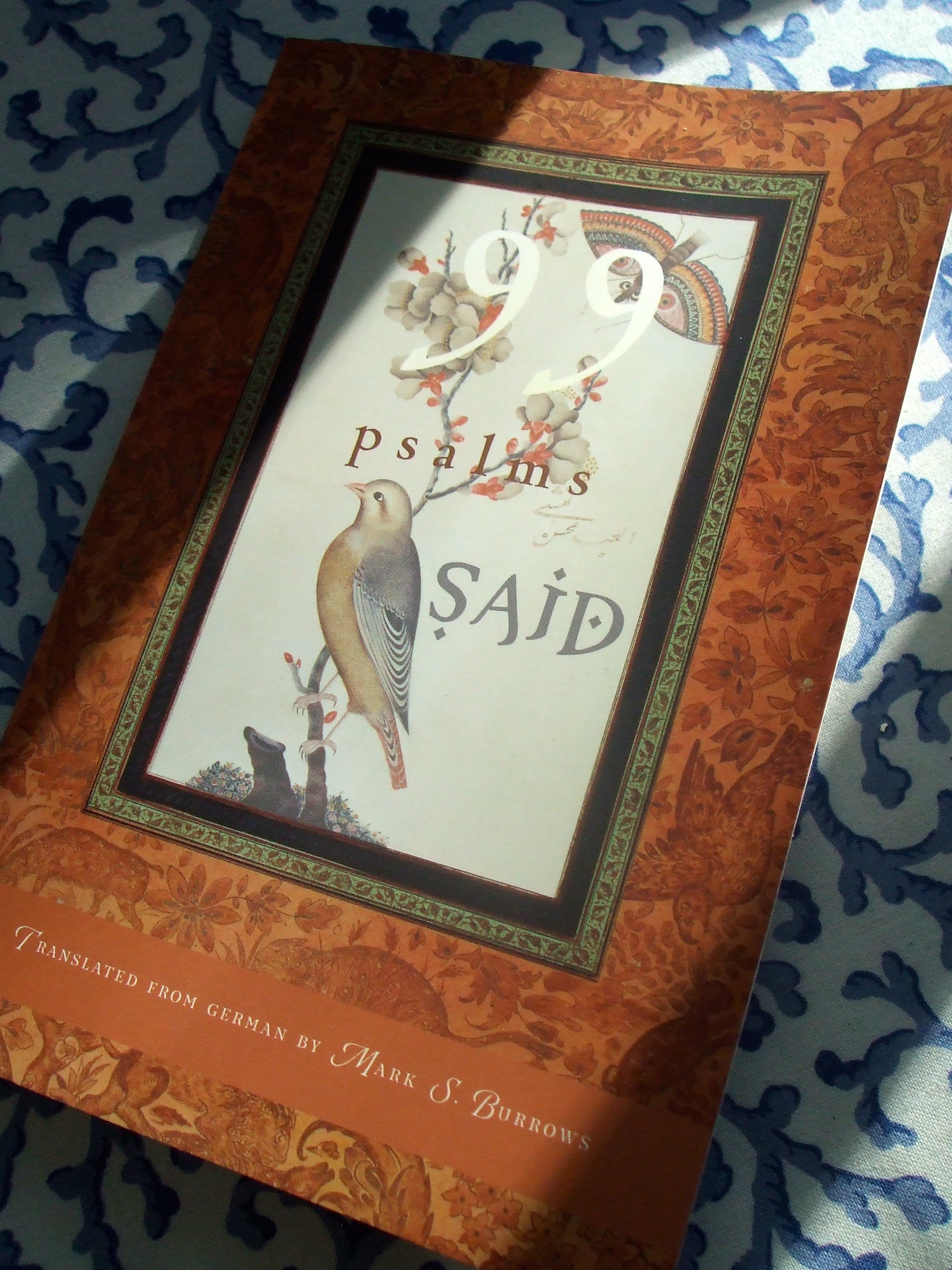
the book is titled, “99 psalms: SAID,” translated from german by mark s. burrows (paraclete press, 2013).

born in tehran, SAID emigrated to germany as an engineering student in 1965, but he abandoned those studies to pursue a writing career, and through the power of his poetry, has become a prominent figure in the german literary scene.

burrows first encountered SAID, he recalls, on a “dreary, rain-soaked night” in munich’s old city hall in may of 2010, at a poetry reading held in conjunction with the second ecumenical Kirchentag, a massive gathering sponsored by the roman catholic church and the protestant church of germany.

as SAID took to the microphone, burrows writes that he noticed the audience leaning forward, the better to absorb what flowed next.

“the psalms he chose…were blunt, vivid, and often startling in their language and imagery. none betrayed any trace of sentimentality…the fierce directness of their language conveyed a marked impatience with intolerance, probing the ambiguities of life with an unflinching honesty in order to remind us — if we had forgotten — that ‘purity isn’t the sister of truth.'”

burrows goes on to write that “these are psalms that cry out against the confidence of zealots, with their claims of righteous authority over others — crusaders, campaigners, and jihadists alike.”

in other words, the exile SAID writes poems of exile, “psalms arising from a ‘no-man’s-land.'” he employs a metaphor of wind as “a hope that reaches beyond religious differences and across the growing disparities between the affluent and poor,” as burrows writes.

in the tradition of the hebrew psalmist, SAID’s works are poems of praise and lament. burrows writes that “the poems we need are often the ones that refuse to leave us unattended.” they remind us “to look beyond what we know, or think we know.”

these poems, writes burrows, “bear witness to the heart’s descent into loneliness and despair, and gesture to the ascents we also know in moments of compassion and generosity.”

as always, poetry does the work of capturing the unspoken, unformed fragments of our heart, of our deepest imagination. the poet, as the butterfly catcher, employs the vessels of language to net, to gather, to collect the flitting-about, untethered, winged idea, the moment.

the poet does the work so we — the reader, the listener, the lonely pilgrim — can stake some claim of understanding in a landscape that until the moment of the poet’s poetry has escaped us.

the poet places us, solidly, in territory at once familiar and foreign. we trip upon the syllables of the imagination, and we find ourselves breathless at the poet’s deep knowing, at the exhilarating moment of loneliness collapsed. we recognize, we understand anew the depths of the human spirit, in wordform before un-uttered.

SAID addresses his psalms to “lord,” though not one bound by any religious tradition. he is certainly a late-modern psalmist, and his prayer poems speak to the complexities of the tangled fractious world in which we live. he explores the human condition with more urgency, perhaps, than he explores the divine. and therein is tension, poetry that refuses to leave us unattended.

one last thing, before i leave you with a psalm or two: about the 99 psalms, the number ninety-nine in the muslim tradition is the precise number of names by which Allah — God — is known. there remains one name — “the last/ the hidden” — that is unknowable, beyond us. so too with the 99 psalms; we are left wondering about the one beyond, the one which, perhaps, is written but not known, or not yet written. what might the unknowable tell us? why are we left not knowing?

here, a pair of SAID psalms that “refuse to leave you unattended”:

[Psalm 35]

lord

pray

that we recognize you

when you come

destroy the go-between gods

with their grand airs and their daily needs

set your seal upon your houses

and don’t be afraid of our nakedness

let the cypresses be your messengers

for they stand upright and whisper

and don’t try to convert the wind

[pause for silence.]

and now, one other, though choosing only one was tough, indeed…

[Psalm 10]

lord

spread wide your arms

and protect us

from the multitudes of your guardians

stand by those who wander

who’ve not lost the gift of hearing

and listen within their solitude

stand by those too

who stay and wait for you

[silence, once again…]

chair friends, i come to you on a wednesday, because in the publishing world these days, blogging about a book is one way to cast wider the net. and today was the day they asked me to write. 

i ask: is there a poem in your life — or especially in your now — that refuses to leave you unattended? and what about the 100th psalm, do you wonder what it asks or says? 

all in a penultimate week’s delight: pulitzer poet, mama’s milk and t-t-tina brown!

sharonoldsat graylag

dispatch from 02139 (in which we offer up a sampling from a string of days in may, as the year of thinking sumptuously hits its crescendo of pinch-me moment upon pinch-me joy, and conversations begin to be doused with impending dates of departure…)

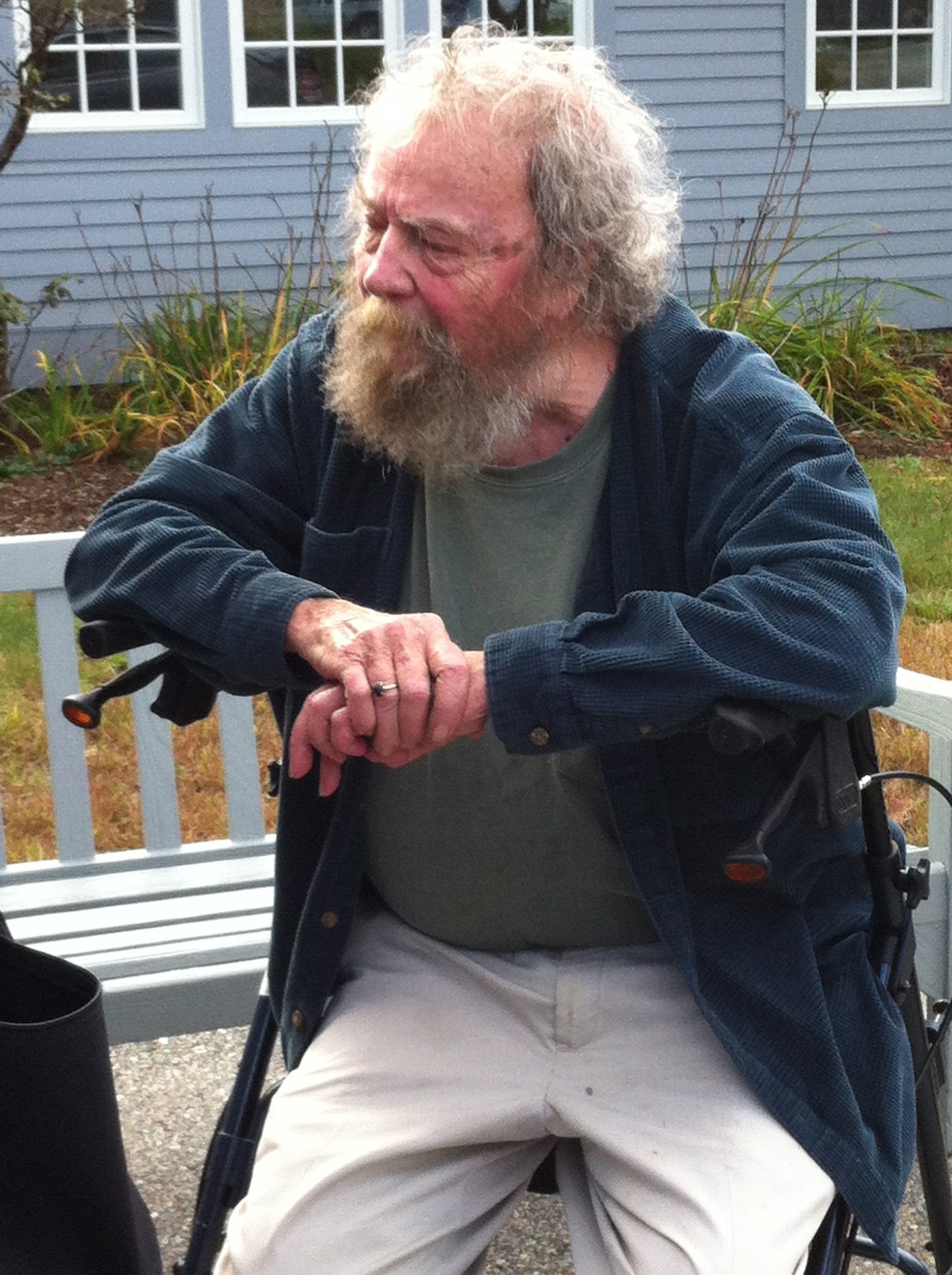
monday (field trip): if you’ve been merrily playing along here at “the chair” all year, you might recall that long ago and faraway in nieman time, a big old bus pulled up to the curb outside the white clapboard clubhouse where niemans romp. and a field trip’s flock of fellows, each clutching a paper sack of road food, climbed aboard and rode into the wilds of new hampshire, to visit poet laureate donald hall.

donald hall

it was a poetic launch to our nieman year of thinking sumptuously. and it unfolded amid the crisp autumn days of october, when the calendar ahead was ripe with promise.

at the start of this, the penultimate week chock full of nieman adventures, we circled back to that same curb and yet another big old bus that ferried a smaller flock of us again to new hampshire, this time to the stoop of yet another poet, the recently crowned pulitzer prize winner, sharon olds.

while i held my breath and prayed the lumbering bus would not teeter over the edge of the skinny dirt road that cut a path through boulders and woods, sharon olds was putting out platters of donuts and pitchers of lemonade, and pulling back her long gray locks into a rubber band.

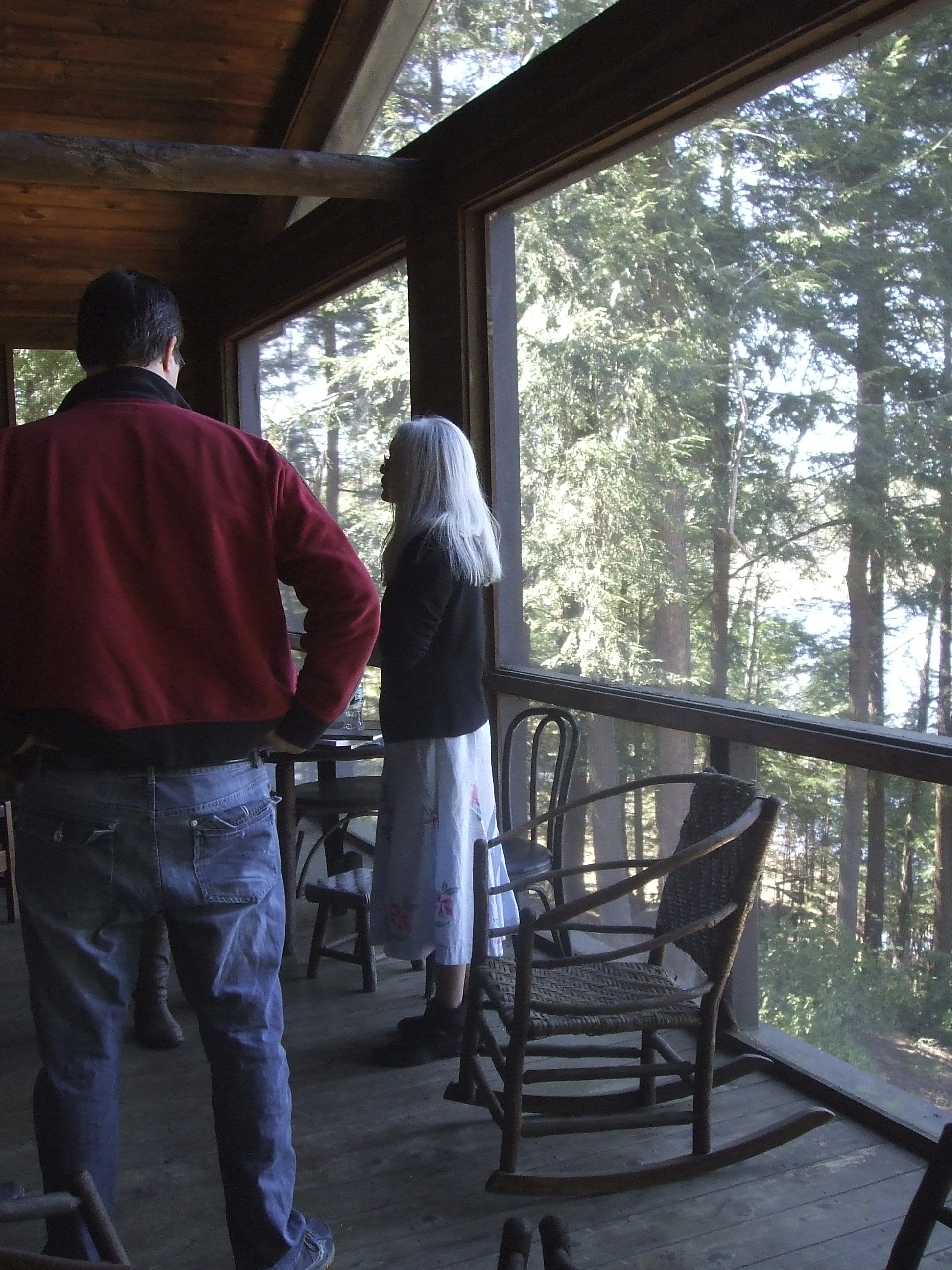
she’d opened wide the door of the cabin just up the hill from wild goose pond, tucked into the granite crevices of pittsfield, new hampshire. she’d set a pile of poems on a cedar table in the broad screened porch, set out a ring of creaky wooden rocking chairs, and ushered us in, one wide-eyed nieman at a time.

she loosed her mane from the tight-bound harness, and began to talk about how for so many years she was dismissed by “the academy,” those highbrows who deemed her poems too quotidian. all those years, more than 40, she paid no mind. and kept writing anyway.

“i did have the sense of ordinary stories of parents of young children having the capacity to be art,” said she.

“i felt a little pissed off that people felt it wasn’t worthy of art,” she opined, letting rip a smidge of the saltiness that propelled her all those years (and stirring a silent “whoop!” from me).

she talked about how she’d never had “excessive conscious confidence,” but let on that there must have been a germ of it deep in her bedrock, “because i was writing.”

writing bracingly, and achingly, with an intimacy that might make you blush. or one that might make you sit up and see the artfulness in the everyday — its tragedy or, rarer still, its triumph.

here’s a taste: the poem, “the last hour,” from this year’s pulitzer-prize-winning tome, “stag’s leap,” about the shattering of her 32-year marriage. in 20 lines, she mines the heartbreak of a single frame in space and time.

Suddenly, the last hour/before he took me to the airport, he stood up/bumping the table, and took a step/toward me, and like a figure in an early/science fiction movie he leaned/forward and down, and opened an arm,/knocking my breast, and he tried to take some/hold of me, I stood and we stumbled,/and then we stood, around our core, his/hoarse cry of awe, at the center,/at the end, of our life. Quickly, then,/the worst was over, I could comfort him,/holding his heart in place from the back/and smoothing it from the front, his own/life continuing, and what had/bound him, around his heart — and bound him/to me — now lying on and around us,/ sea-water, rust, light, shards,/the little curls of eros/beaten out straight.

***

katie hinde at nieman

wednesday (seminar): that’s not all this blessed week held. come wednesday twilight, we all pooled at the foot of evolutionary biologist katie hinde, who set off fireworks for some of us, especially those of us who’ve spent good long years of our lives contemplating the liquid gold that is mama’s milk.

yup, katie hinde is one of the world’s foremost scientists on the unique mammalian capacity to “express a fluid for their young that enables them to survive and thrive.”

she is, in fact, harvard’s high priestess and professor of breast milk, proclaiming it, “the most complex biological fluid.”

“mother’s milk is food; mother’s milk is medicine; and mother’s milk is signal,” says hinde, who goes on to explain that there are “thousands of constituents in milk that have an impact on the infant.”

yet we haven’t begun to unlock the secrets — or the power — of all that flows therein, she says, before counting stem cells, immune triggers and fatty-acid brain-builders in the table of contents of what she terms “the magic potion.”

beloved by her students, hinde is a scientist whose passion for her work is downright contagious. her blog, “mammals suck…milk!” is a treasure trove for anyone intent on knowing even just a drop of all there is to know about mama’s milk. her knowledge astounds. her research blows my mind.

take a listen here to see why she sent at least one of us to the moon:

katie hinde: “why mammals suck” @ harvard thinks big 

***

tina brown

friday (shoptalk): still, the week wasn’t tapped to capacity. come friday afternoon, all fellows and co-vivants were huddled in our last shoptalk of the year. and perhaps the great minds and calendar-fillers at nieman saved the most sumptuous for last.

on tap: none other than tina brown — the inimitable, brilliant former editor of vanity fair, the new yorker and newsweek, and currently founder and editor-in-chief of the daily beast.

turns out the whole conversation was off-the-record, that journalistic cone of silence that allows for no-holds-barred opining, thinking aloud and occasional bloviating.

alas, i can’t spill verbatim quotes from the oh-so-smart-and-sassy brit. but i can tell you she wasn’t nearly so daunting as i would have guessed, after all these years of seeing her name and her razor-sharp wit in big bright lights.

i believe it’s safe to mention — without giving broad swaths away — that she endorsed my deeply held conviction that the whole culture of the internet is far too sneering and snarky, a “blood bath,” she termed much of it.

too too many, she said, “mistake snark for wit.”

and it all “creates drive-by shootings” of verbal bullets. “i love wit and wisdom,” she said, making the distinction that both of those are “generous of heart.” whereas snark — a wholly ungenerous stance — seems to have staked a claim as the universal cyber default mode.

all in all, twas a grand second-to-last action-packed week of nieman-ness.

next up, a class trip to the berkshires, and then the day we’ve all been loathing: graduation day, or rather commencement.

when we begin anew, forever changed.

and how, pray tell, was your week?

photo way above: sharon olds at graylag, her 140-acre compound of woods and cabins on wild goose pond in pittsfield, new hampshire.

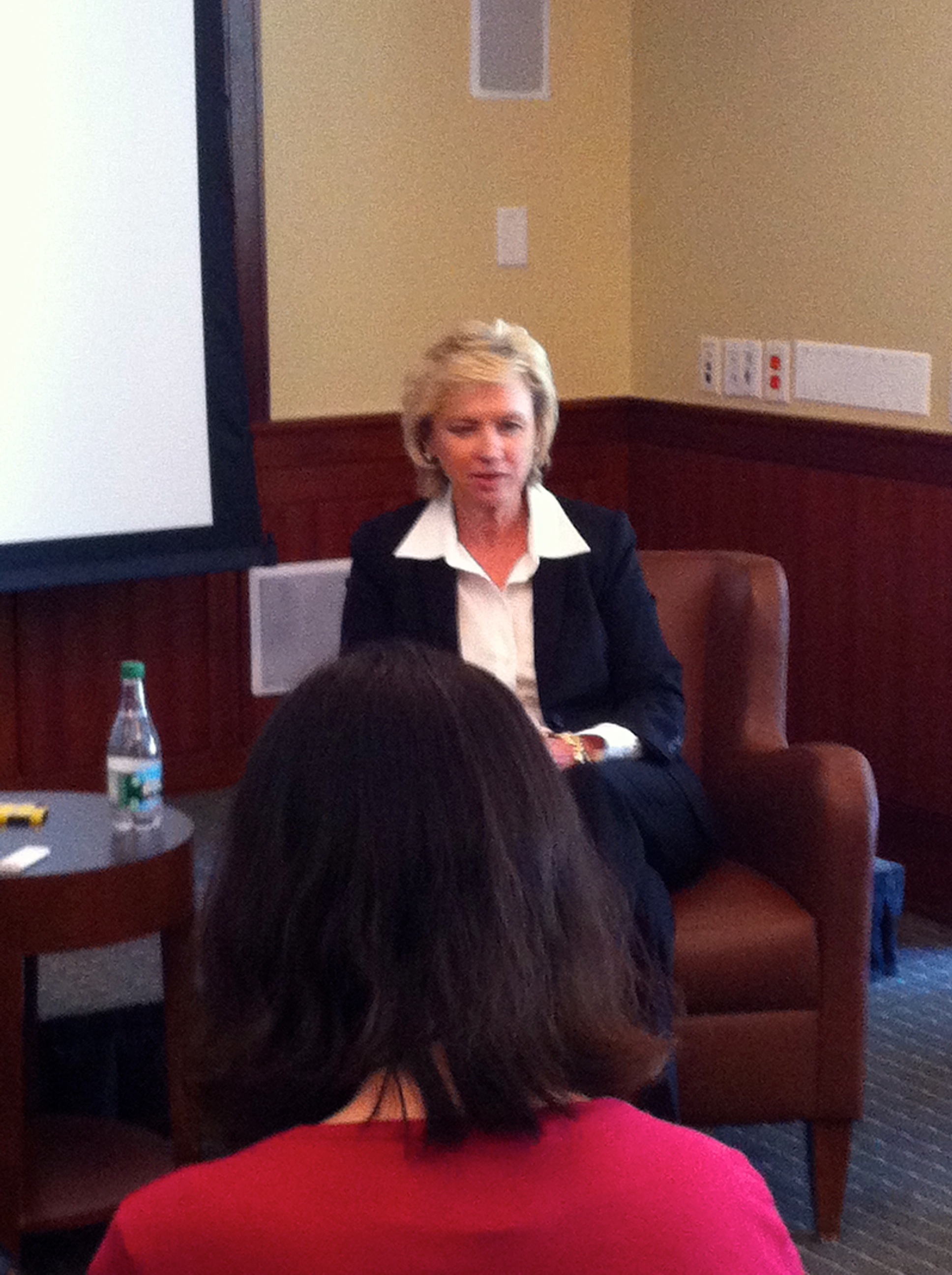
thumbprint a few inches below sharon: the poet laureate donald hall. next down: katie hinde, she of “mammals suck” blogging fame, and finally, in the wee bottom frame, ms. tina brown in brown leather armchair at lippmann house. 

reading night

reading night

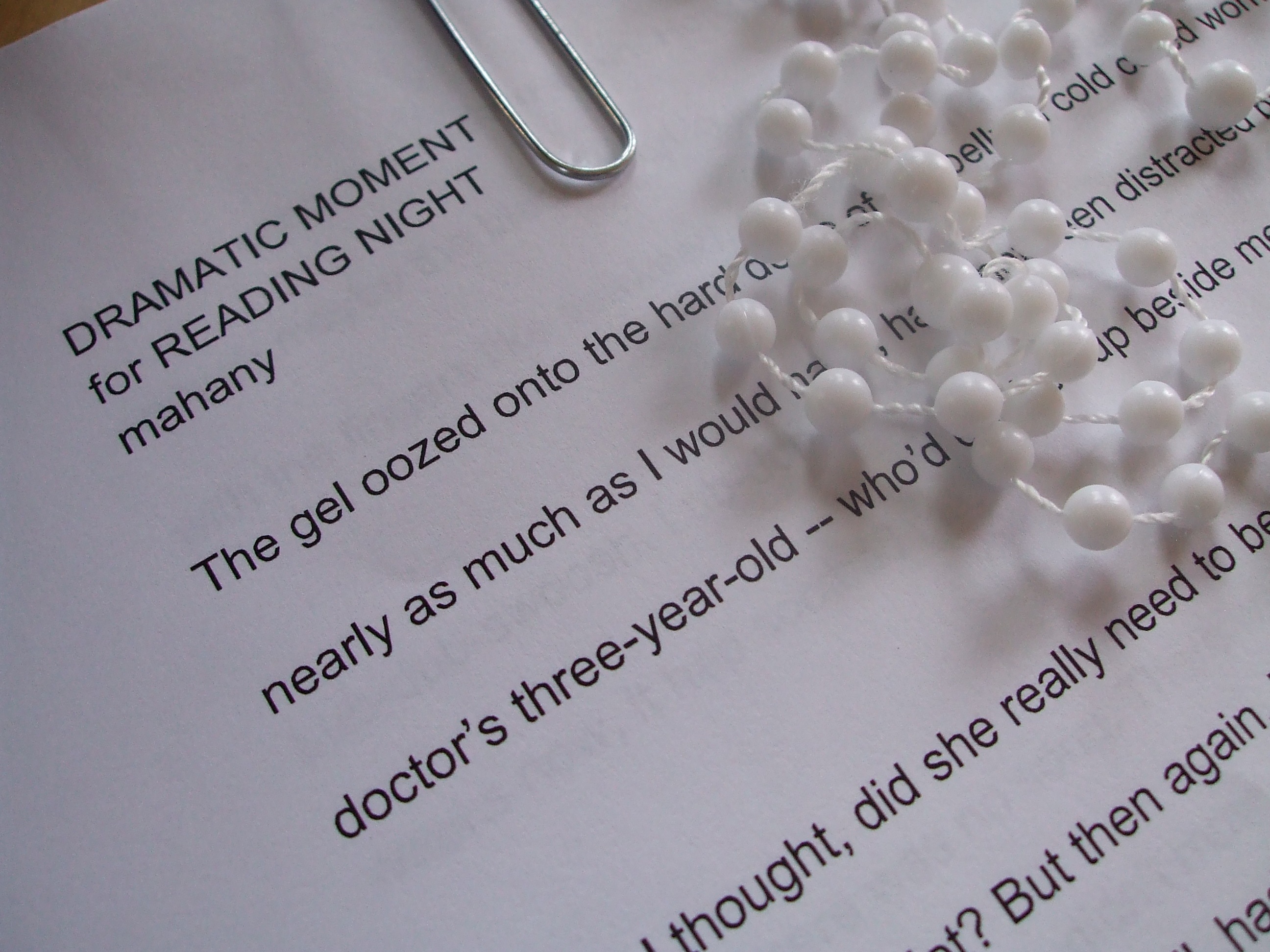
dispatch from 02139 (in which we all circle round, and fellows and co-vivantes engage in a nieman rite of spring, one that prompts us to pull from our pockets one choice passage — scribed this year, and picked just for tonight — that, one-by-one, we will read to the gathered masses. it is a nieman literary tradition, and it has one of us shaking in her reading clogs….thus the rosary beads above…)

long ago, in the leafy shade of my writing room back home, i remember sitting at my old pine table typing a promise to all the beloved “chairs.” i promised to bring you along on this year of thinking sumptuously, and i’ve tried mightily to do that.

sometimes, of course, these dispatches have been placeless, as they’ve captured musings i might have mused wherever i was in the world — a mama’s musings, a mama’s heartaches, moments not tied to any ZIP code. sometimes they’ve been particular to the curious case of going back to college when you’re pewter-haired.

i’ve carried you on a field trip to a poet’s farm in new hampshire, and let you peek in at the volumes piled high on my desk. i’ve tiptoed into the monastery, with you right on my shoulder, and i’ve brought you here to the kitchen when i got to stir a cauldron of chili for a boatful of hungry rowers.

this perfect april’s afternoon — with the just-warming breeze whooshing through the screen door, and the merry finches nibbling from the kitchen-window feeder — i am about to bring you along with me to a big moment on the nieman calendar: reading night.

nothing fancy about the name, nothing fancy about the format.

the framework is this: each fellow and co-vivante (a.k.a. the tagalongs who traipse beside their duly-plucked fellows) is encouraged to sign up to step before the crowd and read one written work they’ve created during their time here in niemanland. twenty-one of the pool of 40 (that would be the 24 fellows plus this year’s 16 co-vivantes) have been slotted to read; i am one.

now, you might not know this about me but i turn to wobbles when called upon to stand up and read aloud. perhaps it dates back to some moment in, say, fourth grade, when i was daydreaming out the window, and sister leonora mary called on me to read, but i had no clue where we were, so the giggles around me rose to a roar, and there erupted a flurry of pointing fingers as deskmates right and left tried to foist me back on track — before sister leonora mary’s rubber-tipped stick thwopped me on the knuckles.

and, while i adore my fellow fellows and each and every co-vivante, this is no crowd for shrinking violets. we’ve got editors from the new york times, a pulitzer winner or two, the founder of the daily beast, a writer from the international herald tribune who regales us with her tales of traipsing in and out of tents of taliban poobahs, where she scores globe-gripping stories. and on and on and, oh my goodness, on.

this exercise in verbal undressing — that’s sure as heck how it’ll feel to me, one of a mere three co-vivantes who’ve signed up to read along — commences at seven bells, just as the sun sets in the western massachusetts sky, and that glorious full moon rises to spill its milky glow on all the cobbled lanes.

the piece i’m reading is one i wrote for a class that might have changed my writing life, the longform narrative writing class, in which i discovered once and for all just how darned hard it is to cobble one majestic sentence, let alone one 10,000-word deeply-reported tale.

this particular assignment was one in which we had to narrate a dramatic moment in our life, and exercise the sublime art of dialing back the descriptives so the power of the moment pulsed through, unweighted by a chain of over-wrought modifiers. it’s all about the verb, we learned and learned again.

“verbs act. verbs move. verbs do. verbs strike, soothe, grin, cry, exasperate, decline, fly, hurt, and heal,” writes poet laureate donald hall in his essential text, “writing well” [9th edition, 2007, pearson longman]. “verbs make writing go, and they matter more to our language than any other part of speech.

“verbs give energy, if we use them with energy.”

you’ll see when you read my humble exercise (just below), why it might feel a bit like i’m standing naked before my writerly fellows.

but, in the spirit of clearing my lumpy throat and trying to shake off the shakes, i offer you the trial run of the hastily-titled, “fading.” (it had no title; heck, it was just assignment #9, but the nieman curator insisted i title it, and the first word that popped in my head was “fading,” so fading it is….)

(the beauty of unspooling it here is you can’t see my wobbly knees, and my fingers aren’t yet ratcheted up into their hummingbird tremble)

FADING

by barbara mahany

The gel oozed onto the hard dome of my belly in cold coiled worms. I flinched but not nearly as much as I would have, had I not been distracted by the three-year-old — my doctor’s three-year-old — who’d climbed up beside me to get a better look.

Really, I thought, did she really need to be clambering around like this was some sort of a hospital tot lot? But then again, I reminded myself, it was a Sunday afternoon, and my doctor, already on call, had told me, just 45 minutes before, “Meet me in Labor and Delivery. Let’s see what’s going on in there.”

Click, someone flicked off the lights. The screen blinked, fuzzy at first, like a black-and-white TV, back in the ‘60s, when the thunderbolts in shades of gray squiggled across the screen before settling into, say, the opening credits of “Twilight Zone,” and my dad whispered, “Shh!”

No one whispered a thing in the murky underworld of the ultrasound room. The screen turned white and nobody — not the doctor, not my husband, not the three-year-old — moved. Least of all, me.

I blinked once, twice, then again. Hoping each time that if I squeezed my lids hard enough maybe the black whorl in the middle would come into focus. The black whorl with the fingers like seaweed, swishing open and closed.

Lub-dub-swoosh. Lub-dub-swoosh. It was the song of the embryonic heart, and, for 15 weeks now, it had soothed me.

This time, there was no song. There was no seaweed. Just an empty black hole. And the white, all around, didn’t move.

“I’m sorry,” my doctor said.

My husband, the father of that baby, withered onto me, his curls mopping my cheeks.

And then — maybe to make sure I’d been scraped of all hope, maybe because to a doctor it was just a curious thing — my doctor pointed to the blurred edge of the baby’s outline, at the crown of the head, down at the toes, where the white wasn’t so crisp anymore. Where the white was pocked with gray.

“See right there,” she said, pointing, “Baby died a few days ago. It’s starting to fade.”

That’s why, for the last couple mornings, the coffee didn’t make me wretch quite so much. That’s why, since Tuesday, I’d been holding my breath every time I walked in the bathroom, afraid to pull down my pants, for the streaks, then the splotches, of blood.

I’d been through this before. But never so late in the game. We were past the first trimester. I’d circled the date — September 22 — on the calendar. Drawn a red heart, actually.

But now I just lay there. Absorbing. Staring at the white part that glowed. I memorized the curve of the head, noticed the nose, how much it looked like the baby’s big brother. I tried not to look at the part of my baby that was already fading.

They sent me home, told me to wait. The baby didn’t wait long. Alone in the night, wailing some primal howl, I cupped my hands and caught my rosy-pink stringbean of a baby, that’s how tiny she was, to save her from swirling into the bowl of the toilet.

***

(this is a not-so-common thursday eve posting, as i’ll be trekking to frederick law olmsted’s stomping ground tomorrow early morn, when i tagalong yet again, this time on a field trip with sweet blair’s “history of landscape architecture” class.)

and, yes, we are all re-catching our breath after the horrors of last week. spring unfolds here in slow time, thanks to chill winds that hover near, and keep the blooms unfurled in suspended animation.

lastly, the rosary beads up above will be in my pocket whilst i read. a sure cure for the shakes, i’ve found over the years.

do you get wobbly when you do certain acts in public? if so, what brings on the wobblies, and what, pray tell, are your tried-and-true cures???
turning the page on my little muse

goodbye little musedispatch from 02139 (in which my stretching-by-the-hour muse proclaims independence and right of first refusal…)

it was just a few weeks ago, one night after dinner, when my little fellow was nonchalantly clearing the table, and plopped his plate precipitously over the edge of the counter, threatening to wobble and crash to the depths of the dishwasher down below.

yes, half the plate was securely on the countertop. ah, but the other half, suspended on air and air alone.

seizing this moment of gravity instruction, i chimed: “sweetie, don’t leave the plate there. it could fall.”

to which my young isaac newton circled back, eyed the non-wobbling plate, and crisply replied: “well, it didn’t.”

“but it could,” i tried again, intent on cementing this lesson.

wherein the young thinker, once again, became the teacher.

said he, looking me straight in the eyeballs: “you don’t want to live your life in what-ifs!”

and then he scurried on. and i was left, alone in the kitchen, his words reverberating. making the walls shake. waking up sound-asleep brain cells.

“you don’t want to live your life in what-ifs.”

who is this 11-year-old buddha? is it not true that the heavens send us our teachers in soccer pants and sauce-stained T-shirts?

so struck was i by this kitchen-sink wisdom that i lurched to grab my trusty camera, to record the not-so-tipsy plate, just as he’d left it. so that, as i’ve so often done in the last six of his 11 years, i might etch the lesson here, on the pages of the chair.

but i was caught, mid-click.

he knew what i was up to. and there arose a gentle protest. a declaration of independence.

“mom, you can’t write about me without checking with me first.”

point taken.

so i didn’t write that week about the lesson of not living your life in what-ifs.

though it was a lesson that shot me through and through. because, yes, how often have i not crossed a threshold after ticking up the hundred ways that something might go wrong. because fear undercuts, boxes in, circumscribes, so very many blue highways in the landscape of our lives.

his claim to right of first refusal became an oft-returned-to point of discussion over days that followed. he’d deemed that if he could be first-reader, it might or might not pass the test. i might or might not get to click the “publish” button.

all wholly on the mark. all wholly admirable. and defensible.

and a policy to which i now subscribe.

and, yes, in that moment, i heard the crinkling of yet another page in my life as it turned, as i lifted up the fragile corner, arced it across time and space, and pressed it back, onto the growing stack of past.

my little muse had, for all these years, been the heartbeat of so many meanders here at the table. there was monster fighter, the one about how he armed himself for perilous nights in those fitful shadowed hours not long before he was swallowed up by first grade. there was the a-ha moment where the little black squiggles on the page suddenly, out of the blue, and after much trying, erupted into words, the likes of which he swallowed whole, in starter sentences and paragraphs. there was, most recently, stitching the homesick blanket, in which he wanted more than anything a plane ticket home. and the meander, in particular, that made him stand up and say, excuse me, i have a right to tell my own story of my own life.

it is a struggle many writers meet head on. there are sharp lines in our lives we do not cross. whole continents of heartland we do not explore in print.

it’s why there’s fiction.

being married to a writer, i’ve long known our unspoken pact: i don’t write about his private life, our private life, because it’s his as much as mine. being the mother of a college kid, i’ve known too just how close i can inch toward that tender, fragile, firm, border crossing. i’ve written less and less about him as he’s grown, claimed his own life story.

but my little one, until just now, has been the one whose heart, whose words, whose wonders i couldn’t help but capture.

like a lepidopterist, i’ve flailed my net, and here and there, in daisy fields and shaded coves, in kindergarten classrooms, and on little league playlots, i’ve netted bright-winged moments that were my sweet boy growing up.

moments that otherwise would have escaped, fluttered off to clouds, or tucked away behind a tree limb.

been lost to time and memory.

i’ve long said that more than anything, pull up a chair has been my truest snapshot album. has lassoed in times new roman (the font in which i type) a mother’s deepest felt moments, the charms of six-year-old and seven-year-old lexicon and logic. has been slow-release, unfurling love song.

more than anything, it’s holding up a life — my life, our life — to the light. it’s catching the rainbow shards distilled in every shaft of sunbeam. it’s turning a moment round and round, re-discovering a miracle or magic not seen in first-run.

and along the way, truth be always told, i fell more in love with one particular little fellow than i ever knew i could. it’s not that i didn’t love him through and through and through in real time. it’s just that in putting him on paper, in digging deep to find the words, to record his whims and whirling marvels, i fell in love all over and over and over again. it’s the prestidigitation of the pen.

just this morning, as i petitioned this very musing, as i inquired as we trudged through snow banks and skidded over ice patch en route to where the school bus stops, he generously offered more than compromise: “oh, you can write about me, mom. just not my private life.”

so no more snaps of little boy legs peeking out from under the covers. no more monster fighter garb, bare naked chest and legs. no more stories from the shadows and the aching vessels of his heart. not without assent — of the committee of one. not unless he lifts the “no trespassing” sign.

my little muse is growing up. and he’s the author of his life.

to which the corollary is: the life that’s mine is the one of which i’m allowed to write. and that alone, i’ll mine.

unless permission’s granted.

tipsy plate

for the writers and artists among you, do you too find places in your heart which you know not to trespass, at least not out loud and in public?

dashing to get to audio storytelling class. huge computer snafus this morning. will edit later. thanks, T, for letting me tell a story.

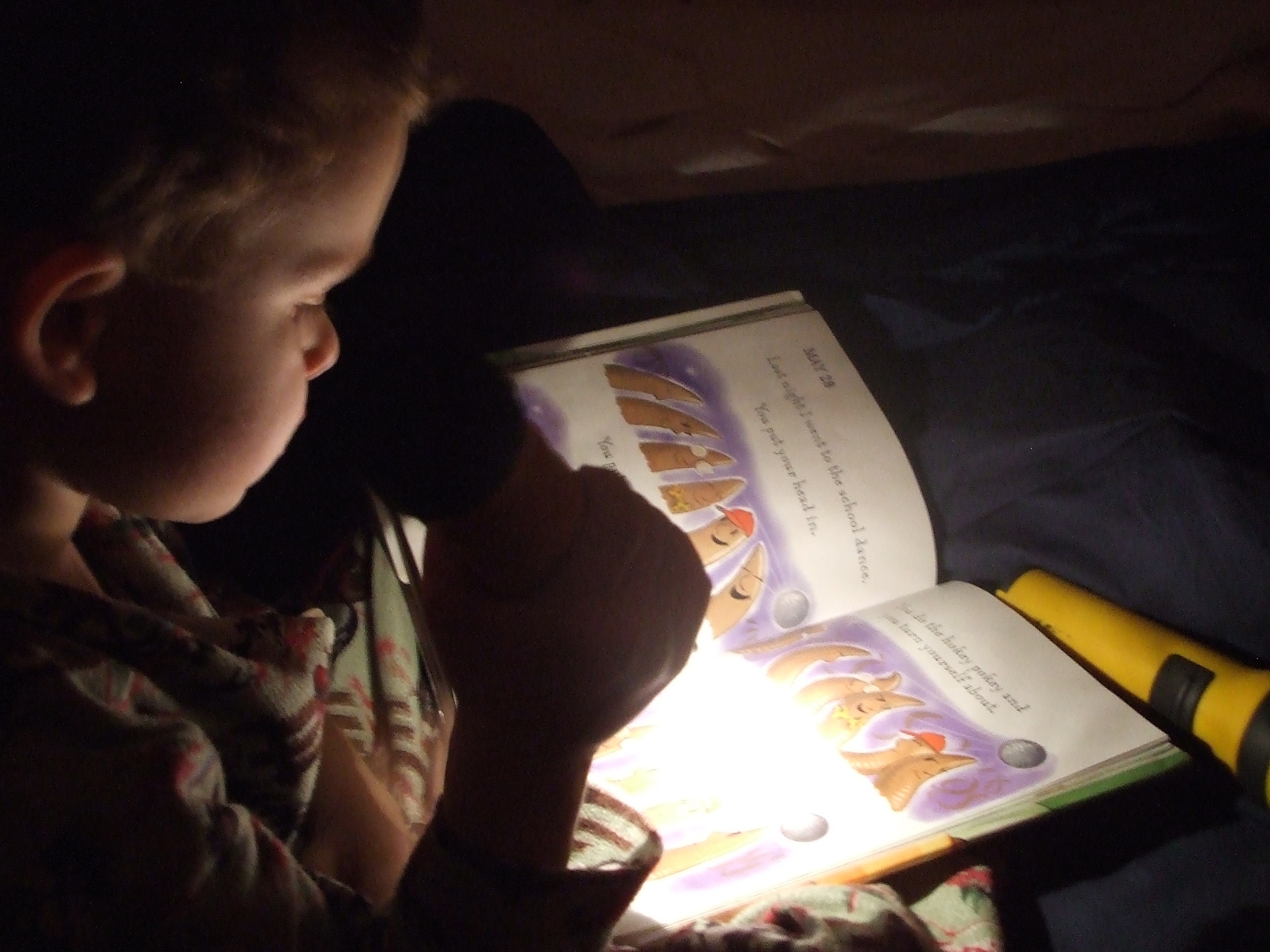
the sweet snap way above is my apple-cheeked boy, caught reading by the light of the double-d battery, long long ago. when he was five, and didn’t mind being the subject of a story.

growing up in a word factory

word factory

dispatch from 02139 (in which every horizontal plane seems buried under sheafs and piles of papers upon papers…)

poor kids.

you wonder — or at least i do, most often when dillydallying before diving in to some writing project that demands utter and undiluted attention — just how it is to grow up in a house where the smoke spewing from chimneys is that of words on fire. where the factory floor is littered not with scraps of leather, shards of porcelain, or snippets of fine cloth (respectable trades, all, the cobbler, the potter, the tailor). but rather everywhere you try to amble, there’s an adjective tossed to the ground. there’s a verb deemed too wimpy cowering in a corner. and there are reams and reams of blah ideas heaved over someone’s hunched-over shoulders.

it’s a veritable word trap here where we dwell.

at this very moment, for instance, the dining room table is awash in a banquet of fist-high papers, with nary an inch for a spoon or a fork. the back office is barred with “do not disturb” tape. only the claw-footed tub might be spared the detritus of the writing biz, the one that seems to be the family obsession, er, occupation.

alas, tis tough having been born a double-byline (we have two), the progeny of two souls who could find nothing more admirable to do with their lives than string words onto clotheslines and call it a day’s toil.

the boys we spawned, that other writer fellow and i, they’ve lived and breathed keyboards since the days they were popped from the womb.

they’ve guzzled mama’s milk to the tip-tap-tap of keys. they’ve drifted off to nap time, lulled by the somnolent shooshing of fingers upon alphabet squares. heck, early on, one of the duo played make-believe with a toy telephone, put receiver to his ear, and promptly proceeded to push aside his mama with a curt, “i can’t talk to you now, i’m talking to my editor.”

he was two.

gulp.

talk about staring your sins in the face.

and so, as i’ve surveyed the landscape around this little aerie this week, i’ve the niggling sense that we might be drowning in words. one of us has hijacked the couch, the afghan, the dining table and all six of the chairs (the better to fan out those vertical files). the other has staked his polar-explorer flag in the icy back office, and, for warmer-upper reprieve, the cozy cove in the kitchen.

which, by my calculations, leaves the poor sixth-grade lad little choice but to hole up on his out-of-reach top bunk when he too decides to partake of the family biz, though in his case he much prefers inhaling to exhaling words. so that’s where we find him these days, when the smoke from the word chimney gets a tad too thick, when he retreats behind his curtainwall of great reads.

is it any wonder the boy is deep-breathing literary wonders at a clip never before clocked in his lifetime? in six short weeks, the once reluctant reader tore through the harry potters (all), then page-turned his way through “the hobbit,” and just this monday and tuesday zoomed through a brilliant tale aptly called “wonder.” (it’s by r.j. palacio, and it’s about a wise-beyond-his-years boy born with a severe facial deformity and his parents’ decision that it’s time to stop homeschooling and, in fifth grade, send him bravely and with much trepidation to ‘mainstream school.’ it’s a book that no less than the wall street journal described as “a beautiful, funny and sometimes sob-making story of quiet transformation”).

which is why one of my best to-do’s of the week was to be the reader lad’s fetcher, to mosey down the lane to the cambridge public library, sidle up to one of the world’s yummiest children’s librarians (and aren’t they all among the yummiest?), pick her brain, and waddle home loaded down with a menu of new word-fattened morsels. (see above.)

in theory, these weeks through here are the january thaw for the brain; in college parlance it’s the stretch known as january term, J term, or inter-term.

only mr. wordsmith and i have decided there’s no time for time-off in our one swift year, so we’re digging in deeper. he is toiling on a book, and writing yet another one in preparation for a class he’ll be teaching for the next two weeks. i am doing what looks like shuffling papers, but really it’s a wee bit more ambitious than that — and a thousand times harder.

so everywhere you go, there are alphabet keys and — shhhhh! — expletives flying. there are pages jamming the printer. and paragraphs clogging the brain.

it’s dense enough around here that i sat down this morning to ask the young lad, the one shoveling oatmeal into his mouth, just how it was to grow up in a house where the family business is words.

said he, “it’s kinda weird.” but then, deeply-versed in the editing process, he asked me to strike that first sentence so he could begin again.

“it’s kind of like everybody’s always picking up the phone cuz they’re on deadline. or running out the door to an interview. or they’re in their office writing like a madman.” [editor’s note: please do note the use of the masculine, madman, not madwoman, proving once and for all that i am not the only off-kilter member of this writing tag team.]

since the lad was on a roll, and had been asked to unfurl a few deep-held words on the matter, he went on with one more complaint before the clock chimed, “STOP, time to chase the school bus.”

that complaint was this: “there’s way too much attention to words. i’m always getting my grammar corrected.”

and so it is, young lad, when you grow up in a house of words, when you’d best not flub your me & him’s, nor your “i choosed the chocolates.” it’s a family sin, and one you’ll not escape unedited.

so sorry you were not born to cobblers. just think, you’d have holey shoes to show for it. instead you’ve nouns and verbs and subjective infinitives pouring from your ears.

poor child.

poor, poor double-byline.

love, your wordy mama

what were the occupational hazards of growing up in the house where you grew up?? 

independent study: the poetry of search

dispatch from 02139 (in which the bleary-eyed one demonstrates that she can rise to fumble with a college paper from 3 till 5 in the morning, return to faux slumber, then get back up and start all over again) …

so here we are, just an hour ago, back before i went to bed the second time, the sky out the front window that looks out over franklin street, and beyond to where the atlantic tickles the shore, it was pitch-black velvet stitched with one french-knot of a star and, dangling just above that, as if buttoned there, one silver crescent of moon.

now, it’s all poufy pink ruffles, backlit in gold, an underskirt of grey inching its way up the legs of the day. the sun rises over boston, over cambridge, over the whole eastern seaboard. the wind in the willows just two yards away, it’s already starting to rustle. the forecast is gloom for today. but when you’re up early, you get the first — sometimes the only — snippets of heaven on earth.

and that’s what i’m looking for here, that’s why i’ve pressed my nose against glass here of late.

oh, i suppose i always knew that behind the story of this trooping off to college, me and my old-fashioned pens and my notebooks (why, i might as well dip quill into inkwell, scritch-scratch my notes onto papyrus, so out-of-date, obsolete, i do seem to be in the land of laptops and iPads), i’d had a hunch that there just might be one other plot line. one other reason for being plucked up and re-planted, half a land mass from home.

i picked up on it early on. back before the start of summer, perhaps, when i first tiptoed through this apartment, spotted the books on the desk of the man who would become my landlord, yes, but more so my lighthouse keeper and guide. he had tall stacks, tomes of poetry, titles that spoke of the sacred. poetry and the divine, it was there in nearly every corner. and i kept poking along.

as i trace my fingers along his bookshelves, in the weeks and months since, i’ve often felt the pull to not leave the apartment, to slide a thin volume off the shelf — any shelf — (there’s wendell berry, thomas merton, a whole thicket of mary oliver, squeezed in between wislawa szymborska, the nobel laureate; there’s e.e. cummings, emily dickinson, and t.s eliot, to run through the c, d and e’s. wallace stevens abounds, as does octavio paz, and a good dash of old robert frost).

i imagine nothing so fine as a seminar for two, if you count bound pages as one half of that pair. i imagine curling up under one of the afghans i’ve pulled from high-above cabinets this week, as autumn’s chill has crept in through the windows. i’ve imagined beginning and launching my poetry school right here where i scramble up eggs, and scrub the sink of its leftover toothpaste.

the school didn’t wait, didn’t dawdle. didn’t put off what october demands (for we pull up stakes, turn back into pumpkins in a mere seven school months).

i knew, back in the summer, that my friend and soon-to-be landlord was writing a book, a book he told me might be the one thing in this world he was meant to make.

the book arrived with a thud on my doorstep this week. it’s titled, “prayers of a young poet: rainer maria rilke,” translated by mark s. burrows.

it’s a beautiful book, a book covered in gold, with a grainy turn-of-the-last-century sepia photo of the great german poet, best known, perhaps, for two works: “letters to a young poet,” published in 1929, and “the book of hours,” in 1905.

“prayers of a young poet” contains, for the first time, rilke’s raw drafts of a cycle of 67 prayers and one long letter written in verse, all penned over the course of three-and-a-half weeks, back in the fall of 1899, in berlin.

they belong, burrows writes, in the genre known as “the poetry of search.”

burrows goes on to tell his afghan-draped pupil that the allure of these prayers is that they give voice to what rilke calls “the stillness between two notes / that don’t easily harmonize.” and there, writes rilke, writes burrows, is where God dwells, within “the dark interval.”

rilke is a poet drawn to the woods, and to the monastery. in these newborn poems, he imagines a monk is the writer, the discoverer of the divine “behind trembling trees,” in the “mushrooms [that] stood up in the forest,” and in the “wet leaves of the blood-red, withering vine.”

but what is pulling me even deeper into the syllabus that spreads across 132 pages is that rilke’s “God,” according to burrows, “is one who is always becoming, ‘the dawning one from whom the morning rose.'”

rilke’s God is not known in intricate trace. rilke’s God is the God of primal darkness, “not sheer absence, but…rather a gesture toward a presence we can ‘sense’ but cannot know.” darkness, burrows writes, is the place of God’s becoming — for rilke, for apostles of rilke.

the poet writes: “I love the dark hours of my being / for they deepen my senses… / From them I’ve come to know that I have room / for a second life, timeless and wide.”

and so, for a student who has dwelled in the murky fog of not knowing for far too long, achingly long, these words come as a trumpet blast of hope.

here, on the pages of a book that landed thwop on my doorstep, i’ve discovered a matchstick to strike in my darkness.

i’m only just 61 pages in, but already i’ve felt its pull, a stirring deep where the pulse begins. i understand that i need to carve out quiet, embroider my days with stillness. it is the poetry of search.

i find it here in the nooks and crannies, the holy sacred rooms this city offers.

in the light-dappled pews of memorial church, on harvard yard, where i slid in yesterday morning, me and my red-strapped backpack, just as the reading began of an amy hempel story that served as scripture.

and, again, just past noon yesterday, when i shoved open the great wood-planked door of the monastery at the bend in the charles river.

i tiptoed in, and found the monks deep in noon song. i fell to my knees on a blue needlepoint cushion. i struck a match, and licked its flame against the wick inside a cobalt blue glass jar.

the blue glowed, a white light of halo within it, behind it. i bowed my head, and did not mind, for once, the not knowing. i am peeling back the poetry of search, and learning that in the darkness of my hours, i just might find what i’ve been waiting for, for so so long.

you can find mark’s rilke book here. who is the author of your most sacred prayer?

must dash (posting this as roughest of  draft); long day of classes, and grammy comes in on the train from portland, maine. big weekend here in 02139.