pull up a chair

where wisdom gathers, poetry unfolds and divine light is sparked…

Category: love of words

reading night

reading night

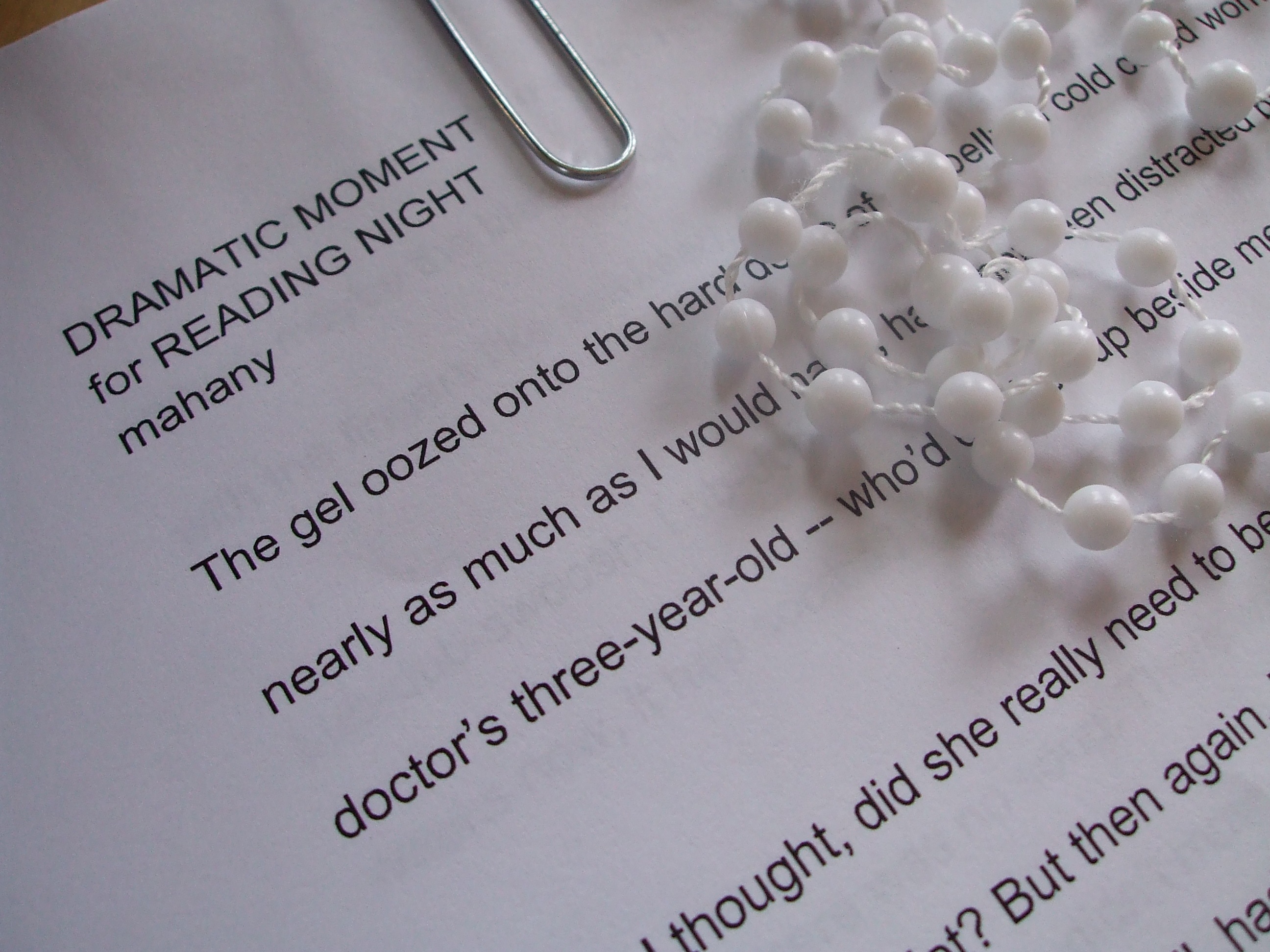
dispatch from 02139 (in which we all circle round, and fellows and co-vivantes engage in a nieman rite of spring, one that prompts us to pull from our pockets one choice passage — scribed this year, and picked just for tonight — that, one-by-one, we will read to the gathered masses. it is a nieman literary tradition, and it has one of us shaking in her reading clogs….thus the rosary beads above…)

long ago, in the leafy shade of my writing room back home, i remember sitting at my old pine table typing a promise to all the beloved “chairs.” i promised to bring you along on this year of thinking sumptuously, and i’ve tried mightily to do that.

sometimes, of course, these dispatches have been placeless, as they’ve captured musings i might have mused wherever i was in the world — a mama’s musings, a mama’s heartaches, moments not tied to any ZIP code. sometimes they’ve been particular to the curious case of going back to college when you’re pewter-haired.

i’ve carried you on a field trip to a poet’s farm in new hampshire, and let you peek in at the volumes piled high on my desk. i’ve tiptoed into the monastery, with you right on my shoulder, and i’ve brought you here to the kitchen when i got to stir a cauldron of chili for a boatful of hungry rowers.

this perfect april’s afternoon — with the just-warming breeze whooshing through the screen door, and the merry finches nibbling from the kitchen-window feeder — i am about to bring you along with me to a big moment on the nieman calendar: reading night.

nothing fancy about the name, nothing fancy about the format.

the framework is this: each fellow and co-vivante (a.k.a. the tagalongs who traipse beside their duly-plucked fellows) is encouraged to sign up to step before the crowd and read one written work they’ve created during their time here in niemanland. twenty-one of the pool of 40 (that would be the 24 fellows plus this year’s 16 co-vivantes) have been slotted to read; i am one.

now, you might not know this about me but i turn to wobbles when called upon to stand up and read aloud. perhaps it dates back to some moment in, say, fourth grade, when i was daydreaming out the window, and sister leonora mary called on me to read, but i had no clue where we were, so the giggles around me rose to a roar, and there erupted a flurry of pointing fingers as deskmates right and left tried to foist me back on track — before sister leonora mary’s rubber-tipped stick thwopped me on the knuckles.

and, while i adore my fellow fellows and each and every co-vivante, this is no crowd for shrinking violets. we’ve got editors from the new york times, a pulitzer winner or two, the founder of the daily beast, a writer from the international herald tribune who regales us with her tales of traipsing in and out of tents of taliban poobahs, where she scores globe-gripping stories. and on and on and, oh my goodness, on.

this exercise in verbal undressing — that’s sure as heck how it’ll feel to me, one of a mere three co-vivantes who’ve signed up to read along — commences at seven bells, just as the sun sets in the western massachusetts sky, and that glorious full moon rises to spill its milky glow on all the cobbled lanes.

the piece i’m reading is one i wrote for a class that might have changed my writing life, the longform narrative writing class, in which i discovered once and for all just how darned hard it is to cobble one majestic sentence, let alone one 10,000-word deeply-reported tale.

this particular assignment was one in which we had to narrate a dramatic moment in our life, and exercise the sublime art of dialing back the descriptives so the power of the moment pulsed through, unweighted by a chain of over-wrought modifiers. it’s all about the verb, we learned and learned again.

“verbs act. verbs move. verbs do. verbs strike, soothe, grin, cry, exasperate, decline, fly, hurt, and heal,” writes poet laureate donald hall in his essential text, “writing well” [9th edition, 2007, pearson longman]. “verbs make writing go, and they matter more to our language than any other part of speech.

“verbs give energy, if we use them with energy.”

you’ll see when you read my humble exercise (just below), why it might feel a bit like i’m standing naked before my writerly fellows.

but, in the spirit of clearing my lumpy throat and trying to shake off the shakes, i offer you the trial run of the hastily-titled, “fading.” (it had no title; heck, it was just assignment #9, but the nieman curator insisted i title it, and the first word that popped in my head was “fading,” so fading it is….)

(the beauty of unspooling it here is you can’t see my wobbly knees, and my fingers aren’t yet ratcheted up into their hummingbird tremble)

FADING

by barbara mahany

The gel oozed onto the hard dome of my belly in cold coiled worms. I flinched but not nearly as much as I would have, had I not been distracted by the three-year-old — my doctor’s three-year-old — who’d climbed up beside me to get a better look.

Really, I thought, did she really need to be clambering around like this was some sort of a hospital tot lot? But then again, I reminded myself, it was a Sunday afternoon, and my doctor, already on call, had told me, just 45 minutes before, “Meet me in Labor and Delivery. Let’s see what’s going on in there.”

Click, someone flicked off the lights. The screen blinked, fuzzy at first, like a black-and-white TV, back in the ‘60s, when the thunderbolts in shades of gray squiggled across the screen before settling into, say, the opening credits of “Twilight Zone,” and my dad whispered, “Shh!”

No one whispered a thing in the murky underworld of the ultrasound room. The screen turned white and nobody — not the doctor, not my husband, not the three-year-old — moved. Least of all, me.

I blinked once, twice, then again. Hoping each time that if I squeezed my lids hard enough maybe the black whorl in the middle would come into focus. The black whorl with the fingers like seaweed, swishing open and closed.

Lub-dub-swoosh. Lub-dub-swoosh. It was the song of the embryonic heart, and, for 15 weeks now, it had soothed me.

This time, there was no song. There was no seaweed. Just an empty black hole. And the white, all around, didn’t move.

“I’m sorry,” my doctor said.

My husband, the father of that baby, withered onto me, his curls mopping my cheeks.

And then — maybe to make sure I’d been scraped of all hope, maybe because to a doctor it was just a curious thing — my doctor pointed to the blurred edge of the baby’s outline, at the crown of the head, down at the toes, where the white wasn’t so crisp anymore. Where the white was pocked with gray.

“See right there,” she said, pointing, “Baby died a few days ago. It’s starting to fade.”

That’s why, for the last couple mornings, the coffee didn’t make me wretch quite so much. That’s why, since Tuesday, I’d been holding my breath every time I walked in the bathroom, afraid to pull down my pants, for the streaks, then the splotches, of blood.

I’d been through this before. But never so late in the game. We were past the first trimester. I’d circled the date — September 22 — on the calendar. Drawn a red heart, actually.

But now I just lay there. Absorbing. Staring at the white part that glowed. I memorized the curve of the head, noticed the nose, how much it looked like the baby’s big brother. I tried not to look at the part of my baby that was already fading.

They sent me home, told me to wait. The baby didn’t wait long. Alone in the night, wailing some primal howl, I cupped my hands and caught my rosy-pink stringbean of a baby, that’s how tiny she was, to save her from swirling into the bowl of the toilet.

***

(this is a not-so-common thursday eve posting, as i’ll be trekking to frederick law olmsted’s stomping ground tomorrow early morn, when i tagalong yet again, this time on a field trip with sweet blair’s “history of landscape architecture” class.)

and, yes, we are all re-catching our breath after the horrors of last week. spring unfolds here in slow time, thanks to chill winds that hover near, and keep the blooms unfurled in suspended animation.

lastly, the rosary beads up above will be in my pocket whilst i read. a sure cure for the shakes, i’ve found over the years.

do you get wobbly when you do certain acts in public? if so, what brings on the wobblies, and what, pray tell, are your tried-and-true cures???

growing up in a word factory

word factory

dispatch from 02139 (in which every horizontal plane seems buried under sheafs and piles of papers upon papers…)

poor kids.

you wonder — or at least i do, most often when dillydallying before diving in to some writing project that demands utter and undiluted attention — just how it is to grow up in a house where the smoke spewing from chimneys is that of words on fire. where the factory floor is littered not with scraps of leather, shards of porcelain, or snippets of fine cloth (respectable trades, all, the cobbler, the potter, the tailor). but rather everywhere you try to amble, there’s an adjective tossed to the ground. there’s a verb deemed too wimpy cowering in a corner. and there are reams and reams of blah ideas heaved over someone’s hunched-over shoulders.

it’s a veritable word trap here where we dwell.

at this very moment, for instance, the dining room table is awash in a banquet of fist-high papers, with nary an inch for a spoon or a fork. the back office is barred with “do not disturb” tape. only the claw-footed tub might be spared the detritus of the writing biz, the one that seems to be the family obsession, er, occupation.

alas, tis tough having been born a double-byline (we have two), the progeny of two souls who could find nothing more admirable to do with their lives than string words onto clotheslines and call it a day’s toil.

the boys we spawned, that other writer fellow and i, they’ve lived and breathed keyboards since the days they were popped from the womb.

they’ve guzzled mama’s milk to the tip-tap-tap of keys. they’ve drifted off to nap time, lulled by the somnolent shooshing of fingers upon alphabet squares. heck, early on, one of the duo played make-believe with a toy telephone, put receiver to his ear, and promptly proceeded to push aside his mama with a curt, “i can’t talk to you now, i’m talking to my editor.”

he was two.

gulp.

talk about staring your sins in the face.

and so, as i’ve surveyed the landscape around this little aerie this week, i’ve the niggling sense that we might be drowning in words. one of us has hijacked the couch, the afghan, the dining table and all six of the chairs (the better to fan out those vertical files). the other has staked his polar-explorer flag in the icy back office, and, for warmer-upper reprieve, the cozy cove in the kitchen.

which, by my calculations, leaves the poor sixth-grade lad little choice but to hole up on his out-of-reach top bunk when he too decides to partake of the family biz, though in his case he much prefers inhaling to exhaling words. so that’s where we find him these days, when the smoke from the word chimney gets a tad too thick, when he retreats behind his curtainwall of great reads.

is it any wonder the boy is deep-breathing literary wonders at a clip never before clocked in his lifetime? in six short weeks, the once reluctant reader tore through the harry potters (all), then page-turned his way through “the hobbit,” and just this monday and tuesday zoomed through a brilliant tale aptly called “wonder.” (it’s by r.j. palacio, and it’s about a wise-beyond-his-years boy born with a severe facial deformity and his parents’ decision that it’s time to stop homeschooling and, in fifth grade, send him bravely and with much trepidation to ‘mainstream school.’ it’s a book that no less than the wall street journal described as “a beautiful, funny and sometimes sob-making story of quiet transformation”).

which is why one of my best to-do’s of the week was to be the reader lad’s fetcher, to mosey down the lane to the cambridge public library, sidle up to one of the world’s yummiest children’s librarians (and aren’t they all among the yummiest?), pick her brain, and waddle home loaded down with a menu of new word-fattened morsels. (see above.)

in theory, these weeks through here are the january thaw for the brain; in college parlance it’s the stretch known as january term, J term, or inter-term.

only mr. wordsmith and i have decided there’s no time for time-off in our one swift year, so we’re digging in deeper. he is toiling on a book, and writing yet another one in preparation for a class he’ll be teaching for the next two weeks. i am doing what looks like shuffling papers, but really it’s a wee bit more ambitious than that — and a thousand times harder.

so everywhere you go, there are alphabet keys and — shhhhh! — expletives flying. there are pages jamming the printer. and paragraphs clogging the brain.

it’s dense enough around here that i sat down this morning to ask the young lad, the one shoveling oatmeal into his mouth, just how it was to grow up in a house where the family business is words.

said he, “it’s kinda weird.” but then, deeply-versed in the editing process, he asked me to strike that first sentence so he could begin again.

“it’s kind of like everybody’s always picking up the phone cuz they’re on deadline. or running out the door to an interview. or they’re in their office writing like a madman.” [editor’s note: please do note the use of the masculine, madman, not madwoman, proving once and for all that i am not the only off-kilter member of this writing tag team.]

since the lad was on a roll, and had been asked to unfurl a few deep-held words on the matter, he went on with one more complaint before the clock chimed, “STOP, time to chase the school bus.”

that complaint was this: “there’s way too much attention to words. i’m always getting my grammar corrected.”

and so it is, young lad, when you grow up in a house of words, when you’d best not flub your me & him’s, nor your “i choosed the chocolates.” it’s a family sin, and one you’ll not escape unedited.

so sorry you were not born to cobblers. just think, you’d have holey shoes to show for it. instead you’ve nouns and verbs and subjective infinitives pouring from your ears.

poor child.

poor, poor double-byline.

love, your wordy mama

what were the occupational hazards of growing up in the house where you grew up?? 

donald hall’s farm

dispatch from 02139, en route to 03287 (in which a flock of fellows and co-vivantes board buses and roll along route 4 into new hampshire, for an audience with a high priest of american poetry)…

back in the faraway house that hums without me now, back in the heat of summer, when the fog was lifting on this year of thinking sumptuously, when i first got a peek at the calendar of what the days and weeks and months would bring, my eye was drawn sharply and swiftly to a little rectangle tucked at the top of the month of october.

it read: field trip to new hampshire farm of poet donald hall.

be still, my hurried heart.

i promise you i am not indulging in the great irish art of embellishment when i tell you i nearly slumped from my chair. i slapped the pine ledge of my writing desk, slapped hard, flat palm against the knotty plank of old french pine. i gasped. i am certain, if memory serves me, i felt a quiver in my arms.

one doesn’t stumble across an invitation to might-as-well-be mecca, the holy place and farmstead of an american poet laureate, just any old friday.

like so many things in my life, i’d come late to donald hall.

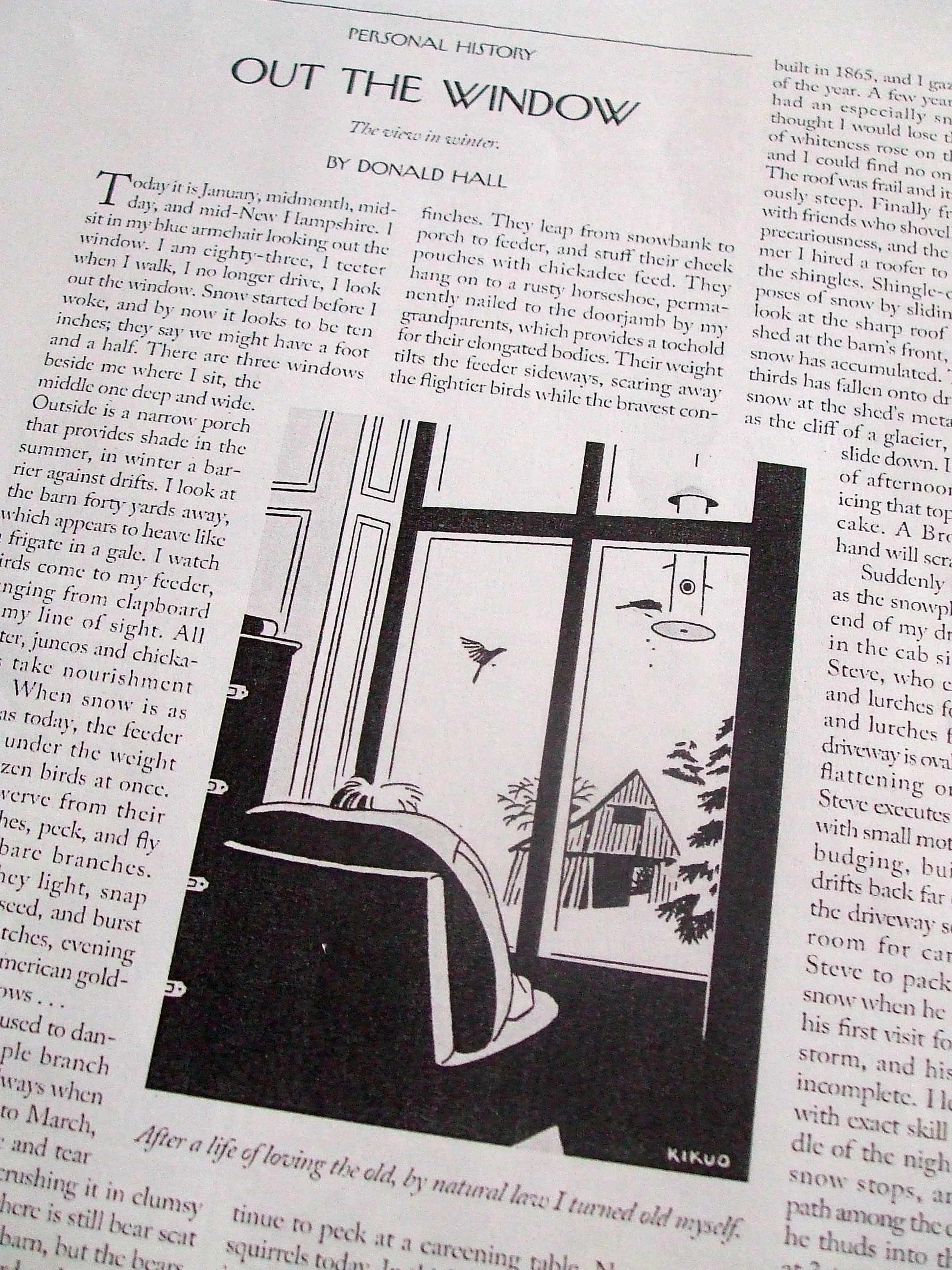
but when i did — stumbling across him in an essay in the new yorker last january, one titled, “out the window,” one you can find here — i sat transfixed by the power of his words.

hall, now 84, was named u.s. poet laureate in 2006, the 14th such poet potentate of the library of congress.

billy collins, himself the poet laureate from 2001 to 2003, once wrote that hall “has long been placed in the frostian tradition of the plainspoken rural poet.”

he has written some 22 books of poetry, at least four biographies, 11 children’s books (most notably, “ox-cart man”), six memoirs, three plays, and more. but it wasn’t till page 40 of the january 23, 2012, new yorker, that i sat up and took hard notice.

he wrote there, straight through to the bottom of page 43, about aging, about growing old in a particular place, his family’s 150-year-old  new hampshire farm, a place he’d long ago committed to memory. knew by heart, by season, by length of light and shadow. knew by fluttering of birds and drifting of snow on the old barn roof.

he wrote words that rocket-launched into my heart, ricocheted around in there, and left me gasping, quite frankly, for air.

take a listen (i’ll offer snippets, a swatch from here and there, all from that one glorious four-page essay)…

“twenty years later,” hall writes on page 41, “my circles narrow. each season, my balance gets worse, and sometimes i fall…my fingers are clumsy and slow with buttons…

“new poems no longer come to me, with their prodigies of metaphor and assonance. i feel the circles grow smaller, and old age is a ceremony of losses, which is on the whole preferable to dying at forty-seven (when his wife, the poet jane kenyon, died) or fifty-two (the age of his father when he died). when i lament and darken over my diminishments, i accomplish nothing. it’s better to sit at the window all day, pleased to watch birds, barns, and flowers. it is a pleasure to write about what i do.

“generation after generation, my family’s old people sat at this window to watch the year. there are beds in this house where babies were born, where the same babies died eighty years later….

“after a life of loving the old, by natural law i turned old myself. decades followed each other….however alert we are, however much we think we know what will happen, antiquity remains an unknown, unanticipated galaxy. it is alien, and old people are a separate form of life…if we forget for a moment that we are old, we are reminded when we try to stand up, or when we encounter someone young, who appears to observe green skin, extra heads, and protuberances.”

i could go on. but, you, please, read for yourself.

check out books from your library. i did. some 17 in all. only just the other day, i checked out two more. and bought one, “life work,” a slender volume i’ll tuck inside my backpack, pull out if i get brave, hand to mr. hall, and ask, shyly, if he’d put pen to a page that is his, but lives on my shelves now.

and since i promised you, long ago, that we would share the glories of this year, i wanted you to have a head start. to spend a swatch of time whirling and swirling inside the poetry of donald hall, while i poke around the clapboard farmhouse, with the narrow porch where the birdfeeder hangs. where, if i’m lucky, i’ll press my nose to the window, deep and wide, where he looks out, keeps watch, as autumn turns to winter, turns to spring, and back to summer.

i’ll drink in the gnarly branches of the maple and the oak, and the “bluing air of afternoon.”  i’ll tiptoe into the cow barn, built in 1865, and scan the hayfields that are the crossbeams and the vaults of a lifetime of pure poetry, born and raised and resurrected in a little town nestled in the mid-hills of new hampshire.

i’ll stand deeply still. inhale and pray. words of thanks, first, for this rare gift. and begging words just after, that whatever’s in the air, the earth, the floorboards, seeps into me, and teaches me to see, out the window, in the ways that mr. hall so clearly sees.

and now, as promised, a few assigned readings:

let’s start with ox cart man, a book that might be tucked on every child’s library shelf.

or this, short one, “the things”

The Things

by Donald Hall

When I walk in my house I see pictures,
bought long ago, framed and hanging
—de Kooning, Arp, Laurencin, Henry Moore—
that I’ve cherished and stared at for years,
yet my eyes keep returning to the masters
of the trivial—a white stone perfectly round,
tiny lead models of baseball players, a cowbell,
a broken great-grandmother’s rocker,
a dead dog’s toy—valueless, unforgettable
detritus that my children will throw away
as I did my mother’s souvenirs of trips
with my dead father, Kodaks of kittens,
and bundles of cards from her mother Kate.

and lastly, though, please don’t stop here…

a poetry corner, where you can curl up, on this fine october day, and drink in the sounds of donald hall in his many forms. please do click on “letter with no address,” written to jane kenyon, his wife who died of leukemia in 1995. you will hear your heart crack.

i promise to post dispatch, post field trip, once we’re back from eagle pond farm, up new hampshire way. if you could visit any poet in the world, who might it be, and why? and feel free to leave a line of poetry here as proof. 

p.s. i realize that if you don’t have a subscription to the new yorker the link above won’t get you directly into the essay, but rather to a bit about the essay. i wish i could get around that, but i can’t. your library will have a back issue of the new yorker, i do believe. if you’re stuck, i will xerox and snail mail. you can send me your address via email. 

the essential shelf

once upon a time, it seemed the end of the week might be a fine time to pull up a chair and ponder the almighty word. relax. get comfy. kick off your workday shoes, plunk your naked toes on table’s edge.

consider the word.

in any form. alone. strung together into something akin to thinking aloud. broken, roughly, into stanza. pressed between the covers of a blessed book. a book you’d grab first thing, should you ever need to dial 9-1-1.

by now, whether you are a regular or a once-in-a-while puller-up of chair, it might have rumbled through your head that, save for clicking on a button, the only real price of admission here is a simple, unadulterated passion for what the linguists call the morpheme. again, standing all alone, a single uttered sound; or strung together, syllable on syllable, root on one of the –fix fraternal twins, pre-fix or suf-fix; or bearing apostrophe or hyphen, the cement of linguists’ possessive and compounding tools.

a word, no matter how you cut it, slice it, tape it back together.

here at the table, words are pretty much our salt and pepper, the very spice, the essence of who we are.

words, it would be safe to say, are the surgeon’s tools with which we poke around deep beneath the skin, pulling back, retracting, examining the places often hidden from ordinary view. words, too, as we’ve suggested in the past, are jungle gym and slide and, yes, the swing set upon which we pump our little legs and point tootsies toward the sky.

i come by love of words quite naturally. words, as much as irish eyes and soulful soul, come to me genetically. from both sides, my papa who typed them for a living, my mama who as often as i can recall was holed away in secluded places, barricaded behind pages of a book that made her laugh out loud, or, sometimes, cry. she claims, though none of us has ever seen, to have a lifelong stash of poetry. free verse. so free it’s captive, under lock and key.

not sated, i married into words. the man to whom i wed my life—son of newspaper editor who, to this day, reads six or seven papers, front page to obituaries, stacks so high i fear the house might soon cave in, and teacher mother who, for 52 years and counting, has championed children struggling to decode long parades of alphabet, turning squiggles into sense, triumphantly ingesting every written line—word by word, we fell in love.

in olden days, before the days of email, we sent surreptitious blurbs of words back and forth across a newsroom. he took my breath away through certain verbs (and, no, not racy ones), left me heart-thumped at the way he furled a sentence. he went on, my wordmate for life, to take home what our 5-year-old at the time called the polish surprise, for the way he cobbled words into thought. thought that at times has left me in tears, the power of its message, the pure poetry of his rock-solid prose.

my life, it seems, is strung together by the syllable.

and some times, oops, i get carried away on winds of words, and ramble on and on, dizzied by the pure delight of watching strings of letters turn to words turn to joy, or, sometimes, crumble into sorrow, right here upon my screen.

my wordly destination today, the place i intended to meander to this morning, is really rather risky. before i even mention where, i must issue a disclaimer: this is fairly off the cuff. you cannot hold me unshakingly to my claims. not forever anyway.

i am proposing that as a gaggle at the table we put forth what we consider the most essential bookshelf. ten authors, ten books, your choice. mix it up. if you only care to offer one or two, that’s fine. we will all set forth with list in hand, and check out the nearest library. we might read and then concur. or we might strongly shout in protest.

i’ll go first. sort of like being the one dared, and dreading, leaping off the dock, into icy waters of the spring-fed lake just before the dawn.

in utterly no order—all right, let’s go with alphabetical—i would stack my shelf with these: dillard, annie; fisher, m.f.k.; heschel, abraham joshua; lamott, annie; maclachlan, patricia; merton, thomas; thoreau, henry david; webster, daniel; and certainly not least, the whites, e.b. and katharine.

dillard for “pilgrim at tinker creek,” and a sentence such as this: “a schedule defends from chaos and whim. it is a net for catching days. it is a scaffolding on which a worker can stand and labor with both hands at sections of time.”

fisher, for making food writing the most essential recipe for life.

heschel for being my guide into the deep rich soul of judaism, and expanding the envelope of what it means to be filled with spirit in any religion.

lamott for making me laugh out loud, laugh ’til my side hurts, and then taking away my breath with a profound irreverent sense of god alive in the darkest hours of our struggling, nearly-broken soul.

maclachlan for “what you know first,” the purest child’s poem–a “grapes of wrath” for tender hearts–that i have ever known.

merton for taking me to the mountaintop, for laying out the poetry of what a catholic soul can sound like, even and especially from inside the silent confines of a monastery named gethsemani.

thoreau, for taking me into the woods like no one else, and for all i’ve yet to learn at the foot of this great teacher.

webster, for being my dearest comrade in the aim to get it right, and for the pure delight of traipsing through his lingual play yard.

the whites, he for charlotte and stuart and just about any canvas to which he brought his richly colored pens; katharine for her views of the garden, for her new england (and new yorker) wit and wisdom, and for being the one who stole the heart of elwyn brooks.

your turn, who’s jumping next?