pull up a chair

where wisdom gathers, poetry unfolds and divine light is sparked…

Category: grief

sodden, sodden week

i come this week with sodden heart, afraid for the world we are (no longer becoming but present in the now), fearful of what’s to come. 

once again, a week of news bulletins, and the voices of mass-shooter psychologists filling the airwaves, unfurling the narrative in their cable-news staccato. i didn’t write of the children of annunciation church two weeks past, because i had no words vast enough to reach the depths of it. and i didn’t want to add empty noise.

but a woman i’ve come to love for the purity of her heart, and her inextinguishable humor (mother of five, breast cancer survivor, sister of a brother who died too young, neighbor of annunciation, and one as likely to freely shed tears as to find the hilarity in the everyday) found out that at the moment the first bullets shattered the stained glass of annunciation church, the children in the pews were just beginning to recite psalm 139. 

one of the most ancient prayers, it begins: 

Lord, you have probed me, you know me:

    you know when I sit and stand;
    you understand my thoughts from afar.

You sift through my travels and my rest;
    with all my ways you are familiar.

Even before a word is on my tongue,
    Lord, you know it all.

Behind and before you encircle me
    and rest your hand upon me.

Such knowledge is too wonderful for me,
    far too lofty for me to reach.

and it includes a line i consider one of the most beautiful of all sacred text: 

II
You formed my inmost being;
    you knit me in my mother’s womb.

I praise you, because I am wonderfully made;
    wonderful are your works!
    My very self you know.

My bones are not hidden from you,
When I was being made in secret,
    fashioned in the depths of the earth.[e]

Your eyes saw me unformed;
    in your book all are written down;
    my days were shaped, before one came to be.

III
How precious to me are your designs, O God;
    how vast the sum of them!

Were I to count them, they would outnumber the sands;
    when I complete them, still you are with me.

When you would destroy the wicked, O God,
    the bloodthirsty depart from me!

Your foes who conspire a plot against you
    are exalted in vain.

i can barely get past the line about being knit in my mother’s womb. and it turns out neither could my friend laura. 

she recites it here, a reading worth hearing, as you absorb the words….

then came this wednesday, and with it an assassination and yet another school shooting. and then, thursday, the twenty-fourth anniversary of 9/11. another tragedy, another thread that over the years has brought its tragedy into full view as a woman i have come to love lost her father in that tower that day. and because i know of the layers and layers of tragedy it brought, it is so much more to me now than a terrible day in our national story. as with any violent death, the shrapnel is of the never-ending sort, carnage upon carnage, year after year. flesh shredded, souls shattered, psyches never ever re-settled. 

and so, this poem, with its title so apt: “Try to Praise the Mutilated World.” mutilated we are, all right. 

this poem, it seems, made its way to light in the immediate wake of 9/11 quite by accident, when the poetry editor at the new yorker, who happened to be reviewing an advance copy of the poet’s newest book (at the time) was asked by david remnick, the new yorker’s editor, to find a poem fitting for a special edition of the magazine to be printed and published within days of the tragedy. it was printed on the last page of that issue, as we all scanned the mutilations that hadn’t yet fully revealed themselves. isn’t that always the case with tragedy? the revelations, not unlike a land mine, explode and explode, unseen until the moment of detonation, whenever that comes. 

adam zagajewski, a polish poet who died in 2021, had written the poem with no particular occasion in mind. over the last two dozen years, it’s become his most famous poem, and a poem often pulled from the files to mark this sad, sad day. his choice of the word mutilation is most apt, a word not too too often pulled into text. twinning it with the verb “to praise,” is wholly disturbing. what is there to praise? maybe the work is in the “try.” maybe that’s the instructive, meant to be just beyond our reach. try to praise….

there is work to be done here. there is always work. and maybe if we can remember june’s long days, and the wild strawberries, and the gentle caring of one stranger for another, we can remember why we must weep at the sound of gunshot, and why we must not surrender. this world, mutilated in so many ways, is still a world rife with wonders. 

might we add but a single drop of sweetness to the bitter, bitter taste in our mouths….

Try to Praise the Mutilated World

By Adam Zagajewski

Try to praise the mutilated world.
Remember June’s long days,
and wild strawberries, drops of wine, the dew.
The nettles that methodically overgrow
the abandoned homesteads of exiles.
You must praise the mutilated world.
You watched the stylish yachts and ships;
one of them had a long trip ahead of it,
while salty oblivion awaited others.
You’ve seen the refugees heading nowhere,
you’ve heard the executioners sing joyfully.
You should praise the mutilated world.
Remember the moments when we were together
in a white room and the curtain fluttered.
Return in thought to the concert where music flared.
You gathered acorns in the park in autumn
and leaves eddied over the earth’s scars.
Praise the mutilated world
and the gray feather a thrush lost,
and the gentle light that strays and vanishes
and returns.
(Translated, from the Polish, by Clare Cavanagh.)


a closing thought from jeremiah johnson, co-founder of the Center for New Liberalism, who writes on his substack Infinite Scroll, where he ponders the politics of posting and the dynamics of the social internet: 

As much as you can, resist the hysteria. Refuse to participate in it, refuse to make the polarization worse. The purpose of liberalism is to allow us to disagree with someone without discriminating against them, without harassing them, without killing them. It’s a precious thing, perhaps the most precious thing our civilization has achieved. Every time you break bread in peace with an outsider, every time a Catholic and Protestant shake hands, it’s a miracle. Don’t take it for granted.

what might you find to praise in this mutilated time and this week of mutilation?

the loads beyond measure

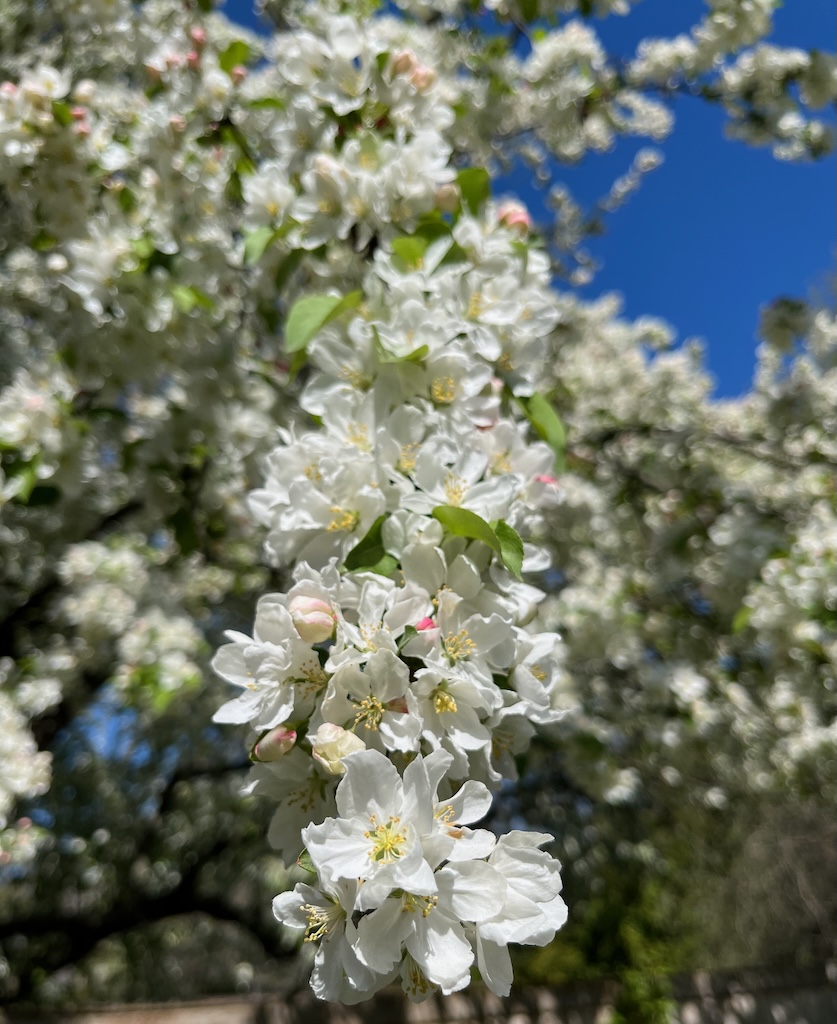
sometimes a batch of words comes tumbling into our world, fluttering onto the path we cross as if the petals from an apple blossom whose bloom has expired. the words come unannounced, and lay there waiting for us to notice. once we read them we can’t think of anything else. all day long, all our thoughts come round to them again and again. 

so it was when a friend whose grief is without measure sent along these words the other morning:

I have been telling myself that I don’t know how to do this, that nothing has prepared me.

i’ve been thinking long and hard about those loads we’re tasked to carry. how every one of us, at some time or another, is bound to have one. a load so beyond measure, a load we never saw coming, it simply stumbles us, knocks us flat and gasping. and in the depth of our hollows — if we’re telling truth — we mouth those very words: “i don’t know how to do this. . . . nothing has prepared me.”

all we see is steep climbing ahead. a load we don’t know how to hold. and all we’ve got to bear it are our stubby shuffling feet, and a ribcage that holds the parts of us that breathe and pump the oxygen. our shoulders and our spine we fear will crumple under the weight of it. 

and then there’s the beehive of a brain, where all the wiring and the worrying, where all the remembering and the grieving and the what-iffing and the if-onlying whirs in and out at every turn in every hour of the day. 

the poet and collagist jan richardson put it like this in her “blessing for the dailiness of grief”:

It will take your breath away,
how the grieving waits for you
in the most ordinary moments.

It will wake
with your waking.

It will
sit itself down
with you at the table,
inhabiting the precise shape
of the emptiness
across from you.

It will walk down the street
with you
in the form of
no hand reaching out
to take yours. . . .

but here, maybe, is what we need to remember, to bear the load we’re sure will finally be the one we cannot budge or bear: our whole life long, we’ve been preparing. every hurt and insult hurled our way. the time in third grade when we cried because the kid one desk over made fun of our clunky shoes. but, next morning, we tied their laces into bows and we walked back in the classroom, and sat there all day long, learning how it is to become more than the stubby shoes that were not penny loafers. the time in high school, when someone in the hall pointed at us and said our face looked like someone smashed us flat against a wall. and it stung for weeks after, every time we stood before a mirror and turned this way and that to measure just how flat our irish face really was. 

and then the big ones come: the time the doctor walked up to the knot of us coagulated in the hospital corridor, and simply said, “i’m sorry.” and we were left without air in our lungs, and with the sudden senseless knowing that the brightest light in our existence had just gone dark. forever.

or the night the clots kept coming. and at last the tiny, tiny arms and legs, the intricately blessed face i’ll never forget, as the baby i thought i was having was cupped in the palms of my bloody hands, the miscarriage that hurt the most. 

the litany is plenty long. and we sometimes never notice just how much each ache is strengthening the fibers of the muscle group without a name, the one that holds us up — yes, wobbling at first; yes, stained with umpteen tears; yes, with sleepless sleepless night — but the one that, in the end, does not fail us. 

we are stronger than we know. and, all along, we’ve been piling on the sinew, deepening the courage, deep breathing the determination, to look that unbearable load square in the eyes, to say, “climb on. i’ll carry you.”

just watch. 

and then, at last, there comes this (jan richardson again, this time “blessing of breathing”):

That the first breath
will come without fear.


That the second breath
will come without pain.

The third breath:
that it will come without despair.

until at last . . .

When the tenth breath comes,
may it be for us
to breathe together,
and the next,
and the next,

until our breathing
is as one,
until our breathing
is no more.

my dear and blessed friend, and all who bear loads they deem unbearable, you do know how to do this. deep in your marrow, you know. your whole life long you’ve been growing strong and stronger. you’ve got this, and you’ve got this. and if and when you stumble, we are here with our simple grace and our love that will not falter. 

where did you find the strength you did not know was yours?

PS (note the all caps!): it’s the birthday sunday of one of the wise women of the chair, our very own lamcal, and i can’t gather up enough love in my bouquet to sufficiently surround her. she is beyond measure! happy blessed day, beautiful one. xoxox and happy mothering day who all who love in that way that knows no end….

amid the dizzyings of springtime…

i imagine it’s been well-established that i am of the homebody persuasion. the sort of girl who thrums inside the cozy confines of space and time i know by heart. to plop behind the wheel and point myself in a direction i’ve not been is, well, to stretch me. to accelerate the tempo of my little heart, to bring on the rumblies in my tummy. and so it was as i set out for The Driftless (a topography that deserves every drop of its capital consonants) a week ago today.

for starters, i got lost. yes, yes, after dutifully trying to follow my index-card directions through country roads and farmer fields, i decided maybe it was safer to let the little voice tell me where to go rather than glancing down and trying to find the numbers i had scribbled. well, news flash: there are TWO mineral points in ol’ wisconsin, and the one i was steered toward was the one in otherwise unmarked farrow field. that little voice announced, “you’ve arrived. your destination is on the right,” whilst i looked up and saw literally nothing but an undulating plot of shaved-off stalks. hmm. this must not be, i intuitively surmised.

i was miles from nowhere, and 67 miles from where i needed to be. where the world’s loveliest host had a turkey meatloaf in the oven, and asparagus steaming in a skillet. ah, but in due time, rollercoastering along country roads, past baby calves (yes, i know it’s redundant, but i like to say it that way) all gathered under little calf-ling igloos, which must be the latest in dairy husbandry for each baby calf had its own domed shelter, and a place to escape the drifting snows, past rock formations that felt prehistoric or laid there by ancient peoples, through towns that time forgot and that i prayed still stuck to old ways, and not the toxic juice that’s infected so very much of old america, i pulled in the gravel lane that was my destination.

and, from the first footfall inside the charming farmhouse, i was home. daffodils and aldo leopold awaited on the bedside table, and the bed itself was a cloud of comforters. each morning that sunrise above greeted me from the kitchen windows. and each morning, it took my breath away, and filled me with holy airs.

the folks i met were as fine and fluent in the poetries of earth as any souls i’ve met along my way. i met a farmer who plows his field with draft horses, and writes letters back and forth with wendell berry (be still my heart!). and another farmer who used to cook at chez panisse. (yes, that chez panisse, the one in berkeley CA, where alice waters revolutionized the kitchen.) i scrubbed pots and pans beside a woman whose heart must pump in gold. and i heard tales of keeping watch on eagles’ nests.

and then, come sunday morning, after hiking through the woods, and talking books in a charming indie book store (where croissants were rising in the ovens behind me), i took to the pulpit in a little country church to deliver what you might call the sermon, but which the priest referred to as a “reflection” since i’ve not passed the sermon-licensing exams. and as i wove threads from the doubting thomas gospel and the book of nature’s sometimes tangible God, i looked out on a congregation of fine souls who were listening in a way i’ve never known: heads cocked, a posture of deep attentiveness, eyes on the pulpit, you could hear a pin drop in that blessed church. and i saw how good souls are hungry for a word of wisdom with their sunday-morning coffee. if this is church, and i do believe it is, may we become a people who know to carve out time to put down phones, dial down the pings, and find our way to wherever it is the holy wisdoms come.

not an hour later, the whole adventure in soul-stretching reached its crescendo when every last soul at the basement coffee hour stood and raised an arm toward me, or laid a hand on my shoulders, and at the behest of the priest, father christian was his name, blessed me with a prayer that had me all but gulping back a walloping sob. when i felt the tiny hand of father christian’s little boy, a kid with special needs, squeezing my left arm, i really truly nearly lost it, as they say. instead, i held his hand and together we squeezed and prayed all the way to the last amen.

and then i motored home, not quite the way i got there. and forever deepened and shifted by the glorious goodness of my new friends who dwell in the driftless.


i came home, of course, to sunlight-blocking moon, and a garden erupting in springtime’s accelerandos. and i spent a good bit of week deep-breathing all of that, and getting mighty muddy too. but i also came home to friends who are grieving inconceivable losses. and when i found this prayer-poem from jan richardson, i knew i needed to pass it along. so, here, too, for all of you is a poem to keep for when grief comes to you or someone you love, or even someone you might not know too well at all. jan is a poet, artist, ordained minister in the united methodist church. i was introduced to her years ago now, by my very own night chaplain (slj to all of you, a regular visitor here at the chair). and as jan’s life was torn open by the sudden death of her husband, she has only deepened. and her work all the more mesmerizing. this is from not long after the death of her husband, when she was coming up on her first valentine’s day without him. her words are among the truest i’ve ever read. she is pure blessing.

Image: Valentine © Jan Richardson

Blessing for the Brokenhearted

There is no remedy for love but to love more.
—Henry David Thoreau

Let us agree
for now
that we will not say
the breaking
makes us stronger
or that it is better
to have this pain
than to have done
without this love.

Let us promise
we will not
tell ourselves
time will heal
the wound,
when every day
our waking
opens it anew.

Perhaps for now
it can be enough
to simply marvel
at the mystery
of how a heart
so broken
can go on beating,
as if it were made
for precisely this—

as if it knows
the only cure for love
is more of it,

as if it sees
the heart’s sole remedy
for breaking
is to love still,

as if it trusts
that its own
persistent pulse
is the rhythm
of a blessing
we cannot
begin to fathom
but will save us
nonetheless.

—Jan Richardson

This blessing appears in Jan’s book, The Cure for Sorrow.

gremlins seem to be lurking here this morning, so let us see if we can fling this to the cyberwires that carry this from my kitchen table to yours. question for the day, besides “will this work?” is where did you find holiness this week? 

and here is a special wink and nod for the great good souls i didn’t get to mention above: the glass sculptor who sailed the world before planting herself on high street, in downtown mineral point. the ones who’d taught for years and years in alaska before sinking deep roots in driftless loam. the bibliophile who opened an indie bookstore, and thought to attach a cooking school besides. and most of all to jane, my storytelling hostess whose graces left me nothing short of gobsmacked.

of thin places and the deep soul of my ancient peoples

i remember perfectly the first time i heard mention of a “thin place.” i was on holy ground, a farm smack dab in the middle of abe lincoln’s homeland. beau’s farm was the name of the farm, an organic farm, an organic farm that rose from an almost impenetrable shadow of grief. deep grief. beau was a marine, a strapping handsome fellow, who died down the road from the farm, home on leave from iraq, when he drowned. his mother, a woman i’ve come to love dearly, once told me that losing beau was “just like being hung, that moment when they pull that thing out from under you,” when the sheriff comes to the door, rings the bell at just past dawn to break the news.

beau’s mama was lost to grief for two long years. but then, she told me, she started to notice little beauties. she’d toss an old dried plant to the ground; and it’d grow.

“it dawned on me, after all those months, i was noticing beauty,” she once told me as we walked the gravel drive to where the peacocks pecked and strutted in their pen. and as i once wrote in the pages of the chicago tribune, “that’s when she realized. realized maybe the one place where she could plant her sorrow, turn it into something beautiful, something lasting, was the almost seven acres that surrounded her old white resurrected farmhouse. . .”

terry starks is beau’s mama’s name; she lives up in maine now, where she still turns earth and life into something beautiful, something lasting.

terry starks was the first to tell me of thin places. she told me the hay loft in her barn was where she went to cry when the tears seemed to have no end. she told me she was drawn there because the loft was surely a thin place, a place where the veil between heaven and earth is lifted. where you can all but feel the arms of God reaching out toward you.

it’s the celts who see the world that way, who know that ours is a topography of the sacred. who live attuned to soulful rhythms most others miss.

i remember sitting on the porch swing at beau’s farm, as beau’s mama poured her hard-won wisdoms as if a pitcher without bottom. i absorbed more gospel that day on beau’s and beau’s mama’s farm than i’ve absorbed most days of my holy blessed life.

ever since, i’ve been drawn deeper and deeper into the wisdoms of the celts, a holy people who traipse the hills and vales and rocky shorelines of my ancient roots.

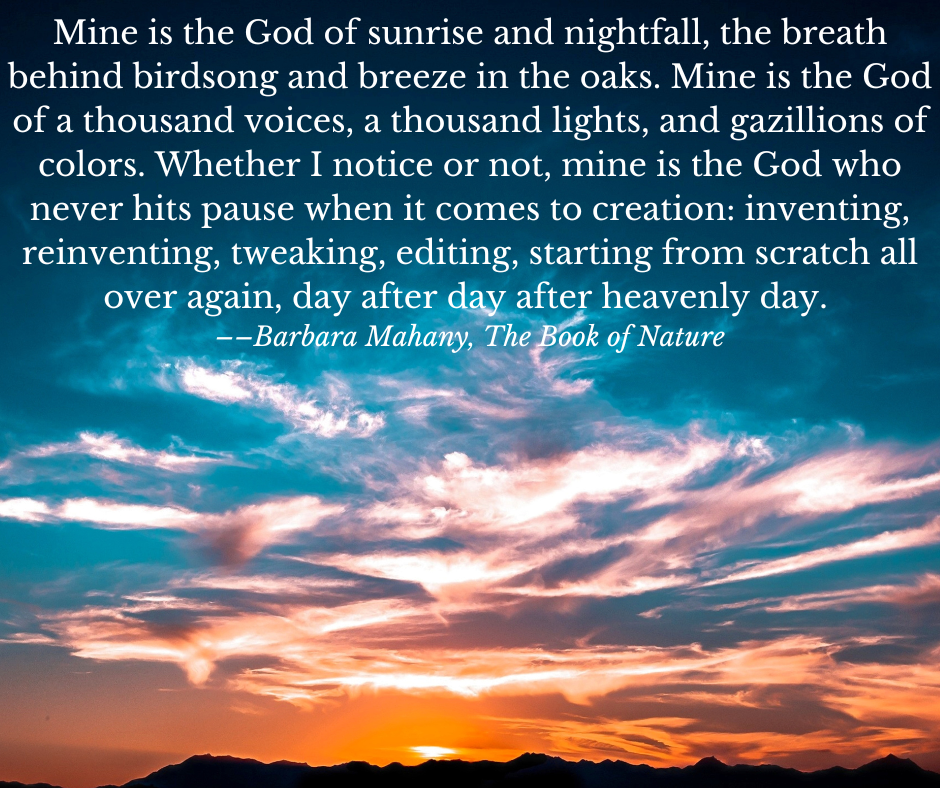
because today happens to be a day when plenty of folk haul out green beer and soda bread, i decided to haul out just one of many passages from The Book of Nature, my little book due to be birthed just the other side of the weekend, on the vernal equinox, day of equal light and shadow, when all of us might look upon each other’s faces for the very first time, reason to rejoice if you ask me. it’s a passage from a chapter on the dawn. and i picked the photo way up above because i took it on the day i drove to beau’s farm, and it fits blessedly with how the celts see the sun. and because i was thinking of thin places, i decided to tell terry’s tale as the long way in to how the celts have taught me so very many things. thin places, among the litany.

here tis. . . a passage from The Book of Nature…

God was considered “the Sun behind all suns,” as the author George MacLeod once wrote. The whole of creation was dappled with the light of the sun as it journeyed across the sky. Wherever its light fell, there was God filtering through, an earthly translation of the divine infusion. And the perpetual Celtic praise song rose up with the dawn. Celtic gentlemen—farmers and herders and fishermen, set off to work in the predawn darkness—doffed their hat at the first light of the sun, and bowed in blessing. The Carmina Gadelica, a collection of Gaelic prayers and chants, is filled with start-of-day blessings, as the Celts were wont to offer up benediction for every chore and implement and God-given element of every day, from milking to weaving to shearing the sheep, from fire to wind to sprinkling of water. And certainly for the miraculous return of the morning’s first light. Mystic and teacher Alexander Scott, who grew up in the west of Scotland and kept Celtic ways alive in his nineteenth-century books, wrote that his were a people “listening for God in all things, ‘in the growth of the tree, in the rising of the morning sun, in the stars at night, and in the moon.’” 

–Barbara Mahany, The Book of Nature


of the many, many stories i wrote over the almost 30 years, the story of beau’s farm was one of the ones i hold closest to my heart. here’s a link, should you care to read it. with love, from terry’s scribe. (apologies if you need a subscription to open the link.)


thanks to a friend i love with my whole heart, i stumbled on another wise soul with buckets of beauty to grace the world. a poet-activist-performer named andrea gibson, now a cancer survivor whose words might take your breath away. andrea identifies as queer, and uses the pronoun “they;” and they are known for their trademark honesty and bare-naked vulnerability, traits i find irresistible and blessed beyond words. here are just a few lines i couldn’t keep from scribbling down:

when it comes to hearts i want always to be size queen…

i love you because we both showed up to kindness tryouts with notes from the school nurse that said we were too hurt to participate….

when your heart is broken, you plant seeds in the cracks and pray for rain.

before i die, i want to be somebody’s favorite hiding place, the place they can put everything they know they need to survive, every secret, every solitude, every nervous prayer, and be absolutely certain i will keep it safe. i will keep it safe.

andrea gibson

one more morsel for this blessed day, a poem from billy collins, once poet laureate of the united states, and a poet with plenty o’ irish roots . . .

Questions About Angels
by Billy Collins

Of all the questions you might want to ask
about angels, the only one you ever hear
is how many can dance on the head of a pin.

No curiosity about how they pass the eternal time
besides circling the Throne chanting in Latin
or delivering a crust of bread to a hermit on earth
or guiding a boy and girl across a rickety wooden bridge.

Do they fly through God’s body and come out singing?
Do they swing like children from the hinges
of the spirit world saying their names backwards and forwards?
Do they sit alone in little gardens changing colors?

What about their sleeping habits, the fabric of their robes,
their diet of unfiltered divine light?
What goes on inside their luminous heads? Is there a wall
these tall presences can look over and see hell?

If an angel fell off a cloud, would he leave a hole
in a river and would the hole float along endlessly
filled with the silent letters of every angelic word?

If an angel delivered the mail, would he arrive
in a blinding rush of wings or would he just assume
the appearance of the regular mailman and
whistle up the driveway reading the postcards?

No, the medieval theologians control the court.
The only question you ever hear is about
the little dance floor on the head of a pin
where halos are meant to converge and drift invisibly.

It is designed to make us think in millions,
billions, to make us run out of numbers and collapse
into infinity, but perhaps the answer is simply one:
one female angel dancing alone in her stocking feet,
a small jazz combo working in the background.

She sways like a branch in the wind, her beautiful
eyes closed, and the tall thin bassist leans over
to glance at his watch because she has been dancing
forever, and now it is very late, even for musicians.


nothing would delight me more than to see some of you, or all of you, come tuesday night, when i am shoving aside my worries about stepping up to speak in front of a crowd any bigger than the one or two who might share this old maple table on any given morning. we’ll gather to mostly rejoice in what’s become a holy sacred bond, one woven over time, through shared wisdoms, devoted kindness, good grace and humor. and i promise to read one or two passages from The Book of Nature, and even talk a little bit about how it came to be. it’s the first of my five books that wasn’t first birthed here, but its pages are filled with wisdoms learned here, steeped here, refined here. so you all have a thread in the whole cloth it became. and i can imagine no finer benediction than to begin the book with you. so see you tuesday, march 21, the vernal equinox at 7 p.m. chicago time.

now, what celtic wisdoms fuel your every day? and where are the thin places in your life where the veil between heaven and earth is at its thinnest, and you too feel it lifted for a blessed glance of the sacred beyond?

when it comes to hearts, i always want to be known as size queen…

hometown horror

highland park, illinois, a town at half-mast: photo by Charles Rex Arbogast/AP

because i am very much still under the avalanche of proofing pages, and still absorbing the granular stories of the mass horror in highland park, the little town where i grew up (it was the next town over, but it was always way more hip and happening than my sleepy little deerfield where the candy counter in the corner drug store was about the biggest action in town), i am keeping it short here today. i’d wanted to share the cover of my new little book, but that will wait, as i feel no impulse toward turning that page.

i don’t know if i can find words yet for sitting in front of a tv, watching a landscape you’d know with your eyes closed, be rattled with war-grade acoustics, the sound of an assault weapon ringing in the canyon of shops where i bought my first communion dress, where we always went for the buttercream roses on birthday cakes, where Fell Shoes was the place to go for capezio’s, the ballet-like flats i once got in the color of a soft summer sky. 

highland park was where my dad died, and where my littlest brother was born. highland park was where we raced when any one of us fell from a roof (two of us did), our bones broken in bits. highland park was where i went every saturday morning, all through high school, in my red-striped jumper that made me “a candystriper” (a volunteer helper of nurses). and highland park hospital’s emergency room was where the trauma teams raced on the fourth to tend to the grievously wounded, seven of whom have died. i’ve walked those halls, sat in those hard plastic chairs, for nearly every trauma in my growing-up family. 

photo by Brian Cassella/Chicago Tribune

i now know that you only hear the finest-grain stories, the ones that might never be washed from the wounds, in the hours and days after the news trucks turn out their lights and lumber away. i know that you hear from your across-the-street neighbor about the someone who died right before her friend’s eyes. i know you hear about the sixth-grade teacher of the shooter, who worked all year to get him some help, as she could see then how troubled he was. i know you hear about the four little kids now sleeping in bed with their mama and papa, too afraid to be alone when the lights go out. and how one of those four is literally shaking, a tremor of fear so deep it hasn’t yet gone away.

i now know that the headlines barely brush up against the whole of the horrors, and the horrors play out in terms so deeply human, so shatteringly broken, you know the pieces will never get put together again. 

so how must it feel to live in a place where gunshots ring out all the time, and news trucks never come, and no one even thinks to gather up the stories of the echoes of fear, of brokenness? 

and why aren’t we stopping this madness? why are AK-47s, those very numbers tattooed on the face of the shooter, seen as the farthest thing from the mind of the revolutionary farmers and statesmen who set about to author a nation of freedom, a place where life, liberty, and the pursuit of happiness seemed to be a central proposition? 

there is no happiness in the little town where i grew up. and the freedom to walk without fear––it’s the latest extinction in a land swiftly losing its grip.

if you’ve thoughts or something you need to exhale, exhale here. otherwise, know we’re encircled in the silence of shared communion. see you next week.

in memoriam…

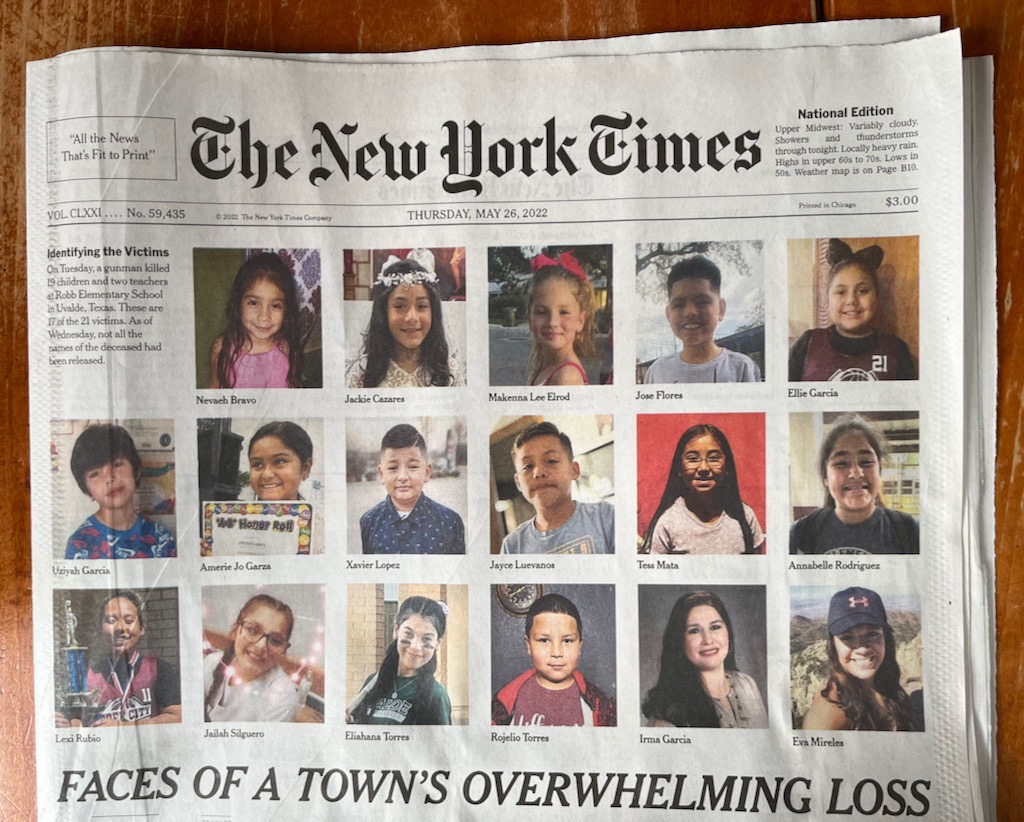
you might want to look away. but the horrors of the last two weeks demand we do more than pause and pick right up again. this week, the place was a school in a small town in texas, a fourth-grade classroom the site of the worst of it. ten days before, it was a supermarket in buffalo, new york.

ever since my second or third day on the job at the chicago tribune, i’ve been writing obits, those few short sentences or maybe a handful of paragraphs in which we try to capture the essence of who someone was. it’s a record for the ages, ones that used to be pasted into the pages of a family album, or carefully scissored out of the paper and tucked in the page of a bedside book or a bible. or a wallet. the ones in wallets always choked me up the most, when years later someone would pull out from their purse or their back pocket a worn leather billfold, and know right where to reach for the newspaper clipping of someone they’d loved. sometimes you found out the words you wrote in a newspaper stuck around for a very long while.

i’m afraid the someones who can change things are looking the other way, too many of them. and i won’t make even a ripple sitting here tapping out postage-stamp-sized obits for each of the 32 souls now departed, now torn from the ones they so dearly loved, the ones they would have clung to, if given half a chance. but to read of the simple quotidian joys, to assemble the notes of how and for what they were remembered, was and is a devotional gesture. it’s a genuflection in short sentences, a way to begin to absorb the hell we have wrought here.

no one should have to worry that running into the store for strawberries for shortcake might be our very last act. or that hiding in the closet of your fourth-grade classroom will be the place where you take your very last breath. something is wrong here. very very very very wrong. something is twisted and cruel and the drip-drip-drip of it all is anesthetizing, a toxic numbing takes hold. you can start to not notice.

the postage-size stories that follow are what i could find on each of the 32 victims, those from uvalde and those from the massacre in buffalo. it’s a long list, and you might not make it to the end. i’m writing it anyway. because to tell even a wisp of their stories is to begin to make real the horror of all that’s lost. their stories are utterly ordinary, a fourth-grader who swooned for a second baseman, a grandpa who ran in a store for a birthday cake.

yesterday’s news snapped into the sharpest focus the dimensions of grief we can’t grasp: the husband of one of the two uvalde teachers died of a massive heart attack in the wake of his wife’s murder. they’d been together for 24 years; high school sweethearts who married, and had four children. that’s what grief can do.

here are their stories, first the children and teachers of texas, and on to buffalo and the ten who died there…

In which, in a posture of reverence, we pause in silence to first hold up each of the 22 blessed ones who died in the massacre at Robb Elementary School in Uvalde, Texas….

Here’s the little we know:

Irma Garcia, 48, a fourth-grade teacher at Robb Elementary, a mother of four, had been married to her high school sweetheart, Joe, for 24 years. Irma died in the slaughter inside the school. Joe died of a fatal heart attack on Thursday. Their four children, two sons and two daughters, range in age from 12 to 23.

Eva Mireles, 44, a fourth-grade teacher who co-taught with Irma Garcia. Her daughter Adalynn posted this on Twitter on Wednesday: “Mom, you are a hero. I keep telling myself that this isn’t real. I just want to hear your voice,” the tribute read. “I want to thank you mom, for being such an inspiration to me. I will forever be so proud to be your daughter. My sweet mommy, I will see you again.”

Amerie Jo Garza had just turned 10. She tried to use her cell phone to call police during the shooting. Her father, Angel Garza, is a medical aide who rushed to the school, and he told this story to CNN: 

After arriving at the scene, he saw a girl covered in blood who told him that someone had shot her best friend. When Garza asked who her best friend was, the girl replied, “Amerie.” His daughter.

“I just want people to know she died trying to save her classmates,” said Amerie’s father. “She just wanted to save everyone.”

Xavier Lopez, who was 10, had just been lauded at the school’s honor roll ceremony. He was funny, never serious, and he had a smile….a smile, his mother said, she would “never forget.”

Uziah Garcia, also 10, and “full of life.” He loved anything with wheels. “The sweetest boy that I’ve ever known,” said Uziah’s grandfather.

Jose Flores Jr., 10, loved baseball, video games, and was “an amazing big brother,” especially to his baby brother. “He would just be like my little shadow,” Jose’s mother, Cynthia, said. “He would just be helping me with the baby. He had a thing with babies, like my friends’ babies. He just had a thing with babies. He was always nice.” His sister, Endrea, was in another fourth-grade classroom. She survived.

Lexi Rubio, 10, made the All-A honor roll. She loved baseball and basketball and wanted to be a lawyer when she grew up. “Please let the world know we miss our baby,” said her father through tears. “All I can hope is that she’s just not a number. This is enough. No one else needs to go through this.”

Tess Marie Mata, 10, had been saving her money to go to Disney World, according to her sister, Faith. She loved Ariana Grande, TikTok dances, and the Houston Astros, especially second baseman José Altuve.

Nevaeh Alyssa Bravo was 10. She put a smile on everyone’s face. Navaeh is heaven backwards.

Eliana ‘Ellie’ Garcia was 9, just about to turn 10. She dreamed of becoming a teacher, but in fourth grade she loved the movie “Encanto,” cheerleading, and basketball. She was the second oldest of five girls in her family.

Annabell Guadalupe Rodriguez was 10. She died in the same classroom as her cousin, Jacklyn Jaylen Cazares.

Jacklyn Jaylen Cazares, “a little firecracker,” according to her father Jacinto, was “full of love and full of life. She would do anything for anybody.” She was 9, and died in the hospital almost three hours after the shooting.

Eliahana ‘Elijah’ Cruz Torres was 10. “Our baby gained her wings,” said her aunt Leandra Vera.

Jailah Nicole Silguero was remembered as “a bespectacled 10-year-old,” whose mother Veronica Luevanos posted updates to Facebook all through Tuesday night into the wee hours of Wednesday. She’d started posting in the hours when she didn’t know what had happened to her daughter, and she was begging for answers. When Jailah’s mother finally found out, she wrote: “I’m not ready for this,” with an image of a broken heart, and a link to Jailah’s obituary. Just before 3 a.m., Veronica wrote: “I’m so heart broken.” Later she added: “My baby you didn’t deserve this neither did your classmates. R.I.P my beautiful angel.”

Jayce Luevanos, 10, whose cousin Jailah (above) was also killed, lived with his grandfather, and every morning Jayce made his grandpa a pot of coffee. 

Miranda Mathis was 11, and very smart. Her best friend was her brother, who was in another classroom when the gunfire broke out in Miranda’s classroom.

Makenna Lee Elrod was 10. She loved to dance and sing and she “made friends everywhere she went.” She was beautiful, smart, and funny, and her smile “would light up a room.”

Layla Salazar, 10, won six blue ribbons at her school’s field day. Her father, Vincent Salazar, shared a video of his daughter on Facebook; he captioned the video: “Run with the angels baby!”

Alithia Ramirez had just turned 10. When her parents welcomed Beto O’Rourke into their home in the hours after the shooting, birthday balloons and her artwork were still taped to the walls. “They want the world to know what a beautiful, talented, happy girl she was,” O’Rourke wrote.

Maite Rodriguez’s age is unknown at this time, though there is a photo of her proudly holding her honor roll certificate in front of the school banner. Her mom’s cousin, Raquel Silva, wrote on Facebook, on behalf of Maite’s mother, Ana: “It is with a heavy heart I come on here on behalf of my cousin Ana who lost her sweet baby girl in yesterday’s senseless shooting. Our hearts are shattered.”

Rojelio Torres, who was 10, was not identified nor his family notified till almost 12 hours after the shooting. His aunt Precious Perez told a local TV station: “We are devastated and heartbroken. Rojer was a very intelligent, hard-working and helpful person. He will be missed and never forgotten.”

and, just 10 days before, 10 more lives gunned down in the aisles of a grocery store.

Pearl Young, 77, a grandmother to eight, spent every Saturday morning volunteering at a food pantry run by her church. A “strict but loving” mother, she still worked as a high school substitute teacher. She was, her son Damon Young said, “full of joy. She just loved life, and she loved the church.” She’d stopped at the Tops Friendly Markets after going out to breakfast. Her son was going to pick her up, but suddenly her text messages stopped, and Damon’s phone filled instead with news alerts about the hell unfolding inside the store.

Ruth Whitfield, 86, was “a blessing for all those who knew her,” said her son, the retired Buffalo fire commissioner, Garnell Whitfield. Ruth had stopped at the Tops after caring all day for her husband of 68 years in the nursing home where he now resides. She was the mother of four, and doted on her family––especially her husband, constantly cutting his hair, ironing his clothes, dressing him and shaving him. “There’s very few days that she did not spend time with him attending to him,” her son said. “She was his angel.”

Andre Mackniel, 53, went to the Tops to get a birthday cake for his son. He was “selfless and generous,” a loving father and grandfather who used “to check in on everyone.” On Facebook, Mackneil’s fiancee wrote this: “Today my baby was born but today my soul mate was taken. How do I tell my son his daddy’s not coming home? How do I as a mother make it ok? Someone please tell me because I really don’t know,” she wrote.

Katherine ‘Kat’ Massey, 72, “the glue” of her very close family, had stopped at the Tops and asked to be picked up in 45 minutes. When her brother came by to get her, he saw police putting up crime tape. She sometimes wrote for the local newspaper, and one of the topics she was most concerned about: guns.

Celestine Chaney, 65, was described by her son as a “survivor,” who twice had survived brain aneurysms. Her son, Wayne Jones, said that when he was 12, he was twice called out of school to rush to the hospital, where he was told his mother wouldn’t make it through the day. His grandmother, he says, made him “go to the foot of the bed and pray.” She later survived breast cancer, but she didn’t make it out of the grocery store. “She was a beautiful person, a spunky, independent woman,” Jones said of his mom. “The life of the party, just a joy to be around.”

Margus D. Morrison, 52, was a school bus aide, a lovable guy who liked to joke. His younger brother Frederick, who said the two were “tight like best friends,” couldn’t find many words in the wake of the killing. But he did say this: “It hurts me so much right now because I wasn’t expecting to lose him.”

Heyward Patterson, 67, was at the Tops because he often drove members of his church to the store, helping them load their groceries, and then taking them home. “That’s what he did all the time,” his cousin Deborah Patterson said. “That’s what he loved to do.” He was gentlemanly, and sprightly, a “real-life, down-to-earth man.” He was a deacon in his church, and loved to sing. One relative compared him to Smokey Robinson ––“only better.”

Aaron Salter Jr., 55, a retired Buffalo police officer, was described by the Buffalo Police Commissioner as “a hero in our eyes.” He was the security guard on duty at the Tops, and he tried to take down the gunman, to spare any lives. “I’m pretty sure he saved some lives,” the commissioner said. 

Roberta Drury, 32, the youngest of four siblings, had moved from Syracuse to Buffalo to help her older brother who was undergoing treatment for leukemia, and to help care for his children. Once her brother had gotten through the treatment, she’d decided to stay on and help him rehab an old bar he had bought. The Washington Post reported that as an African American child adopted at 18 months into a White family, Roberta (known as Robbie) was “no stranger to racism.” In her family, “race never mattered,” said her sister, Amanda. “So this is just ugly on a level that as a family we can barely wrap our heads around.”

Geraldine Talley, 62, was described as “the sweetest.” An avid baker, her Facebook page was filled with desserts she made for the people she loved: cream cheese apple cinnamon bread pudding, peanut butter pie, strawberry filled cupcakes. She had gone to the Tops with her fiance to get sandwich meat for a picnic down by the waterfront, and she sent him to grab a certain tea. That’s when the shooting started. According to family members, her fiance started calling her name, but didn’t see her, and then hid inside a freezer. The gunman shot the door off the freezer, but the fiance survived, and Geraldine died in the store.

may their memories be a blessing, and may their names and their stories not soon fade into the cavernous silence….

equinox of the heart

My heart is in equinox. Equal parts light and shadow. That’s not necessarily an out-of-the-ordinary state of affairs for the human vessel that holds all we feel in a day, in a lifetime. But it’s not usually so amplified, not usually so stark.

On the one hand, I am counting down the hours and minutes till a boy I love, the first one I birthed, comes home for the first real time in years and years. The first time in as long as I can remember when he won’t be squelched by the pressures of (in reverse chronological order) bar exam, law school, admission to law school, wrangling a classroom of hellions for the year he was teaching on the mean streets of Chicago, and before that pushing against the deadline for an honors thesis that somehow stretched to 300-plus pages. He is—in three days and two hours—packing a Portland apartment into a moving van, and one day  and six hours after that he’s boarding a plane, crossing the Rockies, the Great Plains, and the checkerboard of farmland that is preamble to landing at Chicago’s O’Hare International. 

He’ll be here—for the first time in six years—for the Thanksgiving feast. And Christmas, and the turn of the new year. Then he’ll move on, to New York City, where once again he will take up his pen and his law books and clerk for a federal judge. And all that time, all the weeks when he’s here, the first order of business will be simply to breathe. To sleep in the old room at the top of the stairs, to trundle down to this old maple table, to cook by my side, and walk along the lakeshore where we all go to think when our thoughts—and our souls—need every square inch of the infinite sky.

And, on the other hand, the man I married three decades ago, the man whose life has unspooled next to mine for the best of my years, he’s off on the Jersey Shore, in an old quirky-but-endlessly-charming house at the edge of a pond. He is there all alone, except for the movers who are coming in shifts, day after day, to empty the house of every last trace of the long lives lived there. The house will be bulldozed before spring turns to summer. And it’s his job, as the only son, to attend to its final hours. He is packing up the last of the dishes found tucked in a cabinet no one had known, finding nearly lost treasures slipped between books on the shelves (his parents’ ketubah, or marriage “contract,” signed in ink in January of 1955, and almost sent off with a load of donations), taking one last long look out the living room window, watching the sunlight and the swans on the pond. 

It’s a house that has played an anchoring role as a central character in the narrative of the long lives lived there. No one ever imagined it wouldn’t be there, high on the ridge at the top of the slope, peering down on the pond. The footfall of at least a century and a half are pressed into the stairs that twist up to the bedrooms. Sixty-five of those years belonged to my husband’s father and mother—he in his white bucks or his Keds, a gentleman of old-school sartorial splendor; she in her size-10 flats (never heels, for she never wanted to tower too tremendously over the little children she taught, as a woman of considerable height). 

My husband, who has long taken to heart the tenet that architecture shapes lives as lives shape the architecture, is not one to bid farewell to timber and bricks (both of Revolutionary War vintage) without a significant lump in his throat, and a piercing in his chest. I saw how his eyes went dark, the sadness not hidden, when he said to a friend the other day, “It’s like another death.” It’s the last one of its chapter. Six years ago, the sartorial one breathed his last, and just this July, so did the schoolteacher. Each time, my husband and his sister scattered the ashes along the holy ground that is the edge of the pond.

I can barely imagine how hard it will be to turn the key in the door that one last time. To walk down the steps, turn, take one last look. To drive away, down the lane, the white clapboard gardener’s cottage disappearing into the distance. To know, after 64 years, he’ll never come again. 

And so the shadow is thick on the walls of my heart, and the light, too, is dappling, is falling in splotches. The equinox of the heart is not uncharted terrain, but oh it makes for gingerly treading. 

Thank you for listening. It is hard, so hard, to say good-bye.

funny that i wrote this in caps, up till now. i’ve been writing and writing all week, and i guess i’ve fallen back into work mode here on the keyboard. for me caps are like wearing my big-girl shoes, lower case is kicking ’em off, shuffling around in my slippers. i’m letting it stand, as a salute to the ones i love…

photos above by blair kamin, on Shippee’s Pond, fair haven, new jersey.

the boys i love, the one coming home tuesday on the left. standing in the front yard of their grandparents’ house on the day of their grandmother’s funeral.

how often do you live in equinox of the heart, and might it be–in many ways–the natural state of the vessel that contains so very much of our love, and our joy and our hurt? so much of our lives are equal parts light and shadow. how do you find a stillpoint?

all around, a burrowing in…

the shadows crossed the line this week. the equatorial line that cinches the earth’s belly at the waist. those of us on the upside of that line, we’re in shadow now. minute by minute, inch by inch, we’re tipping away from the sunlight, into the deepening, lengthening shadow.

it’s autumn, season of molasses light. season of hauling out the sweaters, putting seed back into the feeders, hauling out cook pots we’ve not seen maybe in months. it’s the season when deep-down parts of me come humming back to attention. everything about it — the scents, the slant of light, the goosebumps of early morning — seems to me a call to begin the in-burrowing.

i was home alone all week so autumn’s call had little distraction. i did as instructed: sifted through the bins of bulbs, cut back the ramshackle runaway garden, plucked the last of the bright orange tomatoes off the vine (it’s a game of where’s waldo, really, rummaging through the tangled vines in search of the ones so certainly orange, i know their time has come). inside, in the kitchen where i ply my alchemies and my otherworldly ministrations, i glugged olive oil, chopped fennel, carmelized onions. i invented things to do with figs.

today i amble to the airport, to fly back to the corner of the jersey shore, tucked between a pond and a river, where my husband is sifting through the decades of his family’s home, the 19th-century house where untold stories are being resurrected every day: a wedding album never seen (not by me or my husband, anyway), a dashiki worn on a south american concert tour, a baseball bat commemorating willie mays’ 600th home run. i am eager to be alone in the house of the woman i am very much missing, while my husband is out attending to the thousands of things on a list when you are closing a chapter of lives fully lived.

my job is to sift through her kitchen, to pull from the shelf the mug she always shared with her husband of sixty years, each one taking a sip of the morning’s coffee, passing the mug back and forth across the maple table, all to the quiet tune of news pages turning. the sort of sacramental moments that unfurl across the span of a lifetime, of a marriage of decades. i will sift, too, through her cookbooks, the ones i hardly think she ever cracked, for cooking to her — a woman who came of age as the feminism of the 1960s was tearing down the eastern seaboard — was pure distraction, and dinner was apt to be a thawed-out Tastee burger (bun and all tossed in the freezer after a run through the drive-in, especially if selling on discount, and i’m told the pickle never really warmed in the toaster oven that served as her main kitchen appliance). i hear there’s a Settlement Cook Book, circa midcentury, i’ll add to my jewish cookery shelf. i’ve reason to believe it will be in pristine condition, not a single splatter of schmaltz (unlike the one already on my shelf; one given to me when i married my jewish beau). there will be pangs that hurt, and moments that make us laugh till we cry. and moments, too, that do both.

all of it — the days home alone, really alone, and the somber-toned trip to new jersey, where a for-sale sign is now staked in the yard — has drawn me deep down more swiftly than in most autumns. i’m finding i need to work a little harder, tread more vigorously, to keep from going under, into the darker shades of the shadow. once again, there’s little to distract me. so i’m listening to the wisdom of the season. i’m surrendering to the call to burrow in, to put the garden to bed, to stock the cellar for winter. to batten the hatches, throw a thicker blanket onto the bed. to not get in the way of the work of the lengthening shadows.

how do you respond to the shadows of autumn?

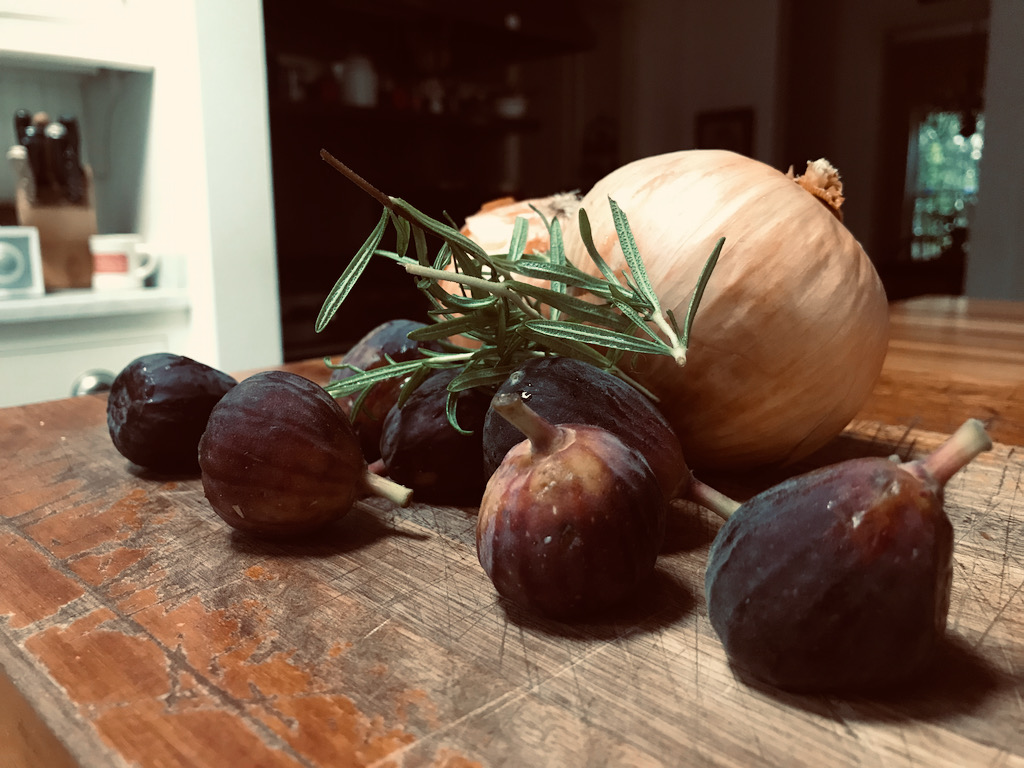
carmelized onion and fig confit, upon which i rested a chunk of roast salmon with late-season rosemary sprigs from my garden: dinner for one, a la autumn.

on kindness, kerouac, and tolstoy

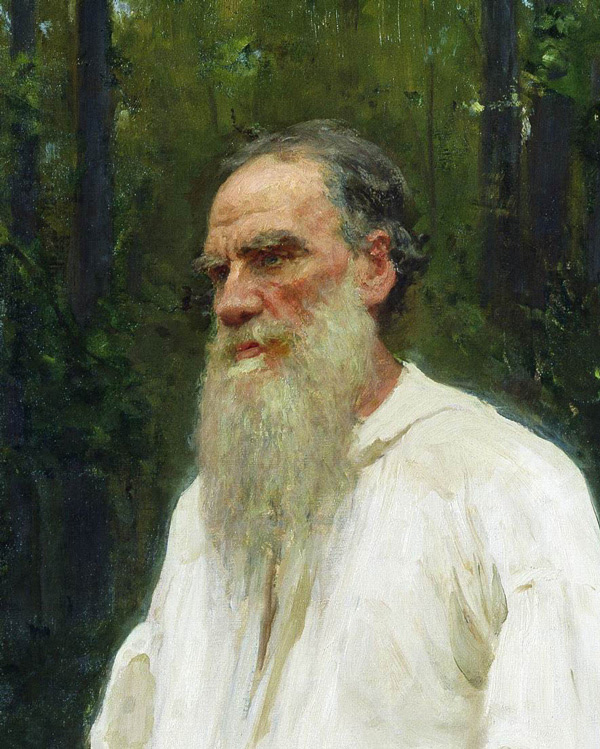
leo tolstoy

i will be backing into this if i begin by quoting a russian intellectual and novelist. but so i begin.

Nothing can make our life, or the lives of other people, more beautiful than perpetual kindness.

Leo Tolstoy

the subject, once again and always, is kindness.

it was unknown to me, and perhaps little known more broadly, that at the turn of the 19th century leo tolstoy neared completion of what he considered an imperative life’s work. not anna karenina, not war and peace, not the death of ivan ilych. but rather something he considered more timeless, more lasting: “a wise thought for every day of the year, from the greatest philosophers of all times and all people,” as he described it.

or as cultural critic maria popova once put it, “to be human is to leap toward our highest moral potentialities, only to trip over the foibled actualities of our reflexive patterns. to be a good human is to keep leaping anyway.” tolstoy’s book, she wrote, was to be “a reliable springboard for these moral leaps.”

in the middle of his 55th year, in march of 1884, tolstoy had set out to read and reap from a circle of the greatest thinkers and spiritual leaders who had shed light on what was most crucial in living a good and righteous life. he dug deep across millennia and miles, reading epictetus, marcus aurelius, lao-tzu, buddha, pascal, the new testament — a reading list he deemed “necessary.”

it was to be his florilegium (a compilation of excerpts from other writings, “mashing up selected passages and connecting dots from existing texts to better illustrate a specific topic, doctrine, or idea,” writes popova. the word comes from the latin for “flower” and “gather;” a bouquet of curated wisdoms). tolstoy saw it as something of a roadmap, daily sign posts pointing the way toward “the Good Way of Life.” in a letter to his assistant, he explained his project thusly:

I know that it gives one great inner force, calmness, and happiness to communicate with such great thinkers as Socrates, Epictetus, Arnold, Parker. … They tell us about what is most important for humanity, about the meaning of life and about virtue. … I would like to create a book … in which I could tell a person about his life, and about the Good Way of Life.

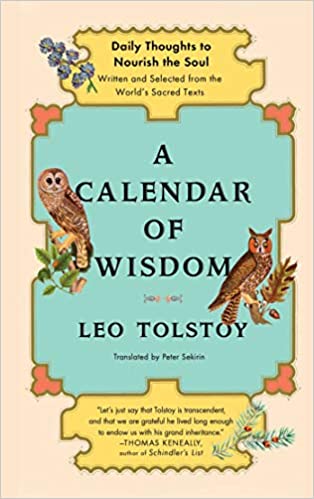
he spent 17 years at it, and shortly after the birth of the 20th century, in 1902, he completed his manuscript, under the working title A Wise Thought for Every Day. two years later, it was published in russian, and nearly a century later, in 1997, it appeared in english translation, all 384 pages of it, under the title A Calendar of Wisdom: Daily Thoughts to Nourish the Soul, Written and Selected from the World’s Sacred Texts. for each day of the year, tolstoy plucked, or gathered, quotes by great thinkers, then added his own musings and connective tissue on the subject, with kindness as the sinew and spine of the book’s moral sensibility.

i bought the book yesterday, in the long hours after i had once again dropped my beloved husband at the curb of terminal 3 at o’hare airport, as he set off once again to race to his mother’s bedside, to honor her, to fill the hospice room with his prayer and his unending grace. in the serendipities of a long afternoon that turned into a longer night, maria popova, she of BrainPickings, the cultural compendium and literary candy counter, dropped in (to my email) with her musings on kindness, a heaven-sent subject in the hours of deep vigil i was keeping for my mother-in-law whose signature and lasting memory is exponential kindness.

i read this entry from tolstoy:

The kinder and the more thoughtful a person is, the more kindness he can find in other people.

Kindness enriches our life; with kindness mysterious things become clear, difficult things become easy, and dull things become cheerful.

i read this from jack kerouac:

Practice kindness all day to everybody and you will realize you’re already in heaven now.

and that’s when i decided i would not merely buy the book but practice it. every day. in honor of my beautiful, blessed mother-in-law who died in the wee hours of this morning, friday, july 2.

her memory will be a perpetual blessing, to me and to all who fall in the radiance of her kindness practiced each and every day.

ginny kamin made lives more beautiful by her practice of perpetual kindness.

“Nothing can make our life, or the lives of other people, more beautiful than perpetual kindness.” a life’s instruction, brought to you by leo tolstoy and one ginny kamin….imagine how you might live it today, one kindness at a time….

the marvel of the capacious soul

i’m convinced that one of the reasons we’re down here on this messy planet, this planet that sometimes feels overpopulated with goons and wise guys, is that on occasion, as we mill about among the masses and misfits, we run into the occasional breathtaking specimen from whom we will undoubtedly learn a thing or three.

i bumped into one this week, and once again i scribbled notes into my chunky fat notebook, the one titled, “how to be a better human. volume 61.”

the most accurate way to phrase it, quite honestly, would be to say that i didn’t so much as bump into him — he’s a time zone away, after all — but rather that this gorgeous soul pretty much flung himself onto the skinny little trail i was traipsing through the day. and it took all of a fraction of a second for me to read his words, feel the breath sucked straight out of my lungs (in that marveling sort of a way), and remember why oh why i’ve always adored him, and would like to be like him when i grow up.

he arrived, my old friend did, in an out-of-the-blue email, one announcing that he — whose wife had died just 10 days before, and whom we’d not seen in years and years — was jumping on a plane to chicago, where he and his wife had lived a couple decades ago, back when both of us were starting out in this experiment called “how to birth and raise a child.” we had all succumbed, his wife and i and our respective mates, at just about the same moment in history. they sped off to the birthing room first, and we followed fairly close behind. then, they sped again shortly after us, so we all spent a few years there cradling newborns, trading tales and names of pediatricians. in fact, the day the chicago tribune decided to unveil a room (more like a rehabbed closet) for “lactating reporters,” my friend’s wife and i showed up to pose for pictures with our little guzzlers well attached (clinging to our shoulders, people; all of us fully clothed and covered, merely suggesting that we young mothers might at some point put down notepads and plug into breast pump (i forsook the whole endeavor and worked from home, with nary a pump in sight)).

i digress.

back to this blessed friend who dropped in this week. he wrote this:

Hi guys,

Corey and I have sort of tumbled into a Chicago comfort trip. He’s there already, and I am flying out in a few hours.

It’s exceedingly last minute, but he and I would love to see as many of you as we can in a gathering of some design. I’ve been thinking brunch Saturday or Sunday, at a restaurant or (if one of you has the stomach for it) a home (I’d ecstatically cover the catering).

Let me float the idea of 10 am Saturday or Sunday. Other times will in truth be tougher (I’ll be doing things with/at the theater, etc.).

Maybe we can reply-all in order to see whether this might work?

I adore you all, and thank you for words and sustenance over months, weeks, and years.

Love,

(old friend)

i should mention that this old friend is a professor of shakespeare in new york city, and from the first day i met him he has used the english language in measures that far exceed just about anyone else i’ve ever known. he matches his eloquence with an effusion of the human spirit that is, frankly, a force of nature. something akin to sharing a room with a hurricane of most glorious refinement.

amid a world of ways of mourning, i was bowled over by this friend’s instinct to surround himself — immerse himself, really — with stories, tears, and laughter. to reach out for old, old friends. to throw himself onto a plane to shrink the distance, to not wait to lather himself in the healing balm, to quite emphatically wrap himself in the company of those who’d lived and breathed the chapters before cancer trod his heart, and stole his lifelong love.

it’s why capacious is the word that best fits his soul, his spirit, the magnitude of how he exercises love and life and full-throttle humanity. “having a lot of space inside; roomy,” the pocket OAD tells us. my friend is roomy, all right, and he makes room for the whole whirling wild climate zone of grief and grieving.

i imagine that tomorrow morning, when my kitchen is filled with lox and bagels and stories tumbling atop stories, when the coffee flows endlessly and big bowls spill with the fattest sweetest berries i can find today, it will get messy. there will be rivers of tears. and once or twice someone might laugh so hard they’ll spit strawberry across the table. i’ve been around enough grief to know it’s uncharted.

what i’ve not often seen, and what i love and what finds me marveling, is this old friend’s willingness to plunge right in, to immerse himself in the anguish and the joys that old friends know by heart. almost none of us witnessed up close the past few years of surgery and chemo and the inevitable dying, but we were all there for the thick of what came before — the births, the strollers, the raucous Shabbat dinners, the summer sunsets from their rooftop terrace.

and we have stories in which to wrap him, and tears to bathe his broken heart, and great good laughter on which to lift and carry him.

from deep inside his fog of pain and loss and rudderlessness, he thrust out a hand, and called on an old unbroken circle of the heart. we will hold a shiva here tomorrow. and there will be prayer in the form of story. and the wailing and gnashing of teeth will be shared in the company of those who remember well the days long before the whiff of cancer slid into the room, and took away our old friend’s truest deepest love.

may his capacious ways remind me to never shrink from the confines of the soul so blessedly breathed into each of us at the moment we were first imagined, and sent forth to fill this planet…..

who are some of the ones in your life who teach you how to be? and in what form have some of those lasting lessons come?