pull up a chair

where wisdom gathers, poetry unfolds and divine light is sparked…

Category: courage

the not-so-simple tasks of being alive
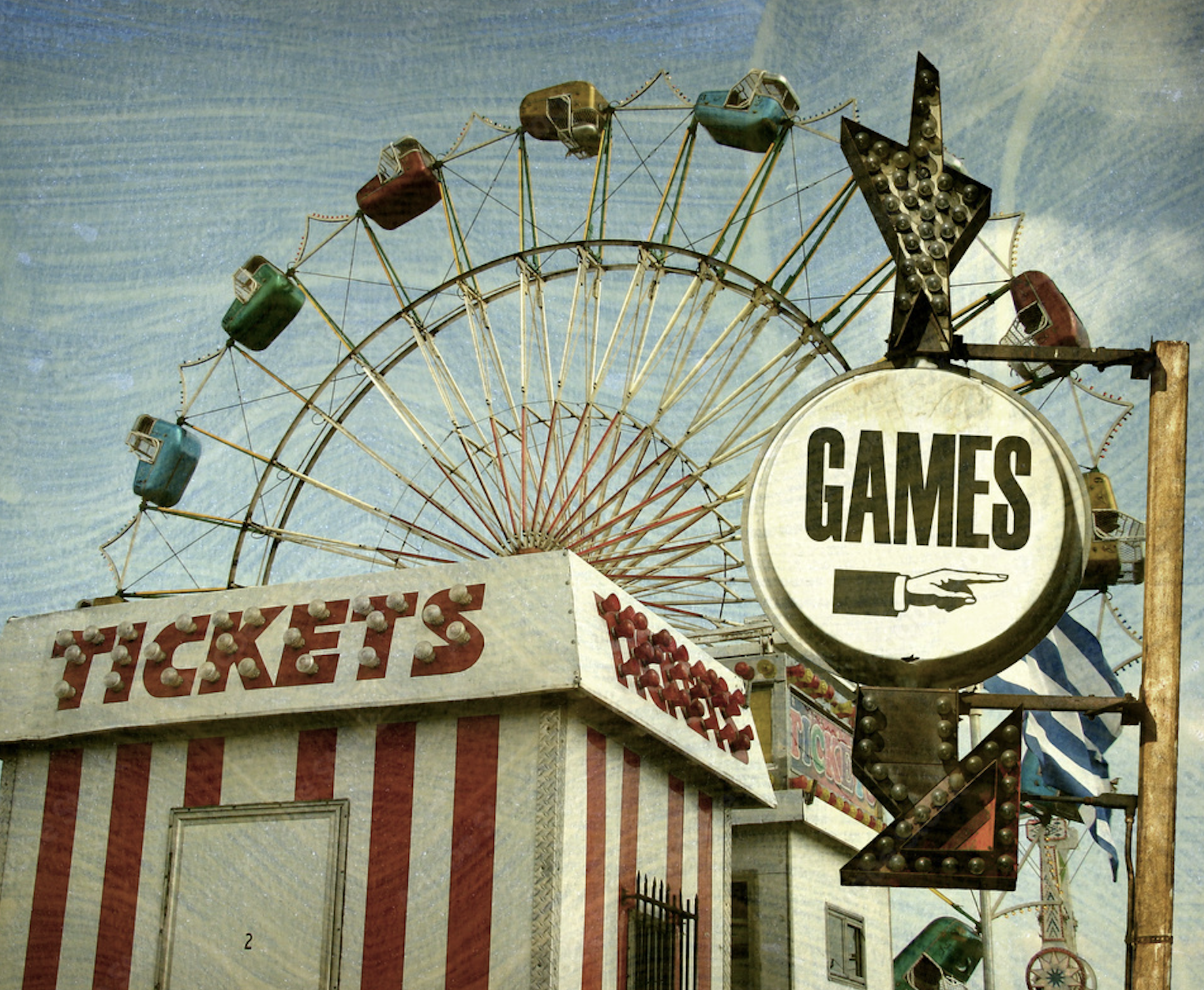
life, sometimes, makes like it’s an arcade of carnival challenges, and to make it to the other side is, in fact, something of a triumph we barely take time to note.

we shouldn’t, though, take it for granted. we are mightier than we think. and there will come times when we truly need to believe how mighty we can be. we’re not here on this earth to dawdle around.

as this week draws to a close, i can testify that these things happened: a new used car was found, bought, driven home, and will soon be ferried to another state; a kid wrestled through the decision of which of three job offers he’d choose, and started the one; husband down for the count with a cough that sounds like it’s hollowing his lungs; cavity filled in the way back of my mouth; latest peek at my lungs behind me (now awaiting results, a fraught interval that always leads to some trembles); and the latest round of edits on Book No. 6 at last sent off to editor (i had to wait till her calendar cleared).

not included in the list, but very much there, are the facts that i spent the week dodging the heck out of whatever virus was mucking up the works, for fear my scan or my cavity filling would get bumped; also, never mind the “check tire pressure” light that went on halfway home from the car lot, and the hurdles to get that untangled. in addition, i arose each dawn, never crashed my own car, swam a few miles, cooked a few mediocre dinners and one or two fair ones, and grocery shopped what seems like ninety-five times.

such is the business of living. each week throws at us a spaghetti bowl of hurdles, some humdrum, some of dimension that leads us to gulping.

it’s the quotidian stuff that comprises our day to day. and to make it through and to the other side is a feat that draws on cords and gears we barely acknowledge. to miss the chance to take note, to not ponder just how resilient we are, just how swiftly we can untangle ourselves from houdini’s chains is to short shrift our capacities.

we live our lives amid stories of what seem insurmountable feats: folks rolling into surgeries that untangle their insides, or shave off a lump on their spine; house fires that leave lives in ashes and soggy remains; kids finding out their cancer is double-D badd. (and those are stories plucked only from the last 48 hours, each one devastating and true.)

the news of the bad guys around us might distract and infuriate and leave us in tears. but the hard work of being human is never far from home. it’s the pit in our belly we awake with, and the headache that drums us to sleep. it’s what we might face before breakfast, and what comes with an unsuspecting wallop midway through the day. it comes in the phone call we never expected, and the one that makes us fall to our knees.

i’m not trying out for a part as the voice of doom here. i’m simply saying what we too often forget: no matter the circumstances, nor the twists in the story, we are all made of strong stuff—stronger than we remember to note.

to get to the other side of the traumas and troubles that hurtle our way is worthy of note, if not ovation. it might do us well to take count of the muscle it takes, and the grit, and the intense imagination, to merely get to the other side.

and here we are, on the far side of all those things that a week ago seemed insoluble.

that alone might stand as proof that even the frailest among us are tough as tough can be. and we can take on just about anything. we are breathed into life with every capacity our lives will demand. and we are living proof of how much we can survive.

you needn’t share this with anyone other than yourself, but perhaps you might find strength in looking back across the arc of your life and seeing what a marvel you are, and all the impossible hills you have climbed. what marvels you the most?
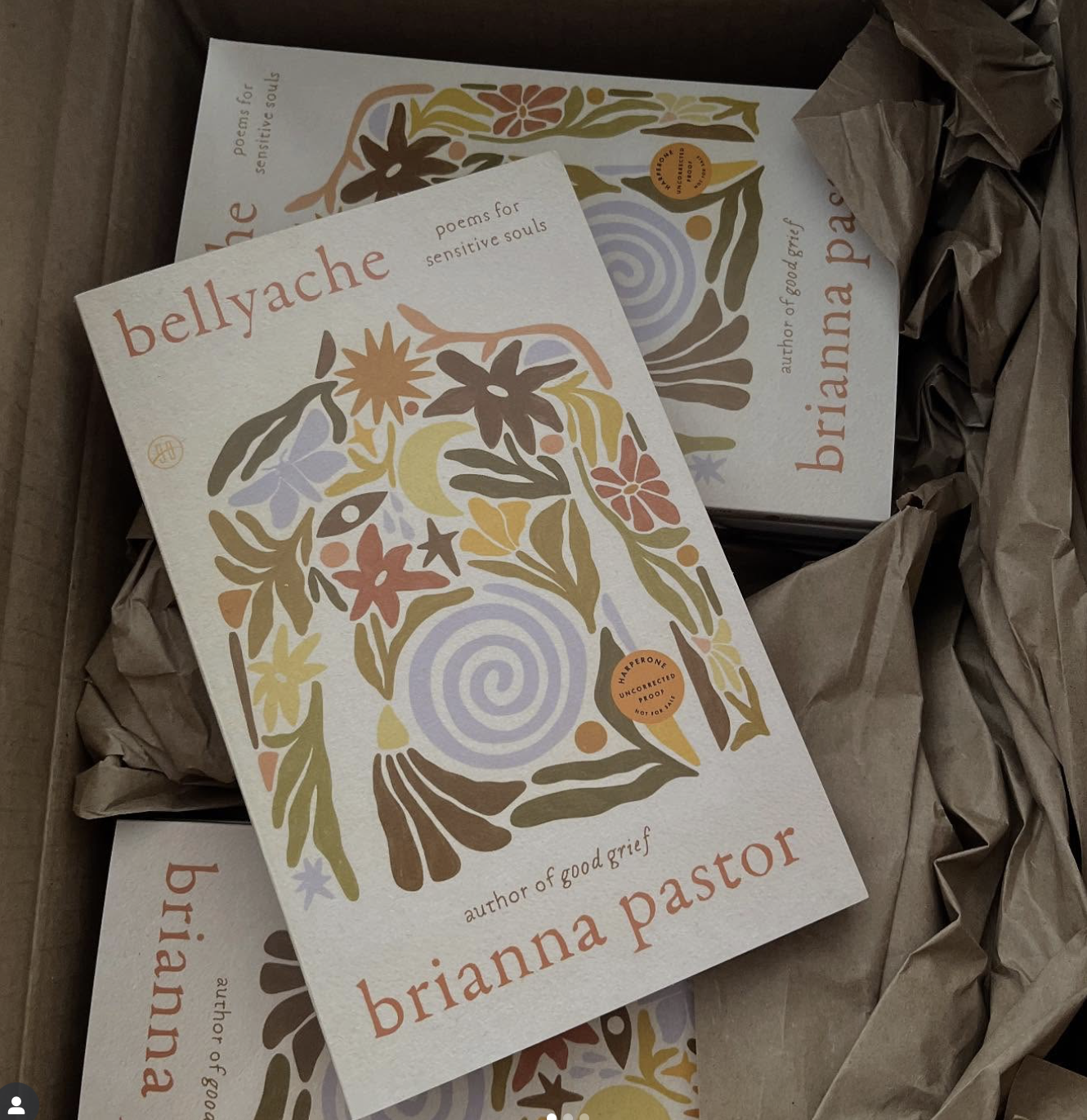

as antidote to all that, i bring you a bit of wonder in the form of the latest book that crossed my transom. it’s titled bellyache: poems for sensitive souls (harper one, 2026), and they had me at the subtitle. it’s by brianna pastor, a poet described in her bio as “a queer writer, empath, advocate, and author of the poetry collection good grief.” the book isn’t due out till february, but i got a review copy, and i’ll share a few marvels here. pastor’s poetry is rooted in childhood trauma and what it means to heal, with sensitivity and love as the non-negotiable parts of the deal. she writes, according to the author note, “about the raw, the uncomfortable, the overlooked, and makes clear that at the root of all things, is love.” it’s not every day that you open a book and find yourself in the midst of a poet whose heart feels so immensely attuned to the pain and the preciousness of tender, tender feeling.

here’s one of my favorites….

and here are two others (the spare simplicity is everything in these love-drenched poems):
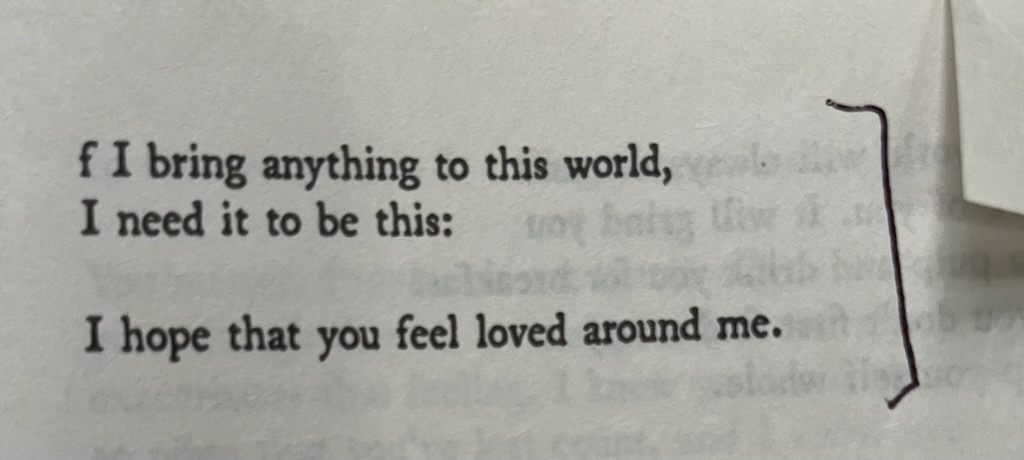
and this:
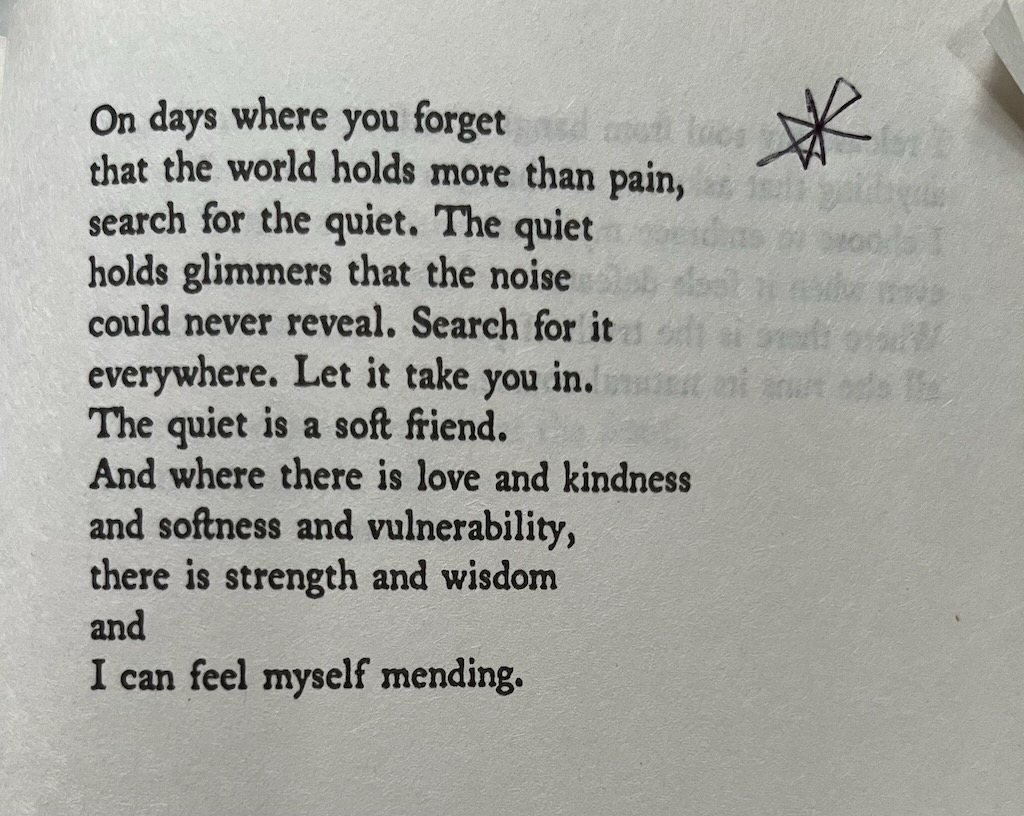
Excerpted from pages10-12 Bellyache by Brianna Pastor, reprinted with permission from HarperOne, an imprint of HarperCollins Publishers. Copyright 2026.

when war games are played on your streets

ICE agents on the campus where my mama now lives

there is nothing make-believe about it. the leafy lanes and brick streets of the little village where i live have been invaded this week. not by distant armies, but by thugs of our country’s own making. men—yes, always men—dressed in combat suits, their faces covered in balaclavas, wearing boots made for stomping and crushing, roaming the streets in vans with darkened windows. traveling in patrols of two vans or three, they cruise slowly, surveilling, and when they come to a stop, when they burst out of the vans, i’m told you can smell the testosterone in the air. they are armed for conflict. they are on the hunt and ready to snatch.

they’ve cruised down our alleys, parked near our grade schools, stopped across from the library, and set chase across the manicured lawns where my mama and some 300 of her fellow nonagenarian, octogenarian, septuagenarian compatriots live out their days in what’s meant to be peaceful harmony. how many they’ve “caught” is unknown (these are not folk who disclose, whose m.o. is secrecy and surprise), but tallying anecdotal reports, the number is somewhere between five and seven, and, mind you, that’s merely the count from these quiet little streets where violent crime is nearly unheard of, and the only gangs you might see are the preteens and their too-many motorized scooters clogging the lanes.

whom might you ask is the target of all this slo-mo patrolling?

it’s the gentle brown-skinned folk who change our children’s diapers, who warm their lunches, and tuck them in for naps, who rock them in their arms, singing lullabies in spanish, and who rinse off the scrapes and the cuts on their knees, and smother them with kisses. or they’re the gentle-souled men who cut back our hydrangeas at the end of the summer, or trim our lawns to manicured perfection. or the ones tacking shingles to roofs, to keep the rains out. they might be the women who shlep into homes lugging vacuums and pails spilling with bottles of cleaning supplies. the women who scrub the toilets, and change the sheets, and fold the laundry in crisp four-corner stacks, so meticulously they rival the stacks in the boutiques at the mall.

thug is not a word i use loosely, and for a peace-making girl it hurts to write it. but i cannot think of another word to put to souls who sign up for a job of cops-and-robbers gone rogue. when i was little i watched my brothers move little green plastic soldiers around the basement floor. they made guttural sounds and knocked over the men with their green plastic rifles and hand grenades. i’d wander away with one of my dolls clutched under my arms. when it wasn’t “war” on the basement floor, they took to the yards and the street where we lived. they’d hide in bushes, leap out, and “capture.” the same guttural sounds, only this time with humans as soldiers. the boys on the stingray bicycles versus the boys on the run.

we are a nation obsessed with our war games. from what i read, basements and rec rooms these days are filled with big loud screens and folks with their headsets and clickers, controllers and keyboards, killing and maiming with automatic rat-a-tat-tats and bombs exploding in cauliflower clouds. i imagine the guttural sounds now come from the screens, in digitized amplitudes. obliteration, i’m told, is the aim.

and we are now a nation that’s bringing its war games to our own backyards. especially if you happen to live in a city deemed blue, with a president who’s never been keen on the city that didn’t embrace his big shiny skyscraper with his name in football-field-sized letters slapped on the side.

i know full well that this is albino-pale compared to gaza or kyiv, but a “federalized military presence” complete with long guns and tear gas is not why we pledge allegiance to the flag. it’s a war of terror. parents afraid to take children with fevers to the ER, children watching their parents handcuffed and hauled away at school drop-off or pick-up. taquerias that now lock their doors. street vendors who’ve locked up their pushcarts and turned off the lights in their kitchens. a people on lockdown is inhumane, unconscionable, and unsustainable.

all because their skin is brown? these are not the criminals, rapists, drug dealers, human traffickers once upon a time purported to be the sole target of this racist campaign. there’s no reading of rights, no miranda anywhere in the vicinity. if you’re brown, and you’re out on the streets, you’re a target. and being a target often means being thrown to the ground, hands tied behind your back. doesn’t matter if toddlers are watching in horror, screaming for their mama, or their nanny. doesn’t matter if you have a u.s. passport back home in the top drawer of your bureau.

but that’s not even the worst of it. the worst is that the folks they snatch are then “disappeared,” a word that means precisely what it says. where you land is a wild-eyed guess, and the people who love you will need to pony up cash to track where you are, and to get you the heck out of the hellscape of a jail, where toilets are few and lights buzz 24/7. too bad if you need pills for your heart, or inhalers so you can breathe.

but here’s a faint glimmer of light: the ones of us whose skin happens not to be brown, we are not having it. and we are leaping out of our complacencies, and in the company of others finding something akin to solidarity, to resilience, to compassion that compounds through the magnification of the many.

chicago, hog butcher to the world, is a fighting-back town. you don’t send your thugs to our streets and expect that we’re going to hide behind the couches. we are whistling our lungs out at the first sighting of a slow-rolling, dark-windowed van. towns that aren’t usually in the news pushing back against men in camo suits, towns with names like naperville, mt. prospect, wilmette, they’re in the resistance.

1939 berlin isn’t too distant for too many of us. i sat next to a woman at an organizing meeting the other day whose hands were quaking as she said she can’t stop thinking of her grandfather and wondering at what point he realized he needed to send his wife and children out of the country, to that faraway place named america, where the tired, the poor, the huddled masses yearning to breathe free were welcomed, were harbored, were the name of the game.

where did that america go?

that question has been haunting me for months now. but what’s happening here on the streets of chicago is giving me hope. we are many, and we are not about to surrender to thugs. we are bursting out of our cloistered existences, and doing what we can to be our brothers’ keeper.

when crews are harbored in your garage for hours, hiding, awaiting the nightfall retreat of the thugs, when you are ferrying out water and oranges, when you’re dashing down the alley to tell the construction crew that ICE is nearby and you see the sheer paralyzing terror on the face of one of the workers, you do not forget. you see the humanity that is all of us. you feel the horror, sense the gentle kindness, get sick at the thought of these men who got out of bed expecting nothing but another day’s hard work now wondering if they’ll ever get home.

you cannot for the life of you figure out why no one in charge can stop this. but then you look over your shoulder and see that there are those around us who are not waiting for help from beyond. the people who live down your very own block, and just across the way, they are showing their muscle, their hearts, their humanity. and for the first time in a long time, you think maybe there’s hope. maybe, just maybe, the good guys can win.

and that’s a war game i’ll play. though i play by pacifist rules.


here, my beautiful friends, is something i truly hope you will read. it’s a little bit long, but i don’t think you will find it in your scrolling around the internet, and it is just what we need in this moment.

it’s a view from the front row of the horrors russia is visiting on ukraine, and the profile in courage that is ukrainians and their unwillingness to surrender to evil. this comes from the Peace Prize acceptance speech of german author Karl Schlögel, and is “a powerful summons to relinquish naivety and wishful thinking, to think hard and to act bravely.” the Peace Prize of the German Book Trade is a major literary award “for authors who have contributed to peace through their writing.” recent recipients include historian Anne Applebaum (2024) for her work on autocracy, author Salman Rushdie (2023) for his defense of free expression, and historian Karl Schlögel (2025) for his work on Eastern Europe and warnings about Russian expansionism. these are Schlögel’s words, and i found them soul-stirring to the highest order. if ukrainians can push back against evil, so too can those of us here on our leafy little streets, and our concrete corridors….

Learning from Ukraine. Lessons of Resistance.

No one is more interested in peace than the Ukrainians. They know that an aggressor with limitless determination cannot be stopped with words. They are realists who can afford no illusions. Their refusal to be victims drives them to fight back. They are prepared for anything. They fight for their children, for their families, for their state – they are prepared even to die for their country. What amounts to television footage for others is firsthand experience for them. Ukraine’s defence at the front would be nothing without the army of volunteers behind it. They have survived the winters and braved the nightly terror of drones and missiles for weeks, even months on end. The IT experts of yesterday are the drone pilots of today. The festive dress women don for the theatre or a concert betrays an attitude that holds firm even in a state of emergency – the club is where young people draw strength to continue the resistance. They are heroes in a post-heroic world, without making a fuss about it. They keep their transport system running, and with it their country remains whole. The howl of sirens is background noise for their everyday lives, not just a fire drill. They have learnt how drone strikes differ from ballistic missile attacks. They are helping us prepare for the time after this historical turning point. They are teaching us that national defence has nothing to do with militarism. Soldiers, and above all women soldiers, are respected because everyone knows that they are performing their duty and doing that for which they are prepared. The citizens of Ukraine are teaching us that what is happening is not the ›Ukraine conflict‹, but war. They are helping us understand whom we are dealing with: a regime that hates Europe and that seeks to destroy Ukraine as an independent state. They are showing us that accommodating the aggressor only increases its appetite for more, and that appeasement does not lead to peace – it paves the way to war. Because they are on the front line, they know more than we in our still-safe confines of the hinterland. Because they are at the mercy of a superior enemy, they must be faster and more intelligent than their foe. Ukrainians, who are generally suspected of nationalism, are showing us that patriotism has not become obsolete in the 21st century. They are ahead of us in terms of military technology, as they were forced to fight at a time when we could still allow ourselves to ponder questions of eternal peace. They took it on themselves to develop weapons that were withheld from them out of hesitation or fear. They are the mirror into which we peer, reminding us what Europe once stood for and why it is still worth defending. They are calling out to us: do not be afraid – not because they are not afraid, but because they have overcome their fear. Ukraine’s writers do their utmost to express what those farther away lack the words for. They have taken the Ukrainian language out into the world and performed a literary miracle. Their poets speak with deadly seriousness, while some have even paid for it with their lives. Their president is a man who expects the truth from his compatriots, no matter how bitter he knows it may be. They are well versed in the behavioural tenets of resistance and are teaching the Europeans what to expect if they continue to fail to prepare for the worst-case scenario. They have learnt from experience that when threat levels are high, decisions are made overnight, while in quieter times they are put off until the day after tomorrow, if even then. Stoic aplomb is a luxury they can only afford once the war is over. To endure, to persevere, despite unspeakable exhaustion – this is the revolution of dignity in permanence. They are the ones to whom we owe our peace, while they pay a price both incalculable and unfathomable. 
—Karl Schlögel

how will you stand up for justice, give voice to the voiceless, be home to the tired, the poor, the huddled masses yearning to breathe free?

*thank you to the dear friend who sent the photo above. best close-up i’ve seen.

on faraway sands, the poets of war spoke to me

i was alone for the day, a whole sumptuous day of solitude and silence. so i, like half the rest of the world it seemed, was pulled to the water’s edge. i carried but a book and a bottle of water. i knew the week ahead would be rough, though i hadn’t a clue yet quite how rough. (two beloved souls, my exact age, died suddenly, one falling to her death*, another simply dying in his sleep.)

the book i carried is one i’d yearned to crack into, and as i sat there allowing its truths to wash over me, as the waves of the lake just across the sand washed over the shoreline again and again, i felt every drop of its anguish and truth. it was a book of poems written by thirty poets in gaza, and four from the west bank.

once upon a time, for ten good years, i gathered up each month for the chicago tribune a collection of three books that had most stirred my soul. they might be children’s books, or poetries, or memoirs and stories of the holiest people. the gatherings were vast, and some of those publishers still send me books, knowing full well my readers now are not the millions from the tribune and beyond, but rather the cherished friends of the chair.

this book i bring today is one worth clutching in your hands, pressing hard against your heart. it might be even more poignant against the improbable news that a cease fire in gaza has begun and some twenty living israeli hostages will soon be released.

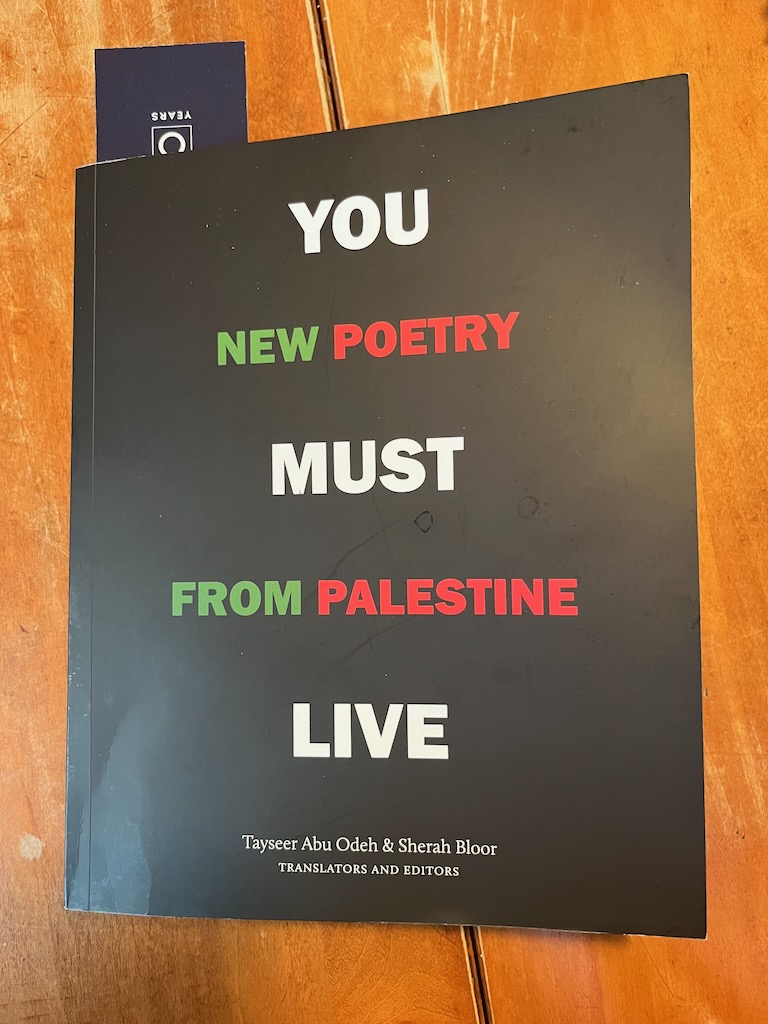
its title, you must live: new poetry from palestine (copper canyon press, 2025), only begins to tell the story, only hints at the horrors and tendernesses within. but you can hear the pleas, the cries rising up from the rubble. it’s a bilingual anthology of poetries from gaza and the west bank, translated from the arabic and edited by Tayseer Abu Odeh and Sherah Bloor, with guest editor Jorie Graham, and it’s written not by poets who’ve somehow escaped, left behind the ravages of war, but rather it’s written by those still there. in poring over its pages—slowly and with prayerful intent—you hear the murmurs perhaps unheard by anyone else, you hear the lone voice rising from dust, you hear the whimper of a child left alone in the world, in the shattered brokenness of a world that no longer stands.

“especially now,” the editors write, “it is crucial to attend to those whose voices are under threat of elimination.”

ocean vuong called it “a light beam of a collection in our dark hours.” ilya kaminsky, the great poet most famous for his deaf republic, has written that it’s a book “filled with poems of utter urgency, poems that give us wisdom, in the face of devastation, in spite of devastation.”

i was as moved by the story behind the poems, as by some of the poems themselves. for starters, editing in a war zone is no feat for the timid. the editors write that at first they didn’t realize that every time someone’s phone connected to a satellite (to reply to an editing question) they became a target. to get a clear signal, the editors write, meant a life-or-death decision: standing atop rubble is where the signal is sharpest, and yet of course that means the poet is risking her or his life to reply.

consider that.

the editors write too that every time a reply did come through, be it a response about punctuation or diction, the editors sighed with relief. “they were still with us.” imagine being willing to die over a comma rather than a semicolon. consider that the next time you make a simple correction in a sentence you’re typing.

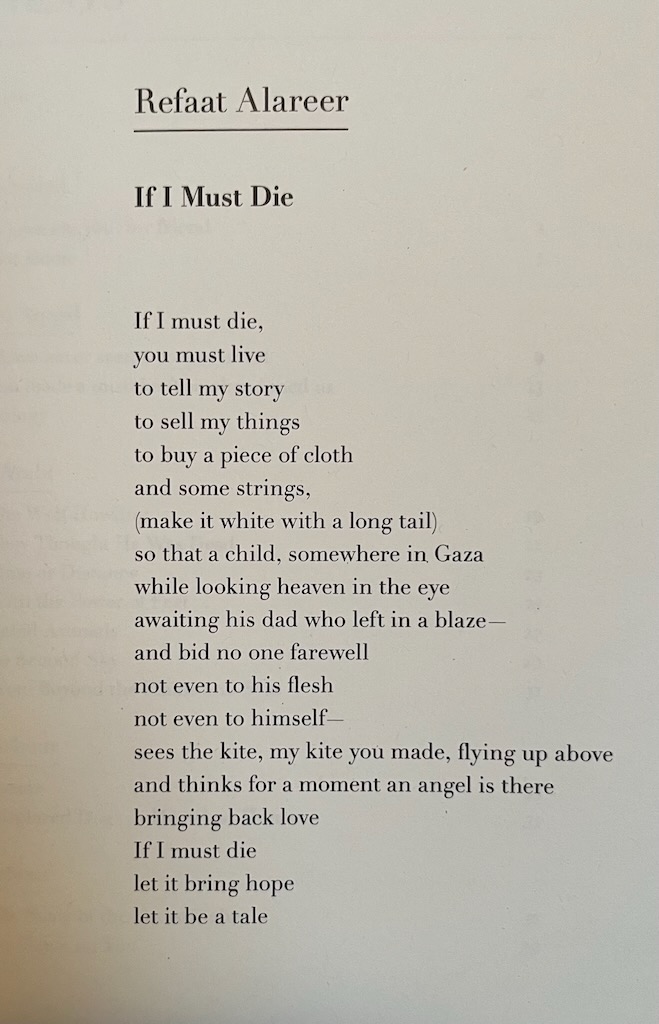
the collection begins with a poem that’s become fairly widely known, “if i must die,” by the late Refaat Alareer. the editors write: “this poem stands in for all those poets we failed to reach in time. their poems—chalked onto collapsed walls, or on the blackboards of schools-turned-shelters-turned-bombsites, traced in sand, or shared in private messages—will never reach us.”

the silence is stunning. the silence demands our reverence.

the editors call the poems a “poetry of witness,” speaking from a war zone deadly for journalists, a war zone where so many stories would otherwise go untold. the poets paint the portrait. and it is seizing with humanity. humanity crushed. humanity pummeled. human refusing to extinguish its tender, fragile beauties. we must know what we, humanity all, have wrought.

here are a few samples, barely enough to give you a sense of the pathos within, the pathos that rises from this old globe like a poisonous cloud desperate for one breath of air….

here is the poet Waleed al-Aqqad’s elegy for a young friend, set at the boy’s funeral, and tenderly describing the mutilations of his war-torn body:

We said goodbye
to you in your small death like the death
of sparrows.
We rearranged you.
We placed your severed hand across your chest,
covered your wounds with flowers,
cried as you wanted.

or this, from Ala’a al-Qatrawi’s poem to her children, two daughters and two sons, all under the age of six, all killed in an air strike on their home. she addresses her babies in heaven, offers her own body parts to her daughter, Orchida, as if she could piece her body back into her embrace:

And give my lungs to her.
Without them, maybe she suffocated.
Maybe she couldn’t call my name.
The rubble would have been too heavy for her.

it is wrenching to read. all of it. page after page, i read slowly, as if a dirge. i sat on a bench on the sand thousands and thousands of miles away. that seemed cruel, unfair, that i should be hearing the sounds of a day at a beach, when the sounds of war pressed on. and the words of new poets would again go unheard.

to those who understand the power of words, to those who dared to gather poems out from the rubble, bless you, and bless you, and may peace, everlasting peace, at last come to the holy land.

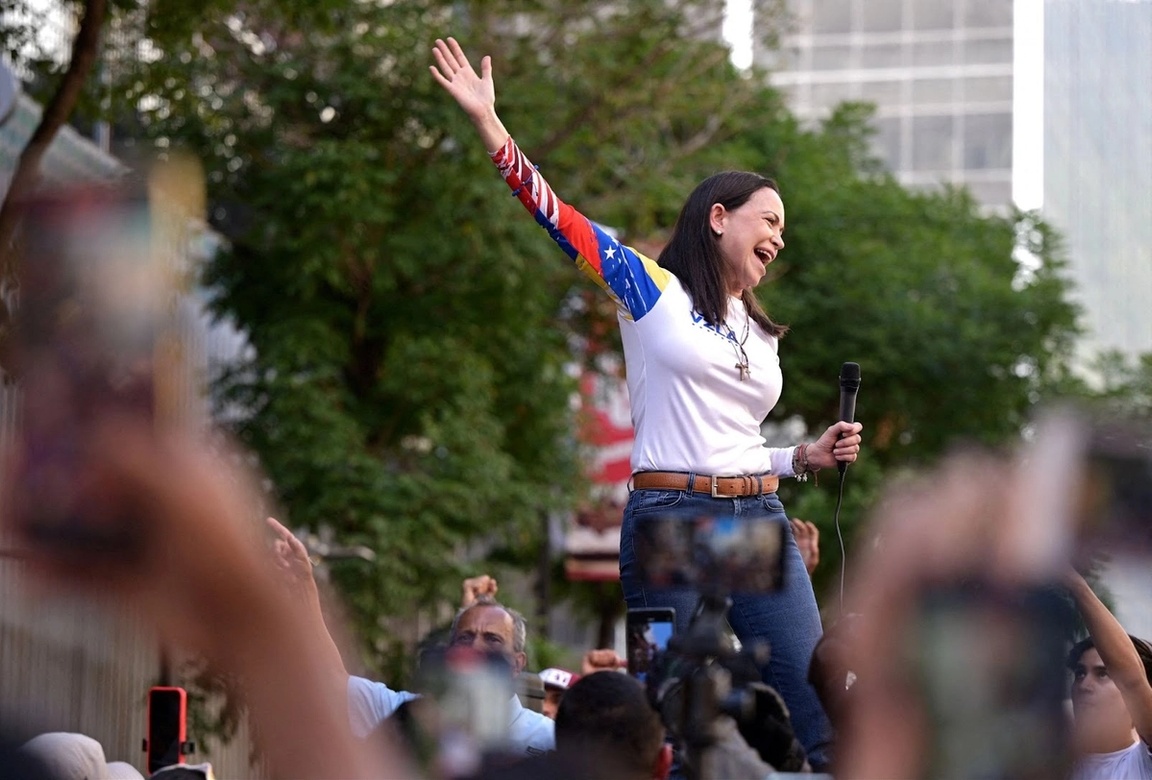
maria corina machado, recipient of the 2025 nobel peace prize

this hard week ends with a few sparks of hope: first, word of the cease fire and the imminent promised release of 20 living israeli hostages, and the bodies of 26 confirmed dead. and, in the immediate wake of that, the nobel peace prize was awarded this morning to venezuela’s “iron lady,” maria corina machado. the committees’ citation reads: “She is receiving the Nobel Peace Prize for her tireless work promoting democratic rights for the people of Venezuela and for her struggle to achieve a just and peaceful transition from dictatorship to democracy.”

where did you find hope in these hard times?

*joannie barth was a most beloved reader of the chair. she lived in evergreen, colorado. was the right-hand everything to the best-selling author philip yancey. she and i had gone to college together, but mostly got to know each other’s souls through this ol’ chair. she would send notes radiant with love, with a faith that couldn’t be shaken. she shared her own heart’s ache, an ache i now hold for her. i was with her less than a year ago, and as she always had, she lit up a room. her smile rose from a deep deep place. a week ago, she was rock climbing. and the belts gave out. she died instantly. not at all surprisingly, i feel her closer than ever. she was, and is, an angel.

joannie

artisanal peace

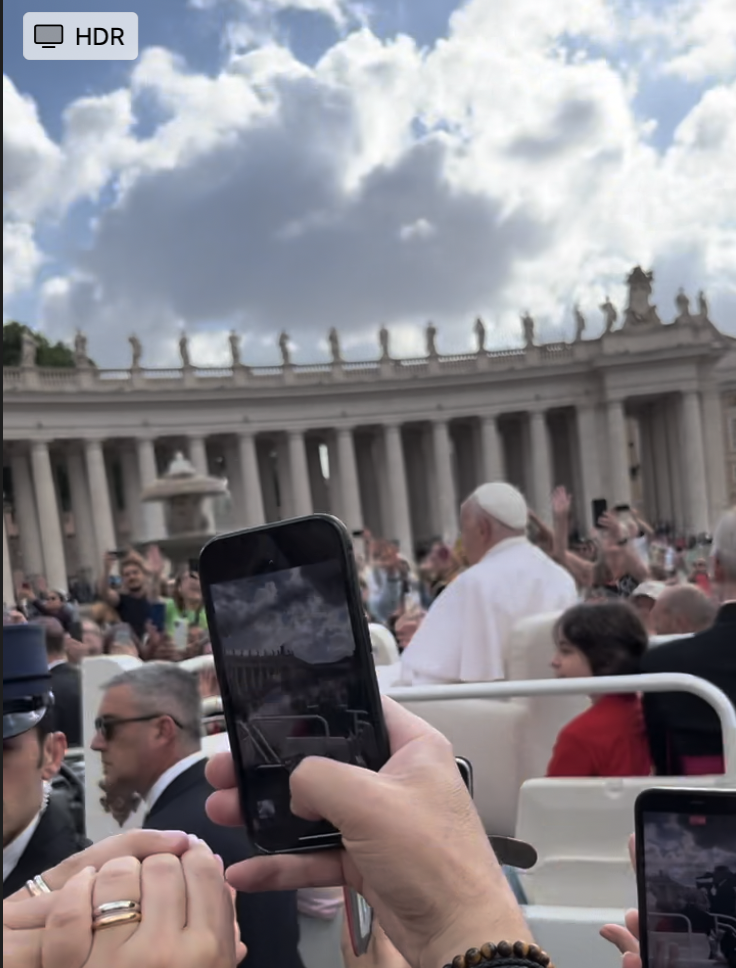
closest i got to Il Papa, when i found myself accidentally at the barricades that clear the way for the Pope-mobile

sages are in short supply, it seems. certainly now, and certainly on the global scale. i scan where i can, ever on the lookout. and wasn’t my eye caught when i read the words “artisanal path” to “handmade peace.”

tell me more, my little heart shouted. 

though it sounded a bit like a recipe for earthy bread or hand-thrown plates, the sort that rise from the potter’s wheel, i sensed the subject here was far more urgent, and in dire need of replenishing. not what you’d find on any pantry shelf. 

hand-crafted peace, peace constructed with care and attention. peace that we at home can build, without scissors or glue or a potter’s spinning wheel.

i clicked on a duly-provided link, and wasn’t one iota surprised to find that Il Papa, our most beloved Francis, was the one who not only dared to raise his voice above the blather, but considered it a requisite of his job’s description.

he is, after all, shepherd to a farflung flock. but more than that, he’s a prophet, which, according to the definition i found in richard rohr’s brand-new the tears of things: prophetic wisdom for an age of outrage, means a radical change agent, teacher of a moral alternative, and deconstructor of every prevailing order. rohr reminds us of the prophets of ancient times, the ones described by isaiah and ezekiel, whose job it was to hold the powers that be “maddeningly honest.”

bring on the prophets, please.

in these times, francis, our dear pope who from his hospital bed in rome reached out to the suffering of gaza, is the rare voice to which all the world will sometimes listen. thank holy God, he speaks the language of love without condition, clause, or pause. there are those among us, in this age of outrage, who might do well to listen. especially when they claim to take instruction from the very same God who whispers to Il Papa

the new york times calls him “an increasingly lonely moral voice on the world stage.”

all the more reason to listen. and listen hard.

“peace is crafted; it is the work of our hands,” francis began at a prayer vigil in the central african republic back in 2015, “it is built up by the way we live our lives.” he was speaking to an audience of children, teens, and young adults in bangui, the capital of the central african republic, when that country was in the midst of a sectarian war between Christians and Muslims, and thousands had been killed, and more than a million displaced from homes, their properties looted or destroyed.

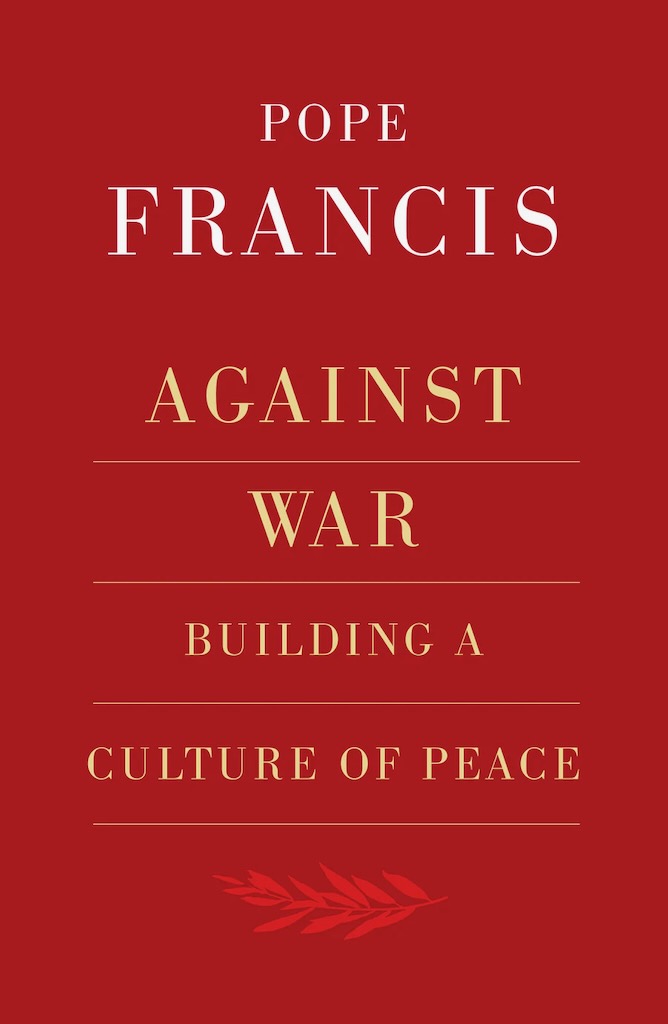
this artisanal path, “built up by the way we live our lives,” is spelled out, it turns out, in francis’s Against War: Building a Culture of Peace, a book i’ve ordered from my local bookstore, as it’s one with permanent claim to a slot on my bookshelf. 

it’s not that i think i can build a culture of worldwide peace, though once upon a time i dreamed of such things. the point here, from the wee bit i’ve read, is that peace is a sphere we build bit by bit, as we travel through space and time, and it’s built by even the most unassuming of gestures, attitudes, and actions.

what the pope is saying, and what the world ought listen to, is that the tiniest empathies and kindnesses matter: giving cuts in the grocery line, waving someone into your expressway lane; taking time to take the call, dropping the tupperware of soup on your neighbor’s stoop. biting your tongue when you’re tempted to snap, and, yes oh yes, turning the other cheek, a trait i’m told no longer belongs in a world of dog eat dog. 

what a game changer: here’s the head of a church that counts 1.39 billion baptized among its ranks, and he too concurs that we needn’t be rocket scientists in the art of magnanimous charitable persuasion to make a dent in the realm of ever-spreading goodness. 

for one thing, it’s fairly contagious. if you’re out-of-the-blue kind to me, if you take my breath away with some wonder act of yours, chances are i’m inclined to be a copy cat and try the same. if for no other reason than the pure joy of watching someone be surprised you’ve not just slammed the door in their sorry, sorry face. 

here’s where Il Papa begins his artisanal path to handmade peace, with this fulsome criticism of the futility of war: 

“war is not the solution, war is madness, war is a monster, war is a cancer that feeds off itself, engulfing everything!”

that’s all i needed to keep on reading. and what i found, and what you’ll find should you decide to play along, is a compendium of his most outstanding commentaries on war and peace during the first nine years of his pontificate. 

here are a few of the nuggets you just might choose to tuck in your peace-gathering pockets. 

because one can’t best the pope when it comes to eloquence and voice, i am quoting from the book, here on in, and plucking five that leap out the most….

1.) seeing the world as one human family living in one common home.

The stars in the sky shine down on every single person — from the beginning of time to today — and learning “to look at the stars” will be “the most effective vaccine for a future of peace,” he said in Ur, Iraq, in 2021.

“Anyone with the courage to look at the stars, anyone who believes in God, has no enemies to fight. He or she has only one enemy to face, an enemy that stands at the door of the heart and knocks to enter. That enemy is hatred,” the pope said.

“There will be no peace as long as we see others as them and not us,” he said. Humanity lives under one heaven, under the gaze of one God who desires his children to be “hospitable and welcoming” to each other on earth.

2.) reconciling with one’s enemies and embracing unity in diversity.

The pope told young people in the Central African Republic that the first step toward being a peacemaker was “never hate anyone. If someone wrongs you, seek to forgive.”

“We only win if we take the road of love,” he said, and, with love, “you will win the hardest battle in life” and find peace.

But “we need to pray in order to be resilient, to love and not to hate, to be peacemakers,” and “you must be courageous,” he added. “Courageous in love, in forgiveness, in building peace.”

3.) the difficult art of dialogue and listening, which can sometimes be as hard as building a bridge over an abyss.

Pride and arrogance must be eradicated from one’s own heart, he told young people at a congress of the educational project, “Scholas Occurrentes,” in 2016. “Our world needs to lower the level of aggression. It needs tenderness. It needs gentleness, it needs to listen, it needs to walk together.”

Dialogue is “the capacity to listen, not to argue immediately, to ask,” he said. “Everyone wins in dialogue; no one loses” because “it is about agreeing to proposals so as to move forward together.”

Dialogue is to put oneself in the other’s place, “to form a bridge” and “persuade with gentleness.”

4.) peace is a constant journey of “getting one’s hands dirty,” concretely working for the common good.

“Our path leads us to immersing ourselves in situations and giving first place to those who suffer,” he said in Assisi for the World Day of Prayer for Peace in 2016.

Feeling responsible for helping others and refusing to be indifferent cleanses the heart and requires the “purification” and conversion that can only come from God, he said in Irbil, Iraq, in 2021.

This new order must meet humanity’s desire for justice, equality and participation, he said in his World Day of Peace message in 2020. A democratic society recognizes everyone’s rights and one’s duties toward others, which can temper a harmful, unbridled understanding of freedom.

5.) living the beatitudes is to bring heaven––and peace––to earth.

In his homily in Baghdad in 2021, the pope said, “We do not need to become occasional heroes, but to become witnesses, day after day,” embodying the wisdom and love of Jesus.

Jesus changed history “with the humble power of love, with his patient witness. This is what we are called to do,” he said, and “that is how the world is changed: not by power and might, but by the beatitudes.”

People who live the beatitudes “are helping God to fulfill his promises of peace,” he said. “This is the way; there is no other.”


in these tumultuous times, i am turning hungrily to prophets and sages in the news and on my dusty bookshelves. i’m inclined to not fill this space with my own blather, but rather to bring any lights that might dapple our paths. it’s always a tug-of-war to quiet the chair or keep it going with whatever bits i find. this doesn’t seem like the time to turn to silence. so my aim is upped to break through blather and bring voices that will wedge open our hearts, and like a doorstop, keep it wedged till we get through to the other side….

what voices broke through to you this week?

a short course in courage

i’ve been mulling these past few months how to move forward in a world where values that shatter me seem to be in ascendency: revenge, retribution, greed, humiliation, belittlement, and so much of it based on a metastasis of mistruth. 

i’d been thinking that keeping my head down and plowing along in a spirit of turn-the-other-cheek, love-thy-neighbor-as-thyself might be a place to begin. might go a long distance. 

but i don’t think that anymore.

i don’t think it’s nearly enough.

i think something much harder is called for. i think we’re called upon to reach deep in our souls, and pull up something called courage. 

courage, when you’ve been taught to demur, to not make too many waves, courage when your father forbid you to use your real name in a basically-tame high school underground paper, courage when you don’t want to hurt those whom you love, can be an awkward suit to slip on.

i stumble sometimes trying to get my arms through its sleeves. 

but i’m thinking it might be a fire built from these sticks: first, root yourself in verifiable truths (check, check, and triple check your sources); second, inhale grace; be clear; be compassionate; be compassionate. keep the most vulnerable keenly in your crosshairs.

and here’s the hard part: put voice to what you believe. correct mistruths when you hear them. amplify the voice of the voiceless. whether it’s in kitchen table conversations, or what serves as the modernday public square (my preference is those sites where fact-checking and vetting are part of the constitution). whether it’s spoken or scribbled or typed.

because conflict aversion lies deep in my DNA, and all but breaks me into hives, i find i’m less afraid when i remind myself that to hold a differing opinion is not to discount or disdain the one who holds it. without discourse, we all stay stuck. without courage, we’re cowards, wasting our time and our breath on our one short ride on this planet. 

i’ve been keeping close watch all week on various lists of how to meet these times, how to keep on keeping on, and not a one of the lists suggests keeping mum. speak up. speak truth. 

my own code of ethics is one that insists on gentleness, on a voice imbued with humility.

i heard such a voice this week, one that broke through the cacophonies that otherwise abounded, all wrapped in shimmering glitz. you won’t be surprised, perhaps, to know that it was an ordained woman of God, a bishop in washington DC, who took a deep breath, who acknowledged being afraid, but spoke up anyway, asking for mercy, one of the essential beatitudes outlined at the sermon on the mount. and she did so looking straight into the eyes of the newly-inaugurated president, who scowled and looked away, and later deemed her a “so-called Bishop” (reminds me of how, on national TV, he called my husband a “third-rate architecture critic,” adding that “most people thought he got fired,” back in the summer of 2014 on the Today Show, when they––along with Chicago’s mayor at the time––got into an architectural scuffle over the 20-foot-tall letters of the Trump sign on the real estate mogul’s eponymous Chicago skyscraper). And then in this week’s prayer service the President went on to add that the bishop was a “Radical Left hard line Trump hater.” 

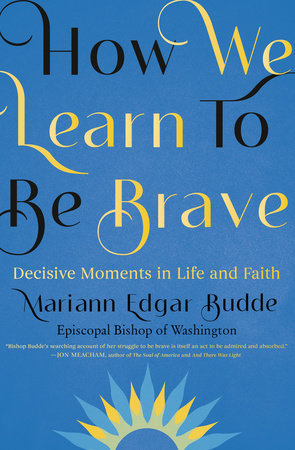
her name is mariann edgar budde, and she is the episcopal bishop of washington, DC. and the full 14:56 minutes of her sermon are worth a listen (or two.) my prayer is that in my one short swift and very small life, i might find such a voice in my own, and put breath to it when and where it most matters. 

bishop budde, it turns out, wrote a book on how we learn to be brave. and i’ve peeked inside while awaiting my copy. worth reading is this:

and this:

and before signing off, inspiration on courage from kentucky bard and old-fashioned farmer wendell berry:

It may be that when we no longer know what to do,
we have come to our real work
and when we no longer know which way to go,
we have begun our real journey.

The mind that is not baffled is not employed.
The impeded stream is the one that sings.

Wendell Berry

and the incomparable maya angelou: 

INSPIRATION

We, unaccustomed to courage
exiles from delight
live coiled in shells of loneliness
until love leaves its high holy temple
and comes into our sight
to liberate us into life.

Love arrives
and in its train come ecstasies
old memories of pleasure
ancient histories of pain.
Yet if we are bold,
love strikes away the chains of fear
from our souls.

We are weaned from our timidity
In the flush of love’s light
we dare be brave
And suddenly we see
that love costs all we are
and will ever be.
Yet it is only love
which sets us free.

— Maya Angelou

where have you found courage of late? did it feel awkward? did it make a discernible difference?

the loads beyond measure

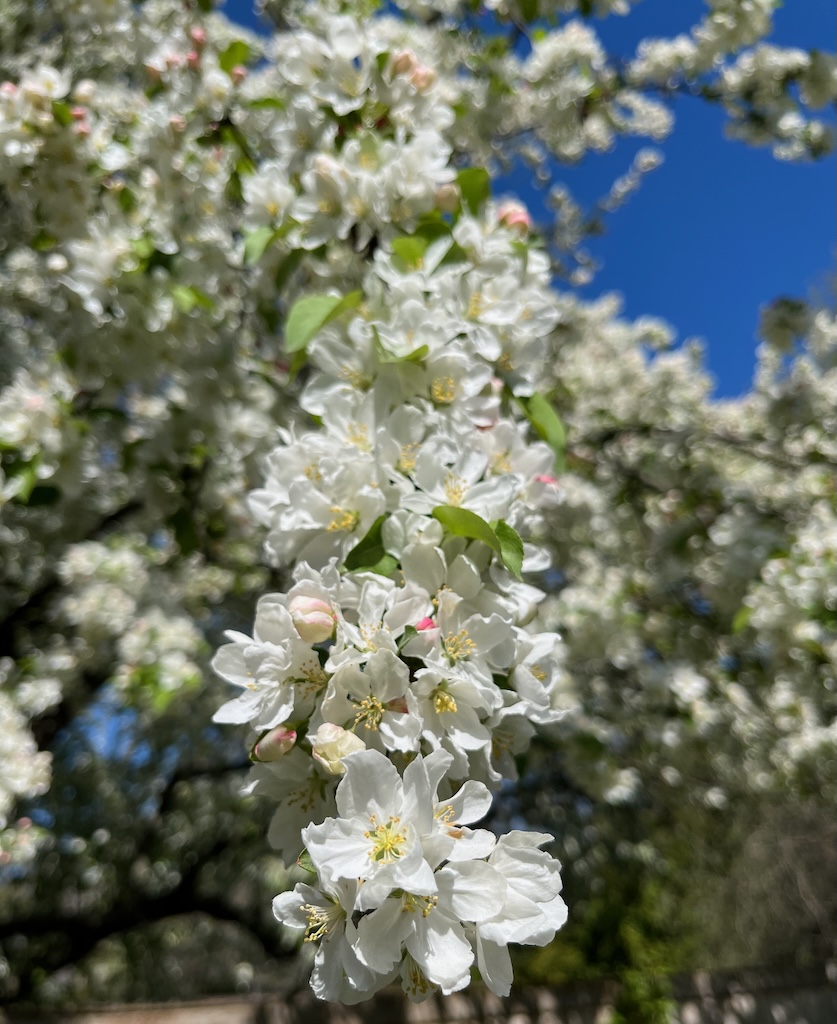
sometimes a batch of words comes tumbling into our world, fluttering onto the path we cross as if the petals from an apple blossom whose bloom has expired. the words come unannounced, and lay there waiting for us to notice. once we read them we can’t think of anything else. all day long, all our thoughts come round to them again and again. 

so it was when a friend whose grief is without measure sent along these words the other morning:

I have been telling myself that I don’t know how to do this, that nothing has prepared me.

i’ve been thinking long and hard about those loads we’re tasked to carry. how every one of us, at some time or another, is bound to have one. a load so beyond measure, a load we never saw coming, it simply stumbles us, knocks us flat and gasping. and in the depth of our hollows — if we’re telling truth — we mouth those very words: “i don’t know how to do this. . . . nothing has prepared me.”

all we see is steep climbing ahead. a load we don’t know how to hold. and all we’ve got to bear it are our stubby shuffling feet, and a ribcage that holds the parts of us that breathe and pump the oxygen. our shoulders and our spine we fear will crumple under the weight of it. 

and then there’s the beehive of a brain, where all the wiring and the worrying, where all the remembering and the grieving and the what-iffing and the if-onlying whirs in and out at every turn in every hour of the day. 

the poet and collagist jan richardson put it like this in her “blessing for the dailiness of grief”:

It will take your breath away,
how the grieving waits for you
in the most ordinary moments.

It will wake
with your waking.

It will
sit itself down
with you at the table,
inhabiting the precise shape
of the emptiness
across from you.

It will walk down the street
with you
in the form of
no hand reaching out
to take yours. . . .

but here, maybe, is what we need to remember, to bear the load we’re sure will finally be the one we cannot budge or bear: our whole life long, we’ve been preparing. every hurt and insult hurled our way. the time in third grade when we cried because the kid one desk over made fun of our clunky shoes. but, next morning, we tied their laces into bows and we walked back in the classroom, and sat there all day long, learning how it is to become more than the stubby shoes that were not penny loafers. the time in high school, when someone in the hall pointed at us and said our face looked like someone smashed us flat against a wall. and it stung for weeks after, every time we stood before a mirror and turned this way and that to measure just how flat our irish face really was. 

and then the big ones come: the time the doctor walked up to the knot of us coagulated in the hospital corridor, and simply said, “i’m sorry.” and we were left without air in our lungs, and with the sudden senseless knowing that the brightest light in our existence had just gone dark. forever.

or the night the clots kept coming. and at last the tiny, tiny arms and legs, the intricately blessed face i’ll never forget, as the baby i thought i was having was cupped in the palms of my bloody hands, the miscarriage that hurt the most. 

the litany is plenty long. and we sometimes never notice just how much each ache is strengthening the fibers of the muscle group without a name, the one that holds us up — yes, wobbling at first; yes, stained with umpteen tears; yes, with sleepless sleepless night — but the one that, in the end, does not fail us. 

we are stronger than we know. and, all along, we’ve been piling on the sinew, deepening the courage, deep breathing the determination, to look that unbearable load square in the eyes, to say, “climb on. i’ll carry you.”

just watch. 

and then, at last, there comes this (jan richardson again, this time “blessing of breathing”):

That the first breath
will come without fear.


That the second breath
will come without pain.

The third breath:
that it will come without despair.

until at last . . .

When the tenth breath comes,
may it be for us
to breathe together,
and the next,
and the next,

until our breathing
is as one,
until our breathing
is no more.

my dear and blessed friend, and all who bear loads they deem unbearable, you do know how to do this. deep in your marrow, you know. your whole life long you’ve been growing strong and stronger. you’ve got this, and you’ve got this. and if and when you stumble, we are here with our simple grace and our love that will not falter. 

where did you find the strength you did not know was yours?

PS (note the all caps!): it’s the birthday sunday of one of the wise women of the chair, our very own lamcal, and i can’t gather up enough love in my bouquet to sufficiently surround her. she is beyond measure! happy blessed day, beautiful one. xoxox and happy mothering day who all who love in that way that knows no end….

solitary vigil

hospital breakfast tray: one year ago

there are days we mark in silence, days best kept in solitude, in the quiet deep down places where only we can trace the contours of the shadow, the weight of how they’ve changed us, cleared the lens through which we see.

they’re the days that have left their mark on us, indelibly. the days in our lifetime that will forever inscribe the demarcation, time divided starkly––before and ever after. 

one by one, or one alone, they’re the days, the dates, the hours that constitute our subterrain, the strata by which our soul is shaped and stretched and textured. it’s the timeline that draws us into depths, to keener understanding of what it means to be alive. or our life, anyway.

it might be a death or disfigurement. it might be birth, or betrothal. a beginning or an end. most often, both at once. to close one chapter is, by definition, to open the next. and while some of those days are duly announced, and bracketed with anything from helium balloons to holding our breath, it might be the weightier ones––the ones whose mark is most unexpungable––best kept in solitary vigil.

it is in the profound spaciousness of unspoken thoughts that we find the room to grope for consequence, that we fumble toward those few faint stirrings that draw us closer and closer to what becomes our truth. we can’t really find our way without the grace of our aloneness, the room where knowing comes. in the beginning and the end, we tread the thin-bare thread of life with but our God to take us by the hand. or so i believe.

and here’s a truth: by the time we’ve hobbled through a few decades (or less or more, depending on our lot), we all accumulate those days. the days whose dates we don’t forget. the day we met our one true love. the long night of our first miscarriage. the house fire that chased us out. the last look into someone’s eyes. the first time the doctor put breath to the word cancer, and quickly added how surprised he was they’d found it deep inside us. 

we keep those days in cloak of silence because we are sifting still through all the ways they’ve reconfigured who we know ourselves to be, and how we move through time. 

yesterday was one such day for me. one year since i awoke on a gurney, my surgeon by my side. i shudder  now to remember it, though at the time i didn’t shudder at all. i was brave that day. it hadn’t sunk in so deeply yet. ever since, and all year long, i’ve had glimpses both of bravery and brokenness. i’ve cried buckets and, then, i’ve set my shoulders firm; i’ve faced the worst of my fears with unflinching questions, endless hours reading, and airplane rides to doctors i wish i’d never needed to know. i’ve slowly, slowly, tried to imagine adding numbers to my years. 

april 18 is a date i’ve uttered umpteen times in the last year. date of surgery: date of diagnosis. date of new beginning. date of counting time with deeper intention and attention. 

maybe the date will dim, as i move on from it. as 2024 fades to 2025 and . . . (and hallelujah for the 4 that now sits firmly where the 3 began.) a year ago today was the first time i saw my life measured in the span best known as five-year-survival rate, the chance you’ll be around five years hence. believe you me, it’s a bracing thing to count forward and hope and pray you cross the line to––bing! bing! bing! your magic number is….––04.18.28. the date now yours with odds attached. 

i’m going for broke here, and placing bets. but that’s only because at this very moment what swells in me is hope. quick as the clouds scuttle across an april sky, i might flinch, get scared, and pull my money from the table. 

my point is simply to say that there are days that define who we are, and we keep those days in silent vigil, wrap those days in certain grace. and we pray to God we come out the other side, with lessons learned and underscored, as we reach and reach toward that one repeating prayer: dear Holy Gracious God, let me make of this one most sacred day every iota of blessing that is mine––and yours––to give. 

some mornings are so much clumsier than others; this is a clumsy one, but my vow to try–even when i mostly miss–is one i take to heart. to write raw is its own peculiar dare. but here’s the why: because every fleeting while you just might catch a dust mote of life as you know it. and thus i will keep swatting at the passing motes, in hopes of putting words to those ineffable pieces of the puzzle. because we are all bumbling along together here, and in good company we find light and air.

as you look back across the plane of your life, are there days you’ve not forgotten, days you note alone and without mention, because you know how lastingly they’ve marked you? and that’s a questions whose answer you needn’t give voice to here. but just a prompt.

some words are hard to say. . .

i don’t think i will ever forget the first time i heard the word cancer spoken in a sentence in which i was the unspoken subject. i was groggy from anesthesia, but there was my surgeon, leaning against the curtain in the recovery room. he was dressed in street clothes, his backpack slung over his shoulder, headed home to dinner, i imagined, with his little brood up here in the leafy suburbs, where we happen to both share the same zip code. i heard him say “it was cancer,” and i heard him say he was so surprised. i don’t think i heard much after that. and for all the days since i’ve been trying on that word. 

it’s a word that’s hard to say. it’s a word that’s hard to slip your lips around. especially when it belongs to you. and when the cancer in question is the one that was settled quite inconspicuously in your very own lung. i’ve thought a lot about the eight years since they first saw it there. no one thought it was cancer. they thought maybe it was a scar, from a pneumonia i’d once had. or an old broken rib. nothing to worry about. all those years. all those christmases and birthday candles blown. all those graduations and droppings off at college, and at law school. all those late late nights when a million worries kept me up, but never that one. never ever a worry that i had cancer in my lungs.

until december, when someone once again saw it by accident and decided we should not ignore it anymore. i owe that someone every year of the rest of my life. and while the next weeks of january into march were a wild, wild ride, it took till april 18 to finally figure out what it was, to finally figure out that the suspicious “neoplastic process” was in fact just that: neoplastic is another word for cancer. 

and it’s gone now. they cut it out. all of it, we hope. my surgeon called the other day and in the cheeriest voice i might ever have heard, he said “congratulations;” said “it’s as good a report as we could hope for, knowing it was cancer.”

i am writing the word here, because words are how i make sense of life. i have always found my way with words. words on paper most of all. words on paper even more than words in air. words on paper are the tracings across the topography of my life. i find my way stringing one word to another, groping along from one to another till the sentence ends. and right now i am in a thicket that makes very little sense. for a few days there, i could not for the life of me tell which way was north, and which was south. i was all turned around, and upside down. i wept and wept some more. 

but slowly, slowly, i am feeling my way. and i am feeling very brave. braver than i ever would have guessed. i would have guessed i’d crumble. but maybe all my crumbling is only in my imaginings. maybe, over the years, when i’ve played out my potpourri of disaster scenarios, i’ve been getting the crumbling out of the way, so that when the real thing came along i was practiced, i was ready to step boldly, bravely, even valiantly up to the plate. 

part of being brave is learning to say those two words, strung together: lung + cancer. lung cancer. i am now part of an unwelcome sisterhood; i’m among the ones to whom those words now belong, and whose lives are shaped and re-shaped thereafter and ever after. and i am linking arms emphatically with the ones who know these hauntings and these hollows. i am, so help me God, intending with every ounce of will and fierce determination to be among the ones who say aloud that we’ve had lung cancer and we are here to prove you can live beyond it. you can live with it shrinking––day by day, month by month––into the distant distance. 

i am still going to dance at my firstborn’s wedding, and my secondborn’s too (or whatever is the life event for which cakes will be ordered and flowers strung). i am going to sashay through my garden, the wise old woman who communes with birds and bumblebees and baby ferns. i will some day tell stories that include the chapter of the time they made the words lung and cancer a part of my vernacular. how never in a million years did i think those words would find their way into my narrative. but here they are. and who knows where they’ll take me, though i’ve a hunch it will be a heady, heady heart-swelling somewhere. i’m not one to leave life’s sheddings by the wayside, unstudied, unplumbed for all their wisdoms and epiphanies.

these might be the two hardest words i’ve ever said. but i am going to say them till they shrink in size, in wallop. i am going to say them till they’re stripped of high-voltage burn capacity.

we all have words that are hard to say, words we don’t think will ever be ours. words we don’t want to be ours: widow, widower, survivor, victim, divorcee, depressed, anxious, anorexic (the word that used to be my hardest one to say), amputee, diabetic, dyslexic, broken-hearted. maybe the point is to take on those words, slip our arms through their sleeves, make them a part of who we are, but not the whole of who we are. to be not afraid, nor defined solely by their simple syllables. but to allow them to deepen who we are, to add contour and dimension, to layer on the empathies. to shape our particular view of how we see the world. and where we find our place within it. 

i don’t intend to turn this into a place where we contemplate cancer. not at all. but right now, it’s the woodsy thicket in which i am trying to find my way. if i—someone who never smoked a single cigarette, someone who never lived with anyone who smoked—can bring the words out into the open then maybe, just maybe, it won’t be such a surprise to the next someone who finds herself stymied by a spot on her lung that cannot be explained. i will be the first one to wave my hand in the air, and say, please don’t wait. don’t hesitate. bite the bullet and let them have at it. find out if it’s cancer or not. don’t dawdle. cuz dawdling does not buy time. 

only courage buys time. stare it down, this cancer. let it know who’s in charge. let it know that you’ve no intention of letting it steal a day of your most precious life. 

i have always known that life is fragile precious. i’ve known that since long before the day my papa died, and i somehow kept on breathing after he was gone. i’ve known it over and over and over again. i’ve known it on the day i got married, when walking down the aisle was something i never really knew i’d know. i’ve known it when i birthed each of my two boys, one whose birth almost felt as if it was about to slip away, but i was determined, and i was not going to lose the answer to the million prayers i’d prayed. i knew it, too, the night i miscarried my baby baby girl, a night as real to me as the ones that ended with babies cradled in my arms. 

i’ve lived so many days i’d never thought i’d see. 

and i am going to live even more. and i am going to say aloud that i once had cancer in my lung, but they cut it out, and now it’s gone. and i am going to tell the story of what it’s like to live emphatically after the doctor in the recovery room tells you he was so surprised. so so surprised to find out that it was, in fact, cancer idling in my lung. 

cancer i hope and pray is gone. completely, totally, forever gone. 


the two little bits i found this week seem fitting for a day of telling hard truths. first, musician Nick Cave’s advice to a 13-year-old:

“Read. Read as much as possible. Read the big stuff, the challenging stuff, the confronting stuff, and read the fun stuff too. Visit galleries and look at paintings, watch movies, listen to music, go to concerts — be a little vampire running around the place sucking up all the art and ideas you can. Fill yourself with the beautiful stuff of the world. Have fun. Get amazed. Get astonished. Get awed on a regular basis, so that getting awed is habitual and becomes a state of being. Fully understand your enormous value in the scheme of things because the planet needs people like you, smart young creatives full of awe, who can minister to the world with positive, mischievous energy, young people who seek spiritual enrichment and who see hatred and disconnection as the corrosive forces they are. These are manifest indicators of a human being with immense potential.

“Absorb into yourself the world’s full richness and goodness and fun and genius, so that when someone tells you it’s not worth fighting for, you will stick up for it, protect it, run to its defence, because it is your world they’re talking about, then watch that world continue to pour itself into you in gratitude. A little smart vampire full of raging love, amazed by the world.”


 and next up, annie dillard on why we read and write at all….

“Why are we reading, if not in hope of beauty laid bare, life heightened and its deepest mystery probed? Can the writer isolate and vivify all in experience that most deeply engages our intellects and our hearts? Can the writer renew our hope for literary forms? Why are we reading if not in hope that the writer will magnify and dramatize our days, will illuminate and inspire us with wisdom, courage, and the possibility of meaningfulness, and will press upon our minds the deepest mysteries, so that we may feel again their majesty and power? What do we ever know that is higher than that power which, from time to time, seizes our lives, and reveals us startlingly to ourselves as creatures set down here bewildered?”

– Annie Dillard


and, this, maybe more than anything. . .

a friend who will be a lifeline sent me this late last night, and i breathed it in through my tears. we can do hard things. humans have done hard things since the beginning of time.

a little note: i am not going to share any medical details here, only the rumblings of my heart. please know that i have a team of angels on my side, medically.

what hard things have you done? and what lightened the load?

maybe we do one, just one, bold (but little) thing…

and by bold i mean one something, anything, in the name of bending that stubborn arc of justice. by bold i mean do one certain something today — maybe even within the next hour — that you otherwise wouldn’t have mustered the will or energy or courage to do.

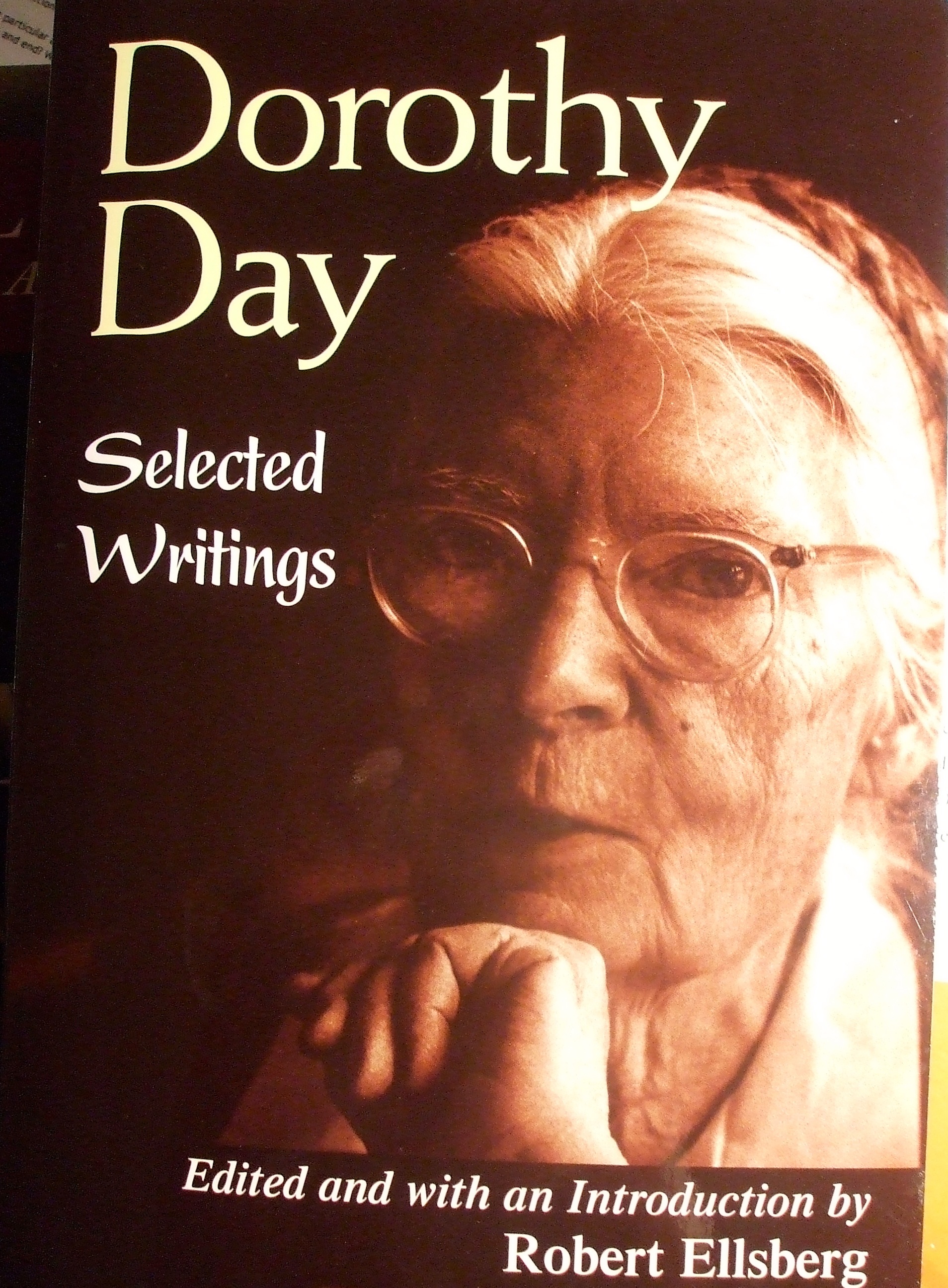
feeling the full weight of what we’re up against in this world that is not letting up in this long hot summer, so many mornings feeling knocked back, feeling impotent, frozen in the face of injustice, in the wake of sirens and spilling blood and streets chaotic, i turn — as i so often do — to the words of dorothy day, who in turn had leaned into the holy wisdom of therese of lisieux, the little saint who preached a spirituality of “the little way,” to mine her everlasting, every day truth:

From Therese, Dorothy learned that any act of love might contribute to the balance of love in the world, any suffering endured might ease the burden of others….We could only make use of the little things we possessed — the little faith, the little strength, the little courage. These were the loaves and fishes. We could only offer what we had, and pray that God would make the increase. It was all a matter of faith.

Dorothy Day: Selected Writings, Edited and with an Introduction by Robert Ellsberg

it’s a place, and a way to begin, for us little people, the ones of us who know full well the real battlefield that calls us every day is the one not too far from our front door, the quotidian one, the one whose players we might know well or not at all. the strangers within our reach. the ones who might be taken wholly by surprise by a sudden gust of kindness, out-of-nowhere kindness. the ones who might find courage a little bit contagious, who might pick up the pieces and pass it on.

once upon a time, stoked by pictures of starving children from biafra, fueled by the stories in time magazine i’d take to my room to read when no one was watching, i used to dream i’d cure world hunger. i imagined i could lope the globe, fill bellies, spoon unicef gruel into mouths open and hungry, like little birds.

it hurts plenty to shed those dreams, to watch them wither away, to realize you were pie in the almighty sky, and some crazy fool besides. what gets tough, gets real, is to station yourself squarely in the middle of your humdrum life, to look out across the landscape, and seek the moments where you might infuse your own cockeyed brand of dorothy day’s little kindness, little strength, little courage.

this bedraggled world needs every bold (but little) drop.

where will you begin?

redoubling

IMG_0977


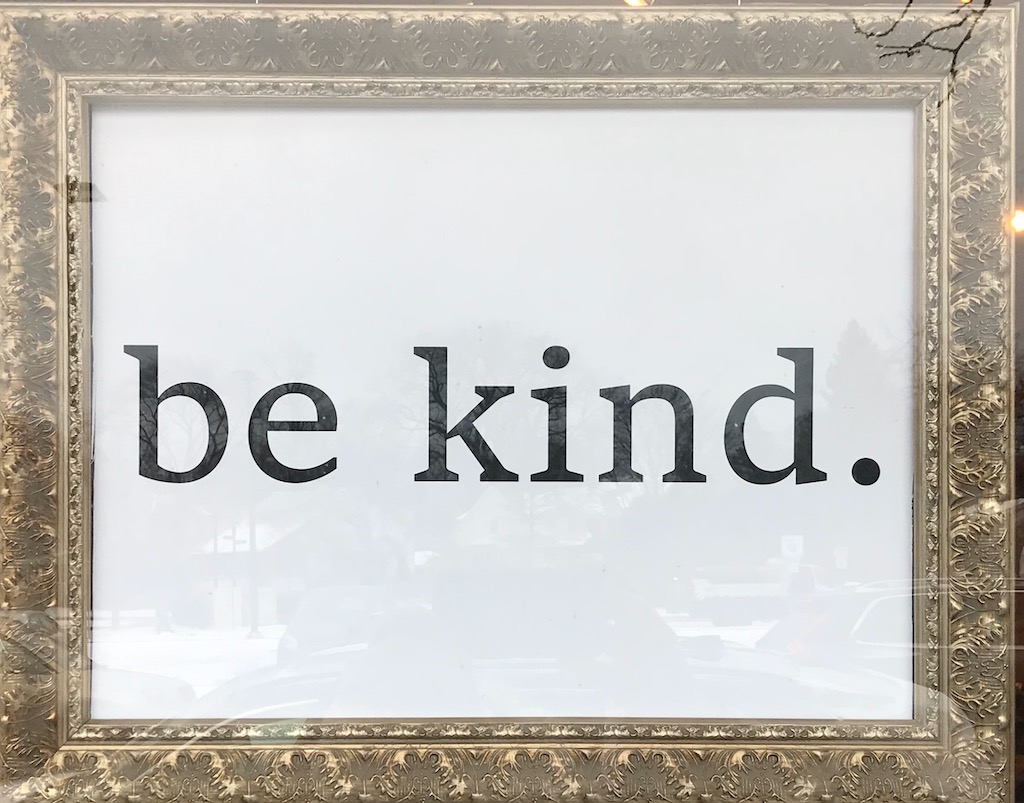
sign in a shop window on a busy street nearby

redouble re·​dou·​ble | \ rē-ˈdə-bəl \ v. 1. make or become greater greater, more intense, or more numerous; make twice as great in size or amount. we will redouble our efforts. 2. a. (obsolete) to echo back. b. (archaic) repeat.


dear people, these are our marching orders. and we do need redouble today. redouble. quadridouble. centidouble. be fruitful and fruitful and multiply.

be kind and kinder. be fierce in your kindness. unclench your fists, resist the urge to punch at the walls. rise above the lowest common denominator. set a new holier bar.

as i dipped into silence this morning, stared out the window at the blessed quiet of this snowfallen morning, where only the cardinal and a few of his acolyte sparrows are animating the tableau, i thought of what this day will bring, what this weekend might be steeped in. i remembered that we are a nation of vitriol at this too-long moment in time. i remembered how crushed we might feel, and how in times of feeling the hard boot heel of history pressing against the breakable bones of our ribcage, the prewired instinct might be to fight back. to wield weapons in kind.

so this is an appeal to resist and redouble. to not knock down vitriol with more vitriol. to put our faith in the longer game. to rustle up every voter you know. to drive them to the polls. bring a bundt cake for good measure. try to believe that goodness might once reign again. that we can be rinsed of this age of disregard, of indecency, of school-lot bullying. in the meantime, write a thank you note. call up the white-domed Capitol, and ask for whoever it is you want to pat on the back. tell them in no uncertain terms what a hero they are. and how you are so eternally grateful. how you hope your kids grow up to be half the hero they are. how they filled you with hope, watching, listening. how contagious their courage was and will be. how you promise you’ll pay it forward, the courage you saw in the face of unthinkable pressure.

there’s an expression–kill ’em  with kindness; i say melt ’em. melt ’em with kindness in the hours ahead. try to make sense, and let your simple acts of kindness be your foot in the door. even with tears in your eyes.

there are corners of the world, not far from our very front doors, where mercy is needed. be merciful. seek out the ones who have no one to turn to. be the face of kindness, be kindness in the flesh. listen to those who are talking into the wind. be the short burst, the certain burst, of goodness dropped from the heavens. we’re all born fully equipped. God gave us two arms so one could reach out while the other held tight. redouble your kindness. redouble your hope.

be the instrument of peace. clear a path in your world and pave it with act upon act of tenderest mercy.

some days, some moments in time, it’s our only hope.

how will you redouble your kindness today?

IMG_1104