pull up a chair

where wisdom gathers, poetry unfolds and divine light is sparked…

Category: caretaking the world

oh, the places we’ve come . . .

winter, i’ve always sensed, is the curling-in time, the season of unseen stirring, and in an octave of dawns, dusks, and nightfalls, winter will be upon us. 

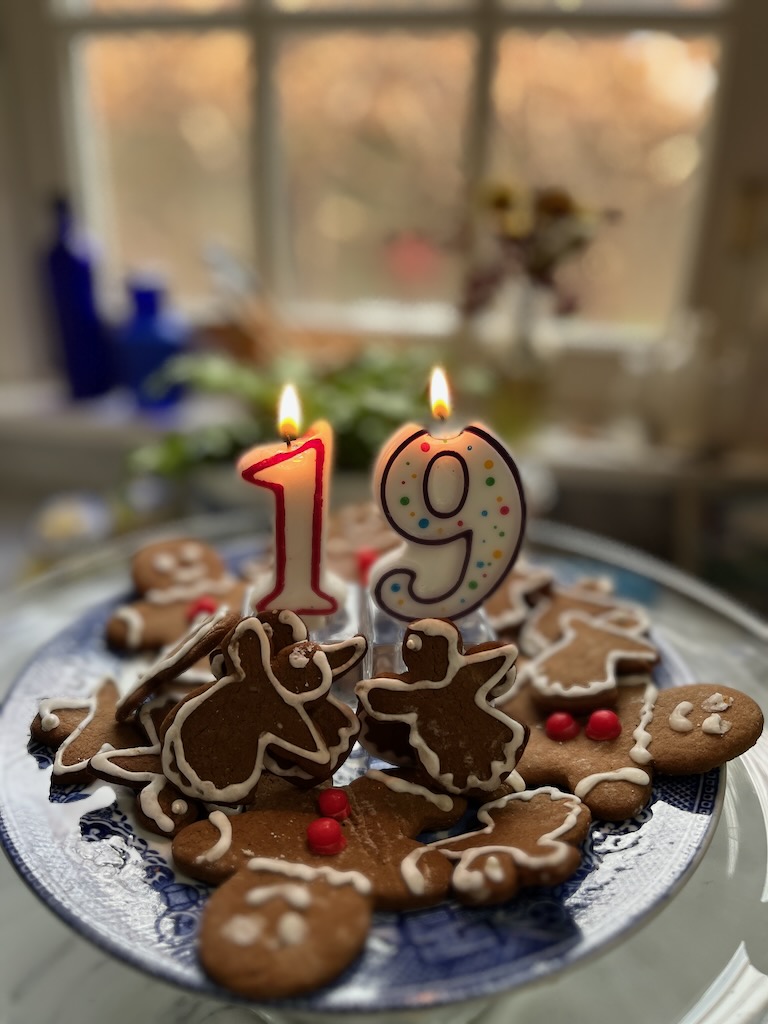
but even now, it’s a season for quieting, for simmering thoughts as well as saucepots of cinnamon stick, star anise, and clove. my simmering for the last nineteen years picks up the pace as the page turns on another year of pulling up chairs to this imaginary old maple table, one where the indentations of long-ago math homework are pressed into the grain, where so many coffees and juices have been poured and sipped and spilled and sopped up with sponges. over the course of these nearly two decades, it seems i’ve developed a knack for simmering while tapping away at the rows of alphabet keys—some 1,255 simmers and counting, all under the name “pull up a chair,” now tapped, posted, and filed away.

only a handful of the very first chairs—bless them, those stalwart humans—still pull up a chair, at least every once in a while. but along the way, so many chairs have been added, and multiplied. and our polestar has never shifted: to carve out a sacred space where questions are asked, and stories are told, where hearts are bared, and above all where gentle, gentle kindness is the metronome by which we set all our rhythms. once in a while, over all the bumps and bruises encountered along the way, we’ve been known to bow our heads and pour out our hearts in holy, holy please God, pray for us.

on the twelfth of december, 2006, our firstborn had just been bar mitzvahed, and our then so-called “little one” was but a kindergartener, not yet reading or writing but melting my heart by the minute and filling our notebooks with his stories and antics and an encyclopedia of unforgettable “teddyisms.” (some kept alive to this day; for the sheer pure joy of it). the firstborn, now law professor, insisted at the dawn of the self-published blogging age that i, his little old mother, could figure out how to “blog,” a verb that’s always sounded to me like a crude guttural effusion, a burp perhaps. and back in the day, he gave me his hand-me-down laptop to do it. to prove i could blog, that is. (as has so often been the case, he even then was wiser than me…)

back then, the question that had captured my attention was the simplest of notions: i believed, after a few years of keenly observing, tagging along with, and writing long newspaper stories of families in the thick of life transitions as a reporter for the chicago tribune, that life’s biggest questions aren’t reserved for colloquia and global summits, nor do they wait for podiums and percussive applause. they are the stuff of the everyday. and if we watch closely, pay keen attention, we can lift those universal, deeply-human questions and struggles from the quotidian stream, hold them to the light for closer consideration, and reap their wisdoms and epiphanies in real time. now, before the moments pass us by and we come to the saddest realization of all: that it’s too late, and our chance at most wakeful living has slipped into the distance. 

all these years later, life certainly has galloped along here at the table. this ol’ chair has seen the growings up of two boys, buried parents beloved, moved another from her home of sixty years. taken a tour of cambridge, mass., and a second helping of college. trekked across the pond, set our sights on war zones, and been rolled into surgical suites and recovery rooms. we’ve feared for our country, for humanity, for civility, and plain old decency. and we’ve refused to surrender to the crude and cruel ways wielded by those who seize power. we’ve kept our minds opened, and tried—oh, we’ve tried—to emphasize the imperative of objective, double-sourced truth, and the slaying of hearsay and heresy. we’ve laid out worries here, and plenty of joys; we’ve marveled and wondered and been gobsmacked aplenty. i’ve pondered cancer and the physics of time, and the holy shimmering presence i know as God. 

lately i seem to have taken to gathering up wisdoms far greater than mine will ever be. i am, as a beloved friend of the chair once put it, something of a magpie. a magpie mostly attuned to seeking the sacred amid the plainstuff of living. the idea of the commonplace book is one i heartily embrace: bring on the poets and sages and prophets, and let me invite you into their brilliant notebooks and minds and unfurl for you their passages and poetics that take away our collective breath and find a way of percolating for hours to come. 

this ol’ chair has given me a place to keep on tapping away at the keys. i realized long ago that i untangle the knots of my life by stringing out sentences. and trying on thoughts. thank you for indulging me, those of you who choose to read along. thank you for pondering the questions at the end of each post, in the quiet of your own soul, or by leaving a note at the table. 

you are, collectively and individually, humans who restore and buck up my faith in the inherent majesty and wonder of the shimmering undying spirit that populates this earth with more than a modicum of heaven’s best offerings.

bless you, bless you, a thousand times thousand, bless you.

this week i am bringing a little birthday bouquet of beauties that struck me across the week, all of them tied together by the beautiful idea that the birthing of holiness is a sacramental act of which we must partake. it’s one that entails unlocking our hearts, making room in the manger within, and allowing the Holy and Sacred to form within, and to birth it with our words and our love in the act. it’s quite the trinity here: a benedictine monk who practices and teaches meditation in the french countryside at a monastery known as bonnevaux; st. john of the cross, the great mystic, as translated by the poet daniel ladinsky; and the late, great luci shaw, a beloved british-american poet and essayist who died at 96 on december first. 


first up, the idea of birthing God within us from the benedictine monk, laurence freeman, whom i’ve been learning from for years…

In the 14th century, Meister Eckhart enjoyed waking people up in his sermons by expounding some uncomfortably new perspectives about their standardised faith. He must have stirred a few dozy parishioners when he asked: “What good is it to me if this eternal birth of the divine Son takes place unceasingly, but does not take place within myself? And, that it should take place within myself, is really what matters.” 

Actually, the great Augustine had asked the same question a thousand years before and added that if we are the children of God, we must become God’s mother as well. If, he said, this birth of the eternal word as Christ in the soul is to happen, our heart – the deepest centre of our being – must become the sacred manger. If we are filled with egocentric distraction there is ‘no room at the inn’ and so the heart must become that empty and open space where the birth takes place and through which he  is welcomed into our world.

In today’s gospel, John the Baptist is usually and badly translated as saying ‘repent, for the reign of God is close at hand’. Basileia, the Greek word we think of as ‘kingdom’, is feminine and so could equally well translate it as ‘queendom’. It doesn’t mean a juridical area but the space in which the presence and grace of God is acknowledged and welcomed. The gospel word, badly translated as ‘repent’, is ‘metanoia’: a change of mind and heart. It is not about feeling sorry for past mistakes. It means spinning round 180 degrees and entirely changing your perspective on and approach to reality.

Living in the desert, wearing a garment of camel hair and eating locusts and wild honey, John seems to us a bit extremist. People who reduce waste and get back to essentials are often called crazy. But because of his spiritual sanity he drew the crowds who asked him ‘what shall we do?’ because, like us, they lived in confused, divided and dangerous times. He told them simply to live honestly and justly but that this lifestyle would prepare them for the imminent – and immanent – coming of the great transformer of all things. 

Meditation is the great simplifier. It reduces the way we waste both time and life’s opportunities. In daily life it is the catalyst for ongoing metanoia. The medicine that loosens the grip of illusion. Usually, we start enthusiastically but before we get to the full 180 degrees we slow down and say, ‘this is quite good, let’s stop here’. Fortunately, if the birth process has already started, it will not allow us to arrest or deny it. We have to see it through until it breaks through into our world and we are happy and lucky if we do.

—Laurence Freeman


and from the sixteenth-century mystic St. John of the Cross there comes this interpretation/translation of what daniel ladinsky calls one of his “love poems”…

IF YOU WANT

If
you want
the Virgin will come walking down the road
pregnant with the holy,
and say,
“I need shelter for the night, please take me inside your heart,
my time is so close.”

Then, under the roof of your soul, you will witness the sublime
intimacy, the divine, the Christ
taking birth
forever,

as she grasps your hand for help, for each of us
is the midwife of God, each of us.

Yet there, under the dome of your being does creation
come into existence eternally, through your womb, dear pilgrim–
the sacred womb in your soul,

as God grasps our arms for help; for each of us is
His beloved servant
never far.

If you want, the Virgin will come walking
down the street pregnant
with Light and sing …

—St. John of the Cross, “If You Want” in Daniel Ladinsky, Love Poems from God: Twelve Sacred Voices from the East and West (New York: Penguin Group, 2002), 306-307.


and, in closing, here’s a classic from blessed, blessed luci, whose great contribution to the canon of Christian poetry would be her capacity for drawing big truths about God and human experience from viscerally pulsing fine-grained images and objects. she is the perfect voice to close out this nineteenth year of the chair….

Kenosis
By Luci Shaw

In sleep his infant mouth works in and out.
He is so new, his silk skin has not yet
been roughed by plane and wooden beam
nor, so far, has he had to deal with human doubt.
He is in a dream of nipple found,
of blue-white milk, of curving skin
and, pulsing in his ear, the inner throb
of a warm heart’s repeated sound.
His only memories float from fluid space.
So new he has not pounded nails, hung a door,
broken bread, felt rebuff, bent to the lash,
wept for the sad heart of the human race.

amen.

may this blessed week bring softening to the walls of your heart, and a widening within those chambers so that Holiness, however you name it, might be birthed there….love, b.

sodden, sodden week

i come this week with sodden heart, afraid for the world we are (no longer becoming but present in the now), fearful of what’s to come. 

once again, a week of news bulletins, and the voices of mass-shooter psychologists filling the airwaves, unfurling the narrative in their cable-news staccato. i didn’t write of the children of annunciation church two weeks past, because i had no words vast enough to reach the depths of it. and i didn’t want to add empty noise.

but a woman i’ve come to love for the purity of her heart, and her inextinguishable humor (mother of five, breast cancer survivor, sister of a brother who died too young, neighbor of annunciation, and one as likely to freely shed tears as to find the hilarity in the everyday) found out that at the moment the first bullets shattered the stained glass of annunciation church, the children in the pews were just beginning to recite psalm 139. 

one of the most ancient prayers, it begins: 

Lord, you have probed me, you know me:

    you know when I sit and stand;
    you understand my thoughts from afar.

You sift through my travels and my rest;
    with all my ways you are familiar.

Even before a word is on my tongue,
    Lord, you know it all.

Behind and before you encircle me
    and rest your hand upon me.

Such knowledge is too wonderful for me,
    far too lofty for me to reach.

and it includes a line i consider one of the most beautiful of all sacred text: 

II
You formed my inmost being;
    you knit me in my mother’s womb.

I praise you, because I am wonderfully made;
    wonderful are your works!
    My very self you know.

My bones are not hidden from you,
When I was being made in secret,
    fashioned in the depths of the earth.[e]

Your eyes saw me unformed;
    in your book all are written down;
    my days were shaped, before one came to be.

III
How precious to me are your designs, O God;
    how vast the sum of them!

Were I to count them, they would outnumber the sands;
    when I complete them, still you are with me.

When you would destroy the wicked, O God,
    the bloodthirsty depart from me!

Your foes who conspire a plot against you
    are exalted in vain.

i can barely get past the line about being knit in my mother’s womb. and it turns out neither could my friend laura. 

she recites it here, a reading worth hearing, as you absorb the words….

then came this wednesday, and with it an assassination and yet another school shooting. and then, thursday, the twenty-fourth anniversary of 9/11. another tragedy, another thread that over the years has brought its tragedy into full view as a woman i have come to love lost her father in that tower that day. and because i know of the layers and layers of tragedy it brought, it is so much more to me now than a terrible day in our national story. as with any violent death, the shrapnel is of the never-ending sort, carnage upon carnage, year after year. flesh shredded, souls shattered, psyches never ever re-settled. 

and so, this poem, with its title so apt: “Try to Praise the Mutilated World.” mutilated we are, all right. 

this poem, it seems, made its way to light in the immediate wake of 9/11 quite by accident, when the poetry editor at the new yorker, who happened to be reviewing an advance copy of the poet’s newest book (at the time) was asked by david remnick, the new yorker’s editor, to find a poem fitting for a special edition of the magazine to be printed and published within days of the tragedy. it was printed on the last page of that issue, as we all scanned the mutilations that hadn’t yet fully revealed themselves. isn’t that always the case with tragedy? the revelations, not unlike a land mine, explode and explode, unseen until the moment of detonation, whenever that comes. 

adam zagajewski, a polish poet who died in 2021, had written the poem with no particular occasion in mind. over the last two dozen years, it’s become his most famous poem, and a poem often pulled from the files to mark this sad, sad day. his choice of the word mutilation is most apt, a word not too too often pulled into text. twinning it with the verb “to praise,” is wholly disturbing. what is there to praise? maybe the work is in the “try.” maybe that’s the instructive, meant to be just beyond our reach. try to praise….

there is work to be done here. there is always work. and maybe if we can remember june’s long days, and the wild strawberries, and the gentle caring of one stranger for another, we can remember why we must weep at the sound of gunshot, and why we must not surrender. this world, mutilated in so many ways, is still a world rife with wonders. 

might we add but a single drop of sweetness to the bitter, bitter taste in our mouths….

Try to Praise the Mutilated World

By Adam Zagajewski

Try to praise the mutilated world.
Remember June’s long days,
and wild strawberries, drops of wine, the dew.
The nettles that methodically overgrow
the abandoned homesteads of exiles.
You must praise the mutilated world.
You watched the stylish yachts and ships;
one of them had a long trip ahead of it,
while salty oblivion awaited others.
You’ve seen the refugees heading nowhere,
you’ve heard the executioners sing joyfully.
You should praise the mutilated world.
Remember the moments when we were together
in a white room and the curtain fluttered.
Return in thought to the concert where music flared.
You gathered acorns in the park in autumn
and leaves eddied over the earth’s scars.
Praise the mutilated world
and the gray feather a thrush lost,
and the gentle light that strays and vanishes
and returns.
(Translated, from the Polish, by Clare Cavanagh.)


a closing thought from jeremiah johnson, co-founder of the Center for New Liberalism, who writes on his substack Infinite Scroll, where he ponders the politics of posting and the dynamics of the social internet: 

As much as you can, resist the hysteria. Refuse to participate in it, refuse to make the polarization worse. The purpose of liberalism is to allow us to disagree with someone without discriminating against them, without harassing them, without killing them. It’s a precious thing, perhaps the most precious thing our civilization has achieved. Every time you break bread in peace with an outsider, every time a Catholic and Protestant shake hands, it’s a miracle. Don’t take it for granted.

what might you find to praise in this mutilated time and this week of mutilation?

summer’s height: the magpie edition

alas, the tuxedo-clad bird, decked out in what seems at swift glance a crisp white bib, along with obsidian jacket and tails, is reputed to be a plunderer of shiny baubles, be it crumples of tinfoil or pop tops of aluminum cans. as such, its reputation is nastier than it deserves. it’s thought to be a mischievous thief, a rapscallion of the ornithological world. one who surveys the landscape for the juiciest morsel to scavenge.

in that case, i am showing my magpilian virtues this week. i am, in summer’s height, plucking and gathering, assembling but a brief collection of baubles for your consideration.

lest we let the poor magpie’s reputation flounder down at the bottom of the seed barrel, science leaps to its rescue with news from the university of exeter that, in fact, the ‘pie is not a thief. it’s been exonerated by exeter’s ornithologists, it seems. according to a study published in the journal Animal Cognition, the bird is merely curious, and actually suffers from a malady known as neophobia, fear of new things.

here’s how the ornithologists explain it:

“The Exeter University study found that magpies were actually more cautious and less likely to approach shiny or novel objects, even when food was nearby. In 64 tests, magpies only made contact with shiny objects twice, picking up a ring and immediately discarding it. This behavior suggested they were trying to determine if the rings were food, rather than expressing an attraction to their shine.”

if only shakespeare had known. over and over, the bard plucks at the so-called plunderer.

“And chatt’ring pies in dismal discords sung;”

this, from Henry VI, Part 3 (Act V, Scene 6, Line 45), but one example.

again and again, shakespeare draws on the corvids—the raven, crow, rook, jackdaw, jay, and magpie—luring them into his scripts. and except for the blue jay, they often appear, according to those of the literary cognoscenti, the ones who read the bard closely, “together in ominous flocks to plunder the dead.” the magpie, specifically, was thought to be “possessed by the devil and channeled his evil words while chattering,” an idea traced back especially to king henry who in Henry VI pulls out “chattering pie” as the cutting-est put-down he knows for his archnemesis, the dastardly duke of york.

audubon’s plate 357, american magpie

nearly a quarter century later, j.j. audubon himself attempted to rehabilitate the bird’s roguish reputation, writing in his journal, the birds of america, of the american magpie in plate 357:

“It is extremely shy and vigilant in the vicinity of towns, where it is much molested, but less so in country places, although even there it is readily alarmed. When one pursues it openly, it flits along the walls and hedges, shifts from tree to tree, and at length flies off to a distance. Yet it requires all its vigilance to preserve its life; for, as it destroys the eggs and young of game birds, it is keenly pursued by keepers and sportsmen, so that one might marvel to find it maintaining its ground as a species, and yet it is not apparently diminishing in most parts of the country.” 

all this to say that at this sauna-like point in the summer, when the air outside is thick enough to cut with a butter knife, and the sweltering has us curling up in arboreal shadows, i come bearing plundered fruits. i am the magpie of ill repute, the one before the reputational rescue. (a warning: not all fruits are sweet. some, too bitter for words, though words are one sure means of conveying even a hint of the harshness.)


joanna macy

for the third week in a row, i come bearing tribute to a great woman whose death leaves us once again with a great voice silenced, and a soul we pray lives on. joanna macy, the buddhist ecophilosopher and translator of rilke, died over the weekend at 96. four years earlier, in conversation with krista tippett, on the occasion of her and anita barrows’ then-new translation of rilke’s Letters to a Young Poet, macy had this to say about living in the moment, and opening ourselves to the beautiful, during this moment in history she refers to as the Great Unraveling:

Well, it seems clear that we who are alive now are here for something and witnessing something for our planet that has not happened at any time before. And so we who are alive now and who are called to — who feel called, those of us who feel called to love our world — to love our world has been at the core of every faith tradition, to be grateful for it, to teach ourselves how to see beauty, how to treasure it, how to celebrate, how — if it must disappear, if there’s dying — how to be grateful. Every funeral, every memorial service is one where you give thanks for the beauty of that life or the quality of what — and so there’s a need, some of us feel — I know I do — to what looks like it must disappear, to say, “Thanks, you were beautiful. Thank you, mountains. Thank you, rivers.”

And we’re learning, how do you say goodbye to what is sacred and holy? And that goodbye has got to be — has got to be in deep thanksgiving for having been here, for being part of it. I kind of sound like I’m crying, and I do cry, but I cry from gladness, you know. I’m so glad to recognize each other. You can look in each other’s face, see how beautiful we are. It’s not too late to see that. We don’t want to die not knowing how beautiful this is.


the thing about being a magpie in human form, is that shiny objects—the true kind, the sort that carry weight and depth all on their own, shininess aside—come all but hiding under rocks. i never know where i’ll spy one. might be bound between the covers of a great book, or might simply be scrolling along when i’m stunned in my own tracks. and so it was when i came upon this sumptuous reply to a post from suleika jaouad in her isolation journals recounting her recent breathtaking birthday trip to tunisia, where she spent much time during her childhood summers. someone named kim wrote this, and set me off on my own voyage into the uninvited beauties that populate and punctuate my world:

In my own world, beauty doesn’t knock. She slips in uninvited—smelling faintly of burnt sugar & sandalwood. She hides in the scorch on toast, the chipped bowl I can’t let go of, the silver cutlery I keep polished for no one but me. I light incense for no reason. I turn the spoon the right way in the drawer. I whisper thank you to the kettle like it’s an old friend who stayed.

you never know where poets are poking about…

but, oh, the reverie in my mind as i, too, considered the beauties too many to count…


i’m going to wade into troubled waters here, and there is nothing but tragedy and horror in the words i feel compelled to leave as the lingering ones of the week.

we cannot let ourselves be living in a world that has children too malnourished to let out a whimper, children whose every rib you could count as if an x-ray with the barest of flesh. in a world of abundance, a world where each night alley dumpsters are spilling with portions too overzealous for even a glutton, in a world where essential nutrition can be picked into space-food sticks, or gel packets meant for mass distribution, there is NO godly or ungodly reason for children or infants or mothers or fathers or the ones who’ve borne them to wither away, for flesh and sinew to waste (the medical term for the breaking down of tissue as the body desperately seeks energy), for breathing to be labored because even the muscles of the chest wall have wasted, and the barest of life-sustaining functions are on their last gasp.

read this statement below, issued yesterday by Philippe Lazzarini, the Commissioner-General of the United Nations Relief and Works Agency, and decide what you might do to respond to the cry of this so-broken world:

“People in Gaza are neither dead nor alive, they are walking corpses…. One in every five children is malnourished in Gaza City as cases increase every day. When child malnutrition surges, coping mechanisms fail, access to food & care disappears, famine silently begins to unfold. Most children our teams are seeing are emaciated, weak & at high risk of dying if they don’t get the treatment they urgently need…. Parents are too hungry to care for their children. Those who reach UNRWA clinics don’t have the energy, food, or means to follow medical advice. Families are no longer coping, they are breaking down, unable to survive. Their existence is threatened.”

we cannot look away. what will we do?

musings on tenderness

of all the ways of love, tenderness is one i hold closest to my heart. it’s the lesson learned and practiced as a little girl, when my mother taught me to run for a shoebox, or little glass jar. to punch its lid with air holes. and to line it with grass and leaves, to bring the outdoors in for this space that would become an infirmary, whether the patient be a baby bird fallen from the nest, or one with a broken wing, or simply a ladybug or firefly who happened to straggle behind. 

i don’t remember signing up for the advanced class, but i do very much recall the village i (a kindergartener at the time) made for my singular ladybug, each edifice constructed of paper and cardboard, care and attention devoted to every adornment (a flower box under the paned window, a wiggly “flagstone” path to the house’s front door). the steeple for the ladybug church i recall being a particular construction challenge. (and i remember depositing said spotted-back bug into the church come sunday morning at 9, per clockwork familial custom.)

tenderness is love on its gentlest setting. tenderness is the heart pierced through with empathies, with quiet, with the barest wisp of touch. a touch so silken it breaks you out in chills down your spine, might make you audibly sigh. to be tendered is, well, to be buttered in love. it is a butterfly kiss of kindness. a heart petaled open, and dusted with golden-grained succors.

tenderness, maria popova tells us, “is the best adaptation we have to our existential inheritance as ‘the fragile species.’”

lewis thomas, the poet and physicist (the lives of a cell: notes of a biology watcher) who first named us “the fragile species,” gives context for why in a 1996 essay from his last such collection, published under the same title, in which he positions us in the context of the universe’s timeline:

“This is a very big place,” lewis begins, “and I do not know how it works, or how I fit in. I am a member of a fragile species, still new to the earth, the youngest creatures of any scale, here only a few moments as evolutionary time is measured, a juvenile species, a child of a species. We are only tentatively set in place, error-prone, at risk of fumbling, in real danger at the moment of leaving behind only a thin layer of our fossils, radioactive at that.”

olga tokarczuk

when olga tokarczuk, the polish psychologist turned poet and novelist, won the 2018 nobel prize in literature, she mused on the art of tenderness in her nobel banquet lecture, a lecture titled “the tender narrator,” and one widely regarded as nothing short of “magnificent.”

tokarczuk began by telling the story of a black-and-white photo of her mother that’s always haunted her, in a blessed way. it was a photo taken before olga was born, and i’ll let her words take it from here (emphasis mine throughout): 

“There’s nothing really happening in the picture—it’s a photograph of a state, not a process. The woman is sad, seemingly lost in thought—seemingly lost.

“When I later asked her about that sadness—which I did on numerous occasions, always prompting the same response—my mother would say that she was sad because I hadn’t been born yet, yet she already missed me.

“‘How can you miss me when I’m not there yet?’ I would ask.

“I knew that you miss someone you’ve lost, that longing is an effect of loss.

“‘But it can also work the other way around,’ she answered. ‘Missing a person means they’re there.’”

stopped by the tenderness of a mother telling her small daughter that she missed her even before she was born, popova comments, is “an astonishing gesture of love so total that it bends the arrow of time.

ponder that string of words, and the meaning behind it, before reading on. “an astonishing gesture of love so total that it bends the arrow of time.” may we all know such love…

tokarczuk picks up her telling from there: 

“This brief exchange, someplace in the countryside in western Poland in the late sixties, an exchange between my mother and me, her small child, has always remained in my memory and given me a store of strength that has lasted me my whole life. For it elevated my existence beyond the ordinary materiality of the world, beyond chance, beyond cause and effect and the laws of probability. She placed my existence out of time, in the sweet vicinity of eternity. In my child’s mind, I understood then that there was more to me than I had ever imagined before. And that even if I were to say, ‘I’m lost,’ then I’d still be starting out with the words ‘I am’—the most important and the strangest set of words in the world.

“And so a young woman who was never religious—my mother—gave me something once known as a soul, thereby furnishing me with the world’s greatest tender narrator.”

a good bit later in the speech, tokarczuk raises this next question, more than worth considering:

“….Have you ever wondered who the marvelous storyteller is in the Bible who calls out in a loud voice: ‘In the beginning was the word’? Who is the narrator who describes the creation of the world, its first day, when chaos was separated from order, who follows the serial about the origin of the universe, who knows the thoughts of God, is aware of his doubts, and with a steady hand sets down on paper the incredible sentence: ‘And God saw that it was good’? Who is this, who knows what God thought?

“Leaving aside all theological doubts, we can regard this figure of a mysterious, tender narrator as miraculous and significant. This is a point of view, a perspective from where everything can be seen. Seeing everything means recognizing the ultimate fact that all things that exist are mutually connected into a single whole, even if the connections between them are not yet known to us. Seeing everything also means a completely different kind of responsibility for the world, because it becomes obvious that every gesture ‘here’ is connected to a gesture ‘there,’ that a decision taken in one part of the world will have an effect in another part of it, and that differentiating between ‘mine’ and ‘yours’ starts to be debatable.”

and then toward the very end of her speech, tokarczuk turns to a literature of tenderness: 

“Tenderness is the art of personifying, of sharing feelings, and thus endlessly discovering similarities. Creating stories means constantly bringing things to life, giving an existence to all the tiny pieces of the world that are represented by human experiences, the situations people have endured and their memories. Tenderness personalizes everything to which it relates, making it possible to give it a voice, to give it the space and the time to come into existence, and to be expressed.

“Tenderness is the most modest form of love. It is the kind of love that does not appear in the scriptures or the gospels, no one swears by it, no one cites it. It has no special emblems or symbols, nor does it lead to crime, or prompt envy.

“It appears wherever we take a close and careful look at another being, at something that is not our ‘self.’

“Tenderness is spontaneous and disinterested; it goes far beyond empathetic fellow feeling. Instead it is the conscious, though perhaps slightly melancholy, common sharing of fate. Tenderness is deep emotional concern about another being, its fragility, its unique nature, and its lack of immunity to suffering and the effects of time. Tenderness perceives the bonds that connect us, the similarities and sameness between us. It is a way of looking that shows the world as being alive, living, interconnected, cooperating with, and codependent on itself.

“Literature is built on tenderness toward any being other than ourselves.”

and a short bit later, she closes her remarks with this:

“That is why I believe I must tell stories as if the world were a living, single entity, constantly forming before our eyes, and as if we were a small and at the same time powerful part of it.”

in a world emblazoned with harshness and cruelties for the sake of cruelty, i will joyfully devote my days to making a living case for tenderness as a way of being. those who have touched me most indelibly in my life are those who wove their way in through that very rare and breathtaking capacity, the one that comes on with a whisper not a bang, the one that quietly says i’ve been keeping close watch on your finest-grained threads, and i see where those threads are tattered or thinned, and i am here to tenderly, yet certainly, place my palm against the small of your back, to let you know you are not alone, you are not unloved, you are seen and beheld.


a modest selection of olga readings:

the whole of her 2019 Nobel Prize acceptance speech here…

and an excerpt from one of the works that won her the 2018 Nobel Prize in Literature, and for which the judges cited: “for a narrative imagination that with encyclopedic passion represents the crossing of boundaries as a form of life”

this one from Flights, her 2007 novel that twines fiction and non-fiction, and which james wood, the new yorker critic and harvard english professor, in 2018 described as tokarczuk’s “omnium-gatherum, a big book full of many peculiar parts: there are mini-essays on airports, hotel lobbies, the psychology of travel, guidebooks, the atavistic pleasures of a single Polish word, the aphorisms of E. M. Cioran. Some of these riffs, which themselves tend toward the aphoristic, are as short as a couple of sentences.”

HERE I AM

I’m а few years old. I’m sitting on the window sill, surrounded by strewn toys and toppled-over block towers and dolls with bulging eyes. It’s dark in the house, and the air in the rooms slowly cools, dims. There’s no one else here; they’ve left, they’re gone, though you can still hear their voices dying down, that shuffling, the echoes of their footsteps, some distant laughter. Out the window the courtyard is empty. Darkness spreads softly from the sky, settling on everything like black dew.

The worst part is the stillness, visible, dense – а chilly dusk and the sodium-vapour lamps’ frail light already mired in darkness just а few feet from its source.

Nothing happens – the march of darkness halts at the door to the house, and all the clamour of fading falls silent, makes а thick skin like on hot milk cooling. The contours of the buildings against the backdrop of the sky stretch out into infinity, slowly lose their sharp angles, corners, edges. The dimming light takes the air with it – there’s nothing left to breathe. Now the dark soaks into my skin. Sounds have curled up inside themselves, withdrawn their snail’s eyes; the orchestra of the world has departed, vanishing into the park.

That evening is the limit of the world, and I’ve just happened upon it, by accident, while playing, not in search of anything. I’ve discovered it because I was left unsupervised for а bit. I’ve clearly found myself in а trap now, and I can’t get out. I’m а few years old, I’m sitting on the windowsill, and I’m looking out onto the chilled courtyard. The lights in the school’s kitchen are extinguished; everyone has left. All the doors are closed, hatches down, blinds lowered. I’d like to leave, but there’s nowhere to go. My own presence is the only thing with а distinct outline now, an outline that quivers and undulates, and in so doing, hurts. And all of а sudden I know there’s nothing anyone can do now, here I am.
—Olga Tokarczuk

maybe you’ll want to add olga to your summer reading list. if you’ve a favorite passage that holds tenderness to the light for you, we’d love to read along here at the table….

who taught you tenderness or, rather, how did you learn of its ways?

blessed birthday today to becca who i love, and who is as wise and strong as woman as i am blessed to know….

undaunted

only when it is dark enough can you see the stars…

Undaunted is the word that came to me. Once the shock began to dull. Once I quelled the queasing in my belly. Once I decided I won’t surrender this blessed world, won’t shift the course of the project I call my most urgent life’s work. 

I am undaunted.

My life’s work is accelerated these days. Its urgency is upon me, upon us all. 

My life’s work aligns with that of every sage and mystic that ever has been: I am devoted to molding myself closer and closer to the holiness I was made to be, we were all made to be. Because this world is a sacred work in progress, and we are its players. We are the ones with the hearts and minds and hands to bend the arc of justice, to kindle more and more brightly the flame of the sacred. To reach toward the holiness infused through our every breath, every utterance, every inkling. The whole of it. At every turn. To be gentle, and kind. To tenderize the fibers of our heart. Especially the ones that have been torn and shorn over the years. 

This is a path beyond the politics and power seekers of the world. I answer to a call from deep within, the eternal flame of the Divine breathed into us all in the beginning. In our beginnings. And the very beginning.

We’re called to play out our work in the milieu of the everyday, on a plane peopled with those who might test us, or just as certainly––often, more certainly––those who reach out a hand, and carry us along. Shimmy us onto their shoulders, if need be. And we in turn will do the same when we’re the ones whose knees aren’t buckling.

It’s contagious more often than not, this reaching toward kindness, toward peeling open the heart, digging deep, living for joy.

I’ve come to know that it’s a work best played out in incremental barely-noticed exchanges: the heart-melting smile shared in a crowded hallway; the hospital scheduler who takes the time to squeeze your hand, knowing you’re afraid; the grocery-store clerk who wipes away the tear that has crept down your cheek.

I once dreamed of solving world problems, curing life-crippling ills. Now, all I ask of each day is that I find moments to be bigger than I’ve been before, to reach deeper into the well of ordinary kindness, to bow my head and heart in deep thanks for every drop of beauty, wonder, decency. 

That work is unaffected by whatever plays out on the world stage. The powers that be hold no power over our souls, and we needn’t succumb. Needn’t employ the crude or the cruel we witness too, too often these days; in fact, we need amplify the opposing forces. Be radical in our generosity. Our empathies. Our magnanimity. Our humility. And our righteous indignation when called for. 

It so happens that this week found me being schooled in some of these very practices, and through the doorways of two great world religions. On Monday, a magnificent soul who happens to be a Hindu yogi, sat me down, lit a candle, and taught me the ways of deep meditation, turning my focus inward to the eternal flame of the Divine within; I am practicing every day. On Wednesday, I walked into the first of a series of classes at our synagogue on an ancient Jewish spiritual practice called the Mussar, centered on the verse in the Torah that tells us, “You shall be holy.” By drawing on seventeen soul attributes, and spending an arc of time––a season, a month, a week––keenly attuned to each, we exercise the muscles of our deepest being to become holy, to work toward our “primary mission in this world…to purify and elevate the soul.” The practice begins with humility. 

In simplest terms, as the great Chasidic teacher known as the Kotzker, once put it: “Fine, be holy. But remember first one has to be a mensch.”

No one can stop us. Mensches will be we.


I’ve spent the week gathering around me a wagon train of wisdoms, a line from the Talmud, a prayer from Judy Chicago, a profoundly wise passage from EM Forster, another from Hannah Arendt, a post from Rebecca Solnit, and finally a paragraph or two from Kamala Harris’ gracious concession speech…..


from the wisdom of the Talmud, found in what’s known as the Pirkei Avot, which translates to Chapters of the [Fore]Fathers, a compilation of ethical teachings and maxims from Rabbinic Jewish tradition. It is a part of the Mishnah, a code of Jewish law compiled in the early third century of the Common Era.

“Do not be daunted by the enormity of the world’s grief. Do justly now, love mercy now, walk humbly now. You are not obligated to complete the work, but neither are you free to abandon it.”


A Prayer for Our Nation
by Judy Chicago

And then all that has divided us will merge
And then compassion will be wedded to power
And then softness will come to a world that is harsh and unkind
And then both men and women will be gentle
And then both women and men will be strong
And then no person will be subject to another’s will
And then all will be rich and free and varied
And then the greed of some will give way to the needs of many
And then all will share equally in the Earth’s abundance
And then all will care for the sick and the weak and the old
And then all will nourish the young
And then all will cherish life’s creatures
And then all will live in harmony with each other and the Earth
And then everywhere will be called Eden once again.


The English novelist, essayist, and broadcaster E.M. Forster (January 1, 1879–June 7, 1970) took up questions of societal empathies in an essay titled “What I Believe,” originally written just before the outbreak of WWII and later included in the out-of-print Two Cheers for Democracy, his 1951 collection of essays based on his wartime anti-Nazi broadcasts. Here’s Forster:

I distrust Great Men. They produce a desert of uniformity around them and often a pool of blood too… I believe in aristocracy, though… Not an aristocracy of power, based upon rank and influence, but an aristocracy of the sensitive, the considerate and the plucky. Its members are to be found in all nations and classes, and all through the ages, and there is a secret understanding between them when they meet. They represent the true human tradition, the one permanent victory of our queer race over cruelty and chaos. Thousands of them perish in obscurity, a few are great names. They are sensitive for others as well as for themselves, they are considerate without being fussy, their pluck is not swankiness but the power to endure, and they can take a joke… Their temple… is the holiness of the Heart’s affections, and their kingdom, though they never possess it, is the wide-open world.

With this type of person knocking about, and constantly crossing one’s path if one has eyes to see or hands to feel, the experiment of earthly life cannot be dismissed as a failure.


Politcial theorist and philosopher Hannah Arendt reminds us our reach for change needn’t be in the boldest strokes in The Human Condition, her 1958 study of the state of modern humanity, thought to be more striking now than at the time of its first publishing. Here’s but one sentence underscoring that claim: 

“The smallest act in the most limited circumstances, bears the seed of… boundlessness, because one deed, and sometimes one word, suffices to change every constellation.”


Rebecca Solnit’s message the morning after the election:

You are not giving up, and neither am I. The fact that we cannot save everything does not mean we cannot save anything and everything we can save is worth saving.  You may need to grieve or scream or take time off, but you have a role no matter what, and right now good friends and good principles are worth gathering in. Remember what you love. Remember what loves you. Remember …what love is. The pain you feel is because of what you love. 


and finally, these two passages from Kamala’s gracious concession speech:

Fight in the voting booth, in the courts and in the public square. And … in quieter ways: in how we live our lives by treating one another with kindness and respect, by looking in the face of a stranger and seeing a neighbor, by always using our strength to lift people up, to fight for the dignity that all people deserve. The fight for our freedom will take hard work. … The important thing is don’t ever give up. Don’t ever give up. Don’t ever stop trying to make the world a better place. … This is not a time to throw up our hands. This is a time to roll up our sleeves. This is a time to organize, to mobilize, and to stay engaged for the sake of freedom and justice and the future that we all know we can build together.

and she closed with this…

You have the capacity to do extraordinary good in the world. And so to everyone who is watching, do not despair. This is not a time to throw up our hands. This is a time to roll up our sleeves. This is a time to organize, to mobilize, and to stay engaged for the sake of freedom and justice and the future that we all know we can build together. Look, many of you know I started out as a prosecutor and throughout my career I saw people at some of the worst times in their lives. People who had suffered great harm and great pain, and yet found within themselves the strength and the courage and the resolve to take the stand, to take a stand, to fight for justice, to fight for themselves, to fight for others. So let their courage be our inspiration. Let their determination be our charge. And I’ll close with this. There’s an adage a historian once called a law of history, true of every society across the ages. The adage is, only when it is dark enough can you see the stars. I know many people feel like we are entering a dark time, but for the benefit of us all, I hope that is not the case. But here’s the thing, America, if it is, let us fill the sky with the light of a brilliant, brilliant billion of stars.

what bright stars did you see this week? and how do you intend to carry on?

to those who note the rare use of caps this week, indeed sometimes you need to stand tall and say it loud and with proper capitalization, and so it is this fine morning. i mean what i say, and i say it undaunted.

love thy neighbor ain’t always easy but it’s where it begins

maybe my world is shrinking, or maybe pragmatism comes with creaky knees and hair turned pewter white. once upon a time i dreamed i might figure out a way to end world hunger. nowadays i spend my days worrying about how to make peace on the little block of houses where i live.

i’ve somehow shrunken my visionary zeal, realized i’m no melinda french gates and will never swipe the planet of those scourges — polio and TB and cluster bombs — that wreak a hardly-holy hell.

what consumes me nowadays is the hard task of human beings bumping up against each other with their curious quirks and rough spots. long ago, when i had my nose in books about saving the planet from the scourge of hunger, when i failed to set the dinner table cuz i was on the phone with a friend in tears, my mama used to drive me nuts with her refrain: “charity begins at home.” i thought that was just another way of getting me to mind my chores.

but, decades later, i get it. i get how hard it is to attend to the one simple command at the core of nearly every world religion: love thy neighbor.

yes, love the lady who shrieks out her window. love the guy whose dog barks through the night. love the ones who park their fancy car in the middle of the alley and don’t think they might be blocking your way.

it’s in the fine grain that we stumble. and that where the grit pits our knees.

it’s pie in the sky — and a cheap way out — to talk in platitudes. it’s a whole other thing to meet that someone on the sidewalk, to look into her eyes, and talk it out. to say i am so sorry you were hurt. to say, i’ll fix it. to invite someone in for coffee — after she’s made it clear she doesn’t much like the way you leave your christmas lights strung up till easter.

i’m not the one who’s in trouble at the moment. but i happen to know that of the eight houses on my side of the block, four are deep in scuffles. and it sickens me to know that in a single ZIP code we cannot find a way toward peace.

and it throws me back to that radical jesus, and maimonides not too long after, and buddha, and mahatma gandhi and mother theresa too, all of whom made it seem so clear, who gave us three words to live by: love thy neighbor.

work it out.

dig deep in your soul’s well, and pull up forgiveness. find compassion. try to imagine how deeply the hurt must be for someone to yell out their window to “mind your own ******’ business.”

this humanity is complicated stuff. not everyone seems to have read the same play book. and no matter how hard we wish, we cannot write the script, nor spew the lines for all to recite.

so how to be the instrument of peace? how oh how, is the question i ask over and over. i don’t have too many answers here. but i do know this: my one holy task, the one way i am choosing to spend my days, is to try. to wake up every morning with that code in mind. to catch myself in the rough spots, just before the fall. and to ask if there’s a kinder, gentler, humbler way to be.

it’s down here in the weeds of our own backyards where the hardest part comes. where it boils down to something more than everyday civility. where if someone’s house was burning, i might run toward the window to catch whatever was being thrown out the windows. where if someone fell on the sidewalk, bleeding, i’d run and hold her hand. wipe her tears. cradle her till the doctors came.

it’s not so hard to send off money to the middle east. what’s hard is walking down the sidewalk, or watering the garden, when someone turns the other way.

it’s in the squeeze of that human vise when we need call on our better, finer, wiser, kinder angels, to not only turn the other cheek, but to figure out a way to span the divide. to sow love where there is hurt. to be the living, breathing instrument of peace.

for that i pray. day after day after day.


diana butler bass, an author and historian who calls herself a public theologian, is someone whose voice i’ve been listening more intently to these past couple years. she points her focus on the intersection of modernday culture (often political culture) and religion and spirituality, and she scythes through any hint of hypocrisy and flat-out baloney. she stands, unflinchingly, for the good. this past week, she was writing about bread and wine and wisdom, and i stumbled into this one paragraph (bolded below) which held me for a long while. wisdom is something i look for, hope for, reach for. i love the way bass takes the hard turns in our lives and sets them as the building blocks upon which the wisdom rises. i love that “bad choices” is part of her mix of what might lead to wisdom. it’s not just that we’re the recipients, that bad things “just happen to us.” sometimes, she wisely puts it, we bring the dark times on. we can be culpable. we can stumble. and do dumb things. words we wish we could stuff back in our mouths. invitations we wish we didn’t turn down. chances we wish we were brave enough to have tried. she makes me wish i could turn back the clock of time just long enough across the arc of my life to tap little me on the shoulder to let me know the dark days i was stepping into were going to be the days that in the end would grow me into the wise old woman i’d long prayed i’d  become. here’s diana on hard-won wisdoms…

Central to bread and wine is the exact same principle: In order to become what they are, they must be transformed from one thing into another. When a leavening agent is introduced to flour and water, it becomes a dough that bakes into bread. When yeast consumes the sugar in juice, it ferments the fruit and turns it into wine. Wheat and fruit are, in effect, broken down and simplified by an outside agent, turning them into bread and wine. That’s what fermentation does.

But this process takes time. Bread must be worked, kneaded, left to rise, reworked, and baked. Wine is the result of weeks or months or even years of yeasts breaking down sugar and slowly turning fruit into alcohol. Bread and wine are staple foods for everyone, and yet they demand great patience of bakers and vintners. Neither happens immediately. One must learn the craft of these foods over time. They cannot be rushed. Staples, yes. Slow foods, absolutely. The best things to grace our tables — those things that sustain us and give us joy — result from an intentional and gradual undertaking.

Wisdom is like that, too. How does one pursue wisdom? Where do you find it? Perhaps it is like bread and wine. It begins as something else — an experience, a loss, suffering, bad choices. But when some leaven — like the Spirit — is introduced, these original ingredients are transformed into wisdom through a process of fermentation that takes time. Wisdom cannot be rushed. You learn, you craft, you wait. Eventually, what was becomes something else — something lasting and satisfying.


i didn’t mean for this to line up quite so charmingly, but another thing that utterly grabbed me this week was this bit of poetry sent by my beloved poet friend win. it’s a poem called “butter knife.” bread and butter, how perfect. but first a word about win, who this year started up a wisdom gathering she sends out every monday morning. it’s called metta monday, and in it she gathers up a bouquet that stirs me, fuels me, and often draws out a tear. her well is deep, and she harvests broadly, drawing on sages and poets and zen masters. i’m not quite sure how you’d sign up for it, but if you leave word here, i will be sure win finds you. she starts your week with a rocketblast of all you need to make it to the other side. . .

click here for butter knife, a poem by hollie mcNish about wonder, and specifically about the wonders and wizardry of the human body and the interplay between blood, sweat, tears and the soul….where “teardrops can be conjured out of thoughts…” it’s a beauty! we might all climb on the hollie mcNish train….

do you have a story to tell of watching love blossom and break through darkness?

summer reading: the writer who gave us spider webs and a little mouse, plus other wisdoms

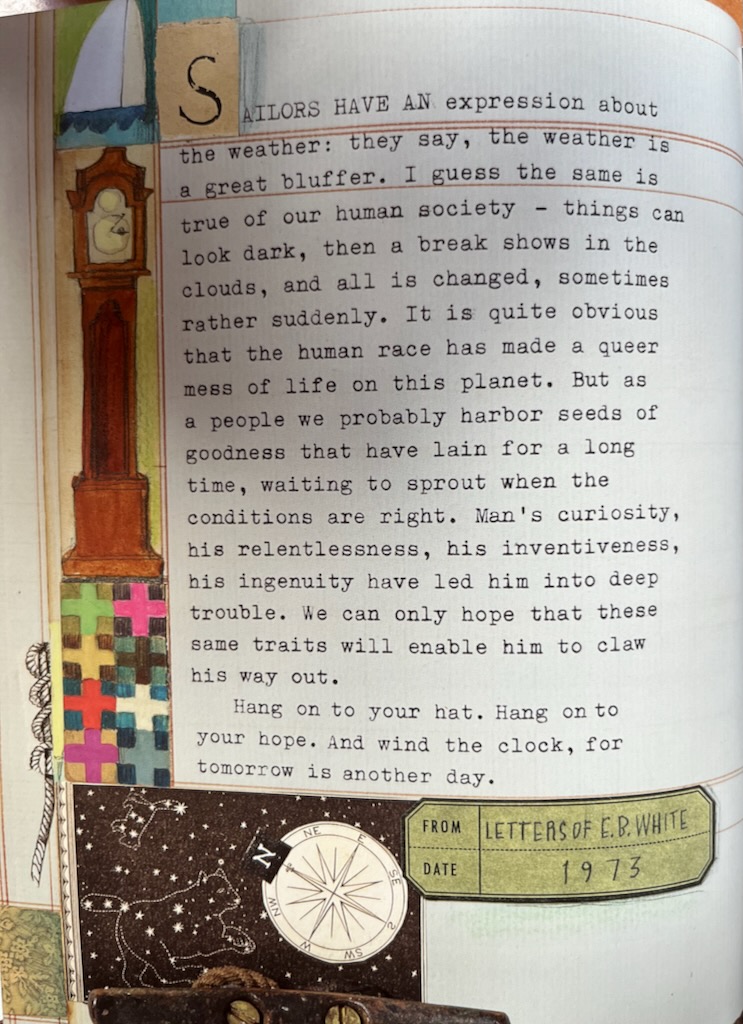
elwyn brooks white, best known to those who loved him as “andy,” and best known to you and me alphabetically as “e.b.,” taught me as much about love as just about any author i’ve ever read. and that includes the sacred texts of just about any religion i’ve happened upon.

every time i’ve pored over the words of charlotte’s web, or stuart little, or “death of a pig,” among the most masterful essays put to paper, i’ve felt the walls of my heart widen, and the bottom go deeper. perched against pillows in the old four-poster bed where both our boys inhabited the dreamland of their youths, i recall the sobs coming in echoes––from the one who was reading and the one being read to––as i choked my way through the tear-blurred words at the top of a still-splotted page 171: “she knew he was saying good-bye in the only way he could. and she knew her children were safe.” (i can’t even type that last sentence now without the tears coming again, filling my sockets.) “. . . she never moved again.” and then “. . .no one was with her when she died.”

we are reading, of course, of a spider. a spider we have all come to love, named charlotte.

and any writer who could make me love with all my heart an arachnid is a writer about whom i can never ever know enough. so it was with purest, geyser-like joy that i turned the pages this week of the first-ever fully illustrated biography of the legendary elwyn brooks white.

part collage, part scrap book, with excerpts of e.b.’s letters, and sketches, and reprints of early drafts and revisions in his own handwritten manuscript, Some Writer! The Story of E.B. White, by the caldecott honor winner melissa sweet, is at heart a love story told of one of the great disciples of love in its quietest, most undeniable forms.

e.b.’s life’s work, as he saw it, and as he wrote in a letter to a reader of charlotte’s web, boils down, pretty much, to this:

love these days seems to be a commodity of which the world is running short. but andy, or e.b., set out to make us see it, and feel it deep in our bones, by telling us the stories, as he put it, “of the small things of the day, the trivial matters of the heart.” he calls those matters “the only kind of creative work which i could accomplish with any sincerity or grace.”

e.b. white

well, dear andy, my gratitude to you is etched on the chambers of my heart, a graffiti of the highest order. to teach a child that love comes in the corner of a barn or even atop the manure pile where wilbur the pig so merrily huddled, well, that’s a blessing pure and certain. and imperative, i’d argue. and too often missed, i’d add.

because he’s earned his post as ballast for my wobbly, sometimes-too-tender heart, wasn’t i delighted when i turned to page 132 in this charmed and charming illustrated biography, and found this excerpt from andy’s letters, which seemed to me a prescriptive for these hard times and the dark clouds under which we find ourselves:

“things can look dark, then a break shows in the clouds, and all is changed, sometimes rather suddenly. it is quite obvious that the human race has made a queer mess of life on this planet. but as a people we probably harbor seeds of goodness that have lain for a long time, waiting to sprout when the conditions are right.

i’ll stop there with my old friend e.b., because that’s the line i want to consider, the line i want us to latch onto and live.

and so, what a curious thing that the next wise soul i wandered into this week was one olga jacoby, a german-jewish englishwoman and mother of four adopted children, who, in 1909 at age 35, had received a terminal diagnosis from her doctor, and sat down to write him a letter on the subject of living and dying without religion, but with moral courage, kindness, and a stunning receptivity to beauty. their correspondence would unfold until jacoby’s death four years later, and her letters, “by turns funny, touching, and intensely sad,” were published posthumously and anonymously by her husband in 1919.

in her first letter, to “my dear doctor,” she boiled down her belief to this:

“To leave a good example to those I love [is] my only understanding of immortality.”

and a year into her diagnosis she illuminated that notion:

“. . . More and more to me this simplest of thoughts seems right: Live, live keenly, live fully; make ample use of every power that has been given us to use, to use for the good end. Blind yourself to nothing; look straight at sadness, loss, evil; but at the same time look with such intense delight at all that is good and noble that quite naturally the heart’s longing will be to help the glory to triumph, and that to have been a strong fighter in that cause will appear the only end worth achieving. The length of life does not depend on us.”

and, she leaves us with this bedrock of lived truth:

“. . . Love, like strength and courage, is a strange thing; the more we give the more we find we have to give. Once given out love is set rolling for ever to amass more, resembling an avalanche by the irresistible force with which it sweeps aside all obstacles, but utterly unlike in its effect, for it brings happiness wherever it passes and lands destruction nowhere.”

who teaches you on the subject of love? what seeds of goodness harbor in you, and how will you coax them to sprout? and how might you put into practice the avalanche of irresistible force practiced by spiders and pigs alike (at least in the rich imagination of one e.b. white) and that, to the dying mother of four, was the most lasting thing that ever there was?

Some Writer! came to me, as so many of the best so-called children’s books do, by way of my best longest friend, auntie mullane, the children’s librarian, who prescribed it as the sure cure for summer blues, or any blues that might befall us in this dark-clouded era.

e.b. white on a rope swing, 1976

where my rabbit hole led me this week. . .

one in a series of summertime esoterica, in which for no particular reason my attention is drawn to this, that, or the other thing…

deep in my summertime poking-around ways, a pursuit of reading akin to ambling barefoot through dew-sodden grass, i found myself the other day burrowing into a rabbit hole, following the trail of a late-19th-century theologian with radical ideas and gloriously poetic prayers. (i might just as effortlessly follow the trail of what to do with too much zucchini, or why banana-peel-steeped waters are so fine for my fledgling tomatoes…it’s a carousel of wonders here on curiosity row…)

walter rauschenbusch (1861-1918)

the theologian of the week, here in rabbit-hole land, is one walter rauschenbusch, the late 19th-century clergyman and theologian who led the Social Gospel movement in the U.S., and whose work is said to have influenced a litany of great 20th-century social-justice warriors, among them martin luther king jr., desmond tutu, lucy randolph mason, reinhold niebuhr, and george mcgovern. his animating idea was that not just individuals but the whole of society needed to work toward what he termed “the kingdom of God” on earth, a place where justice and peace as well as equal rights and a democratic distribution of economic power were holy and necessary works, ones that demanded constant and unrelenting effort. 

rauschenbusch’s radical theology, it seems, was informed by eleven years working as a baptist pastor in NYC’s aptly-named Hell’s Kitchen, where he presided over the funerals of hundreds of children who died from the ravages of impoverishment—malnutrition, domestic violence spurred by overcrowded tenements, or any of the other ills born of economic destitution. 

rauschenbusch wrote: “I began to realize that God hates injustice and that I would be quenching God’s spirit within me if I kept silent with all of the social sin of the world around me.”

of the hundreds of children’s funerals over which rauschenbusch presided (many of them for children younger than five), he wrote:

“At each funeral I would find myself crying out to God, ‘Why do the children have to suffer in this manner?’ I recall on one occasion one of the church members, a single father who worked at a factory for 12 hours each day. His daughter was dying at home and calling out for her daddy. The employer refused to allow the father to go home to be with his daughter in her last hours.

“It was not uncommon to see grown men near our church just begging for work, just so they and their families could survive.

“It was in this context that I began to understand sin in a new and radical way. Baptists had always been known as railing and condemning the sins of alcoholism, smoking, gambling, and sexual promiscuity, such as were exemplified in the lives of the many prostitutes who lived and worked very close to our church. . . .

“The radical conclusion that I came to was this: all of these personal sins which were so obvious to everyone were somehow connected to the sin of structural injustice. So many people saw no hope, no way to extricate themselves from their living hell, their dead-end street. So many would resort to alcoholism. Women would feel compelled to become a prostitute so they could feed themselves and their families. Charles Dickens in his writings helped us see and somewhat feel the environment that could ensnare anyone who was trapped in a world of deprivation and desperation.

“The less obvious sins to most Baptists and other conservative leaders were those that were represented by the vast gulf between those who were extremely opulent, you might say ‘filthy rich,’ and the vast majority of people who were barely able (and oftentimes not able) to get by.”

finding wisdoms from the past for these arduous times is, perhaps, too futile a pursuit. but i believe in the endosperm of hope. and rauschenbusch’s prayers––and his theology––seem apt for a dusting off. and, besides, his prayers are beautifully wrought.

my eye was caught first by one of those prayers, the evening prayer (below) but as i kept reading it was the line above––“I began to realize that God hates injustice and that I would be quenching God’s spirit within me if I kept silent with all of the social sin of the world around me.”––and the children’s funerals that informed it, that clutched me at the gut and won’t let go.

here, as a place to begin, is but one of his prayers, with particular resonance for one who delights in all of creation, especially the trials and triumphs just beyond my own back door:

FOR OUR WORLD, OUR EARTH

O God, we thank You for this universe, our great home; for the vastness and richness of our cosmic environment; for the manifoldness of life on the planet of which we are a part.

We are thankful for the morning sun and the clouds and the constellations of stars.

We rejoice in the salt sea and the deep waters and green leaves of grass.

We thank You for our sense by which we experience earth’s splendor.

We would have souls open to all this joy, souls saved from being so weighted with care that we pass unseeing when the thornbush by the wayside is aflame with beauty.

Enlarge within us a sense of fellowship with all that lives and moves and has being in space and time, especially with all who share this earth as their common home with us.

Remembering with shame that in the past, we human beings have all too often exercised high dominion with ruthless cruelty, we admit that the voice of the earth, which should have gone up to You in song, has been a groan of travail.

May we so live that our world may not be ravished by our greed nor spoiled by our ignorance.

May we hand on earth’s common heritage of life, undiminished in joy when our bodies return in peace to You, our Great Mother who has nourished them.

and here is the beginning of his evening prayer: 

LORD, we praise thee for our sister, the Night, who folds all the tired folk of the earth in her comfortable robe of darkness and gives them sleep. Release now the strained limbs of toil and smooth the brow of care. Grant us the refreshing draught of forgetfulness that we may rise in the morning with a smile on our face. Comfort and ease those who toss wakeful on a bed of pain, or whose aching nerves crave sleep and find it not. Save them from evil or despondent thoughts in the long darkness, and teach them so to lean on thy all-pervading life and love, that their souls may grow tranquil and their bodies, too, may rest. And now through thee we send Good Night to all our brothers and sisters near and far, and pray for peace upon all the earth.

if you’re interested, here’s a link to a PDF of rauschenbusch’s 1910 collection of prayers, For God and the People: Prayers of the Social Awakening.

in the book’s preface, rauschenbusch explained the collection’s genesis: “The language of prayer always clings to the antique for the sake of dignity, and plain reference to modern facts and contrivances jars the ear. So we are inclined to follow the broad avenues beaten by the feet of many generations when we approach God. We need to blaze new paths to God for the feet of modern [women and] men.”

amen, pastor rauschenbusch, amen.


as long as we’re quoting old white men, i admit to being an admirer of the writings of that old-time radio humorist garrison keillor, who has mellowed beyond measure with age. in an ode to summer’s slow pace the other day, he wrote this about morning light, one of the blessings that comes with waking early, a habit i consider essential to the deep breathing of my soul:

It’s a revelation of delight, of our Creator’s delight in His creation, and though we’re brought up to be skeptical, wary of big hopes, prepared to deal with the injustices of life, still the dawn light argues with stoicism and you see the beauty of the ordinary


what ordinary beauties or big ideas captured your imagination this week?

and here’s a harder question (to ponder in your own soul): what shall we do so as not to stay silent in the face of the social sin of the world?

and happy blessed blessed day to my beloved andrea, who makes me laugh hard and often, and whose goodness seems vaster than the circumference of this big blue globe. (A is one of the chair friends who reads dutifully nearly every week, and more often than not sends along a note that melts me or makes me laugh every time…)

this is what mothering looks like. . .

a few years ago, maybe many years ago, i wrote something of a proclamation on mothering, the verb. in my feisty little voice, i argued — as vehemently as a girl taught to be polite could argue –– that, gosh darn it, mothering was not an art that belonged exclusively to those who happen to have pushed a wee squawker from her womb, nor only to those who’ve clutched babies to her bosom, anatomically-aligned attachments. i argued that we should be honoring not simply the noun — those who are mothers — but the verb — those who mother. 

it’s an all-inclusive distinction, one i tried to describe thusly:

yes, every last someone who has stroked a brow, wiped a tear, dabbed chocolate off a little cheek, fluffed a pillow, tucked in the covers, whispered bedtime prayers, set an extra place at the table, stretched a meatloaf, picked the peas out of the pasta salad, kissed a bloody knee, kept a retching belly from falling in the toilet bowl.

yes, every pair of arms that’s lifted a dead-weight child in the pool, played red rover till the cows came home, bent half-over to push a kid on training wheels around and round the block, turned the pages of good night moon so many times you find yourself chanting good night to the mittens when no one’s in the room.

you get the point.

i believe it as firmly as i believe anything. and in fact, in the many hours i’ve spent curled in my window seat in recent days, i found myself with nose in a book that argues — again, vehemently yet politely — that we are missing out on a whole lot of God if we think of God only as a white-bearded fellow perched on a throne with a sword and a scepter, a God as king, imperial ruler and judge, as wielder of power, and slayer of sinners. (for the record, that has never been my image of God, and i admit to images, being of the simple kind who need pictures to go along with my favorite passages. and the picture i saw is a tender God, one with arms that reach, and a palm that cradles, or presses against the small of my back. and as i’ve grown and deepened into the mystery, i now sense God without image at all. i sense God in the shiver that runs up my spine when i encounter the beautiful or the unbearably tender, and i find God in the interplay — the ineffable force — that animates hearts and draws us — any of us, all of us — into each other.)

the book i’ve been reading — She Who Is: The Mystery of God in Feminist Theological Discourse, by Elizabeth A. Johnson , a brave and brilliant theologian who happens to be a roman catholic nun –– says this: 

“God is that on which you lean your heart, that on which your heart depends, ‘that to which your heart clings and entrusts itself,’ in Martin Luther’s memorable phrase.”

the truth is, it’s all mystery, and we reach for metaphor so our little minds can find something to seize. how do you put words to the inexplicable, the unknowable? you simply know what you know. 

but in considering a God imbued with the feminine, a God more mother-like, a God, as johnson writes, of “gentleness and compassion, unconditional love, reverence and care for the weak, sensitivity, a desire not to dominate but to be an intimate companion and friend,” i scan the landscape of my recent days, and i spell out this litany of what mothering — the verb that belongs to all who employ tender loving empathies and unending expression of gentle kindness — looks like:

mothering is the knock at the door on a rainy morning, not long after dawn, and the friend who is standing there with a handful of field-plucked flowers and a soggy brown bag of parsley and spinach and ramps, foods she grabbed from the farmer’s market, knowing from her own daughter’s deadly cancer that these are the foods that should fuel me. and she knew without asking how very much i wished i could get to the market, though i couldn’t quite yet.

mothering is my beloved husband who, every morning, makes certain the feeder is filled with seed and the bird bath fully watered, for he knows the joy i absorb watching the birds flit hither and yon. mothering is the pizza he drove into the city to fetch because it oozes the things i love — spinach and mushrooms and cheese and a heavenly red sauce –– and he is intent on fattening me my way. mothering is the rod stewart and kim carnes tapes he played all morning long to try to convince me the rasp in my so-called voice (paralyzed vocal cord caused by the surgery) was a sexy addition to life here on the homefront.

mothering is the friends who don’t back down, who don’t shy away, who know without asking just when to barge in, and when to stay quiet. and who keep coming back, week after week, willing to walk at a snail’s pace, or pick up a vacuum and suck up the kitchen-floor crumbs that are driving me batty. 

mothering is my aunt who tucked a tiny enamel cross in an envelope and scribbled these words on a note card: “hope i’m helping you carry your cross!” and then wrote that as soon as her daughter could drive her up here from cincinnati, she wanted to sit side-by-side under an apple tree “to make your ‘hurts’ hurt less.”

mothering is the courage to go the distance, even when the distance is wholly uncharted and fraught with shadows and plenty of bumps. and what you need more than anything is a friend who won’t cower and run for the hills. 

mothering is the way some listen for the fears tucked in an otherwise straightforward sentence, and who don’t shush those hauntings away, but make room for it all, the light, the darkness, the liminal. 

mothering is the text message that comes out of nowhere and makes you laugh till the slits in your side tell you to stop. because laughter is always, always, a curative. and it can carry you for hours, the echo of its joy refusing to fade.

mothering is this holy earth unfurling its tight buds and its blossoms into frothy meringues of cumulus white and lavender blue. mothering is the dawn that reminds me again and again that the light will shatter the night. mothering is the papa bird who tucks the seed into mama’s beak, an iteration of kissing i’ll not soon forget.

mothering is without gender, independent of obstetrical status. mothering, quite frankly, is simply another name for “love as you would be loved.”

mothering, quite simply, is what God does. 

blessed mothering to all of you who mother and mother and mother –– even if you don’t realize…

birthday blessings to one of the wise women among us, our beloved lamcal, who fetched me from the darkness last night, and plunked me into a circle of pure and undeniable love, even when i wasn’t sure i was up for an outing. she’d sensed it might do my soul wonders, despite my bodily wobbles and squeaks, and she was oh so very very right on the money. i sat last night in a circle of holy holy pilgrims, who poured out their hearts and their blessings. and sent me forth. happy birthday, wise one….

lest you miss it, here’s the week’s query: tell a story of a time you were so deeply mothered — perhaps by an unlikely motherer — you’ve never forgotten.


and i’m leaving you this. because it’s glorious:

Go Deeper than Love

Go deeper than love, for the soul has greater depths,
love is like the grass, but the heart is deep wild rock
molten, yet dense and permanent.
Go down to your deep old heart, and lose sight of yourself.
And lose sight of me, the me whom you turbulently loved.
Let us lose sight of ourselves, and break the mirrors.
For the fierce curve of our lives is moving again to the depths
out of sight, in the deep living heart.

~ D.H. Lawrence ~

p.s. even though the picture above is overt mothering with a literal mother cradling her literal baby (moi and my firstborn, the law professor) i had to reach for it today, because that tenderness, that love, is the very thing fueling me right now, as i reach out of these past upturned weeks and set my sights fervently, fiercely, on doing everything i can to keep on loving my boys –– and all of this life –– with every ounce of tender lovingness i can squeeze out of me…..so help me, MotherGod….

equal time for equal mothering: this is saying goodbye one college drop off and that’s the kid who graduates next week. my miracle baby. . .

nursing tender things along. . .

barely perceptible nub of palest green, on the first outpost of the left branch of what might once again be my peewee hydrangea…see it?

i found myself crouching down as low as i could go the other day—likely lower than a girl with slits in her side should wisely have gone. but i was intent on inspection. i was searching clumps of stick for little nubs of green. of life. of any sign that the last shrub i planted in the fall — the day before the frost came — had survived the long winter. 

it was a long winter for plenty of us — certainly for my garden, newly planted in the weeks not long after the dreaded fence went up next door, and indeed for me. 

and yet now the season of birth and rebirth is upon us. from every bough and limb, from every red bird’s throat, the song of springtime’s hallelujah bursts forth and keeps on forthing. 

i find myself particularly intent on the tendernesses of this holy spring. i am crouching down low day after day, keeping watch for signs of life, coaxing beauties to unfurl.

poor mama robin laid her egg on a porch railing. oops. fear not, all now is well.

seems a wise posture, that of nursemaid to the birthing earth. it’s one i am learning to mimic as i consider my own deeply tender places, as i picture the convulsions of my poor little lung that likely has no clue what hit it, and why all the folderol and commotion a week or so ago. but it is now doing its darnedest to sew itself back to whole, pressing tight the seams that now are held in place with metal threads. the miracle of the human body is not unlike the miracle of holy earth, and as i slowly walk my garden’s edge, stooping here or there to lend a hand — lifting clematis vine to its fallen trellis, rescuing a robin’s egg mislaid on a railing’s edge — i am breathing in the tender caretaking ways of the God who so tenderly holds us in God’s sacred trusted hand. or so i imagine. none of us has a clue really just what form this God of ours inhabits, so from time to time i apply my storybook imaginings to make it all more apprehensible. i understand the naiveté of picturing a God who scoops me in God’s hand, but somewhere deep in that vision there is a grain of holy comfort. there is an image put to the ineffable. and right in here, i need that image.

i’m not the first to put pictures to my God, and i know i’m not the last. it’s a hard task here on earth to imagine the Divine goodness that inhabits all the cosmos, and surely all the heavens, and then the questions come: is heaven the holy light deep in our hearts? is heaven that palpable knowing that we are held by a goodness beyond our wildest imagination? once upon a time the nuns taught that heaven had a pearly gate, and was carpeted in clouds. oh, lord, they shouldn’t teach such things to wide-eyed little children; it can take a long long time to revise the picture reel inside your head, and why waste time in lala land when God is so much more and vaster and infinitely deeper.

i am spending many chunks of time pondering the presence of God in this messy chapter of my life. what i know is this: when i was deep in the dark tunnel of an MRI that scanned the vessels of my brain, and told not to flinch a single muscle for 45 excruciating minutes, i surrendered to the softest arms i’ve ever known. i imagined them as the arms of God, cradling me. and in that space of utter peace, i rested. and did not flinch, did not cough, did not exercise the itch or cramp in my shoulder; i found the holy wherewithal to do precisely as the doctor ordered. 

and that is how i pass the hardest hours. i go deep down under. into the place where God and angels dwell. i’ve no knowledge of this landscape. it’s all uncharted and unknown. but when i go there i am safe. and i am cradled in what feels like love. and that to me is how it feels when i walk my garden’s edge, crouch down low, and lift a hand to bud or vine or mislaid egg. we are all nurturing each other along. God and all of us. and i’ve no idea just how it works, or what it is. but i know i sense a holiness that i am choosing to call my God.

amen.

(i fully grasp that i’m going out on limbs here, groping along in wholly naked ways, but if i don’t use these hours of my life to plumb the deepest questions, to fumble for the truest answers i know, then what worth will these struggles hold? we have a chance to be our best selves in our darkest hardest hours. and these are mine. so far. so why not open the book and see what stirs? i’m impelled to wonder and to muse aloud….)

mama robin, safely atop her mislaid egg. photo by kerry, who saved the egg and whose porch is mama’s birthing room….

and now a few morsels, as has been my way in this year of gathering up bouquets of wisdoms…

Julian of Norwich, an English anchoress who experienced a vision in 1373 and wrote about it in a work titled Showings or Revelations of Divine Love — the earliest surviving book by a woman in the English language. my friends at the SALT Project (emmy-award-winning visual storytellers with a spiritual bent; check them out) laid this excerpt out as a poem. i found it lovely….

And in this he showed me a little thing
the quantity of a hazelnut,
lying in the palm of my hand, as it seemed.
And it was as round as any ball. 

I looked upon it with the eye of my understanding,
and thought, ‘What may this be?’
And it was answered generally thus,
”It is all that is made.”

I marveled how it might last,
for I thought it might
suddenly have fallen to nothing
for littleness. 

And I was answered in my understanding:
It lasts and ever shall, for God loves it.
And so have all things their beginning
by the love of God. 

In this little thing I saw three properties.
The first is that God made it.
The second that God loves it.
And the third, that God keeps it.


+ Julian of Norwich


 as has been my habit in recent months, i mark the turning of each month by turning to the pages of Henry David Thoreau’s The Journal: 1837–1861. here’s a dreamy entry from the ninth of may when thoreau was 34 and aswirl in the warmth of mid-Spring. (may our warmth please come….) 

May 9. It is impossible to remember a week ago. A river of lethe flows with many windings the year through, separating one season from another. The heavens for a few days have been lost. It has been a sort of paradise instead.

Saw a green snake, twenty or more inches long, on a bush, hang­ing over a twig with its head held forward six inches into the air, without support and motionless. What there for? Leaves generally are most beautiful when young and tender, before insects or weather has defaced them.

These are the warm­-west-­wind, dream­-frog, leafing­-out, wil­lowy, haze days. Is not this summer, whenever it occurs, the vireo and yellowbird and golden robin being here? The young birch leaves reflect the light in the sun.

Mankind seen in a dream. The gardener asks what kind of beans he shall plant. Nobody is looking up into the sky.

a little dictionary for those of us who don’t know our greek: lethe: “forgetfulness,” from the river in Hades that causes drinkers to forget their past.


one more thing a brilliant woman sent me this week when i was inquiring whether a certain “tiny retreat” (that’s how it was billed) had a virtual component, for those of us whose lives are pretty zoom-y these days…..

“Be who God meant you to be and you will set the world on fire.”

Catherine of Siena

finally, a profound note of thanks, to the brilliant and bold mountain-mover of a friend i have in poet and scholar (and my former cambridge landlord) mark burrows, who sent a note to all who were at the zoom book launch a few weeks ago (a lifetime ago!), and who implored you to add a little amazon review to my “languishing” Book of Nature. well, the book isn’t languishing but its state of review sure was. i have no understanding of the algorithms of amazon, but apparently, without reviews, you’re sunk. glub. glub. glub. so mark, unbeknownst to me, rallied the forces and got the reviews boosted from 3 to 11, currently. in a million years i couldn’t have done what he did. in these otherwise upturned days, the human species has shown me in brilliant colors just how magnificently we all can be, and love is pouring forth with the might to rocket me to the holy moon, which was magnificent last night if you happened to notice.

so, thank you, blessed blessed mark. and thank every one of you who in your own magnificent ways has stepped to my side in this curious curious walk through springtime 2023…..

love, bam