it came over me like a wind from the north. suddenly, my little wagon was steering straight toward the tree lot. too early to be opened, i climbed a snow mound (as if i were far more agile than i am) peered through the cyclone fence to get a peek at the price tag, let out a gasp, and climbed back down from the mound.
the little wagon wasn’t finished. it steered toward yet another tree lot, where a clump of three last trees lay cast off in a heap. these were not the sort of firs that stand proud in rows, showing off their verdancy. these were orphans, literally tossed aside. one, i decided, was mine. so i marched in and paid, and looped the tree atop the wagon. then we drove home, the little tree and me. and all by myself i hauled it from car to back door, and into the house, where it lay, awaiting another pair of hands for the vertical lift.
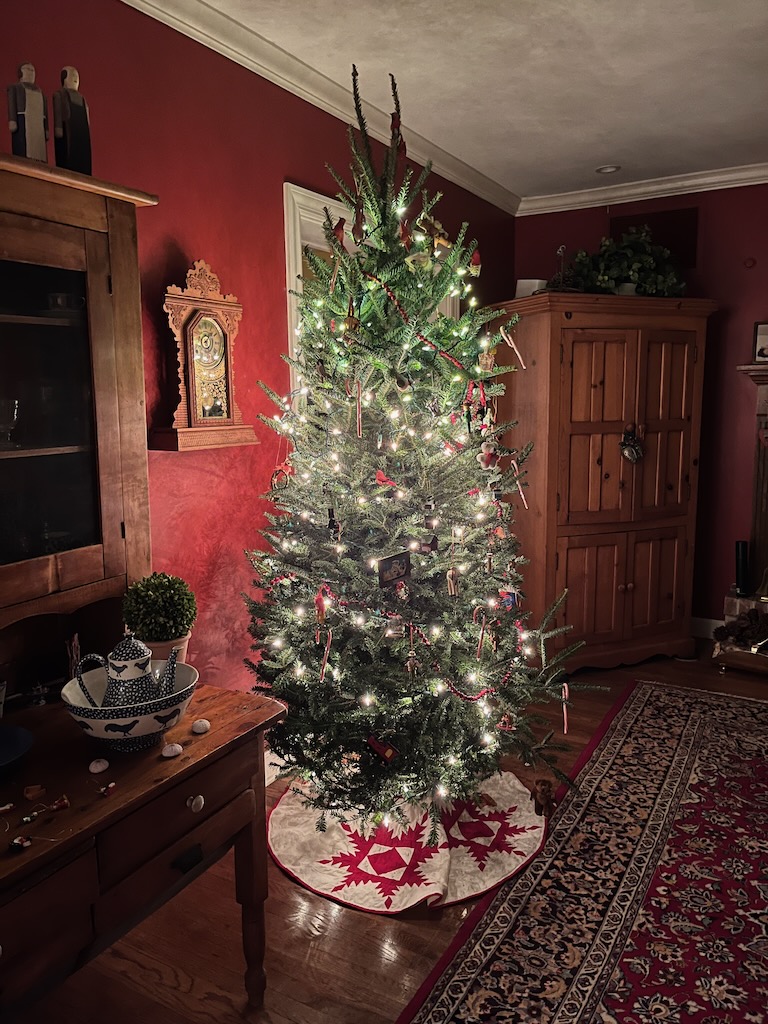
this urge to green, this life force that would not be slowed, as i merried my way into the season, looping garlands, dangling wreaths, lacing strands of lights and cranberries through the boughs of the little lost tree, all of it was as if a whirl had swept through the house—and through me.
“seasonal affliction,” you might think. belatedly getting with the program, another way to put it (for i’d waited far too long for the fresh young trees, and the Christmas countdown was now in single digits). merely catching up, the motivating force that drove this fa-la-la-ing.
until the next morning, when suddenly it made sense—immense sense—in a way i’d not seen it nor felt it before.
there i was, sitting off to the side of the little chapel where i sometimes go to pray, when a holy fellow stepped to the pulpit and began to talk about hildegard of bingen, the great twelfth-century german benedictine abbess and mystic, whose whole theology (a cosmology, really) was centered on the idea of viriditas, a latin term she coined from the words for “greening” and “truth.” it was her notion that all of life has ever been, and will be, imbued with a Godly force, a greening aliveness surging toward wholeness, holiness, and healing. it’s another vision for the breath of God filling our every corpuscle with the oxygen of the Divine. yet hildegard, a polymath and herbalist whose notebooks were filled with writings and doodles of birds and trees and stones and stars, centered her vision on “the greening,” fueled by a sacred sap coursing through and pervading all of creation, and the animating force in each of our souls.
in other words: there is in us, and in every atom and ion of creation, a current, a holy river, propelling us and all creation toward the ultimate whole, the holiness God has ordained and which we mere mortals can only imagine.
hildegard came to this as she studied the greening of plants in the monastery’s garden, paying close attention as stem and bud absorbed the sunlight, and—long before photosynthesis was understood by botanists—she grasped that the sun’s offerings (light and warmth) were the forces that brought the fronds’ unfurling and the peeling open of the blossom. if the garden worked thusly, then why oh why wouldn’t humanity, wouldn’t all of creation, so too? mightn’t we too absorb a holy surge, a Divine light, one that would enable us to bring forth the healing, the wholeness, this world on both a micro and macro level so deeply needs?
and so she set about preaching her twelfth-century truth, imploring and prodding in equal measure, needling those who’d masquerade as mighty, rattling those half-asleep in their pews.
as the theologian matthew fox once put it: “hildegard is not only mystic; she is also prophet. . . . she disturbs the complacent, deliberately provoking the privileged, be they emperors or popes, abbots or archbishops, monks or princes to greater justice and deeper sensitivity to the oppressed. . . .”
no shrinking violet in the churchly world, the mystic-prophet minced no words:
“If . . . we give up the green vitality of [our] virtues and surrender to the drought of our indolence, so that we do not have the sap of life and the greening power of good deeds, then the power of our very soul will begin to fade and dry up.“
suddenly, my greening of the house, the catapulting of the tree into vertical stance, the looping of my mother’s garland at the windows, the hanging of the wreaths, was not simply Christmas festooning but rather a task with heavenly purpose: ushering in a holy force, filling the house, the rooms, with Godly presence.
it’s an anointing i’d not imagined before but now my little orphan tree reminds me, as it sparkles in the corner, what hildegard once knew: in all of us there is a holy surge. and the time is now to infuse our world with it.
this old house is not just greener than it used to be, but resonant with God’s permeating presence.
on the eve of the longest night, when shadow cloaks the planet’s northern half, may you find greening—holy greening—deep within, and may you bring it vibrantly into this desiccating world.
merry blessed countdown. may your days find quiet. and in the depth of these dark nights may the kindling come and cast its light upon your way….
winter, i’ve always sensed, is the curling-in time, the season of unseen stirring, and in an octave of dawns, dusks, and nightfalls, winter will be upon us.
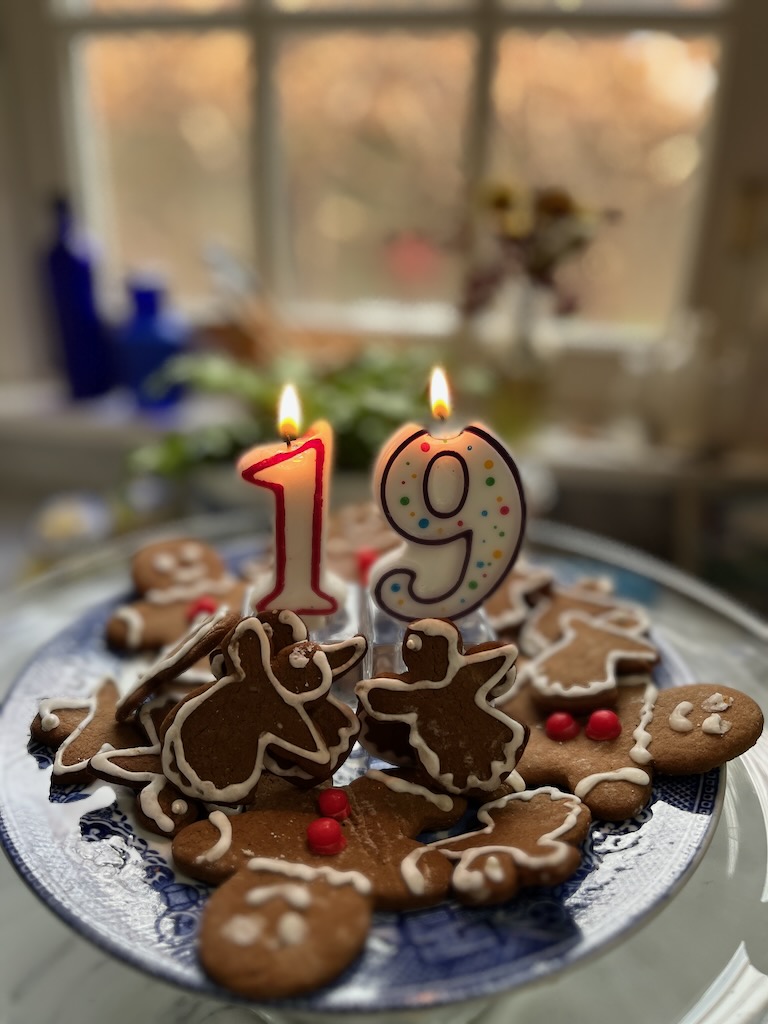
but even now, it’s a season for quieting, for simmering thoughts as well as saucepots of cinnamon stick, star anise, and clove. my simmering for the last nineteen years picks up the pace as the page turns on another year of pulling up chairs to this imaginary old maple table, one where the indentations of long-ago math homework are pressed into the grain, where so many coffees and juices have been poured and sipped and spilled and sopped up with sponges. over the course of these nearly two decades, it seems i’ve developed a knack for simmering while tapping away at the rows of alphabet keys—some 1,255 simmers and counting, all under the name “pull up a chair,” now tapped, posted, and filed away.
only a handful of the very first chairs—bless them, those stalwart humans—still pull up a chair, at least every once in a while. but along the way, so many chairs have been added, and multiplied. and our polestar has never shifted: to carve out a sacred space where questions are asked, and stories are told, where hearts are bared, and above all where gentle, gentle kindness is the metronome by which we set all our rhythms. once in a while, over all the bumps and bruises encountered along the way, we’ve been known to bow our heads and pour out our hearts in holy, holy please God, pray for us.
on the twelfth of december, 2006, our firstborn had just been bar mitzvahed, and our then so-called “little one” was but a kindergartener, not yet reading or writing but melting my heart by the minute and filling our notebooks with his stories and antics and an encyclopedia of unforgettable “teddyisms.” (some kept alive to this day; for the sheer pure joy of it). the firstborn, now law professor, insisted at the dawn of the self-published blogging age that i, his little old mother, could figure out how to “blog,” a verb that’s always sounded to me like a crude guttural effusion, a burp perhaps. and back in the day, he gave me his hand-me-down laptop to do it. to prove i could blog, that is. (as has so often been the case, he even then was wiser than me…)
back then, the question that had captured my attention was the simplest of notions: i believed, after a few years of keenly observing, tagging along with, and writing long newspaper stories of families in the thick of life transitions as a reporter for the chicago tribune, that life’s biggest questions aren’t reserved for colloquia and global summits, nor do they wait for podiums and percussive applause. they are the stuff of the everyday. and if we watch closely, pay keen attention, we can lift those universal, deeply-human questions and struggles from the quotidian stream, hold them to the light for closer consideration, and reap their wisdoms and epiphanies in real time. now, before the moments pass us by and we come to the saddest realization of all: that it’s too late, and our chance at most wakeful living has slipped into the distance.
all these years later, life certainly has galloped along here at the table. this ol’ chair has seen the growings up of two boys, buried parents beloved, moved another from her home of sixty years. taken a tour of cambridge, mass., and a second helping of college. trekked across the pond, set our sights on war zones, and been rolled into surgical suites and recovery rooms. we’ve feared for our country, for humanity, for civility, and plain old decency. and we’ve refused to surrender to the crude and cruel ways wielded by those who seize power. we’ve kept our minds opened, and tried—oh, we’ve tried—to emphasize the imperative of objective, double-sourced truth, and the slaying of hearsay and heresy. we’ve laid out worries here, and plenty of joys; we’ve marveled and wondered and been gobsmacked aplenty. i’ve pondered cancer and the physics of time, and the holy shimmering presence i know as God.
lately i seem to have taken to gathering up wisdoms far greater than mine will ever be. i am, as a beloved friend of the chair once put it, something of a magpie. a magpie mostly attuned to seeking the sacred amid the plainstuff of living. the idea of the commonplace book is one i heartily embrace: bring on the poets and sages and prophets, and let me invite you into their brilliant notebooks and minds and unfurl for you their passages and poetics that take away our collective breath and find a way of percolating for hours to come.
this ol’ chair has given me a place to keep on tapping away at the keys. i realized long ago that i untangle the knots of my life by stringing out sentences. and trying on thoughts. thank you for indulging me, those of you who choose to read along. thank you for pondering the questions at the end of each post, in the quiet of your own soul, or by leaving a note at the table.
you are, collectively and individually, humans who restore and buck up my faith in the inherent majesty and wonder of the shimmering undying spirit that populates this earth with more than a modicum of heaven’s best offerings.
bless you, bless you, a thousand times thousand, bless you.
this week i am bringing a little birthday bouquet of beauties that struck me across the week, all of them tied together by the beautiful idea that the birthing of holiness is a sacramental act of which we must partake. it’s one that entails unlocking our hearts, making room in the manger within, and allowing the Holy and Sacred to form within, and to birth it with our words and our love in the act. it’s quite the trinity here: a benedictine monk who practices and teaches meditation in the french countryside at a monastery known as bonnevaux; st. john of the cross, the great mystic, as translated by the poet daniel ladinsky; and the late, great luci shaw, a beloved british-american poet and essayist who died at 96 on december first.
first up, the idea of birthing God within us from the benedictine monk, laurence freeman, whom i’ve been learning from for years…
In the 14th century, Meister Eckhart enjoyed waking people up in his sermons by expounding some uncomfortably new perspectives about their standardised faith. He must have stirred a few dozy parishioners when he asked: “What good is it to me if this eternal birth of the divine Son takes place unceasingly, but does not take place within myself? And, that it should take place within myself, is really what matters.”
Actually, the great Augustine had asked the same question a thousand years before and added that if we are the children of God, we must become God’s mother as well. If, he said, this birth of the eternal word as Christ in the soul is to happen, our heart – the deepest centre of our being – must become the sacred manger. If we are filled with egocentric distraction there is ‘no room at the inn’ and so the heart must become that empty and open space where the birth takes place and through which he is welcomed into our world.
In today’s gospel, John the Baptist is usually and badly translated as saying ‘repent, for the reign of God is close at hand’. Basileia, the Greek word we think of as ‘kingdom’, is feminine and so could equally well translate it as ‘queendom’. It doesn’t mean a juridical area but the space in which the presence and grace of God is acknowledged and welcomed. The gospel word, badly translated as ‘repent’, is ‘metanoia’: a change of mind and heart. It is not about feeling sorry for past mistakes. It means spinning round 180 degrees and entirely changing your perspective on and approach to reality.
Living in the desert, wearing a garment of camel hair and eating locusts and wild honey, John seems to us a bit extremist. People who reduce waste and get back to essentials are often called crazy. But because of his spiritual sanity he drew the crowds who asked him ‘what shall we do?’ because, like us, they lived in confused, divided and dangerous times. He told them simply to live honestly and justly but that this lifestyle would prepare them for the imminent – and immanent – coming of the great transformer of all things.
Meditation is the great simplifier. It reduces the way we waste both time and life’s opportunities. In daily life it is the catalyst for ongoing metanoia. The medicine that loosens the grip of illusion. Usually, we start enthusiastically but before we get to the full 180 degrees we slow down and say, ‘this is quite good, let’s stop here’. Fortunately, if the birth process has already started, it will not allow us to arrest or deny it. We have to see it through until it breaks through into our world and we are happy and lucky if we do.
—Laurence Freeman
and from the sixteenth-century mystic St. John of the Cross there comes this interpretation/translation of what daniel ladinsky calls one of his “love poems”…
IF YOU WANT
If you want the Virgin will come walking down the road pregnant with the holy, and say, “I need shelter for the night, please take me inside your heart, my time is so close.”
Then, under the roof of your soul, you will witness the sublime intimacy, the divine, the Christ taking birth forever,
as she grasps your hand for help, for each of us is the midwife of God, each of us.
Yet there, under the dome of your being does creation come into existence eternally, through your womb, dear pilgrim– the sacred womb in your soul,
as God grasps our arms for help; for each of us is His beloved servant never far.
If you want, the Virgin will come walking down the street pregnant with Light and sing …
—St. John of the Cross, “If You Want” in Daniel Ladinsky, Love Poems from God: Twelve Sacred Voices from the East and West (New York: Penguin Group, 2002),306-307.
and, in closing, here’s a classic from blessed, blessed luci, whose great contribution to the canon of Christian poetry would be her capacity for drawing big truths about God and human experience from viscerally pulsing fine-grained images and objects. she is the perfect voice to close out this nineteenth year of the chair….
Kenosis By Luci Shaw
In sleep his infant mouth works in and out. He is so new, his silk skin has not yet been roughed by plane and wooden beam nor, so far, has he had to deal with human doubt. He is in a dream of nipple found, of blue-white milk, of curving skin and, pulsing in his ear, the inner throb of a warm heart’s repeated sound. His only memories float from fluid space. So new he has not pounded nails, hung a door, broken bread, felt rebuff, bent to the lash, wept for the sad heart of the human race.
amen.
may this blessed week bring softening to the walls of your heart, and a widening within those chambers so that Holiness, however you name it, might be birthed there….love, b.
uncharted is pretty much the most fitting descriptor for the cartography of cancer. undiscovered nooks hide in the shadows. though not all of it is somber. sometimes, with no warning, you find yourself among an unexplored parcel for the very first time.
i’m covered with goosebumps this week, not because my latest scan was ominous (it wasn’t) but because i am reminded again this week, viscerally so, how very damn thin this ice is—the ice that is any cancer, and mine in particular. i sat down with my oncologist the other day, and she spelled out so many truths about the merciless ways of cancer—how so many hit-or-miss variables make up each individual constellation, how some of mine fall in the you-don’t-wish-this column, and one or two don’t, how some cancers are “undruggable” (mine is) yet some of the drugs are so toxic you’re mostly relieved you don’t have to have them coursing through your veins—and it all becomes stunningly clear that there really is not much certainty or sense to the prognostication at play here. sometimes you make it through the labyrinth, sometimes you don’t. who’s to say what flicks the switch that plays out your story.
but that wasn’t the only reason for goosebumps.
a curious thing happens almost instantaneously and mysteriously when you find out you’ve been highjacked into cancer camp: you make fast friends. with the ones you find strolling around the campground, the ones who know the indignities of needle pokes and incision tattoos that now crosshatch your flesh; the ones who spout the most off-color jokes, and know all the words to the worries that keep you awake in the night; the ones who strip truth to the bone and don’t shy away from words that others dare not utter.
one of those friends died this week. bruce was his name, and not too many months ago, he was the one who all but talked me onto the airplane to new york to get a second opinion, when i—the one who never has had a taste for ruffling feathers, nor for appearing to second-guess authority—was so afraid to face the cold hard reality of a cancer center whose very name registers the seriousness with which cancer is to be taken. bruce told me all about his trek to mayo clinic, and insisted i get on that plane to sloan kettering. and when i got home, he checked in to make sure i’d stayed in one piece. his wife, eileen, also my close cancer buddy (and also with ratchety-vocal-cord voice), has been one of the ones who until now has made me laugh the hardest; lately, her texts have been tearing me apart, especially when she told me she’s mostly been crying herself to sleep these last couple months.
and just yesterday i was scrolling across the internet and bumped into the news that one of the fiercest patient advocates in the world of lung cancer, a woman whose cancer (diagnosed when she was 39, and recurred multiple times) has defied all odds for 16 years, has just started another round of radiation for two metastatic nodules on her chest wall.
when one of us goes down, the thud is felt by all.
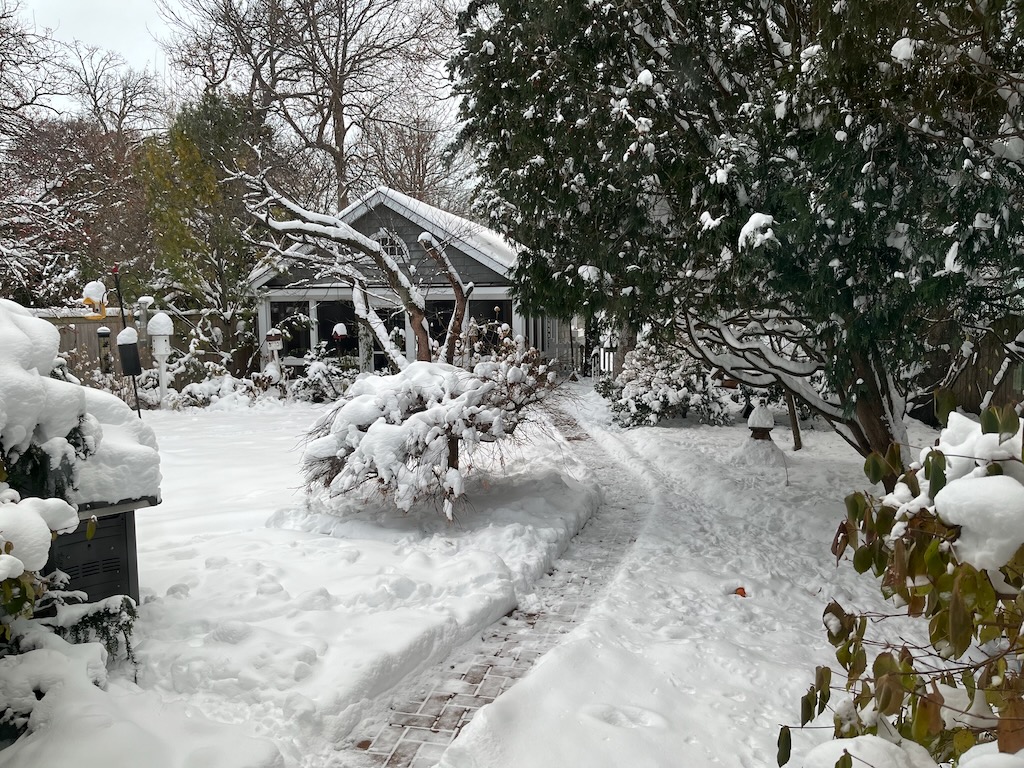
and so, as if never before, i am looking out at the snow-caked garden, at the beefeater-sized snow caps atop all my birdhouses and feeders, and i am whispering, whispering, inaudible prayers of pure and profound thanks. for the miracle of another winter. for the quotidian phone call from one of my boys. for the chance to sit in a near-freezing kitchen to work side-by-side my second born. for the husband who leaves his car in the snow, so i can pull into the snowless garage. and who waits till i get home late one night to eat his bowl of cereal, while i slurp my soup.
and tough as it is to swallow, and bracing and sad as it all sometimes is, i am, in the end, more than a little grateful to be so fully awake to the whole of it: the friend whose courage i’ll carry; the blessing of a doctor who minces no words and delivers each one so bountifully, and with such tender, all-absorbing care; the miracle of any old friday or thursday or tuesday; the lungs that still work as mightily as they can; this place that lets me write it all down, because sometimes you just need a way to make sense of the blur, and this was one of those weeks.
not because i’m dying; because i’m alive.
and with that, a poem that so deeply echoes the essence of all that pulses through me these days, and is, in many ways, the core message of book No. 6 now in the pipeline….
Praise What Comes surprising as unplanned kisses, all you haven’t deserved of days and solitude, your body’s immoderate good health that lets you work in many kinds of weather. Praise
talk with just about anyone. And quiet intervals, books that are your food and your hunger; nightfall and walks before sleep. Praising these for practice, perhaps
you will come at last to praise grief and the wrongs you never intended. At the end there may be no answers and only a few very simple questions: did I love,
finish my task in the world? Learn at least one of the many names of God? At the intersections, the boundaries where one life began and another
ended, the jumping-off places between fear and possibility, at the ragged edges of pain, did I catch the smallest glimpse of the holy?
~ Jeanne Lohmann ~ (The Light of Invisible Bodies)
Jeanne Lohmann was a Quaker poet, and one of the very favorites of the great Parker Palmer. as a wee bonus i am adding here the last stanza of another one of her beauties, “what the day gives.” she is a poet in whose work i shall be poking around. here’s the stanza:
Stunned by the astonishing mix in this uneasy world that plunges in a single day from despair to hope and back again, I commend my life to Ruskin’s difficult duty of delight, and to that most beautiful form of courage, to be happy.
and finally a poem from one of my favorite irish poets, eavan boland, passed along to me by one of my favorite humans. simply because it’s so perfectly, perfectly glorious…..and the very definition of love in its highest order….
In the worst hour of the worst season of the worst year of a whole people a man set out from the workhouse with his wife. He was walking—they were both walking—north.
She was sick with famine fever and could not keep up. He lifted her and put her on his back. He walked like that west and west and north. Until at nightfall under freezing stars they arrived.
In the morning they were both found dead. Of cold. Of hunger. Of the toxins of a whole history. But her feet were held against his breastbone. The last heat of his flesh was his last gift to her.
Let no love poem ever come to this threshold. There is no place here for the inexact praise of the easy graces and sensuality of the body. There is only time for this merciless inventory:
Their death together in the winter of 1847. Also what they suffered. How they lived. And what there is between a man and woman. And in which darkness it can best be proved.
what brought you this weekthe deepest sense of how very blessed you are, to be alive and able to exercise love in whatever form fills you the most?
p.s. i hope all of you who still find a seat here (after all these years; 19 next week!), or who are here perhaps for the very first time, know how very very deeply this space, and your presence here, has become one of the polestars of my life. my calendar is set by writing the chairs (every friday morning without fail); six books now have first been seeded here; and the kindness circle we’ve all built together is rare and precious in the fullest sense of that word. as the world around us has grown harsher, and the rules of engagement seem to be shifting at rapid and dizzying pace, we have rooted ourselves more and more deeply in the gentle art of caring gently for each other, offering up wisdom by the ladleful (and i mean the wisdom you offer me, offer all of us), and lifting our kindness off the page (aka screen) and into the real living, breathing world. among the things for which i am so deeply grateful, all of you dwell at the core of my heart. bless you.
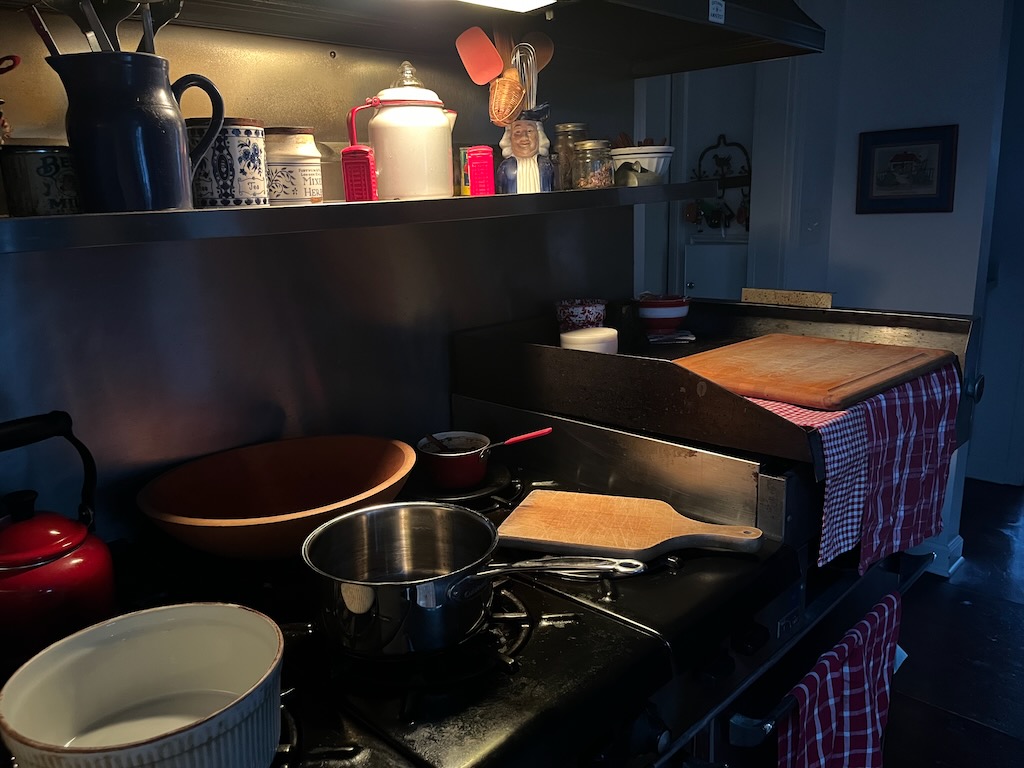
morning-after kitchen: when the cookstove becomes the drying rack
in this old house, the day after the feasting is the day for leftovers and long walks in the woods. we steer clear of the malls, the black-friday deals, and the great american drive to consume. among the leftovers spilling this morn are the ones of my heart which never ever has enough room for all there is for which to whisper “thank you”….
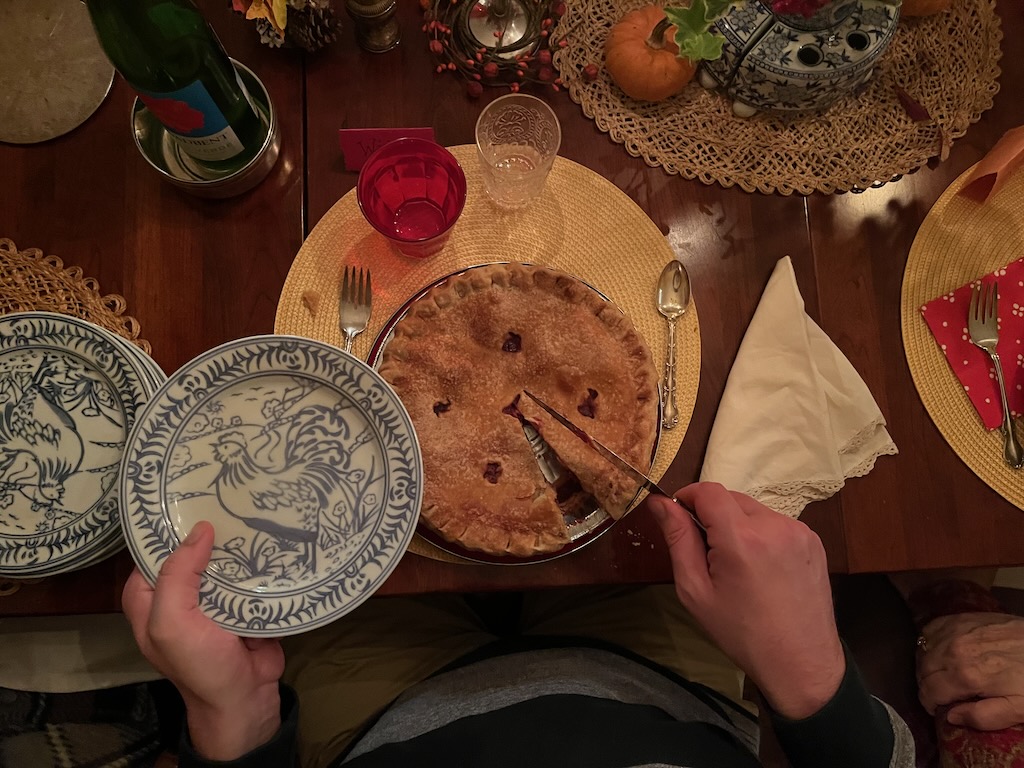
And so I begin with that glorious morning-after inhale and exhale of a put-back-to-order kitchen, a very full fridge, and the echoes of the night before still pinging off the walls, making me giggle as I count out my coffee scoops: the 95-year-old mama who still sits by my side, still notices the one or two things I might have forgotten, and nibbles “quality control” of every dish at every stage on its way to the groaning board; the brother and his beloved who drove in from Detroit, and the one who flew from LA; the new friend who drove down from the Twin Cities and brought along his Rhode Island clam fritters; the beloved friend who mashed every last potato and dolloped in butter, heavy cream, cream cheese, half and half (and sent us all to the cardiologist morning after)…and of course, of course, the miracle of both our boys, the line cook and the law professor, here for the holy hour when we bow heads, hold hands, and pour forth our litanies of thanks; and at the far end of the table, my most beloved, whose presence across from me is always, always the sweet spot of any day…
Moving along, and thinking back across the last stretch of days, the kid mechanic at our neighborhood garage who got rid of the “check-engine” light with a know-how that had me back on the road less than ten minutes later. Phew.
The oncologist who talks to me with her knees pressing against mine, intent that we look into each others’ eyes. And sometimes deeper, I swear.
The orthodontist who put down her pen amid banal history taking and announced: “Let’s just go for coffee!”
The law professor colleague of my very own kid who saw how cold I was in the first quarter of my first football game in 51 years, who slithered from her seat for what I presumed was a dash to the powder rooms, only to have her return with a brand-new-from-the-merch-store, very-warm, blue-and-gold scarf to wrap round my neck and up to my ears.
My sweet line cook of a kid who called to insist he was making two of the sides, plus an appetizer, for Thanksgiving “because you already have a million other things to do, and you shouldn’t have to do everything, and everyone should have skin in the game.” Where did he come from this kid who is always thinking of how it is to be the other someone?
The nice people at the grocery store who made my stuffing so I didn’t have to.
Ditto the nice people who made the gravy.
Ditto the very nice people who smoked the turkey!
The sister-in-law who always always rolls up her sleeves and scrubs every last plate, knife, and serving platter.
The editor who finally said I could send along the latest drafts of a book in the works, a book exploring the undulations and awakenings of Scan Time, that netherworld for those whose days are measured scan to scan to scan.
The countless, countless tenderhearted souls who have paved this bumpy road of a year with more kindness than any girl would dare fall to her knees and ask for…..from hand-stitched quilts, to crocheted afghans, to tea loaves, to the electric blanket that does not fail.
The blessed, blessed souls who dared to share their immense and sometimes unbearable grief; especially the two whose course was so deeply fraught and who dared to unfurl the whole of their fears as they marched face-forward to inevitable ends, and in those unmaskings gave me a glimpse of the ineffable courage and mortal core that will carry us all across our last distance and beyond the sacred veil.
The curious thing that what could have been any old Thursday is now, in this moment, a draw that pulls people we love from across the hills and vales, and rivers and lakes, to sit round one single table, to partake of platters of bird and bread and roots pulled from the ground, for the simple sacrament of saying thank you, And I love you enough to put up with airports and very-packed roads.
For the wisdom guides in this life, the likes of whom include the incomparable Maria Popova, who is adamantly not a religionist but is deeply sacred, and who astounds me time after time with her epiphanies—often all the more forceful because we come from different angles but land at the same sublime spot. She strikes one of my polestar beliefs when she writes this passage, concluding with the line: “It may be that we are only here to learn how to love.”
Because the capacity for love may be the crowning achievement of consciousness and consciousness the crowning achievement of the universe, because the mystery of the universe will always exceed the reach of the consciousness forged by that mystery, love in the largest sense is a matter of active surrender (to borrow Jeanette Winterson’s perfect term for the paradox of art) to the mystery.
It may be that we are only here to learn how to love.
With all my heart, I believe that. And devote my days to the doing of it, an urgency all the more sacred now that my life is set by the metronome of Scan Time….
a forever favorite poem…..
Small Kindnesses
I’ve been thinking about the way, when you walk down a crowded aisle, people pull in their legs to let you by. Or how strangers still say “bless you” when someone sneezes, a leftover from the Bubonic plague. “Don’t die,” we are saying. And sometimes, when you spill lemons from your grocery bag, someone else will help you pick them up. Mostly, we don’t want to harm each other. We want to be handed our cup of coffee hot, and to say thank you to the person handing it. To smile at them and for them to smile back. For the waitress to call us honey when she sets down the bowl of clam chowder, and for the driver in the red pick-up truck to let us pass. We have so little of each other, now. So far from tribe and fire. Only these brief moments of exchange. What if they are the true dwelling of the holy, these fleeting temples we make together when we say, “Here, have my seat,” “Go ahead—you first,” “I like your hat.” + Danusha Laméris
a bit of theology, in advent of Advent, the season of anticipation, awaiting the soon to come Silent Night…..
this is from my friends at the SALT Project who always stir thoughts because they poke around and enter through uncommon angles. i found myself stirred by the idea of Three Advents, one of which comes without folderol or clanging of cymbals, which is in keeping with the quietist that is my soul’s natural setting….
Advent means “arrival,” and Bernard of Clairvaux, the twelfth-century abbot and theologian, wrote eloquently of “three Advents”: first of all, the Incarnation, the Advent at Christmas; and last of all, the Parousia, the Advent at the end of the age (Matthew’s subject in this week’s passage). And the second or “middle” Advent, the one in between these other two, is the everyday arrival of Jesus: the host at the table, the still small voice, the hungry mother, the weary migrant. In other words, Jesus comes to us again and again, calling us, inviting us to help repair the world, little by little, a thousand swords remade into a thousand ploughshares. The new era of God’s shalom is dawning even now — though its glimmers aren’t always obvious at first. On the contrary, they often shine in unexpected places and at unexpected hours, like a thief in the night.
and in the spirit of Thanksgiving’s groaning board, one last dollop, a line that echoes Maria Popova’s wisdom on love; this, from the poet Philip Larkin who ends his famous poem, An Arundel Tomb, with this indelible truth and unforgettable line: “what will survive of us is love.”
the obvious question: what lines will you add to the litany of deep thanks?
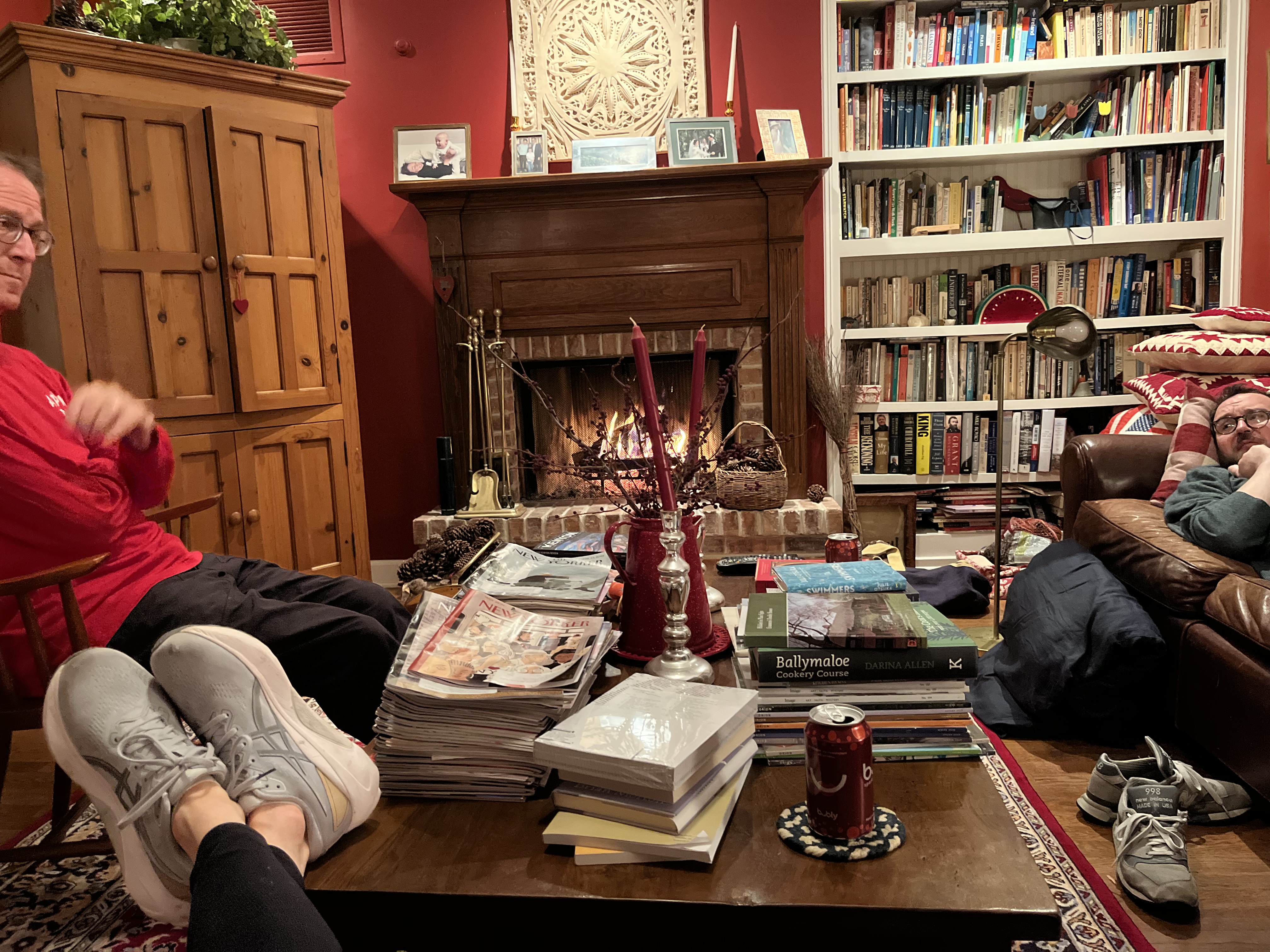
a rare peek inside this ol’ house, where three of us nestled by the fire, catching a moment that no one saw coming…
because of the way my heart leapt midafternoon yesterday as i bumbled into the house, hands all muddy from tossing out the ferns that had frozen in the snow snap, i can claim with absolute certainty that i’m nowhere near dead yet.
what might i mean by such a rash—you might say “obvious”—pronouncement?
well, quite simply, my oft-tired ol’ ticker fired off a triple flip the likes of which simone biles would be proud soon as i glanced down at my phone, that indispensable appendage i always forget to keep indispensably by my side, and noticed a smattering of words that seemed to be spelling out something about “the trip to Chicago” followed by “keep the drive daylight” followed by “i will just hit the road,“ all walloped with “on the off chance that you guys aren’t busy tonight.”
and thus i discovered the manchild who’s been heavy on my heart all week, as i worried about the car that was stuck in the tow lot, and the miracle that he’d not been slammed into metal or glass when his car fishtailed on a slick, dark country road, i discovered there’d be three not two at our dinner table last night. and how perfect that i’d just made a triple-size batch of one of my autumnal mostly vegetable stews.
never mind that he’s 32, and a law professor these days. never mind that i’ve been at this mama gig for rather a while now (well, 32 years plus the duration of mammalian gestation), it’ll never get old. it’s pretty much an indelible truth that until my last breath on this planet the number one zone in my heart will forever be the can’t-get-enough-of-my-boys zone.
and so, in less time than it takes to spell indefatigably up to the task, i had fresh flannel sheets on the bed, a basket of farmer’s market apples on the bedside table along with a mason jar of my fresh-made granola, and if i’d had time to string up holiday lights in the room where he grew up, i’d have done that too. along with a chorus of night-crooning angels.
why the back-flipping joy?
well, living as i am in a personal epoch of carpe diem, in which nearly every dawn i flutter open my eyes and unfurl a big fat gratitude prayer for making it to the sheer marvel of watching sunlight stream in, while simultaneously existing in this moment in history when good news is as infrequent as a meadow of daisies in november, the sheer joy of surprise, especially in the category guess-who’s-coming-to-dinner, is of the highest order.
and sometimes it’s just plain rejuvenating to remember your heart still knows the steps to the happy dance, and can leap into it on a moment’s notice.
my zeal for making each moment count is not a dynamic that’s waning. it only gets more and more intense as the chapters of living press in from all sides.
i seem to have been catapulted full time into that real-life equivalent of frank lloyd wright’s architectural jujitsu compress-and-release, in which the master architect squeezed in the walls of an anteroom so that once you stepped into the chamber beyond you felt the whoosh of expansiveness as the walls and the ceiling let soar. so too with life and its tough spots. in time, they finally relent and release. and you breathe deeper than you remember breathing in days.
our lives are undulations of breath, on both a grand and an intimate scale. the pattern set soon as the umbilical cord is cut—the lungs, the diaphragm, the ribs rise and fall, empty and fill accordingly. and so it is with our lives on a larger scale, as life seems to toss us into the vise, only to at last let us out. let us breathe.
i am breathing today. i am breathing as my house fills with people i love to celebrate the birthday of a woman we love, the matriarch of us all. my mama, who’s shown us grace, resilience, and who these days unendingly charms. we’re not marking the date of her birth, she tells us, but we are marking our love. and we are doing it the best we know: we are gathering in joy, and in love, from corners hither and yon.
and in this old house, when the three of us sat down to stew, we got an extra dollop of breath out of the deal. it was—and is—delicious.
a bit of social action here at the chair, for anyone who might be so inclined. here in chicago, and even here in the leafy burbs we’ve been shattered by the roving bands of federal agents decked out in the camo gear, faces covered in masks, as they’ve rough-armed and thrown to the ground dozens and dozens and dozens of those whose skin might be brown. contrary to federal messaging, these are good folk earning meager livings the hard way: cutting grass, raking leaves, tending to kids in strollers or buggies, pounding shingles to roofs. and for the sin of trying to live unnoticed lives in a country meant to be safe harbor from thugs and militias, they’ve been plucked from the streets, or their cars, or their classrooms, and sent to a hellhole, leaving behind families to fend for themselves. a little band of us here where i live have armed ourselves with whistles and courage, to stand up to the thugs. and to help in any meager way we can. one among our little band offered this possibility to help stock the grocery shelves at a free market in chicago’s mostly hispanic little village neighborhood, where the fear is rampant and the streets have been swept of their usual buzz. it felt mighty good to send off a grocery cart of simple sustenance. and, indeed, i felt the breath fill my lungs.
here’s what my neighbor wrote….
For those that are looking for an option to offer concrete support to Little Village families impacted by ICE…one of my [neighbor’s] dearest friends (Keri Krupp) is a school social worker at Little Village’s Zapata Academy, which serves 500 kids from pre-k to 8th grade and is in need of support for their free “store” Mercado Zapatista. The Mercado is completely reliant on donations and has become a source of support for many of Zapata’s families — while typically focused on winter apparel and toiletries, it is now also distributing food to families that have been hit by both the loss of income due to ICE and the disruption to SNAP benefits. Her stories are heartbreaking. You can quickly donate through by selecting items from this Amazon wishlist or by sending an Amazon gift card to her work email (kbkrupp@cps.edu).
At a time when it can be hard to know where to best focus donations, [my neighbor] can personally vouch for Keri’s commitment to the Little Village community and prudent stewardship of Mercado Zapatista, which she began in 2024. Any donations, big or small, will make an immediate difference to Little Village children and their families!
how not to get sucked into the cesspool, or the tarpit of utter despair.
there are flocks of us, bumbling around, looking down at our weathered, timeworn selves, our selves that are wrinkled or missing some parts, wondering what in tarnation little old me can do about this. all of this chaos, all of this cruelty, all of this jaw-dropping gilding and seizing of power, all of this thuggery, what in the heck can i do?
it’s pretty much the question that runs on auto-pilot through the spheres of my brain.
what oh what oh what?
i turn to the poets, i turn to the pacifists. this week i found myself in the pages of history. more and more i am drawn to the plain old truths of our not-yet-extinguished civilization.
as a species we’ve been cruel from the start, that’s a streak that runs in us. we’ve had so much darkness it makes me want to run for the hills. no wonder the desert elders of the third and fourth centuries did just that, ducked out in far-flung caves and barely ever came out. they just prayed and prayed, imagined God as their next-door neighbor and turned their humble selves into living, breathing prayer altars.
but, just as emphatically, there’ve always been those who turned the other cheek, who refused to partake in whatever the scourge of the age. who did not give up on the vision of radiance, of equal justice for all. there have always been those who heeded the words of the jew from bethlehem: blessed are the poor in spirit, the meek, the merciful, those who hunger for righteousness, blessed are the peacemakers. jesus didn’t even make it to ten. he cut off the list at eight. later on, he threw in “love as you would be loved,” which is actually a teaching he would have learned in the temple, leviticus 19:18, “love your neighbor as yourself.” (i hate to break it to christians, but we’ve no corner on that commandment, it’s as old as time, and core of nearly all world religions.)
it’s the revolutionaries, the radicals, the refuseniks who would not succumb, they’re the ones who might hold the clues: how to be a force against daily injustice when all you’ve got is your will and your hope and your deadset compass pointed at kindness, at mercy, at justice for all.
their point, the refuseniks, ever has been thus: we cannot decide that we’re not equipped. we cannot throw in the towel. the heroes of history usually don’t come with superman capes. it’s people like us, with a limp or a lisp, figuratively or literally, who might look in the mirror and decide, “i’m all i’ve got, so i’d best get to work.”
which brings us back to the cruelty and chaos du jour.
this week, beating back the latest bout of teeming futility and powerlessness, against the backdrop of scenes i’d not imagined emerging from the american landscape—federalized gangs knocking heads against pavement, crushing ribcages under the weight of full-body clutch holds, beaning clergy in the head with pepper balls, and most recently dragging a preschool teacher from her classroom in front of her gaggle of toddlers—i found myself once again on the prowl for what in the world little old me might do to push back against any of this, to counter the cloak of rampant despair.
and i found it—curiously, plainspokenly—in the introduction to a book of letters from prison, specifically the gdansk prison during poland’s communist takeover by the totalitarian regime that clamped down cruelly on every facet of daily life in the last decades of the 20th century.
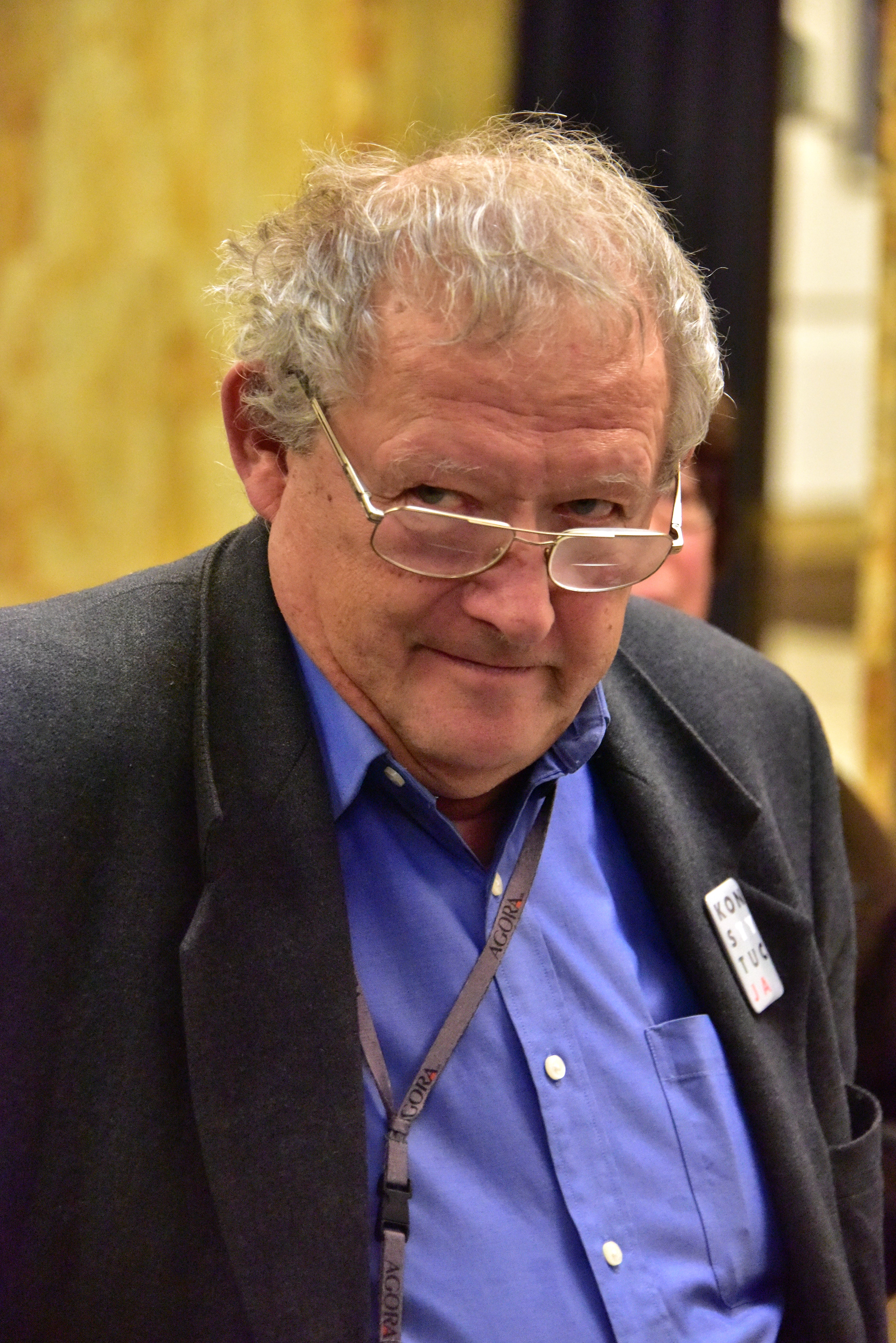
adam michnik
adam michnik, an irrepressible political activist, is the writer of the letters, a lifelong dissident first arrested at 18 for partaking in the writing and dissemination of “an open letter to the party,” critical of the communist regime. he would become one of the leaders of the solidarity movement that in 1989 ended communist rule in poland, and went on to become editor-in-chief of Gazeta Wyborcza, credited with elevating the newspaper to become “a sort of conscience of the New Poland.” he rightfully lays claim to a life spent provoking debate on democracy and human rights.
during that lifetime, punctuated by intervals of activism followed by imprisonment, again and again, michnik often found himself in jail cells where he forged his activism with pen and paper, his letters and essays smuggled out of prison, and widely distributed on the far side of the prison walls.
what i find especially notable about his essays, as i rail against blatant mis- and dis-information in our clickbait age, is that his essays were then and still now are considered models of balance and fairness. what drove him was a singular concern for “deepening his own and others’ understanding, and therefore he [could] not afford the luxury of distortion for partisan reasons.” (emphasis mine). oh, that we should emulate his restraint, seize his clear-eyed purpose.
while ours certainly isn’t a national moment that rises to the level of “organized evil” of poland’s totalitarian regime, it seems fair to say we’re witnessing “authoritarian adjacent” dictates and dramas, particularly in the demonization of the helpless, and the thuggery thrust viciously upon them.
and so, turning to even darker moments in history, we find our cues.
in the introduction of michnik’s letters from prison and other essays, the new yorker’s longtime foreign policy analyst, jonathan schell, captured michnik’s revolutionary counter-revolutionary approach.
he leads into it by first laying out the norm in mapping revolution, and illustrating how the poles turned it on its head, ultimately triumphantly: “the classic formula for revolution is first to seize power and then to use that power to do the good things you believe in. in the polish revolution, the order was reversed. it began to do the good things immediately, and only then turned its attention to the state. in a sort of political and moral version of the hedonist’s credo, ‘carpe diem,’ the opposition proceeded directly, and without postponement toward its goals. its simple but radical guiding principle . . .”
what comes next seems to me the wisest, most doable action we might take:
“Start doing the things you think should be done, and . . . start being what you think society should become. Do you believe in freedom of speech? Then speak freely. Do you love the truth? Then tell it. Do you believe in an open society? Then act in the open. Do you believe in a decent and humane society? Then behave decently and humanely.”
do not succumb to the ways of the demonizers, the clickbaiters, the shills for distortion, deceit, and demagoguery.
put simply: love as you would be loved.
or, in the words of james baldwin: “the place in which i’ll fit will not exist until i make it.”
so, go make it.
how would you describe the world in which you pray to live?
i emerge here from a day of prayer, a day of poring over the sins of my soul, and the sins of us all collectively. it is a day that’s not easy to leave behind. certainly not this year.
Yom Kippur, the day of atonement, opened with the rabbi once again sharing shattering news. a horror in manchester, england, he told us, without details, had left more than one dead.
morning light streamed in.
i felt us all move in closer, a natural deeply human instinct to harbor each other. it’s those natural instincts that tend to get drowned out on ordinary days, days when it’s noisy, days when we’re so distracted we don’t pay attention to the sound of our breath, the warmth of our skin, the deeply human instinct to run toward, not away, from someone who’s hurting.
we live in a world so distant now from the original vision. from an edenic world where boughs were bent from the heaviness of their fruits, where the silence allowed for the chorus of chirring and chirping to rise from the underbrush, from the branches. in the beginning, in the genesis, after the cascade of wonders—light, darkness, seas and sky, dry land and waters, seed-bearing plants and fruits with seeds buried inside, two great lights in heaven’s vault, the demarcation of day and night, teeming waters and birds filling the air, wild beasts and slithering, down-on-the-ground ones—the one who’d imagined it all, the one we name God, God looked down and saw still a void. how would the garden be tilled? how would it be kept?
and so God made beings in God’s own image, so genesis tells us. and for a short flash of time, man and woman lived in peaceful accord. but temptation arose. and it all shattered and changed. eden was no longer. the man and the woman were banned.
and all these millennia later, we are a people plagued by temptation. temptation of power, of greed, of malice and evil, of hurtful whisper, and weapons of war.
we have fallen so far from the garden of peace and tranquility.
and so, on Yom Kippur, we atone. all world religions, as far as i know, hold confession at the core, are built on the knowing that we will go wrong, exercise evil, traffic in hate.
and so, through the day, over and over and over again, we confess. we confess in short form and long form. we confess and confess, each go at it grating closer and closer to the core.
against the backdrop of the world in which we are living, these are a few of the confessions we prayed:
“The ways we have wronged you by hardening our hearts; and the harm we have caused in Your world through careless speech.”
“The ways we have wronged You by giving in to our hostile impulses; and the harm we have caused in Your world through inflexibility and stubbornness.”
or this, one of the pleas to the Almighty and Merciful, Avinu Malkeinu:
“Avinu Malkeinu, halt the reign of those who cause pain and terror.”
so ardently we confess and we pray.
to enter the sanctuary, be it the one of a synagogue or the one under the heavens in my own backyard, is to submit to a paradigm other than the distortions of a world ruled by greed, and power, and envy, and lust.
in these past godawful years, when i can almost hear the walls of decency and democracy crumbling, i retreat more and more into the sanctuary. the voice to whom i answer is that of the Merciful, Benevolent God, a God who is gentle, and tender, a God who seeps into the deepest parts of me, the parts where i surrender, where i know my place is so, so small, and yet, whatever light i can bring to this world, whatever infinitesimal flickering flame, it matters. because we are not the only flame. we inch closer together when word comes, once again, of horror and chaos and evil upon evil. we are many, many flames. or we can be. if we so choose.
it is a mighty thing to stand and sit through a day when over and over we confess our sins, our evils, our hurt-making acts. we are a nation that could do with a day of atoning.
and i am blessed that i, a lifelong believer in God’s tender mercy, was asked to atone for the sins of my own and the sins of us all.
i enter quietly back into this shattered, and shattering world.
i will not extinguish my faint little flame.
what will be your flame this holy day?
i leave you with words of john lewis, the late great hero of civil rights and warrior for justice:
Every human personality is something sacred, something special. We don’t have a right, as another person or as a nation, to destroy that spark of divinity, that spark of humanity, that is made and created in the image of God. —John Lewis
and should you care to be moved by one of the gentlest, fiercest spirits ever to walk among us, this beautiful interview, recorded just last week, of jane goodall, the great primatologist and anthropologist who died at 91 on wednesday. bless her, she was deep in her last book tour when her blessed heart beat its last.
i remember how, when there was a jane goodall special on national geographic, my mother would huddle us around the TV, for she was someone worthy, and i always found her a brilliant source of hope, kindness, an uncanny attunement with nature and nature’s creatures. i have prayed all my life to live to be a wise grace-filled woman like her…..wrinkles worn with dignity, hair whitened by the sun, wrapped in her shawl, at once wise and funny, of the moment and yet timeless. . . .
it started because months, or maybe years, ago, i stumbled onto a poem that took my breath away. it was written by a poet i’d not known of, didn’t think i’d ever read. but the poem, titled “Nativity,” stayed with me, a poem that paints the first Christmas scene in strokes and shades that settled deep into my marrow, and forever more are the Christmas i imagine.
it’s a poem that lays the baby Jesus in a rough-sawn barn, the air pungent with animal. “the wind tugging at the shutters.” there is nothing gilded about it. and it was written, i knew right away, by someone at ease with being small, tucked off in a corner keeping watch. it was written, i could tell, by someone whose very veins course with humility, and understood a God who preached the same, a God who asks us to get about the business, the holy business, of loving as we would be loved without noise or bombast or folderol.
it turns out he lives on an isle on the scottish west coast, a place where the wind might tug at shutters. and it turns out he is something of a polymath: a poet, a painter, a children’s book writer, a translator of great works. and, above all, something of a pilgrim, a pilgrim seeking the quiet beauties that punctuate the everyday. he calls them “atoms of delight.”
and he writes of pilgrimage: “the word is often used to describe the journey to a shrine or sanctuary in search of spiritual transformation, which is a meaning i acknowledge. but now pilgrimage has become a much bigger thing for me; it has gone far beyond that rather heavy and medieval sense of going on a journey to visit a holy site. why shouldn’t it be about a walk to a hill loch to listen to the impossibly beautiful singing of red-throated divers? why shouldn’t it be about a child running into the forest in the early morning to find the treasure they dreamed of? these are journeys of the heart, seeking the profoundly precious places where little miracles happen. and why shouldn’t it be about panentheism—the finding of God in all things?”
it’s not hard sometimes to recognize a kindred soul.
what is hard is to imagine finding yourself in conversation with such a kindred someone. but that’s what’s happened. kindness is the thing that opened the door, his kindness. in a world ruled by transaction, where fees are paid and contracts signed for any exchange of goods—be it words or bricks or lumber—kenneth steven lives otherwise.
i found that out not long ago, when, during the editing phase of my next book, i dove into the task called “permissions,” in which for any chunk of text—poetry or prose or lyrics to a song—beyond a certain measure, you must secure permissions from its author. this can be a costly exercise. and it is always one that makes me quiver, wondering what walls i’ll encounter, and what cold-shouldered hubris i might have to tiptoe through.
it’s that poem, “Nativity,” that’s stayed with me all these years. and i’d included the whole of it, eight lines, at the start of an essay that i hope to include in the book.
wondering if i was whistling into the wind, i sent off a proper letter, the digital kind, and shipped it cross the sea. i’d no idea if mr. kenneth steven would ever reply. but, lo and behold, come monday morning, there he was, tucked kindly in my mailbox. and more than generously writing: “of course you are more than welcome to use the poem. i’m sure you’ll mention where you found it.”
and thus, with the stroke of his generous heart, a friendship has unfolded. and a treasure trove of poetries have now brushed through me. and i am richer for this scottish friend who, as a boy, awoke one night at midnight, and hearing a great and ferocious wind, hurriedly dressed and left the house, where he climbed a hill in howling winds, before crossing through a field to reach his favorite tree, where he knew the horse chestnuts would be falling, and he was out to save them, to gather them up. “i felt given a whole world,” he writes in an essay about the midnight escapade. “it was about the autumn and the big winds, and the thrill of running up that long hill and entering the field at last at what felt like the middle of the night.” and the indescribable delight of knowing “that all this treasure was mine.” the treasure: a cloth bag of chestnuts shaken from the limbs, their deep and woody smell, orbs that looked as though they were made of shoe leather.
befriending him, he who writes me every day now, sometimes more than once a day, is magical. is akin to befriending any of the authors from my childhood who’ve long entranced me, drew me into storybook tableaus: tasha tudor; e.b. white; frances hodgson burnett, who wrote the 1911 children’s classic, the secret garden, a book that featured my holy trinity—an orphaned girl, a padlocked garden, and a robin redbreast that finds the key—and once prompted me to fake a fever so i could skip church one sunday to stay at home and turn its pages.
long ago, when i’d be asked if i’d ever want to write a book, i demurred, brushed away the thought. didn’t think i could hold a thought long enough to pen more than a few pages. i didn’t know, though, that the magic of a book comes in all the threads unspooled along the way. threads that carry me to places far and wide, and to souls i’d never otherwise know. but words, like little birds, or prairie seeds, catch on the wind and settle into fertile loam. and we are richer for them.
in much the way, my beloved chairs, through all the words and all the years, have become my dearest treasures.
bless you.
love, bam
have you a penpal in this digital, globe-crossing, email world? someone you’ve not met but who seems a certain friend?
i promised kenneth i would share word of his beautiful meditative podcast, Imagining Things, on the patreon platform. recorded in a studio that seems to be just behind his island home, you can sometimes hear the scottish winds blowing off the atlantic, and a bird or two not far away. (or maybe i’m imagining.) and of course he speaks in a scottish-soaked timbre, and in between reflections he shares poems that will make you hit rewind so you can listen once again, so breathtaking are the lines.
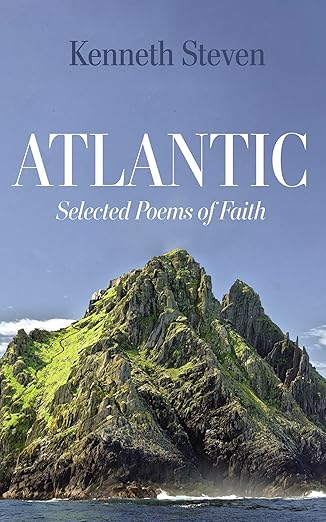
his latest book, one that should be landing on my front stoop within days, is Atlantic: Selected Poems of Faith. but i’m already deep into Atoms of Delight: Ten Pilgrimages in Nature, and Iona: New and Selected Poems.
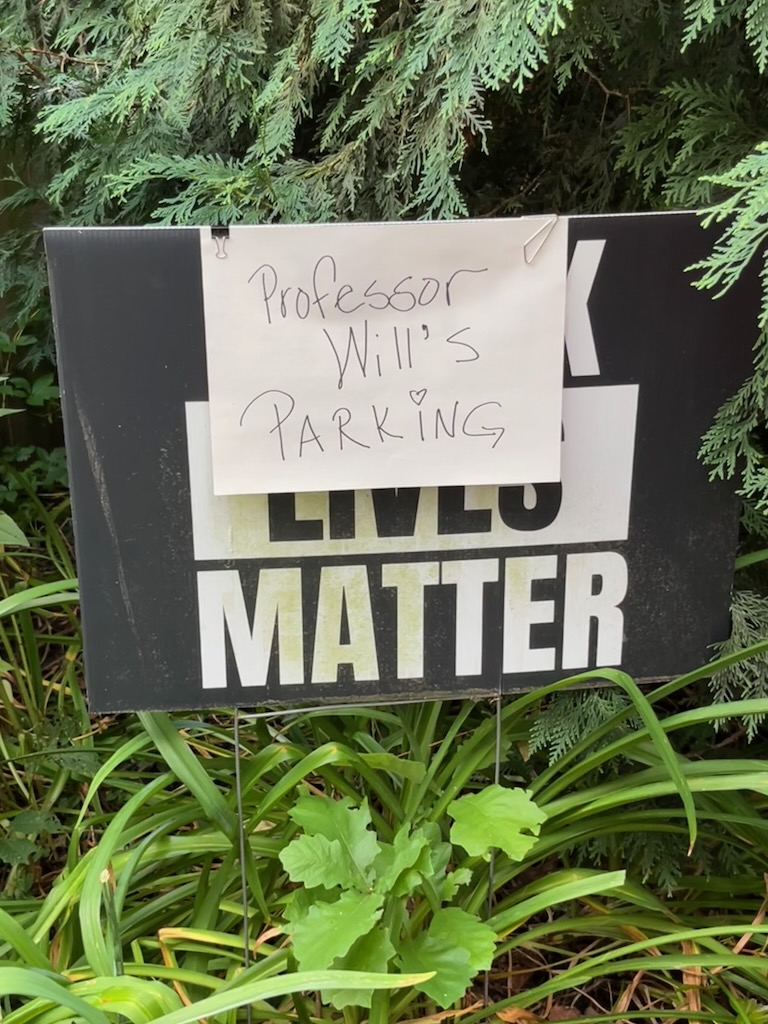
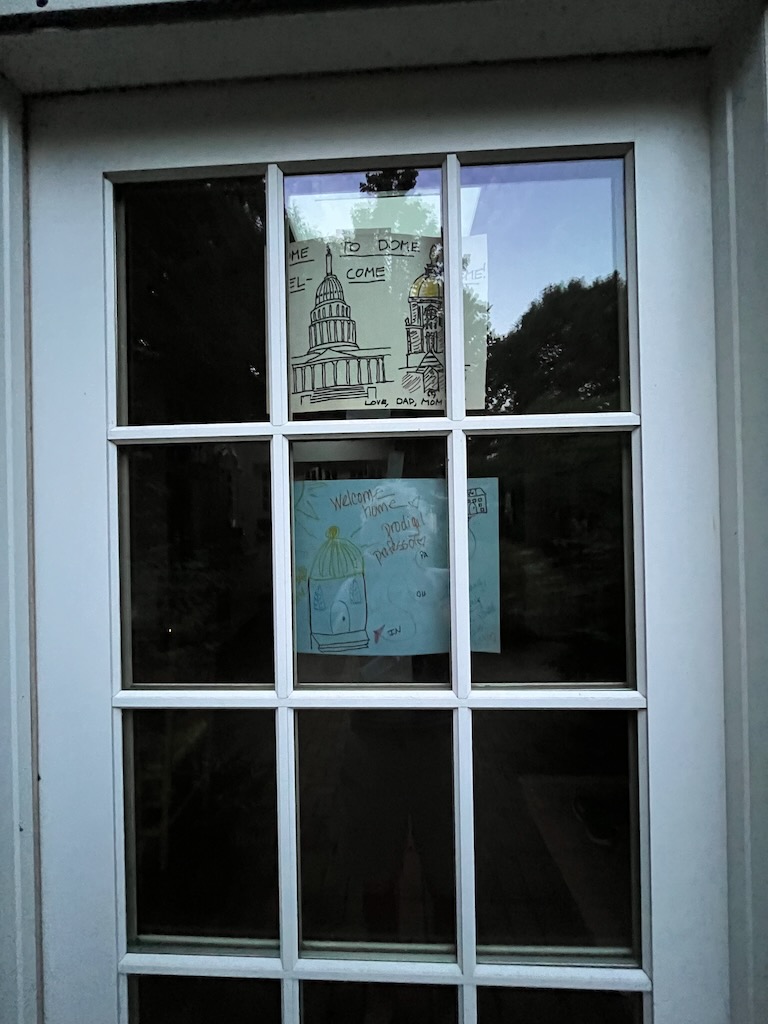
professorial parkingwe make welcome signs at our house‘from dome to dome, welcome home,” reads the top one.
i poured myself out of bed minutes before three last night, as i seem to do like an old swiss clock. and in the murk of the dark, as i stumbled toward the bathroom, a thought crept forth reminding me this wasn’t any old middle-of-the-night trip to the bathroom, this was a night in which the professor was in the house. sleeping under this old roof. back in the room where he grew up.
it’s been 13 years, and a whole lot of law school, and bar exams, and zigzagging across the country. there’ve been trips to the ER that scared the behoozies out of me, and weeks that were hard, and hours that were glorious, but the kid with the dream, the kid who with all his heart was hoping to get back to this middle-of-america, one-of-a-kind american city, that happens to be “home,” is back. for at least a year, an equation my mind is still trying to absorb. any time he’s been here in all these years, it’s only been for a day or two, a week at the most. there was always an end date, a date he’d be leaving, and we’d be back to texting and calling. and missing.
he drove 12 hours to get here. he and a car stuffed to the gills with law tomes and professorial garb. and he’s here now, a truth i witnessed just now with my very own eyes as i tiptoed in the dawn’s thin light past the old room where he’s slumbering. i saw the lump in the bed: proof!
truth is, what prompted him most to want to come home, is that he, like the rest of us, had the behoozies shaken out of him by whatever it is that lurked/lurks in my lungs. we all know the grains of time are gliding from one end of the dial to the other. it’s a subtraction, no matter how you cut it. and so we are hellbent on making addition of it. in the best ways possible. in filling the vessel of time with pure unfiltered joy. pushing our hearts to our sleeves. living a life of heart-thumping gratitude. that’s a word so over-spun it’s lost what it means, but when you get to the heart of it, it’s living a life where the thin veil is lifted, the veil between heaven and earth, and the presence of God, of love, is palpable, is visible in the form of the wonders in which we’re immersed: the soft morning sounds, the laughter of knowing each other by heart, the hand reached across a table and squeezed.
so happens the kid got an invite to teach for a year at a law school not too far away. south bend, indiana, a destination i could reach by lunchtime if i decided at 10 in the morning to head there. he’s moving into an old farmhouse tomorrow, a house out in the country, where apples and peaches hang from the limbs in the orchard out back, and raspberries grow fat on the brambles. it’s a genius invention called a sabbatical home, where one professor hopscotches away, leaving behind a fully-furnished, fully-equipped home (straight down to the pioneer-grade hearth in the hoosier kitchen), and another professor on the visitor’s wheel moves in. keeps the place running, the lights on, till the semester ends.
it’s not lost on me how hard he worked to get here, nor the one or two strokes of pure chance that propelled this along. in these months when i’ve whittled my life to those rare few things that truly matter, being the four of us—mom, dad, and two kids, together, rolled in a ball—is at the tippy top of the list. i’ve imagined the hour when i take my last breath, and what i know is that the last faces i want to see in this life are the three of them, circling round me. i’ll promise to haunt them. and, so help me, i’ll do it. the friendliest ghost there ever was.
for now, though, i’m here and i’m kicking. we all are. and we’re holding on. and i am ever so grateful to the university of notre dame for bringing my beautiful beautiful boy, the professor, back home where we all belong.
radon update, for anyone who wondered: we’re not out of the darn woods yet. in fact, the trail is only more twisted. the little disc i bought on the internet, the one reputed to be so accurate, it’s still flashing bright red, a color that signals far more than caution. it’s readings are high, scary high. but the actual professional radon tester is now on the third round of testing, and each time we’ve passed with enough room to breathe. she’s now as curious as i am as to why the disparity in readings, and we’re about to be stuck in the balance of deciding what to do. it’s no small feat to remediate for radon, though i don’t think it entails knocking out the basement out from under us. my date with the pulmonologist has been moved up from november to next month, and maybe they’ll know from looking into my lungs if there’s any sign of radon’s wreaked havoc. once again: uncertainty, the state of existence i dwell in.
that’s the news from here at the house that might be glowing.
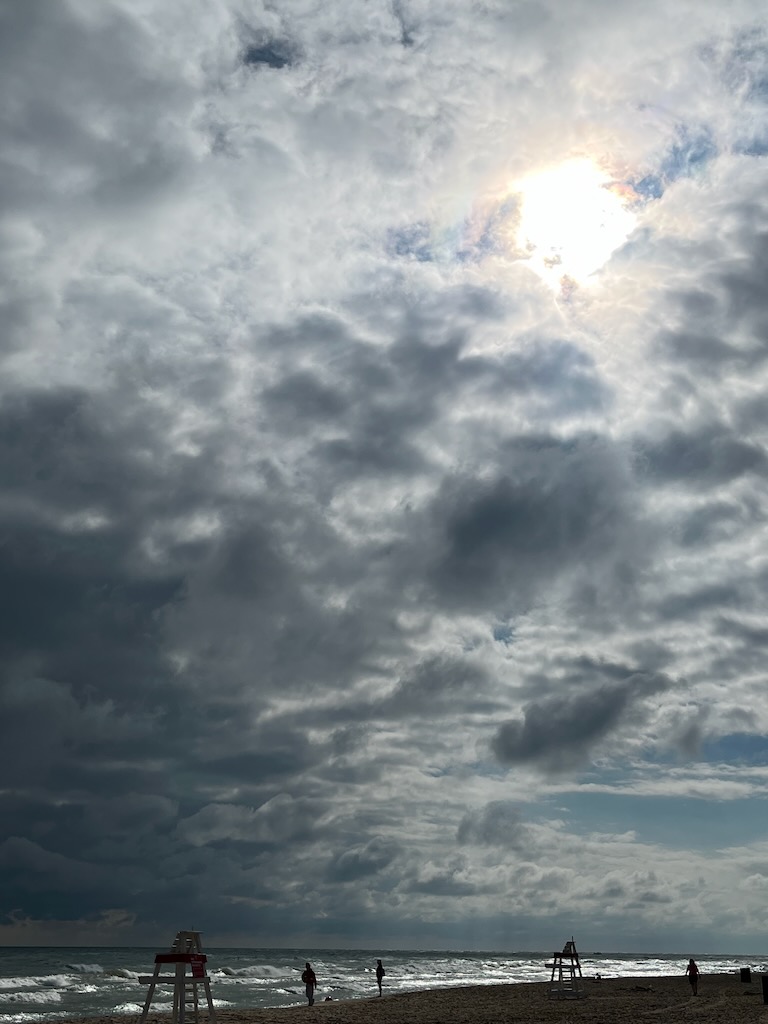
all you need do is glance toward the sky, eyes skimming over the players on high. sunlight and cumulus. sunlight and cirrus. sunlight and nimbostratus. sunlight and cloud ever in play, in duet, in doh-si-doh of shadow and light.
there’s a truth being told there, a universal and organizing principle of all creation. on the first day, in the second verse, there was darkness, darkness hovering over the deep. in the third verse, light. God commanded it. and God saw that it was good.
in our lives, the leitmotif is a given. light will come. shadow will follow. light will come again.
so it was in my reading this week, when first i tumbled deeply into a luminous shaft, a boreen* of writings from a norwegian bishop and monk, erik varden, whose power as a writer was pointed out to me by a poetry friend whose taste i know to be exquisite and deep. i swiftly realized the bishop’s thinking and writing are everything they were billed to be: rare. exquisite. deep. radiant.
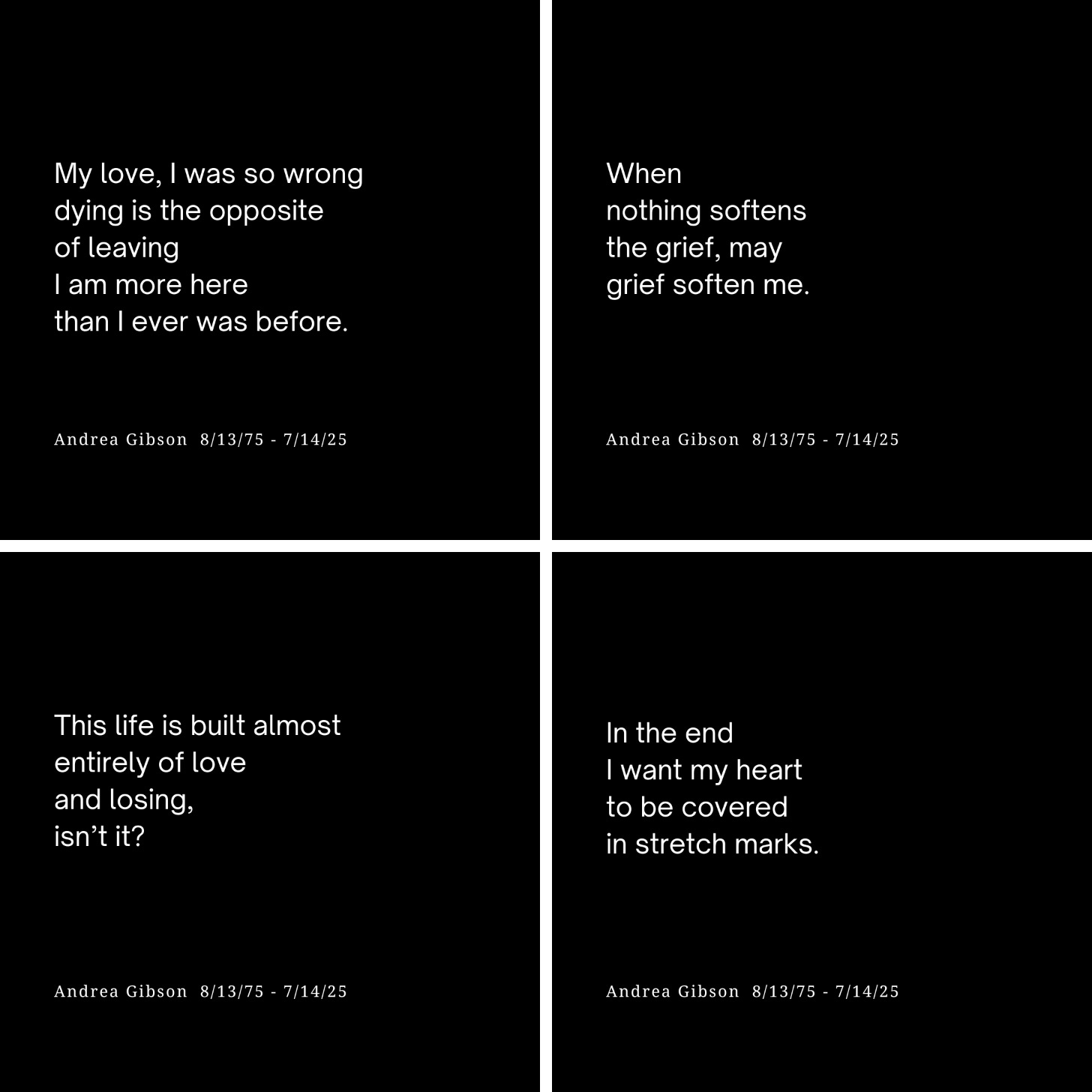
but then, hours later, shadow: i began reading a string of sentences posted from the account of one of my lifeline poets, someone you might call a patron saint of heartbreak and healing, of being more alive than you’ve ever imagined. i started to read, as if it were just another brilliant post: “Whenever I leave this world, whether it’s sixty years from now, I wouldn’t want anyone to say I lost some battle. I’ll be a winner that day.” and then i got to these words: “Andrea Gibson was a winner today. On July 14th, at 4:16AM, Andrea Gibson died…” and my legs stopped moving, and my breath was caught in midstream, and i read and read again. and then my fingers started to tremble, and my knees too.
andrea gibson
andrea gibson, 49, colorado poet laureate in 2023, queer activist (they/them/their pronouns), who had been diagnosed with stage 4 ovarian cancer in 2021, not long after they’d started a newsletter titled “Things That Don’t Suck,” had many, many times pried open my heart, pulled out the unspoken words and the fears and set them soaring. when i too found out what it is to live with cancer as one of the nouns in my story, i drew andrea into my innermost circle. the ones who know, without you uttering a word, just what you’re thinking, you’re feeling, you’re praying. the ones who some days save you. because even though the cyberworld is distant and intangible, it works in mysterious ways, and someone with whom you’ve never breathed the same air can become someone whose voice you can hear as you flutter to sleep, and whose courage you conjure as they glide you into the sarcophagus that is your biannual CT scan.
light. shadow. light from shadow. shadow deepening light. it’s the dance of the duet, interminably entwined. one is always more beautiful because of the other’s presence, because the duet is perpetual.
first, this week’s light:
that monk on a bicycle, spotted cycling through the garth just beyond the cloister, is all it took for me to want to whisper my vows, and cycle along.
as i’m quick to do, i signed up for bishop varden’s website, coram fratribus, a name derived from his episcopal (meaning “of the bishop”) motto, coram fratribus intellexi, latin for “understanding with my brothers.” because the bishop is shepherd of a flock spread across 22,000 square miles in the north of norway, extending beyond the polar circle, he sees his site as a way to speak to the diaspora, to think aloud of those things he finds beautiful or challenging, to gather his flock into a communion of thought. specifically, i felt my heart quicken as i burrowed into the bishop’s collections of writings under the tabs “life illumined,” and the shorter jottings under “notebook,” which he describes thusly:
“To scribble in the margins of texts is an ancient practice. There are people, these days, who make an academic career out of studying ancient marginalia. Any exercise of reading is fundamentally conversational. The notes collected here are brief responses to impressions received not just through books, but also through encounters, art, music, and films.”
now you see why i, a marginalian of long practice, swoon?
before i get to the paragraph in “life illumined” that drew me deep into thought, let us pause to note why we see that little outline of an owl, in the upper right corner, and hovering over every page of the site. the good bishop describes that choice thusly (emphasis mine from here on in):
“The emblem of the site is an owl. The owl does not just wing you back to the front page. It has for centuries been a symbol of the monk. Why? Because it watches in the night, when most people sleep; because it is able to see in the dark, discerning movements and patterns, foundations of meaning, where the human eye perceives only vaguely. I am fond of this Italian doggerel:
“Sopra una vecchia quercia c’era un vecchio gufo: più sapeva e più taceva, più taceva e più sapeva.
“In an old oak tree there sat an old owl: the more it knew, the silenter it was; the silenter it was, the more it knew.”
what fluttered into my mailbox the other morning was a page of the monk’s notebook on the nightingale, complete with an ancient poem (from the early middle ages, written by alcuin of york, an adviser to charlemagne) mourning the absence of the wild creature and its delicate throat. a recitation in english and latin, and including a recording of the nightingale’s song. that alone was more than beautiful enough. and then my poking and peeking accelerated, and that’s how, under the “life illumined” tab, i found a break-me-open paragraph on learning to pray.
in an essay focused on the simplicity of jesus’s prayer, and the universal cry of all believers, “lord, teach us to pray,” varden paints the scene of 72 disciples who learned not simply by listening to the words of jesus in prayer, but in witness to his consuming attention to the ways and will of God. varden expounds:
“Jesus’s teaching on prayer amounted to more than the provision of a text for recitation, that is clear. It was the sight of Jesus praying that made the disciples wish to learn prayer. The words of prayer, which touch our reason and orient our will, point towards the breaking-open of our heart, the transformation of our being as we dare to aspire, even in this life, to ‘become participants of the divine nature’.”
it is the breaking open of the heart, indeed, where the truest serum of our souls pours out. only in the last couple years have i understood that as profoundly as i do now. and, yes, that breaking so often comes with pain, or in pain, or through pain. but i’ve learned now how it truly is the propellent, the force that pushes us deeper into sacred truths than we might otherwise venture. without the breaking open, we might cling to the safer and shallower waters.
the bishop goes on. takes us beyond merely the breaking, and makes the point of its purpose. be it through prayer or through living, the breaking open is the vehicle for those who dare to aspire, in the here and now, to become participants of the divine nature. to inch as close as we can in this lifetime to something akin to sacred. i found a redemptive resonance in that line because at heart, even for the quiet ones among us, we are a people of communion, and there is a heartening, an emboldening, that comes in finding that your purpose, your aim, is not yours alone, but shared in common understanding with at least some of your sisters and brothers.
let us be broken open, then, if it points us toward our holiest purpose. through the break in the clouds, the light comes.
and onto the shadow, the eclipsing shadow…
less than one month shy of her fiftieth birthday, andrea gibson, the poet who boldly faced the coming of her death, who has been amplifying wonder, making us see the unseen, relish the oft-overlooked, took her last breath in the wee hours of monday morning.
i have been relishing her, here and in my everyday, for years now. curiously, her presence in my life spans almost precisely the arc of time in which i’ve been in the company of my own cancer.
the month before my lung surgery, when the world felt overwhelmingly like the depths of a cave, i wrote of andrea and lines i’d inscribed on my heart:
thanks to a friend i love with my whole heart, i stumbled on another wise soul with buckets of beauty to grace the world. a poet-activist-performer named andrea gibson, now a cancer survivor whose words might take your breath away. andrea identifies as queer, and uses the pronoun “they;” and they are known for their trademark honesty and bare-naked vulnerability, traits i find irresistible and blessed beyond words. here are just a few lines i couldn’t keep from scribbling down:
when it comes to hearts i want always to be size queen…
i love you because we both showed up to kindness tryouts with notes from the school nurse that said we were too hurt to participate….
when your heart is broken, you plant seeds in the cracks and pray for rain.
before i die, i want to be somebody’s favorite hiding place, the place they can put everything they know they need to survive, every secret, every solitude, every nervous prayer, and be absolutely certain i will keep it safe. i will keep it safe.
yesterday, thursday, this slipped into my mailbox from andrea’s wife, meg:
A couple years ago, Andrea said, “Whenever I leave this world, whether it’s sixty years from now, I wouldn’t want anyone to say I lost some battle. I’ll be a winner that day.”
Whatever beast of emotion bucks or whimpers through you right now, I hope you can hold that line beside it: Andrea didn’t lose anything. If you had been here in our home during the three days of their dying—if you’d seen dozens of friends drift in to help, to say goodbye, to say thank you, to kiss their perfect face, if you’d felt the love that floored every hospice nurse—you would have agreed. Andrea won.
I won’t sugarcoat the fact that they desperately wanted more time on this planet that they loved so much. This planet of squirrels and romance and basketball and moonlight.
But the time they had was significant, prismatic, and wild. It was full of trampolines and mountain ranges, stage lights and pants-peeing laughter. In their words, they “juiced the sun for every holy drop.” One of the last things they said before dying was, “I fucking loved my life.” Their conviction stunned the room.
If Andrea’s life was a poem (and it was), could there be a better last line?
a little backstory, again from meg:
In 2021, before the diagnosis, Andrea announced they were writing a newsletter, titled Things That Don’t Suck. A few weeks later, we learned they had ovarian cancer.
At first, Andrea said, “What a terrible time to be committed to writing about what doesn’t suck.” Then, almost immediately, they shifted their perspective and said, “What a perfect time.”
And so, this space was born. Part journal, part poetry, part pep talk, part treasure hunt. It became an archive of Andrea’s ability to find beauty in unlikely places, to wring gratitude from even the hardest hours. A museum of how they danced through their diagnosis, always turning their compass toward joy. It fostered a community they deeply loved.
And Andrea wanted all of it to continue.
meg tells us it will. there are reams and reams of unpublished writings, lines scribbled under the silvery light of the moon on those nights when sleep wouldn’t come. pages poured into volumes tucked away. a memoir, unfinished. half-written poems. a documentary coming this fall.
and meg promises this:
And there are stories of our life, and of the last months, that I, as their partner, and as a writer, feel both lucky to carry and uniquely able to tell.
As gut-wrenching, impossible, and tear-soaked as this moment is, I’m grateful beyond measure that they were so prolific. Through their books, their reels, their interviews, their albums, Andrea’s incredible mind will reverberate for a century—I’m sure of that.
and so, in the presence of the bishop monk, and the absence of the poet prophet, we shall go on. awake in the light and the shadow. and the shadow that deepens the light.
in case you’re curious, a bit more about dear bishop varden:
it was only after absorbing so much of his writing that i circled back to learn a bit of his origin story.
varden was born into a non-practicing lutheran family in a small village in the south of norway, and would go on to earn a doctorate in theology and religious studies at the university of cambridge, and further study in rome. a convert to catholicism at 19, he was drawn to the monastic life, and joined the mount saint bernard abbey, a cistertian monastery, in charnwood forest, in leicestershire, england. he was called to rome to be a professor of syriac language, monastic history, and Christian anthropology. and two years later, returned to the abbey when he was named its eleventh abbot. and, in 2019, pope francis named him bishop of trondheim, a nearly 22,000-square-mile prelature north of the polar circle in norway.
mount saint bernard abbey, varden’s home monastery, is where the only Trappist beer is brewed in all of England, under the name Tynt Meadow English Trappist Ale. beer to the trappists is no earthly distraction. the belgian trappists have a saying: “Beer should be liquid bread, not coloured water.”
and here’s a morsel, this one on the theology of beer, as spoken at the blessing of the monk’s brewery on st. george’s day, 2018. from Dom Erik’s address:
“One of the fascinating things about beer, is that this (potentially) sophisticated beverage is made of the simplest ingredients. By being refined to manifest their choicest qualities; by being brought together in a favourable environment; by mingling their properties and so revealing fresh potential; by being carefully stored and matured, the humble malt, hops, yeast, and water are spirit-filled and bring forth something new, something nurturing and good, that brings joy to those who share it. Considered in this perspective, the brewery provides us with a parable for our monastic life, with the Lord as virtuoso brewmaster. The Scriptures favour wine as an image of the Gospel – but that is culturally conditioned; beer, it seems to me, is a much neglected theological symbol.”
*boreen, you might recall from a few weeks ago, is the old irish word for what we might call a pothole, a rabbit’s hole, but in ireland, an island etched with cowpaths, it’s a word derived from a meandering side path when the cow decides to venture off on her own….if language is a cumulative patchwork, boreen is a word now in my lexicon….
you’ll find a veritable font of andrea’s spoken word poems, and writings at their website, andrea gibson.org. spend some good time there.








 pull up a chair