pull up a chair

where wisdom gathers, poetry unfolds and divine light is sparked…

Tag: wisdom

among those unafraid to ask the unanswerable
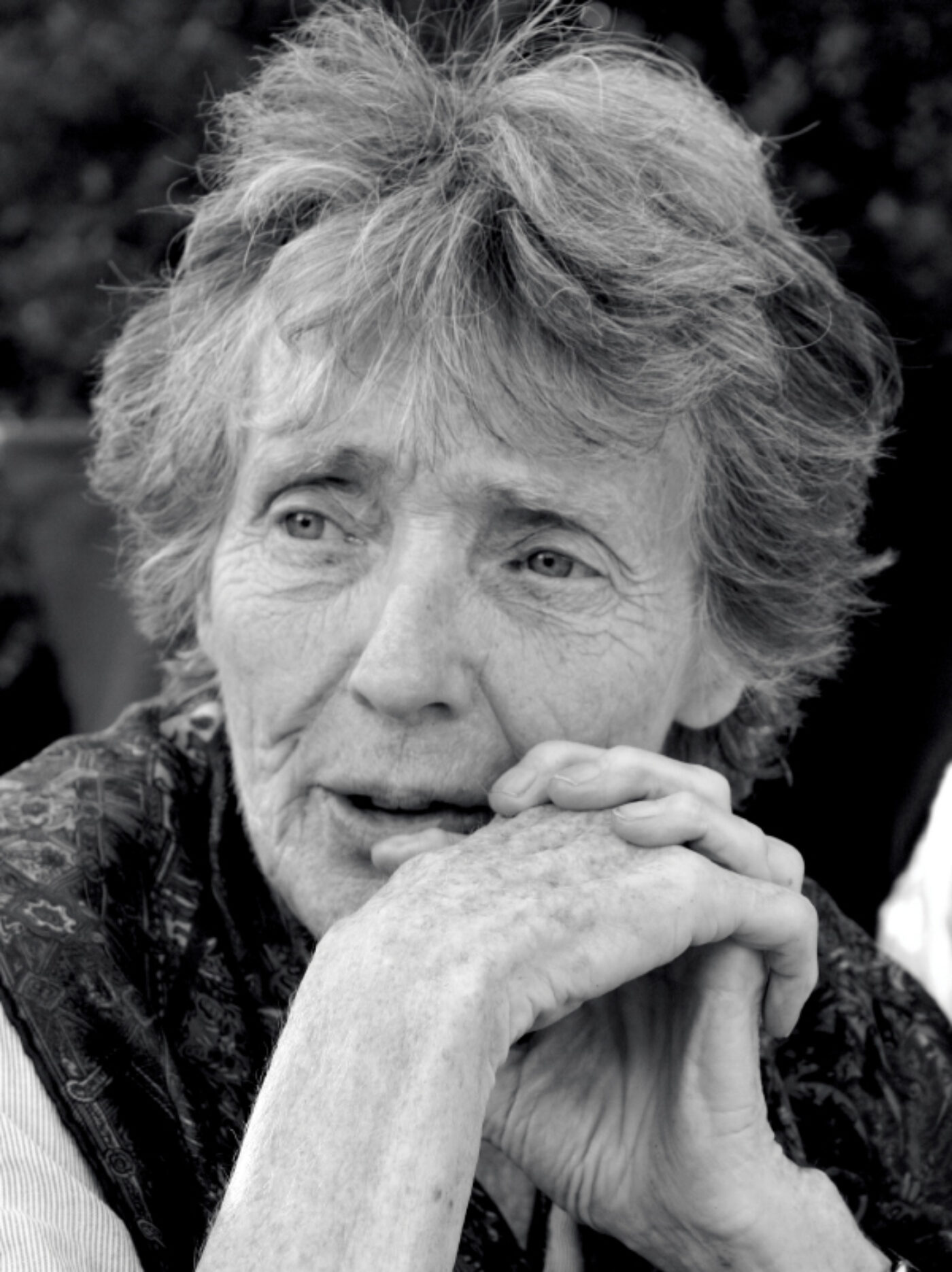
fanny howe (photo by lynn christoffers)

If the intensity of my curiosities in this world were put to trial, and I was pressed to answer what question stirs me most, it would be the realm of the God I reach for as my North Star. I ruminate on the presence of God, the proximity of what I know as tender ballast, and though the edge of my knowing falls into a liminal mist, I aim anyway to live by what seems to be the timeless code of a just and loving, most merciful God. 

Poetry, a gossamer web of knowing and unknowing, seems to be the closest frame through which to ask those questions, to rummage in the dim light and the darkness. It’s the poetry that rubs up against what seems true, and then falls swiftly away, that for me lasts and lingers. More so than sacred Scripture, I find myself venturing closest to the heavens when I follow poets unafraid to ask the unanswerable. The poets, so often, are my priests, my conduits from this much-battered planet to the uncharted heavens. Palpably alive and paying attention to the tiniest shards among us—the broken clock, the fallen sparrow, the furrow of a brow—the poet then leaps beyond or into, catapulting us into the vast, where the questions linger and the answers merely hover. Epiphany sometimes strikes. And we go forth, fortified.

I am particularly taken by those poets unafraid of doubt. As, truth be told, we live in mystery. It is those willing to expose their wrestling, their quest to question, that I find most resonant. Most true.

And when one of those poets dies, a volume closes; the possibility of question falls silent. We no longer knot our life raft to her fearless oceangoing vessel.

The world of poetry, from Ocean Vuong to those on the masthead at The Paris Review, mourned the loss this week of Fanny Howe (1940–2025), who died on Wednesday at 84. Over recent months, Howe, the daughter of an Irish playwright and a Harvard legal historian whose family traced its roots to the Boston Brahmin Quincy family, had been in conversation with the poet and translator Chloe Garcia Roberts, as part of the review’s Art of Poetry series. In a prelude I found as delicious as some of the conversation itself, Roberts sets the stage thusly in a piece published just last month: 

“Howe has a sparrowlike figure and a blue peregrine stare. We met for this interview every few weeks over the course of several months from fall to spring, as she was moving out of her garden-level apartment in Cambridge into an assisted living facility just down the road. I would arrive midmorning, bearing scones and coffee with extra sugar cubes wrapped in napkins, and we’d talk each time for an hour or so. Our conversations circled family, motherhood, failure, race, and faith. After we were done recording, we’d gossip about the poetry scene and the succession of Pope Francis.”

And from there begins the interview, from which I pluck just a few snippets, and some of the Review’s own words (emphasis mine):

“I’d always been looking for a revelation that would open the whole universe for me and make it all have sense,” began Howe, who described herself as a “pagan Catholic,” and who converted to the faith at forty-one, counting among her guides Simone Weil, Giorgio Agamben, and the monks of Glenstal Abbey** in County Limerick, Ireland, with whom she stayed every summer for twenty years and whom she later watched on TV every Sunday, her personal Mass. 

Howe was the author of an astonishing body of work—including twenty-five books of poetry, twelve novels, two story collections, and also essays, pulp romances, and young adult fiction. Her poems often enact the shock of belief, taking their power not from their devotional qualities—in fact, Howe avoided words like devotion and prayer—but their combination of faith and doubt. “I would think of poetry as a place where you connect your doubts to the things you don’t doubt,” she said. “Free-floating doubt wouldn’t trigger the lightning that contradiction does.”

In one of the hours of interviews, Howe let on that she considered it her “job” to be antidote to cynicism. When Roberts asked her to say more, she elaborated:

fanny in 1972 with her son, maceo

If I could say I was assigned something at birth, it would be to keep the soul fresh and clean, and to not let anything bring it down. And that’s the spirit of childhood, usually. Once you know that that’s what you’re doing, even when you’re walking through a war field, you’re carrying something to keep it safe. It’s invisible but you know it’s there, and it’s a kind of vision and a weight. 

(You can listen to Howe, warbly voice and all, speak those very words here.)

Is it not all of our jobs—or certainly the job of some of us—to labor to keep the soul fresh and clean, to strain to not let anything bring it down? It is our singular entity, the one form over which we and we alone can steer the vessel, make the choices, choose love not hate, choose silence not bitter words, it is ours to keep, to draw in all the light we can muster. Our bodies, I’ve learned, are not under our control. Pathogens come, and cancers too. We crumble under the weight of time and toil. Our skin wrinkles, breaks out in bumps. But not our soul. Our soul is eternal, is timeless. Our soul is what we make of it. 

The work of my soul is abetted, most often, by those whose words I read, by those whose way of being I watch. It is, so often, in the smallest, quietest of kindnesses. The triumphs of spirit over the temptations to turn away, to forgo the sharp edge, the blunt force. 

Ours is an ongoing work in progress. 

In her role as perhaps a patron saint of doubt within the amalgam of faith, Howe staked her claim in her introduction to George Bernanos’s 1937 novel of the 14-year-old French peasant girl, Mouchette: “Like a healthy human heartbeat, which has an intrinsic irregular system, the body of an artwork gets its vitality from a rhythm based in uncertainty. (Sick hearts have a dull regular thump.)” 

Among the many lauds that poured forth in the wake of her death, Kazim Ali, the poet and co-founder of the small indie press, Nightboat Books, wrote this of Howe, the first author Nightboat published:

It would be wrong to say she was a polar star or a beacon in the darkness, because Fanny believed in mystery, in unknowing, in bewilderment. She didn’t mean to shine a light, but rather to see in the darkness.

Fanny once told me, in our life-long conversation about God, literature, and the world, that she thought Gnosticism was evil. What she found so evil was the belief that the material world was inferior to, or somehow separate from, the spiritual one. This world was the world to Fanny. “Human was God’s secret name,” she said in one poem. “If this life isn’t enough, then an afterlife won’t be enough,” she said in another. 

To live in this rich, infinite world was the most important thing to her. “One cathedral is equal to the sky,” she wrote. And to God, she begged, “no answers, please, to any of my questions.”

Her life and work were conjoined in a long, lucid series of questions. How lucky we all are to have heard her askings.

may her askings live on, and her memory be a blessing. rest in knowing, dear fanny.
other than life itself and living, how have you encountered wrestling with doubt? is it a plain that animates you, or is it a space from which you run? (as always these questions are meant to be considered in the solitude and sanctity of your own quiet womb.)

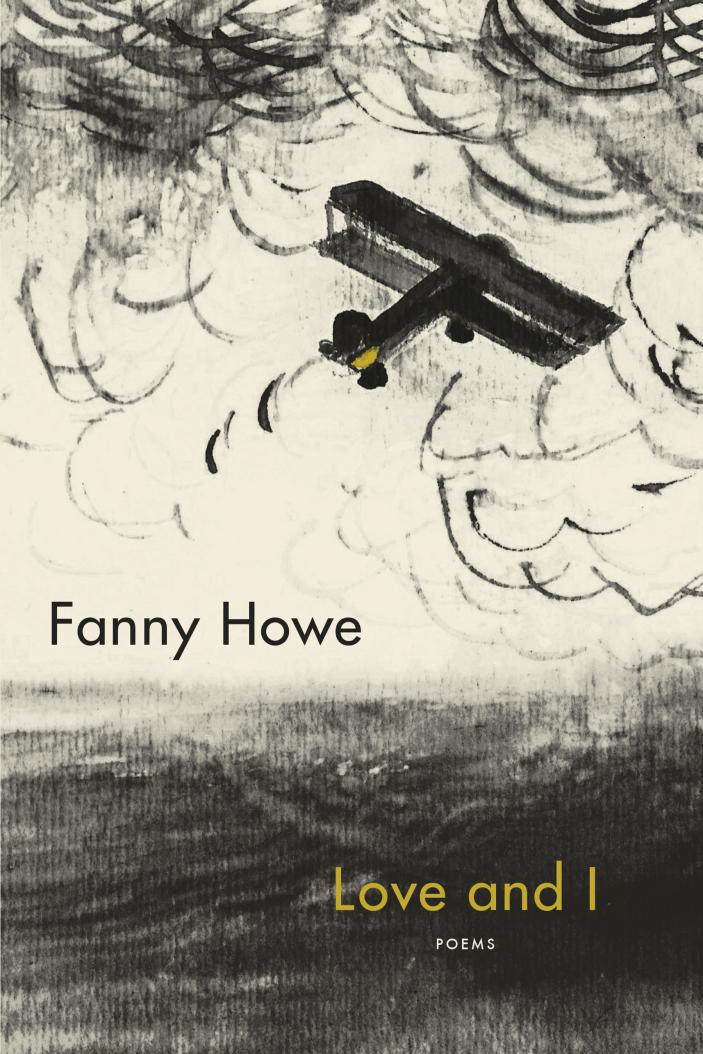
i nearly forgot! should you choose to dig in to a bit of fanny howe and her wrestling with faith, the two books you might seek (mine is coming from interlibrary loan) are Love and I: Poems (2019) and Gone (2003). in both she writes about her conversion to Catholicism, and her relationship to faith.


**because i’ve not found many a rabbit hole into which i’ve chosen not to burrow, my reading of howe led me to Glenstal Abbey, a place i now dream of tucking into for a fulsome contemplative spell. it’s a benedictine monastery in county limerick, ireland, housed in a 19th-century normanesque castle, surrounded by 500 acres of farmland, forests, lakes, and stream. you might just want to join me there…(and you can tune in any time for matins, lauds, vespers, compline, or daily Mass, in both recordings and livecam.) 


and one more thing before i go. it seems bishop marian budde, she who gained fame (and infamy in some quarters) presiding over the prayer service at washington’s national cathedral following the inauguration, has now launched a substack, where she will gather her writings, and broaden the scope of her reach. she introduces herself with these words. . .

“On January 21, 2025, the day after President Trump’s inauguration as our 47th president, I chose to conclude my sermon at a Prayer Service for the Nation, held at the Washington National Cathedral, with a call for mercy:

“Let me make one final plea, Mr. President. Millions have put their trust in you and, as you told the nation yesterday, you have felt the providential hand of a loving God. In the name of our God, I ask you to have mercy upon the people in our country who are scared now.”

she stirred up good trouble with those words. and in her new space on substack, she lays out her mission—”to live as best we can according to the highest aspirations of humankind revealed to us in Jesus” (also in Gandhi, in Buddha, in Brahma, in Allah, in Yahweh)—with this litany:

  • to recognize the inherent, God-given dignity of every human being
  • to love our neighbors as ourselves, and even to love our enemies
  • to share what we have and to strive for an equitable and just society
  • to refrain from evil and refuse to hate
  • to be mindful of the power of our words, and to speak without malice or contempt
  • to forgive, as we have been forgiven
  • to live in hope
  • to be willing to sacrifice, even our very lives, for the sake of love.

she concludes with these words:

“In this space, I hope to encourage a kind of human discourse in which we don’t have to see the world the same way, but we can all agree that we all belong in this world.

“In a culture of contempt, may we speak with dignity.

“In a world of mean-spiritedness, may we act with kindness and love.”

how might you stir good trouble today?

the great kaleidoscope

“it’s like we’re the great kaleidoscope, all little pieces, but every time you turn it, it’s different. so you and i are made up of exactly the same stuff, but every one of us is unique. there’s only one in all the world. and the same with every petal of a pansy….i’m the star thistle, and the grass, and the dirt. i am you; you are me.”

i tumbled into this most breathtaking old soul, majestic soul, and i shall let her do the talking today. i quickly grew so enchanted by her voice, her deep and gravely voice, a voice that must have traveled rocky roads, that i began to take notes, and i am leaving those notes here: part transcript, part poem. i’m not catching every word but the words i’m catching are those i do not want to lose. it’s as if a great elder has come today to impart something. to share a light, the light she came to know was her one thing to share. to leave with the world.

may we all be so.

may we all by illuminated by this nearly 96-year-old, who is a veritable masterpiece of all that matters. 

and here are notes, in prayer form, in poetry…

that i can still breathe easy
i don’t want to have just visited this world
i want to be a child of wonder and astonishment

i’m having my second childhood now, my happy childhood
i was always the outsider, i was always pointed at,
i always felt terribly self-conscious
so i have fun now

i’m just learning about play
because i didn’t know what play was when i was a child
i think play means exploring, experimenting, being curious,
looking, seeing, being in the body
not being afraid

it’s about the miracle and mystery of being alive

“we shall not cease from exploration
and the end of all our exploring
will be to arrive where we started
and to know the place for the first time”

that’s t.s. eliot.

i had cancer once
and . . .
and afterwards i had surgery
and i felt like i had to give myself a reaon that i was spared.
that i got my life back
and then, over many years,
i saw that i had
something to give, my light

something ineffable that i don’t know
that light of harmlessness and harmony
and singing and being joyful and rejoicing and being grateful

we’re here to experience the wonder of being in a body. . .
to know that we are each other
that we’re the same
we’re made of all the same stuff . . .
we’re little bits of stars, we’re dust

it’s like we’re the great kaleidoscope
all little pieces
but every time you turn it, it’s different
so you and i are made up of exactly the same stuff,
but every one of us is unique.
there’s only one
in all the world.
and the same with every petal of a pansy….

i’m the star thistle, and the grass, and the dirt.
i am you; you are me.

. . . my prayer is to go gently
and as much aware of myself leaving with gratitude and joy
and the satisfaction, “i’m done, i’m outa here. and it’s ok”
it’s all such a mystery

thanks, i wanna say thank you
not try to figure anything out, or understand it

but just be in awe

what’s the secret?
it’s go slow
for me . . .

[breaks into song. . .]

this beautiful film was made by two south african filmmakers who go by first names only as far as i can tell, justine and michael. their mission: to explore our shared humanity. their enterprise is known as reflections of life, formerly green renaissance. i do believe there is a trove worth plumbing…..i do not know the name of this blessedly beautiful nonagenarian so i shall name her simply Wisdom.

as we enter into supremely holy time, in both the jewish and the christian spheres, (are we not always in supremely holy time?), our friend here prompts the question how will you choose to live in awe?

summer reading: the writer who gave us spider webs and a little mouse, plus other wisdoms

elwyn brooks white, best known to those who loved him as “andy,” and best known to you and me alphabetically as “e.b.,” taught me as much about love as just about any author i’ve ever read. and that includes the sacred texts of just about any religion i’ve happened upon.

every time i’ve pored over the words of charlotte’s web, or stuart little, or “death of a pig,” among the most masterful essays put to paper, i’ve felt the walls of my heart widen, and the bottom go deeper. perched against pillows in the old four-poster bed where both our boys inhabited the dreamland of their youths, i recall the sobs coming in echoes––from the one who was reading and the one being read to––as i choked my way through the tear-blurred words at the top of a still-splotted page 171: “she knew he was saying good-bye in the only way he could. and she knew her children were safe.” (i can’t even type that last sentence now without the tears coming again, filling my sockets.) “. . . she never moved again.” and then “. . .no one was with her when she died.”

we are reading, of course, of a spider. a spider we have all come to love, named charlotte.

and any writer who could make me love with all my heart an arachnid is a writer about whom i can never ever know enough. so it was with purest, geyser-like joy that i turned the pages this week of the first-ever fully illustrated biography of the legendary elwyn brooks white.

part collage, part scrap book, with excerpts of e.b.’s letters, and sketches, and reprints of early drafts and revisions in his own handwritten manuscript, Some Writer! The Story of E.B. White, by the caldecott honor winner melissa sweet, is at heart a love story told of one of the great disciples of love in its quietest, most undeniable forms.

e.b.’s life’s work, as he saw it, and as he wrote in a letter to a reader of charlotte’s web, boils down, pretty much, to this:

love these days seems to be a commodity of which the world is running short. but andy, or e.b., set out to make us see it, and feel it deep in our bones, by telling us the stories, as he put it, “of the small things of the day, the trivial matters of the heart.” he calls those matters “the only kind of creative work which i could accomplish with any sincerity or grace.”

e.b. white

well, dear andy, my gratitude to you is etched on the chambers of my heart, a graffiti of the highest order. to teach a child that love comes in the corner of a barn or even atop the manure pile where wilbur the pig so merrily huddled, well, that’s a blessing pure and certain. and imperative, i’d argue. and too often missed, i’d add.

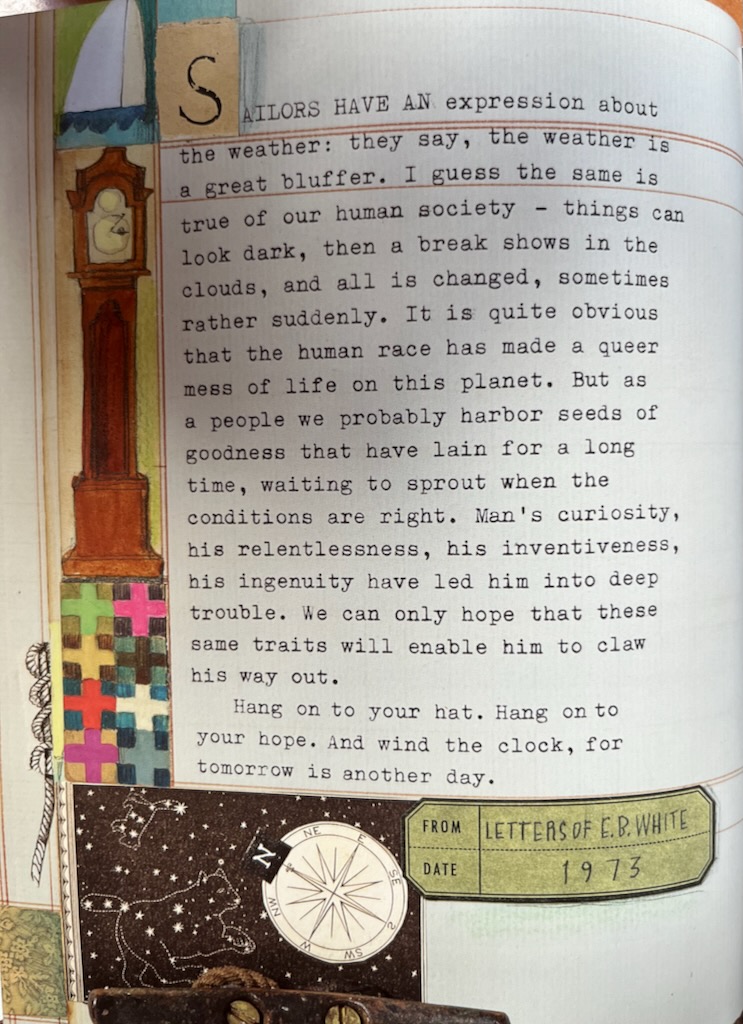
because he’s earned his post as ballast for my wobbly, sometimes-too-tender heart, wasn’t i delighted when i turned to page 132 in this charmed and charming illustrated biography, and found this excerpt from andy’s letters, which seemed to me a prescriptive for these hard times and the dark clouds under which we find ourselves:

“things can look dark, then a break shows in the clouds, and all is changed, sometimes rather suddenly. it is quite obvious that the human race has made a queer mess of life on this planet. but as a people we probably harbor seeds of goodness that have lain for a long time, waiting to sprout when the conditions are right.

i’ll stop there with my old friend e.b., because that’s the line i want to consider, the line i want us to latch onto and live.

and so, what a curious thing that the next wise soul i wandered into this week was one olga jacoby, a german-jewish englishwoman and mother of four adopted children, who, in 1909 at age 35, had received a terminal diagnosis from her doctor, and sat down to write him a letter on the subject of living and dying without religion, but with moral courage, kindness, and a stunning receptivity to beauty. their correspondence would unfold until jacoby’s death four years later, and her letters, “by turns funny, touching, and intensely sad,” were published posthumously and anonymously by her husband in 1919.

in her first letter, to “my dear doctor,” she boiled down her belief to this:

“To leave a good example to those I love [is] my only understanding of immortality.”

and a year into her diagnosis she illuminated that notion:

“. . . More and more to me this simplest of thoughts seems right: Live, live keenly, live fully; make ample use of every power that has been given us to use, to use for the good end. Blind yourself to nothing; look straight at sadness, loss, evil; but at the same time look with such intense delight at all that is good and noble that quite naturally the heart’s longing will be to help the glory to triumph, and that to have been a strong fighter in that cause will appear the only end worth achieving. The length of life does not depend on us.”

and, she leaves us with this bedrock of lived truth:

“. . . Love, like strength and courage, is a strange thing; the more we give the more we find we have to give. Once given out love is set rolling for ever to amass more, resembling an avalanche by the irresistible force with which it sweeps aside all obstacles, but utterly unlike in its effect, for it brings happiness wherever it passes and lands destruction nowhere.”

who teaches you on the subject of love? what seeds of goodness harbor in you, and how will you coax them to sprout? and how might you put into practice the avalanche of irresistible force practiced by spiders and pigs alike (at least in the rich imagination of one e.b. white) and that, to the dying mother of four, was the most lasting thing that ever there was?

Some Writer! came to me, as so many of the best so-called children’s books do, by way of my best longest friend, auntie mullane, the children’s librarian, who prescribed it as the sure cure for summer blues, or any blues that might befall us in this dark-clouded era.

e.b. white on a rope swing, 1976

the wisdom of “it needn’t be correct”

interludes mindful

when you wander through life utterly certain that there are volumes you’ve yet to learn, a certain thing happens. a wonderful thing. you wake up every morning with your eyes, and your ears, and your heart at full alert. you are the ever-scanner, knowing that at any minute, from any crevice, the light might seep in. might flash in. the wisdom, gosh darn it, will come.

by day’s end, by the time you plop that cheek back onto the pillow, by the time you snuggle the sheets up by your chin, tucked back in for one more round of dreams, you’ll have — perhaps — learned a thing or two. gotten just a wee bit wiser. all because the teacher appeared, and you, the eternal student, were ready.

so it was the other afternoon as i was listening along in poetry class, when all of a sudden a fellow, a dancer with the new york city ballet, said something that shocked right through me, that slipped in through the crack, just off to the edge of the frame.

the subject, allegedly, was poetry. emily dickinson’s poetry, specifically. but in this wonderful class that i can’t stop inhaling, all sorts of wise souls wander onto the scene and peel back the layers of emily, of poetry, in ways i’ve not before known.

the discussion at hand was emily’s poem, “i cannot dance opon my toes,” the last poem of the four-week class taught by my beloved professor elisa new. she’d invited damian woetzel, a retired principal dancer with the new york city ballet, and now director of the aspen institute arts programs, to parse emily’s poem. as is professor new’s knack for unlikely pairings in the parsing of poetry, woetzel, a classically-trained ballet dancer, was joined in conversation by charles “l’il buck” riley, a practitioner of a street-dance form known as memphis jookin’ (think breakdance; it’s otherwise known as “gangsta walking”).

as street dance and ballet twirled in conversational tango, woetzel suddenly said this: “when i go to see people dance, it’s not to see them do it correctly. i’m not that interested in correct. i want to be moved. i want to cry. i want — (his voice faded away). i want to find voice, essentially.”

now, this was nothing short of revolutionary to my little mind. i felt the shock of a chill run through me. (my brilliant friend amy, by the way, just yesterday afternoon defined “chill” to me in this way: “a chill is a current of truth that runs through your body,” when you see beauty, she said, or when you hear flat-out wisdom in a way you’ve never thought it before, i’d add.)

“i’m not that interested in correct.”

i felt the ties that bind snap loose. i felt myself freed from the tethers that, long as i can remember, have bound me. do it right, do it correctly, or don’t even try. that was pretty much the lesson i grew up believing. and while it didn’t stop me from trying, it set a nearly impossible bar. “get it right.” or else.

but here was a brilliant dancer, here was the director of aspen institute arts, for crying out loud, telling me it needn’t be correct. needn’t be perfect. stumbles are okay. bumps and bruises are beautiful.

your whole imperfect self is the most ravishingly beautiful self imaginable.

because it’s about something much deeper. it’s about opening up and saying, “this wobbly old soul, this soul that tries and tries, and sometimes makes it and more often stumbles, this is me.

“and you’re here for the likely chance that our two stumbling fumbling selves will find communion — not in our perfect pirouettes, but in the moments when i trip and you catch me. you brush me off and set me back upon the path, and you point the way forward. or better yet, you take me by the hand. you walk together with me. and you laugh, besides, at the way the two of us, we so often nearly fall off the stage.”

it’s a whole new paradigm: the paradigm of imperfection as aim. because what matters lies deep therein.

“i’m not that interested in correct. i want to be moved. i want to cry. i want to find voice, essentially.”

and voice we all have. and, yes, sometimes it warbles. and sometimes it cracks. but it’s a voice and it’s ours. and it’s how we put words to what rustles around deep inside. it’s where our breath resides. it’s the topography that puts height and depth and nooks and crannies — glorious texture — to all that air flowing in and out of our lungs, air keeping us alive.

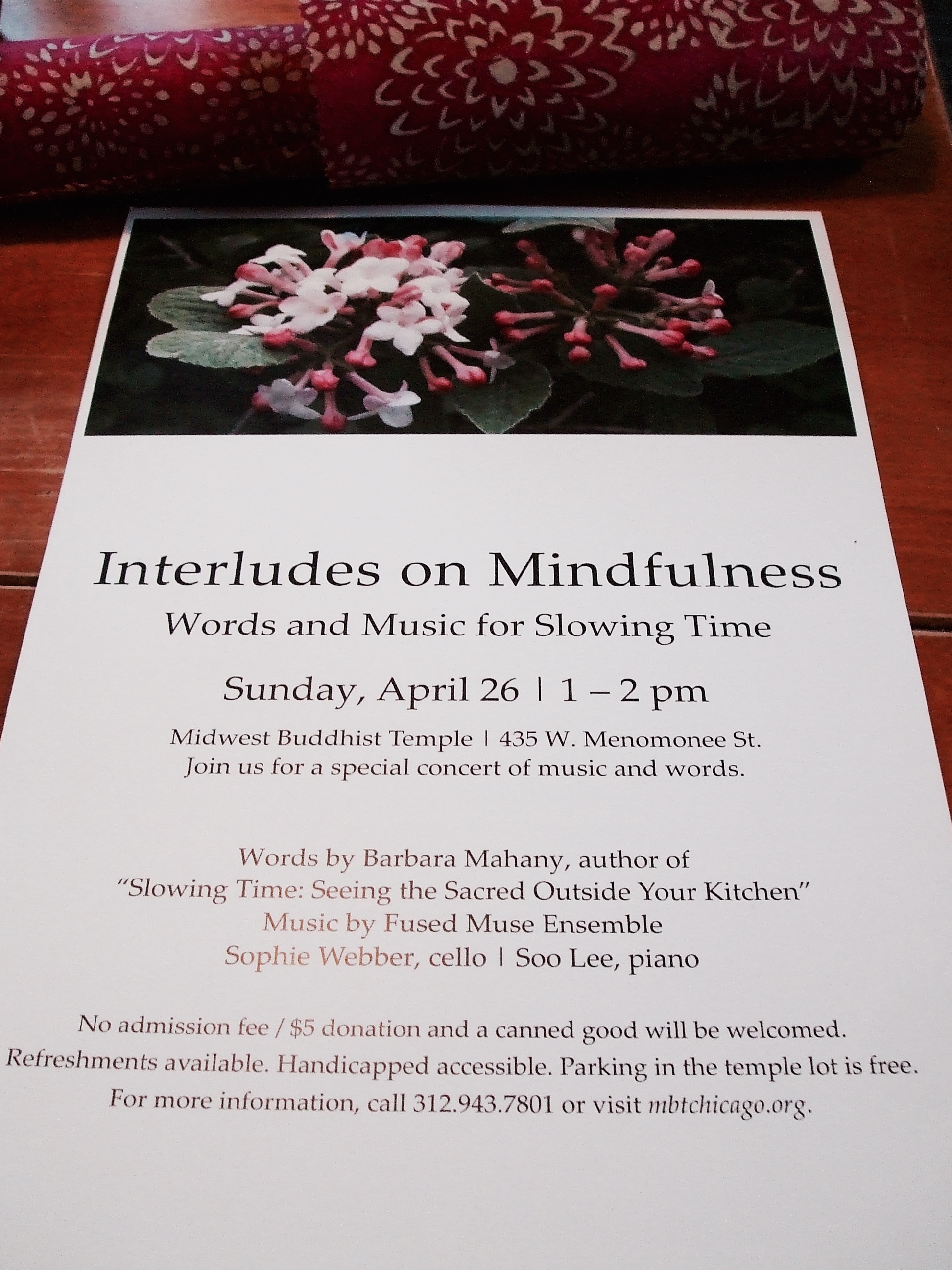
all of this is all the more immediately essential because this sunday i am doing something i’ve never done before. something that might have scared me out of my behoozies. i am walking onto a stage, and i am sitting down beside a cellist and a pianist. it’s a spoken word concert, inspired by one that a beloved friend and editor of mine once saw in japan.

i am, for the first time ever, invited into conversations about lighting and stage set, and in the faintest of ways, costume. i’m immersed in the full dimensionality of theatre. and i am discovering what happens when words are lifted from the page. when words are set soaring by the power of cello strings and piano keys, and the alchemies of audible, ephemeral creation.

and, as is my natural inclination, i was scared silly. until two things happened: until damian woetzel taught me that it’s not about correct; correct holds little interest, little tension, scant transparency.

and the other thing that happened is i stepped into the music during rehearsals, and i felt the most astounding flight: cello and piano, cellist and pianist, dove into conversation with the words i was unfurling. and then this, which i’ll preface by saying that many a writer’s whispered prayer is that, in between and through the words, music might come for those reading or listening. and, suddenly, there in the light-filled rehearsal room, i heard it, i felt it. the music did come, did lift and vault and carry the words to places and heights they’d not otherwise have ascended. it comes, the music does, i discovered, when you step onto a stage, and sit down beside a cellist and a pianist who’ve spent their lives deepening their knowledge of the landscape that’s theirs. the power of music, i’ve realized, is the safety net to my trapeze. is what holds me aloft, shooshes away my perpetual fears, is a medium that suddenly felt like coming home, a place where i, at long last, belong. how utterly unlikely.

so sunday afternoon at 1, at the midwest buddhist temple in chicago’s old town, i will be walking out from behind a curtain, all in black with a wrap of fuchsia. i’ll be sitting down in a japanese armchair, a bowl of oranges beside me, a vase spilling with springtime white. the cellist will pick up her bow. the pianist will strike a key. and i will put breath, put voice, to my words.

and i will remember that the wise ones in the room aren’t there to hear “correct,” they’re there to be moved, to cry, to find a voice, essentially.

and that is a truth that sets me soaring.

do you, like me, spend far too many hours of life being worried you won’t get it right? and thus binding yourself in ways that demand houdini-like tricks to set you free? 

that said, here’s an invitation: if you’re near chicago sunday afternoon, find your way to the temple, and plop yourself in a chair. cellist sophie webber and pianist soo young lee, both of fused muse ensemble, will take you places that might take your breath away…..

a few things:

1.) emily’s poem

I cannot dance opon my Toes –
No Man instructed me –
But oftentimes, among my mind,
A Glee possesseth me,

That had I Ballet Knowledge –
Would put itself abroad
In Pirouette to blanch a Troupe –
Or lay a Prima, mad,

And though I had no Gown of Gauze –
No Ringlet, to my Hair,
Nor hopped for Audiences – like Birds –
One Claw opon the air –

Nor tossed my shape in Eider Balls,
Nor rolled on wheels of snow
Till I was out of sight, in sound,
The House encore me so –

Nor any know I know the Art
I mention – easy – Here –
Nor any Placard boast me –
It’s full as Opera –

2.) the program for sunday’s “interludes on mindfulness: words and music for slowing time”

Screen Shot 2015-04-22 at 7.14.22 AM


and a post-script:

it’s sunday night, the interludes have ended. it’s quiet now and i’m breathing again. a dear friend snapped this moment of the concert. and i’m enchanted by what appear to be fairy lights wafting across the stage. the cellist is sophie webber, the pianist is soo young lee, both have PhDs in music. both are beautiful. sophie founded fuse muse ensemble, a collective of musicians who dedicate themselves to social causes as well as beautiful music in all forms. i hope this is only a beginning for us….here’s a peek at the magic of “interludes on mindfulness: words and music for slowing time.” thank you, from the bottom of my heart….

SlowingTimeMusic

gobsmacked by everyday prophets

Dew Drops

proph-et (n.) 1. (in some religions) a person believed to have been sent by God to teach people about his intentions. 2. a person who predicts the future. 3. a person who promotes or supports a new belief or theory.

and so it is that as we motor along the patched asphalt roads of our everyday, suddenly we screech to a stop when we realize, right before our eyes, a wise soul, a prophet, a shaker-upper has flung his or her wisdom splat in the middle of the lane. stuck there, not able to never mind, not able to turn the wheel and steer around it, we succumb to the roadblock. loosen our grip on the wheel, stare wide-eyed through the windshield, soak up every last tidbit of what’s there in a pile clogging the throughway.

sometimes that’s what it takes to get us to pause, to pay attention.

and so it was, not so many days ago, when sitting in the dim-lit auditorium where our synagogue holds the talk part of sunday school. the rabbi was up at the front, at the mike, sipping his starbucks grande whatever. and, once again, the conversation seemed to be steering into one of those ones i’ve heard far too often. the topic, more or less: how in the world do you talk to your kids about God, when you’ve no clue who or what that might be?

i’ve learned to sit on my hands. to mostly not raise one or the other. over the years, i’ve made it clear on several occasions that i DO have a clue who that is. that i find the Holiness all around and within. that it’s there at the dawn when i tiptoe outside and find the heavens alight with pinpoints of stars. that it’s there when the voice on the other end of the line breathes hope into my emptiness. that it’s there when the words that spill from the mouth of the child i’m tucking in bed hit me with a compassion i’d not expect from a grownup, let alone a 12-year-old who can’t for the life of him untangle the distributive property upon which his pre-algebra homework is hinged.

i’d more or less surrendered to the conversation, felt myself sinking lower and lower — in spirit and chair. but then, the long lanky fellow a few seats to the east in my row, he raised his hand. now, i know this fellow to be wise, and i know he’s lived through some tragedy. his wife died when his children were little, one still in diapers, one just past toddling. he speaks with a gravely voice, the result of a cancer.

here’s what he said: “when my son asked why people die, i said: because it means we have a limited number of days, so how we live matters.”

it means we have a limited number of days, so how we live matters… 

i sat there, low in my spring-loaded chair, and suddenly bolted upright. humbled. stunned. turning the words over and over in my head, as if marbles i held to the light. examining, absorbing.

how we live matters….

these words from a father to son, a son who’d just lost his mother.

i did what i do when i know i’ve heard wisdom: i reached for my backpack, i pulled out a pen and my red little moleskin. i loosened the elastic snap that holds open the next empty page. i scribbled. i suddenly was wide awake and taking in every word of this conversation, no longer the same old, same old.

all week i’ve drifted back to that moment. when suddenly, out of the almost dark, a gravely voice spoke words that stirred me, top to bottom, inside to out.

i was knocked over by what he said — especially since i’ve too heavy a dose of black irish soul, the sort that too often fears the end is just around the next bend, and this notion of using that as a wedge to take it up a notch, to live each blessed day as if it could be the last or the second to last, is rather a zap to the noggin, to the soul.

but even more i was knocked over by the blessed truth that we never know where the wisdom will come, we never guess the prophets around us. and that’s why it matters that we stand at attention. that we live on the lookout — for wisdom, for truth, for gentlest kindness and full-bodied compassion.

if instead of sinking low in our chairs, if instead of surrendering to the ho-hum humdrum we think is unfurling, we stay awake to the possibility that someone far wiser than we’ll ever be is about to brush up against us, pass along a kernel of all that’s holy and wise and forever.

and that’s why this mystery called life is so utterly and wholly capable of taking our breath away — without drumroll or siren — and filling it in with high-octane Holy.

so, who’s your prophet of late? and what wisdom was plopped in your lap?

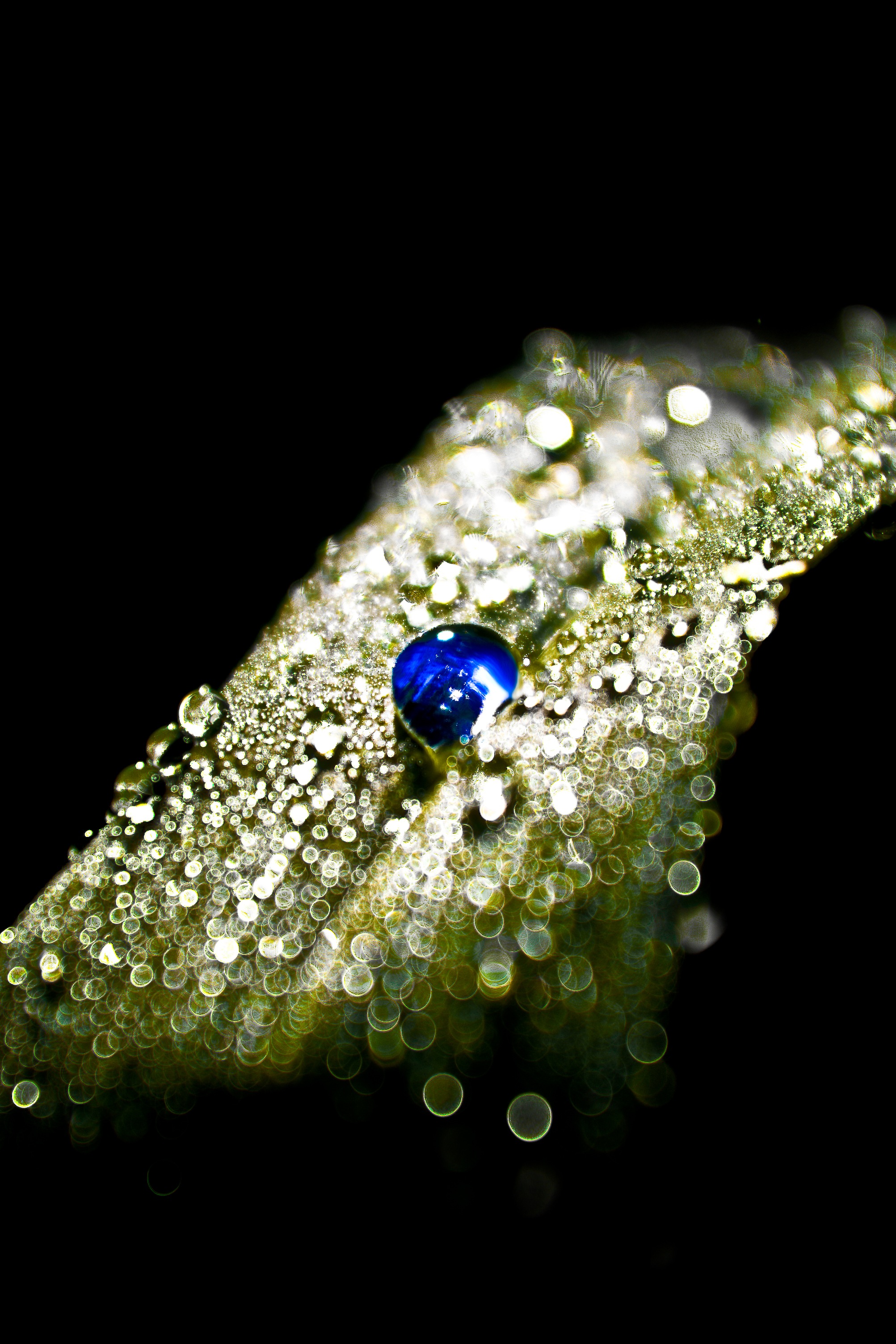
photo credit above: my sweet will kamin. a morning’s dew captured in magnificent light. not unlike the gift of the prophet….

enter to grow in wisdom

enter wisdom arch

dispatch from 02139 (in which, alas, classes at veritas U have come to an end, and we begin to ponder just how deeply what we’ve learned will forever inform our going forward…)

enter wisdom detail

the words are simple, etched in limestone.

each letter, maybe three inches, top to bottom, but looming, soaring, some 12 feet up, for those who pause to crane their neck, or shift their eyeballs heavenward.

i nearly tripped the first time i spied them.

“enter to grow in wisdom.”

i swallowed, smiled. charmed that old harvard would deign to dollop this inscribed dose of aphorism into its citizens’ daily lives. how quaint, i thought, for such a stiff-collared institution.

but then i found myself traipsing out of my way to duck beneath the hallowed words, as if they’d waft down and dust me with magic powders.

(this curious — and intentional — ambulatory detour, of course, might be traced back to the ancient parts of me that were trained to believe, long long ago, that splashing one’s fingertips in the holy waters perched beside the door of any catholic church was sure to make your soul sparkle with good graces for the day. or until you next committed some venial sin — say, coveting your first-grade neighbor’s frilly toothpicks, and pocketing said pokers in the dark confines of your dungarees, whereupon you’d rediscover them once home and feign total loss as to how in the world they got there.)

“enter to grow in wisdom,” indeed.

the words span across the brick-and-limestone dexter gate, one of the 26 such thresholds that encircle harvard yard, defining the pastoral from the pedestrian, the hoi polloi from the highbrow.

built in 1901, designed by the architectural greats mckim, mead & white, the brick-striped pillars rise from the cobbled sidewalk as a monument from a bereft mother, josephine dexter, whose son, samuel, was president of harvard’s class of 1890, but who died in 1894, just two days after coming down with spinal meningitis.

it’s a two-sided prescriptive. as you sashay in from the honking, screeching cacophony of massachusetts avenue, you read: “enter to grow in wisdom,” and as you bustle out, looking up onto the inner-facing side of the limestone span, you mouth the words: “depart to serve better thy country and thy kind.”

i can’t shake the incoming directive, “to grow in wisdom.”

can’t decide, is it command or invitation?

and does it matter which?

for me, all i know as i look back on two semesters, tucked in lecture halls, squished in pop-up seats with wobbly writing slabs, is that the words, more than anything, are a beginning without end.

i wish i could inscribe them across the transom of every space through which the human race parades. on the wall of every birthing room: “enter to grow in wisdom.” in the dingy, dim-lit passageways of chicago’s famous “el,” or boston’s “T.” in churches, synagogues, mosques and temples, of course.

but why not, across the check-out aisles of the grocery stores, where too often i’ve seen squabbles erupt and nasty words exchanged?

and how about behind the dugout of the little league ballfield? or, above your own kitchen table?

wisdom, for me anyway, is holiness, is path to enlightenment, is how you begin to flush out deeper, broader, more fine-grained empathy, the gift that — when you pay attention, close careful attention — rises up from the pages of history and literature and humankind.

and so, this year, i came to cambridge to spark a hundred thousand wicks of candlelight, of wisdom.

i came, greedily, to soak up all i’d never had a chance to learn, to understand, to know. i came to fill in blanks, connect dots. put words to too many empty pages.

i stayed up late, rose early, because there was so so much i didn’t know.

because i was being offered dorothy day and martin luther king, mahatma gandhi and thich nhat hanh as pathfinders and teachers — and a host of modern spiritual pioneers and religious revolutionaries, besides.

i swallowed whole the complete works of virginia woolf, of nabokov, of bellow, of zora neale hurston, w.e.b. du bois, frederick douglass, and that living writer-saint isabel wilkerson, whose “the warmth of other suns: the epic story of america’s great migration,” should be required reading across the land.

i listened hard when paul farmer and arthur kleinman, the godfathers of global health and modernday disciples of pure goodness, implored us to not leave behind, not forget, the shadows of the world where medicines don’t flow, and one toilet might be shared by 10,000 refugees.

i cried too often in a semester of african-american history — AAAS 118: from the slave trade to the great migration — as my stomach turned and my heart splintered into shards. i could not fathom lashings nor lynchings, but i was left gasping at the recountings of how these inhuman acts were headlined as spectacle, and thousands of white folk turned out to cheer charred black flesh dangling from a limb. and hoisted children to shoulders, so the little ones could get a closer look.

i could not even muster the ancient christian prayer, “father, forgive them, for they know not what they’re doing.” that prayer holds no merit here. there is no excuse, no feeble claim for not standing up to cruel injustice. no pretending you don’t know.

and so, with two fifths of my classes this semester spent studying the injustices of white to black, generation upon generation, century upon century, i kept asking myself why i could not tear myself away from the readings, why i was the sole tear-stained silver-hair, amid a sea of smart-as-a-whip undergrads, who filled notebook after notebook with names and dates and stories of those brave souls who rose up to try to stanch the hatred.

it felt as if the answer wasn’t meant to come to me, not yet anyway. and so i sat there, squirming at times, when kids shot hands in the air and spoke bracingly about white privilege, and great-grandparents begat from slavemasters’ rapes of enslaved great-great-grandmothers.

for most of the semester, i thought perhaps i was being readied for a spate of journalism back in chicago’s blood-splattered landscape of racial inequities.

but it’s dawned on me in recent days that — as i sat feeling powerless to turn back the clock and right the wrongs, and wanted to burst out of my (white) skin to stand up to oppression — the task is here and now: our every days are filled with injustice, are filled with small acts of hatefulness for which we can’t afford to turn our heads, to cower in the idleness of our kitchens or our gardens, our leafy enclaves.

maybe it’s the deep-veined jesuit framework upon which my early college days were founded. maybe it’s just the lens through which i’ve always seen the world. but the particular brand of wisdom that’s been birthed in all these months is the one that now springs from a few essential jottings from my notebook:

1.) beware the single story, preached professor kellie carter-jackson, a rising star among african-american historians. “the single story creates stereotype; it’s not untrue, but it’s always incomplete. it robs people of their dignity. we create a single story when we show a people as one thing, as only one thing, and repeat it over and over. the consequence of the single story is that it makes our recognition of our equal humanity difficult.”

2.) search out the voices that have been silenced through history. embrace bottom-up not top-down history; sift through the past to mine the stories of those who fought injustice, even when the price they paid was life itself.

my bookshelves are spilling. my pens, dried of ink. the margins of pages read like constellation guides, so stained with stars i’ve drawn to mark the wisdom there contained.

wisdom.

it all comes back to wisdom.

for me, that’s been a lifelong prayer. i’ve long pictured a frame from the far-end of my life, when i might become the wise old woman, bent and wrapped in shawl. when my kitchen table would be always set, and the teapot hot to pour. when there would be chairs, many chairs, filled with folk of every stripe and color, size and spot.

now, though, that might not be mere wisp of a storybook’s dream.

now, i’ve entered to grow in wisdom, and, for me, there is no departing from that holy sacred path.

Image 1

thank you, All Knowing Light and Wonder, for this great and glorious school year, now winding to a close……

how do you, my chair friends, carry on in your chosen path of wisdom?

(photo credit “depart” arch: blair kamin)

and great and glorious thanks to my most amazing professors: harvey cox, stephanie paulsell, paul farmer, arthur kleinman, paige williams, the kooky  “cooking & science” crew; henry louis gates, lawrence bobo, luke menand, helen vendler, james wood, kellie carter-jackson, and the amazing amazing harvard undergrads and grad students who so generously invited me into their privileged conversations, both in the classroom and beyond, at coffeeshops and lunch counters, in my living room and under shade trees in the yard….God bless you each and every one….

and, most of all, to ann marie lipinski, curator of the nieman foundation for journalism at harvard university, for picking my sweet blair for this year of thinking sumptuously. and, i suppose, to blair for picking me so long long ago…

“my childhood is over.”

when he was not even 2, he looked up through the skylight as i tucked in the covers, soft by his shoulders. “mommy,” he wondered aloud, “who puts God to bed?”

when he was 3, he looked up from the kitchen table, and asked, “mommy, what is facetious?”

i’ve been side-by-side with this questioning child for 18 years now. i’ve gotten used to the way words unspool from his mouth, from his mind, from that heart deep inside.

but that doesn’t mean i’ve stopped catching my breath, feeling the air stopped in its tracks, when some of the thoughts come.

and so it was, the other night, sitting at dinner alongside a pond in chicago’s lincoln park, that great front yard of the city, looking south on the muscled shoulders of steel and glass that scrape the sky.

we were feasting, had sipped the watermelon, basil and gin cocktail (i don’t drink gin, but this had to do with a newspaper assignment, and that boy beside me, he sure didn’t mind). had scooped the very last drop of asparagus puree from our plate, and duck rillettes from a charcuterie slab.

the little one and his papa had gone off to visit the so-called powder room, when my brand-new 18-year-old took in one of his sighs, the kind where the smile begins with the first uptake of air, and the eyes start to glisten, and i pretty much know that what’s coming next will enchant me.

“you know,” he began, “this is the first time in my life a whole phase of my life has ended. my childhood is over. it’s not like you can reach back into any of the moments and shift it around. it was what it was. and even if i don’t remember one moment, or the one after that, the experience of that moment is all there, is a part of who i am.”

then he just smiled.

or i think so. for my eyes were veiled in a scrim of tears, that holy blessed water that anoints so many moments of life. sanctifies. signals, my heart has been touched here. is pounding. is spilling. cannot be contained.

“my childhood is over.”

i tumbled the words in my head, in my mouth, so many dew drops of wisdom packed in each one, so rich was the taste on my tongue.

“my childhood is over.”

and so it is.

and that, perhaps, is the crux of why 18 matters. not that he can now buy cigarettes; which you know he wouldn’t. not that he can vote, which he can and he will. oh, will he. and not, as he remembered to tell us when ticking off the new-found legalities, that he can now buy playboy magazine. which i would bet he won’t do. (and which prompted the little one to ask, loudly, “what’s playboy?” to which we all shooshed him quite emphatically, as fears raced through our heads that he’d be tossing that just-discovered word around on the fifth-grade playground.)

“my childhood is over.”

the words kept tumbling through my head, and suddenly so many scenes pop-pop-popped.

the summer camps at the zoo, and the planetarium, and that great hall of midwestern pluck and twang, the old town school of folk music.

the little boy in the NASA astronaut suit. the little boy in the blue-striped engineer’s cap. the boy on the baseball team in hyde park; the boy standing in the T-ball outfield, turned away from the pitcher’s mound, pointing toward the sky, hollering, “look, there’s venus.”

the boy sitting on the roof of the playhouse on the playground at lab school, watching–not playing in–the schoolyard games. the big move to the 10-mile-away town where all is leafy, is mown, is too-often manicured, leaving behind the pop and the whir of the city he loved. the el rides, back. the boy who would not leave his city. a boy forever enchanted with urban grid, and thoreau’s wilderness.

the tearful nights in the kitchen. the angst of all-nighters. the company he found in the pages of nabokov and faulkner and emerson. the arc of limitations he tested, wrapping his palms ’round the oars, rowing his heart out, not looking back.

it was all the quilt of his childhood. his childhood stitches now pulled through the cloth, now set.

it was what it was.

forever will be.

and i couldn’t help but think of how very wholly i had poured myself into the work of being his mother, of all the hours and brain cells and blood cells it took. the signing up for this camp or that. the filling out form after form. the driving him long ways, and jam-packed ways, at all hours. the praying. the worrying. the peering in through the classroom door to see that all was well.

mothers do that, knowing or not. we set out to be our child’s field guide and companion. we arrange and re-arrange. we call people we don’t know, speak words that don’t come easy sometimes. we listen 24 hours a day. we carry our children wherever we go, even when the miles between us are many.

even when they’re 18. and beyond.

but for that whole first chapter, the one whose last page has just turned, i was fully awake, fully on board.

i gave that boy the best that i had. i’d made him that promise. so help me God, i did not run away, not on the nights when i had no answers, not on the mornings when worry consumed me. not when, for the 9 millionth time, i walked in his room and witnessed what happens when a cyclone blows through.

i was, forever will be, the mother who plays in his childhood scenes. who will endlessly loop. i’m the one off to the left in so many frames. i am, more than anything, the one who is beaming.

the fact of the matter is this: the greatest gift i’ve ever known is the gift of being that boy’s mother. i have learned volumes. fallen umpteen times. scratched the depths of my soul, so help me God.

i have preached and promised and pleaded. i’ve stirred and baked and spooned in whatever was needed, oatmeal to amoxicillin, i’ve served ’em all.

it’s what we do when we discover our deepest calling is the call to mother a child.

that childhood is over. and my tasks there are laid to rest.

but that boy is riding today, in a car full of 18-year-olds, to a faraway city in the belly of michigan. there’s an interstate between here and there, and 18-wheel rigs that whiz by, hellbent on getting wherever they go in a hurry.

it’s time to let the boy go. his childhood is over. but don’t think for a minute that this day will be easy. his father is tied up in knots. i’m the one soothing, saying, he’ll be fine, when deep in my head i picture terrible things.

my last words as he strode out the door, that strapping tall boy with the duffle slung over his rock-hard shoulder: “come home safe, or i’ll kill you.”

dear Lord, hear my prayer.

the murky picture above is not so murky in my mind. it’s my two boys, after dinner, with the chicago skyline rising up over their shoulders. fireworks were exploding from behind those mounding rainclouds, and at first we thought it was red lightning, making for an unforgettable step into the night, as we left the north pond cafe, where we’d savored an unforgettable feast, an unforgettable marking of age. my camera didn’t do what i wanted, but i love the image anyway. it’s the way memory fades, yellows around the edges.

please forgive my tendency lately to write here as if i am tracking time, the close of my firstborn’s childhood, as he put it. one of the gifts of writing is that it serves as glue, to stick snapshots to the pages of your life, so you capture it, hold it. these stories are for down the road as much as for today. they are for me to read and re-read some day; they are for my boys to tuck in their boxes from childhood. in writing of life’s passage, i hope that each and every one of you finds a spark of your such passage, or the passage of someone you love. a blog is an odd-duck of a thing. a blog of four and a half years, odder still, perhaps.

these are but swatches of my heart. and if they spark something in you, my prayers are answered. do tell: when you hear the words, “my childhood is over. it was what it was….” what sparks to your mind? what are the scenes from your own childhood that have lasted through all the years?

“…always an act of courage.”

maybe it happens to you, too, sometimes. you are reading along, and words reach out, like some sort of net strung between trees in a thick jungle. they entangle you, stop you in your tracks, don’t release you, really, for days and days.

so it was, as i was reading along in tina brown’s new newsweek, reading a story about barack obama’s mother, when i stumbled on the words, at the top of a paragraph, nestled inconspicuously into the rest of the black-on-white sentences.

i read: “Motherhood is always an act of courage.”

just like that, it caught me.

as always, the best writing is stitched with wisdom. it catches you unawares. elegant french knots of deep truth tucked in among the narrative.

one minute i was reading that obama’s brave single mother, ann soetoro, a cultural anthropologist by training, was as curious about men as she was perplexed by them, the next i was entangled in a thought that would carry me for days.

“motherhood is always an act of courage.”

indeed it is.

from the moment that seed of life burrows deep into the womb, makes its way to connect to the richness that is a mother’s blood. will feed, will sustain.

from conception on, there is no going back, if God is willing, if prayers are answered.

we move on, one corpuscle tied to the next. we are in this, literally, together. we are forever entwined. though birth will begin the separation, there are separations deep down inside that will never truly be cut with any knife.

from those blurry days of daydreams, before the labor comes, when in hazy fuzzy terms you try hard as you can to imagine this someone, to imagine how it will be.

it will be nothing like those dreams.

it will be nothing like anything you have ever known.

and the one sure thing, the only certainty, is you’d better tap deep into a tank of high-octane courage. no watered-down concoction can take you where you need to go. this trek has no roadmap, and too often, no shortcuts.

it’s courage that will carry you round the skinny mountain passes, where the edge is steep, is precipitous. it’s courage that will carry you through unrelenting passages, when you’d rather turn in swift retreat.

after all, they send you home with this squirming, hungry bundle–and no instructions attached. you shake as you sit in the back seat, the baby’s father driving so cautiously you fear you might be rear-ended, the car behind you not understanding just how deep a journey home this is, this long trip, the maiden voyage.

then, the first morning you are left home alone with this babe, you break out in sweat. or tears. more often, both. the baby squawks, you try to figure out how in the world you will do this. how will you spoon the cereal into your own mouth, so you, in turn, can feed your screaming infant?

courage? oh, mother courage, you came to me, you filled me. shaking, quaking deep inside. uncertain, scared, somehow we carried on.

all along the way, it’s darkness up ahead. we never know what might be around the bend. we simply keep putting one foot out, before the other.

how in the world can you take on the task of mothering if you are not filled up with courage? if you do not gulp it for breakfast, inhale it like undiluted oxygen?

i consider, in a slide show that makes me weep, the moments of courage of mothers i have known:

the mother, just this week, who watched her little girl’s legs be strapped into braces, braces for a year.

the mother who sat outside the OR while oncologists poured hot chemo in her daughter’s belly, a last-ditch hope to stop the unretrenching cancer.

the mother, so many mothers, who bravely steps into the school conference room, where so many minds–and unknown faces–are gathered to map a plan to help the struggling child, the child for whom learning doesn’t come in straight lines, or quickly.

or what of the mother who took the call, from a stranger, who listened to the voice telling her that her bike-riding son had fallen, been found unconscious, limp and bloodied. that mother who drove, trembling, who carried her son to the ER. who listened as the doctor said his vertebrae, high up in his neck, were fractured, one for certain, another most likely. an airlift would be arranged.

and what about the less dramatic, but no less daunting frame: the mother who drops her child off at the classroom door, who hears the cries from in the room, as she cowers in the hallway, barely breathing, wondering, how in the world will he make it–will she, the mother, make it–through the next endless hour?

i think of the mothers i admire most, the ones whose unbroken, unwobbling faith makes me stand straight, breathe deep, reach down and get a grip. i think of those mothers and realize every single one is a profile in pure courage.

you take on life when you bear a child, when you become a mother through birth or love or law.

and when you cradle that child in your arms, rock him or her through the night, on the nights when fevers soar, and cries grow shrill. and you are terrified inside, but you whisper to yourself, “this child needs me, stay strong. don’t waver.”

i’ve been the mother who talked to my knees, instructed, “don’t buckle,” when i thought they would, when i thought my firstborn might be with severed spinal cord. when i needed to wheel his cart down a long lonely hallway, when i could not look into his eyes, for fear of breaking down and falling into pieces. when i saw his life, and mine, pass before my eyes.

“…always an act of courage.”

is it not an act of courage, on any old school morning, when we wave our child down the sidewalk, watch them bravely board the school bus, when we know that there are kids on that school bus who taunt our child, who call him names, who make his schoolday an exercise in humiliation?

and what of the times we pick up the phone, tell the principal in no uncertain terms that we will not let this go on?

when we walk up to the baseball coach, when we tell him what just happened was truly painful, and he had better make it right, for this is no way to model grace under pressure?

even though, deep inside, we are shaking, quaking all the while. not so practiced at this standing up, and being counted. except for when we look around, realize we’re the one who’s being depended on. we’ve become, after all, the grownup. the one who will not let our children out in the rain, to fend for themselves, to march unshielded. we lift our voices, if need be. make decisions. stand taller than we’ve ever stood. because it is our children for whom we are called to be more than we have ever been before.

i think back to my own mother who, at 50, found herself a widow, with five children. who huddled us by the door as we were about to step outside to the long black car sent by the funeral home, who looked each one of us in the eye, who told us, “make him proud,” the father we were burying that morning.

it is courage—the hot wind of heaven that fuels our trembling wings.

it is courage—that makes us reach down deep inside and pull out muscle where we never knew we had it. it’s where the backbone is. it’s where, when we need to, we find the voice that speaks up, that won’t relent, that settles only in solid resolution.

we are charged with much in this lifelong journey called mothering.

the one piece of armament sure to go the distance, is the unfettered, unadorned, magnificent holy breath called mother courage.

how do you spell out mother courage? what profiles fill your bookshelves?

the picture above, curiously, captures my first act of mother courage, and not at the front of the frame, not merely cradling a newborn baby minutes after birth. it’s the nutrition book on the shelf behind; i was so afraid somehow that i would screw up the feeding of my unborn child, i followed along, unwilling to falter one iota. when i laid eyes on his chubby thighs, his thighs with gorgeous folds of fat, i heaved a sigh. i knew my deepest prayers had been answered. which is why i have never thrown out that old nutrition tome. it carried me across a bridge that demanded pure courage.

and, of course, happy blessed mothers day to the mothers among us, in whatever form we find ourselves mothering on this earth….