pull up a chair

where wisdom gathers, poetry unfolds and divine light is sparked…

Tag: summer reading

finishing school

i suffer from a common ailment. especially among a certain breed of bibliophile. i don’t finish. i start, enthusiasms drawing me in like ink to a blotter. pages are turned. pens pulled forth and margins scribbled with scrawl. and then another seductress comes along. another delectable enticement: author. idea. or merely a title.

and it happens all over again. 

i’m talking books, of course. and my long-held habit of starting and stopping. 

start. stop. rinse. repeat. 

crack open the binding, turn pages, ink it all up. add to the pile. the towering, toppling, could-knock-me-out-if-it-fell pile of books. 

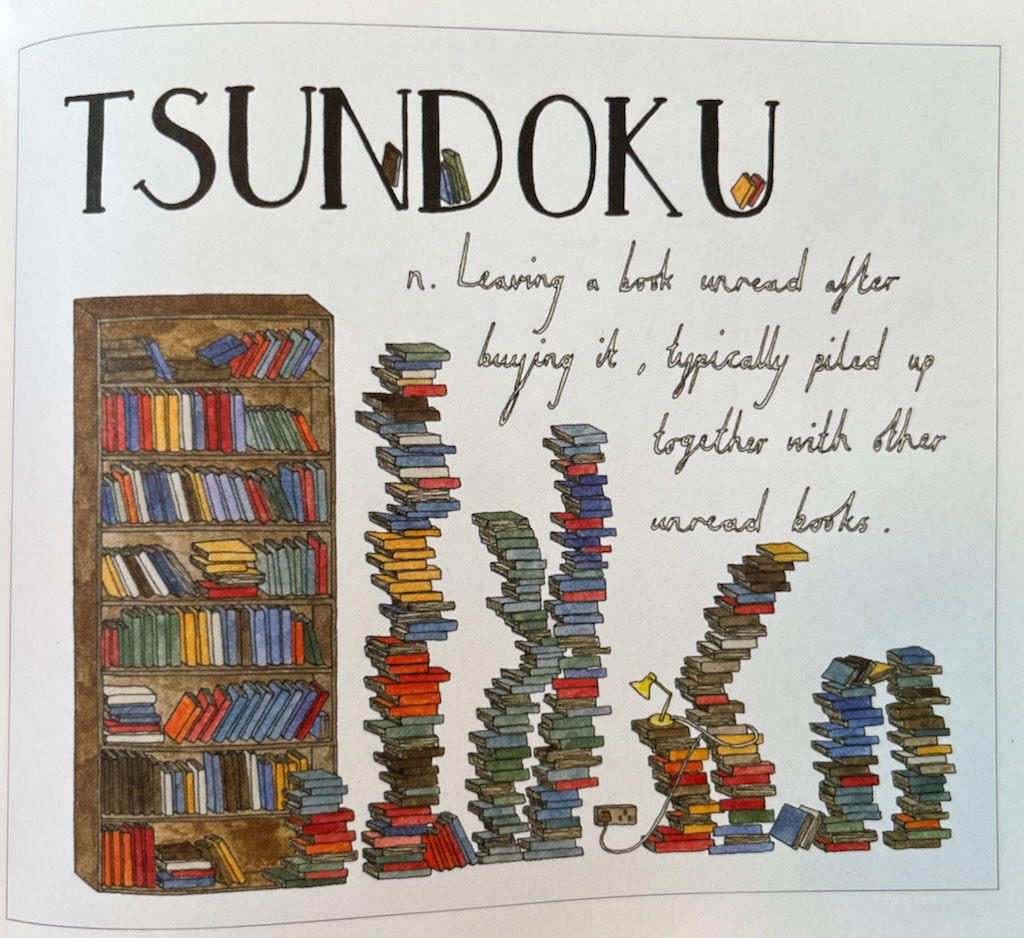
there’s a name for the ailment: tsundoku. (積ん読)

it’s the japanese word meaning, quite literally, “reading pile.” nowhere in the definition—“the phenomenon of accumulating books but not reading them”—would you find evidence of the lethal nature of said phenomenon (ten books falling on your nose will leave a dent). nor the drip-drip-drip of guilt that accumulates every time one sashays past said pile and fails to move forward in a page-turning way. 

so i’ve hatched a plan, an antidote to what ails me. i call it finishing school. i shall, in the summer months ahead, the months when the sun is strong and summer sounds abound, commit to a single purpose: one by one tracking my way toward the last sentence of at least some of the many books piled on my nightstand, my reading nook, my writing room floor, and most any other horizontal plane sturdy enough to hold a vertical biblio-ascension. 

by virtue of this determination to see literary arcs through to the end, i shall be relieving all of you of the task of checking in on the chair to see what’s astir. i am intending to post mostly what leaps off the pages, as i plod along through plots, poetries, and otherwise paradisiacal paragraphs. 

i envision something of a commonplace summer reading adventure, in which we all can chime in with any ol’ ‘graph or line that makes your heart thump, or your eyes fill with tears. 

my summer’s focus will be more reading than writing, at least here. 

the writing portion of my summer will apparently have me bent over the keyboard tapping out pages for a new project i’m not yet free to chat about. there’s an end-of-summer deadline, i do believe, so i’ll be burning up the keys to make that happen. and my refueling time will be spent deeply in reading. in finishing, specifically. 
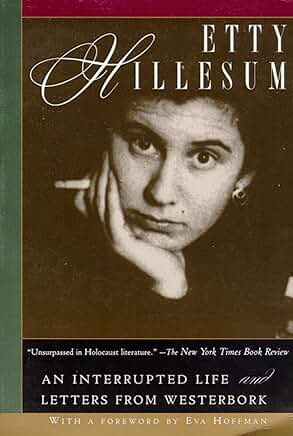
i plan to officially begin my finishing school with a book that’s tugged at me for years, one i started and loved, and truly need to wade deeper into. it’s etty hillesum: an interrupted life and letters from westerbork. begun in 1941, nine months after the netherlands fell to hitler, it’s the epistolary journal of a young dutch jewish woman who traces the darkening shadow of the nazi presence in her homeland as well as her own moral awakening before her death at auschwitz in november of 1943. it seems as essential a book in my stack as any there is. and i’m committing to etty.

back in 1986, in a review of the book in the new york times, michiko kakutani wrote this: 

“All Holocaust writings, of course, must deal with the inadequacy of words in the face of events that defy the imagination, but while Miss Hillesum frequently speaks of her inability to convey the awful magnitude of events around her, she proves herself a most eloquent witness to history—a witness whose grave yet shining testimony attests to the resilience of the human spirit in the face of incalculable odds.”

it seems a book for this moment.
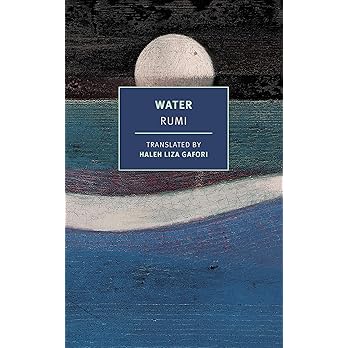
and even though the official starting bell hasn’t chimed, i tiptoed into my project this week by reading start-to-end not one but two magnificent poetry collections: water, by rumi, translated from the farsi by haleh liza gafori (new york review book classics), the second volume of gafori’s translations of the thirteenth-century persian poet (the first one, unfinished but in my pile, of course, was gold, acclaimed for its fluid rendering of rumi’s lyric ecstasies). water’s essence is Love, capital L, gafori writes in her introduction, in which she claims: “Love is a 360-degree embrace of creation, a compassionate acceptance of what it…Love is our unobscured essence, at the root of the root of all creation…Above all, Love is a practice.” 

and but one line that took my breath away in the poems themselves, was this: “Come or go, Love told me, / I am here, closer to you than the vein in your neck.” 
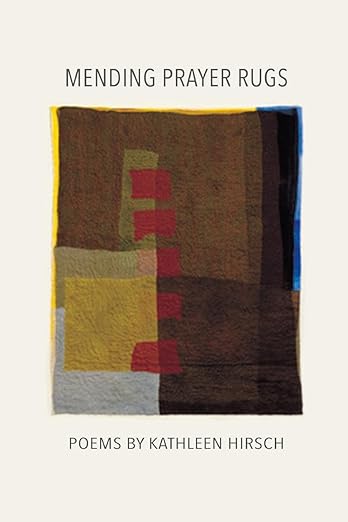
and the second collection of poems i gulped down, start to finish not once but twice, was a book i bumped into quite by accident and whose author immediately swooped into the inner circle of kindred spirits. it’s titled mending prayer rugs, poems by kathleen hirsch (finishing line press), and this collection mines the sacred amid the quotidian, with a particular focus on women of prayer, women whose wisdom is hard-won, be they women from the Bible, craftswomen, workers, wanderers or women we recognize from among our own generations.

in her opening poem, “prayer rug,” hirsch (a longtime journalist and spiritual director) writes in the voice of a woman i imagine with gnarled knuckles and fading eyesight, the cost of a lifetime spent pulling needle and thread through the tatters of prayer rugs for those who prostrate in prayer: “I bend in blessing toward all that breathes: / May each hour enlarge the pattern— / rose dawn, wind song, tender shoot of faith— / that I may see the weft of the hidden weaver.

the weft of the hidden weaver. another name for the Unnameable One. it is the metaphors of poetry that catch the breath in our throats, and frame our seeing anew.

lines such as this, a line that had me choking back tears in a poem titled, “in the end”: “Kiss the light / before it dies / leave those you love / the heirlooms of your passion, your gratitude, your tears.” 

i envision a magical summer. 

straight through to the end. 

will you read along?


a subtly transgressive little poem from the bard of the bluegrass state:

The Hidden Singer

The gods are less for their love of praise.
Above and below them all is a spirit that needs nothing
but its own wholeness, its health and ours.
It has made all things by dividing itself.
It will be whole again.
To its joy we come together –
the seer and the seen, the eater and the eaten,
the lover and the loved.
In our joining it knows itself. It is with us then,
not as the gods whose names crest in unearthly fire,
but as a little bird hidden in the leaves
who sings quietly and waits, and sings.

+ Wendell Berry

p.s. a bit more on tsundoku: The term combines “tsunde-oku” (積んでおく), meaning “to pile up ready for later and leave,” with “dokusho” (読書), meaning “reading books”. 

a note: i’m sensing we all need to shake off some of the routines of our lives that begin to feel too confining, and i don’t ever want the chair to feel that way. so my intention is to be a little bit looser about it, but still to leave faint tracings here on the table, should you happen by. summer for me has long been synonymous with reading, and thus a reading project. feel free to bring your favorites.

summer reading: the writer who gave us spider webs and a little mouse, plus other wisdoms

elwyn brooks white, best known to those who loved him as “andy,” and best known to you and me alphabetically as “e.b.,” taught me as much about love as just about any author i’ve ever read. and that includes the sacred texts of just about any religion i’ve happened upon.

every time i’ve pored over the words of charlotte’s web, or stuart little, or “death of a pig,” among the most masterful essays put to paper, i’ve felt the walls of my heart widen, and the bottom go deeper. perched against pillows in the old four-poster bed where both our boys inhabited the dreamland of their youths, i recall the sobs coming in echoes––from the one who was reading and the one being read to––as i choked my way through the tear-blurred words at the top of a still-splotted page 171: “she knew he was saying good-bye in the only way he could. and she knew her children were safe.” (i can’t even type that last sentence now without the tears coming again, filling my sockets.) “. . . she never moved again.” and then “. . .no one was with her when she died.”

we are reading, of course, of a spider. a spider we have all come to love, named charlotte.

and any writer who could make me love with all my heart an arachnid is a writer about whom i can never ever know enough. so it was with purest, geyser-like joy that i turned the pages this week of the first-ever fully illustrated biography of the legendary elwyn brooks white.

part collage, part scrap book, with excerpts of e.b.’s letters, and sketches, and reprints of early drafts and revisions in his own handwritten manuscript, Some Writer! The Story of E.B. White, by the caldecott honor winner melissa sweet, is at heart a love story told of one of the great disciples of love in its quietest, most undeniable forms.

e.b.’s life’s work, as he saw it, and as he wrote in a letter to a reader of charlotte’s web, boils down, pretty much, to this:

love these days seems to be a commodity of which the world is running short. but andy, or e.b., set out to make us see it, and feel it deep in our bones, by telling us the stories, as he put it, “of the small things of the day, the trivial matters of the heart.” he calls those matters “the only kind of creative work which i could accomplish with any sincerity or grace.”

e.b. white

well, dear andy, my gratitude to you is etched on the chambers of my heart, a graffiti of the highest order. to teach a child that love comes in the corner of a barn or even atop the manure pile where wilbur the pig so merrily huddled, well, that’s a blessing pure and certain. and imperative, i’d argue. and too often missed, i’d add.

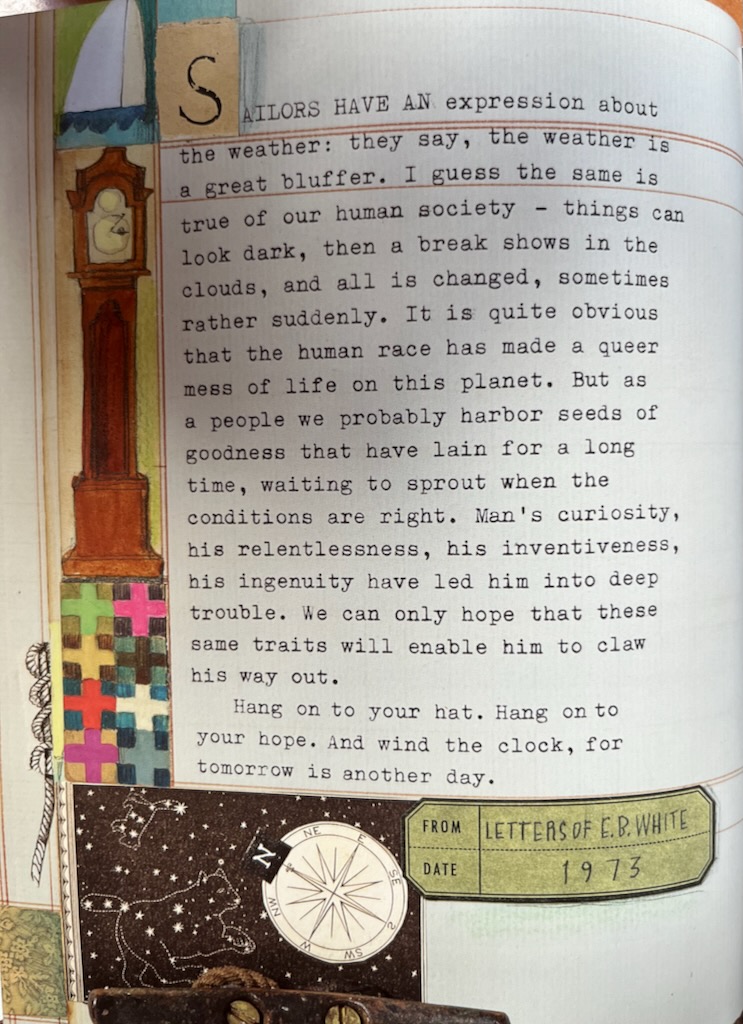
because he’s earned his post as ballast for my wobbly, sometimes-too-tender heart, wasn’t i delighted when i turned to page 132 in this charmed and charming illustrated biography, and found this excerpt from andy’s letters, which seemed to me a prescriptive for these hard times and the dark clouds under which we find ourselves:

“things can look dark, then a break shows in the clouds, and all is changed, sometimes rather suddenly. it is quite obvious that the human race has made a queer mess of life on this planet. but as a people we probably harbor seeds of goodness that have lain for a long time, waiting to sprout when the conditions are right.

i’ll stop there with my old friend e.b., because that’s the line i want to consider, the line i want us to latch onto and live.

and so, what a curious thing that the next wise soul i wandered into this week was one olga jacoby, a german-jewish englishwoman and mother of four adopted children, who, in 1909 at age 35, had received a terminal diagnosis from her doctor, and sat down to write him a letter on the subject of living and dying without religion, but with moral courage, kindness, and a stunning receptivity to beauty. their correspondence would unfold until jacoby’s death four years later, and her letters, “by turns funny, touching, and intensely sad,” were published posthumously and anonymously by her husband in 1919.

in her first letter, to “my dear doctor,” she boiled down her belief to this:

“To leave a good example to those I love [is] my only understanding of immortality.”

and a year into her diagnosis she illuminated that notion:

“. . . More and more to me this simplest of thoughts seems right: Live, live keenly, live fully; make ample use of every power that has been given us to use, to use for the good end. Blind yourself to nothing; look straight at sadness, loss, evil; but at the same time look with such intense delight at all that is good and noble that quite naturally the heart’s longing will be to help the glory to triumph, and that to have been a strong fighter in that cause will appear the only end worth achieving. The length of life does not depend on us.”

and, she leaves us with this bedrock of lived truth:

“. . . Love, like strength and courage, is a strange thing; the more we give the more we find we have to give. Once given out love is set rolling for ever to amass more, resembling an avalanche by the irresistible force with which it sweeps aside all obstacles, but utterly unlike in its effect, for it brings happiness wherever it passes and lands destruction nowhere.”

who teaches you on the subject of love? what seeds of goodness harbor in you, and how will you coax them to sprout? and how might you put into practice the avalanche of irresistible force practiced by spiders and pigs alike (at least in the rich imagination of one e.b. white) and that, to the dying mother of four, was the most lasting thing that ever there was?

Some Writer! came to me, as so many of the best so-called children’s books do, by way of my best longest friend, auntie mullane, the children’s librarian, who prescribed it as the sure cure for summer blues, or any blues that might befall us in this dark-clouded era.

e.b. white on a rope swing, 1976

when suddenly you find yourself on summer retreat

tumbling out of my bedsheet, planting my stiff toes on the hardwood planks, it dawned on me that i’ll be home alone most of today. and tomorrow. and the day after. it dawned on me that through happenstance and the spontaneity that is defining this summer, i’ll soon be immersed in a summer’s retreat. the sort of stretch of time that clouds my vision in gauzy doris-day blurred edges, that nearly dizzies me, and surely makes me giddy.

it’s a rarity these days to be home alone under this old roof. and i’m a girl who needs a bit of solitude to think things through, to soak up simple joys and silence, to see a stretch of unoccupied time unspooled before me, far as i can picture.

here’s how i happened into it, this elixir of time and possibility: the college kid, the one whose dorm i run all summer, he’s off to get a taste of a big ten school up wisconsin’s way, and my sweet mate, he’s off on the jersey shore being an angel to his mother. so that leaves me. and a tall stack of poets to while away a weekend. to take in summer in my own sweet tempo. to saunter through a farmer’s market. to pluck fistfuls of herbs from my very own patch of farm. to sleep with windows wide open and shades not pulled (the better to catch dawn’s first light). to listen to the ticking of the clocks. and watch the blue jays chase away the noisy sparrows.

any day now there’s an editor who’s going to ping me on my little clamshell, and suddenly i’ll be on deadline, in rewrite-and-edit phase of a manuscript now idling on the book-assembly line. but in the meantime, since her calendar got backlogged, i’m on guilt-free time. i can manage not to accomplish much in the writing department and not feel too, too guilty. after all, she’s the one who called time-out.

so here i am with lots of thoughts and a rare dollop of time to let them soak me through and through. thinking while puttering is a very fine endeavor, one especially fit for summer, when the puttering is plenty. there are weeds to mindlessly pull. and hoses that beg to be pointed in the right direction while thumbs are put to work, adjusting the spray with simple pivot and bend in the thumb joint. there are salads to heap on plates. and proseccos to be poured. there are pages to turn, and windows to stare out, though never mindlessly for a million curiosities pass by each and every day.

a summer’s retreat is an especially fine thing. because, like upstairs windows left wide open all through the night, the breeze comes easy, the air is soft, and i’ve little to do but lie there, soaking in its wonders.

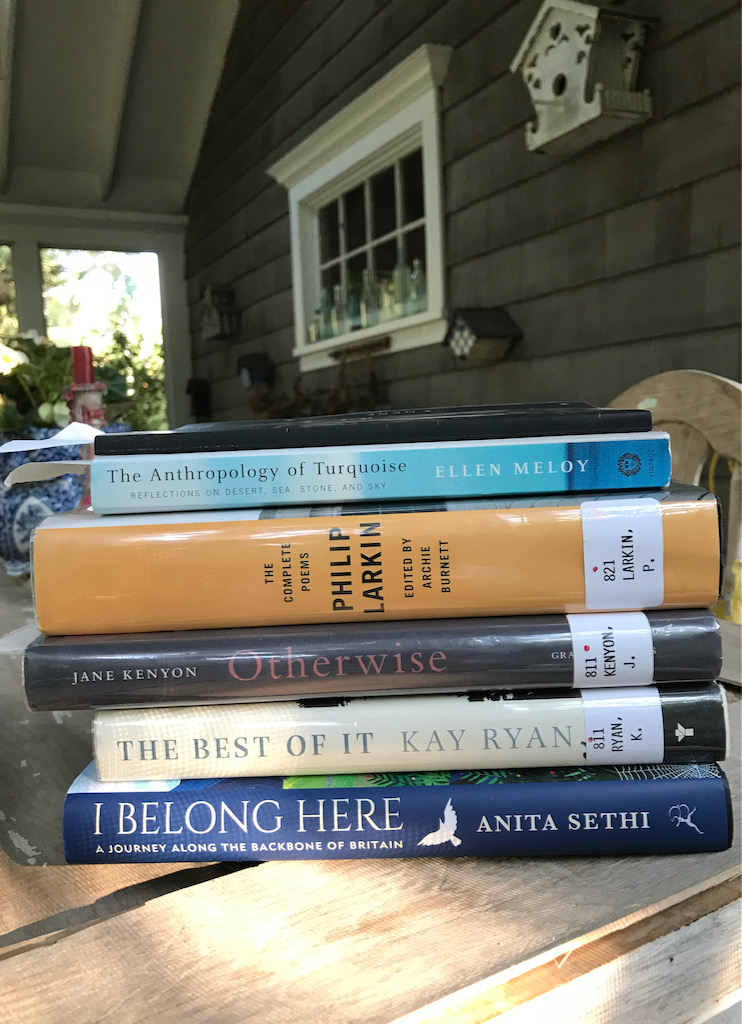
the only certainty of this week’s-end ahead is the stack of poets idling beside me, calling me in whispers to please, please, please crack open each and every spine. here’s who’s on tap:

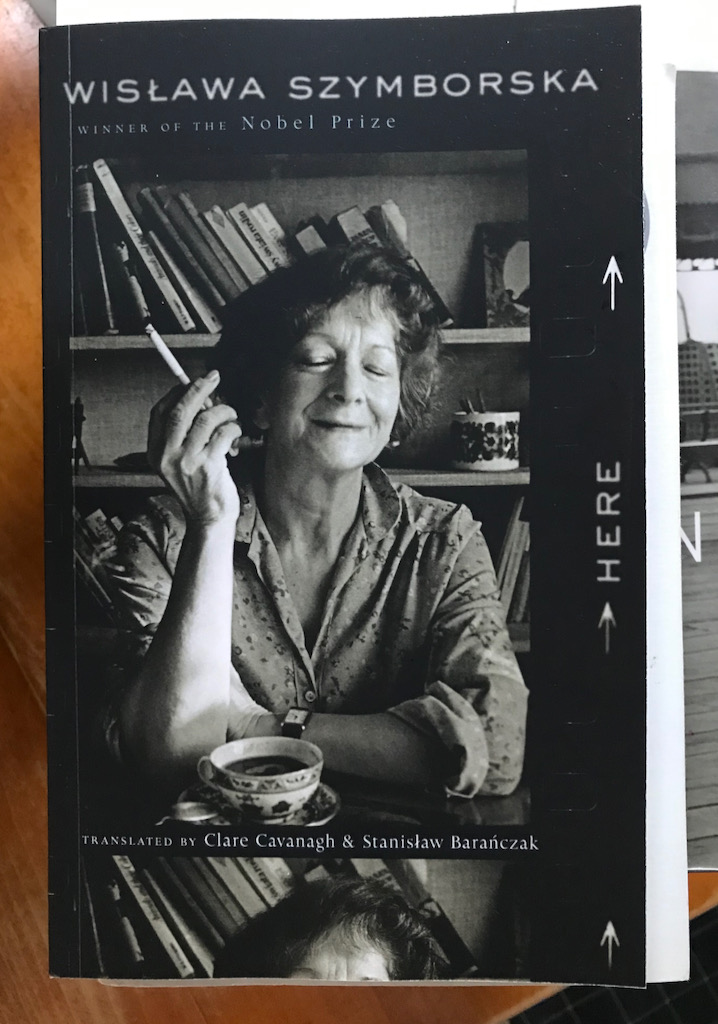
Wislawa Szymborską, the Nobel Prize-winning Polish poet, whose 27 poems in Here, a 2009 collection, consider life on earth, from the microbe to the apocalypse. It’s said to be “a virtuoso of form, line, and thought.” And, by my taste, it’s one of the great book covers of recent time. (see right).

The Anthropology of Turquoise: Reflections on Desert, Sea, Stone, and Sky, by Ellen Meloy. (2002) Call me quirky (in case you don’t yet) but I have an insatiable love of essays on otherwise little considered flecks of life: punctuation marks, colors, et cetera et cetera, and so the anthropology of turquoise is right up my alley.

A trilogy of American poets: Philip Larkin: The Complete Poems; Otherwise: New and Selected Poems, by Jane Kenyon, in whose New Hampshire farmhouse (the one she shared with poet Donald Hall) and barn I once spent a morning; The Best of It: New and Selected Poems, by Kay Ryan, U.S. Poet Laureate 2008-2010. This trio of poets promises to bring a wealth of deep sighs as their way with words is, for me, far better than the most sumptuous deep-tissue massage.

And, finally, I Belong Here: A Journey Along the Backbone of Britain, by Anita Sethi, a just-released book from Bloomsbury I’m reviewing…..on the cover, Lucy Jones promises, “This book will make the world a better place.” I’m all in.

and that’s how i’ll be unfurling this lazy stretch of most necessary time.

how would you spend a lazy stretch of necessary time, a summer’s sudden and unanticipated retreat?

the fresh-washed feel of now….

long ago, at the kitchen table where i grew up, the dad i loved, the one whose words seeped deep into corners of my brain as if etched in perma-ink, he was something of a walking-talking bursting-at-the-seams circa-1950s steel-cased filing cabinet, one so stuffed with aphorisms you could only shut the drawers with the heftiest of heave-hos. he had a witticism for everything, and every occasion. and though i can’t remember precisely the way he unfurled it, there was one along the lines of “the only good thing about banging your head against a brick wall is how good it feels when you stop.” only his version was pithier by multiples. 

i’ve been hearing some variation of those words rumbling round my little noggin these past few weeks, as slowly, elusively the fog begins to lift, we ease off our masks, and tiptoe back into some shadowy semblance of the life we used to know. the brick wall is crumbling. the skull banging into forged cement is winding down to diminuendo. 

and while plenty murky, especially round the margins, there are frames of the now-rolling picture show that indeed feel sharper, crisper, more vividly infused with color than i ever remember. the most quotidian of tasks feel, well, almost celebratory. certainly a relief. 

heck, i walked in a CVS drug store yesterday and ambled — no, sauntered — over to the toothbrush aisle, took my time searching for what i needed instead of grabbing and later discovering i’d grabbed wrong. i didn’t even hold my breath when the dude in biker shorts brushed by close enough for me to get a whiff of his perspiratory beads (a polite way of saying sweat). then, for kicks (a double-header that would have been unheard of just weeks ago), i lollygagged into the grocery store and actually hugged someone with whom i share no DNA, nor the same front door or roof. in other words — egad — someone from outside the confines of my months-long strictly-imposed stay-away-from-me bubble. 

perhaps you, too, have noticed this phenomenon as we emerge from the COVID caves where we’ve been hibernating through two long winters, two springs, a summer, and a fall. so much these days is bristling with an extra tinge of sweetness. we can breathe again. the people we love flow in and out of our houses, and we are paying attention. we are relishing. the bliss of conversation within the six-foot circumference. the occasions when we might be without mask, and thus can once again bring to our expressiveness the whole complement of facial moves and twitches from the nose on south, those parts so long eclipsed from public consumption. 

of course, i’m wary of the calendar filling too swiftly, too mindlessly, but so far that’s not happening. maybe the new dialed-down pace of things will stick around awhile. 

mostly, i hope this fresh-washed feel lingers. i’m perfectly content with one foot still in sticking-close-to-home mode and the other freed from inhaling fear with every half-breathed breath.  

what i love best about this now is watching a kid i love come and go, flow in and out of summer the way summer is supposed to be. he’s only been home three days, but each one of those days has been the very definition of conviviality, of a kid being nothing more, nothing less, than a plain old happy-go-lucky mask-less kid. 

this kid and all kids, in every corner of this republic, are long overdue for anything akin to normalcy. they’re starved for all the sweet spots that make the ardors of growing up bearable. it’s been awful to watch kids confined to dorm rooms, ferrying dinner in plastic-domed containers back from dining halls, to eat in solitude. it’s been awful to know that friday-night fun meant sitting alone in your dorm room, sharing screens on a wide web of laptops, to play remotely — doors closed and towels all but stuffed between the cracks to keep corona off the premises. 

it’s the proportional cost of COVID that’s tipped the scales, made it doubly hard for some among the whole of us. for kids from kindergarten through college, the fraction of their lives stifled by hoping to steer clear of the red-ringed virus is not insignificant. the lower the denominator, the higher the proportion of their little lives has been masked and just plain odd. 1/24th is bad; 1/8th is triple worse. 

at the other end of the age range, it’s proportionality of another kind: the fraction of years left on one life’s lease. our old next-door neighbor, the spriteliest, feistiest of 94-year-olds, one who still spends his best days at the racetrack, laying down bets on thoroughbreds, was making a lunch date with the resident architecture critic a couple weeks back when suddenly he offered perspective i’ve not forgotten. “when you’re 94 and you don’t have much time left, a year lost is everything,” he intoned into the speaker phone. again, it’s a fraction of declining denominators — 1/2, 1/3, a parade of fractions not pretty.

as we all stand back and try to gain some semblance of deeper understanding of the aftershocks, as we now clock our lives in BC and AC, before and after COVID, the kaleidoscope will ever shift. for now though, there’s a sweetness in the air. everything old is new again. getting on a plane. sliding in a cab. parking yourself in the bleachers at the ball park. congregating on the sidewalk with old long-unseen friends. dashing in the grocery store for that one forgotten item. or listening for the click of the front door, when the kid you love ambles in the door, after a long summer’s evening staring at the stars. and you didn’t once worry that he might catch COVID.

and, now, for a bit of summer reading….

it was my ritual of summer, signaling the start of kick-back time, soon as the last of the school bells rang, we were piling in the station wagon, unpiling at the door to the town library, dashing to the desk to ask the librarian if i could sign up for summer reading, being handed the folded card, filling in my name, piling my arms with books, scurrying home to read — all in hopes of the ink-stamped blot that would count the books i swallowed whole each and every summer. it’s a rite not outgrown. my hair’s now the color of old aluminum pipes, but summer reading is a class all its own, one that belongs to all. best accompanied by nighttime’s crickets and the blinking lights of fireflies. best lubricated, in the heat of mid-afternoon, with tall sweaty glasses of mint-swirled waters. and even better if read from a perch, be it tree branch or (geriatrically-approved) solidly-grounded reading nook that safely and securely looks into the trees.  

i’m proposing summer reading here, though what you read is whatever you choose. no groupthink here. i’m starting with annie dillard’s Teaching a Stone to Talk, a collection of meditations “like polished stones,” and french novelist muriel barbery’s The Elegance of the Hedgehog, or as my adorable mother-in-law suggested, “it’s got a porcupine in the title.” and it’s a charmer, set in an elegant Parisian hôtel particulier, it was a best-seller in france, (originally published in 2006), and though the New York Times subtly scowls that it “belongs to a distinct subgenre: the accessible book that flatters readers with its intellectual veneer,” i say label me “accessible” this summer. 

the Times goes on to tell us: 

The novel’s two narrators alternate chapters, but the book is dominated by Renée, a widowed concierge in her 50s who calls herself “short, ugly and plump,” a self-consciously stereotypical working-class nobody. She is also an autodidact — “a permanent traitor to my archetype,” as she drolly puts it — who takes refuge in aesthetics and ideas but thinks life will be easier if she never lets her knowledge show. Even the slippers she wears as camouflage, she says, are so typical, “only the coalition between a baguette and a beret could possibly contend in the domain of cliché.”

Her unlikely counterpart is Paloma, a precocious 12-year-old whose family lives in the fashionable building Renée cares for. Paloma believes the world is so meaningless that she plans to commit suicide when she turns 13.

…Both skewer the class-conscious people in the building: Paloma observes the inanity of her politician father and Flaubert-quoting mother, while Renée knows that such supposedly bright lights never see past the net shopping bag she carries, its epicurean food hidden beneath turnips. Both appreciate beauty in Proustian moments of elongated time. 

who’s in? and what titles might mark your beginning in this, the summer when we slink our way out of COVID hibernation??

and, how’s your emergence from the Age of Corona unfolding?

skunk update: he’s still on the loose, despite our wiliest of efforts. just this morning, evidence that he tunneled right out of the wire escape hatch we thought led straight into his take-me-to-the-woods case…..

a place to curl in summer

summer seat cushion

it goes back, way back to the summers when i’d find a log — a particular log — in the woods across the lane, or nestled along the green pond, so named for the otherworldly martian-colored skin that magically unfurled across the surface overnight when summers turned hot, turned midwest humid. and the overspill pond went from patched with lily pads to bank-to-bank neon green.

i must have discovered early on the gift of making like a toad, and shrinking way down low, inside the swaying fronds of weeping willow, beneath the rustling of the oak-tree giants as they’d shake arthritic, creaky limbs. i might have taken to a particular rock, another favorite perch, down at the woodsy corner where the stream, after thrashing summer storms, practically roared, as rushing water body-blocked against the boulders that dared to interrupt the get-away.

or maybe it was inside the play house, deep in the grove at the back of our yard, where i made believe i was a pioneer, ala laura ingalls wilder, and it was my little house in the big woods. there, i’d arrange and re-arrange the table and two chairs, the upturned coffee can i pretended was a cookstove. i’d sit and look out the paned windows, i’d tuck wildflowers in jars, set the table for my imaginary children, who’d come for victuals when i clanged the dinner bell.

it might be any one of those wonders — or even my cincinnati grandma’s upper porch, an ivy-screened brick-and-limestone veranda overlooking the sloping woods, and the cattails in the distance, where the woods turned boggy. might have been there that i learned to love the nightcall of the wood frog’s love song, or the late summer buzz-saw of cicada.

whatever the source, it’s never gone away, my inclination to hide behind a scrim of leafy green. make like i’m just another butterfly, or lady bug, landed on a broad green pad. and keep watch on the world that doesn’t know i’m watching.

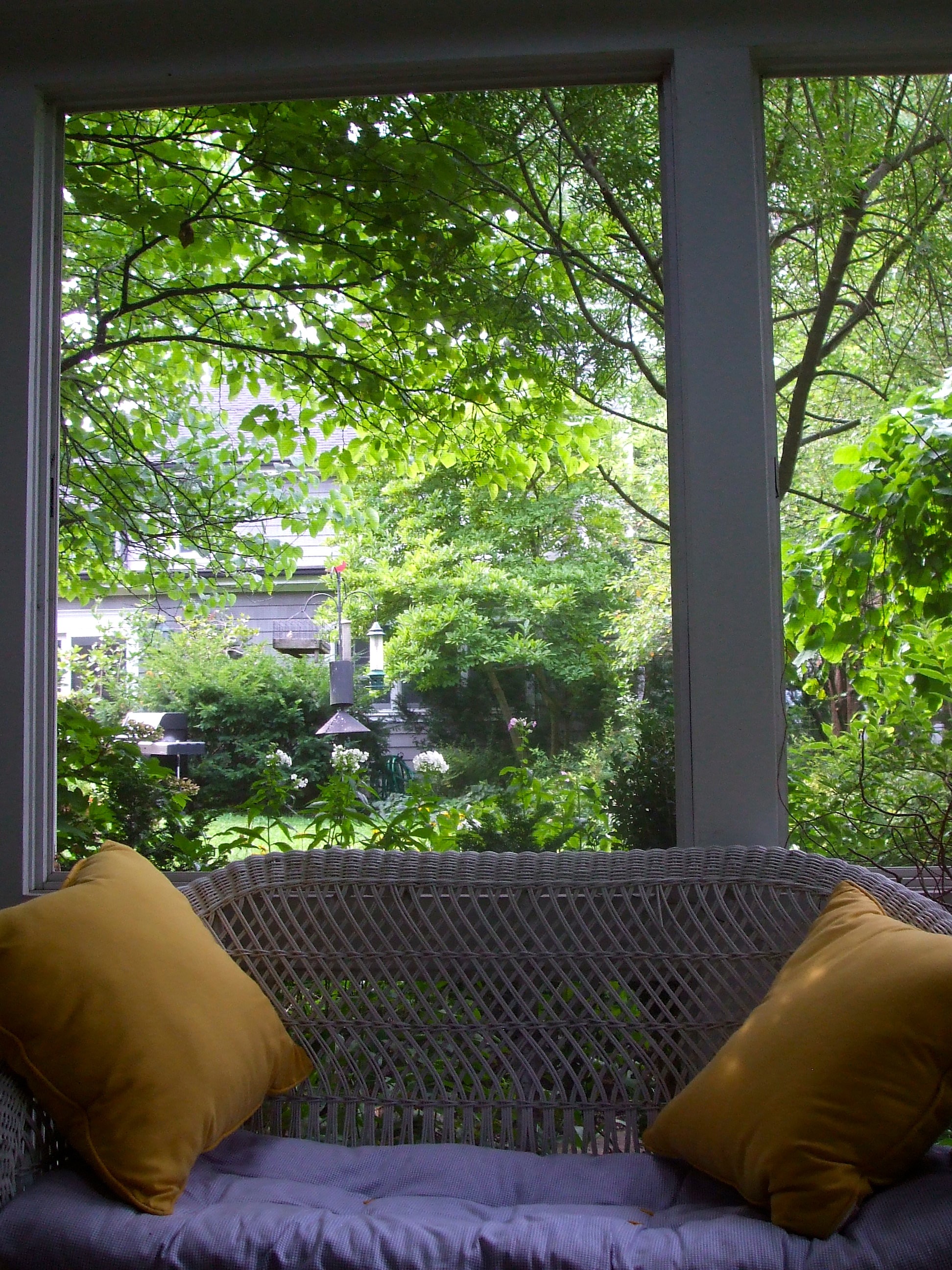
it’s why i lug my books and pens — and pitchers of lemony water, and plates spilling with whatever’s served up in the summer kitchen — out to what we call the summer house, only really that’s the name bequeathed to us when we bought this place, this old shingled house and the gardens that pay no mind to where they’re told to grow. it’s the screened-in porch, tacked onto the garage, for heaven’s sake. but it’s just about my favorite place to sit and watch the summer, frame by frame.

i’ve been calling it “the office,” and it’s been open for business for weeks now. when anyone comes calling, comes to pay a visit, sit a spell, it’s where i take them for a healthy dose of conversation. for a chance to brush up against the magic of a ceiling fan that whirs, and mama wren chastising the cat, or the rare butterfly fluttering by.

it’s a fine thing to have a summer’s perch, a place from which to watch the sun arc across the sky, to spy the wispy bits float across a sunbeam, to catch the glint of the spider’s web in a flash of early morning. to watch the summer theatre unfold unnoticed, according to heaven’s script, without human interjection.

it’s one of the gifts of this old house that i’ve been relishing this week, as i noted on my calendar that a year ago wednesday, i’d felt my heart all but yanked from my chest, as i boarded a plane for boston and left behind this garden in august, this house when autumn’s light was just around the corner.

because i can’t write with all the relish that i like, here on this friday morning when a deadline is staring me in the face, i thought i’d keep up my end of the bargain, by inviting you into the virtual summer house, and sharing a short stack of good reads (plus one “watch”).

here are a few fine things i’ve stumbled upon this week…rifle through the stack, and see if any float your boat…

holland carter’s magnificent essay in the new york times on how a love of poetry led to a love of art…

a little-known letter from e.b. white on why he wrote charlotte’s web (found in slate)…

watch this: one dream, the trailer for a new documentary telling the behind-the-scenes story of martin luther king’s “i have a dream speech,” a new endeavor from red border films, a project from time magazine..

and finally, from close to home, my dear friend and lifemate, blair kamin, launched his e-book on the gates of harvard yard this week, and you can get a peek here (the book itself can only be viewed on iPad, which i don’t have…..) or, even better, a wonderful Q & A here….

that oughta keep you busy, wherever it is you squat in summer…..

what’s your favorite summer perch, now or long-ago???