pull up a chair

where wisdom gathers, poetry unfolds and divine light is sparked…

Tag: poems

so close to the bone

uncharted is pretty much the most fitting descriptor for the cartography of cancer. undiscovered nooks hide in the shadows. though not all of it is somber. sometimes, with no warning, you find yourself among an unexplored parcel for the very first time. 

i’m covered with goosebumps this week, not because my latest scan was ominous (it wasn’t) but because i am reminded again this week, viscerally so, how very damn thin this ice is—the ice that is any cancer, and mine in particular. i sat down with my oncologist the other day, and she spelled out so many truths about the merciless ways of cancer—how so many hit-or-miss variables make up each individual constellation, how some of mine fall in the you-don’t-wish-this column, and one or two don’t, how some cancers are “undruggable” (mine is) yet some of the drugs are so toxic you’re mostly relieved you don’t have to have them coursing through your veins—and it all becomes stunningly clear that there really is not much certainty or sense to the prognostication at play here. sometimes you make it through the labyrinth, sometimes you don’t. who’s to say what flicks the switch that plays out your story. 

but that wasn’t the only reason for goosebumps. 

a curious thing happens almost instantaneously and mysteriously when you find out you’ve been highjacked into cancer camp: you make fast friends. with the ones you find strolling around the campground, the ones who know the indignities of needle pokes and incision tattoos that now crosshatch your flesh; the ones who spout the most off-color jokes, and know all the words to the worries that keep you awake in the night; the ones who strip truth to the bone and don’t shy away from words that others dare not utter. 

one of those friends died this week. bruce was his name, and not too many months ago, he was the one who all but talked me onto the airplane to new york to get a second opinion, when i—the one who never has had a taste for ruffling feathers, nor for appearing to second-guess authority—was so afraid to face the cold hard reality of a cancer center whose very name registers the seriousness with which cancer is to be taken. bruce told me all about his trek to mayo clinic, and insisted i get on that plane to sloan kettering. and when i got home, he checked in to make sure i’d stayed in one piece. his wife, eileen, also my close cancer buddy (and also with ratchety-vocal-cord voice), has been one of the ones who until now has made me laugh the hardest; lately, her texts have been tearing me apart, especially when she told me she’s mostly been crying herself to sleep these last couple months.

and just yesterday i was scrolling across the internet and bumped into the news that one of the fiercest patient advocates in the world of lung cancer, a woman whose cancer (diagnosed when she was 39, and recurred multiple times) has defied all odds for 16 years, has just started another round of radiation for two metastatic nodules on her chest wall. 

when one of us goes down, the thud is felt by all. 

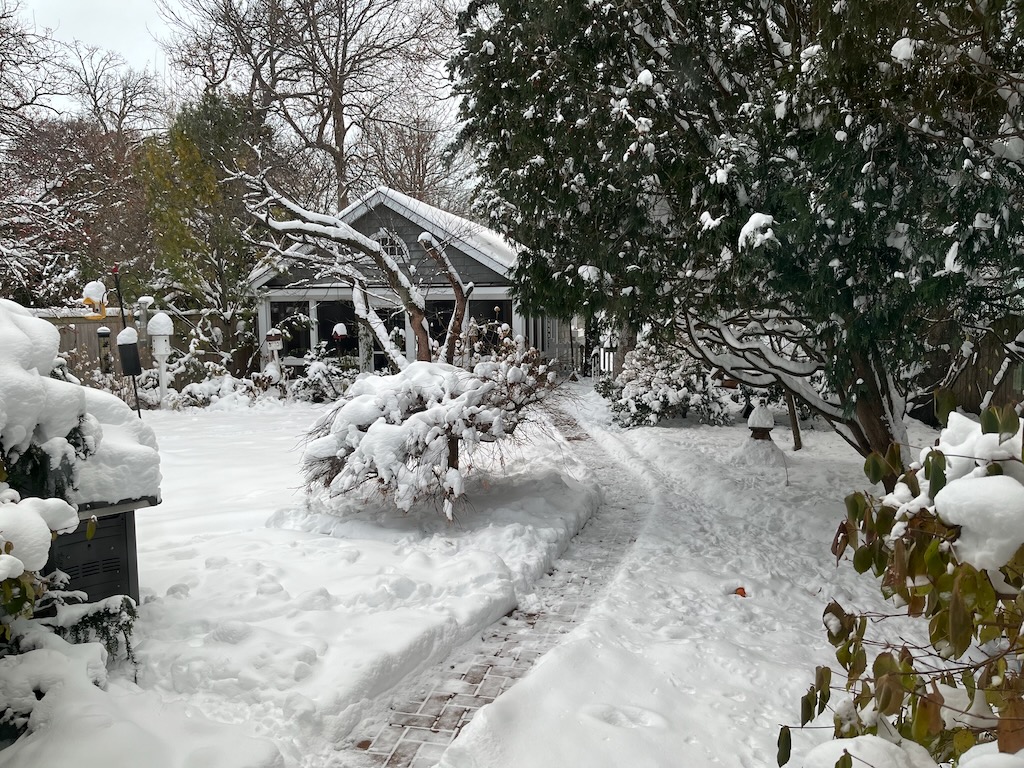
and so, as if never before, i am looking out at the snow-caked garden, at the beefeater-sized snow caps atop all my birdhouses and feeders, and i am whispering, whispering, inaudible prayers of pure and profound thanks. for the miracle of another winter. for the quotidian phone call from one of my boys. for the chance to sit in a near-freezing kitchen to work side-by-side my second born. for the husband who leaves his car in the snow, so i can pull into the snowless garage. and who waits till i get home late one night to eat his bowl of cereal, while i slurp my soup. 

and tough as it is to swallow, and bracing and sad as it all sometimes is, i am, in the end, more than a little grateful to be so fully awake to the whole of it: the friend whose courage i’ll carry; the blessing of a doctor who minces no words and delivers each one so bountifully, and with such tender, all-absorbing care; the miracle of any old friday or thursday or tuesday; the lungs that still work as mightily as they can; this place that lets me write it all down, because sometimes you just need a way to make sense of the blur, and this was one of those weeks. 

not because i’m dying; because i’m alive.


and with that, a poem that so deeply echoes the essence of all that pulses through me these days, and is, in many ways, the core message of book No. 6 now in the pipeline….

Praise What Comes 
surprising as unplanned kisses, all you haven’t deserved
of days and solitude, your body’s immoderate good health
that lets you work in many kinds of weather.  Praise

talk with just about anyone.  And quiet intervals, books
that are your food and your hunger; nightfall and walks
before sleep.  Praising these for practice, perhaps

you will come at last to praise grief and the wrongs
you never intended.  At the end there may be no answers
and only a few very simple questions: did I love,

finish my task in the world?  Learn at least one
of the many names of God?
  At the intersections,
the boundaries where one life began and another

ended, the jumping-off places between fear and
possibility, at the ragged edges of pain,
did I catch the smallest glimpse of the holy?

~ Jeanne Lohmann ~
(The Light of Invisible Bodies)

Jeanne Lohmann was a Quaker poet, and one of the very favorites of the great Parker Palmer. as a wee bonus i am adding here the last stanza of another one of her beauties, “what the day gives.” she is a poet in whose work i shall be poking around. here’s the stanza:

Stunned by the astonishing mix in this uneasy world 
that plunges in a single day from despair 
to hope and back again, I commend my life 
to Ruskin’s difficult duty of delight, 
and to that most beautiful form of courage, 
to be happy.


and finally a poem from one of my favorite irish poets, eavan boland, passed along to me by one of my favorite humans. simply because it’s so perfectly, perfectly glorious…..and the very definition of love in its highest order….

Quarantine
by Eavan Boland

In the worst hour of the worst season
    of the worst year of a whole people
a man set out from the workhouse with his wife.
He was walking—they were both walking—north.

She was sick with famine fever and could not keep up.
     He lifted her and put her on his back.
He walked like that west and west and north.
Until at nightfall under freezing stars they arrived.

In the morning they were both found dead.
    Of cold. Of hunger. Of the toxins of a whole history.
But her feet were held against his breastbone.
The last heat of his flesh was his last gift to her.

Let no love poem ever come to this threshold.
     There is no place here for the inexact
praise of the easy graces and sensuality of the body.
There is only time for this merciless inventory:

Their death together in the winter of 1847.
      Also what they suffered. How they lived.
And what there is between a man and woman.
And in which darkness it can best be proved.

From New Collected Poems by Eavan Boland. Copyright © 2008 by Eavan Boland.

what brought you this week the deepest sense of how very blessed you are, to be alive and able to exercise love in whatever form fills you the most?

p.s. i hope all of you who still find a seat here (after all these years; 19 next week!), or who are here perhaps for the very first time, know how very very deeply this space, and your presence here, has become one of the polestars of my life. my calendar is set by writing the chairs (every friday morning without fail); six books now have first been seeded here; and the kindness circle we’ve all built together is rare and precious in the fullest sense of that word. as the world around us has grown harsher, and the rules of engagement seem to be shifting at rapid and dizzying pace, we have rooted ourselves more and more deeply in the gentle art of caring gently for each other, offering up wisdom by the ladleful (and i mean the wisdom you offer me, offer all of us), and lifting our kindness off the page (aka screen) and into the real living, breathing world. among the things for which i am so deeply grateful, all of you dwell at the core of my heart. bless you.

the not-so-simple tasks of being alive

life, sometimes, makes like it’s an arcade of carnival challenges, and to make it to the other side is, in fact, something of a triumph we barely take time to note.

we shouldn’t, though, take it for granted. we are mightier than we think. and there will come times when we truly need to believe how mighty we can be. we’re not here on this earth to dawdle around.

as this week draws to a close, i can testify that these things happened: a new used car was found, bought, driven home, and will soon be ferried to another state; a kid wrestled through the decision of which of three job offers he’d choose, and started the one; husband down for the count with a cough that sounds like it’s hollowing his lungs; cavity filled in the way back of my mouth; latest peek at my lungs behind me (now awaiting results, a fraught interval that always leads to some trembles); and the latest round of edits on Book No. 6 at last sent off to editor (i had to wait till her calendar cleared).

not included in the list, but very much there, are the facts that i spent the week dodging the heck out of whatever virus was mucking up the works, for fear my scan or my cavity filling would get bumped; also, never mind the “check tire pressure” light that went on halfway home from the car lot, and the hurdles to get that untangled. in addition, i arose each dawn, never crashed my own car, swam a few miles, cooked a few mediocre dinners and one or two fair ones, and grocery shopped what seems like ninety-five times.

such is the business of living. each week throws at us a spaghetti bowl of hurdles, some humdrum, some of dimension that leads us to gulping.

it’s the quotidian stuff that comprises our day to day. and to make it through and to the other side is a feat that draws on cords and gears we barely acknowledge. to miss the chance to take note, to not ponder just how resilient we are, just how swiftly we can untangle ourselves from houdini’s chains is to short shrift our capacities.

we live our lives amid stories of what seem insurmountable feats: folks rolling into surgeries that untangle their insides, or shave off a lump on their spine; house fires that leave lives in ashes and soggy remains; kids finding out their cancer is double-D badd. (and those are stories plucked only from the last 48 hours, each one devastating and true.)

the news of the bad guys around us might distract and infuriate and leave us in tears. but the hard work of being human is never far from home. it’s the pit in our belly we awake with, and the headache that drums us to sleep. it’s what we might face before breakfast, and what comes with an unsuspecting wallop midway through the day. it comes in the phone call we never expected, and the one that makes us fall to our knees.

i’m not trying out for a part as the voice of doom here. i’m simply saying what we too often forget: no matter the circumstances, nor the twists in the story, we are all made of strong stuff—stronger than we remember to note.

to get to the other side of the traumas and troubles that hurtle our way is worthy of note, if not ovation. it might do us well to take count of the muscle it takes, and the grit, and the intense imagination, to merely get to the other side.

and here we are, on the far side of all those things that a week ago seemed insoluble.

that alone might stand as proof that even the frailest among us are tough as tough can be. and we can take on just about anything. we are breathed into life with every capacity our lives will demand. and we are living proof of how much we can survive.

you needn’t share this with anyone other than yourself, but perhaps you might find strength in looking back across the arc of your life and seeing what a marvel you are, and all the impossible hills you have climbed. what marvels you the most?


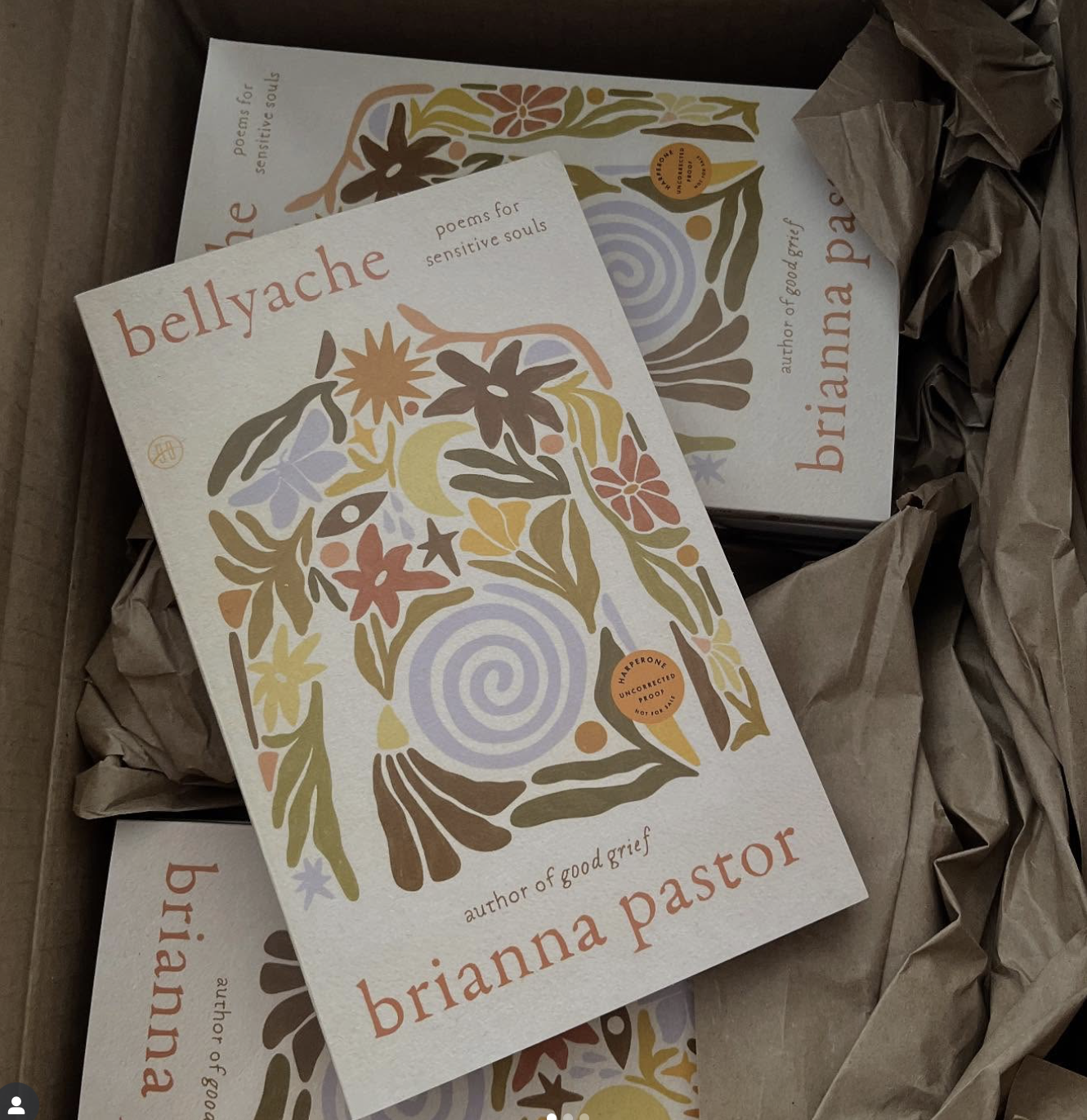
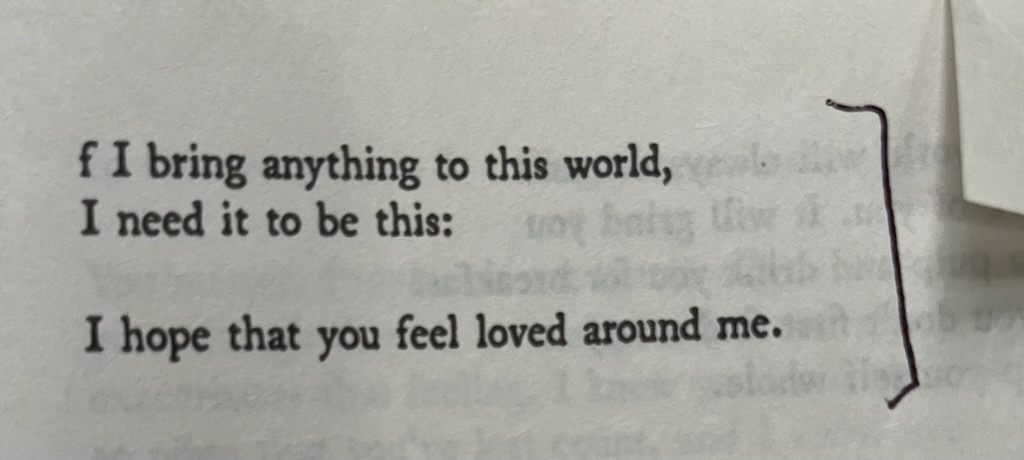
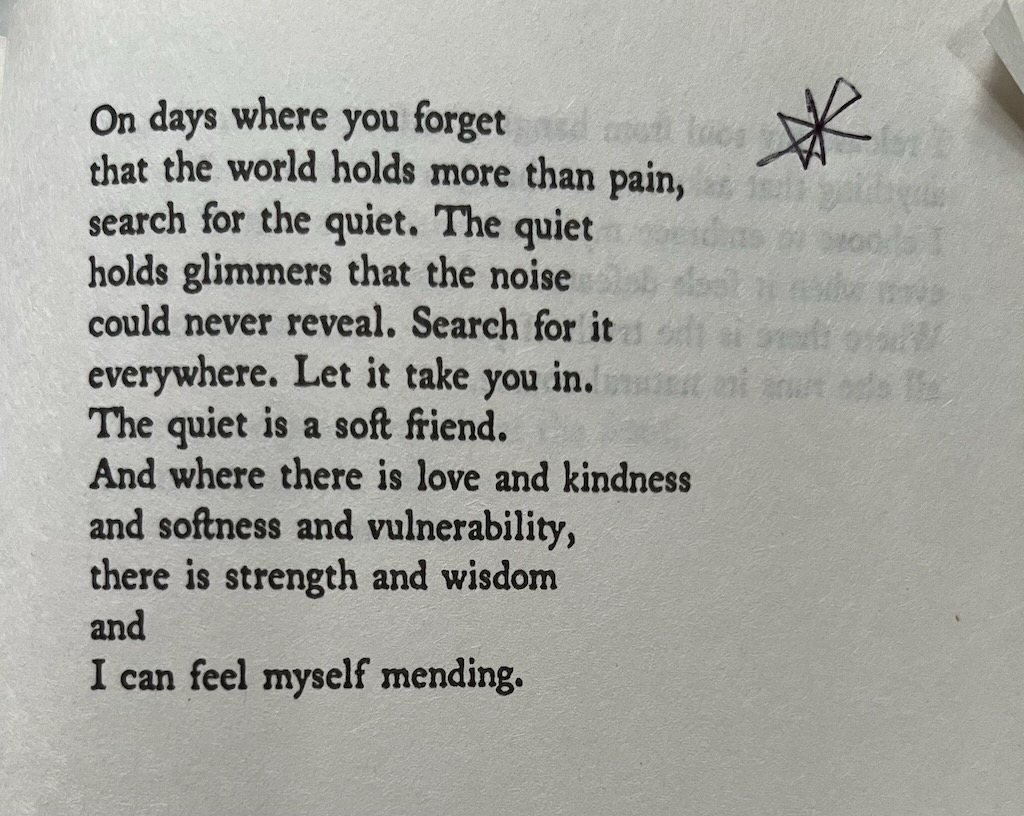
as antidote to all that, i bring you a bit of wonder in the form of the latest book that crossed my transom. it’s titled bellyache: poems for sensitive souls (harper one, 2026), and they had me at the subtitle. it’s by brianna pastor, a poet described in her bio as “a queer writer, empath, advocate, and author of the poetry collection good grief.” the book isn’t due out till february, but i got a review copy, and i’ll share a few marvels here. pastor’s poetry is rooted in childhood trauma and what it means to heal, with sensitivity and love as the non-negotiable parts of the deal. she writes, according to the author note, “about the raw, the uncomfortable, the overlooked, and makes clear that at the root of all things, is love.” it’s not every day that you open a book and find yourself in the midst of a poet whose heart feels so immensely attuned to the pain and the preciousness of tender, tender feeling.

here’s one of my favorites….

and here are two others (the spare simplicity is everything in these love-drenched poems):

and this:

Excerpted from pages10-12 Bellyache by Brianna Pastor, reprinted with permission from HarperOne, an imprint of HarperCollins Publishers. Copyright 2026.

on faraway sands, the poets of war spoke to me

i was alone for the day, a whole sumptuous day of solitude and silence. so i, like half the rest of the world it seemed, was pulled to the water’s edge. i carried but a book and a bottle of water. i knew the week ahead would be rough, though i hadn’t a clue yet quite how rough. (two beloved souls, my exact age, died suddenly, one falling to her death*, another simply dying in his sleep.)

the book i carried is one i’d yearned to crack into, and as i sat there allowing its truths to wash over me, as the waves of the lake just across the sand washed over the shoreline again and again, i felt every drop of its anguish and truth. it was a book of poems written by thirty poets in gaza, and four from the west bank.

once upon a time, for ten good years, i gathered up each month for the chicago tribune a collection of three books that had most stirred my soul. they might be children’s books, or poetries, or memoirs and stories of the holiest people. the gatherings were vast, and some of those publishers still send me books, knowing full well my readers now are not the millions from the tribune and beyond, but rather the cherished friends of the chair.

this book i bring today is one worth clutching in your hands, pressing hard against your heart. it might be even more poignant against the improbable news that a cease fire in gaza has begun and some twenty living israeli hostages will soon be released.

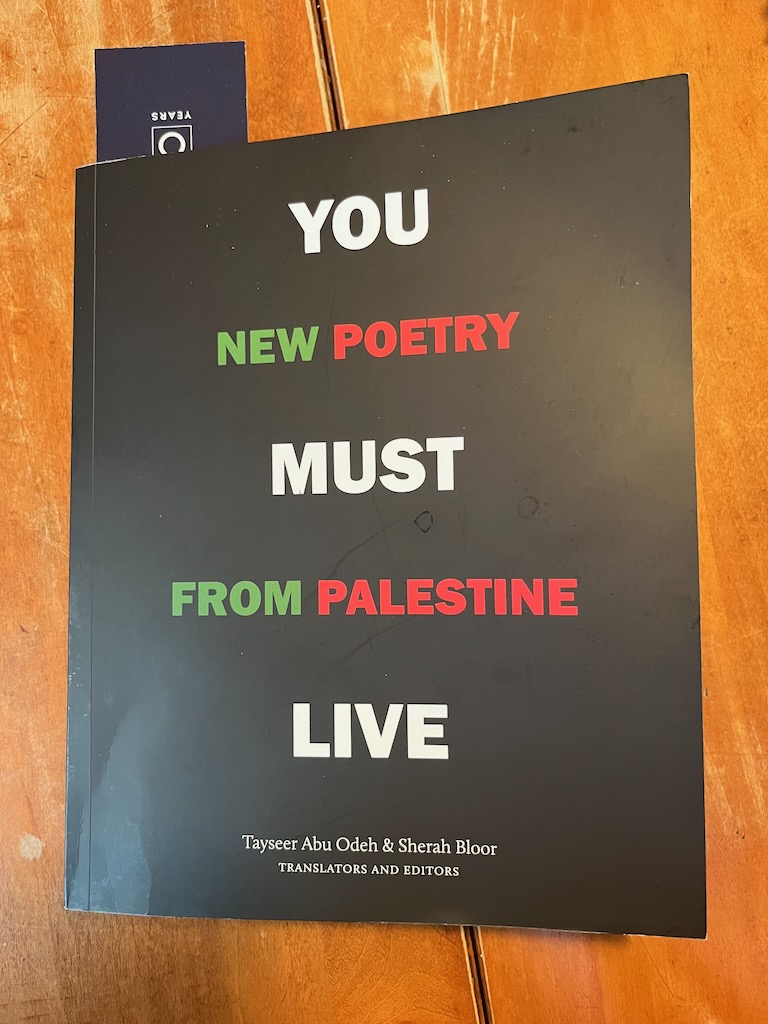
its title, you must live: new poetry from palestine (copper canyon press, 2025), only begins to tell the story, only hints at the horrors and tendernesses within. but you can hear the pleas, the cries rising up from the rubble. it’s a bilingual anthology of poetries from gaza and the west bank, translated from the arabic and edited by Tayseer Abu Odeh and Sherah Bloor, with guest editor Jorie Graham, and it’s written not by poets who’ve somehow escaped, left behind the ravages of war, but rather it’s written by those still there. in poring over its pages—slowly and with prayerful intent—you hear the murmurs perhaps unheard by anyone else, you hear the lone voice rising from dust, you hear the whimper of a child left alone in the world, in the shattered brokenness of a world that no longer stands.

“especially now,” the editors write, “it is crucial to attend to those whose voices are under threat of elimination.”

ocean vuong called it “a light beam of a collection in our dark hours.” ilya kaminsky, the great poet most famous for his deaf republic, has written that it’s a book “filled with poems of utter urgency, poems that give us wisdom, in the face of devastation, in spite of devastation.”

i was as moved by the story behind the poems, as by some of the poems themselves. for starters, editing in a war zone is no feat for the timid. the editors write that at first they didn’t realize that every time someone’s phone connected to a satellite (to reply to an editing question) they became a target. to get a clear signal, the editors write, meant a life-or-death decision: standing atop rubble is where the signal is sharpest, and yet of course that means the poet is risking her or his life to reply.

consider that.

the editors write too that every time a reply did come through, be it a response about punctuation or diction, the editors sighed with relief. “they were still with us.” imagine being willing to die over a comma rather than a semicolon. consider that the next time you make a simple correction in a sentence you’re typing.

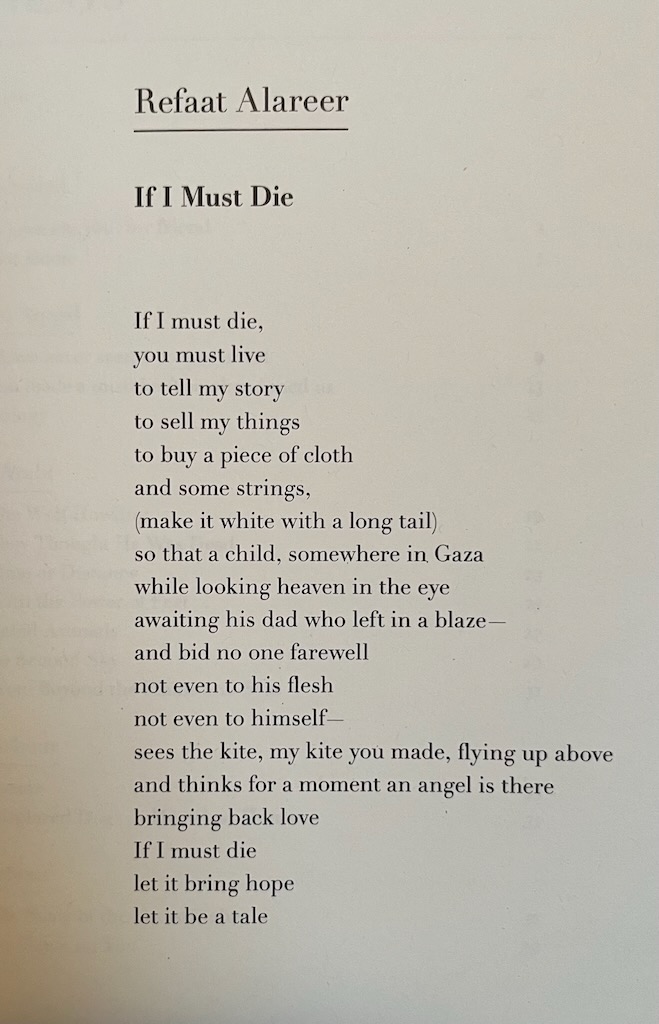
the collection begins with a poem that’s become fairly widely known, “if i must die,” by the late Refaat Alareer. the editors write: “this poem stands in for all those poets we failed to reach in time. their poems—chalked onto collapsed walls, or on the blackboards of schools-turned-shelters-turned-bombsites, traced in sand, or shared in private messages—will never reach us.”

the silence is stunning. the silence demands our reverence.

the editors call the poems a “poetry of witness,” speaking from a war zone deadly for journalists, a war zone where so many stories would otherwise go untold. the poets paint the portrait. and it is seizing with humanity. humanity crushed. humanity pummeled. human refusing to extinguish its tender, fragile beauties. we must know what we, humanity all, have wrought.

here are a few samples, barely enough to give you a sense of the pathos within, the pathos that rises from this old globe like a poisonous cloud desperate for one breath of air….

here is the poet Waleed al-Aqqad’s elegy for a young friend, set at the boy’s funeral, and tenderly describing the mutilations of his war-torn body:

We said goodbye
to you in your small death like the death
of sparrows.
We rearranged you.
We placed your severed hand across your chest,
covered your wounds with flowers,
cried as you wanted.

or this, from Ala’a al-Qatrawi’s poem to her children, two daughters and two sons, all under the age of six, all killed in an air strike on their home. she addresses her babies in heaven, offers her own body parts to her daughter, Orchida, as if she could piece her body back into her embrace:

And give my lungs to her.
Without them, maybe she suffocated.
Maybe she couldn’t call my name.
The rubble would have been too heavy for her.

it is wrenching to read. all of it. page after page, i read slowly, as if a dirge. i sat on a bench on the sand thousands and thousands of miles away. that seemed cruel, unfair, that i should be hearing the sounds of a day at a beach, when the sounds of war pressed on. and the words of new poets would again go unheard.

to those who understand the power of words, to those who dared to gather poems out from the rubble, bless you, and bless you, and may peace, everlasting peace, at last come to the holy land.

maria corina machado, recipient of the 2025 nobel peace prize

this hard week ends with a few sparks of hope: first, word of the cease fire and the imminent promised release of 20 living israeli hostages, and the bodies of 26 confirmed dead. and, in the immediate wake of that, the nobel peace prize was awarded this morning to venezuela’s “iron lady,” maria corina machado. the committees’ citation reads: “She is receiving the Nobel Peace Prize for her tireless work promoting democratic rights for the people of Venezuela and for her struggle to achieve a just and peaceful transition from dictatorship to democracy.”

where did you find hope in these hard times?

*joannie barth was a most beloved reader of the chair. she lived in evergreen, colorado. was the right-hand everything to the best-selling author philip yancey. she and i had gone to college together, but mostly got to know each other’s souls through this ol’ chair. she would send notes radiant with love, with a faith that couldn’t be shaken. she shared her own heart’s ache, an ache i now hold for her. i was with her less than a year ago, and as she always had, she lit up a room. her smile rose from a deep deep place. a week ago, she was rock climbing. and the belts gave out. she died instantly. not at all surprisingly, i feel her closer than ever. she was, and is, an angel.

joannie

add this to your constellation of poetries

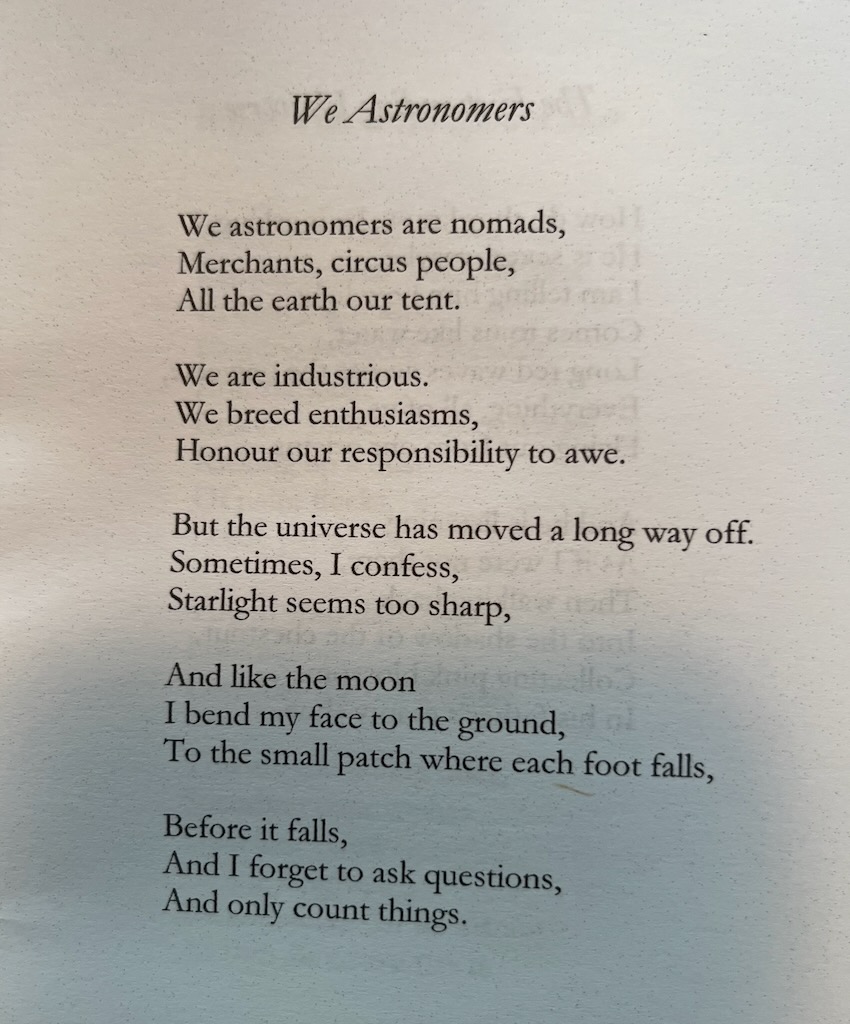
rebecca elson: astronomer + poetess

i’ve been on rooster time for weeks now, though there’s no rooster pecking about the nearby yards. the rooster resides in my little noggin where it cock-a-doodle-doos round about four, and i patiently wait till five. as if the nuns have granted permission and at last i can dash out from under the bedsheets and into the playground that is my kitchen table at that early early hour.

ostensibly i’m up to write, to think, to edit. and i do get to that. i always do. but first i soften into morning turning pages. in other words: i read.

it sometimes seems my mission here is morphing into something more along the lines of slipping poets under your noses; writers, too. any weavers of wonder i happen to happen upon. this week i happened upon an astronomer poet, a brilliant soul who died too soon at 39. she spent her life mesmerized by the heavens, and hers was the gift of reaching into the stars, scooping up a glug of moon, and giving us a taste.

her name was rebecca elson (1960-1999), a canadian-american who at 16 began her studies at smith college, and would go on to earn her PhD from the university of cambridge, somehow fitting in years at radcliffe college and harvard teaching creative writing as well as an expository writing course on science and ethics. at cambridge’s institute of astronomy she was awarded an isaac newton studentship, meaning they paid for her to be there. it’s where she died, amid a field of star embers, i do hope.

her posthumously-published slim volume of poetries and extracts from her notebooks is titled a responsibility to awe (carcanet press, 2001). that title alone is poetry, and tells you all you need to know. in four short words, some might argue, it lays out our holy purpose. our one assignment while we’re here on planet earth, that little orb floating amid a universe of burning flecks of star dust and helter-skelter sky litter (though there’s nothing remotely litter-ish in even one celestial orb, from jupiter to milky way, to the not-yet-named planet L 98-59 f (identified just last month!, the fifth such planet in a splotch of far-off space unpoetically named L 98-59, a system of “remarkably diverse worlds.” little f is orbiting so close to its star, it’s possible liquid water might exist there, the scientists tell us.)

back to rebecca, known to those who loved her as becky. soon as i read the words astronomer and poet coupled in a pair, i was drawn magnet-like to snatch up a copy of her awe-struck works. it’s considered a contemporary classic, in the world of poetries. and not a line of it disappoints. among the pages that left me awe-struck: an ode to discovering zero; another asking what if there were no moon? (her reply: “there would be no months / a still sea / no spring tides / no bright nights / occulations of the stars / no face / no moon songs / terror of eclipse / no place to stand / and watch the Earth rise.”)

a mind as facile and deep as one that imagines darkest night, scans heavens for answers to questions others never even think to ask, is a mind i want to enter. to add my footprints to the paths that have traversed it. as if, in poring over her way of seeing, i too might see more vividly.

that rebecca/becky died too young of a cruel cancer (isn’t every one a cruel one?) added but another element to my quest to know her by her words. her masterwork is considered her six-stanza poem, “antidotes to fear of death.” she begins (as only a star-studier might): “sometimes as an antidote / to fear of death / i eat the stars.”

from there, extracts from her notebooks follow, and we almost watch a mind at work. as she cobbles poetries, we see the words struck out, the finer ones she chose instead. we see, in a swatch titled “origins,” her change of mind, in the line “shaken in the dark soil soul of space.” soil, a richer word (more unexpected) than soul here. we see adjectives get ditched, as she pares and pares her lines. titles of poems are revised. it’s a nimble mind, exercising in the gym, and we are peering through the windows.

two years after elson’s death, the economist, in 2001, named responsibility to awe (her one published poetry volume, though she published 56 scientific papers in her short life) a “book of the year,” writing “with great poignancy, she shows us the world through the eyes of a human being faced by her finite time.”

the bulletin of the american astronomical society, in their roster of supernovae gone dark, described the breadth of elson’s scientific research, her work ranging from “a search for stars in the halo of our own galaxy to regions of rapid star formation halfway across the Universe. She set strong limits on the contribution normal stars could make to the Milky Way’s dark matter halo, using counts from the Hubble Deep Field to rule out a significant stellar component.”

maria popova, who first pointed me to the poet-astronomer, calls her poem “antidotes to fear of death,” a “stunning cosmic salve for our creaturely tremblings of the heart.” she recorded a recitation of it, set against the mournful strains of cello, for her 2020 “universe in verse” extravaganza, popova’s “annual charitable celebration of the science and splendor of nature through poetry.”

elson, whose book now rests beside me, belongs in that rare constellation, a favorite of mine, of those who study the cosmos and, side-by-side the formulae and theorems, see the poetry, and draw it forth: loren eiseley, lewis thomas, robin wall kimmerer. they and their ilk (there are more and more) hold a sacred space on my bookshelves. without them, there are volumes i’d not see, musics i’d not hear.

the back jacket of responsibility to awe says it best, describing elson’s work as “a book of poems and reflections by a scientist for whom poetry was a necessary aspect of her research, crucial to understanding the world and her place in it, even as, having contracted terminal cancer (non-hodgkins lymphoma, diagnosed at 29), she confronted early death.” the text goes on to say that elson was an astronomer whose work took her “to the boundary of the visible and measurable.” isn’t that the space we’re all drawn to, meant to explore? isn’t that where theologians and mystics ply their minds? isn’t that where simple us might wonder too?

in the end, elson, like all who dare to ponder deep beyond the lunar surface, was “undeterred by knowing how little we can know.”

and thus we all now have our one assignment: to search undeterred for what we can. knowing there is majesty in the mystery, and beauty far beyond what we’ve yet glimpsed. our responsibility, of course, is always, always to awe.

where did you stumble into awe this week?

i’ll leave you with a page. . .

have a blessed, awe-filled week….


oh, i promised my dear friend wini i’d share this wonderment she is bringing to town (town being chicago, or the northern environs to be specific). wini is a poet, and she’s worked closely with, and had one of her poems judged “best in class” by the marvelous poet rosemerry wahtola trommer. wini, who makes things happen, invited her and now is inviting all of us for a day of poetries. part workshop, all wonder, it promises to be a day to remember. here are the details, courtesy of wini:

Come experience the gorgeousness of poet, teacher, and storyteller Rosemerry Wahtola Trommer. This event is about more than just poetry; it’s a chance to listen to what is true in your heart and open to “The all of it — the Beauty and Sorrow.

It is beyond lovely to be in-person with Rosemerry, and truly what a treat to sit in community again with like-minded people, and to uplift and celebrate each other’s beauty and light.

I hope you’ll join us. It would be so lovely to see you again.

  • When: Saturday, September 27, 9:00 a.m. – 3:00 p.m. (lunch included)
  • Where: Valley Lo Club, Glenview, IL
  • Details: Three different ticket prices are available.

Buy your ticket here

thank you, wini, for bringing this priceless gift…..

acquiring acquaintances: another name for pen pals

it started because months, or maybe years, ago, i stumbled onto a poem that took my breath away. it was written by a poet i’d not known of, didn’t think i’d ever read. but the poem, titled “Nativity,” stayed with me, a poem that paints the first Christmas scene in strokes and shades that settled deep into my marrow, and forever more are the Christmas i imagine.

it’s a poem that lays the baby Jesus in a rough-sawn barn, the air pungent with animal. “the wind tugging at the shutters.” there is nothing gilded about it. and it was written, i knew right away, by someone at ease with being small, tucked off in a corner keeping watch. it was written, i could tell, by someone whose very veins course with humility, and understood a God who preached the same, a God who asks us to get about the business, the holy business, of loving as we would be loved without noise or bombast or folderol.

the poet’s name is kenneth steven.

it turns out he lives on an isle on the scottish west coast, a place where the wind might tug at shutters. and it turns out he is something of a polymath: a poet, a painter, a children’s book writer, a translator of great works. and, above all, something of a pilgrim, a pilgrim seeking the quiet beauties that punctuate the everyday. he calls them “atoms of delight.”

and he writes of pilgrimage: “the word is often used to describe the journey to a shrine or sanctuary in search of spiritual transformation, which is a meaning i acknowledge. but now pilgrimage has become a much bigger thing for me; it has gone far beyond that rather heavy and medieval sense of going on a journey to visit a holy site. why shouldn’t it be about a walk to a hill loch to listen to the impossibly beautiful singing of red-throated divers? why shouldn’t it be about a child running into the forest in the early morning to find the treasure they dreamed of? these are journeys of the heart, seeking the profoundly precious places where little miracles happen. and why shouldn’t it be about panentheism—the finding of God in all things?”

it’s not hard sometimes to recognize a kindred soul.

what is hard is to imagine finding yourself in conversation with such a kindred someone. but that’s what’s happened. kindness is the thing that opened the door, his kindness. in a world ruled by transaction, where fees are paid and contracts signed for any exchange of goods—be it words or bricks or lumber—kenneth steven lives otherwise.

i found that out not long ago, when, during the editing phase of my next book, i dove into the task called “permissions,” in which for any chunk of text—poetry or prose or lyrics to a song—beyond a certain measure, you must secure permissions from its author. this can be a costly exercise. and it is always one that makes me quiver, wondering what walls i’ll encounter, and what cold-shouldered hubris i might have to tiptoe through.

it’s that poem, “Nativity,” that’s stayed with me all these years. and i’d included the whole of it, eight lines, at the start of an essay that i hope to include in the book.

wondering if i was whistling into the wind, i sent off a proper letter, the digital kind, and shipped it cross the sea. i’d no idea if mr. kenneth steven would ever reply. but, lo and behold, come monday morning, there he was, tucked kindly in my mailbox. and more than generously writing: “of course you are more than welcome to use the poem. i’m sure you’ll mention where you found it.”

and thus, with the stroke of his generous heart, a friendship has unfolded. and a treasure trove of poetries have now brushed through me. and i am richer for this scottish friend who, as a boy, awoke one night at midnight, and hearing a great and ferocious wind, hurriedly dressed and left the house, where he climbed a hill in howling winds, before crossing through a field to reach his favorite tree, where he knew the horse chestnuts would be falling, and he was out to save them, to gather them up. “i felt given a whole world,” he writes in an essay about the midnight escapade. “it was about the autumn and the big winds, and the thrill of running up that long hill and entering the field at last at what felt like the middle of the night.” and the indescribable delight of knowing “that all this treasure was mine.” the treasure: a cloth bag of chestnuts shaken from the limbs, their deep and woody smell, orbs that looked as though they were made of shoe leather.

befriending him, he who writes me every day now, sometimes more than once a day, is magical. is akin to befriending any of the authors from my childhood who’ve long entranced me, drew me into storybook tableaus: tasha tudor; e.b. white; frances hodgson burnett, who wrote the 1911 children’s classic, the secret garden, a book that featured my holy trinity—an orphaned girl, a padlocked garden, and a robin redbreast that finds the key—and once prompted me to fake a fever so i could skip church one sunday to stay at home and turn its pages.

long ago, when i’d be asked if i’d ever want to write a book, i demurred, brushed away the thought. didn’t think i could hold a thought long enough to pen more than a few pages. i didn’t know, though, that the magic of a book comes in all the threads unspooled along the way. threads that carry me to places far and wide, and to souls i’d never otherwise know. but words, like little birds, or prairie seeds, catch on the wind and settle into fertile loam. and we are richer for them.

in much the way, my beloved chairs, through all the words and all the years, have become my dearest treasures.

bless you.

love, bam

have you a penpal in this digital, globe-crossing, email world? someone you’ve not met but who seems a certain friend?

i promised kenneth i would share word of his beautiful meditative podcast, Imagining Things, on the patreon platform. recorded in a studio that seems to be just behind his island home, you can sometimes hear the scottish winds blowing off the atlantic, and a bird or two not far away. (or maybe i’m imagining.) and of course he speaks in a scottish-soaked timbre, and in between reflections he shares poems that will make you hit rewind so you can listen once again, so breathtaking are the lines.

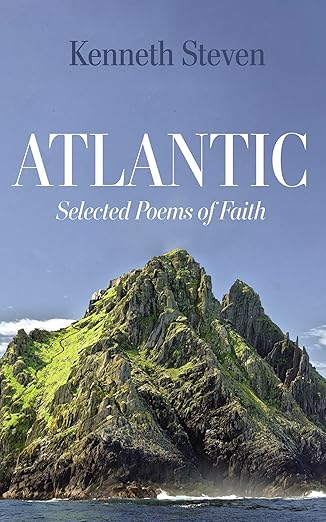
his latest book, one that should be landing on my front stoop within days, is Atlantic: Selected Poems of Faith. but i’m already deep into Atoms of Delight: Ten Pilgrimages in Nature, and Iona: New and Selected Poems.

of night sounds and saints and summer poems. . .

i wasn’t too deep into a jet-lagged slumber when the sound i’d waited to hear rose from the kitchen last night, wended its way up the stairs and into the room where my head lay on the pillow. it was the sound i’d hoped to hear in faraway paris, the sound of two brothers bouncing off each other’s humors and wits and midnight banter. it was a sound that oozed into the cracks in my heart, and the tender spots too. it was a soundtrack so sweet it lulled me back to my dreams.

we finally caught up with the boy who couldn’t get to france when we met him in the international terminal day before last, shortly after he’d flown into chicago from DC, where he’d waited all week for our return. he happens to have a dear friend getting married in town tomorrow, and he’d long planned to fly home with us, to be here for the weekend. so the reunion in the airport was sweet as it could be. long-awaited. much pined for. and i’ve been indulging in every drop of it ever since.

theirs is the soundtrack that makes me more whole than anything else. the soundtrack i’d dreamt of in the days after surgery when i knew more vibrantly than ever before in my life what i lived for. and long, long ago, the soundtrack i’d dreamt of in the very long years before there was ever even a brother, when it seemed “one and only” would be our equation forever. and it’s the soundtrack i pray will go on long into the forever, long after i’m gone and they have each other.

though they’re eight years apart they both share particularly nuanced humors. they tango with words, and glances that only they understand. it’s shorthand for brothers. and it’s the holiest balm i know. i’d longed for it, as if a summer’s hammock tied between trees, one that would rock me into the semi-fugue state of a lazy afternoon’s nap. i’d imagined it unfurling in parisian cafes; threading through crowded sidewalks along the boulevard st. germaine; or taking off into the night as the intrepid pair ventured into the city of lights.

but that wasn’t to be. and the waiting––the hole in my heart that never went away––might have made its midnight appearance last night all the sweeter.

it’s the unexpected twist in the story, the script that didn’t play out as i’d imagined. life is like that. life likes to remind me of its stubborn insistence that i’m not the screenwriter here. and just because it doesn’t turn out the way i’d plotted it, doesn’t mean the happy ending won’t come. sometimes you have to stick it out through the hard parts to get to the part where sweetness comes in.

i’m thinking a lot about hard parts and scripts that don’t seek my opinion, scripts that play out in ways i’d never suggest. i admit to finding myself in a role that’s foreign to me, one that doesn’t make sense: i run out of breath and i run out of steam, and i can get scared by runaway worries. i’ve a long quiet summer ahead to figure some of this out, and i intend to do it the slow way. with the brotherly sound track propelling me onward whenever i get to the hard parts.


side chapel at Chartres, devoted to therese of lisieux

a little bit about a saint: i was one of those catholic school girls, the ones who wore plaid jumpers and were told to pick a saint upon which to model our ways, especially when it came time for our confirmation, and we got to wear white lacy dresses and the bishop would splotch our foreheads with oil. i picked therese of lisieux, the little flower of jesus, partly because i liked little flowers, and i always saw pictures of her surrounded by wee purple violets. i loved that in her quiet little way, she never abandoned love. and i too believed that in my quiet little ways i could make my way through the world, infusing little drops of love all along my route. i didn’t know until last week, when i stepped into a side chapel at the cathedral of chartres honoring the 150th anniversary of her birth, that therese was born the day before me. 84 years earlier. over the years i’ve discovered that dorothy day, one of my heroes, loved her too, for her teaching of “the little way”–by little acts of kindness, little acts of courage, little acts animated by love, we can shift the balance of love in the world. and it turns out that just this week, pope francis (yet another hero of mine, and yet another someone who loves saint therese) devoted his remarks in st. peter’s square to the little flower of jesus, imploring us to imitate her ways, by doing even the littlest things with great love. because she was sickly most of her life, and died at 24, pope francis went on to say that though her body was sickly, “her heart was vibrant and missionary.” i find particular resonance these days in a saint who saw herself as “a small grain of sand,” and who never let her bodily frailties impede her heart’s zeal.

st therese of lisieux

three poems: two summer poems, and a stanza from audre lord that took my breath away…

from mary oliver’s “Six Recognitions of the Lord”

My heart
sings but the apparatus of singing doesn’t convey
half what it feels and means. In spring, there’s hope,
in fall the exquisite, necessary diminishing, in
winter I am as sleepy as any beast in its
leafy cave, but in summer there is
everywhere the luminous sprawl of gifts,
the hospitality of the Lord and my
inadequate answers.

— Mary Oliver


a stanza from audre lord’s, “A Litany for Survival”

For those of us
who were imprinted with fear
like a faint line in the center of our foreheads
learning to be afraid with our mother’s milk
for by this weapon
this illusion of some safety to be found
the heavy-footed hoped to silence us
For all of us
this instant and this triumph
We were never meant to survive.


In Passing

 How swiftly the strained honey
of afternoon light
flows into darkness

 and the closed bud shrugs off
its special mystery
in order to break into blossom:

 as if what exists, exists
so that it can be lost
and become precious

~ Lisel Mueller ~

a curious hodgepodge here, fueled by jet lag perhaps, but nonetheless: what are the summer sounds (or poems) that soothe you most?

a new quiet. again.

i sometimes think it will always be stepping into the new again. it will always be let’s-see-how-this-goes. the undulations of life, a whirl of beginnings and endings and all those elevations between.

this week we packed up the joy blast who is our second miracle child, the one who’s been hovering around the dinner table for months now, patiently kindly engaging in hours-long conversation nearly every blessed night. the one who slept till nearly dusk plenty of days, and stayed up watching old films till the wee wee hours. his raccoon-like hours became a rhythm i knew. the house hummed accordingly. but he’s gone now, back at that little college on a hill in smack-dab-middle ohio, and the absence is raw still. still hurts around the edges.

and this time, there’s a new quiet at home. these will be the first new weeks without the rhythms of someone else’s work life. all these red-ringed months, the other writer in this old house got dressed for work even when work was what happened mostly up in his book-lined office across from the top of the stairs. there were deadlines and stories and headlines, too. there was chatter from the so-called newsroom, the one that had been scattered to bedrooms and nooks and crannies all across sweet chicago, wherever a scribe lived, hung his or her reporterly hat. all that has gone hushed now. not even the sound of a keyboard clackety-clacking. he had to turn in the laptop, and the long line at the apple store means you wait weeks and weeks for a board all your own.

we are a people of rhythms, me and the one who shares this old house. so i’m certain we’ll find one again.

i sometimes wonder how we got here, to this moment, so soon. sometimes look in the mirror to see if i can find the self i’ve known since she was so little, had a gap in the space between two front teeth, just enough of a space to wiggle the tip of my tongue through. the gap is long gone now, and so too plenty of other parts, lost along the way. the losses are wins some of the time. though sometimes a loss is a loss, no doubt about it. same thing with the gains. it’s subtraction and addition, all our life long.

so here we are bumbling around in an all-new quiet, a quiet like never before. as a creature of habit, of course, i’d come to count on the people we were in the everyday. and now readjusting is due. old titles are stripped, though the essence is not. it’s starting all over again and again.

good thing i’ve got typing to do, and plenty of it. i figure i’ll wriggle around inside my hours of typing while all the new rhythms appear. while i see how to fit in this new stretch of time. in the meantime, i thought i’d leave two poems here at the table, poems that put a magnifying lens to the blessings of time, of all the moments quotidian and otherwise. one is from raymond carver, you know who he is, the short story writer who happened to turn a mighty fine poem. the other is from a most blessed woman you might not have known. her name is robbie klein, and her birthday would have been yesterday, but she died a year and a half ago, “peacefully, powerfully,” as her obit in the san francisco chronicle quite emphatically put it. her poem took my breath away when she wrote it, and i asked her back then for permission to share it, to which of course she said yes.

consider how each of these beauties concentrates our focus on the blindingly brilliant blessing of the most ordinary moments of time, and how they freeze-frame the essence, so we can’t help but see its full glory.

 At Least
 by Raymond Carver
 I want to get up early one more morning,
 before sunrise. Before the birds, even.
 I want to throw cold water on my face
 and be at my work table
 when the sky lightens and smoke
 begins to rise from the chimneys
 of the other houses.
 I want to see the waves break
 on this rocky beach, not just hear them
 break as I did all night in my sleep.
 I want to see again the ships
 that pass through the Strait from every
 seafaring country in the world—
 old, dirty freighters just barely moving along,
 and the swift new cargo vessels
 painted every color under the sun
 that cut the water as they pass.
 I want to keep an eye out for them.
 And for the little boat that plies
 the water between the ships
 and the pilot station near the lighthouse.
 I want to see them take a man off the ship
 and put another up on board.
 I want to spend the day watching this happen
 and reach my own conclusions.
 I hate to seem greedy—I have so much
 to be thankful for already.
 But I want to get up early one more morning, at least.
 And go to my place with some coffee and wait.
 Just wait, to see what’s going to happen.
 
 Moments
 by Robbie Klein
 The space behind the waterfall
 The reverberation after a piano key is struck
 The second after hanging up with one you love
 The instant before the match catches fire
 The trace when a cloud covers the sun
 The sliver before sleep comes
 The first raindrop under a tree canopy
 The ebbing of the waves
 The lightening of dawn
 The space between notes
 The bottom of the exhale
 The final brushstroke
 The first drop on the tongue
 The grey before snow falls
 The moment before his fingers touch your face

what prompts you to relish each holy hour?

*photo above is college kid’s room in rare state of clean, only because his teary-eyed mother scrubbed and scrubbed till the sting went away…..