pull up a chair

where wisdom gathers, poetry unfolds and divine light is sparked…

Tag: living love

Dear God, thank you.
Dear God,

Um, I hate to be so bold but we could have used him a little bit longer. (You undoubtedly already know that.) Things are pretty rough around here. Whole swaths of this holy earth, and the people who populate it, seem to have lost their minds. And maybe their souls. 

As You most certainly know, and definitely must have heard, his was the rare voice that could drown out the ungodly noise. The cacophonies of greed and grievance, the ugliness of sin and the Self that thinks it’s higher and mightier. He didn’t let up when it came to the terrible, terrible traumas of war—newborns bombed in hospital nurseries; toddlers drowning in turbulent seas, washing to shore, as if cast-aside flotsam; whole families entombed in the rubble of raining-down concrete and rebar in murderous twists.

He called it where he saw it: called out the avarice of modern capitalism and consumerism, diagnosed it as the fundamental root of the exploitation and suffering of the poor and the vulnerable. Named it “the Devil’s dung.”

He minced not a word in a letter to American bishops this February, when in the wake of the current administration’s drastic deportation campaign, he wrote that while nations have the right to defend themselves, “the rightly formed conscience cannot fail to make a critical judgment and express its disagreement with any measure that tacitly or explicitly identifies the illegal status of some migrants with criminality.”

He didn’t stop there: “The act of deporting people who in many cases have left their own land for reasons of extreme poverty, insecurity, exploitation, persecution or serious deterioration of the environment, damages the dignity of many men and women, and of entire families, and places them in a state of particular vulnerability and defenselessness.”

Il Papa, il mio papa!

Oh, dear God, thank you immensely for making his lifetime line up, at least for a while, with mine. I was starting to fall off the edge there, till the first puff of fumata bianca arose from the Vatican chimney back on March 13, 2013, and the bells from St. Peter’s rang through the city.

Dear Francis filled my lungs again. He preached the version of You that I’d long pressed to my heart, the One taught to me by my post-Vatican II Sisters of Loretto, they who puffed cigarettes behind the convent, traded in their flowy black habits for street clothes and lipstick, all while strumming guitars and singing kumbaya, and all while watching films like “The Red Balloon,” where we little Catholics were meant to evoke the godly meaning from the metaphor.

He was, far as I could tell, a walking-talking, put-your-money-where-your-mouth-is, “love as you would be loved” kind of a guy. He colored wildly outside the lines, as if to shake us out of our stupors, our thinking the ways of the world were the only ways there were. As if to remind that love, honestly, could shatter the worst kind of walls, break through to the tender core at the heart of us all—the one You nestled inside all of us when You breathed us into being. 

His time as the 266th charge of the Church was something of a Kodak carousel of indelible encounters, the ones you cannot forget because they sear you so soundly. (p.s. He was mighty fine with the pen, as well; at least one modern poet called him “the most literary pope of the modern Vatican.”)

He took on no airs. Which made his message all the more of a wallop. He seemed to be saying that we too, in our fumbling, bumbling, banged-up bodies, we too could reach for the heavens. 

His message, quite simply, was to remind that we’re all equipped and ready to cut a swath of radical love through this world. 

And what I really loved about the beloved Argentian Jesuit were the moments when he reached out his arms, and cradled the sobbing child, especially the little boy whose atheist papa had died, and the boy was so very worried about what would happen to his papa. When the little guy was all but choking on his sobs and the words to his question, “Is my dad in heaven?” Francis called out to the little boy, “Come, come to me, Emanuele. Come and whisper it in my ear.” And everyone sobbed, while Francis quelled the boy’s fears and spoke to the crowd: “What a beautiful witness of a son who inherited the strength of his father, who had the courage to cry in front of all of us,” Francis said. “If that man was able to make his children like that, then it’s true, he was a good man.”

Or the little ones born with an extra chromosome who sometimes wandered curiously right onto the altar in the middle of Mass, or a homily, and instead of shooshing the child away, he stood there beatifically smiling, clutching their soft little hand. And went right on with his papal business.
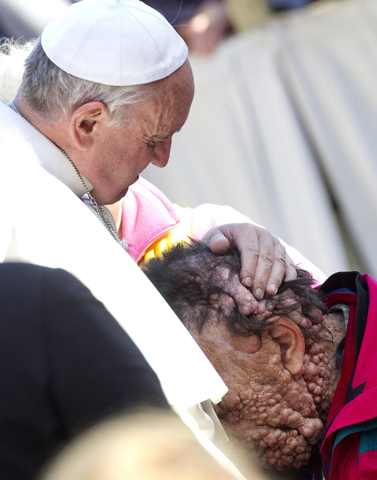
Pope Francis embraces Vinicio Riva, the man with neurofibromatosis.

Or that indelible image of Your Francis first kissing then cradling the man with the eruptions of leathery tumors curdled across his face, his scalp, and clear down his neck. 

And what struck me most, dear God, when I awoke Monday morning to the news that he’d died in the night, was the sudden stunning realization of how breathtakingly he had died—a lesson for us all, and surely for me. I believe he knew these were his last days on earth, when he insisted on leaving the hospital, and knew that until he breathed his last he would teach his last most lasting lessons. In the last week of his life, he visited with 70 prisoners in Rome’s Regina Coeli Prison, from a balcony overlooking St. Peter’s Square he blessed the crowds, and in his Easter Sunday sermon he begged for mercy for “the vulnerable, the marginalized, and the migrants.” He also sent an emissary to preach compassion to the nation’s second-highest ranking executive officeholder and fairly recent convert to Catholicism. 

And then, and only then, he breathed his last. 

I barely have words for the emptiness left in Francis’s wake. It’s rare these days to find a soul who’s proven her or himself worthy of speaking such penetrating truth that the whole world turns an ear to listen. 

We listened, and some of us shouted silent hallelujahs every time. 

We are a world with a spinning moral compass. Up seems down, and right and wrong are inside out and sideways. Hate is cloaked, too often, as a return to the old ways. Truth is chopped into bits and spit back out in bilious flows. 

Are we meant to be the collective voice to fill the new and jarring silence? Is that the point? He constructed the paradigm, handed us the blueprints, and now it’s us who must step to the line, to be brave now? 

Maybe it’s a blessing that much of the world is weeping. Maybe, if we follow our tears, we’ll dig down and rise up. Maybe, like Francis, we can look out at the battle field that is the world and make of ourselves the field hospital set to begin to stanch the bleeding, and work to heal some of the wounds. 

Anyway, God, we’re on it. And thank you, thank you, thank you.

Love, BAM

what memories or moments of Francis most lastingly speak to you?

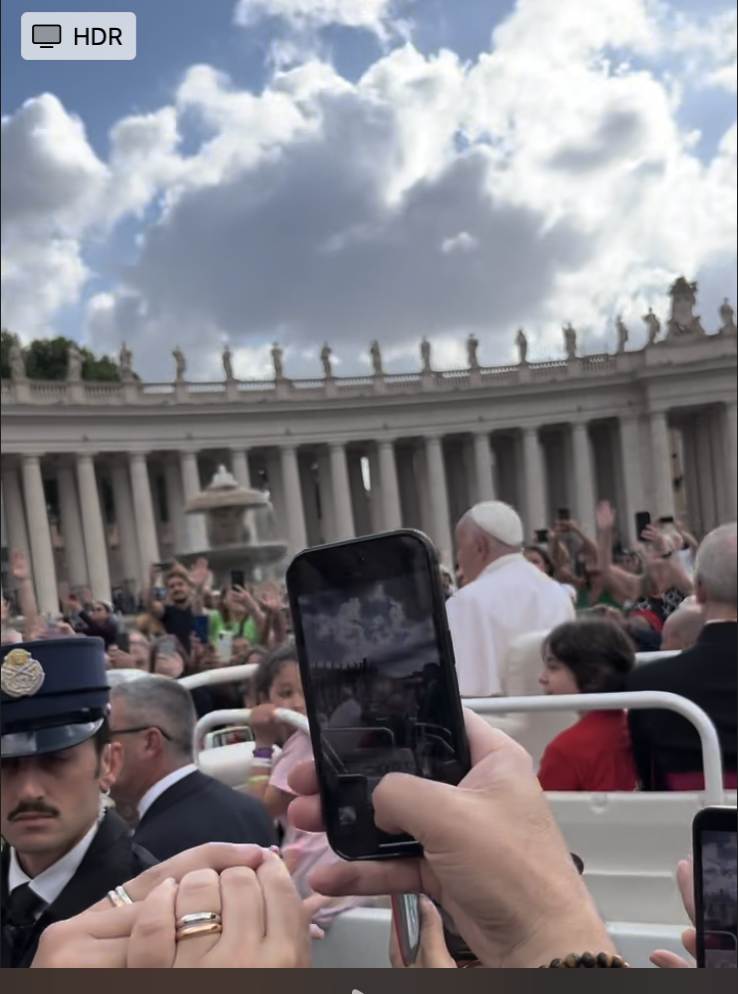
photo above is from the little video i managed to capture when i managed to all but stumble into the path of the oncoming PopeMobile this past summer in St. Peter’s Square….

and p.s.s. a letter to God, i figured, called for capitals. thus, i made rare use of the shift key this morning….

love thy neighbor ain’t always easy but it’s where it begins

maybe my world is shrinking, or maybe pragmatism comes with creaky knees and hair turned pewter white. once upon a time i dreamed i might figure out a way to end world hunger. nowadays i spend my days worrying about how to make peace on the little block of houses where i live.

i’ve somehow shrunken my visionary zeal, realized i’m no melinda french gates and will never swipe the planet of those scourges — polio and TB and cluster bombs — that wreak a hardly-holy hell.

what consumes me nowadays is the hard task of human beings bumping up against each other with their curious quirks and rough spots. long ago, when i had my nose in books about saving the planet from the scourge of hunger, when i failed to set the dinner table cuz i was on the phone with a friend in tears, my mama used to drive me nuts with her refrain: “charity begins at home.” i thought that was just another way of getting me to mind my chores.

but, decades later, i get it. i get how hard it is to attend to the one simple command at the core of nearly every world religion: love thy neighbor.

yes, love the lady who shrieks out her window. love the guy whose dog barks through the night. love the ones who park their fancy car in the middle of the alley and don’t think they might be blocking your way.

it’s in the fine grain that we stumble. and that where the grit pits our knees.

it’s pie in the sky — and a cheap way out — to talk in platitudes. it’s a whole other thing to meet that someone on the sidewalk, to look into her eyes, and talk it out. to say i am so sorry you were hurt. to say, i’ll fix it. to invite someone in for coffee — after she’s made it clear she doesn’t much like the way you leave your christmas lights strung up till easter.

i’m not the one who’s in trouble at the moment. but i happen to know that of the eight houses on my side of the block, four are deep in scuffles. and it sickens me to know that in a single ZIP code we cannot find a way toward peace.

and it throws me back to that radical jesus, and maimonides not too long after, and buddha, and mahatma gandhi and mother theresa too, all of whom made it seem so clear, who gave us three words to live by: love thy neighbor.

work it out.

dig deep in your soul’s well, and pull up forgiveness. find compassion. try to imagine how deeply the hurt must be for someone to yell out their window to “mind your own ******’ business.”

this humanity is complicated stuff. not everyone seems to have read the same play book. and no matter how hard we wish, we cannot write the script, nor spew the lines for all to recite.

so how to be the instrument of peace? how oh how, is the question i ask over and over. i don’t have too many answers here. but i do know this: my one holy task, the one way i am choosing to spend my days, is to try. to wake up every morning with that code in mind. to catch myself in the rough spots, just before the fall. and to ask if there’s a kinder, gentler, humbler way to be.

it’s down here in the weeds of our own backyards where the hardest part comes. where it boils down to something more than everyday civility. where if someone’s house was burning, i might run toward the window to catch whatever was being thrown out the windows. where if someone fell on the sidewalk, bleeding, i’d run and hold her hand. wipe her tears. cradle her till the doctors came.

it’s not so hard to send off money to the middle east. what’s hard is walking down the sidewalk, or watering the garden, when someone turns the other way.

it’s in the squeeze of that human vise when we need call on our better, finer, wiser, kinder angels, to not only turn the other cheek, but to figure out a way to span the divide. to sow love where there is hurt. to be the living, breathing instrument of peace.

for that i pray. day after day after day.


diana butler bass, an author and historian who calls herself a public theologian, is someone whose voice i’ve been listening more intently to these past couple years. she points her focus on the intersection of modernday culture (often political culture) and religion and spirituality, and she scythes through any hint of hypocrisy and flat-out baloney. she stands, unflinchingly, for the good. this past week, she was writing about bread and wine and wisdom, and i stumbled into this one paragraph (bolded below) which held me for a long while. wisdom is something i look for, hope for, reach for. i love the way bass takes the hard turns in our lives and sets them as the building blocks upon which the wisdom rises. i love that “bad choices” is part of her mix of what might lead to wisdom. it’s not just that we’re the recipients, that bad things “just happen to us.” sometimes, she wisely puts it, we bring the dark times on. we can be culpable. we can stumble. and do dumb things. words we wish we could stuff back in our mouths. invitations we wish we didn’t turn down. chances we wish we were brave enough to have tried. she makes me wish i could turn back the clock of time just long enough across the arc of my life to tap little me on the shoulder to let me know the dark days i was stepping into were going to be the days that in the end would grow me into the wise old woman i’d long prayed i’d  become. here’s diana on hard-won wisdoms…

Central to bread and wine is the exact same principle: In order to become what they are, they must be transformed from one thing into another. When a leavening agent is introduced to flour and water, it becomes a dough that bakes into bread. When yeast consumes the sugar in juice, it ferments the fruit and turns it into wine. Wheat and fruit are, in effect, broken down and simplified by an outside agent, turning them into bread and wine. That’s what fermentation does.

But this process takes time. Bread must be worked, kneaded, left to rise, reworked, and baked. Wine is the result of weeks or months or even years of yeasts breaking down sugar and slowly turning fruit into alcohol. Bread and wine are staple foods for everyone, and yet they demand great patience of bakers and vintners. Neither happens immediately. One must learn the craft of these foods over time. They cannot be rushed. Staples, yes. Slow foods, absolutely. The best things to grace our tables — those things that sustain us and give us joy — result from an intentional and gradual undertaking.

Wisdom is like that, too. How does one pursue wisdom? Where do you find it? Perhaps it is like bread and wine. It begins as something else — an experience, a loss, suffering, bad choices. But when some leaven — like the Spirit — is introduced, these original ingredients are transformed into wisdom through a process of fermentation that takes time. Wisdom cannot be rushed. You learn, you craft, you wait. Eventually, what was becomes something else — something lasting and satisfying.


i didn’t mean for this to line up quite so charmingly, but another thing that utterly grabbed me this week was this bit of poetry sent by my beloved poet friend win. it’s a poem called “butter knife.” bread and butter, how perfect. but first a word about win, who this year started up a wisdom gathering she sends out every monday morning. it’s called metta monday, and in it she gathers up a bouquet that stirs me, fuels me, and often draws out a tear. her well is deep, and she harvests broadly, drawing on sages and poets and zen masters. i’m not quite sure how you’d sign up for it, but if you leave word here, i will be sure win finds you. she starts your week with a rocketblast of all you need to make it to the other side. . .

click here for butter knife, a poem by hollie mcNish about wonder, and specifically about the wonders and wizardry of the human body and the interplay between blood, sweat, tears and the soul….where “teardrops can be conjured out of thoughts…” it’s a beauty! we might all climb on the hollie mcNish train….

do you have a story to tell of watching love blossom and break through darkness?

at heart, it’s survival

pickled lime soup.

survival soup: pickled lime, lemon grass, knobs of ginger root, garlic, chili pepper (photo by kalyanee mam)

in this moment of pandemic, amid news reports that make us sometimes want to plug our ears, amid barren calendar pages turned week after week, our everyday tasks are shifted. gone is the dashing here and there (and that’s a very fine thing). gone are the awful tugs and pulls, the guilt strings that tell us we should be doing X,Y, or Z. 

instead, it’s distilled to more of the essence: the few things that really do matter, the ones that matter all the more because all the distraction’s been whittled away. we’re left with essential. and essential is this: exercise your heart, your voluminous, many-chambered heart. use it for its highest purest purpose. use it to love. use it to survive. use it for survival, plain and not so simple. 

or, as my online-college kid put it last night, as he pounded out one of his pile of end-of-semester papers: “corona mom, keep your boys safe. and sane.” (the emphasis on that second sentence, the way he emphatically tacked it onto the first, made it clear that that’s every bit of my job these red-ringed-dodging days. and i couldn’t take it more certainly to heart.)

i’d been thinking a bit about how–in between hours of proofing and re-proofing pages for a new book–my corona days have boiled down to a whole lot of caretaking. how hunting and gathering inform my weekly rhythms (primarily in the form of my hazmat-outfitted grocery-store runs). how feeding is hardly an afterthought. how each night i’m taking time to plot out some serious semblance of dinner, even if, like last night, tearing open bags from the freezer is part of the equation, and it’s hardly all scratch cooking. (though there are days when simmering pots on the stove are as close to incantation as a kitchen might be.) how spritzing pillow cases with lavender water, how scrubbing out the bathtub and sink, how all of it feels essential, verging on straight-up survival. yes, even the scrubbing.

and then, of course, there are the interludes when i’m plopped on the side of someone’s bed, rubbing little circles on someone’s weary forehead. or putting aside those pages of proofs when someone asks, “can you help me with this grilled cheese?”

it is all a part of essential. especially, emphatically, now.

and then i read an essay from a brilliant filmmaker (and lawyer), kalyanee mam, once a cambodian refugee, born during the god-awful khmer rouge regime, one of seven children whose early years were spent in a work camp, before her family escaped through jungle and landmines to a refugee camp on the thai-cambodian border. during the years of the khmer rouge, mam writes that her mother sustained her brood with umami soups, chicken rice, and fried noodles. and that template of nourish-to-survive is the one to which mam has turned in these corona times. she writes:

During these past weeks, I’ve thrown myself into the role of caregiver, as my mother once did. As I soak and sprout beans and rice, chop onions, carrots, and celery, mince and sauté garlic, knead dough, and bake bread, I am finding certainty, meaning, and purpose in preparing and sharing food and conversation with family, friends, and neighbors. In taking care of my loved ones and making sure they are fed, nourished, healthy, and well, I am also being fed. Time has stopped and nothing feels more important.

nothing feels more important.

it’s not every day that we realize that tending to the domesticities of our lives matters at all. most of the time, in the days before corona, that was the almost-disregarded part of what some of us did. those were the chores. the necessities. but maybe, somewhere along the way, we’d come to misunderstand necessity, confused it for meaningless. when, in fact, it’s everything but.

or, as kalyanee mam put it:

care and love are not luxuries: they are necessities, the essence of all life and our survival. in the worst of times and in the face of adversity, care thrives….when our basic human needs are threatened, including our need for certainty, meaning, and purpose, caring emerges to inform us that we are not alone. 

it’s this instinct to care, to take care, to make care, that might make all the difference. that might be the essence of why we’re here at all.

in pondering caring, and what it means to take care, mam writes of the anthropologist margaret mead and her idea of the first sign of civilization. it’s an insight mead long ago revealed in a lecture, and it was retold in a book by the eminent surgeon dr. paul brand, titled, the gift of pain. the revelation, and brand’s take on its meaning, unfolded like this:

“What would you say is the earliest sign of civilization?” Mead asked, naming a few options. A clay pot? Tools made of iron? The first domesticated plants? “These are all early signs,” she continued, “but here is what I believe to be evidence of the earliest true civilization.”

High above her head she held a human femur, the largest bone in the leg, and pointed to a grossly thickened area where the bone had fractured and solidly healed.

“Such signs of healing are never found among the remains of the earliest, fiercest societies. In their skeletons we find violence: a rib pierced by an arrow, a skull crushed by a club. But this healed bone shows that someone must have cared for the injured person—hunted on his behalf, brought him food, served him at personal sacrifice.”

With Margaret Mead, I believe that this quality of shared pain is central to what it means to be a human being.… And the presence of a caring person can have an actual, measurable effect on pain and on healing.

“civilization,” mam concludes, “begins with care.”

and so, we are, all of us, called to care, to share the pain of those we love. to exercise that glorious vessel, the heart. the one anointed and appointed to love and love lavishly. to love as we would be loved. to love as if there’s not a tomorrow. to love with all the urgency of now. as if it might keep us alive. because, truly, it might.

and with that, may your mothering day — a day for all who mother, who care, who love tenderly and fiercely and without end — may it be blessed.

your thoughts on taking care, on the exercise of the heart, and the necessity of love and survival? in any time, but especially now?

this is who we are

hhnhh_horizontal_red

truth is, more days than not i feel like i’m climbing a hill with boots filled with concrete. but then, every rare once in a while, a whiff of hope swizzles by. don’t know about you, but i’m reaching out and grabbing as if my life — all of our lives — depends on it.

last night a friend i love — a friend with a tender heart and fierce magnificent defiance — sent along a link to the sign up above, “hate has no home here.” i’m planting those words — in all those languages and alphabets — squarely in my front yard.

that short declarative sentence captures everything. it gets to the gist of the matter — for me, anyway. it’s the bullying, the hateful tone, and the words and the rulings that pit one against another. that’s what’s draining me, scaring me, making me think i might have a stroke.

“hate has no home here.” hate has no home in my heart.

and, day after day, that’s the epicenter of most of it. i don’t want to live in a country where everyone’s eyeing everyone — are you one of us? we wonder. stopped at a stop sign, tapping our toes in the checkout line. it permeates each and every hour of the day. it’s seeped into the interstitia of all of our minutes. it’s why i stay away from the public square of the new millennia: facebook. i don’t want to marinate my days in the vitriol — from either side of the equation — because harsh words — from any side — serve only to wedge, to divide, to move us farther and farther from the peaceable place where we climb on each other’s shoulders and reach for the heavens.

i was blindsided by the gloating that came along with the win. i hadn’t imagined. i admit that i hadn’t imagined the win in the first place, and shortly after discovered that, for too many, the win gave license to let rip with whatever had been bottled inside. it all came gushing out. and that’s why — months later — i’m still struggling to find my footing.

there’s a house not far from mine where life-size effigies of the former president and first lady were perched on a bench beside the president elect. the former president was dressed in a shiny orange pimp suit. the former first lady, dressed as a whore. it took weeks and weeks for parts of it to finally be taken down (for far too many sickening days, the tableau included a black-faced effigy tied with a noose, dangling from a tree. and ugly yard signs, too). the house is stately, sits on a hill, on a main street that slices this town. i’d have to drive out of my way to avoid it, so i did. i still do. because i couldn’t stand the sight of it. it made me sick every time. i understand that theirs is the right to say whatever they choose; but i wish with all my heart they didn’t find it amusing — maybe delightful — to mock with such vengeance, to jeer, to broadcast what feels to me like plain old hate.

jesus told us never to mock. “blessed are the meek,” is what i learned when i was little, and then learned over and over. “blessed are the meek, the merciful, the pure of heart.” that’s what i believed. still believe.

i’m raising my flag and fighting back in the only ways i know: quietly, without folderol and noise.

the other night, driving home through the dark, i was sitting in the back seat when i noticed a car stopped in what seemed like the heart of an intersection, about a block away. i saw the driver get out, and that’s when i noticed something lumpy and dark in front of the car, lying in the road. i didn’t wait for my brain to make sense; i opened the door and i ran. as i got there, i saw that the lump on the ground was a man, just starting to move. he was already bloodied, his face beginning to leak from his nose and his eyes and his forehead. as he strained to lift his head from the ground, the blood poured without pause. the man’s blood spattered me. i cradled him, tried to keep him still. i asked the man his name, praying he’d be able, and he told me. his name was howard. he lived nearby. he had no family, he said. he had no idea what had happened. and that’s when i looked up at the car stopped just inches away, the car whose windshield was shattered as if a boulder had fallen smack onto it.

with all my heart, i tried to keep howard conscious, to keep him from slipping into a place where we’d not get him back. by the time i was asking him to count backwards from 10, my firstborn had leapt too to his side. he helped hold howard still. we both prayed as fiercely as we’d ever prayed. it wasn’t long till a doctor, from out of the blue, ran over too. pulled out his phone, turned on the flashlight, and began to assess the crack that fissured howard’s head.

the one thing i knew most certainly as we all huddled there together, in the dark, in the cold, one man’s blood pouring and pouring: we were all there for each other. life and death is what lay before us, and we were all pulling for life. because we had to. because no matter what’s going on in the world around us, in the end, we are each other’s only hope. and the decency at the heart of every human still breathing is what we’re exercising here. i know that for those few extraordinarily long minutes, it felt to me like we were shouldering all the hope, all the goodness, this world has to muster. we were strangers suddenly entwined in saving one life. and we harbored him with prayer and with love. because isn’t that what all of us hope will be there for us — should there ever be a night that’s dark and cold, a night when our breath is labored, and we’re slipping away?

and in the end, that’s all i know. and it’s the one thing i will not surrender. i will muster every grain of defiance in my heart and my soul, and i will not let hate or hateful words win.

because who we are is all these tiny moments where love wins out, where we rise up out of our comfortable lives, take the reins of what feels right, and do what needs to be done: we march, we make phone calls, we live and breathe kindness as if it’s political protest. these times are begging us to be our best selves. and all around, i see people i love doing just that. they send me yard signs. they raise money for refugee families. they invite those families in for dinner. they listen to their stories. they find love, front and center. and that’s the way we win. that’s what God’s asking. i’m certain.

and i am listening like never before.

what are the moments of love that inspire and embolden you of late? 

as for my friend howard, he is out of ICU, and i hope and pray he’ll be heading home soon. i’ve been keeping watch all week. because howard will forever be in my heart and my prayers. 

as for the sign above, i’m having a few made today. here’s the link, if you too want to print out a poster, a yard sign, a button to pin to your coat (bless them, they’re free for downloading). the magnificent sign was designed right here in chicago by an artist named steven luce. i don’t know him, but i thank him with all of my heart. 

hhnhh_blue_vertical