pull up a chair

where wisdom gathers, poetry unfolds and divine light is sparked…

Tag: Jan Richardson

the loads beyond measure

sometimes a batch of words comes tumbling into our world, fluttering onto the path we cross as if the petals from an apple blossom whose bloom has expired. the words come unannounced, and lay there waiting for us to notice. once we read them we can’t think of anything else. all day long, all our thoughts come round to them again and again. 

so it was when a friend whose grief is without measure sent along these words the other morning:

I have been telling myself that I don’t know how to do this, that nothing has prepared me.

i’ve been thinking long and hard about those loads we’re tasked to carry. how every one of us, at some time or another, is bound to have one. a load so beyond measure, a load we never saw coming, it simply stumbles us, knocks us flat and gasping. and in the depth of our hollows — if we’re telling truth — we mouth those very words: “i don’t know how to do this. . . . nothing has prepared me.”

all we see is steep climbing ahead. a load we don’t know how to hold. and all we’ve got to bear it are our stubby shuffling feet, and a ribcage that holds the parts of us that breathe and pump the oxygen. our shoulders and our spine we fear will crumple under the weight of it. 

and then there’s the beehive of a brain, where all the wiring and the worrying, where all the remembering and the grieving and the what-iffing and the if-onlying whirs in and out at every turn in every hour of the day. 

the poet and collagist jan richardson put it like this in her “blessing for the dailiness of grief”:

It will take your breath away,
how the grieving waits for you
in the most ordinary moments.

It will wake
with your waking.

It will
sit itself down
with you at the table,
inhabiting the precise shape
of the emptiness
across from you.

It will walk down the street
with you
in the form of
no hand reaching out
to take yours. . . .

but here, maybe, is what we need to remember, to bear the load we’re sure will finally be the one we cannot budge or bear: our whole life long, we’ve been preparing. every hurt and insult hurled our way. the time in third grade when we cried because the kid one desk over made fun of our clunky shoes. but, next morning, we tied their laces into bows and we walked back in the classroom, and sat there all day long, learning how it is to become more than the stubby shoes that were not penny loafers. the time in high school, when someone in the hall pointed at us and said our face looked like someone smashed us flat against a wall. and it stung for weeks after, every time we stood before a mirror and turned this way and that to measure just how flat our irish face really was. 

and then the big ones come: the time the doctor walked up to the knot of us coagulated in the hospital corridor, and simply said, “i’m sorry.” and we were left without air in our lungs, and with the sudden senseless knowing that the brightest light in our existence had just gone dark. forever.

or the night the clots kept coming. and at last the tiny, tiny arms and legs, the intricately blessed face i’ll never forget, as the baby i thought i was having was cupped in the palms of my bloody hands, the miscarriage that hurt the most. 

the litany is plenty long. and we sometimes never notice just how much each ache is strengthening the fibers of the muscle group without a name, the one that holds us up — yes, wobbling at first; yes, stained with umpteen tears; yes, with sleepless sleepless night — but the one that, in the end, does not fail us. 

we are stronger than we know. and, all along, we’ve been piling on the sinew, deepening the courage, deep breathing the determination, to look that unbearable load square in the eyes, to say, “climb on. i’ll carry you.”

just watch. 

and then, at last, there comes this (jan richardson again, this time “blessing of breathing”):

That the first breath
will come without fear.


That the second breath
will come without pain.

The third breath:
that it will come without despair.

until at last . . .

When the tenth breath comes,
may it be for us
to breathe together,
and the next,
and the next,

until our breathing
is as one,
until our breathing
is no more.

my dear and blessed friend, and all who bear loads they deem unbearable, you do know how to do this. deep in your marrow, you know. your whole life long you’ve been growing strong and stronger. you’ve got this, and you’ve got this. and if and when you stumble, we are here with our simple grace and our love that will not falter. 

where did you find the strength you did not know was yours?

PS (note the all caps!): it’s the birthday sunday of one of the wise women of the chair, our very own lamcal, and i can’t gather up enough love in my bouquet to sufficiently surround her. she is beyond measure! happy blessed day, beautiful one. xoxox and happy mothering day who all who love in that way that knows no end….

amid the dizzyings of springtime…

i imagine it’s been well-established that i am of the homebody persuasion. the sort of girl who thrums inside the cozy confines of space and time i know by heart. to plop behind the wheel and point myself in a direction i’ve not been is, well, to stretch me. to accelerate the tempo of my little heart, to bring on the rumblies in my tummy. and so it was as i set out for The Driftless (a topography that deserves every drop of its capital consonants) a week ago today.

for starters, i got lost. yes, yes, after dutifully trying to follow my index-card directions through country roads and farmer fields, i decided maybe it was safer to let the little voice tell me where to go rather than glancing down and trying to find the numbers i had scribbled. well, news flash: there are TWO mineral points in ol’ wisconsin, and the one i was steered toward was the one in otherwise unmarked farrow field. that little voice announced, “you’ve arrived. your destination is on the right,” whilst i looked up and saw literally nothing but an undulating plot of shaved-off stalks. hmm. this must not be, i intuitively surmised.

i was miles from nowhere, and 67 miles from where i needed to be. where the world’s loveliest host had a turkey meatloaf in the oven, and asparagus steaming in a skillet. ah, but in due time, rollercoastering along country roads, past baby calves (yes, i know it’s redundant, but i like to say it that way) all gathered under little calf-ling igloos, which must be the latest in dairy husbandry for each baby calf had its own domed shelter, and a place to escape the drifting snows, past rock formations that felt prehistoric or laid there by ancient peoples, through towns that time forgot and that i prayed still stuck to old ways, and not the toxic juice that’s infected so very much of old america, i pulled in the gravel lane that was my destination.

and, from the first footfall inside the charming farmhouse, i was home. daffodils and aldo leopold awaited on the bedside table, and the bed itself was a cloud of comforters. each morning that sunrise above greeted me from the kitchen windows. and each morning, it took my breath away, and filled me with holy airs.

the folks i met were as fine and fluent in the poetries of earth as any souls i’ve met along my way. i met a farmer who plows his field with draft horses, and writes letters back and forth with wendell berry (be still my heart!). and another farmer who used to cook at chez panisse. (yes, that chez panisse, the one in berkeley CA, where alice waters revolutionized the kitchen.) i scrubbed pots and pans beside a woman whose heart must pump in gold. and i heard tales of keeping watch on eagles’ nests.

and then, come sunday morning, after hiking through the woods, and talking books in a charming indie book store (where croissants were rising in the ovens behind me), i took to the pulpit in a little country church to deliver what you might call the sermon, but which the priest referred to as a “reflection” since i’ve not passed the sermon-licensing exams. and as i wove threads from the doubting thomas gospel and the book of nature’s sometimes tangible God, i looked out on a congregation of fine souls who were listening in a way i’ve never known: heads cocked, a posture of deep attentiveness, eyes on the pulpit, you could hear a pin drop in that blessed church. and i saw how good souls are hungry for a word of wisdom with their sunday-morning coffee. if this is church, and i do believe it is, may we become a people who know to carve out time to put down phones, dial down the pings, and find our way to wherever it is the holy wisdoms come.

not an hour later, the whole adventure in soul-stretching reached its crescendo when every last soul at the basement coffee hour stood and raised an arm toward me, or laid a hand on my shoulders, and at the behest of the priest, father christian was his name, blessed me with a prayer that had me all but gulping back a walloping sob. when i felt the tiny hand of father christian’s little boy, a kid with special needs, squeezing my left arm, i really truly nearly lost it, as they say. instead, i held his hand and together we squeezed and prayed all the way to the last amen.

and then i motored home, not quite the way i got there. and forever deepened and shifted by the glorious goodness of my new friends who dwell in the driftless.


i came home, of course, to sunlight-blocking moon, and a garden erupting in springtime’s accelerandos. and i spent a good bit of week deep-breathing all of that, and getting mighty muddy too. but i also came home to friends who are grieving inconceivable losses. and when i found this prayer-poem from jan richardson, i knew i needed to pass it along. so, here, too, for all of you is a poem to keep for when grief comes to you or someone you love, or even someone you might not know too well at all. jan is a poet, artist, ordained minister in the united methodist church. i was introduced to her years ago now, by my very own night chaplain (slj to all of you, a regular visitor here at the chair). and as jan’s life was torn open by the sudden death of her husband, she has only deepened. and her work all the more mesmerizing. this is from not long after the death of her husband, when she was coming up on her first valentine’s day without him. her words are among the truest i’ve ever read. she is pure blessing.

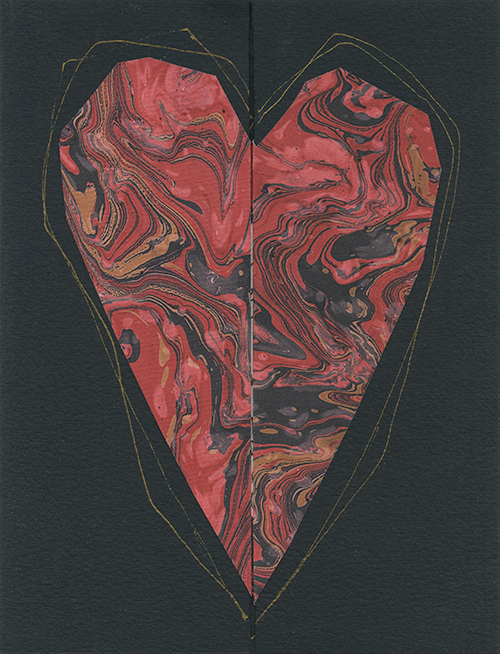
Image: Valentine © Jan Richardson

Blessing for the Brokenhearted

There is no remedy for love but to love more.
—Henry David Thoreau

Let us agree
for now
that we will not say
the breaking
makes us stronger
or that it is better
to have this pain
than to have done
without this love.

Let us promise
we will not
tell ourselves
time will heal
the wound,
when every day
our waking
opens it anew.

Perhaps for now
it can be enough
to simply marvel
at the mystery
of how a heart
so broken
can go on beating,
as if it were made
for precisely this—

as if it knows
the only cure for love
is more of it,

as if it sees
the heart’s sole remedy
for breaking
is to love still,

as if it trusts
that its own
persistent pulse
is the rhythm
of a blessing
we cannot
begin to fathom
but will save us
nonetheless.

—Jan Richardson

This blessing appears in Jan’s book, The Cure for Sorrow.

gremlins seem to be lurking here this morning, so let us see if we can fling this to the cyberwires that carry this from my kitchen table to yours. question for the day, besides “will this work?” is where did you find holiness this week? 

and here is a special wink and nod for the great good souls i didn’t get to mention above: the glass sculptor who sailed the world before planting herself on high street, in downtown mineral point. the ones who’d taught for years and years in alaska before sinking deep roots in driftless loam. the bibliophile who opened an indie bookstore, and thought to attach a cooking school besides. and most of all to jane, my storytelling hostess whose graces left me nothing short of gobsmacked.

road trip reads

IMG_7946

any minute now, we’re piling in the red wagon and pointing it south, straight to louisville, kentucky, the state of grace in which i was born. we’re headed down for a memorial for a beloved uncle who died at 91 earlier this summer. he was known as “secretary of the interior” in blue-grass country, and they didn’t mean affairs of domestic geography so much as affairs of chintz and raw silk and impeccable antiques culled from trips around the world. more than 40 such trips circumnavigating the globe. a lifetime procuring the beautiful, as head of interior design for decades at louisville’s grand old department store.

despite the fact that it’s my beloved architecture critic’s birthday tomorrow, he insisted he was driving my mama and moi and devoting much of his day to interstates and trucks barreling past him, passing as they often do on the left. by sundown tonight, though, we’ll be checking into a sublime historic hotel, the brown hotel, and that alone will make this a trip to remember.

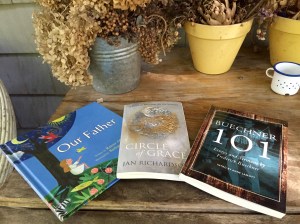
while we’re motoring i thought i’d leave a few books here on the table. i’ve not kept up with posts from my tribune roundups of soulful books. so here, a culled list of favorites from the last two distillations, a potpourri of books i particularly loved.

Buechner 101 by Carl Frederick Buechner, Frederick Buechner Center, 170 pages, $15.99

Maybe once a generation, or once every few generations, someone is born with gifts literary and sacred in equal measure. A translator, perhaps, of the highest calling. One who can at once lift our souls and our sights by virtue of the rare alchemy of the poetic plus the profound. Therein lies the prophet. Therein lies Frederick Buechner, at 90, one of the greatest living American theologians and writers.

In these collected works, “Buechner 101: Essays and Sermons by Frederick Buechner” — including excerpts from his Harvard Divinity School lectures, “The Alphabet of Grace”; a searing essay on his daughter’s anorexia; a seminary commencement address on the hard truths of pastoring a flock of believers, doubters and everyday sinners — we are immersed in the depth and breadth of this rare thinker’s gifts.

Anne Lamott, in her introduction, admits to being blown away by Buechner’s capacity “to be both plain and majestic” at once. She ranks him side-by-side with C.S. Lewis, then declares, “No one has brought me closer to God than these two men.” That alone might make you rush to pore over these pages.

This world sorely needs a prophet who reminds us to not give up our search for holiness amid the noise and hate and madness all around. Buechner, though, says it in words that shimmy through the cracks, burrowing deep within us, reverberating long after the page is turned. He writes: “We must learn to listen to the cock-crows and hammering and tick-tock of our lives for the holy and elusive word that is spoken to us out of their depths. It is the function of all great preaching, I think, and all great art, to sharpen our hearing precisely to that end.”

And it is that very sharpening that we find, paragraph upon paragraph, page after page, in Buechner 101.

Our Father by Rainer Oberthür, illustrated by Barbara Nascimbeni, Eerdmans Books for Young Readers, 58 pages, $16

The questions are pure. The questions, profound. From the child’s script, the surest path to heaven. And from the start, “Our Father,” a breathtaking peeling back of a foundational prayer of so many Christian religions, shimmers with a simplicity that can’t help but catapult our sacred questions to the highest heights.

Before beginning a line-by-line, word-by-word, meditation on the Lord’s Prayer, as it’s often called, this extraordinary picture book frames the prayer in the context of how it responds to the most essential — and possibly unsettling — questions: Where did the world come from? Why does it exist? Why am I here? Why do people die? What happens afterward?

In a voice that exudes comfort and heart-to-heart closeness the reader is told that these really are questions about God: Where is God? Why can’t I see God? How can I talk to God?

Are these not the very questions pondered by legions of theologians? And yet, the answers found here — in a children’s book from a Grand Rapids, Mich., publishing house with a long tradition of searching the globe for particularly illuminating children’s text and illustration — are perhaps among the clearest ever penned.

Which is what makes this a book for the soul young or old or anywhere in between. Each line — alongside charming illustrations that beg to be studied closely — becomes a prayerful exegesis, unfurled in words that speak to the pure heart of the child. It’s a book that will lull you into the sure and safe cove that is a building block of faith. And, chances are, you’ll never again murmur mindlessly the words of “Our Father.” Instead, you’ll be awakened to the depths of its timelessness and its capacity to enfold the answers to all our deepest questions.

Circle of Grace by Jan Richardson, Wanton Gospeller Press, 182 pages, $16

Blessings, an ancient literary form, “illuminate the link between the sacred and the ordinary,” Jan Richardson writes in her breathtaking “Circle of Grace: A Book of Blessings for the Seasons.” Often poetic and pulsing with the rhythms of invocation and incantation, blessings “use ordinary language in ways that can become extraordinary, offering words that arrest our attention and awaken us to how the holy is at work in our very midst.”

Before carrying us through the liturgical year, blessing by blessing, Richardson writes in her introduction that a good blessing “shimmers with the mystery that lies at the heart of God.” And then, she unspools “good blessing” upon “good blessing,” one after another shimmering, in ways that might make you weep, so tenderly, so astonishingly, do they slip into the hollows of the soul.

Richardson, a writer, artist and ordained Methodist minister, belongs among the most treasured spiritual lights on the bookshelf. Her words trace that thin line that courses the topography of the soul. She knows the way into the deepest interiority, into the mysteries of life, of grief, of wonder. Your breath will be taken, again and again. And you will return, again and again, to these pages, pulled by the magnetism of her words, her capacity for imbuing the everyday with the sacred.

A blessing, she writes, “is something wild. It leads us where we did not imagine to go, and never in a straight line.” It does so, in Richardson’s hands, by lifting the quotidian hours of our lives — the waiting for night to end, the unimagined grace of coming home — and making abundantly clear a profound holiness.

Becoming Wise by Krista Tippett, Penguin Press, 288 pages, $28

If you, like me, read with a pen at the ready, you’ll likely run out of ink on this one. If you measure the worth of a book by the volume of scribbles you pen in the margins, the stars emphatically drawn, and the sentences underlined, Krista Tippett’s “Becoming Wise: An Inquiry into the Mystery and Art of Living” — a compendium of wisdom, at once intimate and expansive — stands a serious shot of emerging both splattered and cherished.

Tippett, the Peabody Award-winning radio host and National Humanities Medalist, is a master of what she terms “generous listening,” an act “powered by curiosity,” and a “willingness to be surprised, to let go of assumptions and take in ambiguity.” Sadly lacking in the modern-day public square, it’s an art Tippett has practiced and honed in her years hosting National Public Radio’s “On Being,” a program and podcast launched in 2003 as “Speaking of Faith,” in which she’s generously listened to — and deeply questioned — some of the most luminous minds on the planet.

From this lifetime of rich conversation, Tippett elicits a poetic inquiry, interwoven with memoir. What does it mean to be human? What matters in a life? What matters in death? And, in the end, wisdom is what Tippett seeks. “Wisdom leavens intelligence, and ennobles consciousness, and advances evolution itself,” she writes.

The book, called “a master class in the art of living,” draws from conversations with poet Elizabeth Alexander, physicist Brian Greene, civil rights veteran John Lewis, physician Rachel Naomi Remen, chef Dan Barber, playwright Eve Ensler, and humanitarian Jean Vanier — to name only a partial roster of her fellow seekers of wisdom.

what titles top your summer reading list?