pull up a chair

where wisdom gathers, poetry unfolds and divine light is sparked…

Tag: grief

keening.

the winds have been howling all night, a rushing, a roaring of air on amphetamines. sometimes the sound rises in pitch, almost a keening, the sound of a soul in mourning.

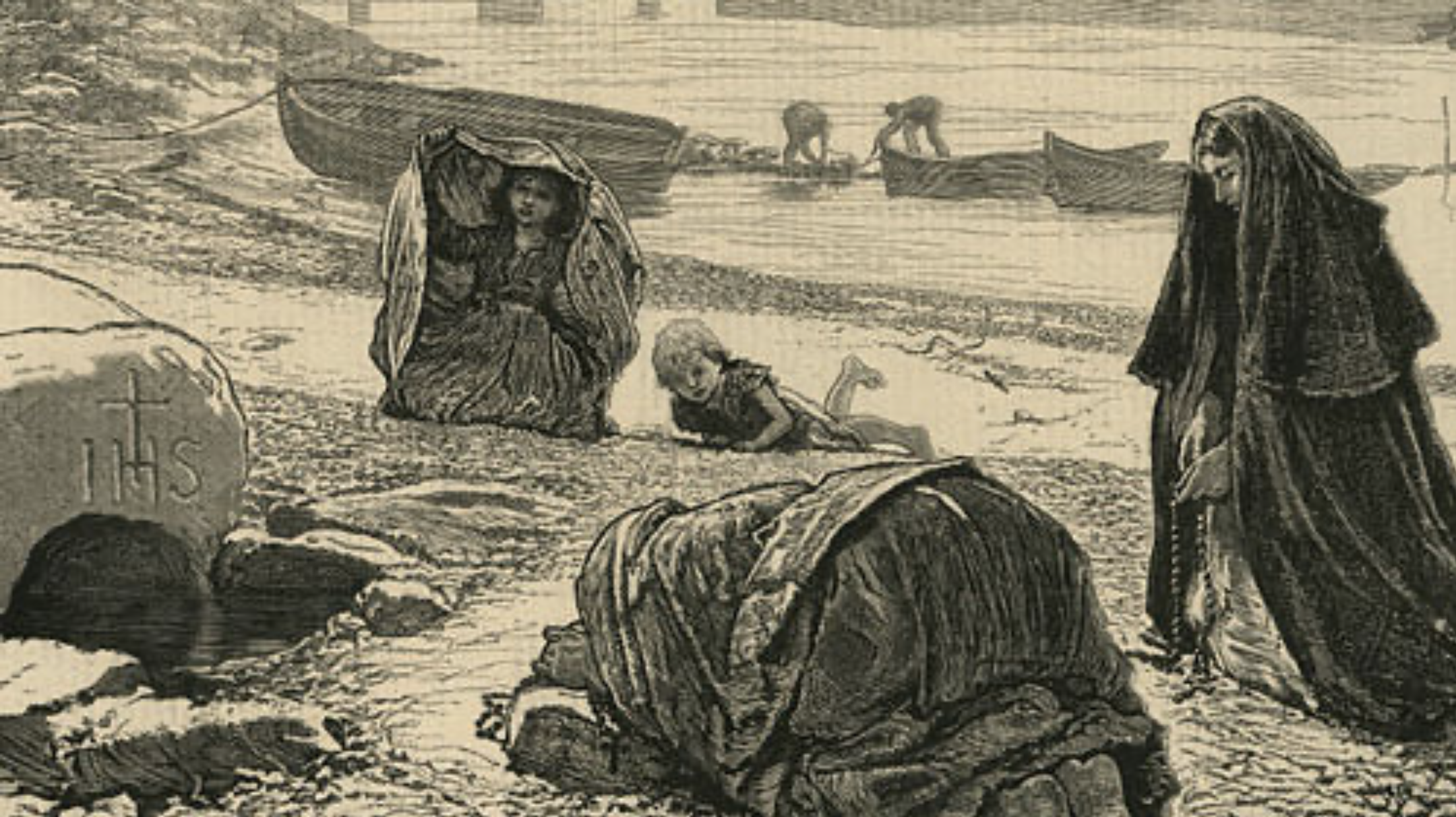
keening, a word that draws me half around the world to the banshees of that faraway island from which my people came (a good half of my people, actually, but it seems the half i’m rooted in). it’s a word that places me in a dark and damp room where a fire roars, and the people are circled in sorrow, cloaked in black woolen wraps. swaying and rocking, the sound that rises up is the sound that lives at the pit of us, the sound that rises when our heart or our soul is shattered. cracked wide open. it’s the ooze of anguish that comes without volition. keening sometimes comes without knowing. it just is. it’s primal. a reservoir so deep inside us it takes velocities of sorrow to tap into it, to draw from its well.

i might have keened once or twice, but i barely remember. both times someone had died, and it felt like part of me did as well. i remember the sound, remember i barely knew where it rose from, or that i’d had it inside.

the God who imagined us imagined so far beyond the imaginable. the God who imagined us gave us a sound, buried it deep, deep inside, where it awaits necessity. there are in our lives times when only that keening will do. that high pitched guttural whoosh that captures the unspeakable, a whoosh that rises and falls, traces the scale from basso, the animal roar, to mezzo soprano, up high where it’s piercing.

and why would the wind be keening?

look around.

listen.

don’t let us dull to the litany.

waking up to find we live in a pariah nation is one. but that’s almost too big for my head. i tend to operate in the finer grain. and the closest i came to keening this week was the news that the poet had been shot through the head.

what poet, you might ask?

the one in minnesota. the one whose first description i read was “37-year-old, mother of a six-year-old, award-winning poet.”

who shoots a poet? how often does the descriptor of a violent death include the word poet?

poets are porous. poets live in the world permeable to the little-noticed. poets process what’s breathtaking and put it, miraculously, to words. poets, the ones i love, the ones whose words put form and frame to unutterable parts of me, they’re among the most gentle-souled humans i’ve known.

renée good was a poet. a mother. and she died at 37, in the front seat of her maroon van we’ve all now watched over and over.

renée nicole good

renée good, back when she went by the name renée nicole macklin, won the 2020 academy of american poets prize. that’s not a prize for a piker. that’s a real-deal prize, a trophy worth tucking on the highest shelf in your house. she won it for a poem curiously titled “On Learning to Dissect Fetal Pigs.” now, that might not be the first thing that stirs me to want to write a poem. but poets begin in curious places sometimes and take us into terrain where wisdom or epiphany comes.

when we become a nation where a poet is shot through the windshield, just minutes after dropping her six-year-old off at school, we need to ask who in the world we’ve become. it only becomes more twisted when we can see for ourselves how the scene unfolded, and the people in charge, the ones holding the guns, the ones not letting a doctor rush to the scene, tell us that we didn’t see what we saw.

i wonder how apt this headline would be: good is dead.

that would be the headline atop the poet’s obituary. rachel good, award-winning poet and mother of three, was shot through the head. by federal agents. who then refused to let a doctor rush to the front seat of her bloodied, bloodied minivan. and waited too many fading heartbeats before giving the okay to call 9-1-1.

no wonder the wind is keening.

no wonder the world is tapping into its most guttural cries.

not long before i’d found myself tripping over the violent death of rachel good, i’d been thinking deeply about poets. thinking about a breed of poets i’d likened to “a tribe of saintesses.” that’s a feminization of saint, an intentional genderizing, if you will, because the poets i’m most drawn to might technically, and in an old-time world, be coined poetesses, and because the ones to which i am most deeply drawn are ones who weave the sacred, even the liturgical, into the vernacular from which they write. because the saintesses to whom i am most drawn are the ones whose verse scans the divine, shimmers at the edge of the ineffable, catches me unaware, but grounds me in a certainty more certain than many a gospel, i turn to them for edification and plain old uplift of my weary soul.

i keep them in close reach.

sitting just beside me here at this old maple table are two such poet saints, the ones whose lines leave me gasping, my spine tingling as if something holy has just wafted by and through me. because it has.

here’s one. her name is kathleen hirsch, and this is from her mending prayer rugs (finishing line press, 2025). it’s the last stanza of her poem “prayer rugs” (emphasis mine):

I bend in blessing toward all that breathes
May each hour enlarge the pattern—
rose dawn, wind song, tender shoots of faith—
that I may see the weft of the hidden weaver.

or, also sitting right by my elbow, jan richardson’s how the stars get in your bones: a book of blessings (wanton gospeller press, 2025), i flip through pages and pluck just one, titled “the midwife’s prayer.” it begins:

Keep screaming, little baby girl.
Keep practicing using those lungs
and do not stop,
because hollering will help
to ease the shock
every time you go through
another birth.

the saintesses, i swear, speak from a godly vernacular. they see deeper than the rest of us, dwell deeper too. their gift is the gift taken away at Babel. while all the rest of us were stripped of the powers of universal understanding, the saintesses kept on. they speak words that speak to all of us—if we listen closely. if we trace our fingers across the lines they offer, sacramental lines, lines that lift off the page, lift us off the page and into the transcendent, where for just a moment we get to reside.

i don’t know the rest of rachel good’s poems. but i know she was a poet. and the silence where once she spun the words of the unspoken, the little-heard voice, that silence now is cacophonous.

and even the winds are keening.


you can read the whole of rachel good’s prize-winning fetal-pig poem here.

and here are the first few lines…

On Learning to Dissect Fetal Pigs
by Renée Nicole Macklin

i want back my rocking chairs,

solipsist sunsets,
& coastal jungle sounds that are tercets from cicadas and pentameter from the hairy legs of cockroaches.

i’ve donated bibles to thrift stores
(mashed them in plastic trash bags with an acidic himalayan salt lamp—
the post-baptism bibles, the ones plucked from street corners from the meaty hands of zealots, the dumbed-down, easy-to-read, parasitic kind):

keening in minnesota on the block where rachel good was killed

what shall we do to quell the need for keening? and what poets draw you into the depths of the Holy?

we are all filled with tears. if only we notice.

i am, as i so often am, late to the game. late to the nick cave game. i’ve known of his profound capacity to pierce the armament of the contemporary human wardrobe: the shield that keeps us at a distance from our own vulnerability. i’d heard rumor that he was a writer’s writer. but i’d never really dived in. 

until now. 

when a beloved, beloved friend sent me a letter he’d written that rang so, so close to truth — to my truth, anyway — i signed right up for more, more, more. 

nick cave, in case he’s floated outside your circle of knowing, is, in a nutshell, a once-upon-a-time choir boy from australia, who went on to a wild ride through the early punk rock scene, and with his shock of black black hair and an emaciated profile, might aptly be described as a goth pioneer (note to mom: that means someone who takes on a wardrobe that’s something of a cross between a corpse and your most ghoulish uncle, and wallows in the literature and the language and the aesthetic of similar darkness, verging on the macabre). in time, he moved into the quieter, more contemplative lane of soulful song. his trademark, a baritone so deep it feels pulled from igneous rock, is fittingly in sync with the haunting, soulful lyrics he’s come to write. 

nick cave

i’d known that tragedy struck dear nick, when his then 15-year-old son, arthur, fell from a cliff near brighton, england, and seven years later another son, jethro, died at 31, a death he doesn’t talk about, abiding by the wishes of jethro’s mother. i’d read bits of his writings about grief.

It seems to me, that if we love, we grieve. That’s the deal. That’s the pact. Grief and love are forever intertwined. Grief is the terrible reminder of the depths of our love and, like love, grief is non-negotiable. There is a vastness to grief that overwhelms our minuscule selves. We are tiny, trembling clusters of atoms subsumed within grief’s awesome presence. It occupies the core of our being and extends through our fingers to the limits of the universe. Within that whirling gyre all manner of madnesses exist; ghosts and spirits and dream visitations, and everything else that we, in our anguish, will into existence. These are precious gifts that are as valid and as real as we need them to be. They are the spirit guides that lead us out of the darkness.

but never have i read any of the longer works i will now go find (faith, hope and carnage, an extended interview with the journalist seán o’hagan.) what’s intrigued me most, in poking around and gathering bits in the ways of magpie (a bird known for scavenging trinkets hither and yon), is his take on religion. it’s always the soulful entrée where i find my curiosities leading me. this paragraph alone shouts, read, read, read more to me….

Cave is an avid reader of the Bible. In his recorded lectures on music and songwriting, Cave said that any true love song is a song for God, and ascribed the mellowing of his music to a shift in focus from the Old Testament to the New. He has spoken too of what attracts him to belief in God: “One of the things that excites me about belief in God is the notion that it is unbelievable, irrational and sometimes absurd.”When asked if he had interest in religions outside of Christianity, Cave quipped that he had a passing, sceptical interest but was a “hammer-and-nails kind of guy.” Despite this, Cave has also said he is critical of organised religion. When interviewed by Jarvis Cocker of Pulp on 12 September 2010, for his BBC Radio 6 show Jarvis Cocker’s Sunday Service, Cave said that “I believe in God in spite of religion, not because of it.” 

*(emphasis, mine; in the case of “hammer-and-nails” it just struck my funny bone.)

the red hand files is the name of his blog, where he writes perhaps his most spontaneous writing (the hidden beauty of blogging [among the uglier words in the lexicon]). started years ago, it was a place for nick cave fans to send him questions, questions he’d sift through and choose to answer—or not. it seems to have morphed into a place of profound nakedness, another name for truth in unprotected, unshielded, undressed form. 

here, the letter that drew me in, or most of that letter anyway: 

As the ground shifts and slides beneath us, and the world hardens around its particular views, I become increasingly uncertain and less self-assured. I am neither on the left nor on the right, finding both sides, as they mainly present themselves, indefensible and unrecognisable. I am essentially a liberal-leaning, spiritual conservative with a small ‘c’, which, to me, isn’t a political stance, rather it is a matter of temperament. I have a devotional nature, and I see the world as broken but beautiful, believing that it is our urgent and moral duty to repair it where we can and not to cause further harm, or worse, wilfully usher in its destruction. I think we consist of more than mere atoms crashing into each other, and that we are, instead, beings of vast potential, placed on this earth for a reason – to magnify, as best we can, that which is beautiful and true.  I believe we have an obligation to assist those who are genuinely marginalised, oppressed, or sorrowful in a way that is helpful and constructive and not to exploit their suffering for our own professional advancement or personal survival. I have an acute and well-earned understanding of the nature of loss and know in my bones how easy it is for something to break, and how difficult it is to put it back together. Therefore, I am cautious with the world and try to treat all its inhabitants with care. 

I am comfortable with doubt and am constitutionally resistant to moral certainty, herd mentality and dogma. I am disturbed on a fundamental level by the self-serving, toddler politics of some of my counterparts – I do not believe that silence is violence, complicity, or a lack of courage, but rather that silence is often the preferred option when one does not know what they are talking about, or is doubtful, or conflicted – which, for me, is most of the time. I am mainly at ease with not knowing and find this a spiritually and creatively dynamic position. I believe that there are times when it is almost a sacred duty to shut the fuck up.

I’m not particularly concerned about where people stand – I’ve met some of the finest individuals from across the political spectrum. In fact, I take pride and immense pleasure in having friends with divergent views. My life is significantly more interesting and colourful with them in it. 

Perhaps this all amounts to very little, but I suppose, in the end, I value deeds over words. I see my own role as a musician, songwriter, and letter writer as actively serving the soul of the world, and I’ve come to understand that this is the position that I must adopt in order to attempt to cultivate genuine change. In fact, I am now beginning to understand where I do stand, Alistair – I stand with the world, in its goodness and beauty. In these hysterical, monochromatic, embattled times, I call to its soul, the way musicians can, to its grieving and broken nature, to its misplaced meaning, to its fragile and flickering spirit. I sing to it, praise it, encourage it, and strive to improve it – in adoration, reconciliation, and leaping faith. 

Love, Nick

but that’s not all….

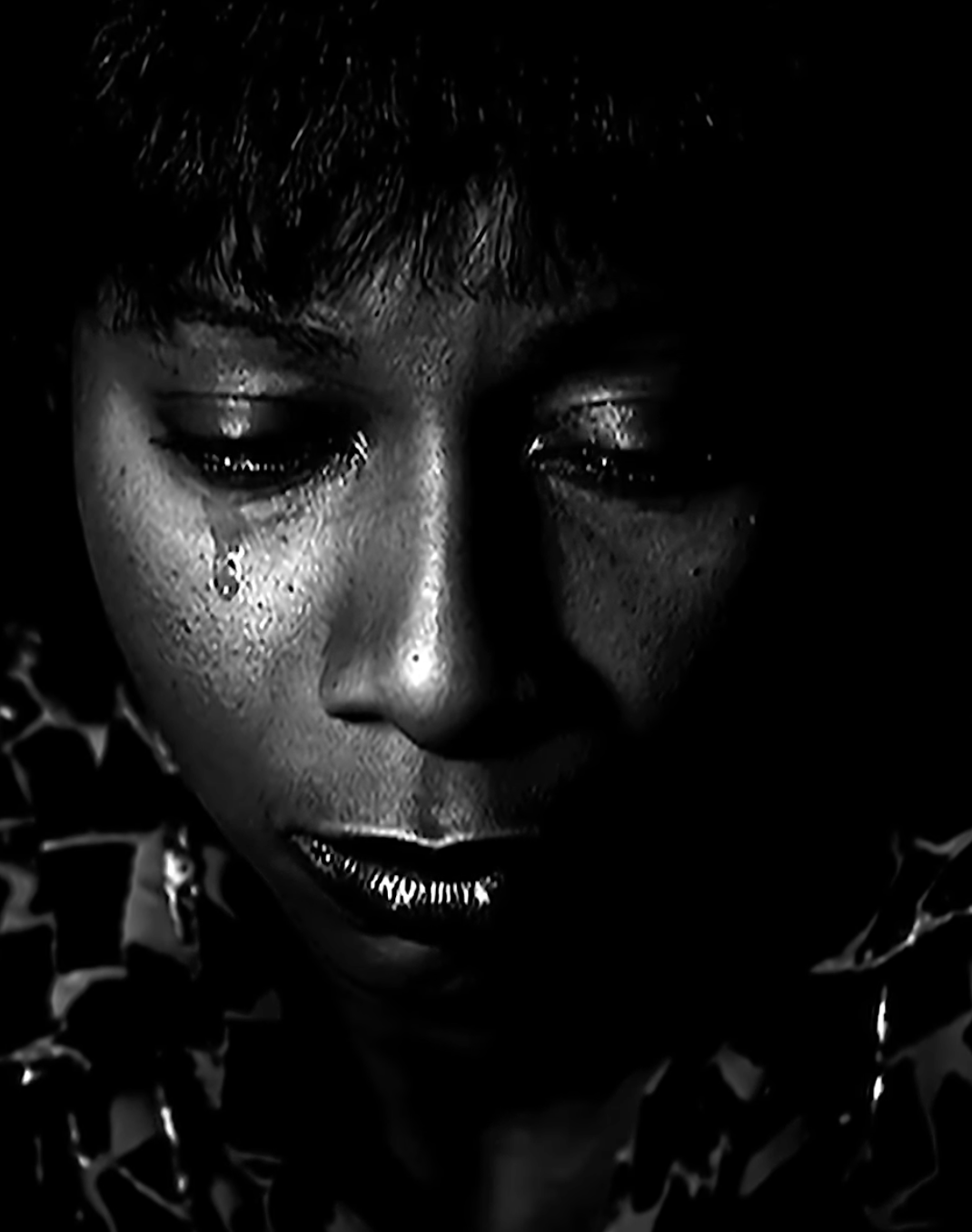
maybe what we need in this age is to move beyond words. to use our eyes more than our ears. to look and look closely at the common bonds of our humanity, and herein is precisely the study we might need, to see the human visage wrought  by sorrow, or grief: on the brink of tears, fighting tears, to watch the flinching of muscle, the biting of lips, the contortion of muscle, pulled by nerves tied to whatever is the emotional core of us. to see how the human face on the brink of tears is sooooo deeply universally understood, felt, responded to. maybe in that place of wordlessness we can remember that we are all one, of one species, and that within us all is the emotion called grief, called sorrow. and we’d do well to remember that we are all always on the verge of brokenness. and, too, we might be the arms that reach out to dry the tear, to hold the quivering shoulders, to brace the wobbling spine against whatever strength we might muster. maybe we need to remember how tender we all are, somewhere, somewhere deep inside…..


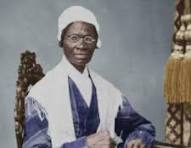
only one poem this week, and it wasn’t actually written as a poem, but laid out that way here it works mightily. it’s excerpted from abolitionist Sojourner Truth’s “Ain’t I a Woman” address, in the version published in 1863. The speech was originally delivered in the 1851 Women’s Rights Convention in Akron, Ohio. we might do well to ask, in the face of so much inhumanity, if swapping out the word “human” for “woman” stirs its own seeds of compassion….i am bereft; hollowed, haunted by the stories of immigrants pulled from their churches, their cars, their homes, flung to the ground, stomped on, kicked, living in fear…..

sojourner truth (unknown birth date; died 1883)

but this, as written, is more than mighty as is…..

Ain’t I A Woman?

That man over there
says that women
need to be helped into carriages,
and lifted over ditches,
and to have the best place everywhere. 
Nobody ever helps me into carriages,
or over mud-puddles,
or gives me any best place!
And ain’t I a woman? 

Look at me! Look at my arm!
I have ploughed and planted,
and gathered into barns,
and no man could head me!
And ain’t I a woman?

I could work as much
and eat as much as a man —
when I could get it —
and bear the lash as well!
And ain’t I a woman? 

I have borne thirteen children,
and seen most all sold off to slavery,
and when I cried out
with my mother’s grief,
none but Jesus heard me!
And ain’t I a woman?
. . .
Then that little man in black there,
he says women can’t have
as much rights as men,
’cause Christ wasn’t a woman! 
Where did your Christ come from?
From God and a woman!
Man had nothing to do with Him.

If the first woman God ever made
was strong enough to turn
the world upside down all alone,
these women together
ought to be able to turn it back,
and get it right side up again!
And now they is asking to do it,
the men better let them!

+ Sojourner Truth

because you are all so wise in so many ways, what thoughts might you add to a conversation on love and grief, and the intermingling therein?

i’m off to my 50th high school reunion this weekend, a date that gives me pause, as it was one of the tenderest times in my life 50 years ago, a time that marked me through all these years. it was a steep uphill climb for a long time there. and thank holy God i lived long enough to get here. my prayer is that those who show up find compassion and grace, and that those who choose to stay home look around and see lives that have grown beyond the bounds of whatever have been the obstacles.

and i pray, oh i pray, for this world. no kings rally tomorrow….i heard a story this week about the not-far-away catholic church where ICE agents filled the parking lot during spanish-language mass, targeting the prayerful inside. so the priest becalmed those in the pews, locked the church doors, promised protection to his flock, and a brigade of rapid-response volunteers drove parishioners safely to their homes. cars had to be left behind. prayers were laced with terror. this is not the america my uncle died for, bayoneted in the night in a tent on iwo jima….

as my beloved friend fanny put it, “they come after us because we’re brown.”

**thank you, laura, for sending me nick….

the loads beyond measure

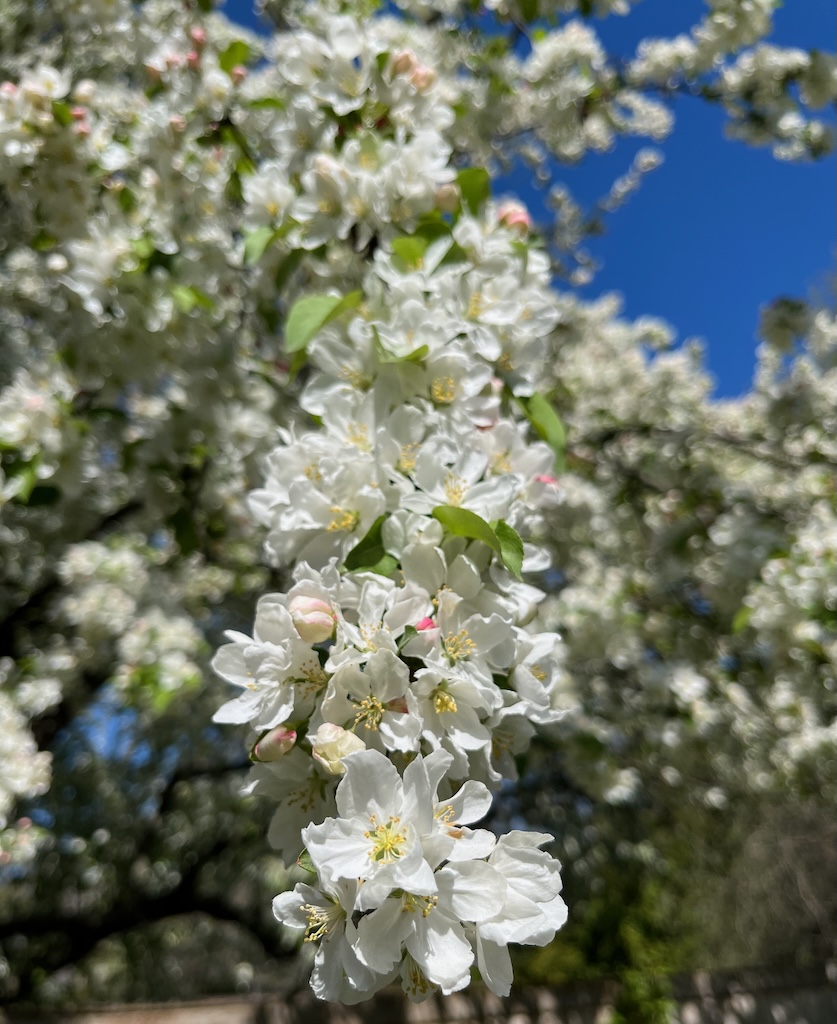
sometimes a batch of words comes tumbling into our world, fluttering onto the path we cross as if the petals from an apple blossom whose bloom has expired. the words come unannounced, and lay there waiting for us to notice. once we read them we can’t think of anything else. all day long, all our thoughts come round to them again and again. 

so it was when a friend whose grief is without measure sent along these words the other morning:

I have been telling myself that I don’t know how to do this, that nothing has prepared me.

i’ve been thinking long and hard about those loads we’re tasked to carry. how every one of us, at some time or another, is bound to have one. a load so beyond measure, a load we never saw coming, it simply stumbles us, knocks us flat and gasping. and in the depth of our hollows — if we’re telling truth — we mouth those very words: “i don’t know how to do this. . . . nothing has prepared me.”

all we see is steep climbing ahead. a load we don’t know how to hold. and all we’ve got to bear it are our stubby shuffling feet, and a ribcage that holds the parts of us that breathe and pump the oxygen. our shoulders and our spine we fear will crumple under the weight of it. 

and then there’s the beehive of a brain, where all the wiring and the worrying, where all the remembering and the grieving and the what-iffing and the if-onlying whirs in and out at every turn in every hour of the day. 

the poet and collagist jan richardson put it like this in her “blessing for the dailiness of grief”:

It will take your breath away,
how the grieving waits for you
in the most ordinary moments.

It will wake
with your waking.

It will
sit itself down
with you at the table,
inhabiting the precise shape
of the emptiness
across from you.

It will walk down the street
with you
in the form of
no hand reaching out
to take yours. . . .

but here, maybe, is what we need to remember, to bear the load we’re sure will finally be the one we cannot budge or bear: our whole life long, we’ve been preparing. every hurt and insult hurled our way. the time in third grade when we cried because the kid one desk over made fun of our clunky shoes. but, next morning, we tied their laces into bows and we walked back in the classroom, and sat there all day long, learning how it is to become more than the stubby shoes that were not penny loafers. the time in high school, when someone in the hall pointed at us and said our face looked like someone smashed us flat against a wall. and it stung for weeks after, every time we stood before a mirror and turned this way and that to measure just how flat our irish face really was. 

and then the big ones come: the time the doctor walked up to the knot of us coagulated in the hospital corridor, and simply said, “i’m sorry.” and we were left without air in our lungs, and with the sudden senseless knowing that the brightest light in our existence had just gone dark. forever.

or the night the clots kept coming. and at last the tiny, tiny arms and legs, the intricately blessed face i’ll never forget, as the baby i thought i was having was cupped in the palms of my bloody hands, the miscarriage that hurt the most. 

the litany is plenty long. and we sometimes never notice just how much each ache is strengthening the fibers of the muscle group without a name, the one that holds us up — yes, wobbling at first; yes, stained with umpteen tears; yes, with sleepless sleepless night — but the one that, in the end, does not fail us. 

we are stronger than we know. and, all along, we’ve been piling on the sinew, deepening the courage, deep breathing the determination, to look that unbearable load square in the eyes, to say, “climb on. i’ll carry you.”

just watch. 

and then, at last, there comes this (jan richardson again, this time “blessing of breathing”):

That the first breath
will come without fear.


That the second breath
will come without pain.

The third breath:
that it will come without despair.

until at last . . .

When the tenth breath comes,
may it be for us
to breathe together,
and the next,
and the next,

until our breathing
is as one,
until our breathing
is no more.

my dear and blessed friend, and all who bear loads they deem unbearable, you do know how to do this. deep in your marrow, you know. your whole life long you’ve been growing strong and stronger. you’ve got this, and you’ve got this. and if and when you stumble, we are here with our simple grace and our love that will not falter. 

where did you find the strength you did not know was yours?

PS (note the all caps!): it’s the birthday sunday of one of the wise women of the chair, our very own lamcal, and i can’t gather up enough love in my bouquet to sufficiently surround her. she is beyond measure! happy blessed day, beautiful one. xoxox and happy mothering day who all who love in that way that knows no end….

amid the dizzyings of springtime…

i imagine it’s been well-established that i am of the homebody persuasion. the sort of girl who thrums inside the cozy confines of space and time i know by heart. to plop behind the wheel and point myself in a direction i’ve not been is, well, to stretch me. to accelerate the tempo of my little heart, to bring on the rumblies in my tummy. and so it was as i set out for The Driftless (a topography that deserves every drop of its capital consonants) a week ago today.

for starters, i got lost. yes, yes, after dutifully trying to follow my index-card directions through country roads and farmer fields, i decided maybe it was safer to let the little voice tell me where to go rather than glancing down and trying to find the numbers i had scribbled. well, news flash: there are TWO mineral points in ol’ wisconsin, and the one i was steered toward was the one in otherwise unmarked farrow field. that little voice announced, “you’ve arrived. your destination is on the right,” whilst i looked up and saw literally nothing but an undulating plot of shaved-off stalks. hmm. this must not be, i intuitively surmised.

i was miles from nowhere, and 67 miles from where i needed to be. where the world’s loveliest host had a turkey meatloaf in the oven, and asparagus steaming in a skillet. ah, but in due time, rollercoastering along country roads, past baby calves (yes, i know it’s redundant, but i like to say it that way) all gathered under little calf-ling igloos, which must be the latest in dairy husbandry for each baby calf had its own domed shelter, and a place to escape the drifting snows, past rock formations that felt prehistoric or laid there by ancient peoples, through towns that time forgot and that i prayed still stuck to old ways, and not the toxic juice that’s infected so very much of old america, i pulled in the gravel lane that was my destination.

and, from the first footfall inside the charming farmhouse, i was home. daffodils and aldo leopold awaited on the bedside table, and the bed itself was a cloud of comforters. each morning that sunrise above greeted me from the kitchen windows. and each morning, it took my breath away, and filled me with holy airs.

the folks i met were as fine and fluent in the poetries of earth as any souls i’ve met along my way. i met a farmer who plows his field with draft horses, and writes letters back and forth with wendell berry (be still my heart!). and another farmer who used to cook at chez panisse. (yes, that chez panisse, the one in berkeley CA, where alice waters revolutionized the kitchen.) i scrubbed pots and pans beside a woman whose heart must pump in gold. and i heard tales of keeping watch on eagles’ nests.

and then, come sunday morning, after hiking through the woods, and talking books in a charming indie book store (where croissants were rising in the ovens behind me), i took to the pulpit in a little country church to deliver what you might call the sermon, but which the priest referred to as a “reflection” since i’ve not passed the sermon-licensing exams. and as i wove threads from the doubting thomas gospel and the book of nature’s sometimes tangible God, i looked out on a congregation of fine souls who were listening in a way i’ve never known: heads cocked, a posture of deep attentiveness, eyes on the pulpit, you could hear a pin drop in that blessed church. and i saw how good souls are hungry for a word of wisdom with their sunday-morning coffee. if this is church, and i do believe it is, may we become a people who know to carve out time to put down phones, dial down the pings, and find our way to wherever it is the holy wisdoms come.

not an hour later, the whole adventure in soul-stretching reached its crescendo when every last soul at the basement coffee hour stood and raised an arm toward me, or laid a hand on my shoulders, and at the behest of the priest, father christian was his name, blessed me with a prayer that had me all but gulping back a walloping sob. when i felt the tiny hand of father christian’s little boy, a kid with special needs, squeezing my left arm, i really truly nearly lost it, as they say. instead, i held his hand and together we squeezed and prayed all the way to the last amen.

and then i motored home, not quite the way i got there. and forever deepened and shifted by the glorious goodness of my new friends who dwell in the driftless.


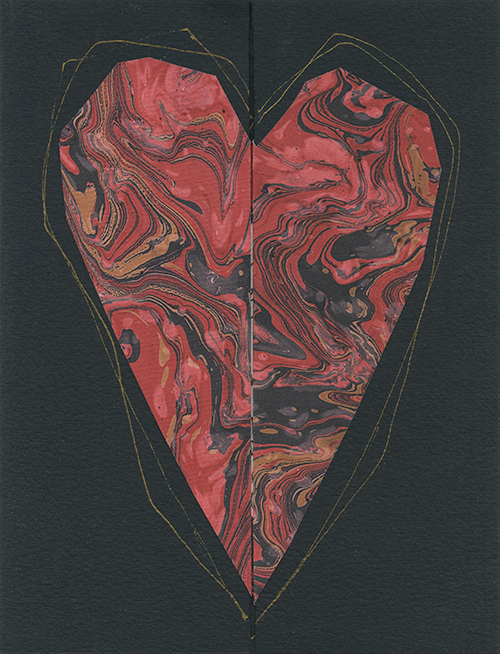
i came home, of course, to sunlight-blocking moon, and a garden erupting in springtime’s accelerandos. and i spent a good bit of week deep-breathing all of that, and getting mighty muddy too. but i also came home to friends who are grieving inconceivable losses. and when i found this prayer-poem from jan richardson, i knew i needed to pass it along. so, here, too, for all of you is a poem to keep for when grief comes to you or someone you love, or even someone you might not know too well at all. jan is a poet, artist, ordained minister in the united methodist church. i was introduced to her years ago now, by my very own night chaplain (slj to all of you, a regular visitor here at the chair). and as jan’s life was torn open by the sudden death of her husband, she has only deepened. and her work all the more mesmerizing. this is from not long after the death of her husband, when she was coming up on her first valentine’s day without him. her words are among the truest i’ve ever read. she is pure blessing.

Image: Valentine © Jan Richardson

Blessing for the Brokenhearted

There is no remedy for love but to love more.
—Henry David Thoreau

Let us agree
for now
that we will not say
the breaking
makes us stronger
or that it is better
to have this pain
than to have done
without this love.

Let us promise
we will not
tell ourselves
time will heal
the wound,
when every day
our waking
opens it anew.

Perhaps for now
it can be enough
to simply marvel
at the mystery
of how a heart
so broken
can go on beating,
as if it were made
for precisely this—

as if it knows
the only cure for love
is more of it,

as if it sees
the heart’s sole remedy
for breaking
is to love still,

as if it trusts
that its own
persistent pulse
is the rhythm
of a blessing
we cannot
begin to fathom
but will save us
nonetheless.

—Jan Richardson

This blessing appears in Jan’s book, The Cure for Sorrow.

gremlins seem to be lurking here this morning, so let us see if we can fling this to the cyberwires that carry this from my kitchen table to yours. question for the day, besides “will this work?” is where did you find holiness this week? 

and here is a special wink and nod for the great good souls i didn’t get to mention above: the glass sculptor who sailed the world before planting herself on high street, in downtown mineral point. the ones who’d taught for years and years in alaska before sinking deep roots in driftless loam. the bibliophile who opened an indie bookstore, and thought to attach a cooking school besides. and most of all to jane, my storytelling hostess whose graces left me nothing short of gobsmacked.

of thin places and the deep soul of my ancient peoples

i remember perfectly the first time i heard mention of a “thin place.” i was on holy ground, a farm smack dab in the middle of abe lincoln’s homeland. beau’s farm was the name of the farm, an organic farm, an organic farm that rose from an almost impenetrable shadow of grief. deep grief. beau was a marine, a strapping handsome fellow, who died down the road from the farm, home on leave from iraq, when he drowned. his mother, a woman i’ve come to love dearly, once told me that losing beau was “just like being hung, that moment when they pull that thing out from under you,” when the sheriff comes to the door, rings the bell at just past dawn to break the news.

beau’s mama was lost to grief for two long years. but then, she told me, she started to notice little beauties. she’d toss an old dried plant to the ground; and it’d grow.

“it dawned on me, after all those months, i was noticing beauty,” she once told me as we walked the gravel drive to where the peacocks pecked and strutted in their pen. and as i once wrote in the pages of the chicago tribune, “that’s when she realized. realized maybe the one place where she could plant her sorrow, turn it into something beautiful, something lasting, was the almost seven acres that surrounded her old white resurrected farmhouse. . .”

terry starks is beau’s mama’s name; she lives up in maine now, where she still turns earth and life into something beautiful, something lasting.

terry starks was the first to tell me of thin places. she told me the hay loft in her barn was where she went to cry when the tears seemed to have no end. she told me she was drawn there because the loft was surely a thin place, a place where the veil between heaven and earth is lifted. where you can all but feel the arms of God reaching out toward you.

it’s the celts who see the world that way, who know that ours is a topography of the sacred. who live attuned to soulful rhythms most others miss.

i remember sitting on the porch swing at beau’s farm, as beau’s mama poured her hard-won wisdoms as if a pitcher without bottom. i absorbed more gospel that day on beau’s and beau’s mama’s farm than i’ve absorbed most days of my holy blessed life.

ever since, i’ve been drawn deeper and deeper into the wisdoms of the celts, a holy people who traipse the hills and vales and rocky shorelines of my ancient roots.

because today happens to be a day when plenty of folk haul out green beer and soda bread, i decided to haul out just one of many passages from The Book of Nature, my little book due to be birthed just the other side of the weekend, on the vernal equinox, day of equal light and shadow, when all of us might look upon each other’s faces for the very first time, reason to rejoice if you ask me. it’s a passage from a chapter on the dawn. and i picked the photo way up above because i took it on the day i drove to beau’s farm, and it fits blessedly with how the celts see the sun. and because i was thinking of thin places, i decided to tell terry’s tale as the long way in to how the celts have taught me so very many things. thin places, among the litany.

here tis. . . a passage from The Book of Nature…

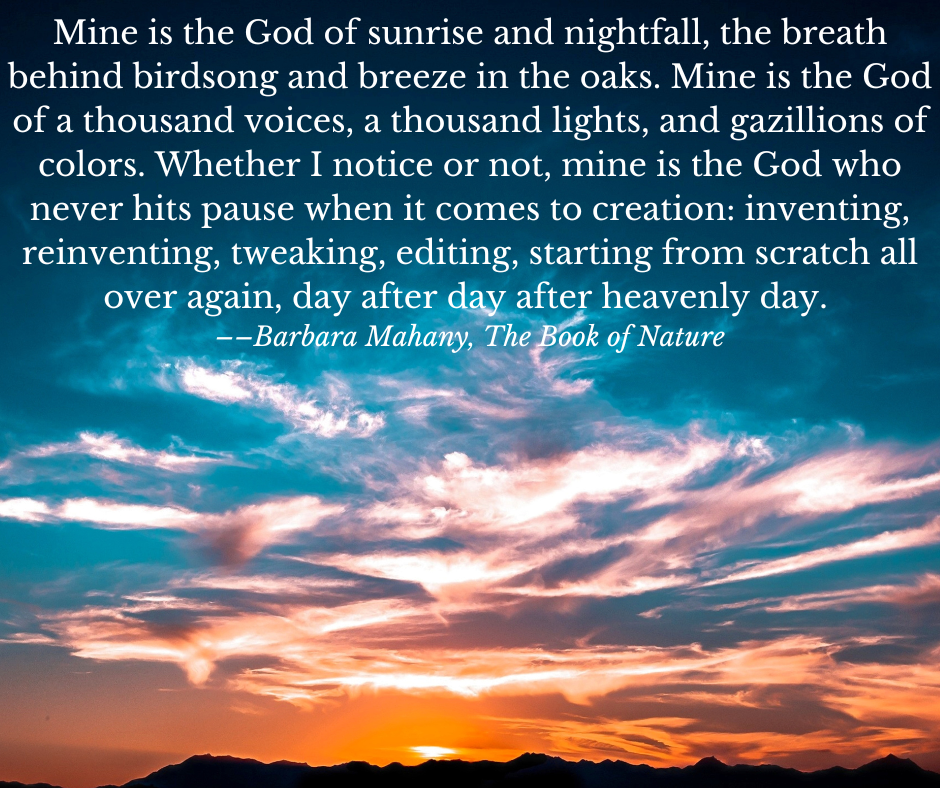
God was considered “the Sun behind all suns,” as the author George MacLeod once wrote. The whole of creation was dappled with the light of the sun as it journeyed across the sky. Wherever its light fell, there was God filtering through, an earthly translation of the divine infusion. And the perpetual Celtic praise song rose up with the dawn. Celtic gentlemen—farmers and herders and fishermen, set off to work in the predawn darkness—doffed their hat at the first light of the sun, and bowed in blessing. The Carmina Gadelica, a collection of Gaelic prayers and chants, is filled with start-of-day blessings, as the Celts were wont to offer up benediction for every chore and implement and God-given element of every day, from milking to weaving to shearing the sheep, from fire to wind to sprinkling of water. And certainly for the miraculous return of the morning’s first light. Mystic and teacher Alexander Scott, who grew up in the west of Scotland and kept Celtic ways alive in his nineteenth-century books, wrote that his were a people “listening for God in all things, ‘in the growth of the tree, in the rising of the morning sun, in the stars at night, and in the moon.’” 

–Barbara Mahany, The Book of Nature


of the many, many stories i wrote over the almost 30 years, the story of beau’s farm was one of the ones i hold closest to my heart. here’s a link, should you care to read it. with love, from terry’s scribe. (apologies if you need a subscription to open the link.)


thanks to a friend i love with my whole heart, i stumbled on another wise soul with buckets of beauty to grace the world. a poet-activist-performer named andrea gibson, now a cancer survivor whose words might take your breath away. andrea identifies as queer, and uses the pronoun “they;” and they are known for their trademark honesty and bare-naked vulnerability, traits i find irresistible and blessed beyond words. here are just a few lines i couldn’t keep from scribbling down:

when it comes to hearts i want always to be size queen…

i love you because we both showed up to kindness tryouts with notes from the school nurse that said we were too hurt to participate….

when your heart is broken, you plant seeds in the cracks and pray for rain.

before i die, i want to be somebody’s favorite hiding place, the place they can put everything they know they need to survive, every secret, every solitude, every nervous prayer, and be absolutely certain i will keep it safe. i will keep it safe.

andrea gibson

one more morsel for this blessed day, a poem from billy collins, once poet laureate of the united states, and a poet with plenty o’ irish roots . . .

Questions About Angels
by Billy Collins

Of all the questions you might want to ask
about angels, the only one you ever hear
is how many can dance on the head of a pin.

No curiosity about how they pass the eternal time
besides circling the Throne chanting in Latin
or delivering a crust of bread to a hermit on earth
or guiding a boy and girl across a rickety wooden bridge.

Do they fly through God’s body and come out singing?
Do they swing like children from the hinges
of the spirit world saying their names backwards and forwards?
Do they sit alone in little gardens changing colors?

What about their sleeping habits, the fabric of their robes,
their diet of unfiltered divine light?
What goes on inside their luminous heads? Is there a wall
these tall presences can look over and see hell?

If an angel fell off a cloud, would he leave a hole
in a river and would the hole float along endlessly
filled with the silent letters of every angelic word?

If an angel delivered the mail, would he arrive
in a blinding rush of wings or would he just assume
the appearance of the regular mailman and
whistle up the driveway reading the postcards?

No, the medieval theologians control the court.
The only question you ever hear is about
the little dance floor on the head of a pin
where halos are meant to converge and drift invisibly.

It is designed to make us think in millions,
billions, to make us run out of numbers and collapse
into infinity, but perhaps the answer is simply one:
one female angel dancing alone in her stocking feet,
a small jazz combo working in the background.

She sways like a branch in the wind, her beautiful
eyes closed, and the tall thin bassist leans over
to glance at his watch because she has been dancing
forever, and now it is very late, even for musicians.


nothing would delight me more than to see some of you, or all of you, come tuesday night, when i am shoving aside my worries about stepping up to speak in front of a crowd any bigger than the one or two who might share this old maple table on any given morning. we’ll gather to mostly rejoice in what’s become a holy sacred bond, one woven over time, through shared wisdoms, devoted kindness, good grace and humor. and i promise to read one or two passages from The Book of Nature, and even talk a little bit about how it came to be. it’s the first of my five books that wasn’t first birthed here, but its pages are filled with wisdoms learned here, steeped here, refined here. so you all have a thread in the whole cloth it became. and i can imagine no finer benediction than to begin the book with you. so see you tuesday, march 21, the vernal equinox at 7 p.m. chicago time.

now, what celtic wisdoms fuel your every day? and where are the thin places in your life where the veil between heaven and earth is at its thinnest, and you too feel it lifted for a blessed glance of the sacred beyond?

when it comes to hearts, i always want to be known as size queen…

in memoriam…

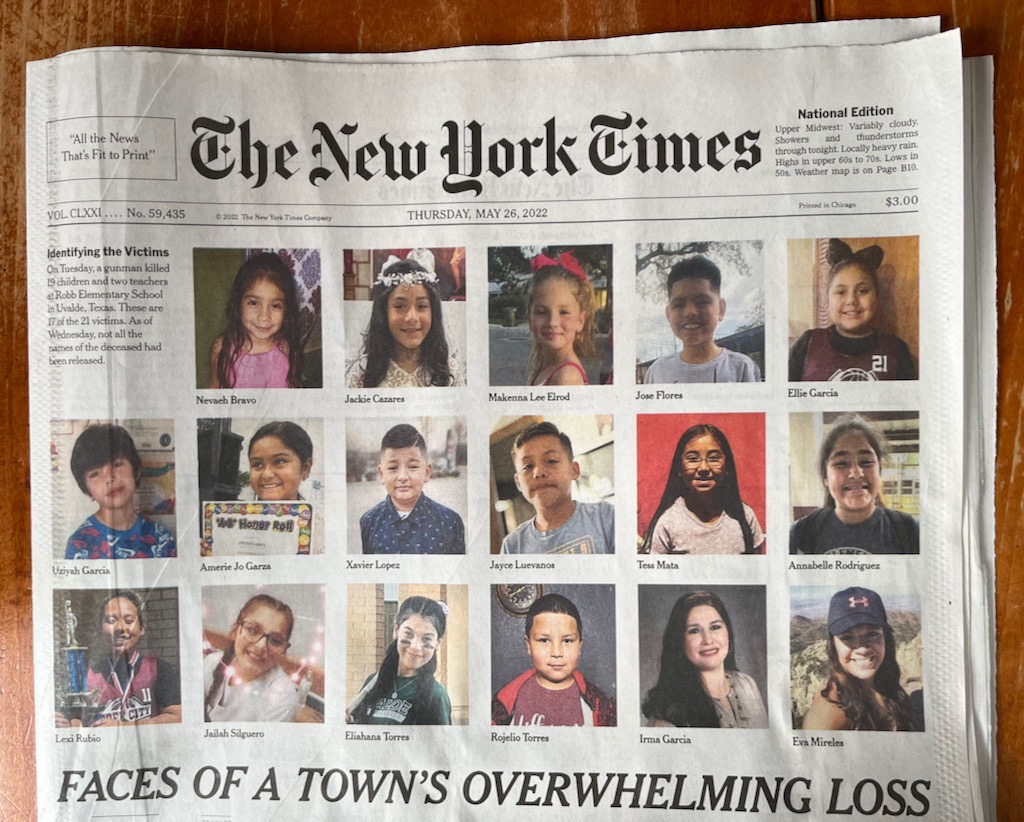
you might want to look away. but the horrors of the last two weeks demand we do more than pause and pick right up again. this week, the place was a school in a small town in texas, a fourth-grade classroom the site of the worst of it. ten days before, it was a supermarket in buffalo, new york.

ever since my second or third day on the job at the chicago tribune, i’ve been writing obits, those few short sentences or maybe a handful of paragraphs in which we try to capture the essence of who someone was. it’s a record for the ages, ones that used to be pasted into the pages of a family album, or carefully scissored out of the paper and tucked in the page of a bedside book or a bible. or a wallet. the ones in wallets always choked me up the most, when years later someone would pull out from their purse or their back pocket a worn leather billfold, and know right where to reach for the newspaper clipping of someone they’d loved. sometimes you found out the words you wrote in a newspaper stuck around for a very long while.

i’m afraid the someones who can change things are looking the other way, too many of them. and i won’t make even a ripple sitting here tapping out postage-stamp-sized obits for each of the 32 souls now departed, now torn from the ones they so dearly loved, the ones they would have clung to, if given half a chance. but to read of the simple quotidian joys, to assemble the notes of how and for what they were remembered, was and is a devotional gesture. it’s a genuflection in short sentences, a way to begin to absorb the hell we have wrought here.

no one should have to worry that running into the store for strawberries for shortcake might be our very last act. or that hiding in the closet of your fourth-grade classroom will be the place where you take your very last breath. something is wrong here. very very very very wrong. something is twisted and cruel and the drip-drip-drip of it all is anesthetizing, a toxic numbing takes hold. you can start to not notice.

the postage-size stories that follow are what i could find on each of the 32 victims, those from uvalde and those from the massacre in buffalo. it’s a long list, and you might not make it to the end. i’m writing it anyway. because to tell even a wisp of their stories is to begin to make real the horror of all that’s lost. their stories are utterly ordinary, a fourth-grader who swooned for a second baseman, a grandpa who ran in a store for a birthday cake.

yesterday’s news snapped into the sharpest focus the dimensions of grief we can’t grasp: the husband of one of the two uvalde teachers died of a massive heart attack in the wake of his wife’s murder. they’d been together for 24 years; high school sweethearts who married, and had four children. that’s what grief can do.

here are their stories, first the children and teachers of texas, and on to buffalo and the ten who died there…

In which, in a posture of reverence, we pause in silence to first hold up each of the 22 blessed ones who died in the massacre at Robb Elementary School in Uvalde, Texas….

Here’s the little we know:

Irma Garcia, 48, a fourth-grade teacher at Robb Elementary, a mother of four, had been married to her high school sweetheart, Joe, for 24 years. Irma died in the slaughter inside the school. Joe died of a fatal heart attack on Thursday. Their four children, two sons and two daughters, range in age from 12 to 23.

Eva Mireles, 44, a fourth-grade teacher who co-taught with Irma Garcia. Her daughter Adalynn posted this on Twitter on Wednesday: “Mom, you are a hero. I keep telling myself that this isn’t real. I just want to hear your voice,” the tribute read. “I want to thank you mom, for being such an inspiration to me. I will forever be so proud to be your daughter. My sweet mommy, I will see you again.”

Amerie Jo Garza had just turned 10. She tried to use her cell phone to call police during the shooting. Her father, Angel Garza, is a medical aide who rushed to the school, and he told this story to CNN: 

After arriving at the scene, he saw a girl covered in blood who told him that someone had shot her best friend. When Garza asked who her best friend was, the girl replied, “Amerie.” His daughter.

“I just want people to know she died trying to save her classmates,” said Amerie’s father. “She just wanted to save everyone.”

Xavier Lopez, who was 10, had just been lauded at the school’s honor roll ceremony. He was funny, never serious, and he had a smile….a smile, his mother said, she would “never forget.”

Uziah Garcia, also 10, and “full of life.” He loved anything with wheels. “The sweetest boy that I’ve ever known,” said Uziah’s grandfather.

Jose Flores Jr., 10, loved baseball, video games, and was “an amazing big brother,” especially to his baby brother. “He would just be like my little shadow,” Jose’s mother, Cynthia, said. “He would just be helping me with the baby. He had a thing with babies, like my friends’ babies. He just had a thing with babies. He was always nice.” His sister, Endrea, was in another fourth-grade classroom. She survived.

Lexi Rubio, 10, made the All-A honor roll. She loved baseball and basketball and wanted to be a lawyer when she grew up. “Please let the world know we miss our baby,” said her father through tears. “All I can hope is that she’s just not a number. This is enough. No one else needs to go through this.”

Tess Marie Mata, 10, had been saving her money to go to Disney World, according to her sister, Faith. She loved Ariana Grande, TikTok dances, and the Houston Astros, especially second baseman José Altuve.

Nevaeh Alyssa Bravo was 10. She put a smile on everyone’s face. Navaeh is heaven backwards.

Eliana ‘Ellie’ Garcia was 9, just about to turn 10. She dreamed of becoming a teacher, but in fourth grade she loved the movie “Encanto,” cheerleading, and basketball. She was the second oldest of five girls in her family.

Annabell Guadalupe Rodriguez was 10. She died in the same classroom as her cousin, Jacklyn Jaylen Cazares.

Jacklyn Jaylen Cazares, “a little firecracker,” according to her father Jacinto, was “full of love and full of life. She would do anything for anybody.” She was 9, and died in the hospital almost three hours after the shooting.

Eliahana ‘Elijah’ Cruz Torres was 10. “Our baby gained her wings,” said her aunt Leandra Vera.

Jailah Nicole Silguero was remembered as “a bespectacled 10-year-old,” whose mother Veronica Luevanos posted updates to Facebook all through Tuesday night into the wee hours of Wednesday. She’d started posting in the hours when she didn’t know what had happened to her daughter, and she was begging for answers. When Jailah’s mother finally found out, she wrote: “I’m not ready for this,” with an image of a broken heart, and a link to Jailah’s obituary. Just before 3 a.m., Veronica wrote: “I’m so heart broken.” Later she added: “My baby you didn’t deserve this neither did your classmates. R.I.P my beautiful angel.”

Jayce Luevanos, 10, whose cousin Jailah (above) was also killed, lived with his grandfather, and every morning Jayce made his grandpa a pot of coffee. 

Miranda Mathis was 11, and very smart. Her best friend was her brother, who was in another classroom when the gunfire broke out in Miranda’s classroom.

Makenna Lee Elrod was 10. She loved to dance and sing and she “made friends everywhere she went.” She was beautiful, smart, and funny, and her smile “would light up a room.”

Layla Salazar, 10, won six blue ribbons at her school’s field day. Her father, Vincent Salazar, shared a video of his daughter on Facebook; he captioned the video: “Run with the angels baby!”

Alithia Ramirez had just turned 10. When her parents welcomed Beto O’Rourke into their home in the hours after the shooting, birthday balloons and her artwork were still taped to the walls. “They want the world to know what a beautiful, talented, happy girl she was,” O’Rourke wrote.

Maite Rodriguez’s age is unknown at this time, though there is a photo of her proudly holding her honor roll certificate in front of the school banner. Her mom’s cousin, Raquel Silva, wrote on Facebook, on behalf of Maite’s mother, Ana: “It is with a heavy heart I come on here on behalf of my cousin Ana who lost her sweet baby girl in yesterday’s senseless shooting. Our hearts are shattered.”

Rojelio Torres, who was 10, was not identified nor his family notified till almost 12 hours after the shooting. His aunt Precious Perez told a local TV station: “We are devastated and heartbroken. Rojer was a very intelligent, hard-working and helpful person. He will be missed and never forgotten.”

and, just 10 days before, 10 more lives gunned down in the aisles of a grocery store.

Pearl Young, 77, a grandmother to eight, spent every Saturday morning volunteering at a food pantry run by her church. A “strict but loving” mother, she still worked as a high school substitute teacher. She was, her son Damon Young said, “full of joy. She just loved life, and she loved the church.” She’d stopped at the Tops Friendly Markets after going out to breakfast. Her son was going to pick her up, but suddenly her text messages stopped, and Damon’s phone filled instead with news alerts about the hell unfolding inside the store.

Ruth Whitfield, 86, was “a blessing for all those who knew her,” said her son, the retired Buffalo fire commissioner, Garnell Whitfield. Ruth had stopped at the Tops after caring all day for her husband of 68 years in the nursing home where he now resides. She was the mother of four, and doted on her family––especially her husband, constantly cutting his hair, ironing his clothes, dressing him and shaving him. “There’s very few days that she did not spend time with him attending to him,” her son said. “She was his angel.”

Andre Mackniel, 53, went to the Tops to get a birthday cake for his son. He was “selfless and generous,” a loving father and grandfather who used “to check in on everyone.” On Facebook, Mackneil’s fiancee wrote this: “Today my baby was born but today my soul mate was taken. How do I tell my son his daddy’s not coming home? How do I as a mother make it ok? Someone please tell me because I really don’t know,” she wrote.

Katherine ‘Kat’ Massey, 72, “the glue” of her very close family, had stopped at the Tops and asked to be picked up in 45 minutes. When her brother came by to get her, he saw police putting up crime tape. She sometimes wrote for the local newspaper, and one of the topics she was most concerned about: guns.

Celestine Chaney, 65, was described by her son as a “survivor,” who twice had survived brain aneurysms. Her son, Wayne Jones, said that when he was 12, he was twice called out of school to rush to the hospital, where he was told his mother wouldn’t make it through the day. His grandmother, he says, made him “go to the foot of the bed and pray.” She later survived breast cancer, but she didn’t make it out of the grocery store. “She was a beautiful person, a spunky, independent woman,” Jones said of his mom. “The life of the party, just a joy to be around.”

Margus D. Morrison, 52, was a school bus aide, a lovable guy who liked to joke. His younger brother Frederick, who said the two were “tight like best friends,” couldn’t find many words in the wake of the killing. But he did say this: “It hurts me so much right now because I wasn’t expecting to lose him.”

Heyward Patterson, 67, was at the Tops because he often drove members of his church to the store, helping them load their groceries, and then taking them home. “That’s what he did all the time,” his cousin Deborah Patterson said. “That’s what he loved to do.” He was gentlemanly, and sprightly, a “real-life, down-to-earth man.” He was a deacon in his church, and loved to sing. One relative compared him to Smokey Robinson ––“only better.”

Aaron Salter Jr., 55, a retired Buffalo police officer, was described by the Buffalo Police Commissioner as “a hero in our eyes.” He was the security guard on duty at the Tops, and he tried to take down the gunman, to spare any lives. “I’m pretty sure he saved some lives,” the commissioner said. 

Roberta Drury, 32, the youngest of four siblings, had moved from Syracuse to Buffalo to help her older brother who was undergoing treatment for leukemia, and to help care for his children. Once her brother had gotten through the treatment, she’d decided to stay on and help him rehab an old bar he had bought. The Washington Post reported that as an African American child adopted at 18 months into a White family, Roberta (known as Robbie) was “no stranger to racism.” In her family, “race never mattered,” said her sister, Amanda. “So this is just ugly on a level that as a family we can barely wrap our heads around.”

Geraldine Talley, 62, was described as “the sweetest.” An avid baker, her Facebook page was filled with desserts she made for the people she loved: cream cheese apple cinnamon bread pudding, peanut butter pie, strawberry filled cupcakes. She had gone to the Tops with her fiance to get sandwich meat for a picnic down by the waterfront, and she sent him to grab a certain tea. That’s when the shooting started. According to family members, her fiance started calling her name, but didn’t see her, and then hid inside a freezer. The gunman shot the door off the freezer, but the fiance survived, and Geraldine died in the store.

may their memories be a blessing, and may their names and their stories not soon fade into the cavernous silence….

equinox of the heart

My heart is in equinox. Equal parts light and shadow. That’s not necessarily an out-of-the-ordinary state of affairs for the human vessel that holds all we feel in a day, in a lifetime. But it’s not usually so amplified, not usually so stark.

On the one hand, I am counting down the hours and minutes till a boy I love, the first one I birthed, comes home for the first real time in years and years. The first time in as long as I can remember when he won’t be squelched by the pressures of (in reverse chronological order) bar exam, law school, admission to law school, wrangling a classroom of hellions for the year he was teaching on the mean streets of Chicago, and before that pushing against the deadline for an honors thesis that somehow stretched to 300-plus pages. He is—in three days and two hours—packing a Portland apartment into a moving van, and one day  and six hours after that he’s boarding a plane, crossing the Rockies, the Great Plains, and the checkerboard of farmland that is preamble to landing at Chicago’s O’Hare International. 

He’ll be here—for the first time in six years—for the Thanksgiving feast. And Christmas, and the turn of the new year. Then he’ll move on, to New York City, where once again he will take up his pen and his law books and clerk for a federal judge. And all that time, all the weeks when he’s here, the first order of business will be simply to breathe. To sleep in the old room at the top of the stairs, to trundle down to this old maple table, to cook by my side, and walk along the lakeshore where we all go to think when our thoughts—and our souls—need every square inch of the infinite sky.

And, on the other hand, the man I married three decades ago, the man whose life has unspooled next to mine for the best of my years, he’s off on the Jersey Shore, in an old quirky-but-endlessly-charming house at the edge of a pond. He is there all alone, except for the movers who are coming in shifts, day after day, to empty the house of every last trace of the long lives lived there. The house will be bulldozed before spring turns to summer. And it’s his job, as the only son, to attend to its final hours. He is packing up the last of the dishes found tucked in a cabinet no one had known, finding nearly lost treasures slipped between books on the shelves (his parents’ ketubah, or marriage “contract,” signed in ink in January of 1955, and almost sent off with a load of donations), taking one last long look out the living room window, watching the sunlight and the swans on the pond. 

It’s a house that has played an anchoring role as a central character in the narrative of the long lives lived there. No one ever imagined it wouldn’t be there, high on the ridge at the top of the slope, peering down on the pond. The footfall of at least a century and a half are pressed into the stairs that twist up to the bedrooms. Sixty-five of those years belonged to my husband’s father and mother—he in his white bucks or his Keds, a gentleman of old-school sartorial splendor; she in her size-10 flats (never heels, for she never wanted to tower too tremendously over the little children she taught, as a woman of considerable height). 

My husband, who has long taken to heart the tenet that architecture shapes lives as lives shape the architecture, is not one to bid farewell to timber and bricks (both of Revolutionary War vintage) without a significant lump in his throat, and a piercing in his chest. I saw how his eyes went dark, the sadness not hidden, when he said to a friend the other day, “It’s like another death.” It’s the last one of its chapter. Six years ago, the sartorial one breathed his last, and just this July, so did the schoolteacher. Each time, my husband and his sister scattered the ashes along the holy ground that is the edge of the pond.

I can barely imagine how hard it will be to turn the key in the door that one last time. To walk down the steps, turn, take one last look. To drive away, down the lane, the white clapboard gardener’s cottage disappearing into the distance. To know, after 64 years, he’ll never come again. 

And so the shadow is thick on the walls of my heart, and the light, too, is dappling, is falling in splotches. The equinox of the heart is not uncharted terrain, but oh it makes for gingerly treading. 

Thank you for listening. It is hard, so hard, to say good-bye.

funny that i wrote this in caps, up till now. i’ve been writing and writing all week, and i guess i’ve fallen back into work mode here on the keyboard. for me caps are like wearing my big-girl shoes, lower case is kicking ’em off, shuffling around in my slippers. i’m letting it stand, as a salute to the ones i love…

photos above by blair kamin, on Shippee’s Pond, fair haven, new jersey.

the boys i love, the one coming home tuesday on the left. standing in the front yard of their grandparents’ house on the day of their grandmother’s funeral.

how often do you live in equinox of the heart, and might it be–in many ways–the natural state of the vessel that contains so very much of our love, and our joy and our hurt? so much of our lives are equal parts light and shadow. how do you find a stillpoint?

all around, a burrowing in…

the shadows crossed the line this week. the equatorial line that cinches the earth’s belly at the waist. those of us on the upside of that line, we’re in shadow now. minute by minute, inch by inch, we’re tipping away from the sunlight, into the deepening, lengthening shadow.

it’s autumn, season of molasses light. season of hauling out the sweaters, putting seed back into the feeders, hauling out cook pots we’ve not seen maybe in months. it’s the season when deep-down parts of me come humming back to attention. everything about it — the scents, the slant of light, the goosebumps of early morning — seems to me a call to begin the in-burrowing.

i was home alone all week so autumn’s call had little distraction. i did as instructed: sifted through the bins of bulbs, cut back the ramshackle runaway garden, plucked the last of the bright orange tomatoes off the vine (it’s a game of where’s waldo, really, rummaging through the tangled vines in search of the ones so certainly orange, i know their time has come). inside, in the kitchen where i ply my alchemies and my otherworldly ministrations, i glugged olive oil, chopped fennel, carmelized onions. i invented things to do with figs.

today i amble to the airport, to fly back to the corner of the jersey shore, tucked between a pond and a river, where my husband is sifting through the decades of his family’s home, the 19th-century house where untold stories are being resurrected every day: a wedding album never seen (not by me or my husband, anyway), a dashiki worn on a south american concert tour, a baseball bat commemorating willie mays’ 600th home run. i am eager to be alone in the house of the woman i am very much missing, while my husband is out attending to the thousands of things on a list when you are closing a chapter of lives fully lived.

my job is to sift through her kitchen, to pull from the shelf the mug she always shared with her husband of sixty years, each one taking a sip of the morning’s coffee, passing the mug back and forth across the maple table, all to the quiet tune of news pages turning. the sort of sacramental moments that unfurl across the span of a lifetime, of a marriage of decades. i will sift, too, through her cookbooks, the ones i hardly think she ever cracked, for cooking to her — a woman who came of age as the feminism of the 1960s was tearing down the eastern seaboard — was pure distraction, and dinner was apt to be a thawed-out Tastee burger (bun and all tossed in the freezer after a run through the drive-in, especially if selling on discount, and i’m told the pickle never really warmed in the toaster oven that served as her main kitchen appliance). i hear there’s a Settlement Cook Book, circa midcentury, i’ll add to my jewish cookery shelf. i’ve reason to believe it will be in pristine condition, not a single splatter of schmaltz (unlike the one already on my shelf; one given to me when i married my jewish beau). there will be pangs that hurt, and moments that make us laugh till we cry. and moments, too, that do both.

all of it — the days home alone, really alone, and the somber-toned trip to new jersey, where a for-sale sign is now staked in the yard — has drawn me deep down more swiftly than in most autumns. i’m finding i need to work a little harder, tread more vigorously, to keep from going under, into the darker shades of the shadow. once again, there’s little to distract me. so i’m listening to the wisdom of the season. i’m surrendering to the call to burrow in, to put the garden to bed, to stock the cellar for winter. to batten the hatches, throw a thicker blanket onto the bed. to not get in the way of the work of the lengthening shadows.

how do you respond to the shadows of autumn?

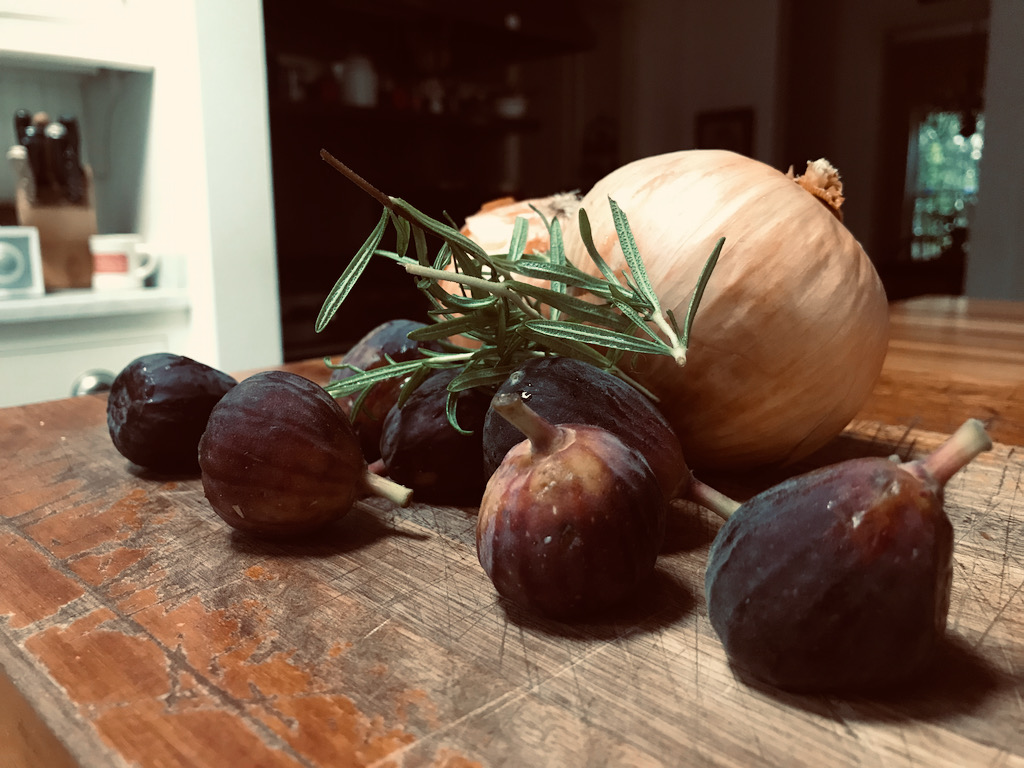
carmelized onion and fig confit, upon which i rested a chunk of roast salmon with late-season rosemary sprigs from my garden: dinner for one, a la autumn.

40 years later…

i thought i was fine this week, the week we marked the day and the hour when my dad died 40 years ago. but then, as the hour grew nearer and the twilight grew dimmer, one of my brothers started a chain of emails, everyone chiming in, adding a snippet, a gesture, a frozen moment in one of our minds. my brother michael, in four short lines, haiku of the heart, conjured a moment that pierced me, one that keeps looping round in my head. he wrote how he’d driven down from milwaukee in a blizzard, in a borrowed car with a bag of sand tossed in the trunk—just in case. my other brother, two years younger and all of 19, was riding shotgun. when they got to the hospital parking lot, walking toward the entrance, they saw an old family friend. the man, always stern, must have been wise enough to station himself out in the cold, on the sidewalk beside the gliding glass doors, where he’d been waiting, on the lookout for two sons not knowing, maybe sensing, they were on their way to their father’s deathbed. wordlessly and from a distance, the man shook his head, a gesture simple and somber, a shorthand for the grief soon to come. a sad shake of the head, that’s all, letting them know, before the question was asked, did we make it in time?

it’s an angle of the story i never knew before, or if i did, i’d long ago buried it. it slayed me, that simple short story. ripped me in bits. i thought until then that i was okay. but then i crumbled…..it all came tumbling back, that awful abyss of a night, and the way the grief spread like a shadow, one by one across each of our lives, changing us all forever and ever. i ached all over again for both of my brothers, out in the cold, absorbing the subtle but certain shake of the head. grief comes in so many layers.

***

because i’m writing up a storm for a book that is taking immense and total concentration, because i’ve been underwater for days, squinting at the screen and hoping no one notices if i never get up from my chair, i am re-upping this tale written 14 years ago. how can that be? when my little one sat on my lap watching his grandpa for the very first time. how can it be that that snowy blizzard-y night was 40 years ago?

measuring life in 8 millimeters (from 2007)

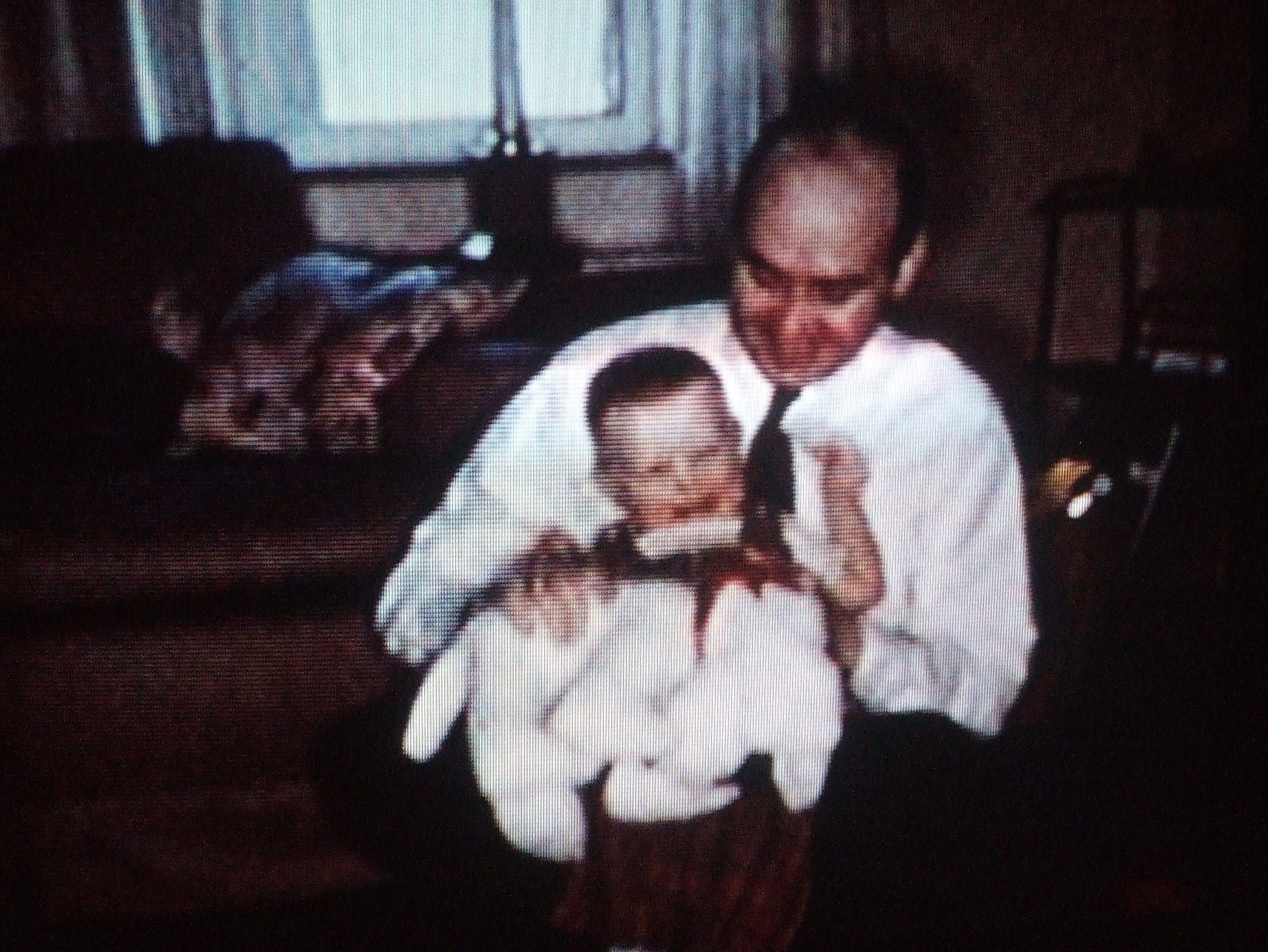
it seemed fitting, on the night, at the hour, that he had died, a whole 26 years ago now, to bring him back to the screen. to huddle my children, to wrap up under a blanket, to watch grandpa geno, a grandpa they never met in the flesh, a grandpa the little one says he remembers from heaven, to watch him come quite back to life. on a screen.

it was remembering for me, discovering for them, a life unspooling in frame-after-frame, a life confined to 8 too-narrow millimeters.

i hadn’t hauled out the home movies in such a very long time. they dwell in the dark under a cabinet under the not-so-big screen where eventually we watched him.

but something was roused, something stirred deep inside me. to not just remember the stories, but to watch them. to take in the gestures, the smile, the laugh. the way he threw back his head and woke the whole world—or my world, at least—when he laughed with the whole of his belly.

mind you, home movies at my house are old enough, date back to the day when there was no sound. only the clicking of film, the spin of the reels, as frame-after-frame rolled rapidly past the blinding white beam of the aqua-and-silver projector.

it was the first thing my little one noticed. where’s the sound? how come i can’t hear grandpa geno?

it’s the same question i ask, the question i ache for, when i watch him but can’t hear a word. can’t hear a sound of the voice i swore i would never forget. it’s a game i used to play, in the weeks and the months after he died. i’d try to imagine how he would sound if i picked up the phone and there was his voice, there was some audible bit to hold onto.

if smell never forgets, i think sound might be the first to go. i cannot, for the life of me, conjure the sound of my papa.

but i can see him. i can watch once again as he tickles me with my little stuffed dog. as he crawls on his hands and knees after me, all around the living room, a study in brown, the beiges and browns of the late 1950s. or at least that’s how it looked through the blur of the film now 50 years old.

as is always the case when i watch the home movies, i found myself studying each frame as if leaves in a teacup. searching for clues that made me, that scarred me. realizing this was the slate of my life when it was clean; the id untarnished, the script not yet scripted.

as the whole of my youth swept past, one reel at a time, i eyeballed the aunt, the first woman i knew to actually wear hotpants (and actually look, well, rather hot), now lost in an alzheimer’s fog, and the cousin i worshipped and now cannot reach, no thanks to a near-lethal cocktail of chemicals.

i saw how my papa, in frame after frame, was tucked in the corner, a book or a newspaper held up to his face. saw how he’d drop it, put down the paper, when someone, my mama perhaps, made mention that this was all being recorded for posterity (a word, by the way, that he tossed with abandon). posterity, i realized as my papa swept by, was now, was what we were watching, the title of this untitled film.

not all was so sweeping. sometimes what leapt from the screen was only a prop, not a player. but it echoed from deep in my life.

in a pan of one christmas morn, i spotted my papa’s plaid robe, the one thing that i took when he died. for a long time, on cold empty mornings, i’d slip my arms through the sleeves of that robe, and cinch it quite tight. then i’d sit and i’d rock as i wiped away tears for my papa.

i watched the whole narrative unfold, right up to the months before he died. i was hungry, have always been hungry, for a look at the last possible frame of his life as i knew him, i loved him. one last frame to hold onto. one frame to freeze. but, alas, that frame never came. no camera was rolling. posterity, lost.

it wasn’t long, i soon noticed, before i was the only one left in the dark, the only one watching the screen. it’s hard to hold interest in a life shot in silence, even when that life is a life that begat you.

but a night or two after i watched, as my little one spooned bedtime cheerios into his mouth, he looked right at me, out of the blue, in that way that 5-year-olds do, and mentioned that when he grew up he was going to get a tv and watch all the movies.

“i want to see the one where grandpa geno sneaks the peanut butter,” he said, of a story he’d heard told time and again, a story that’s nowhere on film. it was the tale of how, like a mouse, before bedtime, my papa would hollow the peanut butter jar, leaving the sides unscathed, no one suspecting. until my mother, poor thing, opened the jar one eventual morning, to make pb & j for her brood, a brood, she discovered, who would be left with just j for the bread she would smear for their lunch.

in my little one’s mind’s eye, it was all on the roll. every last bit of the life he’d not known. like magic, he figured, you put in the disc, and every story is there.

a whole life resurrected on film. oh, if only, i thought, as i sighed. if only we could curl up and watch any frame of a life that’s now only on film. and too many frames, they are missing.

how do you remember the ones you have loved, and now lost? how do you pass on their soul to the hearts of those who never knew them? the ones you love now, who were not in the past, the ones you ache for them to know?

the candle burns

shivacandle

our house is blanketed in sadness. layers and layers of sadness. landscapes of uncharted sadness: a son without the father he adored, grandsons without the grandpa who told them knock-knock jokes and reveled in their every triumph. and all of us — since sunday, when news of one death tumbled atop another — without a lifelong friend who, across the decades, animated our dinner table, our hearts, and taught us fearlessness in the face of whatever life hurled our way.

in five short days, we lost two of the dearest souls in our deepest closest orbit.

and so, at our house, sadness ebbs and flows, one minute casting shadow dark and dense; the next, scuttling off, clearing space for light to fill the room. we are wrapped in varied textures of mourning — we mourn a life lived long, and another one snuffed out far too soon. grief catches us by the heart, not letting go. grief leaves us gasping. grief, as it so often does, so especially when it’s just cracked open once again, plays tricks and mind games; we snap our heads and imagine the voice, the someone we love, tumbling through the door, calling on the telephone, springing back to life inside our nighttime’s tossing and turning.

so the candle burns. it burns till the last one of us tiptoes off to bed, and from the moment one of us shuffles into the pre-dawn kitchen.

in its mystical flickering, no matter the shadow cast or beyond the snuffing out of sunbeam at day’s end, it holds me, presses its light against my heart, and reminds me, hour after hour, moment after moment, that souls burn on. that the essence of who we loved still fills the room, is still here to brush up against, to illuminate and magnify the beautiful and the broken.

i’ve never before had a shiva candle burning in my home. and i have found unexpected comfort, caress, in the faint light it casts, hour after hour.

the minute he tumbled in the door from the airport sunday night, my husband pulled from his pocket a small glass jar that held a candle, a yizkor candle, one his mama had handed him as he kissed her and said goodbye in the old white clapboard house by the pond in new jersey, where we had just been joined in a circle of prayer and poetry and remembering.

the candle was a jewish observance of death my husband intended to observe. he didn’t wait before reaching for the kitchen drawer that holds the matches. he struck the match, lit flame to wick, and began the prayer of mourning, the mourner’s kaddish.

the next day, a gray and misty morning, i called the synagogue to ask if they might have another candle, since this short squat one he’d carried home was only meant to burn for 26 hours. and i knew — in that way you know without words spoken — that my husband wanted longer, wanted flame to burn as long as it might light the darkness.

the synagogue had plenty. and so, with rain spitting down on me, i climbed the synagogue steps and stumbled into the embrace of our rabbi, who could not have been kinder, in handing me the candle, the prayer card, the book for the house of mourning. and, that night, when my husband with the heavy heart came home, we lit the seven-day shiva candle, the one that now is burning, that could be burning round-the-clock (except that we’re afraid — despite rabbinic insistence otherwise — of our house going up in shiva flames).

every time i swirl through the kitchen, there it is. flickering. when i’m alone in early morning darkness, there it is, casting golden glow across the maple table, illuminating one small corner of the room. so, too, after nightfall, when i’m the last one up the stairs, when darkness shrouds us once again.

it’s a simple remembrance, yet profound. once again, a quiet nod to the psyche and the soul. a timeless knowing that with death comes darkness, comes a time when one’s whole landscape shifts, and for a time, you cannot find your way. there is no compass out of grief.

not a night has passed in this long last week when our tenderhearted boy, the younger one, the one who’s never known death to brush so close against his heart, not one night that he’s not shed tears upon tears. he has sobbed. and shaken with sadness. so have i. i find myself awash in tears. out of the blue. unstoppable. there is no compass out of grief. no torch to light the way.

and yet, i catch a glimpse of the soft pure incandescence burning from the shiva candle, and i feel as if some tender soul has brushed up beside me. whispered. squeezed me by the hand.

we are cloaked in shades of sadness. we are re-charting the landscape, finding it filled with deep dark holes, ones we tumble down, ones that catch us breathless. we are reaching for the light. we are remembering. we pore over pictures, over words typed and texted just weeks ago. we riffle through our memories, our hearts.

the absence is vast, is limitless.

the soft glow of flame to wick — reminding us that the soul, like the flame, strives heavenward, brings light to darkness — it is constant, and it does not dim.

nor does our love for the ones we lost. may their memory be a blessing. forever and ever. amen.

i’d wanted so very deeply to write a love letter to my beloved friend now gone. but privacy was everything to her, and privacy i will preserve for her. i will, though, post a few pictures — ones already seared in my mind and my heart. two from years and years ago, the first time she came to meet little teddy, just newly born, and one she sent me just this past summer, from sunrise at the shore of lake michigan, where she’d gone for sunrise salutation. finally, because it’s out in the world, an audio tribute to my beautiful friend, from her dear friend, the brilliant writer, alex kotlowitz. savor these moments with my friend, and if you’ve a spare, offer up a prayer for her dearest tenderest circle, her beloved husband of 21 years today, and their two beautiful children, one of whom is the curly-haired beauty at the elbow of and cradled in his mama’s arms in the photos below.

cecimeetsteddy

beholding joy….newborn, unexpected joy….

cecijoy

marveling at the itty-bittiness of a newborn.

zenceci

sun salutation. illuminated in everlasting light.

in your hours of grief, what lit your way?