
apologia to the world
dear world,
i fear we must be seeming pretty ugly these days, those of us of huddled here in this nation built on what we’d deemed monumental pillars that would not, could not, be crumbled.
but for all the world, and certainly from the wobbly chair where i sit, the granite, the marble, the impenetrable ore looks to be crumbling into fine, chalky bits.
i am—we are—so, so sorry.
mortified is more like it.
in the last 48 hours, i’ve heard the titular head of the land once home of the free labeled a.) “a national embarrassment,” b.) “unhinged,” c.) and the right-wing belgian prime minister put it this way: “it’s up to him to decide if he wants to be a monster, yes or no.”
of our american president’s words from the podium in ski spa switzerland, even the conservative bret stephens of the new york times wrote that it “sounded, in places, as if it had been ghostwritten by mario puzo [author of epic crime-family novel, the godfather]. wrapped in self-aggrandizing boasts and exaggerations, along with ugly jibes, meandering asides and shopworn grievances, lay a premeditated threat worthy of a padrino [mob boss]: ‘you can say ‘yes’ and we will be very appreciative,’ the president said, in reference to his demand for greenland. ‘or you can say ‘no’ and we will remember.’”
the so-called “board of peace,” convened by our very own national embarrassment, has been populated by “three ex-soviet apparatchiks, two military-backed regimes, and a leader [wanted for] war crimes,” according to the financial times. with an entry fee of one billion per pop. peace needn’t be so exclusive a club.
let me put this plainly (and plaintively): we are not, most of us, bullies. we are not always crude. we do not lie awake at night imaging the gilding of our toilet bowl, our hearth, the chairs upon which we perch.
the people i know here—plenty of them anyways—will race you to the ER on a second’s notice, ferry in casseroles of steaming hot chicken and dumplings, and should someone without a home need a warm shower, clean clothes, and a sandwich, well, my street number is 522.
my distaste for bullies is not new. i’ve had a lifelong aversion. could sniff out a skunk in disguise as far back as first grade.
in the house where i grew up we made shoebox hospitals for dinged baby birds, and cardboard villages (complete with a church and a steeple) for ladybugs who’d shimmied in through open windows. oh, and early on we were taught the tenth commandment: “thou shalt not covet thy neighbor’s goods.” so i went to confession to divulge to the priest my longing for my next-door-neighbor’s rainbow-colored toothpicks. yes, toothpicks. (a counting device in first grade, so mandated by the nuns.)
and believe you me, toothpicks pale in comparison to coveting the island nation of the arctic north, where threats have been made and the stomping of combat boots could be heard in the distance.
all i’m trying to say, dear world, is that we too are shuddering, and shaking our heads, and seeking any possible exit from this existential yet very real nightmare. and we are not, most of us, in any way, shape, or form seeing any bit of ourselves, our souls, reflected in this national madness.
we’re clanging the five-alarm fire bells. some days, weeping into our palms.
we yearn to return to the U.S. of Compassion, the flotillas and flanks that race to the rescue whenever, wherever, there’s rupture—earthly or otherwise.
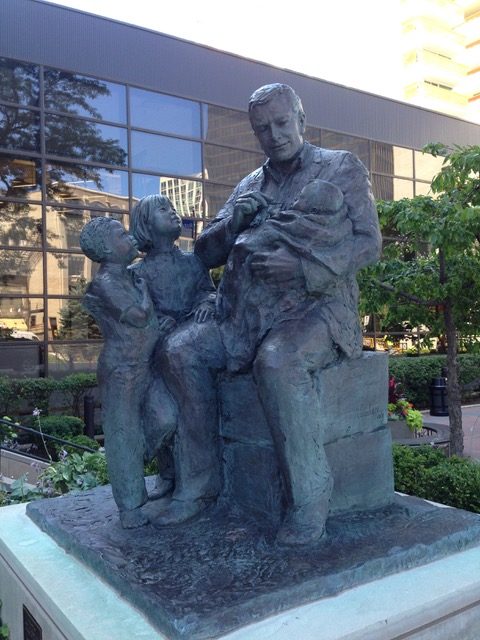
there’s a statue i pass on the way to church (or trader joe’s) of a kindhearted doctor, (you can sense the kindness even in passing by; i’d imagined it to be dr. jonas salk, developer of the polio vaccine, though turns out it’s just your basic good doctor) with wee ones clambering onto his lap, as he plunges a dose of vaccine into the mouth of one of the babes, part of a worldwide effort to eradicate the godawful scourge. it makes me weep when i pass it now. as it’s the antithesis of our national policy and our re-ordered global health agenda, and i cannot believe that in my lifetime i am watching this obsolescence.
i fear you’ll shove us from your sidewalks, should we dare to set foot in your lands. i fear you’ll see hate when you look at my weathering face.
and i’ll understand. though it will crush me.
all i want you to know is that we are, mostly and deeply, a rather good people. and if there’s anything you ever need, please knock at my door. i promise gentle, warm welcome. and chicken and dumplings to go.
speaking of scandinavian environs, it just so happens that i found a breathtakingly beautiful poem from a reclusive norwegian poet, emil boyson, as i was reading one of my favorite new thinkers recently. my poet friend kathleen hirsch pointed me to norwegian bishop erik varden a while back, and ever since, his wisdom illuminates my days. this poem was found in varden’s 2023 book, Chastity).

i love that it speaks to that delicate beauty inside all of us, a beauty that we ourselves often shy away from, demur. but in truth we yearn to be seen, and maybe most important to see for ourselves our tender, unbreakable beauties. it sounds to me as if some celestial wisdom, maybe God, is speaking in whisper to a precious child who is blind to her own beauties.
here tis:
To the Body
by Emil Boyson
Life is made bearable because, in this world, you exist.
You are the hidden songbird.
You are the new moon’s beauty.
You are the white cloud of yearning.
You are the tornado that pulls us out of ourselves and lets our sweet pain know that all will be changed like a garment and that one day when fate’s measure is full the face of this world must pass.
Who would have thought that YOU, who hold in your hand ultimate secrets known otherwise to God alone,
should be a shy young girl whom thousands pass in the street,
about whom nought is known except that you like crosswords,
do housework for your mother, speak sense about the weather,
and knit little vests for the child your sister expects in March.
Are you never fearful, in the quiet of the night, of your being’s enigma?
Is it your unfurrowed brow that obliges us to brood?
What do you know of questions and answers?
You smile as you pass on your way to reality’s frontier, strangely united with your fate;
while our hearts quiver you are again transformed,
finding, lost in a freedom you have never sought to fathom,
the rigorous paradigm of grace made one with your body,
then collapsing as if dead at the end of your last dance.
what brought any droplet of anti-madness to your world this week?









 pull up a chair