pull up a chair

where wisdom gathers, poetry unfolds and divine light is sparked…

when the gentlest, dearest sounds of your day are gone

DSCF2348_2

some days when i write, it feels like i need a crane to hoist my heart out of the deep-down depths, to vault to the heights where the words deserve to be. this is one of those days….

it’s been five days now. five days without the sound of his front right paw rubbing against the back-door glass, when every morning at dawn, his shadow etched against the fading darkness of night, he’d be waiting for me, waiting for me to let him back in, our night-prowling cat, to let him get back to the business of roaming this creaky old house as if it all belonged to him, his acreage to do as he pleased, to rustle under the covers here, to climb into the laundry basket, the shopping bag, the shoe box we accidentally forgot to put away. to plop himself squarely onto whatever book or newspaper we were reading, whatever keyboard upon which we were trying to type, shoving aside all distraction with his furry insistence, as if to say, forget that, pay attention to me.

it’s been five days since i’ve heard the faintest trot-trot-trot of his little cat paws, descending the stairs, coming round the bend to where he knew he’d find me, letting out one of his signature meows, the ones we’d learned to read as if particular declarations, and so we’d do as he ordered every time: feed him, scoop him into our arms, open the door to let him out into the garden he guarded so well and so long.

tiger boy and his tiger cat

tiger boy and his tiger cat

it’s been five days since we’ve heard the lap-lap-lapping of his tiny sandpaper tongue, scooping up the droplets of cream with which we indulged him (or, truth be told, the water from the bowl of the toilet he considered his own private pond). and it’s been five days since i’ve heard the sound of his four-pawed leap to the hardwood floor from the very high bed of the boy who’s never known a day without him, the old striped cat, the cat who came from the farm, the cat with more adventures than a conquistador or even huck finn. the cat we called “turkey” for short, the cat whose very long name — turkey baby-meow-meow-choo-choo-hi-cat-bye-cat — won him a contest just this year at a faraway vet school, where the vet students (one of whom used to work at our long-ago animal hospital) were asked to submit the best pet name they’d ever heard — well, sadly, finally, after nearly 19 years, our sweet little cat is no longer.

turkey baby meow-meow etcetera lay down and died on pi day, monday, the 14th of march, 03.14.16. curled up in a ball, face turned to the stars, he quietly softly slipped away, a dignified death for a most dignified fellow.

and it’s the absence of sound — those soft, barely-perceptible sounds, the ones that beg your keenest attention — that is so deafening, that amplifies the ache in all our chests, that defines — at least in small measure — the volume of the hollowed-out hole in each of our hearts.

in the blur that this week has been, here’s what happened: sunday afternoon i found out my dear, dear friend had died, and because i’d been asked to write her obituary, i slipped into that writing zone where i lost focus on nearly everything that wasn’t the words i needed to type to tell the world who she was. i do remember that later that night i scooped up the cat as he meowed at the bottom of the very steep stairs, and i carried him up to the bed of the boy doing homework beside the bedside lamp. as i walked in the room, the boy scooted over, away from the light, clearing a space on the sheets and the pillow. i asked what he was doing, and he matter-of-factly told me, “oh, that’s the side that turkey likes, so i’m getting out of his way.” when i countered that, actually, he — the boy with the hours of homework — was the one who needed the lamplight, he shrugged it off, said, “nope, turkey gets the side he wants.”

that’s the last that anyone remembers.

and then, monday, not long after dinner, when i bent down to scoop up my backpack, to head out the door to drive a carpool to soccer, i eyed the little cat bowl still piled with bits of the food that he crunched whenever he needed a nibble. and that’s when it hit me: i hadn’t seen him all day, or at least i suddenly didn’t think i had, though i couldn’t clearly remember. delaying carpool departure, i zipped through the house, spot-checking each of his usual places, an itinerary i knew by heart: atop the sleeping bag in one bedroom closet, under the bed blankets in the other boy’s bedroom, curled on the heated bathroom floor, snuggled on the bean bag by the back door from which he surveyed his lair. one by one, the spots came up blank. our cat was not in the house. so we took to the alleys, combed them up and down, back and forth till close to midnight. (i managed to squeeze in my carpool duties, worried the whole way, resumed my search with headlights on high beam once back home.)

and then, the next morning, in an early morning volley of email about wholly other matters, i mentioned to my across-the-street guardian angel of a neighbor that “on top of everything, we can’t find turkey.” and that’s when she shot back the news that felt surely heaven-sent: that reminded her, she wrote, that a friend of hers had mentioned seeing a cat who looked sick the day before, and it was somewhere down our very block. i had hardly finished sweeping my eyes across the words when i was out of my seat, and halfway across the room to the old tin bucket where we kept the cat’s mud towel, the one we’ve used a hundred thousand times to wipe off the rain or the snow or the puddles of goop he padded through, on his way to the door where he waited, always waited.

i ran out the door, and down the sidewalk, eyes trained on the distance, murmuring — almost a prayer — no, no, no! and then the lump i’d passed the night before, the lump that in the dark had appeared to be a pile of leaves, it wasn’t leaves in the early morning light; it was dear sweet turkey, curled in a little cat comma, his paw up and over his eyes, his face pointed up toward the half-moon, still fading against the early morning’s soft sunrise.

a whole 18.5 years after he trotted into our lives, he was gone. i wrapped him, and carried him home. my arms shook the whole way. we all huddled in the front hall, at the foot of the steps, and we cried. the little one’s knees went out, as he crumpled onto the stairs, and his face contorted in grief.

not one of us didn’t cry, and cry hard.

and just like that this old house is missing some of its most essential sounds. and surely an immeasurable chunk of its heart.

i heard the boys shouldering each other’s heartache. i heard one say to the other, “he was like our third brother.” they both said, in unison, as i carried him, stiff, into the house, “he was my best friend.” a cat can do that — a cat can be so loyal, so loving, so there when you need him, everyone thinks he or she is his favorite. DSCF6964

the older one, the one who rode out to the farm with me back in october of 1997, back when we were convinced there’d never be another babe in the family, he’s been around for every one of ol’ turk’s big adventures: the time he got stuck in the drug-dealer’s den just down the alley; the time he leapt and then tumbled from the third-floor skylight, and lived to tell about it, staggering along the gangway, dizzied but unharmed except for a droplet of blood that dribbled down his little cat chin; the time he was missing in action for six unbearable days, and then, minutes before the very-sad firstborn was supposed to shuffle off to his very first day of kindergarten, that old cat came bounding up the back steps like he was the hero in a hollywood western, the sheriff who rides to the crest of the hill, bringing on the cavalry, just in time to kill the villain, just before the credits roll and the sun sets on the five-hanky movie.

the little one — only 14 to turkey’s 18 years, six months and 21 days — he had never known a day without that old cat. when we moved to cambridge, mass., for a year, the little one said he was happy to tag along, but he had one non-negotiable caveat: “i’m not going unless turkey comes too.” and so, we tucked that old cat in a nifty little carrier, slid him under the airplane seat, and made him an apartment cat for one (rather miserable, far as he was concerned) year of his long and storied life.

so here we are: bereft beyond words. the reminders are tucked in a thousand places — the cat toy peeking out from the basket, the stacks of cat-food cans on the shelves of the pantry, the old navy bean bag still streaked with clumps of his fur. bit by slow bit, i’ve been subtracting, cleaning the shelf of the cat food, washing out his bowls one last time. i’m trying to think of these awful days as lessons in grief, and the insolubility of death. no matter how hard you wish, you can’t bring back the pit-a-pat paw sounds. can’t muster his face, with the ears perked just so, there at the glass still streaked with his mud prints.

it’s the valley of mirage and phantom echo, the raw and early hours of grief, as you imagine, make-believe — for an instant — you’ve just caught a glimpse, or just heard the sound.

it’s deafening. and deadening.

and i know that time, the sacred balm of all of life’s deepest heartaches, i know time will bring healing. i know the day will come when the thought of that old cat won’t sting quite so piercingly, the way it does now.

and so, for the second time this week, i am writing an obituary. and while the loss of a most blessed friend and the loss of a furry one are in no way comparable, i’ve realized this week that death is death. and “little deaths,” too, loom large, and they hurt sometimes in ways that riddle each hour with excruciating moments of missing.

and, yes, it’s only a cat, but a cat over time, a cat you’ve known and nuzzled and loved across the arc of your entire childhood — across the days when no one else understood your sorrows, and no one else curled across your chest, or slipped warm against your pjs quite the way your cat did — it makes it achingly hard to catch your breath, to steady your knees, to find your way forward without him.

our garden will be so empty this spring. the whole landscape is so empty right now. and it will take a good dose of time till we’re breathing deeply again.

i was thinking i’d write an “ode to one exemplary cat,” but for now i might simply point you toward posts from the past: in chronological order (he’s been a recurring character here at the chair over the years) the hunter (2007); starting the goodbye (2010); when the cat comes limping home (2011); and “will he make it home?” (2013).

if you’ve a furry or a feathered or a slippery or a hard-shelled friend, give him or her an extra squeeze today. and listen close to those sounds that animate your day. the silence will break your heart when those blessed little friends are no longer…..

IMG_5233

dear turk, we loved you dearly. as sweet will said when he kissed you goodbye, “thank you.” thank you so very very much. xoxox happy hunting wherever you are. love, all of us.

and to louisey who insisted we needed the little striped farm kitten so willie wouldn’t grow up alone, and to dr. jane whom we adored and who tried to convince us a roaming cat wasn’t such a good idea in the bustling big city but fixed him every time he got into a fix, and to all the friends who’ve loved him, and not minded — alicia! — when he ambled in your back door, and made himself quite at home, despite your trembling fear of all things furry, thank you and thank you for ever and ever amen.

special edition: mary ellen sullivan & the soul of the hummingbird

mes-shot_200_dpi

i don’t usually write on wednesday mornings, but this is no ordinary wednesday. my beloved friend, the one to whom i said goodbye on friday, the friend i’d not named here — out of respect, out of privacy — she died on sunday afternoon. her name is mary ellen sullivan, and before she died, she asked that i write her obituary. my knees nearly buckled when i opened the email friday night that held that blessed and soulful and wrenching request. mary ellen was a writer; we met 35 years ago, when i was a nurse learning how to be a journalist, and she was fresh out of boston college, ready to take on the world as a magazine writer and editor. we stayed friends for all the years and all the life that has tumbled by since the summer of 1981. i was in her wedding, she was in mine. i was there, too, when her marriage ended, and for the weeks and months that followed. she drove me to the hospital the bitter-cold night when my first pregnancy was suddenly slipping away. i drove her home from the airport the gray winter’s afternoon when she returned from her six-month trek around the globe all on her own; it was during that car ride that i told her i was again pregnant, this time with the baby who would become my firstborn. when mary ellen started a blog four years ago, i became a careful reader and devoted follower. i knew — because i’d been doing it for five years by then — just how exposed you can feel, just how much it matters that this curious form of writing be held to the very same standards we’d both learned at medill’s school of journalism (i loved it once, not so many months ago, when mary ellen caught a typo in one of my blog posts, and she called to make sure i correct it; i had mis-typed “their” when it should have been “there”). and we both knew that an even higher standard comes into play when you commit to what we do here: you write from the heart, you speak the deepest truth you know, and when you hit the “publish” button you unreel a prayer.

so in the hollow hours of saturday, wholly aware of the weight of the assignment — “write mary ellen’s obit” — i turned to mary ellen’s breathtaking blog, on the wings of the hummingbird. as i pored over her entries, i melted. and i started to smile a very deep smile. i realized that mary ellen had already written much of her obituary. her words were so poetic, so infused with the essence of who she was and ever will be, i simply began to snatch up whole passages, lining them up in what felt like the wisest order. i realized that mary ellen might have had a hunch that i’d figure out the way to write her obit: let her write her obit. and so i did. i stepped out of the way, made hers the voice of the obit.

it is serious business — in my book, perhaps, the most serious business — to write an obit, anyone’s obit. a whole life is distilled. the message of a lifetime is trumpeted, is illuminated. it is daunting to sit down and try to capture the whole, the beauty, the poetry. and so, every time, before i lift a finger, before i put a finger to keyboard, i close my eyes and i pray. 

the answer to my prayer on sunday afternoon, minutes after i learned that mary ellen had died and it was time for me to begin my assignment, is today in the chicago tribune; it’s what’s known as the “lead obit.” mary ellen would love that. and that makes me smile in a week when my heart is sodden with sorrow.

with love, here is a life story i want you to read. mary ellen’s wisdom, her poetry, her clarity — the whole of her — takes my breath away. from today’s chicago tribune:

Mary Ellen Sullivan, who wrote a blog on joy, dies at 56

Barbara Mahany
Chicago Tribune

On the day she was wheeled into surgery for recently diagnosed ovarian cancer, Mary Ellen Sullivan wrote words that would become her clarion call, words that ring with the insistent urgency of a prophet: “If you are sleepwalking through your life — wake up — before the universe does it for you.”

She posted the words on her blog, On the Wings of the Hummingbird, a compendium of wisdom and joy, under the title, “A rare piece of hummingbird advice.”

Sullivan, 56, who died of ovarian cancer Sunday at Prentice Women’s Hospital in Chicago, wasn’t in the business of giving advice.

She was a writer and traveler, a diviner of joy — joy unexpected, unlikely and against the odds. “In a time of chaos (now righted),” she wrote in March 2012, “on a day in which joy seemed eclipsed by uncertainty, I committed to writing about joy every day. I figured that if I can find joy when I’m in the mud, then maybe I have something to say about joy.”

Sullivan, a longtime Chicago resident, was born in Harlingen, Texas, and, from the beginning, crisscrossed the continent and the globe.

“I grew up a nomad,” she once wrote, “living in 10 different places by the time I was 19 because my father’s corporate job took our family across the country and around the world. Some of it was glamorous — San Francisco in 1969, Europe for my college years — but other parts were, as you might imagine, difficult.”

She earned a bachelor’s degree from Boston College in 1981, majoring in English, with philosophy and art history minors. In 1982, she earned a master’s degree in magazine journalism from Northwestern University’s Medill School of Journalism.

Upon graduation, she took a job as a magazine editor at General Learning Corp., a small educational publishing house in Highland Park, and five years later, she moved to Advocate Health Care, in Oak Brook, where she ran the publications department for another five years.

She was putting down roots, falling in love with Chicago, from the lakefront she biked by the mile to the backstreets and blues joints and countless holes in the wall. She explored the city with an adventurer’s eye and a journalist’s curiosity. After a decade, though, she was ready to travel the globe. All on her own.

“On the heels of a short marriage, a grueling divorce and some burning career questions, I took an extended leave of absence from my job to travel around the world by myself,” she once wrote. “I skied the mountains of New Zealand and biked through the Chinese countryside. I bargained for goods at the Bangkok night market, shopped the glittering stores of Hong Kong, touched the crumbling Berlin Wall, swam along the coast of Australia and holed up in Somerset Maugham’s former hotel room in Malaysia to write.

“Mine was nothing less than a spiritual journey in which I peeled off layers of cultural conditioning to get to the essence of my spirit,” she wrote.

Unwilling to return to the corporate world, Sullivan launched a freelance writing career that brought her bylines in the New York Times and various women’s magazines, as well as travel guides, a book about Chicago’s “Cows on Parade” public sculpture exhibit, and liner notes for a jazz record label.

She designed her life, she said, so that she could continue to travel, paradoxically deepening her roots the farther she roamed.

“I spent one winter in South America, another on Tahiti and Easter Island. Along the way I fell in love with Africa and returned to this land of my heart, time and time again. I began studying with the ancient medicine men and women around the world, and found a community here in Chicago of like-minded people who became my tribe.”

While in Chicago, Sullivan convened a writers’ group that influenced a memoir, a novel, a self-help volume and a historical text, “The Warmth of Other Suns.”

She might have found her deepest calling, though, as a keeper and chronicler of joy. Her blog, which she started in March 2012, was a reflection of the way she lived her life.

She began by putting a journalist’s sharp eye to the world around her:

“I noticed how unconscious most people were, blind to the joy all around them. They walked with their heads down and their defenses up. They saw without seeing, heard without hearing, spoke without thinking, remembering nothing. It actually hurt my heart to watch. And then, as the economy got worse and the natural disasters quickened, I saw fear, anger and incivility. Drivers became ruder, sales clerks surlier, tempers shorter.”

And so, she set out to right that, recording joy day after day. She named her blog after the hummingbird: “My favorite description of hummingbird magic comes from Ted Andrews, who wrote the seminal book on animal totems called ‘Animal Speak.’ He says, ‘There is something inside the soul of all of us that wants to soar through sunbeams, then dance midair in a delicate mist, then take a simple bath on a leaf. There is something in our souls that wants to hover at beautiful moments in our lives, making them freeze in time. There is something in us that wants to fly backwards and savor once more the beautiful past. Some of us are just hummingbird people.’”

“Guilty as charged,” Sullivan added.

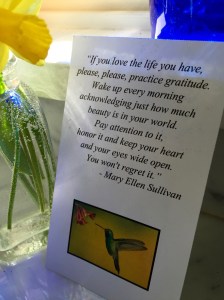
And she ended one blog entry with this insistent instruction: “And if you love the life you have, please, please, practice gratitude. Wake up every morning acknowledging just how much beauty is in your world. Pay attention to it, honor it and keep your heart and your eyes wide open. You won’t regret it.”

Sullivan’s partner of 18 years, Michael Schmitt, died in 2014.

She is survived by her parents, Donal and Martha Sullivan; two brothers, Bill and John; and a sister, Sheila Zimmerman.

Memorial services are pending.

Barbara Mahany is a freelancer reporter.
Copyright © 2016, Chicago Tribune

blessings, my beautiful friend. blessings upon blessings. and thank you. thank you with all my heart….

FullSizeRender

this is the headline that wound up in the newspaper edition of the story. she would love this headline, as do i. oh to be known as a “chronicler of joy”….blessings, my hummingbird friend. i will be watching for you, waiting for the brush of your wings past my brow. and my heart…..

“can we have a day?”

DSCF1005

hand-in-hand with my firstborn


willie and bam making willie brussels sprouts ala christmas 2014

side-by-side with my firstborn, all grown.

if i sound insistent, urgent, imperative today, it’s because i am. 

it couldn’t have come at a more ordinary moment. we’d been motoring about the utilitarian landscape, the backroads of suburbia, past big old houses, and strip malls, threading our way through the tangle of morning rush hour. the other car was in the shop, so i was the designated deliverer. i’d dropped one child at the schoolhouse door, the other was about to dive into a day at the courthouse, where he works twice a week, defending the otherwise undefended. i’d just mentioned that i really didn’t mind driving all over creation. didn’t mind the banal scenes out the window. didn’t mind the cold coffee tucked in the holder beside me.

we’d been laughing since the older one leapt into the car — minutes later than we needed to leave, socks not yet on his feet, his coffee cup sloshing. we’d thought we’d be late, as in the little one marked “tardy.” and for a minute there, we were cranky. or at least i was. but then the sockless one got going, got us laughing. the little one practically spit out his oatmeal, he was laughing so hard.

and so it had been for 25 minutes or so. pure straight driving and laughing, and trying not to spit out mouthfuls of oatmeal.

all i’d said was i didn’t mind driving one bit. didn’t mind clocking a good ten miles in a sliver of time when i could have been curled up with coffee and the morning’s news.

and that’s when my firstborn chimed in: “could we have a day when the two of us just bop around all day? a whole day? we just get in the car and go where we go?”

the sentence shot through the air sealed in that car. shot straight from his mouth to my soul.

the request couldn’t have been simpler, purer.

mom, could we clear a long stretch of hours, just one day’s stretch, and could you and me burrow into that sacred cocoon of time, could we savor the hours together? could we stitch together a plain old ordinary day of doing the things we love — just the two of us, in slow time?

right away, i heard and i felt the whole of that question. the layers and layers. a longing i too had long known — to spend an unbroken stretch of time with someone you dearly and deeply love, hearts sealed not by virtue of itinerary but simply by the gift of no one or nothing else getting in the way. because all you want is to be entwined, to travel across the hours, together. because all that matters, really, is proximity of the most soulful kind. is time, shared.

by the end of the day, the question couldn’t have been more profound.

by the end of the day — not more than a few hours later, really — i’d gotten word that a very dear friend had taken a terrible turn. her cancer was running amok. doctors had told her — with a rapidity that left us all breathless — that there was nothing left to do. they’d stop the chemo, they’d send her home.

or they had hoped to, anyway. now, it hardly looks likely.

and that was yesterday. this morning i am getting back in my old station wagon, and i am driving downtown. to a hospital. i am going to say goodbye to the woman who has long been the bravest traveler i know. she crossed the globe all on her own, in a trek that stitched her shattered heart stronger than ever, in a trek that taught her thousands of lessons i’ll never know. my friend is blond, naturally so, and as she glided through the dirt-packed roads of africa, then india, and china, and bali, she cut the most exotic figure. she laughed, the deepest soulful laugh, whenever she talked about how the children had flocked to her, stroked her hair, this otherworldly creature who’d dropped into their midst. she loved being surrounded by children, my friend who never birthed her own. my friend who stood beside me at my wedding. my friend who drove me to the hospital the night my bleeding would not stop. my friend who over the years learned the ways of indigenous wise women, and who once, on the eve of my own awful surgery, wafted me head to toe, heart to womb, with the smoke and the incense of the bundle of sage she pulled from her satchel, her medicine bag.

this is the second time in six months, i am saying goodbye to a blessed and beloved friend.

i know how both would answer the question: “can we just have a day?”

the answer, the imperative, is this: seize the day. seize it now. make each hour holy. do not allow the hour to fritter away, charred bits of time, lost to petty and insignificant slights.

can we just have a day?

can we just have a day to seal our hearts, to savor the joy, the truth, before it’s tugged away from us? can we revel in each other’s laughter? can we find the delight as we look out at the world passing by? can we taste deliciousness, taste the whole of it? can we dive deep into the well of each other’s company, each other’s undying love?

i can hear my friends now, both reaching up from their hours of shallow and shallower breathing, i can see the look in their eyes, the insistence, the impatience: seize the day, seize the hour or minute. seize the time that is yours. and be guided only by love. pure and simple.

please, take this day. and make it holy, pure and simple.

please whisper prayers for safe-keeping for my beautiful friend. please please, hold her in all the light you can muster……

rx for the end-of-winter blues

IMG_7218

i’d not realized as i ambled through the grocery aisles that i was stumbling on a cure for the end-of-winter blues.

or at least a hearty inoculation against its jagged edge, the one that leaves you nearly flopped over, drained of all vims and vigors.

i filled my cart merrily, madly, picking up speed as i tossed in accoutrements i don’t normally pluck from shelves with such abandon. there were crunchy things in a thousand shapes. there were bottles to be quaffed. there were the makings of icing-slathered cinnamon rolls (those makings, truth be told, came in a tube that is merely slapped against the counter’s edge, disemboweled, tucked in a 9-inch-round, and baked till the morning kitchen fills with heaven-scent of butter, cinnamon, vanilla, the holy trinity of essential deliciousness. and who really minds if those smells emerge from cardboard tube; is not the point simply that somehow they emerge?).

a crew was descending on this old house, a crew of men six-feet-tall and taller, and they are hungry men, young men, twenty-somethings who flew in from three east-coast cities to poke around the middle of the country they’ve, until now, ignored.

they are the best pals of my recent college graduate. and they chose this snowy, cold march weekend to make a slumber party of our house. there were limbs strewn everywhere when i awoke this morning. and not long after, morning groans, the noises young men make when they are hoisting selves from sleep.

i’ve now fed them, quenched their thirsts, and sent them all southbound on the early-morning train. it’s quiet now, but in their wake i realize they’ve all shot me through with just the things i needed: noisy distraction. unbridled merriment. disruption of the old routine.

there is nothing quite as curative as a house that’s filled, a house in which the shower runs for the better part of an hour, as one hops in and one hops out. a house in which the sink is swiftly piled. and even better, all the pillows from the couch are madly strewn.

i once longed for a flock of kids to call my own, but i’ve realized over the years that The One Who Pulls Those Strings must know me better than i do, for truth be told i might collapse under the weight of more than two. so i get my fill in occasional blasts of multiples.

over the years: the gaggle of sleepy-eyed second graders who emerged from sleeping bags to squeeze around the kitchen table, hands flying, syrup spilling, as they pulled their portion from the flapjack stack i’d plopped before their hungry eyes. the nights the basement hit capacity, with every bean bag occupied, and i was tapped from slumber to be the designated driver for the winding roads to half a dozen homes. or the lunchtimes when the backdoor flung open and kid after hungry kid piled in, testing my capacities in the griddle-flinging challenge.

it heals me every time. i get lost in the reverie. of their secret codes. the jokes i only half hear. the kicks under the table i seem to never miss.

i love the mad swirl of company. i love a room where the rafters ring with human hum. i even love a kitchen that seems to have been overtaken by a team of poltergeists. and messy ones at that.

while i might more naturally be a girl who loves her whispered tete-a-tetes, knees huddled under cozy blankets, i can spring to full-throttle animation when the ones i love are surrounded, buoyed, pole-vaulted by the ones they call their nearest and dearest.

the next 60 hours in this old house will rise and fall with the ebb and flow of cacophonous company. i’ll breathe deep, inhale the whole of it. i know, too soon, it will be but a memory, a long tucked-away soundtrack from that one glorious weekend when this old house opened wide its rooms, and invited in a slew of dreams come true.

***

and in other news, dear beloved chairs, i must pass along this bit of blessing: i signed this week a contract, a long-awaited contract, for another book, one that comes from the deepest place in my heart. its title, for now anyway, is motherprayer: lessons in loving, and it’ll be out a year from now. it’s coming from the same publisher as slowing time, although i’ve a new editor for this one, and she is a dreamy dream if ever there was. more details as they emerge. having done this once, it might be even scarier the second time round, but i steady myself with the dear and deep souls who ring this table. it’s all been keeping me tap-tap-tapping away for months now, and it promises to keep me at it.

as the world beyond our tables feels more and more inhospitable, tell me who taught you the fine art of hospitality, and what’s your dream equation for great good company, and the ways you make each and every someone feel deeply much at home?  

IMG_7221

quiet season

IMG_7215

it’s quiet season in my house. in my soul, actually.

it’s odd then, when i tiptoe outside in the dawn and hear the world achatter. the winged choristers — robin and sparrow and cardinal — are having at it, calling out from limb to bough to bush. staking turf. declaring the early hours of starting all over again, survival of the species, the No. 1 task on the vernal to-do list. it’s what happens when the globe tips toward the sun, the angle draws nearer, draws shorter; the light longer, not so thin anymore.

it happens to all of us, one season or another. we’re out of sync with the world beyond our window sill. i’m still deep in the burrows of winter. but the world wants to shake off its slumber, awaken.

i’m not ready yet.

i will be. i have no doubt.

but not yet.

now, i am curled under blankets, turning pages, soaking up the words of other quiet souls. and so, when i cracked open a book of poems the other day, i nearly dissolved into tears, into the mystery of grace, of feeling tapped on the wall of my heart, with sacred whisper.

i was turning slowly through the pages of mary oliver, my patron saint of poetry. i was inhaling her latest infusion of wisdom distilled, of heaven on earth, of sacred scripture rising up from out of the dawn, out of the trail through the woods where the poet keeps pace.

i read, among other words, these:

there are moments that cry out to be fulfilled.

like, telling someone you love them.

or giving your money away, all of it.


your heart is beating, isn’t it?

you’re not in chains, are you?


there is nothing more pathetic than caution

when headlong might save a life,

even, possibly, your own. 


then i turned a few pages, and stumbled on this:


God, or the gods, are invisible, quiteIMG_7208

understandable. But holiness is visible,

entirely.

i pulled out my pen. the sound of ink scratching along sheaf of paper, the only perceptible noise interrupting the season of silence.

and now i’ve shared my silence with you.

may your week be blessed. silent or not.

mary oliver’s latest slim volume of prayer poem is titled, felicity (penguin press, 2015). the words above, first, from the poem, “moments,” and finally, a few lines from “leaves and blossoms along the way.” 

sometimes when you fly, you land in heavenly places

IMG_7150

sources tell me it’s no secret that i’m a homebody. one of the original give-me-my-old-lumpy-mattress homegirls. so it was with no smidge of trepidation and wishing-it-was-over that i sped off to the airport the other morning, encountered a TSA line sure to make me miss my plane, and nixing all hopes of a hot paper vat of airport coffee.

i flew to music city (aka nashville) where i sang not a note, but i did meet some very very very fine folk. i was there to make a video — five brilliant women + me. i was there in the role of (take your pick) oprah or, my preference, krista tippett. all i had to do was ask questions. the brilliant ones did the stuff that mesmerized me. two of the women are professors, biblical scholars of the old and the new testament, four are preachers. one (the professor/preacher from princeton and yale divinity school) preaches at the oldest black baptist church north of richmond, virginia, a church in alexandria founded in 1806 by the black baptist society whose number swelled when slaves from mount vernon plantation joined in 1815.

that professor-preacher, rev. dr. judy fentress-williams, mentioned to me that she served as senior assistant pastor to rev. dr. howard-john wesley, considered “one of the great orators of this generation” (so claimed by the NAACP, in awarding him one of their most prestigious honors earlier this month). wesley’s sermon, “when the verdict hurts,” preached just 12 hours after the 2013 verdict in the trayvon martin murder trial, was pegged by no less than time magazine as “the best” on the subject of george zimmerman’s not-guilty verdict, in their cover story, “after trayvon,” with the prompt, “if you hear one sermon about america’s trayvon martin moment, let it be this one.”

judy, beyond brilliant in her own right, mentioned to me that i really ought to take a listen. so, of course, i did.

it might have been the holiest thing i heard this week, so rather than prattle on about trivialities, let me turn this week’s table over to the man who left med school to become a preacher, was named a martin luther king, jr., scholar at MLK’s alma mater, boston university, and in whose pews i pray i some day find myself.

pull up a chair, and take a listen: “when the verdict hurts,” july 14, 2013. rev. dr. howard-john wesley, pastor, alfred street baptist church.

what i’d give to be able to go someplace once a week where i was stirred to goosebumps, stirred to action.

made me remember, once again, that when i pull myself away from where i’m most at home, i never fail to be amazed by the wonders always just beyond my doorstep.

who stirs you to goosebumps?

pulled by heart

lunch

the hour hand had just nudged itself past 5. the tableau out the window was black-on-black. the bedsheets, warm, toasty warm. the soft folds of the flannel, pulled snug against my shoulders, invited one last episode of sleep. all i wanted was one more hour. but then i remembered.

the light down the hall was already splintered through the crack under the door. the soft bells of an alarm were faintly chiming. the whoosh of the shower broke the pre-dawn hush of a house just beginning to rouse. i knew my firstborn was up and getting dressed. i knew he’d soon be barreling into the morning’s bitter cold. the headlights of his little black car would shine down the alley, turn toward the city, to the west side, to the streets where just a week ago a bullet pierced the window of the pre-K classroom in the school where he teaches. the bullet shattered glass. sailed across the room, ramrodded a metal pipe, ricocheted. hit no one. thank God. but the cluster of little 4-year-olds, who by the grace of God had been clustered at that instant on the far side of the classroom, away from the bank of sidewalk-level windows, they heard the blast, the ping, and at last the thud of the bullet dropping to the classroom’s hard tile floor. deadly sounds. sounds that shouldn’t be heard in a pre-K classroom. or any classroom anywhere.

a week ago, at 2:46 p.m., i got this text from my firstborn:

There’s been a shooting outside school. We are in lockdown, but I am okay, so are my students. Do not call, I don’t want there to be any noise in my room.

a mother’s heart all but stops when she reads those words.

it would be another hour till he called, till i heard the rush of air i knew as his voice. it was over now, he told me.

the children had all been shepherded into the hands of parents. or grandparents. or some adult who’d get them home. he, too, was headed home, he told me. shaken, so shaken by the news of what happened in the pre-K. shaken by the holes in the metal screen and the pane of glass. shaken by the glass that shattered in what looked like a cobweb of shards. shaken by the long hour’s lockdown, not knowing the whole time — as he tried to keep his sixth graders quiet — whether the shooter was inside or out of the building. shaken by footsteps that ran down the hall, toward his classroom, where the door had been locked. shaken by the news that a mother who’d come to school early to take home her young child had stepped out the school’s front door into the direct line of two men with guns chasing down the sidewalk, shooting. the mother threw her little one to the sidewalk, then threw herself — hard — on top. she waited, she’d told a teacher, lay stone still, not knowing if she’d be hit. fully expecting the thud of a bullet to her back. or worse.

monday, my kid came home with word that 46 kids of 180 kids hadn’t come to school that day. parents kept them home. they’re not used to bullets piercing classroom windows. not even on the west side of chicago. he said, too, that the only two white kids in the school, kids whose parents teach there, they’d been pulled. “a social experiment they weren’t willing to risk any longer,” was how he put it.

and then he said, “mom, if i tell you something, promise not to freak out.”

ooo-kay.

“there’s apparently a turf war in the neighborhood, and (school) is in the middle of it.”

and so as you hear those words, as they barely begin to settle onto your eardrums, onto your heart, you somersault into prayer. your every inhale breathes in prayer. your exhale begins the next, an endless loop of prayer after prayer.

you settle yourself down, slowly. over the course of hours, as you turn round and round the heartache, the insanity of it all, as you sift through the shards, examine from all angles. imagine the worst. consider the kids who call those streets home. who can’t leave.

you pray mightily.

and then, yesterday on the front page of the newspaper, there was a story with eery echoes. it was a story that happened last friday, just five hours after the bullet shattered the window of my kid’s school. it happened three miles due south. a bullet — out of nowhere — pierced the driver’s side window of a parked car where a young 25-year-old woman was sitting, talking on her cellphone to her dad in san diego. suddenly, he told the reporters who had called him, she started to say her head hurt, her head hurt. then the phone went dead. the dad in san diego couldn’t figure out what happened. frantic, he called his daughter’s boyfriend, who called her roommate, who ran out onto the street and down the block where she found the woman slumped, near dead. the woman died from a bullet that “came out of nowhere;” two men chasing down the street with guns. the stray bullet — a bullet not meant for her — killed her.

as i sat there reading the news story, tracing the lines that connected her story to the one i knew from my own kid’s school — same day, same short span of hours, same damn  scenario, guns and chasing and flying bullets — i shuddered at the tragedy, shuddered for the father who now told the story, who now tried to explain how — as she sat in her car on her quiet street on her way home from a job where she’d just gotten a promotion, in a city she loved and had moved to after college — he was now burying his daughter, “the only one in her preschool class who could read, a straight-A high school student, a magna cum laude college graduate,” the father told the reporters.

and so this morning, knowing my kid was getting dressed to go back to the school where the pre-K window is now covered in plywood, while they wait for new glass to come, while they all pray for calm in the streets, i yanked back the sheets, and i planted my wobbly feet on the cold wood floor of my bedroom. i shuffled down the stairs, and i opened the fridge. i piled turkey on slabs of bread. i tossed in an apple. i poured a tall to-go cup of coffee.

not for one minute could i send my kid out into the cold, back to school, back to streets where a gang war wages, and not do the feeble things a mama does: i slathered mustard on bread, i folded slices of deli turkey, i tucked it all in the little brown bag he uses day after day. i prayed the whole while. i prayed mightily.

when he tumbled down the stairs, and saw me standing there with my mustard knife in hand, he looked surprised. “mommo, what are you doing here?”

just packing lunch, was all i said. he knows me well, my kid of 22 years. he knew without me saying so that that sandwich was super-packed. stacked with prayer upon prayer. besides the turkey.

as i closed the door behind him, as i told him i loved him, called out,”be safe,” i traced a sign of the cross onto the back of his thick winter coat. it’s all i could do.

it’s the truth of motherhood, or one of them anyway: we’re armed with so very little. especially when up against a world of flying, piercing, life-taking bullets.

yet we don’t abandon our station: we rise before the dawn, we shuffle down the stairs, we do what little we can. we pack a lunch, with a motherlode of prayer.

we are pulled by heart out of slumber. we are pulled by heart into prayer. deep into prayer.

what will we do? what can we do? is there any way out of this insanity that spills blood on the front seats of cars, on front porches, and playgrounds, and too many sidewalks and streets in this city?

history: lost and found

DSCF1448

four of us, before there were five of us. 

i’ve been pulled into the mists and folds of history, family history, tumbling across generations and centuries, drawn back to beginnings. and what’s pummeling me more than anything is the sense of stories lost. i sift through the barest scraps of biography: birth, death, name (or, too often, too confusingly, derivation of name, not the name that will lead me to slips of paper that nail down history, as much as history can be relied upon, can be trusted to those who put ink to government forms).

it began with a wisp of a note from my brother, a short bit of digging about our kentucky roots. didn’t take long to hop to ireland, that homeland that stirs me in ancient, primal ways. my attention — despite a deadline that pounds at me by the hour — was captured. i couldn’t resist. and in the wonders of the world we live in, a few clicks away i found birth dates and days of someones’ last breaths. any time i stumbled on a document, found corroboration for hint, for approximation of fact or of timeline, i heard a faint sigh. one more story with beginning or end. soon, but not yet, i will begin to sift through those dates, search for overlappings, for patterns, for sense. connect the dots, literally. fill in what i can of the story.

i finally determined that i’m only three generations away from ireland, at least on one strand of my story. i learned, too, because i found a letter along the way, that my irish great grandpa, teddy (though officially timothy, or thaddeus, depending on the document), spoke with a brogue so thick, so old-country, he was hard to understand for those who bumped into him on the streets of paris, kentucky, where my papa was born.

on my mama’s side, i tumbled into some stroke of genealogical good fortune when my tapping around bumped into someone else’s hours and hours of archival digging, and suddenly i was looking at 16 generations — dating all the way back to 1470 in the year of our Lord, dear Lord. i was charmed, on this side of familiar affairs, to discover that besides the name barbara (which i’d always been told had a long family history), the other name spotted with alarming frequency was none other than — hold your chairs, here — Apollonia. my favorite: one Apollonia Winter, born in 1659. she must be my great-great-great-great-great-great-great-great grandmama. i admit to being charmed to have an apollonia for a grandma. (although my serial and lifelong protests of my own barbed name might now be put to permanent rest, for what if they’d reached in the archival closet and pulled out the feminine nod to Apollo, variously regarded as god of music, truth and prophecy, healing, the sun and light, plague, and poetry.)

by the end of the day’s digging and clicking i had a spread sheet that filled a few screens, and yet, i knew so little. while somehow i found comfort, embraced in the arms of time spread across decades, century, millennia, i was washed in a profound sense of loss — of stories lost. of moments of heroism, or plain old hearts cracked. i wondered what kept apollonia awake at night. i wondered who caught her fancy. did she know what it was to bury a child? and what of all the men i noticed, especially on the irish side, who’d buried a wife, and then started all over again (a predilection that sprang forth my very own papa). and, because it’s february, and because long ago now, my own papa died on the 10th of this month, i find myself achingly missing him all over again. only slighted comforted typing the name and the line of his mama, my dear anna mae shannon, born 1896, died february, 1954.

there was a yin to this yang, though, and it unfolded the other night, well past bedtime for my freshman in high school, the formerly named “little one” whose adventures have so filled these pull up a chair pages. he sat down for some reason, and pulled up a chair, and for a good hour or so i heard him giggling and sighing as he clicked from story to story. he was reading the bits of history i’ve left behind, the scraps i’ve put here on the table. for him. for his brother.

all along i’ve said the number one reason i write these tales from the front is so that my boys will have a record. a record of love, more than anything. i want them to be able to pore over the grains of their growing up years. i want them — and, goodness, maybe even their children’s children — to know the stories. to be able to grasp a detail or two, so it’s not lost. so that the whole of one someone’s life — and more importantly her love, her heart — isn’t washed away with my very last breath.

i’d give anything to gather up the scraps of story from long long ago.

i think of my father’s words to me, shortly before he died, one of the very last times i rested my head on his chest. we were standing in front of the refrigerator in the house where i grew up. he’d just read a love letter i’d written to him, to each one in my family. he said simply, strikingly at the time: “you have a real sense of history.” he could see what i didn’t yet know. and then he was gone from my everyday.

and that sense of history, one filled with so many blanks, it haunts me, it pulls me. it propels me to gather up stories. before they’re lost to all time.

has anyone gathered the stories at your house?

power of five. five.

and here is the fifth of our five, my forever dream come true.

any hour now

my papa and me, taking a walk.

proper porridge

IMG_7123

i stand at the cookstove, stirring. and stirring. and stirring.

five minutes, maybe seven, bent in prayer. for that’s what seems to happen every time i stand there, spoon in hand, circles upon circles lifeguarding the oats.

oats + water + salt.

that’s the equation. quite simple. all the rest is alchemy, and stirring. keeping the oat bits from crusting against the bottom of my little blue pot, my pot the color of mama robin’s eggs, my pot that made the trip long ago from merry old england, sacred stirring ground of porridge.

oats in the morning — oats done properly, i’ve found — unfurl the day in slow time. meditative time. if ever the cookstove becomes prayer altar it is at the dawn, when the house is only beginning its morning grunts and hisses and shivers and burps. when the kitchen is dark except for the flame of the burner, and the single bulb that casts its faint beam on my pot.

i didn’t used to stand at attention, not for so long a stir anyway. but then i went to londontown, and one chilly morning i found a plump pot of porridge standing sentry on a shelf at a cozy corner cafe. i admit to being charmed by the name — porridge (poetic, with a hint of the ancient, the celtic, perhaps; and as opposed to the more plebeian, american, oatmeal) — as much as the contents lumped inside.

but then i dipped in my spoon. and what i tasted was pure soothe. if food has the capacity to sandpaper the rough spots of our soul — and i believe it most certainly does — then that first spoonful of proper british porridge declared itself “necessary balm.” balm begging to begin the day, every day. or at least the ones when fortification is needed. when what lies ahead in the hours to come just might fell you, buckle your knees.

while swirling the velvety porridge there in my mouth, i noticed the words on the sweet paper pot in which the porridge was served. again, a call to attention.

here’s what i read: proper porridge prescription

WELL WORTH THE WAIT

porridge is a surprisingly tricky dish to perfect (it’s taken us years to get ours right). stirring is good. boiling is bad. slowly, slowly simmering is the key. you just can’t rush a good porridge. so we don’t.

it was cooking instruction as koan, as kenshu (buddhist notions, both; the former a puzzle prompting deeper enlightenment, the latter a way of seeing).

and it captured my attention, all right.

deliciousness was only part of it. if something so simple demands such attention, such practice, i wanted to get to the bottom of it. even if it meant scraping the golden-crisped bits off the bum of the pot.

i turned, logically, to the patron saints of porridgery. i turned to british cookery writers. and there, what i found — for a word girl, anyway — was as delicious as anything i’d slipped onto my tongue.

consider this fine instruction from f marian mcneill, author of the 1929 classic, The Scots Kitchen, who advises that the oats should be sprinkled over boiling water, “in a steady rain from the left hand, stirring it briskly the while with the right, sunwise.”

which prompted this, the sort of snappy retort you might only find tucked in the pages of the british press, where one felicity cloake (oh, such a byline!), food scribe for the guardian of london, put dear f marian in her place thusly:

“having tested this out, it seems to make no more sense than the idea that stirring them anti-clockwise will encourage the devil into your breakfast.”

mon dieu. it’s testy at the cookstove this morning.

snippy retort aside (or perhaps because of it) this miss felicity has stirred her way to the top of my oat-writer’s heap. read along, and i’m certain you’ll promptly agree:

“to even approach the foothills of perfection, you need to use a pan,” she wrote in arguing  against the microwave as appliance of oats.

or this, weighing the intrinsic virtues of milk v. water (might we note that only the brits would get their britches all in a knot debating the ideal ratio of fluid to fluid):

“scottish traditionalists insist that porridge should contain nothing more than oats, water and salt, but such an attitude strikes me as depressingly dour: after all, if no one had ever experimented, then we’d still be eating pease pottage, morning, noon and night. full-fat milk makes a delicious, but queasily rich breakfast, but, even allowing for the time-honoured creamy moat of milk at the end, porridge made with water only has a puritan thinness of flavour. after a bit of juggling, i settle for a 1:2 ratio of milk to water.”

and finally, from the felicity file, there’s her instruction for how you might choose to finish off your bowl of oaty perfection:

“a girdle of very cold milk, or single cream on special occasions, is essential, (traditionally, it would be served in a separate bowl, to keep the oats hot and the milk cold), but a knob of butter, as suggested by readers, while melting attractively into the oats, proves too greasy for my taste.”

i might never stop stirring, so entranced am i by all this back-and-forthing across the pond on the fine points of porridge.

but one more morsel (or two) before i close the oat bin: it should come as no surprise that a lump of gruel that’s been synonymous with breakfast since the year 1000 anno domini might carry with it a millennia’s prescription and particulars. for instance, the scots saw fit to carve up an oat-stirring stick, one that goes by the name spurtle, and if you’re a proper porridge stirrer, you’ll have one lodged in your kitchen drawer. it’s practically guaranteed to keep your oats from going all lumpy.

and of course, the brits have dedicated porridge pots: the porringer, a shallow bowl, often pewter or silver, dates back to medieval times, and weaves through history, a specialty ware of paul revere, colonial banger of metals when not galloping at breakneck speeds, announcing the coming of pesky porridgey brits. nowadays, the porringer is apt to be a specially-developed double boiler, or bain-marie, preferred for keeping oats from sticking to the pot bottom. and as if that wasn’t plenty, it’s thought that the lower temperature under the oats (provided by double-decker cookpot) might boost the little darlings’ cholesterol-busting capabilities. so scurry along, and grab your porringer.   

but before you dash: the tried-and-true road to proper porridge, for which i turn to no less than london cooking sensation, nigel slater, who instructs:

THE RECIPE
Traditionally made with water ( The Scots Kitchen – F Marian McNeill’s recently republished 1929 classic – recommends spring water), it is sometimes made with hot milk. Stirring is essential if the porridge is to be truly creamy. You need a handful of oatmeal to a breakfast cup of water and a pinch of salt. To quote from McNeill: “Bring the water to the boil and as soon as it reaches boiling point, add the oatmeal in a steady rain from the left hand, and stirring it briskly the while with the right, sunwise.” Add the salt after it has been cooking on a low heat for 10 minutes. Serve with sugar, cream or a little more salt.
THE TRICK
If the salt is introduced too early, it can harden the oats. Porridge needs cooking for longer than you think if the starch is to be fully cooked. It should be served piping hot – try the old Scottish habit of spooning it into cold bowls and having a dish of cream or buttermilk handy to dip each spoonful in before you raise it to your lips.
THE TWIST
Use both coarse and fine oatmeal to give texture. (The larger the oat, the earlier you need to add it.) Stir in blueberries or blueberry compote (150g blueberries, 2 tbsp sugar, a squeeze of lemon simmered for 10 minutes). Raspberry purée is another favourite addition, as is golden syrup and cream. I have been known to add a swirl of marmalade, too, but it might upset the horses.

and that, dear friends, is a proper porridge. creamy moats. knobs of butter. slow road to morning prayer. and all.

are you of the morning oats persuasion, and if so, have you discovered the zen of stirring and stirring and stirring your oats? national oatmeal season

radiant brokenness

cracked plate

someone i love was shattered this week. it shattered me.

and it got me to thinking about kintsugi, the japanese art of repair when a bowl or a vessel is shattered. in this craft as ancient — and poetic — as any still practiced on earth, the crack isn’t simply glued, the pieces reassembled. it isn’t hoped that no one will notice, that the brokenness will be hidden, kept secret.

hardly.

kintsugi

the crack and its repair are illuminated. literally. powdered gold, most often, but sometimes silver or platinum, is sprinkled into lacquer resin. the vessel is veined boldly, radiantly. if a piece of the vessel has been shattered into splinters, the missing piece — the absence or abyss — becomes invitation for abundant gold compound, a gilt vein pooling into eddy or island or pond. golden pond of patching together.

kintsugi plate

it’s a practice that dates back, at least, to the 15th century. and, so the story goes, it may have originated when a powerful japanese shogun by the name of ashikaga yoshimasa broke one of his prized chinese tea bowls, and sent it off to china for repair. what came back was a bowl mended with ugly metal staples. the shogun, somewhat shattered by the ugliness, ordered his craftsmen to come up with a more beautiful means of reassembling, of repair.

kin = golden + tsugi = joinery

kintsugi. golden joinery.

it’s the art of embracing brokenness. it’s craft, yes, but even more so it’s philosophy, a philosophy that draws from the japanese understanding of wabi-sabi, which is to behold the beautiful in imperfection, impermanence.

at heart, it’s a knowing that the fracture doesn’t mark the end of the object’s life, but rather embodies an essential moment in its history. it’s worn because it’s been woven into the fabric of daily life, and daily life offers up bumps and bruises and tears and tatters. the more it’s engaged in the depths of day after day, the more likely it’ll be knocked around, jostled, sometimes even broken.

so, too, the human heart.

“the vicissitudes of existence over Screen Shot 2016-01-21 at 7.52.29 PMtime, to which all humans are susceptible, could not be clearer than the breaks, the knocks, and the shattering to which ceramic ware too is subject. this poignancy or aesthetic of existence has been known in japan as mono no aware, a compassionate sensitivity, or perhaps identification with, [things] outside oneself,” writes christy bartlett in flickwerk: the aesthetics of mended japanese ceramics.

to be engaged in the drama of the human theatre — that place called being alive — is to be exposed to shattering.

yet isn’t the redemption found in the truth — resounding truth — of hemingway’s glorious line from a farewell to arms:

“the world breaks everyone and afterward many are strong in the broken places.”

or, in the infinite wisdom of rumi, the sufi mystic:

“the wound is the place where the Light enters you.”

so that, today, is my prayer. that the shards disassembled, strewn and scattered across the plains of life, in those darkest hours known to humankind, are not merely slapped back into some smoothed-over order, some half-baked pass at hiding away the fracture.

but that, as inspired by buddhist wisdom, we come to a deep understanding of the truth of golden joinery. that if perhaps we can find love for the whole of who we are — the broken, the fractured, the piece that’s forever lost — we might discover not simply strength but radiance in the stuff we find to patch ourselves back into a whole.

and in so doing we become all the more beautiful because of where we’ve been broken. and where the Light now finds a way in.

plate cracked

watch this kintsugi master at work (and, yes, it’s without sound): golden joinery video

i know, i know, i promised that proper porridge post. it’s bubbling away on the back burner, i promise. this just wasn’t the week for a clump of oats. although they fortify me many a morning.

have you ever considered the truth that our brokenness makes us more beautiful? have you discovered that, indeed, the Light pours in in those places where once we’d been shattered, that in gathering up the pieces, in patching the whole together, we might begin our repair by sprinkling flecks of radiance? aren’t these the precise fault-lines where God finds His opening, where God infuses the breathtakingly beautiful?