pull up a chair

where wisdom gathers, poetry unfolds and divine light is sparked…

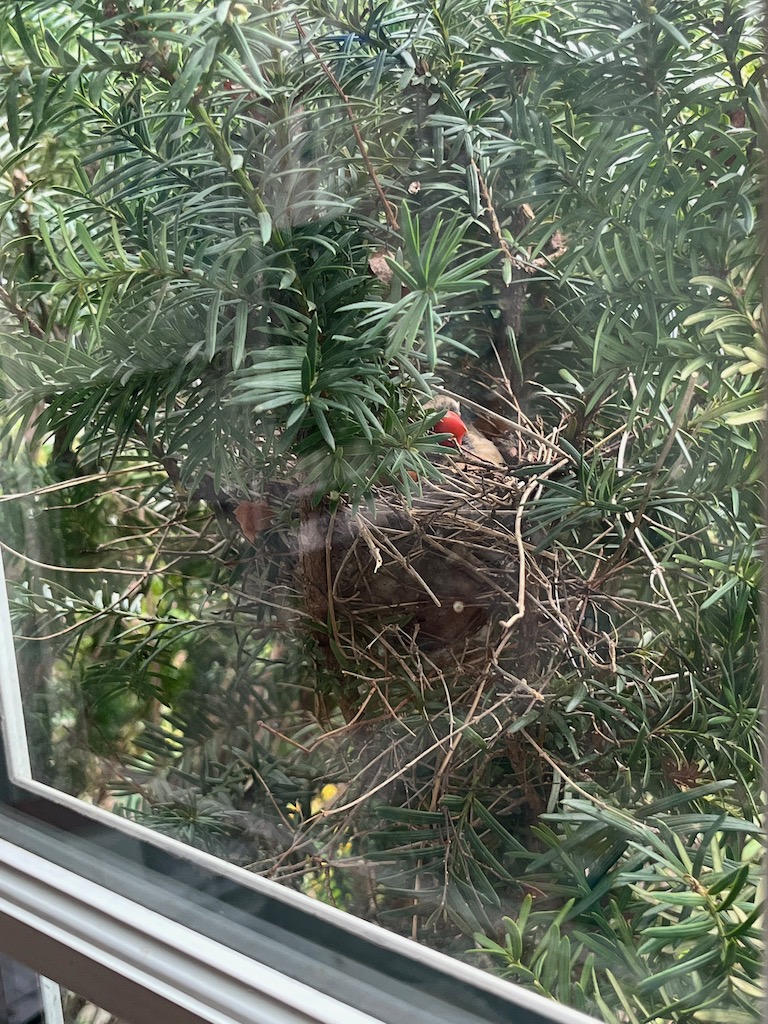
empty nest

once the adrenaline died down, more fire-hydrant surge than all-out combat, once i paused my pounding on the window, realized how close i’d come to thrusting my fist right through the glass, shattering and bleeding sure to pre-empt the rescue i’d attempted, once i took a breath, my first impulse was to think maybe i’d jinxed it.

it must be my fault for letting out their secret. maybe i shouldn’t have extolled the wonders of the nest right before my eyes.

here’s what happened: mama and i were, as we’d been for weeks, co-existing peacefully, she on her side of the glass, blanketing her babies in her downy feathers, me tap-tapping away here on the word-churn machine. it was late saturday afternoon, just one short day and a half after i’d spun the tale of how mama cardinal and i were expectantly working toward our deadlines: mine, a book in the making; hers, a clutch of eggs.

she’d been on the nest 15 days and counting. i delighted at the way she punctuated our shared workspace –– seemingly out of the blue –– by belting out an abbreviated string of song, as if she’d suddenly been overcome by the jubilance of nesting. any day now, i would have heard the wee peep-peep-peeps of nestlings, seen the blur of pointy beaks thrusting skyward for an airdrop of worm.

but then, at nearly six o’clock that fateful evening, without so much as a peep of warning, in those final hours of what eliot so rightly termed “the cruellest month,” there suddenly arose from the bushes such squawking as i’ve never heard. i turned and saw furiously flapping wings — mama and papa both, each on separate branches of the ordinary evergreen that for two weeks now had been the nursery for their nest, the closest i had ever come to northern cardinal observation deck, a broodling in the works. while the two of them squawked and flapped, i noticed the third player in this late-breaking drama. it was furry, brown, and little. its stripe down the back gave it away: a chipmunk. a very hungry and extremely nasty chipmunk, if you don’t mind my editorializing. i leapt into life-guard mode, pounded hard as i could pound from my side of the glass. gave a holler to my own mother, ensconced in her armchair in the other room. as if she could help me here in dire land. at first my pounding seemed to confound the furry one, he turned down the branch, as if in exit. but then, he must have had a second thought, for up he turned, and scampered head-first into the nest. oh, dear god, such horror i’ve not witnessed. this was full-tilt assault. this was nature at its cruelest. and i stood witness. after plumbing the hollow of the nest, the hungry varmint turned and ran. i couldn’t swear to what i saw, but it would not be wrong to think i saw him clutching something in his mouth.

poor mama sat there flapping. her squawks slowing but not quieting. she circled the branch a few lonely times and then resumed her post. we both tried to catch our breath. i tried to convince myself that all was not lost, perhaps the casualty count was one and only one. and, besides, mama stood her post straight through to nightfall, never once lifting her belly from what she surely must be guarding with her life. only then, when darkness eclipsed my keeping watch, did i surrender too; turned off my desk lamp, whispered benediction, and tiptoed off, unsure of what the dark would bring.

alas, when dawn came, i threw off my blankets and hurried down the stairs. no mama. i’d thought i heard a muffled squawk not too too long after dark. i now presume the furry thing returned, finished the deed. the dastardly, dastardly deed.

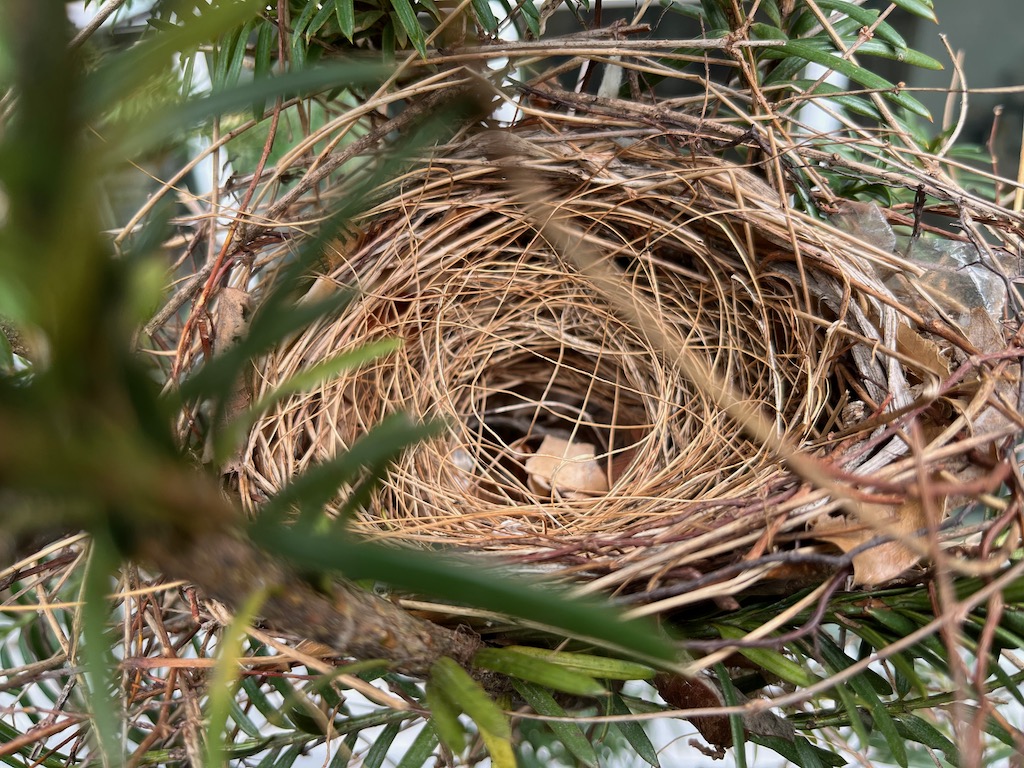
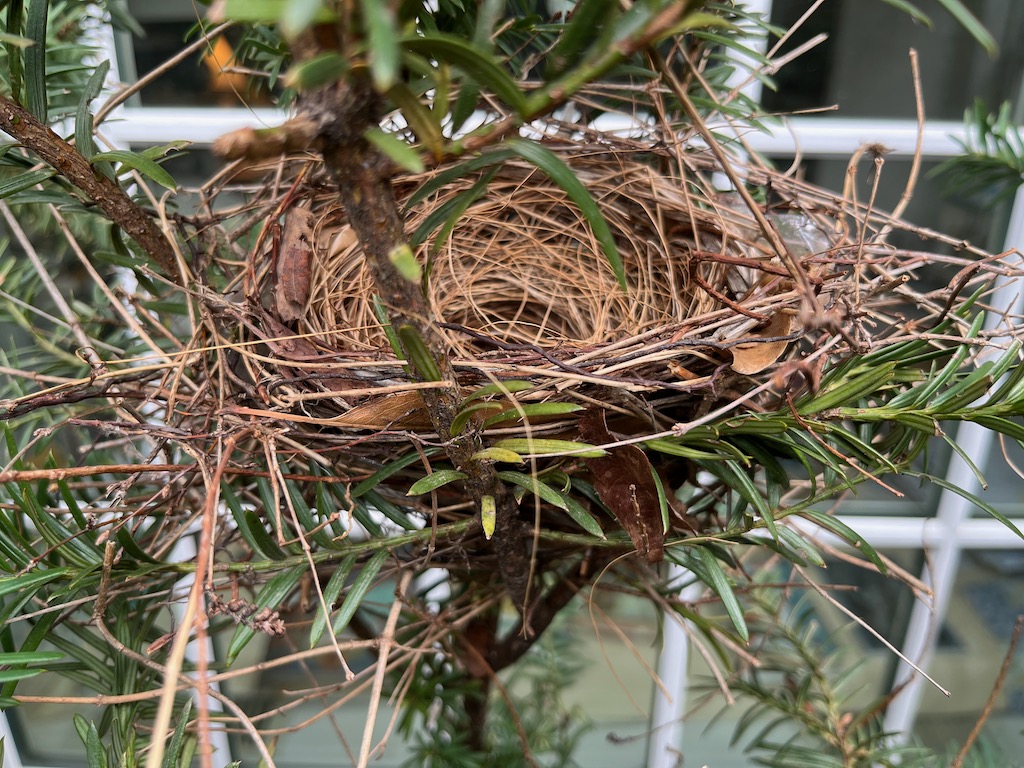
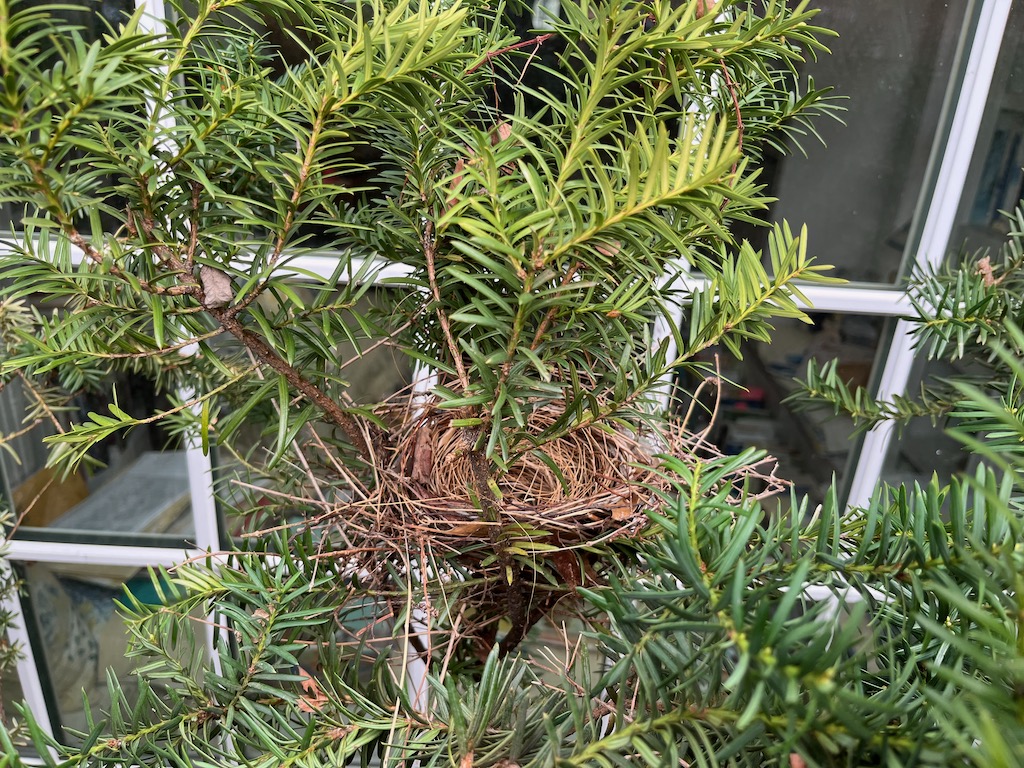
and so, the nest is empty. quite literally as i have just now hauled a step ladder out the door and, clinging for dear life, i climbed and pulled back branches, and indeed there is not a sign of life. just the artistry of their construction, right down to the shiny cellophane they might have thought to employ as something of a rain guard, what with all the rainy weeks of april.

turns out, the cardinals never had more than a one in three chance at making it out of the nest. despite their predilection for deeply tucking away their vernal constructions — remnants of a summer past, a bricolage of bits, dried grasses, thread-thin sticks, that cellophane wrapper perhaps from someone’s pack of cigarettes — the northern cardinal ranks near the sorry cellar of the nesting-survival charts, a long tumble down from the ash-throated flycatcher who scores the highest chance of flying from the nest, with seven of ten baby flycatchers flying. only the lowly house sparrow (11 percent chance) and the european starling (16 percent) fare worse than the red birds, and both sparrow and starling are invaders, anyway, non-native species snuck in as unintended cargo on some north america-bound vessel.

it hurt to sit here the first few days, the silence pounding in my ear. the absence of mama’s brown and red tail feathers protruding from the tuft of evergreen in which she so adeptly hid her nest.

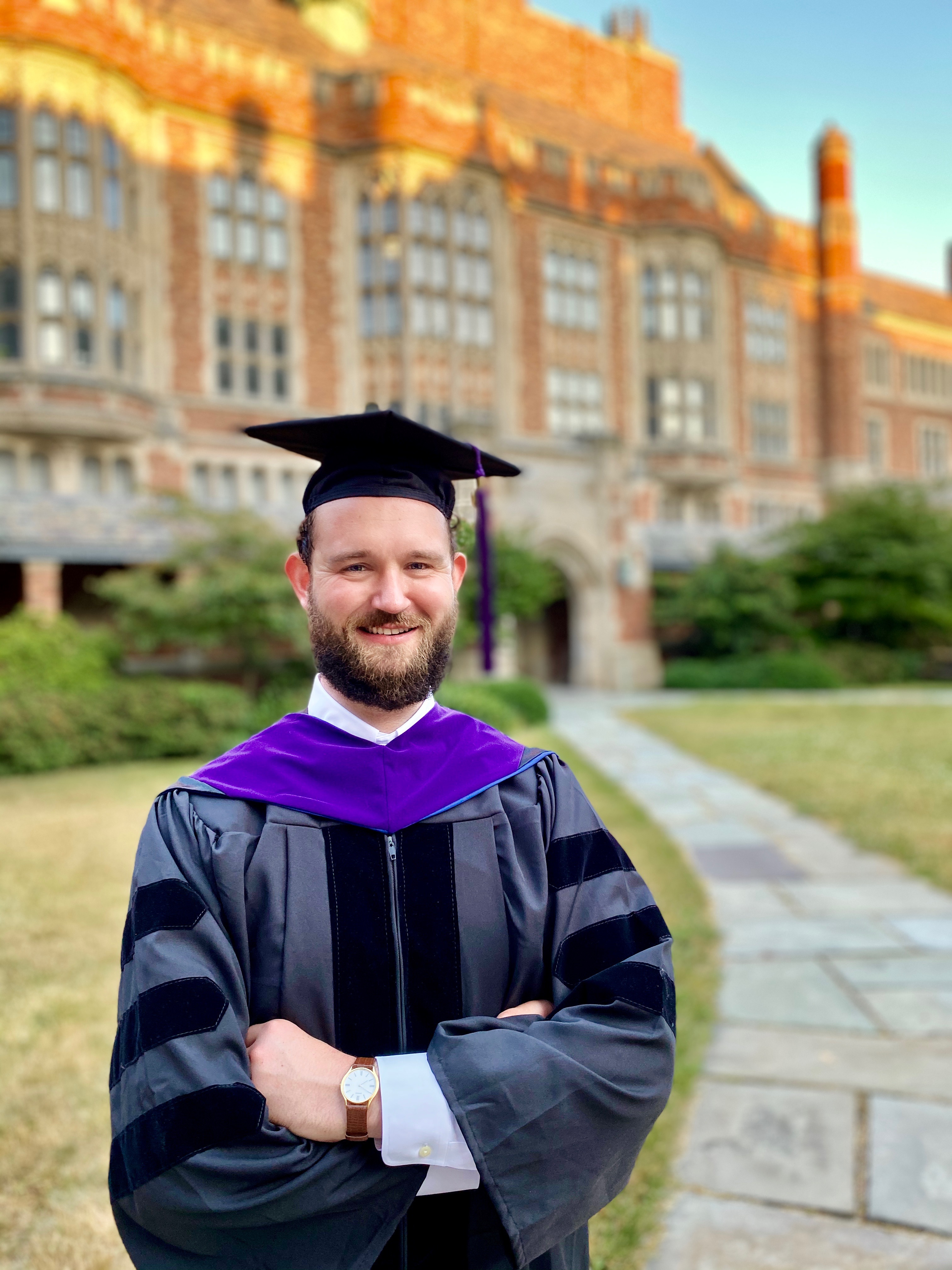
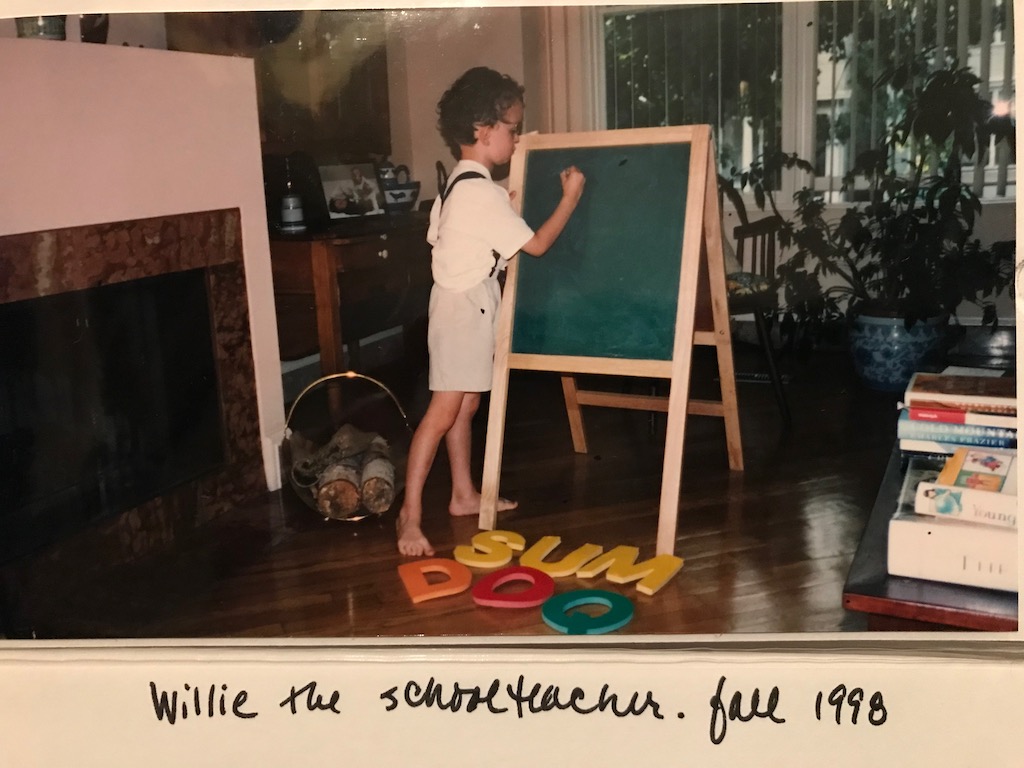
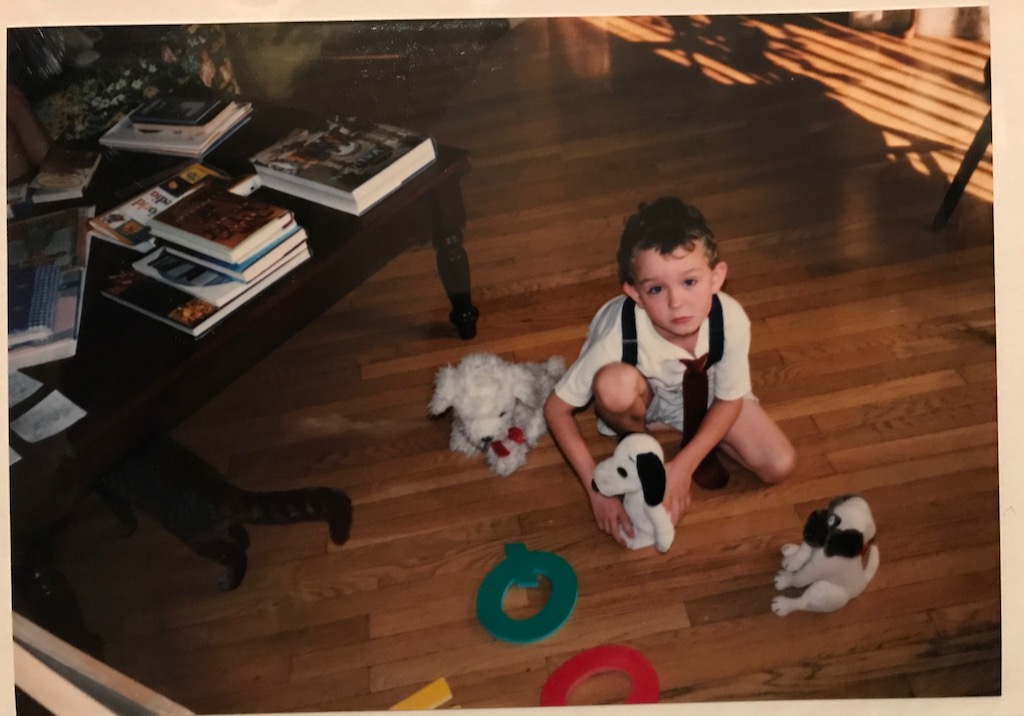
and then i started to consider my own empty nest, a consideration that comes, of course, as mothering day approaches. i think as much now about mothering as i ever have. though it consumes fewer hours of my focus, and fewer drives hither and yon, my fascination only deepens. i think often of how rare — how blessed — it is to know so fluently the whole makings of any life, let alone these two i love so dearly. day by day, it seems, the adventures pick up pace. the twists and turns in their narratives expand my own sense of being alive, being witness to lives unfurling each according to his own storyline. from my perch here at the old homestead, where i am reliably on watch and ever present, i follow two young men carving out paths that couldn’t be more different and yet entwine in ways that make me see the shared origins loud and clear and undeniably. the little boy who once could stare at a tv screen for interminably long times, he is carving out a path to be the very voices, the very storytellers, he once listened to. and the one who once set up an easel in the living room, encircled the room with every stuffed critter from his toy box, donned suspenders and necktie, scooped up a clutch of alphabet letters, and commenced a lecture on the fine points of S-U-M and Q, he looks toward a life in lecture halls filled with legal scholars in the making. let the record show it was snoopy who got first crack at his fledgling professorial skills.

my job here — simply loving through and through — will never ever be done. they might not need me (not so often anyway) to rouse them from their slumbers, to ferry them to the school house door, to shiver on their sidelines, but i’ve come to understand that my unique brand of loving means i’ll never find a way to lay aside aside my worries and my sometimes overly rambunctious fears. the phone calls these days are farther in between, the texts often unanswered, but my contemplations and my prayers deepen by the month. i’ve started worrying in a whole new way about this world we’re leaving to their keeping. i once held out hope that they could right our many, many wrongs. but now i wonder if we’re too far gone, this world so broken in so many places.

i look to mama bird, and her now hollowed nest. there is stunned silence out my window. no flicker of a sighting of mama now at it once again. she makes me think hard about the seasons of mothering, how some are full to bursting, and others pulse with a kind of aching, a sorrow for the hours out of reach, a longing for the more tactile days when every flinch and whimper was within our watch. her empty nest makes me think hard about the one i call my own, at once emptier and fuller than i can sometimes truly comprehend.

no wonder mothering never ever loosens its holy grip on me.

may your motherings be ever blessed, in whatever ways you love and hold those you count as your dearest rarest treasures.

now empty…

when grace comes tapping at the windowpane…

amid a season of war and worry, on the very day when steam was all but rising from this keyboard––a deadline looming, conveyor belts of verbs and nouns at high production––there came a rustling in the bushes just beyond the panes of glass that stretch between my bookshelves.

the morning was punctuated with the sounds of preoccupation, the faintest plink barely tapping at the glass, more than the usual chatter between birds. over and over, takeoffs and landings from bush to branch to nearby picket fence. the occasional outburst of trills and warbles.

it was the quiet of the sound that most intrigued me, the sound of trying to be unnoticed, hard at work in the art of concealment, a most necessary survival skill when up against the odds of danger, in a world where prowling cats and coons, thunderstorms and untimely freezes are another name for doom.

because i knew my role in this rare showing was to be as discrete and invisible as possible, i barely shifted my eyes, dared not tiptoe near the glass, for fear of spooking, for fear of shutting down production.

turned out, the faintest murmurings were these: the sound of wing brushing up against the glass, the sound of branches being jostled to make way for the laying down of bits of grasses, dried and brown and wholly unremarkable.

but what was done, over the course of a single day, was not only wholly remarkable and breathtaking. it was only the beginning.

mama and papa–a pair of cardinals i know by name–had for the first time in all my decades decided to grace me with a front row seat on their reproductive spring: they’d chosen my very ordinary, very ungroomed evergreens, as the very spot to build their nest. it just so happens to be up against the glass, as if the window to the nursery in the maternity ward, the ones where long ago fathers pressed their nose against the glass to get a first peek at the progeny newly birthed and swaddled, the hard labor shielded from the men not allowed near delivery, too faint for such primal birthings.

over all my years, i’ve spied robins all but nesting in the public square. i’ve seen sparrows busily and noisily stuffing gutters and cracks in this old house with the makings of a nest. but never ever had i figured out just where it is the cardinals go to replenish the species.

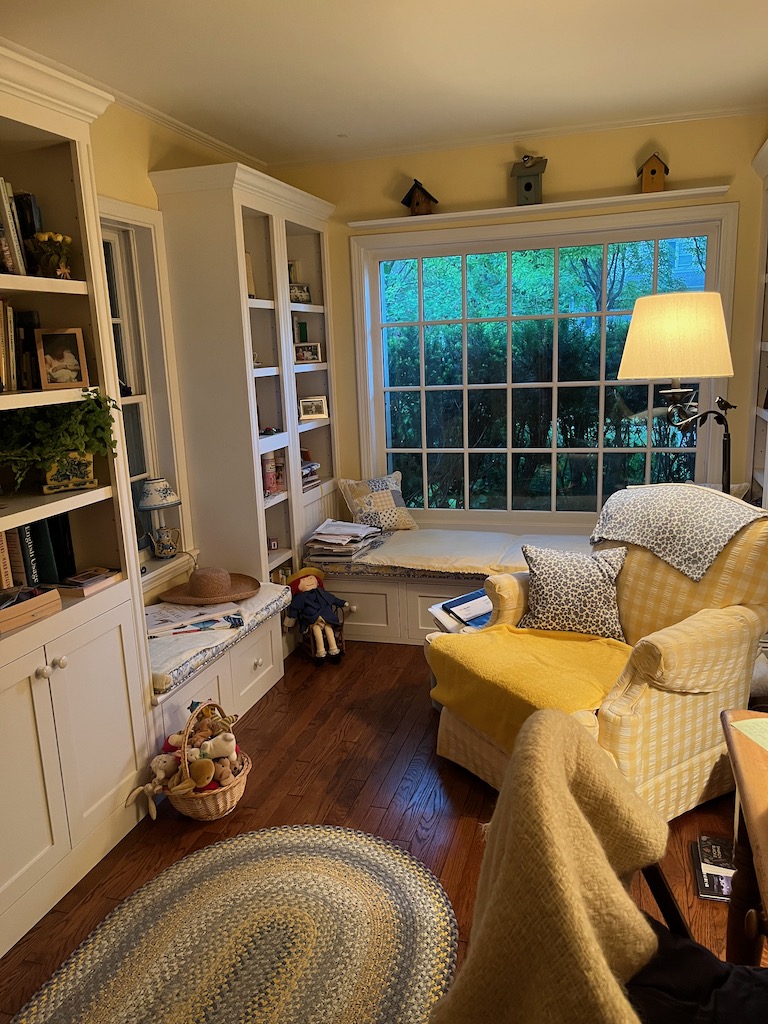
i now know why. my guess is they’re the high scorers in the game of hide-and-seek. their nest, literally up against the glass, is all but impossible to see from the other side of the bushes, and wedged in in such a way that i cannot for the life of me peek into the bowl of the nest (believe me, when mama flits off to grab a seed, to relieve her feathered bum from all its incubating, i’ve climbed atop my window seat to try to fetch a look).

we’ve come to work in synchrony, mama cardinal and moi. i tap quietly at my keys all day long while she goes about her warming of those eggs all day long. once the sun goes down, i leave the premises, turn off the lights, shuffle off to the old maple table in the kitchen–not wanting a brood of mixed-up baby birds to mistake my desk lamp for a never-setting sun.

far as i can tell, and i tell you my guess here is based on scantest evidence, there’s not yet a clutch of little beaks to fill with bits of worms. each day, though, the drumbeat picks up pace. it’s been two whole weeks, and surely we must be getting close.

it’s a blessed thing, a most blessed thing, a thing that fills my soul, to be witness to the against-all-odds timeless knowings of the feathered flocks. those little birds know nothing of the ravages that tear apart the human flock. theirs is a universe––far as we know, and maybe i’m just wishful thinking––without the sorts of strife, without the demonic ingenuities to dream and build and drop a bomb. do birds know worry? does mama bird go about her business without the slightest hint of begrudgement? is she already plotting her grocery list? does she count her clutch, scan for misshapen egg, dread the day those baby birds take flight and leave the nest?

such are the questions that reel through my mind, as mama bird and i go about our tasks this one most blessed spring. it’s a wonder when grace comes tapping at the window pane. as if the heavens know just who and when needs holy balm far far from the madding crowd.

what grace has brushed you by this spring? what’s caught you unawares? what quiet has so startled you, and awakened you from your worldly slumbers?

when the history you seek is your own

The Dixie Line of the L&N Railroad

it started over matzo and maror, the staples of passover, when amid cups of wine (they’re commanded, four of them), i started to pepper my mate with question upon question (more than four of my own; again, four are commanded). i was asking about seders of his long-ago past, curious about each of the characters, and the long journey from shtetl to tenement to, well, ivy league colleges and a pulitzer prize. because i tend to poke around in the vaults of history, root around for tidbits and clues, i remembered i’d once tucked away what we thought were steerage records of one isidore kaminski’s arrival on nov. 14, 1912 from russia by way of rotterdam, on the s.s. uranium.

and upon pulling that sheaf from my stash, i felt my curiosities piquing. i was suddenly hot in pursuit of my own irish peoples. and, lo and behold, i found philip mahoney himself arriving in boston harbor on may 9, 1850, on the silas leonard, a steerage ship that only three years later would be shipwrecked off the coast of newport, rhode island.

the deeper i look the likelier i see how often the fact of my existence is but a long, long series of near misses and narrow escapes.

and, often, when poking around long-ago times when survival was iffy, the tales you unearth can knock you back for a while. it’s the price of paying attention. and i welcome it, though it might take a few days, maybe some months to really distill all i discovered this week.

best of all, i discovered a long-lost cousin, a cousin whose tales criss-cross the pages of the new york times, among other adventures. we share a great grandmother and great grandfather. tragedy struck his branch of the tree right from the start, when our great grandmother died birthing joe’s grandmother. my grandfather would have been seven, left without a mother and with a newborn baby sister. i am still filling in all of the pieces of a story far sadder even than that. i am imagining––enlivening––all of the characters in each of the plots, thrusting myself back in time, peeking out from under the tables and around all the corners.

that’s what is often the case for those of us who find ourselves compelled by the stories of the past, stories we know in some way inform who we are and how we got to this moment. the few cousins i’ve met along the way, one of them one of the true treasures of my life, all seem to share a gnawing curiosity, a wanting to fill in the blanks. to step back from the present and take in the whole sweep of the story.

it’s how i discovered an uncle had died in the great battle of iwo jima, slashed with a bayonet in the deep of night before he could leap from his tent. it’s how i filled in so many missing pieces of the grandmother my own father so rarely spoke of, a silence i sensed was fueled by a heart so broken by her absence he chose to stay mostly wordless when it came to talk of her. though he did tell me once––and with my father the less he said, the more emphatically you knew he meant it––that he saw so much of his mother in me.

i am fairly certain i get lost in the mists of family history in my feeble attempt at resurrections. oh, what i wouldn’t give to sit at an old maple table, fueled by tea for the women, scotch for the men, and indulge in the swirl of their stories. maybe it’s reaching deep into the vaults––frustrating as it is to run into the dead ends and cul-de-sacs of hard-to-read 18th-century cursive and records gaping with holes––maybe it’s reaching back into time, barely brushing up against the most basic of biographies, that fills in a sense of just who i am, and propels me to make of my one little life just a little bit more than i otherwise might.

maybe it’s that the long sweep of history puts me more squarely in my place, highlights how tiny a dot is my place in the long ellipsis of genetics and time.

this week i spent a long time looking at the mahany side of my family, a side i knew too little about, a side whose story is much sadder than i ever realized. my dad said so very little, and my dad was gone way before i’d asked even a tenth of my questions. the last significant thing i remember my dad saying to me, one day not long after his very last christmas, was “kid, you have a real sense of history.”

indeed, it seems it’s a hunger.

and all these years later, i’m still trying to ask my next question, to find the stories he never told.

with all the love in my heart, this one is in its own way a love note to my dear beloved p. shannon, a third cousin who more than anyone i know has taken me by the hand deep into the vaults, and pointed the light at each and every turn. bless you paddy, i will adore you till the way end of time…..

the map above is the rail line through kentucky where my choochoo papa (my paternal grandfather) was the locomotive engineer for the Louisville & Nashville Rail Road at the early age of 26 until his retirement some 50 years later. he––along with my dad and the grandma i never knew––started out at the little dot on the map marked “paris,” as in kentucky not france, a dot on the map that will forever be my old kentucky home.

manifest of the s.s. uranium that carried our boys’ great grandfather to america in 1912
my great-great-great grandfather’s record of arrival from ireland in 1850

have you poked around in the attic of your own family’s history? are you propelled by curiosities? i suppose, after a lifetime of bylines, i’ve left more than my share for some curious soul in generations to come. have at it, sweet girl, i only wish i could join you…….

year upon year, truth upon truth…

14th-century rendering of the plagues of egypt

we are tellers and re-tellers of story, a people long bound by the unspooling of truths told in text or in verse, around table or hearth, under moon and star or plaster and beam.

in the geometry of time, there lies both wisdom and instruction in the unfurling of the year, an unfurling that might feel like a circle but that i see as a spiral. year after year, we return to texts––familiar texts––that draw us in more and more deeply, the more closely we pay attention. 

so it is––as i fill my house with matzo and shred it of breadcrumbs, as i shop for both lamb and shank bone, as i steam mounds and mounds of asparagus––that once again we come to this holy stretch of time endowed with foundational story, ancient stories both christian and jewish. the story of a savior who wept in a garden, and soon was betrayed, then flogged and stripped and pierced with a crown of thorns. a humiliation as severe as any i’ve ever read. certainly more than any i’ve ever known. and at the same time in this house, we read and retell the story of the enslaved jews finding their way out of bondage, crossing an isthmus, a sand bar in a sea of reeds, but not before witnessing the scourge of ten plagues. 

the beauty of these texts, and any text meant for endless curiosity––these texts, as if prisms we hold to the light, turning and turning for the making of new rainbows––is that each year some new fragment may catch our attention. new rainbows might scatter against the walls of our soul. 

so it is that this year i am thinking anew of the plagues: water turning to blood, frogs, lice, flies, livestock pestilence, boils, hail, locusts, darkness, and the killing of firstborn children.

i remember how at the long seder table where my boys grew up, the table would be scattered with wee plastic frogs and broad-winged bugs; ping pong balls would serve as hail. and red food dye would be splattered on plates. the detail was never lost. 

and only this year––a year when both those boys who once squirmed at the bugs and squealed at the blood will be hundred of miles away––only this year have i come to pay closer attention to what the plagues might have meant to the story we’re commanded to tell. 

according to a wise, wise rabbi whose wisdom i found myself reading the other day, the plagues are “commonly read as punishments levied against the egyptian people for the terrible suffering they forced upon the israelites,” writes sharon brous, the senior rabbi and founder of IKAR, a jewish congregation in los angeles, a rabbi who calls it her life’s work to re-animate religion. oh, that we animate it, this vein in our lives that seems to either be bent to fit particular agendas, or shoved to the side altogether. 

but, writes rabbi brous, there is another way to interpret the plagues, and God’s intent therein (and here’s where i buckle my seatbelt, and begin my own homegrown rocket ride): what if the plagues, the sufferings, are meant not to punish but rather to tender the heart. to grow compassion. to breathe and breed empathies. 

we need turn to the 16th and 17th centuries, to the wisdom of a venetian scholar and rabbi named obadiah ben jacob sforno, to find the seeds of this thinking: sforno argued in his commentary on the text of exodus that the plagues were actually brought to awaken the conscience of the oppressor, “to increase the chances that pharaoh would finally see the light and become a genuine penitent.” 

“in other words,” writes brous, “what God desired was a true change of heart. God wanted pharaoh and his people to take responsibility for the injustices they committed. tell the truth. make amends. offer reparations. chart a new course, together with the israelites.”

in a world as plagued as ours currently is––war and pillage, pandemic and pestilence, fire and flood and drought––in a world where it’s too too easy to turn our backs on the sacred, to point to the suffering and insist there’s no God so hard-hearted to look the other way so therefore there must be no God, in a world as replete with reasons not to believe, what if the radical notion, the one that’s hardest to come by, is the dawning idea that with each and every suffering we grow more and more tender. 

there’s the crux, the hard part: to allow the suffering to tender us, not to harden. not to let horrors metastasize, not to let hurt spread like a cancer, nor turn us into walking, talking cess pools of resentment, to leave us every morning, noon, and night with the afterburn of bitterness there on our tongues. 

imagine ten of your own plagues: the time you were double-crossed; the time you discovered a terrible truth, a truth that was crushing; the dying and death of someone you loved. the remembering and never forgetting of a time you caused the suffering. the lie you let grow. the cruel innuendo that crossed your own lips. count your own ten.

now, consider the pain that you felt. how it awoke you in the night. how it haunted you by the day. how it felt like a nest of hornets let loose in your soul. 

now imagine that the pain didn’t harden. imagine it worked to loosen the loam of your soul. allowed room for new seeds to be planted there. tender sproutlings of purer compassion. how, ever after, you knew what it meant to grieve in a bottomless way. how, ever after, you knew how tempting it was to turn away and never turn back. how, ever after, you knew the muscularity demanded to rise up and out from the darkness. 

consider how those plagues pushed you––not without ache, not without wishing you could wish it away––toward a deeper, broader understanding of and connection with the suffering all around.

imagine if the resonance of your own hours of suffering allowed you to look upon the sins and the suffering all around and find common ground, feel your heart open not close.

imagine if the world’s suffering was meant to do the same. imagine if all this is an exercise in tendering our holiest vessel: the one heart made as a chamber for the sacred to dwell. 

what if, instead of growing bitter and hard over time, we grow softer and sweeter? what if we return to the text––the suffering and crucifixion of the one born to teach and live love, the freeing of an oppressed people made to witness hardship upon hardship, ten plagues in all––what if we return to the text and find, for the very first time, a wisdom to carry us on? into a world that never seems to pause in its inflicting of pain.

what if, in feeling the pain, we are moved to be the agent of balm, of healing, of lifting the other out of a pain we know all too well? tikkun olam. “repair the world.” mend the tatters. reimagine the whole.

there must be wisdom, must be reason we circle again and again to the same lines of text, as if we’re meant to meet it again with whomever we are one year to the next. this year the lines that most drew me in were the ones that ask why in the world would ours be a God who not only allows but inflicts plague upon plague, hurt upon hurt.

my knowing next year might differ. but this year i’ve come to dwell on the thought that no one escapes a life stitched with sufferings. and if the sufferings come, how might they make of us souls that pulse with compassion. communion, after all, is the holiness we seek. oneness. with God, with ourselves, and the whole of humanity circling this earth in this long, dark hour.

what plagues move you to compassion? (a question to answer deep in your soul in these entwined holy hours ahead….)

i cannot let this day pass without remembering my beautiful mother-in-law whom i last saw on this day, her birthday, a year ago. we keep her flame alive, very much alive, in the telling and re-telling of her stories. may they never end…..

*the question of the israelites and the plagues––whether they witnessed them or endured them––was a question that prompted much discussion at dinner last night. one of those rabbit holes into which we fall at our house because one of us––either the jew or the catholic––is always fairly new (or newer) to a story, and wonders about it in ways that have never quite struck the one to whom it is more familiar. i’d assumed––wrongly, it turns out––that to be in egypt at the time of the plagues meant to endure them but a closer read of the story made clear that, according to Exodus, for at least some of the plagues, the israelites were protected. certainly, i knew that the whole point of the “passover” was that Jews were to mark the doorways to their home with the blood of a sacrificed lamb, and the angel of death would know to pass over, sparing the firstborn son. i hadn’t realized––nor had my tablemate––that plagues one through three seem to have been endured by all, and four through ten were endured only by the egyptians, except for those who were penitent and thus spared the wrath.

tick, tick, tick….

snapshot of the writing garage moments after final manuscript submitted

waiting has been the posture of the week here at book-making headquarters. which, for someone wired like me, means clicking my phone every few minutes, checking to see if there’s yet a reply. forcing myself into tasks—say, cleaning the bathtub, sorting the wash––that will keep me and my antsy fingers away from the checking, reminding myself simply to breathe. 

it might come as little surprise––after keeping you in the loop here as i’ve loped toward the publishing finish line––that the reply i am so, so anxiously awaiting is the one from the editor who will, ultimately, thumbs-up or thumbs-down that collection of words i refer to as my latest book. a book whose making has certainly silvered a few more of my hairs. a book i turned in sunday night, with hours to spare before the monday deadline. the first editor, a true godsend with whom i’ve been back-and-forthing for the last four weeks, gave it a solid thumbs up, but the one we now await is the one who a.) moves it along. or b.) asks for more rewrite still. or, i suppose, in the doomsday version (one i’m apt to imagine) c.) she simply throws up her arms and shrieks, “i’ve no clue at all why this was a book i thought worthy of printing!”

over the last few weeks, in this latest batch of dispatches from here in the writing garage (this appendage to our old house began its existence as a place where mid-century cars sputtered fumes, not too distant, i suppose, from its now housing a sputtering writer), i’ve pulled back the curtain a bit on just how it is that thousands of words find their way onto pages soon to be glued, bound, sewn, or whatever is the latest technology for keeping the papers from scattering. (imagine if in buying a book, you were handed an assemblage of pages and told to shuffle them into just the right order before you sat down to read; binding, clearly a nifty invention….)

one of the lists i’ve been making this week is something of a manifesto, of how––should i ever find myself in the editor’s desk––i might try to alleviate the suffering of a writer whose tender self and soul would be under my watch. it’s hardly a stretch to assume that most who assign themselves to the occupation of putting words on the page tend to find their hearts rising and falling in some measure with the way those words are met by editors and loved ones and even anonymous readers. 

i’ve suffered at the hands of all the above. i’ve winced as editors killed my “little darlings,” the newsroom nickname for those snazzy bits of sentence or prose that the writer pretends makes him or her the star of the class, only to find the darling is unceremoniously flung to the cutting room floor, where it lands with an unceremonious thud. i’ve gulped as my father-in-law dialed long distance to suggest i might need a refresher stretch on the therapist’s couch as he thought something i’d penned right here on the chair, after our firstborn sauntered off to college, was far too depressing, and a sure sign that i’d teetered over the edge. and, back in my newspaper days, i had readers pen letters in what used to be a telltale chickeny scratch, often in recycled envelopes (in the digital age, it’s now hard to predict when an incoming email is going to explode with invective), all but insisting i leap from my desk in the tribune tower, run––not walk––three blocks east, and jump in the big cold lake. with stones tied to my ankles.

it can be not so pretty, this audacity to say what you think. or you feel. or what you pray. to put into words the otherwise ineffable. to sometimes see sentences there on the screen that you simply hadn’t realized were in you until they arose, one tap-tap at a time. 

it’s one thing to put words to breath, in conversation over breakfast or lunch or sitting alongside a friend on a bench or a swing, and to know that those words won’t leave a trace––except in the memory of the one to whom they were spoken. to dare to put ink (or pixels on a screen) to those thoughts––sometimes half-baked, sometimes raw, sometimes with too many dashes or commas––is, when you pause to think about it, rather a bold expedition. seatbelts ought be required. 

anyway, my manifesto would begin with one or two basics: don’t forget that the one on the waiting end is likely on needles and pins; offer kind words even when pointing out stumbles and weak spots; and please remember how daunting it is to play at this game. it’s not too much of a stretch to extend my manifesto beyond the wordsmithing game. it’s a very short list that might apply to the wider world as we seem to be slipping deeper and deeper into an age of too-little regard for the human species with whom we share this moment in time. 

it takes so very little.

what would you include on a Manifesto for Minimal Kindness, editorially or otherwise?

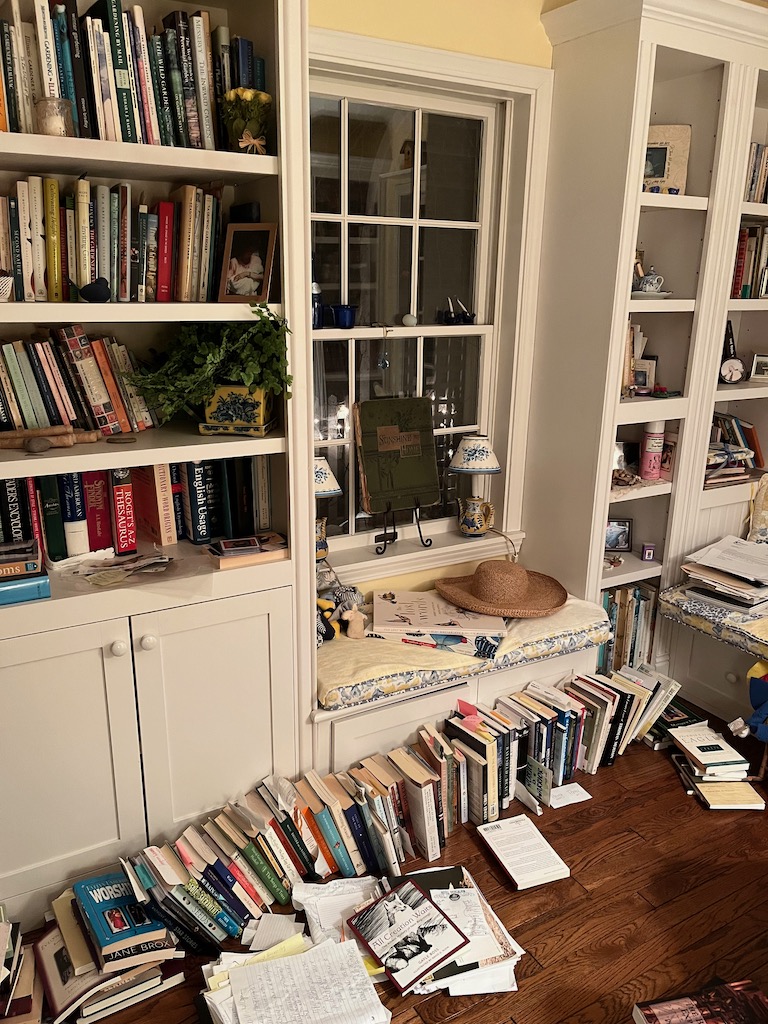
note that in the snapshot above, compared to one shared a couple weeks back, the stacks in the writing garage only grew higher and higher as the days ticked by, one after another en route to that finish line...good news is the other writer who lives in this house wandered into the room last night, eyed the bowing shelves, the shelves all but groaning under the weight, eyed the impossible hopscotch of books, and declared: “you need more shelves.” so i guess my disarray just might save me after all.

still plowing…

please excuse the interruption in regular programming here at the chair, i’m barreling toward the latest installment in the Deadline Plan, this one poured in concrete, i’m told. i rounded the bend on the penultimate deadline last sunday, and awaited the first batch of edits, which landed tuesday midday. now awaiting batches two, three, and possibly four. all destined to drop––impeccably and with my whole heart attached––on the editor’s desk by end of business on monday.

if you ever wondered how a book becomes a book, here’s how in one word: persistency.

never looking up from the page. forgetting to eat lunch. thinking of verbs in your sleep. surrendering nearly every last domestic chore to the very kind fellow who stalks these same halls, the one who is making sure i sleep, eat, and drink gallons of water.

i think it will all be worth it. i’m pretty sure there will come a day when i look back on this chapter and––just like labor pains––forget how much it hurt, how much my head pounded, and my heart right along.

as i look at my bookshelves these days, i see not just pages and pages of paper and ink but the accumulated anguish of hundreds of authors over hundreds of years. books do not write themselves. books demand total attention. and day after day of it. for as long as it takes.

and what’s it all for? for the scant hope of communion, for the slim chance that one someone somewhere will be reading along and suddenly hearing a loud pop, down in their heart, or up in their brain. because some faraway someone has just put to words some ineffable thing that they’ve never named. though they’ve long sensed it.

there is much typing still to be done here. and after that, the copy-editing brigade comes over the hills. and then proofing each page, making sure no squiggles or bloops slide into a sentence. making sure each their is a their and not there. same with the its‘s.

once this latest round of incessant typing slows to a ceasefire, i’ll be back to breathing again. it’ll come in waves from then on. this here is the final hard push. just like the time my miracle baby was about to arrive, and the monitor beside me dropped to a gulch. and my doctor looked me in the eyes, and said, “barb, you’re getting this baby out in one push.”

and i did.

and i’ll do it again with this book.

in the meantime, here’s a little amuse bouche for your troubles.

One of the best things a man can bring into the world with him is a natural humility of spirit. About the next best thing he can bring, and they usually go together, is an appreciative spirit — a loving and susceptible heart.

John Burroughs, naturalist, conservationist, wonder seer

and why not another?

If we turn our mind toward the good, it is impossible that little by little the whole soul will not be attracted thereto in spite of itself.

Simone Weil, French philosopher, mystic, political activist

what pithy bits of wisdom or heart stirred you this week?

out of chaos, come pages of quiet

this is the word factory, the chamber where a book is in the making. and if you can’t see the steam rising from the computer screen, imagine it. it’s there. and so too it rises from the fingers wildly skipping about the keyboard, plucking new verbs from out of thin air. making up occasional others.

i’m in the final stretch of a book-making adventure that has been wildly, um, adventurous. early thursday morning i was given the latest in a long series of hurdles, each one daunting, each one prompting me to mutter under my breath, this is impossible, i can’t do this. but then, hours later, after the shakes (and the swears) wear off, i find my stride here on the alphabet keys from which i build so much of my life. i type like there’s no tomorrow, i type into the wee wee hours. my deadline––a full revision of a manuscript: this sunday night, before bedtime.

which is why this one particular friday, there isn’t much chair to pull up to. i’m deep in the 70,359 words that currently comprise The Book of Nature: The Astonishing Beauty of God’s First Sacred Text, a quiet contemplative book slated for birthing on the vernal equinox of 2023 (that’s march 21st, if you’re wondering). where it will end, is anyone’s guess. i sense a word chopper not too far in the distance. that’s when you’ll hear the telltale welp of the writer watching her words whirl down the drain. a painful interlude in which i try hard to fixate on the words of that guy we know around here as the oak park native and spear-fisherman, one ernest miller hemingway, who might or might not have once insisted “a story is only as good as what’s left on the cutting room floor,” a possibly apocryphal maxim that’s meant to take the sting out of the editor’s slicing and dicing, and by which the writer soothes herself as each “little darling” dies a swift death as it whirls to the cutting-room catch basin. what it means is that you’ve pared your pages of prose of all fat and mouthfuls of gristle, and all you have left is sinew and spine. and now, i’ve mixed enough metaphors in a single paragraph to have each and all editors unbuckling their seatbelts, scrambling for safe exit.

speaking of safe exit, you might be wondering if this room where i type has been deemed an occupational hazard, a danger zone where i could be caught under an avalanche of literary proportion. there is, you might be pleased to know, a single narrow uncluttered trail to the door. and the books that surround me on four of four sides are stacked in utterly intelligible groupings, all of which i can easily reach from here in the chair where i spell out my words, one tap at a time. i pride myself on conservation of effort when it comes to bending and plucking.

before i leap back in, somewhere around the 39,000-word mark, i thought i’d quietly leave a dollop of wisdom from the inimitable novelist george saunders on why it is we write in the first place. may this give you something fat-free, and stripped of all gristle, to chew on:

Literature is a practice that improves a culture and can make it more tender and open.  But its effects lag and are approximate and tend to benefit people already gentle and inclined to caring. 

And yet.

In stories we might catch a glimpse of why people do the things they do, which should prepare us to think about things more incisively and boldly when people do something that is cruel, violent, or inexplicable.  Whatever we are brought to feel, through literature, about love and understanding and sympathy must take this into account: the invasion of a peaceful country by people who have somehow, it would appear, set aside love, understanding, and sympathy, or have twisted these notions into strange shapes amenable to their purpose.

Also, in this world of ours, there be monsters — the workings of whose minds are mysterious, and whose darkness (their apparent indifference to love, understanding. and sympathy) we somehow keep underestimating.

This, too, can be written about. 

But what also can be written about: people fighting and dying for their freedom and the freedom of the people they love.

What do we do when notions dear to us (notions of compromise and kindness and the ultimate goodness of any human being) are mocked by events and made to feel facile? Can our understanding of these notions be expanded so that they are more muscular and useful and don’t have to be set aside or apologized for at moments like this?

George Saunders, Story Club newsletter

or this, from jane hirshfield:

“Poetry’s work

is the clarification

and magnification

of being.”

may this week bring you peace. and a glimmer of peace to this broken, broken world.

and happy blessed most magnificent birthday to two complete loves of my life, who happen to have been born back-to-back: my beloved sweet P, on sunday, and auntie M, on monday the 28th, a day i consider a national treasure.

the room to which i return….

in need of beannacht, i found my way back to an old friend, the irish poet of infinite blessing…

the author photo of John O’Donohue, now fading, but still my bookmark

in search of profound goodness this week, i found my way back to the saint of a gentle soul, a poet with whom i once shared a st. patrick’s day, and who would remain a kindred spirit and friend, with warm and occasional phone calls until 2008, when he died in his sleep on january 3, a day that happens to be my birthday, and two days after his own 52nd birthday.

john o’donohue was a priest and a poet on the day in 1999 when i (a newspaper scribe at the time) pulled up to his hotel in my little brown toyota corolla and spirited him away to one of those ridiculous faux irish pubs that line chicago’s more touristy streets. we landed there, amid faux celtic ruins and an endless loop of tin pipes and ditties, with more than a touch of irony. we talked till the sky beyond us went dark, and the city streetlights turned on. it was one of those newspaper interviews that wound its way into something that never ended. we were there in the wake of his best-selling anam cara‘s american publication (and marking the occasion of what would become his second best-seller, eternal echoes), and we found our own soul friendship. he was and is a rare blessing to me. his mind was voluminous. his heart and his soul even more so.

i found my way back to john, against the drumbeat of this unrelenting savagery in ukraine, because i was looking for words that might comfort. i was trying to be hopeful in hard times (per howard zinn down below, sent to me this week by a beloved friend of the chair.) i’d been collecting a litany of small wondrous moments of human kindness and utter goodness arising from the brokenness in kyiv and kharkiv and mariupol, when i decided to search for words that capture this moment of brokenness, of enormity distilled into poetries, well-chosen words that give us a way in to whatever is true, and beyond our worldly comprehension.

i found john’s beannacht or blessing, a blessing with a tinge of goodbye, “goodbye and God bless,” and whenever i read john’s words, i think of the day — and the story that came of it — back in march of 1999. as i started to read the story under my byline, a story that ran in the chicago tribune on st. patrick’s day of that year, i decided i’d bring my friend here to the table, for all of us. we could all use some comfort. we could all use some john o’donohue.

THE GOOD GREEN POET

By Barbara Mahany

Chicago Tribune

Mar 17, 1999

The poet-philosopher, who lives in solitude in the west of Ireland, leapt the curb and strode into a North Clark Street saloon purporting to be an authentic Irish pub — about a block away from another place purporting to be a rain forest.

The poet-philosopher has experienced the real thing plenty — pubs, that is — and when he looked up and saw, beside the tavern door, faux stone slabs pretending to be ancient Celtic ruins, he jolted up a bit and mumbled something about the Flintstones.

But not wanting to sound impolite, he muffled most of the rest of what he had to say, here in a place in downtown Chicago where the accents on the waiters were so thick he couldn’t believe they came from the country he has called his own for all of his 43 years.

John O’Donohue, a giant of a thinker, and a pretty tall guy, too, folded his 6-foot-3-inch frame onto a carved-wood bench, and did what any self-respecting Irishman would do, caught in such a circumstance. He ordered a pint of Guinness, and a bit of Irish stew to wash it down.

Then, his feet occasionally breaking into an under-the-table tap, in tune with some fine accordion blaring over the speakers, he settled into a long afternoon of conversation — the great art he alternately refers to as “an old blast of ideas” or “the source of luminosity in the Western tradition, going back to Plato’s dialogues.”

Oh, how he laments that discourse is dying, one of the great casualties of postmodern culture. What passes for it these days, he says, is really “just intersecting monologues.”

For a man who spends most of his days hearing only his own thinking, living alone as he does in the wilds of Connemara, O’Donohue–a Catholic scholar, priest and, of late, a best-selling author–is spilling with much to say about everything from how odd it is to refer to coffee as regular, “as distinct from coffee that misbehaves,” to how we should cross the threshold of the millennium in two days of silence, “with a liturgical solemnity in some way.”

He cracks Steven Wright jokes –“I went into a restaurant. It said, `Breakfast Any Time.’ I ordered French toast during the Renaissance.” He croons with Sinead O’Connor. He drops the names of philosophers from practically every century dating to ancient Greece. He sprinkles blessings on everything from the car he had just bumped around in, to the table where the afternoon’s conversation unspooled.

And the world is very much starting to listen–even if it’s only to him talking to himself, as he puts it.

In fact, of his pair of best-selling books, both spiritual works laced with Irish lyricism–“Anam Cara: A Book of Celtic Wisdom,” the No. 1 best seller in Ireland for 18 months until it was bumped from that spot by his new book, “Eternal Echoes,” now shifting between No. 1 and 2 in the country that, after 800 years of colonization, has built an empire of words–he says: “All I’m doing with these two books is allowing, maybe, others to overhear some of my own internal conversations. I’m not sure I’m right at all.”

And some conversations they are.

“He is the finest English-language-speaking spiritual writer of our time,” says Rev. Andrew Greeley, the Irish-Catholic priest and best-selling author of 42 novels, including his newest, “Irish Mist,” in bookstores for St. Patrick’s Day.

“When I started his first book, I said, `Oh, I’ll sit down and read the whole thing.’ Well, I soon realized I’d only read a chapter a day. It got down to a paragraph, at most a page, a day. I’m using the new book for spiritual reading, and the section I’m on now, it’s about a sentence a day.”

It’s not that it’s drudgery. “It’s rich,” says Greeley, who has the heroine of his new book quoting O’Donohue, a sure sign that he’s seeping into popular culture.

No less than Deepak Chopra, the best-selling author, physician and spiritualist, is a fan. He says O’Donohue’s work is “a rare synthesis of philosophy, poetry and spirituality.” He calls it “life-transforming for those who read it.”

Yow.

And how is it that the boy who grew up on a sod farm, whose vision of hell to this day is an endless prairie of turnips that need thinning, who lives an ascetic’s life alone in a cottage with walls held up by books, the nearest human a mile away, how is it that such a lad grew up to be “well on his way to becoming one of the master practitioners of the trade,” in the words of Greeley, the trade being the saving of souls through spiritual writing?

“I was born on a farm in the west of Ireland, and I’m so glad of that because I think one of the finest places to begin acquaintance with the universe is on the land,” says O’Donohue. “The landscape at home is exceptionally dramatic, the Burren region of County Clare, the amazing stonescapes, you know.”

You mean sort of like the stones standing near the door?

“No, not at all,” he says, barely glancing away from his Guinness.

“It was an intimate landscape. Every field had its name. It was a folk world, a world of folk culture. Also, through working the land –cows and cattle, sheep and fowl, sowing crops, cutting hay and turf, it was a full farming life–it meant that you became acquainted with the landscape.”

His favorite chore: Cutting turf in the bog, slicing half-foot slabs of earth, boring deeper and deeper with every slice. The bog, he explains, “is where there was a forest and where it collapsed, and where all the past life is congealed underneath the surface in a fallen way.”

And so, “in a sense, cutting turf is a place where you enter the hidden time of a landscape, where its memory is interred.”

It is those poetic riffs, infused with a passion for the natural world, that are the underpinning of O’Donohue’s vision. It is his Celtic soul oozing out–in conversation or in his books.

He was blessed with a father “with a lovely mind for a farmer. He always had the ability to think. He could go to the horizon with the thoughts.”

And always, turning the hay, cutting the turf, there was conversation.

“At night, too, around the fire at home, the experience of the day is sifted. With all kinds of silence, loads of silence looking into the fire. A lot of old time for integrating experience, digesting, mulling over things.

“It was a lovely way for a young man to grow up. James Hillman (the Jungian analyst) said, `Women relate face to face, but men relate shoulder to shoulder.’ “

It wasn’t long before O’Donohue went off to university, where he studied philosophy and English literature, and where his mind, he says, “really woke up.”

“I always think that thoughts are the most intimate part of humans,” he says. “The way you think is the way you are. Meister Eckehart (a 13th Century German mystic) says our thoughts are our inner senses. Polish them and refine them; the edge of your thinking will determine who you hold yourself to be, what you hold the meaning of life to be and how you will live with yourself in the world.

“I think one of the things that really holds us back and atrophies us and condemns us to live such forsaken lives is the deadness of our thinking, and how we swallow like fast food the public cliches that are given to us, and how we dedicate so much of our precious inner time of the mind to listening to garbage that has nothing to do with anything.”

O’Donohue, in his own humble way, wouldn’t mind turning that around. He doesn’t much like the trappings of celebrity, though. He quips as his picture is being taken, “Rilke says, `Fame is the sum total of misunderstandings that gather around a new name.’ “

He never set out to be the writer of books that have made him a household name back in the old country. And lately he has been crisscrossing America where people line up, sometimes in the hundreds, waiting for a word, and his scrawl on the books they buy, often four or five at a time.

“One of the things that consoles me about all this is that I didn’t go out looking for it at all,” he says.

He was quite satisfied with having completed his PhD in philosophical theology with a dissertation on the philosopher Georg Hegel that won him a summa cum laude in 1990 from the University of Tubingen, near the edge of the Black Forest in Germany. That dissertation, written in German, draws rave reviews — one as recent as last summer in The Review of Metaphysics, a scholarly journal. He’s thinking he should have it published in English.

But back to the, er, more accessible road his writing career has taken.

It just kind of took off on its own, it seems.

Having written poetry since he was 21 and along the way becoming a priest, although not tied to any parish or particular order, O’Donohue had been invited several years ago to share his meditations at a conference in California. Someone made tapes of his talks that were later heard by an agent in New York. The agent got them tucked between covers as “Anam Cara,” which sold like hot cross buns from Dublin to Donegal. In America, sales topped 50,000 in hardcover and 60,000 in paperback, not too shabby for a first book of its ilk.

“I’ve been totally blown away, really amazed, so humbled, by the resonance these books have found,” says O’Donohue, who for long hours every morning sits with a fountain pen in a little room with an open fire, writing a sentence, throwing it out, writing another, tossing it too. “After three hours, you have four miserable sentences,” he says. “For every one of them, you’ve thrown out 100.”

But in the end, when all the sentences add up to a finished work, he whispers one last benediction as he seals the envelope to his publisher. “Always when I’m launching a book,” he confides, “the last line I always say is, `May this book find its way to those who need it.’ “


and here is the beannacht that started my way back to my old poet friend….

written for his mother, Josie; beannacht, in Gaelic, is a word with more nuance than mere blessing, it’s “goodbye and God bless,” so here is a beannacht for the those we have lost, in ireland, in ukraine, here on our very own sod…

Beannacht

On the day when
the weight deadens
on your shoulders
and you stumble,
may the clay dance
to balance you.

And when your eyes
freeze behind
the grey window
and the ghost of loss
gets into you,
may a flock of colours,
indigo, red, green
and azure blue,
come to awaken in you
a meadow of delight.

When the canvas frays
in the currach of thought
and a stain of ocean
blackens beneath you,
may there come across the waters
a path of yellow moonlight
to bring you safely home.

May the nourishment of the earth be yours,
may the clarity of light be yours,
may the fluency of the ocean be yours,
may the protection of the ancestors be yours.

And so may a slow
wind work these words
of love around you,
an invisible cloak
to mind your life.

~ John O’Donohue ~

(Echoes of Memory)

if you’d like surround-sound comfort, you can listen to him — and hear that beautiful lilt — here, talking with krista tippett about beauty….

and here is the wonderful wisdom from howard zinn that had me looking for hope….(with huge thanks to PJT, my holy light in D.C.)

where did you find comfort — and hope — this week?

there is no peace

in eastern Ukraine, a woman standing in the ruins of what had been her backyard; photo from lynsey addario for the New York Times

we can’t get away from it, nor should we. as bombs rain from the sky, as hospital wings are mortared, and women in labor carried away, who are we to wonder which can of soup we might open? or which load of laundry to do?

as bodies in masses lie bloodied and dead in the road, escape made folly, how dare we flip through the page of a magazine, looking for words to carry us off? 

as old people, too frail to leave home, are shivering in their now windowless houses, neighbors cutting down trees, building fires for heat and for cooking, boiling snow for buckets of water, who am i to complain about all the times in a week i have to run to the grocery?

those are the questions, some of the questions, that plague us in this war time. war a word that now shrieks from the page. it should have shrieked sooner, shrieked louder, i fear. or maybe i just wasn’t listening, quite closely enough. wars until now have mostly not woken me in the night. but now the war does. 

i’m barely awake in the the murky hours of darkness, and the gnawing dread and the weight of this war are close enough to the thin icy edge of my consciousness that one little stirring brings it all back to mind, to heart. i’m fully awake then, startlingly so. 

i know, because the math now comes without pause, the eight-hour time calculation, i know that in the deep of my night it’s morning in kyiv, and bombs must be pelting again, so how can i go back to the business of sleeping? what if, while i keep my eyes closed, a child is lying cold and afraid––in a half-frozen field, at the back of a church, in a house ripped to shreds along with everyone else who’d been under its roof? except for that one lone child now trapped in the cold grip of terror.

i might sit in an armchair not long after dinner, and it might seem like i’m looking ahead, at the screen where a show rolls along, but i’m not paying attention. i’m wondering what it must feel like to count yourself blessed for crossing a border and leaving all else far, far behind. 

there is no peace on the planet. 

the very words war and peace now carry a weight that expands far beyond what had become almost a throwaway sense. i don’t think i realized before just how much volume they hold. i think i mostly dismissed them. considered them words mostly just holding a place. words with a hint of amnesia. words stripped of their grip on us. 

prayers for peace now hold a meaning that used to escape me. i imagine the day when the bulletin breaks, and we might hear the words, war ends. i pray for that day. i pray mightily. but i am wondering now how prayers in the holocaust felt? 

what prayer do you pray as you count the last seconds you breathe? i pray it’s a good one. and i pray even more that it’s heard on the other end. 

i imagine God is distraught. i know i am. i know nearly every last someone i know is. if they’re paying attention. paying attention to me is a prayer, so i pray it day after day. there are days when i want to turn off my attention. slink off to a safe little cove, wake up when it’s over. when the bulletin comes. 

in the times when my prayers are dried up, when my heart has run out of gas, i try to find someones stronger than me. someones who know how to keep going, how to stare fear in the face, how to not cover their eyes and their ears. i poke around looking for words to sturdy me, to steady my wobbly ways.

there is, so often, no better someone than the gentle-souled farmer who plows his own fields with draft horses and oxen down kentucky way. wendell is his name, wendell berry. and this poem of his––the last poem i read to a friend who was dying––is, like all the best prayers, a quiet wisp of a poem that slips in through the smallest chance it can find. i know this poem by heart, or pretty close anyway. but now, more than in a very long time, it reaches out from the dark and brings a most holy communion. 

i pray that some little child far off in ukraine might be wrapped in the whisper of wing that comes from a wild thing stirring. 

The Peace of Wild Things

When despair for the world grows in me
and I wake in the night at the least sound
in fear of what my life and my children’s lives may be,
I go and lie down where the wood drake
rests in his beauty on the water, and the great heron feeds.
I come into the peace of wild things
who do not tax their lives with forethought
of grief. I come into the presence of still water.
And I feel above me the day-blind stars
waiting with their light. For a time
I rest in the grace of the world, and am free.

Wendell Berry

from New Collected Poems (Counterpoint, 2012)

what brings you strength when you’re feeling wobbly, or weak in the knees?


lynsey addario, whose photo is above, is considered one of the greatest war photographers of the 21st century. she’s a fearless photojournalist, who focuses her work on conflict, human rights, and the role of women in traditional societies. she’s unflinching, she runs toward the scene, whatever it is, so we can all see. she was in the news this week because she took the picture of a family––a mother, her two children, and a church volunteer helping them run––dead in the road trying to escape kyiv. the new york times made the brave and important decision to run the photo–big–across its front page. addario, who is 48 and who was named a macarthur “genius” in 2009 , talked this week about making that photo; here’s what she said:

“I’m a mother, and I when I’m working, I try to stay very focused. I try to keep, sort of, the camera to my eye,” she said. “But of course, it was very emotional. First of all, I had just been sprayed with gravel from a mortar round that could have killed us very easily. So I was shaken up, and when we were told that we could run across the street by our security adviser, I ran and I saw this family splayed out and I saw these little moon boots and puffy coat.”

Addario added that, even though she felt it was disrespectful to take the photo, she thought that she had to.

“This is a war crime,” she said. 

and the world needs to see.

a note: i understand that for some it’s too painful to keep too close a watch. and i understand that our words can’t make a dent in the evil. but against the backdrop of suffering of this magnitude, i can’t imagine turning away.

beyond words…

we are waking up to a terrifying morning, reports of ukraine’s nuclear plant seized by the russians, after they spent the night shelling it, setting parts of it on fire, while every nuclear emergency team in the world huddled, prayed, awaited reports of radioactivity. word comes that the diabolical plot is not merely to cut the power grid to turn out the lights, but to freeze out the people.

our lungs are left breathless, our limbs are trembling. what hell has been wrought?

while the morning leaves room only for prayer, for collective mind-meld to beg to stop putin and his evil conspirators, my work of the week––keeping count, compiling a list of break-through moments of radiant light amid the gathering darkness––feels lame. but, because gathering each and any spark of hope and indefatigable humanity just might keep us from teetering, i will leave it here anyway.

i began the week drawn to pray in one of chicago’s breathtakingly ornate ukrainian churches. not a word was in english (though i did recognize “alleluia,” and “kyiv,” and “kharkhiv,” among the many slavic syllables). but no words were needed to read the faces of the deeply devout, hands clasped, making the byzantine sign of the cross over and over and over (tracing the shape of a cross in the air, but touching the right shoulder first before the left; thumb, index, and middle fingers pressed together, an invocation of the holy trinity).

the faithful came in traditional garb, vyshyvanka, the glorious embroidered shirts worn by men and women alike. and they came americanized, in black leather pants and skiwear. fur, in pelts or jackets, was abundant. but it was the faces i’ll never forget: etched in despair, fervent in prayer. the queue to light candles on the side of the altar never let up, each petitioner clutching crumpled dollar bills in his or her fist, clear through the hour-long mass, a choreography of mystery and reverence, faith and fortitude, i’ll not soon forget.

the lighting of candles never let up

as the week wore on, the reports more and more dire, i began making a list, because otherwise we might be engulfed by sorrows. these are the moments i am holding onto with all my heart, when the resilience of human kindness and hope refuses to die:

did you see the ukrainian grandma who walked up to an armed russian soldier, asked him what the (heck) he was doing there, told him he was an invader, an occupier, a fascist, and then handed him a fistful of sunflower seeds, and told him to put them in his pocket so that when he dies sunflowers (the ukrainian national flower) will grow from his corpse? and before she turned away, she let him know that from that moment on, he was cursed?

ukrainian “sunflower” grandma confronting russian soldier

did you see the ukrainian woman with the purple streaks in her hair who gave tea and cakes to a captured russian soldier, a young man with nothing but peach fuzz on his reddened cheeks, and when the purple-haired woman used her phone to call the soldier’s mother, natasha, the soldier broke into tears and blew a kiss to the phone?

did you see the little 8-year-old girl who spent her days in the underground subway station crocheting a tiny pink heart, and then she tapped a stranger on the shoulder, and gave it to him?

did you hear the UN translator’s voice crack as he echoed in english the words of ukraine’s president volodymyr zelenskyy, who called out to the world: “Nobody is going to break us. We’re strong. We’re Ukrainians. We have a desire to see our children alive. I think it’s a fair one.”

did you see the ukrainian grandma cradling a cat, giving a very emphatic middle finger to the passing-by russian brigade?

did you see the thousands of romanians, lined up in their cars, waiting at the ukrainian border to welcome the tired, the hungry, the cold, the women and children and babies fleeing for their lives? 

baby born in kyiv subway shelter

did you see the baby born in the subway shelter in kyiv?

or the ukrainian woman who crossed the border into hungary with the phone number of a woman she’d never met and two children who’d been entrusted to her––along with their passports––by a man not allowed to leave, who thrust his children into her arms, and instructed her to call the number once they crossed into safety. and not long after she placed the call, the mother of the two children approached; mission accomplished. mother and children, reunited. (the children’s mother had left ukraine earlier, with two younger children, but once it was clear the older children needed to leave, and the father was not allowed to cross the border, he turned to a stranger, and begged, please get my children to safety; if you call this number you will find their mother. and she did.)

or the holocaust survivors huddled in a bomb shelter in ukraine, with the flags of israel and ukraine limp behind them, voices cracking as they cursed putin and asked for peace?

have you seen the thousands of germans who crowded into the central train station in berlin to offer fleeing ukrainians a place to stay? and they came with hand-penned placards in german, english, and ukrainian, offering welcome. “i was very scared, i had to get out from this hell,” said one ukrainian woman as she stepped off the evacuation train, and fell into the arms of a berliner she had never before seen or known.

the images keep coming, moving us to tears upon tears, bringing flickers of something that every once in a rare while feels like the faintest outline of hope. but they fade away, and we are haunted once again by this horror we cannot stop. 

Lord, have mercy.

what images from ukraine are etched in your heart this terrible morning?