pull up a chair

where wisdom gathers, poetry unfolds and divine light is sparked…

a most special gathering: let us pull up chairs and launch this book together

it’s monday. i know. and that’s not a day when i usually leap out of the cyber-vapors to plop onto whatever is the glowing screen of your choosing.

but i come with invitation:

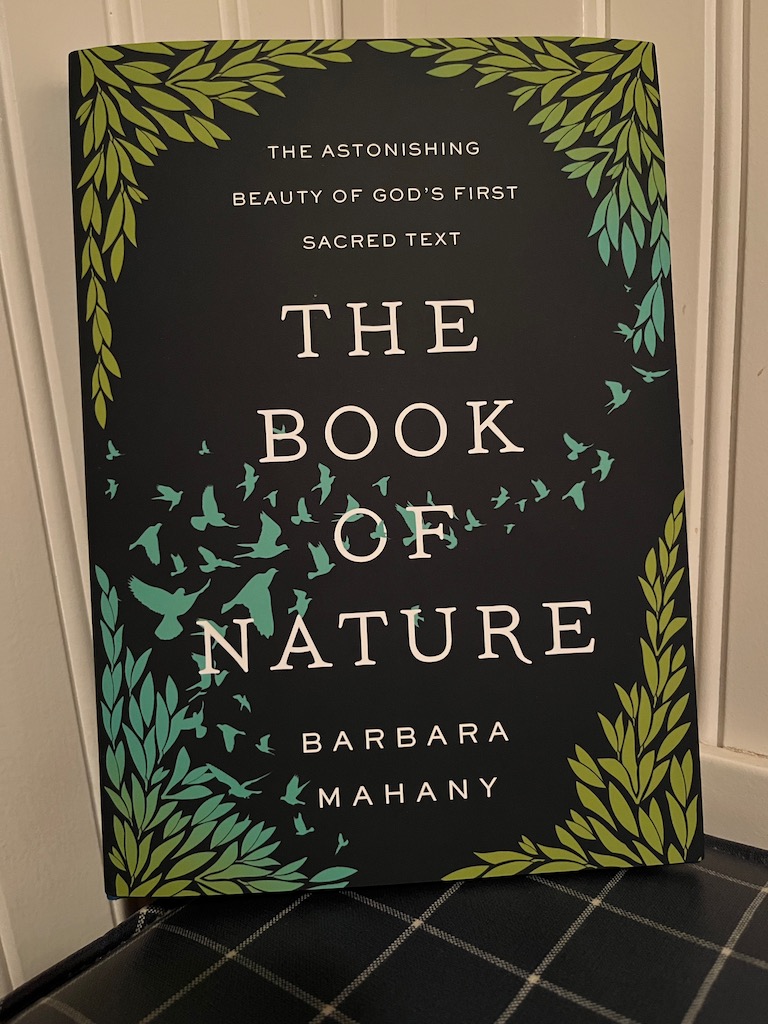
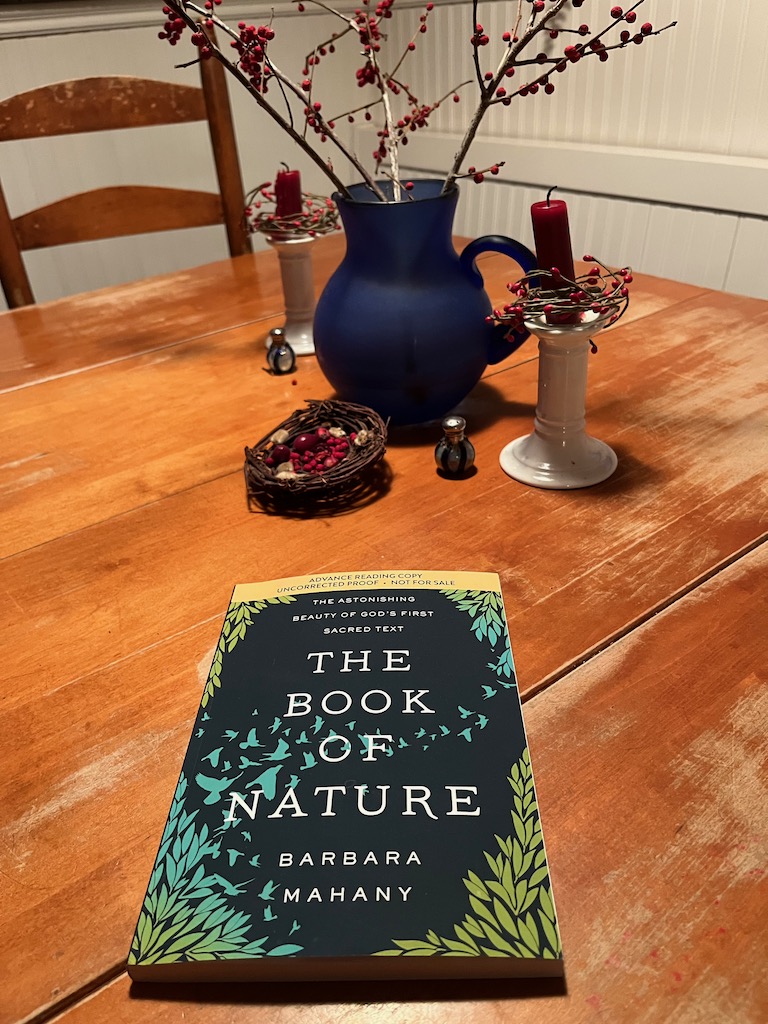
please join me in pulling up your very own chair to gather round this virtual old maple table to attend the birthing of my next book, the one titled The Book of Nature: The Astonishing Beauty of God’s First Sacred Text (Broadleaf Books).

we’ll gather on the evening of Tuesday, March 21––its actual pub date––when we shall send The Book of Nature soaring into the everland. it’s free and it’s just for friends of the chair––wherever you are––and it’ll be at 7 p.m. chicago time, when we’ll gather by zoom. and all you need to do is click this link to register. the zoom link will be magically sent to you. and, since i’ve never ever done this before, beyond that we will all find out together what happens next.

but what i do promise you is that i will be right here. perched on my stool, snug against the kitchen counter. and i can’t imagine a cozier way to begin this latest adventure in book-birthing.

it is a downright thrill to imagine seeing many of your faces for the very first time because after 1,102 meanders here at the chair, it’s about time we look into each other’s eyes, feel the smiles wash up from the depths of our very own soul, and revel in the collective goodness of those who have so buoyed me over the years.

truth is, i can think of no finer way to gather the graces and muster the courage i’ll need to tell the world all that i’ve tucked into these 200-some pages. this is a book that stands on the shoulders of wisdom seekers across the millennia, and across cultures and faiths and geographies. it’s a book that pokes around in the nooks and crannies of all creation, seeking the thrum of the sacred––the holy Divine––in our very midst. it stands in awe of the moon and the night sky. it awaits the dawn, and gathers the dusk. it traipses through the woods, and settles into the murmurous grasses that rise from the mounds not far from the water’s edge.

this book has been called “a field guide to the depths of your holiest places,” and i hope and i pray that as you turn its pages you find yourself inching deeper and deeper, closer and closer, into your own holy encounters with the ineffable wonder and wisdom that stirs in the wind and rustles the meadow.

but this gathering––this rare leap off the page and into the virtual––is how my heart yearns to begin the book’s first breathing.

you can find out more about this newest book on its very own page here at the chair, where you can even find links to buy it from your favorite indie bookstore, or direct from its publisher Broadleaf Books, or, yes, our friends at the behemoth that is amazon.

here’s a peek at the first review that’s crossed the transom. and, yes, i will be forever grateful to that lovely, lovely soul at Booklist, the publication of the American Library Association, who wrote this in the January edition of Booklist:

The Book of Nature: The Astonishing Beauty of God’s First Sacred Text

By Barbara Mahany

Mar. 2023. 191p. Broadleaf, $27.99 (9781506473512). 200

Writing with a nurse’s foundation, a scientist’s eye, a theologian’s mind, and a poet’s soul, journalist Mahany (Stillness of Winter, 2020) contemplates God’s presence as revealed in nature, His “first sacred text.” Tracing the Judeo-Christian belief that scripture succeeds and augments nature by directing humanity to knowledge of the divine, Mahany looks to nature itself, marveling at its intricacies and blending scientific facts with literary descriptions that all point unquestionably to a grand designer worthy of worship. She incorporates literary writing by a host of essayists and poets (Annie Dillard, Henry David Thoreau, Mary Oliver, Walt Whitman) and Christian and Jewish religious writers as well as Islamic, Greek, Chinese, Celtic, and Indigenous traditions. She implores readers to continue reading the book and not to allow the noise of modern life to obscure its message. Supplemental material includes an annotated list of recommended reading and an extensive bibliography. Mahany’s lyrical, thoughtful, most recent work beautifully complements her shelf of awe-inspired books about nature and will appeal to fans of Shauna Niequist and Anne Lamott.

–Karen Clements

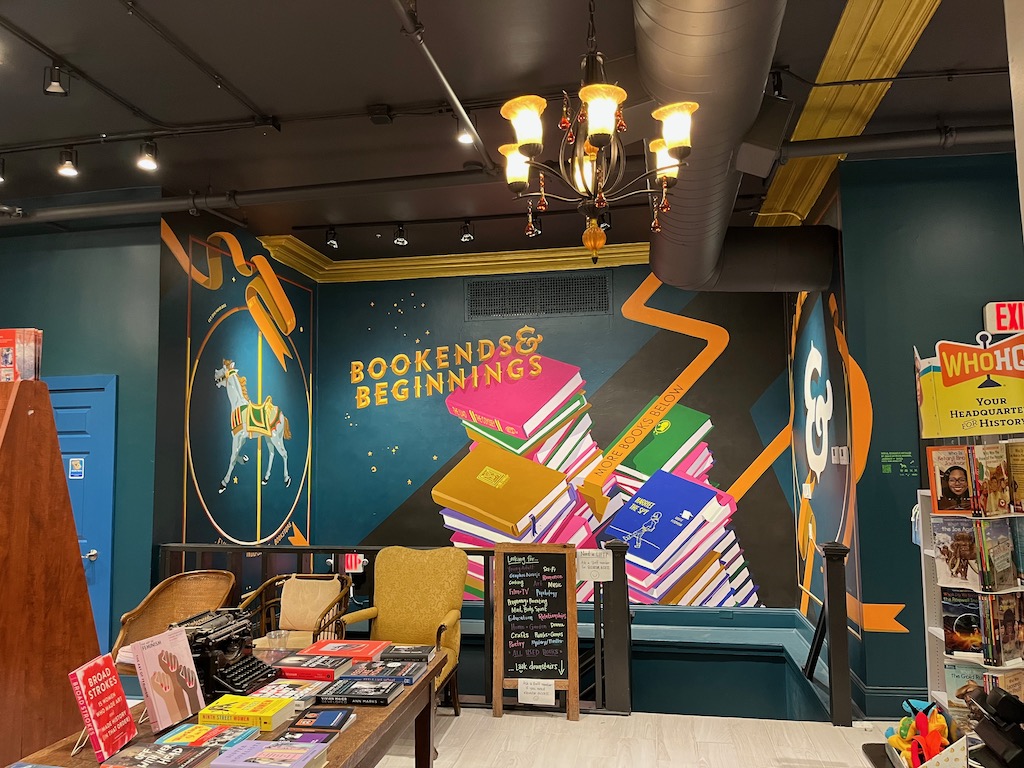
till then, i’ll keep finding you here on fridays. and while i dream up ways to sign books for those not nearby, do know that there will be real-live book events in person at bookstores and sacred places in the days and weeks and even the months after the 21st. in fact, an actual in-store book launch is on the calendar for thursday, march 23, at 6 p.m. at that charmed bookstore, bookends & beginnings, in their brand-new space at 1620 Orrington, Evanston.

i hope, hope, hope, you can pull up your very own chair on march 21. though i won’t be able to pass a tin of cookies, nor pour you a spot of tea or bubbly, the conviviality alone will fill my lungs, and set my heart a soaring….

please let me know if you encounter any glitches, and i’ll don my thinking cap. and turn to the wizards at Broadleaf who seem to know how to guide me at every turn.

with love, babs, the chair lady.

p.s. the book in the photo at the top here is the Advanced Reading Copy, or ARC, and it’s the only edition i’ve got, though i hear the final final is due to plop on my stoop any day!

chop. stir. turn. sigh. repeat.

my days these days are filled with simple verbs; staccato, monosyllabic verbs: chop. stir. turn. sigh.

in other words, i fill my hours tucked between the pages of tall stacks of books i am guzzling down as if to carry me across the frozen tundra out my window. i guzzled my way through january, and except for a few days in the air in february, i aim to do it all over again in this the shortest month. 

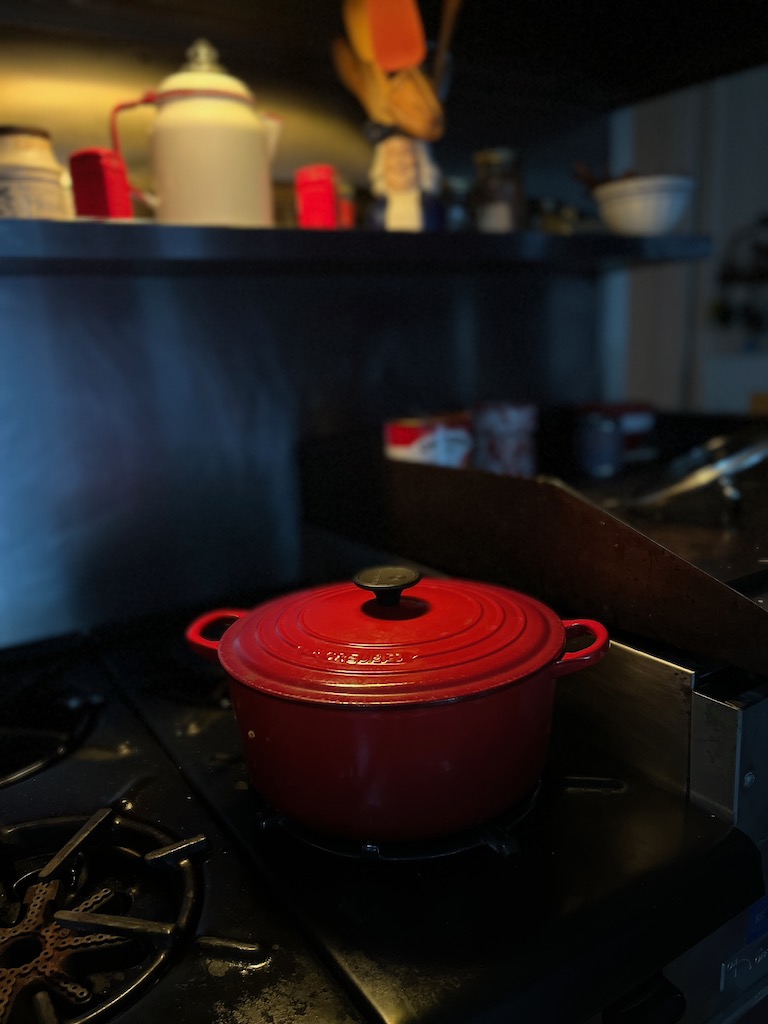
i do rise on occasion from my butter-yellow-checked chair, mid-morning sometimes, to take my station at the chopping block, where my knife work begins. usually in the alliums, chopping onions to bits, mincing garlic buds, filling the room and my fingertips with the essence of under-earth. i glug olive-y oils into the big red pot, the one weighty enough to shatter my toes should i ever let it slip from my grip. i slow-cooked my way through the year’s first month: stews and soups and braises. more stews and soups and braises.

it’s the simple rhythms that put the hum in my day. sustenance, really. the exotic and the excitement––the sighs and the gasps––come in the pages i turn. the ones where i might find a sentence so lovely i all but haul out my scissors to make of it a shrine to the genius of human mind and soul that so sees the world in these breathtaking ways, and dares to combine words in ways we’ve never before imagined. or felt.

really, it’s all filling my tank for the weeks ahead when my little book will take its pirouette for a few short moments, and i will step beyond my shadows long enough to put voice to its birthing. those of us who tremble when stepping before a crowd, we need to store up a winter’s worth of quietude, of sustenance, so we’ve a reserve to dip into. to share abundantly.

these wintry months i am doing winter’s work: letting the roots seek deeper ground whilst on the surface all looks still.

and so my offerings here are leaning more than usual on the genius of those i gather round me. and my hope is that what punctuates and titillates my day might bring the same to you…


we begin with mary oliver, a little poem she wrote as part of a septet.

“So Every Day”

So every day
I was surrounded by the beautiful crying forth
of the ideas of God,

One of which was you.

—Mary Oliver


a beloved, beloved friend of the chair sent me this the other day. and i thought you too might want to tuck it in your drawer of special words (i could not for the life of me find its origins, only that it was tagged “healers” and so i share it thusly:

some will turn away when you show them your bleeding.
some will stay.
will press stars into the wounds.
will hold your feet as you learn to walk again with the weight of a too-full heart pummeling your bones.

(healers)


i mentioned last week that i’d tumbled my way into a poetry conversation between dante micheaux and a poet priest named spencer reece, whose story so intrigued me i ran to the library and found his magnificent, magnificent memoir, the secret gospel of mark: a poet’s memoir, which is hands down the most gasp-inspiring book i’ve read in a good long while. i couldn’t stop reading; inhaled 400-plus pages in two days. tried hard as i could to stay awake into the night to keep reading. but my old body refused. i saved it till the morrow. i wound up giving it five stars in an amazon review, and i wrote this:

5.0 out of 5 stars In a Word: Brilliant Reviewed in the United States on February 2, 2023

In an age of binge-watching, this magnificent, tender, deeply vulnerable, and utterly breathtaking memoir from poet and Anglican priest Spencer Reece deserves to be binge-read. In one gulp, if you don’t need to sleep. I swallowed it whole in two sittings. And I couldn’t wait to get back to its pages when I had to put it down. Reece writes gloriously on multiple levels. He is at once raconteur and poet. A lifetime’s close read of poetry pours from the pages, as Reece takes us deep into his fluency in — and kinship with — Sylvia Plath, Elizabeth Bishop, Emily Dickinson, James Merrill, Mark Strand, George Herbert, and Gerard Manley Hopkins. Interwoven with his own sometimes wrenching, occasionally tragic, story — one that carries him through dark years as a closeted gay teen, and later an alcoholic who briefly finds himself on a psych ward, and ultimately stumbles into grace as a priest called to love with abundance — Reece writes that “poetry saved me more than the church.” The twinned lenses, funneling toward a holy and redemptive intersection of God and poetics, serve to make this a book I’ll long press close to my heart. As a longtime reviewer of Books for the Soul for the Chicago Tribune, this one counts among the rare few unforgettable treasures tucked on that bookshelf. It’s at turns bawdy, and funny, and crushing, and always, always crafted in sentences so beautiful, so crisp, and — yes — so poetic, they will leave you gasping in awe.

and from the pages of reece’s secret gospel come this week’s. . .

sentences of the week (in which i invite you into my commonplacing world and share some of the snippets that filled my notebook this week):

“The hint of night scratched at the edges of the day.” (372; Spencer Reece, Secret Gospel of Mark)

“foggy green lawn footnoted with hedgehogs” The Secret Gospel of Mark: A Poet’s Memoir, by Spencer Reece (“footnoted” as in splattered, punctuated with…(113)

“the land oozed God.” (and for the trifecta, it’s Spencer Reece once again…)


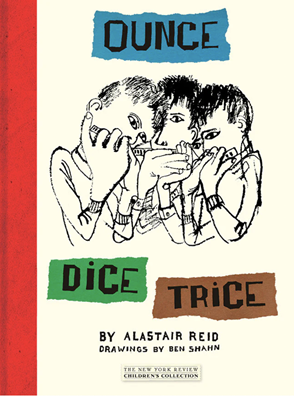
i often let my friends at the New York Review of Books point me toward what belongs on my shelves. and so it is, especially, in the children’s corner. i’ve long been mad for whimsical nearly obsolete words, words that need a puff of oxygen to keep their hearts still beating. and, so, i’m enchanted by this long-time favorite, which i’d not known before: Ounce Dice Trice, with words by Alastair Reid and illustrations by Ben Shahn. Ounce Dice Trice was the only children’s book ever illustrated by Shahn, and only one of two books Reid wrote for children. 

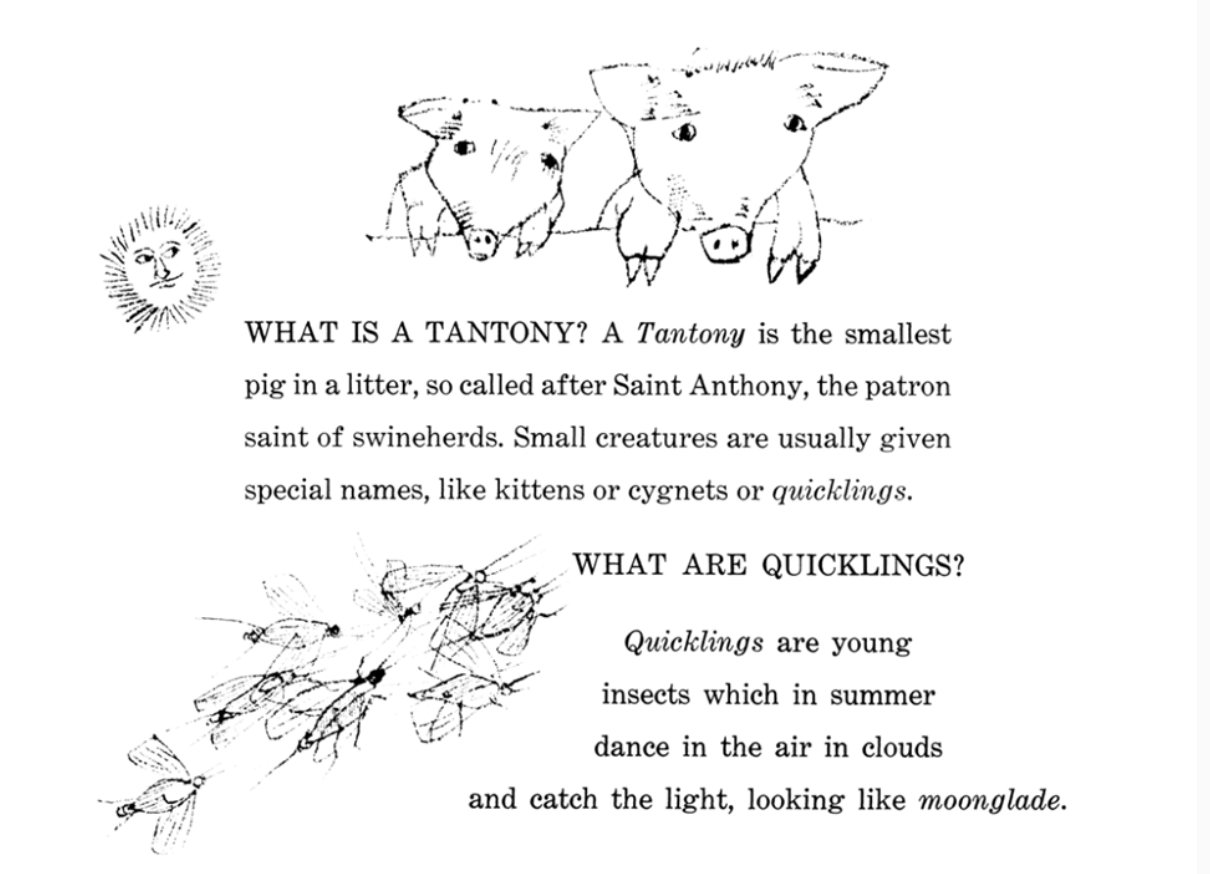
NYBR says this: “Ounce Dice Trice operates as a haphazard, whimsical dictionary of words and word play. Reid, a Scottish-born poet and long-time correspondent for The New Yorker, provides list upon silly list of fantastic words, most of them real, some completely made-up. Shahn, the Lithuanian-born American artist known for his socially- and politically-informed art, provides hilarious drawings to accompany the words.” [see below, for a wee quickling of a peek. and be charmed, like me, by the name for a little pig. i suppose dear wilbur (of charlotte’s barnyard) was a tantony.]


and that, dear friends, is my week’s worth of sustenance. except for one thing: the big red pot. so here is but one of the many things that filled that pot this past week and this past month:

Turkey Meatballs in Eggplant Tomato Sauce (from Melissa Clark at the New York Times, with a little twist by me*)

INGREDIENTS

Yield: 28 meatballs, 4 to 6 servings

  • ½ cup grated Parmesan cheese, more for serving, if desired
    ½ cup panko or other plain dried bread crumbs
    ¼ cup minced onion
    ¼ cup chopped chives or basil
    2 garlic cloves, grated on a microplane or minced
    1½ teaspoons kosher salt
    ½ teaspoon black pepper
    ½ teaspoon dried oregano
    Pinch red pepper flakes (optional)
    1½ pounds ground turkey, very cold
    1 large egg, beaten
    3 tablespoons extra-virgin olive oil, more as needed
    3 cups marinara sauce, more to taste*

PREPARATION
Step 1
In a large bowl, combine cheese, bread crumbs, onion, chives, garlic, salt, pepper, oregano and red pepper flakes, if using, and mix well. Add turkey and egg and blend with your hands until well mixed. If you’ve got time, cover mixture and chill for an hour or up to 24 hours. These are easiest to form into balls while very cold. Form into 28 meatballs, each about 1¼-inches in diameter.

Step 2
Heat 2 tablespoons of the oil in a large sauté pan. When hot, add enough of the meatballs to fit in one layer without crowding, and brown on all sides, 5 to 8 minutes. Transfer to a plate, add another tablespoon of oil to pan and brown another layer of meatballs, transferring them to the plate as they brown. Repeat until all meatballs are browned, adding more oil to the pan as needed.

Step 3
When meatballs are all browned, add marinara sauce to pan and bring to a simmer, scraping up the browned bits on the pan bottom. Return meatballs and their juices to pan, shake pan to cover the meatballs with sauce, and lower heat. Partly cover pan and simmer until the meatballs are cooked through, 15 to 20 minutes.

Step 4
Serve hot, drizzled with more olive oil and sprinkled with more cheese, if you like.

*note: this week i super jazzed up the sauce with a shiny night-black eggplant: while the meatballs chilled in the fridge, i took my marinara up a couple notches: sautéed onions, garlic, and then eggplant. added fennel, red pepper flaks (a pinch), marjoram and oregano, salt and pepper. cook till browned and then relaxed. add splash red wine. jar of tomato basil marinara; let simmer a good half hour. (here’s where i added extra bowls: i scooped my simmered sauce into a bowl, and browned my meatballs in the big red pot; once browned, i poured back the sauce, and let it all get cozy, simmering for another while. at dinner time, they all arrived deliciously on our plates. (and this is why you’d best take your cooking instruction for a more precise cook!)

what sustains you through your week?

forecast: more quiet

we seem to have stumbled around here onto the recalcitrant version of the red-ringed bug, the one that won’t go away. or came back before it left. i was on the mend, as was my mate here in this old house, when suddenly a cumulus nimbus of cloudy congestion came roaring back to the head of the one with whom i share these rooms. and then the little test confirmed our suspicions: it’s covid again. so he’s re-grounded and i’m shuffling quietly, still under wraps (aka mask).

which means that with a weekend forecast for snow and cold, along comes one for much more quiet. to which i let out a little yelp of muffled delight. because that means more time to dig into my latest reads: thoreau’s walden; and what could be more fitting for a january cold spree than a charming tome titled the nightingale: notes on a songbird?

and that means that once again, i’ve spent bits of my week cobbling together a few morsels for my friends who might pull up a chair.

to wit:

i begin with this beauty from henri nouwen, the modern-day mystic and deep theologian whose wisdoms are many, and whose birthday this week had me bumping into this:

Compassion asks us to go where it hurts, to enter into the places of pain, to share in brokenness, fear, confusion, and anguish. Compassion challenges us to cry out with those in misery, to mourn with those who are lonely, to weep with those in tears. Compassion requires us to be weak with the weak, vulnerable with the vulnerable, and powerless with the powerless. Compassion means full immersion in the condition of being human.

Henri Nouwen

a more beautiful definition of compassion, of being a profoundly alive human, i do not know. perhaps you’ll marinate in these holy words for a few hours this cold, cold weekend.


next up, in the wonders of the week, i found myself in a poetry conversation that spanned continents (thank you, oh wonders of zoom), and thanks to my friend Pádraig Ó Tuama, i discovered a poet whose work and whose voice i can’t get enough of. his name is dante micheaux, and what i know is that i will be chasing down his poetries in any form i might find them. here’s a bit of his bio (though i am starting to dream of a journalistic beat in which i wander the globe talking to poets, in hopes of filling out the fine grains of their stories). . .

Dante Micheaux is the author of Circus (Indolent Books, 2018) and Amorous Shepherd (Sheep Meadow Press, 2010). He holds a Master of Fine Arts in Creative Writing from New York University. His poems and translations have appeared in The American Poetry Review, Callaloo, Poetry, PN Review and Tongue—among other journals and anthologies. Micheaux’s honors include a prize in poetry from the Vera List Center for Art & Politics, the Oscar Wilde Award and fellowships from Cave Canem Foundation and The New York Times Foundation. In 2019, he won the Four Quartets Prize from the T.S. Eliot Foundation. He grew up in New Jersey, but lives now in London, and we shared a wee bit of enthusiasms for a bagel shop on Brick Lane, or as the brits would spell it, a “beigel bake.”

the judges’ citation on the Four Quartets Prize is this: “How right that this poet’s first name should be Dante. For his Circus is a Comedy: a savage comedy, lacerating dialects, fingering wounds, looking for loves right and wrong in the crevices of history and of humiliated bodes. And yet, and yet. His language exults, triumphs, and freely rummages in the treasuries of the Bible, Baudelaire, Whitman, Eliot, Baraka, and Mahalia Jackson, taking what it needs, making it his sovereign own, a wrested blessing. Congratulations, Dante Micheaux, on your astonishing Circus.”

you can hear a bit of him here, in a podcast called beyond the red door, an audio companion to a poetry series that brings poetic meditation inside the walls of St Mark’s, an Anglican church in Jackson Heights, in New York City. Here, Micheaux is in conversation with Anglican priest and poet, Father Spencer Reece (himself a whole nother story). Micheaux reads a poem reminiscient of Tony Morrison’s The Bluest Eye, and at the end a Canto …

(i’m promising more on Spencer Reece next week, as i’ve requested a slew of his books from the library…) and here is but one of dante’s poems that took my breath away…

Mary at the Torture

Everyone was out that day, for a show.
Sure, it was sad for people who knew him
but she was his mother, slinking about
the rabble in that dark halug, veiling
her face with a headscarf—as if no one noticed her.

Some say it served her right,
letting her son run about the countryside
the way she did. Poor Joseph,
for all efforts at teaching the boy
a skill, never succeeded,
hadn’t a chance against Mary’s coddling.

But how could she just stand there, watching?
Each time the scourge met flesh she didn’t even flinch.
No cry, no lamentation—most unlike a child of God.
Any other mother would have had to be contained,
would have put herself between lash and child,
would have succumbed to conniption—at the least,
rent her clothing. Not one tear.

She was always strange, though—quiet,
dark days about her since she was a girl.

It wasn’t easy: the scandal before the wedding;
him getting into trouble with the law.
Perhaps, she was relieved.

–Dante Micheaux

(first published May 11, 2011, in Painted Bride Quarterly)


the techno team here at the chair is figuring out how to host a virtual launch of my soon-to-be book, The Book of Nature: The Astonishing Beauty of God’s First Sacred Text (which got its very first official review this week, in Booklist, a publication of the American Library Association, and which you can find over on Book of Nature’s very own page here at the chair. details and sign-up soon as the techno wizards figure it out. and yesterday, in a meeting with the lovely team who does the heavy lifting in the book-peddling department, someone held up an actual hot-off-the-presses copy of said book, proving its existence, and alerting me to the notion that it could soon be landing with a plop on my snow-covered stoop. (though it’s official pub date is still firmly on the vernal equinox, march 21, 2023)

before closing, a wee bit about the two books waiting on my butter-yellow-checked chair: thoreau’s walden i am reading cover to cover as preamble to the weeks ahead when i’ll likely be extolling the wonders of keen-eyed watchkeeping on the woods and the turning of seasons.

sam lee’s the nightingale has been on my bedside table for at least a year (there’s a whole essay on the books we keep close at hand, yet never manage to crack). for the pure whimsy of it (as well as a fine excuse to read the pages of the irish news) here’s what they have to say about the wondrous love-letter to the vanishing bird. but should you refrain from clicking, here’s the book jacket description:

Come to the forest, sit by the fireside and listen to intoxicating song, as Sam Lee tells the story of the nightingale. Every year, as darkness falls upon woodlands, the nightingale heralds the arrival of Spring.

Throughout history, its sweet song has inspired musicians, writers and artists around the world, from Germany, France and Italy to Greece, Ukraine and Korea. Here, passionate conservationist, renowned musician and folk expert Sam Lee tells the story of the nightingale. This book reveals in beautiful detail the bird’s song, habitat, characteristics and migration patterns, as well as the environmental issues that threaten its livelihood.

From Greek mythology to John Keats, to Persian poetry and ‘A Nightingale Sang in Berkeley Square’, Lee delves into the various ways we have celebrated the nightingale through traditions, folklore, music, literature, from ancient history to the present day. The Nightingale is a unique and lyrical portrait of a famed yet elusive songbird. Sam Lee has brought the poetic magic that has long enchanted so many of his musical fans into the written word.

and that’s the news, thin as it is, from here at covid central.

how shall you be soaking in your quiet hours ahead?

when the quiet you get isn’t quite the one you asked for. . .

maybe i mumbled. maybe the universe mistook what i’d been thinking aloud. or maybe i’d be wise to watch what i wish for.

yes, i’m the one who mentioned just last week ago that i was wiped out; low tide had come with no hint of refueling. so i might have muttered something about how a few days of monasticism would suit me just fine.

i guess i forgot to note that i sought a quiet that comes without quarantine. one that’s not particularly de l’instant, of the covid moment. 

till late last night, it was the other one in this old house who’s been behind closed doors (with a bath towel stuffed into the under-door crack –– just for good measure!) since sunday night when first he sniffled and then asked if i might fetch a thermometer. it seems his two years dodging the red-ringed virus came screeching to a 102-fahrenheit halt. 

turns out he might be living proof that sauntering into a sauna isn’t quite on the recommended list for things to do during pandemics. (not for nothing did i go to nursing school!) 

till late last night, i was the nurse and he was the patient. the little pink line — the one from our friends at abbott labs, the one the government is kindly mailing to any household that asks — hadn’t shown up under my nose. but then it did. covid 2.0  came knocking. and let itself in. 

might as well hang a shingle outside the house –– warning: covid at work. 

i never really thought i was going to end-run it. might as well have been watching a sand dial. knowing any minute the sand would run out. and my number was up. again.

for the record: it’s a very odd thing to be home alone on the other side of a quarantine room. we’d a lovely little routine, choreographed by the mother of invention. there’s an upturned milk crate just outside the room where he’s holed up (the very chamber i’d scrubbed top to bottom soon as the college kid moved out and back to college). i deposit deliciously cooked breakfast, lunch, dinner and even bedtime snacks there in the tray on the perch, fully masked every time (meaning the mask’s on me, the one doing the depositing). 

i’d become so attached to my mask i never traipsed up the stairs — or near the stairs — without it. given the odds, it might have been a fool’s charade. even KN 95 can’t erase what’s already invaded. 

for the most part, i stuck to my pre-meditated monastic agenda all week: stirred simmering soups, mopped the kitchen floor (with no worries that big soles would be soon slopping across it), and got to the end of a (brilliant) 400-page tome. i did add plenty more lysol to the cleaning equation, and enough alcohol wipes to get a bit woozy. 

but honestly, there is something comforting about not needing any excuse to cower indoors. as long as a few other people i love stay in the clear, i will more than forgive the masters of the universe for muddling my one little wish. 


(Photo by Peter Kramer/Getty Images)

because i had lots of time for reading this week, i found one or two things worth passing along. from vietnamese zen master thich nhat hanh, who died a year ago sunday (january 22), here’s one of his ten love letters to earth. as i look toward the end-of-march publication of my next book, The Book of Nature: The Astonishing Beauty of God’s First Sacred Text, i find myself endlessly drawn –– with deeper and deeper attention –– to those who’ve penned sacred devotions to the wonders of this holy earth.

II
Your Wonder, Beauty and Creativity

Dear Mother Earth,

Each morning when I wake up you offer me twenty-four brand new hours to cherish and enjoy your beauty. You gave birth to every miraculous form of life. Your children include the clear lake, the green pine, the pink cloud, the snowcapped mountain top, the fragrant forest, the white crane, the golden deer, the extraordinary caterpillar, and every brilliant mathematician, skilled artisan, and gifted architect. You are the greatest mathematician, the most accomplished artisan, and the most talented architect of all. The simple branch of cherry blossoms, the shell of a snail, and the wing of a bat all bear witness to this amazing truth. My deep wish is to live in such a way that I am awake to each of your wonders and nourished by your beauty. I cherish your precious creativity and I smile to this gift of life.

We humans have talented artists, but how can our paintings compare to your masterpiece of the four seasons? How could we ever paint such a compelling dawn or create a more radiant dusk? We have great composers, but how can our music compare to your celestial harmony with the sun and planets—or to the sound of the rising tide? We have great heroes and heroines who have endured wars, hardship, and dangerous voyages, but how can their bravery compare to your great forbearance and patience along your hazardous journey of eons? We have many great love stories, but who among us has love as immense as your own, embracing all beings without discrimination?

Dear Mother, you have given birth to countless buddhas, saints, and enlightened beings. Shakyamuni Buddha is a child of yours. Jesus Christ is the son of God, and yet he is also the son of Man, a child of the Earth, your child. Mother Mary is also a daughter of the Earth. The Prophet Mohammed is also your child. Moses is your child. So too are all the bodhisattvas. You are also mother to eminent thinkers and scientists who have made great discoveries, investigating and understanding not only our own solar system and Milky Way, but even the most distant galaxies. It’s through these talented children that you are deepening your communication with the cosmos. Knowing that you have given birth to so many great beings, I know that you aren’t mere inert matter, but living spirit. It’s because you’re endowed with the capacity of awakening that all your children are too. Each one of us carries within ourself the seed of awakening, the ability to live in harmony with our deepest wisdom—the wisdom of interbeing.

But there are times when we have not done so well. There are times when we have not loved you enough; times when we have forgotten your true nature; and times when we have discriminated and treated you as something other than ourself. There have even been times when, through ignorance and unskillfulness, we have underestimated, exploited, wounded, and polluted you. That is why I make the deep vow today, with gratitude and love in my heart, to cherish and protect your beauty, and to embody your wondrous consciousness in my own life. I vow to follow in the footsteps of those who have gone before me, to live with awakening and compassion, and so be worthy of calling myself your child.

—Thich Nhat Hanh, Ten Love Letters to the Earth

you can listen to all ten love letters being read by the editor of Emergence Magazine here.


and only because i will always and forever love the imaginative world of alan alexander milne, born january 18, 1882, in hampstead, london, here is this most precious mirrored image of father, son, and bear. 


so now my quarantine continues. only this time fueled by advil. how would you spend a quarantine?

new year cleanse

despite being a fundamentally punctual soul, i tend to be late for plenty of things. in life, that is. 

got married at 34. first baby at 36. last one at just shy of 45. so i shouldn’t be too surprised that we’re two weeks into the new year and i’ve finally gotten around to realizing it’s high time for a cleanse.

i’m not talking refrain from fuzzy bubbly, nor gulping goopy green drinks in an effort to roto-root my insides. i’m talking one of those good old-fashioned retreats from the noise and the headaches that too often encumber the festooned days of fa-la-la december.

fact is, after a string of weeks that brought to this old house canceled christmas eve flights, hacked bank accounts, more late nights than i’m used to, a general level of cacophony, and too many comings and goings, i am full-on frazzled. 

i dream of hot bubbly baths. and towering monastery walls (of which i’m on the inside, safely ensconced, and far from the harsh, harried world). i imagine quietude. not a decibel louder than that of a page turning, a firelog crackling, or a kettle of soup lazily simmering. 

i long for unfettered days, with nowhere to go, and no one to answer to.

it takes some of us a good bit of time to snap our synapses into order again, to de-frazzle our wee little nerves, to fill our heads and our souls with pure fresh breathable oxygen. 

i basically long for a DIY friary, with compulsory silence. and menial chores. 

yes, chores. and, yes, the more menial the better.

since this is a prime time of year to be confessional, and confession is a fine first stop on the monastic road, i’ll go first, and––ahem––admit to one or two quirks when it comes to the ways i unjangle my nerves: over the years, i’ve found uncanny pacification in hoisting bucket and mop. yes, i’m a serial cleaner. i often reach for fleece-lined yellow rubber gloves when i’m in need of mollifying. vacuuming dehydrated bits of the vacated christmas-y tree (wee little thing that it was) tends to quell my wobbliest self. scrubbing spots off the floor puts me together again. de-greasing the stove = the short route to nirvana.

you can bet your brill-o pad that soon as the college kid slips out the door and onto the tarmac this weekend, i’ll be peeking behind the bedroom door he’s all but barricaded these past many weeks (the better to bar me from tsk-tsking the mess). i’ll be switching out sheets, spritzing sweet herbal poofs in the air, rinsing the crud out from the drains. call me loony (if you didn’t already) but i tap into rarefied bliss when armed with squeegee and lysol. 

only then, when every last wrinkle is smoothed, and the faucet and sink twinkling like venus, will i settle into my preferred mid-january posture: squished in a nook with a book. decidedly monk-like. and i might not look up for days. should the phone ring, i’ll not hear it. should the phone ping, i’ll play possum. 

of course, this isn’t the only way to take on the starter month, the one roz chast (yet another of my new yorker supernovas) vividly declared the “cruellest.” (see new yorker cover above)

i realize i’m hardly alone in pondering new-year restoratives. just the other day, blithely turning the pages of the new york times, i found––in the food section, no less!––even the recipe mavens were proffering thoughts on how to muddle through the 31 days. here’s longtime writer melissa clark on the matter: 

“maybe there’s another way to look at it,” she begins. “what if january could be quiet and centered, a period of calm reflection when it’s too cold to go out and no one wants or expects anything social from you anyway? to me this is the ideal moment to hide in your house, cozy up near the stove and simmer a nice pot of stew. go low and slow—after all, you’ve got plenty of time this month.”

sign me up, missy!

while i set my sights on the distant shores of far-off february (when things might really turn dreary), i’ve decided to up my january game, and thus will subscribe to a slight monastic upgrade: 

as a firm believer that one shouldn’t starve while immersed in abstemious mode (a fancy way to say spartan), i plan on stocking my make-believe monastery with sumptuous soups, breads so grainy they give your incisors a run for their money, and, true to time-tested friarly ways, a good vintage to wash it all down (mine will be an $8.99 prosecco from ol’ trader joe).

here’s what i’m stirring this morning: 

Carrot-Leek Soup With Miso
By David Tanis* (annotations by babs) 

4 servings

INGREDIENTS
2 tablespoons olive oil
4 cups peeled, cubed carrots (from about 6 medium carrots)
2 medium leeks, white part only, chopped
Salt and black pepper
8 cups water or vegetable broth
2 tablespoons yellow or white miso
1 small lime
Thinly sliced chives, for garnish (optional) 

PREPARATION
Step 1
Heat olive in a heavy pot over medium heat. When the oil glistens or ripples (both signs that it’s hot enough), add carrots and leeks. Season generously with salt and pepper, and stir to coat well. Sauté for a minute or 2, then add broth (Tanis insists lightly salted water simmered with leeks and carrots is plenty tasty enough; count me among the not-yet-convinced). Bring to a boil over high heat, then reduce to a simmer. As soup simmers, taste and add salt as needed. Cook until carrots are soft, about 15 minutes. 

Step 2
Once the soup is cooled, reserve 2 cups liquid, then purée the remaining contents of the pot in a blender. (Alternatively, use an immersion blender in the pot.) Use reserved liquid to adjust the purée’s thickness, adding just enough so the consistency is that of a thin milkshake. 

Step 3
To serve, heat soup and whisk in miso. Divide among 4 bowls. Grate a little lime zest over each bowl. Quarter the lime and add a good squeeze of lime juice into each bowl. Scatter with chives, if using. 


well, that was a long-winded way to bring you a root-vegetable recipe. but this space for me is what a gym might be to a gymnast. it’s where i practice my twists and turns, and aim to stick my landings. as a long-ago failed athlete, i ply no bodily tricks, and confine myself to maneuvers of nouns, verbs, and a host of dangling modifiers. 

because levity is a proven balm for most ails, i’m adding a bonus here this morning, and showing you a snap of what this ol’ monk shall be wearing during her retreat from the world. if it seems i’m on some sort of new yorker binge, it’s unintentional, and pure coincidence. but the one thing i got for christmas this year was this fine pair of cat’s pajamas (new yorker cartoon cats splattered up and down legs, sleeves, and even the pockets), which arrived in the post just the other day and which i just might never take off (the ad on the new yorker shop site shows new yorkers wearing these things out and about. even in art galleries, and on the stoops of their brownstones). i solemnly vow only to wear mine inside the friary.

what’s your preferred prescription for those chunks of the year when you’re in need of deep hibernation?

p.s. thank you roz chast for your eternal and forever brilliance. new yorker cover above, by dear roz!

low tide

at the dawn of this new year, i am drawn into a particular quiet, the quiet of entering in slowly, and deliberately. i am turning pages, pulling taut the threads of a thick new wrap, stirring onions and garlics and soups on the stove. i am looking out windows, with little inclination to step into the misty fog of the morning. i am content. content to be quiet. content to be still.

i am, you might say, at low tide.

and i’ve no desire to barge in on your own quietudes and stillness. and so i am simply leaving a few traces here, gatherings this week has brought me. i find myself more inclined these days to bring you the wisdom of others. i am holding this space for the days when i will have something worth saying, but for now, my offerings come from the wonders of others. it’s my hope and my prayer that you find here a little nourishment for the week. i’m inclined to think that my most generous offerings these days come not from my own well, but from reading and looking and living through the days with an eye toward deep curiosity and a never-ending sense of the wonder that always seems to find its way in to our most closely-held nooks and our crannies…


i begin with a book, a book mailed to me by my oldest best friend in the world, the one who long ago all but scooped me off the floor and propped me up, and spooned goodness into me, and shone sunlight on me till i ripened and pinkened, and has never ever let go. she’s the one i call when my heart hurts, and when i can barely breathe. over the years we’ve woven a lifeline that stretches from here on the shores of lake michigan to her house along the pacific coast. she and i share a love for quirky artists and writers and painters of marvelous colors. and she sent me this week maira kalman’s latest: women holding things, described as “a love song to women and the many things they hold, literally and metaphorically.” maira kalman is the madcap artist and illustrator who lights up pages of the new yorker, and lately has been making books so bright and beautiful and hilarious and heart-melting you might want to devote a whole shelf just to maira. you almost might wish to invite her to tea. but it would have to be tea in a room with armchairs covered in eye-popping colors. and you’d need to wear leggings in vivacious stripes and a skirt made of patchworks of peacock-hued threads. and you might serve pomegranates sprinkled on white peaches in winter. because maira seems like a someone who would like the most exotic fruit you could find. and if you served petit fours they would come swirled with coils of sugary buttercream in rose-petal colors. because maira seems like someone who has never colored inside the lines, and never turns down a dollop of whimsy.

and what i love so very much about maira is that you are merrily turning pages, pages so bright and colorful you almost need sunglasses, and then you come to a page that just about stops your heart for a second. a page like this:

but maira is always maira, so page after page is simply marvelous to look at, and absorb in all its whimsy. pages like these (woman holding a pink ukulele under a giant cherry tree, woman holding shears, woman holding red balloons, fruits and jam):


Don’t think the garden loses its ecstasy in winter.

It’s quiet, but the roots are down there riotous.

Rumi

and then, in a maria popova posting about how to beat back a sense of helplessness in a world of so much suffering, i ran across this from the musician nick cave:

The everyday human gesture is always a heartbeat away from the miraculous — [remember] that ultimately we make things happen through our actions, way beyond our understanding or intention; that our seemingly small ordinary human acts have untold consequences; that what we do in this world means something; that we are not nothing; and that our most quotidian human actions by their nature burst the seams of our intent and spill meaningfully and radically through time and space, changing everything… Our deeds, no matter how insignificant they may feel, are replete with meaning, and of vast consequence, and… they constantly impact upon the unfolding story of the world, whether we know it or not.

i found it a profound burst of a reminder that every little move we make matters. every little one. only nick cave says it beautifully: “the everyday human gesture is always a heartbeat away from the miraculous.” it’s a very good thing to tuck in your front pocket at the start of the year, to remember that every single day we hold the possibility of being makers of the miraculous. all it takes is a whole lot of love, and a wheelbarrow full of humility, enough to be willing to turn the other cheek, and love as you would be loved…


and, finally, a friend i love sent me this, and it took my breath away, and i am leaving it here, in case you needed to read this very thing. and maybe it will take your breath away, too.

i studied lots and lots of elisabeth kubler-ross in nursing school, but i don’t think i ever came across this. and it’s so true, and so beautiful. “beautiful people do not just happen.” bless the beautiful people who populate our every day with their everyday gestures that hold the possibility of becoming the miraculous.

who’s inspiring you in your new year?

p.s. there are a bevy of birthdays upon us here at the end of the year’s first week: dear friends of the chair mary jo and mary beth, may your days be bursting with the miraculous, large and small….

and i’m reminded that today, january 6, is epiphany, which in ireland is sometimes celebrated as Women’s Christmas, a tradition we’d be wise to take up. it’s described by the brilliant artist Jan Richardson thusly: “some folks celebrate Epiphany (January 6) as Women’s Christmas. Originating in Ireland, where it is known as Nollaig na mBan, Women’s Christmas began as a day when the women set aside time to enjoy a break and celebrate together at the end of the holidays.” you can find your own copy of her wonderful at-home retreat PDF by clicking to her “sanctuary of women” webpage here. it’s free but her artistry and her soulfulness might stir you to drop a figurative dime in her coffer.

merry blessed women’s christmas, and holy new year….

packin’ it in. . .

at one point yesterday afternoon, five of six burners were occupied on the carrier ship of a cookstove that occupies this kitchen: one boiled a vat of water for soon-to-be-roiling pastas; one simmered the beginnings of roux; one held a pot of tomatoes and basil and a chunk of parmesan cheese; one simmered chunks of apple and pear and cranberry into a compote; and one awaited the tea kettle’s whistlings.

even the cutting boards had taken assigned seats: one for the stinky onions and garlic; another for apples and pears.

we were packin’ it in.

stuffing as many favorites onto the stove, into one afternoon, into one ultra-condensed week of days jam-packed together. four of us––aka, all of us––are home this week. bedsheets are tossed in two of the rooms, the floors seem to be serving as closets and drawers. why unpack when you’ll soon be packing again, heading back out the door, into the air, and home to those faraway places?

packing it in seems as apt a way to live a life as any i can imagine. squeeze in as much as you can. (as long as those super-thick times are bracketed with spells of the monastic quiet that seems my most natural habitat.)

when it comes to loving, i’ll attach lavish every time. i don’t think an hour’s gone by this week––or maybe in my whole motherly lifetime––when i didn’t deep-down marvel at the miracle that two human beings were born to me. born from me, as a matter of fact. a feat i somehow never ever thought my wobbly old body would be able to do. i’d never put quite enough faith in my physical capacities. finish lines felt far beyond my reach; i wasn’t one to get where i needed to go by sinew and bone. and, besides, i’d mucked it up plenty along the way.

and so, the sound of their newborn cries in two dimly-lit delivery rooms is a sound that lifted me out of my body. it’s never faded.

in birthing both of them, volumes and volumes were birthed in me. i began to redefine love. and loving. i was filling in blanks, inserting my own particulars, and reaching toward the surest truth i’d ever been told: love as you would be loved. it was sacred instruction made flesh.

and all these years now––decades now––i’ve been stumbling, and bumping into walls, and trying and trying to do just that. my boys have become my paradigm for loving. my living-breathing exercise in empathy. i might try too hard sometimes. but i’d rather err in that direction than in not quite enough. not enough can feel achingly empty.

and so, here at the brink of a newborn year, another chance at trying again, it’s not a bad time to consider the ways we choose to live our days: will we pack it in? lavish a little bit of love? or as much as we can muster? will we put up with the jumble, and the noise, because it means we might squeeze in a few bits of truth, the truth that rises up from the deepest residue of the heart and the soul? will we pay close attention? will we savor our one more chance to live the love we all pray for? to be the love we imagine, we believe in?

my prayer for the new year is ancient and infinite: dear Holy Breath, that i may love as i would be loved. again and again and again. in ways never noticed, and in ways certain and strong. amen.

how will you live your days?

(the sweet boy above had promised he’d send along a photo of the jam-packed cookstove, with all its burblings and gurglings, since i was far too busy stirring to snap one, but as of friday morning press time, said photo hadn’t yet appeared, so we’re running with the one frame i managed to snap, in all its blurry glories. tis the famed mac ‘n’ cheese i’ve been making for 28 years.

p.s. long as i’m here, might as well pass along the mac ‘n’ cheese that has my boys crowding the cookstove….

mama mac ‘n’ cheese

Provenance: Gourmet magazine, May 1995, pages 200 -201; the issue that just happened to be lying on my kitchen table the day I sat down to plot the festivities for my firstborn’s second birthday.

Yield: Serves 8 children.

3 Tbsp. unsalted butter

3 ½ Tbsp. all-purpose flour

½ tsp. paprika

3 C. milk

1 tsp. salt 

¾ pound wagon-wheel pasta (rotelle)

10 ounces sharp cheddar cheese, shredded coarse (about 2 ¾ C.)

1 C. coarse fresh bread crumbs

* Preheat oven to 375-degrees Fahrenheit and butter a 2-quart shallow baking dish (the broader the crust, the better).

* In a 6-quart kettle bring 5 quarts salted water to a boil for cooking pasta.

* In a heavy saucepan melt butter over moderately low heat and stir in flour and paprika. Cook roux, whisking, 3 minutes and whisk in milk and salt. Bring sauce to a boil, whisking, and simmer, whisking occasionally, 3 minutes. Remove pan from heat.

* Stir pasta into kettle of boiling water and boil, stirring occasionally, until al dente. Drain pasta in a colander and in a large bowl stir together pasta, sauce and 2 cups Cheddar cheese. Transfer mixture to prepared dish. Macaroni and cheese may be prepared up to this point 1 day ahead and chilled, covered tightly (an indispensable trick, when confronting a serious to-do list for a day of birthday jollity). 

* In a small bowl, toss remaining ¾ cup Cheddar with bread crumbs and sprinkle over pasta mixture {Note: My boys insist you go heavy on the extra cheese here, it makes it better, and my boys are ones who like their cheese to supersede their bread crumbs}. 

* Bake macaroni and cheese in middle of oven 25 to 30 minutes, or until golden and bubbling. Let stand 10 minutes before serving. At last: Dig in.

may all of our 2023s be blessed. . .

when wonder comes wrapped in exclamation!

nose pressed to the windowpane, watching the whirl blow in, i’m inclined to think i’m not alone in counting this mandatory pause among the gifts of the season. the world stilled amid the madness that preambles christmas. i proclaim it perfect

it ushers in a particular, succulent quiet. reminds us how little we are. how frail against the forces that blow, that stir, that upturn the outside, right down to the toppling pinecones.

oh, sure, it’s thrown a few maybes into the yuletide equation: maybe the flight will be canceled; maybe the package won’t plop; maybe the lights will go out (and so too the fridge, which would be a considerable bummer since a beast of considerable proportion is currently napping inside, and unlikely to wait out a warming).

but then again, it’s a grand excuse for extra-thick blankets and long afternoons turning page upon page. it stirs me to kindle candlewicks. simmer cinnamon sticks and starry anise, fistfuls of cranberry and wedges of orange.

and, oh, the sound of wind whistling…

in keeping with the quiet, i’m simply leaving here a few little trinkets in hopes that one, two, or all will add a bit of glimmer to your blizzardy almost-christmas day: my favorite christmas poem; a twelfth-century recipe from hildegrad of bingen; two passages from those who’ve considered the longest night, one from a children’s picture book and the other from the great naturalist henry beston, whose writings i cannot get enough of. and, never too late, a wonder of hand-painted blessing: an inspiration candle made by one of my favorite souls on the planet, the glorious elizabeth marie, who dreamed up these beacons of light with which to kindle your prayers, hopes, and wishes…

merry blessed christmas. merry quiet christmas. merry wonder out the window.


we begin with a poem i count among my very favorites….

The Work of Christmas
by Howard Thurman

When the song of the angels is stilled,
When the star in the sky is gone,
When the kings and princes are home,
When the shepherds are back with their flock,
The work of Christmas begins:
To find the lost,
To heal the broken,
To feed the hungry,
To release the prisoner,
To rebuild the nations,
To bring peace among others,
To make music in the heart.


and, should you be inclined to bake one last batch of deliciousness, here’s a recipe from the twelfth century’s hildegard of bingen, a recipe sent my way by a dear friend of the chair, a modern-day saint by the name of kerry.

HILDEGARD JOY COOKIES

For St. Hildegard – a beloved mystic, prolific writer, medicine woman, Benedictine nun, herbalist, musician and one of only four female Doctors of the Church – Joy cookies are to be eaten often! Literally, she said three or four a day! The recipe is found in her book “Subtleties of the Diverse Qualities of Created Things” and comes under the heading for nutmeg.

Nutmeg

Nutmeg (nux muscata) has great heat and good moderation in its powers. If a person eats nutmeg, it will open up his heart, make his judgement free from obstruction and give him a good disposition. Take some nutmeg and an equal weight of cinnamon and a bit of cloves and pulverize them. Then make small cakes with this and fine whole spelt flour and water.

In her own words she wrote, “nutmeg … will calm all bitterness of the heart and mind, open the heart and impaired senses, and make the mind cheerful. It purifies your senses and diminishes all harmful humors. It gives good liquid to your blood and makes you strong.”

Hildegard also loved spelt flour, which she believed soothed the mind, so together these two ingredients account for a large part of the positive effects of Hildegard cookies.

Joy Cookies Ingredients:

3⁄4 cup butter
1 cup brown sugar
1 egg
1 tsp baking powder
1⁄4 tsp salt
1 1⁄2 cup spelt flour
1 tsp ground cinnamon
1 tsp ground nutmeg
1 tsp ground cloves

Directions:
Let butter soften and then cream it with the brown sugar. Beat in the egg. Sift the dry ingredients. Add half the dry ingredients and mix. Add the other half and mix thoroughly. Dough may be chilled to make it workable. Heat oven to 400 degrees. Form walnut- sized balls of dough, place on greased and floured cookie sheet and press flat. Bake 10-12 minutes (till edges are golden brown) Cool for 5 minutes, remove from cookie sheet and finish cooling on racks.


and with a nod toward the longest night, the winter solstice, of this past week, i share two considerations. the first from a children’s book, and the second from one of the last century’s finest naturalists, the great henry beston.

an excerpt from susan cooper’s The Shortest Day, illustrations by carson ellis:

So the shortest day came, and the year died,
And everywhere down the centuries of the snow-white world
Came people singing, dancing,
To drive the dark away.

They lighted candles in the winter trees;
They hung their homes with evergreen;
They burned beseeching fires all night long
To keep the year alive.

and may your year, too, be kept very much alive….

***

and from henry beston:

In the old Europe which inherited from the Bronze Age, this great feast of the Solstice was celebrated with multitudinous small fires lit throughout the countryside. Fire and the great living sun — perhaps it would be well to honor again these two great aspects of the flame. It might help us to remember the meaning of fire before the hands and fire as a symbol. As never before, our world needs warmth in its cold, metallic heart, warmth to go on and face what has been made of human life, warmth to remain humane and kind.

Henry Beston, Northern Farm

and finally, and with regret for not having shared this sooner, my brilliant friend elizabeth marie (one of the most artful souls i know) was inspired one good friday to paint the blessed virgin mary on a tall votive flask, into which she tucked a pillar candle, and named it the intention candle, the idea being that we might kindle our prayer, and set forth our intentions, all while a flame flickers. each one of elizabeth marie & co.’s intention candles (there are now three designs: lily madonna, golden madonna, our lady of hope) is hand-crafted, and wrapped with equal attention to detail and beauty. i think they’re breathtakingly lovely, and imagine friends here at the virtual table might think so too. take a peek here. and maybe send to someone you love, including your very own self!

image atop this post is from tasha tudor’s heavenly Take Joy! a compendium of christmas-y merriments, published in 1966

and how do you take your wonder come the season of glistening light in the night…..

and may yours be the merriest of christmases, be it quiet or raucous, in whispers or shouts, and may you be surrounded by those you most dearly love, whether in flesh or by heart…bless you this christmas most deeply….

the littlest tree and the beating heart of Christmas . . .

shuffling in from the tree lot––the Christmas tree lot––with the littlest tree that nearly ever there grew, and once i’d kerplunked the pitiful seedling in its far-too-big tree stand (the yuletide equivalent of a saggy pair of dungarees slipping down to the knees of an undersized tot), i sat right down to pen my apologia to my faraway boys.

my mea culpa unfolded thusly: 

sweet boys, we have adopted this year, from the neediest Christmas tree farm, the wee littlest tree you ever did see. he very much wanted a home, and we shall be taking name nominations starting now. he’s an inflationary victim, the poor little sprout (there’s a name, Sprout!), as trees are in short short supply (and they’re short!). we’ve gussied him up with a santa cap, cranberry ropes (don’t tell him they’re wooden), and the lovely quilted skirt that will soon be an heirloom. a standard-sized tree topped 200 bucks this year, and for two weeks of Christmas that is not allowed. (just think, your tree funds will be shifted to the beef tenderloin fund, which is much more delicious anyway.) the little fellow smells just like the woods, and i am certain a bird might land in him soon. i beg your mercies in embracing this little guy. he tried with ALLLLL his might to grow like the big guys, but he just didn’t have it in him, and here in this house we love the ones on the margins, even the trees. xoxoxox deepest apologies if you are duly disappointed…

xox 

didn’t take but a minute for the one i might forever call our “little one” to ping right back: 

I like underdogs

and then:

This tree seems like a underdog

and so my upside-down day was snapped into crystal-clear focus: the message of Christmas delivered, and echoed. 

it’s all about heart, and dimensions don’t matter. nor superlatives. nor getting it right. nor any of the vexations that sometimes tangle me in my own unlit strands.

never mind the panting toward some imaginary finish line, as once again our festival of lights and our feast of nativity wedge their way into the same single overbooked week. never mind the slab of brisket i need to fetch from the butcher, or the welcome-home mac-n-cheese i need to slide in the oven, while dashing to an incoming plane at an airport many miles south (after picking up grammy plenty miles north, making for a 78-mile loop on a holiday weekend afternoon). and never mind the onerous chore that just yesterday had us signing last wills and testaments, which i can assure puts something of a damper on the jolly spirit of christmas. (one of those “responsible-grownup” tasks right up there with root canals!)

all of it vanished, the panting, the worries, the how-will-get-it-all-dones, in the flick of a text (the modernday spin on a wink of the eye, and a twist of the head, as clement c. moore immortally put it). 

the kid needed no convincing. no need to shovel lament. he was ready to love the littlest tree.

in years past i’d taken some ribbing––and serious protest––for my proclivities toward picking the spindliest trees. so i figured a misshapen midget of a fraser fir might have me taking my Christmas out in the doghouse (and since we’ve no dog, the fair equivalent might have been sheltering under the seed trough). 

thus, i’d decided to nip protests in the bud, devised my long-winded defense. 

and the lightning-quick reply––I like underdogs––made me see what should have been clear all along: the kid with the very big heart needs no convincing, no urging to consider the plight of the nearly forgotten. 

This tree seems like a underdog

he’s the kid who long, long ago taught me to watch out for worms, who led me on moon walks, and insisted he stand on the very same spot where abraham lincoln once stood so he could recite the line from the gettysburg address that made him break into tears every time: “we can not dedicate, we can not consecrate, we can not hallow this ground.” and, on that gray pennsylvania day in 2009, when we asked why the tears, he choked out what to him seemed blatantly obvious, “it’s the soldiers.” a sadness too big for his second-grade heart.

he’s 21 now. old enough to drink, drive, and drop a vote in the ballot box. and that heart, it only grows bigger. 

hearts have a way of finding each other, the truest hearts anyway.

so, once again, he’s pointed the way to the bright heart of the season. and the littlest tree, the tree with no name yet, will stand tall and stand proud on its upturned crate. because in this old house, underdogs are always, always the heroes. 

and ours is now dressed in mighty regalia: santa cap, blinking lights (they’ll be switched out, soon as i get to the Christmas light store), and string upon string of bright wooden berries. and up on the milk crate, he’s gotten some inches. our sorry old tree isn’t so sorry, hauled in from the cold, given due glory.


here’s a beauty of a poem, just because it stirred me. . . a poem about rising up, about beauty from ashes. . .

such beauty from ashes
by carolyn marie rodgers**

and we are singing our hearts out, and
our souls are in our eyes,
and they are beautiful souls.
they are souls of truth.
they are souls of love.
they are souls of faith.
they are souls of hope.
and we have conquered a little corner in the
world of fear.

and we have stepped up and forward,
    and we have torn down walls.
we have smashed sound barriers between us.
we have dared again and again and yet again to dream,
and our dreams have finally taken material form.
we have changed our hearts.
we have altered and changed our minds,
and because of this, we now have some
    valor and strength,
and we are threatening to change the world.
that it     might be a better place.
For us and for all god’s children.
for all that we are.
for all that we might be
we have done it.
And we rise now as one voice, with many harmonies,
Through the mystery and beauty of harmony.
One voice

    Though many, for one, for all.
For all the earth to grow and know,
From the mounds of ashes of our dead, our martyred,
Our lambs, our sacrificed, those who died and have been dead
So long, so long they are no more than, nor any less than,
Sacred memories. Mountains of ashes, of our sweet, beloved,
Beautiful dead.
Today, what beauty we now have, to gain strength from to continue on,
Beauty,
From ashes.

***

**Born in Chicago on December 14, 1940, Carolyn Marie Rodgers was born to Clarence Rodgers, a welder, and his wife, Bazella. The last born of four children, her family had moved from Little Rock, Arkansas to Chicago’s South Side, where Rodgers grew up. Early in her career, Rodgers was associated with the Black Arts Movement, attending writing workshops led by Gwendolyn Brooks and through the Organization of Black American Culture. Rodgers’s poetry collections include Paper Soul (1968); Songs of a Black Bird (1969), which won the Poet Laureate Award of the Society of Midland Authors; her best-known book, how i got ovah: New and Selected Poems (1975), a finalist for the National Book Award in 1976; The Heart as Ever Green: Poems (1978); and Morning Glory: Poems (1989).

Rodgers’s poetry addresses feminist issues, including the role of Black women in society, though her work evolved over time from a militant stance to one more focused on the individual and Christianity. Other themes she explored in her poetry include mother-daughter relationships, relationships between Black men and Black women, street life, and love. In addition to poetry, Rodgers wrote plays, short stories, and essays. She worked as a book critic for the Chicago Daily News and as a columnist for the Milwaukee Courier.

Rodgers founded Third World Press in 1967 with Haki Madhubuti, Johari Amini, and Roschell Rich and began Eden Press with a grant from the Illinois Arts Council. She was as a social worker through the YMCA and taught at various colleges. She was inducted into the International Literary Hall of Fame for Writers of African Descent in 2009 on the campus of Chicago State University. She died in 2010 in Chicago, at the age of 69.

—abridged bio taken from the Poetry Foundation


and here is the heavenly late cartoonist George Booth’s last New Yorker Christmas cover. . .  

i seem to be reverting to smorgasbord here at the chair, leaving more than one thing, as i meander through the week collecting my morsels. likely comes from thinking a little isn’t enough. making sure there’s at least enough. today, a tale, a poem, and a drawing. oh, and a question, always a question:

has a little bit of Christmas leapt out from the cracks or the corners of your life, surprised you, taken your breath away just a bit because suddenly, amid the blur, you saw crystal clear the beating heart of the season?

merry almost everything. . .

sixteen.

sixteen years old. old enough to drive a car, the chair now is. not quite old enough to vote, but we’ve stayed away from politics all these years; allowing only goodness, grace, to be our guide––even in those rare few times we’ve wandered in the public square, celebrated the election of a president, felt crushed by the words and ways of another.

we’ve stood watch here as the world crushed us (i can still see the image of that precious little two-year-old, the syrian toddler––alan kurdi was his name, the little boy in the bright-red T shirt, the little black sneakers, and scrunched-up navy pants––washed up on the sands of the aegean sea, trying to escape a war’s unimaginable horrors and terrors). we’ve felt the crushings, too, of close-to-home heartaches, the ones not felt much beyond our own intimate borders, but more piercing than all the rest sometimes. 

why do we invite in crushings here? because it’s how i’m wired, i suppose. i’ve always felt hurts so, so deeply (some say too deeply; to them i say not sorry). and i have always wished for a place where tender comforts, heart healings, might occur. where the one who’s hurt could find a featherdown place to curl into. to be tucked under fuzzy afghans. handed warm mugs of tea. and a bowl of clementines, for when the tears paused long enough to give way to nibbling. maybe it’s the nurse in me, the heart of me. i can’t bear to see, to hear, to feel, to imagine hurting. but i will witness every time. for every hurt needs witness. needs bearing. needs extra body parts––shoulders to lean on, hands to squeeze, eyes to gently smile––to bear and share the load.

sometimes, i’ve brought silly here. not because i’ve any proclivity for clowns or clownishness. but because life not seen through comic lens is sometimes too unbearable. to laugh is to lighten the load. to be lifted by the effervescence of a good giggle. or even a guffaw. there’s alchemy and medicine in the sound of joy rising from the lungs.

in sixteen years, we’ve held up to the candlelight life’s beginnings and endings and all in-betweens: goodbyes and homecomings, births and death, and the littlest flickerings of the everyday. 

i’ve uncorked a bit of my soul here, let you see my heart’s wanderings as i moved deeper and deeper, bolder and bolder into saying aloud what i was sometimes plenty timid to whisper. somehow, over the years, the sacred i call God––God, a name that resonates a tenderness to me, a name whose very uttering fills me with a knowing, a hope––has pulsed so palpably through my every day, i now put breath to it without too much trembling. and in words––i hope––that do not close doors. i’m more intent than ever to draw forth the wisdom, the wonder, the light from any path that winds toward God, Allah, Adonai, Divine and Holy Wisdom. i reach for the doorways, have no use for locks on doors.

i’ve brought tinkerings at the cookstove here, too. in part because i will always be trying to find my way back from a dark, dark place when i was just 18, and, for reasons that escaped me at the time, i’d somehow decided i’d see how little food i could swallow in a day. it’s a place that filled me with cringing shames for years, and years. and tangled me in terrible knots. not knowing how to eat, being daunted by and quaking in the face of simple food, is a scourge i’d wish on no one. the question i’d long asked, and which was long asked of me: how does the homecoming queen find herself riding an elevator to a full-blown psych ward? (1975 was back in the day before anyone really knew what anorexia was; and there were no such eating disorder programs as there are today. and the movie “one flew over the cuckoo’s nest” had just come out on the very big screen, so it set the stage for a most awful fright.) i can type those sentences now because the years have gentled my shame, and slowly, faithfully, i’ve found my way to a shore of my own. a shore where olive oil doesn’t scare me anymore. and where just last week i drizzled honey (on dorie greenspan’s sweet & smoky roasted carrots*). and it seems that when you’ve struggled so to feed yourself, you find a quiet certain joy in feeding those you love. (and maybe by osmosis you’re hoping to absorb some ease…)

i didn’t intend for this birthday note to grow so confessional. but over all these years, you’re the ones who’ve made this place into the sacred, gentle, quiet space i once dreamed of. and always believed in. you’ve shown me, though your unending kindness, that what i write here is safe here––and i will protect to the end your safety to say here what you will. and, hard as it might be to imagine (given the crude world in which we live), never once in all these years have i found a harsh or mean-spirited comment left here at the so-called “old maple table.” (it would crush me if i found one.) your gentle graces, your heartfelt, heartfelt notes and comments, as well as your incredibly heavenly occasional snail mails, have emboldened me to tell only truth here. life is short, too short, we know. and why waste a day fudging around the edges when what draws us whole––and into each other’s embrace––is saying who we are, and what hurts us, and what makes us giggle? and aren’t we all, in truth, wobbly creatures at the core, only slowly ascending from all the snags and quirks that make us so delightfully who we are? 

so here’s to truth. and sixteen, a number imbued with introspection, and spiritual purity, and a sign of good things to come, according to those who study numbers, find meaning therein. 

may this next whirl around the sun bring blessings to us each and all…

i have an especially lovely birthday present for all of you, one i will leave here on the table (down below). my friends at the SALT project dug it up from wendell berry’s bookshelf, and it’s a beauty like no other. it’s called “the birth (near port william)” and as you’ll see, it’s a nativity poem for all. happy blessed birthing day, for whatever it is you’ll birth today….(the poem is long, so i will leave it at the very bottom here….) (p.s. because the formatting itself is lovely and i can’t get it replicated here, and because you might love the SALT project, i’m leaving the link to their page here.)

one other gift, before i leave you the poem. little alan kurdi’s father, the only one of the family of four who survived the escape in a rubber boat back in the early autumn of 2015, a few years later started a foundation to help children whose lives have been torn apart by war. it’s yet another miracle of the human spirit’s capacity to rise from the deepest, darkest ashes. you can find out more about the kurdi foundation here.

and another treat: the other evening i time-traveled to amherst, mass., for a birthday celebration in the glorious home of emily dickinson, the great butter-yellow house on the hill, known as the homestead, and during that hour and a half of marvelousness, one of curators mentioned that emily’s beloved sister-in-law susan had written emily’s obituary, which was published in the springfield republican on may 18, 1886. immediately curious, i asked for the link, and here tis, with some of the most lovely writing, and most charmed intimacies of emily’s life, written in the immediate wake of emily’s death by the one who perhaps knew her most dearly…. https://www.emilydickinson.it/edobituary.html

here is but one passage i found delectable…

As she passed on in
life, her sensitive nature shrank from
much personal contact with the world,
and more and more turned to her
own large wealth of individual resources
for companionship, sitting thenceforth, as
some one said of her, “In the light of
‘her own fire.” Not disappointed with the
world, not an invalid until within the past two
years, not from any lack of sympathy, not be-
cause she was insufficient of any mental work
or social career – her endowments being so ex-
ceptional – but the “mesh of her soul,” as
Browning calls the body, was too rare, and the
sacred quiet of her own home proved the fit
atmosphere for her worth and work.

and the obit ends thusly:

To
her life was rich, and all aglow with God and
immortality. With no creed, no formulated
faith, hardly knowing the names of dogmas,
she walked this life with the gentleness and
reverence of old saints, with the firm step of
martyrs who sing while they suffer. How
better note the flight of this “soul of fire in a
shell of pearl” than by her own words? –

Morns like these, we parted;

Noons like these, she rose;

Fluttering first, then firmer,

To her fair repose.

*oh, and those carrots drizzled with honey? dorie greenspan’s sweet + smoky roasted carrots you’ll thank my sister-in-law, brooke, who sent them my way…

and that, dear friends, is the stack of gifts i have for you this blessed early morn…..(one question, and then wendell berry’s poem…)

so here’s the question: how did you find the chair?

“THE BIRTH (NEAR PORT WILLIAM),” BY WENDELL BERRY

They were into the lambing, up late.
Talking and smoking around their lantern,
they squatted in the barn door, left open
so the quiet of the winter night
diminished what they said. The chill
had begun to sink into their clothes.
Now and then they raised their hands
to breathe on them. The youngest one
yawned and shivered.

                         “Damn,” he said,
“I’d like to be asleep. I’d like to be
curled up in a warm nest like an old
groundhog, and sleep till spring.”

“When I was your age, Billy, it wasn’t
sleep I thought about,” Uncle Stanley said.
“Last few years here I’ve took to sleeping.”

And Raymond said: “To sleep till spring
you’d have to have a trust in things
the way animals do. Been a long time,
I reckon, since people felt safe enough
to sleep more than a night. You might
wake up someplace you didn’t go to sleep at.”

They hushed awhile, as if to let the dark
brood on what they had said. Behind them
a sheep stirred in the bedding and coughed.
It was getting close to midnight.
Later they would move back along the row
of penned ewes, making sure the newborn
lambs were well dried, and had sucked,
and then they would go home cold to bed.
The barn stood between the ridgetop
and the woods along the bluff. Below
was the valley floor and the river
they could not see. They could hear
the wind dragging its underside
through the bare branches of the woods.
And suddenly the wind began to carry
a low singing. They looked across
the lantern at each other’s eyes
and saw they all had heard. They stood,
their huge shadows rising up around them.
The night had changed. They were already
on their way — dry leaves underfoot
and mud under the leaves — to another barn
on down along the woods’ edge,
an old stripping room, where by the light
of the open stove door they saw the man,
and then the woman and the child
lying on a bed of straw on the dirt floor.

“Well, look a there,” the old man said.
“First time this ever happened here.”

And Billy, looking, and looking away,
said: “Howdy. Howdy. Bad night.”

And Raymond said: “There’s a first
time, they say, for everything.”

                                   And that,
he thought, was as reassuring as anything
was likely to be, and as he needed it to be.
They did what they could. Not much.
They brought a piece of rug and some sacks
to ease the hard bed a little, and one
wedged three dollar bills into a crack
in the wall in a noticeable place.
And they stayed on, looking, looking away,
until finally the man said they were well
enough off, and should be left alone.
They went back to their sheep. For a while
longer they squatted by their lantern
and talked, tired, wanting sleep, yet stirred
by wonder — old Stanley too, though he would not
say so.

          “Don’t make no difference,” he said
“They’ll have ’em anywhere. Looks like a man
would have a right to be born in bed, if not
die there, but he don’t.”

                         “But you heard
that singing in the wind,” Billy said.
“What about that?”

                         “Ghosts. They do that way.”

“Not that way.”

                         “Scared him, it did.”
The old man laughed. “We’ll have to hold
his damn hand for him, and lead him home.”

“It don’t even bother you,” Billy said.
“You go right on just the same. But you heard.”

“Now that I’m old I sleep in the dark.
That ain’t what I used to do in it. I heard
something.”

               “You heard a good deal more
than you’ll understand,” Raymond said,
“or him or me either.”

                        They looked at him.
He had, they knew, a talent for unreasonable
belief. He could believe in tomorrow
before it became today — a human enough
failing, and they were tolerant.

                                 He said:
“It’s the old ground trying it again.
Solstice, seeding and birth — it never
gets enough. It wants the birth of a man
to bring together sky and earth, like a stalk
of corn. It’s not death that makes the dead
rise out of the ground, but something alive
straining up, rooted in darkness, like a vine.
That’s what you heard. If you’re in the right mind
when it happens, it can come on you strong;
you might hear music passing on the wind,
or see a light where there wasn’t one before.”

“Well, how do you know if it amounts to anything?”

“You don’t. It usually don’t. It would take
a long long time to ever know.”

                                 But that night
and other nights afterwards, up late,
there was a feeling in them — familiar
to them, but always startling in its strength —
like the thought, on a winter night,
of the lambing ewes dry-bedded and fed,
and the thought of the wild creatures warm
asleep in their nests, deep underground.

Wendell Berry

**sixteen, in case you wondered, is how many years the chair has been this quiet little place where these days we gather every friday morn. or at least that’s when i pull up a chair. you’re welcome to stop by any time, stay as long as you’d like. or, for years and years….’twas launched, the chair was, on 12.12.06, with this little post…