pull up a chair

where wisdom gathers, poetry unfolds and divine light is sparked…

Category: wisdom

the quarryings of time

my hair is gray. my left shoulder is frozen. my right middle finger locks most mornings. and half of one of my lungs is no longer. 

there’s more (darn that paralyzed vocal cord), but the dirge needn’t drone on. the point is i’ve been quarried by time. which is close to the way annie dillard, my polestar and patron saint of seeing, put it in a passage i read –– and couldn’t forget –– this week. 

on page 238 of pilgrim at tinker creek, my bible of the woods, annie D. turns her otherworldly attentions to living creatures in various states of disarray: spiders with only six or seven of eight species-imperative legs; grasshoppers missing antennae; butterflies whose wings are torn; a swallowtailed sparrow minus its tail. and, yet, and yet, they creep and leap and flutter and glide on anyway. nature is not daunted by its disassembling. 

nor should we be. 

when it comes to us humans –– the species with the power to wonder, to question, to connect the occasional dots –– each quarrying carries its own volume, its own mysteries and humilities and sometimes epiphanies. each nick or chink in the armament of flesh and sinew and bone both takes us down a notch, and, if we’re paying soulful attention, points us closer to our soul, to that essence that bellows our being.

dillard writes thusly:

I am a frayed and nibbled survivor in a fallen world, and I am getting along. I am aging and eaten and have done my share of eating too. I am not washed and beautiful, in control of a shining world in which everything fits, but instead am wandering awed about on a splintered wreck I’ve come to care for, whose gnawed trees breathe a delicate air, whose bloodied and scarred creatures are my dearest companions, and whose beauty beats and shines not in its imperfections but overwhelmingly in spite of them, under the wind-rent clouds, upstream and down.

she got me to thinking about the beauty in brokenness. in disrepair. in all the parts of me that no longer follow instructions. 

and then four pages in, annie lands on the phrase that’s entranced me all week. she wonders aloud if, rather than somehow thinking it our birthright to come into existence “with the spangling marks of a grace like beauty rained down from eternity,” we might be wiser to realize we’re most whole “with the botched assaults and quarryings of time?”

“we are all of us clocks,” she goes on, quoting british astrophysicist arthur stanley eddington, who described us as clocks “whose faces tell the passing years.”

there, in those time-etched crowsfeet and the lines that furrow our brow, lie some of our deepest wisdoms. and most hard-earned beauties. that is, if you, like me, consider it a dazzling thing to have tucked into your brain files those rare few ideas whose staying power drives your every step thereafter. 

i’ve been in hospitals more times than i can count, have sat with eyes squeezed shut as someone drew needle and thread through my torn flesh, have felt the warm ooze of plaster cast being swaddled round my broken wrist. and each and every time, the wounds have left me more awake to life’s unscripted, oft-unspoken ponderings. (except maybe not the time when i made like peter pan, and flew off a garage roof when a rope swing escaped my grasp.) each and every time, we emerge keener to the pains –– and wonders –– of the world.

the most lasting empathies are forged in ERs and aftermaths.

and think about this: might you tally the innumerable times you’ve broken into smile, or squinched your eyes in irrepressible delight, to earn yourselves those hieroglyphs that now stand testament to your life’s-long accumulation of joy, or the hours you bent in deep concentration. or worried for the someones you love.

such are the quarryings of time. they inch us toward our holiest core.

it’s an excavation i’d not surrender.

now in my seventh decade (egad, that sounds sooooo old), i’ve been reminded time and again that none of this is a given. and we are breakable vessels nearly every time. and yet, without the botched assaults and the quarryings, from whence would come our vast acquired wisdoms? 

how would i know how precious each birthday candle is if i’d not wondered “will there ever be another?” how would i know the utterly-taken-for-granted gift of seamlessly sliding an arm down a sleeve if i’d not done so yelping the whole while?

doesn’t our brokenness bring us the pricelessness of knowing how deeply perishable we are? and how we’d best get on with what we know to be those few defining pursuits: whatever is the thumbprint we aim to leave behind on the life and lives we’ve loved? 

aren’t our depths — even the impossible-to-ask-aloud parts –– the prize that comes via our frayed and nibbled selves? 

none of us asked for nor expected the choreography of our lives. but with each and every quarrying there’s come an unintended plus. even if it took awhile to make itself apparent. 

all of which brings me roundabout to this prayer for beauty in the mundane. beauty in the brokenness is another prayer for which i pray. but first, this from writer and poet Cole Arthur Riley*’s breathtaking book Black Liturgies, in which she prays for our capacity to hold together the extraordinary and the ordinary:

God of every beautiful thing,

Make us people of wonder. Show us how to hold on to nuance and vision when our souls become addicted to pain, to the unlovely. It is far easier to see the gloom and decay; so often it sings a louder song. Attune our hearts to the good still stirring in our midst, not that we would give ourselves to toxic positivity or neglect the pain of the world, but that we would be people capable of existing in the tension. Grant us habits of sacred pause. Let us marvel not just at the grand or majestic, but beauty’s name etched into every ordinary moment. Let the mundane swell with a mystery that makes us breathe deeper still. And by this, may we be sustained and kept from despair. Amen.

cole arthur riley

*i am reading cole, stockpiling her wisdoms, as i begin to stock my larder for the lean months to come, when i sense the discord of the world beyond my quarter acre might otherwise knock me asunder. i intend to find a path toward the light. and i will, of course, bring it here.

how has time quarried you? what treasures did you find down deep beneath the dug-out parts?

any time i can bring a nurse to these pages it’s a good day. here, a fine acolyte of healing in action….can you imagine the shenanigans that landed this crew in her sublimely fine care? and, yes, i once wore a cap as pert as hers. and shoes not too dissimilar….

the beauty of small things

sometimes when i pull up a chair, and plonk myself down at this table i am really only beginning to trace an idea, almost like beginning a drawing by dragging my finger through a scattering of powdered sugar. (who paints in powdered sugar, i do not know, but then my mind is a mysterious sometimes-tilted place…) 

and so, this morning, with a tidal wave of a week behind me, and a busy day ahead, i am sitting here tracing my finger along the tabletop, thinking aloud about a thought that surfaced and re-surfaced all through the week.

it’s the beauty of small things.

a few nights ago i was sitting below ground in a library where once upon a time i would have been a regular resident. i was back at my college, a college where one of the study carrels on the fourth floor of the old library all but had my name engraved in it; it certainly had my coffee stains seeped into its woodgrain. this night i was in the new iteration of what had once been my temple of memorization and occasional epiphany.

i was talking about my book, and talking about how my holiest posture, the one that stirs me most deeply, is when i feel small against the vastness of the universe. how i break out in goosebumps, the most comforting goosebumps, when i am crouched down low, arms wrapped around shins, an origami of flesh and joints folded, nestled between dune grasses, perhaps, looking up, into the star-salted heavens. 

i consider it a holy thing to know how infinitesimal we are in this vast and intricate cosmos. our modernday world could do with a very strong dose of downsizing our egos. humility is wanting in the 21st century. 

as serendipities so often happen, that one moment was followed by this:

not long after the talk had wrapped up, a jesuit priest i’d met earlier in the day––a brilliant young priest i hope to befriend, for i do believe we both felt something of a lightning bolt strike in our shared fascinations with theology and literature and their divine intertwining––my new friend father joe came bounding up to the armchair where i was still sitting, slipped a piece of paper into my hand, and began speaking in latin. yes, latin. he then told me (in english, thank heaven) that when i was talking about how i love to go small, he just happened to think of the great line from thomas aquinas, a line often quoted by pope francis: 

“not to be confined by the greatest, but able to be contained by the least, is a mark of the divine.” 

i am still marveling that i have a new friend who whips off lines from aquinas, in latin no less. and i admit to being schoolgirl-crush blushed when i learned (from a little morning-after googling around) that he earned his DPhil at oxford, and might be the closest thing to an Inkling (that literary cadre of Tolkein and CS Lewis and Oxfordian friends in the mid-20th century) in my current state of being. 

but back to small things. 

the very morning after being so taken by that line from aquinas, the first thing i happened to read was this paragraph from the japanese writer Miho Nonaka “on the beauty of small things.” 

“I am drawn to small things. I wrote the poem [“The Museum of Small Bones”] after seeing an exhibit of the skeletons of small animals like bats, moles, and baby lizards. …There was a sense of dignity to the architecture of each animal’s bones. When you see something like that, you can’t help but reflect on God’s creativity as an artist. And for me, smallness matters, because it makes God’s intentionality and investment in each creation appear that much more acute.”

the reason i read with pen and sometimes scissors in hand is because other people always say what i’m trying to say, only better than i can. and so it is with Miho: “…smallness matters, because it makes God’s intentionality and investment in each creation appear that much more acute.”

the intersection of thirteenth century aquinas, and 21st-century nonaka, is what stirs me to attention. surely there is wisdom to be plumbed, and contemplation to be unspooled in the hours and days before me, as i deep-dive further into the beauty of small things. we are living in a world of atrocity. we can be broken at any moment by the sheer evil and deceit that comes without pause, it so often seems. but there, on the simple footpath we trod, we stumble on tiny shards of shimmering light. shards that just might save us. 

and this week, the beauty of small things is the shimmering shard of thought that just might brace me against the unending brokenness. 

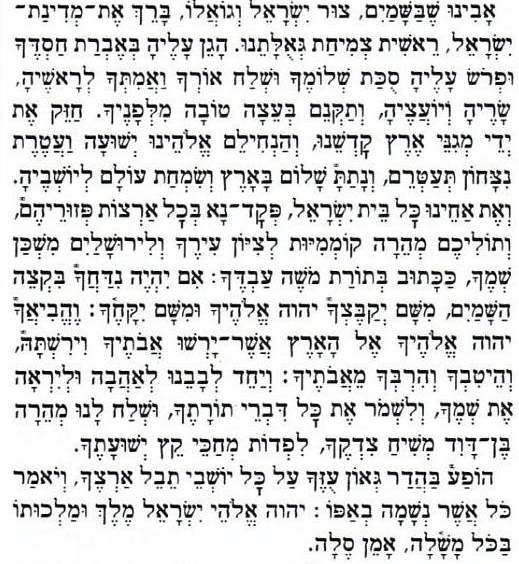
and on the subject of brokenness, i offer this prayer for the state of israel*…..

Our Father in Heaven, Rock and Redeemer of Israel, bless the State of Israel, the first manifestation of the approach of our redemption. Shield it with Your lovingkindness, envelop it in Your peace, and bestow Your light and truth upon its leaders, ministers, and advisors, and grace them with Your good counsel. Strengthen the hands of those who defend our holy land, grant them deliverance, and adorn them in a mantle of victory. Ordain peace in the land and grant its inhabitants eternal happiness.

Lead them, swiftly and upright, to Your city Zion and to Jerusalem, the abode of Your Name, as is written in the Torah of Your servant Moses: “Even if your outcasts are at the ends of the world, from there the Lord your God will gather you, from there He will fetch you. And the Lord your God will bring you to the land that your fathers possessed, and you shall possess it; and He will make you more prosperous and more numerous than your fathers.” Draw our hearts together to revere and venerate Your name and to observe all the precepts of Your Torah, and send us quickly the Messiah son of David, agent of Your vindication, to redeem those who await Your deliverance.

Manifest yourself in the splendor of Your boldness before the eyes of all inhabitants of Your world, and may everyone endowed with a soul affirm that the Lord, God of Israel, is king and his dominion is absolute. Amen forevermore.

i pray too for the innocent of gaza, for those without hope, or water, or food, or electricity. i pray and i pray. and i wonder over and over who in hell’s name beheads a child? pray for this desperate world. pray however you do, however you can…..

what saved you from brokenness this week?

*”prayer for the state of israel” from the jewish virtual library

photo above by my favorite law professor, will kamin, back when he was taking AP photography his senior year of high school….

in which we pause to remember one who would bristle at being called the patron saint of anything. . .

She stretches from Sharon Olds’ Stag’s Leap to Christine Valters Paintner’s Dreaming of Stones on my bookshelf. Sixteen volumes in all. And that’s just the poetry. Doesn’t count her essays, housed on a whole other shelf. I am talking, of course, of the poet I call my “patron saint of paying attention.” Mary Oliver. 

You might also say she’s the poet master of astonishment. She breaks me out in goosebumps and wonder. Line after line after line.

Oh, I’ve heard her poetries dismissed for their “surface simplicity and populist reach.” But when it comes to stirring my soul, I’ve no need for the critics. I side with those who, as was written in her New York Times obituary, find that “her poems, which are built of unadorned language and accessible imagery, have a pedagogical, almost homiletic quality.”

I call them holy. 

Give me a writer who can write of the “uncombed morning,” or confess that “sometimes I am that quiet person down on my knees.” Or cobble together words into a stanza that reads: “All things are inventions of holiness / Some more rascally than others.” Give me that writer and I’ll hitch my starship any last day.

These days, this long hard season, I seek saving grace wherever it falls. I find it in an evening’s sky punctuated by dragonflies drifting and darting in parabola. I find it in any sentence that ends “unlikely distant metastasis.” And I most certainly find it in the poet who reminds me: “So quickly, without a moment’s warning, does the miraculous swerve and point to us, demanding that we be its willing servant.” 

Count me willing.

Emily D. taught me to look for and love the slant, the wisdom that slides in on a steep-edged, improbable angle. Mary O does that every time. I am reading of a bluefish being washed at the water’s edge, and suddenly I am remembering to be on the lookout. To find God, the Holy, in all of creation. Or, as Emerson put it: “To attend all the oratorios, the operas, in nature,” in life, in the day upon day. 

Mary O is the one who puts her ink to the sacred as it spills across creation’s page. How else to describe the one who, when writing of a lone seal pup found on a desolate beach, muses: “. . . maybe / our breathing together was some kind of heavenly conversation / in God’s delicate and magnifying language, the one / we don’t dare speak out loud, / not yet.”

Pay attention to how she places that very last line. The barbed last hook. The one that sticks in your craw just a little bit longer. Whispers a gossamer faith. Mary O was a theologian of the barest brushstroke. You’d barely know you were shaken, but then you quake through to your deepest marrow. 

Mary Oliver’s birthday is September 10. She would have been 88.

And here, in her poem “Messenger,” she describes her life’s work:

My work is loving the world.
Here the sunflowers, there the hummingbird—
equal seekers of sweetness.
Here the quickening yeast; there the blue plums.
Here the clam deep in the speckled sand.

Are my boots old? Is my coat torn?
Am I no longer young, and still half-perfect? Let me
keep my mind on what matters,
which is my work,

which is mostly standing still and learning to be
astonished.
The phoebe, the delphinium.
The sheep in the pasture, and the pasture.
Which is mostly rejoicing, since all the ingredients are here,

which is gratitude, to be given a mind and a heart
and these body-clothes,
a mouth with which to give shouts of joy
to the moth and the wren, to the sleepy dug-up clam,
telling them all, over and over, how it is
that we live forever.

—by Mary Oliver


Seeing Not Looking

Celtic scholar Esther de Waal considers Thomas Merton’s practice of contemplative photography:   

Thomas Merton was of course a writer and a teacher, and a poet, but he was also a photographer, and it is from his photographs that we learn much about how he saw the world, and how he prayed—and the two are of course intimately connected…. He handled a camera as an artist would, and used it as an instrument of delight and perception. It was in the later 1950s that the journalist John Howard Griffin [1920–1980] visited Merton in his hermitage. He had his camera with him and … let [Merton] keep it on extended loan. At first when Merton sent him the negatives, John Howard Griffin was puzzled, for [Merton’s] view was so different from that of most people. Merton photographed whatever crossed his path—a battered fence, a rundown wooden shack, weeds growing between cracks, working gloves thrown down on a stool, a dead root, a broken stone wall. He approached each thing with attention, he never imposed, he allowed each thing to communicate itself to him in its own terms, and he gave it its own voice.  

Later on when he was out in the woods with a young friend, Ron Seitz, both with their cameras, Merton reprimanded him severely for the speed with which he approached things. He told him to stop looking and to begin seeing:  

Because looking means that you already have something in mind for your eye to find; you’ve set out in search of your desired object and have closed off everything else presenting itself along the way. But seeing is being open and receptive to what comes to the eye…. [1] 

He used his camera primarily as a contemplative instrument. He captured the play of light and dark, the ambience, the inner life. But above all he struggled towards an expression of silence through the visual image, so that his photographs show us that ultimately his concern was to communicate the essence of silence. 


it’s the month of Elul in the Jewish calendar, a month for accounting of the soul before the high holidays, Rosh Hashanah, the new year, and Yom Kippur, the day of atonement. i’ve been deep in soulful accounting, and bring along this prayer from the blessed Rabbi Nachman, who taught that life should be lived with joy. and centered in prayer.

A Prayer of Rabbi Nachman of Bratslav (1772-1810)

Grant me the ability to be alone;
may it be my custom to go outdoors each day
among the trees and grass – among all growing things
and there may I be alone, and enter into prayer,
to talk with the One to whom I belong.
May I express there everything in my heart,
and may all the foliage of the field –
all grasses, trees, and plants –
awake at my coming,
to send the powers of their life into the words of my prayer
so that my prayer and speech are made whole
through the life and spirit of all growing things,
which are made as one by their transcendent Source.
May I then pour out the words of my heart
before your Presence like water, O God,
and lift up my hands to You in worship,
on my behalf, and that of my children!


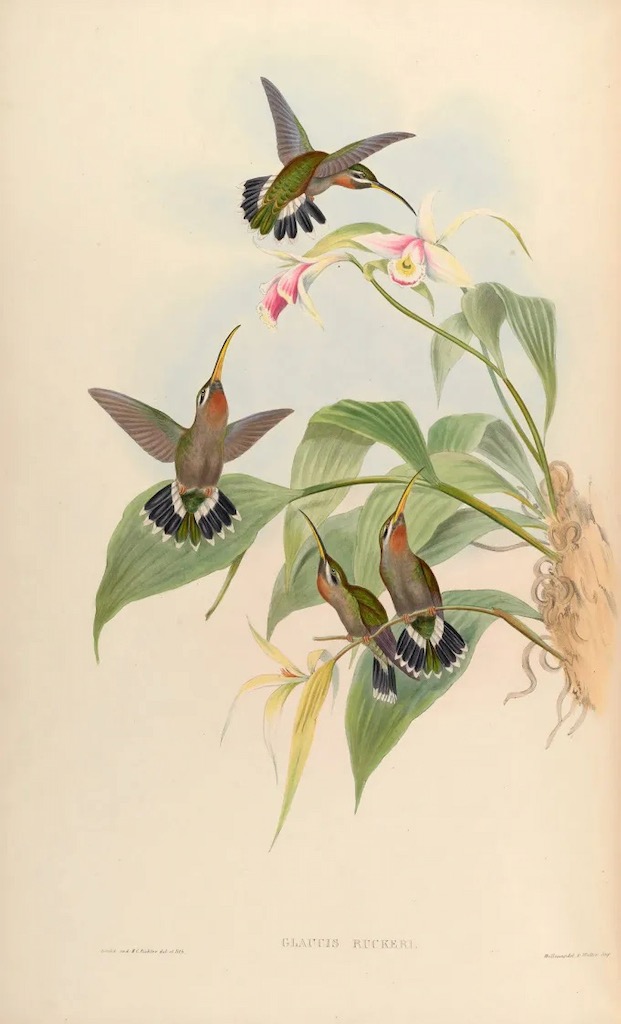
hummingbird photo (above) by shelia zimmerman, sister of my beloved late friend mary ellen sullivan, may her memory be a blessing, (and it is. every day.)

happy blessed sunday birthday to a personal patron saint of mine, mark burrows.

looks like i was in the mood for capitals this morning, maybe just to prove i know how to find the shift key. hope you don’t mind the tall letters every once in a while. i do understand how it makes a sentence filled with proper nouns a bit easier to read…..

let’s play a bit of book group: what are some of your favorite Mary O lines, or words, or phrases?

p.s.s. i almost forgot: i’m taking The Book of Nature on the road this weekend. sunday afternoon, in fact, when i’ll be at Winnetka’s Book Stall at 2 p.m. for a book talk canceled last spring and now back on the calendar. problem is my little voice has gone missing again, and my vocal cord injections are on the books for tuesday, so it’ll be a bit squawky but the show must go on. it’s also Printers Row LitFest this weekend, so lots of getting pulled in several directions. wherever you are, have a lovely blessed almost-autumn weekend.

early morning

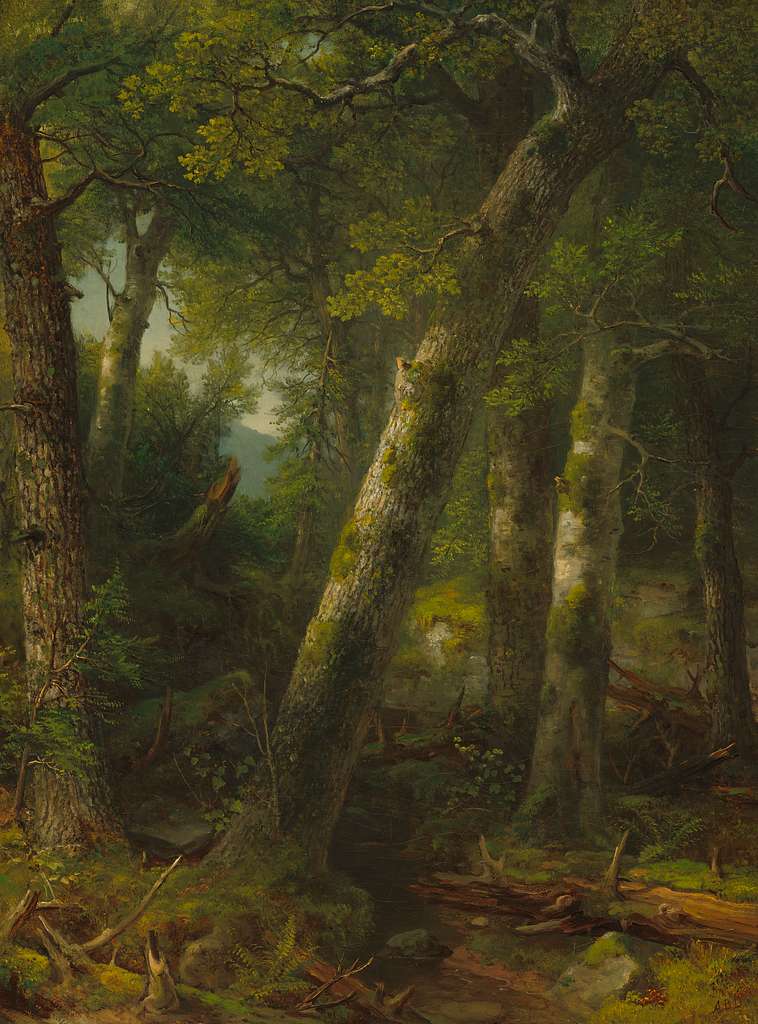
Forest in the Morning Light, 1855 (Oil on Canvas), by Asher Brown Durand

early morning is when the veil is thinnest, my soul most porous. i sometimes imagine the air i breathe then, the soft air, the air a recipe of oxygen and dew, is dispatched directly from the heavens. it’s why i slide out from under the bedsheet, to begin the percolating thoughts that rise while the coffee brews. i step outside, and there, as always, is my old friend ancient moon. all but winks at me, that moon, lets me know i’m not alone. there’s watchkeeping at work. from up where angels roam.

my thoughts feel less alone then. in bed they sometimes wrestle me, won’t let me sleep. but once i’m upright, once there’s mug in hand, and moon above, they settle down, fall in some semblance of a line. i find sense then. i feel infused then. infused in a Godly way. as if my gliding out of bed when the clock strikes five gives me just a wee little jump on what God might want me to consider. as if that might be the hour when the clarity comes.

this morning was one of those mornings, after a long, long week that took every ounce of courage my little self contained. i flew hundreds of miles away to talk to a doctor who knows a thing or two about the cancer in my lung. i walked into a shiny tower with expanse of glass, where as much light could shine in as the heavens had to spare. the place is infused with light, as if to tip the balance of all the darkness you can feel in every hallway, in every bent over human body, bodies leaning on canes, on walkers, in wheelchairs, on whomever walks beside them. where every body seemed to have an extra limb in the form of plastic tubes and tiny pumps, all attached, sometimes trailing, peeking out from under pant legs or flapping-open gowns, or tethered to misbehaving poles. all chasing out the demon cells that know not when to stop.

to sit in those waiting rooms is to witness human compassion at its most majestic. hands rubbing shoulders, rubbing backs. hands trying to knead the ache out of someone else’s flesh and bone. foreheads pressed against foreheads. words whispered. holy words. the most emphatic prayers i might ever have witnessed from across a room.

the prayers prayed there are the ones that gush up from untapped places in the soul. those places not known till life excavates to its deepest depths. till prognoses are spelled out, and sentences put forth — and i don’t mean the sentences with verb and nouns.

my visit was not so dire, but it was a visit that’s left me plenty to sift through, as i work hard — so hard — at absorbing all that’s been, and deciding how to seize my holy, holy days.

so i’m up early. where me and God are most likely to bump into each other. where sometimes when i plant my bum on the stoop just beyond the kitchen door, i almost feel another shoulder rubbing up against mine.


little gems just kept floating my way this week, in that way that sometimes blessings know to come. r.s. thomas, an anglican priest poet who kept watch on the rocky edge of wales, is one of my most favorite holy poets. i discovered him when i went to poetry school at yale divinity school a few blessed summers back. reading him always carries me back to the sunlit seminar room where i first met him.

THE BRIGHT FIELD

I have seen the sun break through
to illuminate a small field
for a while, and gone my way
and forgotten it. But that was the
pearl of great price, the one field that had
treasure in it. I realise now
that I must give all that I have
to possess it. Life is not hurrying

on to a receding future, nor hankering after
an imagined past. It is the turning
aside like Moses to the miracle
of the lit bush, to a brightness
that seemed as transitory as your youth
once, but is the eternity that awaits you.
— R. S. Thomas


this one came from a gentle tender soul who breathes poetry. i thought as i started to read it, that she had written it, but then i glanced down and saw “david whyte,” another in my pantheon of saintly poets, the ones who capture threads of my very own heart and weave them into stanzas…

AT HOME

At home amidst
the bees
wandering
the garden
in the summer
light
the sky
a broad roof
for the house
of contentment
where I wish
to
live forever
in the eternity
of my own
fleeting
and momentary
happiness.

I walk toward
the kitchen
door as if walking
toward the
door of a recognized
heaven

and see the
simplicity
of shelves and
the blue dishes
and the
vapouring 
steam rising
from the kettle
that called me in.

Not just this
aromatic cup
from which to drink
but the flavour
of a life made whole
and lovely
through the
imagination
seeking its way.

Not just this
house around me
but the arms
of a fierce
but healing world.

Not just this line
I write
but the
innocence
of an earned
forgiveness
flowing again
through hands
made new with
writing.

And a man
with no company
but his house,
his garden,
and his own
well peopled solitude,

entering
the silences
and chambers
of the heart
to start again.

   -from The House of Belonging
David Whyte


this one, from pablo neruda, needs no introduction. simply behold it.

Night,
night of mine,
night of the entire world,
you have something inside you, round
like a child
about to be born, like
a bursting
seed,
it is the miracle,
it is the day.
You are more beautiful
because with your darker blood
you feed the poppy being born,
because you work with eyes closed
so eyes can open,
so water can sing,
so our lives
might resuscitate. 

Ode to Night by Pablo Neruda (translated by Ilan Stavans)


and here, if you’ve read all the way down to here, is one last succulence. again, sent by a friend, a blessed friend, of this old chair.

Life is amazing. And then it’s awful. And then it’s amazing again. And in between the amazing and awful it’s ordinary and mundane and routine. Breathe in the amazing, hold on through the awful, and relax and exhale during the ordinary. That’s just living heartbreaking, soul-healing, amazing, awful, ordinary life. And it’s breathtakingly beautiful.

L.R. Knost

what time of day is thinnest for you? and did any gems flutter from the heavens for you this week?

i swear there must be more babies born in august than any other month (it’s not the case; i’ve checked) and some of my favorites are in the parade: my beloved brother david (today); my beloved blair (sunday, in which he will find himself among those competing in the triathlon world’s big national swim, bike, run along milwaukee’s lakefront); and my teddy (who is camping under the stars out in the rocky mountains for the next two weeks, and whose big day is tuesday). happy birthday to each of you whom i love with every chamber of my heart and then some! xoxoxox

whilst i wander commonplacely . . .

page from 19th-century commonplace book in which emily and charlotte bronte’s brother, patrick branwell, contributed four pages of poetry and sketches*

“commonplacely . . .”

that is to make an adverb of the adjective “commonplace,” as in “commonplace book,” a descriptive i’ve already tweaked into a transitive verb, “to commonplace,” to partake of the act of commonplacing. the commonplace book, you might recall, is a centuries-old literary tradition of squirreling away snippets and bits of esoterica and wonder, and tucking them into a common place, a journal or diary in days of old, or here on this rickety old laptop in the digital age. 

it’s a habit i’ve taken to voraciously. i am a packrat of linguistic persuasion. or, as my beloved friend amy more poetically put it, as she described her incessant gathering of singular words or wisdoms as that of a magpie, that feathered species known for its “borrowing” proclivities, as it feathers its nest with an assemblage of freshly plucked (and pilfered) shiny objects and upholsteries. 

in flicking my wand over the quaint coinage, commonplace, i’ve taken linguistic liberties to make it an adverb describing the ways i exercise my curiosities and enchantments. i commonplacely gather up bitlets––a wisdom here, a sigh-triggering superword there. and, with pure joy percolating in my heart, i scurry here to bring them to you. 

in the house where i grew up, the only girl amid a huddle of brothers, with a mother who recited poetries as a way of waking us from our long night’s slumbers, and a father who punctuated all conversation with endless puns and wordplay, i come by my affinities maternally, paternally, and i imagine generationally (my grandma mae, a kentucky school teacher whose testing scores earned her a blue-ribbon blurb in the bourbon county news, certainly must have loved a succulent word––and, oh, that i would have known her to have basked in her starlight . . .). 

and so, standing on the shoulders of all of them, i commonplacely bring you this wordly bouquet for your literary delight and soulful ponderings . . .


let us begin with a romp through a sandbox of little-used words, all of which deserve prompt and hearty resuscitation…

from Ounce Dice Trice

a few fine words for times of day: day-peep (dawn), dimity (time of day when daylight dims), dayligone (twilight)

a smattering of “terms of venery” or “nouns of assembly,” collective nouns specific to certain kinds of animals, a tradition that traces its roots back to english hunting in the late middle ages:

a booing of buffaloes

a pioling of pelicans

a skulk of foxes

a smother of spiders

a trembling of goldfish

a scribbitch of papers

a tumbletell of church bells

a snigglement of string


and from a dear friend who might have been spuddling along: 

spuddle: (17th century) to work feebly or ineffectively; to be very busy whilst achieving absolutely nothing.


and now let us turn from singular words to singular wisdoms….

visiting a cemetery atop a sacred mountain three hours from his home in japan, pico iyer, the british-born essayist known for his voluptuous and epiphanic travel writing, brings us this summons to attention, elicited by a ghostly walk amid the gravestones:

“The thought that we must die, I might have heard the two hundred thousand graves saying, is the reason we must live well.” — Pico Iyer


George Herbert, the English poet and priest, described prayer as “heart in pilgrimage.” (The Secret Gospel of Mark) (page 255)


this next one particularly struck me, as someone whose writing often references God, and who understands viscerally that the very name can stir a host of untapped responses. more and more i claim my ground as an ecumenicist, one who seeks out and sees the glory, wonder, and wisdom in myriad paths to the Sacred Source, and who stakes no single road as the sole salvation. God for me is a name of great comfort, but not all react quite that way. and so i understand why a writer might wrestle therein. and, as so often happens in my Russian doll school of reading, where one idea opens into another, one reference leads me on to another, stumbling upon the quote below introduced me to a writer i certainly should have known, and whose works i am now gathering from my ever-acquisitive neighborhood library.

so this, from Lyanda Lynn Haupt, naturalist, ecophilosopher, and author* of Mozart’s Starling, The Urban Bestiary, Crow Planet, Pilgrim on the Great Bird Continent, and Rare Encounters with Ordinary Birds: (*i’ve already put on library hold as many of her titles as i could find on the shelves)

“When the fraught name God comes up in conversation or reading, I always remind myself that whatever the source or language used, we are at root on common ground — invoking the graced, unnamable source of life, the sacredness that cradles and infuses all of creation, on earth and beyond. I know that prayer is the lifting of our hearts, our thoughts, and even our bodies in conversation, or contemplation, or remembrance, or supplication, or gratitude within this whole, requiring no dogma, only openness. Hildegard counseled, ‘To be alive is to give praise.'”


and from the late great david foster wallace, whose birthday was marked this week, on february 21:

“The really important kind of freedom 
involves attention, and awareness, 
and discipline, and effort, and being able 
truly to care about other people and 
to sacrifice for them, over and over, 
in myriad petty little unsexy ways, 
every day.”

– David Foster Wallace from This is Water


the season of lent began this week, with ash wednesday when we’re reminded through the smearing of burned bits of palm on our foreheads that our short swift lives are indeed bracketed, and that we’d best step up the pace toward whatever is our life’s holiest work. i scanned all week for a lenten offering to bring here, but didn’t find just the right one yet. if you’ve one you’d be inclined to leave here on the table, by all means, do.

and in the housekeeping department: remember that little gathering we’ve planned (march 21, 7 p.m. central time) for the “official launch” of The Book of Nature, my forthcoming adventure in publishing, well, i upgraded my zoom-i-ness this week, and we are no longer confined to 40 short minutes. we can gather for as long as 30 hours at a stretch. though i don’t think we’ll need quite that much time. if you’ve registered, you’ll be getting an email from EventBrite with the link to the event two days, two hours, and 10 minutes prior to the gathering. they work hard to make sure no one forgets.

*page from commonplace book with sketches and poetries of Patrick Branwell, among the many commonplaces found at the Harry Ransom Center at the University of Texas.

next week the chair will post from the capital city, land of about-to-bloom cherry blossom, where i shall be deeply and joyfully ensconced in the project of helping my firstborn settle into his new book-lined apartment in the adams-morgan neighborhood, where he shall launch his professorial life in the weeks and months and years ahead….it never grows old, being there in the trenches, as my boys find their ways. it’s my holiest work, and i am so blessed to have it…..

what wonderments did you stumble upon whilst wandering this week?

low tide

at the dawn of this new year, i am drawn into a particular quiet, the quiet of entering in slowly, and deliberately. i am turning pages, pulling taut the threads of a thick new wrap, stirring onions and garlics and soups on the stove. i am looking out windows, with little inclination to step into the misty fog of the morning. i am content. content to be quiet. content to be still.

i am, you might say, at low tide.

and i’ve no desire to barge in on your own quietudes and stillness. and so i am simply leaving a few traces here, gatherings this week has brought me. i find myself more inclined these days to bring you the wisdom of others. i am holding this space for the days when i will have something worth saying, but for now, my offerings come from the wonders of others. it’s my hope and my prayer that you find here a little nourishment for the week. i’m inclined to think that my most generous offerings these days come not from my own well, but from reading and looking and living through the days with an eye toward deep curiosity and a never-ending sense of the wonder that always seems to find its way in to our most closely-held nooks and our crannies…


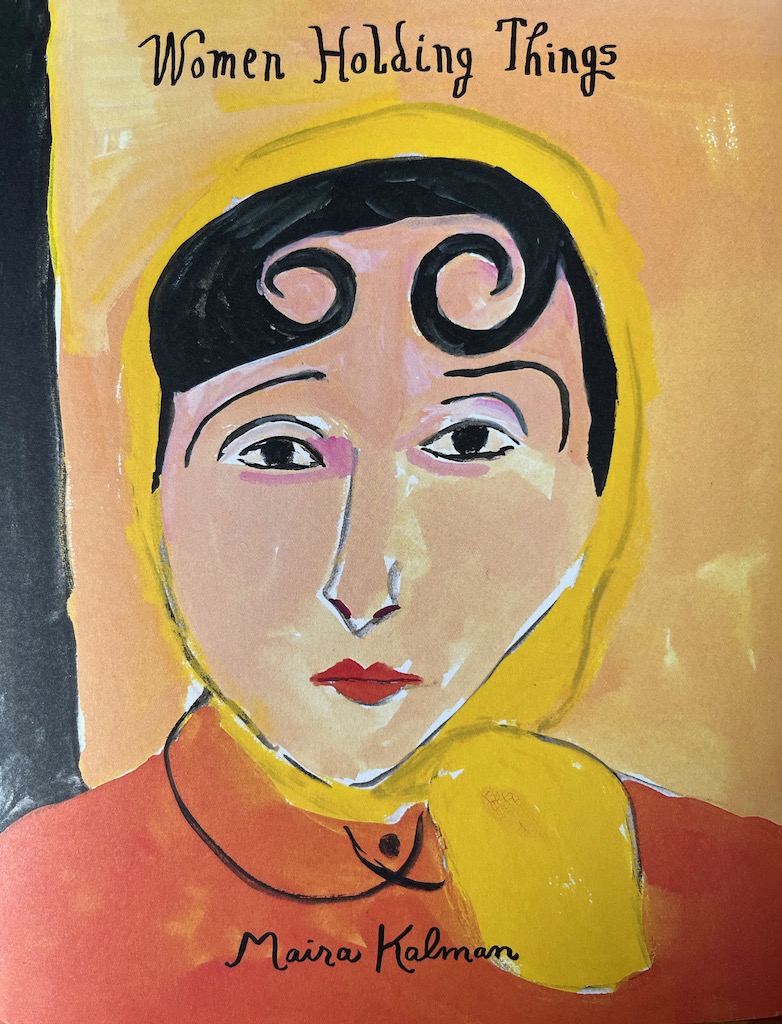
i begin with a book, a book mailed to me by my oldest best friend in the world, the one who long ago all but scooped me off the floor and propped me up, and spooned goodness into me, and shone sunlight on me till i ripened and pinkened, and has never ever let go. she’s the one i call when my heart hurts, and when i can barely breathe. over the years we’ve woven a lifeline that stretches from here on the shores of lake michigan to her house along the pacific coast. she and i share a love for quirky artists and writers and painters of marvelous colors. and she sent me this week maira kalman’s latest: women holding things, described as “a love song to women and the many things they hold, literally and metaphorically.” maira kalman is the madcap artist and illustrator who lights up pages of the new yorker, and lately has been making books so bright and beautiful and hilarious and heart-melting you might want to devote a whole shelf just to maira. you almost might wish to invite her to tea. but it would have to be tea in a room with armchairs covered in eye-popping colors. and you’d need to wear leggings in vivacious stripes and a skirt made of patchworks of peacock-hued threads. and you might serve pomegranates sprinkled on white peaches in winter. because maira seems like a someone who would like the most exotic fruit you could find. and if you served petit fours they would come swirled with coils of sugary buttercream in rose-petal colors. because maira seems like someone who has never colored inside the lines, and never turns down a dollop of whimsy.

and what i love so very much about maira is that you are merrily turning pages, pages so bright and colorful you almost need sunglasses, and then you come to a page that just about stops your heart for a second. a page like this:

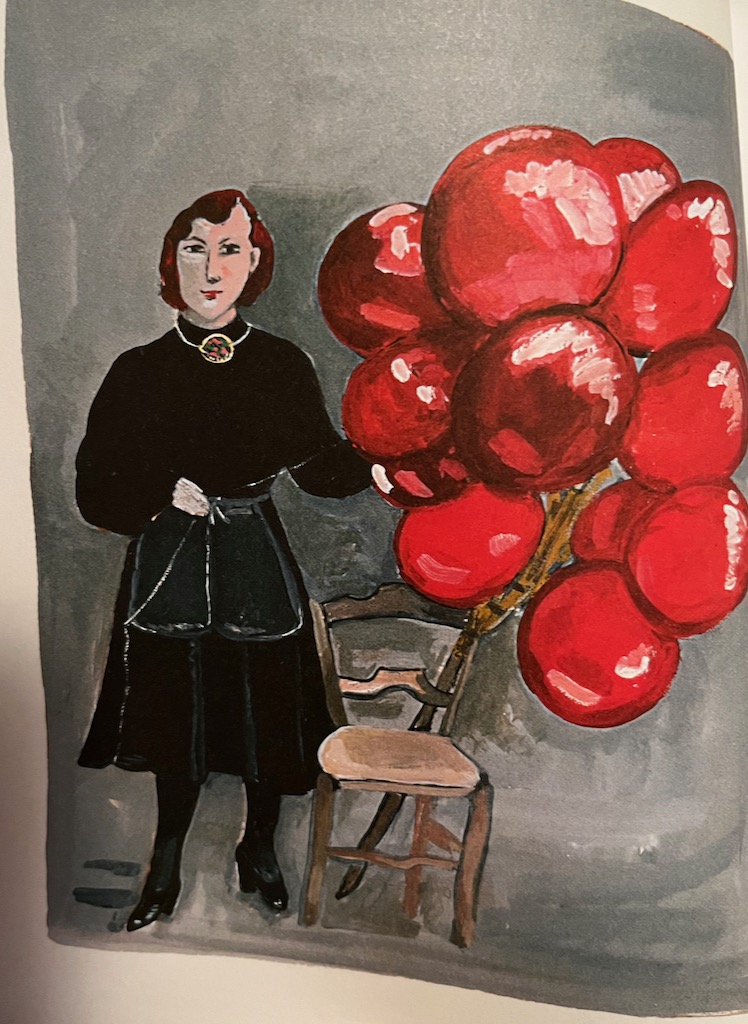
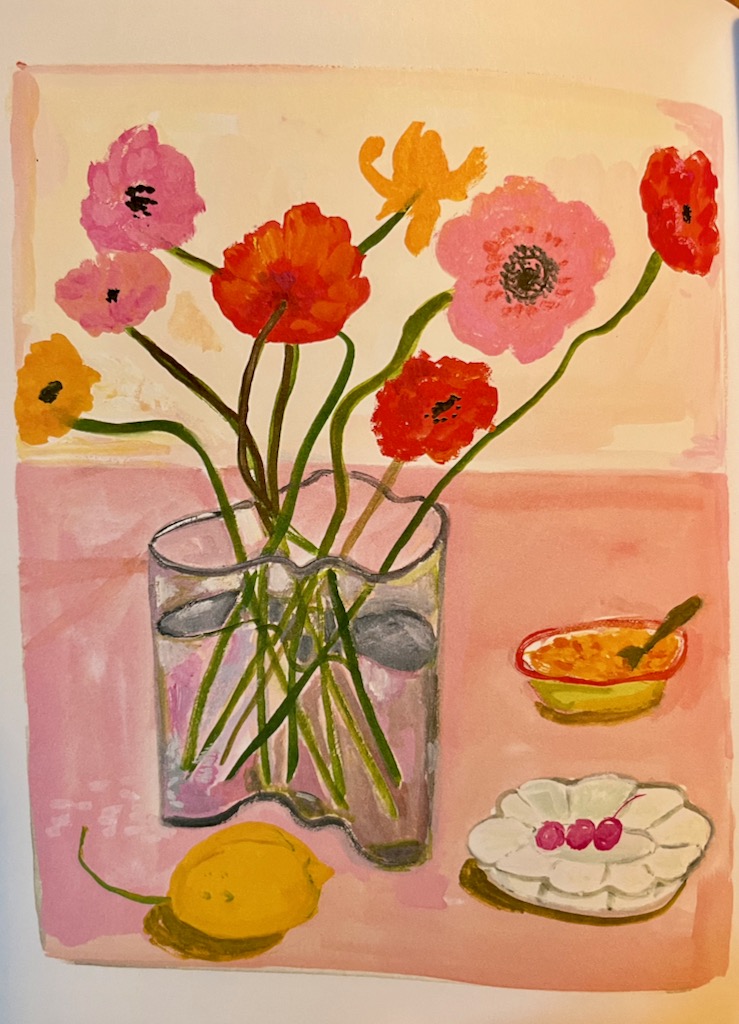
but maira is always maira, so page after page is simply marvelous to look at, and absorb in all its whimsy. pages like these (woman holding a pink ukulele under a giant cherry tree, woman holding shears, woman holding red balloons, fruits and jam):


Don’t think the garden loses its ecstasy in winter.

It’s quiet, but the roots are down there riotous.

Rumi

and then, in a maria popova posting about how to beat back a sense of helplessness in a world of so much suffering, i ran across this from the musician nick cave:

The everyday human gesture is always a heartbeat away from the miraculous — [remember] that ultimately we make things happen through our actions, way beyond our understanding or intention; that our seemingly small ordinary human acts have untold consequences; that what we do in this world means something; that we are not nothing; and that our most quotidian human actions by their nature burst the seams of our intent and spill meaningfully and radically through time and space, changing everything… Our deeds, no matter how insignificant they may feel, are replete with meaning, and of vast consequence, and… they constantly impact upon the unfolding story of the world, whether we know it or not.

i found it a profound burst of a reminder that every little move we make matters. every little one. only nick cave says it beautifully: “the everyday human gesture is always a heartbeat away from the miraculous.” it’s a very good thing to tuck in your front pocket at the start of the year, to remember that every single day we hold the possibility of being makers of the miraculous. all it takes is a whole lot of love, and a wheelbarrow full of humility, enough to be willing to turn the other cheek, and love as you would be loved…


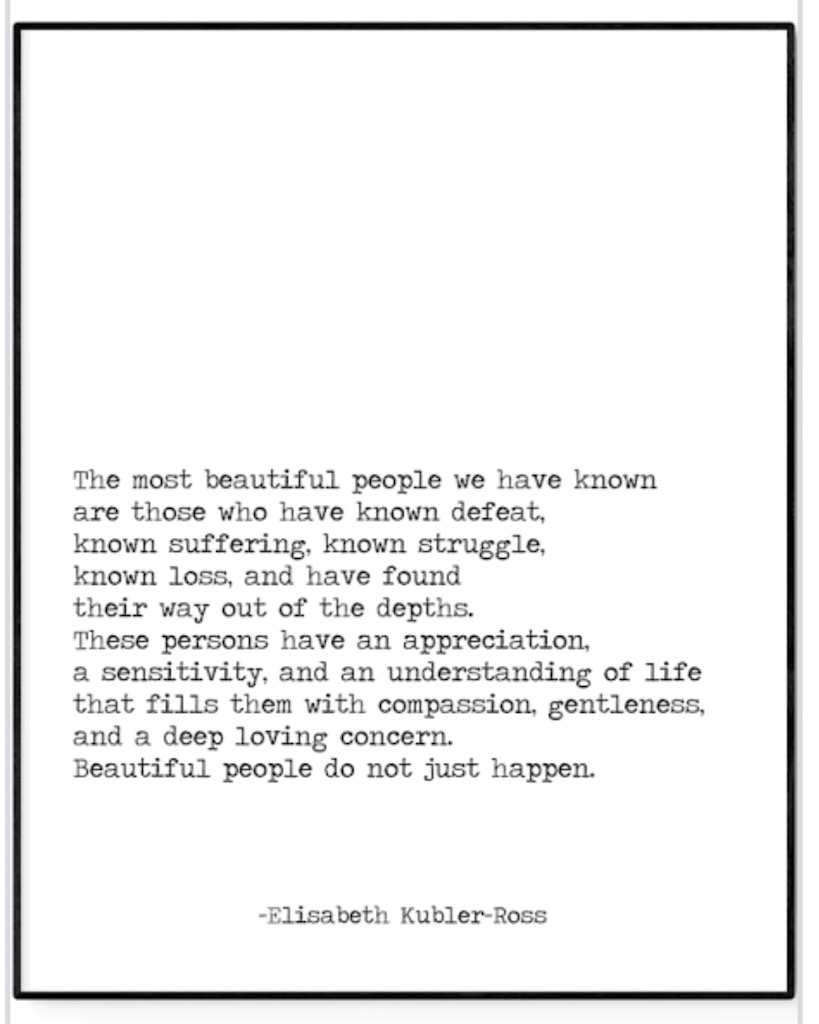
and, finally, a friend i love sent me this, and it took my breath away, and i am leaving it here, in case you needed to read this very thing. and maybe it will take your breath away, too.

i studied lots and lots of elisabeth kubler-ross in nursing school, but i don’t think i ever came across this. and it’s so true, and so beautiful. “beautiful people do not just happen.” bless the beautiful people who populate our every day with their everyday gestures that hold the possibility of becoming the miraculous.

who’s inspiring you in your new year?

p.s. there are a bevy of birthdays upon us here at the end of the year’s first week: dear friends of the chair mary jo and mary beth, may your days be bursting with the miraculous, large and small….

and i’m reminded that today, january 6, is epiphany, which in ireland is sometimes celebrated as Women’s Christmas, a tradition we’d be wise to take up. it’s described by the brilliant artist Jan Richardson thusly: “some folks celebrate Epiphany (January 6) as Women’s Christmas. Originating in Ireland, where it is known as Nollaig na mBan, Women’s Christmas began as a day when the women set aside time to enjoy a break and celebrate together at the end of the holidays.” you can find your own copy of her wonderful at-home retreat PDF by clicking to her “sanctuary of women” webpage here. it’s free but her artistry and her soulfulness might stir you to drop a figurative dime in her coffer.

merry blessed women’s christmas, and holy new year….

on kindness, kerouac, and tolstoy

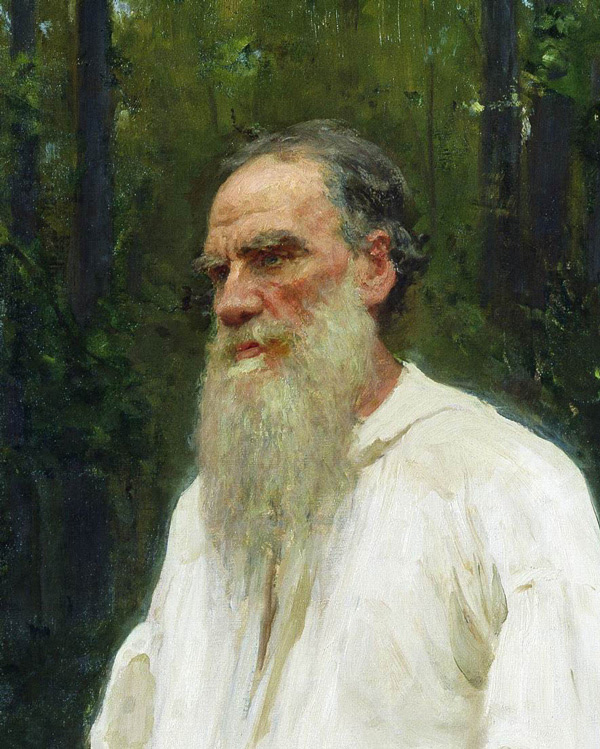
leo tolstoy

i will be backing into this if i begin by quoting a russian intellectual and novelist. but so i begin.

Nothing can make our life, or the lives of other people, more beautiful than perpetual kindness.

Leo Tolstoy

the subject, once again and always, is kindness.

it was unknown to me, and perhaps little known more broadly, that at the turn of the 19th century leo tolstoy neared completion of what he considered an imperative life’s work. not anna karenina, not war and peace, not the death of ivan ilych. but rather something he considered more timeless, more lasting: “a wise thought for every day of the year, from the greatest philosophers of all times and all people,” as he described it.

or as cultural critic maria popova once put it, “to be human is to leap toward our highest moral potentialities, only to trip over the foibled actualities of our reflexive patterns. to be a good human is to keep leaping anyway.” tolstoy’s book, she wrote, was to be “a reliable springboard for these moral leaps.”

in the middle of his 55th year, in march of 1884, tolstoy had set out to read and reap from a circle of the greatest thinkers and spiritual leaders who had shed light on what was most crucial in living a good and righteous life. he dug deep across millennia and miles, reading epictetus, marcus aurelius, lao-tzu, buddha, pascal, the new testament — a reading list he deemed “necessary.”

it was to be his florilegium (a compilation of excerpts from other writings, “mashing up selected passages and connecting dots from existing texts to better illustrate a specific topic, doctrine, or idea,” writes popova. the word comes from the latin for “flower” and “gather;” a bouquet of curated wisdoms). tolstoy saw it as something of a roadmap, daily sign posts pointing the way toward “the Good Way of Life.” in a letter to his assistant, he explained his project thusly:

I know that it gives one great inner force, calmness, and happiness to communicate with such great thinkers as Socrates, Epictetus, Arnold, Parker. … They tell us about what is most important for humanity, about the meaning of life and about virtue. … I would like to create a book … in which I could tell a person about his life, and about the Good Way of Life.

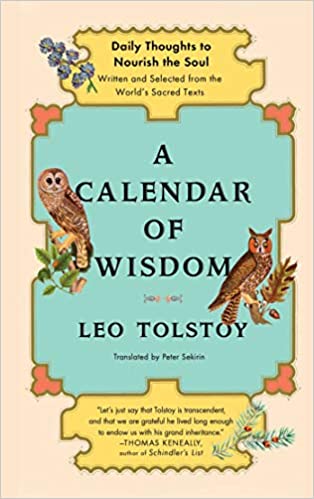
he spent 17 years at it, and shortly after the birth of the 20th century, in 1902, he completed his manuscript, under the working title A Wise Thought for Every Day. two years later, it was published in russian, and nearly a century later, in 1997, it appeared in english translation, all 384 pages of it, under the title A Calendar of Wisdom: Daily Thoughts to Nourish the Soul, Written and Selected from the World’s Sacred Texts. for each day of the year, tolstoy plucked, or gathered, quotes by great thinkers, then added his own musings and connective tissue on the subject, with kindness as the sinew and spine of the book’s moral sensibility.

i bought the book yesterday, in the long hours after i had once again dropped my beloved husband at the curb of terminal 3 at o’hare airport, as he set off once again to race to his mother’s bedside, to honor her, to fill the hospice room with his prayer and his unending grace. in the serendipities of a long afternoon that turned into a longer night, maria popova, she of BrainPickings, the cultural compendium and literary candy counter, dropped in (to my email) with her musings on kindness, a heaven-sent subject in the hours of deep vigil i was keeping for my mother-in-law whose signature and lasting memory is exponential kindness.

i read this entry from tolstoy:

The kinder and the more thoughtful a person is, the more kindness he can find in other people.

Kindness enriches our life; with kindness mysterious things become clear, difficult things become easy, and dull things become cheerful.

i read this from jack kerouac:

Practice kindness all day to everybody and you will realize you’re already in heaven now.

and that’s when i decided i would not merely buy the book but practice it. every day. in honor of my beautiful, blessed mother-in-law who died in the wee hours of this morning, friday, july 2.

her memory will be a perpetual blessing, to me and to all who fall in the radiance of her kindness practiced each and every day.

ginny kamin made lives more beautiful by her practice of perpetual kindness.

“Nothing can make our life, or the lives of other people, more beautiful than perpetual kindness.” a life’s instruction, brought to you by leo tolstoy and one ginny kamin….imagine how you might live it today, one kindness at a time….

wild things

IMG_1229

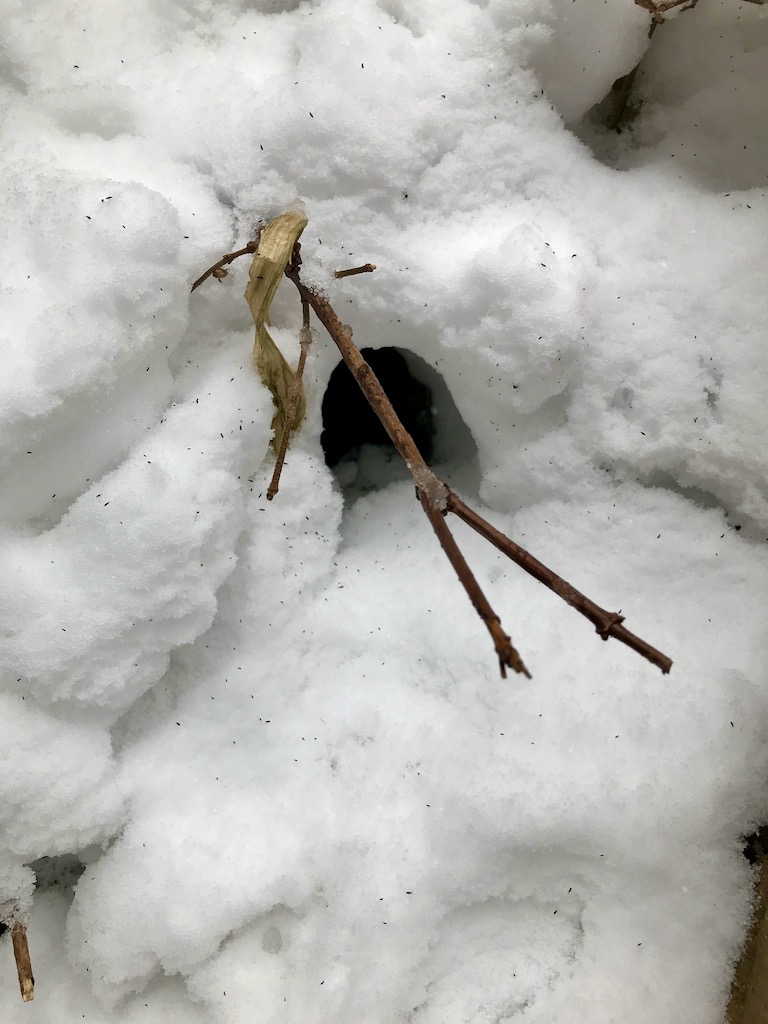
a mouse’s house? with front-porch perch…

it’s the permeability of winter, when the cell wall between the wild and the worldly is punctured, when the precious little things come out into the open, are pushed out into the open, all but tap at the window, beg for a taste of mercy, that’s holiness to me.

IMG_1231against the white tableau of snowy day after snowy day, winter makes evident the tracings of the wild things: a mouse hole here; chantilly-lace tracks of junco and cardinal and jay. even the abominable paw prints of a giant-sized coyote, straight from the woods, up my walk, paused there by the door (did he press his nose to the glass, take a peek under the cookie dome?).
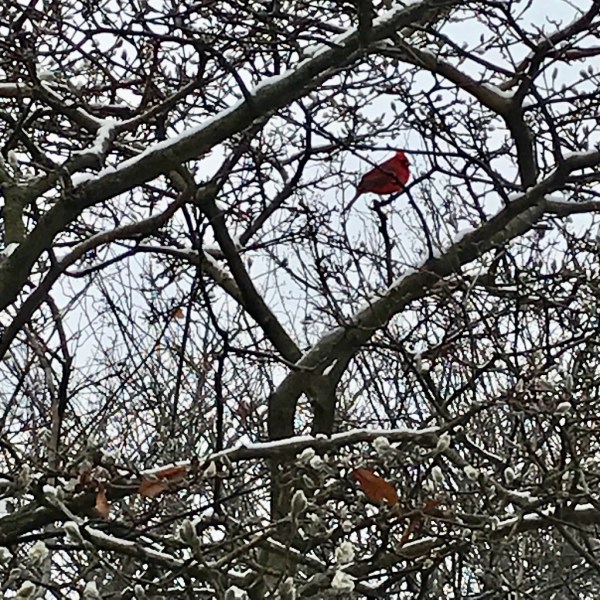
each morning, no matter what the heavens are hurling my way, i don my make-believe farmer-girl boots, i scoop my battered old tin can, fill it with seed, and head out for what you might call matins, morning benediction. i bow to the heavens. scan the trees for any flash of scarlet, or blue-jay blue. i unfurl prayer upon prayer (the moon, if it’s shining, even a crescent or wedge, draws it deep out of me, never more so than in those inky minutes just before the dawn).

what i love about the wild, about this curious equation between us in our warm cozy kitchens and them seeking harbor in ways that mystify now and forever, is the fragile interplay in which we reach beyond what we know, extend an open palm of pure unbridled trust, an offering, no strings attached. it takes stripped-away ego to dare to tiptoe into the world of the wild. it takes a deep and undiluted knowledge of how small a dot we are against the vast canvas of the universe, all but insists we put aside our big ol’ bossy pants, our hurried agendas, our know-it-all nonsense.

it’s the very image of holy veneration: head bowed, palms extended. i come bearing sustenance, in the form of plain seed.

have you ever felt the backdraft of a feathered thing, as it’s flown inches away from your shoulder? have you felt the rush of the wing, heard the soft sound of feather and bone parting the wind?

and then there’s the shock of color, all day long, brush strokes of scarlet, of blue, of smoky charcoal. the boughs are alive, are animated. it’s not all black and white and static gray, not in my patch of the world anyway. all day long it’s a reminder, the wild is just beyond, the wild has wisdoms to teach. mercy is among the urgencies. mercy is what we need to remember; we are lacking in mercies these days.

who ever thought to bring so much wonder to winter? that’s the point at which my wondering leaps from earthly to divine. that’s where unshakeable faith begins to take hold. the wild begs questions that only the heavens can answer for me.

which brings me, round about and once again, to david whyte, whose poem the journey says everything i could ever hope to say with any string of words. have a listen:

The Journey

Above the mountains
the geese turn into
the light again

Painting their
black silhouettes
on an open sky.

Sometimes everything
has to be
inscribed across
the heavens

so you can find
the one line
already written
inside you.

Sometimes it takes
a great sky
to find that

first, bright
and indescribable
wedge of freedom
in your own heart.

Sometimes with
the bones of the black
sticks left when the fire
has gone out

someone has written
something new
in the ashes of your life.

You are not leaving.
Even as the light fades quickly now,
you are arriving.

from House of Belonging  and Essentials by David Whyte

IMG_1240

what wisdoms does the wild whisper to you?

and, while we’re here, the late january table brings a slew of birthdays: kerry down the lane today, beloved beloved pammy jo of the high desert, yesterday. british columbia mary and indiana BB on the 28th. happy blessed whirls around the sun, ladies. and thank you for your radiance….

keeping company with waldo & friends

by the hour, i sit behind my wall of books, reaching from merton to thoreau to emerson, deeper and deeper into the folds of wisdom. it all started because of merton, aka brother louis. or maybe it all started because of mary O. or maybe it all started because of my mother.

my mama, who goes to mass every day of her life (a week ago, during the depth of the polar vortex, i called, and she was in her armchair at 8 o’clock sharp, watching mass on the telly. i shouldn’t have been surprised, and i wasn’t; but i melted a bit at her devotion), she must have been my first rabbi (rabbi in hebrew translates to “master,” or “teacher”).

she’s the one who woke me each morning, flinging the blinds, warbling lines from browning or dickinson — “God’s in his heaven, all’s right with the world” (browning, song from “pippa passes”); “some keep the sabbath going to church — / i keep it, staying at home — / with a bobolink for a chorister — ” (dickinson, 236).

she’s the one whose home movies always drifted away from the faces of her five cherubic children to the iridescent-blue indigo bunting, or the neon-red scarlet tanager darting in the boughs over our heads. some 60 years ago, when in a single day a realtor toured her through half a dozen lovely houses along chicago’s north shore, she bought the one with the most trees. and the creek gurgling in the woods across the street, and the green pond where the frogs croaked and the turtles sunbathed on logs, and the country club directly across the way, with its wide-open vista, promising her a lifetime of sunsets.

she must have been the one who first planted the seed. the seed that has grown and grown. the seed that now is a towering, undeniable, inescapable force, the one that draws me into the woods, under the star-stitched dome of midnight or dawn, the seed that draws me to windows where i can keep watch — on the birds, on the wind, on whatever is falling from heaven.

turns out i am hardly alone in this congregation of woods-goers. i’ve been hot on the trail of something called the Book of Nature, a text i’d never known by name, though i’ve been reading it since before i learned to assemble alphabet letters into words that came with particular sounds and meanings. i’d first learned of it — by name — when a rabbi i was talking to on the radio a few years back said of my first book, slowing time, “it’s midrash to the Book of Nature.” (midrash is defined as ancient commentary, often rabbinic, on Hebrew Scripture; it makes connection between text and lived reality, so says my all-things-jewish dictionary.)

hmm. i’d never known that a girl with a confirmation name, and a patron saint besides, could put a pen to midrash. but my main intrigue centered on this Book of Nature, a title i certainly wanted to get my hot little hands on.

over time, and through the years since, i’ve burrowed deeper and deeper into this ancient wisdom. there’s a whole theology that centers on the notion that the Book of Nature, unfurled at Creation, is God’s first holy text. (called the Two Book Theology, it’s the belief that God is revealed through a pair of complementary sources: the Books of Scripture and Nature; Genesis followed by Word.) this first text even has a latin name, librum naturae, and it traces through the millennia, an idea explored by the ancient “church fathers,” among them augustine of hippo, origen of alexandria, galileo, on through martin luther, emily dickinson, clear to merton’s gethsemani doorstep and mary oliver’s walks through the cape cod woods.

a fellow by the name of sir thomas browne, clear back in the 17th-century, aptly wrote: “there are two books from whence i collect my divinity: besides that written one of God, another of his servant, Nature, that universal and public manuscript that lies expansed unto the eyes of all.”

just a few years ago, pope francis wrote: “God has written a precious book, ‘whose letters are the multitude of created things present in the universe.'” and before him, pope john paul declared: “the visible world is like a map pointing to heaven… we learn to see the Creator by contemplating the beauty of his creatures.

all i knew was that i love nothing more than to stand, stone still, under the night sky, drinking in the moon and the glowing orbs of heaven. or to sit burrowed in sand and stiletto-sharp dune grasses along the shore, counting out the undulations of the lake’s watery pulses. or to marvel at the mama bird dutifully and vigilantly building her nest, one shriveled stick or grass or ribbon at a time.

i knew and know that i feel the hand of God there. feel the telltale tingle up my spine. i know God’s nearby when i catch the goosebumps breaking out along my arms and my thighs.

so, acolyte to Wisdom, i follow the trail deep into the pages where wisdom is recorded, where it’s spelled out in words that hold me like a vice, or would it be as a spelunker? this week found me in the Transcendentalists: first thoreau, then the master, r.w. emerson, who i learned preferred to go by his middle name, waldo. (henceforth, waldo it is.)

i’ll begin though with a few notes drawn from thoreau, first from richard higgins’ thoreau and the language of trees:

…The winter woods, especially, were a spirit land to Thoreau, a place for contemplation. He walked them alert to the mystical, more as supplicant than naturalist….All its motions… must be “circulations of God.”

and from thoreau himself: “if by watching all day and all night i may detect some trace of the Ineffable, then will it not be worth the while to watch?”

or: “my profession is to be always on the alert to find God in nature.”

maple trees, thoreau called “cheap preachers,” whose “century-and-a-half sermons” minister to generations. 

at his funeral, thoreau’s friend and teacher emerson said that despite thoreau’s “petulance” toward churches, he was “a person of a rare, tender, and absolute religion.” 

which drew me straight to emerson, absorbed for days in his signature essay, Nature. and these are but some of the notes i scribbled into my notebook:

Chapter IV Language:

Every natural fact is a symbol of some spiritual fact. Who looks upon a river in a meditative hour, and is not reminded of the flux of all things? Throw a stone into the stream, and the circles that propagate themselves are the beautiful type of all influence.

A life in harmony with nature, the love of truth and of virtue, will purge the eyes to understand her text. By degrees we may come to know the primitive sense of the permanent objects of nature, so that the world shall be to us an open book, and every form significant of its hidden life and final cause.

Chapter VII Spirit: 

[Nature] always speaks of Spirit. It suggests the absolute. It is a perpetual effect. It is a great shadow pointing always to the sun behind us. The aspect of nature is devout. Like the figure of Jesus, she stands with bended head, and hands folded upon the breast. The happiest man is he who learns from nature the lesson of worship. 

…the noblest ministry of nature is to stand as the apparition of God. It is the organ through which the universal spirit speaks to the individual, and strives to lead back the individual to it.

…Is not the landscape, every glimpse of which hath a grandeur, a face of him?

Chapter VIII: Prospects

The invariable mark of wisdom is to see the miraculous in the common.

no wonder mary oliver called herself a student, first and most, of emerson, who taught her — and us — that “the heart’s spiritual awakening” is “the true work of our lives.”

and with that i leave you to your own musings on the true work of our lives, the Book of Nature, and its most brilliant disciples and diviners….

who are your wisdom teachers, from the pages of the Book of Nature, or otherwise?

IMG_1276

one stack among many

ordinary time

noddling bells of spring

deep in the recesses of my DNA, these knowings lurk. those little bits of knowledge slipped in once upon a time, those bits that order time, that frame the paradigm, the window frame, through which i watch the passing picture show called life.

somehow this week there was a whisper barely heard that told me ordinary time had come. technically, liturgically, it had come because the church i grew up in, the catholic church, ordains the monday after pentecost sunday as the opening of the long chapter of the year called “ordinary time.” and so, this week, as i slipped into this time, i couldn’t keep myself from considering the folds and undulations of just what ordinary means.

all around me, as lily of the valley sent up its flagpoles of perfume, as apple blossoms drifted down like vernal snowfall, as songbirds in feathers shocking pink and golden yellow darted in and from my feeders, i hardly thought things “ordinary.” the world’s in exultation.

and in my daily everyday, there was no relenting from the news that never stops and never slows to a trickle, nor was there quelling from the firehose of bumps and bangs that comes with loving widely, deeply. one night had me up till 2 a.m., making sure a young typist came to the end of his bibliography and junior theme (aka massive term paper) before we clicked out the lights. that same night had me dispensing nursing cures to a long-distance patient whose neck was in some spasm. all while keeping track of a train chugging to st. louis, where my sweet mate and familial co-conspirator drew more distant by the minute and the mile. by day, i somehow managed to turn in — on deadline — my own newspaper assignment, the first such one (a cookbook tale, complete with half a dozen lively interviews) in quite a while. none of this seemed “ordinary,” if by ordinary we mean “having no distinctive features,” as the oxford american dictionary tries to persuade us.

oh, around here, it’s distinctive all right.

i even plopped my bum on the old cedar slab i call my prayer bench, amid the ferns and bleeding hearts of my secret garden, intent on keeping watch on this so-called ordinary time.IMG_0172

lured by curiosity to the pages of old books, i dug around to learn a thing or three about this ordinariness. here’s a bit of what i learned: the church, in all her wisdom, divides the year into chunks of time (perhaps to fine-grain our focus, knowing full well we’d succumb to blur if not for demarcation). the church knows, according to one wise writer, “that human psychology desires the marking of moments.”

there are, apparently, two liturgical mountain peaks in the year, easter and christmas, each with preamble (lent and advent, respectively) and in between (here comes “ordinary time”) “the pasture between the mountains,” otherwise referred to as “vast verdant meadows,” of ordinary time, of tempus per annum (my church loves its latin, and, according to my resident latin translator, this literally means “time throughout the year”).

it must be the quiet season, the chunks of year when — inside the church and beyond — there is not the cacophony that comes with birth (christmas) or death and dying and its glorious resurrection (easter).

in one lovely meditation, i read that God, in infinite wisdom, invented the notion of seasons (not unlike the kaleidoscope that turns a notch and explodes in all new shapes and colored bits) as “invitation to reflection,” to jostle us awake as the all-around ever shifts. yet another meditation opined that God uses seasons to “translate wisdoms into a language of purpose for our lives.”

what that means, i think, is that it’s no accident that some of us walk around fully willing to be klonked on the head by the 2-by-4s of revelation that have us extracting lessons from earth and sky and trickling waters in between. it’s why a vine that blooms long after deadline (the week before thanksgiving, one year) might speak to me of undying courage, and the quiet of the dawn reminds me to settle my soul and breathe deep before the launch of day. it’s why the springtime stirs me full of hope, and all but insists i power up my rocket blasters.

ordinary, i read, comes from “ordinal,” or numbered, the weeks of the year simply counted off, one by one. amid the canvas of quiet, without profound distraction, our task in this stretch of time is to think hard and deep about the mysteries in the weft and warp of being alive. as this is the longest time of year, a full 33 to 34 weeks of ordinary time, depending when the feast days fall, i suppose the point is to settle in, sink deep, into the extraordinary work of living, with our attention meters cranked as high as we can muster.

all of that is literal, is what the books i sought spelled out. i tend to veer off the page. and that’s when i began to really contemplate the power of unencumbered ordinary. as if we’re given unfettered canvas on which to quietly and without bother absorb the sacred simple. the gift of being alive without all the inner chatter. the charge to scan the hours of the day for those moments that break us out in goosebumps. the blessing of deep, slow breathing. the chance, scant chance, to catch God in the act….
IMG_0173

of late, i’ve become intrigued by what i call the theology of the sacred ordinary. not the loud bangs and pyrotechnics, not the stuff that comes at the end of miles-long, desert-crossing pilgrimage, but rather the stark and quiet notion that we are living the Holy right now.

it’s the hush of a whisper, the percussion of the rain, those are the sounds that call us in, call us to behold the simple pure sacred. it’s the humility of the moment that belies its grandeur, its magnificent majesty……

and perhaps that’s the invitation of ordinary time, to dwell amid the plain-jane, stripped-down quotidian of the everyday. to awaken our deeper senses, our fuller attentions, to behold the Beautiful, the Wise, the Profound amid our daily stumbles and bumbles. to live as if the Book of Wonder has been placed upon our open palms, its pages spread akimbo. to extract, inhale, deep breathe its mighty and eternal lessons. the ones that whisper, the ones we hear only when we truly, truly listen.

what does ordinary time mean to you?

this morning’s writing came in fits and starts, as it sometimes does, as somehow this morning this old house clattered like it was grand central station, locomotives and the people who aim to board them rushing in and out the station, barely and noisily keeping to the clockwork schedule.