pull up a chair

where wisdom gathers, poetry unfolds and divine light is sparked…

Category: simplicity

ode to summer’s drippiest fruit: the tomato

in which we begin with news: ol’ babs signed a book contract yesterday; the book, it so happens, is already written (sorta unfurled swiftly, once i started to type), and already back from being edited (the contract was agreed upon back in may, but these things take time to get shuffled around the publisher’s desk.) and now i’m knee-deep in responding to edits, cranking the dial in an attempt to make it worthy of the paper on which it shall be printed, and the bookshelves on which it might take up real estate. more details shall come but what i can tell you now is that the working title is When Evening Comes: An Urgent Call to Love, and the epigraph pretty much points to the heart of the book:

“When the evening of this life comes,” says St. John of the Cross, “you will be judged on love.” The only question asked about the soul . . . “Have you loved well?”
––Evelyn Underhill, The House of the Soul

in a nutshell, it’s a collection of essays exploring the spiritual awakening and very real tremblings that come with cancer. a subject with which i’ve been living for the last two years. so, while i’m deep in the fine art of toiling over the words that will or won’t wind up in the book, i leave you today with the simple tomato, summer’s drippiest fruit, and my all-star contender for the juiciest mouthful of summer.

it’s summer and living is easy. and beginning to drip down our chins. at least in the tomato aisle, that is. because i am deep in the task laid out above, i am leaving you today with the simple tomato. and pablo neruda’s sumptuous ode…
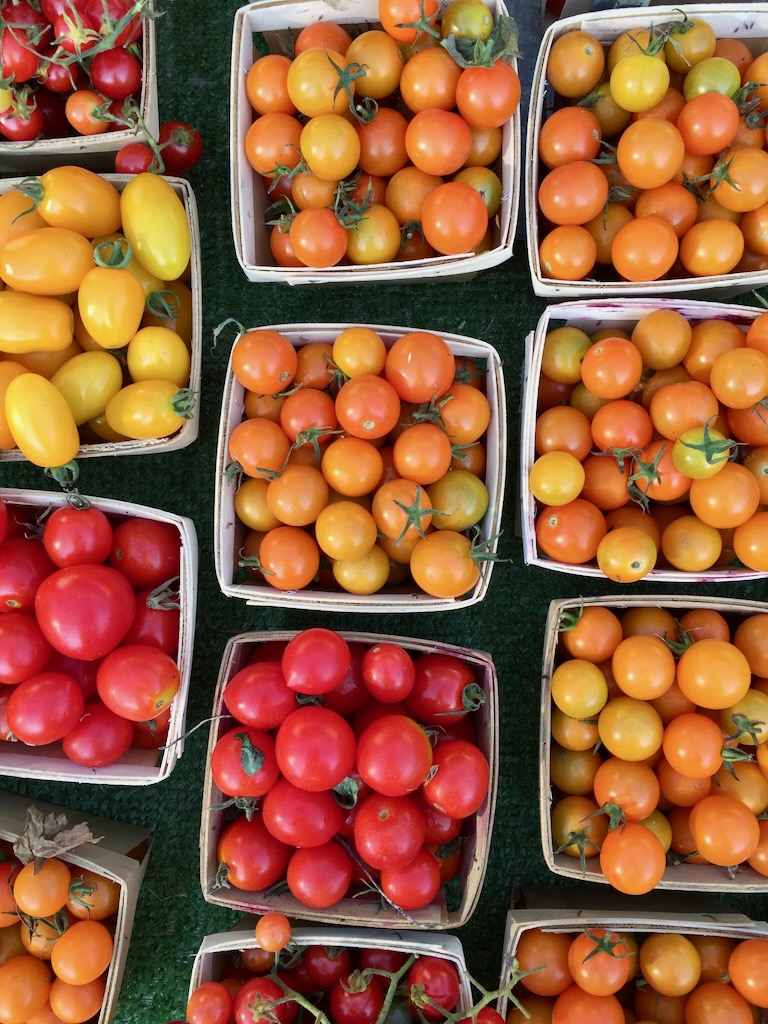
my recipe is this:

pluck the reddest orb faintly tender to the touch. 

slice, or halve into hemispheres, if you’re the poet neruda.

sprinkle with a dusting of sea salt.

add a grind or three of tellicherry peppercorns.

lean over sink.

employ your top teeth and your jaw.

clamp down.

dribble.

repeat. 


and now for the ode, one of the many neruda wrote in the later chapters of his life. what’s more than charming—and so very wise—is that neruda, the chilean poet and nobel laureate, wrote odes to the simplest things, training a poet’s eye—and thus ours—on the wonders right before us. it’s a lifework worth emulating.

while poking around, i found a marvelous ode to the odester on the website of a chap named huck gutman, who happens to be not only a professor of english at the university of vermont, but the former chief of staff to bernie sanders. who knew?!?!

of pablo neruda, the great chilean poet, huckman writes that he is particularly fond of his late ‘odes’. he goes on:

the good poet pablo

“I love these poems in praise of his socks, his suit, lemons, and other everyday objects.  They speak to me very powerfully about the wonderful world we inhabit.  His aim, as I say in the long introduction to his poem, was to speak to those he lived with about the shared wonder of our world.  He set out to speak not to intellectuals or ‘lovers of poetry,’ but to his neighbors in the small coastal town in northern Chile where he lived.  The language of his odes is simple, the imagery rich but drawn from the experience all humans share. In a century when too frequently poetry seems divorced from the concerns and language of everyday life, Neruda embraced the commonplace and made it uncommon, though still shared. 

 “Neruda’s love of the richness of the world was hard-earned.  He lived a full life, of sorrow and suffering as well as joy and love.  He was acquainted with alienation and oppression, with persecution and exile; he also knew the glories of tomatoes. 

 “One of his close friends was Salvador Allende, the socialist who was elected President of Chile and then overthrown by Chile’s right-wing military (with, tragically, the collusion of the American CIA).  Neruda, already ill with cancer, died shortly after Allende perished in the coup which ended both his presidency and Chilean democracy.” 

Ode to Tomatoes 
by Pablo Neruda

The street
filled with tomatoes,
midday,
summer,
light is
halved
like
a
tomato,
its juice
runs
through the streets.
In December,
unabated,
the tomato
invades
the kitchen,
it enters at lunchtime,
takes
its ease
on countertops,
among glasses,
butter dishes,
blue saltcellars.
It sheds
its own light,
benign majesty.
Unfortunately, we must
murder it:
the knife
sinks
into living flesh,
red
viscera,
a cool
sun,
profound,
inexhaustible,
populates the salads
of Chile,
happily, it is wed
to the clear onion,
and to celebrate the union
we
pour
oil,
essential
child of the olive,
onto its halved hemispheres,
pepper
adds
its fragrance,
salt, its magnetism;
it is the wedding
of the day,
parsley
hoists
its flag,
potatoes
bubble vigorously,
the aroma
of the roast
knocks
at the door,
it’s time!
come on!
and, on
the table, at the midpoint
of summer,
the tomato,
star of earth,
recurrent
and fertile
star,
displays
its convolutions,
its canals,
its remarkable amplitude
and abundance,
no pit,
no husk,
no leaves or thorns,
the tomato offers
its gift
of fiery color
and cool completeness.

which lines made you marvel? what’s making your mouth water these days?

tomato madness: slow-roasted cherries from the vine out back

an ode to indolence…

i’ve long called this the indolent season, the season for never mind, que sera, oh well, and  it’ll do. the season for open windows, bowls of zaftig summer fruits, and what’s-ever-easy for so-called supper.

but indolent is just a fancy-pants way of saying lazy. indolent merely hides the truth behind an extra lobbed-on syllable. truth is, lazy is the straight route to what we’re after here; indolent is a bit more round-about.

my friends the etymologists* put it like this:

lazy (adj.)

1540s, laysy, of persons, “averse to labor, action, or effort,” a word of unknown origin. In 19c. thought to be from lay (v.) as tipsy from tip. Skeat is responsible for the prevailing modern view that it probably comes from Low German, from a source such as Middle Low Germanlaisch “weak, feeble, tired,” modern Low Germanläösig, early modern Dutch leuzig, all of which may go back to the Proto-Indo-European root *(s)leg- “slack.” According to Weekley, the -z- sound disqualifies a connection with French lassé“tired” or German lassig “lazy, weary, tired.” A supposed dialectal meaning “naught, bad,” if it is the original sense, may tie the word to Old Norse lasenn “dilapidated,” lasmøyrr “decrepit, fragile,” root of Icelandic las-furða “ailing,” las-leiki “ailment.”

and so, the ode to indolence is, in fact and without an ounce of folderol, the ode to lazy, the season that this is:

lazy is what i am right now, decked out in hand-me-down khaki shorts closed by safety pin instead of zipper.

lazy is dumping berries in a bowl, and deeming them “dessert.” (or at the other end of the day, “breakfast.”)

lazy is screen doors that slam behind your bum.

lazy is open windows all night long; never minding when the ping-ping-ping of rain arrives. lazy is rolling over, merely tugging at the summer-cotton sheet.

lazy is making do with the curious assemblage on the refrigerator shelf; ditching one more trip to the grocery store.

lazy is marking one long afternoon in nothing more arduous than the turning of pages. and no one says you need to hurry through a single one. you might, perhaps, spend half an hour — or more — pondering a single sumptuous string of words. or maybe even just one shining gem of syllable.

lazy is plopping onto an old wicker chair (one long overdue for paint job), and staying there till the underside of your thighs are pocked in wee little divots, wicker-induced every last one, the inverse of a case of hives.

lazy is looking up into the night sky, connecting dots of stars, and calling it “a picture show of celestial proportion.”

lazy is hauling the hose from its garden wheel, cranking the spigot to semi-throttle and watering your toes. why haul off to the beach — the need for towel! for sunscreen! for jug of ice cold water! — when a slow trickle from the rubber-mouthed serpent gets you the very cool you were after in the first place?

lazy is emphatically embracing a life of lolligagging through the days and nights, stringing out the summer holiday for all the indolence it offers.

so call me decrepit, dilapidated, or just plain lazy. i’m conserving kilowatts for trudging-through-the-snow-drift season. and i’m too indolent to unearth a juicier excuse.

from the pages of slowing time, here’s an indolent dessert: 

cobbler

From the Summertime Recipe Box…

No-cook summer, the aim. Pluck tomato from the vine. Shake with salt. Consume. Repeat with the sweet pea, the runner bean, the cuke. And who ever met a berry that demanded more than a rinse — if that? Thus, the blueberry slump. A no-frills invention, concocted — lazily, one summer’s afternoon — in the produce aisle. Even its verbs invoke indolence: dump, splash, dash…spoon and lick. With lick, though, comes a sudden surge of gusto.

Blueberry Slump

(As instructed by a friend bumped into by the berry bins; though long forgotten just whom that was, the recipe charms on, vivid as ever…)

Yield: 1 slump

2 pints blueberries dumped in a soufflé dish (fear not, that’s as close as we come to any sort of highfalutin’ cuisine Française around here….)

Splash with 2 to 3 Tbsps. fresh lemon juice

Cinnamon, a dash

In another bowl, mix:

1 cup flour

1 cup sugar

1 stick butter, cut into pea-sized bits

{Baker’s Note: Add a shake of cinnamon, and make it vanilla sugar, if you’re so inspired…(I usually am. All you need do to make your sugar redolent of vanilla bean is to tuck one bean into your sugar canister and forget about it. Whenever you scoop, you’ll be dizzied by high-grade vanilla notes.)}

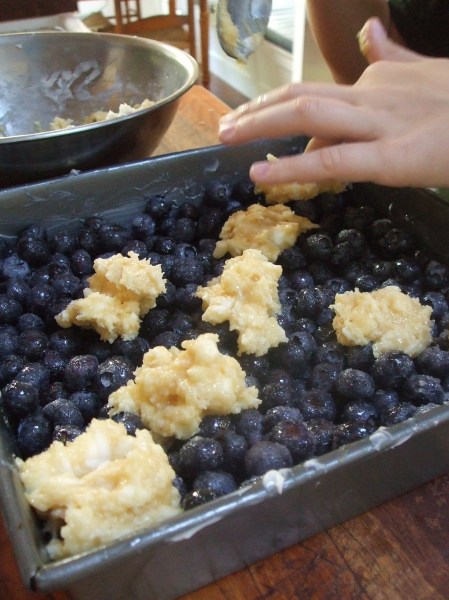
* Spoon, dump, pour flour-sugar-butter mix atop the berries.

* Bake at 350-degrees Fahrenheit, half an hour.

(Oh, goodness, it bubbles up, the deepest berry midnight blue. Looks like you took a week to think it through and execute. Ha! Summer in a soufflé dish. Sans soufflé….)

* Serve with vanilla ice cream. But of course….

Tiptoe out to where you can watch the stars, I was tempted to add. But then I quickly realized you might choose to gobble this up for breakfast, lunch or a late summer afternoon’s delight. In which case a dappled patch of shade will do….

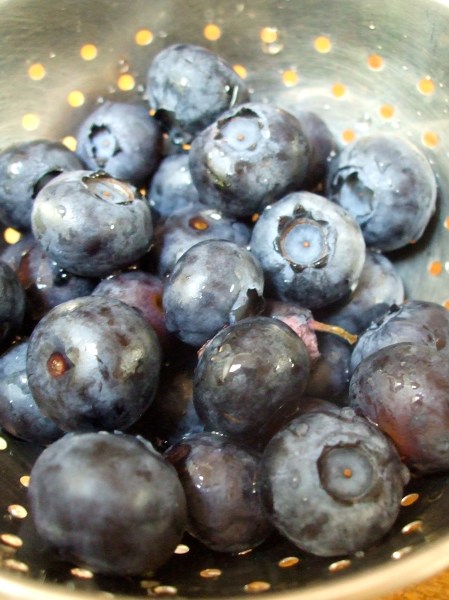
fat and sassy blueberries

how do you define lazy? and what might be a verse in your own ode to indolence?

*credit to my friends at etymonline.com, the online etymology dictionary

a monk’s life

no, people, this is not some new year’s diet prescription. not the bread-and-water plan to a more minimalist you. no, no, not at all.

rather, this is my new year’s confession.

huddle up close, here, and perk up your ears.

what i’ve got to say might befuddle you. might leave you scratching your noggin. or perhaps you, too, share the same yearnings, and you and i shall skip off to behind some walled garden, a place of prayer and bells chiming, of bread and water. and surely some wine.

oh, but that’s getting ahead of the confession.

so, come, come, step here in the little black box, kneel down beside me, and listen in.

the fact of my matter is that beneath all the trappings that make me out to look like just another mama on the leafy shore of chicago–the old swedish wagon, the red-flowered backpack that bops behind me wherever i go, the grocery list that never seems to end, the curly gray curls i keep forgetting to color–well, underneath it all beats the soul of a monk.

i’m convinced, increasingly, and much to the dismay of my boys–the tall one who calls me his wife, and the others who call me their mama–that really i belong in the friary.

i’ve no desire, curiously, to go to the nunnery. somehow i think it more joyful off where the monks do their monking.
i find myself dreaming of days all alone. of unbroken quiet. of tending a small patch of earth. of growing nearly all that i swallow. and milking the rest from a fine little goat. or a cow i might name little flower.

i dream of simple repasts–bread, cheese, a chunky fine soup. salad i’d started from seedlings. and the bread, too, would be made from my hands, my fingers pressed into the slow-rising flesh of the yeast and the flour.

drawn as i am to the dawn, i think i’d adjust quite without ruffle to the prayer of the earliest morn, the one the monks call matins. the one where the night meets the daybreak, at the hour the celts and the seers deem thinnest–or closest, really, to heaven.

i already dress day-after-day as if in a habit. i’m nearly all black, with a little white tee. and if i think of it, i do slip on socks. but often i’m barefoot. (don’t tell my mother, but i’m sockless even in snowboots sometimes.) all i need is a rope round my middle, tied in a long line of knots–one for each prayer i need to remember–and i’ve got the garb for the job.

the best part of being a monk, besides the hours and hours of quiet–oh, and the chanting, the gregorian fly-me-to-the-moon prayers that soar from the old wooden pews to the holy on high–is that a monk’s is a life of quotidian moments and tasks, each and all distinctly imbued with the sacred.

to till the soil is to make way for the seed, to witness the infinite mystery unfolding. to leaven the dough is to consider the miracle of rising again. to kindle the wick of the bee-bundled wax is to bring light to the darkness.

over and over, again and again, from the dawn to the dusk, under sunlight or moon, not an everyday chore is left without purpose divine.

and that, in the end, is a virtue to which i’d turn over the whole of my soul.

now, of course, i’ll not ever discard this life that is mine. this life that is messy, that’s filled with the joys and the sorrows of being a mother, a friend, and a lover in so many ways.

but i do think there always will be a part of my heart that yearns for the life i imagine on the other side of the towering monastic wall.

like all make-believe lives, i pick and i choose the parts i warm up to. i don’t want, not at all, to sleep on a hard slab of oak. nor do i care to be given the cold stare of the no. 1 monk.

no, the abbey i inhabit in my mind’s eye is one that is supremely simple, and utterly warm. the stone floors, i think, are radiantly heated. the garden is bursting with color, and armloads of herbs. the kitchen is steamy all day.

i think really what i am looking for is to make my life in this old creaky house the one i imagine far off in the hills of kentucky, or upstate new york.

it is my task–and maybe yours too–to continue to mine for the heart of the monk here in the midst of my modernday madness.

to find joy in the simplest brushes with heaven above. to fill up my hours with a prayerfulness that never ends. to understand the sanctity of an everyday chore done with pure heart, be it the zen of washing a bowl, or the blessing of changing the sheets for someone whose slumber you pray will be sweet.

it’s a quirky confession, perhaps, but it’s mine. and as this new year unfolds, i enter the most hallowed hours intent on bringing the life of the monk here to a home so utterly earthly.

i wonder, do any of you harbor monastic leanings? any of you spend any time behind the blessed walls of some faraway abbey? any scholars of merton, or friar tuck, or one of the other wise and soulful monks from centuries past?

photo above, courtesy of my sweet will. for the life of me it looks like some ad you might find in the new yorker.

and it is with great joy that i welcome the birth of a beautiful blog that promises to feed our spirits, day in and day out. everyday soup, is the name of dear slj’s blessed repast, now served. please do, give it a taste. you’ll find it, i’m certain, delicious.

by virtue of birth accident, my new year is abundantly a roll-over in every which way. the calendar turns as i too take on another year. my annual summing up, and looking ahead is double-dosed. tomorrow i turn 51. and the gift i just opened is the one of dreaming aloud. bless you, each and every one, for coming here, and letting me do so, day after day.