pull up a chair

where wisdom gathers, poetry unfolds and divine light is sparked…

Category: life lessons

solitary vigil

hospital breakfast tray: one year ago

there are days we mark in silence, days best kept in solitude, in the quiet deep down places where only we can trace the contours of the shadow, the weight of how they’ve changed us, cleared the lens through which we see.

they’re the days that have left their mark on us, indelibly. the days in our lifetime that will forever inscribe the demarcation, time divided starkly––before and ever after. 

one by one, or one alone, they’re the days, the dates, the hours that constitute our subterrain, the strata by which our soul is shaped and stretched and textured. it’s the timeline that draws us into depths, to keener understanding of what it means to be alive. or our life, anyway.

it might be a death or disfigurement. it might be birth, or betrothal. a beginning or an end. most often, both at once. to close one chapter is, by definition, to open the next. and while some of those days are duly announced, and bracketed with anything from helium balloons to holding our breath, it might be the weightier ones––the ones whose mark is most unexpungable––best kept in solitary vigil.

it is in the profound spaciousness of unspoken thoughts that we find the room to grope for consequence, that we fumble toward those few faint stirrings that draw us closer and closer to what becomes our truth. we can’t really find our way without the grace of our aloneness, the room where knowing comes. in the beginning and the end, we tread the thin-bare thread of life with but our God to take us by the hand. or so i believe.

and here’s a truth: by the time we’ve hobbled through a few decades (or less or more, depending on our lot), we all accumulate those days. the days whose dates we don’t forget. the day we met our one true love. the long night of our first miscarriage. the house fire that chased us out. the last look into someone’s eyes. the first time the doctor put breath to the word cancer, and quickly added how surprised he was they’d found it deep inside us. 

we keep those days in cloak of silence because we are sifting still through all the ways they’ve reconfigured who we know ourselves to be, and how we move through time. 

yesterday was one such day for me. one year since i awoke on a gurney, my surgeon by my side. i shudder  now to remember it, though at the time i didn’t shudder at all. i was brave that day. it hadn’t sunk in so deeply yet. ever since, and all year long, i’ve had glimpses both of bravery and brokenness. i’ve cried buckets and, then, i’ve set my shoulders firm; i’ve faced the worst of my fears with unflinching questions, endless hours reading, and airplane rides to doctors i wish i’d never needed to know. i’ve slowly, slowly, tried to imagine adding numbers to my years. 

april 18 is a date i’ve uttered umpteen times in the last year. date of surgery: date of diagnosis. date of new beginning. date of counting time with deeper intention and attention. 

maybe the date will dim, as i move on from it. as 2024 fades to 2025 and . . . (and hallelujah for the 4 that now sits firmly where the 3 began.) a year ago today was the first time i saw my life measured in the span best known as five-year-survival rate, the chance you’ll be around five years hence. believe you me, it’s a bracing thing to count forward and hope and pray you cross the line to––bing! bing! bing! your magic number is….––04.18.28. the date now yours with odds attached. 

i’m going for broke here, and placing bets. but that’s only because at this very moment what swells in me is hope. quick as the clouds scuttle across an april sky, i might flinch, get scared, and pull my money from the table. 

my point is simply to say that there are days that define who we are, and we keep those days in silent vigil, wrap those days in certain grace. and we pray to God we come out the other side, with lessons learned and underscored, as we reach and reach toward that one repeating prayer: dear Holy Gracious God, let me make of this one most sacred day every iota of blessing that is mine––and yours––to give. 

some mornings are so much clumsier than others; this is a clumsy one, but my vow to try–even when i mostly miss–is one i take to heart. to write raw is its own peculiar dare. but here’s the why: because every fleeting while you just might catch a dust mote of life as you know it. and thus i will keep swatting at the passing motes, in hopes of putting words to those ineffable pieces of the puzzle. because we are all bumbling along together here, and in good company we find light and air.

as you look back across the plane of your life, are there days you’ve not forgotten, days you note alone and without mention, because you know how lastingly they’ve marked you? and that’s a questions whose answer you needn’t give voice to here. but just a prompt.

the quarryings of time

my hair is gray. my left shoulder is frozen. my right middle finger locks most mornings. and half of one of my lungs is no longer. 

there’s more (darn that paralyzed vocal cord), but the dirge needn’t drone on. the point is i’ve been quarried by time. which is close to the way annie dillard, my polestar and patron saint of seeing, put it in a passage i read –– and couldn’t forget –– this week. 

on page 238 of pilgrim at tinker creek, my bible of the woods, annie D. turns her otherworldly attentions to living creatures in various states of disarray: spiders with only six or seven of eight species-imperative legs; grasshoppers missing antennae; butterflies whose wings are torn; a swallowtailed sparrow minus its tail. and, yet, and yet, they creep and leap and flutter and glide on anyway. nature is not daunted by its disassembling. 

nor should we be. 

when it comes to us humans –– the species with the power to wonder, to question, to connect the occasional dots –– each quarrying carries its own volume, its own mysteries and humilities and sometimes epiphanies. each nick or chink in the armament of flesh and sinew and bone both takes us down a notch, and, if we’re paying soulful attention, points us closer to our soul, to that essence that bellows our being.

dillard writes thusly:

I am a frayed and nibbled survivor in a fallen world, and I am getting along. I am aging and eaten and have done my share of eating too. I am not washed and beautiful, in control of a shining world in which everything fits, but instead am wandering awed about on a splintered wreck I’ve come to care for, whose gnawed trees breathe a delicate air, whose bloodied and scarred creatures are my dearest companions, and whose beauty beats and shines not in its imperfections but overwhelmingly in spite of them, under the wind-rent clouds, upstream and down.

she got me to thinking about the beauty in brokenness. in disrepair. in all the parts of me that no longer follow instructions. 

and then four pages in, annie lands on the phrase that’s entranced me all week. she wonders aloud if, rather than somehow thinking it our birthright to come into existence “with the spangling marks of a grace like beauty rained down from eternity,” we might be wiser to realize we’re most whole “with the botched assaults and quarryings of time?”

“we are all of us clocks,” she goes on, quoting british astrophysicist arthur stanley eddington, who described us as clocks “whose faces tell the passing years.”

there, in those time-etched crowsfeet and the lines that furrow our brow, lie some of our deepest wisdoms. and most hard-earned beauties. that is, if you, like me, consider it a dazzling thing to have tucked into your brain files those rare few ideas whose staying power drives your every step thereafter. 

i’ve been in hospitals more times than i can count, have sat with eyes squeezed shut as someone drew needle and thread through my torn flesh, have felt the warm ooze of plaster cast being swaddled round my broken wrist. and each and every time, the wounds have left me more awake to life’s unscripted, oft-unspoken ponderings. (except maybe not the time when i made like peter pan, and flew off a garage roof when a rope swing escaped my grasp.) each and every time, we emerge keener to the pains –– and wonders –– of the world.

the most lasting empathies are forged in ERs and aftermaths.

and think about this: might you tally the innumerable times you’ve broken into smile, or squinched your eyes in irrepressible delight, to earn yourselves those hieroglyphs that now stand testament to your life’s-long accumulation of joy, or the hours you bent in deep concentration. or worried for the someones you love.

such are the quarryings of time. they inch us toward our holiest core.

it’s an excavation i’d not surrender.

now in my seventh decade (egad, that sounds sooooo old), i’ve been reminded time and again that none of this is a given. and we are breakable vessels nearly every time. and yet, without the botched assaults and the quarryings, from whence would come our vast acquired wisdoms? 

how would i know how precious each birthday candle is if i’d not wondered “will there ever be another?” how would i know the utterly-taken-for-granted gift of seamlessly sliding an arm down a sleeve if i’d not done so yelping the whole while?

doesn’t our brokenness bring us the pricelessness of knowing how deeply perishable we are? and how we’d best get on with what we know to be those few defining pursuits: whatever is the thumbprint we aim to leave behind on the life and lives we’ve loved? 

aren’t our depths — even the impossible-to-ask-aloud parts –– the prize that comes via our frayed and nibbled selves? 

none of us asked for nor expected the choreography of our lives. but with each and every quarrying there’s come an unintended plus. even if it took awhile to make itself apparent. 

all of which brings me roundabout to this prayer for beauty in the mundane. beauty in the brokenness is another prayer for which i pray. but first, this from writer and poet Cole Arthur Riley*’s breathtaking book Black Liturgies, in which she prays for our capacity to hold together the extraordinary and the ordinary:

God of every beautiful thing,

Make us people of wonder. Show us how to hold on to nuance and vision when our souls become addicted to pain, to the unlovely. It is far easier to see the gloom and decay; so often it sings a louder song. Attune our hearts to the good still stirring in our midst, not that we would give ourselves to toxic positivity or neglect the pain of the world, but that we would be people capable of existing in the tension. Grant us habits of sacred pause. Let us marvel not just at the grand or majestic, but beauty’s name etched into every ordinary moment. Let the mundane swell with a mystery that makes us breathe deeper still. And by this, may we be sustained and kept from despair. Amen.

cole arthur riley

*i am reading cole, stockpiling her wisdoms, as i begin to stock my larder for the lean months to come, when i sense the discord of the world beyond my quarter acre might otherwise knock me asunder. i intend to find a path toward the light. and i will, of course, bring it here.

how has time quarried you? what treasures did you find down deep beneath the dug-out parts?

any time i can bring a nurse to these pages it’s a good day. here, a fine acolyte of healing in action….can you imagine the shenanigans that landed this crew in her sublimely fine care? and, yes, i once wore a cap as pert as hers. and shoes not too dissimilar….

incandescence

There must be always remaining in every one’s life some place for the singing of angels, some place for that which in itself is breathlessly beautiful and, by an inherent prerogative, throws all the rest of life into a new and creative relatedness, something that gathers up in itself all the freshest of experience from drab to commonplace areas of living and glows in on bright white light of penetrating beauty and meaning — then passes.

— Howard Thurman

my relationship with time shifted this year. living does that. somewhere along the line, a rock is thrown. it shatters what it hits. and as you stumble to pick up the pieces, you start to see that you won’t get it back to what it was. the picture window is no longer. instead, the shards are what you hold. 

i’m beginning to practice gathering the shards, holding each to the light. being careful not to get cut on the sharp edges, the piercing edges. knowing the shards are what’s left, i find it easier to lift each one, position it in front of the flame, turn it this way and that, and watch for the incandescence. 

it’s called seizing the day. 

it’s why we watch babies, stare at them mesmerized. they are our sages, the ones whose every dandelion, every dust mote floating by, is a new encounter. can you imagine emerging from the dark wet womb and suddenly feeling fleshy arms cradling you, soft lips kissing you? can you imagine finally putting form to the face from which that one murmuring voice has been coming? 

babies seize everything because it’s all new. the rest of us learn to seize things when we start to realize they won’t last forever. 

if only we all realized how fragile a life this all is. we would be kinder to it. we would be kinder to ourselves maybe. we’d let go of the hurts that poison us. we’d shake off the fears that strangle us. we’d dig down deeper maybe, and let all the beauties out. and, critically, we’d let more in. 

and so, with my understanding of time now deepened, my frame of time shifted, i am more determined than ever, and finding it far less arduous, to step out of my old, afraid ways and into the incandescence of each and every shard. each and every blessing called “this day.” this holy day.

i am, as thurman writes above, keeping an ear out for the singing of angels, and allowing the bright white light of this most blessed life to enfold me, to behold the breathlessly beautiful. before it passes. 

where are you seeing the incandescent? are you letting it in?

and happy blessed blessed new year. while my seat belt is buckled for the year ahead, let us hold hands, and bump our way along, scaffolded by those few fine things we know to be immutable and imperative.

note to true wonder: the bottom photo i took driving home from your farm all those blessed years ago. yes, i drove and clicked. and how it happened, i still wonder. but that heartland panorama i do love. and the heartland farmer.

of walls and bridges…

before: when sunlight had a place to play

been thinking a lot about walls and bridges this week, because it seems the only thing to do about a wall is to try to build a bridge. something of a wall––a six-foot-three-inch, solid-cedar wall––was dropped into our little world this week. it’s a wall i’d known was coming. a wall i’d been warned was on the wishlist all of three years ago. that’s a lot of breath-holding, spring to fall to summer, again and again and again. but held it i did. savored every drop of sunlight shafting in. counted my blessings in dapplings and plashes of sunshine’s incandescence, delighted in the way the light danced upon the wicker and the shingled walls of the little room we call “the summer house.” stood there just soaking in the breeze.

after…

it’s gone now.

and once i cried (the day i heard it’d been ordered, paid for, and soon to be arriving), once i dried those tears, i did what mightier folk than me have shown me what to do, and how to do it: how to build a bridge. starts with chin up, and turn the better cheek. if a wall was coming and i couldn’t stop it, i pretty much shrugged my shoulders and decided i’d take it like a grownup, take it with as open a heart as i could muster. and i’ve been mustering. all summer we’ve been gardening side by side, my next-door-neighbor friend and i. i dug up all the plants that wouldn’t grow in the dark at my house, and now they’re growing in the light at hers. on her side of the six-foot-three-inch fence.

since i’ve been at this digging thing for a few decades now, i’ve told her the few secrets and wise things i’ve learned the hard way. fact is, she’s smart as a whip and a whip-crack study, figures things out in a flash. and best of all she’s not afraid to get her hands muddy, or to spend a whole darn day on her hands and knees scrubbing. i’d say there’s grown genuine affection in our weeks of garden talk. we’ve sprouted something even a wall can’t eclipse.

and then this week the fence was no longer something i needed to picture in my head; it’s right outside, the whole long stretch of it. i wish it was a picket. i wish it let even a little dab of light through, but it doesn’t.

once the sun slides low, it gets dark out there. the light no longer plays.

so i got to work digging. dug myself a garden plot where before there’d been an isthmus of grassy lawn that stretched without end, it seemed. my old garden––along the western edge, a patch of peonies, an oak leaf hydrangea, some happy happy ferns––it’s pinched and stunted in mid-sentence it seems. things will need to be moved, and the few i moved already, to escape the metal posts being banged into the ground, they seem to have died in protest.

but i’ve a new garden now. one that will catch the morning sun. one i’ll delight in, once it starts to bloom. once the butterflies come in, and the birds nibble at the seed, and the bumblebees imbibe the succulence. and three years ago i bought myself a fantabulous bird house that will rise up on a bird-house post from somewhere in that garden, and it will be the pretty thing my eye is drawn to, the birds are drawn to. and i intend to come to love what i’ll pretend is my cloister garth. my place to soak in the sacred that animates this holy earth.

it’s not the only bridge i had to build this week, which got me to thinking hard about the ways i want to live my life. i will always always try to be the one to turn the other cheek. to search for the glowing heart of humanity –– or do i mean the sacred? the divinity? –– buried deep down inside, in the shadow of whatever hurts and scars have made it hard to see. i turned to thinking about the long line of blessed radicals, even the one whose name has been so deeply abused by so-called christians. i thought about the good samaritan. i thought about gandhi and martin luther king, jr. i thought about how, in the face of hurling hatreds, they listened only to the sound of love. how they always, always chose the bridge, and broke the walls.

what it really means to practice love is to do it when it’s hard. when things you dearly love are being taken away. when ones you love are sometimes even the ones doing the hurting. whatever are the million things that make it hard to muster, to offer, to model, to practice love.

we all need practice. it’s try and try and try again. stumble, skin your knees, and try again. the question is: will we try, or will we walk away, and leave a trail of hurt and hearts that only serve to harden?

and while i was thinking of all that, i stumbled on these words that fell right in line with all my thinking of walls and bridges…

SOMETIMES

we need a bridge and sometimes we are the
bridge. No one I know has escaped
troubled waters, rough seas and challenging,
scary days. There are times in our lives
when we could use a little help, and other
times when we are given the chance to be
that help for someone else. It really doesn’t
matter where you are right now. What
matters is that you remember we are
stronger together, and taking a hand is
just as important as offering one.

paul boynton

what bridges are begging to be built in your world this week? (a question for quiet contemplation….no self-disclosure needed…)

so far i’ve built a path of limestone stepping stones in what’s now a skinny gangway between garage and fence, but it’ll some day have a picket gate, and i plan to line that stretch of fence with avian residences (aka bird houses) and i need to find wee plants that don’t mind growing in the dark. and today, since my page proofs still aren’t here, i’m headed to the nursery to pluck myself some bushes that will bloom in spring and blossom into berries when the autumn comes. and there’s a long list of perennials i’ve always wished i had a place for, and now i do. so my bridge promises delight even in its earliest iterations.

year upon year, truth upon truth…

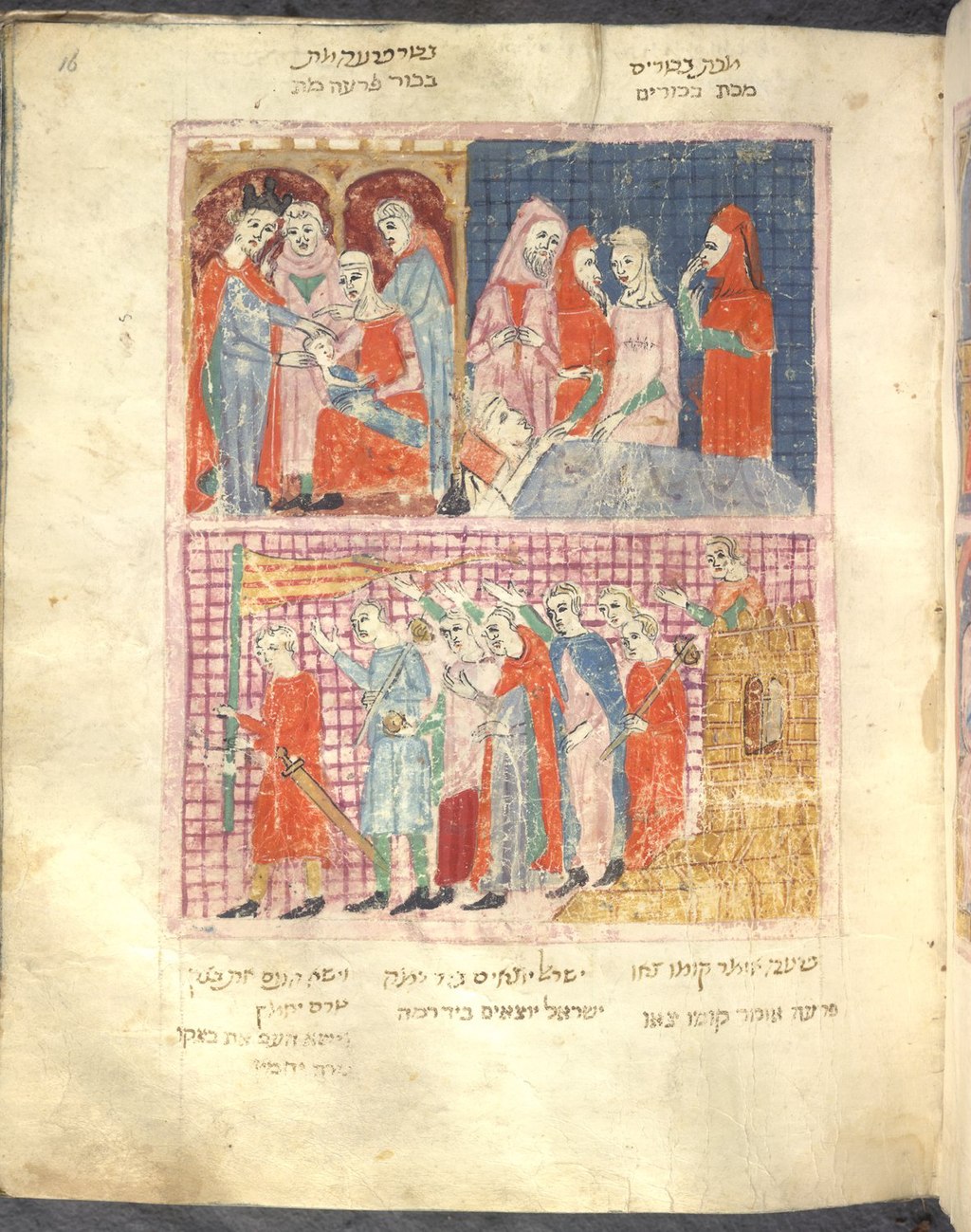
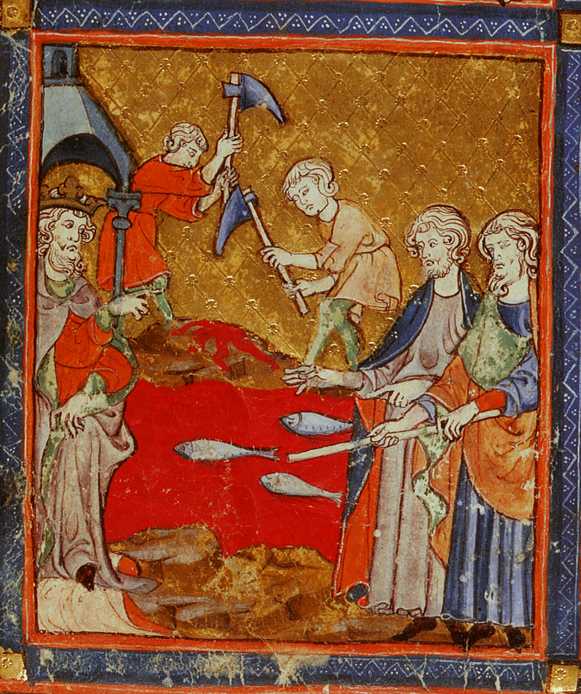
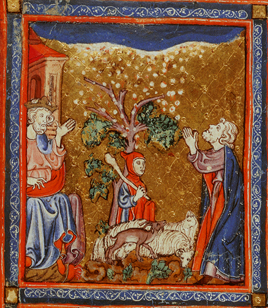
14th-century rendering of the plagues of egypt

we are tellers and re-tellers of story, a people long bound by the unspooling of truths told in text or in verse, around table or hearth, under moon and star or plaster and beam.

in the geometry of time, there lies both wisdom and instruction in the unfurling of the year, an unfurling that might feel like a circle but that i see as a spiral. year after year, we return to texts––familiar texts––that draw us in more and more deeply, the more closely we pay attention. 

so it is––as i fill my house with matzo and shred it of breadcrumbs, as i shop for both lamb and shank bone, as i steam mounds and mounds of asparagus––that once again we come to this holy stretch of time endowed with foundational story, ancient stories both christian and jewish. the story of a savior who wept in a garden, and soon was betrayed, then flogged and stripped and pierced with a crown of thorns. a humiliation as severe as any i’ve ever read. certainly more than any i’ve ever known. and at the same time in this house, we read and retell the story of the enslaved jews finding their way out of bondage, crossing an isthmus, a sand bar in a sea of reeds, but not before witnessing the scourge of ten plagues. 

the beauty of these texts, and any text meant for endless curiosity––these texts, as if prisms we hold to the light, turning and turning for the making of new rainbows––is that each year some new fragment may catch our attention. new rainbows might scatter against the walls of our soul. 

so it is that this year i am thinking anew of the plagues: water turning to blood, frogs, lice, flies, livestock pestilence, boils, hail, locusts, darkness, and the killing of firstborn children.

i remember how at the long seder table where my boys grew up, the table would be scattered with wee plastic frogs and broad-winged bugs; ping pong balls would serve as hail. and red food dye would be splattered on plates. the detail was never lost. 

and only this year––a year when both those boys who once squirmed at the bugs and squealed at the blood will be hundred of miles away––only this year have i come to pay closer attention to what the plagues might have meant to the story we’re commanded to tell. 

according to a wise, wise rabbi whose wisdom i found myself reading the other day, the plagues are “commonly read as punishments levied against the egyptian people for the terrible suffering they forced upon the israelites,” writes sharon brous, the senior rabbi and founder of IKAR, a jewish congregation in los angeles, a rabbi who calls it her life’s work to re-animate religion. oh, that we animate it, this vein in our lives that seems to either be bent to fit particular agendas, or shoved to the side altogether. 

but, writes rabbi brous, there is another way to interpret the plagues, and God’s intent therein (and here’s where i buckle my seatbelt, and begin my own homegrown rocket ride): what if the plagues, the sufferings, are meant not to punish but rather to tender the heart. to grow compassion. to breathe and breed empathies. 

we need turn to the 16th and 17th centuries, to the wisdom of a venetian scholar and rabbi named obadiah ben jacob sforno, to find the seeds of this thinking: sforno argued in his commentary on the text of exodus that the plagues were actually brought to awaken the conscience of the oppressor, “to increase the chances that pharaoh would finally see the light and become a genuine penitent.” 

“in other words,” writes brous, “what God desired was a true change of heart. God wanted pharaoh and his people to take responsibility for the injustices they committed. tell the truth. make amends. offer reparations. chart a new course, together with the israelites.”

in a world as plagued as ours currently is––war and pillage, pandemic and pestilence, fire and flood and drought––in a world where it’s too too easy to turn our backs on the sacred, to point to the suffering and insist there’s no God so hard-hearted to look the other way so therefore there must be no God, in a world as replete with reasons not to believe, what if the radical notion, the one that’s hardest to come by, is the dawning idea that with each and every suffering we grow more and more tender. 

there’s the crux, the hard part: to allow the suffering to tender us, not to harden. not to let horrors metastasize, not to let hurt spread like a cancer, nor turn us into walking, talking cess pools of resentment, to leave us every morning, noon, and night with the afterburn of bitterness there on our tongues. 

imagine ten of your own plagues: the time you were double-crossed; the time you discovered a terrible truth, a truth that was crushing; the dying and death of someone you loved. the remembering and never forgetting of a time you caused the suffering. the lie you let grow. the cruel innuendo that crossed your own lips. count your own ten.

now, consider the pain that you felt. how it awoke you in the night. how it haunted you by the day. how it felt like a nest of hornets let loose in your soul. 

now imagine that the pain didn’t harden. imagine it worked to loosen the loam of your soul. allowed room for new seeds to be planted there. tender sproutlings of purer compassion. how, ever after, you knew what it meant to grieve in a bottomless way. how, ever after, you knew how tempting it was to turn away and never turn back. how, ever after, you knew the muscularity demanded to rise up and out from the darkness. 

consider how those plagues pushed you––not without ache, not without wishing you could wish it away––toward a deeper, broader understanding of and connection with the suffering all around.

imagine if the resonance of your own hours of suffering allowed you to look upon the sins and the suffering all around and find common ground, feel your heart open not close.

imagine if the world’s suffering was meant to do the same. imagine if all this is an exercise in tendering our holiest vessel: the one heart made as a chamber for the sacred to dwell. 

what if, instead of growing bitter and hard over time, we grow softer and sweeter? what if we return to the text––the suffering and crucifixion of the one born to teach and live love, the freeing of an oppressed people made to witness hardship upon hardship, ten plagues in all––what if we return to the text and find, for the very first time, a wisdom to carry us on? into a world that never seems to pause in its inflicting of pain.

what if, in feeling the pain, we are moved to be the agent of balm, of healing, of lifting the other out of a pain we know all too well? tikkun olam. “repair the world.” mend the tatters. reimagine the whole.

there must be wisdom, must be reason we circle again and again to the same lines of text, as if we’re meant to meet it again with whomever we are one year to the next. this year the lines that most drew me in were the ones that ask why in the world would ours be a God who not only allows but inflicts plague upon plague, hurt upon hurt.

my knowing next year might differ. but this year i’ve come to dwell on the thought that no one escapes a life stitched with sufferings. and if the sufferings come, how might they make of us souls that pulse with compassion. communion, after all, is the holiness we seek. oneness. with God, with ourselves, and the whole of humanity circling this earth in this long, dark hour.

what plagues move you to compassion? (a question to answer deep in your soul in these entwined holy hours ahead….)

i cannot let this day pass without remembering my beautiful mother-in-law whom i last saw on this day, her birthday, a year ago. we keep her flame alive, very much alive, in the telling and re-telling of her stories. may they never end…..

*the question of the israelites and the plagues––whether they witnessed them or endured them––was a question that prompted much discussion at dinner last night. one of those rabbit holes into which we fall at our house because one of us––either the jew or the catholic––is always fairly new (or newer) to a story, and wonders about it in ways that have never quite struck the one to whom it is more familiar. i’d assumed––wrongly, it turns out––that to be in egypt at the time of the plagues meant to endure them but a closer read of the story made clear that, according to Exodus, for at least some of the plagues, the israelites were protected. certainly, i knew that the whole point of the “passover” was that Jews were to mark the doorways to their home with the blood of a sacrificed lamb, and the angel of death would know to pass over, sparing the firstborn son. i hadn’t realized––nor had my tablemate––that plagues one through three seem to have been endured by all, and four through ten were endured only by the egyptians, except for those who were penitent and thus spared the wrath.

the clarity of puzzling

i am, as i so often am, late to the game. it’s a game i’ve not played since the long-ago years when a fat-fingered toddler might be plopped on my lap, as he and i searched for the fat wooden pieces, maybe seven in all, and slid them into their hollowed-out shapes on the puzzle board. little boy blue, i remember. and thomas the train. 

but this week, stirred by winter snows and stitches in my paw that kept me from typing too much, i found myself pulling from the cobwebby corner a 500-piece jigsaw sent my way a whole year ago by my very best friend, my friend who spent all of wednesday in surgery. 

i was pulled at first by a faint curiosity, a wondering why she and so many i love seem entranced––almost in meditative spell––bent over card tables of cardboard squiggles and bits, allowing images to emerge out of what starts as some iteration of chaos, albeit colorful. 

sometimes mesmerizing, quite often maddening, it’s a picking-up-pieces sort of a game, a game particularly apt for these times that make so little sense, these times that feel in such tatters and broken-up bits. the whole point of this puzzling pursuit is to make of its maddening and disjointed parts a seamless whole that slowly, serenely comes into view, soul-satisfyingly so.

it didn’t take too many days before i found it all but impossible to stay away from the spillage on the dining room table. in very large measure, i felt pulled deeper and deeper by a wanting to be connected––all these thousands of miles away––to the one who’d shipped me the box. by the time it was wednesday, the day framed squarely in the lens of her surgery, the pieces of puzzle had become some sort of pressed-cardboard prayer bead, an amulet of wiggly edges and bright splashes of color. i was puzzling for something akin to protection, in that way that two very best friends sometimes imagine, wielding shield and sword for each other, willing to leap tall buildings if that’s what it takes.

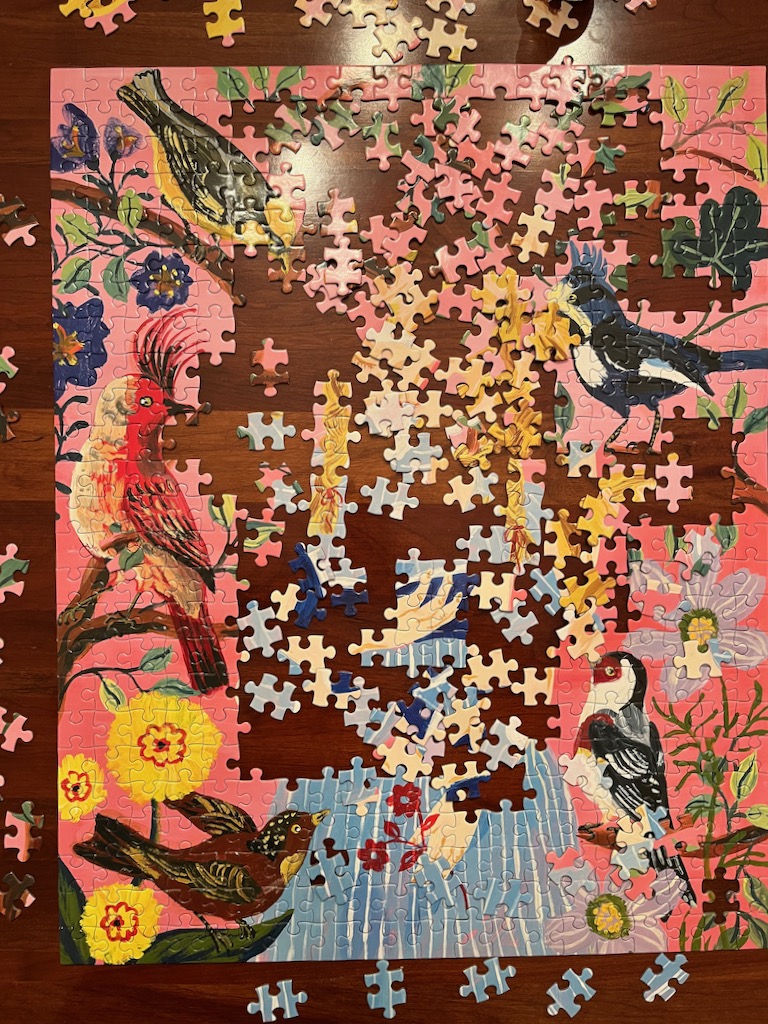
if piecing together the puzzle she’d sent—a charming illustration of a braided-hair girl reading a book to the birds (its title, en français, charmingly: la fille qui lisait aux oiseaux; in english, quite plainly, “the girl who reads to birds”) from the french illustrator nathalie lété––somehow drew me into the inner sanctum of my puzzling friend, allowed me to slip in like some sort of guardian angel, then the hours of her surgery could pass with certain focus, and most determined purpose. 

as the faraway surgeon deftly excised the cancerous nob, i focused more and more sharply on the pieces before me, magically thinking that my high-voltage zeroing in might somehow guide the hand and the blade of the surgeon. i aimed for nothing short of textbook precision. i wanted my dear and gentle friend, my friend who sends puzzles by long-distance post, a children’s librarian fully fluent in the charmingest of pages, a wonder of a human who knows by heart the storybook hits of all of the ages––i wanted her clean and unbound from all cancer. 

as the long afternoon drew longer, and the minutes ticked numbingly by in my head, i discovered that puzzling is as much as anything an exercise in fine-tuning attention. but that isn’t all. there slowly emerged an even more pressing call to attention. it’s not merely visual, the narrowing field of super-fine focus. there seems, along with the eyes, to be a training of the mind, a sharpening of cognitive mettle, a nifty little syllabus for teaching your brain not to leap to conclusions, not based on scant bits of shape, size, or color: sometimes what you see is not what it is. a squiggle you’re sure is the claw of a bird, just might turn out to be the twig of a tree. and the point, over and over, seems to be some sort of lesson in keeping an open mind. not shoving the piece where you think it belongs. only to find that you’re wrong. that seems a wisdom that reaches far beyond the puzzle corner.

at the start, as the 500 pieces tumbled onto the table, all i saw was a dizzying morass of undulating edges. the first few passes were sieved simply by broad swaths of color: pinks over here, blue-and-white stripes shoved to one side, and whole other piles neatly haystacked all round the table: stippled bits of yellow and brown, the reds of a bird, followed by blacks and browns and golds and blues, and all the greens of the various leaves. 

but the longer i kept at it, i found my focus shifting from broader swaths to barely visible daubs and dots. i noticed the shifts in the flow of the paint brush’s bristles. and soon enough i realized i was teaching myself how to see, how truly to see. and how to patiently wait for puzzling clarity. in time, the puzzles give way to emergent precision. an indecipherable brushstroke of brown suddenly manifests as the branch that it is. what appears an odd variegation of white dashes on black suddenly makes sense as the wing of a towhee. 

it’s all in keeping the focus, honing in on the subtlest of clues. working hard to keep open your mind. allowing the truth to slowly emerge.

it took hours and hours. no short cuts in puzzling. no short cuts in seeing the whole.

it finally came, though. where my eyes had been spinning, my pupils near bursting, there suddenly was the deep satisfaction of the whole greater than any or some of its parts. those dashes and dots had turned into fine-feathered birds. the brushstrokes of the yellow and brown, the braids that spilled to the little fille‘s frock.

and now, the last piece inserted, my beloved best friend home in her bed, i’m ready to puzzle again. it’s an insatiable pull, the puzzling clarity that comes in a box, 500 bits at a time. 

shall i go for 1,000?

fini!

do you puzzle? and have you a pastime that teaches the secrets of seeing? and keeping open your mind?

a little bit about nathalie lété:

a one-woman whimsy factory, madame lété. it’s been written that she sought refuge from a troubled family life in the make-believe world of european fables and chinese legends; she was an only child––“sad and solitary”––shunted between a german-czech mother and a chinese father “who did not get on,” as she’s told it. though she now lives and works in paris, the walls of her tucked-away cottage in fontainebleau forest are alive with playful folk-life motifs. it’s a bit alice-in-wonderland sprung to life: a giant papier-mâché toadstool serves as a console table. a door is fringed with ceramic “moss.” a pink bedhead, adorned with hearts and birds, and tree trunks hemming the edge of the doors. it’s all inspired, she’s said, by the bloomsbury group, who painted across walls and floors, over and under furniture, including lampshades, and carpets, and the bindings of books—a palette without end. hers is a hand-painted world filled with “an air of fairy-tale wonderment,” according to the slick world of interiors (she’s also been profiled in harper’s bazar UK, and chinese edition of vogue and cosmo, and of course france’s le monde).

prayer corner: prayers for the puzzler in sunny la, and prayers for sweet P, a dear and beloved friend of the chair, getting herself a brand new ball and socket this morning. xoxox. and giant giant happy birthday prayers for my beloved “baby brother,” the one who was and is my dream come true, born 2/4/68, the perfect pair to my odd numbered 1/3/57.

p.s. quite a morning here, with back-to-back phone calls starting at 7 a.m., including one from my favorite law clerk who called to report that he’d bumped into none other than the real sarah palin (sounding “more tina fey than tina fey,” he reported) as he ambled into the courthouse this morning. thus, the delay. so, so sorry.

the dangers of not letting go. and the dusty path toward redemption.

the homestead, circa 1957

this is not a story about religion. though it’s a subject with zealots and slackers.

marie kondo, the porcelain doll of a declutterer, calls it sparking joy (and swears it can change your life). i call it getting covered with cobwebs. and eye-watering dust. and reminding myself of my proclivities for not letting go of the sentimental. 

but i took a trip to new jersey, to a white-clapboard house that might have been built in the early 19th century, and might have been there (in one form or another) as early as 1789. 

and everything changed. 

inside that old house were dozens and dozens of orifices, each one packed to the brim. to open the door to the attic was to trigger a domestic avalanche, the sort you might find spelled out in the weekly gazette, where some poor soul was buried alive beneath decades-old shoeboxes, crumbly yellowed news magazines, and strings of christmasy lights that might never have burned. 

when your job is to pack up the kitchen, to wrap not only the skinny-necked goblets, but to sift out toothpicks, circa 1960, and mismatched tupperware lids by the dozens, you swiftly absorb an abiding commandment: thou shalt not leave behind a house stuffed with stuff thou hast not had the courage or chutzpah to preemptively toss. 

you get cured right quick of your stockpiling ways.

marie kondo, whose best-selling tidying book i once was assigned to survey, makes the closet-clearing task sound downright zen-like, as if standing before overstuffed shelves, blithely sorting and chucking and plucking for joy — would that be placing the object in the palm of one’s hand, awaiting the wee bit of voltage that’s the signal for “keep me”? — is the next best thing to a trip to the spa. (no wonder i tossed aside that pretty little spark of a joy-jolting book, the book that sparked little but befuddlement back in my stuff-keeping days.)

the truth is, i found packing up the kitchen of someone i love a hauntingly heart-tugging endeavor. i unearthed the red apple-shaped placemats she must have delighted in setting on her breakfast table, or when a struggling student she lovingly tutored came for after-school cookies and milk. i pulled from a drawer the crystal-handled cake cutter that might have sliced into chocolatey layers on countless occasions, and i heard once again the peals of laughter that echoed through the house’s post-colonial walls. i discovered my mother-in-law’s absolute obsession for all things valentine’s day; heart-shaped candy dishes, red paper doilies, and 101 variations on heart-speckled pink paper napkins. 

it’s as if a life is being unspooled wordlessly, a silent reel of thing upon thing. each one with a story you can only imagine, each one a frame still palpably pulsing, but only just barely. and you feel the slipping away all over again.

i kept picturing my mother-in-law peeking over my shoulder, wincing each time i tossed a tchotchke into a trash bag or pitched some trifle to the give-away pile. i felt guilty. i felt tender of heart. i wiped away dozens of tears. (and i kept those few things that belong in the family treasure heap: a dough cutter (highly likely unused), a trio of age-worn red plates (the ones i ate off dozens of times), the red-plaid apron i long ago sewed for her birthday, and now frayed at the ties.)

but then, stripped of my long-held tossing hesitancies, emboldened to not bequeath such a task to my own two boys, i came home and applied my newfound thick-as-reptilian toughness to the orifices i call my own. all week i’ve been standing akimbo in closets and tucked-away corners, dispatching and discarding with gusto. whole bags have been filled as i’ve scoffed at the millions of times i’ve stashed some odd something away, long deluding myself that some day i might find reason to put into action whatever was the odd esoterica. i now know that someday never comes. 

and my new best allies are the fine fellows at goodwill industries, who handily roll out the big blue bins every time they see my red wagon pulling into the lot. 

it’s hard work for the heart. and i don’t mean the muscle that’s doing the pumping. i mean the ineffable filaments of said organ that cling too mightily to the objects of everyday living. the invisible cords that — in some of us anyway — tug too hard in the attachment department. 

to excavate the closets and cupboards of a life long lived is to sweep across the narrative told in dusty old things. in the story told from the long life i hope is mine, i want the people i leave behind to lift up each object and know it sparked me pure joy. 

but more than that, far more than that, in the now, i want my life to not be buried under the crumpled weight of stuff that niggles at me, taunts, “why on earth are you holding onto me?” why not let go, and be freed from the crushingness of closets that threaten to topple, drawers stashed with missing and misplaced parts, and the generalized sense that i live in a house that might split at the seams? 

i want only the things that conjure a someone or sometime or someplace i loved. i want to live lean and clean and not take up more than my share of the room. i want a house without the ghosts of fibber mcgee. i want a lightness of being.

mostly, i guess, i want to pare it all back to the essence, the true essence of joy — unencumbered.

turns out, marie kondo was right after all.

how do you rate in the declutter department? are you a stasher or trasher? if you told your life story in objects, what might be the most treasured pages?

on kindness, kerouac, and tolstoy

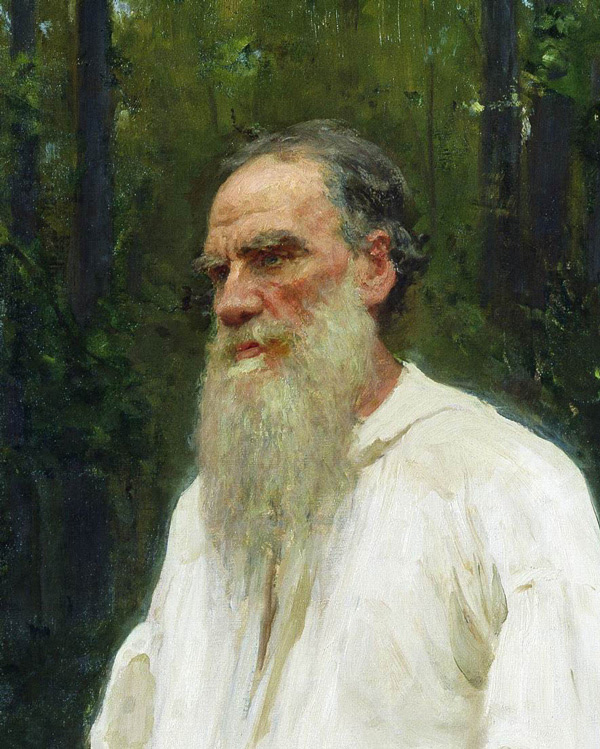
leo tolstoy

i will be backing into this if i begin by quoting a russian intellectual and novelist. but so i begin.

Nothing can make our life, or the lives of other people, more beautiful than perpetual kindness.

Leo Tolstoy

the subject, once again and always, is kindness.

it was unknown to me, and perhaps little known more broadly, that at the turn of the 19th century leo tolstoy neared completion of what he considered an imperative life’s work. not anna karenina, not war and peace, not the death of ivan ilych. but rather something he considered more timeless, more lasting: “a wise thought for every day of the year, from the greatest philosophers of all times and all people,” as he described it.

or as cultural critic maria popova once put it, “to be human is to leap toward our highest moral potentialities, only to trip over the foibled actualities of our reflexive patterns. to be a good human is to keep leaping anyway.” tolstoy’s book, she wrote, was to be “a reliable springboard for these moral leaps.”

in the middle of his 55th year, in march of 1884, tolstoy had set out to read and reap from a circle of the greatest thinkers and spiritual leaders who had shed light on what was most crucial in living a good and righteous life. he dug deep across millennia and miles, reading epictetus, marcus aurelius, lao-tzu, buddha, pascal, the new testament — a reading list he deemed “necessary.”

it was to be his florilegium (a compilation of excerpts from other writings, “mashing up selected passages and connecting dots from existing texts to better illustrate a specific topic, doctrine, or idea,” writes popova. the word comes from the latin for “flower” and “gather;” a bouquet of curated wisdoms). tolstoy saw it as something of a roadmap, daily sign posts pointing the way toward “the Good Way of Life.” in a letter to his assistant, he explained his project thusly:

I know that it gives one great inner force, calmness, and happiness to communicate with such great thinkers as Socrates, Epictetus, Arnold, Parker. … They tell us about what is most important for humanity, about the meaning of life and about virtue. … I would like to create a book … in which I could tell a person about his life, and about the Good Way of Life.

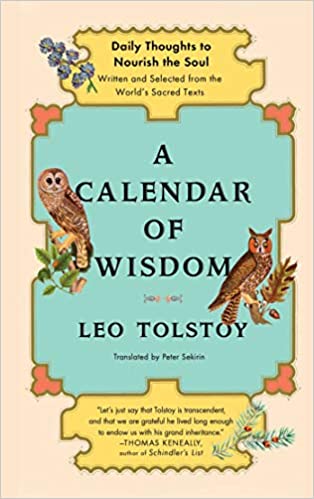
he spent 17 years at it, and shortly after the birth of the 20th century, in 1902, he completed his manuscript, under the working title A Wise Thought for Every Day. two years later, it was published in russian, and nearly a century later, in 1997, it appeared in english translation, all 384 pages of it, under the title A Calendar of Wisdom: Daily Thoughts to Nourish the Soul, Written and Selected from the World’s Sacred Texts. for each day of the year, tolstoy plucked, or gathered, quotes by great thinkers, then added his own musings and connective tissue on the subject, with kindness as the sinew and spine of the book’s moral sensibility.

i bought the book yesterday, in the long hours after i had once again dropped my beloved husband at the curb of terminal 3 at o’hare airport, as he set off once again to race to his mother’s bedside, to honor her, to fill the hospice room with his prayer and his unending grace. in the serendipities of a long afternoon that turned into a longer night, maria popova, she of BrainPickings, the cultural compendium and literary candy counter, dropped in (to my email) with her musings on kindness, a heaven-sent subject in the hours of deep vigil i was keeping for my mother-in-law whose signature and lasting memory is exponential kindness.

i read this entry from tolstoy:

The kinder and the more thoughtful a person is, the more kindness he can find in other people.

Kindness enriches our life; with kindness mysterious things become clear, difficult things become easy, and dull things become cheerful.

i read this from jack kerouac:

Practice kindness all day to everybody and you will realize you’re already in heaven now.

and that’s when i decided i would not merely buy the book but practice it. every day. in honor of my beautiful, blessed mother-in-law who died in the wee hours of this morning, friday, july 2.

her memory will be a perpetual blessing, to me and to all who fall in the radiance of her kindness practiced each and every day.

ginny kamin made lives more beautiful by her practice of perpetual kindness.

“Nothing can make our life, or the lives of other people, more beautiful than perpetual kindness.” a life’s instruction, brought to you by leo tolstoy and one ginny kamin….imagine how you might live it today, one kindness at a time….

maybe we do one, just one, bold (but little) thing…

and by bold i mean one something, anything, in the name of bending that stubborn arc of justice. by bold i mean do one certain something today — maybe even within the next hour — that you otherwise wouldn’t have mustered the will or energy or courage to do.

feeling the full weight of what we’re up against in this world that is not letting up in this long hot summer, so many mornings feeling knocked back, feeling impotent, frozen in the face of injustice, in the wake of sirens and spilling blood and streets chaotic, i turn — as i so often do — to the words of dorothy day, who in turn had leaned into the holy wisdom of therese of lisieux, the little saint who preached a spirituality of “the little way,” to mine her everlasting, every day truth:

From Therese, Dorothy learned that any act of love might contribute to the balance of love in the world, any suffering endured might ease the burden of others….We could only make use of the little things we possessed — the little faith, the little strength, the little courage. These were the loaves and fishes. We could only offer what we had, and pray that God would make the increase. It was all a matter of faith.

Dorothy Day: Selected Writings, Edited and with an Introduction by Robert Ellsberg

it’s a place, and a way to begin, for us little people, the ones of us who know full well the real battlefield that calls us every day is the one not too far from our front door, the quotidian one, the one whose players we might know well or not at all. the strangers within our reach. the ones who might be taken wholly by surprise by a sudden gust of kindness, out-of-nowhere kindness. the ones who might find courage a little bit contagious, who might pick up the pieces and pass it on.

once upon a time, stoked by pictures of starving children from biafra, fueled by the stories in time magazine i’d take to my room to read when no one was watching, i used to dream i’d cure world hunger. i imagined i could lope the globe, fill bellies, spoon unicef gruel into mouths open and hungry, like little birds.

it hurts plenty to shed those dreams, to watch them wither away, to realize you were pie in the almighty sky, and some crazy fool besides. what gets tough, gets real, is to station yourself squarely in the middle of your humdrum life, to look out across the landscape, and seek the moments where you might infuse your own cockeyed brand of dorothy day’s little kindness, little strength, little courage.

this bedraggled world needs every bold (but little) drop.

where will you begin?

this is the part of the story where some of us hit the proverbial wall…

IMG_1492

having now lived 44 days in fear of invisible spiky red-ringed viri that might or might not be lurking on the sides of my milk carton, having grown accustomed to wrapping my face in a variety of shmatas, having mastered the art of bleach spritzing, i think it’s fair to say we all know a thing or two about Life in Pandemic.

the trajectory, i submit, goes something like this: week 1, dizzying nausea at the prospect that we really truly are running low on toilet paper and, for the first time in our lives, we hold little chance of bringing in reinforcements; week 2, full-throttle determination that we will surrender to the new-found wonders of Zoom and the vernal explosions that must be teaching us lessons; week 3, a creeping sense that a calendar can get just as overbooked and exhausting by Zoom as in the Time Before Corona; weeks 4 through 6, a blur. which brings us crashingly to now, the thick of week 7 in which many many of us — for a host of reasons indecipherable and/or clear as the day is long — hit or are soon to hit the proverbial wall.

the signs are these: dinnertime is drowned in tears (note to self: you can omit the salt shaker on the table if the tears are profuse enough). you wake in the night because your left baby toe is throbbing (reason unclear; something to do with knots of nerves wedged between your tootsies, which has something to do with, ahem, aging) and that’s it for the night as a thrashing storm of what-ifs hurl through your noggin, and propel you from bed drenched in a glistening sweat.

all around this week i gathered up evidence to back up this half-baked notion of mine: my best friend in california went to bed the other night worried to death about rising temperatures and the too-real threat of wildfires, awoke to her mattress vibrating under her bum (it was an earthquake, not the latest in west-coast slumber device), and stumbled into the bathroom where she writes that she consoled herself with the somewhat comforting thought that “at least we’ll all die together.” (it might now be obvious why we’ve long been very best friends; we share a disaster-is-looming view of the world.)

she’s not the only one teetering on the pandemic brink. (for quick — and rare, here — current events commentary i might also submit that the present inhabitant of the white house, the one who last night suggested we all guzzle — or inject — lysol as cure for the red-ringed virus, he too might have succumbed to the pressures. but then again…)

even CNN’s media guru, brian stelter, admitted in print that he’d flat out hit the wall, after failing to send out his nightly roundup of all you need to know about news and the news biz.

it can get to be too much: the daily death count, the ever-extending shelter-at-home orders, the shelves that might never again hold toilet paper or lysol (and now that the president is urging ingestion thereof, it might be a public health boon to keep the lysol out of the hands of the american masses).

and, frankly, this is novel to all of us. some days i’m tempted to peek behind the budding leaves of the trees to see if maybe this is a movie set (not too many years ago in this leafy little town they filmed a horror film called “contagion,” and hordes of cute little kids from my then-first grader’s class were cast in roles that had them bleeding to death and being rushed from the schoolhouse on stretchers). maybe if we shake our heads wildly enough, we’ll awake and tumble back into our humdrum life of abundant TP and milk cartons that don’t beg to be run through the lysol bath.

truth is it hit me hard the other day when i found out a beautiful and glorious mom down the block had died, one month after being diagnosed with a cancer. she used to work with me at the tribune. she was one of the brilliant lights on the marketing side of the news biz. she was the mother of three magnificent girls, and she lived and breathed for those girls. they buried her yesterday, after a service held by Zoom.

i can’t shake the sadness of that, can’t stop thinking how the last month of her life — sheltering at home while dying of cancer — must have been unbearably suffocating. or maybe, i pray, there came a clarity — and a calm like my friend in her california bathroom who consoled herself — staring into the razor-sharp truth, holding tight to the few fine things that make it all matter.

some days these are impossible times. some days we can breathe again. some days we weep. and some day, i’m certain, we will once again be able to wash away the tears from the cheeks of the ones we love — from less than six feet away.

i won’t ask if you’ve hit the wall. i will only say that, if so, it’s the truth of the times in the age of pandemic, a subject on which we are now immediate experts.