pull up a chair

where wisdom gathers, poetry unfolds and divine light is sparked…

Category: life lessons

we are all filled with tears. if only we notice.

i am, as i so often am, late to the game. late to the nick cave game. i’ve known of his profound capacity to pierce the armament of the contemporary human wardrobe: the shield that keeps us at a distance from our own vulnerability. i’d heard rumor that he was a writer’s writer. but i’d never really dived in. 

until now. 

when a beloved, beloved friend sent me a letter he’d written that rang so, so close to truth — to my truth, anyway — i signed right up for more, more, more. 

nick cave, in case he’s floated outside your circle of knowing, is, in a nutshell, a once-upon-a-time choir boy from australia, who went on to a wild ride through the early punk rock scene, and with his shock of black black hair and an emaciated profile, might aptly be described as a goth pioneer (note to mom: that means someone who takes on a wardrobe that’s something of a cross between a corpse and your most ghoulish uncle, and wallows in the literature and the language and the aesthetic of similar darkness, verging on the macabre). in time, he moved into the quieter, more contemplative lane of soulful song. his trademark, a baritone so deep it feels pulled from igneous rock, is fittingly in sync with the haunting, soulful lyrics he’s come to write. 

nick cave

i’d known that tragedy struck dear nick, when his then 15-year-old son, arthur, fell from a cliff near brighton, england, and seven years later another son, jethro, died at 31, a death he doesn’t talk about, abiding by the wishes of jethro’s mother. i’d read bits of his writings about grief.

It seems to me, that if we love, we grieve. That’s the deal. That’s the pact. Grief and love are forever intertwined. Grief is the terrible reminder of the depths of our love and, like love, grief is non-negotiable. There is a vastness to grief that overwhelms our minuscule selves. We are tiny, trembling clusters of atoms subsumed within grief’s awesome presence. It occupies the core of our being and extends through our fingers to the limits of the universe. Within that whirling gyre all manner of madnesses exist; ghosts and spirits and dream visitations, and everything else that we, in our anguish, will into existence. These are precious gifts that are as valid and as real as we need them to be. They are the spirit guides that lead us out of the darkness.

but never have i read any of the longer works i will now go find (faith, hope and carnage, an extended interview with the journalist seán o’hagan.) what’s intrigued me most, in poking around and gathering bits in the ways of magpie (a bird known for scavenging trinkets hither and yon), is his take on religion. it’s always the soulful entrée where i find my curiosities leading me. this paragraph alone shouts, read, read, read more to me….

Cave is an avid reader of the Bible. In his recorded lectures on music and songwriting, Cave said that any true love song is a song for God, and ascribed the mellowing of his music to a shift in focus from the Old Testament to the New. He has spoken too of what attracts him to belief in God: “One of the things that excites me about belief in God is the notion that it is unbelievable, irrational and sometimes absurd.”When asked if he had interest in religions outside of Christianity, Cave quipped that he had a passing, sceptical interest but was a “hammer-and-nails kind of guy.” Despite this, Cave has also said he is critical of organised religion. When interviewed by Jarvis Cocker of Pulp on 12 September 2010, for his BBC Radio 6 show Jarvis Cocker’s Sunday Service, Cave said that “I believe in God in spite of religion, not because of it.” 

*(emphasis, mine; in the case of “hammer-and-nails” it just struck my funny bone.)

the red hand files is the name of his blog, where he writes perhaps his most spontaneous writing (the hidden beauty of blogging [among the uglier words in the lexicon]). started years ago, it was a place for nick cave fans to send him questions, questions he’d sift through and choose to answer—or not. it seems to have morphed into a place of profound nakedness, another name for truth in unprotected, unshielded, undressed form. 

here, the letter that drew me in, or most of that letter anyway: 

As the ground shifts and slides beneath us, and the world hardens around its particular views, I become increasingly uncertain and less self-assured. I am neither on the left nor on the right, finding both sides, as they mainly present themselves, indefensible and unrecognisable. I am essentially a liberal-leaning, spiritual conservative with a small ‘c’, which, to me, isn’t a political stance, rather it is a matter of temperament. I have a devotional nature, and I see the world as broken but beautiful, believing that it is our urgent and moral duty to repair it where we can and not to cause further harm, or worse, wilfully usher in its destruction. I think we consist of more than mere atoms crashing into each other, and that we are, instead, beings of vast potential, placed on this earth for a reason – to magnify, as best we can, that which is beautiful and true.  I believe we have an obligation to assist those who are genuinely marginalised, oppressed, or sorrowful in a way that is helpful and constructive and not to exploit their suffering for our own professional advancement or personal survival. I have an acute and well-earned understanding of the nature of loss and know in my bones how easy it is for something to break, and how difficult it is to put it back together. Therefore, I am cautious with the world and try to treat all its inhabitants with care. 

I am comfortable with doubt and am constitutionally resistant to moral certainty, herd mentality and dogma. I am disturbed on a fundamental level by the self-serving, toddler politics of some of my counterparts – I do not believe that silence is violence, complicity, or a lack of courage, but rather that silence is often the preferred option when one does not know what they are talking about, or is doubtful, or conflicted – which, for me, is most of the time. I am mainly at ease with not knowing and find this a spiritually and creatively dynamic position. I believe that there are times when it is almost a sacred duty to shut the fuck up.

I’m not particularly concerned about where people stand – I’ve met some of the finest individuals from across the political spectrum. In fact, I take pride and immense pleasure in having friends with divergent views. My life is significantly more interesting and colourful with them in it. 

Perhaps this all amounts to very little, but I suppose, in the end, I value deeds over words. I see my own role as a musician, songwriter, and letter writer as actively serving the soul of the world, and I’ve come to understand that this is the position that I must adopt in order to attempt to cultivate genuine change. In fact, I am now beginning to understand where I do stand, Alistair – I stand with the world, in its goodness and beauty. In these hysterical, monochromatic, embattled times, I call to its soul, the way musicians can, to its grieving and broken nature, to its misplaced meaning, to its fragile and flickering spirit. I sing to it, praise it, encourage it, and strive to improve it – in adoration, reconciliation, and leaping faith. 

Love, Nick

but that’s not all….

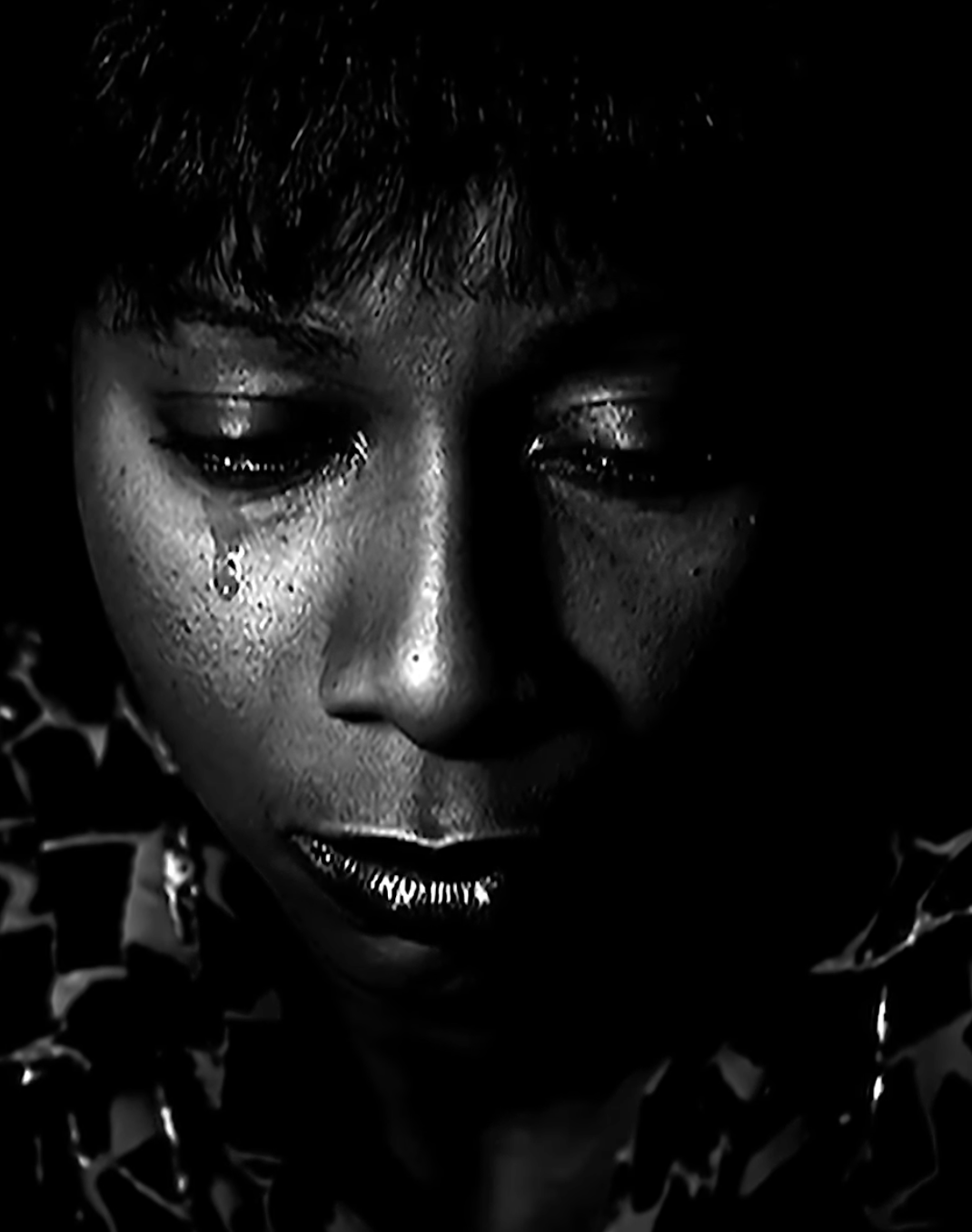
maybe what we need in this age is to move beyond words. to use our eyes more than our ears. to look and look closely at the common bonds of our humanity, and herein is precisely the study we might need, to see the human visage wrought  by sorrow, or grief: on the brink of tears, fighting tears, to watch the flinching of muscle, the biting of lips, the contortion of muscle, pulled by nerves tied to whatever is the emotional core of us. to see how the human face on the brink of tears is sooooo deeply universally understood, felt, responded to. maybe in that place of wordlessness we can remember that we are all one, of one species, and that within us all is the emotion called grief, called sorrow. and we’d do well to remember that we are all always on the verge of brokenness. and, too, we might be the arms that reach out to dry the tear, to hold the quivering shoulders, to brace the wobbling spine against whatever strength we might muster. maybe we need to remember how tender we all are, somewhere, somewhere deep inside…..


only one poem this week, and it wasn’t actually written as a poem, but laid out that way here it works mightily. it’s excerpted from abolitionist Sojourner Truth’s “Ain’t I a Woman” address, in the version published in 1863. The speech was originally delivered in the 1851 Women’s Rights Convention in Akron, Ohio. we might do well to ask, in the face of so much inhumanity, if swapping out the word “human” for “woman” stirs its own seeds of compassion….i am bereft; hollowed, haunted by the stories of immigrants pulled from their churches, their cars, their homes, flung to the ground, stomped on, kicked, living in fear…..

sojourner truth (unknown birth date; died 1883)

but this, as written, is more than mighty as is…..

Ain’t I A Woman?

That man over there
says that women
need to be helped into carriages,
and lifted over ditches,
and to have the best place everywhere. 
Nobody ever helps me into carriages,
or over mud-puddles,
or gives me any best place!
And ain’t I a woman? 

Look at me! Look at my arm!
I have ploughed and planted,
and gathered into barns,
and no man could head me!
And ain’t I a woman?

I could work as much
and eat as much as a man —
when I could get it —
and bear the lash as well!
And ain’t I a woman? 

I have borne thirteen children,
and seen most all sold off to slavery,
and when I cried out
with my mother’s grief,
none but Jesus heard me!
And ain’t I a woman?
. . .
Then that little man in black there,
he says women can’t have
as much rights as men,
’cause Christ wasn’t a woman! 
Where did your Christ come from?
From God and a woman!
Man had nothing to do with Him.

If the first woman God ever made
was strong enough to turn
the world upside down all alone,
these women together
ought to be able to turn it back,
and get it right side up again!
And now they is asking to do it,
the men better let them!

+ Sojourner Truth

because you are all so wise in so many ways, what thoughts might you add to a conversation on love and grief, and the intermingling therein?

i’m off to my 50th high school reunion this weekend, a date that gives me pause, as it was one of the tenderest times in my life 50 years ago, a time that marked me through all these years. it was a steep uphill climb for a long time there. and thank holy God i lived long enough to get here. my prayer is that those who show up find compassion and grace, and that those who choose to stay home look around and see lives that have grown beyond the bounds of whatever have been the obstacles.

and i pray, oh i pray, for this world. no kings rally tomorrow….i heard a story this week about the not-far-away catholic church where ICE agents filled the parking lot during spanish-language mass, targeting the prayerful inside. so the priest becalmed those in the pews, locked the church doors, promised protection to his flock, and a brigade of rapid-response volunteers drove parishioners safely to their homes. cars had to be left behind. prayers were laced with terror. this is not the america my uncle died for, bayoneted in the night in a tent on iwo jima….

as my beloved friend fanny put it, “they come after us because we’re brown.”

**thank you, laura, for sending me nick….

ode to my fairy gardenmother: one last love note. . .

Mostly, this is a love letter. One I might have tucked in the pine coffin now buried beneath a foot-and-a-half of Chicago’s clumpiest earth, earth we shoveled onto it, one full spade at a time. The one to whom I write this, though, my fairy gardenmother, is not one ever confined by boxes or borders or hard lines scrawled in the dirt. She, my Marguerite, was as free a spirit as they come. So I cast this to the wind, and know she will catch it. 

Marguerite made beauty for a living. She sowed joy in abundance. Not a single root or shoot was tucked in the earth or tied to a trellis without the ringing sound of her laughter. 

Marguerite’s acanthus

She bequeathed me beauty, her beauty and that of this holy earth. And grace, and a tidepool of peace, the sort that settles deep within, calming what had long been a turbulence. It all came in a litany of botanic derivative, a litany I water and witness: tree peonies, fuchsia and ruffled and broad as a dinner plate; oakleaf hydrangea, its bottle-brush blooms now bursting in time for the Fourth of July. Pieris japonica (sometimes known as lily-of-the-valley shrub, or flame of the forest) whose delicate white star-blooms are the petit point of late springtime, stitched along the bluestone path that bends toward my front door. A dwarf lilac that defies its definition and perfumes profusely my brick walk out back. My garden blooms with acanthus, the ancient Greek thistle of endurance and immortality, and white bleeding hearts that, as instructed, seem to be on the verge of spilling succulence drop by drop by drop. Everywhere, the vanilla scent of Jack-in-the-pulpit rises. There are ferns in abundance, and climbing hydrangea who wouldn’t be daunted by Everest. And about a dozen other beauties whose names I often forget, and when I do I’d text her, and she’d remind me, always with annotation of what she loved most about it. And another something I might want to try. 

If I tried to describe her, I’d begin with her face. Her face was alive, was radiant, was always revved up in joy. Or deep concentration. Her laugh came easy, so easy. Her limbs flowed. She was a ballerina in the everyday. Clogs buried in garden, wielding a shovel or pruners, she swayed with the wind, with the whims, with purpose. 

She planted my secret garden, the one that meanders along the side of my house, from my writing room window, past the kitchen door, and into the garden out back. It’s the place I’d point to if pressed to answer the question: Where did you finally find your long-sought peace? It was there in the garden that Marguerite grew. 

I first met Marguerite a garden ago, back in 1991, months after we married, my beloved and I. The very day we wandered into the old Victorian that became our house for a decade, the house to which both our boys first came home, the house that held so many joys and so many sorrows, Marguerite was there. She was packing up boxes with Jim the sculptor who was dying of AIDS, and who would soon leave us his beautifully sculpted three-story house (and a set of Old Willow dishes besides). They wept and wailed and laughed together. We heard the echo of their affections before we saw them, and when we climbed the stairs there she was: radiant, a mop of blond curls, eyes hazel and sparkling. 

She knelt beside me summer after summer, teaching me much of what I know about what grows in a garden. We wandered nurseries and tree lots. We planted according to her unorthodox teachings. When anything ailed, she knew the fix. Or we yanked it and started again. 

My jewel box of a tiny urban garden, one where the alley rats dared not roam for the fierce farm cat who patrolled it, grew to be a wonder. One whose measure in my mind far exceeded a yardstick. 

When at last we decided we’d finished our work, at least for the time being, Marguerite and Ted, her rabbi of a husband who presided over a congregation of his psychotherapy clients, came by one late summer’s evening to bless the little plot. In a story I love so much I included it on pages 37 and 38 of The Book of Nature**, Ted offered up fertility prayers for my garden, that it would blossom and bloom, and multiply. Four months later, on the brink of my 44th birthday, after eight years of broken hearts and infertility, I discovered that I was the one blossoming and multiplying. I was “with child,” as the Bible would put it. I always giggled that Ted had mixed up his fertility prayers, and pulled out the ones for the barren woman instead of the ones for the garden. 

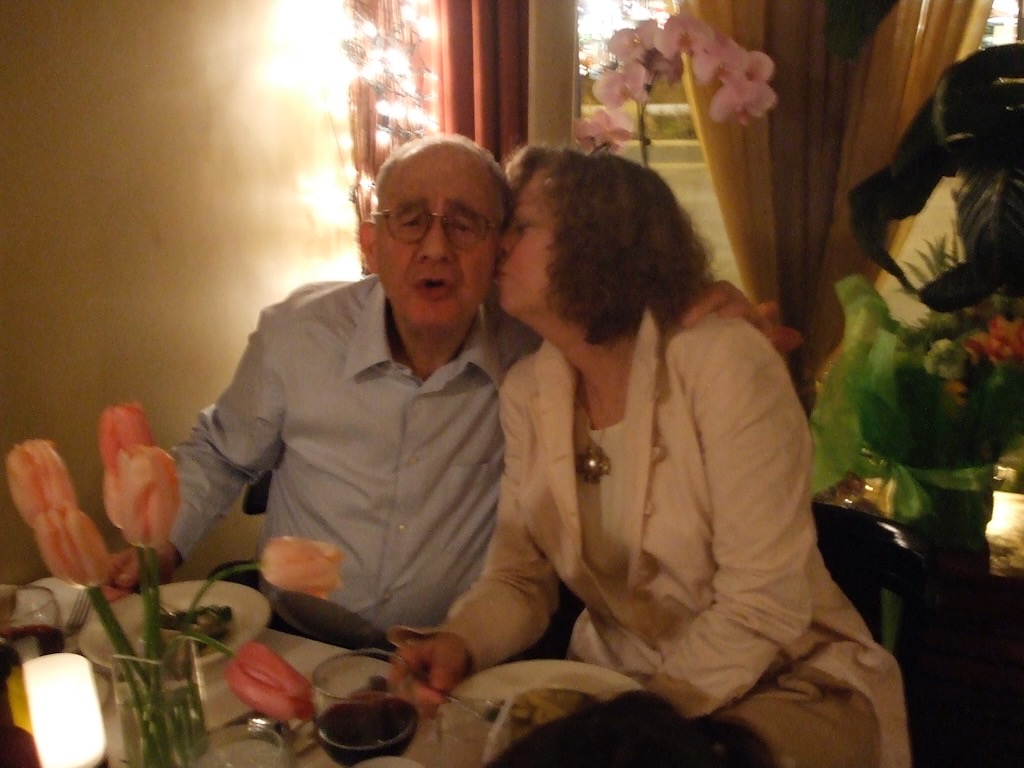
ted and marguerite

And so, of course, and ever since, Marguerite is the one to whom I turned with every garden question, and every delight as it bloomed. When Ted died not quite two years ago, I knew Marguerite’s heart was shattered. And there was no glue in the world to put it back together. But I didn’t know it would kill her. 

I now know that it did. For she died on Monday, and was buried on Tuesday. And ever since I’ve been strolling through my garden, stopping to marvel here, stooping to deadhead there. I’ve been shlepping my hose, and giving big drinks to each and every bloom bequeathed to me by my Marguerite. 

Marguerite will always bloom in my garden. Her longtime sidekick, David the cop, is coming soon to help me dream once again. There is a plot under the ornamental lilac and the row of burning bush, and I have named it Marguerite’s Garden, and I will be planting it before the month of her death turns to August. 

And it will be abundant in beauty. Because that’s what Marguerite taught me to grow. And that will never die.

the jewel box of a flower shop: Marguerite Gardens (from Victoria Magazine)

Marguerite’s genius in the garden spread far beyond our little block of Wellington Avenue, 60657. When she couldn’t be contained, she launched a for-hire garden crew (a motley crew counting two cops, a U of C theology grad fluent in Mandarin Chinese, a commodities trader, a banker, and a pet photographer) with a seasons-long waiting list. She planted tulips by the thousands up and down Boul Mich, Chicago’s grand Magnificent Mile. She planted the city’s lushest rooftops and balcony gardens. She was a connoisseur of miniatures, and knew how to cram the most in the least. She opened a dream of a flower shop in Andersonville, aptly named Marguerite Gardens, and twice daily received imports from her beloved Netherlands. The shop, with the bell that tinkled as you walked in, held a European-style flower market, and was stuffed to the rafters with eighteenth-century antiques, from bird cages to terraria. Aptly, she was named for the daisy whose name means “pearl” in French, and is the bloom from which petals are plucked in the prognostication game, “he loves me, he loves me not.” Married for 43 years to the inimitable, unorthodox, Yale-educated rabbi and psychotherapist, Theodore Gluck, Marguerite died 656 days after Ted, three days short of what would have been his 95th birthday. Marguerite was 75.

**excerpt from pages 37 and 38, Marguerite’s star turn in The Book of Nature, in which i describe that first garden we planted and blessed together…

. . .That garden—where a priest, a rabbi, and a tight circle of people we love gathered for blessings shortly after the births of each of our boys; where baby bunnies and nestlings and goldfish were buried after premature deaths; where our stubbornly resistant house cat mastered the art of escape—that plat of earth became as sacred to me as any cloister garth.

Not only was it where I knelt to teach my firstborn the magic of tucking a spit-out watermelon seed into the loam and, each morning after, tracking its implausible surge. During seven long years of miscarriage after miscarriage, ectopic pregnancy and emergency surgery, and doctors finally telling us to give up hope, I dug and I dug in that garden, all but willing the tiniest bulbs and tenderest sprouts to beat impossible odds, refusing to let anything else die on my watch. And then, at the end of one summer, as the crab apples were starting to turn, a rabbi who lived down the block came by with his wife, whom I’d long called my fairy gardenmother for her magical ways and her unbroken guidance. Standing under the stars, the rabbi, his wife, and I, we blessed the garden itself, casting prayers and sprinklings of water. By that Christmas, I was pregnant, with nary a drop of medical intervention. Just shy of forty-five when that blessing of a baby arrived the next August, I’ve always wondered if maybe the rabbi mixed up the garden fertility prayers.

It’s all a holy whirl—that intricate and inseparable interweaving that is the cosmos.


one poem this week, from a bouquet of many i plucked:

Desiderata

Go placidly amid the noise and the haste, and remember what peace there may be in silence. As far as possible, without surrender, be on good terms with all persons.

Speak your truth quietly and clearly; and listen to others, even to the dull and the ignorant; they too have their story.

Avoid loud and aggressive persons; they are vexatious to the spirit. If you compare yourself with others, you may become vain or bitter, for always there will be greater and lesser persons than yourself…

Exercise caution in your business affairs, for the world is full of trickery. But let this not blind you to what virtue there is; many persons strive for high ideals, and everywhere life is full of heroism…

Take kindly the counsel of the years, gracefully surrendering the things of youth…

Beyond a wholesome discipline, be gentle with yourself. You are a child of the universe no less than the trees and the stars; you have a right to be here.

And whether or not it is clear to you, no doubt the universe is unfolding as it should. Therefore be at peace with God, whatever you conceive Him to be. And whatever your labors and aspirations, in the noisy confusion of life, keep peace in your soul. With all its sham, drudgery and broken dreams, it is still a beautiful world. Be cheerful. Strive to be happy.

by Max Ehrmann


and in extra case you’re extra curious, here’s a story i wrote for the chicago tribune back in may of 2000 about my friend marguerite and her garden crew: https://www.chicagotribune.com/2000/05/07/planting-away-again-in-marguerite-aville/

who taught you much of what you know about beauty and joy and free-flowing grace? might you tell us a bit of that story….

one last time: love story of a lifetime. ted + marguerite = forever and ever. amen.

the great kaleidoscope

“it’s like we’re the great kaleidoscope, all little pieces, but every time you turn it, it’s different. so you and i are made up of exactly the same stuff, but every one of us is unique. there’s only one in all the world. and the same with every petal of a pansy….i’m the star thistle, and the grass, and the dirt. i am you; you are me.”

i tumbled into this most breathtaking old soul, majestic soul, and i shall let her do the talking today. i quickly grew so enchanted by her voice, her deep and gravely voice, a voice that must have traveled rocky roads, that i began to take notes, and i am leaving those notes here: part transcript, part poem. i’m not catching every word but the words i’m catching are those i do not want to lose. it’s as if a great elder has come today to impart something. to share a light, the light she came to know was her one thing to share. to leave with the world.

may we all be so.

may we all by illuminated by this nearly 96-year-old, who is a veritable masterpiece of all that matters. 

and here are notes, in prayer form, in poetry…

that i can still breathe easy
i don’t want to have just visited this world
i want to be a child of wonder and astonishment

i’m having my second childhood now, my happy childhood
i was always the outsider, i was always pointed at,
i always felt terribly self-conscious
so i have fun now

i’m just learning about play
because i didn’t know what play was when i was a child
i think play means exploring, experimenting, being curious,
looking, seeing, being in the body
not being afraid

it’s about the miracle and mystery of being alive

“we shall not cease from exploration
and the end of all our exploring
will be to arrive where we started
and to know the place for the first time”

that’s t.s. eliot.

i had cancer once
and . . .
and afterwards i had surgery
and i felt like i had to give myself a reaon that i was spared.
that i got my life back
and then, over many years,
i saw that i had
something to give, my light

something ineffable that i don’t know
that light of harmlessness and harmony
and singing and being joyful and rejoicing and being grateful

we’re here to experience the wonder of being in a body. . .
to know that we are each other
that we’re the same
we’re made of all the same stuff . . .
we’re little bits of stars, we’re dust

it’s like we’re the great kaleidoscope
all little pieces
but every time you turn it, it’s different
so you and i are made up of exactly the same stuff,
but every one of us is unique.
there’s only one
in all the world.
and the same with every petal of a pansy….

i’m the star thistle, and the grass, and the dirt.
i am you; you are me.

. . . my prayer is to go gently
and as much aware of myself leaving with gratitude and joy
and the satisfaction, “i’m done, i’m outa here. and it’s ok”
it’s all such a mystery

thanks, i wanna say thank you
not try to figure anything out, or understand it

but just be in awe

what’s the secret?
it’s go slow
for me . . .

[breaks into song. . .]

this beautiful film was made by two south african filmmakers who go by first names only as far as i can tell, justine and michael. their mission: to explore our shared humanity. their enterprise is known as reflections of life, formerly green renaissance. i do believe there is a trove worth plumbing…..i do not know the name of this blessedly beautiful nonagenarian so i shall name her simply Wisdom.

as we enter into supremely holy time, in both the jewish and the christian spheres, (are we not always in supremely holy time?), our friend here prompts the question how will you choose to live in awe?

iterations of love

the God of every religion tells us to do it. commands us: love thy neighbor as thyself. 

i’ve felt it in my own life, know it to be a force that transcends time, space, and matter. i’ve felt it all but align planets whose orbits were out of whack. i’ve felt it pierce through to the core of me, prompt me to reach down and seize a source, a muscle, i didn’t know that i had. it’s made me more than i ever imagined i could be. lured me out of mighty dark years. 

love, thank heaven, is patient. love is keenly perceptive. love, often, won’t take No for an answer.

i’ve felt it shrink distance, make the sound coming through the telephone as close as if we were sidled, thigh to thigh touching, on the seat of a couch in the very same room. 

i’ve heard it in barely audible whispers, and in shouts across the corridors of an airport, a hospital, a college campus––a sound so ebullient my heart leaps to quicken its pace. 

i’ve spent my life learning how to do it. keeping close watch on the ones i encounter who do it the best. the most emphatically. 

i’ve learned it from the little bent man who perched on a hydrant, befriending the pigeons. flocks and flocks of pigeons, he lovingly tended. even in the face of taunts and jeers from the cars passing by.

i’ve learned it from my first best friend who knew without asking how deeply it hurt, how tender it felt to be seen in shadow and light. 

i’ve learned it from my long-ago landlady, the one who would knock at my door, come dinnertime, and hand me a hot steaming bowl of avgolemeno, the egg-and-lemon-rich chicken-rice soup that serves as Greek penicillin, and cured what ailed me no matter how awful the day.

i’ve learned it from a 12-year-old girl who lay in a hospital bed, her legs unable to move, paralyzed from the waist down by a tumor lodged in her spine. i’ll never forget the glimmer in her eye, as she looked up and laughed, as she handed me her hand-made papier-mâché green pumpkin head, the one she’d made flat on her back, and with which she crowned me her Irish Pumpkin Queen of a hospital nurse.

i’ve learned it, and felt it: in the canyon of grief, in the vice hold of fear, and in long seasons of haunting despair. it’s the ineffable force with the power to pull us up off the ground, inch us just a little bit forward, and shake off the worries that freeze us in our tracks. 

my hunch is that someone at hallmark international invented today, the day in which pink paper hearts are soared hither and yon. or maybe it was the three catholic saints, all named valentine or valentinus, and, as was so often the story, all of whom were martyred for breaking some reason or rule. in the case of third century rome, a priest named valentine defied the emporer who’d ruled that single men made better soldiers than those with a wife, and thus outlawed marriage. valiant valentine, seeing the injustice in the loveless decree, kept about the business of marrying young sweethearts in secret. for this, he lost his head. 

earlier still, pagans seized the midpoint, or ides, of the month––february 15––as Lupercalia, a fertility festival dedicated to Faunus, the roman god of agriculture, and to Romulus and Remus, the founders of rome. a priestly order of roman pagans, the Luperci, gathered at the secret cave where Rom and Rem were thought to have been raised by she-wolves, to sacrifice a goat, which they then stripped of its hide, and sliced into strips. then, according to historians, “they would dip [the strips] into the sacrificial blood and take to the streets, gently slapping both women and crop fields with the goat hide.”* 

maybe pink paper hearts are, after all, a step in the right romantic direction. 

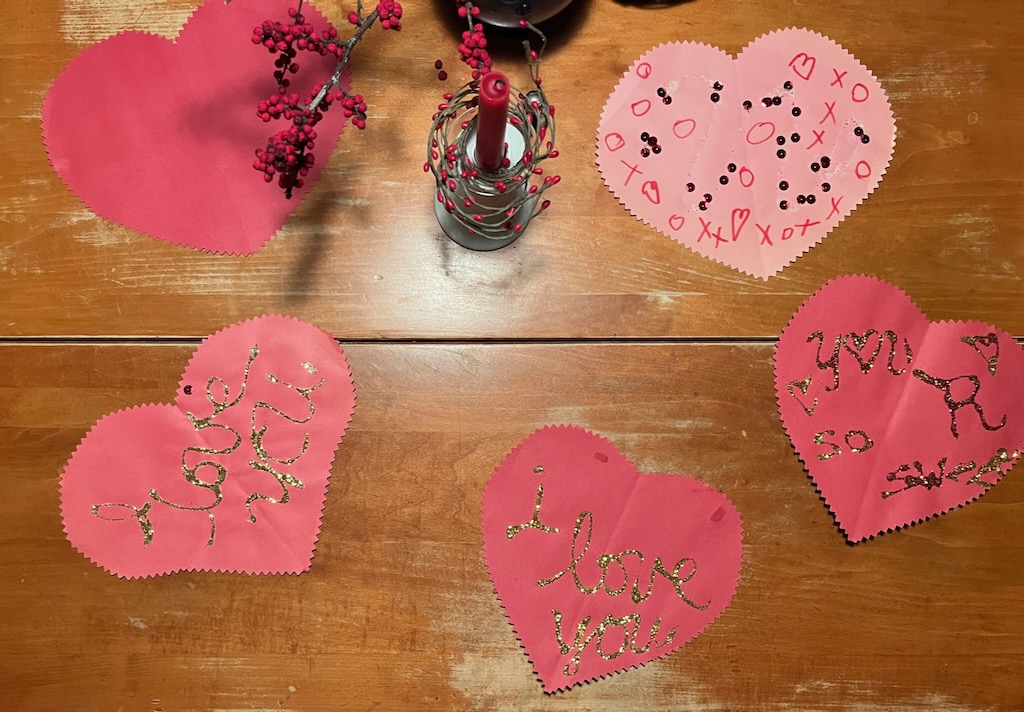
truth be told, 34 years in, it’s recycled hearts adorning someone’s place at the breakfast table…

*postscript on those slap-happy romans: far from being fearful of the bloody slaps, young roman women were said to welcome the mark of the bloody hides, for it was thought to make them more fertile in the year to come. 


lifting the day out of its purely-romantic framing, here are three takes on iterations of love, reminding us of the evolution of love across the decades of marriage, and the love of this one sacred Earth we’ve been given to tend:


first up, the sage from kentucky, farmer-poet-secular priest wendell berry, from a much longer poem, but i was drawn to these three parts, meditations on a long and deepening love…

excerpts from The Country of Marriage
by Wendell Berry

III.
Sometimes our life reminds me
of a forest in which there is a graceful clearing
and in that opening a house,
an orchard and garden,
comfortable shades, and flowers
red and yellow in the sun, a pattern
made in the light for the light to return to.
The forest is mostly dark, its ways
to be made anew day after day, the dark
richer than the light and more blessed,
provided we stay brave
enough to keep on going in.

IV.
How many times have I come to you out of my head
with joy, if ever a man was,
for to approach you I have given up the light
and all directions. I come to you
lost, wholly trusting as a man who goes 
into the forest unarmed. It is as though I descend
slowly earthward out of the air. I rest in peace
in you, when I arrive at last.

V.
Our bond is no little economy based on the exchange
of my love and work for yours, so much for so much
of an expendable fund. We don’t know what its limits are–
that puts us in the dark. We are more together
than we know, how else could we keep on discovering
we are more together than we thought?
You are the known way leading always to the unknown,
and you are the known place to which the unknown is always
leading me back. More blessed in you than I know,
I possess nothing worthy to give you, nothing
not belittled by my saying that I possess it.
Even an hour of love is a moral predicament, a blessing
a man may be hard up to be worthy of. He can only
accept it, as a plant accepts from all the bounty of the light
enough to live, and then accepts the dark,
passing unencumbered back to the earth, as I
have fallen tine and again from the great strength
of my desire, helpless, into your arms.


and the belle of amherst turns our attention to this world that keeps loving us, despite the ways we batter it, and ignore it…

This world is just a little place, just the red in the sky,
before the sun rises, so let us keep fast hold of hands,
that when the birds begin, none of us be missing.
— Emily Dickinson, in a letter, 1860


and finally, the late great naturalist and essayist Barry Lopez, on how to be awake to this still blessed world, from the foreword to Earthly Love, a 2020 anthology from Orion magazine. He is describing walking a vast landscape––a spinifex plain, or grassy coastal dunes, in North-Central Australia––for the first time, but the wisdom is how to attend to a deepening love:

My goal that day was intimacy — the tactile, olfactory, visual, and sonic details of what, to most people in my culture, would appear to be a wasteland. This simple technique of awareness had long been my way to open a conversation with any unfamiliar landscape. Who are you? I would ask. How do I say your name? May I sit down? Should I go now? Over the years I’d found this way of approaching whatever was new to me consistently useful: establish mutual trust, become vulnerable to the place, then hope for some reciprocity and perhaps even intimacy. You might choose to handle an encounter with a stranger you wanted to get to know better in the same way. Each person, I think, finds their own way into an unknown world like this spinifex plain; we’re all by definition naive about the new, but unless you intend to end up alone in your life, it seems to me you must find some way in a new place — or with a new person — to break free of the notion that you can be certain of what or whom you’ve actually encountered. You must, at the very least, establish a truce with realities not your own, whether you’re speaking about the innate truth and aura of a landscape or a person.

. . . I wanted to open myself up as fully as I could to the possibility of loving this place, in some way; but to approach that goal, I had first to come to know it. As is sometimes the case with other types of aquaintanceships, to suddenly love without really knowing is to opt for romance, not commitment and obligation.

and, later in the same essay, his call to attention for a world suffering from what he quite plainly calls, “a failure to love,” a message of urgency on a day in which love, in its many many iterations, is held up to the light.

EVIDENCE OF THE failure to love is everywhere around us. To contemplate what it is to love today brings us up against reefs of darkness and walls of despair. If we are to manage the havoc — ocean acidification, corporate malfeasance and government corruption, endless war — we have to reimagine what it means to live lives that matter, or we will only continue to push on with the unwarranted hope that things will work out. We need to step into a deeper conversation about enchantment and agape, and to actively explore a greater capacity to love other humans. The old ideas — the crushing immorality of maintaining the nation-state, the life-destroying beliefs that to care for others is to be weak and that to be generous is to be foolish — can have no future with us.

It is more important now to be in love than to be in power.

who were some of your great teachers of love?

one wish . . .

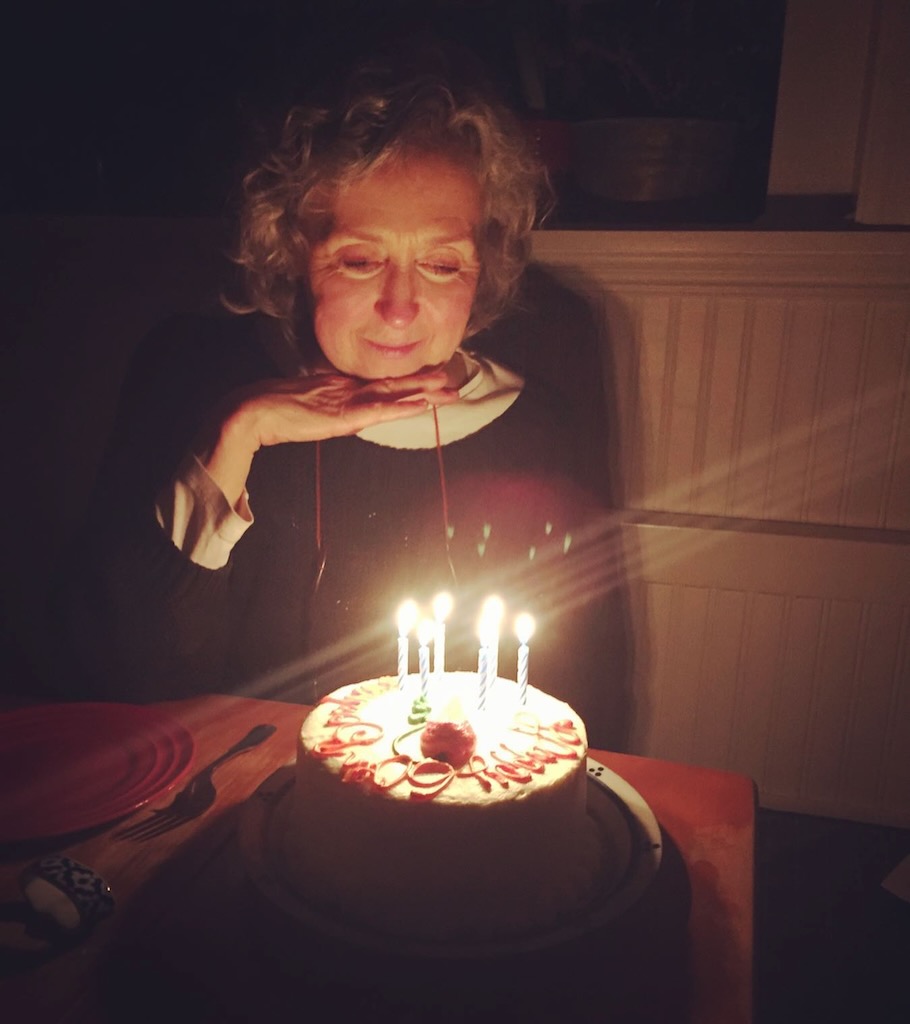
when i take a deep breath in tonight, and close my eyes to make a wish, there is only one wish i’m wishing this year: i wish for a birthday next year.

that’s everything, really. 

i’ll be wishing so hard.

it’s a wish that feels so far away. and so very big. like i’m asking for the moon. 

it’s a wish that carries a secret. one the sages and prophets and poets have known for a very long time.

it’s a paradox wish. it’s a koan. it’s a wish that makes you think. perk up and pay attention. root around for the wisdom, the immutable truth.

truth is, it’s even bigger than it seems. it’s a russian doll of a wish. one of those ones with umpteen tiny-grained wishes within. grain by grain by grain we make it across a year, and year by year a lifetime. 

a birthday next year. 

doesn’t sound like too much. but, oh, it’s infinite really. 

the blessing of cancer––and yes there are blessings, ones the sages and prophets all seem to have known without needing the verdict, without the scalawag cells lurking in shadows, cells that can’t wait to divide and multiply and muck up the works––is that it rejiggers your seeing. it’s the psychophysics of vision: when range is narrowed, acuity’s heightened. you learn to look not too far into the offing; you learn to look more closely than ever at whatever it is that’s right there before you. and, thus, you see all the more clearly the finest of grains all along the way. 

the fine grains are where the wonder, the magic, the awe, are kerneled inside, awaiting their turn to burst forth, to be seen, savored, not left by the wayside.

life in the up-close, life when we’re listening for whispers not waiting for timpani, is how we come to know the most sacred grain therein. 

in wishing for one more birthday––please God, just one is all i’m wishing this year (if wishes come true, i’ll wish it again and again and again as long as i can)––what i’m really wishing for are those tiny, tiny moments that strung onto a cord make for one holy rosary.

within my one moon-size, more-than-anything wish, here are some of the grains nestled inside:

i wish for the holy, holy sound of one or both of my boys calling me at some unlikely hour to tell me one of their dreams has come tumbling true. or at least the latest chapter therein. and before they’ve uttered a word, i’ll know from the sound of their breathing that the news that’s coming is good. and, dear God, i don’t wanna be stingy but i’d sure love one or two more of those sweet, sweet jubilant sounds.

and while i’m wishing, i sure wish i get to hear the rough draft versions of those dreams, as they’re in the making, as my boys try them on for size and dare to let me in on the beta versions.

i wish for their soft, big hands to wrap around my now-more-wrinkled littler one––to hold me steady, be it a cobblestone walk or life’s herky-jerky jolts tipping me over. 

i wish for one of those early mornings where no one is stirring but me, and the dawn hasn’t yet rosied the sky, and the biggest decision i’m called to make is which mug should i pull from the shelf.

i wish to sink my teeth into the sweetest strawberry of the season. ditto the crispest apple of fall. and the juiciest of august’s tomato. 

i wish to run down the airport corridor one more time and into the arms of my faraway boy, all while loudly belting out, “it’s been five years!” (even when it hasn’t been), only because all the good souls slumped in their hard plastic seats deserve a little airport sentimentality. even if it’s improv, and utterly fiction. and because there’s nothing i love so much as the arms of my boys wrapped round my shoulders.

i wish to come to the last page of a book with tears rolling down my cheeks, not yet wanting to say goodbye to characters i’ve come to love. 

i wish to sit down to dinner with only the one i love, or to a table filled with nearly a dozen i adore. 

i wish to exhale that one cleansing breath when the last of the dishes are done, and all that’s left is a long evening of laughter and stories and loving.

i wish for the sound of the crackling logs on the fire.

i wish to wake up one morning and remember there is not a single worry weighing me down.

i wish i could gather all the people i love—or just a good handful––and plonk down at a table where no one tries to corner the conversation and everyone takes a generous turn. and by the time i’m getting up from the table, i am marveling once again at the goodness, the depth, the hilarity of the vast human character.

i wish i could stand under the stars and behold the star-salted sky.

i wish i could pray so deeply that i felt the shoulder of God brushing against me. or catch myself walking alone in the woods and feeling a shaft of light break through the boughs, and sense that i wasn’t one bit alone, but that the God who i love was leading me forward.

i wish for those beautiful blessed souls who populate hospitals in the unlikeliest spots, the ones who radiate the gift of making you feel so deeply seen. and safe. and cocooned.

i wish for a sermon so stirring it breaks me into tears. 

i wish to hear the soul-stirring sound of the deepest laughter there is from the people i love who laugh the heartiest laugh, the sort of laughter that runs tears down your cheeks. and makes you gasp for a breath.

i wish i could answer the knock at the door and be just the person that someone needs, the shoulder to cry on, the arms to hold them steady, the one to dry the tears.

i wish i could wake up one morning and read a headline that makes me believe the good guys will finally, finally win. and that plain old gentle kindness and the raw courage to speak up for what’s fair and right and just will bend the arc toward justice once again….

that’s enough wishes for one russian doll of a wish, though the truth is i’m only beginning…


i found a few nuggets to launch this holy new year, all worthy of contemplation. the first is from the writer suleika jaouad, a comrade on the cancer road (and wife of the brilliant musician jon batiste). she’s suffering godawful setbacks these days and i’m holding her in my every day’s prayers…:

This year, we’re contemplating and reveling in the idea of magic. It’s based on a theme I’ve found myself returning to: the need to let go of the fear of the unknown and instead to open ourselves up to the mysteries and the magic of the unknown. That’s my constant work—and in this time when our world feels more uncertain than ever before, I’d venture to say that it’s all of our work.


from the inimitable mystic and theologian henri nouwen who guides my every day:

Born to Reconcile

If you dare to believe that you are beloved before you are born, you may suddenly realize that your life is very, very special. You become conscious that you were sent here just for a short time, for twenty, forty, or eighty years, to discover and believe that you are a beloved child of God. The length of time doesn’t matter. You are sent into this world to believe in yourself as God’s chosen one and then to help your brothers and sisters know that they are also Beloved Sons and Daughters of God who belong together. You’re sent into this world to be a people of reconciliation. You are sent to heal, to break down the walls between you and your neighbors, locally, nationally, and globally. Before all distinctions, the separations, and the walls built on foundations of fear, there was a unity in the mind and heart of God. Out of that unity, you are sent into this world for a little while to claim that you and every other human being belongs to the same God of Love who lives from eternity to eternity.


and, not least, my favorite, favorite after-Christmas prayer-poem from howard thurman, a prophet of his time. . .

The Work of Christmas

When the song of the angels is stilled,
When the star in the sky is gone,
When the kings and princes are home,
When the shepherds are back with their flock,
The work of Christmas begins:


To find the lost,
To heal the broken,
To feed the hungry,
To release the prisoner,
To rebuild the nations,
To bring peace among others,
To make music in the heart.

— Howard Thurman

what one wish will you make this year? (you needn’t reveal here, of course!)

bless you, each and every one for making this year more blessed than you might ever imagine. you have been there for me at every turn. even when you did not know it. and i am forever blessed by you.

p.s. photo above is from a few years back, but it captures the depth of a wish being cast to the stars and the heavens above….

as one year sighs its last, and another stirs anew, wish upon a star and then some…

this blessed string of days we’ve called “a year,” is drawing now its last deep breaths. it’s almost time to begin again, or so we imagine in the geometry of the mind, a flatter-planed sphere that sees the year going round and round like vinyl spinning on a phonograph. ascension is not in the equation.

in the geometry of the soul, though, each new turn––we hope, we pray––is not mere spin, but spiral, ascension its sure distinction. it’s the ever-incremental accumulation of loft we’re after. loft attained, most often, the hard way. we stumble, skin our knees, hold our nose and hold our breath while the doctor jabs the needle. from year to year, there is, we hope, at least the humblest modicum of lessons learned. year by year, we aim for wiser.

and so in this year now waning to its close, its hardest lessons came in scans and calls not returned, in snubs and deaths that came too, too soon. but it brought too the sorts of hallelujahs that remind us that good patience, in time, brings resolution, brings peace, brings love come home. the long lost friend we found again. the one hard heart that finally softened, seemed to learn a whole new lexicon, the language of delight at last unfiltered.

i am letting all the lessons settle in, knowing they’re the elements of accumulating wisdom. one year to the next, wiser, gentler, quieter, deeper.

or so we pray.

and in this quiet space––this most delicious time of yuletide, the time beyond the noise, the shopping, the dishes scrubbed and put away––i am inviting the past year to wash over me, to sift through the sediment, to save the gems, rinse away the detritus.

i’m adopting my deep-breathing posture, the one that has me curled under blankets in my red-checked armchair, the fire crackling, the tree twinkling, my boys all ringed around me.

and i’m leaving here at the table two shimmering gems: one, something of a wish upon a star and the discovery that the star is us; and the other a truth of which i cannot be reminded too many times….

here’s the first…

azita ardakani, an iranian-born social activist and communications guru, wrote this “once upon a time” for maria popova’s the marginalian. it’s part poem, part lullaby, and part creation myth with a dash of astronomical science. it reads a bit like a children’s book, and, like all the best and deepest pages penned to a child, it ends in revelation: the true wonder that the star upon which we wish is, in fact, a little bit of us. we are our own wish come true. or, we can be, especially if we aim for spiral and not spin…

Once upon a time,
In a place far far away,
The darkness drifted.
The darkness knew no time.
Reaching for infinity, only knowing beyond.
One day in the web of inky forever, it asked itself, can I see you?
It waited, and waited, and then, answered, a star.
And then another, and another, and, another.
Another was where it began,
and as the star beings asked to be born to meet the darkness from which they came, one particular planet created water so it too could reflect the stars back to themselves.
The stars seeing their reflection were filled with joy and delight.
Curiosity was born in their light millions of years away.
One by one they made their way down, to touch the ocean, to see themselves.
The soil darkness watched with awe as the stars arrived,
A heart’s desire asked: Can I see you closer?
The water stars stretched onto the soil, and mixed into the clay, and became,
everything.
Yes you too, coyote who hears this, wise owl, mouse and rabbit, you too sleeping fawn, you too tree and root and seed, you too nested flight, and you too, sitting two legged.
Mixed from clay and star, flesh and life, a hollow canal opened so breath too could reach back to the darkness.
Missing the beginning, it exhaled a bridge, home.
The star water became everything we know, and you? The story of us?
Well, to experience the closest thing to the very beginning of star meeting water, we learned to create a small ocean inside of us, where it could all be felt, all over again.
Once upon a time, in a place far far away, the darkness drifted, and you drifted inside it.
You were the wish you once wished for.


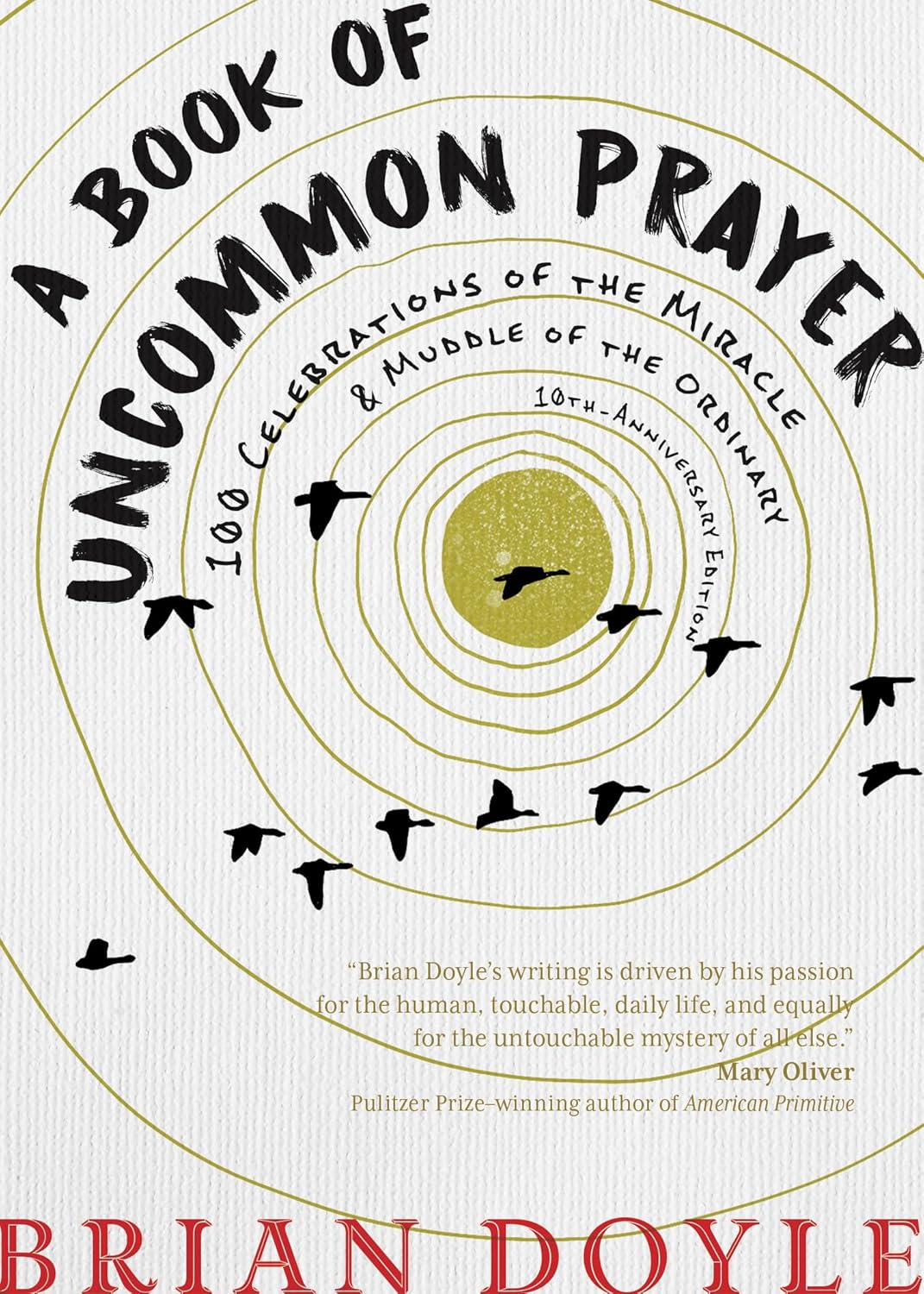
i count the late, great (astonishing) brian doyle among the favorite soul seers i have ever read. he finds words that burrow deep into the places in my soul that might never before have been struck or stirred. in his too-short time on earth, he saw wonder, plumbed wisdom in the unlikeliest of places. from prayers for cashiers and checkout counter folks, to prayers for robert louis stevenson on his birthday, and prayers for the greatest invention ever, the wicked hot shower, all found in his marvelous, marvelous, A Book of Uncommon Prayer: 100 Celebrations of the Miracle & Muddle of the Ordinary. these are the first lines of one with the magnificently brilliant title, “Furious Prayer for the Church I Love and Have Always Loved but Which Drives Me Insane with Its Fussy Fidgety Prim Tin-Eared Thirst for Control and Rules and Power and Money Rather Than the One Simple Thing the Founder Insisted On.” and it’s a fine fine note on which to both end and begin a year….

Granted, it’s a tough assignment, the original assignment. I get that. Love — Lord help us, could we not have been assigned something easier, like astrophysics or quantum mechanics? But no — love those you cannot love. Love those who are poor and broken and fouled and dirty and sick with sores. Love those who wish to strike you on both cheeks. Love the blowhard, the pompous ass, the arrogant liar. Find the Christ in each heart, even those. Preach the Gospel and only if necessary talk about it. Be the Word. It is easy to advise and pronounce and counsel and suggest and lecture; it is not so easy to do what must be done without sometimes shrieking. Bring love like a bright weapon against the dark… And so: amen.

bless us all. and may your new year bring you loft and leaven.

any wisdoms you acquired this year, with a story to share?

the chair is old enough to vote. . .

i’ve raised a blog, it seems, from birth to the verge of being grown-up. eighteen years: 12.12.06 it all began. 1,200 posts before today, so this––wondrously (to me, anyway)––is 1,201. at first i tended it, this conversation, this wondering aloud, this occasional epiphany, every weekday for a year, then chiseled it down to thrice a week. and then, yet again, i distilled it: once weekly––religiously every friday morn. here and there i’ve taken rare short breaks. a bit of summer breather once or twice.

and yet, kept on. and on and on. (sometimes wondering if maybe i should just be quiet.)

cycled through waves who’ve pulled up chairs in ebb and flow as of the tides. friends who’ve come to stay awhile, then shuffled off for one reason or another. at least a few i’ve deeply loved have died; angels still among us. some who’ve pulled up a chair have never ever strayed. here from the beginning, faithful as the day is long. bless them. bless and bless and bless them. 

i too have ebbed and flowed. waded into deep and deeper waters. shed old fears, grew courage. been puzzled. pondered. hatched new fears. wobbled. stumbled. inhaled courage again, again, and again. i’ve wondered and worried aloud. weathered aching heart, and phone calls and headlines that left me breathless. i’ve loved and loved some more. i intend to never stop. 

my school at first was all that unfolded under this old roof, where creaky twisting stairs and a nearly antique Garland stove––six burners, flattop, quasi-oven, a behemoth you’d find at any all-night diner––came to animate so many stories. it was my boys from whom i mostly learned and learned the most. and learned and learned again. and of course the holy earth and heavens high above: the gardens, the birds, the trees, the stars and moon, the dawn and dusk and nighttime’s inky darkness that never fail to draw me in. the book of nature, i’ve come to read, where lessons rise and fall season after season after season. i found a holy peace in this old house and the ramshackle plots where i kneel with trowel and soul wide open. i’d been chasing that peace for years. 

i seem to have stumbled into a new teacher these days, one i’d never thought could bring such knowing: it comes with darkness, yes, though i’m reminded that darkness is the embryonic space where stirrings first begin. and it’s nighttime’s darkest hour when stars most brightly shine. stripped of distraction, of the nettlesome sorts of things that blur our everyday, it denudes us to our barest essence. it’s cancer (even when i do not name it here it’s ever present in my rumblings, and has catapulted me to highest most-reverent attention). mine is an especially wily iteration, one that doesn’t follow rules. and brings me squarely into the land of uncertainty. where i, a girl who likes to know things, am finding out how not knowing whittles the knowing to one or two immutables: love is the force that triumphs over all; its alpha and omega, the God who dwells within. within me, and you. and even all the ones who make us want to scream and run for cover. 

here’s what i know 18 years in: there is nothing that love––true, deep love in all its iterations––cannot infuse. and in the infusing, molecules are stirred, shifted, and forms reshaped, dissolved, emboldened, made new. i’ve felt mountains move. i’ve felt fear melt away, like butter on hot biscuits. i’ve felt surrender––holy, holy “thy will be done.”

and a life well lived is one in which we love as unstintingly, as capaciously, as we might never have known possible. to live a life of loving is to scatter the few seeds that might blossom in our wake, that might rise in the seasons beyond us. it is the deepest mark i hope and pray to leave: to know my heart, my soul, has found a way in, forever in, to those whose lives i might have touched. 

it all becomes so spare, so simple, in the end. when you realize your days––for as long as they stretch––are your one rare turn to hone the art of loving, as it is meant to be. as it is meant to make the holy difference. to trace the path from here to heaven. 

that’s some of what i’m thinking eighteen sweet years in.

and now, because the older i get the more i glean from the wisdom of those who’ve left their trace, here’s my birthday bouquet to ponder for the day, the week, the hour…an indelible quote, a poem to make you laugh, and one to maybe melt you….

first, a quote from the french philosopher and playwright gabriel marcel, from the mystery of being:

“You know you have loved someone when you have glimpsed in them that which is too beautiful to die.”


a poem that might make you laugh, and certainly leave you with a smile:

Emily Dickinson at the Poetry Slam
BY DAN VERA

I will tell you why she rarely ventured from her house. 
It happened like this:

One day she took the train to Boston,
made her way to the darkened room,
put her name down in cursive script
and waited her turn. 

When they read her name aloud
she made her way to the stage
straightened the papers in her hands —
pages and envelopes, the backs of grocery bills,
she closed her eyes for a minute,
took a breath, 
and began. 

From her mouth perfect words exploded,
intact formulas of light and darkness.
She dared to rhyme with words like cochineal
and described the skies like diadem. 
Obscurely worded incantations filled the room
with an alchemy that made the very molecules quake.

The solitary words she handled
in her upstairs room with keen precision
came rumbling out to make the electric lights flicker.

40 members of the audience 
were treated for hypertension.
20 year old dark haired beauties found their heads
had turned a Moses White.

Her second poem erased the memory of every cellphone
in the nightclub,
and by the fourth line of the sixth verse
the grandmother in the upstairs apartment 
had been cured of her rheumatism. 

The papers reported the power outages. 
The area hospitals taxed their emergency generators
and sirens were heard to wail through the night.

Quietly she made her way to the exit,
walked to the terminal and rode back to Amherst. 

She never left her room again
and never read such syllables aloud. 


and finally, a christmas poem that just might melt you, as it melted me. . . 

Kenosis
by Luci Shaw

In sleep his infant mouth works in and out.
He is so new, his silk skin has not yet
been roughed by plane and wooden beam
nor, so far, has he had to deal with human doubt.
He is in a dream of nipple found,
of blue-white milk, of curving skin
and, pulsing in his ear, the inner throb
of a warm heart’s repeated sound.
His only memories float from fluid space.
So new he has not pounded nails, hung a door
broken bread, felt rebuff, bent to the lash,
wept for the sad heart of the human race.

thank you, with all my heart, for pulling up a chair, be it only for awhile, or for some or all these years. i am holding especially close against my heart this morning ginny, my once closest reader (my beloved mother in law who was quick to call if she liked what she’d read, and deafeningly silent if she did not!), mary ellen, and ceci, who waft over my shoulder, angels to my every day….and especially to my boys, who animate each and every pulse of my heart and every breath i breathe….(and certainly to will, who got this whole thing started, when he insisted i could do it, and built the website to make it happen….)  xoxo love, bam

how did you find the chair?

the equinox of scan time: equal parts shadow and light

you start to wonder. which is another name for worry. for most of the last five months, i’ve worked at pushing it off to the edge of the frame. to keep it out of my focus. but october is coming. and with it, the next scan. the next clear-eyed peek into my insides, into my lungs, to see if anything’s lurking that oughtn’t be. 

i’ve mused about the saintly side of scan time. how it’s akin to memento mori, the ancient and holy practice of remembering our death so that we maximally live our one swift shot at this astonishing life. 

but the other side of scan time is the deeply human side. the wake-me-up-in-the-night, the try-not-to-worry-that-the-pain-in-my-ribs-is-anything-scary side. 

i feel it rumbling around the edges. the what-ifs i bat down as if a pesky mosquito that won’t leave me alone. i try not to tumble down the shadowy mole hole of imagining a call to my boys, letting them know i need another round of surgery. i try to quash the dialogue that runs through my head, my doctor’s voice telling me there’s something in the scan that looks worrisome, that needs more poking around. i try not to let cancer be the ice to my spine. 

i try not to cry.

but sometimes i get scared.

i am, always, bumpily, raggedly, very much human.

i’m still new to the tidal ebb and flow of scan time. and the scan now rising on the horizon’s edge is only my third since surgery, since they took out a chunk of my lung, since they found an uncommon cancer that sometimes decides to shuffle around in the lungs, settle in where it wasn’t before. what i’m finding here in the precinct of scan time is that when i near the one-month-to-go mark, the palpable fear comes. 

maybe each round i’ll get a little bit less wobbly (though, having lived with myself and my keen imagination for all of these years now, i tend to doubt that). maybe i won’t be tempted to imagine the worst. 

but the flip side, the smarter side, even now, even at the less-than-three-weeks-to-go mark, is that the hovering worry makes me sink deeper and deeper into the now. “today is a day when i don’t know anything’s wrong yet,” i sometimes hear myself saying. i suppose there are healthier ways to frame the day (for instance, omitting the “yet”), but once the doctor stamps the C word onto your chart, once it follows you pretty much wherever you go, it gets decidedly hard to unshackle yourself from being afraid.

remember, i’m bumpily, raggedly, very much human.

which is why a necessary ingredient on this bumpy, pock-riddled road is to enlist a battalion of comrades. some are fellow travelers i know up close and personal. a few are glorious souls i only know through their words, words they beam to me as if telepathic lifelines to put oomph where i’m lacking. 

whether they’re friends whose numbers i could find in my phone, or soulmates by circumstance, they’re all someones who know by heart how it is to live in the penumbra of cancer. what i find utterly indispensible about each and every one of them is that they put words to the rumblings i’d otherwise keep under lock and key. 

and when you hear the worst of your worries, the very words you’ve not yet dared to utter aloud, come out of a mouth that’s not yours, there comes an incomparable sigh, a sheer and certain relief to find you are hardly alone. and deep in communion, even if it’s a union to which you wish you didn’t belong.

one of my incomparable comrades is suleika jaouad, the best-selling author of between two kingdoms: a memoir of a life interrupted, the new york times writer of the “life interrupted” column, and every week in my inbox, the author of “the isolation journals,” her unfolding and intimate chronicle of her rare leukemia and relapse and bone marrow transplant. she’s one of the ones whose wisdom and courage i lean on. she infuses me. and, often, she steadies me. 

just the other day, after a weeks-long silence that signaled something amiss, suleika, who indeed has suffered yet another relapse and is back to chemotherapy, mused about radical acceptance.

she wrote:

That’s not to say I don’t feel fear—of course, I do. But strangely, the anticipation of pain can be far scarier than just being in it, actually confronting it. After my first transplant, in the years when I was cancer-free, I felt hijacked by the prospect of a recurrence and afraid that I wouldn’t be able to handle it. When it actually happened, I faced it. Knowing that, I have been trying to practice a kind of radical acceptance of whatever comes up, responding with whatever the situation calls for.

Take last weekend, for example. On Saturday, I had to go in for my last infusion of my second round of chemo. The side effects compound day-to-day, and afterward I felt awful, and I knew I’d be spending the day in bed. It had been a rainy morning, but on my way home, the sky began to clear, and I beheld a spectacular rainbow. For a moment, I glimpsed a sense of wonder. When I got to my room, I said to myself, “If I have to be in bed all day, so be it. What can I do to make this a little less miserable?” I took some anti-nausea meds and got a big glass of water. I put on my favorite face oil, wrapped myself a heating pad, gathered my pups around me, and queued up some favorite old movies to watch. Did I still feel awful? Yes. But instead of fighting it, or lamenting all of the things I wouldn’t be able to accomplish that day, I accepted it. And it turned out that staying in bed all day felt almost luxurious.

she speaks such truth. and then she somehow wraps it in what feels like a velvet blanket, somehow makes even a day in the sickbed sound a bit like a day at the spa. no wonder suleika is someone whose hand i would reach for on the darkest and scariest of days.

even though she wouldn’t know me if i bumped into her in the revolving door of sloan-kettering (a hospital entrance both of us have spun through) i wrote her right away to thank her for planting seeds of courage that some day might be my ballast. and i seized on her phrase, “radical acceptance,” to try to put it to practice. to not let my fears escape from the barnyard. to not be hijacked by fear, but to stare it square on, and to remind myself that time and again in my fair little life, i’ve steadied my knees and my spine in the fulcrum of whatever would have been my worst fear. i’ve always been braver than i’d ever imagined. i think we all are.

another one of my unparalleled big-hearted compatriot warriors who speaks to my deepest-down soul is the spoken-word poet and queer activist andrea gibson, diagnosed with ovarian cancer in 2021 and a recurrence last spring. i can’t count the times she’s sprung me to tears. tears of recognition. of stripped-naked truths. of beauty so rare and so fine i sometimes imagine she dwells with celestial beings. 

here’s a line from one of her poems that stiffened my spine and reminded me to steady my ways:

My worst fear come true. But stay with me y’all-
because my story is one about happiness
being easier to find once we finally realize
we do not have forever to find it. 

we do not have forever to find it…

i play their words over and over, as if a broken record, hoping and hoping that with each spin of needle to groove, i might finally inscribe their wisdom, their wonder, their truth, onto my heart. or at least find a strong steady hand to hold while i aim there….

what steadies you when you’re afraid?

summer idyll: another name for “idle”

summertime is for slow. and slow i am this summer. i watch bunnies make breakfast buffet of my flowerpots. i keep vigil for a redbud tree that might be on its death march. i cut corn off the cob and dump it into confetti-like salads, delicious salads of tomato, armenian cucumber, and fists full of basil. i swim, slowly and gasping for air at the end of the lanes, in a pool where i am the youngest by a few decades.

and of course i read, an exercise that requires little other than the moving of one’s pupils, the occasional blink, and the turning of pages should one resort to that quaint document, the page.

and so it was in reading this week that those pupils of mine––and the braincells behind them––paused for deep consideration when i came across a commencement address by the late great russian poet and essayist joseph brodsky.

joseph brodsky

in the summer of 1989, two years after he won the nobel prize in literature and two decades after he fled the soviet dictatorship with the help of w.h. auden, brodsky stepped to the podium at dartmouth college to give the commencement address, later published in a posthumous collection titled, “on grief and reason: essays” (farrar, straus and giroux, 1997).

the topic he chose, curiously, was boredom. but brodsky being brodsky, he soared with it. and because i found it altogether mesmerizing, and because his closing passage stuck with me in what amounts to the cerebral iteration of gum to the bottom of your sneakers, i’m bringing it here to the old make-believe maple table.

what’s true, in these months of living fully awake to the ephemerality of time, is that i soak in especially the wisdoms of those who understand that fleetingness to be central to the sanctifying of time’s each and every parcel. to understand that time is not endless, but rather bracketed and with certain end, is for me anyway the gravitational force that drives my attention out of malaise and into full-on savor.

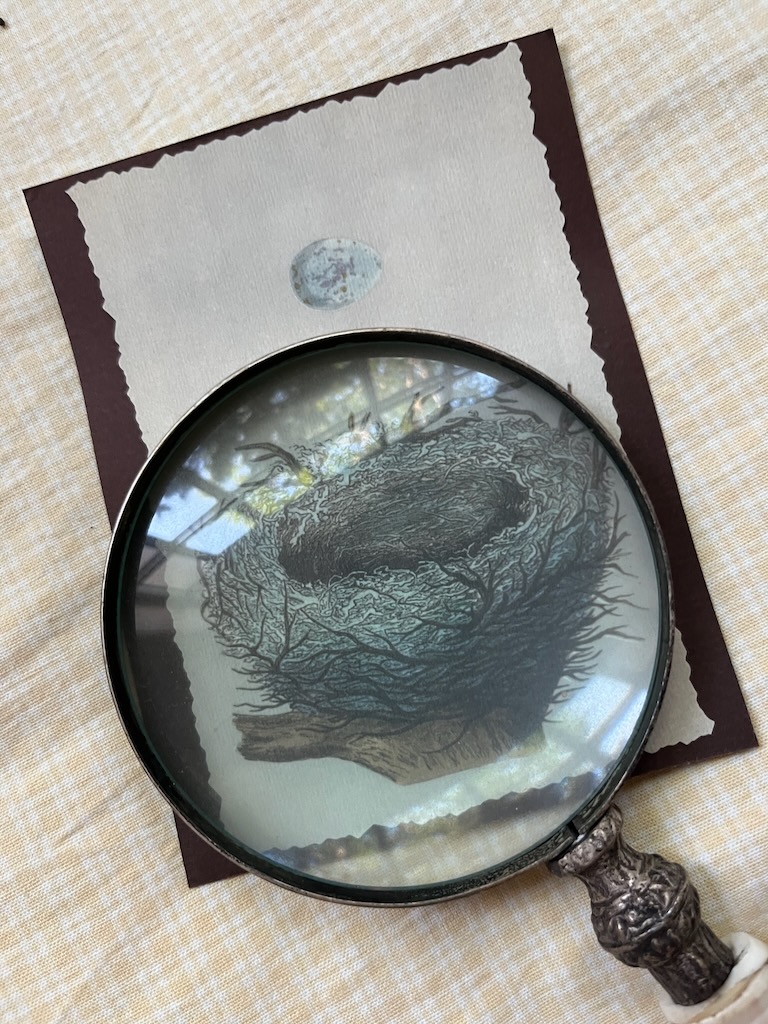
i hold each grain of time, as often as i pause and catch myself, up to the incandescent luminescence that reveals and magnifies its wonder. in other words, i aim to live with one of these in my back pocket, gliding time beneath my ever-ready looking glass:

here then is where brodsky begins his deep-dive into boredom, as he looked out upon a sea of soon-to-be-graduates at that ivy-covered college in new hampshire’s piney countryside (i’d endorse reading clear through these next few grafs, but if you’re pressed for time, leap down to the bottom of read to see if you, too, are struck by brodsky’s likening our time here to a ride on a runaway train, and his admonition to seize each blessed frame as it’s passing by):

Known under several aliases – anguish, ennui, tedium, doldrums, humdrum, the blahs, apathy, listlessness, stolidity, lethargy, languor, acedia, etc. – boredom is a complex phenomenon and by large a product of repetition. It would seem, then, that the best remedy against it would be constant inventiveness and originality. That is what you, young and newfangled, would hope for. Alas, life won’t supply you with that option, for life’s main medium is precisely repetition.

[…]

In a manner of speaking, boredom is your window on time, on those properties of it one tends to ignore to the likely peril of one’s mental equilibrium. In short, it is your window on time’s infinity, which is to say, on your insignificance in it. That’s what accounts, perhaps, for one’s dread of lonely, torpid evenings, for the fascination with which one watches sometimes a fleck of dust swirls in a sunbeam, and somewhere a clock tick-tocks, the day is hot, and your willpower is at zero.

Once this window opens, don’t try to shut it; on the contrary, throw it wide open. For boredom speakes the language of time, and it is to teach you the most valuable lesson in your life – the one you didn’t get here, on these green lawns – the lesson of your utter insignificance. It is valuable to you, as well as to those you are to rub shoulders with. “You are finite,” time tells you in a voice of boredom, “and whatever you do is, from my point of view, futile.” As music to your ears, this, of course, may not count; yet the sense of futility, of limited significance even of your best, most ardent actions is better than the illusion of their consequences and the attendant self-aggrandizement.

For boredom is an invasion of time into your set of values. It puts your existence into its perspective, the net result of which is precision and humility. The former, it must be noted, breeds the latter. The more you learn about your own size, the more humble and the more compassionate you become to your likes, to that dust swirls in a sunbeam or already immobile atop your table. Ah, how much life went into those fleck! Not from your point of view but from theirs. You are to them what time is to you; that’s why they look so small. And do you know what the dust says when it’s being wiped off the table?

“Remember me,”
whispers the dust.

Nothing could be farther away from the mental agenda of any of you, young and newfangled, than the sentiment expressed in this two-liner of the German poet Peter Huchel, now dead.

brodsky closes his address with the words that first caught my eye this week, and that i––once again––will aim to not forget:

[…]

What lies ahead is a remarkable but wearisome journey [on a] runaway train. No one can tell you what lies ahead, least of all those who remain behind. One thing, however, they can assure you of is that it’s not a round trip. Try, therefore, to derive some comfort form the notion that no matter how unpalatable this or that station may turn out to be, the train doesn’t stop there for good. Therefore, you are never stuck — not even when you feel you are; for this place today becomes your past… receding for you, for that train is in constant motion. It will be receding for you even when you feel that you are stuck. So… look at it with all the tenderness you can muster, for you are looking at your past.

i reached for that confetti salad glamour shot above because it was a bit more visual than trying to find an image of boredom. it was perhaps the most delicious thing i made this week (the grilled salmon that arrived with the salad was mighty good, but i did nothing other than introduce it to the heat of the grill), and if you’re now hungry, here’s the recipe, courtesy of david lebovitz, a former pastry chef from chez panisse now a cookbook writer living in paris. lucky david.

fresh corn, tomato, cucumber, avocado, basil summer salad

2-3 ears of fresh corn
2 cups (350g) cherry tomatoes , (or 2 cups fresh tomatoes, diced)
1 ripe avocado
1/2 cucumber, peeled and seeded
1 cup (75g) loosely packed chopped fresh basil, (reserve any small leaves for garnish) Freshly ground black pepper
Vinaigrette
2 tablespoons red wine vinegar
4 teaspoons Dijon mustard
1-2 small shallots, peeled and minced (1-2 tablespoons)
1 teaspoon sea or kosher salt
6 tablespoons (90ml) extra-virgin olive oil

  1. Shuck the corn and remove it from the cob.
  2. Remove any stems and slice the cherry tomatoes in half.
  3. Peel the avocado, remove the pit, and dice the flesh. Cut the cucumber into similar sized cubes.
  4. Put the corn kernels, tomatoes, avocado, cucumber, and basil into a serving bowl and season with freshly ground black pepper.
  5. In a small bowl, whisk together the vinegar, mustard, shallots, salt, and olive oil. Pour the vinaigrette dressing over the salad and gently mix together. Taste, and add more salt and pepper if necessary.

Serving and storage: The dressed salad can be served right away or in a few hours. (It can be stored in the refrigerator or at room temperature, but should be served room temperature.) It’s best the same day it’s made.

your thoughts on the runaway train (above) welcome here, with the related question, what are the ways you remind yourself to live each day mindful of the preciousness and miracle that it holds?

a narrative twist and the wisdoms that come in its wake

when last we pulled up a chair, we were a gladsome foursome giddily gadding about the eternal city. unbeknownst to us, a fifth was among us. a red-ringed hanger-on who might have climbed aboard on the plane that flew through the night. or perhaps in the crowds in one art-ringed room or another.

but by nightfall one friday ago, a mere four days into our roman romp, one among us was lying flat on his back when he plaintively asked, “could you feel my head?” and suddenly the tiniest of sniffles i’d been hearing for the past two days, and the uncharacteristic naps that were beckoned mid-morning and again mid-afternoon snapped into sense, and a not-so-subtle hypothesis bolted into my brain: “this couldn’t be covid, could it?!?”

and with that, lickety split, i leapt out the door and wiggled my way through ancient streets and crowds thick with myriad tongues. i found myself a farmacia and in the clearest italian i knew, asked, “covid test?” the farmacista knew too. it seems the red-ringed word is universally understood. she handed me the prova covid, i handed her euros, and off i flew.

didn’t take more than a minute for that dreaded double line to flash into sight. bright purple it was, as my pictures of rome in quartet whirled down the drain. we had among us a covid-plagued fellow, the very one who had spent weeks and weeks planning and plotting. signing us up for this tour and that. and now, the poor chap was confined to a room at the back of the Airbnb, and i was moved to the couch.

i felt my heart crack.

i pictured a big pink eraser descend from above, dashing our roman holiday and turning our fine little appartamento into a quarantined clinica covid. i feared, right away, that the dastardly viral intruder would tear us asunder. that i, too, would be felled. and then boy 1 and boy 2.

i reached for my phone and dashed off a text to my beloved american doctor. as the sun set in rome, it was just reaching its midday peak in the states, so, lo and behold, she swiftly wrote back. told us they’re basically treating covid as a head cold these days, and that 24 hours after the fever broke or symptoms abated, our chief travel guide would enter the five-day mask-and-distance phase. and the rest of us should hope for the best.

without delay, the ailing one and i both reached for our phones to alert the dear friends with whom we’d shared the previous evening of rooftop aperitifs and a long and lovely roman dinner. and, belly flip-flopping all the while, i texted the sorry update to our boys, who’d gone out with a professorly friend for pastas and spritzes and whatever else might unfold on a friday night in glorious rome when you’re young and with nary a care.

i couldn’t sleep. so i lay there on my couch till the wee hours, listening for the boys’ signature voices and the clomp of their feet on the stone-cobbled street down below. when in they wandered, i confirmed that they’d seen the bum news spelled out on their phones. and we figured the weekend engagements — a guided tour of the colosseum and forum, as well as a lazy sunday lunch on our friends’ rooftop terrace (which had been the imagined highlight of the trip to little old me) — had gone up in vatican smoke.

but here’s where the story once again takes a turn, rises into the allegorical, and makes of one player a hero: assuming the boys would never in a million years awake for an early-morning architectural tour of ancient roman ruins, i’d already scratched the colosseum and forum off the list. so wasn’t i proven to be the fool when, with an hour to spare before the already-paid-for tour, the bedroom door cracked open and out strolled a towel-clad gent on his way to the shower. as he sauntered sleepily past me, he uttered only three words that soon set the tone for the day and all those that followed: “when in rome. . .”

and so we were off. if he, a boy who’d slept a mere few hours, could pull himself off the pillow to make good on his papa’s pre-ordained plot for the day, certainly boy No. 1 could follow, and i — who had originally declined a tour of what i referred to as “the ancient blood bath” and imagined instead a leisurely morning alone — could step into gear. turned out we missed the guided part of the tour, but we managed to get into the old ruin and carried on the self-guided way. all that walking and gawking made us hungry, so kid No. 2 called time-out and guided us through the meandering streets to an osteria that he’d been told had the very best food in all of roma (and it certainly did)*. and then, bellies full and sunscreen slathered, we climbed to the tippy top of the palatine gardens, and all of rome lay majestically, magnificently sprawled out before us.

the boy’s simple instructive “when in rome. . .” is the essence of carpe diem, the code by which he not only lives but inspires. he’s a mere 22, a kid born just before 9/11, a kid whose years have been punctuated by the horrors of parkland and sandy hook, a kid who cowered inside our cambridge apartment the terrible week of the boston marathon bombing when we could watch the police helicopters whirring in the sky just out our windows, a kid who went to college during covid and got sent home for half a semester to watch pre-recorded lectures on the laptop perched on the covers of his boyhood bed.

he’s emerged with an unshakeable knowing that life comes around but once, and you’d better seize it while you can. because there’s no cinch on tomorrow. which pretty much is the truth it’s taken me decades — and a medical scare of whopping proportion — to figure out.

we talked plenty (be it discoursing eternal verities or swapping silly serendipities) as we wound through the ancient streets of rome (his hand always reaching for mine, to make sure i didn’t wobble or fall), as he insisted we mosey down the block to the corner watering hole for spritzes at dusk, as he and his brother led us hither and yon to the best eats in the city. and his ironclad creed is that life is to be lived to the fullest.

my number one teacher in rome was the kid who grew in my womb long after the doctors insisted there’d never be another; an odds-breaker ever since, a kid who dwells in the joy of exclamation. and his lesson is one i’ll not tuck away on a shelf now that we’re home. nor ever.

it’s a beautiful and glorious thing when the teacher appears in the form of a kid who serves up his lessons with spritzes and leads you through rome on a quest for flavors you’ll never forget.

bless you, and thank you, dear T.


post script: our covid-afflicted fellow made it through mostly unscathed, and is now back among the unmasked. once his fever broke, and 24 hours had passed, he made the most of his unfettered hours to stand and absorb the architectural wonders of rome for as long as his big ol’ heart desired. none of the rest of us ever tested positive. though we missed the rooftop lazy sunday lunch of our dreams, we now have reason and incentive to return. i brought a good chunk of rome home in my heart.

me and my boys, ala sunset spritz

what wisdoms have come your way in the wake of a narrative twist?

*in case you find yourself in the eternal city any time soon, the best food we inhaled in rome was at the little osteria il bocconcino, just up the hill and around a few bends from the colosseum. if you ask the boys, there are multiple other contenders as well. every bite, in a word, was sublime.