pull up a chair

where wisdom gathers, poetry unfolds and divine light is sparked…

Category: joy of writing

quiet season

IMG_7215

it’s quiet season in my house. in my soul, actually.

it’s odd then, when i tiptoe outside in the dawn and hear the world achatter. the winged choristers — robin and sparrow and cardinal — are having at it, calling out from limb to bough to bush. staking turf. declaring the early hours of starting all over again, survival of the species, the No. 1 task on the vernal to-do list. it’s what happens when the globe tips toward the sun, the angle draws nearer, draws shorter; the light longer, not so thin anymore.

it happens to all of us, one season or another. we’re out of sync with the world beyond our window sill. i’m still deep in the burrows of winter. but the world wants to shake off its slumber, awaken.

i’m not ready yet.

i will be. i have no doubt.

but not yet.

now, i am curled under blankets, turning pages, soaking up the words of other quiet souls. and so, when i cracked open a book of poems the other day, i nearly dissolved into tears, into the mystery of grace, of feeling tapped on the wall of my heart, with sacred whisper.

i was turning slowly through the pages of mary oliver, my patron saint of poetry. i was inhaling her latest infusion of wisdom distilled, of heaven on earth, of sacred scripture rising up from out of the dawn, out of the trail through the woods where the poet keeps pace.

i read, among other words, these:

there are moments that cry out to be fulfilled.

like, telling someone you love them.

or giving your money away, all of it.


your heart is beating, isn’t it?

you’re not in chains, are you?


there is nothing more pathetic than caution

when headlong might save a life,

even, possibly, your own. 


then i turned a few pages, and stumbled on this:


God, or the gods, are invisible, quiteIMG_7208

understandable. But holiness is visible,

entirely.

i pulled out my pen. the sound of ink scratching along sheaf of paper, the only perceptible noise interrupting the season of silence.

and now i’ve shared my silence with you.

may your week be blessed. silent or not.

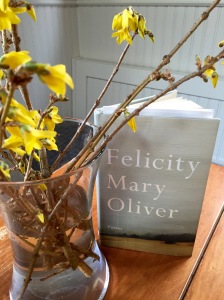
mary oliver’s latest slim volume of prayer poem is titled, felicity (penguin press, 2015). the words above, first, from the poem, “moments,” and finally, a few lines from “leaves and blossoms along the way.” 

she asked for a poem

mary oliver poem

she asked for a poem, my beautiful friend did. she asked for words. she asked for my voice.

she asked so that “at certain times,” in the dark dark hours that come when you are lying in your bed, or curled on your couch, when the knife-to-the-gut of cancer won’t stop, when you tremble deep down inside, when all you want is to wail but you can’t, she asked “to be soothed” by the sound of the human voice rising and falling and wrapping around letters and lines and syllables and silence and words, each word a vessel of hope, a finger to grasp, the next best thing to morphine. or, maybe, better.

she asked me to pick out a poem, to read it, to record the sound of my voice. “not STAGE PERFORMANCE,” she wrote, just “ntural,”she typed, her fingers fumbling for keys, “poems red by my friends.”

it was a blanket of sound she was stitching together, my friend whose world has always been about sound. she’s gathered sound all around the globe, on nearly every continent. she’s woven sound into story, story that shattered hearts, peeled back truths, shone beacons of light. sound that reached out through the squat little box that sits on the kitchen counter, or the flat rectangular one that blinks red numbers just beside my bed. sound that could draw me to the ends of the earth, or into the depth of someone’s long lonely walk through a mountain pass, or down a dusty country road. it might be the sound of a katydid. or a jackhammer. or maybe the cry of a mother who’s just buried her child. it might be the whistle of wind she records. or the story in spanish of someone who’s been lost for too long.

her life has been a tapestry of sound, one that my friend has pieced together with fierce intelligence, unparalleled heart, and a light in her eyes that will never go out.

so, in her darkest hours, in the hours when the walls seem to be squeezing in from all sides, she asked for more sound. for the sound of the human voice, doing what it most sacredly does: putting breath to the balm that is love, that is tender and dripping with mercy, that heals, always heals, and that just might be the last earthly tie, one heart to another.

it’s no mystery why mamas sing lullabies to their babies. why mamas turn pages of storybooks. why mamas make “mmm” sounds and sigh to their wee little newborns. the human voice is breath + vibration + heart, is sound put to flight. the instrument of that flight might be a screech, or a whisper. it might be vicious and crack in half the heart of the one who hears it. or, in the case of my friend, it might be the best shot for soothing, for wrapping a blanket, a compress, of undying love.

and, yes, it might be a poem. the healing power of the hard-chosen word, words plucked from the star-stitched heavens, beauty and heartbreak distilled. that’s poetry. and, no, it won’t cure cancer, certainly not. but there are ails along the way that poetry — a poem read aloud by someone you love — will always be able to heal.

it will break through the canyon of fear and of emptiness. it will cradle the tired. and, as best as is possible, it just might dull the ragged edge of the pain, and, maybe just maybe, soften the suffering for as long as it takes for the poem to be read and maybe to linger.

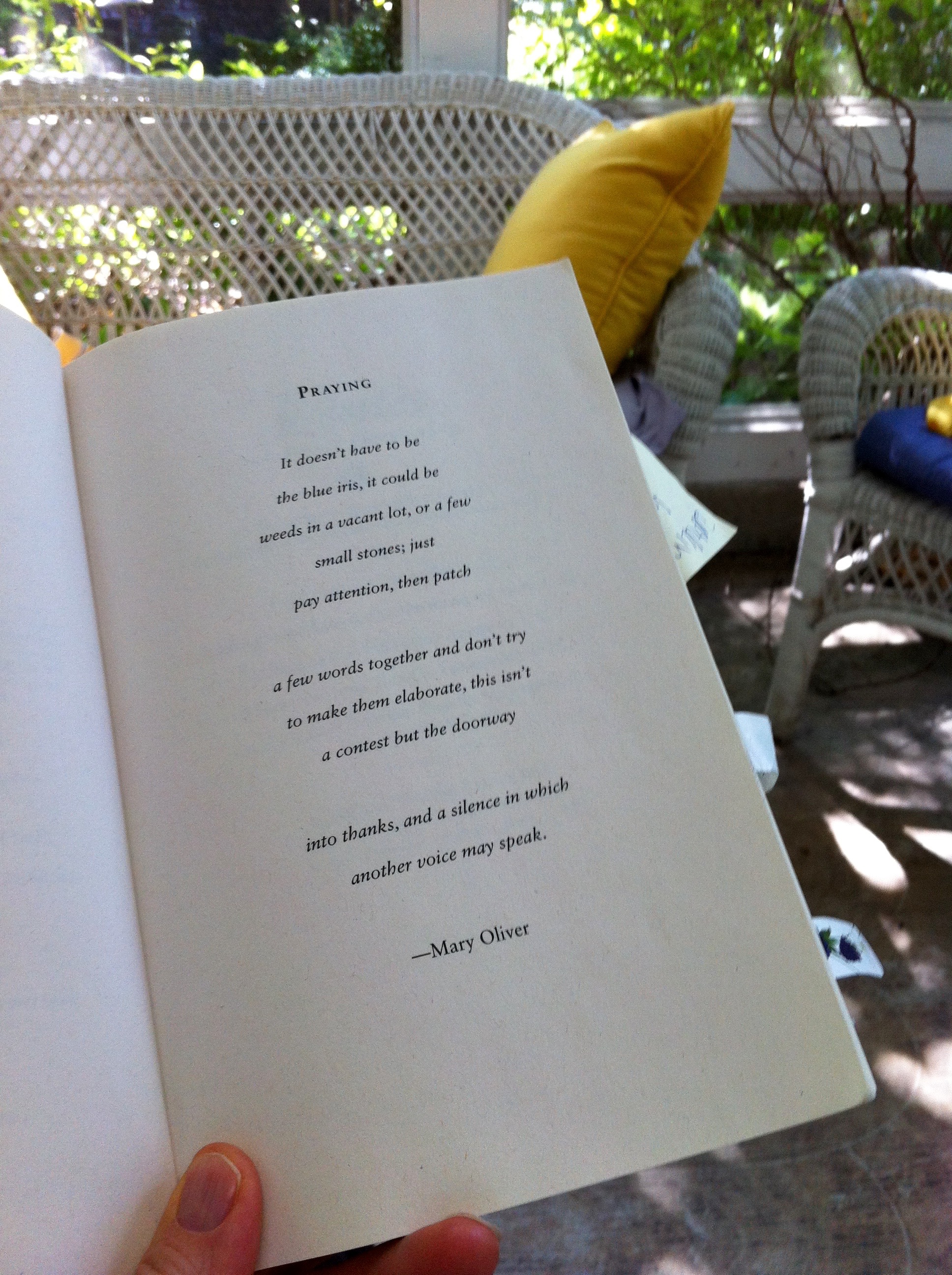
i knew right away the poem and the poet to which i would put my breath and my heart: mary oliver. “praying.” it’s the poem i tucked on the very front page of my very first book. it’s a poem about paying attention, about patching together a few simple words, nothing elaborate. it’s about prayer not being a contest, but a doorway into thanks, and “a silence in which another voice may speak.” it’s about stitching together prayer, and it’s something my friend and i have talked about — many times, once while wandering about a wooded magic hedge.

i knew, too, right away, just where i wanted to read it, the poem about prayer — amid my late-summer garden, so the words of mary oliver would be enfolded, would be punctuated, with the sounds of this summer drawing to a close: the few cicada still buzz-sawing, the blue jay who squawks, even the wind rustling through the boughs of the willow.

i whispered a prayer, took a breath, and pushed the little red “record” button.

my friend asked for a poem. i sent her the pulse of my heart, and a sound-swatch of the late summer garden.

here’s how it sounded:

i wanted to quietly lay this on the table because i know that among the chairs circled here, there are hearts intent on finding ways to bring healing to the world, and i thought it the most beautiful quiet creation, the notion of my friend to weave together a patchwork of poems, all in the voices of friends, all for the purpose of soothing. it’s a simple gift, a pattern we can all trace and retrace, should the need arise. it might even be a baby gift, a gift at the launch of life, when you wrap not just a favorite picture book, but the sound of your very own voice reading it, turning the pages. the gift of your voice is one no one else could ever give. and it comes from the depth of your heart. priceless.

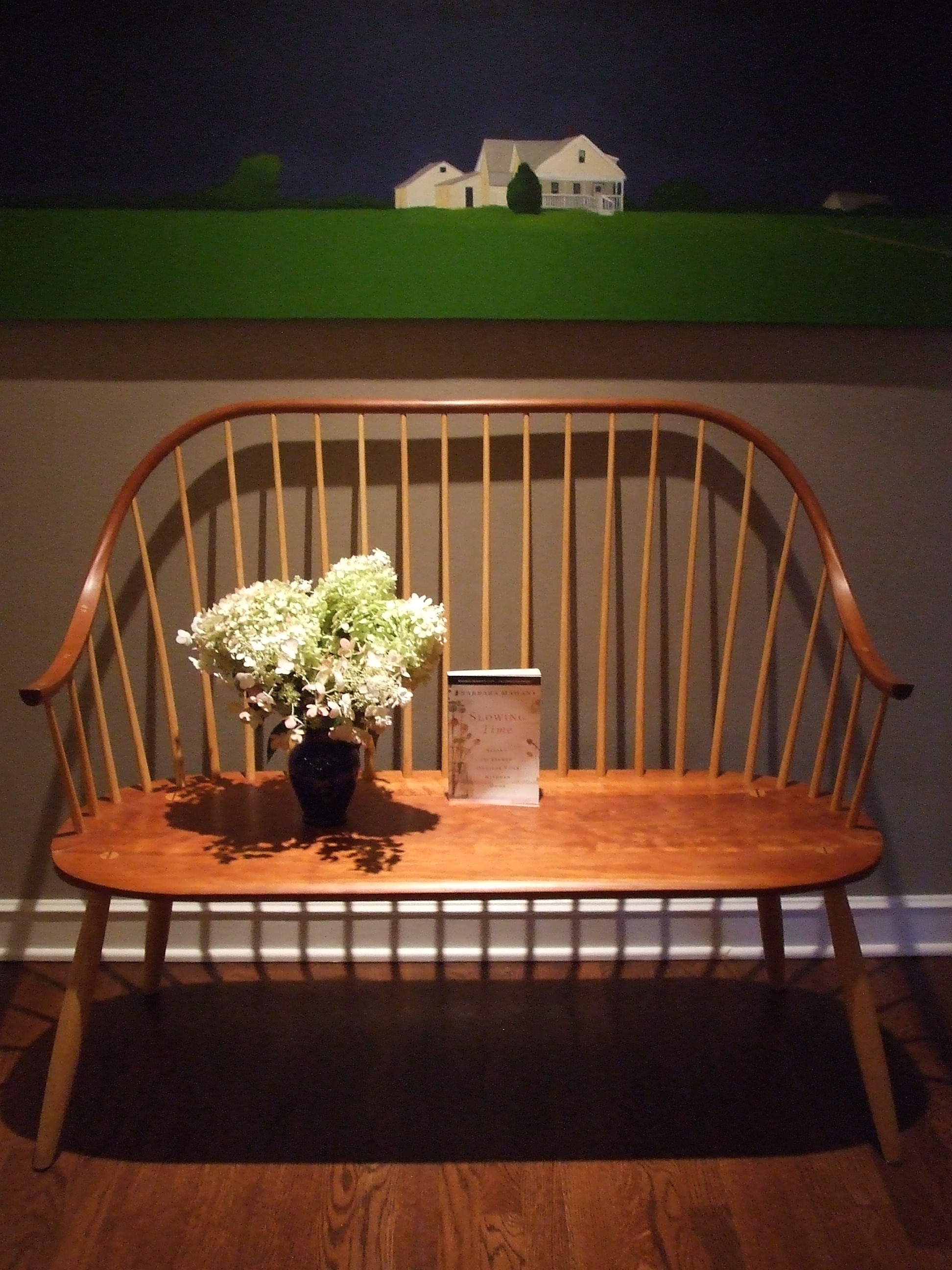
because i happen to know that mary oliver doesn’t want anyone printing her poems anywhere without permission (i asked for and received full permission for the epigraph of slowing time), i am honoring mary’s heart and will not print it here, although it is in the photo above. and you can read it yourself if you open the book to just past the dedication page. and, miracle of miracles, i figured out how to drop a line of poetry reading onto this latest meander. wonders never cease. 

so here’s the question: if someone you love asked you to read a passage or a poem, what one would you choose?

from the middle ages to me: my voracious appetite for the not-so-edible “salad of many herbs”

799px-Flickr_-_Beinecke_Flickr_Laboratory_-_(Commonplace_Book),_(late_17th_Century)-thumb-615x190-75565

florilegium, or “gathering of flowers,” they’re called. or were called in medieval times.

quaint.

one wealthy 15th-century italian wool merchant declared his zibaldone, or book of hodgepodgery, “the salad of many herbs.” a snip here, a pungent bit there.

it was his self-inscribed anthology of esoterica and knowledge, the pages into which he stuffed everything from recipes to tables of weights and measures to the latest smart something he’d heard rumbling on the florentine sidewalks. decidedly, it was not a journal, no catch-all for memoir, nothing like a diary. nary a rambling of the soul found here, this was strictly the province of accumulated knowledge — and things not to forget.

more commonly known as commonplace books, i’ve just discovered i’ve been keeping one — or four or five, more like it — for years and years. (“commonplace,” you should know, is a translation of the latin term locus communis (from greek tópos koinós), or “common place,” and, according to our friends at harvard university’s library, suggests a storehouse, or clearinghouse — in ink, on paper — of ideas and arguments, easily located for ready application. say, when engaged in verbal jousting at the medieval village pub.)

and i just thought i was a hoarder of the literary kind, demonstrating my rodent-like tendencies for squirreling away little bits and snips of enchantment. of the poetic species.

they live in assuming places, my commonplace books, my cache for what tickles my imagination, delights my word-ly fancy, catches my breath. for years, one lived on my laptop’s desktop, but it grew to be so long, so unwieldy, so likely to bring down my hard drive, i only recently birthed its second generation, both titled, “words and lines worth saving,” iterations I and II.

two more, the kind made of cardboard and paper pressed between covers, they live atop my desk, my actual old pine desk, one to my right and one to my left. as i flip through them now, i see i’ve stuffed inside a post-it note with a german address (in case i visit, i suppose), an advent calendar from 2012, a rosary (still in plastic) from the basilica of holy hill. and as i flip through the left-hand book, one i’ve titled, “notes of wonder,” i see that it’s bulging with snipped-out pages from the new york times book review, notes i scribbled on the back of someone’s eighth-grade essay, and assorted ponderings, including this: “God’s first language, which is silence.”

the one i count among my life’s truest treasures, though, is the unwieldy one on my desktop. there, if you scroll along, you’ll find among its 9,938 words unfurled across 35 pages, the turkish word for “moonlight on water” (gumusservi), the definition of epistemology (after stumbling across the line, “the epistemology of loss,” in a john berryman poem), or this from galway kinnell: “to me,” he said, “poetry is somebody standing up, so to speak, and saying, with as little concealment as possible, what it is for him or her to be on earth at this moment.”

it’s my digital memory box, the place where i commit the things that take my breath away, stir my soul, make my heart beat double-time. it’s my independent study in the literary arts, and poetry in particular.

little did i know that no less than jonathan swift prescribes one thusly:

“A commonplace book is what a provident poet cannot subsist without, for this proverbial reason, that ‘great wits have short memories:’ and whereas, on the other hand, poets, being liars by profession, ought to have good memories; to reconcile these, a book of this sort, is in the nature of a supplemental memory, or a record of what occurs remarkable in every day’s reading or conversation. There you enter not only your own original thoughts, (which, a hundred to one, are few and insignificant) but such of other men as you think fit to make your own, by entering them there.”
—from “A Letter of Advice to a Young Poet”

apparently, the practice, with its roots in antiquity, has been unbroken since the middle ages, with a particular up-bump in renaissance times. the idea — brought on with a bang not long after the invention of the gothenburg press, “largely because literate people were discombobulated by the flood of information the printing press had unleashed upon them,” according to alan jacobs, writing in the atlantic — was that particularly pithy or otherwise catchy little thoughts were to be hand-copied and tucked into one’s commonplace book. in arranging topically, it was thought, the literate raconteur would have, at fingertips’ reach, a ready arsenal of neatly tucked-away poetry and argument. need a zippy rejoinder? oh, just wait, it’s right here, on page 23 of my florilegium (the latin name pinned onto the practice by the medievals, who found them particularly handy for stockpiling thought of theological and religious theme. for what little it’s worth, i much prefer to think of mine as that “salad of many herbs”).

why, thomas jefferson was a prodigious keeper of the commonplace (writing in english, latin and greek, of course). as were henry david thoreau and ralph waldo emerson. the british library’s renaissance project boasts a collection of some 50, many penned inside the iron bars of prison cells and locked towers (sir walter raleigh, so imprisoned from 1606 to 1608, filled his penitent hours with library lists, poetry and an illustrated guide to the middle east). in fact, clear through the early 20th century, students and scholars were long required to keep them. and so, if you tiptoe into the bowels of any of the western world’s great libraries, just ask to see the commonplace collections, and you’ll soon stumble on the jottings of john milton, victor hugo, sarah orne jewett, samuel clemens, and john quincy adams, to name but a smattering.

i found out i was such a keeper of the commonplace only by accident. because i happened to ask a dear friend of mine, one who unfurls great lines of poetry at the drop of a hat, how it was that she had such a stockpile at the ready. here’s how my poetic friend, dear amy, replied:

“Yes, I have books and journals filled with favorite quotes, as well a hefty computer file with snippets of words I want to remember. I’ve been a nut about quotes and have collected them all my life, but it wasn’t until recently that I discovered that the squirreling away of meaningful quotes is called keeping a commonplace book, a practice that hearkens back to the likes of Marcus Aurelius and Montaigne and Thomas Jefferson. I just LOVE words of beauty and wisdom, and like a magpie, I love to feather my nest with them, as it were!”

it is the dearest thing to encounter a fellow magpie, both of us flitting through the air with words dangling from our beaks. i’ve long said that if my house began to burn, one of the few things i’d tuck to my bosom would be my long-kept compendium of beauty and breath-taking.

for that, in the end, is what animates so much of my imagination. and puts flight to the task of typing so many hours of my lifetime. there is something deeply holy about tripping upon depths of meaning in thoughts thought before you, in words committed to paper long ago, or just the other afternoon.

i can’t imagine my world without knowing that, at the click of a computer key, i could unlock these lines, copied and pasted long ago, breath-catching beauties from dear virginia woolf:

from “Mrs. Dalloway”: “…she was like a bird sheltering under the thin hollow of a leaf, who blinks at the sun when the leaf moves; starts at the crack of a dry twig.”

on sewing: “…her needle, drawing the silk smoothly to its gentle pause, collected the green folds together and attached them, very lightly, to the belt.”

describing grand houses of London: “….halls laid in black and white lozenges…”

“turning one’s nerves to fiddle strings….”

“long streamers of sunlight…”

on “the compensation of growing old”: “the passions remain as strong as ever, but one has gained — at last! — the power which adds the supreme flavour to existence, — the power of taking hold of experience, turning it round, slowly, in the light.”

“thunderclaps of fear”

i copy to remember. i paste to never forget. as mr. swift so finely put it: it’s my “supplemental memory,” my “record of what occurs remarkable in every day’s reading or conversation.”

excuse me while i amble off to imbibe on my salad of many, many herbs.

do you keep a salad of many herbs, a gathering of flowers, a book of hodgepodgery, otherwise known simply as a commonplace book? and do you not think the practice a wholly invigorating one? a holy one, too?

and, most deliciously, what would be among the herbs you’ve snipped from your literary garden?

finally, happy blessed launch of spring on this day of equal light and darkness, the vernal equinox, when, as my beautiful brother david says, “you can hear the earth breathing.” but only if you listen, of course…..

the lesson of eight: follow the whisper

eight. plate

i remember the morning. i remember the dark. i remember the quiver, there in my fingers. i remember the pounding in my heart.

i’d tiptoed out of bed, taken a deep-down breath. and then i started typing, started believing.

i’d pulled up a chair for the very first time. and i’d no clue where that typing would lead. heck, i wasn’t even sure i’d find the end of the very first sentence. but i did. sentence after sentence. so many sentences now — eight years of sentence. of fragment. of shards of my heart.

the words that are tucked away here, in this place that — for me — amounts to a treasure box, an unlocked treasure box, one that holds virtual sheafs of paper, and snapshots i lift from the stack, study as if dust motes floating across a shaft of light, the words here have been my butterfly nets, as i lope and stumble and try — oh, i try — to capture the moments of life passing by.

it’s the closest thing i know to lifting up these holy hours, to etching the words of my boys, of passing strangers, of friends, onto this screen that i pretend is parchment. that i write as a relic of life loved well. life loved deeply.

to write in the dark of the just-dawning day, to write when the sky out the window is first soaking up light, starting out black, turning to blue-tinged haze or cottony gray, depending on clouds, to write when the shadows and shapes of the trees fill in, the birds first rustle the branches, is to write at the cusp of consciousness.

this is the hour when the heart and soul, perhaps, are most porous, so what oozes through is closer to truth than anything else we might know all day.

this is the sacred hour, the hour of stillness.

and so, this hour is the one when i’ve learned to slide into my explorer’s boots, when i’ve hauled my butterfly net from the jam-packed closet, and loped around the premises to see what i catch, what i find.

and then, like a child whose attention is held, is rapt, by a ladybug landed on a leaf, or a fuzzy caterpillar inching along, i crouch down low. i pull out my looking lens, and i examine. i marvel. i wonder.

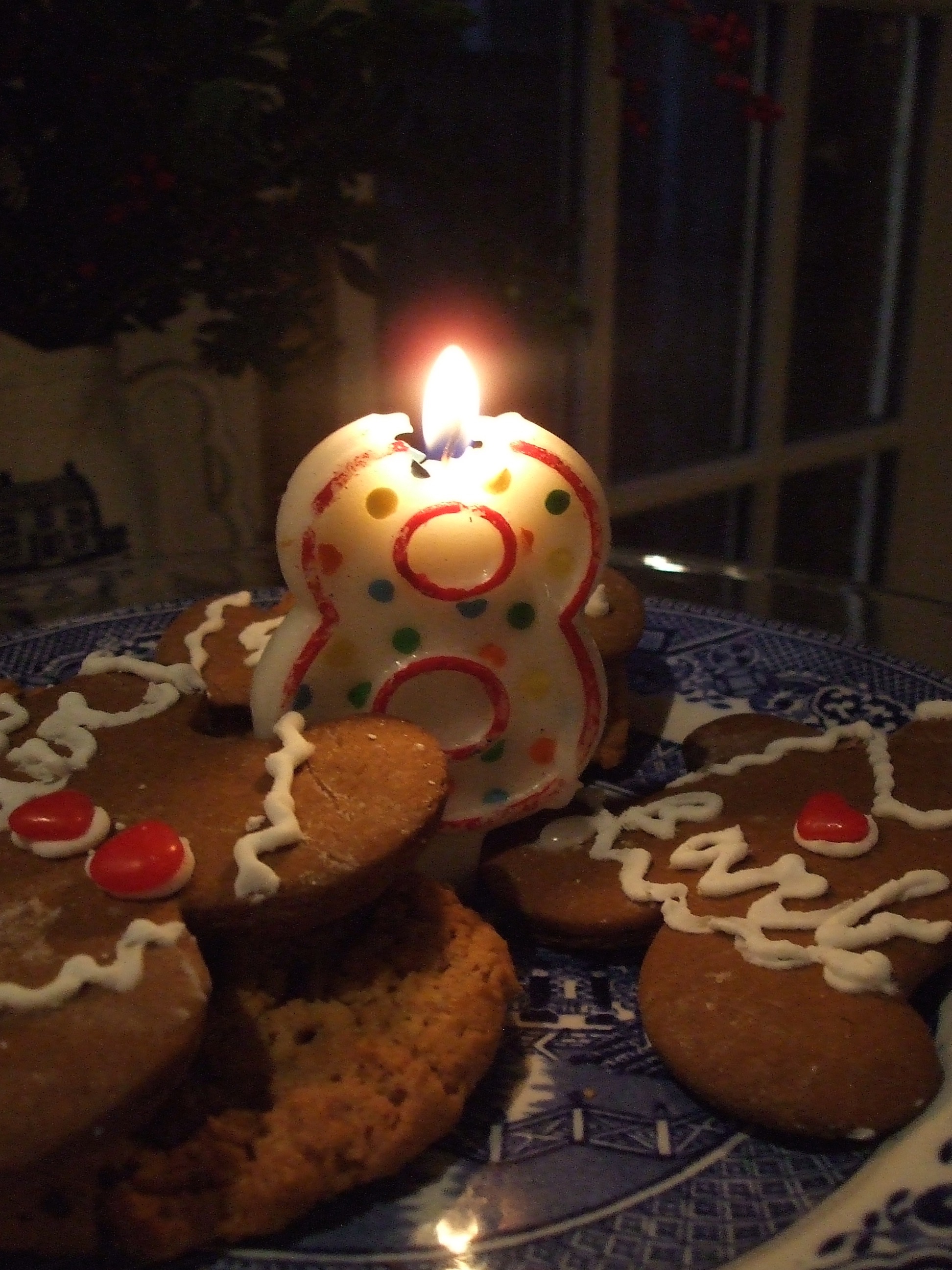
eight years. eight years today. 12.12, the chair’s birthday.

when this old chair first scratched across the kitchen floor, my little one had just turned five, my older one was nearly 13.5. i only wish i’d started before both boys were born, because then i’d have the whole cloth, and now i’ve got only a portion. priceless portion.

because more than anything this is a stack of love letters to my boys. this is a record of who their mama was, and how she loved them. it’s the surest way i know to give them the gift of my heart. because in my book, words equal heart equal love — exquisite, breathtaking, stumbling and fumbling. love that tries so hard, and yet still blows it. love that aims and misses. love that dusts off her knees and tries it again. love = a work in perpetual progress.

but beyond this place as a keeper of heart, it’s taught me one other thing, if not 100 other things, or 1,000.

it’s taught me to follow the whisper.

back when i first sat down to type, that trembly shadowed morning, i had no idea where i was going. i was typing into the dark. but i believed in the light.

i wasn’t sure where or how i’d find it. but the one thing i knew was that the surest way through the dark was one word at a time. one word quietly, boldly, sometimes trepidatiously following another.

word after word equals sentence. sentence after sentence equals moving toward truth. and in time, whole cloth is unfurled.

this is who i am, the words start to say. this is what i believe.

it’s called finding a voice. but it’s also divining for heart. if you quiet the noise, the distraction. if you muffle the ever-chattering doubt, you just might stumble upon the poetry that breathes at the pulse point of all of us.

we are infused with whisper. that’s where our dreams begin. and when — despite all the back talking we can do to ourselves, all the convincing ourselves we might as well throw in the towel, call it a day, pack up our toys and shuffle off home — when we keep our ear to the whisper, when we go with the heart that’s pushing us forward, the heart that says, over and over, “don’t mind the darkness, just live toward the light,” we’re tracing the course to the deepest-down truth. we’re becoming the blessing we are most meant to be.

maybe your whisper is dance. maybe your whisper is healing the sick. maybe your whisper is pleading: “please lift a paintbrush, tickle it into the azure, the cobalt, the tourmaline, and, please, paint a sunrise or sunset.”

my whisper told me to write. write for the depths and the shadows. examine the light. see the poetry. wrap your words around the breathtaking essence of each and every day.

my whisper said, “just keep writing.”

so i did. and along the way, oh, the beauties i’ve gathered. the beloved friends whose whispers heard mine. the ones who whisper back.

eight years later, and there’s a book in the world, the one being “mullipuffed,” even now as i type. God bless mullipuffs.

i’d long dreamed of armchairs pulled round the hearth. and kitchen tables splattered with crystals of sugar, and cream-stirred rings spilled from mugs of hot coffee. i imagined a world where kindred spirits pulled chairs to a circle, and talked about the holiness that animates their every blessed hour.

i have no clue, not an inkling, how many such tables and chairs are out there right now. but i have a picture i keep in my head, in my heart: i close my eyes and out of the darkness, out of the black velvet cloth that wraps the globe, night after night, dawn after dawn, i see golden lights glowing. dabs of candlelight here and there, all haloed together. a shimmering, glimmering necklace of light. lanterns of flame. old kitchen fixtures. maybe simply the roar of the fire, the logs of the forest offering up their incandescence — blessed sacrifice, indeed.

i typed in the dark, dawn after dawn, for eight blessed years. an octave of typing. i followed the whisper to wherever it led. it led me to here, the place where my heart nestles so soundly.

and, here in the dark, in the shadow of dawn, i’ll keep fumbling for keys and the truth. i’ll keep typing, i promise.

bless you each and every one of you who has ever pulled up a chair. bless you for listening. and following along in the dark.

what is your whisper telling you? 

eight

maybe i should pretend….

picture of dad, taken from back cover of his book.......

i’m typing this a day before i usually type. because tomorrow, friday, at this lovely hour, i’ll be feeling my heart plunk though my chest. i’ll pretty much be wishing i was anywhere besides where i’ll be: sitting in a grand dining room, with white-jacketed waiters scurrying like flocks of plate-bearing birds. knives and forks will be tinkling. i’ll be wishing that every wine goblet at every place was sloshing and swiftly being drained. i’ll wish for delirium to sweep across the room, and everyone in it to drift into ether-land. i’ll wish, quite frankly, to be knocked out myself.

it might extinguish the angst.

as the clock ticks toward 40 minutes after 12, i’ll be calling on angels and saints to lift me and carry me through the next 35 minutes.

you see, i’m slotted to get up, before a crowded dining room, in an old-guard chicago club, and unspool a few wisdoms.

which — if you know me even a wee little bit, this should come as no surprise — scares the behoozies right out of me. oh, i’ve been practicing a good bit of late. it’s what comes after you spend a few years sitting alone in a room, typing your heart out. all of the sudden, they (those faraway someones in the towers of publishing) glue all that typing together, put a pretty cover on it (in my case, a vase of what my little one calls “the dead flowers”), and then they make you get up and talk about those words. out loud.

which, pretty much, is my definition of living-breathing fear. it’s so far outside my comfort zone, i find myself dreaming of rocks i could hide under. examining closets for the extent of their “hide-ability.” my recurring nightmare, just before i wake up on the dawns of the days when i’m slotted to “book talk”: it’s me being toppled by tidal wave after tidal wave. complete with slimy sea shimmerers.

but then, each and every time i stand up — certain my knees will give out, especially if i’m teetering on the skinny little “kitten heels” my fairy godmother in book touring told me i needed to buy (“everyone looks at your feet while you’re reading; you need something excellent for them to look at,” she instructed, in no-fooling terms) — each and every time (so far), i’ve been overtaken by the intoxicant that swirls through the room. the one called love, pure and simple. i look out into a crowd peopled with faces i love, even faces i’ve never seen before, and suddenly i am soaring. no longer the terrified typer, but suddenly afrolic, to make up a word, one that for these purposes we’ll define as in the midst of frolicking. frolicking in waves and waves of laughter and tears and words tumbling on words.

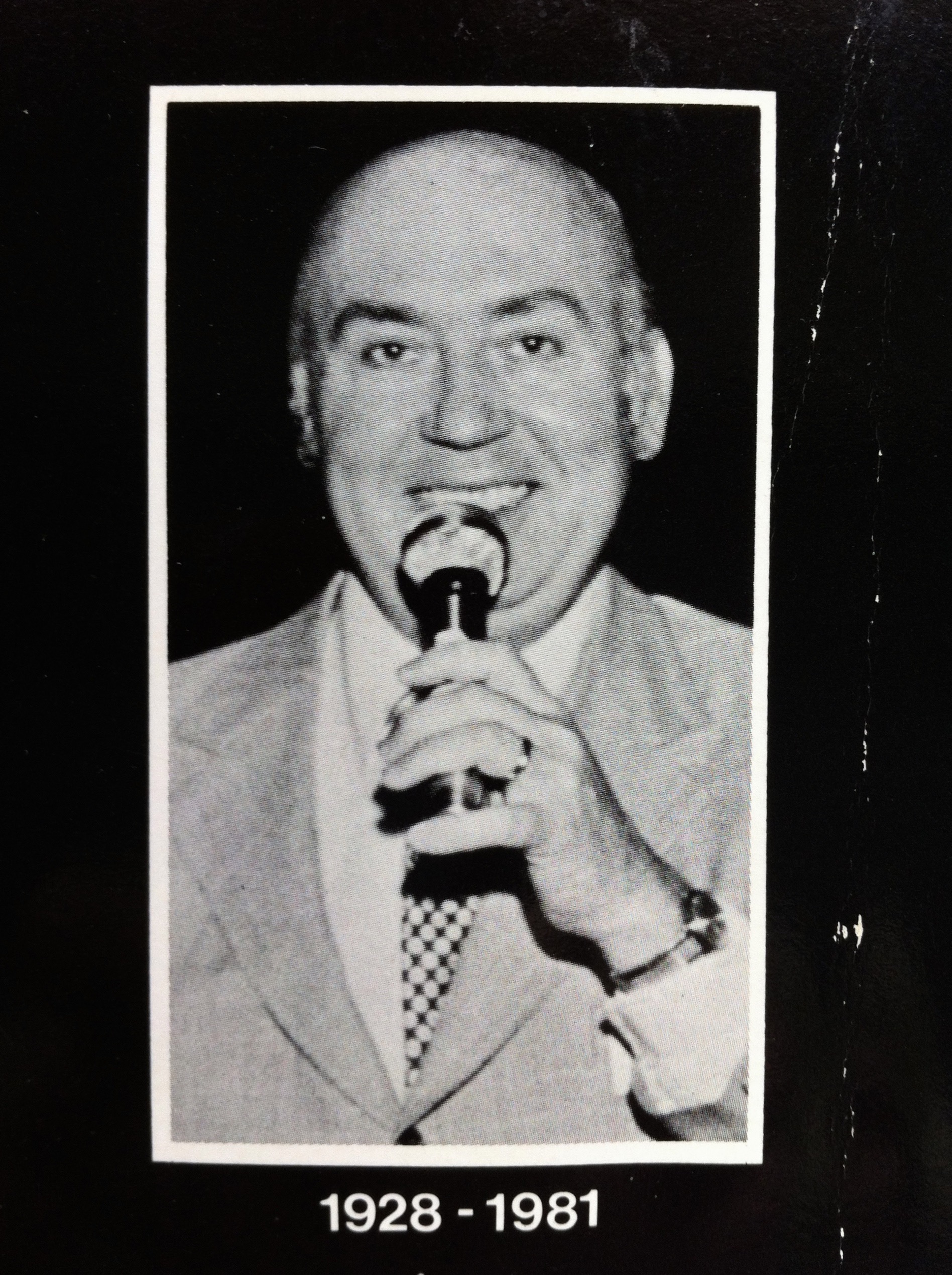
but here’s the problem: i can tell, by the toxins that build by the hour in the hours and days leading up to every one of these podium moments, that i have clearly not inherited the microphone gene, the one double-dosed in my father, that jolly fellow above, the one who looks as if the mike is a plug that literally fills him with high-voltage current.

my papa never met a podium he didn’t love. heck, he traveled the world seeking out podiums. told us umpteen thousand times his fine little podium trick: just look out and picture everyone in their skivvies (that’s vintage 1920s talk for undies).

frankly, it’s never worked for me. i’m too scared to picture anything, let alone fruits-of-the-loom, and tattered stretchy sports bras (if my undies drawer stands as template for this).

so it came as something of a surprise — perhaps a hand reaching down from the heavens — when, a few hours ago, hard at work rinsing gunk from the kitchen sink, i suddenly was struck with a novel idea. one that in alllllllllll my years of being allergic to podiums and microphones has never before leapt into my braincells.

what if i pretend my papa is sitting there? smack dab in the very front row, all pink cheeks and twinkling gray-blues, drumming his fingers in that way that he did, that way i still can hear in my head.

what if i channel that jolly old soul who lived to tell a great tale, who wrung every drop of guffaw out of a punch line, who couldn’t care less how corny it was, long as it erupted the room in knee-slapping, tear-swiping, catch-your-breath laughter?

my papa lived to make people laugh. my papa lived to delight the ear with the tricks of his tongue and his tale-telling superpowers.

i’m a dialed-down version of my papa. what i’m aiming for, first and foremost, is to make it through alive. or at least not collapse in a heap, my little black dress and kitten heels the only discernible survivors. oh, i love a good laugh. i swell to it, like any living-breathing soul of irish descent.

but when i feel heaven and earth intermingling is when it’s so very quiet you can hear breath flowing in, flowing out. when you look into faces, rapt. maybe a tear, maybe streams of tears, messily making their way down cheek after cheek.

that’s the magic that propels me out of my seat. that’s the one and only reason i’m mustering whatever it takes to stand up and teeter on wobbly knees, wobbly ankles, curled-up toes: i’m aiming for the pulsing heart inside each and every one of us. i want our hearts — for as long as we can stretch it out — to beat in the blessed unison, the deep-down understanding that we all, every one of us, are searching for the sacred stitch that draws us together, that animates the whole of us, and lifts us to a plane of higher purpose.

and, maybe, if i pretend my papa is there, in the very front row, all dapper in his brooks brothers suit, the one with the buttoned-up vest, the one he wore on the most special occasions. maybe if i pretend he walked across chicago’s loop from the glistening tower where he typed for all those years — maybe, just maybe, the god-awful worry will melt away.

and i can pretend, tomorrow, that me and my dad are sitting alone in a very big dining room, and i am looking at him, straight into his heart, telling my very best stories, and unspooling a wee bit of wisdom.

miss you, sweet papa. see you tomorrow….

how do you talk yourself through the things that scare you to jitters?

an invitation

an invitation

the invitation is broader and deeper than simply offering you a date and a time and a place. yes, there is that (details below). but the invitation i’m gently laying here at the table, it’s a doorway, an entering in….

the invitation is to slow time, to savor, to pay attention, to carve out quietude in the rush and the whirl of your every day.

we’ve been circling around those notions for years now, here at the chair. and somehow, in a mystical, magical, marvelous way, those quiet ideas have tucked themselves into the pages of a book, a book that might plop onto my front stoop any hour now. while i’ve not yet lifted it out from a box, haven’t felt its weight hard against my palms nor flipped through its pages, haven’t marveled forward and back that words typed here in the murky first light of so many mornings have found their way off the screen and onto the page. spelled out in ink — a newsgirl’s primary intoxicant.

but i’ve seen proof that those pages are finally off the printing press. they’re bound, slipped between covers.

any hour now, i’ll christen those pages with my freshly spilled tears.

so it’s time for the invitation.

for starters, consider the book, Slowing Time: Seeing the Sacred Outside Your Kitchen Door (Abingdon Press, Oct. 7, 2014), a portable iteration of this old chair. why, you can take it wherever you go. you can bring it to bed, tuck it under your pillow. you can spill it with crumbs (and not have to worry that your keyboard gets jammed with a bit of a cracker). you can climb into a tree, and turn its pages. you can even slink in the bathtub (and not have to worry about glug-glugging your screen under the bubbly suds). it’s the chair unleashed. the chair on the loose. we’ve snipped the cords and numbered the pages.

ah, but there’s something even more enticing than the fact that Slowing Time, the book, can follow you anywhere, can go where’er you go.

and that’s where the invitation begins: my prayer all along has been that what’s tucked in the pages of Slowing Time is simply a field guide into the depths of your holiest hours. my hope is that it might become your whispered companion. a place to begin to contemplate how your life might look and feel and radiate if we dial down the noise, hit pause, and sift through the mess for the shards of the Sacred.

it’s a sketch pad, really, in which the flickers of half-baked ideas clothe themselves in words. and those words become the stepping path into the woods, into the depths. or at least point you in intriguing direction.

professor elisa new, beloved poetry scholar at harvard, talks about how a poem is a “communal resource, a convening space — written in a language we all understand.” it’s a place, she says, “where one human being has tried to make meaning, using a tool — the language we all share — that belongs to all of us. and so, by entering into inquiry, discussion, and interpretation of that poem, we can fully engage in that activity so central to the humanities, that activity of human conversation about what it is really to be human.”

and so, too, with the words you find spilled on the pages of Slowing Time, it’s an invitation to “shared inquiry.” and its words are, at heart, prayer unfurled in plainspoken prose. one someone’s prayer searching, searching for companion — be that gentle journeyer God, or the soulmate you find along your stumbling way, or sitting just inches across from you.

after all, the geometry of the old maple table, and the chairs that are tucked up against it, is the circle. heart linked to heart, hands within squeezing range, eyes close enough together that we can catch the sparkle on a joy-filled day, or the empty hollows in the hours when sadness or grief has eclipsed the light.

it is in those circles of our life — the circles we create out of love, or even when carved by accident of geography — that we find communion. and our own plumbing of the depths becomes shared inquiry, scaffolded exploration. a safe zone, where even our rawest tender spots can be laid before us, with no fear of harm or scorn or raised eyebrow.

still, though, it is in solitude, and in the sanctuaries of time we’ve hollowed out of the day, that the deepest paying attention begins.

as with so many spirit-filled vespers, slowing time — here at the table over the years, most lately every friday morning — has become a practice. practice, as in trying over and over and over to hew closer to the anointed edge at our most blessed core. practice, as in a ritual that surrenders to a rhythm. and, as with all holy acts, the holiness is found burrowing into the nooks and the crannies of a place — an interior, our interior — at once familiar and still to be explored.

it is the nautilus of prayer.

and it is the invitation that pulses at the heart of Slowing Time: use these words, little more than one pilgrim’s prayer, to lead you deeper into your own heart’s vault. settle in. deep breathe. catch the light. embrace the shadow.

and, once you’ve breathed Holiness in and in and in again, lift your eyes, and discover the light of the circle around you, within you. there is Holiness abounding, and it’s ours, radiant with grace.

and here’s the date-time-and-place invitation:

Slowing Time begins here: Reading, Conversation and Book Signing 

Wednesday, September 17 (feast of St. Hildegard of Bingen, the great medieval mystic, composer, writer, visionary)

7 p.m. to 9 p.m.

Francis Xavier Warde School at Old St. Patrick’s Church

120 South DesPlaines Avenue, Chicago

(leave it to Old St. Pat’s to prompt the heavens to rain down books before the publication date…)


yet another reading, after the actual publication date of Oct. 7, is now inked onto the calendar of a marvelous magical bookshop in Evanston:

Slowing Time Reading and Conversation

Bookends & Beginnings bookstore, a magical bookshop tucked in an alley that feels as if it’s popped off the pages of Harry Potter. Co-hosted by Evanston Public Library. To reserve a seat, please contact Bookends and Beginnings at 224-999-7722.

Thursday, Oct. 9

6 to 7:30 p.m.

1712 Sherman Avenue, Alley #1, Evanston

bookendsandbeginnings.com

and yet another marvel:

Slowing Time Reading and Conversation and Autumnal Joys

Women & Children First, a Chicago literary landmark in magnificent Andersonville, is hosting a reading, conversation and celebration of autumn, Season of Awe.

Wednesday, Oct. 29

7:30 p.m.

North Clark Street, Chicago, IL

womenandchildrenfirst.com

more readings to come…..stay tuned.

and now a question: how do you slow time? (oh, and what will be your crumb of choice to spill onto the pages and clutter the book binding gulley?)

slowing time cover

pausing, because that’s what you do when a great light floats into the starry night

maya angelou

if you could rub your palms across the planks of this old kitchen table, if we could all hear the scccrrch of the legs of the chairs scuffing across the floor boards of this old kitchen, if i could pour you all whatever it is you sip, there in the heavy chipped mugs that fit flush against your palms, well surely this morning we’d all be pausing, paying attention to the great light of the poet, the one with the gravelly cadence that made us wish she was our grandmama, or the wise lady who lived down the lane, or the prophet who knew our name.

maya angelou died this week, on wednesday at 86, which you certainly know by now. so we are left to sift through her pages, her words, her rhythms, her heart as she’s sprinkled it across sentences, across years.

a poet’s ashes, holy ashes, are the words she or he leaves behind, words pressed to the page. and we hold the poet to the light by sifting, poring over those everlasting traces of who the poet was, and how she saw the world, how the world filtered through her irreplaceable lens and settled on her soul.

and what you do when someone passes into the heavens is you stop what you were doing, you draw in the deepest breath you possibly can, and, sometimes, you don’t want to let that breath go, afraid to let go of the air that once co-mingled with the air of the someone who’s gone. i remember that breath when my papa died, and for a flash of an instant i wondered if i could hold it forever, not wanting the breath of a world in which he’d dwelled to escape — ever — from the depths of my chest.

but this is about maya, maya angelou, a poet and heart song who made me feel safe, safe in this bone-rattling, rockabye world.

now i can’t say i’m any sort of scholar of maya. only that she’s among the ones — women, many of them — whose words i often read in triplicate, because the words are so breathtaking on the first whirl, my eyes and my heart simply go back to the start of the sentence to read it again. to breathe it again. to catch the updraft and make me go soaring. to delve into the construction, the word choice, to figure it out, to see how she does it. like watching, i suppose, a brilliant hand surgeon reweave the tendons of a woodworker’s thumb. or sitting off to the side of a painter as she daubs her brush in the palette of oily whites and yellows and blues and greens, and puts them just so on the canvas, and suddenly sunlight is dappled where before there was only a montage of paint dabs.

so this dappled morning at the table, we sift through what maya has left us….

here, a few sentences worth reading in triplicate (these from angelou’s 1969 memoir, “i know why the caged bird sings,” which many know as the poem. this, though, is from the less familiar prose):

“Late one day, as we were attending to the pigs, I heard a horse in the front yard (it really should have been called a driveway, except that there was nothing to drive into it), and ran to find out who had come riding up on a Thursday evening…

The used-to-be sheriff sat rakishly astraddle his horse. His nonchalance was meant to convey his authority and power over even dumb animals. How much more capable he would be with Negroes. It went without saying.

His twang jogged in the brittle air. From the side of the store, Bailey and I heard him say to Momma, ‘Annie, tell Willie he better lay low tonight. A crazy nigger messed with a white lady today. Some of the boys’ll be coming over here later.’ Even after the slow drag of years, I remember the sense of fear which filled my mouth with hot, dry air and made my body light.” 

and here, because my mama ran to the library to get it, is the start of maya’s 2008 “letter to my daughter”:

Dear Daughter,

This letter has taken an extraordinary time getting itself together. I have all along known that I wanted to tell you directly of some lessons I have learned and under what conditions I have learned them.

My life has been long, and believing that life loves the liver of it, I have dared to try many things, sometimes trembling, but daring, still.

There have been people in my life who meant me well, taught me valuable lessons, and others who have meant me ill, and have given me ample notification that my world is not meant to be all peaches and cream.

I have made many mistakes and no doubt will make more before I die. When I have seen pain, when I have found that my ineptness has caused displeasure, I have learned to accept my re- sponsibility and to forgive myself first, then to apologize to anyone injured by my misreckoning. Since I cannot un-live history, and repentance is all I can offer God, I have hopes that my sincere apologies were accepted.

You may not control all the events that happen to you, but you can decide not to be reduced by them. Try to be a rainbow in someone’s cloud. Do not complain. Make every effort to change things you do not like. If you cannot make a change, change the way you have been thinking. You might find a new solution.

Never whine. Whining lets a brute know that a victim is in the neighborhood.

Be certain that you do not die without having done something wonderful for humanity.

I gave birth to one child, a son, but I have thousands of daughters. You are Black and White, Jewish and Muslim, Asian, Spanish-speaking, Native American and Aleut. You are fat and thin and pretty and plain, gay and straight, educated and unlettered, and I am speaking to you all.

and finally, we close with this, from 1995’s “a brave and startling truth,” the poem maya wrote for the 50th anniversary of the united nations (it’s more than worth reading every last word of the entire poem, but here’s the last stanza):

When we come to it
We must confess that we are the possible
We are the miraculous, the true wonder of this world
That is when, and only when
We come to it.

should you choose to read a bit more about maya, the poetry foundation puts it poetically here.

and, now for the best part of our pause, what lines from maya do you bring to the table?

p.s. i hope she wouldn’t mind my calling her maya instead of the more stately ms. angelou. either one would do, and i beg her pardon — or yours — if the familiarity of using her first name suggests anything other than the deepest of dignified respect.

dear mama, for all of this…

grammy tedd chess

day after tomorrow, it’s the day when the globe pauses in its spinning so toast can be sprung from the toaster, violets can be clutched by little hands, and college kids can shoot a quick text: “luv u mom.”

otherwise known as children-remember-your-mom day, a wholly artificial slow-down in the whirl so cinnamon-raisin crumbs can be hansel-and-greteled between the bedsheets, violets can suffer strangulation, and mothers can get bleary-eyed at being remembered. or not.

sometimes, though, the day affords much more. it allows us to dig down to where our memories lie, and pull a few good ones out by the roots. that’s the notion at the heart of a breathtaking essay written by a friend i met a few weeks back. my friend is laura lynn brown, and before i met her at a crowded noisy dinner table, i’d read her essay, the one the iowa review printed in its esteemed pages, and the one slated to run on slate, the uber cool website, today.

her essay, “fifty things about my mother,” started out as an experiment in crafting pure-gold sentences, one at a time, in no particular order.

laura, then and now a daily newspaper editor in little rock, arkansas, was getting close to 50, the age at which her mama had died, and she found herself aswirl in rememberings. around that very time, twitter, that 140-character writer’s challenge, was gliding onto the horizon. rather than scoff at such syllabary confines, laura was intrigued by the notion of power-packing a sentence.

you’ll read, as you scroll through her sentences, how magnificently she mastered that challenge. and why no less than susan orlean picked the whole lot of them to win the 2013 iowa review nonfiction award.

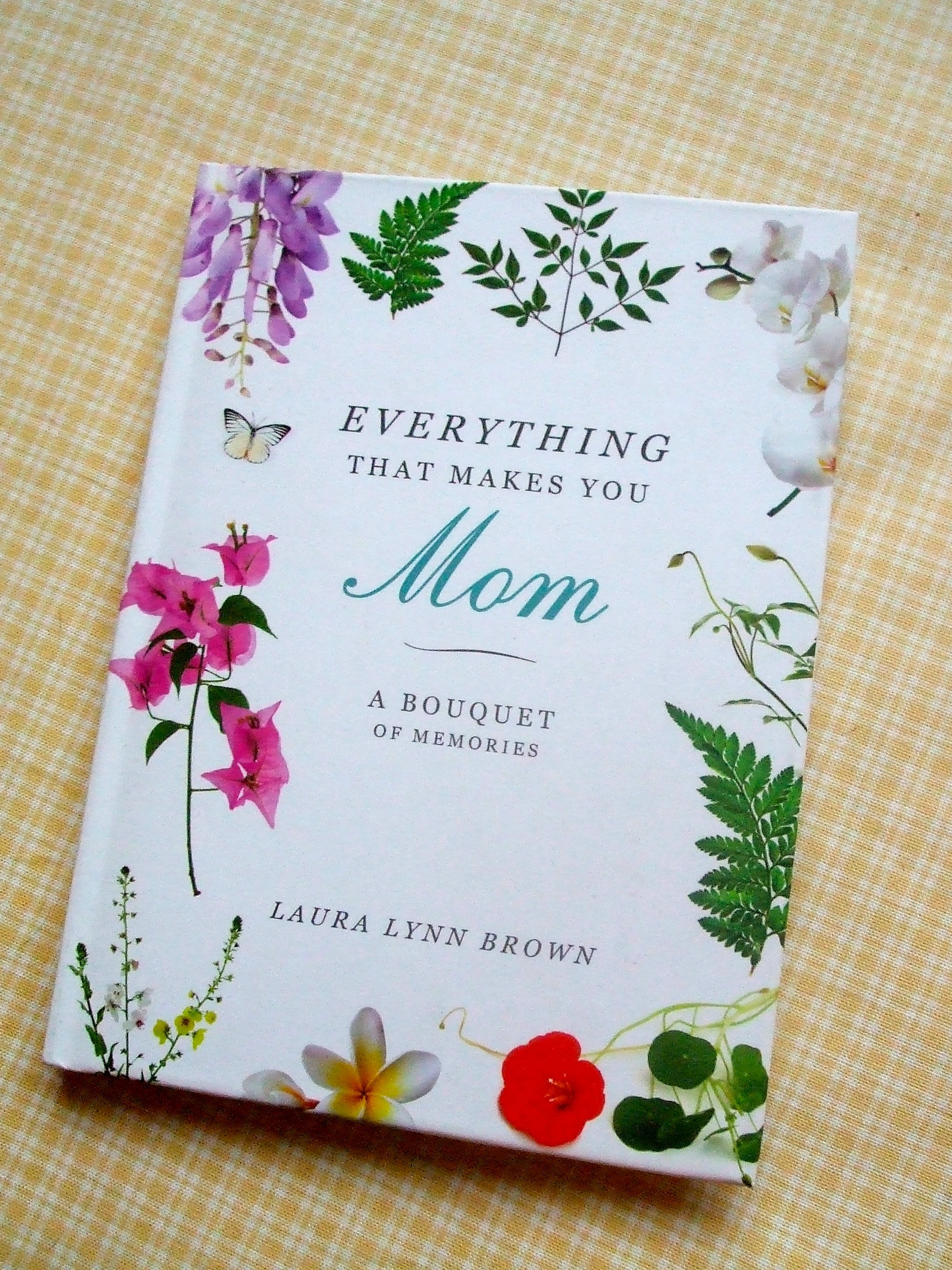
what happened next was that laura’s essay caught an editor’s eye, and, lo and behold, a book was born, everything that makes you mom: a bouquet of memories. only five of the original 50 sentences are tucked in the book, and rather than making it a book in which you’d read only laura’s memories of laura’s heavenly-sounding mom, she’s made it a book that tickles the reader’s heart and uproots some of your own most delicious mama memories.

laura brown book

laura wondered if maybe a gaggle of her writerly friends might open the pages of the book and see what happened. i got to page 108, and found my assignment, under the heading “essay question”: “remember when Mom taught you how to write a thank-you note (promptly, saying thank you, naming the gift given, and telling how you will use it or why you appreciate it or why it was a just-right choice)? write your mother a thank-you note now.”

here at the chair, i’ve written over the years what amount to thank-you notes to my mama. the original mother nature is one, and so is grammy tuesday.

but borrowing from my writerly friend laura, i’ll take a crack at crafting a few thank-you sentences to my very own mama, who, at 83.5 and ticking strong, still parks her sleek silver SUV at the curb of our old house every tuesday, ambles up the walk with her blue-plastic cooler of whatever groceries she needs to cook and lay on the table one of her ever-revolving repertoire of the dinners i grew up with: chicken rice grammy, 3-4-5 stew, meatloaf crusted with catsup, and bags and bags of frozen carrots and peas.

dear mama,

for tucking me by your side on the hardwood stairs the summer’s afternoon the hive of yellow jackets shimmied up my skinny little legs, trapped inside my jeans, and stung me mercilessly straight up to my bum. for making like julie andrews and singing into my ear, “when the dog bites, when the bee stings, when i’m feeling sad, i simply remember my favorite things, and then i don’t feel so bad,” the tune from “the sound of music” that still clicks on auto-play when i find myself inside-out, upside-down or just plain afraid.

for flipping open my bedroom window shades on especially sunlit mornings with robert browning’s song from pippa passes, “the lark’s on the wing/the snail’s on the thorn/God’s in His heaven/all’s right with the world!”

for the image of you in the rainy cemetery i’ll never forget: you with your sturdy sole to the cusp of the garden shovel, slicing into the oozy earth, at the mound of your beloved’s — my papa’s — grave — right above his heart, you whispered to me — digging the hole for the mahogany jewelry box that held our stringbean-sized baby girl, the one stillborn in the hollow of night, the one you helped us lay to rest, tucked snug against her grandpa’s stilled heart “where they’ll both always be safe,” you promised me.

for the 1,048 grammy tuesdays since boy 1 was born, and the 572 grammy thursdays you tacked on once boy 2 arrived. for forging connections to those two boys that are at the bedrock of who they are and always will be. for knowing the instant you met my “old shoe” of a newsroom friend, the one with the holes in his penny loafers and the hanging-down hem on his seersucker shorts, that despite the fact that i was a lifelong catholic and he was a devoted jew, i’d met my soul’s desire. 

an abbreviated list of what you taught me: love like there’s no tomorrow; don’t ever stop; poetry is prayer; 101 things to do with frozen peas; and if you want julie andrews, plop her on the record player.

for all of this, and so very much more, dear mama, thank you and thank you and happy blessed mama’s day. please come for 3-4-5 stew, washed down with slippery buttery baby frozen peas.

what would you write in your thank you note to your mama?

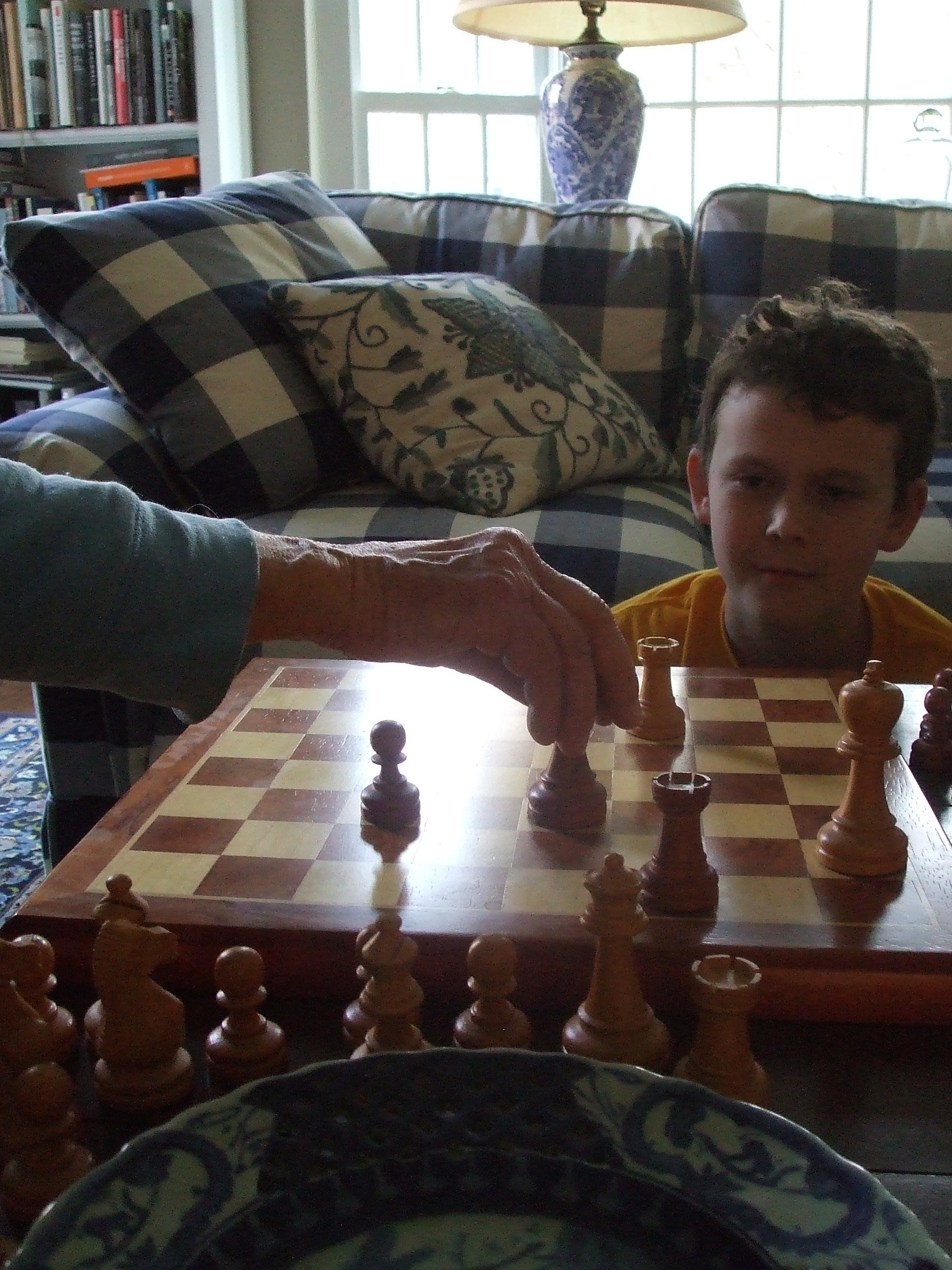
photo above is my mama playing chess just this past tuesday with boy 2, aka teddy. and here is one more thing she taught me to love…

viburnum

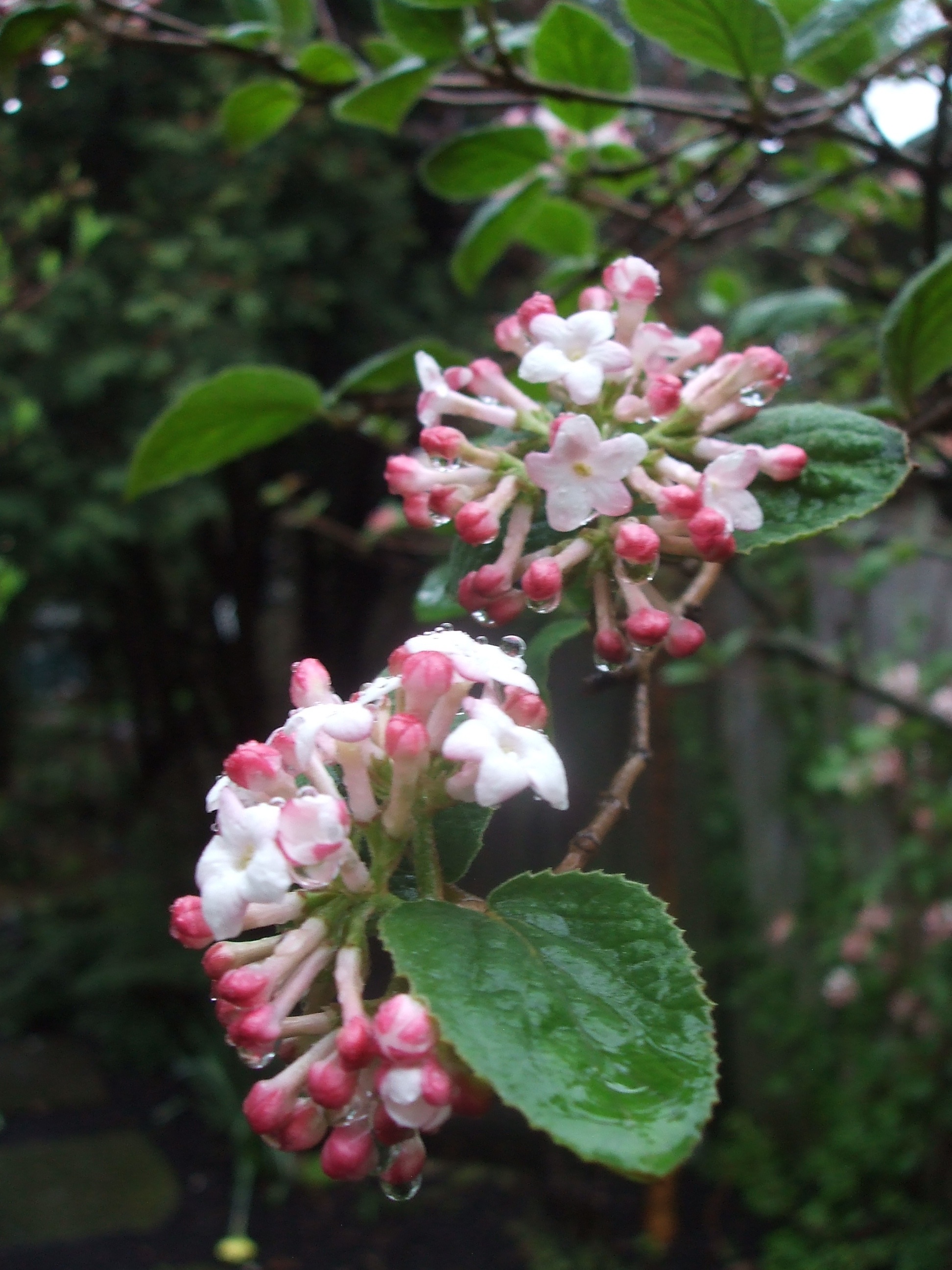
korean spice viburnum, blooming just this morning outside my kitchen door, a bouquet for my mama..

and for all my beautiful friends whose mamas are no longer here, a bundle of extra deep hugs. it’s a bottomless loss, stirred all the more painfully on this day when it seems everyone else is bathing in the very thing that brings you heartache. 

reporter’s notebook: on poetry and peepers and what’s hierophany?

reporter notebook faith and writing

because it’s sunday night, and late at that, and because i promised to ferry home a satchel filled with poetry and wisdoms to mull for a week or a day or a lifetime, i’ll cut straight to the cuttings from my notebooks, the two i filled front and back, draining three fine pens of all their ink.

i will say — because it’s impossible not to — that besides the breathless whirl of words and words and kindness and words that sometimes lifted me from the hard pew on which i was sitting, or the hilarity of anne lamott that made me marvel — and love her rare brand of kooky brilliance — all over again, the most mystical moment came late two evenings, as i walked alone toward the far end of the vast asphalt acre that was the calvin college parking lot.

the moon was half both nights, or nearly so. the sky, a western michigan sodden blue. the daylight not yet rinsed out. the night shadow inking in. and then, from the lacy backdrop of leafless woods, the rising vernal chorus of the spring peepers, that amphibian night song that breaks you out in goosebumps — or it does me, anyway. it’s a froggy croak — a high-pitched rendition, indeed — i’d not heard since trying to fall asleep in the upstairs dormer of my husband’s boyhood home, where the backyard pond and its full-throated citizens lull me to dreamland with their percolating melodies. i wanted to record a few bars for you, so you too could share the goosebumps. instead, i offer this, borrowed from the land of internet.

and now, from my notebooks:

notes from the festival of faith & writing:

reading list*:

william spencer, the poet’s poet according to keats.
brian young, one of the more powerful poets writing today, according to poet geoffrey nutter. died last week. “recollection.”
theodore roethke opened up nature and poetry for poet and scholar kimberly johnson.
before the door of god, religious poetry through history, by jay hopler and kimberly johnson.
“man killed by pheasant,” john t. price. short story.
loren eiseley, “the star thrower.” 16-page essay.
chenjerai hove, zimbabwean author, poet, playwright and human rights activist (outspoken critic of robert mugabe) who lived in exile in norway, wrote the novel bones, and inspired okey ndibe.
jessica mitford, great memoirist, the american way of death.
patricia hampl: “if i could tell you stories.”
“the whaling chapters” of moby dick.
“the inheritance of tools,” essay by scott russell sanders.
lia purpura, “rough likeness.” a book of essays.
john fowles, “the tree.” essay.

* these are the titles i scribbled every time one of the truly enlightened speakers tossed out an exhortation, “you must read…” a reading list in progress (in perpetuity, actually)….

words to fall in love with:

pullulating: means “sprouting.” or breeding or spreading.
hierophany: places where sacred and secular meet. The term “hierophany” (from the Greek roots “ἱερός” (hieros), meaning “sacred” or “holy,” and “φαίνειν” (phainein) meaning “to reveal” or “to bring to light”) signifies a manifestation of the sacred.
petrichor: word for the smell of rain on dry rock. petra, rock; ichor, blood that flows through vein (in greek mythology, the ethereal golden fluid that is the blood of the gods and/or immortals). in modern usage, it’s a glorious word for a pleasant smell that frequently accompanies the first rain after a long period of warm, dry weather. (who knew there was a word for that most delicious spring perfume?)
adiaphora: “meaningless things.”

a few fine lines, and the lively minds who put breath to them:
notes scribbled from my notebook (in order of appearance over the three-day festival)…

uwem akpan, nigerian catholic priest (formerly a jesuit), author of say you’re one of them, collection of five short stories telling of african horrors, each told through the voice of a child:

“if you’re afraid to fail, then don’t try. sit in your room. don’t marry. don’t give birth.”

“for those who want to be writers, be brave, act justly, love tenderly, walk humbly before your god.”

most poignant moment, after his talk when a young blogger walked up to him and said she’d been writing from darkness all month, in the eclipsed days since feb. 13 when her 29-year-old husband died, after a years-long battle with cancer, leaving her alone with a not-yet one-year-old. akpan, a priest since 2003, magnificently ministered to her with his gift of words. i cried, and through tears, i scribbled some of what he said after folding her into his embrace: “get into rhythm. don’t shy away from anger. the prayers may not come. go to the psalms, let them fall off your tongue. when God sends you on a trip, he arrives there before you.

“right now you’re alone in that body of water, rowing toward the shore.”

geoffrey nutter, poet, author of four poetry collections, most recently, the rose of january. teaches poetry at princeton:

it’s been said that his writing gestures toward what t.s. eliot called, “frontiers of consciousness beyond which words fail, though meanings still exist.”

“comprehension is unnecessary in reading a poem. apprehending is instantaneous response: what poetry does best. to poets, the image creates the powerful image more so than ideas. images are more intelligent in the poet, do more work. unfold into resonance. it’s where the soul work is done. poems resonate with mystery.”

“the moment when empathy was born: when jesus, scribbling in the sand, said, ‘don’t judge lest you wish to be judged.’”

calls 17th-century poet henry vaughan “one of my best friends.” adds: “words written in the 17th century in a moment of passion, like a note slipped under the door to us.”

“certainty leaves no room for imagination. if uncertainty can wake up our imagination, our imagination is the beginning of empathy.”

eliza griswold, guggenheim fellow, journalist and poet, author of the tenth parallel: dispatches from the fault line between christianity and islam, and a new collection of poetry, i am the beggar of the world: landays of contemporary afghanistan

“heirophany, places where sacred and secular meet. one of the most fundamental places in my life, this space where the horizontal, secular, meets the ultimate; literally, the shape of the cross. that’s poetry, everyday time is punctured by the sacred….my calling is there, the place where sacred and secular meet.”

mary szybist, poet, 2013 national book award winner for poetry for incarnadine:

szybist, a reviewer wrote, has “an appetite for the luminous; reaches for the heavens without bypassing earth.”

“hard for me to believe faith is possible without doubt. or reverence without irreverence.”

kimberly johnson, poet, translator, literary critic, professor of renaissance literature and creative writing:

“writing a poem is like walking around all day with someone pecking on your forehead. something just beneath the surface is waiting to be let out.”

“i want to live my life in epiphany. i want all my pores open. it’s easier for me when language and culture and stripped away. it’s unmediated experience. my antennae is tuned to stuff that exists beyond the social sphere.” (it’s why she loves nature).

from john t. price, essayist, nature writer, professor of english:

quoting mary oliver: “attentiveness is the root of all prayer.”

okey ndibe, nigerian writer, poet, journalist, author of arrows of rain and foreign gods, inc.:

referring to some not-so-cheery bloke: “no milk of human kindness in him….” (an expression that found me muffling my out-loud sigh of verbal wonder)

“a story that must be told never forgives silence.”

thomas troeger, professor at yale divinity school, hymnist, ordained episcopal and presbyterian minister, who has been quoted as saying (not in this festival, but i couldn’t resist):

“I am trying to map the landscape of the heart that still rejoices in God yet lives in a world that is often oblivious to the spirit.  I believe to live gracefully with this tension is the mark of wisdom.  Such an understanding may baffle the dogmatic mind, but it does not lie beyond the capacity of the poetic imagination.  The imagination often holds together realities that are logically inconsistent yet dynamically coherent.”

reading from his essay, “season of lament”:
“we are living in a season of sorrow for the human community, and part of our role as musicians is to help the human heart relieve its tears so that we might sense anew the resilience of hope that we will never know if we have never wept.”

might i mention that he was a textbook portrait of old-school yankee sartorial splendor, with taut bow tie, tweed jacket, and crisply-creased khakis. all topped off with a mop of professorial white curls.

anne lamott (who was brilliant through and through, and hilarious to boot. oh, and who had just turned 60 the day before her friday night keynote).

“it doesn’t help that when you sit down to write, all your unresolved psychiatric issues choose to come visit you that day.”

(and as she sat down let sunday morning to type a facebook post about turning 60) “all the psychiatric issues sat on the bed with me — and they’d had a lot of coffee. they wanted me to know how they thought it was going — not very good.”

“laughter is carbonated holiness.”

“because we’re religious people we’re not going to spackle our hearts closed to block out the hurt.”

panel with peter marty (pastor/writer), christine byl (seasonal laborer, clearing trails in alaska, where she lives in a yurt with her husband and a band of retired sled dogs, author dirt work: an education in the woods), john t. price (nature writer)

quoting henry james: “a writer is someone to whom nothing is lost.”

quoting patricia hampl: “we don’t write what we know; we write to discover. to go off on an adventure.”

christine byl: “i write about what i don’t know about what i know. that’s where i enter. i enter the familiar with an eye toward the undiscovered.”

fred bahnson, writer, farmer, former peacemaker among mayan coffee farmers, author of soil and sacrament: a spiritual memoir of food and faith

“our job is not so much to make a point but to evoke something. invocation is one of the oldest forms of communication. it’s a priestly urge. the act of focusing your attention on something. creating a shared empathy. they’re not beating them over the head, you’re simply saying, ‘look, attend.’”

mycelium (vegetative part of fungus): “perfect metaphor for prayer.”

amen and amen. and good night.

it’ll be two more years till this festival convenes again. i’ve plenty to read till then, and more than enough to think about….(and in the meantime, big giant thanks to my dear old friend and latter-day pathfinder, bruce buursma, the tribune’s longtime religion writer — later baseball writer — who pointed me to the festival in the first place…what a mensch. and great wise soul.)

anything above strike your poetic fancy? who would you add to an essential reading list of poets and thinkers and brilliant essayists (oh, by the way, some fine soul reminded me this weekend that the word essay, with french roots, means “to try, to attempt.” is that not all we can ever do, weaving words into thoughts into rocket blasts from our heart)? what words would be among the most delicious on your plate? 

road trip: words upon words, stopping at the intersection of faith, doubt and ink in between

ffw-logo-shadow

before the sun rises over the steel mills of gary, indiana, tomorrow morn, i’ll be motoring toward motor city for a three day festival of words, words and more words. with a fat dash of big questions stirred in for good measure.

i’ll hit the brakes before i hit the outskirts of detroit. in fact, i’ll be stopping mid-mitten, at just about the palm of the hand, to pull into the fine burg of grand rapids. i could roll down the windows and listen for the voice of anne lamott, a faith-filled writer you might have read. but i’m actually a bit more keen on listening closely to uwem akpan, the nigerian catholic priest who penned the haunting “say you’re one of them,” five short stories of african atrocities told through the voices of children; or amy leach, a shy and brilliant essayist whose debut book, “things that are,” is a madcap collection of nature essays encouraging communion with the wild world (she’s been said to be “a descendent of lewis carroll and emily dickinson,” be still my heart — a girl after my very own chambered vessel, indeed).

a clutch of poets will be in the bunch, and i intend to be in the room when mary szybist, the author of “incarnadine,” winner of the 2013 national book award for poetry, tackles “reverence without curtsying.” or when jeanne murray walker, poet and playwright, talks memoir, or okey ndibe, the nigerian poet, novelist, journalist and political commentator,  takes on “negotiating between the visible and invisible: deities and writing.”

i’ll have notebook flapped open and pen perched (for i’m among the last of the pen-and-paper note takers) when guggenheim fellow eliza griswold, best-selling author of “the tenth parallel: dispatches from the fault line between christianity and islam” steps to the podium, or when james mcbride, author of the brilliant “the color of water: a black man’s tribute to his white mother,” and most recently, “good lord bird,” a comedy about the abolitionist john brown, which won the 2013 national book award, settles in for a thursday night’s conversation.

it’s called the “festival of faith & writing,” and who knew that such a gathering of great minds has been convening every other year on the rolling campus of calvin college — smack dab between the literati-littered coasts — since 1990. and that over the years, elie wiesel, john updike, maya angelou, salman rushdie, annie dillard, kathleen norris, and donald hall — to name but a handful — have been putting voice not to unwavering belief but the far more animated living-breathing blurred boundary between doubt and hope.

it’s that very crack in the veneer of faith, the place where shadow seeps, that birthed the festival in the first place.

“because of a long interest in writers between the cracks — writers who struggle with and deal honestly with the challenges of human experience, while writing with skill and poise and quality. these are not people who are easy believers, but that is part of what makes reading such authors worthwhile. we can learn a lot from these folks and their honest portrayals of the human experience,” says dale brown, the former calvin english professor who dreamed up the festival, one literary invitation at a time, and presided over it until he left the college to run the buechner institute in 2007.

it’s a mere 204 miles away, and it’s a landscape i’m learning, one page at a time.

if laptop and lulls allow, i’ll post dispatches from the front. fine thoughts, stirring questions, readings you might want to track down. if not, click on any of the above links and partake in a virtual festival of faith & words, all on your own.

in the meantime, what writers/thinkers/poets might you drive a couple hundred miles to encounter, page to page?