pull up a chair

where wisdom gathers, poetry unfolds and divine light is sparked…

Category: journalism

and so she wrote….

this is it.

end of chapter. start of new…

but, before we finish turning the page, before i sit and stare at a whole blank page of the newsprint of my life, i want to sift through a few old, yellowed sections. i want to remember. to spool forth thanksgiving. to send smoke signals out to people and places far far from here.

i want to hold up this moment, these moments, this chapter. i want to grace it with abundant blessing.

i walked out of the newsroom yesterday afternoon, my last day there. i had to leave early. i laughed. even my last day i sort of flubbed, if you want to call it that, because my little one had invited me to the fifth-grade wax museum, and i wasn’t about to miss it — he’d spent the better part of two months crafting and memorizing and dramatizing the life of PT barnum, and it just so happened the show’s opening was the very close of my newspapering.

so, instead of staying in my desk till the bitter end, i had to throw on my backpack and dart out the door, a mother’s best move so very often.

i didn’t pop champagne. didn’t turn out the lights at the billy goat tavern, that subterranean watering hole that’s doused so many a newspaper scribe’s parched, dry gullet.

but there was coffee served in the conference room yesterday morn, and all the folks i type with, they huddled around, took seats at the table as if it was any everyday meeting.

being journalists, they rattled off a few great questions: what was your favorite story? how many jobs have you had here at the tribune? how did you meet blair (my mate of 20 married years, my dear friend and “crush” of nearly 25)?

i loved the question about the favorite story. took time to answer that one with plenty of heart.

i’ve been pondering it for the last couple weeks. in fact, i decided a while back that my own private chapter closing would be the day i climb to the attic and sift through the boxes and crates of old yellowed newspaper clips, to read and remember, to run my fingers over the grainy photos from long ago, to absorb through and through the holy walk that was this chapter.

but, without even yanking the rope that lowers the door to the attic, i can sift through a few stories here.

after all, all of you here at this table, have been behind every breath of this passage, even when you hadn’t a clue.

there is much to remember as i flip through the pages of all of the years.

my favorites?

one has to be the story i wrote about the farmer who lost her soldier son, and turned to the fields to till through her grief. i sat beside her one hot summer’s day on her creaky old porch swing, down on a farm where the trees scratched the sky. i wrote what she said, what i noticed, what stirred in the air. and once that story hit the paper it somehow wound up in faraway maine.

there was a fellow who worked in some shop up there, and when he sat down to lunch one particular day, he found the chicago tribune spread on the table. he picked it up and read the story about the farmer and all of her sorrow. he put the paper back down, and went back to work.

but that night, driving the two hours home, he couldn’t stop thinking of the story — and the farmer. so he turned his truck around, and drove back to the shop. he tore through the trash cans till he found it, the newspaper section with the farmer, standing out in her field looking skyward. he rolled up the paper, tucked it under his arm, tossed it onto the passenger seat and drove home. he stared at that paper for awhile, then he got brave. sat down and penned a letter. addressed the envelope with nothing but her name and the name of the town he read in the dateline of that newspaper story.

to make a long story short and sweet, here’s what happened: he wrote, and she wrote. back and forth for the better part of a year. even a phone call or two. he invited her to come up to maine. she did. she went back home and put her farm up for sale. they farm together in the north woods of maine now.

all because he read her newspaper story.

another favorite is the one about the pigeon man of lincoln square, a curious fellow, a fellow who struck me right away, a fellow whose story i had to find out.

he used to sit on a fire hydrant along a busy city street, and dozens of pigeons flocked to him, perched on him. i nearly swerved out of my lane the first time i saw him. i drove back quick as i could, talked to him off and on over the course of a few days. went up to his attic apartment, the place where he kept his pigeon-feeding supplies and rested his head. i wrote his story. wrote how he struck me as some sort of st. francis of the city.

three years later, that old man with the crooked spine was shuffling along another busy street when a van up and hit him. he fell right there on the sidewalk, died before they got to the ER. as they lifted his body onto a stretcher, the police told me he was clutching a laminated copy of the story i’d written three years earlier.

those might be the bookends of my shelf of favorites — a start and an end.

but in between, there would be so very many. the trek across america, all on my own, back in 1984, as i traveled to see and to hear — from the rio grande valley to the mississippi delta, from pennsylvania steel mills to backwoods in maine, from salmon fisheries in northern california to farm towns in iowa — just what it meant to be hungry in america.

or the night when i stood, nose pressed against the crack between ballroom doors, and watched prince charles swirl on the dance floor with all of the ladies of the oak brook polo club.

or the mother, long long ago, who had a sweet boy with down’s syndrome whose smile i will never forget. or the father whose daughter lay dying of anorexia nervosa. or the little boy who fell through the ice of lake michigan but did not die, and so i kept vigil with his mama and papa as the whole city watched and waited and held their collective breath.

after all those 30 years, when i think back over the breadth and depth of humanity i have scribbled into my notebooks, soaked into my heart, i sigh a mighty sigh and whisper one solitary truth: it really was the voyage of a lifetime.

and i am so deeply grateful and humbled and blessed.

i wrote one last column, a “Dear Reader” goodbye. i sent it to my editor the other morning, but i don’t think she’s letting it run in the paper.

so i will end this meander with the one column that no one else will ever read.

these are the last words i typed for the chicago tribune, where i worked from june, 1982, to february 10, 2012:

Dear Reader,

There is a breathtaking tradition in newspapers when one of the ink-in-the-veins scribes leaves the newsroom for the very last time: Everyone at every news desk stands up and “claps out” the exiting reporter, a parade of final applause that is, in every way, the highest salute.

I want to reverse that tradition on this, my last day in this newsroom. I want to be the one who stands and applauds all of you, dear readers — even though I’m the one leaving.

I want you to know that for the last nearly 30 years I have poured my heart into each and any story, because as journalists we get to be the eyes and the ears and the heart for all of you as we go about the business of gathering stories. We ask questions, listen hard to answers, and soak up the scene, so we can bring you to the news as much as we bring the news to you.

I want you to know that it has meant the world to me to be trusted to tell you those stories. And I want you to know that I treasure our connection, a very real connection. I have saved — and will carry home — your emails, and your letters. Alas, I will have to leave behind a few glorious voicemail messages, some of them saved years ago. I consider all of them — penned, or typed, or recorded — the prizes of my life.

I will miss you.

And I thank you for inviting me into your homes, to your kitchen tables, and your favorite armchairs, for all of these many very rich years. I leave this newsroom in very good hands, and in very good hearts.

Bless you all.

Your grateful scribe,

Barbara Mahany

-30-

-30-

back in the old days, when i started out in the newsroom, that nurse who’d wandered in off the street, in search of a great story to tell, we pounded out stories on typewriters, on triple-thick pages.

at the bottom of any news story, to let the desk know you were ending your tale, you typed “-30-”

and so, today, -30- is the keystroke of the day.

my phone rang just minutes ago. i’d been jumpy all day. had put off typing here, because i wanted to see if finally i could tell you, could let the ol’ cat out of the bag.

here’s the cat, squirmed from the sack:

my days of newspapering at the chicago tribune are nearly through. they told me just now that my request for a buyout has been “allowed.”

what that means is that next friday will be my very last day to walk into the great gothic tower, the one with the flag waving up against the clouds. it will be my last day to tuck my badge in the little card-reader box and to see the light flicker green. it will be my last day to call out “hullo,” to ricky the guard who always starts my day with a big fat smile.

it will be my last day to shuffle over to my cubicle, to sit down among the cards and letters and books piled high.

it will be my last day, after nearly 30 years, to type, “barbara mahany, tribune reporter.”

but i have utterly no intention of hanging up my story-gathering cape, or retiring my deep and unending dream of telling stories that wend their way straight into the deepest corners of the human heart.

something was born here, where we pull up chairs.

i learned a way of writing here that i can’t muzzle.

it is a way of writing that every once in a while found a place on the news pages. and whenever it seeped out into the world of readers, i got plenty of notes. heartfelt, beautiful, make-me-cry notes. from readers.

oh, i will miss those readers.

i’m leaving because i want to be free to find and to tell stories that burn to be told.

i’m leaving because i’ve achingly missed being here in this little typing room, where the birds flit by, and the sun slants in, where the sacred dwells all around me and through me.

oh, sure, i’ve managed to find moments of joy on the el train. i love rumbling through the city. but i don’t so much like locking the door behind me each morn, and not coming back till the day is nearly done.

i love slow cooking while i type.

i love being here when my little one leaps through the door.

this is the thing that took so much courage: to finally, after so many years there on the edge of the high dive, take the final big bounce and jump through the air.

it’s not easy leaving behind a once-every-two-weeks paycheck.

it’s not so easy letting go of the knowing — till now, anyway — that my stories would always find a place to land, without me having to peddle too hard.

but i finally, finally dug down deep to where the answer was crouched. i finally reminded myself how brave i could be. and how deeply i want to see if my words and my stories and my heart can make a difference. can make this world just a little bit more compassionate. can shine the light on some lost soul in the shadows. or some phenomenal hilarious character whose life might make us all want to get up and dance.

i am taking a big fat chance on me and myself.

i am believing that somewhere deep down inside me, i can stand on a mountaintop and whisper long lines of poetry.

i am holding a candle in the dark, and believing a long line of wicks will flicker, one at a time.

i am being brave, and teaching my boys not to be afraid. not to be bound. to march, always, to the sound of the drum that they alone hear.

i am begging for grace to come raining down.

i will keep writing this story, one word at a time.

i can’t imagine that all this living i’ve done, all this collecting of hearts, has not been a serious chapter in the education of bam.

i’m not looking for fame. i’ve seen that pass by the best of the best too many times.

i am looking for simply one thing: to live my every last day with full heart, and full soul, and full courage.

and that’s the thing i’ve been wanting to tell you.

now, we all know.

thank you for giving me wings.

ever grateful,

your bam

holding hands

it’s been a long time since i leapt off the high dive, felt the whoosh of my body — bare skin, wet suit — free-falling through air.

it’s been a long long time since i last mustered the courage, flung myself out into the unknown.

but, i was reminding myself, i’ve done it plenty before.

i can do this.

there was the time, long long ago, when my mama and papa drove me downtown. to the hospital, they told me. you are going to get better, they told me. and i did. but not before being scared out of my wits.

and there were long nights in college when i had no clue where i was headed. but one saturday night in the library i decided i knew. and i decided that to get there i was going to snare myself a solid line of straight As. so i did.

there was the night my papa died. and i never wanted to exhale the breath in my lungs from before he was gone. could not bear to take in a swallow of this new oxygen, depleted of the great love of my life at the time, my hero, my papa.

but i did.

not too many weeks after that i picked up a telephone and told a man on the other end of the line that i was a nurse, but i wondered if maybe they’d have room in their school to teach me a thing or two about writing.

he did. so i did.

and then, not long after that, i walked into the great gothic tower of a newspaper i’d grown up reading. i bumped into a fellow who wore purple high-top tennis shoes, and spilled chunks of oil-drenched salad all over the pages, my pages, that sat on his lap. he read along, looked up, said, “i think i can use this.” i let out a yelp. said, “i think you just made my life.”

not long after that, the lady in charge of plucking recruits out of the masses, enlisting them in the summer army of interns, she called me up, called me in for an interview. last thing she said to me in that tiny broom closet of an interview room was this: “around here, you sink or swim.” i looked her straight in the eye and said, plainly, “i’m a swimmer.”

and so it’s gone, over and over and over again.

we forget sometimes, until we need to remember, just how brave we can be.

and then, once we remember, the oddest most curious things start to happen.

once we stare our fears in the eye, once we decide, okay, universe, we’re not going to be bound anymore. not going to stand here, frozen in time and space, thinking of all the things that could go wrong, might go wrong. we’re going to step off this ledge, and try that free-falling move once again.

once we do that, just as goethe, the great german philosopher, long ago said, “at the moment of commitment, the universe conspires to support us.”

in other words, all around, from out of the darkness, folks start extending a hand. taking our shaky one in theirs, and holding it soft and tight.

the phone starts ringing, and people say things that give you tingles up your spine. because how did they know–out of the blue–that you needed to hear those very words at that very moment?

emails pop into your mailbox. and you click here or there, not really thinking what you’re doing, and next thing you know you are reading something that slides right sweet into the place where you needed it to be.

might be that the fellow you married — a guy known to be plenty cautious and not keen on rash, irrational moves, pretty much the life-long grounding rod for your high-wire act — keeps telling you you’re doing the right thing.

might be your 10-year-old boy, who lets out a whoop, pipes up during dinnertime prayers, “dear God, thank you for the bravest mommy there ever was.”

trust me, i’m not launching myself into space. not about to set up a colony on the moon. not tackling a cure for cancer.

just putting one foot in front of the other.

but, for the first time in a long time, headed in the direction of my heart. instead of the way that’s been slow-dripping, leeching the pink right out of my cheeks.

and once i got through the talking to myself, reminding myself i’ve moved my own personal mountains before, i have been utterly and joyfully buoyed by the power, the knowledge, the wisdom, of the universe to make like a marvelous tunnel of hands and hearts, each one reaching out, giving me the nudge, the squeeze, the full-throttle embrace i need to keep this free-fall from feeling like a death-dive.

instead, i am slowly, solidly, catching the wind.

and one of these days, i just might look down and realize i’ve started to soar.

what a bummer. can’t let you in on specifics. not yet. will when i can. but in the meantime, what freefalls have you knowingly, bravely, stepped into in your life, and who were the great good souls who reached out and let you know you were going to be all right, and no one was letting you splat flat on your face? what are your moments of personal courage?

mama’s got a tough, tough job, and someone’s gotta help

when i was a kid, my dad was larry tate, the buttoned-up business half of the ad-biz duo on “bewitched,” that 60s (or was it the 70s?) sit-com starring samantha.

well, he wasn’t really ol’ larry. but that’s how i had to explain it, whenever i said my dad was an ad man, and the follow-up question was always: “is he darrin stephens or larry tate?” darrin was the creative dude, the one who married the nose-twitching daffy-hearted witch. larry–and, yup, my dad–was the one who kept the creative types in line. but, at least in the case of my dad, that didn’t mean he was so buttoned-up.

my dad loved nothing more than a great laugh.

if there’s one sound i can still hear, it’s the sound of his big booming guffaw, breaking the air in a room, filling the space between walls, flicking the switch in my heart, making it glow.

i LOVED that my dad was an ad man. fact is, i loved everything about my papa. but knowing he rode downtown on the train, carried that briefcase filled with top-secret memos to clients like betty crocker, mcdonald’s, even the folks who made play-doh, well, that made me feel like i was plugged into the nerve center of our times.

heck, my dad brought home a plain cardboard box, marked X, and it was a test sample of hamburger helper. we were some of the first kids in america to spoon that glop in our mouths. and we lived to give him a thumbs up or thumbs down.

the stories at our dinner table would swirl with stuff that mattered to kids growing up in suburbia in the hair-raising 60s, and the dick-nixon 70s.

we knew the ins and outs of big macs, and all about all the sugar-coated cereals packing the grocery-store shelves.

pop tarts? we had ’em early, had ’em often.

we didn’t screech on the taste-testing brakes when we crossed over the sharp lines of whatever “the clients” had fobbed on the market.

why, it was our job, our patrimonial duty, to invade enemy territory. we were the spies, me in my pig tails, my brothers in freckles and iron-on patches on knees.

we guzzled whatever the ’60s and ’70s offered. we didn’t much mind (although, for the life of me, i was deadset against hamburger helper and its ilk from the get-go, not yet appreciating the ease of dumping, stirring and filling the tums of five hungry kids).

which, in a round-about way, brings me back to the latest episode in the tale of the boys we call our double-bylines, meaning the poor little fellows (one, now not-so-little) who get to grow up in a house with a dad and a mom in the news biz.

which, on rather regular occasions, means i lope home from the office with a satchel stuffed with curiosities and delights and general conversational stimulants.

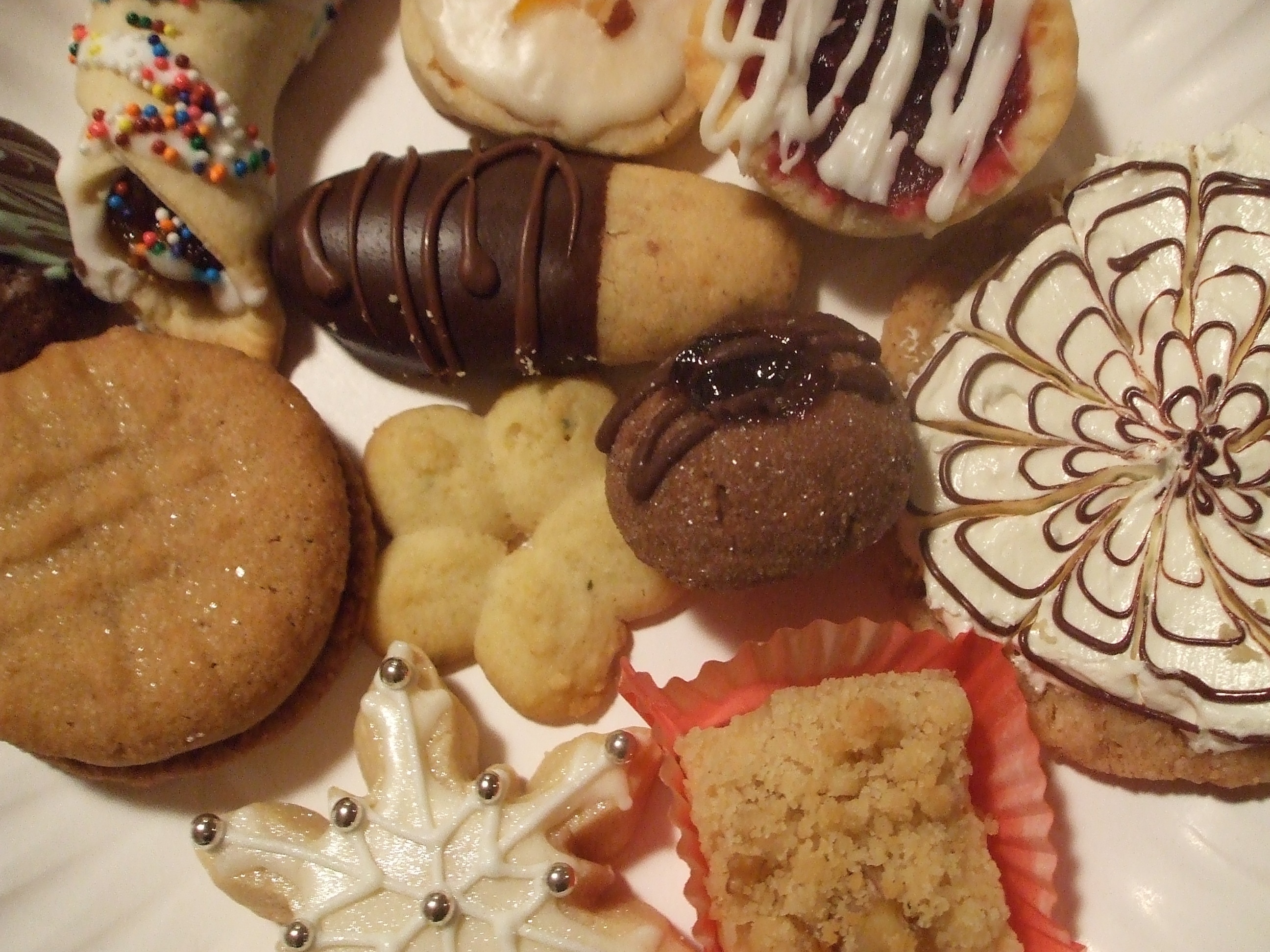
like this week, when it was my job to corral the best cookies in the land. or at least among readers of the newspaper where i type three days a week.

yup, it was the annual tribune holiday cookie contest, and someone had to be in charge of getting those cookies into the great gothic tower that is the tribune. and someone had to rustle up the 16 judges, put out the paper plates, the cups of water, the pens and the score sheets.

that someone was me.

and so, when the long hard day of nibbling and scoring was over, i asked if — please! — i might be allowed to haul home just one plate of each one of the 11 finalist cookies, so my own personal judging panel could convene.

and that’s where the sugar-saturated plate up above comes in.

that was homework for my fine little boy who’s pretty much convinced that sweets is one of the food groups. if not the most essential of the lot.

just after dinner (yup, we actually held off till after the protein and veggies; give us brownie points for that, please), we lined up the contest with great ceremonial pomp.

just like back in the tribune test kitchen, i set out cups of water, pens for each judge, and the nibbling began.

in fact, i knew full well that this was yet another one of my ploys to exercise that boy’s descriptive ways. i swooned when he launched in on the first, a glimmery snowflake of a cookie, which he described thusly: “it looks like a snowflake has just fallen with sugar and sparkles dancing on it.”

or, of a chocolate-swirled marshmallowy number: “it looks like a collage of butterflies.”

find me a full-fledged tribune judge who dished out such poetry. and this from my boy who has tussled with words in his day.

while he nibbled and spun his sugary stanzas, his papa chewed and scribbled in silence. in the end, once the last crumb was licked off the plate, we wound up with a three-way tie for first prize.

but for me, the very blue ribbon i pinned on the day was the glorious fact that, for little more than my train ride into the city, i could bring home a piece of the world far beyond our little town’s walls.

in the same way that once upon a time my daddy’s job made me feel like i had a window onto something big, something exciting, i hope my sweet boy feels just a tad more engaged with the wheels of the ever-cranking universe.

i hope that while i’m the one with the measly paycheck, he’s the one who catches the magic. who sees the power of words. who tastes the thrill of civic engagement, even when it’s just a cookie contest.

if he listens–and i’ve reason to think that he does–there’s not a page from my day job that doesn’t somehow rub off him. if not in ink, then surely in stories, in laughter. and sometimes, come the start of november, in cookies that make for fine poems.

when you were growing up did someone in your house have a job that made you look at the world in a particular way? it’s a curious marvelous thing, not oft considered perhaps, how all the ways the grownups lead their lives, are all a part of the education of the little ones who grow up so closely, thoughtfully watching. it adds a dimension of meaning to the every day. and makes that ol’ trainride not nearly so onerous. tell us how you learned to look at the world?

despite it all…..

if, on any one of the days of this past week, i had scribbled down every last thing i was trying to hold in my head or my heart, i might have run out of ink.

there was the phone call from school, saying the little one was sick again, please come fetch.

and there was the early morning email that someone very wonderful, very brave, had died.

there was the lost assignment notebook, and the lost $40. there was the rowing jacket that needed to be claimed, and the rower, too.

there was the doctor to visit, and the milkshake to wash it all down. there was the carpool — or two — i was scheduled to run, and did, even though the player of soccer was felled by a flu bug.

there were eight lunches to pack, and three days where a can of noodle-y soup sufficed for the one spending his days on the floor in a pile of blankets.

there was dinner times four. and a brouhaha the night the little one didn’t eat much from his plate, but somehow finagled a trip to the donut shop, riding shotgun with his unsuspecting papa.

then there was the rowing trip to pack for, and the deciding which grownup would drive to toledo and which would stay home for the soccer team pictures.

there was the neighbor whose papa had died, and the figuring out who would bring dinner.

there were tomatoes to pick before they burst, and hand-me-down hostas to plant before they shriveled and died.

sometimes i wonder if maybe we’re doing too much.

if maybe i’m trying to squeeze too very much into the too-narrow skins of my sausage.

sometimes–and that list up above is barely the least of it–i think maybe it’s not such a good idea to try to live like we do.

but then, despite it all, i find myself out in the world, gathering stories, doing the work that i love, and well i can’t imagine not getting to do that.

one fine early autumn morning this week, i was tromping through parks i might never have entered alone. i was meandering along a prairie river, tiptoeing across rocks laid in the path of trickling waters. i was deep in the fronds of a fern room, all laid out by that great designer of greenspace and parks, jens jensen, the dane who fell hard for the midwestern landscape, the prairie, the rocks swept in by the glaciers, the billowing shafts and nodding heads of the grasses.

yet another hot september morn found me seated beneath a crabapple tree on a wood bench in an english walled garden beside a ruddy-cheeked englishman, one with a sketch pad on his lap, and a mug of earl grey clasped in his fist. it was john brookes, i was sitting beside, the great designer of gardens english and otherwise, author of 26 books, and something of a living legend. we were talking, he and i, about the spirituality to be found in a garden, and the distinction he makes between vines and climbers, and why one belongs in a vineyard and the other is essential for ooomph and lift in a garden.

through it all i was gathering bits and yarn for the most humbling sort of story to write (at least in my book, that is): an obituary, the distillation of one great and layered life into a mere 800 words. it is the writer’s job always, but especially here, to sift and pick, to harvest only the richest fruits from the tree of a life. to hold up mere threads that suggest the whole tapestry. to leave the reader gasping and grasping, understanding a life as its flame is snuffed out. oh, lord, let me do right.

so, yes, despite it all, despite the nights when i did not sleep, drew the bath at 3 in the morning in hopes of quelling a raging hot fever, despite the grumbling there in the kitchen, and the hauling myself out of bed to pack yet another brown bag lunch, to simmer one more pot of oatmeal, i cannot imagine a life much richer: to learn history at the foot of a great historian, to talk gardens with one of the best in the world, to talk to the still-raw widow, to ease from her the words that will tell the world of her one true and lasting love.

despite it all, i’d do it again. and chances are, soon as the page of the calendar turns, and a new week starts all over again, i will.

the variations are many, but the theme is constant: i cannot imagine one half of my life without the other, and even when they bump and collide, each half makes me so much more than a whole.

oy. forgive me. this might seem more of a lonely unspooling than reaching for common thread. except that every one of us likely has a corollary to the mayhem and triumph above: we live half-crazed lives, uphill climbs, because we believe we’ll get to a mountain top. there will be a moment, we convince ourselves, when all the headaches are swept away and the big picture is clear: the combined steps of our journey have taken us to a place beyond our dreams. how do you wrestle the dailiness of your life into a meaningful climb? do tell.
and p.s. for those of you wondering about that new tribune adventure, it’s coming next week. in the news biz schedules change with the blink of an eye. so the editors held off for awhile….

storybook gardener

since the day i moved here, five years ago now, the storybook cottage up above has held me in its spell. oh, i don’t live beneath its shingled roof, don’t know my way from room to room, have never even turned the front-door knob.

i only wander by, and cast my wishes in its woodland garden, where trillium, in spring, bumps up against the jacob’s ladder. where snowdrops are the first to come when winter will not take its graceful leave. and where, in autumn, tall grasses swish, the wind-borne lullabye before the garden slumbers.

i wink sometimes at raggedy ann, peeking out from up beneath the turret’s peak. see her? just a wisp of her, in the upper eastern window where she bathes, each morning, in the dawn’s first-light, as rosy-fingered sky reaches up and over the great blue lake just blocks away?

the raggedy one looks down on a garden as magic as any i have ever known, save maybe for “the secret garden,” frances hodgson burnett’s secret one, of course, which by page 42 of that sinful book (i once pretended to have a fever so i could stay home from church to read on and on) was the first i fell head-over-heels in love with, imagined myself inside of, tiptoeing near the climbing roses, curling up on stony bench, listening for the robin who’d led the orphan mary to the garden’s long-lost key and then, at last, to the ivy-covered door that hadn’t been unlocked in years and years.

there is for me something about a garden, a particular sort of mind-of-its-own garden, not one all clipped and shorn and pedicured, but one that rambles, grows this way and that, that sets me to pretending, spinning yarns to match the garden’s swift enchantment.

a little more than a year and a half ago, the storybook garden that belongs to the storybook cottage that just might belong to raggedy ann, gripped me, shot me through and through with what i feared was a most unhappy ending.
before i tell you what unfolded just the other day, i’ve pasted here the passage i once told. read along, then meet me at the story’s end, so i can fill you in on what we’ll call the epilogue.

the story just below, once was published in the chicago tribune. but i wrote it right here at my old pine desk, before i had a kitchen table where i could share my stories.

here’s what now becomes the prologue, printed first in october of 2006:

I am haunted these days by a fairy tale garden that I fear has lost its gardener.

There is, not far from my house, an enchanted little garden and a storybook house to go with it. The first time I eyed it, I nearly drove up the curb. It is all trellis and turret, and delightfully low to the ground, as if curled in a humble embrace with the growing things that spring all around. It is a house that whispers, not shouts.

At the head of a stepping-stone path there’s a front door an elf might wander through, and all around there are great patches of magic, grasses and flowering vines, birdhouses by the dozens, a place lovingly tended by someone completely in tune with the rhythms of wonder and the unfolding of time, season by season.

A Raggedy Ann, toddler size, sits up in the window of one the turrets, peeking out, keeping an eye on all. More than once, I swore she winked at me. The place, I’m telling you, is bewitching.

To drive by, or to wander by, is to slow the staccato of my every day. It is to breathe in and be reminded that lovingly tending the earth reaps wheelbarrows full of heaven.

The other day, though, the staccato picked up as I was stopped at the stop sign across from the storybook house. I saw streams of finely dressed folk pouring down the sidewalk, into the elfin front door, in the middle of a sun-drenched afternoon. This isn’t a holiday, I thought. But then a synapse connected: Those fine clothes were funeral clothes. Oh my goodness, something in the storybook was amiss.

And then, sure as could be, the next morning, flanking both sides of the garden walk, standing sentry for any passerby, were two giant funeral wreaths, one a sumptuous circle of red roses, the other a sheaf of blood-red gladioli.

I am haunted now by the storybook house, and its autumnal garden. Haunted because I am afraid the woman who loved there might be no longer.

Sad thing is, I never met her. Only saw her as a constant stooped figure, bent over her trillium and her scilla in the spring, deadheading her jonquils, cutting back and transplanting through the summer, raking and staking well past the first frost of winter.

I can barely breathe now when I drive by, wondering, worrying. What happens to a garden when a gardener dies? Who will feed the birds that have called her little patch home for decades and decades?

For now, Raggedy Ann keeps an eye on the place. I won’t be able to bear it if she, too, slips away some day when I drive by.

I mourn for the woman who tended the earth with all her heart. I mourn for the trillium and the jonquil and the clematis that will no longer be cajoled and tucked back and talked to, as I often saw her, lips moving as she moved from this to that growing thing. I mourn for all of us who might not have the storybook garden to calm us in the midst of our modern-day madness.

It is a wicked thing when a garden and its gardener do not live happily ever after.

–end of tribune story–

not long after the story ran, i found an email in my tribune mail box. just a few sentences in, my heart caught in my throat. it was an email from the storybook gardener herself.

she’d been stopped, she said, as she turned the sunday pages, drawn in by the drawing of a raggedy ann that ran beside my story, running down two columns. she started to read, and soon knew that this mysterious writer was writing of her very own garden.

she’d not died, she wrote me. but her dear, beloved husband had. suddenly. achingly. without a warning.

and all the bustle i’d come up upon, and the funeral wreaths standing guard by the front door, were indeed for someone loved, now lost.

the garden and the gardener were, oh, yes, deep in mourning. but the words i’d written had not rattled her, so much as soothed her, she wrote. to know that her garden brought so much magic to even one odd passerby.

i should stop by, she wrote. i should visit her in her storybook garden, or inside the magic cottage she now shared with only one limp ragdoll.

for 20 months almost, i’ve kept an eye out. i’ve knocked on that elfin door. i’ve spied evidence of her being there, a just-dropped trowel, a pile of leaves. but not once did i ever see the magic gardener herself.

until just the other dappled afternoon. when the sun played peek-a-boo through her maple leaves, and i saw her slight bent frame, hard at work.

i leapt from my car, i called her name. i tiptoed through her ferny thicket, felt my heart pound hard against my chest. i told her who i was, reminded her that i’d once written of her garden.

she needn’t be reminded. she’d waited, she said, all these months. had wondered why i’d never come.

oh, but i have, i said, a little bashful, a little sad that i’d not maybe tried harder. hadn’t thought to drop a basket or a note, tucked it by the door.

somehow, though, more words–scribbled, folded, left behind–didn’t feel enough, didn’t feel the thing to do. i’d been inclined to meet this soul in person; to know the hands, the eyes, the heart, that made this place call out to me.

here, sit, she said, patting her mud-rubbed palm on just the moss-laced stony bench you’d expect sprouting from her woodland trails.

we talked for the better part of an hour. she offered me anything she grows, to divide and migrate the few blocks south, to my still-getting-off-the-ground patch of earth.

uncannily, time and time again as we talked of achy hips and sudden deaths and how her garden grew, i felt as if i’d known her for a long long while. found myself delighted through and through by just how much our roots, our tales, entwined.

maybe, though, that’s what happens when you’ve imagined yourself in someone’s garden. thought about sipping tea on chilly afternoons, tucked behind her stained-glass kitchen windows.

or maybe, it’s simply magic, long seeded in the hearts of those who share a fondness for a sparrow’s nest tucked under eaves, and ragdolls who nap away the day up in attic windows.

as shadows grew, and i knew my stay might be getting in the way of some dear plant’s undivided attention, i couldn’t help but think how it was that her undying grief had brought us so round-aboutly together, sitting here, side-by-side, in her most enchanted garden.

and how this beauty all around us grew, despite the dappled darkness.

kindred souls discovered where the lilac bloomed, and mayapples nodded in the filtered sunlight.

the story, once imagined, had no happy ending.

but the story, real, i now knew, was like so very much of life: it is shadowed, yes, but only just in spots.

and, here and there and everywhere, new life is pulsing; pushing, bulging, shouldering the clumps of dirt, straining to break through the crusty-shell of earth.

no longer merely make-believe, the storybook gardener and the writer begin that time-worn art of cultivating friendship. drawn together oddly, they carry on as if their story’s meant to be.

which, just maybe, it truly was.

have you made a friend thanks to a garden? or some odd-unfolding circumstance? have you some inkling there’s someone not far from where you live, who just might be your long-lost soulmate, not yet discovered? do tell…

breakfast of champions

the little one was shlurping up the last bit of waffle a la jam, running way behind this morn, when he called out, “excuse me, can i have my sports section?”

he didn’t seem to mind the strawberry dribble running down his cheek. but he did mind when i–the one charged with shushing him out the door and down the sidewalk, somehow sweeping to the schoolhouse door before the whistle blew–did not oblige.

demurred, in fact, with a simple, and emphatic, “no, sweetheart, we’re late.”

still gulping, he protested: “but you can’t interrupt my morning schedule.”

oh. so sorry. hadn’t realized, sir, that what we had here was a routine, a way of being, a moment on which the day depended.

of course i’d noticed that, morning after morning for the last few days, while the rice chex soak up milk, you, my slugger sweet, soak up RBIs and ERAs and all those alphabet equations that long ago and always have escaped me.

but i had not heard the sound of cement drying, and this becoming what it’s been for ages long before you and who knows how long into the beyond: the rite of little boys and sometimes girls obsessed with all things round and flying through the air, cracking off of wooden sticks and diving through the dirt.

you have joined the ranks, my little reader, of those whose day begins with the shaking out and creasing of the pages where all the world’s a horserace or a ballgame or a wobbly putt rolling toward what might be a rodent hole but, in fact, was put there for the purpose of men and women wearing god-awful-colored pants and shoes with little nails jutting out from underneath the toes.

you, too, now scour the front page, search for what you call the headline, the score of last night’s game. and then, you bore inside. you up and rise off your stool or chair, you dive head-first into the somethings you call “the standings.” you report, out loud, all sorts of names and numbers. and by then i’ve lost you, i am sad to say.

just this morning, as i combed the house for keys, ran back for one last swallow of caffeine, you were broadcasting in spanish, no less, spitting out the scores–“quatro to uno,” you barked–for those who cared not to know in english.

quite impressive, little boy. you who months ago could have cared no less for all those scribbles on the page. you who thought you’d never read a number or decipher all the letters crowded there together, a herd masquerading as a word.

in a world where newspapers are whirling at the center of a storm, where few and fewer see the economic sense of printing news on paper and plopping it on your doorstep–such service, and such fear, will we go the way of the milkman and the knife sharpener, those door-to-door deliverers of goods and service, long lost–someone needs to understand the power of the third section from the front. the one marked plainly, sports.

it is from here that whole lives of depending on the news are born, are launched, are set in motion.

i have watched it time and time again. my brothers, four, my own boys, first one, and now the other.

it is reading, yes. but it is so much more. it is learning how in this dog-race world you measure up. it is boiling down the game of running bases to charts and graphs and teeny-tiny type. it is drama on the field–and life–condensed to bare-bone stats.

it is the way a boy with spoon in soggy flakes first reaches out beyond his little world, into that of world beyond.

what’s on the screen at night, becomes his in the morning, there in black-on-white, just beside his cheerios and wheaties, his waffles and his raisin toast.

it is the breakfast of champions, with a splash of milk. and orange juice on the side. hold the pulp, please. pass the syrup.

i find it wholly charming to watch as little boy begins to sift through all the chaos of the world, and claim as his the simple practice of nose-diving deep into the sports page.

at least you get no grass stains sliding into home.

do you make sense of your world through daily rituals? how and when did you learn to order your day through the religious practice of some sense-making routine? do you too have your breath taken away watching little children grow, take on the ways of grownups all too soon?

lucy’s story: what you didn’t yet read

there is more. there is always, always more.

sometimes, when i am writing a story for the newspaper, it actually hurts to leave out whole chunks of what i’ve gathered. a hundred thousand times i’ve cut and cried, leaning mightily on the words of one mr. hemingway: “a story’s only as good as what you leave on the cutting room floor.” it’s a line we whisper to ourselves as we wave goodbye to bits and threads we love, but cannot use. only so much you can squeeze onto those blank white pages, before they wrap the next day’s fish. or, in the case of my mother, line her birdcage.

lucy’s story, the one i told on mother’s day, is one of those ones that would have left me aching, feeling unfinished, if not for this holy sacred place where there is always room to finish every story.

my job, as storyteller, is to propel the reader through the piece, to condense, refine, suggest, spell out, depending on the day and space.

my preference, as storyteller, is to meander. to take my time, peek in corners, poke beneath the covers. listen. really, really closely. let whole thoughts unspool, and not just cut and grab.

i understand, of course, that readers mostly want to get to the point, and then move on to tidy up the kitchen table, get the kiddies out the door, pick up the dry cleaning. be done with it.

but this place here, this table with so many chairs, is wholly discretionary. you take it, or you leave it. this is whipped cream and maraschino cherries. you don’t have to pick just one, eenie-meenie-minie-moe.

so curl up, rest your chin on your palms, and your elbows on the table’s edge.

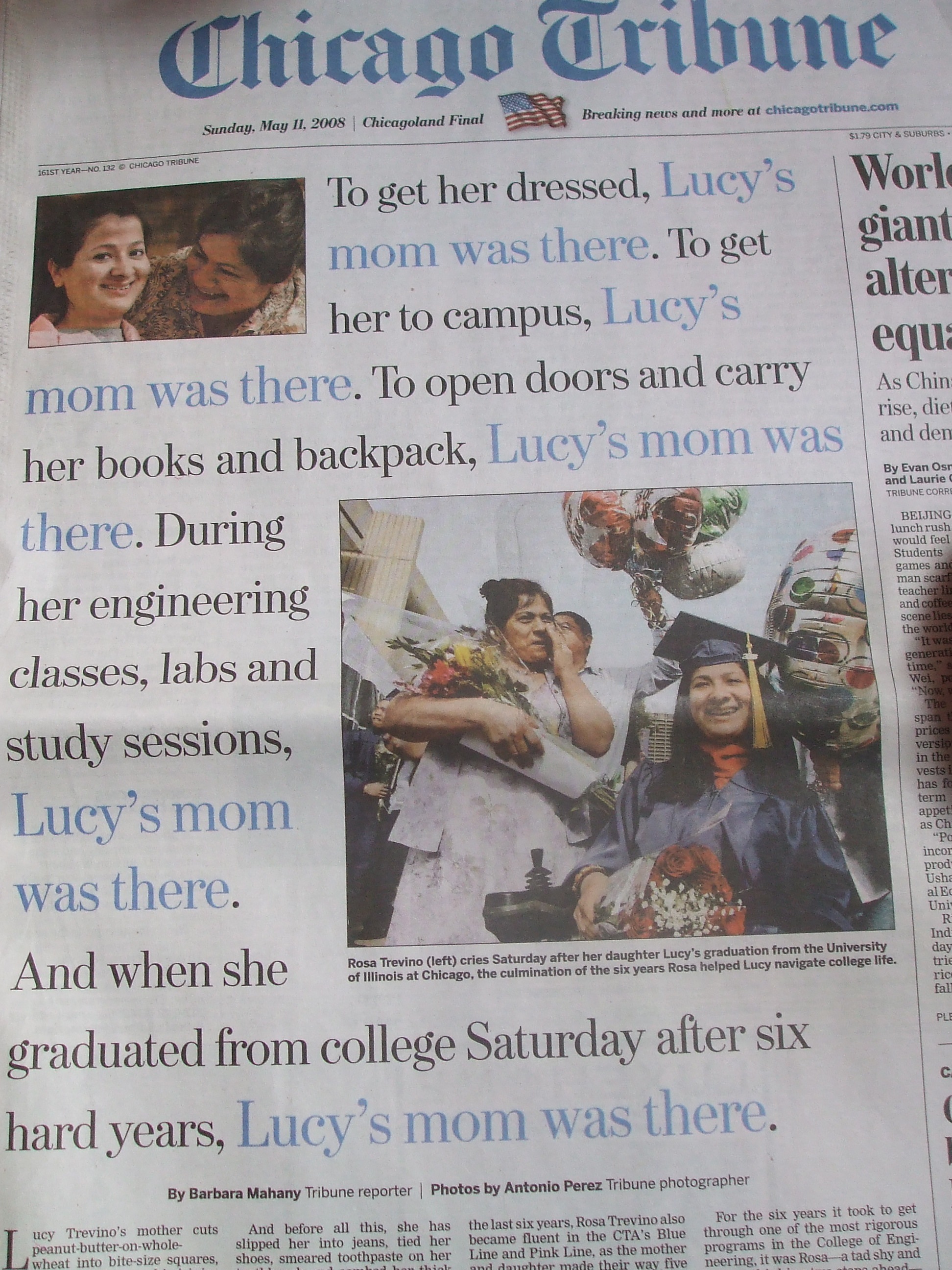
there is more to tell you about blessed lucy, and her mama rosa, the two i introduced you to just yesterday, or if you picked up a chicago tribune, you might have met them back on mother’s day.

for you just joining us, lucy graduated saturday with a degree in bioengineering from the university of illinois at chicago. she’s been in a wheelchair since she was 9. she found out when she was four that she had a rare degenerative disease, spinal muscular atrophy, which has left her arms and legs rag-doll limp, unable even to turn the pages in a heavy book, sometimes too tired to lift a peanut-butter sandwich to her lips.

her mama, rosa, has been the arms and legs that lucy cannot use. for six years. all through college.

she has opened doors, laid out books and papers, cut up lucy’s breakfast, lunch and dinner. at night, she rolls her, side-to-side, three times before the dawn.

i condensed all of this in the story. but what i didn’t get to spell out were some of the everyday obstacles that would have felled a lesser duo.

for instance, lucy and her mama–who is not fluent in english–rode the CTA’s blue line train every day to campus, a one-hour ride if all unfolded as it should have. but, often, it did not.

sometimes, the elevator in the train station near campus wouldn’t work, so lucy and her mama would have to re-board the next incoming train, take it on downtown, where they would transfer to another line, and take that train back out to campus, to a station that didn’t require an elevator.

or, sometimes, when it rained, lucy would worry that the rain would muck up the battery that operates her wheelchair, which would loosen the cable to her joystick, and she’d be stuck–with a 420-pound wheelchair that her mother couldn’t push if she wanted to.

just last week, riding in for her very last exam, a two-hour grueler in her hardest class, lucy spilled a bit of gatorade from the bottle she was sipping during the ride. the sticky liquid got into the battery of her wheelchair, and when they got to campus, to take the exam, the wheelchair wouldn’t work. they had to turn around, go home, get the back-up chair, and start the trip again.

“good thing i hadn’t gotten around to giving away the old chair,” she said matter-of-factly. good thing, too, she added, she’d originally set out for campus four hours before the exam.

earlier in the semester, the only elevator in the building where she took her hardest class was broken for a week. she had to miss a whole week’s lectures, relying on the notes that someone else took for her, never quite totally grasping every concept in a class called Pattern Recognition, which has something to do with understanding how an automated machine–say, an MRI–analyzes data to make a diagnosis.

for a woman who takes half an hour just to write one page of painstakingly-looped letters and words and sentences, she said there was nothing she could do but watch closely as her lab partners precisely measured out chemicals–in fractions of a milliliter, sometimes–with the glass pipettes that are so essential and so taken for granted in every science lab.

same thing, she said, when it came to intricate wiring that had to be tracked and secured for circuit panels in a bio-instrumentation lab. she watched, and absorbed without the tactile learning that comes from fingering each wire, screw and micro-tool.

but what sticks with me as much as the heartache over how hard her road was, and how she not once complained, is what lucy had to say about her unshakable faith, once lost, now found. and a friend whose light still illuminates her way.

“when i was little i was real religious,” said lucy, sitting in a study room in the engineering building at UIC last week. “when i stopped walking, i became an atheist at the age of nine.

“i was depressed from nine to 15. ‘why did i have to be born with a disability?’ i kept thinking.

“but then i thought about how would the world be different if everyone was perfect? would everybody be super vain? they would never think of helping anybody else. what if? when i finally accepted my disability, it felt like a lot of bricks had been lifted off me.”

lucy, who is 24 now, says she wouldn’t change one thing in her life. “i’m not blind, i can hear, i can speak, i can use my mind. i think i finally just got tired of being depressed. i thought, ‘i’m never gonna walk, why be sad about it?’ being sad about it, isn’t going to change it.”

it was a college religion class, one on catholicism, actually, that really opened her heart, she says. the class was assigned to read one of the writings of Pope John Paul II, who suffered from parkinson’s disease. the writing, an encyclical titled, “The Gospel of Life,” she says, revolutionized her thinking about her own disabilities.

“i used to feel like a disability was a punishment. after reading the pope, i realized it’s another beautiful form of life.”

reading the pope’s words, she said, “kind of helped me bring my faith back in God.”

her mother, rosa, never lost it. even though she says her deepest desire is to see lucy stand and walk.

“you know why i think God is very good,” rosa asks. “lucy cannot walk; my other daughter can. what i can’t see in one, i see in the other.” it is the same, she says, with her two sons, one of whom is in a wheelchair (and a freshman at the university of illinois at urbana-champaign), and one of whom is not.

this, from a mother who must speak up for her daughter in the cafeteria line, because lucy’s disease won’t allow her to speak much louder than an amplified whisper. she can’t bark out a request for the baked ziti that is her very favorite lunch.

the one thing that lucy still misses, she says, is her privacy.

“before i’d hide notes all over my room. after i stopped walking, i couldn’t keep anything hidden. everybody always had to know everything.”

lucy says she learned patience from her best friend, giovanna, whom she met when she was eight, and who died when she was 13, from SMA, the same disease that lucy has.

“she taught me to have patience. i didn’t want people to help me, i wanted to do everything for myself. when i first met her i could walk. to all of a sudden be in a wheelchair…”

it was practically unbearable, lucy says. giovanna, she adds, “taught me determination.”

giovanna was full of grace, as lucy tells it. and giovanna, i think, bequeathed her grace to lucy.

and that is most of what i wanted to tell you about two fine souls who rolled into my life last week, and now will never leave.

one of them, a woman who finds justice in the divine equation that has two of her four children in wheelchairs, motoring around college campuses, refusing to rein in their dreams, now inspiring far beyond the boundaries of their colleges.

the other, a woman who sees the wisdom–and the beauty–in a world where our imperfections compel us to reach beyond our limits, to be each others’ arms and legs and hopes and dreams.

those are the lessons i learned at work this week.

it is no wonder why i call this storytelling business not just a job but a holy sacred calling. how blessed i am.

how blessed, lucy and rosa trevino, not trapped at all by a life in a 420-pound chair on wheels. but rather, teaching as they roll, inspiring as we lope behind, trying to catch their holy shining wisdom.

bless you if you stayed to read this story. it was long, i know. but it feels so deeply essential. your thoughts….

the photo above is one i took at lucy’s graduation. months ago, she ordered that certificate of gratitude for her mother, just for graduation day. because the print is small, i’ll spell it out: “thank you for all your love and support. i would not be where i am today if it wasn’t for you. i feel so grateful to have you in my life. today is my day, but i dedicate it to you.”
and then she signed it, lucy trevino. it took minutes to push the pen through those 11 proud but simple letters.
the lilac chiffon you see behind the certificate, and the sturdy hands, those belong to rosa, who was beaming all day saturday, mexican mother’s day.

lucy’s story

i promised, and i always try to keep a promise. i told you i would have something beautiful and wonderful for you to read, to start your week, to tuck in your heart. to give you wings, in the hours and the minutes when you feel empty, out of gas and maybe even hope.

a week ago this morning, i dialed the number to a woman whose name i’d just learned was lucy trevino. a soft, clear voice answered. i told her who i was and why i was calling. she nearly squeaked: “i can’t believe this. i can’t believe you would think of writing my story.”

i thought, all right. thought all week, and can’t stop thinking. every once in a rare while, i get to tell a story that i can’t help but think might change some lives, might plant a holy seed, where one is needed. you never know when you cast a sacred pebble in the waters, just how wide and far that rippled ring will flow.

sometimes, i make a wish, or maybe really it’s a prayer, as i stand at the water’s edge, about to make my toss. whispering, blessing each and every word and sentence, praying that the story finds its way to where it deeply does belong.

i prayed wholly and mightily on this one. lucy trevino and her mama, rosa, are magnificent beyond words. they are humble, shy, but fierce when it comes to not being teetered off the narrow path to their undying dream.

as promised, i share with you a story i believe in with all my heart. it’s a bit longer than we usually meander here, but i want you to always have a place to find it, when you need a little oomph toward your own dreams.

from the chicago tribune….

Lucy’s mom was there

By Barbara Mahany | Tribune reporter
May 11, 2008

Lucy Trevino’s mother cuts peanut-butter-on-whole-wheat into bite-size squares, unscrews a strawberry-kiwi juice and holds the bottle to her daughter’s lips so Lucy can get through lunch and make it back to class.

 She riffles through Lucy’s lavender backpack to find the lab report for BioE 494, bioengineering-based physiology. When the cell phone rings, she holds it to her daughter’s ear. She zips her coat. Unfolds a tissue, puts it to her mouth, trying to be discrete, so Lucy can ditch a wad of gum.

And before all this, she has slipped her into jeans, tied her shoes, smeared toothpaste on her toothbrush and combed her thick black hair into a perfect ponytail.

Lucy Trevino’s mother was right behind her firstborn daughter all through college—sometimes trying to shove through mounds of snow, or maneuver up an icy ramp if her motorized wheelchair balked. When they got stuck, her mother pulled out her cell phone to call maintenance and ask if someone could please come clear the walks.

Over the last six years, Rosa Trevino also became fluent in the CTA’s Blue Line and Pink Line, as the mother and daughter made their way five days a week from home, a red-brick two-flat in Cicero, to the University of Illinois at Chicago.

Lucy Trevino graduated Saturday from UIC with a degree in bioengineering, and the dean stopped the commencement of the Class of 2008 to tell of the Trevinos’ triumph. He barely made it, he said, without breaking into tears.

For the six years it took to get through one of the most rigorous programs in the College of Engineering, it was Rosa—a tad shy and always thinking two steps ahead—who got her daughter to every class, lab and study session. She knew which text and notebook to lay on Lucy’s desk. And she turned the pages when a heavy book tired Lucy’s hands.

For two or three hours, as Lucy absorbed lectures in calculus or thermodynamics or circuit analysis, Rosa sat not far away, just in case Lucy needed a sip of water or began choking.

Lucy, who is 24, was told she had a rare genetic degenerative disease, spinal muscular atrophy, when she was 4. SMA is a progressive disease that withers the muscles that control the arms, legs and lungs, and can make breathing a struggle.

Lucy’s type of SMA usually takes away your ability to walk by the time you’re in your teens—she began using a wheelchair at age 9—but unlike some other types, doesn’t necessarily affect life span.

Lucy, who is the oldest of four, has a younger brother, Hugo, who has the same disease. He, too, uses a wheelchair; he’s a freshman at the University of Illinois at Urbana-Champaign, studying architecture.

Parental dedication

“Lucy’s story is about the sacrifices our mothers make for all of us,” said Pete Nelson, interim dean of UIC’s engineering college. Trevino’s teachers, he said, “were pounding down my door” to ask for some recognition for this mother-daughter feat of unconditional devotion.

At UIC, where nearly a third of the students are the first in a family to go to college, Nelson said it’s not uncommon to hear tales of parents working two or three jobs, sending money from overseas and just plain struggling so their kids can get what parents weren’t afforded.

“But this is sort of the pinnacle in terms of the amount of dedication,” Nelson said. “This is what makes this business worthwhile.”

One of the professors pounding on Nelson’s door was Michael Cho, who teaches mostly graduate courses in cell and tissue engineering, but who has gotten to know—and has been amazed by—the ubiquitous mother-daughter duo, so often spotted wending their way up a ramp, on or off an elevator, or tucked away studying in some secluded corner.

“The first thing that comes to my mind is this can’t be anything else but a mother’s love,” Cho said. “It goes beyond commitment. It is sacrificial love. And I am just overwhelmed. It’s not just one month or one semester. It’s every day for the last four years that I can think of.”

In fact, it’s six years, because Lucy had to take time off when she got really sick her junior year; she suddenly couldn’t lift her arms and was quickly losing memory.

It took months before a sleep test showed she stopped breathing 30 times an hour when she was asleep. She now sleeps with a machine that helps her breathe, and, within a week of using it, she said, she regained her memory, if not her arm strength.

“Ever since I was little, I loved science,” said Lucy, who shares her mother’s deep cocoa-colored eyes and rolls around campus in a purple wheelchair with back wheels that sparkle, like fireworks, with tiny neon bits. “Because I went to doctors a lot and had a lot of medical exams, I would always wonder, ‘How do those devices work?’ ”

In her senior year at Morton West High School in Berwyn, Trevino learned from a counselor about a summer camp in bioengineering at UIC, so she signed up, and found her life’s work.

She once dreamed of working to find a cure for her own disease, but decided “it would be too stressful if I couldn’t find it.”

The first one in her family to ever go to college, Lucy Trevino said she was “too afraid” to venture down to the U. of I. in Urbana-Champaign, where there’s a whole dorm for students with disabilities, and the nation’s oldest college-level disabilities-services program provides trained personal assistants, physical therapy, even wheelchair repairs.

“I didn’t know if I should risk going all the way down there,” she said.

Sticking closer to home seemed like a better plan. But because UIC doesn’t have a personal-assistants program, she was stuck trying to find someone who could help her in a thousand little ways and be there whenever she needed.

“In college, you have such a crazy schedule. You stay after to study with other students. You need to talk to a professor. I was like, ‘Oh, my gosh, how am I going to find someone who’s going to put up with all of that?’

“My mom was like, ‘Well, I guess I’ll just go with you.’

“And then it was getting closer to the start of the first semester, and I still hadn’t found anybody. She said, ‘How would you feel if I went with you?’ I was like, ‘Oh, my gosh, would you?’ ”

Because Rosa Trevino, who is 47 and moved from Mexico when she was 17, had two children with special needs, she had long since become a stay-at-home mom, giving up a series of baby-sitting jobs. Rosa’s husband, Hugo, retired last year after 32 years as a CTA bus driver. Rosa herself had never even been to high school.

On the day back in 1987 when doctors said her little girl would “someday need a wheelchair,” Rosa recalled, crying at the memory, she promised herself she would do “everything I can.”

Mother keeps busy

Even if that meant sitting through more than 2,100 hours of 51 classes, countless study sessions and hourlong train rides, back and forth, each day. Most often, Lucy said with a laugh, her mother spends time cutting recipes and coupons, because she gets bored with all the bioengineering in a language she doesn’t fully understand.

At first, Lucy admitted, going to college with her mother wasn’t exactly without its bumps.

“I had never spent so much time together with my mom. We would sometimes get on each other’s nerves,” she said, chuckling. “But then we got to know each other really well. We’re like best friends. Now I tell her everything. Before I wouldn’t tell her everything that happens when you have a disability. People who aren’t in a wheelchair can’t understand. But now, since we do everything together, she knows.”

Semester after semester, year after year, Lucy and her mother found a way. She passed 400-level exams. She wrote up labs that took her twice the time of everyone else, simply because the pushing of a pen on paper is so hard for her.

Once, a civil engineering professor noticed that because of Lucy’s wheelchair, she couldn’t write on her desk. He challenged her to design a lightweight writing table. Then he went and built it. She got an A.

Mostly, the Trevinos relied on each other, and on unflagging faith.

“One time, I think in the night, almost for an hour, I cried to on high, ‘Why me? Why me?’ ” Rosa said. “I heard a voice, ‘Why not me?’ ”

For those who watched their unswerving perseverance, the simple fact that the Trevinos never stumbled inscribed a lasting honor on Lucy’s college transcript.

“One time last year,” Lucy said, “a student told me she’d felt like ditching class, staying home. But then she looks and says, ‘There’s Lucy, she’s always here. There’s nothing wrong with me. I’m just lazy.’

“Wow, I didn’t even think that anyone noticed me.”

In the very end, on a Mother’s Day weekend in the red-carpeted UIC Pavilion, as Nelson saluted a student and a mother who had taught them all a lasting lesson, a sea of Lucy’s blue-gowned classmates rose and nearly drowned out the dean with a thunderous two-minute ovation. Chances are Lucy and Rosa Trevino finally understood how very much a whole college noticed.

your thoughts, my blessed friends? if you can even muster words…. next meander: lucy’s backstory, what i didn’t get to say in the paper…

no reason ’cept she’s beautiful…

no reason cept she's beautiful

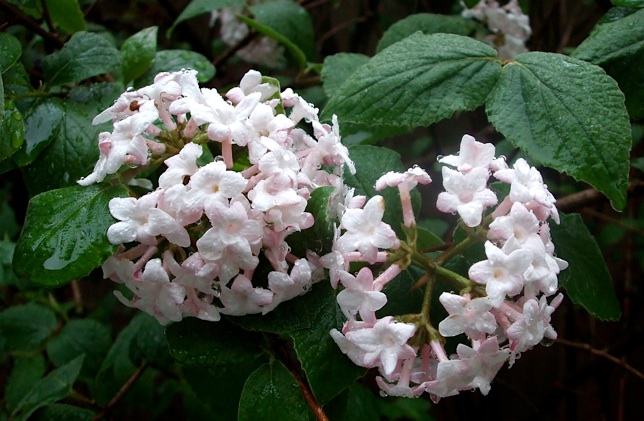
i guess maybe you’ll think you need to call the doctor. dial up some prescription for that poor lady who cannot haul herself in from out beneath the smelly bush.

oh, my, the neighbors soon will whisper. why, i saw her there, just the other night, they’ll say. all curled up and sleeping. didn’t seem to mind the rain. she lay there, drip, drip, drip. till morning. when she stirred, and stretched and, dang, she took another picture, that lady did. seems she’s up and lost her mind over that there vi-bur-num.

fear not, friends. it’s just that, well, i couldn’t very well tuck that lovely rain-laced beauty queen away in some old box with mothballs to keep it from crumbling. i had to lay it out, so you could see. sort of like when folks invite you in for coffee, then make sure to leave all the baby books right there on the cushions of the couch, and you can’t help but flip the pages and coo the mandatory ooohs, and ahhhs.

the other thing is simply this: it’s the very end of a long, long week, and looking at that picture (although here it looks a little fuzzy, which it did not before it landed here. oh, well…) is sort of like putting on your old holey jammies, the ones you would not wear out the house. the ones you would race to change, even before the fire fighters got there, if you’d had to call and beg their services.

it’s just a friday night, is all, and rather than curling up with ice cream and a trashy novel, i thought, oh, heck, why not wander over to the table. put out some new fresh flowers. pretty things up for the weekend.

this is, of course, that day we mamas wait for, yessirree. that day when we do the shopping, make the quiche, invite the friends, and call it mother’s day brunch. oh, wait. it’s not like that at your house? hmm. well, it is at mine.

mostly, i’m unwinding from a week that stretched my heart from here to there, and back again. my computer went kerpluey. which was not so very fun. no, not at all.

and, then, i stumbled upon a story so sweet and so delicious, i am still trying to get the drippy stains off of my chest. actually, they might be dried-up tears, because i’m not like those hard-boiled, tough-skinned news chicks on tv. oh no. i don’t pretend that it’s just a story, and i am there to scribble notes.

nope.

i fall hard sometimes. really really hard.

thing is, i realized this week that, for me, writing stories is the most fervent prayer i pray. it is wholly sacred, i tell you, to sit and listen as some fine someone unfurls her story. and i, collecting words like rosary beads, just snatch and string each one. bead after bead, story after story. until the tale is told.

when i’m in the gather mode, scooping up so many beads, i do ask a million questions. once, someone laughed and called me a human vacuum cleaner. hmm.

well, i do tend to ask for a few thousand teeny-tiny details. and, then, because i can’t help myself, i whip up my newsgirl lasso and swing it first in little circles once or twice, then i cast it out, wide and sweeping. often, this is where the things that someones say humble me to tears. if you listen long enough, you can’t help but hear some mighty wisdom.

other times i tiptoe on the ledge, inching close as i can inch to just short of that place where the teller of the story, would say, oh no. that i cannot, will not, tell.

when it’s over, when the last story is spilled, and folks are starting to yawn, i gather all my beads, sweep them up and stuff them in my satchel.

then, back home, i sit down before the magic keys and close my eyes, and pray to God to be that holy pencil, i so often refer to.

what i pray for, is that the pulsing beauty of the everyday psalm–as the brilliant chicago photographer, john white, once referred to the capturing of the uncommonly common street story–oozes through the words that just come spilling out, and fill the page.

then i send it off and wait. i have this little picture in my head. i imagine some sort of gold dust, from the spirit of the story’s essence, rubbing off, onto the fingers and the heart of every someone who takes the time to sit and pick up that day’s news, and, then, just happens to bumble on the one i stitched my heart in, and reads along, to the very end.

i imagine, this mother’s day especially, a whole city glowing gold, as, one-by-one, a story’s read and passed along. i imagine a whole city shining.

or at least that’s what i pray. and why i think the work i do each day is really nothing more than the finest prayer i ever learned to pray.

and that’s what i’m thinking about this lovely evening. lying here, beneath that raindrop-christened bush, where all is beautiful these smelly days and nights.

oh, and besides, the nice computer man told me to fool around here and see if he’d chased out all the critters that were gunking up the gears. so let me just push this one little button here, and see….

promise, soon as i can i will share with you the story that has me at once so giddy, and so very tired, this late late friday night.

it’s sunday now. the computer went kerpluey again. but i think we’ve now done the proper voodoo. at least i hope so. tomorrow morn, when all is quiet, and i am fully breathing once again, i will post the lucy story, and share with you the lovely bits that had to fall to the cutting room floor. ol’ dear mr. hemingway once said, a story is only as good as what’s left on the cutting room floor. and that fine maxim has been the novacaine to get me through plenty a painful cutting session. ouch. it always hurts. but this here blog, i now realize is a fine remedy, a way to still get to tell some of the pieces of the story that i think you’ll love. lucy trevino and her mama, rosa, are my heroes of this day. a more amazing love story i’ve not heard in a long long while….check out the tribune’s website today, or come back tomorrow, and i’ll have the story here….