pull up a chair

where wisdom gathers, poetry unfolds and divine light is sparked…

Category: interfaith family

molasses light

molasses light

i caught a lick of it just the week before last. seeped through a late afternoon window. oozed in between branches of honeysuckle.

there it was pooled on the dining room table. scattered like seeds on the wall just beyond. it is the light that i live for. it is the light of the autumn, when the globe starts to tilt and the slant of the sun shines more purely, i’m certain.

now, i’m no monet. i know not a thing, not a sciencey thing–or even an art one–about light. how it falls. how it bounces through bits in the air. how our eye knows.

but i do know a thing of the soul. and light, i am certain, unlocks some deep-inside chamber. lets it out. lets it flap like the monarchs that fill the air now. that busy the garden.

and when the fall comes, the light comes right with it. comes before it. knocks on the door, says, excuse me, it’s time for the summer to go. that was the warm-up. far as some of us think.

the real golden days, they are coming. they are autumn. and the light through the window, it tells you. it hints. it gets the pot bubblin’.

it gets me bubblin’, for sure. as long as i’ve lived, as long as i can remember, the fall is the time when my body starts humming. my heart sings along.

the light through the window, the light through the crack in the door, it’s pure gasoline. probably high-octane. i could go round-the-clock when the light turns to autumn.

is it blue light, or white light? or is it molasses?

i can’t quite decide.

i know, though, i’m not alone having noticed. i’ve heard here and there, the snippets of something, the talk of the light. it’s changed. have you seen it? i’ve heard people whisper.

i’m sure deep inside, maybe back of our eyes, there’s a meter. a little widget with dials and buttons. it takes in the light, into a beaker. it measures it. weighs it. marks it as “autumn.” tells the brain. signals the heart. sends a message: dig out the sweaters. start thinking apples. and maybe a simmering stew.

oh, am i jumping the gun? geez, it’s not even september, and here i am woozy for fall. for the “er” months: september, october, november, december. i love them all. some get quite busy, but that’s not here yet. and maybe by then we’ll come up with a plan to avoid the confusion.

right now, we’re just on the brink of what i might call the molasses days. the days when it’s golden. when the light is so straight from the heavens. straight from the heart of what is.

these are the days that make you want to stick out your tongue and just lick it, the light through the window.

these are the days you can taste it. it’s golden and sweet. you could pour it on flapjacks. melt butter.

the light now’s delicious.

it is a most blessed thing to pause for a moment and let it soak in. consider the source.

this here is sacred time, far as i know. far as the jews do too. not too long now, the days they call the days of awe will be here. the highest of high holidays, rosh hashanah, yom kippur.

even though i didn’t grow up knowing those prayers, i do know them now. and now, as i chant them, the light through the windows, i can picture it now, will fall on the pages of prayer books. it will be golden.

it makes me think, long ago, a wise soul or two must have noticed the light. noticed the glow. felt awe drape the days, like some sort of cloak. woven of shimmery threads. told a story that fit the occasion. declared it was blessed.

which it is. the light through the windows, the light in the leaves, it is the light of a God who saved, i am certain, the best for the last.

here it comes now. go out and pluck some. catch it, pour it into a jar. turn the lid tight now. it won’t last. but it’s here now. and it’s ours for the licking.

raise your hand if you’ve noticed. if the change of the light poured through your panes, and hit you right in the heart.

if you happen to know a bit of the science, know what it is that softens and shifts the way it comes in, please do tell. if you, like me, have a light meter, please tell what it does to your engine, this pure filtered light of the fall.

and a molasses-y birthday wish to sweet sandra, who is off in the country, up by the lake, savoring pies and second-hand stores. happy most blessed birthday…..

into the woods

leave it to the italians. they have a name for today. they call it “pasquetta,” or little easter.

why, they wonder, after all the deprivation and darkness of lent, the shadow that burst, finally, into light, into the unbridled exuberance of easter, why, they wonder, why pack it up like so many leftover baskets, and tuck it on the shelf ’til next year?

mais non, they would say if they were french. but, of course, they say it in italian. dag nab it, is what they mean, though, again, they don’t say it quite that way.

those smart italians, they do a very smart thing: they grab one of those baskets, they pack it with leftover yummy things from easter, and they take to the woods. specifically, they set out in search of a watery place.

water, on pasquetta, is key. there is, depending on your level of gusto for this little easter, some splashing involved.

in fact, all over europe today, there are folks splashing. they are not being mean to each other. as a matter of fact, they are partaking of the little easter blessing.

in hungary, apparently, boys knock on doors. girls answer. boys splash girls. girls invite them inside. they feast. they send boys home with wildly painted easter eggs.

on easter tuesday, the girls return the favor. they knock and splash.

it must be riotous, all this knocking and splashing and heading to the woods with your leftover pink and green eggs.

but, besides the fact that it’s quaint, there is, it seems, something rich about the european approach to little easter. to all of life, perhaps, but certainly to little easter.

it is about taking linear measure of time, peeling back the ordinary, extracting mystery and sacred, raising simple hours into the realm of the extraordinary. it is about pushing away the rock of workday expectation, exploring the cavern of the deep unknown, the unexpected. reveling on a monday.

because a friend i love has been telling me for months i need to, have to, must not sleep until i read, “to dance with God,” (paulist press, $14.95) a poetic, eye-opening 245 pages on family ritual and community celebration written by gertrud mueller nelson, i finally cracked the cover over the weekend.

she is very wise, this deeply jungian, deeply spiritual woman, who in 1986 wrote this book while living in california. she says this of what she calls “holy time out”:

“holes are created in time through the creation of holidays–or, indeed, holy days–where the ordinary and everyday stops and time is set apart and not used. every seventh day (sabbatical) since the story of creation is a day of being, a ‘day of rest.’ that is what a feast is. the feast has its origin and its justification in its dedication to celebrating and worship. it belongs to the gods.”

she goes on to tell us that plato, of all thinkers, put it this way: “the gods, taking pity on mankind, born to work, laid down a succession of recurring feasts to restore them from fatigue and gave them the muses and apollo, their leader, and dionysis, as companions in their feasts–so that, nourishing themselves in festive companionship with the gods, they should stand again upright and erect.”

the feast–or holy day–then, is, “the very act which makes the transition from crawling beasts to the upright and conscious human,” nelson writes, “a transformation which makes what is human equal to and a companion (comrade) of the gods.”

i don’t know about you but we don’t spend a whole lot of time around here even noticing feast days, let alone packing our baskets and heading to the woods.

apparently, gertrud does. she says that on easter monday she always let her children stay home from school. they went off to church early in the morning, but then they took off to the woods, often to a marshy place. through binoculars, they watched the water birds, the mating birds, doing their springlike thing. they inhaled the woods, the little tips of tender green budding on all the branches, turning the gray of winter woods into the lacy green of early spring.

getting wet, she says, was always part of the picnic. back to the baptismal waters, and the holy sprinklings, that are so very much a part of easter.

immediately, i found all of this a notion i could warm to: an excuse for picnic. tromping through the woods. stopping time for one more day. stealing children from the classroom, for the sake of exuberating spring (i know, i know, it’s not a word, but i just made it one, so now it is).

so last night, well past sleeping time, i tiptoed in the dark to the bedside of my almost-man-child, the one who loves the woods and who also had just flicked out the light when he heard me coming up the stairs. i told him my little easter idea. at first, he broke out in a grin (he turned the light back on, that’s how i know that), but then he thought about the school day, and thought, not even for a lunch hour picnic could he leave the load at hand.

oh, well, i sighed. fact is, we might have done our little easter backwards. we had taken to the woods already, on big easter. taken kosher-for-passover-for-easter picnic to the woods, in our glorious mixing of religions. it seemed the place to be, the woods that is. for all the reasons up above.

but still, i think, i might take the little one on a pasquetta picnic. or maybe in the twilight, i’ll take my boys by the hand, and take them off to where the gods urge us to recline. just one more day, a holy day.

a holy day for splashing in the woods. i think i like this little easter.

all right, all you wise people, do some of you already know and do this little easter? have you been splashing away for years without me? and what of the notion of not confining the holiday to one day, but extending exuberance? might we do well to weave more holiness and more exuberance into our ordinary time? are the italians, and all the europeans, not onto something? something much larger than little easter?

photo credit: my sweet will. taken on big easter. we both spotted the moss island amid the marsh; my camera said it was busy reclining and couldn’t be bothered, so will came to my rescue, once again.

p.s. it’s monday, the lazy susan spins afresh…

silence on a day that darkens

today is the day it gets dark. it does, i swear it does. it almost always does. i watched, when i was little, for the darkness to roll in.

God was broken, broken-hearted, on Good Friday. and i, grade-school believer with all my heart, i kept an eye, all afternoon, on the sky. sometimes i’d take to a rock. a thinking rock. i’d sit and watch the sky. i would know, come three o’clock, when the story says that Jesus closed his eyes, sighed his final sigh, and we all drop to our knees, that black clouds would roll in, eclipse the light.

early on, i told my jewish not-yet husband that story. i’ve told my children. i will watch the sky today.

and while i watch, i will be silent. three hours, noon to three. the hours that, by his hands and feet, Jesus hung on that heavy wooden cross. it is, my mother taught me, the least that we can do.

last night i went to church. my very favorite day of the whole church year is holy thursday. the last supper. the washing of the feet. for two hours, the stream of people, humbled, on their knees, feet naked, washed. i was washed, and i washed. a beautiful mother from kenya, her baby on her hip, washed me. i held her baby on my lap so she could wash, yes, between my toes. i washed her toes too.

it is not hard, when you see an old priest walking barefoot, ferrying pitchers and basins of water and clean white towels, to the blind, the wheelchair-bound, the teenage boy with down’s syndrome, the black, the brown, the pink, to picture Jesus doing the same.

while all the washing was going on, while the long lines of people filled with prayer, stood waiting, waiting to be seated in the chair, to lift their naked feet above the bowl, to have the stream of water poured, then lathered, then poured again, then dried and blessed–no half-baked, symbolic washing here, this was real and hygienic as well as full of spirit–while all the washers waited, i thought about the sins of this sorry world.

there is much to be silent for this good, dark, friday. as i sat ticking through a litany of sins, once again, i found myself informed and borrowing from jewish prayer, from yom kippur, the day of atonement, the holiest of holy days when you’re a jew. and if you listen, if you pray along, it is a deeply holy day even if you’re not.

i find myself, every year, filled with awe at the breath-taking jewish admission of the brokenness of the human condition. they do not tick through mamby-pamby sins. no. they get astonishingly real, and very close to the bone, to home. where my mother, again, always taught me charity begins. i think forgiveness might do well to start there, too.

so, in the spirit of atoning on this day in which it feels so right to be considering our sins, especially the sins of the homefront, that place we spend so much time considering here, i borrow from that same frank baring of the soul, i tap into the confessional vein i have found, and been held by, in the jewish prayers of the mahzor, the prayer book for the days of awe.

on this most christian day of awe, i beat fist to breast, i wrap myself in cloak of silence. i look deep within.

there is much, yes, to be silent for…

the sin of being afraid to speak up–even when it is among neighbors, and you hear or see exclusion.

the sin of shouting, singeing tender hearts of children.

the sin of not opening the door–or closing it in too much of a hurry.

the sin of breaking down the beauty of this world, and not repairing that that you’ve left broken behind you.

the sin of not noticing the hurt right in front of your face.

the sin of asking too much of your children.

the sin of wanting too much.

the sin of believing but not taking action.

the sin of standing back, watching injustice eclipse the truth, and doing not enough.

the sin of saying you’re too busy, but you’re not.

the sin of holding back, not fulfilling all that you can be, for being afraid to manifest the seed of genius that, surely, has long been buried deep inside you.

the sin of leaving someone else to reach out a hand to lift up the poor, clothe the naked, give the extra toys in the basement corner to children without any.

the sin of going along with the crowd.

the sin of thinking you needn’t be the one to feed the forgotten on your block.

the sin of going to sleep another night taking for granted there will be a tomorrow morning.

the sin of sending children off to bed without saying, “i love you.”

the sin of not saying i’m sorry–or not being so.

the sin of not feeding yourself–body or soul.

this might be just the beginning. but for each of these, i am so heartily sorry. Father, forgive me, for i know not what i am doing.

i leave you now in prayerful silence. i leave you to this day that just might darken. i’ll be watching. trust me.

feel free, should it mean something, to cast a sin….

every year, a cast of characters


every year. count on it. there will be characters. they will be many. they will be deeply, richly, crazily creviced, shadowed, colored.

it is as much the order of the seder as the haggadah itself. the table will spill with character. ooze with it. rumble, tumble, jumble, full of characters.

wafting just above, that’s character no. 1. the tall one, that is.

that’s ted. rebbe ted. the one wrapped in japanese prayer robe, tied with obi. the one raising the first of four glasses of vintage manishewitz. the one we drive miles to be with every pesach.

ted, a rabbi and cantor without a congregation these days, is a therapist; spends his working hours trying to screw on people’s heads, or at least screw them on a little less wobbly than when they first wandered in.

but mostly, always, ted is a character. ted’s eyes, i think, must gleam even when he’s sleeping.

at ted’s seder, things are, um, unorthodox. ted reaches in a bag and pulls out yarmulkes from around the world. sometimes he wears his tibetan temple headdress. he always wears his japanese robe.

at ted’s, you do some chanting. you close your eyes and chant the vowels. you do not close your lips when chanting vowels, he tells you, and thus you assume a posture of openness that ted thinks the world truly deeply needs. you chant deeply, ahhhhhhhhh.

at ted’s, you eat sumptuous french hors d‘oeuvres. (and then you find out, oops, they are not kosher for passover; maybe that’s why they tasted so good.)

i tell you the story of ted because in bringing my children to ted each year i bring them to one of the most essential gifts a parent can give a child: the gift of the one who’d never paint by numbers, the iconoclast, the eccentric, the character. the deep and rich and soul-expanding knowledge that life is splashed with vibrant colors.

one of those colors is the color ted.

it brings unending joy to me to bring my children to tables where i know they will hear voices they do not hear at home. home is where the grounding happens. home is where you learn that the parachute has a safety cord, and you can pull it any time.

other people’s launch pads are where you learn to lift your foot off the ledge, set it in mid-air, and feel the fall, but then the updraft, carrying you, lifting you to places you’d never see from the safety of that concrete ledge.

last night we soared with ted. heard his salty brand of politics. took in his dash of new-age mysticism. felt the gestalt of letting go of that by which we’d been enslaved. watched him raise a yale sweatshirt, oy, to teach a lesson on hebrew light and perfection. (right there, spelled out on yale’s emblem, in hebrew letters, who knew? found out that centuries ago, at the founding of yale, patrician of patrician schools, hebrew was required study. ted, by the way, went to yale.)

tonight we congregate again. at another table of eccentrics. they will be the ones with whom we’ve worked for decades. the ones with whom i’ve “sedered” for 25 years, before husband, before children, and every variation since. a cast of newspaper kooks. my boys, all eyes and ears, will learn much that i won’t teach them.

besides the wine glasses filled with jelly beans (the kinder version of fruit of the vine), the flogging each other with scallions, yes, scallions, the pulling out of little plastic plagues, there is the annual putting of passover lyrics to broadway tunes.

we drive home each year, from nights one and two, with bellies aching. not from all the passover matzo kugel. no, no. from laughing ’til our sides feel split in two.

we are blessed. so very blessed.

all my life, far back as i can remember, i have loved the odd ball. the duck who waddled to his or her own drum beat. at my mid-century mark, i survey the landscape of my life and see i’ve assembled quite some cast of characters.

my almost-man-child told me recently that one of the most lasting lessons he learned from his uncle david was when david spoke of a brilliant friend of his, a friend with phD in sanskrit, a friend who studies global drumming and, for a long while, drove a cab in new york city. david, it seems, told my almost-man-child: “he really is a kook.” and my almost-man-child told me that the way he said it, he knew that uncle david meant that to be a kook is a very noble thing. “that’s how i learned i should never march to other people’s drummers,” said my boy who decidedly does not.

my prayer this pesach, my prayer that already has been heard on high, is that all the children, not just my boys, hear a world of many drummers. and come, as often as they can, to a table that spills with kooks and characters and bold eccentrics, a table, every first-night seder, led by rabbi ted.

who, by the way, i love with all my heart. even if he makes me close my eyes and chant the vowels.

do you collect characters? do you see the beauty in those who color outside the lines? do you, if you have children, or love children, or are a child at heart, seek out tables where you know they–and you–will hear voices unlike the ones they–and you–hear at home?

holy, holy week

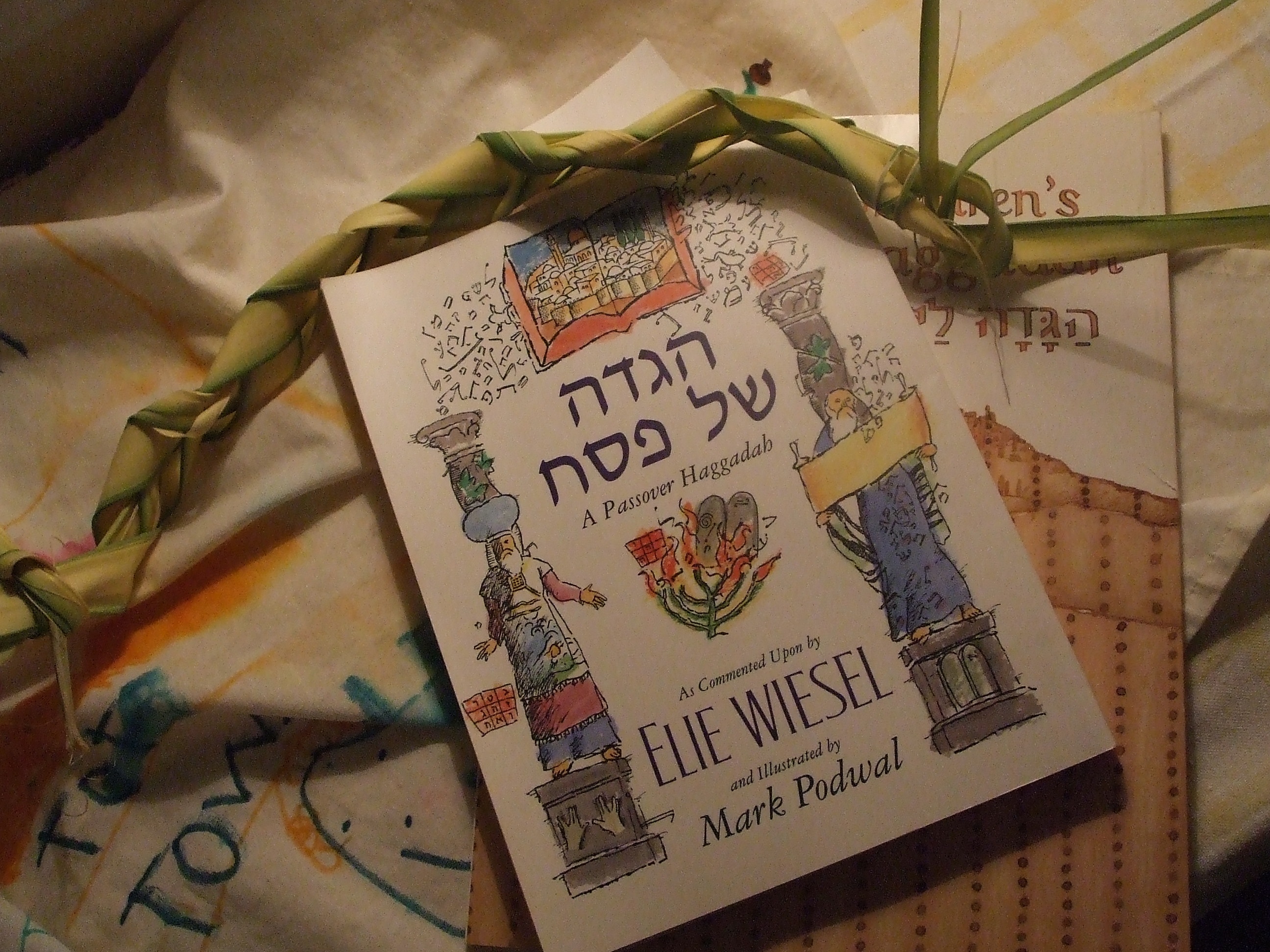
in our house, it is the gospel according to matthew, and the seder infused by elie. and this, by the blessing of the calendar, is one of those wham-bam weeks.

we’ve got it all, and weave and flow from exodus to last supper, from parting of red sea to rending of blackened sunless sky. we dash the house of bread, but then bring on the easter baskets.

long long ago, we set our own pesach dispensation for easter sunday. even when it’s in the midst of the eight days of no leavened grains, we part the matzo for a sprinkling of chocolate, for jelly beans, in the easter basket.

i was musing that wednesday is the only day of this whole week not rich in something jewish or catholic, and thus i would need to consult the koran to divine my depth for the day.

it is, very much, a fact that the interlacing of the passion of jesus, a passion set in history at the cusp of passover, and the jewish remembrance of the exile from egypt, is, for me, a rich one.

after 25 years of living them on top of and through each other, i have come to see shadows, understand subtleties that would have escaped me were it not for my being drawn, in love and faith, to a man who is, himself, a son of the tribe of israel.

and so it was that we all, the four of us, two jews, one catholic and one just learning both, walked into a church courtyard yesterday where palms were swaying in the air, the priest’s red robe was billowing–nay, blowing–up and nearly over his head from behind, the winds were whipping so unrelentingly, a red bird’s plumage in flight. the red cloth punctuating the otherwise gray day.

the priest, one i’d known long ago, one who’d grown older and even wiser, and though he’d grown bent, never bent from his focus on that core of what i call dorothy day catholicism that sees peace and justice as the central burning flame of a religion he won’t let go down in flames.

he was in the midst of reading the passion of jesus when he looked up, looked out at the sea of waving palms, and implored the multi-colored crowd: “consider and tend the wounds of the world as if they were your own—-for they are.”

that then, i gulped, is the mission of this week.

i came home, sat down to consider elie wiesel, the nobel-prize winning poet and seer who survived the holocaust and will not, bless him, let us forget.

“i love passover,” he wrote, “because for me it is a cry against indifference, a cry for compassion.”

wiesel wrote those words in perhaps the only autographed book (certainly the only autograph that fills me with awe) on my shelves, “a passover haggadah,” (simon & schuster) his 1993 commentary and guide through the seder, or meal of remembrance, the retelling of the exodus story, that is the centerpiece of passover.

“sometimes the sheer speed of events makes us reel,” wiesel also wrote in the haggadah. “history advances at a dizzying pace. man has conquered space, but not his own heart. have we learned nothing? it seems so. witness the wars that rage all over the globe, the acts of terror that strike down the innocent, the children who are dying of hunger and disease in africa and asia every day. why is there so much hatred in the world? why is there so much indifference to hatred, to suffering, to the anguish of others?”

wiesel asks. the old priest implores.

because i am catholic, because i spent many years on my knees studying the 10-foot-high crucifix that hung before me in the church where i grew up, i don’t even have to close my eyes to see the wounds that i’ve been asked to dab with cool and healing waters.

and so i walk, i stumble, through this most holy week.

what questions do you carry into this blessed string of holy days? what thoughts do you put to those questions? those callings?


p.s. some really fine thoughts–really fine–have been tacked onto meanders in recent days, thanks to the brilliant souls who keep pulling up chairs. bless them! don’t forget to take a look back and keep the conversation flowing. just because we move on to a new meander does not ever mean the case is closed on a meander past. in fact, we might have drummed up a real-live beekeeper to tell us a thing or three about the
heartbreak in the hives….
p.s.s. welcome back from break, all of you who flew away…we held down the fort just fine….

vernal whisperings

if you listen, you can hear the first stirrings of winter loosening its grip. yes, the snow moon, that great white orb that cast its full light on the cold cruel landscape of last night, made it hard to see anything that was not white, or bluish white, a color even colder.

but in fact, and despite the wind chill, this is the day when myth and legend begin their vernal whisperings. there’s the old folktale about the ground hog and his shadow. but that doesn’t much catch my fancy.

what does catch it, locks it in its grip, is something i knew little about. until now. it is the jewish festival of tu b’shevat, the new year of the trees.

it is, it seems, all about vernal whisperings, the first hint of promise that all this, the harsh and the cold and the barren, will soon melt away.

as a woman married to a jew, as a woman who embraces spirit and rite and story and all things of the earth, this little holiday seems made for souls like me.

i had had an inkling that the holiday i had a hard time pronouncing (tu-bish-vat, more or less) had something to do with trees or planting trees. in fact, it is said that this is the day when God decides how bountiful the fruit of each tree will be in the coming year.

in israel, this is when the almond tree awakes from its winter sleep, erupting in clouds of tissue-white flowers, the first blossom of spring.

in ancient times, tu b’shevat marked the day of tithing. it clanged the final bell on the fiscal year. all fruits borne before this day, belonged to the harvest of the last year, and must be divided accordingly, a portion to the poor, a portion to the temple in jerusalem.

all of that was lovely enough.

but then i heard something about a special seder of seven fruits.

and that’s when i knew i needed to dig a little deeper. that’s when i discovered the thinking of the 16th-century jewish mystics.

known as the kabbalists, these deeply spiritual thinkers believed that we elevate ourselves by the eating of certain fruits on tu b’shevat. if done with holy intention, they taught, sparks of light hidden in the fruit could be broken open from their shells, freed to float up to heaven, to the great divine, completing the circle of the renewal of life.

oh my.

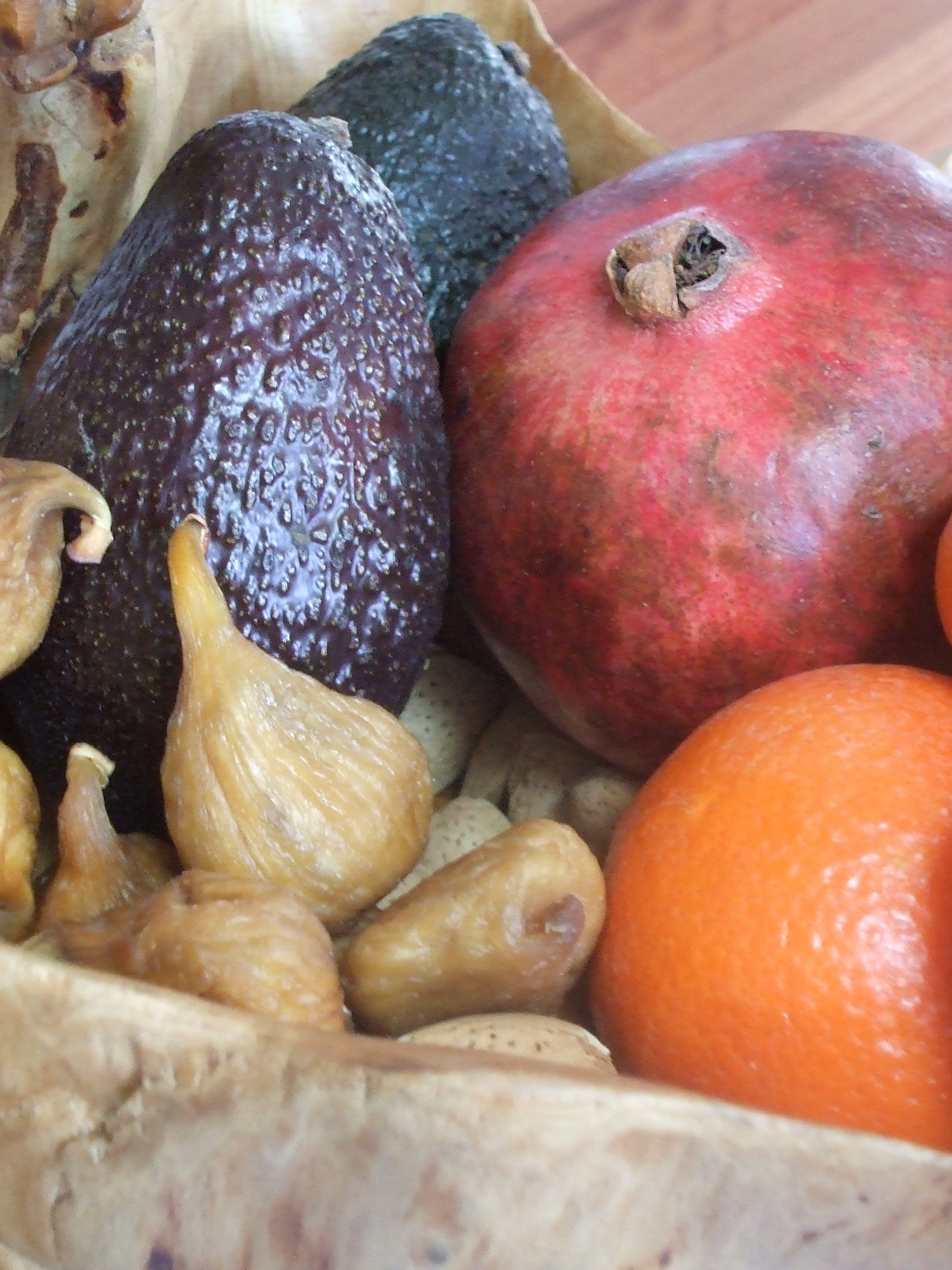
they go on, these marvelous mystics. they talk not about seven fruits, but ten. they break them into categories corresponding to four levels of creation. there are the fruits that need no protection, and can be wholly eaten; grapes and figs, among them. there are fruits that require protection but only at the heart; olives, dates and persimmons would be among these. then there are the fruits that need full protection, the pomegranate and avocado, both of which hide inside a leathery shell. the fourth realm, purely spiritual, by definition has no fruits: it’s just pure spirit.

the holiness of each fruit or nut is, according to the kabbalists, the soft edible part, the part you can bite into. the pits or inedible parts were thought to be impure. and the shells were the protection of the holiness. (makes you feel kindly toward that ol’ banana peel, eh?)

reciting blessings–there is a particular line from the torah for each fruit or nut, believe it or not–helps to release the holy spark of life flow trapped within them, the kabbalists believed.

ah, but the act of chewing, they tell us, kicks it all into some sort of spiritual overdrive.

get this: chewing is more powerful than reciting blessings, they believed, because humans have 32 teeth, and that is the precise number of times the word “elohim,” or God, appears in the story of creation.

goodness. it is morsels like that that make it so delicious to dig deep into something of which you once knew so little, but deep in your soul feel so drawn to. it’s the marvelous adventure, open to all of us, of cracking deep into the book of religions other than the one we knew first. it’s the weaving and steeping, the absorbing and unfolding, that i swear enriches the broth.

but back to the fruits, and the part that i think is the absolute swooningest.

along with the fruits of the seder, the kabbalists said there must be four glasses of wine at the meal. you begin, they taught, with a white wine. each glass after that adds more and more red wine, so that each glass deepens in color. the first glass represents the cold whiteness of winter, the next, the pale buds of spring, onto the deep rose of the height of summer, and finally the crimson of the autumn leaves before they fall from the trees.

you needn’t be jewish to want to drop to your knees on that one, the breathtaking progression, the resonance of the fruit of the vine with the rhythms of earth, the unfolding. a whole sensory reminding that the changing of season is a blessing beyond blessing.

and this is a day when we pause, when we listen, for the first stirrings of the deep underground.

abraham joshua heschel, the great 20th-century jewish scholar, writes magnificently of the sanctification of time in judaism. here is one thought to ponder:

“judaism teaches us to be attached to the holiness of time, to be attached to sacred events, to learn how to consecrate sanctuaries that emerge from the magnificent stream of the year.”

and so tonight, as i light the shabbat candles, usher in tu b’shevat, a sanctuary i never really knew until now, i will sit down to a feast of the earth’s promise, to fruits and nuts and wine. i will behold the shifting of the seasons, the absolute truth of the returning of life.

yes, now winter is making itself abundantly present. but from the heart of the fruits, will break open great sparks of holiness, wafting toward heaven. from each sip of my ever-blushing wine, the taste of the turning of time.

i will know as i eat and drink that beneath the cold hard snow, the fruits of spring are stirring. are whispering sacred incantations. vernal incantations.

baking with henry

it is friday, a friday. it will soon be shabbat. it is time for baking with henry. henry and i bake challah together. henry is my teacher.

henry lives downtown. in a tall black building.

i live in a leafy little town 12 miles north. in a stone-and-shingle, two-story house.

we bake over the phone.

henry is jewish. i am catholic.

henry is a grandfather; he talks about growing up in germany, before the nazis erupted. every friday night, he tells me, stewed chicken or brisket main-staged the meal; the challah, his mother’s opening act.

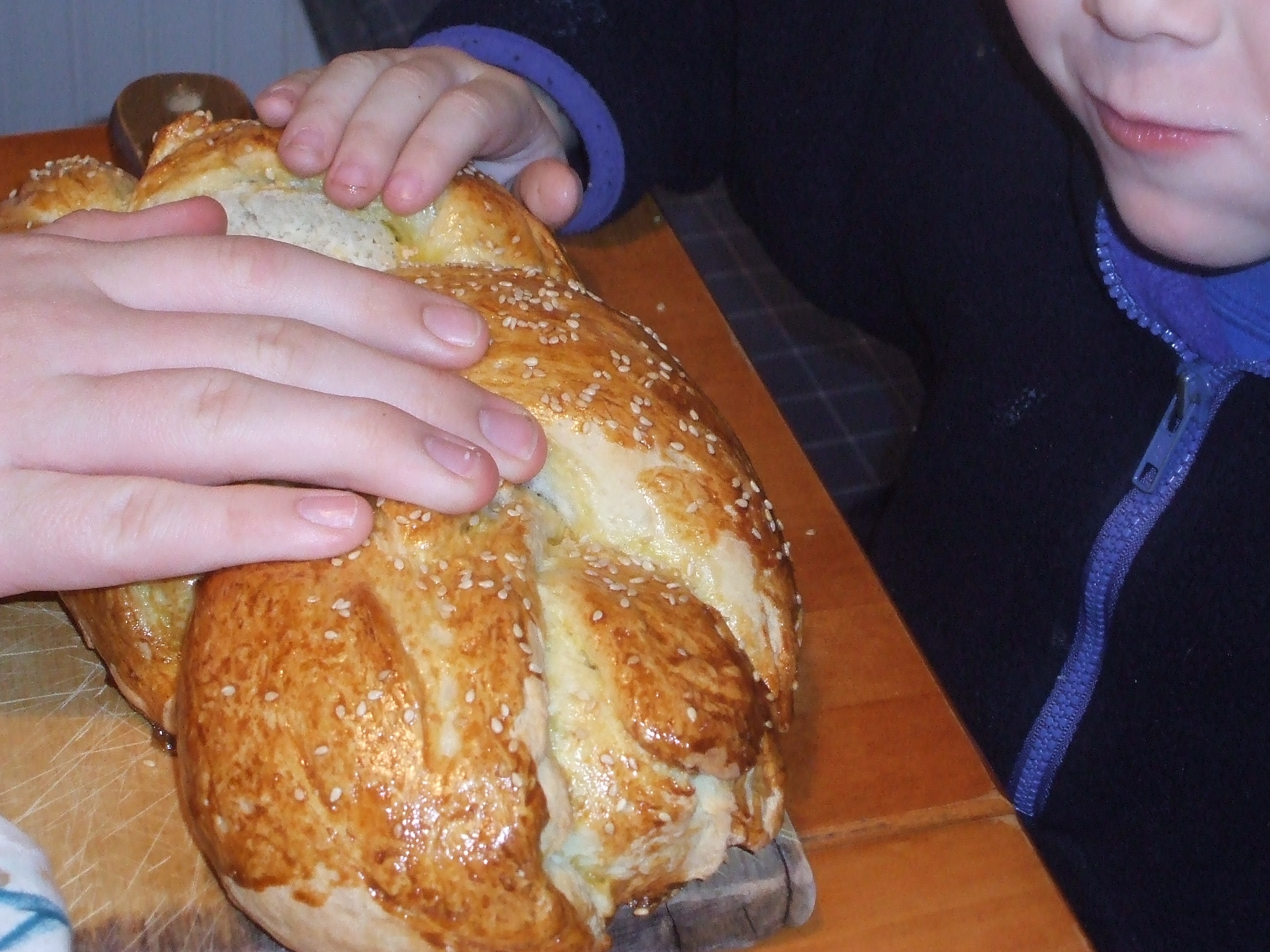
challah, the braided egg bread that is the sustenance of shabbat, the sacred canyon of time stretching from sundown friday to sundown on saturday, marking, each week, the seventh-day rest at the end of God’s original creation.

i am a mother, a wife, married to a fine jewish man. we have two boys, growing up jewish and catholic. together, we lift up shabbat, wrap up our harried work week with the pause and the majesty of blessing bread, blessing time, at our table.

i have, over the years, made shabbat mine. i sink into the rhythms of friday, sink into the rhythms of unfolding shabbat. i slow cook on fridays. i pick and choose from the book shelf, finding a passage worth reading, a thought worth shabbat. i put out the candles. i bring out the wine. i reach for the yarmulkes, or little skull caps.

and, after years of wishing i could, i now bake for shabbat.

henry is sifting through my lumps, leavening my learning. henry is teaching me challah.

he came to me in an email, with story attached.

last year, typing away on a 10-year anniversary book for our synagogue, i culled recipes for a few trademark foods. the rabbi’s brisket. his wife’s gefilte fish. henry’s challah.

with recipe in hand, i decided i had no excuse not to roll up my sleeves and insert fist into flour. i did what henry had written. thoroughly blended all dry ingredients; added oil, eggs, water. kneaded for 5, then for 10, finally upward of 15 minutes, in search of the elusive dough state, “moist and elastic.”

it was then that i made my first call to henry.

add water, just one little drib at a time, he advised.

i followed orders.

place dough in warm spot to rise. about 1 hour, he had written.

two hours later, accidentally out longer than planned, i came home to dough that had let out its air.

i put in a second call to henry.

that night, we broke bread but it was more like we were breaking a flat-shelled turtle. this was challah without the rise. this was challah gone flat.

henry called the next morning. he was with me now, and wanted the word on what in the end had come out of the oven.
and so it went, week after week.

i progressed. sort of a reptilian progression. one week a turtle, the next week an alligator. it would be weeks before the soft twisted mounds looked anything like the challah in the bakery windows.

and then my kitchen was demolished. so all baking stopped. but it is a new year, and a new kitchen.

so henry and i begin baking again.

the flour is measured and dumped. the yeast, quick-rising, mixed in. i know how to knead. i know that one hour’s rise, not two, and not three, is essential.

best of all, i know henry’s number, even in florida.

stay tuned for the reptilian report.

all right, all you bakers. anyone willing to go on record with a tried-and-true challah tale? pictures to come, if you promise not to laugh…

Henry’s Berches Challah Recipe
_
_
Makes 1loaf
_
_ 1 Pkg Instant Yeast*
_ 3 cups Unbleached Flour
_ 1 TBS Sugar
_ 2 tspn Salt
_ 5 oz. +/- Warm water
_ 1 TBS Vegetable Oil
1 Egg white (save yolk for egg wash)
* simplifies and speeds baking

_
_ Toppings
_ To taste: Poppy seed, Sesame seed, Kosher salt, etc.
_
_ Thoroughly blend all dry ingredients in a large mixing
bowl. Add oil, egg whites, and water. Mix thoroughly using
an electric mixer with paddle attachment (or hands) until
dough forms. Get dough as smooth as possible in mixer.

Remove from bowl and knead a bit more by hand until silky smooth. If
dough sticks to hands, add a bit more flour; if dough is too dry,
add a little more oil for elasticity. Knead for 5 to 10 minutes.
Dough should be moist and elastic.
_
_ Place dough in oiled, covered bowl, in a warm spot, to rise.
_ About 1 hour. Gently deflate dough and divide into 3 lots.
Roll each lot into a rope, about 10 inches log, and braid to form the finished loaf.

Place on lightly oiled baking sheet for a
second rise, (or use a parchment paper lined sheet, which makes for less clean up) until doubled, about 45 minutes.

Pre-heat oven to 375 degrees
_
_ Brush loaf with beaten egg yolk (beat yolk with 1 tspn water),
paint top and sides of loaves, and sprinkle with
_ favorite topping: poppy seed, sesame seed, kosher salt etc.

_ Place in oven until browning begins. Lower temperature to
350 degrees and continue baking until golden brown and
loaves sound hollow when tapped on the bottom. It is best, though, to use an instant read thermometer and bake to 190 degrees internal.

If loaf brown too quickly during baking, tent with aluminum foil.

Baking time about 30 minutes. Cool on rack.

after i struggled with this version, henry sent a tutorial, titled, “challah, one step at a time.” i’ll send–or post later–if you, too, need henry over your shoulder.

get set, ready, dash…

a page ripped from my to-do list, on this the day when a constellation of holidays converge on one little square of my calendar…

6:02 outa bed, sweetheart.

get oatmeal going, dump in dried fruit.

6:40 get 13-year-old out door to orchestra. our turn for carpool. do not forget toothpick bridge.

treadmill (how ironic).

blog.

latkes out of freezer.

teddy up, fed, dressed.

9:30 leave for hockey. don’t forget bag of chocolates for coach.

rent shin and elbow pads.

wedge feets into skates. lace up. squeeze helmet on head. let loose.

10:00 tedd on ice. re-make grocery list. refine to-dos. call editor.

10:45 strip sweaty hockey player of pads, skates, helmet.

look one more store for latke mix, darn it.

pick up gift cards for junior high teachers.

stop for two loaves holiday bread.

make fruit salad for kwanzaa at kindergarten.

make stewed apples for hanukkah.

finish setting table for hanukkah dinner tonight. don’t forget to let tedd put candles in menorah.

don’t forget to feed tedd.

12:30 drop tedd at school.

try again to file expense report. call computer help desk.

write bike accident essay.

2:30 kwanzaa at kindergarten. don’t forget yam chips, fruit salad, cups, napkins, forks, books. and notecards.

3:15 pick up tedd from school.

3:30 go to shake-shake at physical therapy.

4:10 pick up jelly donuts for hanukkah.

4:30 grate potatoes for latkes.

slice and reheat brisket.

salad ready to go.

check will & homework.

get little christmasy things off coffee table–toddler is coming.

6:30 hanukkah dinner for 12, at long last. hallelujah.

9ish clean up.

tedd to bed.

will to bed.

write teacher christmas letters. stuff gift cards inside.

line-up all gifts for delivery thurs.

make to-do list for thurs.

make fat bowl of popcorn.

do nothing.

don’t even begin to think about christmas eve, and what it’ll take to get there….

because i believe it’s therapeutic to share the madness, feel free to lay your to-do list on the table. i’ve always thought a year’s collected to-do lists, or the amalgamated lists of so many busy people, would make for one fascinating anthropological analysis…we begin here….

it’s brisket weather…

borrowing amply from mr. capote, who in his delicious and utterly memorizable 1956 treasure, “a christmas memory,” tells us of his eccentric sixty-something-year-old cousin who presses her nose to the kitchen window, gauges the novemberness of the outside tableau, and exclaims, “oh my, it’s fruitcake weather!…it’s fruitcake weather! fetch our buggy. help me find my hat.”

and at our house this weekend, i woke up, sniffed my nose in the air, and proclaimed, “it’s brisket weather.” with that i trotted off to the butcher who had cleaved and wrapped seven and a half pounds of pure red steer, laced heavily with adipose. he marked it, mahany, and as he handed over the white-paper-wrapped log, he raised one eyebrow and quizzed, “that jewish?” well, no, mister meat man. but my husband is, my boys are half and half, and we do hanukkah.

the thing about being an irish catholic mother in a jewish-catholic family is that you have no long lineage of recipes you call your own. you have, forgive me for braggin’, something far better than that: an amalgam of adopted jewish mothers and the best of their best. i’ve got ina’s matzo balls, aunt joni’s tips on storing, freezing and reheating latkes, liat’s hamantashcen, audrey’s “tzimmes with potato kugel topping,” that one cut from the los angeles times, now yellowed and long ago scribbled with audrey’s thoughts on how to improve it.

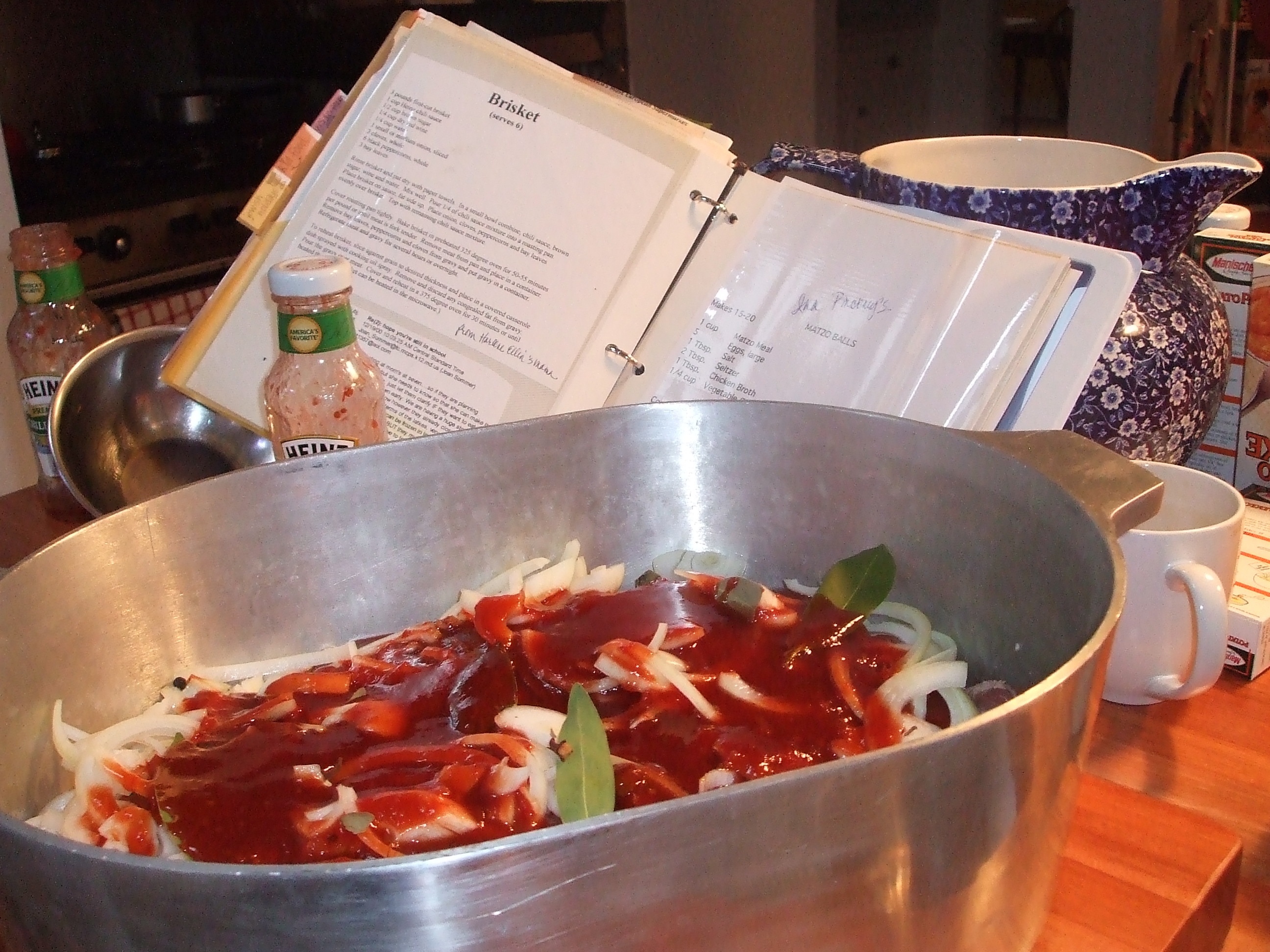
brisket i’ve got in triplicate: susan’s famed brisket, one boasts; sandra’s working-woman’s brisket; and the one i now call my own, brisket from harlene ellin’s mom. now, mind you, i have met harlene ellin’s mom once–at the side of a pool at a 7-year-old’s birthday long long ago, where the meeting was doused liberally in chlorinated pool water. but harlene’s mama and i, once or twice a year, we make brisket together. listening closely as she insists it must be heinz chili sauce, nobody’s else’s. following carefully as she guides me through the rinsing and patting dry of the beef slab.

last night, i leaned heavily on mama ellin. she swears you need 50 to 55 minutes per pound in a 325-degree oven. do the math: that was 6 and a quarter hours. being a good catholic girl, i did what i was told. even though after a while i started doubting the wisdom of all this baking and baking. was i en route to the leatheriest brisket ever served at a hanukkah dinner? as i unearthed said brisket from the oven, well past bedtime, and noted the bayleaves had started to blacken, my knees how they trembled, my calm how it shattered.

quick, i grabbed mark bittman. he tells me how to cook everything. he said nothing about brisket being cooked for a full quarter of a day. i googled brisket. the longest stretch there was five hours, for a five-pound brisket. but i had the motherlode of all briskets. my meat man set me up with 7.5 pounds, for cryin’ out loud. i had no option last night but to stay the course with mama ellin. i did as i was told, vaulted it from roasting pan to refrigerator pan, tucked it in under a taut aluminum blanket, turned out the kitchen lights and hoped for the best.

frankly, my brisket dreams did little to soothe me.

called the butcher first thing this morn. he swears i did the right thing; only he cautions a low long oven is the best route to brisket heaven. he goes overnight at 200 degrees. has brisket by the mound for breakfast, he does. maybe i should have turned down the heat.

all i know now is it smelled a bit like heaven around here for six-plus hours on sunday, all chili sauce, red wine, cloves and those bay leaves. i wasn’t about to lower the burn on that celestial scent.

we had 12 coming for brisket tonight, but little tedd has a fever of 103. so, for now, me and my brisket we are on hold. we are whispering prayers, jewish and catholic, for fork-tender, melt-in-your-mouth, mind-if-i-help-myself-to-more. dinner is rescheduled for wednesday. we’ll let you know if our brisket prayers they are answered.

here’s how harlene ellin’s mama and i go at it, year after year:

Brisket
3 pounds first-cut brisket (these things a Catholic girl must learn, who knew from first-, second- or even third-cut?)
1 C. Heinz chili sauce
½ C. brown sugar
¼ C. dry red wine
¼ C. water
1 small or medium onion, sliced
3 cloves, whole
6 black peppercorns, whole
3 bay leaves

Rinse brisket and pat dry with paper towels. In a small bowl combine chili sauce, brown sugar, wine and water. Mix well. Pour ¼ of chili sauce mixture into a roasting pan. Place brisket on sauce, fat side up. Place onions, cloves, peppercorns and bay leaves evenly over brisket. Top with remaining chili sauce mixture.

Cover roasting pan tightly. Bake brisket in preheated 325 degree oven for 50 to 55 minutes per pound, or until meat is fork tender. Remove meat from pan and place it in a container. Remove bay leaves, peppercorns and cloves from gravy, and put gravy in a container. Refrigerate meat and gravy for several hours or overnight.

To reheat brisket, slice against grain to desired thickness and place in covered casserole dish sprayed with cooking oil spray. Remove and discard any congealed fat from gravy. Pour the gravy over meat. Cover and reheat in a 375 degree oven for 30 minutes or until heated through. (Brisket can be reheated in microwave.)

Serves 6

feel free to add your brisket thoughts to this melt-in-your-mouth conversation….