pull up a chair

where wisdom gathers, poetry unfolds and divine light is sparked…

Category: old house

public health announcement: check your darn radon

so, in the latest twist and turn over here in medical odyssey land, a very fine pair of doctors looked into my lungs the other day, and saw yet another odd thing. and the oddest thing is, they don’t think it’s cancer in the other lobe, but they do think it might be radon. RADON! the number one cause of lung cancer in never smokers.

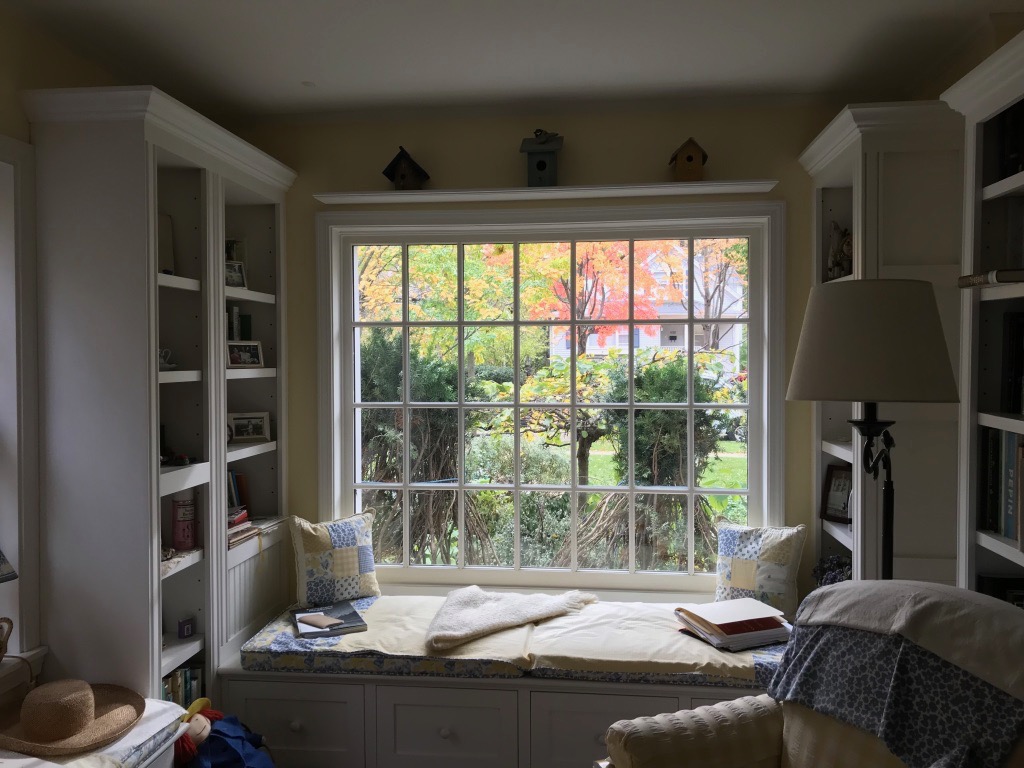
because we were zooming, the doctors were able to see the room behind me, and a room you might note for its decidedly not modern detail. it’s a fairly old house, though not old by historic standards. it’s 1941, which means it’s older than 1970 when homes started to be built with attention to radon, a radioactive gas naturally occurring in the earth. i’ve been breathing here for twenty-two years.

the good doctors wanted to know if we’d ever checked for radon. yes, yes, i quickly answered, sounding just like the girl who sat near the front of the classroom, waving her hand whenever she knew the answer—especially when she knew it faster than everyone else. (i am poking fun at myself here, lest you not see that!) anyway, back to the radon and the trusty detector i got two years ago when i first learned i had mysterious lung cancer. soon as the doctors finished their question, i pointed straight to the detector so the good doctors could see where i’d tucked it. um, not so good, they replied in unison.

the very good doctor explained that radon can only be detected in the first few inches off the ground, and it has to be measured at the lowest point in the house, where the foundation rubs up against ol’ mother earth. that meant the basement. where i’d never measured, even though i’ve been down there an hour a day walking on the treadmill for as long as we’ve lived here, all twenty-two years.

don’t you know that the second we got off the phone i was lickety-split in the basement with that little detector that until then had always flashed green, giving me the falsest assurance that all was well at chez 522.

took but five minutes for that ol’ detector to turn yellow (not so good) then red (get outa here folks!). and as i felt my heart sinking, and my tummy beginning a series of flipflops, i scampered back up the stairs, to report the damage to my fellow breather in this old house.

any minute now the radon detector lady is going to be knocking at the door with her super-duper testing devices. she’ll track our radioactive gas over the weekend, and come back monday to fetch it and read it. she will write up her report and pass it over to the very kind guy who will come to our rescue, apparently boring a hole through to the earth below, sucking out the noxious gas, and blowing it out through the roof. the mechanics of this are unbeknownst to me, but whatever they want, they can do. PVC pipes running through the living room? no problem. please, just save what’s left of my lungs.

in the meantime, i’ve let my doctor know the results of my home-testing detector, one thought to be accurate. and she’s snared me an appointment with the top pulmonologist at U of C, though i can’t get in till november. i’m thinking this stuff they see in my right upper lobe (my left lower is the lobe now missing) might explain why i get so exhausted, and why i sometimes feel pale as a semi-ghost. and why when i try to breathe and talk and walk, one of the three has to go.

so why i am divulging all this before i know more, before i have answers? because my doctor, who i loved at first sight, told me that too few people are aware of the dangers of radon; i know that, for me, it was merely what sounded like an infomercial droning on in between dramas, or noise on the car radio.

but, people, it’s real. and i have the holes in my lung to prove it, it seems.

my doctor, already known as the world pioneer of a particular lung cancer mutation, suggested we team up together for an awareness campaign. i’m all in. and i wasn’t willing to wait for definitive answers. i’m starting with this, and with you, my beloved, breathable chairs.

what i know is this: my lung is missing a part, my breathing doesn’t come easy too often of the time, and my detector is flashing red rings. i don’t want any of that to happen to you.

my doctor says that chicago is especially bad, with higher naturally occurring radon than other places. but she says that too few of us know. too few of us think of it.

here’s what the EPA, that now shaved-to-the-bone federal department charged with saving our air among other things, has to say about radon: “Radon is a radioactive gas that forms naturally when uranium, thorium, or radium, which are radioactive metals break down in rocks, soil and groundwater.”

gets a wee bit more vivid when you turn to plain ol’ google, now powered by AI: “Radon is a naturally occurring radioactive gas, invisible and odorless, produced by the breakdown of uranium in soil, rock, and water. It can seep into buildings, particularly through cracks and openings in foundations, and accumulate indoors, posing a lung cancer risk if inhaled. Testing and mitigation are crucial for managing radon exposure.”

radioactive, invisible, risk, and crucial, are all words that grab my attention. mightily.

it’s never too early to be warned of a risk that might mess with your lungs, so while i wait for vicki the radon detector to knock on the door, i want you to know that if you happen to live in an old house (the kind i’ve always loved best), and it sits on the ground, or worse yet, was plopped in a hole in the ground (the standard for two-story-or-more construction), you might wanna look into your radon.

i’ve no desire to be the poster child for radioactive invisible gases that can eat away at your lungs, but if that’s who i am then so be it. i offer my troubled breathing for your protection. please, please consider it.


and because that’s rather a dark chunk of news to drop on your laps this morning, i bring you one magnificent poem to even things out.

barbara ras

appropriately, it’s titled, “you can’t have it all,” and it’s glorious…..the poet is barbara ras, an american poet, translator, and publisher, born in new bedford, mass., and traveled extensively in central america. she’s been honored with the walt whitman award, and both guggenheim and breadloaf fellowships. her most recent poetry collection is The Blues of Heaven (University of Pittsburgh Press, 2021), preceded by The Last Skin (Penguin Books, 2010), One Hidden Stuff (Penguin Books, 2006), and her first collection Bite Every Sorrow (Louisiana State University Press, 1998). soon as my radioactive gas is dashed from this ol’ house and my edits are all wrapped up, i am diving deep into ras…..

YOU CAN’T HAVE IT ALL
by Barbara Ras

But you can have the fig tree and its fat leaves like clown hands
gloved with green. You can have the touch of a single eleven-year-old finger
on your cheek, waking you at one a.m. to say the hamster is back.
You can have the purr of the cat and the soulful look
of the black dog, the look that says, If I could I would bite
every sorrow until it fled, and when it is August,
you can have August and abundantly so. You can have love,
though often it will be mysterious, like the white foam
that bubbles up at the top of the bean pot over the red kidneys
until you realize foam’s twin is blood.
You can have the skin at the center between a man’s legs,
so solid, so doll-like. You can have the life of the mind,
glowing occasionally in priestly vestments, never admitting pettiness,
never stooping to bribe the sullen guard who’ll tell you
all roads narrow at the border.
You can speak a foreign language, sometimes,
and it can mean something. You can visit the marker on the grave
where your father wept openly. You can’t bring back the dead,
but you can have the words forgive and forget hold hands
as if they meant to spend a lifetime together. And you can be grateful
for makeup, the way it kisses your face, half spice, half amnesia, grateful
for Mozart, his many notes racing one another towards joy, for towels
sucking up the drops on your clean skin, and for deeper thirsts,
for passion fruit, for saliva. You can have the dream,
the dream of Egypt, the horses of Egypt and you riding in the hot sand.
You can have your grandfather sitting on the side of your bed,
at least for a while, you can have clouds and letters, the leaping
of distances, and Indian food with yellow sauce like sunrise.
You can’t count on grace to pick you out of a crowd
but here is your friend to teach you how to high jump,
how to throw yourself over the bar, backwards,
until you learn about love, about sweet surrender,
and here are periwinkles, buses that kneel, farms in the mind
as real as Africa. And when adulthood fails you,
you can still summon the memory of the black swan on the pond
of your childhood, the rye bread with peanut butter and bananas
your grandmother gave you while the rest of the family slept.
There is the voice you can still summon at will, like your mother’s,
it will always whisper, you can’t have it all,
but there is this.


most importantly of this fine day, it’s my beautiful beautiful miracle boy’s 24th birthday. two dozen sumptuous years of loving the kid whose insistence on “seeing the world” prompted us leap outa the nest, and spend a year of thinking sumptuously in yet another one of the current administration’s targeted campuses, the one in cambridge, MA. he is perhaps the sweetest soul on the planet, with the tenderest heart. he’s the first to reach for my hand any time there’s a step to descend or a sidewalk that might be riddled with bumps. his birthing, two dozen years ago on the night just passed, was dicey there for a while, but with every drop of sinew and soul that i had, i did what the doctor ordered and got him delivered to safety, soon nestled as close to my heart as any human can be. happy birthday, teddster. love, love, love, your ol’ mama.
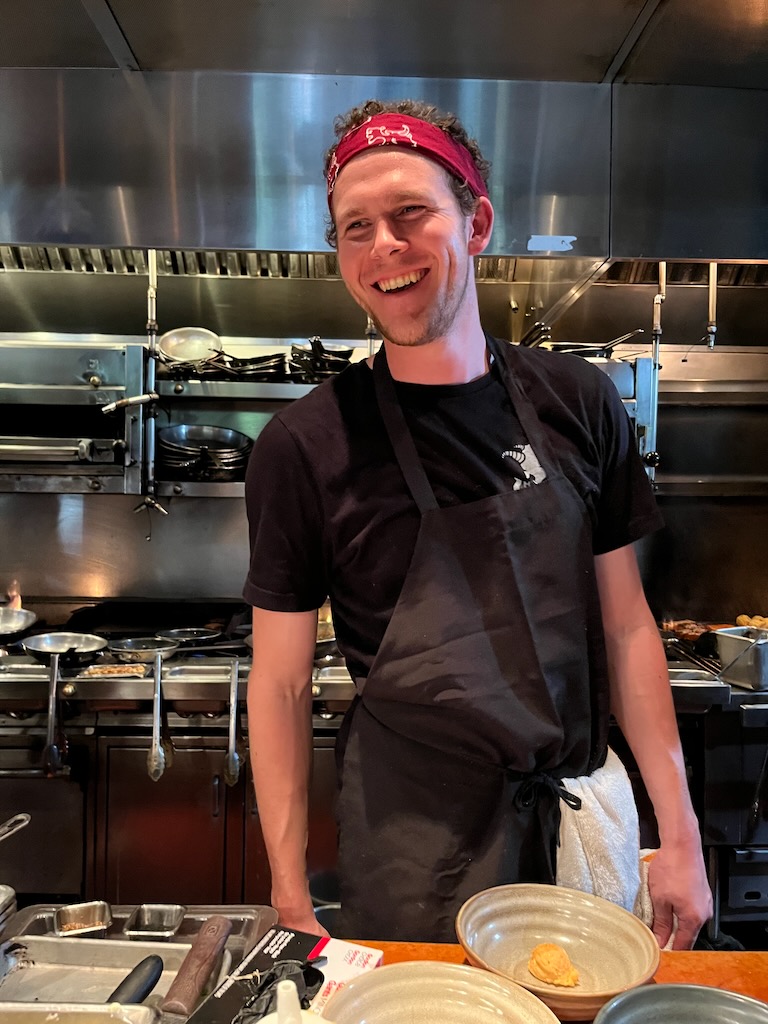
is that not a face you could love till the end of all time?

standing at the doorway of time

i found myself standing in a bedroom doorway the other day, staring. you might have thought i’d momentarily lapsed into freeze frame, but my mind was whirring wildly. it must be a sign of the times — my times, my where-did-the-years-go, i-remember-all-that-unfolded-in-this-storybook-room flash in time. 

i call it a kodak-carousel moment, a name in itself that dates me. as obsolete a term as there might be here in the age of slide shows on phones. no need to plunk in the slides, the film framed by cardboard, a portrait in miniature, and click-click-click to advance. 

the kodak carousel in my mind was playing and replaying the little boy room, the room where my miracle baby grew up. the room where we once stacked his baseball jersey and glove, his ballcap of his very first team, on the eve of his very first game. the room where a fallen-out wiggly tooth was laid to rest (in hope for the fairy) under the pillow. the room where night after night we prayed he would please fall asleep so we could tiptoe our escape without raising a plaintive cry. 

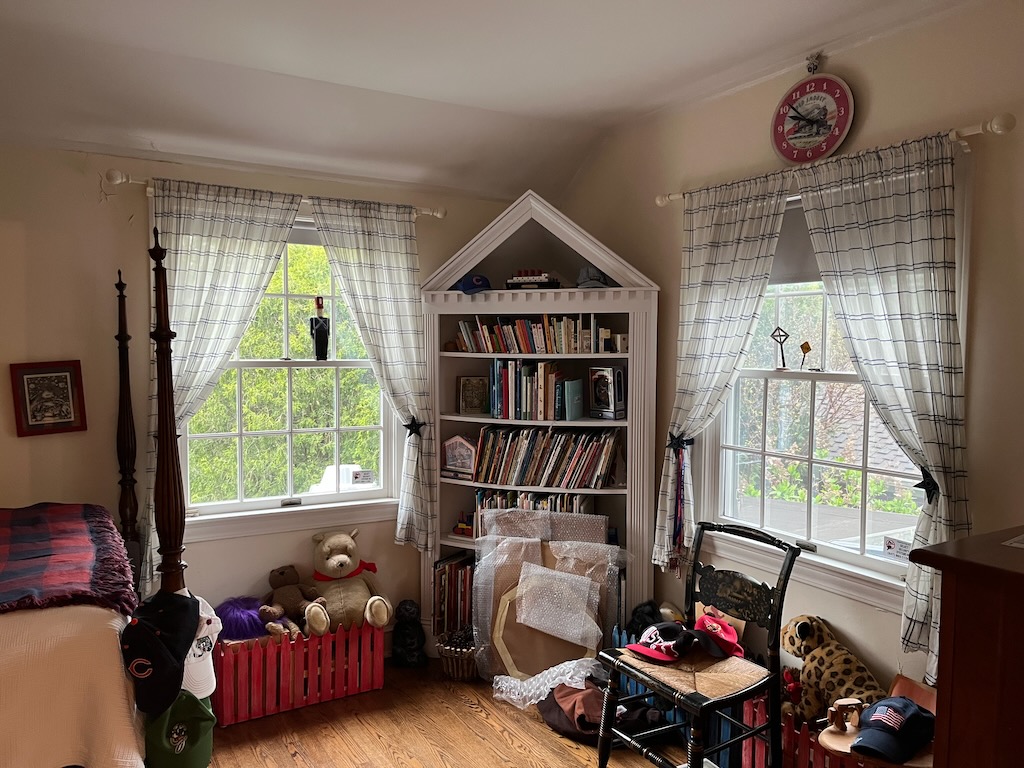
i suppose i’ve made something of a museum of that room. added a few paper-wrapped hand-me-downs tucked in a corner (a safe spot for storage) but otherwise it’s all as it was. the alphabet rug, where i taught two boys their ABCs. the four-poster bed where my grandma once slept, a bed where i too slept for years, and then both of our boys. and now whoever comes to visit. the bins of blocks and bears and hand puppets, too. a whole childhood frozen in time. 

and i won’t touch it. 

the drawers of the dresser are filled these days with extra sheets, and art project makings. no longer stuffed with little boy PJs, and shorts and T shirts, size small. but if you open the top drawer on the right you can still find a vial filled with the teeny-tiniest babies of teeth. i couldn’t bear ever to toss those. 

in time, an old house starts to show its cracks. and chips in the paint. and squeaks in the floorboards, and layers of impenetrable grease in the vent of the diner-grade six-burner cookstove. 

i fear i might be blind to the blemishes as the house crumbles around me. 

all i see is the room where i tucked into bed one reluctant sleeper, night after night, for sooo many years. where he learned how to read, and chased away night-prowling monsters. and another (the room at the bend in the stairs) where we brought home the boy with the broken neck. where he wrote his essays to get into college, and years and years later studied for LSATs. (and just a few weeks ago, home for easter, sat at the old desk and recorded a lecture for all of his first-year law students.)

i look at the pillows on the old four-poster bed, and remember the nights and the mornings we propped up against them, turning the pages of books that left us—both reader and readee—with tears soaking our cheeks. charlotte’s last web. or giggling at the antics of a big raspberry-hued rascal named Ted. or that little monkey named George. 

it seems a holy thing. to pause, to turn back in time. to anoint each moment, each memory, with the deepest form of thanksgiving. to soak in to the deepest fiber of your soul those hours you thought might never end. 

i hope, in that ephemeral fluidity of time, we can rewind the clock, even if only in our soul, to finger each hour, each grace, as if the bead of a rosary. to press it against the whole of who we are now. day by day each of us more graced. as we fill ourselves with accumulation of blessing we’ve lived. the boy who defied every odd of a very old singular ovary, the pregnancy that lasted all nine months, the chromosomes that aligned just as prescribed. the life that was given to me. the years upon years of joy, of undiluted wonder, that grew up in that room where i now stood. soaking it in. soaking and soaking. 

saying my prayers once again. 


yesterday was a glorious day in the life of the soul, and in the life of the church i was born into. it was a stunner of a moment as we listened, in italian, to the first then the middle name of the new Il Papa. in all the italian we didn’t yet know that for all of his life, he was just Bob. Bob the priest. Bob the cardinal. now Leo the Pope.

as i wrote to my boys in the flurry of texts that then punctuated the day, “i feel close as i’ve felt in a long time that God had an actual hand in worldly affairs. this world needs a voice unafraid to speak to worldly power, and proclaim the rule of God. it’s a paradigm the polar opposite of so much idolization in this world. peace and love are not vagaries. huge swaths of the world desperately need both.” 

there is much to learn and to listen to from this unlikely pope from chicago’s very own south side. a pope who roots for the sorry sorry white sox, a pope who loves an aurelio’s slice. a pope, we learn, with creole roots. a pope whose grandparents identified as black in a turn-of-the-century census from new orleans’ seventh ward. a pope who left for peru as a very young priest, to work with the poor. a pope with the courage to set straight those who misread Catholic theology—no matter their office, nor the power they wield. i have been praying with all my heart for a voice of true courage in this world. and this morning, i am thinking that in time the moral arc of the universe does sometimes bend toward justice.

what doorways to time have you found yourself staring into of late? and what stirred through your heart at the news of the new Il Papa?

happy blessed almost birthday to a most beloved chair who, around here, goes by the name lamcal. a wise woman of the highest order.

and happy mothering day to all. because, in my book, mother is a verb, and if you gather here you do it magnificently. xoxox love, bam

the roof and the trees under which i grew up

i’d told myself that ever since the night my papa died, when i walked in that dark house, his tennis sweater flung over the back of a kitchen chair, as if he’d breeze through any minute, the night when i sat in the den afraid and unwilling to take in a breath, for i didn’t want to let go of the last one i breathed when he was alive, i’d told myself that house was mostly hollow to me. 

it’s held a chill for me ever since. 

i didn’t think i’d much miss it.

but then i drove back the other day. drove back to walk through the rooms where no sound was stirring, not even the whir of the furnace. drove back to see rooms emptied, the rugs a radiograph in reverse where the geometries of now-taken-away furniture shone bright against decades-worn dim. where you could make out the plot where my mama’s four-poster bed had been, and the circular table beside it. where the den, too, was a checkerboard of absence, chairs and a couch lifted and moved. 

this week my mama moved out of the house where she lived, the house she called home, for six whole decades. long long ago, when my papa got a job in chicago (an ad man in the age of the Mad Men), and they’d moved us again from a faraway city, she’d picked that house out of many along the north shore of lake michigan because it was the house with the oaks. more than a half dozen big old oaks. maybe a whole dozen once upon a time. my mama loves big trees and big skies. the house gave her both. 

my mama moved into that house in 1963, with four of us under third grade; two, still tricycle-bound. one of us, the fifth among us, was born to that house. never knew another till the day he went off to college. we used to joke that he and my mama are the only northerners among us. all the rest were born south of the mason-dixon line. we all grew up, though, on brierhill road, a winding dead end of a street carved into the woods. a golf course just across the way made for sixty years of unobstructed sunsets for my mama, who kept watch dusk after dusk through the kitchen window. the creek and the crawdads, the green pond, and the logs in the woods made for my playthings, the topography of all my imaginings.

i made my way back there this week, after it was mostly emptied, when i knew i could be alone. i wanted to walk room to room to room, and up the stairs to my old bedroom at the top of the stairs. the room where you can still find my sixth-grade scribble on the wall in the closet’s back corner. the room where so many nights i looked up and out through the oaks into the stars and the moon, where i rocketed all of my prayers and my dreams. 

as i drove there, to the house at the bend in the road, i thought of all that had happened there. how i got married there, under the trees, breezing through the garden gate flanked by all four brothers. how, ten years before that, we’d sat round the kitchen table the night after my papa died, and tried to make sense. i thought how that was the house from which i was taken to hospitals, especially the time at the end of high school, and how our family pediatrician (yes, he really truly was Dr. Kamin, the most beloved housecall-making pediatrician that ever there was) came in the middle of nights when i was burning with fever. i thought how i’d close the door to my room in those sodden sulky middle-school years when i was sure no one loved me, and how during high school i’d yank the telephone cord from the kitchen round into the dining room, as far as i could uncoil it, to steal a wee bit of sanctuary amid the roar of a family of seven. 

and then i walked the rooms, poked into drawers, shooshed away cobwebs, and inhaled it all one last time. when i got to the oaks out back, looked into the grove where my little girl log cabin once had stood, when i counted the feeders that still swayed in the november breeze, i felt the tears begin to pool in my eyes.

maybe the old house wasn’t so hollow to me, after all. maybe the old house where we’d all grown up, the house that had so long harbored my mama, maybe it would be hard to leave behind, to say a proper goodbye––and thanks–– to. 

my tears spilled one last time on that bumpy old earth under the oaks on brierhill road. 

i stooped to pluck one last acorn, now tucked in my snow coat’s pocket, and then i climbed in my own red wagon, the one that has ferried my very own boys through their growing-up years, back and forth plenty of times to their grammy’s. and i drove ever-so-slowly away. 

but not without whispering a very deep blessing for the house that held us all, and mostly my mama, for so very blessedly, blessedly long. 

what do you miss most about the house where you grew up?

equinox of the heart

My heart is in equinox. Equal parts light and shadow. That’s not necessarily an out-of-the-ordinary state of affairs for the human vessel that holds all we feel in a day, in a lifetime. But it’s not usually so amplified, not usually so stark.

On the one hand, I am counting down the hours and minutes till a boy I love, the first one I birthed, comes home for the first real time in years and years. The first time in as long as I can remember when he won’t be squelched by the pressures of (in reverse chronological order) bar exam, law school, admission to law school, wrangling a classroom of hellions for the year he was teaching on the mean streets of Chicago, and before that pushing against the deadline for an honors thesis that somehow stretched to 300-plus pages. He is—in three days and two hours—packing a Portland apartment into a moving van, and one day  and six hours after that he’s boarding a plane, crossing the Rockies, the Great Plains, and the checkerboard of farmland that is preamble to landing at Chicago’s O’Hare International. 

He’ll be here—for the first time in six years—for the Thanksgiving feast. And Christmas, and the turn of the new year. Then he’ll move on, to New York City, where once again he will take up his pen and his law books and clerk for a federal judge. And all that time, all the weeks when he’s here, the first order of business will be simply to breathe. To sleep in the old room at the top of the stairs, to trundle down to this old maple table, to cook by my side, and walk along the lakeshore where we all go to think when our thoughts—and our souls—need every square inch of the infinite sky.

And, on the other hand, the man I married three decades ago, the man whose life has unspooled next to mine for the best of my years, he’s off on the Jersey Shore, in an old quirky-but-endlessly-charming house at the edge of a pond. He is there all alone, except for the movers who are coming in shifts, day after day, to empty the house of every last trace of the long lives lived there. The house will be bulldozed before spring turns to summer. And it’s his job, as the only son, to attend to its final hours. He is packing up the last of the dishes found tucked in a cabinet no one had known, finding nearly lost treasures slipped between books on the shelves (his parents’ ketubah, or marriage “contract,” signed in ink in January of 1955, and almost sent off with a load of donations), taking one last long look out the living room window, watching the sunlight and the swans on the pond. 

It’s a house that has played an anchoring role as a central character in the narrative of the long lives lived there. No one ever imagined it wouldn’t be there, high on the ridge at the top of the slope, peering down on the pond. The footfall of at least a century and a half are pressed into the stairs that twist up to the bedrooms. Sixty-five of those years belonged to my husband’s father and mother—he in his white bucks or his Keds, a gentleman of old-school sartorial splendor; she in her size-10 flats (never heels, for she never wanted to tower too tremendously over the little children she taught, as a woman of considerable height). 

My husband, who has long taken to heart the tenet that architecture shapes lives as lives shape the architecture, is not one to bid farewell to timber and bricks (both of Revolutionary War vintage) without a significant lump in his throat, and a piercing in his chest. I saw how his eyes went dark, the sadness not hidden, when he said to a friend the other day, “It’s like another death.” It’s the last one of its chapter. Six years ago, the sartorial one breathed his last, and just this July, so did the schoolteacher. Each time, my husband and his sister scattered the ashes along the holy ground that is the edge of the pond.

I can barely imagine how hard it will be to turn the key in the door that one last time. To walk down the steps, turn, take one last look. To drive away, down the lane, the white clapboard gardener’s cottage disappearing into the distance. To know, after 64 years, he’ll never come again. 

And so the shadow is thick on the walls of my heart, and the light, too, is dappling, is falling in splotches. The equinox of the heart is not uncharted terrain, but oh it makes for gingerly treading. 

Thank you for listening. It is hard, so hard, to say good-bye.

funny that i wrote this in caps, up till now. i’ve been writing and writing all week, and i guess i’ve fallen back into work mode here on the keyboard. for me caps are like wearing my big-girl shoes, lower case is kicking ’em off, shuffling around in my slippers. i’m letting it stand, as a salute to the ones i love…

photos above by blair kamin, on Shippee’s Pond, fair haven, new jersey.

the boys i love, the one coming home tuesday on the left. standing in the front yard of their grandparents’ house on the day of their grandmother’s funeral.

how often do you live in equinox of the heart, and might it be–in many ways–the natural state of the vessel that contains so very much of our love, and our joy and our hurt? so much of our lives are equal parts light and shadow. how do you find a stillpoint?

the dangers of not letting go. and the dusty path toward redemption.

the homestead, circa 1957

this is not a story about religion. though it’s a subject with zealots and slackers.

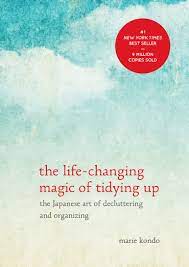
marie kondo, the porcelain doll of a declutterer, calls it sparking joy (and swears it can change your life). i call it getting covered with cobwebs. and eye-watering dust. and reminding myself of my proclivities for not letting go of the sentimental. 

but i took a trip to new jersey, to a white-clapboard house that might have been built in the early 19th century, and might have been there (in one form or another) as early as 1789. 

and everything changed. 

inside that old house were dozens and dozens of orifices, each one packed to the brim. to open the door to the attic was to trigger a domestic avalanche, the sort you might find spelled out in the weekly gazette, where some poor soul was buried alive beneath decades-old shoeboxes, crumbly yellowed news magazines, and strings of christmasy lights that might never have burned. 

when your job is to pack up the kitchen, to wrap not only the skinny-necked goblets, but to sift out toothpicks, circa 1960, and mismatched tupperware lids by the dozens, you swiftly absorb an abiding commandment: thou shalt not leave behind a house stuffed with stuff thou hast not had the courage or chutzpah to preemptively toss. 

you get cured right quick of your stockpiling ways.

marie kondo, whose best-selling tidying book i once was assigned to survey, makes the closet-clearing task sound downright zen-like, as if standing before overstuffed shelves, blithely sorting and chucking and plucking for joy — would that be placing the object in the palm of one’s hand, awaiting the wee bit of voltage that’s the signal for “keep me”? — is the next best thing to a trip to the spa. (no wonder i tossed aside that pretty little spark of a joy-jolting book, the book that sparked little but befuddlement back in my stuff-keeping days.)

the truth is, i found packing up the kitchen of someone i love a hauntingly heart-tugging endeavor. i unearthed the red apple-shaped placemats she must have delighted in setting on her breakfast table, or when a struggling student she lovingly tutored came for after-school cookies and milk. i pulled from a drawer the crystal-handled cake cutter that might have sliced into chocolatey layers on countless occasions, and i heard once again the peals of laughter that echoed through the house’s post-colonial walls. i discovered my mother-in-law’s absolute obsession for all things valentine’s day; heart-shaped candy dishes, red paper doilies, and 101 variations on heart-speckled pink paper napkins. 

it’s as if a life is being unspooled wordlessly, a silent reel of thing upon thing. each one with a story you can only imagine, each one a frame still palpably pulsing, but only just barely. and you feel the slipping away all over again.

i kept picturing my mother-in-law peeking over my shoulder, wincing each time i tossed a tchotchke into a trash bag or pitched some trifle to the give-away pile. i felt guilty. i felt tender of heart. i wiped away dozens of tears. (and i kept those few things that belong in the family treasure heap: a dough cutter (highly likely unused), a trio of age-worn red plates (the ones i ate off dozens of times), the red-plaid apron i long ago sewed for her birthday, and now frayed at the ties.)

but then, stripped of my long-held tossing hesitancies, emboldened to not bequeath such a task to my own two boys, i came home and applied my newfound thick-as-reptilian toughness to the orifices i call my own. all week i’ve been standing akimbo in closets and tucked-away corners, dispatching and discarding with gusto. whole bags have been filled as i’ve scoffed at the millions of times i’ve stashed some odd something away, long deluding myself that some day i might find reason to put into action whatever was the odd esoterica. i now know that someday never comes. 

and my new best allies are the fine fellows at goodwill industries, who handily roll out the big blue bins every time they see my red wagon pulling into the lot. 

it’s hard work for the heart. and i don’t mean the muscle that’s doing the pumping. i mean the ineffable filaments of said organ that cling too mightily to the objects of everyday living. the invisible cords that — in some of us anyway — tug too hard in the attachment department. 

to excavate the closets and cupboards of a life long lived is to sweep across the narrative told in dusty old things. in the story told from the long life i hope is mine, i want the people i leave behind to lift up each object and know it sparked me pure joy. 

but more than that, far more than that, in the now, i want my life to not be buried under the crumpled weight of stuff that niggles at me, taunts, “why on earth are you holding onto me?” why not let go, and be freed from the crushingness of closets that threaten to topple, drawers stashed with missing and misplaced parts, and the generalized sense that i live in a house that might split at the seams? 

i want only the things that conjure a someone or sometime or someplace i loved. i want to live lean and clean and not take up more than my share of the room. i want a house without the ghosts of fibber mcgee. i want a lightness of being.

mostly, i guess, i want to pare it all back to the essence, the true essence of joy — unencumbered.

turns out, marie kondo was right after all.

how do you rate in the declutter department? are you a stasher or trasher? if you told your life story in objects, what might be the most treasured pages?

this old house is so much more…


not long after nine the other morning, an army of painters pulled to the curb and launched what appeared a military-level operation on this old house. ladders upon ladders were hauled from the lid of a van, drop cloths were draped over bush, tree and stoop. brushes were slid from plastic wrapping, buckets of paint shimmied up ropes, dangled from hooks that swayed in the breeze. in all, 15 painters had at it, each with his eye on the darkening skies, the skies that threaten a freeze by daybreak tomorrow.

it’s been 15 years — at least — since this old house was slathered in beechwood semi-transparent stain all across its shingles, its windows and mullions traced in white white, its doors in van deusen blue. that was back in the long-ago days, back before high school and colleges and law school, back before a broken neck and assorted orthopedic adventures, back in the days when a fat cat prowled the so-called acreage. back when we were deep in the grain of making this old house our own.

this old house has harbored much in our short slice of its 78 years. it’s become the place we come home to, the place we miss when we’re away. a few weeks ago, when the tree cracked in half in the dark of the night, both boys — faraway now — wrote home with alarm. they begged for pictures, needed to see for themselves; hauled out the exclamation marks on their keypads. even from a distance — long distance — they did not cozy to the notion that their old house and the tree that harbors it had suffered a blow.

home is like that. home roots us. home is our ballast in the storms — and, oh, there will be storms. we come to consider home — the old house with its particular creaks and moans and recalcitrant sashes — something of a character in the life of our family. its floorplan is the one we trace in our imagination, the narrative throughline of all of our stories. we picture it, no matter how far we roam. sometimes we physically ache to run our palms down its bannister, to click open the door that insists on a shove. sometimes, when we’ve been away a long while, we begin to feel its pull, its true magnetic pull, soon as we come through the underpass, take a left at the smoke house, retrace the leafy lanes, see the place standing, just as we’d left it. sometimes, we can’t get the key in the lock to turn quite fast enough. sometimes we don’t fully breathe till we’re standing there in the old front hall, and we inhale the smell of home again.

there’s a book on one of my shelves titled, a home for the soul: a guide for dwelling with spirit and imagination, by anthony lawlor, who happens to be an architect and author of the acclaimed the temple in the house. in the opening pages of home for the soul, lawlor writes:

from the moment we are born, we seem compelled to travel homeward. in places and people, we seek that elusive feeling of being welcomed. home is the goal of the epic journeys of the human spirit. jesus returns to his heavenly father. moses leads his people to their homeland. buddha reaches the immovable spot of enlightenment beneath the bo tree. 

i like it even more when lawlor turns to a lakota medicine man named Lame Deer who writes of the sacredness right under our noses, a sacredness woven into the everyday fibers of home, yet a sacredness we sometimes forget to see.

writes lame deer:

what do you see here, my friend? just an ordinary old cooking pot, black with soot and full of dents. it is standing on the fire on top of that old wood stove, and the water bubbles and moves the lid as the white steam rises to the ceiling. it doesn’t seem to have a message, that old pot, and i guess you don’t give it a thought. [but] i think about ordinary, common things like this pot. the bubbling water comes from the rain cloud. it represents the sky. the fire comes from the sun, which warms us all. the steam is living breath. it was water; now it goes up to the sky, becomes a cloud again. we sioux spend a lot of time thinking about everyday things, which in our mind are mixed up with the spiritual. we see in the world around us many symbols that teach us the meaning of life. we try to understand them not with the head but with the heart, and we need no more than a hint to give us the meaning.

the painters are gone now. they’ve folded up their drop cloths and hauled them and the ladders away. our old house this morning is redolent of eau de semi-transparent stain. when i wandered out to gather up the newspaper at the curb, i turned to ogle the beechwood shingles and the van deusen blue door in the first light of the day. i’m certain this old house is standing just a little bit snappier today. it’ll be good for at least another chapter, this one that now echoes too often and too loudly with the sound of not quite full.

where do you find the sacred pulse point in the place you call home?

IMG_0582

the painters tied up the bushes so they could paint my window to the world

coming home.

coming home kitchen

i slipped back in as if gliding my arms through the sleeves of the oldest soft-knit sweater from the back of my closet. the sort of sweater you reach for when it’s the end of the day, and you want the goosebumps to go away, but even more you want woolen threads that breathe against your skin, woolen threads that whisper to your soul, “here we are, home.”

that’s pretty much how it felt to unlock the door after a few days away, to plop the duffel in the front hall, to wander about in that way that one does, to check for what’s happened while you’ve been gone. i saw right away that chipmunks must have upturned a brick or two at the steps that lead down to the garden. and the old house all but hollered to please open the windows, to let the hot dry air back out where it belonged.

wasn’t long till i found the note left on the kitchen counter, the note written by a dear, dear friend — the one who’d stayed at our house while we were away, since she needed a place to sleep and we had one. she wrote:

“in this house, one is always aware of time. the ticks and tocks, the chimes of multiple clocks evoke shared joys, episodes of comfort and sorrow, presences long gone but still close to our hearts. the rhythms of those machines wake me in the mornings, lull me to sleep…and call me to return.”

it’s a fine thing to hear your house through the ears of a friend, a soulful friend, a friend who has always put words to page with more grace than nearly anyone i know. my blessed friend’s words only amplified what i already know. what i know every single hour of every single day i live here.

coming home — even when there’s not a note to remind you — sharpens your ears, and all of your senses. wakes you up once again to this place you’ve spent your life making — making home.

home, for those of us lucky enough to have one, is that place that over time has come to hold the living breathing narrative of perhaps your most essential essence, those threads in your life you hold to be sacred.

my old house is one layered with story upon story. each old clock tells a story. the sounds that ooze in through the windows — the fact that i almost always leave a window open at least a crack — the birdsong, the breeze rustling the leaves, the faraway train whistle, the dog down the block. those are the sounds of home to me. i know its gurgles and burps so intimately that if one is off-kilter i know it’s time to call the plumber or the fellow who stokes the furnace. i am the guardian of my old house, and my old house returns the favor: my old house guards my heart and my soul.

and so coming home to it was coming home to a friend i’d left behind. we’d gone off to see the boy we brought first into the world. we’d packed a two-week visit into four short days — whirled our way through the hottest days DC has seen in a mighty long time (and lived to tell the tale, though for a while there we were gasping for air and long, tall quenchable waters). i’d be lying if i didn’t admit to wiping away a tear (or more) when we said goodbye to the sweet sweet legal-scholar-in-the-making, the one who was working so hard he couldn’t even take in the fourth of july fireworks. and while i wouldn’t trade a single one of those days away for anything, the sweet joy of finding myself back in this place where i most belong made the absence more than worth it.

i’ve come to know my particular custom for coming home: right away i dump the laundry down the chute, i gallop off to the grocery store, tear through the stacks of mostly-junk mail. i’m a madwoman restoring order. and then the puttering comes: i pour drinks down the gullets of my garden. i reach for the clippers and snip here, there, and yon. i stuff the old pitchers again, and tuck a fresh batch of cookies under the shiny glass dome that sits atop the pedestal (my nod to the ’50s diner).

i always take time to listen. to breathe in the ticks and the tocks and the chimes and the rhythms. to be quelled and lulled by all of the quirks of this place i so know by heart.

by the time i plop my creaky bones atop that old familiar mattress, perk my ears to the night sounds seeping in through the screens, whisper my litany of thank-you prayers, i am thoroughly deeply home. and more than grateful to call this old friend by that most blessed of names — home.

thank you, sweet home.

what’s the thing you relish most when you come home? and, just because i’m curious, do you have a quirky way of reacquainting yourself with the place once back from where you’ve roamed?

here’s a little extra morsel, a link to a story about retro and vintage cookbooks i wrote for the chicago tribune. it ran on the fourth of july, a day not too fit for browsing through the news pages. it’s a story whose reporting made me swoon — for the fine cast of characters from the literary kitchen, tamar adler, graham kerr (the famed “galloping gourmet”) and a very fine baker with a yen for updating retro pies, cakes and confections.  

heartbeat home

heartbeat home clock

it’s quiet here this morning, too quiet. it’s been that way for 10 long weeks.

the only sound is the susurration of the furnace. poor overtaxed furnace. burning kilowatts to try to keep us warm, to keep the goosebumps at bay.

the missing sound is the tick that follows the tock that follows the tick. and on and on and on.

there’s a clock, an old old clock, one once packed up in a florida house, laid carefully atop a formica-slabbed kitchen table, not unlike a baby after a bath, wrapped in towels, slipped in a box, and carefully carefully sent from west palm beach to chicago. where, once it arrived, we lifted it, hung it, wound it, and listened.

i’ve been listening ever since.

i’ve aligned my heart to the tick and tock of that old clock — a clock whose provenance we have only guessed at. i thought dutch. a clocksmith told me “mexican.” what i do know of its provenance is that my beloved, that tall bespectacled fellow, had a grandpa who loved clocks. and that grandpa’s pride and joy — or the ticking one, anyway — was his wall of clocks from across the time line and the world map. that wall, in that house down florida way, it clanged and squawked and chimed, a ticking-tocking  quarter-hour reverie.

i never met that grandpa, but the grandma to whom he’d long been paired, she became, in one fell swoop, the dearest grandma i ever knew. i might have spent the rest of my happy days bopping around as the irish catholic granddaughter of a teeny, wrinkled, jewish fireball, but she died 11 years ago this week, far too soon even though she was pushing 93 and change. they called her the “teaneck tornado,” my jewish grandma, the one who took college classes into her eighties, the one who once threatened to fly a slab of cow in her suitcase so she could teach me how to make a brisket. the one whose squeaky “barb!” — a puncturing pronunciation that launched every long-distance rapid-fire tete-a-tete — i still can hear, without even closing my eyes to crank the long-gone volume.

that grandma — her name was syl — she shipped off the clock, and twice a week for 23 years, i wound it. the rest of the time, i counted on it to keep the rhythms of my hours, to be the heartbeat of our house. it moved, in the back seat of the station wagon, from our city house to this old house out where lanes are leafy and the lake is near enough that, on a windy day, i can make out the rhythms of the waves shooshing against the shore.

and there’s no sound that says “i’m home” more certainly than the tick and tock and quarter-hour chime of that old timekeeper.

so when it slowed to the silence that follows the tick, when i realized the tock was not coming, we all stared wide-eyed at the wall. as if there’d been a death in the family. certainly, there’d been a silencing. the heartbeat of the house was gone, erased, snuffed out. and in a house where these days most every purchase is weighed, is considered, we didn’t take lightly the news that this clock’s stay in the timekeeper’s infirmary would tally quite a bill.

but, not unlike the ancient cat who prowls the soft spots of the house, the house’s heartbeat is beyond domestic calculation, outside the accountant’s domain. if your striped old cat is ailing, you wrap the furry fellow in a towel and you ferry him to the vet. so, too, the clock.

i swallowed hard as i lifted the old clock from the wall. and, yes, i wrapped it in old bath towels. i parked as close to the door of the timekeeper’s shop as i could get — anything to slash the chance of me and the clock skittering to the sidewalk, in a thousand irreparable pieces. and i turned it over with all the solemnity of a mother sending off her little boy for a tonsillectomy (okay, maybe minus the tears, but trembling nonetheless).

we endured a christmas without a clock, and the new year too slid in without the ceremonial clang-clang-clang (our old clock never has been aligned with the hours). heck, we bumbled right through ground hog day without the metronome of time passing audibly. and here we are, the clock is coming home today. any hour now, i’ll strap on my snow boots, maybe even add the yaxtrax to keep from slipping on the ice, and i’ll plow through mounds and glide on icy patches to fetch my clock and bring it back where it belongs — home, hanging on the red-red wall that’s been achingly absent its old, old ticker.

all this, of course, has got me to thinking. thinking about how it is that humans are hard-wired to the song of the heartbeat. how it’s the first of the sensory awakenings in the unborn child. long before the eyes have anything to see, the human eardrum begins its lifelong percussive beat (if, God willing, the auditory system is developing as hoped and prayed). somewhere between the 17th and 19th week in a mama’s womb, the unborn baby’s world is wakened to the sound of breath and heartbeat, rhythm and vibration at their most elemental, most soothing i’d imagine.

the wonderful scientists who study these things have found, among other pulse-quickening wonders, that the baby’s heart echoes the mother’s response to music. when the mama hears soothing dulcet tones, her baby’s heart settles into slow steady intervals. when the mama is jarred by cacophony, by dissonant screeching, the baby’s heart rate accelerates, startles.

hearing, we know, is the last of the earthly threads to be severed when death is but a breath or two away.

so is it any wonder that in the blessed interval between in utero and death, we humans turn to heartbeat — be it of a clock, or the drip of rain, or our own ear pressed against the chest of whoever it is we love deeply enough, tenderly enough, to be invited to the chest wall’s quiet ticking?

and is it any wonder that some of us are soothed by whatever brings us back in time and rhythm to that one first murmuring, that percussive pounding, that told us we were safe, enwombed, nestled up against a mama’s ever-pulsing heart?

what are some of your favorite soothing sounds? 

long ago, back in 2007, on the jewish “new year of the trees,” known as tu b’shevat, which we marked this week, i wrote a meander called vernal whisperings. because it’s a moment of the jewish calendar that i find especially breathtaking, i’m offering it back here at the table.

here’s a bit of tu b’shevat’s deliciousness, as taught by 16th century mystics:

“known as the kabbalists, these deeply spiritual thinkers believed that we elevate ourselves by the eating of certain fruits on tu b’shevat. if done with holy intention, they taught, sparks of light hidden in the fruit could be broken open from their shells, freed to float up to heaven, to the great divine, completing the circle of the renewal of life.

“oh my.”

the nesty girl’s guide to real estate

when you grow up curled into armchairs, with your nose pressed to the pages of fairy-tale storybooks, absorbed by the drawings of magic cottages tucked in the woods…

when you grow up meandering about the pond across the lane from your growing-up house, poking around in the woods you call your own, making logs into beds, and the seed pods of wildflowers into your make-believe kitchen…

when you grow up with a grandma who lives in an old fine house, with secret stairs and itty-bitty passageways, and an upstairs porch with creaking wicker chairs and fireflies dotting the summer night’s air…

when your idea of a heavenly summer as a 10-year-old girl is to spend it with cardboard boxes and your very best friend, cutting out fabric bits, and gluing and dabbing on paint, building a dollhouse that stretches from june straight into august’s last hours…

when all of those synapses have been connected somewhere along the way, when all of that cozy-cottage DNA courses through your chromosomes, well, you don’t look for a place to lay your head quite like the rest of the world. you don’t get wowed by granite countertops or showers that look as if they might lift off and whirl to outer space.

nope, you tend to poke around in peculiar uncharted ways. you know when you’re home when you hear the ping go off somewhere deep inside your noggin. you wait to feel the pounding there in your chest. matter of fact, you must have a light meter tucked back behind your eyeballs, because you always, always pay attention to the way the sunbeams filter in through the windowpanes.

you become over the years a decidedly undeniably nesty girl.

you turn into a someone who draws oxygen from dappled light dancing on old floor boards, who finds herself charmed by the newel post at the bend in the staircase, who spies clawed feet peeking out from under the victorian bathtub and you can’t wait to climb in.

you, very much so, find places to live by heart.

and you are over the moon when along with all of those lumber and glass particulars, you discover the person who owns the place is clearly a kindred spirit, a brand-new lifelong friend, the soulmate you’ve been searching for, without ever asking.

and so it was that we stumbled upon a charmed treetop aerie the other afternoon, one that will be our home for a year, the holy sacred place we’ll come back to night after night, as soon as we launch our big back-to-college adventure in cambridge, massachusetts, 02139.

as much as, just a few weeks ago, i could barely imagine leaving this old house that owns a piece of my soul, i discovered this week what i’ve always known: four walls and a roof are only the beginning.

what makes a place home are the whispers you hear when you tiptoe in through the doorway. what makes a place home is the way some invisible hand reaches out and cradles the tenderest parts of you.

and as we motored about the twisty winding streets of old cambridge, i knew, soon as we turned around the corner of putnam and franklin, that suddenly something felt familiar, not foreign, even though i’d never been there before. maybe it was the pie bakery & cafe we passed just before taking a left turn at the white picket fence. maybe it was the cobblestone sidewalks. or the victorian laciness of the woodwork out front.

as soon as the front door opened, and a gentle man ushered us in, as soon as we passed the statue of st. jude tucked in one of the bends in the three-story staircase, i found myself sighing deep down inside.

once we walked in, once i saw the way the sunlight fluttered on the old floor boards, dancing through the leaves of the trees that harbored most of the many, many windows, once i noticed the old brick column, a chimney from the downstairs fireplace, once i saw the cherry dining table with room for all of us and a few of our friends, i was starting to cross all my fingers and toes.

then, i tiptoed into the book-lined office of the very kind man who had opened the door, who had shaken our hands and left us alone to look about in quiet.

i spied there on his desk the covers of books with titles that gave me goosebumps, each one some combination of poetry and divinity, the two subjects i’ve long said i was heading east to study. i felt tears welling up in my eyes.

i hadn’t expected any of this. i’d more or less abandoned the hope that my long string of real-estate magic could take yet another miraculous turn. real estate, they tell you, is all about hard cold numbers: dollar signs and square feet. it’s about making the deal, signing the contracts.

except when it’s not. except when you’re a soulful spirit and you don’t work in worldly ways. you wait for the tears to spring in your eyes. you wait to feel that thumping thing there in your chest.

you don’t need dotted lines, on which to scribble your name. you don’t need security deposits to promise you will keep from banging holes in the walls.

you, an A-number-1 nesty girl, you know when you’ve stepped into a hallowed chamber.

you know, right away, when the fellow offering you two kayaks and a canoe, along with passes to all of boston’s museums, and 11 months in this treetop two-bedroom, two-study apartment, complete with bird feeders at two of the windows, you know he’s the saint and the spiritual guide you’ve been secretly waiting for for so many years. (especially when he starts to list for you the monastery in walking distance, should you be inclined toward “smells and bells,” as he joked, meaning the incense and vespers, and then goes on to tell you about the abbey not so far away, along the south boston shore, where you can rent a hermitage for the night, should you care to be holed up with your pen and your prayers in utter silence.)

you didn’t need all the running around to the bank and the notary public. all you needed was to stand there and shake hands, a deal is a deal — when it’s of the heart, that is.

you didn’t need some 10-page typed contract. you simply accepted the invitation of the lovely fellow and his lovely wife to come back that evening for a glass of wine at the candlelit table on the back deck where the mockingbird kept up his night song, and all of you began the unspooling of your life’s story, and the very first threads that would stitch you together for years to come.

and so it is that we now know where we’ll hang our hearts this coming school year, when all of us go back to school in cambridge.

and so it is that once again i am witness to the truth that if you never extinguish the pilot light of faith in undying old-fashioned goodness, it will up and surprise you, surround you, and illuminate your path in pure unfiltered luminescence.

and that’s how nesty girls do real estate.

if i were to write up the real estate ad for the lovely place we’ll call our home, it would go something like this:

2 bdrm, 1 w/ skylight where you can absorb the lullaby of gentle summer’s rain. kitchen w/ bird feeders at 2 windows. windowseat tucked into corner. back deck tucked into the tops of trees, looking out on a flock of gabled roofs where mockingbirds and robins perch for evening song. bookshelves stocked with every cookbook you could dream of. complete, chronologically-catalogued case of sacred music. old quilts on beds. hardwood floors that glow in sunlight. birdsong from 4 a.m. till sunset. church bells, 2 blks. away, chime on the hour. herb garden. climbing roses. lifelong friendship included. floorboards and ceiling beams appear to have absorbed years of poetry.

how would you write the real estate ad for the place you call home?

illustration above is the frontispiece from “the tasha tudor cookbook: recipes and reminiscences from corgi cottage.”

apartment hunting and the hurdle of the three-dot plates

in all the years that we’ve been pulling up chairs, it’s become more than cloudy clear, i’m certain, that i tend to be a nesty girl, a girl who sinks her roots down deep, and doesn’t yank them lightly.

so bear with me while i tell you the tale of why it is i am apartment hunting nowadays, and what in the world three-dot plates have to do with that far-flung adventure.

i suppose the time has come, at last, to let you all in on what had been a secret, but now is seeping out, so it’s not a secret anymore. (i can imagine the pounding in your hearts as you worry where this is going; fear not, no need for worries.)

but let’s begin at the beginning, where most stories do begin, and turn the clock back to a dark december day.

there i was sitting at my typing pad in the newspaper tower, when i heard a ping ring out from the box that was my desk-top computer. i clicked and looked and saw there a missive from my lawful wedded mate.

seems he’d gotten a little email from some folks at a university in cambridge, massachusetts. they were asking him to apply for a fellowship, a journalism fellowship, one that gathers 24 fellows from around the globe, and one that would entail a one-year stint, thus lifting our whole little family out of our cozy chicago life and plopping us onto an unmapped one in cambridge.

kind fellow, decent fellow, my mate, he wrote back right away to say that he was deeply flattered but no thanks; we have a little fellow, a fifth-grade fellow, he explained, who could not be yanked from his life.

as a mere afterthought, this man i married, he sent this all along to me so i could smile and carry on with my otherwise ordinary day. or at least that’s what he thought i’d do.

but i did not.

i shot right back, “whoa, hold your horses there, buster. at least stop and think about it,” i implored. “is this not the manna from heaven that we’ve been praying for? peering skyward day after day, in search of sign of falling crumb?

“let’s at least ask the little guy, see what he has to say,” i begged, all but dropping to my knees.

and so we did: that night at dinner, we asked the 10-year-old lad what he’d think about moving away for just one year, moving, say, to massachusetts, so daddy and mommy might go back to college?

why, that brave old soul, he did not blink, nor flinch. he piped right up: “sounds great. i want to see the world.”

we explained every which way that this would mean he would not be here for sixth grade, nor for soccer on the team he loves, nor for spring baseball, nor friday night skate, his highlight of so many weeks.

no matter what we pitched his way, he batted it all away, stood fast to his determination that it was time to see the world.

so, as i scrubbed the dirty plates that night, it was my turn to come up with excuses why we shouldn’t leave. i wasted no time ticking off a long list of things i could not bear to leave behind: my three-dot plates, for instance. i’ve only four sets, and only scored them after tracking them down at a resale shop, after pining for them for 20 years. they’d been the plates i wanted back when we were getting married, but the architecture critic who would be my mate thought the dots got in the way. in the way of what, i’ve never quite determined. but the dotted plates went the way of the rose-covered bedsheets i’d once admired. one makes compromise when living with a design-steeped fellow, and i long ago realized our peaceful co-existence depended on my occasional surrender to his whims. so these plates, procured a full two decades post betrothal, they are the plates i pluck from the stack whene’er i need a ceramic boost.

and somehow, in that odd way my mind stumbles along, they came to represent the dividing line between the world i’d leave behind, and the one i just might dive into. what if they were cracked and broken while we were away? what if, whilst i was off in pilgrim land, they were accidentally expunged from the cupboard, and, upon return, i’d find myself without the proper spotted saucer to uphold my breakfast toast?

for more than a day or two, i weighed the choices here: go to harvard, play like a pig in mud, taking any class i could stuff into my braincells; or stay here in chicago, in the house i know and love, and eat off three-dot plates till the end of time.

in due time, i realized i was, frankly, an idiot to be debating such obstacles.

i surrendered to the adventure of it all, and cannot over-emphasize how that deep-down sense of grab-it-now-it-might-not-come-again has come to permeate, well, just about everything.

ever since, i’ve been living my days as if each one is a bit of a hallelujah christmas gift, a box wrapped up in shiny paper, with pretty bow and all.

it was, in fact, the rocket-booster oomph behind my thinking it was time to leave behind the newspaper life i had long loved. and right in here, with may and june and summertime swirling deliciously around us, it’s what propels me not to mind spending hours at the kitchen table, or perched on chairs outside, in the dappled light of the pine trees, chewing over a thousand ideas and stories with my college boy, now home for endless days and nights of sweetest-ever summer.

we had no idea, of course, whether embracing the adventure would lead to any sort of happy ending. had no idea, once the long and layered application was turned in, shipped off cambridge way, whether the deciding folks would pick the home-team architecture critic, slot him in the nieman class of journalism fellows for the school year 2012-2013. but, indeed, they did. he is the arts and culture fellow.

so here we are. poring over real estate ads, dialing up massachusetts realtors, searching high and low for a two-bedroom apartment in ZIP code 02138 or 02139. and before we’ve found a place to lay our sleepy heads, we’ve taken care of business and secured a slot on a cambridge soccer team for our little goalie. priorities, after all.

as for this old house we love, we have a beloved friend who will move in, hold down the fort here, watch over the three-dot plates, and the red-and-white checked chair, and the window seat i’ll miss.

and for one extraordinary year, i’ve come to deeply realize, i will make a new nest. i will come to know the rhythms of a new city, an extraordinary city, a city where i have always, always wanted to live. i will sit in classrooms, and stuff my brain with poetry and writing and divinity, and some of america’s great professors. i will tiptoe into the widener library, and deep breathe. i will walk home down cobbled streets, absorb the cacophony of a learned city.

and a week from today, we will board a plane, all four of us in our little adventure troupe, and we will pound the sidewalks, ring doorbells, and peek in cupboards and bathrooms till we find the place that we’ll call home for the next sweet year.

and maybe while away in far-off cambridge, i will stumble into yet another thrift shop, and lying there in stacks, i’ll spy a three-dot plate.

and i will know, through and through, that home is wherever you set the table. pull up a chair. and share your heartfelt stories.

so that’s the news of the week, and, fear not, you’ll all amble along with us on this fine adventure, as the chair will go on, and i’ll impart every week the finest things i’ve learned in all my college lecture halls. congratulations, we’re all going back to college. 

p.s. next week’s trek is merely the apartment-hunting expedition. we don’t pack the wagons and head east till round about early august….