pull up a chair

where wisdom gathers, poetry unfolds and divine light is sparked…

Category: bees

bee season

when you happen to tiptoe outside into the dewy sop of dawn, just after the light breaks through, you might hear a noise, at that liminal hour when noise is one thing there’s not. not much of, anyway. 

i was standing there with my mug and my prayers, when all of a sudden i heard it. the sound of a mosquito buzzing your ear, only amplitudes louder. it’s not as loud as the nighttime’s cicada, nowhere near it. it’s the buzzsaw of dawn, when the bees are up early and nose-deep in work. 

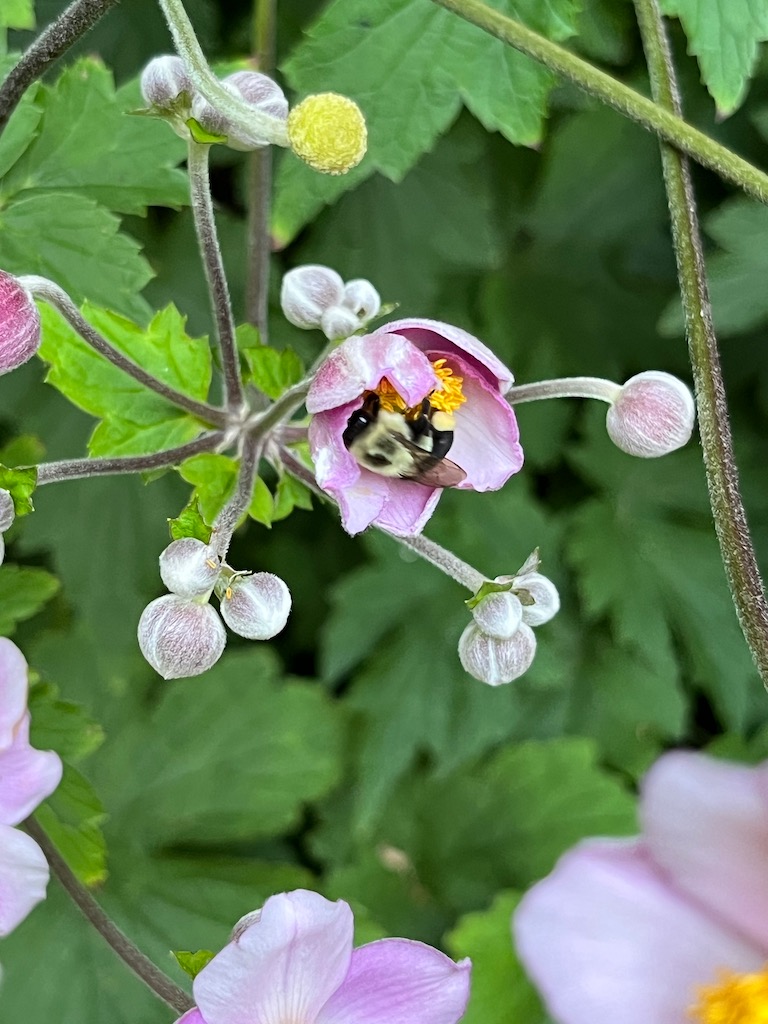
i followed a pair, fat, fuzzy, all full of themselves. full of unctuous beads of gold-dazzled pollen. looked like they’d rolled in a can of it. which they more or less did, dive bombing into the gold-dusted pincushions that rise from the swirl of anemone petals.

because i tend to read nature in a scriptural way, meaning i stand there in the face of a question, connecting the dots, unpuzzling the parable, i wondered what lesson i might extract from the bee, while the bee was drowsily, drunkenly, extracting its pollen-y porridge. 

what i came up with was unrelenting. unrelenting as in the bee, morning after morning, rises up from the hive, zigzags out the door, and plows ahead with his one holy task: he gathers up gold dust, the baseline of honey. it’s the task he was born to, a task he can’t shirk. a task he dives into with unrelenting enthusiasms.

i stood there for a while marveling at all there is in the tableau of dawn. the breeze already stirring. the moon now off the clock, back under the covers. or maybe just hiding back behind clouds. one or two birds were up and starting to chirp. but centerstage, in my attentions at least, was that fine pair of harvesting bees.

i thought about the perfect harmony of this early hour. how all of creation plays its own part. 

i thought about my own holy task and not being daunted. i don’t really know yet what exactly i’m up against — none of us do. but, i took a note from the bees: head down, nose first, gather up gold dust wherever you can.

be unrelenting. don’t be distracted. or daunted. even on days when it’s harder than hard: nuzzle your way into the gold dust, suck up what you can. 

it’s the reason you’re here on this holy earth.

maybe the bee understands: his days in the hive, they’re numbered. just like yours and like mine. so he gets down to business. gathering all that he can.

i let that sink in, while i kept up my watch, mesmerized by the bee who would not be dissuaded, distracted, or daunted. 

bee season brings lessons. but you need to perk up your ears. 


among the gold-dusted pollens i gathered this week was one heavenly spoken-word poet, podcaster, and author: amena brown. “a breathtaking blend of poet, prophet and pioneer,” one reviewer wrote. “her life and words will bless your soul.” no less than richard rohr, the modern-day mystic, and his center for contemplation and action pointed me in her direction. and what a direction it is. have a listen:

amena brown: “She Said How Do You Know When You’re Hearing From God”

i ran out and bought the book from which it came, so knocked off my socks by it was i. and i was only going to share the first verse. or two. but i can’t bear to leave out a one. it’s a bit long. and worth every drop. thank you, amena, for sharing your wonder…

She said, “How do you know when you are hearing from God?”
I didn’t know how to explain
It is to explain the butter grit of
  cornbread to a mouth that just
  discovered it has a tongue
The sound of jazz to ears that only ever
   thought they’d be lobes of flesh
The sight of sunsets to blinded eyes
   that in an instant can see
To fail at the ability to give words to
   how the scent of baked bread can
   make the mind recall a memory
Every detail
Of a house, a room, a kitchen, a
   conversation
Like explaining to a newborn baby this
   is what it feels like to be held
My words never felt so small, so
   useless, so incapable

I wanted to say
Put your hand in the middle of your chest
Feel the rhythm there
I wanted to say you will find the holy
  text in so many places
On crinkly pages of scripture
In dusty hymnals
In the creases of a grandmother’s smile
The way she clasps her hands
The way she prays familiar, with
 reverence as if to a dignitary and friend
The way she sings a simple song from
  her spirit and porches turn to cathedrals

I learned from my great-grandmother
   how to pray
How to talk to God
How to listen
Watching her and the other silver-
   haired church mothers gather in her
   living room
Worn wrinkled hands on top of leather
   bibles well traveled

They prayed living room prayers
   because you don’t have to be inside
   the four walls of a church to cry out to
   the God who made you
Because no matter where you sing or
   scream or whisper God’s ears can
   hear you

And despite what the laws say or what
   our human flaws say
God’s ears don’t play favourites
God’s ears don’t assess bank accounts
   or social status before they attune
   themselves to the story your tears or
   your fears are telling

God’s ears are here for the babies
For the immigrant, for the refugee
For the depressed, for the lonely
For the dreamers
The widow, the orphan
The oppressed and the helpless
Those about to make a mess or caught
   in the middle of cleaning one up
Dirt don’t scare God’s ears
God is a gardener
God knows things can’t grow without
   sun, rain and soil

I want to tell her to hear God
You have to be willing to experience
   what’s holy in places many people
   don’t deem to be sacred
That sometimes God sits next to you
   on a barstool
Spilling truth to you like too many beers
That God knows very well the dance
   we’ll do
When we love ourselves so little that
    just about anyone will do

That God cares about the moments we
   find ourselves
On the edge of a cliff
On the edge of sanity
On the edge of society
Even when we have less than an inch
   left of the thread that’s been holding
   us together

I want to tell her God is always waiting
Lingering after the doors close
And the phone doesn’t ring
And we are finally alone
God is always saying
I love you
I am here
Don’t go, stay
Please

I try to explain how God is pleading with us
To trust
To love
To listen
That God’s voice is melody and bass
   lines and whisper and thunder and
   grace

Sometimes when I pray, I think of her
How the voice of God was lingering in
   her very question
How so many of us just like her
Just like me
Just like you
Are still searching
Still questioning, still doubting
I know I don’t have all the answers
I know I never will
That sometimes the best thing we can
   do is put our hands in the middle of
   our chest
Feel the rhythm there
Turn down the noise in our minds, in
   our lives
And whisper,
God
Whatever you want to say
I’m here
I’m listening

– Amena Brown


and one last wonder, sent my way this week, from rebecca solnit’s 2004  Hope in the Dark, her counterpoint to a world in despair, an exploration of hope as “an embrace of the unknown and the unknowable.”.

Hope is not a lottery ticket you can sit on the sofa and clutch, feeling lucky. It is an axe you break down doors with in an emergency. Hope should shove you out the door, because it will take everything you have to steer the future away from endless war, from the annihilation of the earth’s treasures and the grinding down of the poor and marginal…

To hope is to give yourself to the future – and that commitment to the future is what makes the present inhabitable. 

Rebecca Solnit

finally, finally, but maybe sweetest for last: 32 years ago i married the love of my life. my tall sequoia of a sweet and steady soul. he has been my ballast all these holy blessed years, and never more than now, so one big giant i love you from me.

how were you unrelenting this week? and did you gather up gold dust?

heartbreak in the hives

it’s not every day we interrupt our homefront meditations to bring you the news, but it’s not every day the honeybee lands on the front page of the newspaper that’s dropped on your front stoop.

sadly, today is that day.

the honeybee, Apis mellifera, is, as you know, or might easily imagine, one of God’s creations that we love best. (see “illumination: bees’ no lesser labor,” 01.24.07)
and the honeybee, it seems, is in distress. serious distress.

suddenly, starting last fall, beekeepers all over the country were opening their hives and finding nothing–no bees, no dead bodies, no obvious culprits, either. “apian ghost towns,” the chicago tribune called it.

hundreds of thousands of colonies–millions and millions of honeybees–dying off, across the map.

at first, the keepers of bees were calling this strange occurrence “fall dwindle,” or “disappearing disease.” but then, underlying and amplifying the alarm, just last month a swarm of bee brains put their heads together in a task force and realized this was not some seasonal decline; they renamed the mysterious and vast wiping out of bees from coast to coast, Colony Collapse Disorder. egad, capital letters.

no one has a clue what’s wreaking all the havoc; the beekeepers, it seems, are truly baffled. it might be pest, or the modern ways some have come to manage hives. it might be, worst of all, some environmental scourge.

to date, 24 states across the country count themselves among the seriously afflicted; illinois has yet to raise its tattered flag. but, beekeepers say, it’s never a good idea to open your hive before the daffodils are in bloom, so in many states they just don’t know what they’ll find when they finally lift the lid.

what’s at stake, according to the bee people and the newspaper that landed on my stoop, is, of course, the $150-million-a-year honey industry, but worse, the honeybees’ pollination of crops across the U.S., valued at $14 billion annually. (what they do, when all is well, is truck in billions of bees in boxes, and let them do their thing among the would-be fruited plains; problem is, all is not now well, and there’s no buzzing in the fields.)

that would mean, my friends, your produce bin, severely done in. and grab your almonds while you can, because almond growers in california haven’t a clue what they’ll do without their bees.

about three decades ago, an apiculturist, that’s someone who studies bees, estimated that one third of what humans eat is a direct result of honeybees’ pollinating labors, the way they nuzzle their nose in the fuzz of every blossom that must be passed from pistil to stamen if bearing fruit is to occur.

the national research council figures three-fourths of all flowering plants require pollination to bear fruit.

far as i’m concerned, though, all this number pinning only begins to lay out the breadth of the disaster.

here’s a dabble into the depth: no economist will put numbers to the loss of wildflowers, but already in the u.k. and the netherlands, scientists have correlated the decline in honeybees and flowers. it’s a vicious cycle: bees rely on certain plants, plants rely on certain bees. what’s lost is the ephemeral wild flower, beacon of fragile beauty, bursting through the earth with reckless and random abandon.

but what else of the noble bee might we stand to lose? the wax, illumination in its early stage; a wonder healer called propolis, believed to cure or stave off everything from the common cold to asthma to festering wound; the colony itself, model of cooperation and getting the job done, even if an autocratic civilization, what with madame queen bee ruling over all her winged minions.

when i am distressed about the bee, or just plain curious about the buzzing creatures, i turn to sue hubbell, who has been described as “a latter-day henry thoreau with a sense of the absurd.” once a beekeeper in the ozarks, she wrote, “a book of bees,” (houghton mifflin, $12) back in 1988, bits of which originally ran in the new yorker. she puts together words that drip like honey from the hive.

i wish i could have called her to get her read on this disaster, but, alas, i could only turn her pages, remind myself of why it is i am so gaga for the bees.

on page 53 she tells us, “beekeeping is farming for intellectuals.” already, i am more than hooked. not that i consider myself any sort of intellectual. but i know that all sentences that follow will send me to the moon. and they did.

she goes on to tell that “the greeks spun tales about the god of beekeeping, aristaeus. pliny wrote about bees. aristotle observed them, puzzled over them and reported his findings. virgil made bees the subject of his fourth georgic, a part of the series of poems with agricultural themes.” classicists, she tells us, insist that virgil’s purposes were political, that he used bees as a vehicle for his clearly political leanings, to prove his civic points, pointing all the while to the workings of the hive.

but isn’t that the very thing that makes us drool at the thought of bees (and not simply their golden honey), the very fact that bees might be a model for whole civilizations?

and then we come back to the wildflowers. there is nothing left but sadness, when considering that the tender and the robust, both and all, would be helpless in the wind if it weren’t for the busy flapping bee, ferrying most essential pollen from one sweet throat to another.

and what would be a world without strawberry? or berry of any sort? or the apple or the peach? would it be a world in which i would want to dwell?

the honeybee it seems is hardly afterthought, although most of the world, save for all those beekeepers and honey lovers, think little of the bee in the course of any day.

it’s curious to note that back in ancient times, there grew a great myth, the myth of aristaeus, that had as its crisis point the wiping out of all the hives.

it makes me wonder if there’s a lesson to be learned, if only we will listen to what’s unfolded in the millennia of long ago.

here’s the story: aristaeus, it’s told, was the son of cyrene, who despised spinning, weaving, “and similar housewifely tasks.” she preferred to hunt wild beasts. apollo, you might remember, once watched her wrestle a lion to the ground and fell so in love with her, he carried her off to africa and built a palace there for her.

after their love child, let’s call him ari for short, was born, apollo ditched cyrene, and cyrene, longing for the wild, in turn ditched poor ari, leaving him to be raised by nymphs who, among other tasks, taught him to raise bees in terra cotta pots.

when grown, aristaeus wandered out of libya, and amid his wanderings stumbled upon eurydice, a wood nymph, who happened to already be taken, the beloved, it seems, of orpheus. (and you thought modern soap operas were twisted? well, hold on, it gets better here…)

not-smart ari, according to the story, tried to rape eurydice, but she ran, through the woods. in her hurry, she did not see a big fat snake right there on the path. don’t you know, this being a greek legend, she tripped right then and there over a tree root. the snake, of course, bit her and she died from the poison. orpheus, heartbroken, grabbed his lyre and started to pluck. hades, god of the underworld, was so moved by the beautiful music, he was going to let eurydice out, but only if orpheus promised not to look at her until she was safely in the sunlight. alas, ol’ orph couldn’t help himself, looked back, and lost her forever.

the other gods, so furious at ari, punished him by killing all his bees. he had no clue–sound familiar?–why all the bees had died, so he went off in search of his mother, mistress of wild things. he found her living under a stream, a fine place for a wild mama. she knew nothing about the bees, but sent him off to proteus, the god of many shapes, who might have a clue. ari ends up having to wrestle proteus to the ground, insisting he hold one shape until he tells what happened to the bees.

to make a too-long-already story a mere tad shorter, suffice it to say that much sacrifice was involved, but at last, the gods relented and a swarm of bees appeared to ari, who promptly stuffed them back in terra cotta pots.

grateful for the forgiveness of the gods, ari and his pots of bees settle down and live a relatively uneventful life, except for when his son gets turned into a stag, then torn to bits by a pack of 50 hounds.

all this is to say that, perhaps, just maybe, the gods are buzzing mad at something that we’ve done. and we, like ari, must do something rather drastic, something sacrificial, should we ever have a hope of once again seeing swarms of honeybees in our terracotta pots.

it’s either that, or a life that might be hades-ruled, a life spelled h-e-double l. i can’t imagine. no strawberries. no beeswax candles. no wildflower tossing in the wind. it makes me shudder.

whither the honeybees?

record your heartbreak here…..

illumination: bees’ no lesser labor

ah yes, back to the hive. back to the inner sanctum, the holy hollows, of hundreds of thousands of Apis mellifera, uncommonly known as the western honeybee. more often, simply, the bee.

it is the wax of the bee we consider today, hardly the lesser of the sweet honeybee’s labors.

there is so much to ponder about the great pollinators, your pontificator soon will be percolating. strike that. make it a buzz. as in your brain soon will be buzzing.

consider this: to produce a pound of beeswax, bees must consume roughly eight times that in honey. likened to a sumo wrestler packing on pounds by sucking down steaks before the big match, the bee intent on waxing might be found gas-guzzling nectar.

put another way, it is estimated by those who estimate such things that bees fly 150,000 miles to yield one pound of beeswax.

or, this: 10,000 bees can produce one pound of beeswax in three days.

here’s how it works: the bee, known for short as A. mellifera, sucks up the nectar from les fleurs, from blossoms, from your own lowly rose bush, through a very long tongue. the nectar is then stored in a sac called the honey stomach. when the honey tummy is full, the besotted bee zig-zags back to the hive, and somehow transfers the not-yet-liquid-gold to young house bees, bees 12 to 17 days old, in case you’re counting. the house bees, not unlike a compulsive housekeeper, spread the nectar drop by drop into the honeycombs. while they’re at it, they add enzymes to the nectar to break it down from complex into simple sugars.

because the nectar, back at the blossom stage, is 80 percent water, the bees need to distill it down to its dehydrated essence, a fantastical feat they accomplish through, get this, the fanning of their little bee wings. flap, flap, flap, out goes the water, out of the nectar. turning watery nectar to syrupy honey.

here’s where the beeswax comes in: each little house bee has eight slits on her belly. when it’s time, teeny tiny shavings of wax–flakes the size of the head of a pin, one hundred of which are said to weigh hardly as much as a kernel of wheat–emerge on the bee belly.

what happens next is best put in the words of one holley bishop, author of the utterly mesmerizing, “robbing the bees: a biography of honey–the sweet liquid gold that seduced the world” (free press, $24).

she writes: “… like a construction worker pulling nails from her toolbelt, she reaches for a flake….in an advanced yoga move [she] transfers it to her mouth. there, she masticates it, chewing and working the wax like a baker kneading dough…all around her, other masons are patting and caressing their own scales of wax into place.”

never mind that she switches similes faster than a bee beats its wings. what she’s telling us here is fairly straight-forward: the bees do a helluva job constructing their hexagonally-heavy honey palace. and not only that: each she-bee minds her own beeswax.

when each honeycomb is filled, the ol’ house bees drop one final wax blob, sort of the tupperware lid on the sweet golden goo. in fact, one lid, about the size of a split pea, can take several hours and dozens of bees to assemble.

it is hard not to be awed, not to be wowed, by the fannings and droppings of the wax-wielding bees.

it is ancient, this hushed veneration of bees and beeswax. daedalus of course used beeswax for his flawed wings. and ulysses, in the odyssey, stuffed ears with the stuff, in hopes of blocking the call of the sirens. and, at the cusp of the first millennia, candles as we now know them were born, and, without haste, made their way to the front of the pews. the roman catholics insisted on beeswax. the greek orthodox, too.

in 1855, a thinker named karl von leoprechting wrote: “the bee is the only creature which has come to us unchanged from paradise, therefore she gathers the wax for sacred services.”

clearly, we are not the first to draw a line between the divine and the communal chaos of the hive where, through mystery and miracle, the sap of the back forty is turned into the golden sweet goop we spread on our toast. and the fall-out from the shelter is melted down and dipped into sticks that shine light on our lives.

perhaps this is all more than you wanted to know about bees and their pre-plastic, all-purpose wax. perhaps it’s making your head buzz.

but, in the end, i know one thing for certain: the next time i strike a match to a wick, i will marvel, will drop my head in a deep bow of reverence for the little winged things that laid down their lives for my sweet incandescence.

what if we all did away with those paraffin fillers? what if we vowed that the only candle worth burning was one built the hard way, through the flapping of hundreds of thousands of wings, for hundreds of thousands of miles, through the hard work and labor of A. mellifera & friends?
cast your vote here….

from tasha’s bees to me

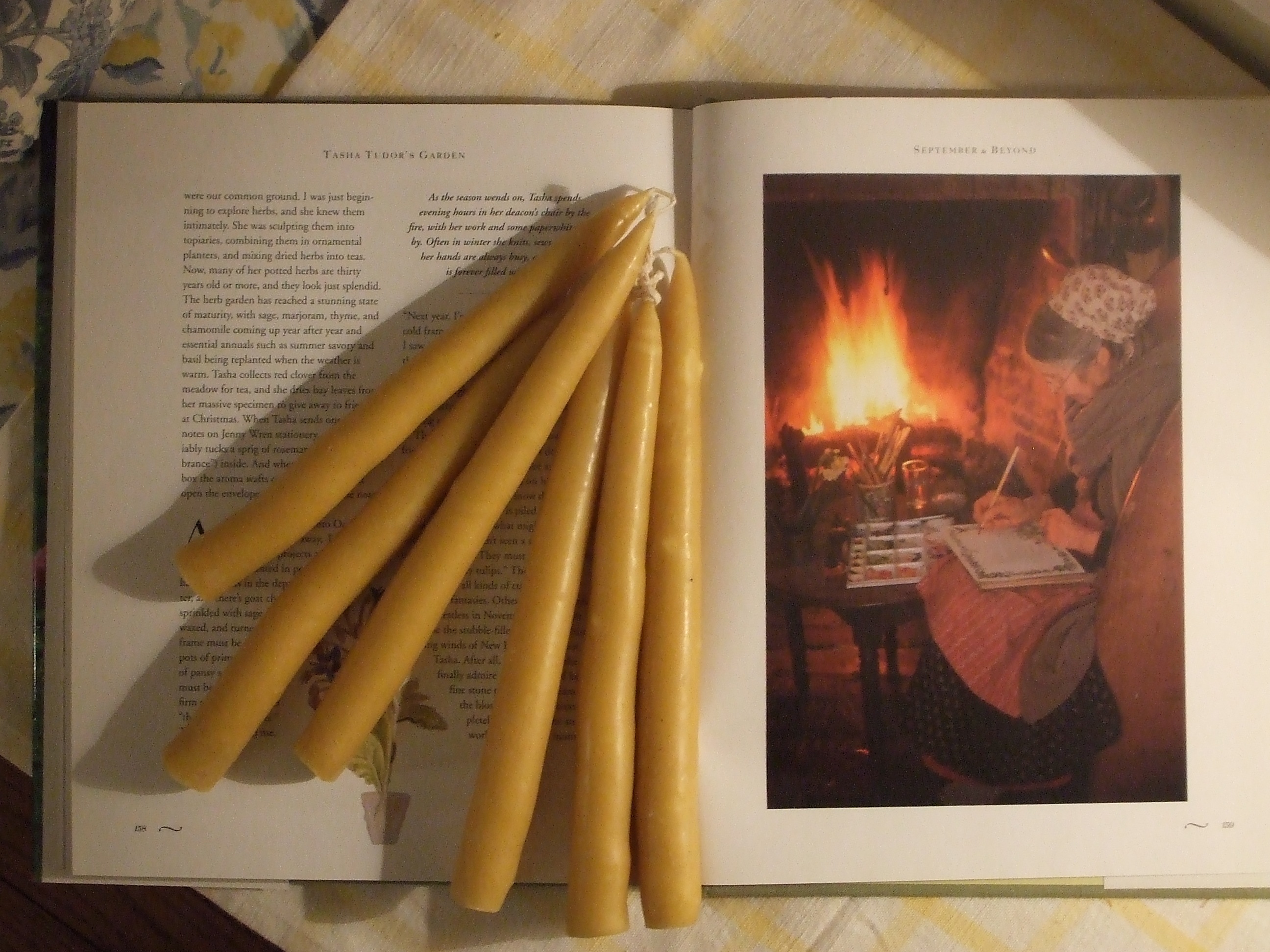
a box arrived over the weekend from vermont. anything from vermont makes me happy. but this particular box said it was from tasha tudor, who is pretty much my hero. she might be the loveliest illustrator of children’s books that ever there was. think “secret garden.” she’s the one who painted the garden that pulled you in, and all these years later has never let you go.

tasha is my hero as much for how she lives as for how she puts color to paper. she lives at the end of a perilously-steep, much-potholed road, in a timeworn cedar-planked farmhouse–just like one built in 1740 in concord, new hampshire, one that caught her considerable fancy.

but her house, on the crest of a hill, the inside a labyrinth of rooms with low-slung doorways and uneven floorboards, is one that her son seth built for her, using only hand tools.

seth and his mama are both, they like to say, “a bit reluctant to live in the twentieth century.”

tasha, who is 91, lives purely. you might say she lives simply, but that would be to discount the bone-thinning work it takes to live the way she lives. she is old yankee through and through.

she cooks on an old black cookstove, roasts a turkey in a “tin kitchen,” a contraption she describes as a reflector oven, set in front of the fire. (“barricade the bird from corgies and cats with a firescreen,” she warns, right in the midst of her roasted turkey recipe, a recipe for which she insists a fireplace is required, not optional.)

she eats what she grows in her tumbly riotous garden. raises goats for milk and butter and cheese. wraps herself in shawls to keep away the cold.

when dusk rolls in through the windows, she lights her rooms with beeswax candles, candles she has dipped in autumn, after she cleans the hives so the bees can begin again.

which brings us back to the box that came from vermont over the weekend. it was sent by my sister who is married to my brother in maine (don’t be frightened by that construction; i just constructed it, but it seems right, more right than saying, sister-in-law, a term too clinical for me). it was sent by becca. but it came from tasha.

yes, tasha dipped the candles that now are at my house, now lying on my window seat. maybe it was her children who did the dipping, or maybe one of her grandchildren, some of whom live in cottages nearby. whoever dipped, it’s close enough for me.

and so, as i opened the box, unrolled the sturdy brown paper, i watched six nubby, knobby hand-dipped sticks of beeswax roll toward me. they are in pairs, their wicks still joined, their wicks all tumbled together.

i was dumbstruck by the candlesticks. by the bees’ hard work. by their purity. by the fact that they were dipped and came from tasha’s bees, bees that sucked the nectar from tasha’s enviable and magnificent garden, the garden that has long been the muse for all her painting. the garden that is a muse for me.

the candles got me to thinking about bees. i happen to love bees. i did some reading. soaked up all kinds of wonderful things about bees, about beeswax. i will tell you all about it tomorrow, because this seems to have turned into a tale about tasha. which is a good thing.

which is a pure thing.

please come back tomorrow for another pure thing, a bit about bees, a bit about beeswax, the less considered thing about bees and their labors. honey, of course, being the bee thing that tends to get more of our time and attention. because it’s a sweet thing. of course.