pull up a chair

where wisdom gathers, poetry unfolds and divine light is sparked…

Category: conversation

official enough: Slowing Time

slowing time

the manuscript is off in copy editing. and just this week, i discovered a name that i’ve long known, long answered to, has been added to the “authors” roster.

so that must make it official enough.

and there it is, almost like getting a peek at the amniotic-slicked crown of a baby’s head as it wedges through the birth canal.

almost.

it’s slowing time, a book with my name on the cover. and pages and pages of my heart inside.

and it will be in bookstores come october. or maybe even september.

and for a girl who long ago sat tucked between her twin beds, splayed upon the braided oval rug, folding blank pages in halves and quarters, drawing pictures, pressing pencil to page to add sentences and paragraphs, it rather makes my heart thump to see that this time someone other than me is doing the work of rolling those pages off the presses, stamping that copyright on the page with the bit about the library of congress.

it’s a book that was born here, at the old banged-up maple table, where for so many mornings now we’ve pooled our wisdoms and our paying attentions. i think the page that made my heart thump the loudest as i was writing it, was perhaps the dedication page. that’s where you dig down deep and pull out the plumpest roots, the ones without which your heart might wither and die. you’ll find the chair sisters nestled there, in that abbreviated roster of literary midwives, the ones who propped me up on days when i might otherwise have wilted. or crumbled. or run away to hide.

what that means is that you and you and you are among the winds that blew me forward, that would not let me fade away and give up hope.

it’s not so easy putting words to the whispers of a heart. but what i found is that the more i typed, the more i believed.

what i love best about slowing time is that it’s a compilation of the quiet art of paying attention. and paying attention, i’ve found, is a silent — yet deeply animated — form of prayer. it’s tiptoeing through the holy hours of the day, of the seasons, and opening your heart wide enough to feel — and shlurp up — the brushstrokes of the Divine.

sometimes that comes in the words of a five-year-old boy who asks, “mama, what will happen when i die?” and follows rat-a-tat with: “will you die? will daddy die?”

sometimes it comes in keeping watch as mama bird builds her nest, as she scans the clumps of rustling grasses, plucks the fattest one and flies it back to the hatching branch. and, all the while, she’s teaching you a thing or two about resilience. and inexhaustibility. and faith, no matter the pounding of the springtime’s downpour.

often, for me, a lifelong churchgoer — one who pedaled her bike six weeks straight to early-morning mass the lent that i was eight and working hard to put shine to my halo — the Divine has skipped across my heart as i tiptoed into synagogue and wrapped myself in prayer at once ancient and timeless.

the undiluted premise of slowing time and the heart behind it is that the Divine is all around, if we slow down and pay close enough attention. it is a life of prayer lived in the thick and the messiness of the everyday.

it’s pure wonder that mary oliver, my poet priestess, graces the book’s first page, and it’s no accident that emily dickinson — “some keep the Sabbath going to church/ i keep it, staying at home” — is my patron saint.

my prayer is not bound by religion, but thrust heavenward by heart and because i’ve learned — stumbling all along the way — that most essential element of every prayer: the unspoken line where we are deeply listening.

here’s a peek at the publisher’s catalog for slowing time.

and bless you every one who pulled up a chair, and shared a wisdom — silent or otherwise — here where we call it holy communion. with a splash of cream.

how do you practice the art of slowing time? 

tea therapy

tea therapy

against the arctic whistle on the far side of the glass, the shrill siren of the tea kettle is all but marking shift change, with its regular rhythmic blasts. here at the old maple table all week, it signals: “in session.”

it’s the steam-driven bellows of the mugs of teas that punctuate a holy ritual taking place here. almost as if a shingle had been hung, with red neon arrows blinking, pointing up the bluestone walk, past the paned front door in shade of oceanic blue, lighting the way past snow drifts to the tucked-in table where the talk unfolds.

it’s been a blessing of this month of college interlude. my own sweet boy is long gone, now back in classes, but a host of other college kids, kids with heavy hearts and twisted potholed paths, kids who’ve lost their way, they are finding their way here, to this table, to this ample-bellied teapot where the water never empties and the teas are always spiced. my bowl of clementines is at the ready, so too the cookies under glass, where a swift lift of the domed lid offers sweet accompaniment for salty tears.

i find it a whisper of a miracle that kids have figured out they are always welcome here, and that there’s a heart who will listen without judgement, who makes a place for them to dump their worries and their fears. and who lives and breathes the promise that these dark days will end; there’s a grownup — right here in the flesh — who’s known the shadow and the great abyss, and who — with skinned knees all her own — found her way up the side of the steepest trail.

“it’s the 10-minute rule,” one wise tea-sipper intoned. she meant that she’d been taught to take on her overwhelming dread or angst or out-of-this-world anxiety in 10 minute chunks. endure it. know it has an end, and will not swallow you whole. and in a good 10 minutes, something deep inside will shift. or not. and you’ll enter into yet another 10-minute exercise in sheer survival. and soon enough, sure as sure can be, it will pass. the vista will change. and those baby steps — those 10-minute triumphs of straight-up enduring — they will, through simple additive powers, combine into hour- and then hours-long stretches of breathing. curled in a ball, perhaps. or with the self-propelled motivation to pick up a book, climb on a treadmill, call a friend, tiptoe to the kitchen to see if warm company might be found.

i’ve seen the gamut here this week, had kids whisper words, and follow swiftly with, “i hope that doesn’t shock you.” no, it doesn’t shock. no, no. never. it only breaks my heart that smart kids, gorgeous kids, kids with hopes and dreams  are nearly train-wrecked by the vicissitudes of hurdles set too high, of broken promises and betrayals, of a world in which no sin goes un-broadcast and there’s too little wiggle room for the fine art of making honest mistakes.

so while i steep in my own brand of guilt for not raking in freelance assignments, and while my bank account is on the decline and not the rise, i find more than a dose of solace that the pages of my life flipped forward to the chapter i long ago dreamed of: where i’m the old lady at the maple table, the old lady (not yet hunched-over, thanks be to the pharmaceutical gods who give us bone-boosting weekly white horse pills) whose shoulders are wrapped in the woven folds of woolen shawl, and who with lumps of sugar and dollops of milky cream doles out vast acreages of her heart and what scraps of wisdom she’s tucked into her apron pocket all along the way.

at long week’s end, i find myself bowed in prayer for these children, these wide-eyed pilgrims trying so hard to find their way, to find the shafts of light breaking through the tight space between the rocks. and i find myself so deeply grateful that my years of being lost now pay me back in solid company where it matters most: here at the old maple table, where hope is served around the clock.

no need to knock: i promise you, the door is always open. and so’s the heart.

word of the week: i believe i’ve let languish a promise made back in 02139 to bring you a delectable word of the week. well, here’s one for this week — salmagundi (provenance: nigel slater’s “notes from the larder”)  a hodgepodge is what it means, and it comes from a literal mix of chopped meat, eggs, flavored with oil, vinegar, anchovies, and onions. but used freely far beyond the bounds of the kitchen, as in “they were a salmagundi of old and young, wise and fool.”

and before arriving at the query of the week, another bit of poetic thought picked up last week in my online “poetry in america: walt whitman,” class, taught by professor elisa new of harvard college. in her introduction to poetry lecture, she riffed on poetic language, and its powers. i thought you might find it worth pondering, and so i snipped it to bring to the table, though i forgot to leave it here, as last week’s recipe took up so very many lines….here tis, from elisa new, harvard’s powell m. cabot professor of american literature (and wife of former treasury secretary and former harvard university president larry summers):

Poetic language is language worth pausing over. It’s language that slows down time. It’s language that takes us into corners of our experience we might have overlooked. It’s language that is conscious of itself as language. It’s language trying out and expanding and pressing at the borders of what language can do, just as in other media, in painting, painters think about how to use paint in new ways. In the world of music, musicians think about how to use tone and sound in new ways.

Poetry is language curious about language itself. To say that is, in a way, to put poetry at the very center of the humanistic enterprise, since human beings are the creatures who use language. When we study poetry, we think about what it is to be human, the ways in which our existence is mediated and created and advanced and expanded by language.

oh, to be so supremely conscious of the words we choose, and how we push the boundaries of human connectedness….

where do you dish out your best counsel? the kitchen table, the cutting board, the cookstove, the couch, the driver’s seat of your mobile, the bedroom, the work bench, the miles and miles upon which you walk? 

gobsmacked by everyday prophets

Dew Drops

proph-et (n.) 1. (in some religions) a person believed to have been sent by God to teach people about his intentions. 2. a person who predicts the future. 3. a person who promotes or supports a new belief or theory.

and so it is that as we motor along the patched asphalt roads of our everyday, suddenly we screech to a stop when we realize, right before our eyes, a wise soul, a prophet, a shaker-upper has flung his or her wisdom splat in the middle of the lane. stuck there, not able to never mind, not able to turn the wheel and steer around it, we succumb to the roadblock. loosen our grip on the wheel, stare wide-eyed through the windshield, soak up every last tidbit of what’s there in a pile clogging the throughway.

sometimes that’s what it takes to get us to pause, to pay attention.

and so it was, not so many days ago, when sitting in the dim-lit auditorium where our synagogue holds the talk part of sunday school. the rabbi was up at the front, at the mike, sipping his starbucks grande whatever. and, once again, the conversation seemed to be steering into one of those ones i’ve heard far too often. the topic, more or less: how in the world do you talk to your kids about God, when you’ve no clue who or what that might be?

i’ve learned to sit on my hands. to mostly not raise one or the other. over the years, i’ve made it clear on several occasions that i DO have a clue who that is. that i find the Holiness all around and within. that it’s there at the dawn when i tiptoe outside and find the heavens alight with pinpoints of stars. that it’s there when the voice on the other end of the line breathes hope into my emptiness. that it’s there when the words that spill from the mouth of the child i’m tucking in bed hit me with a compassion i’d not expect from a grownup, let alone a 12-year-old who can’t for the life of him untangle the distributive property upon which his pre-algebra homework is hinged.

i’d more or less surrendered to the conversation, felt myself sinking lower and lower — in spirit and chair. but then, the long lanky fellow a few seats to the east in my row, he raised his hand. now, i know this fellow to be wise, and i know he’s lived through some tragedy. his wife died when his children were little, one still in diapers, one just past toddling. he speaks with a gravely voice, the result of a cancer.

here’s what he said: “when my son asked why people die, i said: because it means we have a limited number of days, so how we live matters.”

it means we have a limited number of days, so how we live matters… 

i sat there, low in my spring-loaded chair, and suddenly bolted upright. humbled. stunned. turning the words over and over in my head, as if marbles i held to the light. examining, absorbing.

how we live matters….

these words from a father to son, a son who’d just lost his mother.

i did what i do when i know i’ve heard wisdom: i reached for my backpack, i pulled out a pen and my red little moleskin. i loosened the elastic snap that holds open the next empty page. i scribbled. i suddenly was wide awake and taking in every word of this conversation, no longer the same old, same old.

all week i’ve drifted back to that moment. when suddenly, out of the almost dark, a gravely voice spoke words that stirred me, top to bottom, inside to out.

i was knocked over by what he said — especially since i’ve too heavy a dose of black irish soul, the sort that too often fears the end is just around the next bend, and this notion of using that as a wedge to take it up a notch, to live each blessed day as if it could be the last or the second to last, is rather a zap to the noggin, to the soul.

but even more i was knocked over by the blessed truth that we never know where the wisdom will come, we never guess the prophets around us. and that’s why it matters that we stand at attention. that we live on the lookout — for wisdom, for truth, for gentlest kindness and full-bodied compassion.

if instead of sinking low in our chairs, if instead of surrendering to the ho-hum humdrum we think is unfurling, we stay awake to the possibility that someone far wiser than we’ll ever be is about to brush up against us, pass along a kernel of all that’s holy and wise and forever.

and that’s why this mystery called life is so utterly and wholly capable of taking our breath away — without drumroll or siren — and filling it in with high-octane Holy.

so, who’s your prophet of late? and what wisdom was plopped in your lap?

photo credit above: my sweet will kamin. a morning’s dew captured in magnificent light. not unlike the gift of the prophet….

loopy days

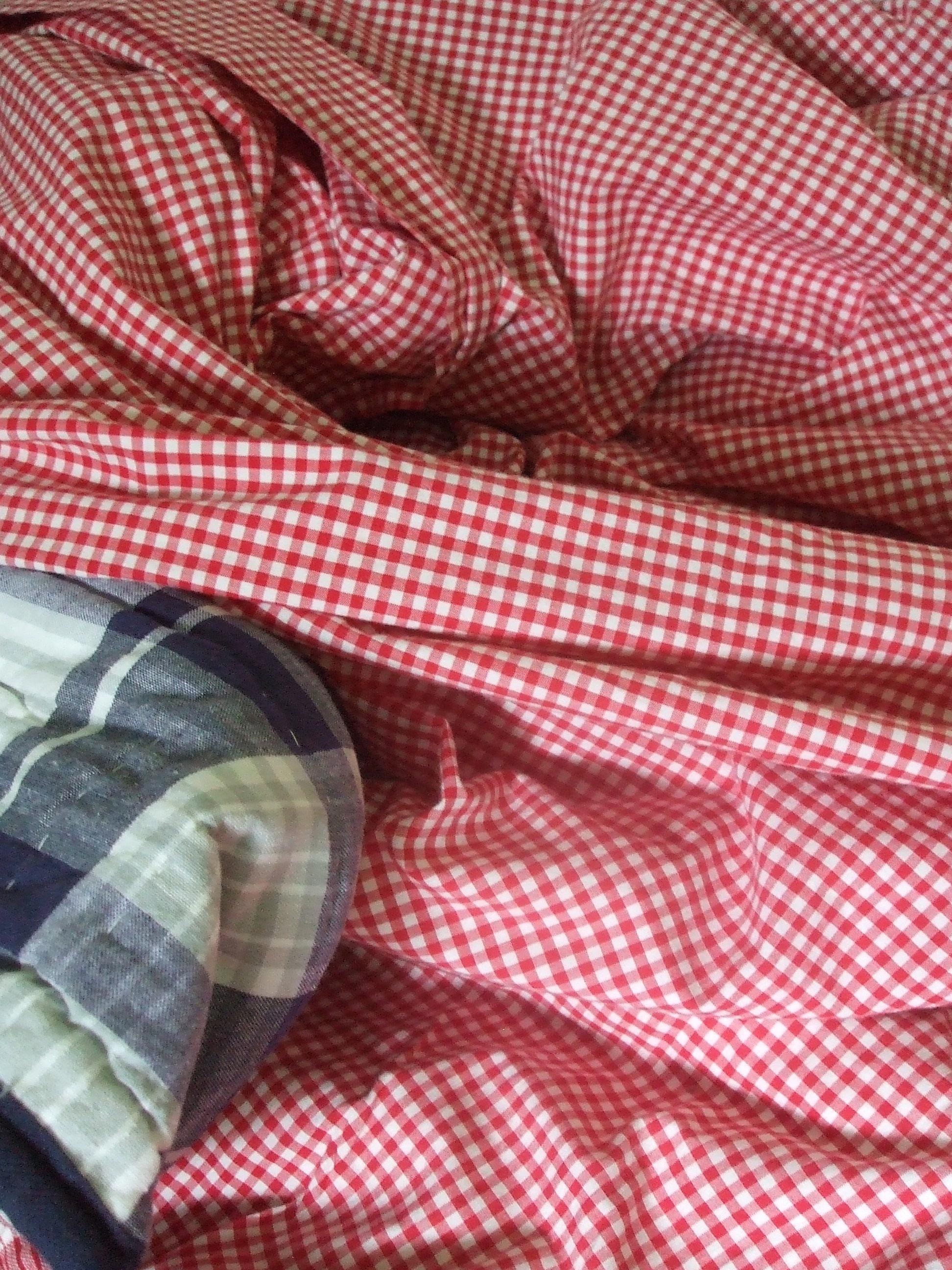
loopy days bedsheet

for three short weeks — one down, only two to go — there’s a new rhythm in this old house. it goes like this: ’round late morning, i hear a swoosh from up above the kitchen ceiling (that’s the bedsheets being whipped aside); then i hear a thud, followed by a parade of thuds, thud-thud-thud down the stairs. as the thuds round the bend, lope into the kitchen, i look up and see a bed-head. my beloved boy.

he begins his morning forage through the fridge. as he piles tubs and cartons on the countertop, he lets out with a “whadda we got for breakfast, mommo?”

that’s my cue to begin the litany, all within the confines of high-protein, low carbs, healthy, delicious, and filling.

hmm. let me know if you’ve got ideas.

it’s at about this point that the eggs are being cracked, he’s begging for mushrooms, and wants to know if i remembered to get the mozzarella at the market. as i watch egg whites whirl toward the kitchen walls, i leap up from my typing to play at being his sous-chef (though really all i am is the wiper-upper of kitchen splats).

he whips up something grand, something delicious, and always spilling over the sides of his plate.

we mosey back to the table. or, well, he moseys, and i finish up the de-splatting. then we sit, and the loopy days begin. we dive deep. quickly.

waste little time on folderol and fluff. we’ve got a year’s worth of college life to pour over (we’ve been known to take in two years at a gulp, retreading over year before last, if pertinent) , and there’s the year ahead to consider, too.

we loop round and round, drop threads, follow new ones, circle back — hours later — to the thread we’d left behind. it goes like this for half the day.

now, not all college kids go off the way mine has. i’ve heard tales of kids who text many times  a day. i’ve even heard stories about college kids who dial phones. call home. to be fair, that happens here too, but not so very often. and, when it happens, it is sometimes very very late at night.

we seem to have birthed a college kid who takes his college full-throttle. unless it’s dire — and on occasion, it’s been vaguely that — we’re pretty much the side show. oh, there are insistent “love you, mommo”s. and there are (astonishingly), “do you remember where you put my sewing kit?”

mostly, i, um, never ever doubt, not for any longer than five or 10 minutes, that he appreciates my unbroken love and care.

but, really, it’s these sacred hours when he’s home, when the two of us are circling in and out of each other’s footspace and quarter-hour time slots, that we make up for lost time, and seal the deal for the long whitespace ahead.

these hours, the ones where he might sink down low inside a bean bag, while i trod for miles on the treadmill, the ones where i sous to his chef, these are the ones that knit us deep and thick and forever at the heart.

love in every house spills out in idiosyncratic ways. and it changes over time.

at my house now, i am licking up these hours of deep and winding conversation as if the ice cream melted on my cake plate.

i am whispering thanks to the heavens above that, right now, for this short interlude, i can do my typing here, not far from where the thuds patter down the stairs. so that i can weave my sentences in between his stories. so i can be here to catch the loop-de-loops of conversation as they unfurl. in slow time. unhurried time. whip-up-omelettes-while-you’re-talking time.

because i’m long practiced in the art of asking questions, allowing long spells for replies, i find this a part of motherhood to which i take a particular shine. play time on the floor, i flunked. so, too, chutes and ladders and monopoly. i wasn’t bad at crayons and paper. but really.

the deepest glue i know is the one that comes from unfurling the whole of the human heart. the nooks and crannies. crests and high plains.

so it’s what we do here. for three short weeks. in the mid-day hours when no one else is home. and my brain’s at full attention. and my work can wait till dark. for these hours are slipping through my fingers. and i am plumbing the depths of each and every one.

loopy days, i find, are the summer’s sweetest offering.

do you practice the art of the slow-unwinding conversation? the one with someone you love that stops and starts and plumbs the depths for days and days on end? and carries you across long dry deserts of barely enough time to really, really talk?

and because i promised a bit of cerebral uplift, i’ll begin what i’m calling the marginalia department, where i scribble in the margins of whatever page i’m turning, where i recount for you the lines i’ve scored and underscored. 

this week from rebecca solnit’s “the faraway nearby,” a line to chew on for a time:

“Difficulty is always a school, though learning is optional.”

or this….

“Disenchantment is the blessing of becoming yourself.”

i am especially keen on the first, about difficulty school, and the option of learning from it. it’s a thought that carried me to sleep last night…..and it’s a book that came highly recommended by one of my very favorite reader friends…..

the things that moms just know….

the boy with his spoon in the loops mumbled something this morning that sounded like a family of mmm’s had gone out to the carnival, climbed onto the bumper car ride, and rumbled their way through the course.

mmm, mm m mm mmm mmm mm?

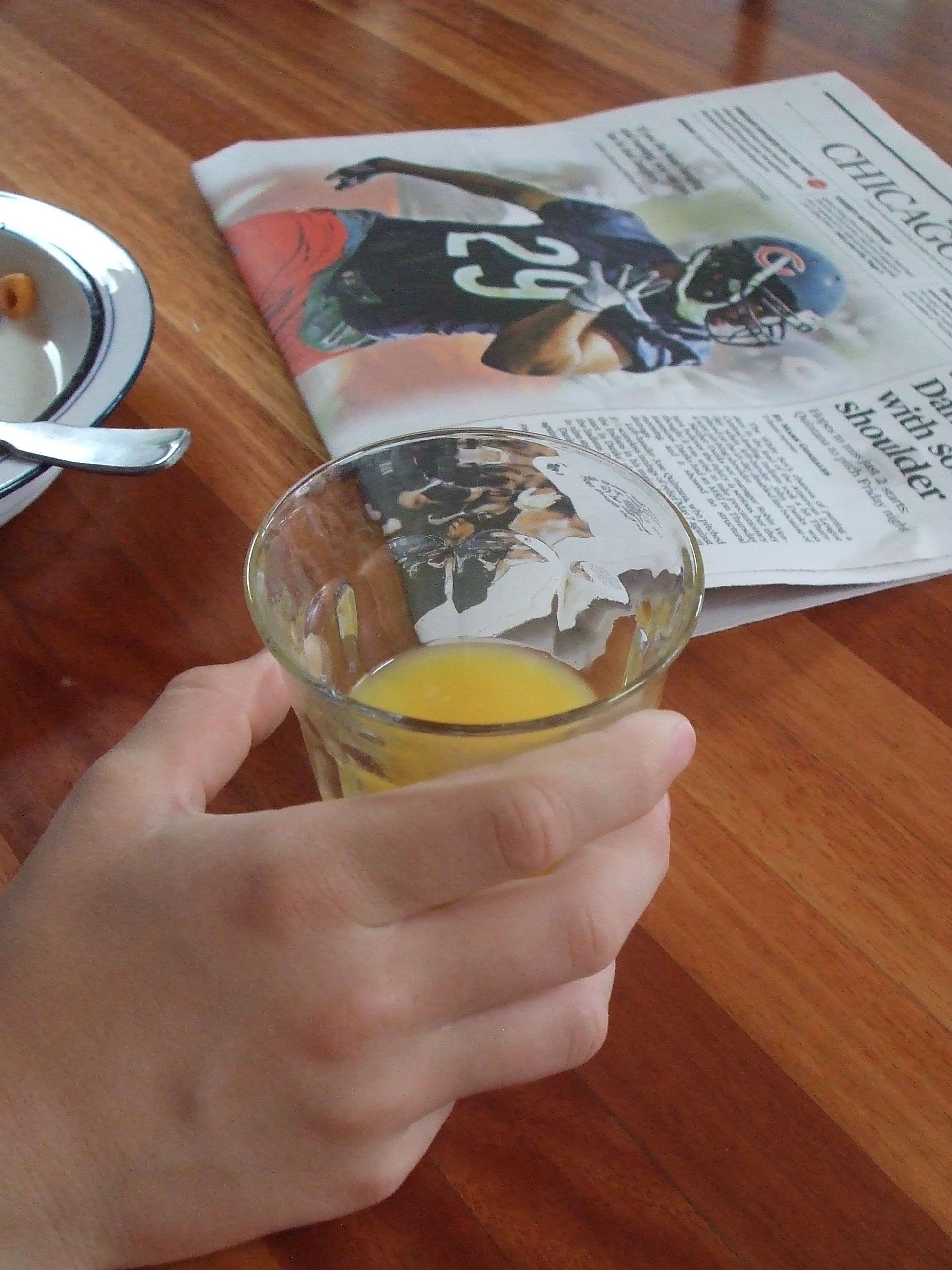
“oh,” said i, “you want some orange juice?”

he nodded, then swallowed.

not thinking another thing of it, i opened the fridge, reached for the carton and poured.

he, though, looked up from the page where the sports scores are duly recorded. he had that curious look in his eyes.

and that’s when he did what he so often does; he broke open the ordinary, caused me to stop in my tracks, to pause, to ponder, to pay closer attention.

he said, simply and not simply at all: “i have a question. what are some of the most interesting things that moms just know?”

he fielded the question as if moms were a species unto their own. as if he were there at the zoo, peering in from the far side of the bars, and i was one of the slow meandering mammals, one of those big furry cats, perhaps, pacing purposefully back and forth in my concrete-floor rectangle, looking out at the crowd, plotting somehow, as i always imagine they do, those poor cats, how to break out of that measly four-walled existence.

my little one, the one with the loops back in his spoon, continued on with his morning query: “i mumbled,” he said, “but you knew exactly what i meant,” he explained of the motherly feat that had captured his attention.

“what are some of the really abstract things that you know? the really abstract things that you know about me?”

ah, yes, the mother, Mater omnes sciens, mother all knowing, as the latin scholar would say.

apparently, to the sweet child, it appears that without trying, without elaborate control board and dozens of criss-crossed wires, i mysteriously, and on occasion, pull out my invisible magnifying tool, peer deep into his cerebrum, and divine all sorts of nifty things. say, that it’s breakfast time, he’s been snoring all night in a stuffy little chamber of a room, and he’s developed a thirst for the drink he downs each and every morning, give or take the ones when something more tempting — say, pineapple juice — is there in the fridge. he wants me to pour, voila, a shallow glass of OJ.

to the child, apparently, this appears a motherly trick of pure prestidigitation.

the child, apparently, has no clue that we live and breathe, some of us, to map out the swath of their landscape. they have no clue that as they shovel pasta tubes into their mouth, we are studying their sweet little face, reading between lines, on patrol at all times for sparks that might be smoldering there in the forest. or that we are searching, as they roll through the door after a long day of school, for the slightest telltale flinch, the mere suggestion of a clue that this was a bad day, and we are here, all but tied up in apron strings, the living-breathing emotional-rescue machine.

the child, apparently, has no clue that his entire life long we have been listening, listening intently. we have felt the piercing upon impact of certain words as they simultaneously hit our eardrums, and zing straight to our hearts. they have no clue that we have powers of instant memorization, that we tumble some lines, the occasional shard of a word or words, over and over and over in our minds that don’t cease, don’t know from the pause button.

and thus, whereas we think nothing of reaching for the drink that they drink breakfast after breakfast, or smearing the same old peanut butter onto the bread that he happens to love more than any, there stands a chance, a slim chance, that the child on rare occasion looks up from his daily existence and catches a glimmer of the miracle that is having someone who loves you, someone who knows you so intently, so deeply, that she is able without vowels interrupting the string of consonant sounds, to decipher just what it is you desire.

and, without you even saying a word sometimes, she is able to tiptoe into your bedroom at night, on just the right night, and she knows to slip under the sheets, right beside you, and start making those circles on your forehead, the ones that you love, the ones that make you let down your shoulders, your worries, after a long hard day. and she knows, without you saying a word, just when you need her to ask, “so how was your day, sweetie?” because she might have asked that question a dozen times already, but it’s at bedtime, it’s there in the dark, when the words serve to uncork the deep heart of the matter.

mamas know those things.

they do if they are listening, if they are paying attention. if their own hearts are still enough, if they’ve spent years deep at work practicing the art of those things that mamas do and know and say and understand and feel through and through.

that’s how mamas acquire what to a little boy spooning loops might seem like a list of abstractions. like how a mama knows by the way a boy bites at his lip that he’s just a little bit nervous, or that when he hops a certain way on the ball field it means he is quietly proud of that ball he just caught tight in his mitt, or how she knows — not because it’s abstract so much as highly particular — that he likes his cinnamon sugar sprinkled right up to the edge of the buttered toast, and he doesn’t like the butter in unmelted lumps, thank you.

because, in the end, mothering is all about the particulars.

mothering, at its best, is the art of paying pure attention.

of knowing, for a good long spell of years anyway, the unspoken landscape of the unfolding child. because, after all, we start out this adventure from the very beginning, from before when the words come. so we’ve had years and years of filling in blanks, from reading the particular shrill of a cry, from feeling how the little one kicks his legs against the wall of our womb, and later on watching how he does the same there on the stretched-out blanket.

i like to think it’s my job to be a high-sensory detector. to discern the interior dialogue, the one of his heart, before he’s learned the words to put to that script. if i know to ask the right question, if i can lay out the word choice, the possible phrase, then he can begin to pluck from the choices. he can begin to gain fluency in honoring all the feelings that bottle up inside. i can be his guide in the language of self-expression.

and i can be the one who knows that first thing in the morning, when he needs to race to the bus, a mouthful of OJ is just the drink to sweeten, to douse, his dry little throat.

no miracle there from my perspective. but the miracle is, from his, there is.

and those are just some of the things that mamas just know…..

what are some of the abstract things that you just know about the people you love? and how did you learn them?

the hours that matter the most

as i sift through the grains of my week, of my year, of my long stretch of motherhood, i’ve come to know that the grains i hold a bit longer, the grains i hold up to the light, are the fine simple hours that come, often, right after school.

when the boys who i love are bothered, are troubled, are weighed down with the grit of the day.

when suddenly the chairs at the table are pulled. bottoms splot onto cane-woven seats. when tea cups are cradled in palms. when oranges are peeled, piled in sections.

when the talking begins.

of all the scores of things i might do in the course of a week, of a lifetime, nothing perhaps matches the wholeness of those holy hours.

the boys who i love are sifting through their own hearts, laying their troubles there at my chest, at my heart. they are trusting not my mouth but my ears.

just listen, you can hear them hoping.

just hear all my words, spoken and not.

just listening alone will heal, will soothe, go a long way toward fixing.

when days are bad, when hours are bumpy, most of the time we aren’t looking for quick-cures or band-aids. all we want, really, is someone to sop up the hurt. to listen to worries.

all we want, often, are eyes that look deep, look gently. eyes that listen. not words that cut off. not words that dismiss.

just hear me, you can hear the hearts saying. if you listen. just listen.

and so, unscripted, unplanned, the scene plays over and over. one minute we’re there at the sink, i might be chopping or rinsing, a child is circling the kitchen. the talking begins.

the kettle is cranked. the tea bags and cups, pulled from the cupboards. tea kettle whistles. stories are spilling.

i walk to the table, two teacups in hand. chairs are pulled out. each of us sits. i lean in, my chest pressed against the edge of the table, tilting toward the one who is talking.

the quieter i sit, the more wholly i take in the words, the deeper the place from which the words come.

it’s a curious algebra, the one of the heart.

on the surface, perhaps, it appears to be one-way. but in fact, the art of listening is a most active one. you take in, you sift, you turn each morsel of thought, you examine, allow the questions to rise. but you wait. you hold your questions off to the side, in a queue, on hold. patiently waiting their turn.

when it’s time, when the pause comes, you reel out the questions, one, or maybe a string. you sit and you wait.

a question, constructed with care, unspooled on the river of talk, is one that sinks deep, one that says, “i am with you in thought. we are in this together. our heads and our hearts entwined, teamed up. you’re not alone. i wonder, too.”

no solution need come. no answers, plucked from the current.

a deep conversation is not one in which the success of the time in the water is measured by number of fish in your bucket. there’s no scale at the end. no photo of you with your whopper-sized trout.

in fact, it might not be till later that night, or a week or a year down the road, when the one who you talked to realizes that all those hours, strung on a line that never breaks, have woven themselves into a cord that connects. a life-string that keeps you from drowning, from sloshing alone in the deep.

it’s what you hold onto, there with your ears and your heart wide open, and your mouth rather hushed.

you remember how deeply you prayed that someone would listen.

you cradle that cup till the sides grow cold, till the sun sets, and the clock inches along.

you know when it’s time for homework to start, for dinner to simmer along in the pots.

but in that holy interlude where one heart’s ache is offered up, received by another, the weight shared, burden lifted, those are the hours that matter the most.

those are the hours that answer our prayers.

the ones we’ve prayed all our lives.

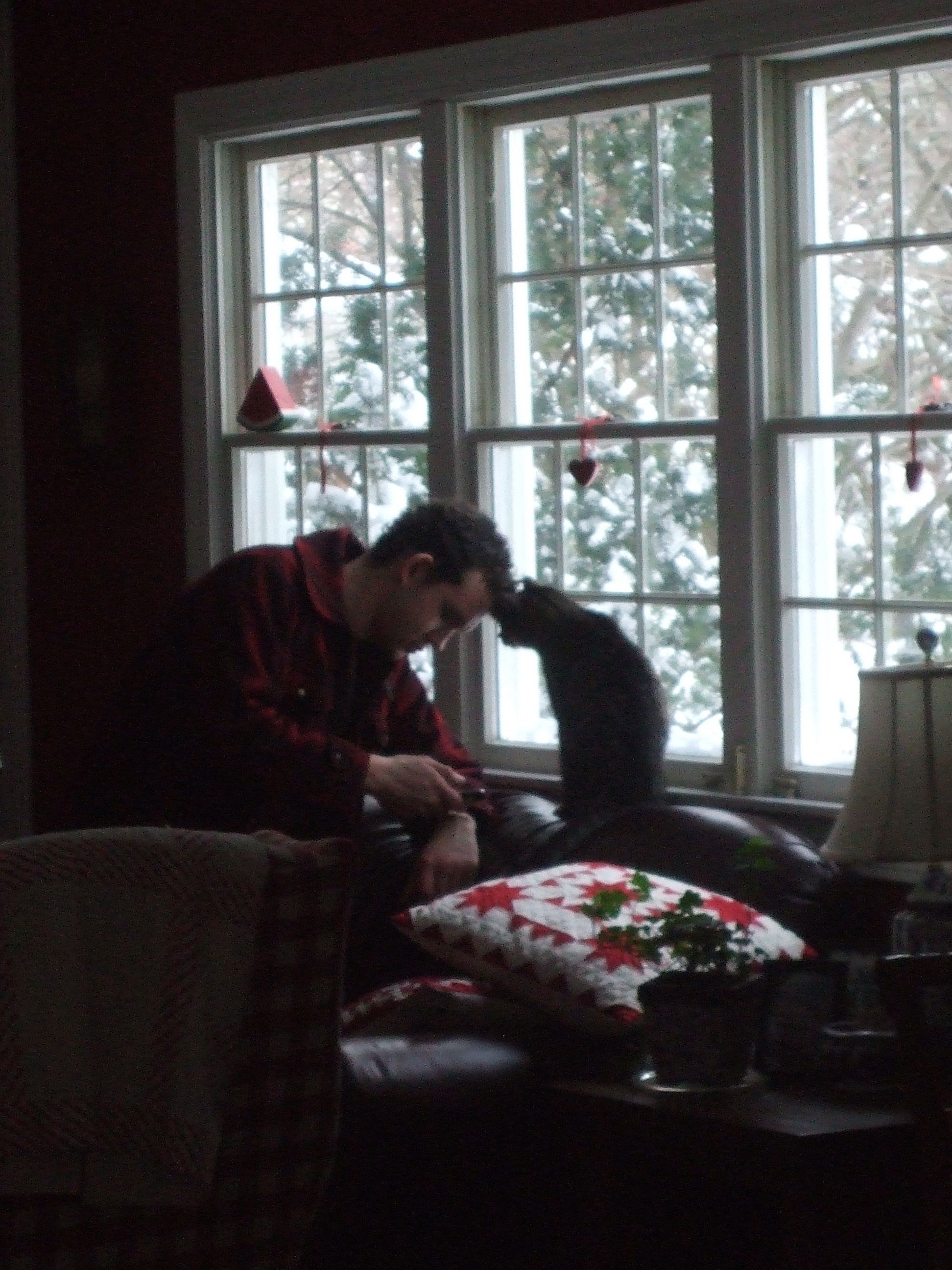
the image up above, a boy and his cat, on a cold snowy day is one that i cherish. i love how the two of them lean in toward each other, touch forehead to forehead. a good afterschool talk is like that. and yes, one of us purrs.
what holy interludes of listening have you had this week? who taught you how to listen?

pull up a chair. no, really.

in a life where just about every hour feels claimed, where any which one belongs to work, or washing machine, or endless runs to the grocery store, i always seem to be lacking in one serious department: taking time to sit and be with friends.

not dashing off an email in the middle of the night. not calling while walking on the treadmill. not sitting side-by-side at work. but actually, intentionally, gathering for pure purpose of catching up, checking in, putting finger to pulse of a heart that i love, a heart i don’t know as deeply as i wish i did, or both of the above.

and so it was that this morning was carved out. held by scribbles of ink on the calendar, anchored there more than a month ago, after a few rounds of emails eventually ruled it claimed and untouchable.

nothing–not a tummy ache of a child, not a deadline, not leaves that beg to be raked in the yard–nothing was going to hijack this morning. so help us, lord.

and sure enough, no hijacking occurred. one lugged a baby. one lugged a heavy heart. one shoved aside an annual trip to the midwife. i brewed up the coffee.

and so we sat. for hours and hours. no one minded the clock slipping into double digits, and then back into singletons, when the noon hour came and went.

how rare, and how perfect, to sit, hands cupped around still-warm mugs. plates stacked high with clementine peels and crumbs from pumpkin loaf.

how rare, how perfect, to watch stories unspool, to follow one thread into another. to sit back and watch, the criss-crossing of this thread over to that one. to peel back the layers of who we are and the lives we have lived.

to relish the mere fact that this morning had brought us together. that in this small town, four such drawn-together hearts, could actually draw together.

it’s one of the pitfalls of packing too much into our daily to-do’s: it’s friendship, too often, that falls by the wayside.
not that the love’s not there. not that the yearning is gone.

just that, in a tall order of living, we too often forget to refuel on the very thing that stirs all our hearts: the simple sacred time for connection, re-connection, building layer upon layer of holy criss-cross connection.

clearly it’s something i long for. it’s at the heart of this old kitchen table. the one where words on a screen too often suffice for the real thing.

so, rare that it was and it is, this morning the knock at the door came over and over, and each time, i uttered the words that have opened so many hearts: here, pull up a chair.

do you take time to pull up real chairs in your life? do you carve out hours for sacred connection? or do you, too, skimp on what might be the most essential of all? tending to friendships that matter….
and now, late for my mad-dashing rounds of errands, i need to lope out the door….

“can i come talk?”

the house was blanketed in little else but moonlight. the clock ticked from down the stairs and around a bend or two. the red digits that burn beside my bed–there only simply because they get the job done, there in the middle of the night when you roll and see them flashing the wee, wee hours–they broadcast, 11:01.

i was dozing when the footsteps padded up the walk. so all i heard was the click of the door. and the breathing that followed, the footsteps up the stairs.

i knew right away whose steps those were. you memorize those things.

and then i heard, through the gauzy mostly-darkness: “mom? can i come talk?”

and so, a summer’s night turned sweeter than a cantaloupe cut open, spilling, melon juices running off the cutting board, melon in july the sweet you wait for, perfect sugar stewed in sun and farmer’s field.

“mind if i lie down?’ the long-bodied boy asked, politely, though he didn’t wait for any grunt of answer, throwing his lanky self upon the sheets in darkness.

how long had it been since we’d lay side-by-side, this boy who as a babe slept every night curled beside me so i never missed his gruntings or his midnight peeps when once again he needed mama’s milk?

once he’d thrown his skinny jeans upon the sheets, his curls upon the pillow, i heard the deep, deep sigh.

i assure you i’d roused myself from sleep. i was wholly at attention. it’s what happens when your end-of-high-school child throws himself upon your bed: you listen hard. you savor every word.

what flowed beyond the sigh were sentences and paragraphs, whole stories of moonlit walks and beaches, of how he saw the world, and more importantly, the human heart.

as he talked, considered contours of the human race, the soul, what’s right, what’s not, i lay there soaking in the whole of it. every blessed drop of the notion that i’d a 17-year-old almost-man who understood through and through that wherever i am in the world, there’s a heart that wholly listens.

oh, there are many things that i am not. i grind myself daily that i’m not at the park, throwing, catching balls with the little one who would swell at such attentions. i do not make weekly trips to the library, as i wish i did, trudging home with loads of books and the little boy in tow, the one i cannot get, without squalls of protest, to lift a book. i wander past a treehouse, just built down the block, and think, now why didn’t i surrender a corner of the yard to old-fashioned summer construction, the sort engineered and executed by a child equipped with load of wood and pure imagination?

oh, i scold myself plenty. sadly heard too often as a child, shame on you. and shame i did absorb.

but there is one small arena of the heart, of motherhood, that i can proudly claim, learned the hard way, learned through all the bumps and bruises of the heart to which i’ve paid keen attention: i seem to know how to listen, how to take my children by the hand, traverse the landscape of the heart, the bumps, the planes, the high places.

it all came rushing in to me the other night, there in the murky moonlight darkness. i heard the boy i love tell stories, and in the ones he told, i heard that he too has learned to forge head on through the shadows of the heart, to seek the clearings, to know they’re just around the bend. to breathe blind faith into thickets all around.

at long last we heard footsteps on the bluestone walk. heard the click of the door, and more steps up the stairs. it was the father of the man-boy, home at last from work.

and there he found us, mother and son, lit only by the shafts of moonlight, telling stories, listening, as one day became another.

“can i come talk?” the child asks.

and the answer, always, always, says the mother: i am so deeply blessed that you lay your heart on mine.

holy God, bless the children and their stories and the mothers born to listen…..

whose heart did you turn to when you were growing up? whose heart do you turn to now? who turns to yours?

long walks and talks that never end

the end of the long hard story that was junior year of almost college is that, well, it ends.

ends any hour now, actually.

already is gliding toward close, is pressure cloud lifting, is window for words.

words, for my sweet boy and i, are the long-tested glue that hold us, cement us, keep our hearts in connection.

that boy and i have spent long long hours, over the years, deep in the forest of words.

we’ve climbed down to the side of a brook, watched the light dapple through leaves. savored the joy, pure delight, the swapping of stories. we’ve hiked into the deep, plenty of times, marveled at the heft of the tree trunks, the length of the shadows, the sound of the silence except for our words. once or twice, we’ve found ourselves lost, at the end of a trail. or so it seemed, as we pushed back the brush, searched for the sliver of clearing that would show us the way.

i don’t remember when, really, the long talking started. i do remember a young boy, maybe four at the time, walking in circles, unspooling his thoughts as i stood there and listened. we lived in a house with a square kitchen island, and that was the mooring, it seemed, around which he strode and he thought.

i remember the stairs, the ones that rose as if floating on air, no backs and no sides, just up. or down, with precipitous drop. i remember sitting there, for hours on end, watching the slant of the sun as it fell on his face. i remember the tears. i remember the stories. i remember the questions.

i remember the nook in his room, the slant of the roof right over our heads. i remember the leaves of the trees, brushing up against glass. how his room was a perch. a loft for high thoughts. i remember playing with blocks and towering stories.

as far back as i can remember, the boy and i have lived with our hearts inside out. little to hide. no words not allowed.

i suppose i set out to be the sort of mother who always had the “open for business” sign on the door. and in our house, the telling of story, the landscape of heart, is most serious business.

junior year, though, got in the way.

oh, the stories we started to tell. but then, oops, we cut ourselves off. knew we couldn’t go round that bend. not with math books and junior themes, faulkner and fdr twiddling their thumbs, up on his desk.

so for the last couple of months, too often, we clamped it. tightened the lid of the jar, lest stories begin. lest we get lost on a miles-long hike back to the woods that we love, the woods of the words.

the one short jaunt we’ve allowed, on all of these nights of late-night study, is our walk in the dark. around the “big block,” we call it. a study break. a bedtime preamble, literally. for me that is. for him, there’ve been too many nights with no bed in sight, but that’s over now, almost.

he can sleep all he wants.

and we can talk all we want.

just last night we went for our walk. and when we got to the very last corner, the one that turns us toward home, he pointed left, away from our house, deeper toward story.

i indulged. we kept turning corners, away from our house, for a good extra half hour.

oh, there were stories to fill every step. right up to the end, right up to the stoop in front of the door.

and oh, it felt fine to be back in the business of endlessly tilling our hearts.

my sweet boy and all of his stories are back. the long year is over, is ended.

all i need now, for the summer ahead, is a thick pair of soles for miles and miles of story.

it is a blessing, i know, to march by the side of a boy of 16–nearly 17–who still finds reason to walk with his mama, talk to his mama. sometimes, in the dark, i take his elbow, to keep from tripping over cracks in the sidewalk. the top of my head comes just to his shoulders. we’re quite a walking pair, little mama and her towering lad. oh, what a gift to take on the darkness with a boy of long stride, and long story.
what’s your preferred mode for soaking up stories with the someones you love?

storybook gardener

since the day i moved here, five years ago now, the storybook cottage up above has held me in its spell. oh, i don’t live beneath its shingled roof, don’t know my way from room to room, have never even turned the front-door knob.

i only wander by, and cast my wishes in its woodland garden, where trillium, in spring, bumps up against the jacob’s ladder. where snowdrops are the first to come when winter will not take its graceful leave. and where, in autumn, tall grasses swish, the wind-borne lullabye before the garden slumbers.

i wink sometimes at raggedy ann, peeking out from up beneath the turret’s peak. see her? just a wisp of her, in the upper eastern window where she bathes, each morning, in the dawn’s first-light, as rosy-fingered sky reaches up and over the great blue lake just blocks away?

the raggedy one looks down on a garden as magic as any i have ever known, save maybe for “the secret garden,” frances hodgson burnett’s secret one, of course, which by page 42 of that sinful book (i once pretended to have a fever so i could stay home from church to read on and on) was the first i fell head-over-heels in love with, imagined myself inside of, tiptoeing near the climbing roses, curling up on stony bench, listening for the robin who’d led the orphan mary to the garden’s long-lost key and then, at last, to the ivy-covered door that hadn’t been unlocked in years and years.

there is for me something about a garden, a particular sort of mind-of-its-own garden, not one all clipped and shorn and pedicured, but one that rambles, grows this way and that, that sets me to pretending, spinning yarns to match the garden’s swift enchantment.

a little more than a year and a half ago, the storybook garden that belongs to the storybook cottage that just might belong to raggedy ann, gripped me, shot me through and through with what i feared was a most unhappy ending.
before i tell you what unfolded just the other day, i’ve pasted here the passage i once told. read along, then meet me at the story’s end, so i can fill you in on what we’ll call the epilogue.

the story just below, once was published in the chicago tribune. but i wrote it right here at my old pine desk, before i had a kitchen table where i could share my stories.

here’s what now becomes the prologue, printed first in october of 2006:

I am haunted these days by a fairy tale garden that I fear has lost its gardener.

There is, not far from my house, an enchanted little garden and a storybook house to go with it. The first time I eyed it, I nearly drove up the curb. It is all trellis and turret, and delightfully low to the ground, as if curled in a humble embrace with the growing things that spring all around. It is a house that whispers, not shouts.

At the head of a stepping-stone path there’s a front door an elf might wander through, and all around there are great patches of magic, grasses and flowering vines, birdhouses by the dozens, a place lovingly tended by someone completely in tune with the rhythms of wonder and the unfolding of time, season by season.

A Raggedy Ann, toddler size, sits up in the window of one the turrets, peeking out, keeping an eye on all. More than once, I swore she winked at me. The place, I’m telling you, is bewitching.

To drive by, or to wander by, is to slow the staccato of my every day. It is to breathe in and be reminded that lovingly tending the earth reaps wheelbarrows full of heaven.

The other day, though, the staccato picked up as I was stopped at the stop sign across from the storybook house. I saw streams of finely dressed folk pouring down the sidewalk, into the elfin front door, in the middle of a sun-drenched afternoon. This isn’t a holiday, I thought. But then a synapse connected: Those fine clothes were funeral clothes. Oh my goodness, something in the storybook was amiss.

And then, sure as could be, the next morning, flanking both sides of the garden walk, standing sentry for any passerby, were two giant funeral wreaths, one a sumptuous circle of red roses, the other a sheaf of blood-red gladioli.

I am haunted now by the storybook house, and its autumnal garden. Haunted because I am afraid the woman who loved there might be no longer.

Sad thing is, I never met her. Only saw her as a constant stooped figure, bent over her trillium and her scilla in the spring, deadheading her jonquils, cutting back and transplanting through the summer, raking and staking well past the first frost of winter.

I can barely breathe now when I drive by, wondering, worrying. What happens to a garden when a gardener dies? Who will feed the birds that have called her little patch home for decades and decades?

For now, Raggedy Ann keeps an eye on the place. I won’t be able to bear it if she, too, slips away some day when I drive by.

I mourn for the woman who tended the earth with all her heart. I mourn for the trillium and the jonquil and the clematis that will no longer be cajoled and tucked back and talked to, as I often saw her, lips moving as she moved from this to that growing thing. I mourn for all of us who might not have the storybook garden to calm us in the midst of our modern-day madness.

It is a wicked thing when a garden and its gardener do not live happily ever after.

–end of tribune story–

not long after the story ran, i found an email in my tribune mail box. just a few sentences in, my heart caught in my throat. it was an email from the storybook gardener herself.

she’d been stopped, she said, as she turned the sunday pages, drawn in by the drawing of a raggedy ann that ran beside my story, running down two columns. she started to read, and soon knew that this mysterious writer was writing of her very own garden.

she’d not died, she wrote me. but her dear, beloved husband had. suddenly. achingly. without a warning.

and all the bustle i’d come up upon, and the funeral wreaths standing guard by the front door, were indeed for someone loved, now lost.

the garden and the gardener were, oh, yes, deep in mourning. but the words i’d written had not rattled her, so much as soothed her, she wrote. to know that her garden brought so much magic to even one odd passerby.

i should stop by, she wrote. i should visit her in her storybook garden, or inside the magic cottage she now shared with only one limp ragdoll.

for 20 months almost, i’ve kept an eye out. i’ve knocked on that elfin door. i’ve spied evidence of her being there, a just-dropped trowel, a pile of leaves. but not once did i ever see the magic gardener herself.

until just the other dappled afternoon. when the sun played peek-a-boo through her maple leaves, and i saw her slight bent frame, hard at work.

i leapt from my car, i called her name. i tiptoed through her ferny thicket, felt my heart pound hard against my chest. i told her who i was, reminded her that i’d once written of her garden.

she needn’t be reminded. she’d waited, she said, all these months. had wondered why i’d never come.

oh, but i have, i said, a little bashful, a little sad that i’d not maybe tried harder. hadn’t thought to drop a basket or a note, tucked it by the door.

somehow, though, more words–scribbled, folded, left behind–didn’t feel enough, didn’t feel the thing to do. i’d been inclined to meet this soul in person; to know the hands, the eyes, the heart, that made this place call out to me.

here, sit, she said, patting her mud-rubbed palm on just the moss-laced stony bench you’d expect sprouting from her woodland trails.

we talked for the better part of an hour. she offered me anything she grows, to divide and migrate the few blocks south, to my still-getting-off-the-ground patch of earth.

uncannily, time and time again as we talked of achy hips and sudden deaths and how her garden grew, i felt as if i’d known her for a long long while. found myself delighted through and through by just how much our roots, our tales, entwined.

maybe, though, that’s what happens when you’ve imagined yourself in someone’s garden. thought about sipping tea on chilly afternoons, tucked behind her stained-glass kitchen windows.

or maybe, it’s simply magic, long seeded in the hearts of those who share a fondness for a sparrow’s nest tucked under eaves, and ragdolls who nap away the day up in attic windows.

as shadows grew, and i knew my stay might be getting in the way of some dear plant’s undivided attention, i couldn’t help but think how it was that her undying grief had brought us so round-aboutly together, sitting here, side-by-side, in her most enchanted garden.

and how this beauty all around us grew, despite the dappled darkness.

kindred souls discovered where the lilac bloomed, and mayapples nodded in the filtered sunlight.

the story, once imagined, had no happy ending.

but the story, real, i now knew, was like so very much of life: it is shadowed, yes, but only just in spots.

and, here and there and everywhere, new life is pulsing; pushing, bulging, shouldering the clumps of dirt, straining to break through the crusty-shell of earth.

no longer merely make-believe, the storybook gardener and the writer begin that time-worn art of cultivating friendship. drawn together oddly, they carry on as if their story’s meant to be.

which, just maybe, it truly was.

have you made a friend thanks to a garden? or some odd-unfolding circumstance? have you some inkling there’s someone not far from where you live, who just might be your long-lost soulmate, not yet discovered? do tell…