pull up a chair

where wisdom gathers, poetry unfolds and divine light is sparked…

Category: childhood

musings on tenderness
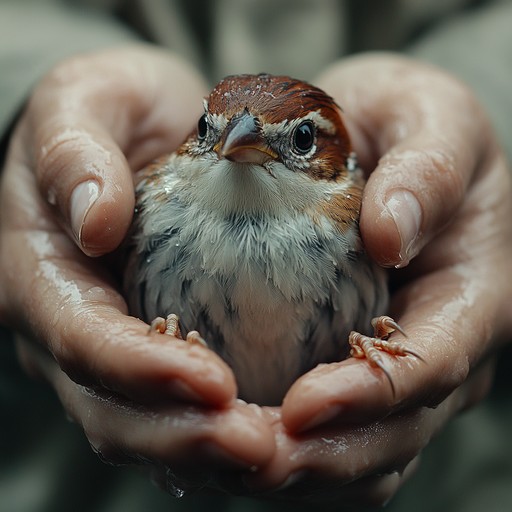
of all the ways of love, tenderness is one i hold closest to my heart. it’s the lesson learned and practiced as a little girl, when my mother taught me to run for a shoebox, or little glass jar. to punch its lid with air holes. and to line it with grass and leaves, to bring the outdoors in for this space that would become an infirmary, whether the patient be a baby bird fallen from the nest, or one with a broken wing, or simply a ladybug or firefly who happened to straggle behind. 

i don’t remember signing up for the advanced class, but i do very much recall the village i (a kindergartener at the time) made for my singular ladybug, each edifice constructed of paper and cardboard, care and attention devoted to every adornment (a flower box under the paned window, a wiggly “flagstone” path to the house’s front door). the steeple for the ladybug church i recall being a particular construction challenge. (and i remember depositing said spotted-back bug into the church come sunday morning at 9, per clockwork familial custom.)

tenderness is love on its gentlest setting. tenderness is the heart pierced through with empathies, with quiet, with the barest wisp of touch. a touch so silken it breaks you out in chills down your spine, might make you audibly sigh. to be tendered is, well, to be buttered in love. it is a butterfly kiss of kindness. a heart petaled open, and dusted with golden-grained succors.

tenderness, maria popova tells us, “is the best adaptation we have to our existential inheritance as ‘the fragile species.’”

lewis thomas, the poet and physicist (the lives of a cell: notes of a biology watcher) who first named us “the fragile species,” gives context for why in a 1996 essay from his last such collection, published under the same title, in which he positions us in the context of the universe’s timeline:

“This is a very big place,” lewis begins, “and I do not know how it works, or how I fit in. I am a member of a fragile species, still new to the earth, the youngest creatures of any scale, here only a few moments as evolutionary time is measured, a juvenile species, a child of a species. We are only tentatively set in place, error-prone, at risk of fumbling, in real danger at the moment of leaving behind only a thin layer of our fossils, radioactive at that.”

olga tokarczuk

when olga tokarczuk, the polish psychologist turned poet and novelist, won the 2018 nobel prize in literature, she mused on the art of tenderness in her nobel banquet lecture, a lecture titled “the tender narrator,” and one widely regarded as nothing short of “magnificent.”

tokarczuk began by telling the story of a black-and-white photo of her mother that’s always haunted her, in a blessed way. it was a photo taken before olga was born, and i’ll let her words take it from here (emphasis mine throughout): 

“There’s nothing really happening in the picture—it’s a photograph of a state, not a process. The woman is sad, seemingly lost in thought—seemingly lost.

“When I later asked her about that sadness—which I did on numerous occasions, always prompting the same response—my mother would say that she was sad because I hadn’t been born yet, yet she already missed me.

“‘How can you miss me when I’m not there yet?’ I would ask.

“I knew that you miss someone you’ve lost, that longing is an effect of loss.

“‘But it can also work the other way around,’ she answered. ‘Missing a person means they’re there.’”

stopped by the tenderness of a mother telling her small daughter that she missed her even before she was born, popova comments, is “an astonishing gesture of love so total that it bends the arrow of time.

ponder that string of words, and the meaning behind it, before reading on. “an astonishing gesture of love so total that it bends the arrow of time.” may we all know such love…

tokarczuk picks up her telling from there: 

“This brief exchange, someplace in the countryside in western Poland in the late sixties, an exchange between my mother and me, her small child, has always remained in my memory and given me a store of strength that has lasted me my whole life. For it elevated my existence beyond the ordinary materiality of the world, beyond chance, beyond cause and effect and the laws of probability. She placed my existence out of time, in the sweet vicinity of eternity. In my child’s mind, I understood then that there was more to me than I had ever imagined before. And that even if I were to say, ‘I’m lost,’ then I’d still be starting out with the words ‘I am’—the most important and the strangest set of words in the world.

“And so a young woman who was never religious—my mother—gave me something once known as a soul, thereby furnishing me with the world’s greatest tender narrator.”

a good bit later in the speech, tokarczuk raises this next question, more than worth considering:

“….Have you ever wondered who the marvelous storyteller is in the Bible who calls out in a loud voice: ‘In the beginning was the word’? Who is the narrator who describes the creation of the world, its first day, when chaos was separated from order, who follows the serial about the origin of the universe, who knows the thoughts of God, is aware of his doubts, and with a steady hand sets down on paper the incredible sentence: ‘And God saw that it was good’? Who is this, who knows what God thought?

“Leaving aside all theological doubts, we can regard this figure of a mysterious, tender narrator as miraculous and significant. This is a point of view, a perspective from where everything can be seen. Seeing everything means recognizing the ultimate fact that all things that exist are mutually connected into a single whole, even if the connections between them are not yet known to us. Seeing everything also means a completely different kind of responsibility for the world, because it becomes obvious that every gesture ‘here’ is connected to a gesture ‘there,’ that a decision taken in one part of the world will have an effect in another part of it, and that differentiating between ‘mine’ and ‘yours’ starts to be debatable.”

and then toward the very end of her speech, tokarczuk turns to a literature of tenderness: 

“Tenderness is the art of personifying, of sharing feelings, and thus endlessly discovering similarities. Creating stories means constantly bringing things to life, giving an existence to all the tiny pieces of the world that are represented by human experiences, the situations people have endured and their memories. Tenderness personalizes everything to which it relates, making it possible to give it a voice, to give it the space and the time to come into existence, and to be expressed.

“Tenderness is the most modest form of love. It is the kind of love that does not appear in the scriptures or the gospels, no one swears by it, no one cites it. It has no special emblems or symbols, nor does it lead to crime, or prompt envy.

“It appears wherever we take a close and careful look at another being, at something that is not our ‘self.’

“Tenderness is spontaneous and disinterested; it goes far beyond empathetic fellow feeling. Instead it is the conscious, though perhaps slightly melancholy, common sharing of fate. Tenderness is deep emotional concern about another being, its fragility, its unique nature, and its lack of immunity to suffering and the effects of time. Tenderness perceives the bonds that connect us, the similarities and sameness between us. It is a way of looking that shows the world as being alive, living, interconnected, cooperating with, and codependent on itself.

“Literature is built on tenderness toward any being other than ourselves.”

and a short bit later, she closes her remarks with this:

“That is why I believe I must tell stories as if the world were a living, single entity, constantly forming before our eyes, and as if we were a small and at the same time powerful part of it.”

in a world emblazoned with harshness and cruelties for the sake of cruelty, i will joyfully devote my days to making a living case for tenderness as a way of being. those who have touched me most indelibly in my life are those who wove their way in through that very rare and breathtaking capacity, the one that comes on with a whisper not a bang, the one that quietly says i’ve been keeping close watch on your finest-grained threads, and i see where those threads are tattered or thinned, and i am here to tenderly, yet certainly, place my palm against the small of your back, to let you know you are not alone, you are not unloved, you are seen and beheld.


a modest selection of olga readings:

the whole of her 2019 Nobel Prize acceptance speech here…

and an excerpt from one of the works that won her the 2018 Nobel Prize in Literature, and for which the judges cited: “for a narrative imagination that with encyclopedic passion represents the crossing of boundaries as a form of life”

this one from Flights, her 2007 novel that twines fiction and non-fiction, and which james wood, the new yorker critic and harvard english professor, in 2018 described as tokarczuk’s “omnium-gatherum, a big book full of many peculiar parts: there are mini-essays on airports, hotel lobbies, the psychology of travel, guidebooks, the atavistic pleasures of a single Polish word, the aphorisms of E. M. Cioran. Some of these riffs, which themselves tend toward the aphoristic, are as short as a couple of sentences.”

HERE I AM

I’m а few years old. I’m sitting on the window sill, surrounded by strewn toys and toppled-over block towers and dolls with bulging eyes. It’s dark in the house, and the air in the rooms slowly cools, dims. There’s no one else here; they’ve left, they’re gone, though you can still hear their voices dying down, that shuffling, the echoes of their footsteps, some distant laughter. Out the window the courtyard is empty. Darkness spreads softly from the sky, settling on everything like black dew.

The worst part is the stillness, visible, dense – а chilly dusk and the sodium-vapour lamps’ frail light already mired in darkness just а few feet from its source.

Nothing happens – the march of darkness halts at the door to the house, and all the clamour of fading falls silent, makes а thick skin like on hot milk cooling. The contours of the buildings against the backdrop of the sky stretch out into infinity, slowly lose their sharp angles, corners, edges. The dimming light takes the air with it – there’s nothing left to breathe. Now the dark soaks into my skin. Sounds have curled up inside themselves, withdrawn their snail’s eyes; the orchestra of the world has departed, vanishing into the park.

That evening is the limit of the world, and I’ve just happened upon it, by accident, while playing, not in search of anything. I’ve discovered it because I was left unsupervised for а bit. I’ve clearly found myself in а trap now, and I can’t get out. I’m а few years old, I’m sitting on the windowsill, and I’m looking out onto the chilled courtyard. The lights in the school’s kitchen are extinguished; everyone has left. All the doors are closed, hatches down, blinds lowered. I’d like to leave, but there’s nowhere to go. My own presence is the only thing with а distinct outline now, an outline that quivers and undulates, and in so doing, hurts. And all of а sudden I know there’s nothing anyone can do now, here I am.
—Olga Tokarczuk

maybe you’ll want to add olga to your summer reading list. if you’ve a favorite passage that holds tenderness to the light for you, we’d love to read along here at the table….

who taught you tenderness or, rather, how did you learn of its ways?

blessed birthday today to becca who i love, and who is as wise and strong as woman as i am blessed to know….
standing at the doorway of time

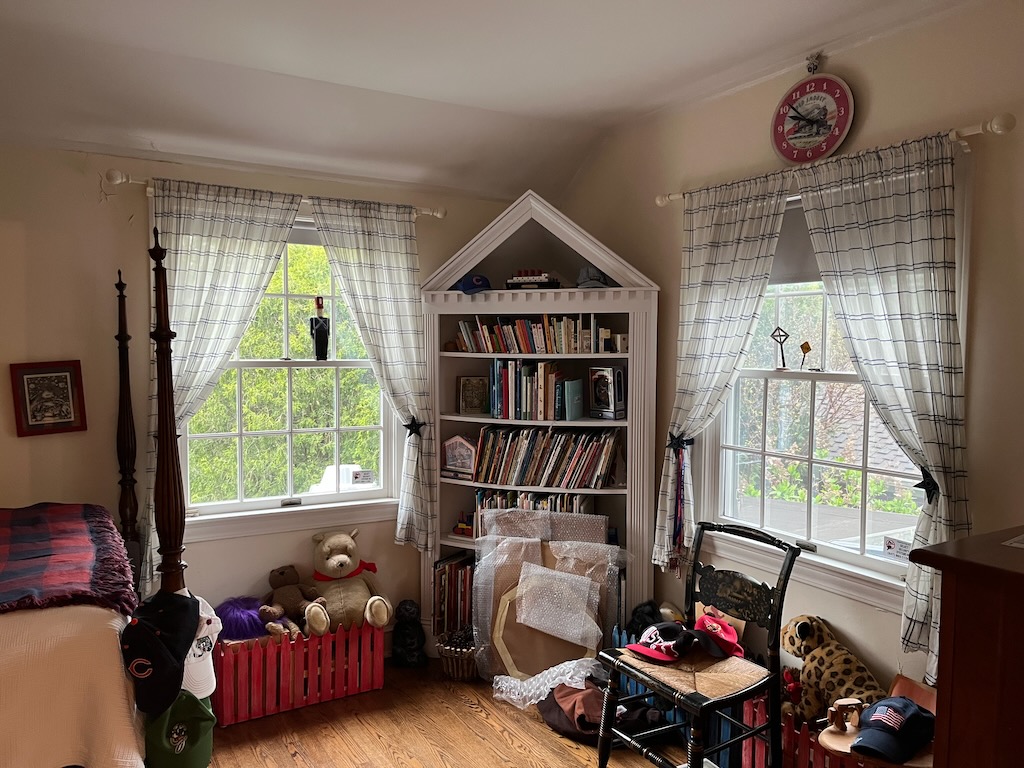
i found myself standing in a bedroom doorway the other day, staring. you might have thought i’d momentarily lapsed into freeze frame, but my mind was whirring wildly. it must be a sign of the times — my times, my where-did-the-years-go, i-remember-all-that-unfolded-in-this-storybook-room flash in time. 

i call it a kodak-carousel moment, a name in itself that dates me. as obsolete a term as there might be here in the age of slide shows on phones. no need to plunk in the slides, the film framed by cardboard, a portrait in miniature, and click-click-click to advance. 

the kodak carousel in my mind was playing and replaying the little boy room, the room where my miracle baby grew up. the room where we once stacked his baseball jersey and glove, his ballcap of his very first team, on the eve of his very first game. the room where a fallen-out wiggly tooth was laid to rest (in hope for the fairy) under the pillow. the room where night after night we prayed he would please fall asleep so we could tiptoe our escape without raising a plaintive cry. 

i suppose i’ve made something of a museum of that room. added a few paper-wrapped hand-me-downs tucked in a corner (a safe spot for storage) but otherwise it’s all as it was. the alphabet rug, where i taught two boys their ABCs. the four-poster bed where my grandma once slept, a bed where i too slept for years, and then both of our boys. and now whoever comes to visit. the bins of blocks and bears and hand puppets, too. a whole childhood frozen in time. 

and i won’t touch it. 

the drawers of the dresser are filled these days with extra sheets, and art project makings. no longer stuffed with little boy PJs, and shorts and T shirts, size small. but if you open the top drawer on the right you can still find a vial filled with the teeny-tiniest babies of teeth. i couldn’t bear ever to toss those. 

in time, an old house starts to show its cracks. and chips in the paint. and squeaks in the floorboards, and layers of impenetrable grease in the vent of the diner-grade six-burner cookstove. 

i fear i might be blind to the blemishes as the house crumbles around me. 

all i see is the room where i tucked into bed one reluctant sleeper, night after night, for sooo many years. where he learned how to read, and chased away night-prowling monsters. and another (the room at the bend in the stairs) where we brought home the boy with the broken neck. where he wrote his essays to get into college, and years and years later studied for LSATs. (and just a few weeks ago, home for easter, sat at the old desk and recorded a lecture for all of his first-year law students.)

i look at the pillows on the old four-poster bed, and remember the nights and the mornings we propped up against them, turning the pages of books that left us—both reader and readee—with tears soaking our cheeks. charlotte’s last web. or giggling at the antics of a big raspberry-hued rascal named Ted. or that little monkey named George. 

it seems a holy thing. to pause, to turn back in time. to anoint each moment, each memory, with the deepest form of thanksgiving. to soak in to the deepest fiber of your soul those hours you thought might never end. 

i hope, in that ephemeral fluidity of time, we can rewind the clock, even if only in our soul, to finger each hour, each grace, as if the bead of a rosary. to press it against the whole of who we are now. day by day each of us more graced. as we fill ourselves with accumulation of blessing we’ve lived. the boy who defied every odd of a very old singular ovary, the pregnancy that lasted all nine months, the chromosomes that aligned just as prescribed. the life that was given to me. the years upon years of joy, of undiluted wonder, that grew up in that room where i now stood. soaking it in. soaking and soaking. 

saying my prayers once again. 


yesterday was a glorious day in the life of the soul, and in the life of the church i was born into. it was a stunner of a moment as we listened, in italian, to the first then the middle name of the new Il Papa. in all the italian we didn’t yet know that for all of his life, he was just Bob. Bob the priest. Bob the cardinal. now Leo the Pope.

as i wrote to my boys in the flurry of texts that then punctuated the day, “i feel close as i’ve felt in a long time that God had an actual hand in worldly affairs. this world needs a voice unafraid to speak to worldly power, and proclaim the rule of God. it’s a paradigm the polar opposite of so much idolization in this world. peace and love are not vagaries. huge swaths of the world desperately need both.” 

there is much to learn and to listen to from this unlikely pope from chicago’s very own south side. a pope who roots for the sorry sorry white sox, a pope who loves an aurelio’s slice. a pope, we learn, with creole roots. a pope whose grandparents identified as black in a turn-of-the-century census from new orleans’ seventh ward. a pope who left for peru as a very young priest, to work with the poor. a pope with the courage to set straight those who misread Catholic theology—no matter their office, nor the power they wield. i have been praying with all my heart for a voice of true courage in this world. and this morning, i am thinking that in time the moral arc of the universe does sometimes bend toward justice.

what doorways to time have you found yourself staring into of late? and what stirred through your heart at the news of the new Il Papa?

happy blessed almost birthday to a most beloved chair who, around here, goes by the name lamcal. a wise woman of the highest order.

and happy mothering day to all. because, in my book, mother is a verb, and if you gather here you do it magnificently. xoxox love, bam

all these years later

forty-four cakes. three-thousand-two-hundred-seventy-eight candles. that’s how many cakes and candles we’ve missed since my papa died in the winter of 1981. i counted it up because today would have been his 96th birthday. he didn’t make it past 52. 

all these years later the second of august is still a day i remember.

i remember the sunny sunday mornings when honeydew melon and handmade cards were strewn at his place at the dining room table, birthday brunch a step-up from the requisite eggs, bacon, and toast after ten-o’clock mass. i remember, in the preambles to birthday dinner, the glistening of his pewter mug, summer’s sultry humidity meeting the cold of his ice cubes and tonic and gin. the quarter of lime floating canoe-like near the rim. eight-minute burgers on the grill, corn on the cob littering all of our chins. 

i remember his laugh. 

much, though, fades.

i can’t remember the sound of his voice. or the way he called me barbie. i remember a few lines, but not the ones my brothers often remember. i remember the time he told me he’d prayed and prayed and could not understand why he was driving me to the hospital. i remember the time, driving home from my college graduation, when he told me he’d felt his mother right beside him when they called out the names of those who, like him long before, were graduating with highest latin honors, and he watched me rise from my seat in the crowded arena. 

i remember how one late summer’s afternoon he called me from the office and asked me to meet him for burgers on the outdoor cafe of a place called jerome’s in lincoln park, a place he deemed “kicky.” my papa liked things that were “kicky” or “cool.” my papa, born of a locomotive engineer and a country school teacher in little bitty paris, kentucky, never shed the marvel of being a big-city ad man in the heady era of Mad Men and martini lunches and sixty-second commercials whose jingles and cutlines stoked the soundtrack of america’s bell-bottomed woodstock-and-watergate age. my papa liked to travel the globe. to give speeches in sydney and meetings in munich. he liked his corporate apartment in mid-town manhattan. he loved new york city. a place he never wanted to move us; he’d moved his moptop crew too many times, he and my mama agreed. one more uprooting might do us in. so he more or less made a weekly commute to the big juicy apple.

and home base for all those years was the two-story colonial with all the big trees at the bend in the dead-end lane. he brought the “neat, keen, cool, fab, it’s a blast” to our dutch backdoor, and on in to the big oval table where, at 6:30 sharp each night of the week except for on sunday when we pushed it to 5:30, we sat down for dinner, all seven of us. if there was something new out there in the world, my papa wanted us to know. didn’t matter if it was a word or a box soon to be labeled “hamburger helper.” he was our conduit, our passport, to all that was grander and jazzier than our sleepy little burg one in from the lake. 

those are the things, all these decades later, i still remember––like yesterday. i remember, too, the year after he died when i thought i might never stop crying. how there were nights when i wailed a wild-animal sort of a wail, and bit into my pillow to muffle the sound. i never thought i would know joy again. 

i never thought the ache would stop aching.

but here we are: two kids, a long marriage, and a whole career later. my papa had no idea i––a nurse when he died––would take his and my shared love of words and make a life of it. but the first day i sat down in the chicago tribune newsroom and they told me i needed a password, i knew just what i’d type each time i needed to rev up my desktop computer: my papa’s initials and mine; he was a part of every start to every story. and i never dropped his last name, cuz i wanted my papa to stay in the news. and in print. day after day. byline by byline. 

here’s where i fell short: no matter how many stories i’ve told my boys and the man i love the most, i have not come close to bringing my papa to life. and, believe me, i’ve tried. no story, no matter how animated, no matter the gleam in my eye, can ever, ever come close. the man was a human high-wattage bulb. he was known for his wit. but i remember the tenderest parts. i’ve tried to bring all of it forth over the years. 

but all these years later, it fades. and the truth is, my papa fades too. there’s too much i cannot remember. 

grief and time make for an odd, sometimes cruel calculus. yes, the aching abates most of the time. though the piercing can come and come strong. in a grocery aisle. when a certain song comes on. when you’re trying to tell––or to catch every word of––a particular story. (writing these words here this morning, the tears have come too. if i’ve wallowed in moments, in memories, here, it’s only to make it all last. to live in those moments again.) 

as much as the gasping for air is no longer a part of the grief, so too the frames of a life reel on, and the erasing begins. after so, so many years, you sometimes forget the one who’s no longer there. not always, and not in those crucible moments, when time itself feels condensed and magnified all at once. i too have felt my papa beside me when my firstborn walked a graduation stage; when my firstborn became a professor of law (a profession my papa once yearned for). i’ve watched how tender my so-called “little one” is, especially to my papa’s widow (“grammy” to both of my boys), and i know my papa would melt. but, truth is, ordinary time mostly hurls by, and i don’t remember. and then i might catch myself with a twinge. or i might not catch myself at all. there’s an anesthesia in grief that i never saw coming. maybe it saves us. maybe it’s cruel.

maybe that’s why there are birthdays, even when the someone is gone. especially when someone is gone. they become remembering days. they are days without cakes and no candles. but, in the silent chambers of the heart and the mind and the soul where time knows no rules, those someones return. 

my papa rumbles in me this morning. in the only way i know how, i just brought him back. and i didn’t need to close my eyes, or make a wish, or blow out candles to make it happen.

he’s here. right beside me. in each of these stories. i know it.

happy birthday, dear papa. i love you forever.

at our house, we have an august birthday parade, a 2-4-6-8 of celebrations. so most blessed of birthdays i wish for my brother david (4), my blair(6), my teddy(8). i love you each and all to the moon and mars and beyond.…

tell a story of any someone you miss. any story. any someone. we’ll make this a party.

my papa and me

coming home to an empty nest

a desk cleaner than it’s been in a long, long while…

the house i walked into the other day, upon return from faraway, was not the house i left. mostly, it looked the same. same pair of stools at the kitchen counter. same loose brick on the backdoor step. but here and there things were missing: coats no longer weighing down the coat hooks; size 12 shoes, all gone; the big ol’ speaker with the disco lights, the one parked beside the birdseed bin ever since last springtime’s college graduation, it had up and vanished. 

and the silence was the loudest i had heard in a long, long while.

whilst i was away, there arrived an absence.

my beloved and i, for the first time in nearly 31 years, now dwell in an empty nest. 

the younger fledgling has flown the coop. and we, the grownups, haven’t much clue what to do with the newborn stillness.

while i was off in the nation’s capital, puttering about Boy No. 1’s apartment, planting myself in the way back of his law school lecture hall, motoring about the countryside in search of sought-after antiques, Boy No. 2 set south for the ‘hood to which he was born. 

he left behind a room that would be described as empty, if not for the torrent of assorted trinkets strewn in his wake. (it’s a collection of castoffs that counts among its contents a box of not-yet-dusty college paraphernalia, a half-burned chicago-scented candle (who knew?!), the oddest assortment of half-empty bottles and squeezed-dry tubes, outgrown clothes, and, yes, a tall stack of various welcome-home placards we’d penned upon his many returns over the years.)

as of one week ago, this old house boasts an official population of two and only two. 

i, though, only stepped into the stillness the day before last––late to the game, as i so often am. my mate, the boy’s papa, has had a six-day jump on the vast emptiness, and he deems it a “sad, sad” state of being. 

we just plain miss the kid, is the gist of it.

and while a piece of me is feeling the pangs, i’m just as keenly approaching this new endeavor as if a room to which i’d never before entered. i’ve always known it was there at the end of the hall but the knob hadn’t yet turned, and so as i now tiptoe about, peeking into its nooks and crannies, i am still getting to know my way.

for starters, the quiet. the pared-down daily rhythms (no more nightly shuttle of the old sedan to park it near the train once the meters dozed off at 9 p.m., and where it awaited the boy’s 1:05 a.m. arrival from downtown, thus sparing him a long-enough walk in the cold and the dark and whatever the weather gods chose to hurl on his route). no more rushing to throw some semblance of breakfast in a rumpled brown bag as he raced off to work and we all held our breath that he’d beat the train to the station. (and, yes, yes, if you’re starting to catch on that we might be among the dotingest parents that ever there were, we plead utterly guilty.) 

did i mention the newfound dearth of laundry? or the fact that the cupboards look to be barer than ever before?

in that way that the mind plays tricks, as it wraps itself around those episodes in life it’s not before encountered (after a birth, a death, a diagnosis), i find it playing a form of peek-a-boo. an almost haunting hide-and-seek. i forget the kid is not asleep behind the bedroom door. wake up and skip a beat or two till i remember not to check that he made it home the night before. remind myself there’s no need to leave the porch light on when i tiptoe off to sleep.

in this day and age, where youngins come and go till their middlings or older, this new empire of emptiness cannot be called an inevitable geography. while the college years gave us a taste of it, this time round it seems a sharper, bolder border, a less permeable line than the empty nest of yore, when the emptiness ebbed and flowed according to academic calendar. 

this time the kid is paying his own utilities, and sending off a monthly check to the landlord. and except for the comfy armchair and the rug he whisked from his upstairs room, he needs us not in his domestic equation. 

and while he whistles the freedom song, his papa and i are fumbling in a fog across the contours of this new state of being. largely, i find myself deeply curious, and admit to something of a relieved sigh that i no longer will wake in the night to be sure i hear him clomping up the stairs. 

time turns and turns in labyrinthine spirals, and with every twist we see ourselves from whole new angles. though i know full well that parenting is a post without pause, and one i intend to hold onto till my very last breath, this empty nestiness allows for––begs for––a whole new deepening. we’re a duet again, his papa and i, and on our own to chart our days. indeed, it’s solitude i’ll oft befriend. 

which makes me think that now must be the hour in a lifetime when our soul begins its quickening, something of a leavening, with more hours to read, more years to remember, heavier questions to ponder. my prayer is that with the quiescence there comes a gathering of deeper grace.

of course, it aches a bit to think we’re past the years where cacophony was a daily occurence. where my hours were filled with comings and goings, and assorted bunches of kids clumped in the basement or were planted in sleeping bags or stuffed in the way back of the old red wagon. where an hour to myself was both rarity and marvel.

but maybe, just maybe, the quiet that’s tiptoed in will point the way toward the wise old lady i’ve always wanted to become. 


and let us indulge in a glistening bit of mary O here this morning. an old favorite, something that indeed kills me with delight….

Mindful
by Mary Oliver

Every day
I see or hear
something
that more or less

kills me
with delight,
that leaves me
like a needle

in the haystack
of light.
It is what I was born for—
to look, to listen,

to lose myself
inside this soft world—
to instruct myself
over and over

in joy,
and acclamation.
Nor am I talking
about the exceptional,

the fearful, the dreadful,
the very extravagant—
but of the ordinary,
the common, the very drab,

the daily presentations.
Oh, good scholar,
I say to myself,
how can you help

but grow wise
with such teachings
as these—
the untrimmable light,

of the world,
the ocean’s shine,
the prayers that are made
out of grass?

how did you navigate through the rocks and shoals of those uncharted landscapes life has surely thrown your way?

the roof and the trees under which i grew up

i’d told myself that ever since the night my papa died, when i walked in that dark house, his tennis sweater flung over the back of a kitchen chair, as if he’d breeze through any minute, the night when i sat in the den afraid and unwilling to take in a breath, for i didn’t want to let go of the last one i breathed when he was alive, i’d told myself that house was mostly hollow to me. 

it’s held a chill for me ever since. 

i didn’t think i’d much miss it.

but then i drove back the other day. drove back to walk through the rooms where no sound was stirring, not even the whir of the furnace. drove back to see rooms emptied, the rugs a radiograph in reverse where the geometries of now-taken-away furniture shone bright against decades-worn dim. where you could make out the plot where my mama’s four-poster bed had been, and the circular table beside it. where the den, too, was a checkerboard of absence, chairs and a couch lifted and moved. 

this week my mama moved out of the house where she lived, the house she called home, for six whole decades. long long ago, when my papa got a job in chicago (an ad man in the age of the Mad Men), and they’d moved us again from a faraway city, she’d picked that house out of many along the north shore of lake michigan because it was the house with the oaks. more than a half dozen big old oaks. maybe a whole dozen once upon a time. my mama loves big trees and big skies. the house gave her both. 

my mama moved into that house in 1963, with four of us under third grade; two, still tricycle-bound. one of us, the fifth among us, was born to that house. never knew another till the day he went off to college. we used to joke that he and my mama are the only northerners among us. all the rest were born south of the mason-dixon line. we all grew up, though, on brierhill road, a winding dead end of a street carved into the woods. a golf course just across the way made for sixty years of unobstructed sunsets for my mama, who kept watch dusk after dusk through the kitchen window. the creek and the crawdads, the green pond, and the logs in the woods made for my playthings, the topography of all my imaginings.

i made my way back there this week, after it was mostly emptied, when i knew i could be alone. i wanted to walk room to room to room, and up the stairs to my old bedroom at the top of the stairs. the room where you can still find my sixth-grade scribble on the wall in the closet’s back corner. the room where so many nights i looked up and out through the oaks into the stars and the moon, where i rocketed all of my prayers and my dreams. 

as i drove there, to the house at the bend in the road, i thought of all that had happened there. how i got married there, under the trees, breezing through the garden gate flanked by all four brothers. how, ten years before that, we’d sat round the kitchen table the night after my papa died, and tried to make sense. i thought how that was the house from which i was taken to hospitals, especially the time at the end of high school, and how our family pediatrician (yes, he really truly was Dr. Kamin, the most beloved housecall-making pediatrician that ever there was) came in the middle of nights when i was burning with fever. i thought how i’d close the door to my room in those sodden sulky middle-school years when i was sure no one loved me, and how during high school i’d yank the telephone cord from the kitchen round into the dining room, as far as i could uncoil it, to steal a wee bit of sanctuary amid the roar of a family of seven. 

and then i walked the rooms, poked into drawers, shooshed away cobwebs, and inhaled it all one last time. when i got to the oaks out back, looked into the grove where my little girl log cabin once had stood, when i counted the feeders that still swayed in the november breeze, i felt the tears begin to pool in my eyes.

maybe the old house wasn’t so hollow to me, after all. maybe the old house where we’d all grown up, the house that had so long harbored my mama, maybe it would be hard to leave behind, to say a proper goodbye––and thanks–– to. 

my tears spilled one last time on that bumpy old earth under the oaks on brierhill road. 

i stooped to pluck one last acorn, now tucked in my snow coat’s pocket, and then i climbed in my own red wagon, the one that has ferried my very own boys through their growing-up years, back and forth plenty of times to their grammy’s. and i drove ever-so-slowly away. 

but not without whispering a very deep blessing for the house that held us all, and mostly my mama, for so very blessedly, blessedly long. 

what do you miss most about the house where you grew up?

george booth has died and other news of the week…

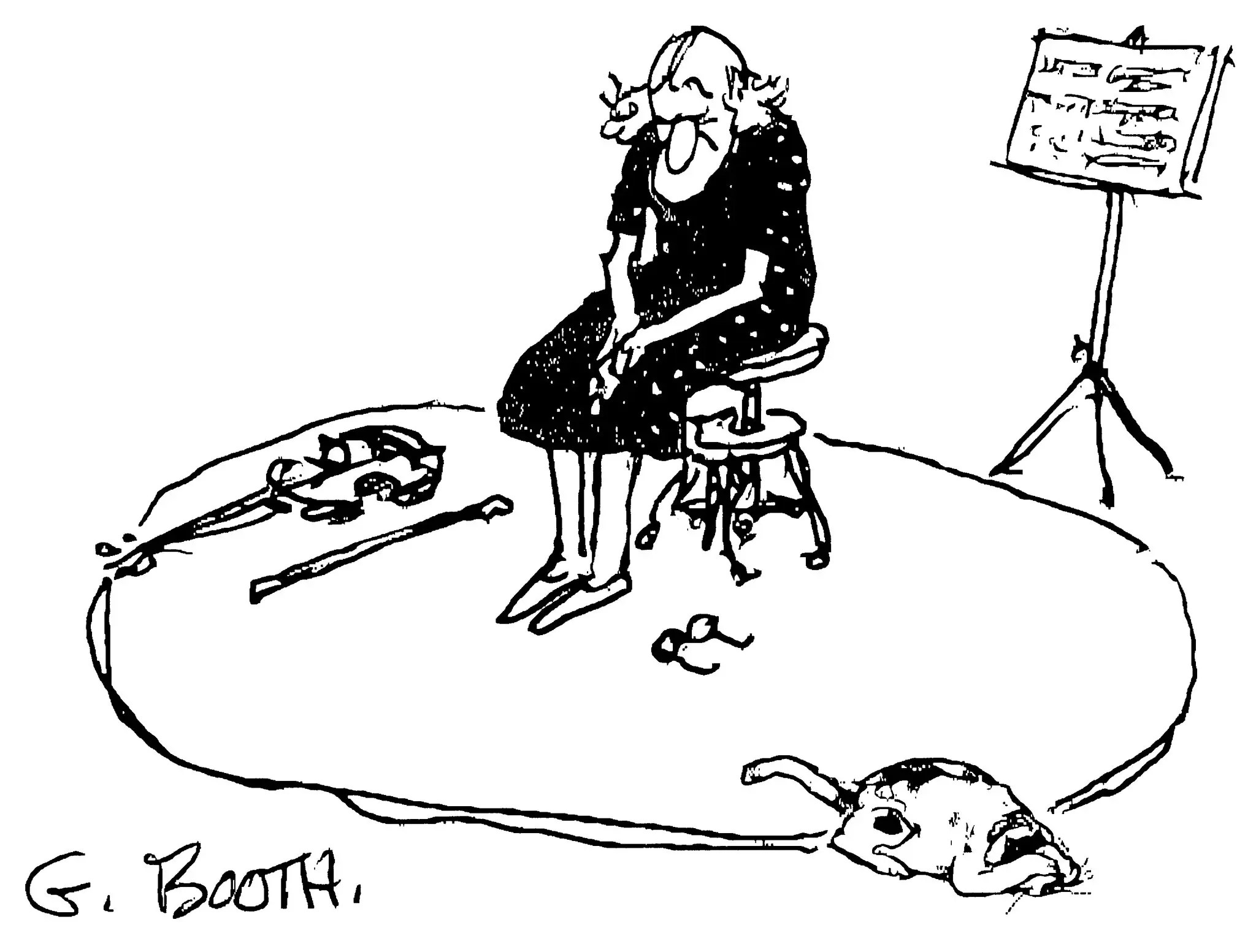
George Booth, the New Yorker cartoonist who created a world of oddballs sharing life’s chaos with a pointy-eared bull terrier that once barked a flower to death, and sometimes with a herd of cats that shredded couches and window shades between sweet naps, died on Tuesday at his home in Brooklyn. He was 96.

so begins the new york times obituary of a man who infused my childhood. no, he didn’t frequent the five-and-dime in our leafy little town. he didn’t populate the pews of our native church. he came in the mail. every week. and in the weeks when he graced the cover, or was tucked inside the confines of william shawn’s new yorker (known as “the holy grail for cartoonists”), you could count on tracking down my mother if you traced the vapors of her out-loud laughing to where you’d find her giddily all but hiding behind the glossy pages of the slick. she would laugh, back then and even now, in a way that made you think there was something almost-naughty about those pages, which of course made us, her troupe of five, scamper to its pages soon as she abandoned it on the stack of mail, where hours later our ad man of a dad (who never met a joke or pun he didn’t relish) would saunter on the scene and chuckle at whatever was the funny. 

george booth proved to us that our mother — the very one who trained us to eat our peas and lima beans without complaint, and never tell a lie, to ne’er ignore the dinner bell, and always look both ways –– had a secret compartment full of almost-naughty humor. and if we kept close watch, we too might figure out the shortcut to some eternally redemptive funny bone. 

thus, coming upon the news that mr. booth has died this week, and that his wife of 64 years had died a mere six days earlier (such tales of love and lives that end in stunning unison nearly always make me weak at the knees), i felt a thud to the heart that only certain deaths elicit. 

there is a minor cast of characters in every childhood — the names that brought applause, the ones whose books most frequently recurred, the ones whose movies brought us the rare chance to blow a bedtime  –– who indelibly marked our evolution, and maybe formed the foggy outlines of who we aimed to be when we grew up. or at least what attributes we might try on for size. 

if i close my eyes and tick through the litany of those my mother ushered in, the ones held up in near heroic halo, it’s george booth & co., the new yorker cartoony cast; peg bracken, she of the i hate to cook cookbook; it’s doris day and julia child, all of whom made my mother giggle. it must have been the giggle that so allured. it was a merriment i must have longed for, and long for still. laughter belongs to a human register all its own, audible proof of joyful stirring deep inside. w. h. auden once observed: “among those whom i like or admire, i can find no common denominator, but among those whom i love, i can: all of them make me laugh.”

thank you, mr. booth, for bringing laughter, so much muffled laughter, to the house where i grew up.

in other news, i find myself absorbing the miracle of 70-degree november days. took me a long time — too long — to learn to freeze-frame pure joy and deep-down contentment. but now the hours of my days are as if beads threaded on a string, not unlike the rosaries i long ago learned to pray: mysteries joyful, sorrowful, glorious, and luminous. not a bad paradigm for living. learn to live bead by bead, moment to holy saturated moment. allow each orb to shine in all its constitution, be it radiant or shadowed or somewhere in between. and the beauty of these days, when the leaves are blazing paint-pot hues –– aubergine and persimmon, pure gold and harvard crimson –– they tap me on the soft shell of my soul, and whisper: this is holy time. behold it well. 

george booth would make me laugh at that. but he’s no longer here. so it’s on us to find the humor hidden in the chaos of the every day. 

who comprised the minor cast of characters in your growing up years? who made your mama laugh or cry, who or what did you aspire to be when you grew up and moved away from home?

this is booth’s cartoon in the immediate wake of 9/11, when the new yorker had decided no cartoons for that issue, but george submitted this anyway; the cat covering its face with its paws, the usually animated fiddle-playing miss rittenhouse (a recurring character modeled after booth’s mother), head down, hands clasped in prayer, sadly silenced by it all.

turning the page with a tug and a pull

we are definitely turning the page here at this old shingled house. the bespectacled architecture critic no longer calls me from the office at 8 at night, saying he’ll be stuck writing for a few more hours. there are no carpools to coordinate, no getting up at 5 in the morning for soccer matches in kingdom come. i’ve gotten used to the new geographies in my head, the ones that have me simultaneously keeping track of news, weather, and covid in new york city and the middlelands of ohio, the current turfs of both of our birthlings. 

somehow, without notice, without even a sign posting the warning, we’ve moved into the loveliest calmest quietest chapter of our married life that ever there was. (do not think of even uttering a syllable of the R word, the one synonymous with hanging up one’s professional hat; one of us has no intention of putting away the keyboard and the other seems to have taken up full-time swimming, biking, and running across finish lines). underscoring the shift, this year we’ll be racking up plenty of lasts in the kid department: the last college drop off. last parents weekend. last winter and spring breaks. last graduation. last packing up the dorm room. last whopping tuition bill. 

we are, very much so, on the final verge of true empty nesting.

it’s a mix tinged with poignancy, and a good measure of disbelief. time passes so swiftly, you suddenly realize. after years and years of thinking the routines will never be broken. poof, and they’re gone! 

we’re late to this party, only because i found myself in a delivery room when others i knew were there awaiting their grandbabies, but i was there because of what felt and always will feel like i somehow squeaked through the maternity ward as the very last egg was being cleared from the deck. and, as with so much in my life, i’ve been soaking it in from every which angle, taking none of it lightly, extracting as much as i possibly could at every twist, turn, and trial along the way. 

ours, these days, is a quiet life by choice. my favorite hours are nestled in books and on my knees in the garden, over coffees with people i love, and the dinners at the end of the day when we weave together the threads we’ve both followed all through the day. i know full well that every drop of it is pure blessing, a benevolence no one deserves, for life is not doled out in rewards and punishments. we just get what we get, and it’s ours to savor or squander. i’ve had more than enough hours staring into the shadowed abyss, imagining sudden endings, to perk up my relishing gears. (the bright side of being a doomsayer is that any and every happy ending is reason for rousing hallelujah. don’t mind my scrambled up wiring. seven decades in, it works for me just as it is.) 

anyway, this weekend’s the last-ever parents weekend, that glorious mix of scintillating speakers and professorial panels, long strolls across a campus straight out of the picture books, and delivering a pile of groceries and pies and blankets and boots only a college kid’s idiosyncratic tastes would relish or request (who else would send a middle-of-the-night text asking for portwine spread cheese, rubber-soled boots, and someplace good to go out for dinner?). i plan to savor every sweet drop, knowing not long from now i’ll pine for the chance to make-believe i’m a kid savoring college. (as long as i don’t peek in the mirror, and wonder who in the world is the one with the locks now the color of silvery moon.)

i know, because life has taught me over and over, whole new adventures await, and none of this will ever get dull. but i’ve loved this part where you hover fairly closely over the shoulder of the kids you’ve brought into the world, and feel your heart grow by the week and the month and the year. i know, because life is already teaching me, each of their new adventures becomes vicariously mine, and therein lies a whole nother joy. but now, here i am at the precipice looking both ways. and mostly i’m grateful for this heart that finds it hard to let go….


because we’re motoring back and forth in three short days (the weekend cut short by a work trip to houston for the one more apt to be running or riding these days), i’m keeping this short, and will leave you instead with two little morsels: a peek inside the little book that landed on my stoop the other night, and a soup i plan to make on one of the autumnal days next week when the critic is chowing down on texas barbecue. slow cooking is in sync with my slow, savoring ways. 

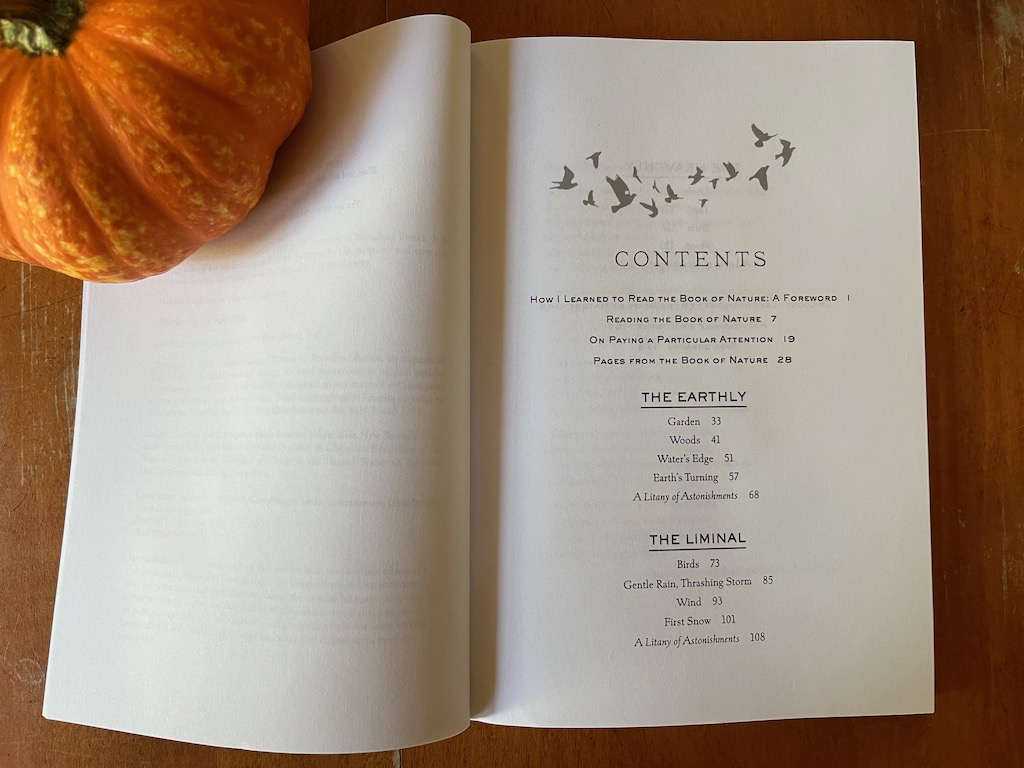
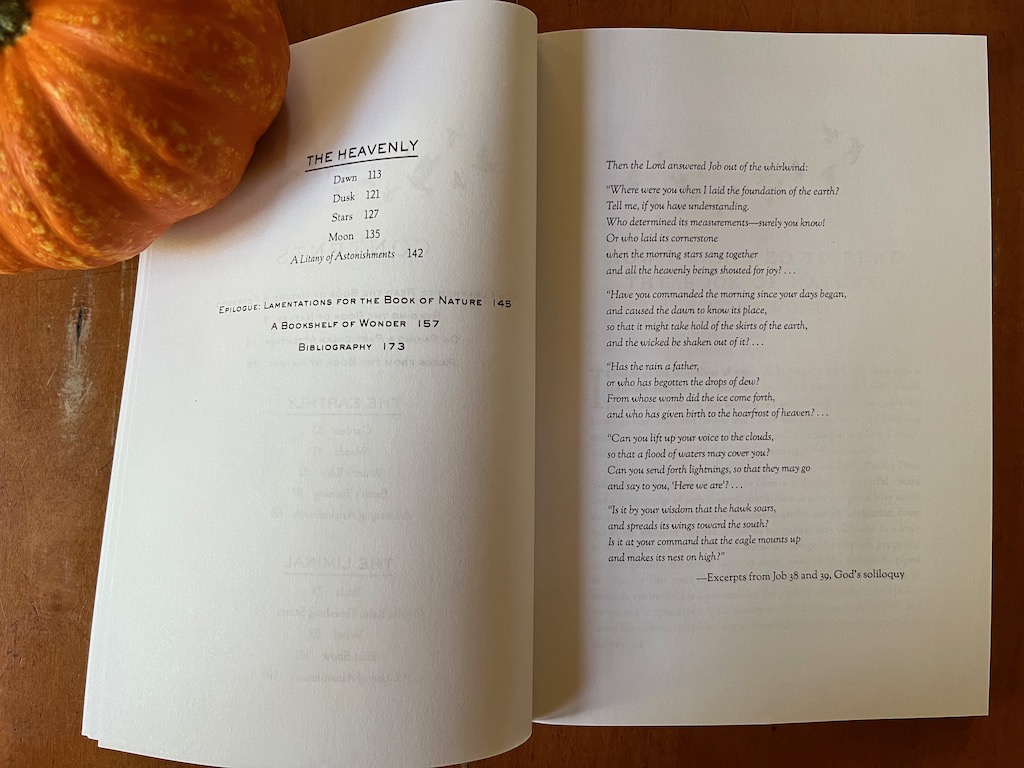
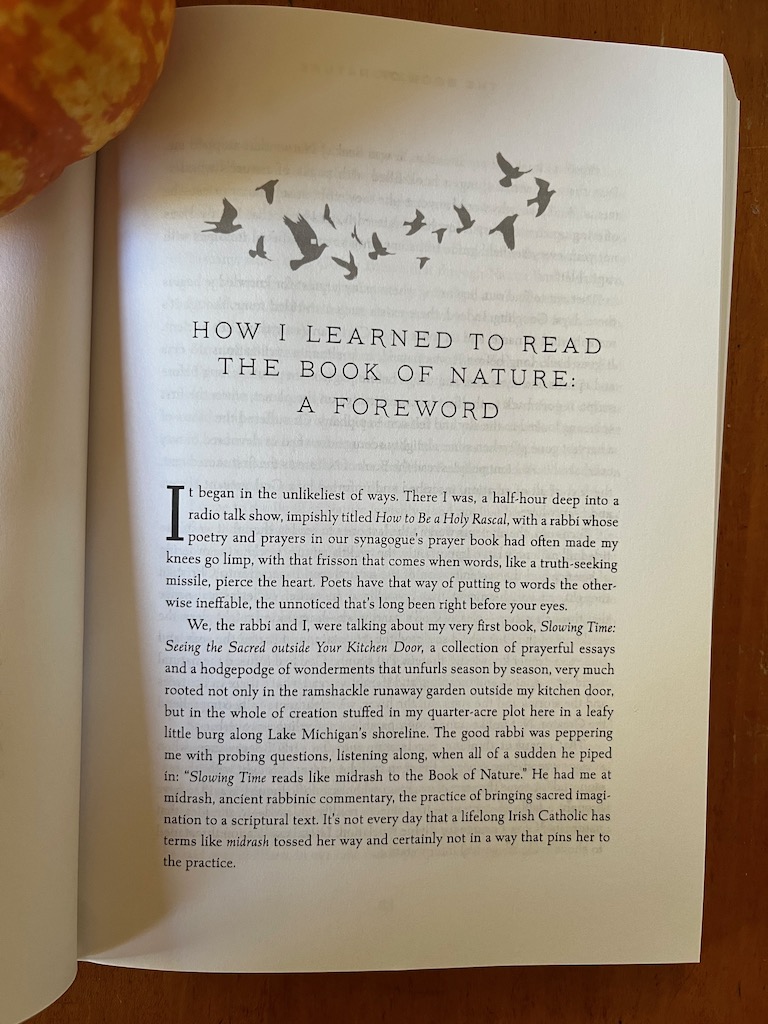
first, a peek at the Advanced Reading Copy of The Book of Nature, with a look at the cover, the table of contents, and the first page of the foreword.


photo by Bobbi Lin, NYT

Creamy Cauliflower Soup With Harissa Tomatoes
By Melissa Clark, The New York Times
Yield: 6 servings

INGREDIENTS
1 large head cauliflower (about 3 pounds), trimmed and cut into 1-inch florets (about 12 cups)
Kosher salt (such as Diamond Crystal) and freshly ground black pepper
1-1⁄4 teaspoons ground coriander
7 tablespoons extra-virgin olive oil, plus more for serving
1 small bunch thyme (about 10 sprigs)
1 pound plum tomatoes, halved, seeds scooped out
2 to 4 tablespoons harissa paste
3 large bunches scallions, whites and greens thinly sliced (about 21⁄2 cups)
1 jalapeño, seeded (if desired) and coarsely chopped
4 large garlic cloves, finely chopped
1-1⁄2 teaspoons ground cumin
1 tablespoon tomato paste
6 cups vegetable stock
3⁄4 cup chopped cilantro leaves and tender stems, plus more for optional garnish
1 lemon

PREPARATION
Step 1
Heat oven to 425 degrees and line 2 sheet pans with parchment paper.
Step 2
In a large bowl, combine cauliflower, 1 teaspoon salt, a large pinch of black pepper, 3⁄4 teaspoon ground coriander, 3 tablespoons oil and half the thyme sprigs, tossing everything until well coated. Spread the cauliflower evenly across one of the prepared pans.
Step 3
Using the same bowl (no need to wash it first), combine halved tomatoes, 1 to 2 tablespoons of harissa (depending on how spicy your harissa is; taste it first), 2 tablespoons olive oil, a large pinch of salt and the remaining thyme sprigs, and toss gently until the tomatoes are well coated. Spread tomatoes on the other baking sheet, cut-side up.
Step 4
Place both sheet pans in the oven and roast for 20 minutes, then stir the cauliflower but not the tomatoes. Continue to roast until cauliflower is golden brown and tender, 15 to 20 minutes longer (35 to 40 minutes total roasting time). Transfer cauliflower pan to a rack, and discard thyme sprigs.
Step 5
Using tongs, gently flip tomatoes over so their cut sides are down. Using the tongs, pinch off the tomato skins – they should slip right off – and discard. Brush 1 to 2 more tablespoons of harissa onto tomatoes and continue to roast until shriveled and condensed, about 15 to 25 minutes (35 to 45 minutes total roasting time).
Step 6
While tomatoes are roasting, make the soup: In a large pot, heat the remaining 2 tablespoons oil over medium. Add scallions (saving 1⁄4 cup scallions for serving) and jalapeño, and cook, stirring occasionally, until soft and lightly colored, 5 to 7 minutes. Stir in garlic and cook for 1 minute. Add another 1 1⁄2 teaspoons salt, black pepper to taste, cumin and tomato paste, and cook until tomato paste darkens and caramelizes, 2 to 3 minutes.
Step 7
Stir in roasted cauliflower and stock, and bring to a simmer. Cook, partly covered, over medium-low heat until all vegetables are very tender, 15 to 20 minutes. Turn off the heat. Using an immersion blender, purée the soup until smooth. (Alternatively, you can purée it in batches in a food processor or blender.)
Step 8
Transfer the roasted tomatoes into a mixing bowl and add cilantro. Using a Microplane or other fine grater, grate zest from about half the lemon into the bowl, then stir in 1⁄2 teaspoon coriander and reserved scallions.
Step 9
Using a fork or spoon, break up some of the tomatoes as you combine everything. Cut the lemon in half and squeeze a little into the tomatoes, then taste and add more salt and lemon juice as needed. It should taste well seasoned and a little tangy.
Step 10
To serve, squeeze in the juice from half the lemon. Taste and add salt, pepper and lemon if needed. Ladle soup into individual bowls and dollop harissa tomatoes on top; top with olive oil and more cilantro, if you like.

how do you savor the most succulent parts of your life? and do you, like me, find turning the page a bit of a tug and a pull?

the sodden state of summer’s back-to-school days . . .

it’s been getting heavier and heavier all week. my heart, that is. the boy i love—or one of ‘em anyway—is heading off again. one last time. to school, that is. we’ll be playing follow-the-leader, interstate-style, this weekend, when he pushes off with a trunk filled to the gills, and i follow not far behind with a wagon equally jammed. i’m enlisted only for my skill at hospital corners (a nurse’s way of tucking in bedsheets), and my knack for stuffing things in the teeny spaces that qualify as dorm-room closets. 

all week, amid a blur of other complications, i’ve felt my heart grow heavy with tears not yet spilled. the country roads the whole way home––just me and some fine book on tape––will make for a bucolic sponge for salt-water spillage. 

that boy is the best of company, that boy of the very big heart and the disposition best described as super chill, and ever animated. the boy fills this old house, and every heart in it.

so, once he’s left behind, back here at the homestead it’ll feel hollow once again till we get used to the long pauses of silence, till we get used to a room where the door isn’t sealed shut to hide the disarray inside. 

a wise someone once told me that if i thought high school blurred by in a blink, i’d find college blurred in half a blink. and so it is. eight years after dropping off his big brother one last time, it’s time for the caboose to part as well. this is it: the end of tuition checks and dorm vernacular, the end of considering time in back-to-school and semester allotments.

there’s perhaps a better chance that this one will find his way back home, to call sweet chicago the place where he belongs. but till then, nine months will trickle by. 

it’s the leave-taking that always bumps me up. the saying goodbye is not my strong suit. my trouble in that department dates back to when i was five and my papa got a big new job in a city far away, and every sunday night for the rest of a school year, he slid behind the wheel of his turquoise ford falcon and headed down the drive while i sat slumped on the concrete stoop there in the garage. i remember crying till my cheeks hurt. and going to bed with tummy aches. till he came home on friday nights.

nowadays i cry while spritzing the bathroom mirror, and when luring dust bunnies out from under the college kid’s bed, once he’s emptied it, once he’s faded into the faraway. then i try to find my way again, to find the joy in silence, in the slower pace with which the fridge and pantry empty, in the fewer loads of laundry. in that bathroom mirror that never splatters.

it’s come and go, all life long. and we’re wise to make the most of those blessed hyphens in between.

in the weeks ahead, i’ll be busy plotting my new cloister garden as a six-foot wall is being erected (straight through a chunk of what had been my garden, and hard up against our once-breezy screened-in summer porch) even as i type. i’m thinking of it as my monastery wall––the cedar barricade shutting out all the troubles of the world. but the thing i’ll miss most is the slant of sunlight at the twilight hour, as the great orb sinks low and the shafts of light get long and longer. it’s a golden glow that makes my summer porch seem gilded with celestial stardust. 

and because the last round of page proofs got delayed till next week, i’ll fill my quiet hours with the intense concentration those pages demand. and then it’s off to the printer as i await the day the box of books lands plop on my doorstoop. 


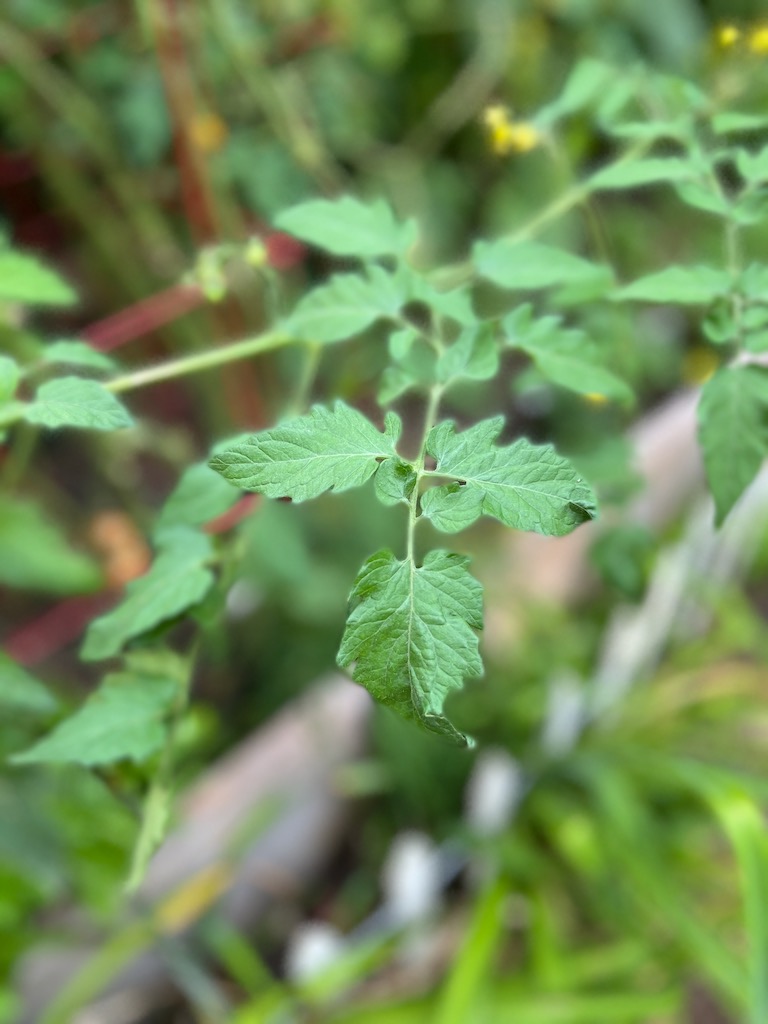
cook’s corner: here’s a truly nifty thing i bumped into this week (if meat lovers thrill to find a way to use every bit of the beast, from tongue to tail, then we who love the produce patch thrill just as mightily to find there’s more to the vine than just the fruits!). as one with a plethora of tangled vines, and one who sniffs deeply of my finger tips after plucking my daily tomato harvest, this enlightenment brings double the delight from those vines. and it’s all about the leaves…

How to Cook with Tomato Leaves

Tomato leaves contain 2-isobutlythiazole, a compound responsible for the plant’s distinctive aroma. Commercial tomato products, like ketchup, often include an isolated form of that compound to boost fresh tomato flavor.

If you have a garden full of tomatoes, though, you’ve got a great source of 2-isobutlythiazole right in your backyard. Here’s how to use tomato leaves to boost your sauce’s flavor.

1. When you harvest your tomatoes, pluck a handful of leaves from the plant.

2. Toss the leaves into the sauce and steep them for 10 minutes.

3. Remove and discard the leaves. 

Taste your sauce, and you’ll find that the tomato flavor has been both heightened and made more complex and earthy.


commonplacing:

from poet and pacifist William Stafford, found in his son Kim Stafford’s intimate portrait, Early Morning: Remembering My Father:
every day Stafford would write a page in his journal, his response to what he called “the emergency of being alive.” 

we are all of us deep in the emergency of our being alive…


a little bit of Buechner, in memory of the blessed man who died at 96 on monday. 

Frederick Buechner

a few years back, in 2016 to be precise, i counted a new collection of writings from theologian frederick buechner, with introduction by anne lamott, as one of the best books for the soul that year. his death this week made me pull that review from the shelf, and perhaps it’ll prompt you to pull a bit of buechner from your own bookshelf or that of your nearest library. 

Buechner 101: Essays and Sermons by Frederick Buechner

By Carl Frederick Buechner, Introduction by Anne Lamott, Frederick Buechner Center, 170 pages, $15.99

Maybe once a generation, once every few generations, someone is born with gifts literary and sacred, in equal brilliant measure. A translator, perhaps, of the highest calling. One who can at once lift our souls and our sights, by virtue of the rare alchemy of the poetic plus the profound. Therein lies the prophet. Therein lies Frederick Buechner, at 90, one of the greatest living American theologians and writers.

In these collected works, Buechner 101: Essays and Sermons by Frederick Buechner — a table of contents that includes excerpts from his Harvard Divinity School lectures, The Alphabet of Grace; a searing essay on his daughter’s anorexia; a seminary commencement address on the hard truths of pastoring a flock of believers, doubters and everyday sinners — we are introduced to, or immersed in, the depth and breadth of this rare thinker’s literary and soulful gifts. 

Anne Lamott, in her introduction, admits to being blown away by Buechner’s capacity “to be both plain and majestic” at once. She ranks him side-by-side C.S. Lewis, then declares, “No one has brought me closer to God than these two men.”

That alone might make you rush to pore over these pages. What I know is that this world sorely needs a prophet who reminds us to not give up our search for holiness amid the noise and hate and madness all around. Buechner, though, says it in words that work as poetry, shimmying through the cracks, burrowing deep within us, reverberating long after the page is turned. He writes: “We must learn to listen to the cock-crows and hammering and tick-tock of our lives for the holy and elusive word that is spoken to us out of their depths. It is the function of all great preaching, I think, and all great art, to sharpen our hearing precisely to that end.”

And it is that very sharpening that we find, paragraph upon paragraph, page after page, in Buechner 101


poet’s corner:

two poems worth pressing against your heart…

Field Guide

Once, in the cool blue middle of a lake,
up to my neck in that most precious element of all,

I found a pale-gray, curled-upwards pigeon feather
floating on the tension of the water

at the very instant when a dragonfly,
like a blue-green iridescent bobby pin,

hovered over it, then lit, and rested.
That’s all.

I mention this in the same way
that I fold the corner of a page

in certain library books,
so that the next reader will know

where to look for the good parts.

––Tony Hoagland

Moon

The moon is full tonight
an illustration for sheet music,
an image in Matthew Arnold
glimmering on the English Channel,
or a ghost over a smoldering battlefield
in one of the history plays.

 It’s as full as it was
in that poem by Coleridge
where he carries his year-old son
into the orchard behind the cottage
and turns the baby’s face to the sky
to see for the first time
the earth’s bright companion,
something amazing to make his crying seem small.

 And if you wanted to follow this example,
tonight would be the night
to carry some tiny creature outside
and introduce him to the moon.

And if your house has no child,
you can always gather into your arms
the sleeping infant of yourself,
as I have done tonight,
and carry him outdoors,
all limp in his tattered blanket,
making sure to steady his lolling head
with the palm of your hand.

And while the wind ruffles the pear trees
in the corner of the orchard
and dark roses wave against a stone wall,
you can turn him on your shoulder
and walk in circles on the lawn
drunk with the light.
You can lift him up into the sky,
your eyes nearly as wide as his,
as the moon climbs high into the night.

––Billy Collins


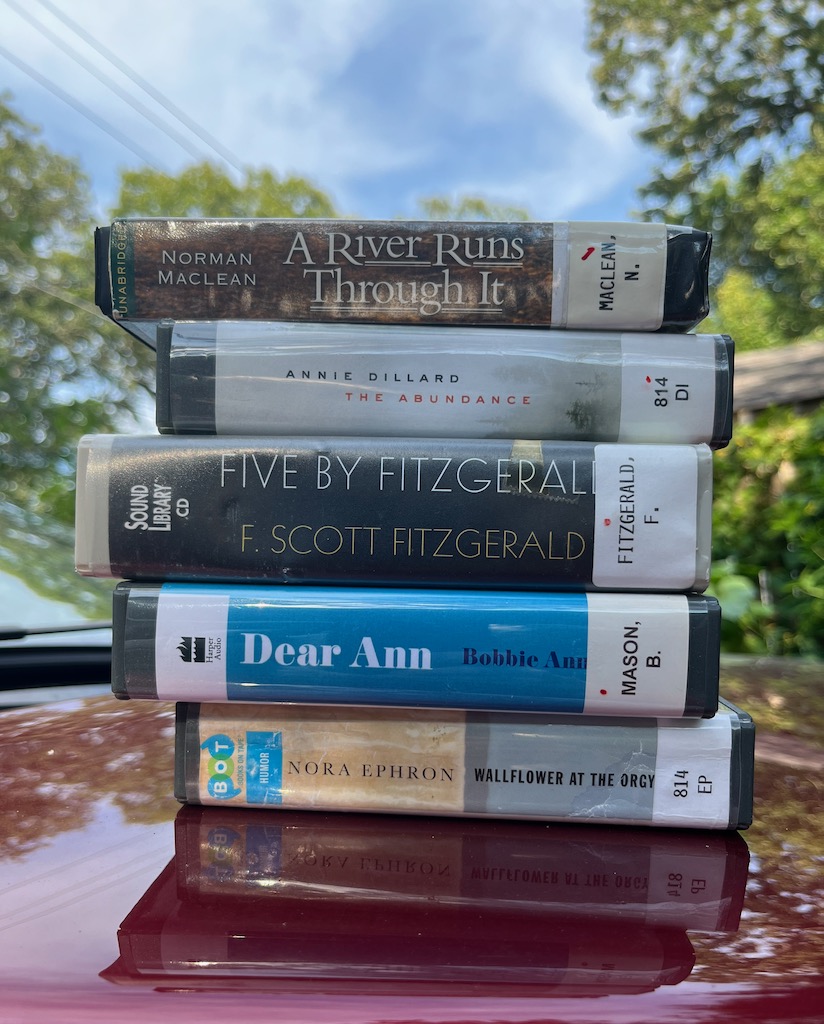
listening nook: because i’ll be coursing through the countryside in my red wagon this weekend, i’m bringing my reading nook on little discs. here’s the stack assembled from the library shelves:

A River Runs Through It, Norman Maclean: i once was graced to work alongside Norman’s son John, a fine fine bespectacled gent with a much quieter, more studious demeanor than many of the newsroom characters. his father’s masterwork  stands as one of the great “evocations of nature’s miracles…and a probing of human mysteries.”

The Abundance, Annie Dillard: a landmark collection from the writer i consider my north star.

Five by Fitzgerald, F. Scott Fitzgerald: i’m ever trying to expand and deepen my knowledge of the American canon and F. Scott deserves more of my attention. 

Dear Ann, Bobbie Ann Mason: mason, like me, is a kentucky native, so i feel it my native obligation to inhale her prose and her poetic ways of unspooling a story. i read my first bobbie ann mason so long ago, and it’s been ages since, so where better to reacquaint ourselves than the rolling countryside of the heartland we both call home?

Wallflower at the Orgy, Nora Ephron: ephron makes me laugh so hard i’d best keep an eye out for rest stops along the way. en route to one parents’ weekend, we listened to Heart Burn, her tale of woe from her years married to and divorcing from none other than journalistic legend Carl Bernstein. we loved listening so much we were sort of bummed we had to stop the car in ohio, where our kid was a freshman in college, and couldn’t roll along till, say, the atlantic seaboard, where we could have gotten a few more hours of ephron under our belts….


a bit more buechner, because there’s never enough:

“What we hunger for perhaps more than anything else 
is to be known in our full humanness, and yet that 
is often just what we also fear more than anything else. 
It is important to tell at least from time to time the secret of who we truly and fully are . . . because otherwise we run the risk of losing track of who we truly and fully are and little by little come to accept instead the highly edited version which we put forth in hope that the world will find it more acceptable than the real thing. It is important to tell our secrets too because it makes it easier . . . for other people to tell us a secret or two of their own . ”

Frederick Buechner

and with that, this week’s edition of the chair gazette is a wrap. question of the week: how will suck the succulence out of summer’s august sweetness?

college kid this week, on the brink of one last back-to-school.

empty nest

once the adrenaline died down, more fire-hydrant surge than all-out combat, once i paused my pounding on the window, realized how close i’d come to thrusting my fist right through the glass, shattering and bleeding sure to pre-empt the rescue i’d attempted, once i took a breath, my first impulse was to think maybe i’d jinxed it.

it must be my fault for letting out their secret. maybe i shouldn’t have extolled the wonders of the nest right before my eyes.

here’s what happened: mama and i were, as we’d been for weeks, co-existing peacefully, she on her side of the glass, blanketing her babies in her downy feathers, me tap-tapping away here on the word-churn machine. it was late saturday afternoon, just one short day and a half after i’d spun the tale of how mama cardinal and i were expectantly working toward our deadlines: mine, a book in the making; hers, a clutch of eggs.

she’d been on the nest 15 days and counting. i delighted at the way she punctuated our shared workspace –– seemingly out of the blue –– by belting out an abbreviated string of song, as if she’d suddenly been overcome by the jubilance of nesting. any day now, i would have heard the wee peep-peep-peeps of nestlings, seen the blur of pointy beaks thrusting skyward for an airdrop of worm.

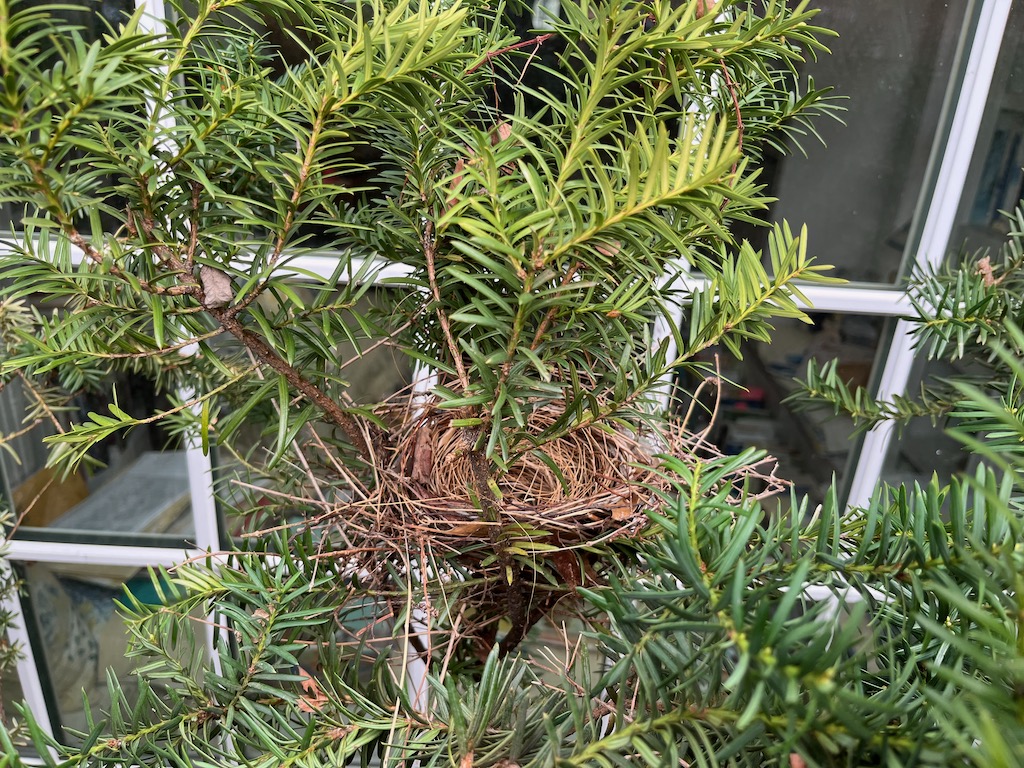
but then, at nearly six o’clock that fateful evening, without so much as a peep of warning, in those final hours of what eliot so rightly termed “the cruellest month,” there suddenly arose from the bushes such squawking as i’ve never heard. i turned and saw furiously flapping wings — mama and papa both, each on separate branches of the ordinary evergreen that for two weeks now had been the nursery for their nest, the closest i had ever come to northern cardinal observation deck, a broodling in the works. while the two of them squawked and flapped, i noticed the third player in this late-breaking drama. it was furry, brown, and little. its stripe down the back gave it away: a chipmunk. a very hungry and extremely nasty chipmunk, if you don’t mind my editorializing. i leapt into life-guard mode, pounded hard as i could pound from my side of the glass. gave a holler to my own mother, ensconced in her armchair in the other room. as if she could help me here in dire land. at first my pounding seemed to confound the furry one, he turned down the branch, as if in exit. but then, he must have had a second thought, for up he turned, and scampered head-first into the nest. oh, dear god, such horror i’ve not witnessed. this was full-tilt assault. this was nature at its cruelest. and i stood witness. after plumbing the hollow of the nest, the hungry varmint turned and ran. i couldn’t swear to what i saw, but it would not be wrong to think i saw him clutching something in his mouth.

poor mama sat there flapping. her squawks slowing but not quieting. she circled the branch a few lonely times and then resumed her post. we both tried to catch our breath. i tried to convince myself that all was not lost, perhaps the casualty count was one and only one. and, besides, mama stood her post straight through to nightfall, never once lifting her belly from what she surely must be guarding with her life. only then, when darkness eclipsed my keeping watch, did i surrender too; turned off my desk lamp, whispered benediction, and tiptoed off, unsure of what the dark would bring.

alas, when dawn came, i threw off my blankets and hurried down the stairs. no mama. i’d thought i heard a muffled squawk not too too long after dark. i now presume the furry thing returned, finished the deed. the dastardly, dastardly deed.

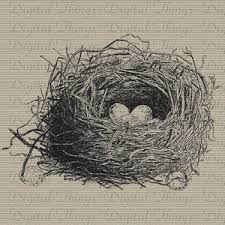
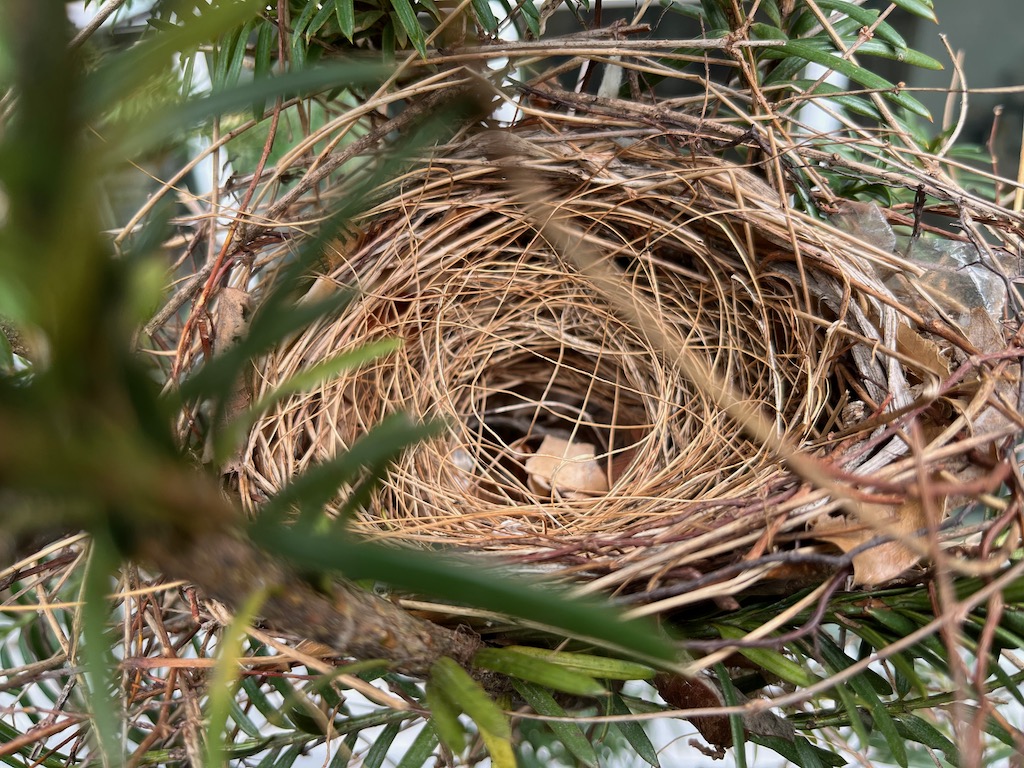
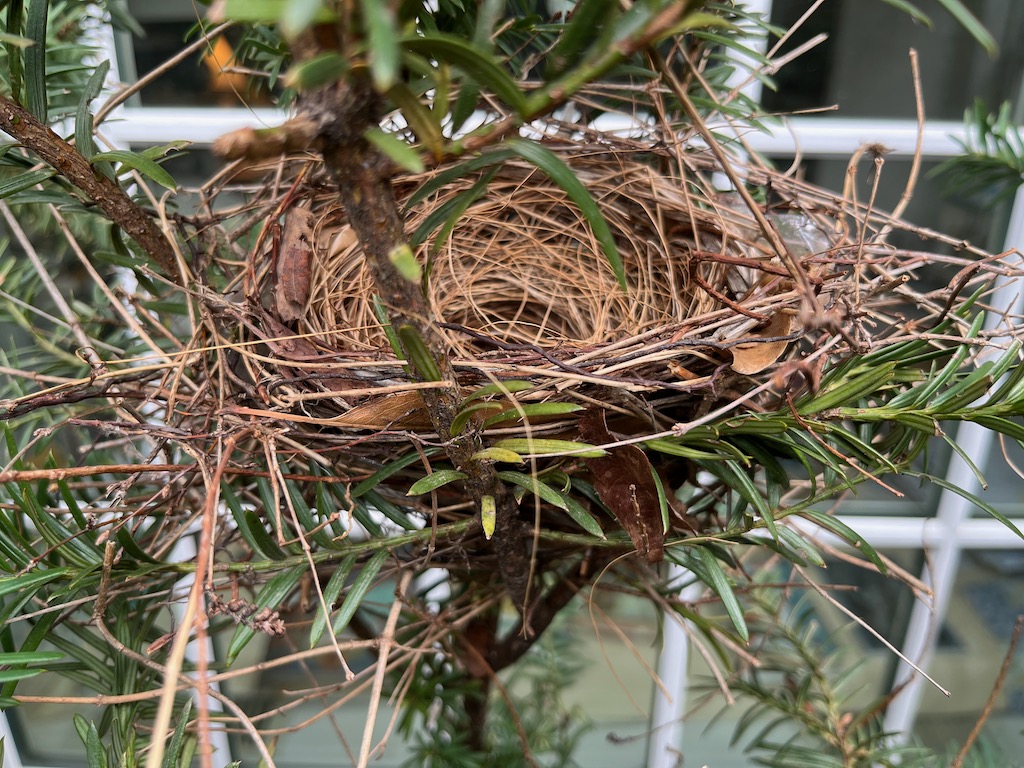
and so, the nest is empty. quite literally as i have just now hauled a step ladder out the door and, clinging for dear life, i climbed and pulled back branches, and indeed there is not a sign of life. just the artistry of their construction, right down to the shiny cellophane they might have thought to employ as something of a rain guard, what with all the rainy weeks of april.

turns out, the cardinals never had more than a one in three chance at making it out of the nest. despite their predilection for deeply tucking away their vernal constructions — remnants of a summer past, a bricolage of bits, dried grasses, thread-thin sticks, that cellophane wrapper perhaps from someone’s pack of cigarettes — the northern cardinal ranks near the sorry cellar of the nesting-survival charts, a long tumble down from the ash-throated flycatcher who scores the highest chance of flying from the nest, with seven of ten baby flycatchers flying. only the lowly house sparrow (11 percent chance) and the european starling (16 percent) fare worse than the red birds, and both sparrow and starling are invaders, anyway, non-native species snuck in as unintended cargo on some north america-bound vessel.

it hurt to sit here the first few days, the silence pounding in my ear. the absence of mama’s brown and red tail feathers protruding from the tuft of evergreen in which she so adeptly hid her nest.

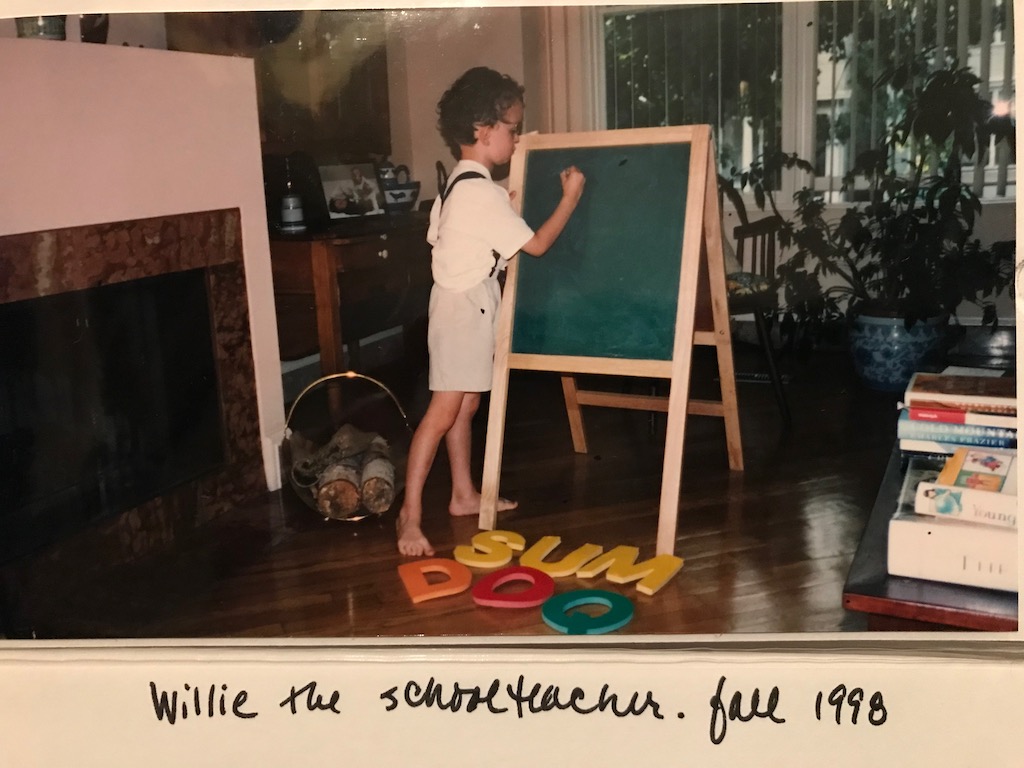
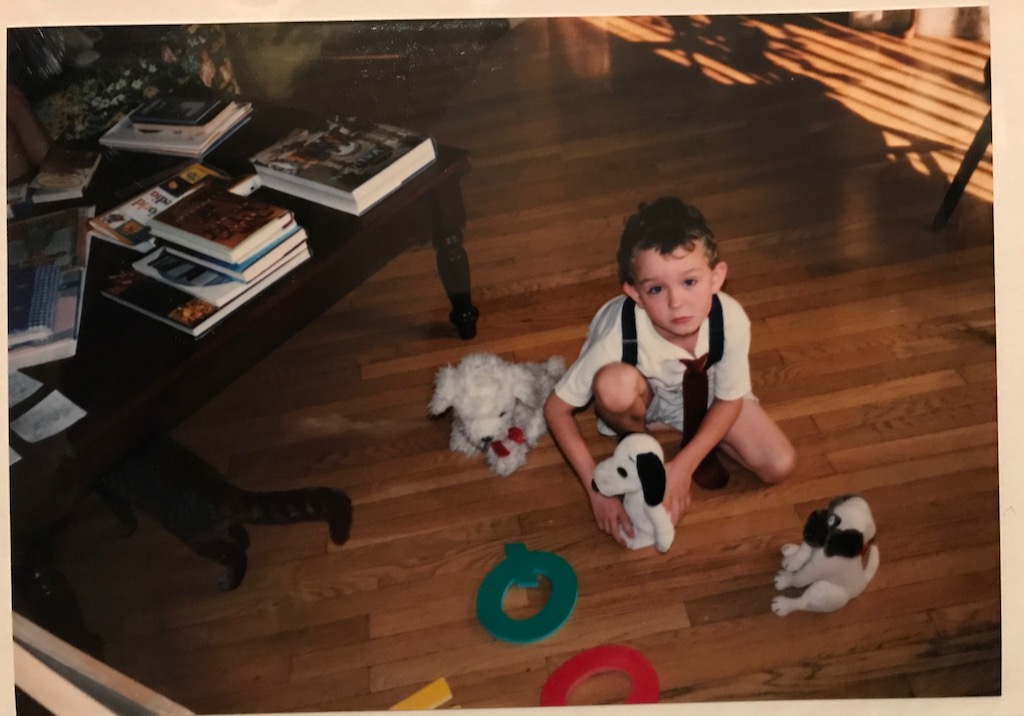
and then i started to consider my own empty nest, a consideration that comes, of course, as mothering day approaches. i think as much now about mothering as i ever have. though it consumes fewer hours of my focus, and fewer drives hither and yon, my fascination only deepens. i think often of how rare — how blessed — it is to know so fluently the whole makings of any life, let alone these two i love so dearly. day by day, it seems, the adventures pick up pace. the twists and turns in their narratives expand my own sense of being alive, being witness to lives unfurling each according to his own storyline. from my perch here at the old homestead, where i am reliably on watch and ever present, i follow two young men carving out paths that couldn’t be more different and yet entwine in ways that make me see the shared origins loud and clear and undeniably. the little boy who once could stare at a tv screen for interminably long times, he is carving out a path to be the very voices, the very storytellers, he once listened to. and the one who once set up an easel in the living room, encircled the room with every stuffed critter from his toy box, donned suspenders and necktie, scooped up a clutch of alphabet letters, and commenced a lecture on the fine points of S-U-M and Q, he looks toward a life in lecture halls filled with legal scholars in the making. let the record show it was snoopy who got first crack at his fledgling professorial skills.

my job here — simply loving through and through — will never ever be done. they might not need me (not so often anyway) to rouse them from their slumbers, to ferry them to the school house door, to shiver on their sidelines, but i’ve come to understand that my unique brand of loving means i’ll never find a way to lay aside aside my worries and my sometimes overly rambunctious fears. the phone calls these days are farther in between, the texts often unanswered, but my contemplations and my prayers deepen by the month. i’ve started worrying in a whole new way about this world we’re leaving to their keeping. i once held out hope that they could right our many, many wrongs. but now i wonder if we’re too far gone, this world so broken in so many places.

i look to mama bird, and her now hollowed nest. there is stunned silence out my window. no flicker of a sighting of mama now at it once again. she makes me think hard about the seasons of mothering, how some are full to bursting, and others pulse with a kind of aching, a sorrow for the hours out of reach, a longing for the more tactile days when every flinch and whimper was within our watch. her empty nest makes me think hard about the one i call my own, at once emptier and fuller than i can sometimes truly comprehend.

no wonder mothering never ever loosens its holy grip on me.

may your motherings be ever blessed, in whatever ways you love and hold those you count as your dearest rarest treasures.

now empty…

covidian land of counterpane: geography for the new year

counterpane noun

coun·​ter·​pane | \ ˈkau̇n-tər-ˌpān

Definition of counterpane: BEDSPREAD

Origin (from Oxford Languages): early 17th century: alteration of counterpoint, from Old French contrepointe, based on medieval Latin culcitra puncta ‘quilted mattress’ (puncta, literally meaning ‘pricked’, from the verb pungere). The change in the ending was due to association with pane in an obsolete sense ‘cloth’.

***

when i was little, i was oft confined to bed when i got sick. and, as i recall, my childhood was pocked with the sorts of sicknesses for which bedroom doors were closed and meals delivered by metal tray. a dinner bell rested on my mirror-topped vanity, and i jingled it if in need of gingerale on ice, or saltine crackers in wee stacks. clearly, my mother of five was practicing astute infection control lest she find herself in charge of quintuple cases of whatever was my ailment of the hour.

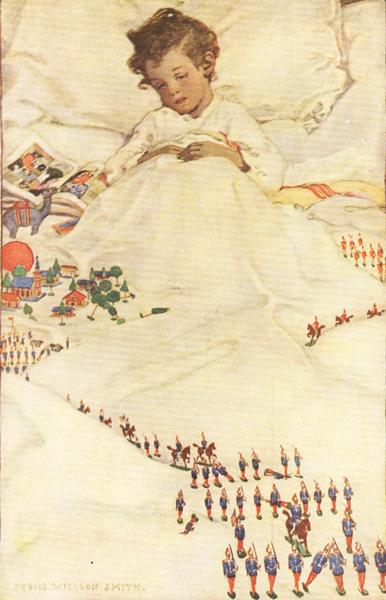
it was all quotidian enough—scarlet fever, chicken pox, mumps, measles, really nasty flu. i twice was sent to hospitals for IVs and a week of restitution, and so, given the spells in bed, i came to think the land of counterpane a most familiar terrain. (maybe, in part, it’s why i was drawn to being a pediatric nurse.) and, of course, i populated the contours of my bedclothes with a well-steeped storybook imagination––hills and vales and undulations, the nooks and crannies of my make-believe lilliputian chambermates: trolls and elves and sprites and sometimes an imaginary baby sister.

among the first poems i memorized was robert louis stevenson’s “the land of counterpane,” a verse i know by heart: 

When I was sick and lay a-bed,
I had two pillows at my head,
And all my toys beside me lay
To keep me happy all the day.

and so, this past stretch of days (now ten), once again behind closed bedroom door with trays duly delivered by the nurse in charge (now, the sweet, sweet man i married long ago), i find myself a-bed, beneath my counterpane, all my toys beside me laying. and (except for the few days when it was a bit of a challenge to catch a breath) it’s not been quite as dreadful as it might sound. 

apocalyptic broccoli, 30-year shelf life

i’ve windows on three sides with golden sunlight streaming in by day; at night, i watch the twinkling lights and street lamps that punctuate the darkness as far as i can see. and the wonders of laptops and itty-bitty phones mean you can stay in touch with even the longest lost compatriots (two friends from nursing school in fact), neighbors who’ve checked in every day, my faraway best friend who has been as close as close could be, and my distant cousin whom i adore who thought to overnight me a barrel of freeze-dried apocalyptic broccoli. and, best of all, i’ve got my covid buddy––my firstborn, the one who fell first––directly across the hall. he escaped solitary confinement at midnight last night, as we’re abiding by the 10-day rule unless a negative antigen test allows early egress (which, in his case, he never got). so he and i have had long hours of crossword puzzles and conversation that might not have unfolded had we both been skittering hither and yon. it’s the younger one i miss the most, as he’s taken to steering as clear as possible of me and my omicron. (the kid’s no dummy.) 

strange to think, a week ago i didn’t yet know what it was that had buckled me at the knees, and it would not be till christmas afternoon that the test result came back in red ink with exclamation mark, dare i miss the point. 

the lesson of this covid tale would be as one wise doctor told me just the other day: assume you’ve got it––and stay in isolation––till proven otherwise. testing is just a mess, and misses far too many positivities till all the contagions are scattered in your wake. i fear for what’s coming in a country shut down by this latest red-ringed mutation. but i enter it now armed with mighty antibodies (or so i hope and pray). and a determined willingness to do all i can to help the next one fallen to make it through with TLC, and all the isolation tips i’ve learned along the way.**

sticking to the rules, i’ll not be sprung from my confinement till the midnight bell tolls tonight, and the year turns as well, allowing me to begin afresh the year of our Lord MMXXII. 

my new year prayer is even more distilled than my christmas prayer a week ago:

dear God, let all of us have someone dear to check in on us, to bring us cups of tea, to care for us in tender ways (and even on the days when we’re not anchored in our lands of counterpane). keep us safe, dear God, and mindful of all that matters most: let us put down the weapons of words, of grudges, of cold hard shoulders. let us snap into focus to see that the path is short, is sometimes rough, and that the best way home is side by side, entwining elbows, and leaning toward the light. let us lock out the rampant toxicities (and i don’t mean the biologically viral ones), bar the doors to discourse that divides us, and strain to find our common common threads. we’re woven of the sacred, after all. it’s buried there, beneath the noise, the bombast, the sure evidence otherwise. the unfettered truth––most clearly realized on long nights when breath comes hard and fevers swirl––is this: life is swift. we’ve no escape from certain end, so let us make each day a living prayer in which we seek and find certain trace of all that’s heaven-sent, and all that hails from You, the One who fuels the light, who preaches love beyond measure and without end, and who gives us our each and every breath—even when it’s labored. blessed be that holy, holy breath, amen.

most of all, i hope and pray you’re well. and staying safe from this nasty bug that’s toppling us like tin soldiers.

what’s your prayer to usher in the new year?

** see isolation tips in comment down below!!!