pull up a chair

where wisdom gathers, poetry unfolds and divine light is sparked…

Category: brothers

oh, the places we’ve come . . .
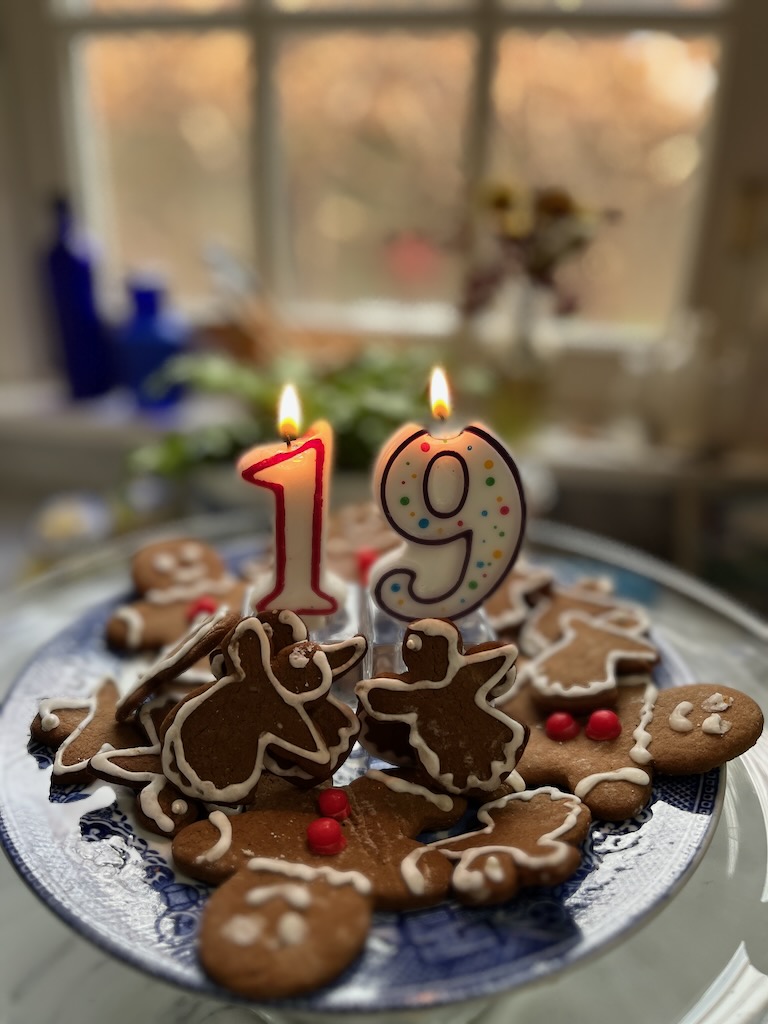
winter, i’ve always sensed, is the curling-in time, the season of unseen stirring, and in an octave of dawns, dusks, and nightfalls, winter will be upon us. 

but even now, it’s a season for quieting, for simmering thoughts as well as saucepots of cinnamon stick, star anise, and clove. my simmering for the last nineteen years picks up the pace as the page turns on another year of pulling up chairs to this imaginary old maple table, one where the indentations of long-ago math homework are pressed into the grain, where so many coffees and juices have been poured and sipped and spilled and sopped up with sponges. over the course of these nearly two decades, it seems i’ve developed a knack for simmering while tapping away at the rows of alphabet keys—some 1,255 simmers and counting, all under the name “pull up a chair,” now tapped, posted, and filed away.

only a handful of the very first chairs—bless them, those stalwart humans—still pull up a chair, at least every once in a while. but along the way, so many chairs have been added, and multiplied. and our polestar has never shifted: to carve out a sacred space where questions are asked, and stories are told, where hearts are bared, and above all where gentle, gentle kindness is the metronome by which we set all our rhythms. once in a while, over all the bumps and bruises encountered along the way, we’ve been known to bow our heads and pour out our hearts in holy, holy please God, pray for us.

on the twelfth of december, 2006, our firstborn had just been bar mitzvahed, and our then so-called “little one” was but a kindergartener, not yet reading or writing but melting my heart by the minute and filling our notebooks with his stories and antics and an encyclopedia of unforgettable “teddyisms.” (some kept alive to this day; for the sheer pure joy of it). the firstborn, now law professor, insisted at the dawn of the self-published blogging age that i, his little old mother, could figure out how to “blog,” a verb that’s always sounded to me like a crude guttural effusion, a burp perhaps. and back in the day, he gave me his hand-me-down laptop to do it. to prove i could blog, that is. (as has so often been the case, he even then was wiser than me…)

back then, the question that had captured my attention was the simplest of notions: i believed, after a few years of keenly observing, tagging along with, and writing long newspaper stories of families in the thick of life transitions as a reporter for the chicago tribune, that life’s biggest questions aren’t reserved for colloquia and global summits, nor do they wait for podiums and percussive applause. they are the stuff of the everyday. and if we watch closely, pay keen attention, we can lift those universal, deeply-human questions and struggles from the quotidian stream, hold them to the light for closer consideration, and reap their wisdoms and epiphanies in real time. now, before the moments pass us by and we come to the saddest realization of all: that it’s too late, and our chance at most wakeful living has slipped into the distance. 

all these years later, life certainly has galloped along here at the table. this ol’ chair has seen the growings up of two boys, buried parents beloved, moved another from her home of sixty years. taken a tour of cambridge, mass., and a second helping of college. trekked across the pond, set our sights on war zones, and been rolled into surgical suites and recovery rooms. we’ve feared for our country, for humanity, for civility, and plain old decency. and we’ve refused to surrender to the crude and cruel ways wielded by those who seize power. we’ve kept our minds opened, and tried—oh, we’ve tried—to emphasize the imperative of objective, double-sourced truth, and the slaying of hearsay and heresy. we’ve laid out worries here, and plenty of joys; we’ve marveled and wondered and been gobsmacked aplenty. i’ve pondered cancer and the physics of time, and the holy shimmering presence i know as God. 

lately i seem to have taken to gathering up wisdoms far greater than mine will ever be. i am, as a beloved friend of the chair once put it, something of a magpie. a magpie mostly attuned to seeking the sacred amid the plainstuff of living. the idea of the commonplace book is one i heartily embrace: bring on the poets and sages and prophets, and let me invite you into their brilliant notebooks and minds and unfurl for you their passages and poetics that take away our collective breath and find a way of percolating for hours to come. 

this ol’ chair has given me a place to keep on tapping away at the keys. i realized long ago that i untangle the knots of my life by stringing out sentences. and trying on thoughts. thank you for indulging me, those of you who choose to read along. thank you for pondering the questions at the end of each post, in the quiet of your own soul, or by leaving a note at the table. 

you are, collectively and individually, humans who restore and buck up my faith in the inherent majesty and wonder of the shimmering undying spirit that populates this earth with more than a modicum of heaven’s best offerings.

bless you, bless you, a thousand times thousand, bless you.
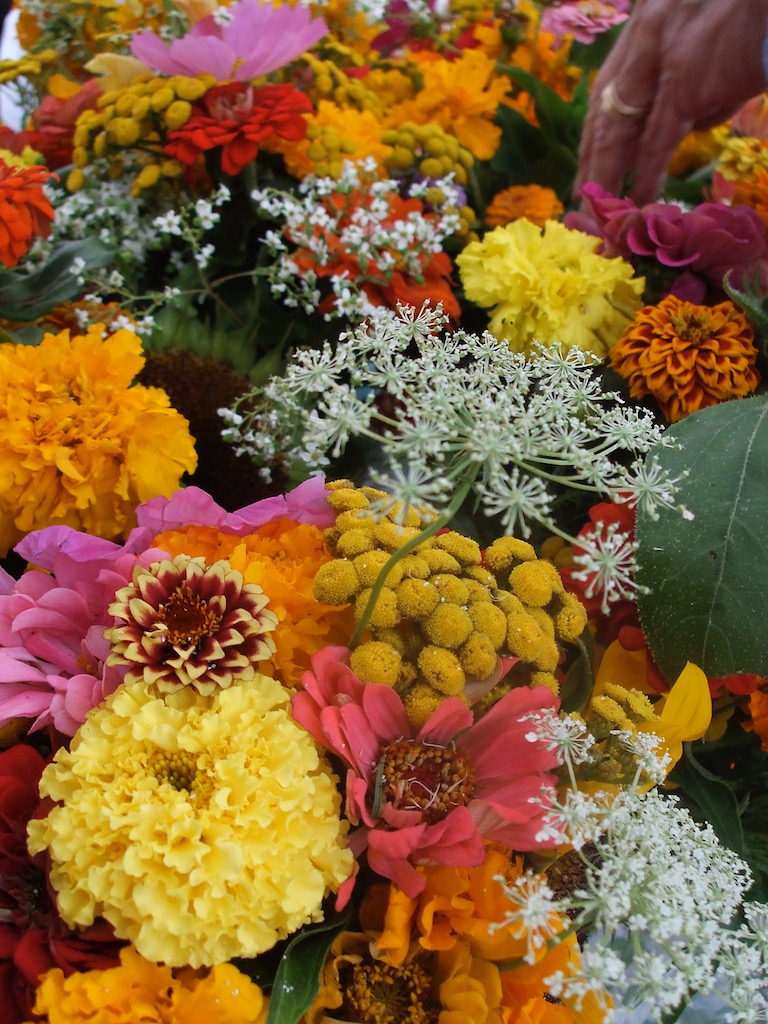
this week i am bringing a little birthday bouquet of beauties that struck me across the week, all of them tied together by the beautiful idea that the birthing of holiness is a sacramental act of which we must partake. it’s one that entails unlocking our hearts, making room in the manger within, and allowing the Holy and Sacred to form within, and to birth it with our words and our love in the act. it’s quite the trinity here: a benedictine monk who practices and teaches meditation in the french countryside at a monastery known as bonnevaux; st. john of the cross, the great mystic, as translated by the poet daniel ladinsky; and the late, great luci shaw, a beloved british-american poet and essayist who died at 96 on december first. 


first up, the idea of birthing God within us from the benedictine monk, laurence freeman, whom i’ve been learning from for years…

In the 14th century, Meister Eckhart enjoyed waking people up in his sermons by expounding some uncomfortably new perspectives about their standardised faith. He must have stirred a few dozy parishioners when he asked: “What good is it to me if this eternal birth of the divine Son takes place unceasingly, but does not take place within myself? And, that it should take place within myself, is really what matters.” 

Actually, the great Augustine had asked the same question a thousand years before and added that if we are the children of God, we must become God’s mother as well. If, he said, this birth of the eternal word as Christ in the soul is to happen, our heart – the deepest centre of our being – must become the sacred manger. If we are filled with egocentric distraction there is ‘no room at the inn’ and so the heart must become that empty and open space where the birth takes place and through which he  is welcomed into our world.

In today’s gospel, John the Baptist is usually and badly translated as saying ‘repent, for the reign of God is close at hand’. Basileia, the Greek word we think of as ‘kingdom’, is feminine and so could equally well translate it as ‘queendom’. It doesn’t mean a juridical area but the space in which the presence and grace of God is acknowledged and welcomed. The gospel word, badly translated as ‘repent’, is ‘metanoia’: a change of mind and heart. It is not about feeling sorry for past mistakes. It means spinning round 180 degrees and entirely changing your perspective on and approach to reality.

Living in the desert, wearing a garment of camel hair and eating locusts and wild honey, John seems to us a bit extremist. People who reduce waste and get back to essentials are often called crazy. But because of his spiritual sanity he drew the crowds who asked him ‘what shall we do?’ because, like us, they lived in confused, divided and dangerous times. He told them simply to live honestly and justly but that this lifestyle would prepare them for the imminent – and immanent – coming of the great transformer of all things. 

Meditation is the great simplifier. It reduces the way we waste both time and life’s opportunities. In daily life it is the catalyst for ongoing metanoia. The medicine that loosens the grip of illusion. Usually, we start enthusiastically but before we get to the full 180 degrees we slow down and say, ‘this is quite good, let’s stop here’. Fortunately, if the birth process has already started, it will not allow us to arrest or deny it. We have to see it through until it breaks through into our world and we are happy and lucky if we do.

—Laurence Freeman


and from the sixteenth-century mystic St. John of the Cross there comes this interpretation/translation of what daniel ladinsky calls one of his “love poems”…

IF YOU WANT

If
you want
the Virgin will come walking down the road
pregnant with the holy,
and say,
“I need shelter for the night, please take me inside your heart,
my time is so close.”

Then, under the roof of your soul, you will witness the sublime
intimacy, the divine, the Christ
taking birth
forever,

as she grasps your hand for help, for each of us
is the midwife of God, each of us.

Yet there, under the dome of your being does creation
come into existence eternally, through your womb, dear pilgrim–
the sacred womb in your soul,

as God grasps our arms for help; for each of us is
His beloved servant
never far.

If you want, the Virgin will come walking
down the street pregnant
with Light and sing …

—St. John of the Cross, “If You Want” in Daniel Ladinsky, Love Poems from God: Twelve Sacred Voices from the East and West (New York: Penguin Group, 2002), 306-307.


and, in closing, here’s a classic from blessed, blessed luci, whose great contribution to the canon of Christian poetry would be her capacity for drawing big truths about God and human experience from viscerally pulsing fine-grained images and objects. she is the perfect voice to close out this nineteenth year of the chair….

Kenosis
By Luci Shaw

In sleep his infant mouth works in and out.
He is so new, his silk skin has not yet
been roughed by plane and wooden beam
nor, so far, has he had to deal with human doubt.
He is in a dream of nipple found,
of blue-white milk, of curving skin
and, pulsing in his ear, the inner throb
of a warm heart’s repeated sound.
His only memories float from fluid space.
So new he has not pounded nails, hung a door,
broken bread, felt rebuff, bent to the lash,
wept for the sad heart of the human race.

amen.

may this blessed week bring softening to the walls of your heart, and a widening within those chambers so that Holiness, however you name it, might be birthed there….love, b.
countdown. . .

i clambered up from the basement yesterday morn, and found myself face-to-face with a whiteout. snow falling in thickets. snow whirling wildly. snow, snow, and more snow for hours and hours and hours. 

it was all the currier & ives i needed to supercharge my countdown clock. the one that’s percolating at quicker and quicker clip as the days turn closer to wednesday a week, the eve of thanksgiving itself, when not just one but both of the boys i so love will––for the first time in almost a year––unfurl their dreams on the pillows of their long-ago boyhood beds, all nestled cozily under this mostly dependable, nearly centenarian roof. 

and i will savor the joy of kissing both on the forehead as i trundle off to bed hours before my wide-eyed night owls, or should we all stay up till the same insensible hour i will give it my best waltons’ bedtime holler, and call out from under my bedsheets and across the hall and down a few stairs, “good night, will. good night, Bear. good night, old house. sweet dreams, my beautiful boys.”

it’s been a long hard autumn, held in the vise of worries and fear the likes of which i’d not recommend. and so this coming thanksgiving is the emotional equivalent of frank lloyd wright’s trademark compress-and-release, in which the great architect intentionally magnified the vast spaciousness of a room by first pressing in the walls and the ceiling of the space leading into the room, so that upon stepping through the tight corridor and into the vaulted chamber the sense of openness would be perceived as vaster than ever. 

and so it is with the human dynamic of fear, grace, and gratitude: to walk through unbearable days, days that stretch into weeks, and weeks that stretch into more than a month, and then to find yourself falling into the arms of the human beings you most long to hold onto; it’s the pinnacle of paradise on earth, to be released from the vise and enwrapped in a love without end. 

cancer sharpens that point. cancer sometimes brings on seasons of uncertainty that are quickly populated with ghosts and demons that defy containment. i’m learning the undulations of cancer that are colored in shades of gray. interminable shades of gray. questions that come without answers. doctors who call with unwelcome news. and barely stay on the line long enough to answer a single question. and then you hang up and feel the floor drop out from under you. sometimes––if you’re me––you take the short road to doom. because that’s what worriers do. we worry. we pray for holy release.

in time, we get a grip. regain our bearings. hold our chin high, dry our tears, practice at being brave. whistle into the in-blowing winds. hold tight to the hands of the one or two who know how dark it’s become, and we fall to our knees, or fold to the ground and enter the depths of divine meditation. i’ve spent more hours with eyes closed, palms open, sitting in silence, beckoning the perpetual God-flame within, than ever before. i’ve been tempted to beg, “more time, please.” but i don’t any longer believe i can––or hold any special claim to––change God’s equation, so what i pray for is grace. is heightened attention. what i pray for is an emphatic aliveness that infuses each turn of the day with unbarred acceptance. i don’t want to blink and miss something holy.

those prayers––for grace, for keen attention, for seeing deeper than ever day in and day out, for pausing to savor––are answered, blessedly. and my own season of unending thanks coincides with that of this nation founded on pillars of moral perpetude, and the hope of equal justice for all.

the essence of my life’s gratitude has always been the improbable miracle that i became a mother. that i birthed not one but two glorious humans, and devoted the best of my heart, my soul, my breath, my being, to carving out for them a space in which they’d be cocooned in the purest love i could imagine, could muster. along the way, i’ve tossed every life line i could whenever they needed, and now, lo and behold, they’re the lifelines and i’m the one needing.

and so all these past 45 days, i have longed for only one thing: hours more to sit side-by-side the ones i so fervently sumptuously love. to giggle at their antics. to marvel at their wild-eyed wonder tales. to feel their hands squeeze mine, to be wrapped in their arms, my ear pressed to their chest, absorbing the heartbeat i’ve loved since the very first ultrasound when that echoing lub-dub-dub poured over and through me like the holiest chrism. 

this is a countdown like never before. and my heart is more than open for business. the business of loving my boys. in real time. under one shared and sheltering roof.

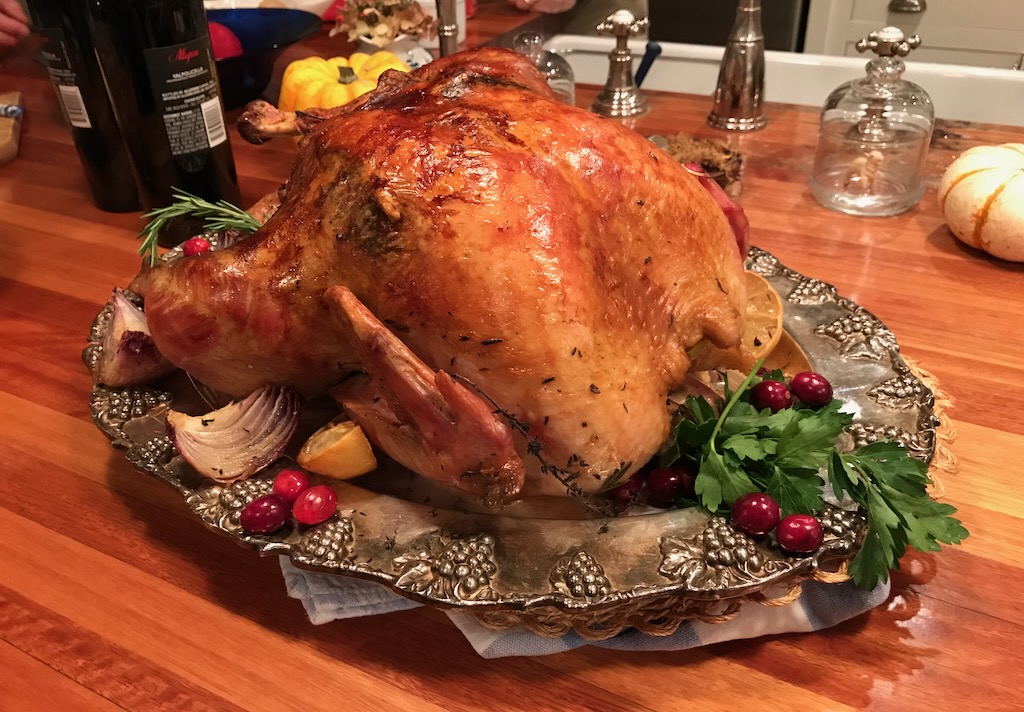
thanksgiving morn, a few years ago.

here’s a poem, fittingly, a prayer poem by the great madeleine l’engle, who lived by words but found herself wordless in prayer. which, indeed, is sometimes the way to our deepest depths…

Word

I, who live by words, am wordless when
I try my words in prayer. All language turns
To silence. Prayer will take my words and then
Reveal their emptiness. The stilled voice learns
To hold its peace, to listen with the heart
To silence that is joy, is adoration.
The self is shattered, all words torn apart
In this strange patterned time of contemplation
That, in time, breaks time, breaks word, breaks me,
And then, in silence, leaves me healed and mended.
I leave, returned to language, for I see
Through words, even when all words are ended.
I, who live by words, am wordless when
I turn me to the Word to pray. Amen.

––Madeleine L’Engle


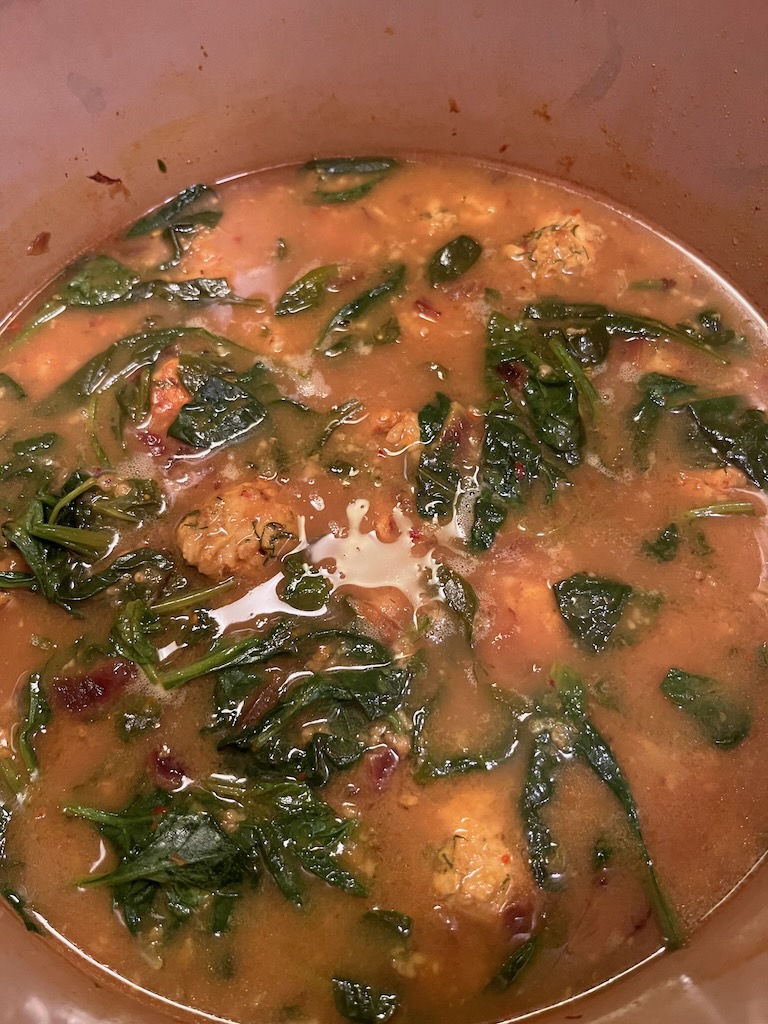
and here, because i love to imagine ladling steaming bowls of soup to people i love, is my new favorite stoup recipe, lemony chicken-feta meatball with spinach from my friends at NYT Cooking (you will be licking the bowl; it’s that good):

Lemony Chicken-Feta Meatball Soup With Spinach
By Yasmin Fahr
Yield: 4 servings
Total Time: 30 minutes

Note from NYT: Some might be suspicious of the rolled oats called for in this recipe, but used in place of breadcrumbs, they help create a light and tender chicken meatball. A half-cup more is simmered in the broth, which thickens it and provides a pleasant texture. The meatballs, made with ground chicken, feta and fresh dill, swim in a lemony, spinach-filled broth that’s comforting and light, perfect for lunch or dinner. Serve any leftovers with a fresh squeeze of lemon juice to brighten the soup.

INGREDIENTS
1 pound ground chicken or turkey, preferably dark meat (i use white meat)
½ cup crumbled feta
¾ cup old-fashioned rolled oats
1 small red onion, halved (½ diced, and ½ grated, then squeezed with a paper towel to remove excess liquid)
⅓ packed cup fresh dill leaves and fine stems, finely chopped
1 tablespoon ground cumin
½ teaspoon plus 1 tablespoon ground turmeric
Kosher salt and black pepper
3 tablespoons olive oil
½ teaspoon red-pepper flakes, plus more for serving
4 cups low-sodium chicken broth
4 packed cups baby spinach (about 5 ounces)
2 lemons (1 juiced and 1 cut into wedges for serving)

PREPARATION
Step 1
In a medium bowl, add the chicken, feta, ¼ cup oats, the grated onion, most of the dill (reserve about 2 tablespoons for garnish), the cumin, ½ teaspoon turmeric and 1 teaspoon salt. Gently combine without squeezing too hard or overworking the meat. Lightly wet your palms and shape the meat into small balls, a little smaller than the size of a golf ball, about 1½ inches. (You will have approximately 25 balls.)

Step 2
Heat the oil in a large Dutch oven or wide pot over medium until shimmering. Add the diced onion, season with salt, and cook until it begins to soften, about 2 minutes, stirring occasionally. Add the remaining 1 tablespoon turmeric and the red-pepper flakes, and stir until fragrant, about 30 seconds. Push the onions to the sides as best you can, then add the meatballs. (They will be close together, and that’s OK.) Cook until browned on two sides, 5 to 7 minutes total.

Step 3
Pour in the broth and remaining ½ cup oats, then gently tilt the pot to the right and left to distribute the oats and broth without disturbing the meatballs. Bring to a gentle boil, then immediately reduce the heat to maintain an active simmer. Season with salt. Cook, gently stirring occasionally to make sure nothing is sticking to the bottom, until the oats have softened and the meatballs are cooked through, about 4 minutes more.

Step 4
Stir in the spinach and lemon juice until the spinach is wilted, about 2 minutes more. Adjust the seasoning to taste. Spoon into bowls, top with pepper and the remaining dill. Serve with lemon wedges.

what is your heart longing for this season of through-and-through thanks?

a narrative twist and the wisdoms that come in its wake

when last we pulled up a chair, we were a gladsome foursome giddily gadding about the eternal city. unbeknownst to us, a fifth was among us. a red-ringed hanger-on who might have climbed aboard on the plane that flew through the night. or perhaps in the crowds in one art-ringed room or another.

but by nightfall one friday ago, a mere four days into our roman romp, one among us was lying flat on his back when he plaintively asked, “could you feel my head?” and suddenly the tiniest of sniffles i’d been hearing for the past two days, and the uncharacteristic naps that were beckoned mid-morning and again mid-afternoon snapped into sense, and a not-so-subtle hypothesis bolted into my brain: “this couldn’t be covid, could it?!?”

and with that, lickety split, i leapt out the door and wiggled my way through ancient streets and crowds thick with myriad tongues. i found myself a farmacia and in the clearest italian i knew, asked, “covid test?” the farmacista knew too. it seems the red-ringed word is universally understood. she handed me the prova covid, i handed her euros, and off i flew.

didn’t take more than a minute for that dreaded double line to flash into sight. bright purple it was, as my pictures of rome in quartet whirled down the drain. we had among us a covid-plagued fellow, the very one who had spent weeks and weeks planning and plotting. signing us up for this tour and that. and now, the poor chap was confined to a room at the back of the Airbnb, and i was moved to the couch.

i felt my heart crack.

i pictured a big pink eraser descend from above, dashing our roman holiday and turning our fine little appartamento into a quarantined clinica covid. i feared, right away, that the dastardly viral intruder would tear us asunder. that i, too, would be felled. and then boy 1 and boy 2.

i reached for my phone and dashed off a text to my beloved american doctor. as the sun set in rome, it was just reaching its midday peak in the states, so, lo and behold, she swiftly wrote back. told us they’re basically treating covid as a head cold these days, and that 24 hours after the fever broke or symptoms abated, our chief travel guide would enter the five-day mask-and-distance phase. and the rest of us should hope for the best.

without delay, the ailing one and i both reached for our phones to alert the dear friends with whom we’d shared the previous evening of rooftop aperitifs and a long and lovely roman dinner. and, belly flip-flopping all the while, i texted the sorry update to our boys, who’d gone out with a professorly friend for pastas and spritzes and whatever else might unfold on a friday night in glorious rome when you’re young and with nary a care.

i couldn’t sleep. so i lay there on my couch till the wee hours, listening for the boys’ signature voices and the clomp of their feet on the stone-cobbled street down below. when in they wandered, i confirmed that they’d seen the bum news spelled out on their phones. and we figured the weekend engagements — a guided tour of the colosseum and forum, as well as a lazy sunday lunch on our friends’ rooftop terrace (which had been the imagined highlight of the trip to little old me) — had gone up in vatican smoke.

but here’s where the story once again takes a turn, rises into the allegorical, and makes of one player a hero: assuming the boys would never in a million years awake for an early-morning architectural tour of ancient roman ruins, i’d already scratched the colosseum and forum off the list. so wasn’t i proven to be the fool when, with an hour to spare before the already-paid-for tour, the bedroom door cracked open and out strolled a towel-clad gent on his way to the shower. as he sauntered sleepily past me, he uttered only three words that soon set the tone for the day and all those that followed: “when in rome. . .”

and so we were off. if he, a boy who’d slept a mere few hours, could pull himself off the pillow to make good on his papa’s pre-ordained plot for the day, certainly boy No. 1 could follow, and i — who had originally declined a tour of what i referred to as “the ancient blood bath” and imagined instead a leisurely morning alone — could step into gear. turned out we missed the guided part of the tour, but we managed to get into the old ruin and carried on the self-guided way. all that walking and gawking made us hungry, so kid No. 2 called time-out and guided us through the meandering streets to an osteria that he’d been told had the very best food in all of roma (and it certainly did)*. and then, bellies full and sunscreen slathered, we climbed to the tippy top of the palatine gardens, and all of rome lay majestically, magnificently sprawled out before us.

the boy’s simple instructive “when in rome. . .” is the essence of carpe diem, the code by which he not only lives but inspires. he’s a mere 22, a kid born just before 9/11, a kid whose years have been punctuated by the horrors of parkland and sandy hook, a kid who cowered inside our cambridge apartment the terrible week of the boston marathon bombing when we could watch the police helicopters whirring in the sky just out our windows, a kid who went to college during covid and got sent home for half a semester to watch pre-recorded lectures on the laptop perched on the covers of his boyhood bed.

he’s emerged with an unshakeable knowing that life comes around but once, and you’d better seize it while you can. because there’s no cinch on tomorrow. which pretty much is the truth it’s taken me decades — and a medical scare of whopping proportion — to figure out.

we talked plenty (be it discoursing eternal verities or swapping silly serendipities) as we wound through the ancient streets of rome (his hand always reaching for mine, to make sure i didn’t wobble or fall), as he insisted we mosey down the block to the corner watering hole for spritzes at dusk, as he and his brother led us hither and yon to the best eats in the city. and his ironclad creed is that life is to be lived to the fullest.

my number one teacher in rome was the kid who grew in my womb long after the doctors insisted there’d never be another; an odds-breaker ever since, a kid who dwells in the joy of exclamation. and his lesson is one i’ll not tuck away on a shelf now that we’re home. nor ever.

it’s a beautiful and glorious thing when the teacher appears in the form of a kid who serves up his lessons with spritzes and leads you through rome on a quest for flavors you’ll never forget.

bless you, and thank you, dear T.


post script: our covid-afflicted fellow made it through mostly unscathed, and is now back among the unmasked. once his fever broke, and 24 hours had passed, he made the most of his unfettered hours to stand and absorb the architectural wonders of rome for as long as his big ol’ heart desired. none of the rest of us ever tested positive. though we missed the rooftop lazy sunday lunch of our dreams, we now have reason and incentive to return. i brought a good chunk of rome home in my heart.

me and my boys, ala sunset spritz

what wisdoms have come your way in the wake of a narrative twist?

*in case you find yourself in the eternal city any time soon, the best food we inhaled in rome was at the little osteria il bocconcino, just up the hill and around a few bends from the colosseum. if you ask the boys, there are multiple other contenders as well. every bite, in a word, was sublime.

time travel

the other morning, when the clouds were especially bumpy, i boarded a plane, paid no mind to the bumps, and flew 612 miles to turn back the clock to “before time,” and seize a few of the most important days of my life. 

what might those days be, you wonder? those days are nothing so fancy as plain old ordinary quotidian days side-by-side with a law professor who happens to be my firstborn. and whose life all those hundreds of miles away from where i usually lay my head on my pillow feels too far for a mama trying to seize every blessing from every old day. 

i count myself among the blessed, having birthed a human who happens to be one of my favorite of the whole species. he is 30 and i am double that-plus. and all these decades in, i still purr like a happy cat when he and i are curled like bookends on either side of the same couch. or side-by-side in the front seat of a car, him at the wheel, motoring hither and yon as together we trace some curiosity. or attend to a plain old errand. 

a year ago at exactly this time i was here slicing open boxes, stacking sheets on shelves, and filling a fridge, moving him in at the start of his professorial life. it was just weeks before i had surgery, and before i had any idea what the surgeon would tell me as i lay there coming out of an ethereal fog. in fact, it was during my week here in DC that i tried to casually mention that i was going to be having a little surgery. and so, this week in time and place holds some sort of magical power for me: it allows me to suspend time, to return to “before,” and to savor the simple insatiable union of mother and manchild. 

only, truth is, there’s a twist this time round. and that twist takes it up a notch. or many a notch. 

i know now, in a way i didn’t know then, how very precious even one day is. and how, if you told me i had only a certain number of days, and then asked me how i would want to seize the most of those days, i would tell you the one thing i wanted most emphatically was to be as close as i could be to the people whose lives have left the deepest mark on me. 

this year, i know a bit more about the arithmetic of life. and how, no matter how many days there are, there are a precious few categories for which there are never enough. and how, simply hearing the sounds––even the humdrum ones, maybe especially so––of someone you love shaking off the bedsheets in the other room, awaking to another day, watching that someone in real time, in the flesh, go about the unspoken routines that make for a day––grabbing the keys from the bowl, looping back for one last chug of coffee, turning down a particular street to get to work, all those incidentals that make a life a life––those are the things i want to take in in real time. to press them to my knowing. to be entwined with.

and so, as the calendar rolls back to that seminal season when everything changed, i wanted to slip in between time and enter a netherworld in which i could plant one foot in “before time,” when i wasn’t someone who’d been told she had cancer, and “after time,” another name for now, when i do know that the blessing of cancer, or any leaden-weighted diagnosis, is that nothing means more than time. unfettered, ordinary, spectacular, magnificent hour-upon-hour doing the things that make a life a life. 

because these are the hours i will never ever regret or forget. and i don’t ever want to wish i’d made more time for time. 


while i marinate in the hours and days before me, before i board the homebound plane, here are a few things worth pondering. all of which make for this most beautiful mosaic we call our sweet fine lives. . .

this sweet gem is an excerpt from the very lovely susan cain’s Bittersweet

Franz Kafka was one of the great European novelists of the twentieth century. But there’s another story, this one written not by Kafka but about him, by the Spanish writer Jordi Sierra i Fabra. This story is based on the memoirs of a woman named Dora Diamant, who lived with Kafka in Berlin, just before his death.

In this story, Kafka takes a walk in the park, where he meets a tearful little girl who just lost her favorite doll. He tries and fails to help find the doll, then tells the girl that the doll must have taken a trip, and he, a doll postman, would send word from her. The next day, he brings the girl a letter, which he’d composed the night before. Don’t be sad, says the doll in the letter. “I have gone on a trip to see the world. I will write you of my adventures.” After that, Kafka gives the girl many such letters. The doll is going to school, meeting exciting new people. Her new life prevents her from returning, but she loves the girl, and always will.

At their final meeting, Kafka gives the girl a doll, with an attached letter. He knows that this doll looks different from the lost one, so the letter says: “My travels have changed me.”

The girl cherishes the gift for the rest of her life. And many decades later, she finds another letter stuffed into an overlooked cranny in the substitute doll. This one says: “Everything that you love, you will eventually lose. But in the end, love will return in a different form.”


and, lastly, this: wisdom from The Dhammapada, a collection of sayings of the Buddha in verse form and one of the most widely read and best known Buddhist scriptures.

With gentleness overcome anger – with generosity overcome meanness – with truth overcome deceit – Beware of the anger of the mind – master your thoughts – Let them serve truth – the wise have mastered body, word and mind – the wise harm no one. 

The Dhammapada*

“the wise harm no one…” let us be wise, be gentle, be generous.


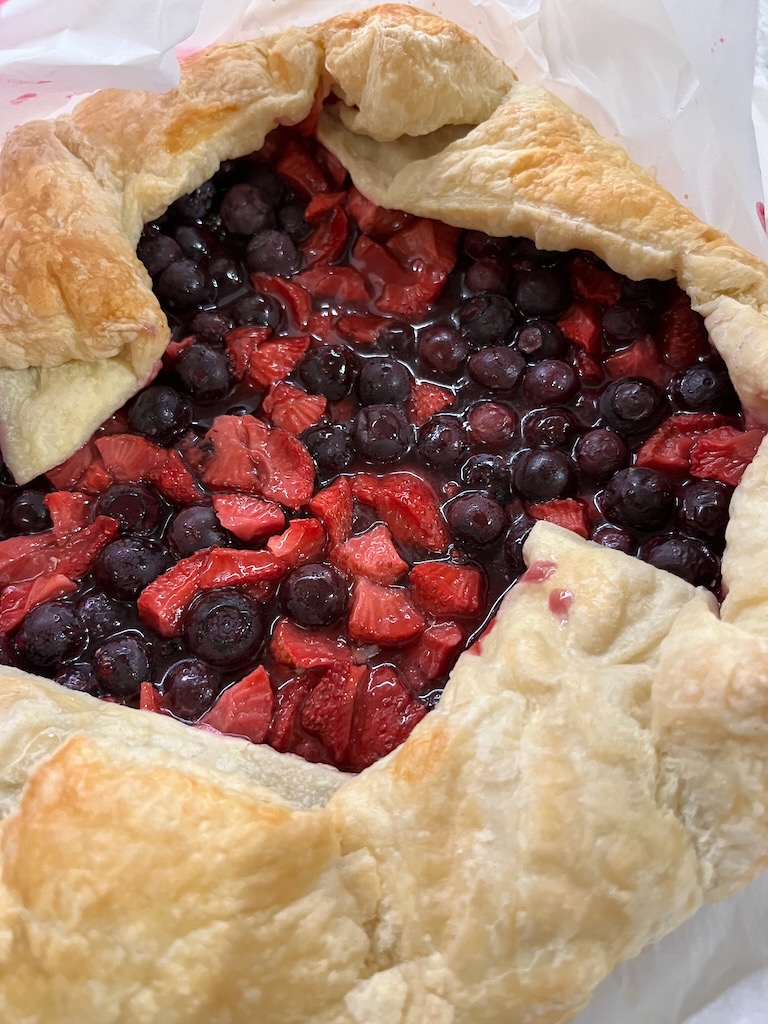
and speaking of generosity one of our beloved beloved chairs who lives not far from where i sit typing here in DC motored over yesterday to spend a good chunk of the day traipsing through a franciscan monastery that took our breath away (and not only because of the paths up and down hills) and who delivered this glorious berry-filled galette to me and my sweet professor, whom she knew when he was a mere wee lad of kindergarten age…generosity abounds at the chair, and i love you all for it.

pjt’s very magnificent very-berry galette

and how might you choose to seize a day, any old day, in the magnificent story of your sweet and blessed life?

the last sick tray

it might have been the last time i’ll ever hear it, those words rising out of the murky middle-of-the-night darkness, curling out from under the door of the bedroom at the bend in the stairs. “mo-o-om, i feel sick,” came the plaintive declaration, my one-syllable moniker being drawn into multiples, emphasizing the dire straits the sick one was in. 

and, with that, the boy about to move out of this old house, about to move into the big city where his freedom will be all his own, we played out one last time the choreography of mother caring for feverish, achy, gland-swollened child. 

this time around, he took his own temperature and called into work in the wee dark hours. but still i was the one who deep in the night tugged on the medicine drawer at the top of the stairs, and filled the cup with fat chunks of ice and glugs of gingerale. and, soon as the light came, i set out for the store to fetch the fixtures of sick days with this particular boy: salty oyster crackers and noodly chicken soup.

it’s a role i know well. it’s a role i have loved, all told, for thirty years now, even though it first came upon me with my own arms trembling, so worried was i by the baby i cradled (this one’s big brother, my firstborn) on a long-ago night when the cry came shrilly and skin felt hot to the touch. 

i can’t count the number of nights i’ve lay on the bathroom floor, a bath towel for both pillow and blanket, as we staked out the nearest position to the toilet bowl or the bath — depending which virus was doing the attacking. i can’t count the number of trips up and down the stairs in the dark, fetching ice, fetching honey, fetching gingery ale. 

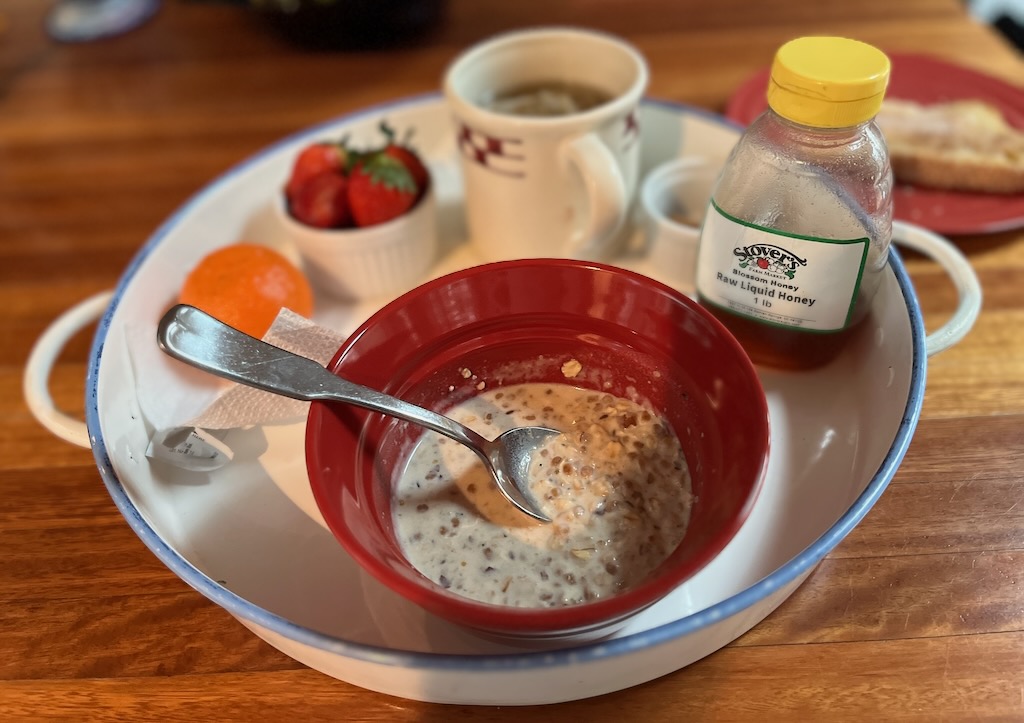
on day two of this latest siege, when morning came, and the boy on the verge of moving out let on that he was hungry, i dove in to a task i couldn’t have relished more: i made one last sick tray, and, right down to the spoonful of brown sugar i plopped in a dish, i felt my whole soul being ladled into each unnecessary flourish. 

somehow the ticking down of days in which i can take care of him, in which he’ll let me take care of him, made me all the more emphatic about each and every drop. i ladened that sick tray with every indelible talisman from our homegrown, family-specific, sick-day manual: the buttery toast sprinkled with cinnamon sugar, the ice chips drizzled with honey, the clementine and plump red strawberries for extra vitamin C. and of course the spoon and the glass wrapped with a rubber band, tagging it sick-kid’s-only, just as my mama had done for me, her unscientific attempt at keeping the lid on infectious disease amid her troupelet of five. 

it was as if i was packing him off for a lifetime of taking care, as if an eternity of loving him was what i was ladling onto that sick tray, and into his soul. as if i was shortshrifting the snuffing out of time, making my own tight-end run around some clock that is ticking. i was sealing a deal with forever and ever. and it came, in this moment, in the form of being his nursemaid. 

there is something in me that takes like a bird to the wind when it comes to taking care of the ones i love, especially the ones i birthed and the one to whom i was birthed. maybe that’s why i found myself in nursing school. i’ve always been drawn to the sick-bed bedside. 

it’s a place of certain tenderness, of amplified permeabilities (we are more wide-open when we are ailing, and our needing each other is heightened). it’s a place where exercising empathies is so often met with eager and unspoken reception. it’s one of the best places i know to love as i would be loved. and more than once or twice, i’ve found myself on the receiving end, tended to by the very boy i am tending to now. (a story i’ll never forget.)

maybe because this is the last or almost last go-round in the sick-kid-under-my-care department, and maybe because i am feeling this latest pulling-away (the kid getting ready to move, once and for all) deep in my marrow, the reel started wheeling of sick hours when he and i have stitched our hearts together: the ERs where i was right there, and the one when i was far away, connected only by long-distance telephone line and left only to imagine him strapped inside the ambulance that carried him across farmland and rolling hills to the heartland hospital where they checked him in. i remember a yom kippur he and i spent in the ER, and another when he had a bulge in his neck so golfball-sized they considered slitting it open. i remember the awful time i’d squished his tiny toddler fingers in the car door window. i remember and remember, and truth be told i feel every tug of the letting go. 

when the surest thing you have done in your life, the one thing you’ve most tried to imbue with the holy, is about to shift into another more distant gear, it’s an act you surrender with all the grace you can muster. and a spoonful of dark brown sugar besides.   

what are your most natural ways to dollop your love? and what are the ways of the sick bed you’ve picked up along the way?

of night sounds and saints and summer poems. . .

i wasn’t too deep into a jet-lagged slumber when the sound i’d waited to hear rose from the kitchen last night, wended its way up the stairs and into the room where my head lay on the pillow. it was the sound i’d hoped to hear in faraway paris, the sound of two brothers bouncing off each other’s humors and wits and midnight banter. it was a sound that oozed into the cracks in my heart, and the tender spots too. it was a soundtrack so sweet it lulled me back to my dreams.

we finally caught up with the boy who couldn’t get to france when we met him in the international terminal day before last, shortly after he’d flown into chicago from DC, where he’d waited all week for our return. he happens to have a dear friend getting married in town tomorrow, and he’d long planned to fly home with us, to be here for the weekend. so the reunion in the airport was sweet as it could be. long-awaited. much pined for. and i’ve been indulging in every drop of it ever since.

theirs is the soundtrack that makes me more whole than anything else. the soundtrack i’d dreamt of in the days after surgery when i knew more vibrantly than ever before in my life what i lived for. and long, long ago, the soundtrack i’d dreamt of in the very long years before there was ever even a brother, when it seemed “one and only” would be our equation forever. and it’s the soundtrack i pray will go on long into the forever, long after i’m gone and they have each other.

though they’re eight years apart they both share particularly nuanced humors. they tango with words, and glances that only they understand. it’s shorthand for brothers. and it’s the holiest balm i know. i’d longed for it, as if a summer’s hammock tied between trees, one that would rock me into the semi-fugue state of a lazy afternoon’s nap. i’d imagined it unfurling in parisian cafes; threading through crowded sidewalks along the boulevard st. germaine; or taking off into the night as the intrepid pair ventured into the city of lights.

but that wasn’t to be. and the waiting––the hole in my heart that never went away––might have made its midnight appearance last night all the sweeter.

it’s the unexpected twist in the story, the script that didn’t play out as i’d imagined. life is like that. life likes to remind me of its stubborn insistence that i’m not the screenwriter here. and just because it doesn’t turn out the way i’d plotted it, doesn’t mean the happy ending won’t come. sometimes you have to stick it out through the hard parts to get to the part where sweetness comes in.

i’m thinking a lot about hard parts and scripts that don’t seek my opinion, scripts that play out in ways i’d never suggest. i admit to finding myself in a role that’s foreign to me, one that doesn’t make sense: i run out of breath and i run out of steam, and i can get scared by runaway worries. i’ve a long quiet summer ahead to figure some of this out, and i intend to do it the slow way. with the brotherly sound track propelling me onward whenever i get to the hard parts.


side chapel at Chartres, devoted to therese of lisieux

a little bit about a saint: i was one of those catholic school girls, the ones who wore plaid jumpers and were told to pick a saint upon which to model our ways, especially when it came time for our confirmation, and we got to wear white lacy dresses and the bishop would splotch our foreheads with oil. i picked therese of lisieux, the little flower of jesus, partly because i liked little flowers, and i always saw pictures of her surrounded by wee purple violets. i loved that in her quiet little way, she never abandoned love. and i too believed that in my quiet little ways i could make my way through the world, infusing little drops of love all along my route. i didn’t know until last week, when i stepped into a side chapel at the cathedral of chartres honoring the 150th anniversary of her birth, that therese was born the day before me. 84 years earlier. over the years i’ve discovered that dorothy day, one of my heroes, loved her too, for her teaching of “the little way”–by little acts of kindness, little acts of courage, little acts animated by love, we can shift the balance of love in the world. and it turns out that just this week, pope francis (yet another hero of mine, and yet another someone who loves saint therese) devoted his remarks in st. peter’s square to the little flower of jesus, imploring us to imitate her ways, by doing even the littlest things with great love. because she was sickly most of her life, and died at 24, pope francis went on to say that though her body was sickly, “her heart was vibrant and missionary.” i find particular resonance these days in a saint who saw herself as “a small grain of sand,” and who never let her bodily frailties impede her heart’s zeal.

st therese of lisieux

three poems: two summer poems, and a stanza from audre lord that took my breath away…

from mary oliver’s “Six Recognitions of the Lord”

My heart
sings but the apparatus of singing doesn’t convey
half what it feels and means. In spring, there’s hope,
in fall the exquisite, necessary diminishing, in
winter I am as sleepy as any beast in its
leafy cave, but in summer there is
everywhere the luminous sprawl of gifts,
the hospitality of the Lord and my
inadequate answers.

— Mary Oliver


a stanza from audre lord’s, “A Litany for Survival”

For those of us
who were imprinted with fear
like a faint line in the center of our foreheads
learning to be afraid with our mother’s milk
for by this weapon
this illusion of some safety to be found
the heavy-footed hoped to silence us
For all of us
this instant and this triumph
We were never meant to survive.


In Passing

 How swiftly the strained honey
of afternoon light
flows into darkness

 and the closed bud shrugs off
its special mystery
in order to break into blossom:

 as if what exists, exists
so that it can be lost
and become precious

~ Lisel Mueller ~

a curious hodgepodge here, fueled by jet lag perhaps, but nonetheless: what are the summer sounds (or poems) that soothe you most?

jubilance and the boy who made impossible possible

My baby boy, the one they told me I’d never ever have, is graduating from a college he never thought he’d know as his own. And we are celebrating. We are jubilant. We are celebrating deep down inside both of us all those things that people say you will never ever do; but you forge right ahead and you do them anyway. 

We have long thought of the kid as “the egg that wouldn’t take no for an answer.” That little egg did not care that I was 43, halfway to 45 by the time he was born. Did not care that so many other eggs had not followed instructions. That egg — his egg — refused to take no for an answer. And that egg grew and grew into the magnificent human with the very very big heart. The tenderest heart I’ve ever known. A heart that says best what it says in unpunctuated text messages, in hilarious pictures he sends of himself dressed in alligator suit, complete with spiky tail he swishes hither and yon as he stalks his native habitat.

That kid is my champion. That kid makes me believe in the impossible. That kid is living, breathing, impossible made possible. 

That kid told me a few weeks ago that when he was trying to do the impossible — to reach for something well out of reach — he tapped his shoulder as if to beckon me, to give him the strength and the will and the courage he needed. Turns out, he reached what he was reaching for. And he let me in on his secret the morning after it happened. Ever since, I’ve follow his lead: when I need to reach for something beyond my reach — be it courage, or breath, or not flinching a muscle when the doctor comes at me with needles the size of a drain pipe — I now tap my shoulder too. 

That kid and I might spend the rest of our lives tapping our shoulders, beckoning courage, beckoning the possible, beckoning reaching far, far beyond what we think we can do. 

So I am madly wildly celebrating that kid, and the chance to be by his side when he doesn’t exactly walk across the graduation stage this weekend. Because his most recent impossible something was winning a championship along with his mates, the ones who fling frisbees into the air, and shout out in joy as they run for the discs that spin through the air, impossibly. He’s taking to frisbee fields, in the national championship, instead of seizing diploma, and I will be right there on the sideline. Jubilant. Celebrant. Waiting to see if he taps at his shoulder. 

My once-impossible impossibly soaring and diving, seizing the impossible. My blue-ribbon boy. My joy and jubilance ever after…


i could sit and read jane kenyon all day any day. and this one is new to me, so i’m sharing it…

jane kenyon, a poet of the quotidian, was long and adoringly married to donald hall, the late great poet and essayist. both now gone; forever heroes to me, their poetries worthy of a lifetime’s attention. some years ago, in the blessing of one such lifetime, i sat beside hall –– on the floor tucked against his armchair –– in the living room of their white frame farmhouse on eagle pond, in new hampshire. it was during our “year of thinking sumptuously,” when we up and moved to cambridge, mass., and drank from the firehose that is the nieman fellowship for journalists. poetry was where i took my deepest dive that year. and, after that field trip to new hampshire, hall and i became something of pen pals, posting letters back and forth, letters i now save tucked between the pages of his poems. on the day we had spent at eagle pond farm, kenyon, who had been the poet laureate of new hampshire, had already died (she died at 47 in 1995), but her poetries for me are now animated by knowing the kitchen where she cooked, the desk where she wrote, and the barn where she sometimes went to weep.

here is kenyon’s “happiness”…

There’s just no accounting for happiness,
or the way it turns up like a prodigal
who comes back to the dust at your feet
having squandered a fortune far away.

And how can you not forgive?
You make a feast in honor of what
was lost, and take from its place the finest
garment, which you saved for an occasion
you could not imagine, and you weep night and day
to know that you were not abandoned,
that happiness saved its most extreme form
for you alone.

No, happiness is the uncle you never
knew about, who flies a single-engine plane
onto the grassy landing strip, hitchhikes
into town, and inquires at every door
until he finds you asleep midafternoon,
as you so often are during the unmerciful
hours of your despair.

It comes to the monk in his cell.
It comes to the woman sweeping the street
with a birch broom, to the child
whose mother has passed out from drink.
It comes to the lover, to the dog chewing
a sock, to the pusher, to the basket maker,
and to the clerk stacking cans of carrots
in the night.

It even comes to the boulder
in the perpetual shade of pine barrens,
to rain falling on the open sea,
to the wineglass, weary of holding wine.

+ Jane Kenyon

my jubilance: apparently, he’s been dressing up as zoo animals his whole life long. here he is, my tiger.

a mother’s heart finds its place in a canyon of moving boxes

dispatch from 20009: in which canyons of boxes in every room are ours to conquer, moi and the one i birthed first. . .

i write to you this dawn from the singular place on the planet i wanted to be this week, a point on the map now highlighted in illuminating shades of radiant. a kid i love is a professor now, and i am here where, in my book, a mother belongs: by his side, tearing open his boxes, tallying the lost and found, turning a blueprint of rooms into a place called home. 

i’ve planted the kid in five points on the map since the day he left home for college, and each one for its season became a place i peered in on, checking the weather, counting the miles, watching police reports. his dot became mine by extension. 

i’ve spent years now considering places called amherst and new haven, portland, manhattan, and now the nation’s capital, specifically adams morgan, a neighborhood where RBG graces the banners that waft from the light poles, with the words “live your truth.”

the kid has decidedly hopscotched across the country over the course of the last decade. but his itinerant days might be over, as a tenure-track post prompts me to think i’d better get used to the latest in zip codes. and, anyway, unpacking boxes, finding places on shelves, has become my sub-specialty. it’s a task i take on with all the love in the world. i don’t think i’ll ever extinguish the place in my heart that tells me my number one job on the planet is to soften the blows, trod the circuitous path, keep stretching my arms clear across the landscape, and always, always find space and time for side-splitting giggles and tears when they spill from both of our eyes. 

the kid is 29 but nowhere in the manual i was handed in the delivery room can i find a line telling me there’s a time when the mothering stops. mothering over the decades is a three-dimensional wonder: it deepens and widens, is layered with strata of life’s most wrenching and glorious moments. just last night as we were giggling and whispering our way to sleep––me on un-sheeted bed (we’re working our way from kitchen to bedroom), him on inflatable mattress––i told him how even though i see the professorial glasses he wears these days and feel the heft of his six-foot-three pillar of flesh and bone when he wraps his arms around me, i also see plenty often a flashing picture show of his life at various points along his continuum: i see––clear as clear could be––the wet and squirmy little thing placed in my outstretched arms the very first time; i see the six-month-old who let out a belly laugh for the very first time; i see the toddler who looked up from the kitchen table one breakfast and asked, as if it was the most ordinary of questions for a three- or four-year-old, “mommy, what is facetious?” meaning what does it mean, this very long word not normally found in preschool vocabulary. and, yes, i see the kindergartener who set up a lecture hall in our living room, with a circle of stuffed-animal pupils, a chalkboard and easel, and 26 spongy alphabet letters. the professor wore suspenders and tie and bare feet, and instructed his class on the fine points of D, O, and Q.

it’s a curious thing, this mothering the grown human being. there are those, i’ve been told, who believe a mother’s role is to step into the distant background, loosen the grip on the ups and the downs of those you’ve loved every day of their lives. i’m not among them, though i can go––and i have––whole weeks without more than a short burst of texting. i find it only gets richer and richer, the closest i know to “love as you would be loved.” mothering to me is a spectacular testing ground: day after day, i re-define and refine the extraordinary intricacies of loving, of where to position myself in the tableau of his life, how much of the weight to bear, and when to stand silent and when to come running. 

what i know, after a lifetime of fumbles, of occasional hits and plenty of misses, is this: the width of my brain has only grown wider over the years, as each of my boys carry me into realms i’d otherwise never explore. and my heart and my soul, they’ve at once defied the laws of physics, both deepening and rising to depths and heights i’d never ever imagined. and so, as long as i’m needed and able, i shall tear away the endless strips of packing tape till my fingers are raw and my boy has a place to call home, his very own faraway home. six hundred miles from mine.


since i’ve been busy unpacking this week, i’ve not had much chance to gather up a commonplace-y bouquet. but i did find this, from the late great bard, leonard cohen, on sainthood:

“What is a saint? A saint is someone who has achieved a remote human possibility. It is impossible to say what that possibility is. I think it has something to do with the energy of love. Contact with this energy results in the exercise of a kind of balance in the chaos of existence. A saint does not dissolve the chaos; if he did the world would have changed long ago. I do not think that a saint dissolves the chaos even for himself, for there is something arrogant and warlike in the notion of a man setting the universe in order. It is a kind of balance that is his glory. He rides the drifts like an escaped ski. His course is the caress of the hill. His track is a drawing of the snow in a moment of its particular arrangement with wind and rock. Something in him so loves the world that he gives himself to the laws of gravity and chance. Far from flying with the angels, he traces with the fidelity of a seismograph needle the state of the solid bloody landscape. His house is dangerous and finite, but he is at home in the world. He can love the shape of human beings, the fine and twisted shapes of the heart. It is good to have among us such men*, such balancing monsters of love.”

Leonard Cohen

“achieved a remote human possibility. . . ” contemplate that for a while….


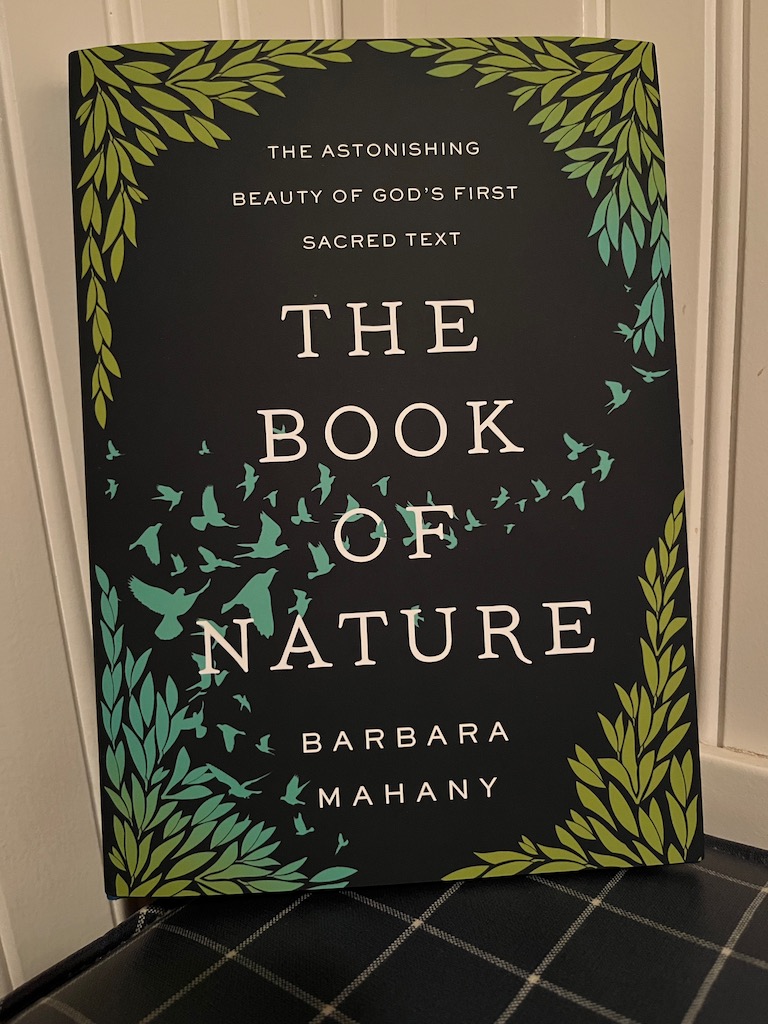
in book news: it seems hard copies of The Book of Nature have been plopping onto front stoops all over these united states, and heavenly folk, especially friends of the chair, have been sending along snaps, each of which makes my heart do a little bit of a gallop. it’s still a couple weeks till the official pub date––the vernal equinox, march 21; bring on the springtime, bring on the book!––so these early sneak-peek arrivals are both surprise and delight. and i am hoping to set that book soaring with a grand circle of chairs, as night falls on that first day of spring. see here for more details, should you be so inclined. (we’re gathering on march 21 at 7 p.m. central time, via zoom, one of the rare silver linings to emerge from our years in pandemic––or at least i count it as a silver lining, bringing me poets and thinkers from all across the globe.)

before i get back to uprooting books from their boxes, here’s the question (to ponder or drop us your thoughts): of all the mothers you’ve known or watched from some distance or close proximity, what are/were the defining qualities that allowed you to see and see clearly just what it means to love in the deepest mothering way? (and, remember, mothering for me is a verb not tied to any particular gender or state of procreativity, but rather to any and all who love with a tender loving attention and care, and the undying prayer that in some way they might both lighten another’s load and magnify the wonder of being alive…)

the littlest tree and the beating heart of Christmas . . .

shuffling in from the tree lot––the Christmas tree lot––with the littlest tree that nearly ever there grew, and once i’d kerplunked the pitiful seedling in its far-too-big tree stand (the yuletide equivalent of a saggy pair of dungarees slipping down to the knees of an undersized tot), i sat right down to pen my apologia to my faraway boys.

my mea culpa unfolded thusly: 

sweet boys, we have adopted this year, from the neediest Christmas tree farm, the wee littlest tree you ever did see. he very much wanted a home, and we shall be taking name nominations starting now. he’s an inflationary victim, the poor little sprout (there’s a name, Sprout!), as trees are in short short supply (and they’re short!). we’ve gussied him up with a santa cap, cranberry ropes (don’t tell him they’re wooden), and the lovely quilted skirt that will soon be an heirloom. a standard-sized tree topped 200 bucks this year, and for two weeks of Christmas that is not allowed. (just think, your tree funds will be shifted to the beef tenderloin fund, which is much more delicious anyway.) the little fellow smells just like the woods, and i am certain a bird might land in him soon. i beg your mercies in embracing this little guy. he tried with ALLLLL his might to grow like the big guys, but he just didn’t have it in him, and here in this house we love the ones on the margins, even the trees. xoxoxox deepest apologies if you are duly disappointed…

xox 

didn’t take but a minute for the one i might forever call our “little one” to ping right back: 

I like underdogs

and then:

This tree seems like a underdog

and so my upside-down day was snapped into crystal-clear focus: the message of Christmas delivered, and echoed. 

it’s all about heart, and dimensions don’t matter. nor superlatives. nor getting it right. nor any of the vexations that sometimes tangle me in my own unlit strands.

never mind the panting toward some imaginary finish line, as once again our festival of lights and our feast of nativity wedge their way into the same single overbooked week. never mind the slab of brisket i need to fetch from the butcher, or the welcome-home mac-n-cheese i need to slide in the oven, while dashing to an incoming plane at an airport many miles south (after picking up grammy plenty miles north, making for a 78-mile loop on a holiday weekend afternoon). and never mind the onerous chore that just yesterday had us signing last wills and testaments, which i can assure puts something of a damper on the jolly spirit of christmas. (one of those “responsible-grownup” tasks right up there with root canals!)

all of it vanished, the panting, the worries, the how-will-get-it-all-dones, in the flick of a text (the modernday spin on a wink of the eye, and a twist of the head, as clement c. moore immortally put it). 

the kid needed no convincing. no need to shovel lament. he was ready to love the littlest tree.

in years past i’d taken some ribbing––and serious protest––for my proclivities toward picking the spindliest trees. so i figured a misshapen midget of a fraser fir might have me taking my Christmas out in the doghouse (and since we’ve no dog, the fair equivalent might have been sheltering under the seed trough). 

thus, i’d decided to nip protests in the bud, devised my long-winded defense. 

and the lightning-quick reply––I like underdogs––made me see what should have been clear all along: the kid with the very big heart needs no convincing, no urging to consider the plight of the nearly forgotten. 

This tree seems like a underdog

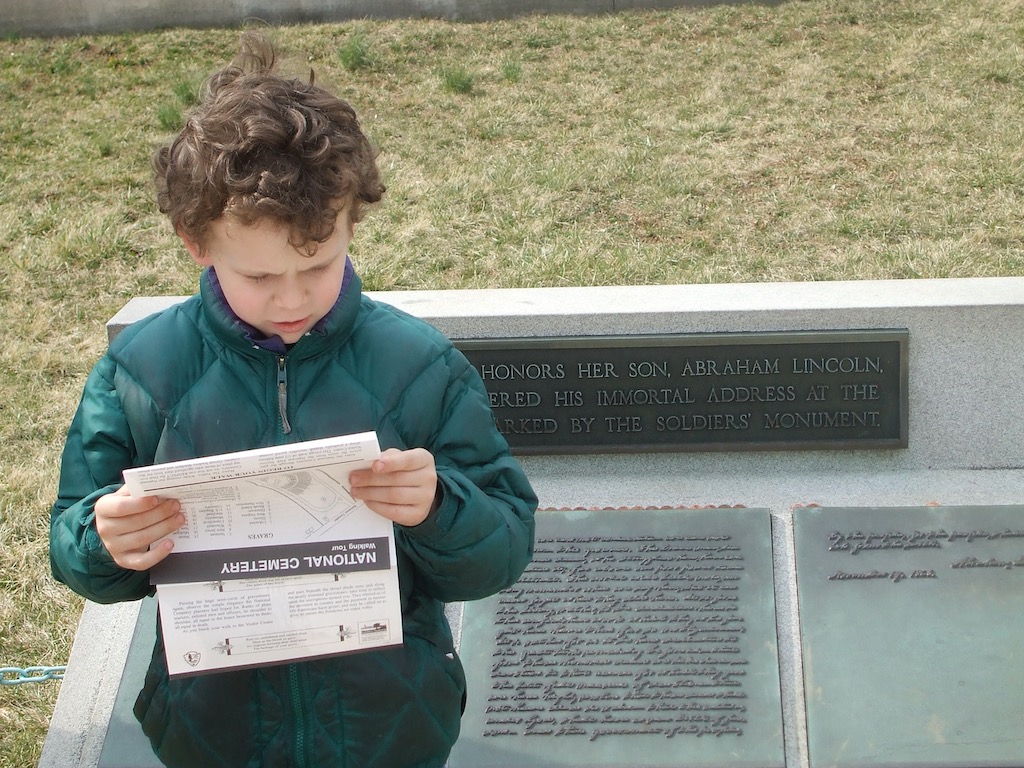
he’s the kid who long, long ago taught me to watch out for worms, who led me on moon walks, and insisted he stand on the very same spot where abraham lincoln once stood so he could recite the line from the gettysburg address that made him break into tears every time: “we can not dedicate, we can not consecrate, we can not hallow this ground.” and, on that gray pennsylvania day in 2009, when we asked why the tears, he choked out what to him seemed blatantly obvious, “it’s the soldiers.” a sadness too big for his second-grade heart.

he’s 21 now. old enough to drink, drive, and drop a vote in the ballot box. and that heart, it only grows bigger. 

hearts have a way of finding each other, the truest hearts anyway.

so, once again, he’s pointed the way to the bright heart of the season. and the littlest tree, the tree with no name yet, will stand tall and stand proud on its upturned crate. because in this old house, underdogs are always, always the heroes. 

and ours is now dressed in mighty regalia: santa cap, blinking lights (they’ll be switched out, soon as i get to the Christmas light store), and string upon string of bright wooden berries. and up on the milk crate, he’s gotten some inches. our sorry old tree isn’t so sorry, hauled in from the cold, given due glory.


here’s a beauty of a poem, just because it stirred me. . . a poem about rising up, about beauty from ashes. . .

such beauty from ashes
by carolyn marie rodgers**

and we are singing our hearts out, and
our souls are in our eyes,
and they are beautiful souls.
they are souls of truth.
they are souls of love.
they are souls of faith.
they are souls of hope.
and we have conquered a little corner in the
world of fear.

and we have stepped up and forward,
    and we have torn down walls.
we have smashed sound barriers between us.
we have dared again and again and yet again to dream,
and our dreams have finally taken material form.
we have changed our hearts.
we have altered and changed our minds,
and because of this, we now have some
    valor and strength,
and we are threatening to change the world.
that it     might be a better place.
For us and for all god’s children.
for all that we are.
for all that we might be
we have done it.
And we rise now as one voice, with many harmonies,
Through the mystery and beauty of harmony.
One voice

    Though many, for one, for all.
For all the earth to grow and know,
From the mounds of ashes of our dead, our martyred,
Our lambs, our sacrificed, those who died and have been dead
So long, so long they are no more than, nor any less than,
Sacred memories. Mountains of ashes, of our sweet, beloved,
Beautiful dead.
Today, what beauty we now have, to gain strength from to continue on,
Beauty,
From ashes.

***

**Born in Chicago on December 14, 1940, Carolyn Marie Rodgers was born to Clarence Rodgers, a welder, and his wife, Bazella. The last born of four children, her family had moved from Little Rock, Arkansas to Chicago’s South Side, where Rodgers grew up. Early in her career, Rodgers was associated with the Black Arts Movement, attending writing workshops led by Gwendolyn Brooks and through the Organization of Black American Culture. Rodgers’s poetry collections include Paper Soul (1968); Songs of a Black Bird (1969), which won the Poet Laureate Award of the Society of Midland Authors; her best-known book, how i got ovah: New and Selected Poems (1975), a finalist for the National Book Award in 1976; The Heart as Ever Green: Poems (1978); and Morning Glory: Poems (1989).

Rodgers’s poetry addresses feminist issues, including the role of Black women in society, though her work evolved over time from a militant stance to one more focused on the individual and Christianity. Other themes she explored in her poetry include mother-daughter relationships, relationships between Black men and Black women, street life, and love. In addition to poetry, Rodgers wrote plays, short stories, and essays. She worked as a book critic for the Chicago Daily News and as a columnist for the Milwaukee Courier.

Rodgers founded Third World Press in 1967 with Haki Madhubuti, Johari Amini, and Roschell Rich and began Eden Press with a grant from the Illinois Arts Council. She was as a social worker through the YMCA and taught at various colleges. She was inducted into the International Literary Hall of Fame for Writers of African Descent in 2009 on the campus of Chicago State University. She died in 2010 in Chicago, at the age of 69.

—abridged bio taken from the Poetry Foundation


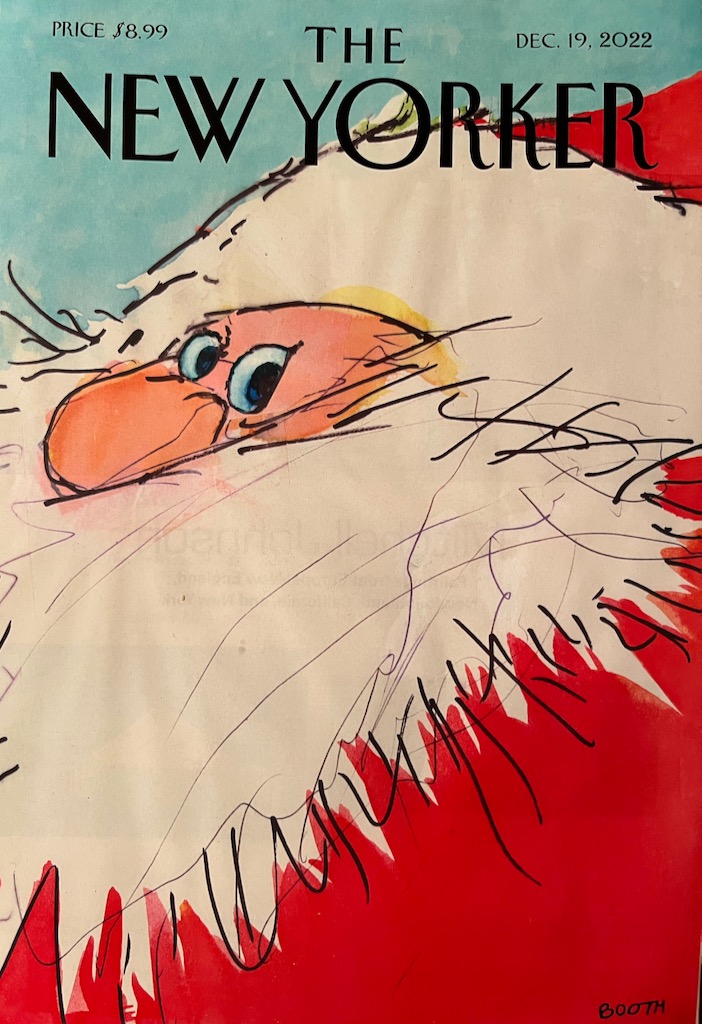
and here is the heavenly late cartoonist George Booth’s last New Yorker Christmas cover. . .  

i seem to be reverting to smorgasbord here at the chair, leaving more than one thing, as i meander through the week collecting my morsels. likely comes from thinking a little isn’t enough. making sure there’s at least enough. today, a tale, a poem, and a drawing. oh, and a question, always a question:

has a little bit of Christmas leapt out from the cracks or the corners of your life, surprised you, taken your breath away just a bit because suddenly, amid the blur, you saw crystal clear the beating heart of the season?

merry almost everything. . .

equinox of the heart

My heart is in equinox. Equal parts light and shadow. That’s not necessarily an out-of-the-ordinary state of affairs for the human vessel that holds all we feel in a day, in a lifetime. But it’s not usually so amplified, not usually so stark.

On the one hand, I am counting down the hours and minutes till a boy I love, the first one I birthed, comes home for the first real time in years and years. The first time in as long as I can remember when he won’t be squelched by the pressures of (in reverse chronological order) bar exam, law school, admission to law school, wrangling a classroom of hellions for the year he was teaching on the mean streets of Chicago, and before that pushing against the deadline for an honors thesis that somehow stretched to 300-plus pages. He is—in three days and two hours—packing a Portland apartment into a moving van, and one day  and six hours after that he’s boarding a plane, crossing the Rockies, the Great Plains, and the checkerboard of farmland that is preamble to landing at Chicago’s O’Hare International. 

He’ll be here—for the first time in six years—for the Thanksgiving feast. And Christmas, and the turn of the new year. Then he’ll move on, to New York City, where once again he will take up his pen and his law books and clerk for a federal judge. And all that time, all the weeks when he’s here, the first order of business will be simply to breathe. To sleep in the old room at the top of the stairs, to trundle down to this old maple table, to cook by my side, and walk along the lakeshore where we all go to think when our thoughts—and our souls—need every square inch of the infinite sky.

And, on the other hand, the man I married three decades ago, the man whose life has unspooled next to mine for the best of my years, he’s off on the Jersey Shore, in an old quirky-but-endlessly-charming house at the edge of a pond. He is there all alone, except for the movers who are coming in shifts, day after day, to empty the house of every last trace of the long lives lived there. The house will be bulldozed before spring turns to summer. And it’s his job, as the only son, to attend to its final hours. He is packing up the last of the dishes found tucked in a cabinet no one had known, finding nearly lost treasures slipped between books on the shelves (his parents’ ketubah, or marriage “contract,” signed in ink in January of 1955, and almost sent off with a load of donations), taking one last long look out the living room window, watching the sunlight and the swans on the pond. 

It’s a house that has played an anchoring role as a central character in the narrative of the long lives lived there. No one ever imagined it wouldn’t be there, high on the ridge at the top of the slope, peering down on the pond. The footfall of at least a century and a half are pressed into the stairs that twist up to the bedrooms. Sixty-five of those years belonged to my husband’s father and mother—he in his white bucks or his Keds, a gentleman of old-school sartorial splendor; she in her size-10 flats (never heels, for she never wanted to tower too tremendously over the little children she taught, as a woman of considerable height). 

My husband, who has long taken to heart the tenet that architecture shapes lives as lives shape the architecture, is not one to bid farewell to timber and bricks (both of Revolutionary War vintage) without a significant lump in his throat, and a piercing in his chest. I saw how his eyes went dark, the sadness not hidden, when he said to a friend the other day, “It’s like another death.” It’s the last one of its chapter. Six years ago, the sartorial one breathed his last, and just this July, so did the schoolteacher. Each time, my husband and his sister scattered the ashes along the holy ground that is the edge of the pond.

I can barely imagine how hard it will be to turn the key in the door that one last time. To walk down the steps, turn, take one last look. To drive away, down the lane, the white clapboard gardener’s cottage disappearing into the distance. To know, after 64 years, he’ll never come again. 

And so the shadow is thick on the walls of my heart, and the light, too, is dappling, is falling in splotches. The equinox of the heart is not uncharted terrain, but oh it makes for gingerly treading. 

Thank you for listening. It is hard, so hard, to say good-bye.

funny that i wrote this in caps, up till now. i’ve been writing and writing all week, and i guess i’ve fallen back into work mode here on the keyboard. for me caps are like wearing my big-girl shoes, lower case is kicking ’em off, shuffling around in my slippers. i’m letting it stand, as a salute to the ones i love…

photos above by blair kamin, on Shippee’s Pond, fair haven, new jersey.

the boys i love, the one coming home tuesday on the left. standing in the front yard of their grandparents’ house on the day of their grandmother’s funeral.

how often do you live in equinox of the heart, and might it be–in many ways–the natural state of the vessel that contains so very much of our love, and our joy and our hurt? so much of our lives are equal parts light and shadow. how do you find a stillpoint?